Provided photos: Sheriff Michael J. Filicetti signs the oath of office after being sworn in to lead the Niagara County Sheriff’s Office.
Press Release, Niagara County Sheriff Michael J. Filicetti
LOCKPORT – A small private ceremony was held at the Niagara County Sheriff’s Office to swear in Sheriff Michael J. Filicetti and his administrative team.
The Sheriff began his four-year term as the 57th Sheriff of Niagara County on Jan. 1. Undersheriff Michael P. Dunn, Chief Deputy Patrick G. Weidel, Chief Deputy Aaron C. Schultz and Chief Jail Administrator Daniel N. Greenwald all took their oath of office alongside the sheriff.
“It was humbling to receive the strong support of our residents,” Sheriff Filicetti said. “I look forward to continuing the great record of public safety here at the Sheriff’s Office, and leading the men and women who serve honorably. I will work hard every day to ensure the residents of Niagara County feel safe and protected. Lastly, it was important to me that my administrative team took their oath along with me. I count on these individuals every day to help me get the job done.”
Pictured from left to right: Chief Jail Administrator Daniel N. Greenwald, Chief Deputy Patrick G. Weidel, Sheriff Michael J. Filicetti, Undersheriff Michael P. Dunn, and Chief Deputy Aaron C. Schultz.
Assemblyman Steve Hawley (R,C,I-Batavia) is calling on his colleagues in the Legislature to reject Assembly Bill 416, which would give the Governor or his surrogates the authority to detain individuals determined to be a threat to public health.
Hawley opposes this legislation as he believes it to be unconstitutional and in violation of the right to due process.
“This bill is unconstitutional on its face and disregards all basic concepts of due process that make us free in this country,” said Hawley. “Protecting the health of our neighbors is a noble goal to be certain, but this bill forfeits our constitutional liberty in a way we can never allow.”
“This is yet another piece of legislation from a downstate member of the Majority that blatantly disregards the constitution and causes people to distrust their government,” Hawley said. “People being detained on a whim just isn’t something that should ever happen in our country, and I will do everything I can to stop the passage of this dystopian legislation.”
By Tom Rivers, Editor Posted 4 January 2021 at 11:51 am
Each year since the Orleans Hub started in 2013 we’ve honored a group of Outstanding Citizens who stood out the past year for extraordinary contributions to improve the community.
Orleans County is fortunate to have many citizens who give of their time, talent and money, without seeking any fanfare. This past year, with the Covid-19 pandemic, many residents pushed projects through to completion or stepped up as volunteers in response to difficult circumstances.
Medina woman makes Dog Park a reality
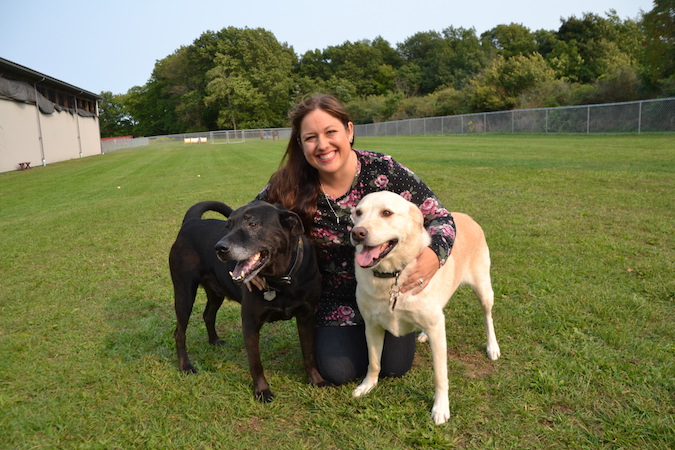
Photo by Tom Rivers: Alaina Zapf is shown with her dogs Batman (left) and Bailey in September at Medina’s new Dog Park on North Gravel Road.
After three years of planning and fundraising, the Medina Dog Park opened this summer at 260 North Gravel Road, next to the former composting plant.
Alaina Zapf, president of the Friends of the Medina Dog Park, led the group in raising $20,000 for the park.
Zapf wanted a place for dogs to socialize and get some exercise near the village. The dog park is a first in Orleans County. People have inquired about it from Rochester to Buffalo. Zapf is thrilled to see the response to the park, where the dogs can roam leash-free.
“So many dogs do not have adequate room to run around,” she said. “Here they can get all that energy out. They are happier and less aggressive.”
The group expects to add a small dog enclosure, more equipment in the dog agility section and a water station.
Zapf, 30, convinced the Village Board to back the project. She organized many fundraisers, including a dunk booth with several community leaders, Dog Park frisbees and other merchandize. Many local residents generously donated to the project as well.
Zapf often brings her two dogs, Batman and Bailey, to the park. When she lived in North Carolina, she would drive 15 minutes to take the two lab mixes to a dog park. When she moved to Medina, she wanted a place for her dogs to get exercise and socialize with other dogs.
Albion mom coordinates ‘Adopt-A-Senior’ program for 136 students after school year disrupted
Sara Mathes holds a T-shirt – “Senior Skip Day Champions – Class of 2020.” The shirts were distributed on May 17. Mathes coordinated a steady showering of gifts for Albion High School seniors at the end of their senior year after in-person classes and events were cancelled in mid-March.
Sara Mathes felt bad for the Albion High School seniors, including her daughter Chloe, when in-person classes were cancelled in mid-March due to the Covid-19 pandemic. There weren’t any spring sports, no prom or senior trip, and no graduation ceremony with the class together in front of 2,000 people in the gym.
Mathes wanted the seniors to feel some love from the community during a time of uncertainty and disconnection. She saw how the Ken-Ton school district adopted seniors, with residents committing to buying a senior in the class a gift. Mathes thought Albion might do the same for the 136 members of the senior class.
But she was nervous there might not be enough people willing to adopt a senior, given the difficult economic times. She floated the idea on a Facebook group for seniors and within an hour and half had 136 people committed to adopting a senior. By the end of the day she had two people or families for every senior.
Provided photo: Mekhi Rivera has a big smile when he received a gift from an adoptive community member.
She created an Excel spreadsheet to match names with seniors after getting a list of each student’s hobbies, favorite snacks and other interests. She passed the list on to the adoptive community members.
Mathes assigned the students randomly to the people in the community. From April through graduation in late June, students received gift baskets and boxes at their homes. They were very appreciative.
Mathes also coordinated getting a yard sign for each senior that was paid for by donations. The students also received T-shrts that said “Senior Skip Day Champions – Class of 2020.” That effort was coordinated by Lynn DiBella, a retired aide in the pre-kindergarten program. Angie Wolfe, a kindergarten teacher, helped with the T-shirt distribution.
Mathes was pleased to see hundreds of community members support the Class of 2020.
“It was definitely worth it,” she said. “It was to make them feel special and to celebrate them in a different way because we couldn’t celebrate them all together in the gym.”
Mathes was so thankful the community stepped forward and showed love for the seniors, including students they didn’t necessarily know.
“The seniors were able to see that Albion comes together and helps each other,” Mathes said.
Mekhi Rivera, one of the Albion seniors, appreciated the gifts from the adoptive community members.
“I am so thankful to be a part of this adopt a senior thing we are doing!” Rivera posted on the Adopt A Senior Facebook page. “Thank you for doing this and ever body else that is doing this. We are all thankful for the time and money you have put into us it means a lot.”
Mathes switched to coordinating another effort in December. Her mother-in-law, Brenda Winters, lived in one of three houses badly damaged by a fire on West State Street. Local residents again were quick to volunteer to help.
“The community has shown such an outpouring,” Mathes said. “It’s been amazing and definitely helped her get through this.”
Developer completes massive transformation of former Holley High School
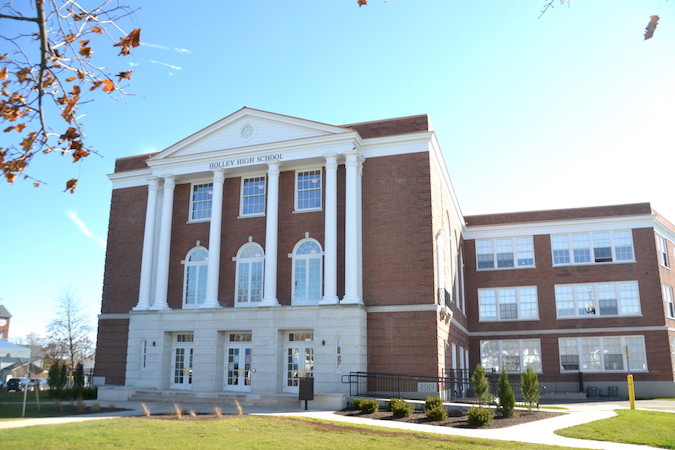
The transformed former Holley High School has new columns, windows, paint and a major overhaul inside for 41 apartments and the offices for the village.
For years, even decades, the Holley community has longed to see one of its most prominent buildings get an overhaul. The former Holley High School closed in 1975. A business, Liftec Manufacturing, used part of the space but went bankrupt in the mid-1990s. The building was left vacant, and often was the target of vandals for more than 20 years.
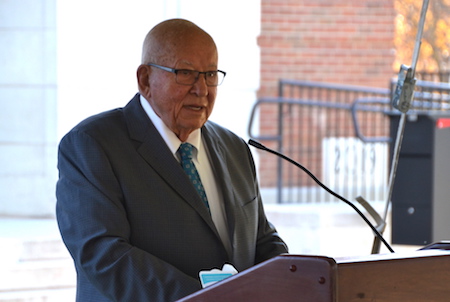
Nelson Leenhouts, chairman of Home Leasing and Home Leasing Construction, celebrates the $17 million transformation of the former Holley High School during a ribbon-cutting in November. The construction project took two years, with the building turned into 41 apartments and the Holley village offices.
It pained the Holley community to see its gradual demise – the many broken windows, peeling paint, rotted columns and a fate that seemed destined for the wrecking ball.
Holley village officials reached out to developers over the years, pitching the site for apartments and other uses. But a deal never came together – until 2018.
Home Leasing and Home Leasing Construction in Rochester committed to transforming the building into 41 apartments for seniors and the Holley village offices, with the auditorium space being a meeting room.
Home Leasing would use tax credits for investing in a historic structure to help make the project work financially. The village also committed to being a tenant which helped to seal the deal.
Nelson Leenhouts, leader of the company, has tackled ambitious projects before in buildings that have faced years of neglect. He has 50 years in the construction business. He said he’s never seen a community rally behind a project like they did in Holley.
Local, state and federal officials, including U.S. Sen. Charles Schumer, all were critical to the $17 million project’s success. Leenhouts also praised an enthusiastic community for steady encouragement along the way.
Leenhouts deserves credit for tackling the project in a small village, and seeing the it through to completion when the Covid-19 pandemic slowed construction work.
Besides improving housing options locally, the building provides handicapped accessible office space and a meeting room for the village.
But it also is a major morale boost for the Holley community, and puts a shining success on the eastside on one of the main gateways into Orleans County. It is part of major improvements in Holley, which is also tackling water and sewer upgrades and new sidewalks in parts of the village. The restored school building sends a message that Holley is on the upswing and wouldn’t back down from a major challenge – reviving a school building that had fallen into significant neglect.
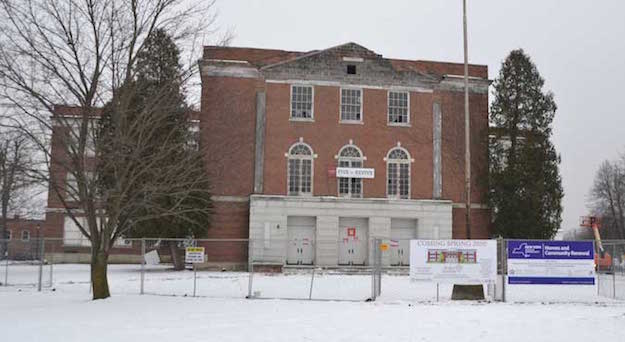
The building, shown here in Dec. 11, 2018, just before the construction work started, had steadily fallen into disrepair and was a blight at Holley’s main intersection, routes 31 and 237.
Iroquois Job Corps volunteered at food distributions throughout the county
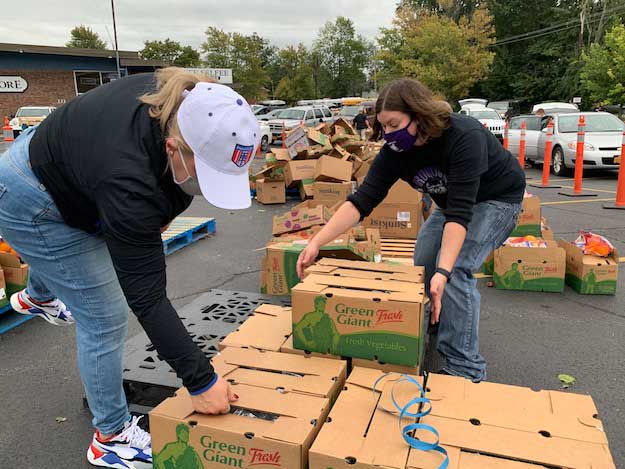
Julie Horton, left, and Hannah Donley of Iroquois Job Corps in Medina were among the volunteers on Sept. 11 during a food distribution in Albion at the parking lot of the Main Street Thrift Store. Job Corps employees volunteered over several months at distributions in Albion, Clarendon, Holley and Medina. The events would have been a challenge without them.
For many Fridays from April through mid-December, there were hundreds of boxes of food available in the mornings. Those food distributions have been in Albion, Clarendon, Holley and Medina. A long line of cars were start to form around 6 a.m. for distributions that were advertised to begin at 9 o’clock.
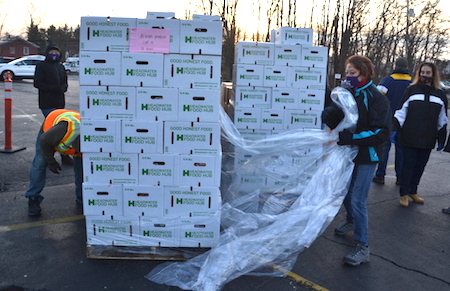
Krista Fiegel, an employee at the Iroquois Job Corps, rips the plastic off a pallet of boxes of food during a food distribution on Dec. 11 in Albion. She was one of four Job Corps employees who helped that chilly morning.
It takes at least a dozen volunteers to make the events go smoothly. There were many volunteers at the distributions in April and May, when many non-essential businesses were shut down due to the Covid-19 pandemic. As the restrictions eased on businesses, the volunteers were harder to come by to carry 30- to 40-pound boxes of food to trunks of cars or to set on the truck beds of pickups. They volunteers needed to be masked up – whether in stifling heat or bitter cold.
Staff from the Iroquois Job Corps proved critical to the food distributions later in the summer, throughout the fall and in December. There were often at least six Job Corps staff at the distributions and they came to ones at Holley and Clarendon – which was on the other side of the county from the Job Corps Center in Shelby. They went to ones in Albion and Medina, too, and they tackled the tasks with zest.
Some events there would be extra produce and it would need to be sorted and put into boxes. It wasn’t pre-boxed like the meat and dairy boxes. The Job Corps personnel worked hard, without complaints and were well organized.
Without them, the organizers say the food distributions would have been difficult to pull off, especially later in the year.
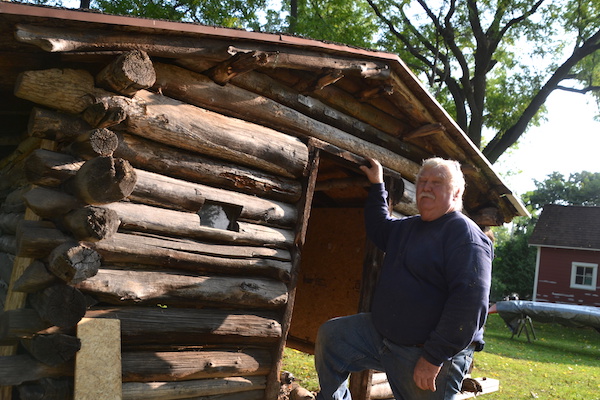
Rick Ebbs is shown in September with a log cabin from 1930. He orchestrated moving the cabin from an Albion backyard to behind the Gaines Basin cobblestone schoolhouse.
When a log cabin from 1930 was settled onto a foundation behind a cobblestone schoolhouse on Oct. 1, Rick Ebbs let out a sigh of relief.
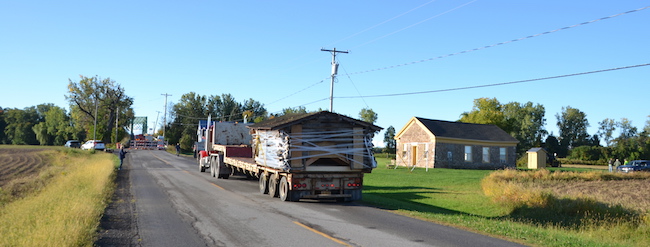
“I was worried it would fall apart,” he said after the cabin made a 4-mile journey on a flatbed trailer.
Ebbs, a local carpenter and historical enthusiast, coordinated moving the log cabin from an Albion backyard to the behind the school, which is owned by the Orleans County Historical Association.
The log cabin was built by Boy Scouts and one of their dads in 1930. Ralph and Patricia Moorhouse agreed to donate the log cabin after being approached by the Historical Association, which wanted to display and preserve the authentic cabin.
Mrs. Moorhouse’s father, Faris Benton, was one of the scouts who built the cabin with help from his father, Fred Benton. The scouts dragged logs from the nearby woods. They built a fireplace on the inside and outside. That fireplace deteriorated over time but will be reset and repaired in its new location.
Rick Ebbs reached out to Keeler Construction, which moved the long cabin on Oct. 1 from Linwood Avenue to the former schoolhouse on Gaines Basin Road. Ebbs also was able to line up help from the Town of Gaines Highway Department.
Ebbs had the delicate task of bracing the inside of the cabin, to give it structural support when it was picked up with a fork lift and set on the flatbed. He put plywood sheets inside the cabin with cross-bracing to help keep the cabin together for the trip.
The 10-by-14-foot log cabin had withered in recent years, partly due to woodchucks. They damaged the concrete floor causing it to heave.
The reinforcements from Ebbs worked just fine. The cabin didn’t buckle when it was picked up with fork lifts, or when it headed down the highway, or when it was set down on a concrete pad with a new wooden base for the cabin.
It’s in a more visible site near the Erie Canal next to the historic Gaines Basin No. 2 cobblestone school, which was built in 1832. It is the oldest documented cobblestone building in the area.
The Historical Association thought the log cabin, which was built by children, was a good fit next to a school.
Ebbs was impressed with how well the scouts built the cabin. Despite some deterioration and rot, the structure has held up remarkably well for nearly a century. Thanks to his efforts, it should stand for a long time to come for the community to enjoy.
Church volunteer served others despite fight with cancer
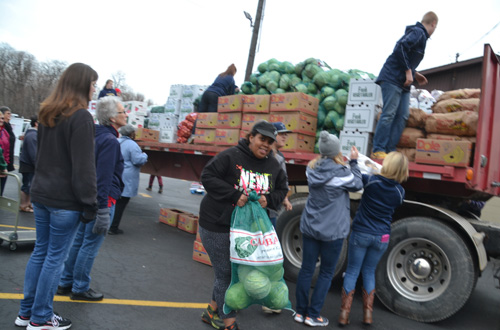
Angela English carries a sack of cabbages for the food pantry at the Lord’s House on Dec. 12, 2015. This was at Community Action in Albion when the Albion FFA unloaded produce donated from local farms. English took on many roles to help the church serve the community.
Angela English was a bright light in the Albion community, coordinating a Toys for Tots program, keeping a food pantry stocked at the Lord’s House (a church run by her parents), and offering enthusiastic support at her kids’ sporting events, cheering for them and their teammates.
English was 37 when she passed away on Oct. 19. She was diagnosed with cancer on Dec. 27, 2019, and started chemotherapy last January.
Her son Omar is 17 and graduated in 2020. Her daughter Olivia is 12 and in the sixth grade. Angela was in the stands at her son’s soccer games and her daughter’s basketball contests.
Angela served as missionary at the Lord’s House, a church led by her father, Eddie English, and mother, Rose. Mr. English is the church pastor. His daughter was a praise leader, pastor’s aide, sound system technician, lyrical dancer and the Toys for Tots coordinator.
The church has run the Toys for Tots since 2008, serving about 40 families. In some years, they partner with the Orleans County Sheriff’s Office, which delivers the toys to the church.
Eddie and Rose English have been leading the Lord’s House since it started 15 years ago in downtown Albion. They renovated a former United Methodist church in Waterport, after acquiring the site at an auction in 2011. The building had been vacant for 20 years.
Angela English has been a big part of the journey and the Lord’s House mission to reach out to the community.
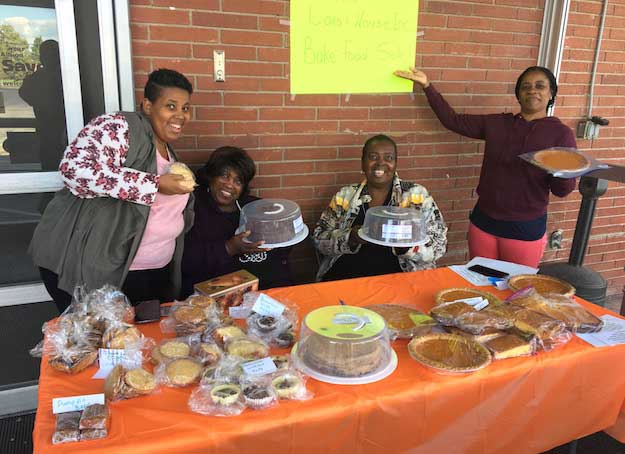
Members of The Lord’s House in Waterport sold sweet potato pie and many other baked goods at the Albion Save-A-Lot in this photo on Sept. 29, 2018. Pictured from left include Angela English, Brenda Winters, First Lady Rose English and Nadine Johnson.
K of C leader gives veterans a fitting tribute on Courthouse Square
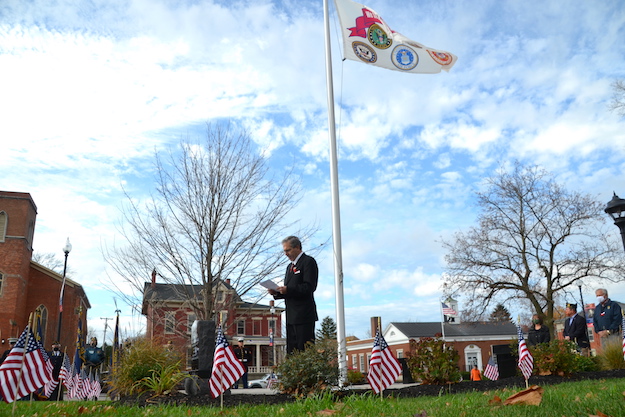
Greg Dugan, the grand knight for the Knights of Columbus in Albion, speaks to a crowd of about 50 at a dedication ceremony on Nov. 11 for a new memorial for veterans.
Greg Dugan, an Albion barber since 1991, has cut hair on thousands of heads over the years. Many of his most loyal customers have been veterans.
Once they are in the barber chair, Dugan said many veterans open up and share about their experiences, including in combat.
He mentioned the late Albion Town Justice Bill Larimer, who was a POW in World War II. He has cut the hair for other World War II veterans and people who served in Korea, Vietnam, Afghanistan and Iraq.
Members of the Honor Guard were present on Nov. 11 for a dedication service for a new veterans’ memorial at Courthouse Square. The Knights of Columbus, Albion Council #1330, took the lead in the project.
“I’ve had contact with so many veterans, young and old, since 1991,” Dugan said before a dedication ceremony on Nov. 11 for a new veterans’ memorial on the Courthouse Square.
Dugan and the Knights of Columbus led the project, which took a little longer due to the Covid-19 pandemic.
There is a new flagpole, granite benches and a headstone for the monument. The headstone includes the inscription: “Dedicated to our courageous brothers and sisters of this community who served our country in times of peace and war. We thank them for their service. And especially to those who gave their lives in that service. May God grant them eternal rest.”
The stone includes the insignias of the U.S. Army, Marine Corps, Navy, Air Force, Coast Guard, Army National Guard and Merchant Marine.
The new flag pole includes a flag that recognizes the different branches of the military.
The memorial includes two granite benches. One bench has an inscription, “To Commemorate.” The other has the words, “To Heal.”
Dugan and the Knights of Columbus pushed the project to completion and put a fitting tribute for veterans in one of the community’s highest profile locations.
Dugan has been an active leader for the K of C in recent years, leading the group in many parades around the county and organizing a “Blue Mass” at Holy Family Parish in Albion to honor and pray for law enforcement officers, corrections officers, coroners, firefighters and medics.
Dugan said he has deep appreciation for first responders after they saved his life when he was critically injured in a motorcycle accident on Aug. 6, 2012. In that accident Dugan broke both knees, both wrists, separated his pelvis, fractured his left hip, and lacerated his left leg.
That accident has turned him into a very strong advocate for first responders and veterans in the community.
“Thank you for taking the time to remember our veterans,” Dugan told the crowd during the dedication on Nov. 11. “They never gave up on us and we can’t give up on them.”
Retired museum director adds another asset to historic Childs hamlet
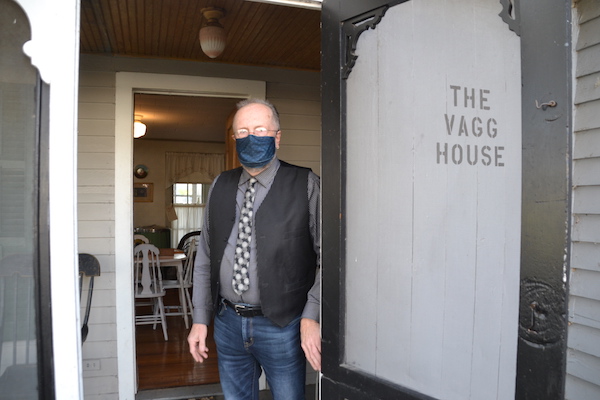
Bill Lattin welcomes visitors to the Vagg House on Nov. 7 following the Cobblestone Museum’s annual meeting. Lattin led the transformation of the Vagg House, at the corner of routes 98 and 104, into a home decorated in the 1920s and ’30s. The event on Nov. 7 was the first public event at the Vagg House since it was redone and added to the museum’s campus.
Bill Lattin has been a caretaker and storyteller of Orleans County history for the past 50 years. He is officially retired as Orleans County historian and Cobblestone Museum director. He served in those roles for 35 years. (He retired from the museum in 2010 and from the county on Dec. 31, 2014.)
But he remains an active force in preserving important local sites and documenting history. In 2020, he helped relocate a log cabin built by Boy Scouts in 1930. It went from an Albion backyard to behind a cobblestone school built in 1832 on Gaines Basin Road. Lattin has been a key worker on saving that school in recent years. He has handyman skills and deep connections to rally the community to a cause. That school and the log cabin are recent examples. But that mission started long ago. He was a key leader of the Save the Tower committee that raised $30,000 in the mid-1970s for the Civil War Memorial at Mount Albion Cemetery. Lattin has given new life to many local structures.
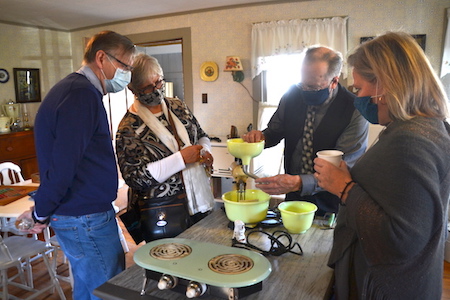
Bill Lattin shows Doreen and Gary Wilson a 1930s food mixer and a green enamel hot plate on Nov. 7 during the first public tour of the Vagg House. There is also a Kalamazoo kitchen range that was made in 1935. The Vaggs used it for heat as well as cooking. Museum Trustee Maarit Vaga is at right. Visitors will notice a big difference between the 1920s-era Vagg house and the cobblestone Ward house, furnished in the style of the 1880s.
He doesn’t seem to be slowing down. At the Cobblestone Museum this past summer, Lattin and his grandson Freeman painted several of the buildings on the Route 98 campus.
The museum acquired the Vagg House at the corner of routes 98 and 104, the main intersection in Gaines and the Childs hamlet. The site was most recently owned by Lattin’s partner, the late René Schasel.
Lattin led the efforts to curate the former home of blacksmith Joe Vagg and his wife Nellie, who was active in the temperance movement. The house includes many of Schasel’s antiques, with many of those items given to the museum in Schasel’s memory through his estate, which Lattin is co-executor.
Lattin also was able to find additional antiques to decorate the house in a 1920s, ’30s theme, with many of the early electrical appliances.
(Lattin even built an outhouse for the site to help it match the others on the museum’s grounds.)
The Vagg House is a new “jewel” in the Cobblestone Museum’s crown, said Doug Farley, the museum’s current director. The house can be used for small gatherings of less than 30 people, such as meetings, rehearsal parties or teas, and other museum events.
Lattin continues to be a mentor and strong supporter of Farley and other historians in the community.
Medina couple pushes modern public art murals to enliven alleyway
Chris Piontkowski of Cheektowaga paints a floral-themed mural on a cinder block building on Proctor Place, a one-lane street that starts near Rudy’s Diner. He is shown on Nov. 28. This is one of four large-scale murals added to Medina last year.
Tim Hungerford and Teresa Misiti, a married couple in Medina, are pleased to see so much investment in the Medina community in recent years, especially in the downtown business district.
Tim Hungerford and Teresa Misiti met with the Village Planning Board on Aug. 4 to discuss regulations for public art.
The two are among those investors, doing a major renovation of their loft apartment in the downtown and at the restaurant they own, Mile 303.
Hungerford and Misiti believed there was a missing piece in the community: dramatic modern art. They also felt there were some rough spots in the downtown, mainly back walls off Main Street.
They are part of the Form Foundation, a non-profit looking to bring public art to Medina. They coordinated having four large-scale murals off Proctor Place, a one-lane street a block from Main Street. Hungerford and Misiti met with village officials and found a way to accommodate public art in a historic district.
The projects have created another attraction in Medina without altering the historic structures. The murals are painted on cinder block walls. Hungerford and Misiti pushed to get the murals done during the pandemic, wanting to bring some positive energy during a difficult year.
They plan to replace the murals every two years and hope to add more locations.
Chuck Tingley shows a traveler with a message, “Fake It Til You Make It!” with this mural on the back of 410 Main St., which faces Proctor Place, a one-way street a block from Main Street.
Julian Montague, an artist from Buffalo, painted two walls of a building at the corner of Pearl Street and West Avenue. The walls are 14 feet high and 80 feet long. Montague paints geometric patterns with eyes and mouths to give the mural some added personality. “It’s playful and a little weird,” he said.
The “Canalligator” mural was the first of four in Medina in 2020. Artist Tim Meyers painted the “Canalligator” that stretches more than 50 feet on a cinder block building on Proctor Place.
The Orleans Hub usually has an awards program for the honorees. It is unlikely a ceremony with all the attendees and their family and friends will be allowed soon due to Covid-19 restrictions and concerns. We’ll work out a way to present them with their awards.
WASHINGTON, D.C. – Congressman Chris Jacobs (NY-27) released the following statement after being sworn into the 117th Congress on Sunday.
“Serving Western New York has been the honor of a lifetime. I am looking forward to a productive new term and working to tackle pressing regional and national priorities. My focus will be on rebuilding Western New York’s economy, supporting small businesses and farmers, and investing in new infrastructure – including rural broadband.
“I also know there is much work left to be done as we defeat COVID-19, especially securing vital aid for our local governments,” Jacobs said. “I want to thank Western New York and the great people of NY-27 for putting their trust in me. I pledge to put you and the United States Constitution first, and continue to uphold my commitment to serve with honor and integrity.”
By Tom Rivers, Editor Posted 4 January 2021 at 8:29 am
Provided photo: Adam Kirby holds the trophy for winning the 2019 corn yield contest in New York. He won the 2020 yield contest in the conventional irrigated category in NY.
ALBION – Adam Kirby again is on top of the corn yield contest in New York. Kirby won the contest in 2019 with a 277.0 bushel yield in the strip till, non-irrigated category.
He won another category in 2020 with a 271.8 bushel yield in the conventional irrigated category. Kirby used a Pioneer seed, P1197AM, for the winning entry.
He also was second in the strip, min, mulch, ridge-till non-irrigated category with a 273.6 yield. That was just behind Andrew Mcllroy of Pavilion at 273.8 bushels. Kirby used a Pioneer seed, P0720AM, for this entry.
Other New York winners in other categories include: conventional non-irrigated, Henry Everman of Danville at 299.8 bushels; no-till non-irrigated, Craig Phelps of Groveland at 239.2 bushels; strip, min, mulch, ridge-till irrigated, Tom Jeffres of Wyoming at 286.7 bushels.
The National Corn Growers Association announced the results of the contest last month.
Don Stall of Charlotte, Mich., produced the highest yield in the contest with a yield of 476.9 bushels per acre. That was in the conventional irrigated category.
The National Corn Yield Contest is in its 56th year and remains NCGA’s most popular program for members.
“This contest brings farmers together to create, innovate and explore ways to optimize the nation’s largest and arguably most important crop,” said Debbie Borg, chair of NCGA’s Member and Consumer Engagement Action Team. “At both the state and national levels, contest winners find new ways to excel while using a variety of techniques. Ultimately, the invention and improvement by farmers and input providers enable U.S. farmers to continue to meet the future demand for critical food, feed, fuel and fiber.”
Winners receive national recognition in publications such as the NCYC Corn Yield Guide, as well as trips or other awards from participating sponsoring seed, chemical and crop protection companies.
Winners are traditionally honored in March during Commodity Classic. With the convention moving to a virtual format in 2021, NCGA is working with sponsors to find an alternative means to recognize the accomplishments of yield contest winners.
By Tom Rivers, Editor Posted 3 January 2021 at 6:44 pm
Positive rates rise in Finger Lakes Region, state-wide
New York State has passed some grim milestones this past week with 1 million cases of Covid-19 since March 1 and more than 30,000 deaths.
After 11,368 new confirmed cases were reported to the state on Saturday, the statewide count is now at 1,017,153 who have tested positive for the virus in New York.
On Saturday, there were also 138 deaths due to Covid, bringing the number of confirmed deaths in the state from Covid to 30,476 in the pandemic.
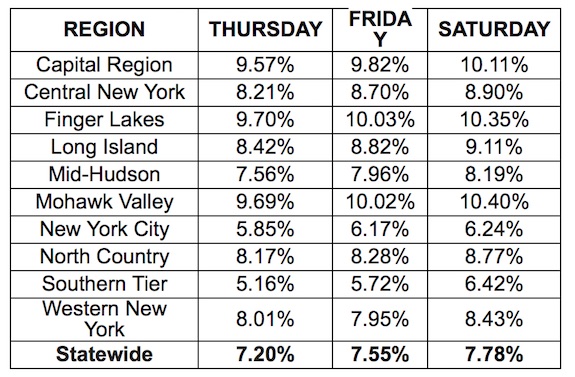
The percent of Covid tests that are positive continues to rise. The state was at 7.78 percent positive on Saturday, which was up from 7.55 percent on Friday and 7.20 percent on Thursday.
The Finger Lakes Region, which includes Orleans, topped 10 percent positivity on Friday and Saturday.
The state reported Orleans had 19 new positive on Saturday out of 212 tests, for a positive rate of 9.0 percent. The positivity rate in Orleans the past seven days is 9.3 percent, which is actually the second lowest of the nine counties in the Finger Lakes Region.
The other counties and their positive rates the past week include: Genesee is at 12.3 percent, Livingston at 10.7 percent, Monroe at 10.1 percent, Ontario at 10.5 percent, Seneca at 10.4 percent. Wayne at 9.8 percent, Wyoming at 14.2 percent, and Yates at 8.9 percent.
By Mike Wertman, Sports Writer Posted 3 January 2021 at 3:13 pm
Photo courtesy of the Buffalo Bills – Medina Coach Eric Valley holds a football honoring his earning the Buffalo Bills Coach of the Year Award for Section VI.
Medina High varsity football coach Eric Valley has earned the Buffalo Bills and ADPRO Sports Coach of the year Award for Section VI.
The award was announced at halftime of this afternoon’s Miami vs. Buffalo game.
The honor earns Medina a $1,400 grant as well as a $2,000 credit from ADPRO Sports for the Mustangs football program.
“That is greatly appreciated,” said Valley during an interview on the half-time program on the Bills website. “Obviously asmall community like ours we can use every penny we get to make it a great experience for these kids as part of our program.”
Valley, along with Albion varsity football coach Adam Krenning and Wilson varsity football coach Bill Atlas, were among the Coach of the Week honorees this fall all of whom were eligible to for the Coach of the Year honor.
A Medina High graduate who played college football at SUNY Cortland, Valley has been on the Mustangs coaching staff for 25 years serving as head coach for the past 12 years.
When he earned the weekly honor the Bills press release cited Valley’s strong involvement in the community as well as his efforts to bring Unified sports including basketball and bowing to the Medina athletic program.
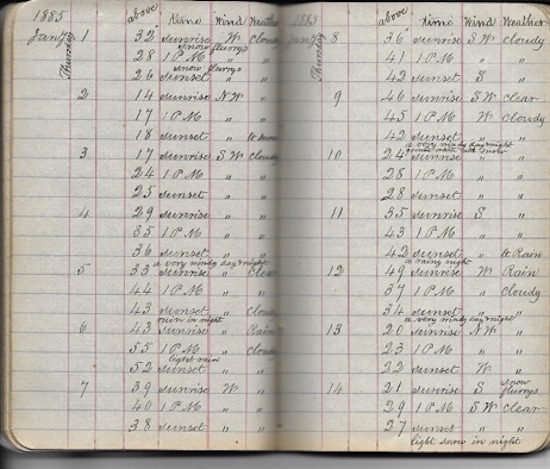
Courtesy of Department of History: This diary offered a daily record of weather in Medina in 1883.
Illuminating Orleans, V1, No. 4 By Catherine Cooper, Orleans County Historian
At the beginning of a new year, it is not unusual for people to resolve to keep diaries or lists. Our subject this week is an example of such, from the collection at the Medina Historical Society Museum. It is a sturdy tan note-book, with a plain cover. The first page contains the following inscription which describes its purpose:
“A Weather Record kept at Medina, Orleans County, NY, from Jan. 1st 1883 to “
The columns of the pages of this ledger type note-book were labeled to indicate the Year, Date Temperature, Time, Wind and Weather. The temperature for each day was neatly recorded at three times every day: Sunrise, 1 p.m. and Sunset.
The prevailing wind direction was noted, as well as the general weather condition, whether Cloudy, Clear, Rain, Snow, Sleet, or Fog. There are occasional notations in tiny handwriting: “a very windy day and night” or “3 or 4 inches of snow in night”
The destructive windstorm of 1885 is noted: “1885, Jan. 26, A terrible windy night, 50 chimneys reported blown down in the village”
There are notations about fires:
“1883, Feb. 10, about 5 am, fire broke out in the pail factory of Johnson & Wigley on East Center St., the fire went into the adjoining building known as the Union Mills, owned and occupied by S. C. Hoag, both buildings nearly all burnt up, with contents.”
“1883, Nov. 1, Fire alarm at 9:45 pm, fire discovered in Mrs. Alford’s barn, in the alley between Park Ave. and Center St., burnt down, with J.C. Davis barn adjoining & Pat Horan & A.M. Barry barns on the north side. The next adjoining shed was Newell’s, which to stop the fire he ordered pulled down & the fire was stopped, thus preventing a spread of the fire, as a strong SW wind was blowing, a terrible fire would have been the result”
These descriptions highlight the destruction that could ensue from a single fire, at a time when many buildings and most barns were of wooden construction.
And how do the summer temperatures compare with ours?
In 2020, we had one 93-degree day in May, one 90-degree day in June, and in July eight consecutive days of 90 degrees or higher, as well as the hottest day in 63 years at 98 degrees.
In the summer of 1883, there was one 90-degree day, 15 days with a temperature between 80 and 84, and 3 days with a temperature between 85 and 89.
In the summer of 1885, there was no 90-degree or higher day, 21 days with a temperature between 80 and 84 and 2 days with a temperature between 85 and 89.
We are so accustomed to having detailed weather information right at hand, on our phones. Local newspapers in the 1880’s were weekly and did not include weather forecasts. But, by 1882, Pool’s Signal Service Barometer, “the Best in the World” was advertised regularly. It could be ordered “on receipt of $1, or 6 for $4” from J.A. Pool’s Oswego Thermometer Works, Oswego, NY.
The weather records in this notebook run from Jan. 1883 to August 21, 1886, the last full entry on the next to last page. We can deduce that this record keeper was methodical and precise. But what of the person’s identity?
The answer is provided at the end of the very last page of this notebook. The notation reads:
“Levan W. Merritt died at 1:15 a.m., August 23, 1886. Funeral services at 3 p.m. Aug. 26th, 1886. Burial about 4:30 p.m. under a perfectly cloudless sky.”
Born in Connecticut in 1806, Mr. Merritt came to Medina in 1833. He operated a flouring mill. In 1841, when he built his sturdy red brick home at 406 West Ave., the location was considered to be “out in the country”. He helped design the layout of Boxwood Cemetery, was a founding member of the first fire company and is credited with planting the first shade trees on the Village streets. He would, no doubt, have appreciated that “perfectly cloudless sky”.
By Tom Rivers, Editor Posted 3 January 2021 at 9:02 am
Photos by Tom Rivers
MEDINA – The Marshall Road canal bridge in Medina reopened last week after extensive repairs. This was the last of the seven bridges to be reopen as part of a $10.7 million overhaul of canal bridges in Orleans County.
Crane-Hogan Structural Systems in Spencerport was the contractor on the projects. Besides painting most the bridges from green to black, the work on the seven bridges included installing high-strength galvanized steel to replace steel floor systems, low chords, gusset plates and truss elements. Bridge railing and guide rail on the bridge approaches also were improved.
Crane-Hogan Structural Systems started the work two years ago on the seven bridges, beginning with Bennetts Corners Road in Holley.
The seven single-lane truss bridges were constructed between 1909 and 1914. The locations of the bridges that were rehabilitated include:
Bennetts Corners Road, between Route 31 and Gulf Road, in the Town of Murray.
Telegraph Road, between Route 237 and Groth Road, in the Town of Murray.
Transit Road, between Route 31 and West Brockville Road, in the Town of Murray.
Densmore Road, north of Route 31, in the Town of Albion.
Gaines Basin Road, between Albion Eagle Harbor Road and West Bacon Road, in the Town of Gaines
Bates Road, between Telegraph Road and Portage Road, in the Village of Medina.
Marshall Road, between Route 31 and School Road, in the Town of Ridgeway.
A truck passes over the Marshall Road canal bridge on Saturday, heading north.
My friend Heather was telling me about the importance of my new lot number in Tennessee. There is energy behind each property number, if you entertain the possibilities of balancing energy… Being I am sort of an empath, I am big on energy.
We feed off energy, so it is important to make sure you are on a path that will lead to good energy. My friend assured us our address #283 in TN is a favorable number. Our conversation led me to Google for a bit of research on this concept. First reduce your property number to a single digit. This allows you to properly diagnose your Address Numerology. For example.. 2+3+8 = 13. Then 1+3 = 4. Four is Heart Chakra and represents love.
We all need love so this is splendid. The lucky colors are pink and green, which is so awesome because as a combo pink and green are my favorites together! A four is the most grounded of the numbers and those that spend time in fours need safety and security. A four is also great for growing a business. If you are a four then you live in a world where promises must be kept – integrity is a big thing. One pitfall of a four is that you can be very inflexible in your thinking and tend to be quite conservative.
All of this totally describes me – both the good energy and the not-so-good energy. Funny thing is that as I was thinking this over I realized that I currently have all of these things and I am not even on the mountain yet. Come to find out I already spend most of my waking hours in a Four. My home in NY is 364 which reduces to a 4 and my business is 139 which also reduces to a 4. There are no coincidences. Your home is your foundation for life and its energy should be one that is compatible with your soul and dreams.
The wonderful thing is no matter your numerological foundation, once you leave your bubble you can have a great adventure, even for a non-risk taker like me. We protect the safety and security of our home, but also crave a bit of adventure when we get out into the world. I am glad I have lived under the watchful eye of the Four because its energy has blessed me with a 30-year marriage full of love, laughter and happiness, plus a business that has blossomed for the last 20 years. Goodness, I can not wait to see what happens at 283 because 364 and 139 have already given me so much.
Just for fun, reduce your number and see what kind of energy your home has. See if it is one that can make you happy! This is not scientific at all, but it never hurts to check off all the boxes when building a serendipitous life. I talk alot about self and being responsible for our self and happiness, but truth be told I have a little superstition in me too!
Google Address Numerology for more information. If anything it is fun to imagine its power in the universe. Oh and if you are a 5, I will be over sometime to let loose :).
Share what your number means, visit my blog live online (click here) and catch up on Weekly Photo Perks and past Sunday posts. Like and share your comments.
Albion goalie Sydney Mulka goes high to make a save on Nov. 11 during an overtime win vs. Depew in the Class B1 semifinals. It is one of Cheryl Wertman’s favorite sports photos from 2020.
Click here to see her other picks as well as the top 10 sports stories of the year picked by Mike Wertman, the sports editor.
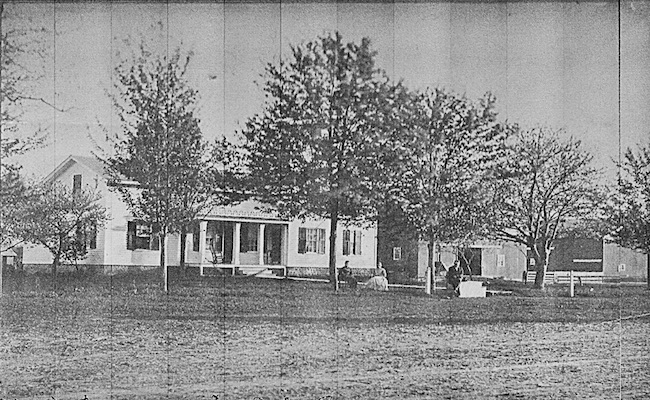
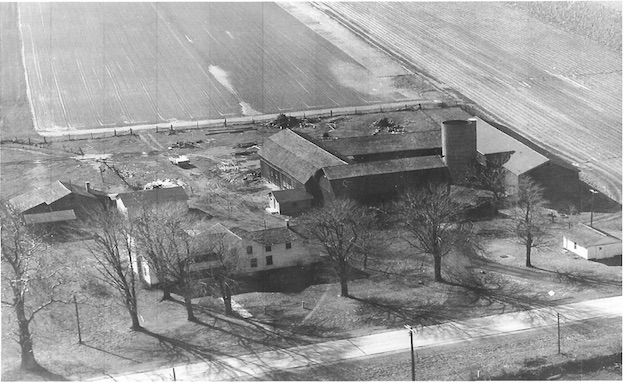
GAINES – The Thompson family farm is another longtime farming operation in the Hamlet of Childs whose roots go back to the early 1800s. In 1872 Henry Williams bought the farm to the east at the corner of Brown Street Road and Route 104 thus enlarging the farm to 235 acres.
Elmer Thompson of East Barre married Henry’s daughter, Theda Williams, and moved into the homestead on Ridge Road. Their son Charles Thompson inherited the farm from his father. He married Hannah Harding and they had four children: Gary, Gail, Ruth and Ross. The Thompson farm as seen is this picture from the late 1800s shows an unpaved Ridge Road. Paving was not accomplished until the 1920s.
Charles Thompson operated the dairy and cattle farm on both sides of Ridge Road. He started with Black Angus beef cattle and added 35 milking cows. The beef cattle were out to pasture on the north side of the road, except during the winter months when they were housed in the west barn. The dairy cows were put out to pasture during the day on the south side of the road. The picture shows the dairy barn and milk house on the east. The Thompson farm also included a farm seed business that supplied corn, wheat and other seeds to local farmers.
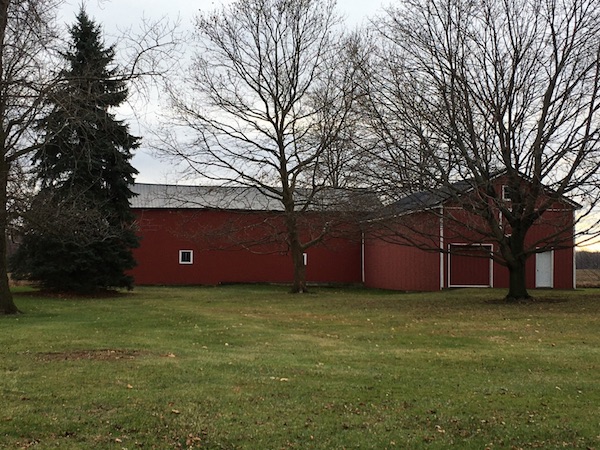
Historian Bill Lattin examined the large hand-hewn beams in the back barn that is still standing and dated its construction to the 1820s.
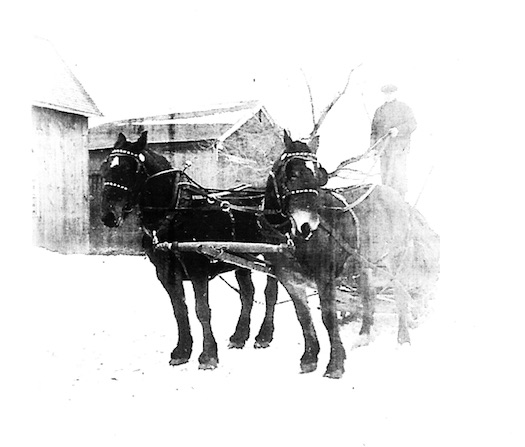
Activity on the farm continued year around. As late as the 1940s, farm chores were done in the winter using horses to pull a sled.
Charles Thompson’s daughter, Gail (Thompson) Johnson, who still lives on land once held by the farm, has many fond memories of family life growing up. She said, “I really enjoyed playing outdoors. We stayed home. I played in the corn picker and pretended it was a spaceship.” Gail said she learned her simple philosophy of life from her father and mother. Charles did not spend money foolishly. He lived a frugal life and only bought what he could pay for with cash, including all of the farm equipment.
Gail remembers when the family first bought a television set in the 1950s. They watched it together as a family about one hour every evening. Gail recalled that at a certain point in time the TV broke and Charles decided they wouldn’t get it repaired. He said, “You kids should do your homework instead.” And, that’s what they did.
Gail’s mother Hannah lived a simple life, too. She was a thrifty homemaker and canned farm produce to make meals for her family. Following her husband’s death, a friend asked Hannah if she was going to can some fruits and vegetables for the winter. Hannah remarked, “No! I am not going to be a slave to another vegetable.”
Gail said her father stopped farming around 1960 and put his land in the Soil Bank Program instead. She said, “The state kept coming up with new regulations, year after year, like demanding that the barnyard be paved with cement. Dad had complied for years with the state but it became very difficult to make a living. He had gone from simple milk cans to bulk milk tanks which had cost quite a bit of money.” The Soil Bank paid farmers not to grow crops, but to mow the grass instead. Gail said government regulations forced a lot of the small farmers in the region to go out of business.
Gail remembered that her parents were involved in many farm related activities including Gaines Grange. She said, “My mother used to sell donuts at the Grange square dances on Saturday evenings.” She also recalled attending family picnics at Indian Falls, probably related to her father keeping Brown Swiss cows. She said, “Our farm was pretty much self-sufficient. Beef and dairy cows brought in meat and milk, and chickens supplied eggs.” Like most farms, the Thompsons had a large vegetable garden to provide their daily needs.
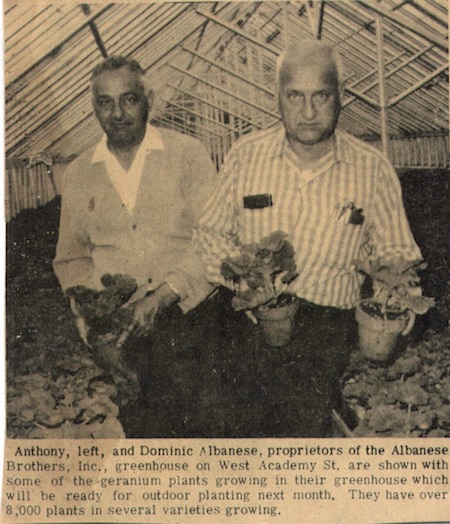
The Albanese brothers – Anthony, Dominick and Frank, farmed about 50 acres along the north side of the Ridge in Childs between the Cobblestone School and Church in Childs. They also operated the Orleans Hotel in Albion from 1944-1955. Their farming enterprise included a large farm on Sawyer Road where they grew Apples, cabbage and tomatoes, among other crops. They also had a large labor camp on Sawyer Road to house about 100 migrant laborers who came up from the south to harvest the crops.
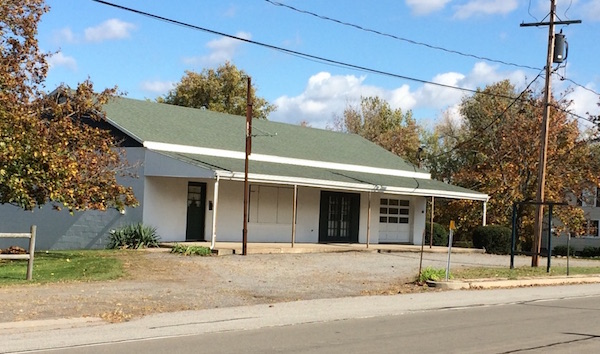
In the 1950s the brothers built a combination liquor store and farm market on Ridge Road. They sold a large variety of homegrown produce in their roadside stand, seen here, in Childs. Anthony’s son, Robert Albanese, remembers working at his father’s Sawyer Road farm during High School. Bob said, “I worked weekends on the farm. They had over 300 acres of orchards and all-in-all we picked 100,000 bushels of apples each year.” In addition to the roadside stand, the farm sold produce to Comstock Foods. Farming continued there until about 2000.
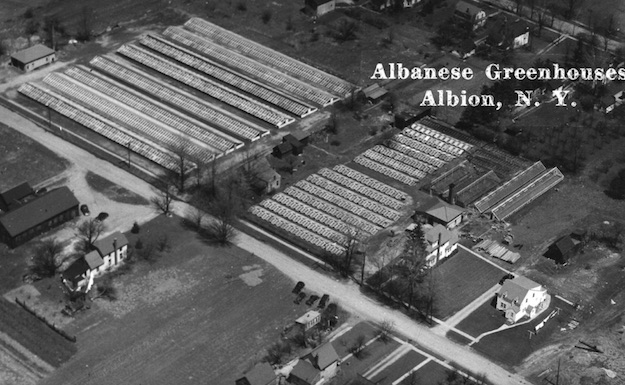
The Albanese Brothers farming operation also included greenhouses on West Academy Street in Albion that raised over 5 million tomato plants each year. They sold these to local farmers and to the tomato industry. The greenhouse operation continued into the 1990s before they were all removed.
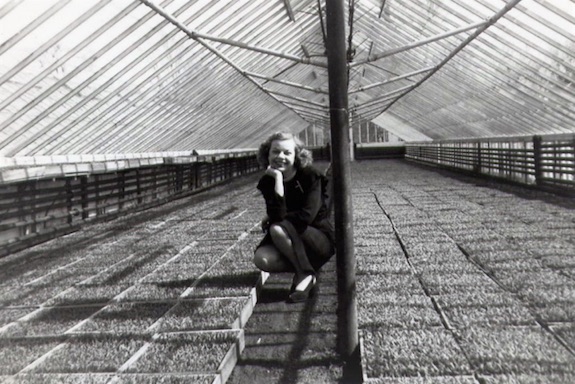
Robert’s mother, Eleanor Albanese, is shown inside one of the greenhouses in about 1950.
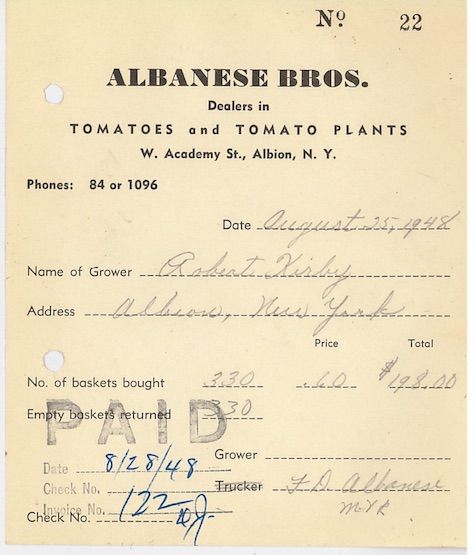
Bob Albanese recalled that each tomato flat contained 118 young plants which were started each year from seed. He remembers having to track down all of the empty wooden flats again in the fall so the process could start all over again each year. Here we see an Albanese Brothers invoice for Robert Kirby’s purchases of 300 flats of tomato plants in 1948. While $198 was a lot of money in 1948, it averaged out to one-half cent per tomato plant.
Here are some of the colorful annual bedding plants grown in the Albanese greenhouses that kept gardeners coming back year after year.
Businesses that supplied goods and services to farms and farm workers were also important to any farming community, and Childs was no exception. One of these businesses was the Janus Service Station and Garage located between the Cobblestone Schoolhouse and Albanese Farm Market on Route 104. Owner Frank Janus sold Sinclair Gas and convenience store items to farm workers and highway passersby beginning in the 1900s. He also specialized in repairing cars, trucks and farm equipment. Frank’s wife, Victoria, operated a lunch room on the premises before the NYS Thruway opened in 1954. Historian Bill Lattin remembered, “I bought the last drop of gas sold there in 1970s. The pump ran out of gas in mid-fill and that was the end of that.”
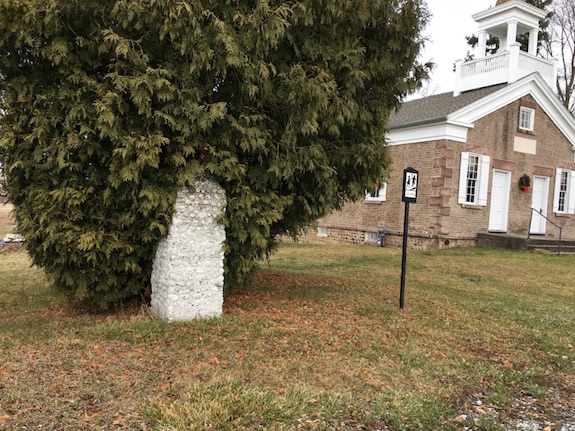
Very little remains of the Janus Service Station today, except two “cobblestone” style pillars that once held Sinclair Gasoline globes.
By Tom Rivers, Editor Posted 1 January 2021 at 9:33 pm
Photos by Tom Rivers: These Kendall graduates walk by a large 2020 sign created for the commencement ceremony on June 26, 2020, which was moved from the auditorium to outdoors at the Kendall Firemen’s grounds. Families watched from cars and trucks due to a cap on crowds at 150 for graduation ceremonies because of the Covid-19 pandemic. Each vehicle counted as one person if the event was a drive-in. Kendall and others in the community found ways to adapt during a year of unprecedented challenges.
Orleans Hub smashed its record for traffic in 2020 with nearly 11 million pageviews and by averaging nearly 10,000 unique visitors each day for the year.
The 10,932,597 pageviews last year was up by 15 percent from the 9,556,253 in 2019, which was the previous high for the Hub.
We also averaged 9,956 unique visitors, which was up 17 percent from the previous record of 8,529 in 2019.
Sean Kennedy wore these cool 2020 glasses for Holley’s commencement on June 27.
We saw a noticeable spike in mid-March with Covid-19 impact, when schools and non-essential businesses were closed. We covered the impact each day throughout the year.
We get some pushback – too much on Covid, some people tell us. But we are committed to getting out the information to the community. Based on the reader traffic, we know most people want updates in this long public health emergency.
We tried to cover lots of other community news as well this year. We appreciate the readers checking the site so often, and for advertisers choosing us to help promote their businesses.
Here is the monthly traffic report for 2020:
January: 835,154 pageviews (27,838 daily average)
February: 819,021 (27,301 daily average)
March: 1,064,215 (35,474 daily average)
April: 1,034,461 (34,482 daily average)
May: 936,049 (31,202 daily average)
June: 843,672 (28,122 daily average)
July: 841,576 (28,053 daily average)
August: 861,688 (28,723 daily average)
September: 812,577 (27,086 daily average)
October: 923,199 (30,773 daily average)
November: 931,530 (31,051 daily average)
December: 1,029,455 (34,315 daily average)
Orleans Hub went live almost eight years ago. After 2019, when we had a 1 million pageview jump, I didn’t think we could grow much more. I thought even back then it would take a lot of bad news to push us past 10 million.
Well, 2020 delivered with near-constant bad news. The public health crisis is 10 months and counting. We tried to show a resilient community in 2020, highlighting ways to live, work and celebrate safely while protecting others.
The five public schools, for example, all found new ways to hold their high school graduation ceremonies. They couldn’t do large indoor or outdoor gathering like before. They stayed within the guidelines – no more than 150 people – and still gave graduates a fitting sendoff.
Businesses found new ones to serve customers, through curbside sales, deliveries or on-line. Major projects moved along including the redevelopment of the former Holley High School and the Bent’s Opera House in Medina.
Most parades and festivals were cancelled but community groups weren’t shut out with all their events. In Medina, the annual Parade of Lights was a “reverse parade” with people driving by stationary floats and decorated fire trucks. Service clubs and non-profits served chicken barbecue dinners – take-out only.
After the spring high school sports season was wiped out, athletes returned in the fall, wearing masks while playing soccer and golf, even while running long distance in cross country.
Even Santa got creative. With his in-person visits discouraged by the health Department, Santa met with children and their families through Zoom video conferencing. He made the rounds standing from the back of a pickup truck and waving to kids.
The show went on.
Here are the annual page views and average daily unique visitors annually since the Orleans Hub started in 2013:
2013: 1,697,887 – average daily unique visitors: 2,100 (went live April 1)
2014: 5,267,498 – average daily unique visitors: 4,700
2015: 7,811,345 – average daily unique visitors: 6,739
2016: 8,334,946 – average daily unique visitors: 7,112
2017: 8,553,605 – average daily unique visitors: 7,884
2018: 8,467,818 – average daily unique visitors: 7,463
2019: 9,556,253 – average daily unique visitors: 8,529
2020: 10,932,597 – average daily unique visitors: 9,956
Santa couldn’t do in-person visits like usual in 2020 so he found other ways to spread holiday cheer, including riding from the back of a pickup truck in Albion on Dec. 19.
By Tom Rivers, Editor Posted 1 January 2021 at 6:35 pm
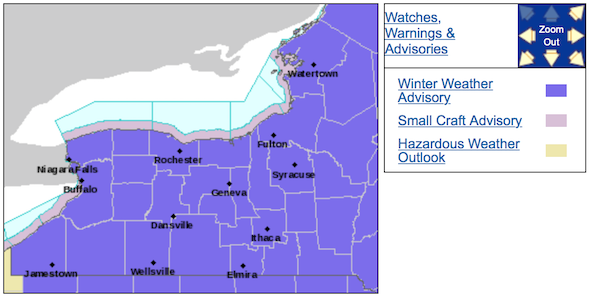
The National Weather Service’s map shows a winter weather advisory covering most of the state.
There is a winter weather advisory in effect until midnight tonight in Orleans County and most of New York State.
It will be icy with periods of snow, sleet or freezing rain that will result in slippery roads and limited visibilities, the Weather Service said. Drivers are urged to slow down and use caution.
“Plan on slippery road conditions,” the Weather Service said. “This will especially be the case this evening.”
By Tom Rivers, Editor Posted 1 January 2021 at 4:07 pm
Photos by Tom Rivers
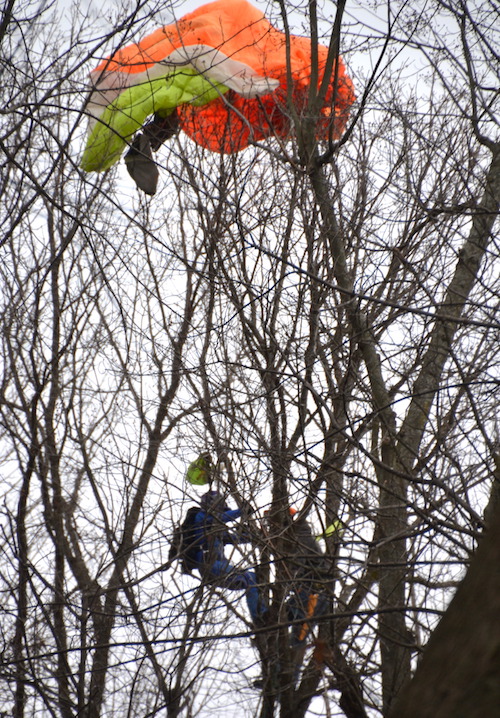
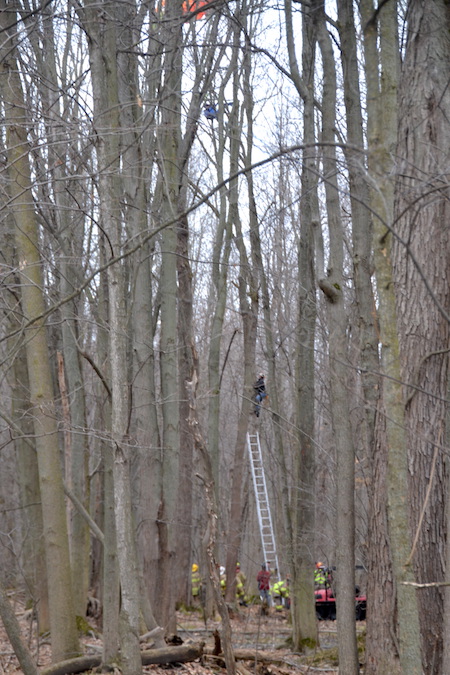
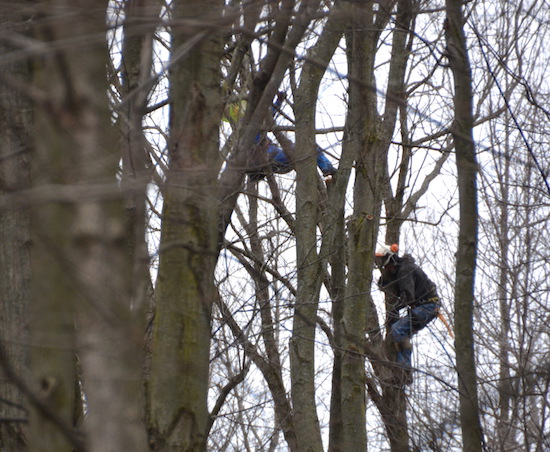
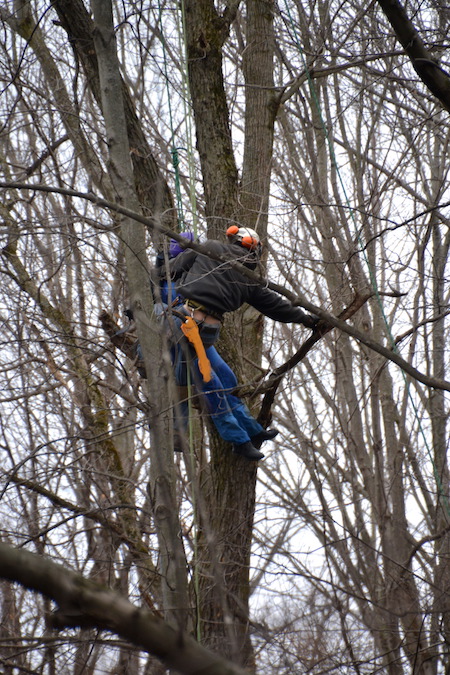
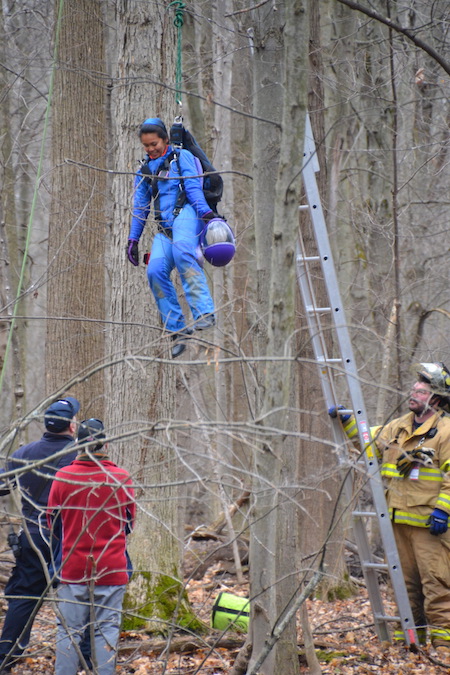
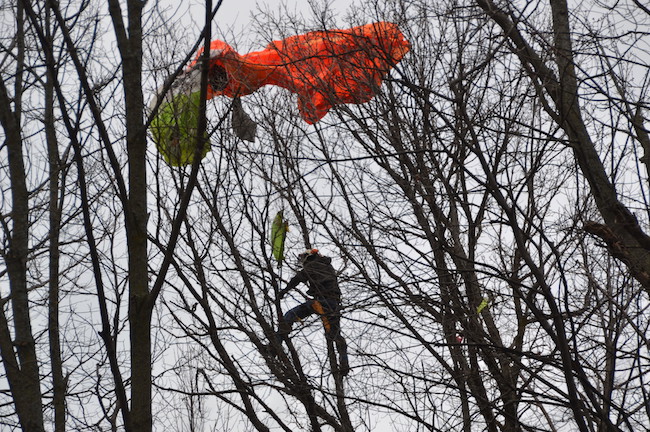
BARRE – Greg Rosato (right), a tree climber from Gaines, is 65 feet up a tree helping to free Melissa Allport of Carlton after she got stuck in the branches next to the Pine Hill Airport this afternoon.
Allport was doing a New Year’s Day jump from an airplane about 10,500 feet up with WNY Skydiving. The group does a popular skydiving event annually to start the year.
This was the 54th jump for Allport, who is a licensed skydiver. She said her helmet fogged up and she became disoriented in the air. She also was using a larger parachute at 200 square feet and the wind took her into the trees next to the air strip at the airport.
Allport said she learned from the experience and is looking forward to jumping again.
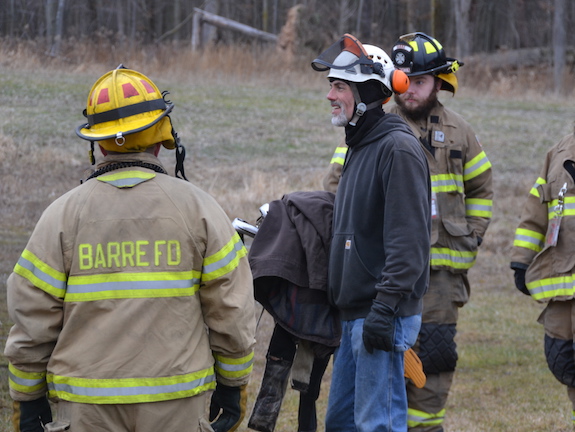
Barre and Clarendon firefighters took a 20-foot-high ladder back into the forested area by the airport. That wasn’t nearly high enough to get Allport. Rosato, a motor equipment operator for the Orleans County DPW, also has run his own tree business the past 25 years.
Firefighters reached out to him at about 1 p.m. Rosato was home and was able to respond.
Rosato used tree climbing spikes to get up to Allport. He threw a rope over limbs above him and tied himself off with his harness in case he slipped. He was able to quickly climb the tree and get to Allport, whose legs were getting numb with the temps in the low 30s.
Allport was already wearing a harness for her parachute. Rosato used a carabiner hook to connect a rope to Allport’s harness. The firefighters had a pulley and they were able to lower Allport through the branches. Rosato helped to guide her as she went down. He used a chainsaw to remove some branches that were in the way.
Melissa Allport thanked the firefighters and wished them a Happy New Year’s Day as she was lowered to the ground.
Barre firefighters say there have been few calls over the years for the skydivers. Tim Allen, owner of WNY Skydivers, has done 9,000 jumps himself. He praised the firefighters and Rosato for their response. They had Allport down in about 45 minutes after the initial dispatch call.
“Greg and the folks at Barre Fire Department did a great job,” Allen said.
Rosato was also able to get the parachute out of the tree, by cutting a few branches.
Greg Rosato said he was happy he could help today.
Once Allport was safe and back in the clubhouse, other skydivers were ready for their jumps at about 10,500 feet.




























 At the beginning of a new year, it is not unusual for people to resolve to keep diaries or lists. Our subject this week is an example of such, from the collection at the Medina Historical Society Museum. It is a sturdy tan note-book, with a plain cover. The first page contains the following inscription which describes its purpose:

 My friend Heather was telling me about the importance of my new lot number in Tennessee. There is energy behind each property number, if you entertain the possibilities of balancing energy… Being I am sort of an empath, I am big on energy.