









agriculture

Tenney seeks to modernize H-2A agricultural guest-worker program

Posted 30 June 2026 at 2:54 pm

Proposed changes include allowing H-2A for dairy farms

Press Release, Congresswoman Claudia Tenney

WASHINGTON, DC — Congresswoman Claudia Tenney (NY-24) today joined House Agriculture Committee Chairman Glenn “GT” Thompson (PA-15) and a bipartisan group of lawmakers in introducing the Securing Agriculture’s Workforce Act, legislation to modernize the H-2A agricultural guest worker program, reduce unnecessary bureaucracy, provide greater certainty for farmers, and help ensure America’s producers have access to the workforce they need to keep the nation’s food supply strong.

For nearly 40 years, the H-2A program has remained largely unchanged despite the evolving needs of American agriculture. As labor shortages continue to challenge farms across the country, producers face increasing difficulty finding enough workers to plant and harvest crops, care for livestock, and maintain safe, reliable food production.

The Securing Agriculture’s Workforce Act would modernize the program by expanding eligibility for temporary agricultural work, including making dairy farms eligible for H-2A, creating a streamlined online application system, simplifying program requirements, and codifying recent reforms to provide greater wage stability and certainty for farmers.

“Farmers across New York and our nation work tirelessly to feed America, but too many are struggling to find the workforce they need to keep their operations running,” Tenney said. “Our outdated H-2A program has created unnecessary costs, delays, and uncertainty that hurt family farms and drive up food prices. For too long, critical industries like dairy have been locked out of the H-2A program.”

The legislation has earned endorsements from more than 385 organizations representing farmers, ranchers, agricultural employers, commodity groups, food producers, and businesses nationwide, including New York Farm Bureau, U.S. Apple Association, International Dairy Foods Association (IDFA), National Milk Producers Federation (NMPF), and dozens of other leading agricultural organizations.

“We appreciate Representative Tenney’s sponsorship of the Securing Agriculture’s Workforce Act. This legislation includes long overdue improvements to the H-2A guest worker program, among other much-needed changes to the agricultural labor system. We value Representative Tenney’s continued leadership and support for New York farmers.” – New York Farm Bureau President David Fisher

“New York apple growers know firsthand that a reliable workforce is essential to keeping orchards productive. We appreciate Rep. Tenney’s leadership in advancing long-overdue H-2A reforms that will help ensure growers have the workers they need to continue growing apples in New York and across America.” – U.S. Apple Association President & CEO Jim Bair

“The Securing Agriculture’s Workforce Act represents the most significant reform to the ag workforce we’ve seen in decades. It’s particularly critical for dairy farmers, who have been effectively shut out of the H-2A program, the main U.S. farmworker visa. The bill would stabilize the dairy workforce by allowing H-2A contracts of up to 350 days and providing a targeted mechanism for current dairy workers to transition to a viable visa program. We thank Congresswoman Tenney for joining Chairman Thompson in the Securing Agriculture’s Workforce Act, and we look forward to working with these congressional champions and all of agriculture to get this bill to the president’s desk.” – Gregg Doud, President and CEO, National Milk Producers Federation

“International Dairy Foods Association (IDFA) thanks Representative Tenney for co-sponsoring the Securing Agriculture Workforce Act and supporting commonsense guestworker reform for U.S. dairy. Dairy farms and processors alike operate year-round and need access to a reliable workforce. Modernizing the H-2A program to meet the needs of year-round dairy farm operations moves the needle in the right direction by strengthening the dairy supply chain. Although dairy processors also need reforms that offer workforce support, the Securing Agriculture Workforce Act better positions all of U.S. dairy to ensure families continue to have access to nutritious dairy products.” – International Dairy Foods Association (IDFA)

NY launches $30 million tariff relief program for agricultural producers

Posted 29 June 2026 at 8:22 am

Program will provide direct payments of a minimum of $1,000 and a maximum of $25,000

Press Release, Gov. Kathy Hochul’s Office

Governor Kathy Hochul today announced the release of the $30 million Agricultural Resiliency Against Tariffs Program for New York agricultural producers.

The program, first announced in the Governor’s 2026 State of the State address, will help offset rising costs and market loss that New York farmers faced in 2025 because of federal tariff policy. Applications for dairy, livestock, specialty crop and aquaculture producers are now available here.

“The tariffs imposed by the Trump administration are reckless and damaging to so many of our industries, including our agricultural producers, who rely so heavily on the forces of international markets.” Governor Hochul said. “I promised to stand up and fight for our farmers and I’m proud that our Agricultural Resiliency Against Tariffs Program will provide the much-needed relief to New York’s farmers who feed our communities.”

The deadline to apply for the Tariff Relief Program is Tuesday, August 11, 2026. Only complete applications will be considered for payment. The application and detailed instructions on how to apply, including a webinar, are available on the Department’s webpage at https://agriculture.ny.gov/agricultural-resiliency-against-tariffs-program. Farmers are encouraged to begin the application process early to ensure all parts are completed and submitted by the deadline.

New York Farm Bureau President, David Fisher said, “Farmers of many different commodities have been faced with significant tariffs, which have sometimes been staggeringly difficult to manage. As we all know, farmers already operate on razor-thin margins, so we welcome any kind of relief program and appreciate the Governor’s efforts to help alleviate some of the pain points farmers have been experiencing.”

With an estimated 20 percent of a farmer’s income on average dependent on export markets of their product, the federal tariffs instituted in 2025 and resulting market instability are creating economic hardship for New York’s agricultural producers. In addition, farmers are facing the escalating costs imposed by tariffs on essential imports like grain, feed and other inputs. Over 80 percent of agrochemical imports and 70 percent of farm machinery imports originate from countries that were subjected to U.S. tariffs, making it difficult for farmers to secure alternative sources.

While the broader financial impact of tariffs on New York agricultural producers is still being calculated, many commodities have already reported financial burdens. For example, New York’s wine industry, which is the third largest in the nation, supports tens of thousands of jobs and New York’s grape growers, has seen significant impacts. Canada is the largest market for U.S. wine exports, including New York, and last year New York exports to this bordering country were down 77 percent, a major market loss at a time when the U.S. wine exports decreased 33 percent overall.

The Governor’s tariff relief program will provide direct payments of a minimum of $1,000 and a maximum of $25,000 to eligible producers. Distribution of funds will be determined through two tracks:

Track 1: Cow Dairy Farms

Track 2: Livestock, Livestock Products, Specialty Crops, Aquaculture

Eligible applicants must fill out a general application, provide agricultural sales or milk production data and meet specific criteria, including:

  • Applicants must have at least two-thirds of federal gross income in excess of $30,000 derived from agricultural activities, as defined by New York State Tax Law.
  • Applicants must produce eligible crops within New York State.
  • Eligibility and production data must be certified by a qualified financial professional.
  • All applicants must provide a complete substitute W-9 form, necessary for payment.
  • Dairy farm applicants must sign a records release form, allowing confirmation of milk production data.

New York State Agriculture Commissioner Richard A. Ball said, “Farmers get hit by tariffs on both the export and import side, losing market opportunities while also facing rising costs of things like grain, equipment and fertilizer. I thank the Governor for continuing to advocate for and stand by our agricultural industry. This program will ensure that the producers impacted by tariffs will receive some level of relief to help offset these new expenses and safeguard their operation.”

NYS Horticultural Society Executive Director Jim Bittner said, “New York State is the number 2 producer of apples in the country. About 30 percent of the apples grown in the US need to be exported in order to have returns back to growers at a profitable level. When the US imposes tariffs on other countries, one of the first things those countries target is apples from the US. New York apple growers are the ones hurt by those tariffs on our apples. We are also hurt by the tariffs the US applies to inputs we use on our farms to produce those great local apples. The specialty equipment and the parts to repair them as well as the fertilizers we use are mostly imported and have increased in price to us because of the tariffs. Between lower prices for the apples we produce and paying more for many of our major inputs, we need help to mitigate these influences. The last two years of tariffs have been especially harmful. Agriculture is the bedrock of our economy. We want to be able to continue to grow high quality apples for New York residents.”

NYS Vegetable Growers Association President Brian Reeves said, “There is an old saying that farmers are the only ones who buy at retail and sell at wholesale. While this is not always the case, the tariff activity has raised the cost of many inputs, which are partly or in whole imported. Relief from the increased costs can only help farmers’ bottom line.”

Schumer, Gillibrand back ag disaster declaration for NY due to damaging spring frost

By Tom Rivers, Editor Posted 4 June 2026 at 9:57 am

USDA estimates more than $30 million in damages to apples, grapes, stone fruits and onions

Press Release, U.S. Senators Charles Schumer and Kirsten Gillibrand

WASHINGTON, D.C. – Yesterday, U.S. Senator Kirsten Gillibrand (D-NY), along with Democratic Leader Charles Schumer (D-NY) and Representative Pat Ryan (D-NY-18), urged Secretary of Agriculture Brooke Rollins to approve federal aid for New York fruit and specialty crop growers facing mass crop loss after an April frost that damaged the early growth of fruits and vegetables.

The letter follows New York Governor Kathy Hochul’s request for a Secretarial disaster designation, which would give affected farmers access to low-interest emergency loans. The New York State Department of Agriculture and Markets estimates more than $30 million in losses to date, with apple, grape, stone fruit, onion, and other growers potentially losing anywhere from 15 to 100 percent of their crops to the frost.

“Farmers are the backbone of New York’s economy, but as climate change worsens, extreme weather events are becoming more common and are wreaking havoc on growers across the state,” Senator Kirsten Gillibrand said. “These frost events are devastating for New York’s specialty crop and fruit sector, and a Secretarial disaster designation would help ensure that impacted growers have the resources they need to recover. I urge USDA Secretary Rollins to swiftly consider and approve New York’s request in order to bring relief to farmers across New York.”

The primary affected counties include Albany, Columbia, Dutchess, Erie, Greene, Niagara, Chautauqua, Onondaga, Orange, Putnam, Schuyler, Sullivan, Ulster, Westchester and Yates, and the contiguous counties of Cayuga, Chemung, Cortland, Delaware, Erie, Madison, Monroe, Ontario, Orleans, Oswego, Rensselaer, Rockland, Saratoga, Schenectady, Schoharie, Seneca, Steuben, Tompkins and Wayne.

“From the vineyards of the Finger Lakes to the orchards of the Capital Region, New York’s farms are the heart of our economy. But this past April, they suffered from a devastating freeze that severely damaged crops, which had already started growing due to a warmer winter,” said Senator Schumer. “That’s why I’m calling on USDA Secretary Rollins to swiftly provide New York’s farms with a disaster designation so our farmers can unlock the critical emergency relief funds they need. I will always fight to protect and support impacted farms across Upstate New York.”

According to USDA’s 2022 Census of Agriculture, New York is one of the top-ranking specialty crop states in the country, including second in apples and third in grapes. Many specialty crop farms also support New York’s agritourism and economy through pick-your-own operations and value-added products, such as hard cider and wine.

The bicameral group wrote to Secretary Rollins: “A Secretarial Disaster Designation will unlock resources, such as emergency loans, for farmers across New York so that they can begin the process of recovering.”

“April’s frost had temperatures easily reaching below freezing and badly damaged the early growth of buds and shoots,” the group continued. “This disaster has significantly impacted New York farmers growing specialty crops, particularly apples, grapes, stone fruit, pears, and strawberries, as well as early vegetables such as onions.”

The letter is also signed by Reps. Paul Tonko (D-NY-20), Josh Riley (D-NY-19), and Tim Kennedy (D-NY-26).

Governor seeks disaster declaration for Orleans, other counties with crop loss from April frost

Posted 29 May 2026 at 8:09 pm

Press Release, Gov. Kathy Hochul’s Office

Governor Kathy Hochul today announced that New York State has requested a United States Department of Agriculture (USDA) Secretarial Disaster Designation for counties in the Hudson Valley, Capital Region, Central New York, Southern Tier and the Western New York regions.

Following an early bloom due to warmer than normal temperatures, frost conditions in April 2026 significantly impacted many fruit operations, including apple, stone fruit, grape and strawberry growers. To date, producers that reported in these regions have experienced an estimated loss of more than $30 million. A Disaster Designation would allow affected farmers to apply for USDA low-interest emergency loans. The request was made to the USDA on May 20.

“New York’s growers are second to none and many have taken a significant hit, with some reporting upwards of a 100 percent loss of their crop and millions in economic loss,” Governor Hochul said. “This hardship follows a trend we are becoming all too familiar with — temperature swings that are indicative of our changing climate. This time, our fruit growers are taking the brunt of frost conditions that damaged already blooming buds and shoots.

“I urge the USDA to take swift action to declare a disaster designation for the impacted counties and help our growers get the assistance they need to recover and move forward,” Hochul said. “I also encourage New Yorkers to continue to support their local growers, whether it’s by buying fresh local products from the farm or purchasing the many products made from New York fruit.”

New York is a major specialty crop state. The apple, grape and stone fruit industries represent an important and large component of New York’s agricultural economy. New York ranks second in the country for apple production and third for grapes, for example. The apple industry alone generates $574 million in economic impact. These crops also play an important role in wholesale markets as well as retail and direct pick-your own sales.

Freezing temperatures that dipped below 23 degrees significantly damaged the primary and secondary fruiting buds and shoots of fruit crops, including apples, grapes, stone fruit — peaches, plums, cherries — pears and strawberries across the regions, particularly those in higher elevation, following warmer than average temperatures that brought many crops to bud early. In addition, early vegetable crops like onions sustained damages.

Impacted counties include Albany, Columbia, Dutchess, Erie, Greene, Niagara, Chautauqua, Onondaga, Orange, Putnam, Schuyler, Sullivan, Ulster, Westchester and Yates. Contiguous counties include Cayuga, Chemung, Cortland, Delaware, Erie, Madison, Monroe, Ontario, Orleans, Oswego, Rensselaer, Rockland, Saratoga, Schenectady, Schoharie, Seneca, Steuben, Tompkins and Wayne.

Damage varies from county to county and a survey conducted by the New York State Department of Agriculture and Markets estimates that many growers are facing a wide range in losses — anywhere from 15 percent to 100 percent, with an estimated economic loss of more than $30 million to date.

A USDA disaster designation makes farm operators in primary counties and those counties contiguous eligible to be considered for emergency loans from the Farm Service Agency, provided eligibility requirements are met. Farmers in eligible counties have eight months from the date of the disaster declaration to apply for relief programs.

Senator Kirsten Gillibrand said, “Farmers are the backbone of New York’s economy, but as climate change worsens, extreme weather events are becoming more common and are wreaking havoc on growers across the state. These frost events are devastating for New York’s specialty crop and fruit sector, and a secretarial disaster designation would help ensure that impacted growers have the resources they need to recover. I urge USDA Secretary Rollins to swiftly consider and approve New York’s request in order to bring relief to farmers across New York.”

Landowners have chance to add farmland to county’s ag district

Posted 29 May 2026 at 9:47 am

Photo by Tom Rivers: These peach blossoms are shown on April 22, 2024 at the fruit orchards at Watt Farms on Route 98 in Gaines.

Press Release, Orleans County Department of Planning and Development

ALBION – Orleans County is accepting enrollment of additional parcels in its existing, certified agricultural district during the month of June, pursuant to New York State Agricultural and Markets Law.

The annual 30-day window is for inclusion of property that consists of predominantly viable agricultural land. During this time period, land may only be added and not removed from County Agricultural District No.1. Presently, there are over 120,150 acres in County Agricultural District No. 1.

This opportunity supplements, but does not replace, enrollment in an existing agricultural district during a more comprehensive review process held once every eight years. In 2024, the County Agricultural District No. 1 went through its major eight-year review. The next eight-year anniversary review – the only time during which parcels can be both added and removed – will not occur until 2032.

Requests for inclusion in District No. 1 will be evaluated, in order, by the Orleans County Agriculture and Farmland Protection Board, the Orleans County Legislature, and the New York State Department of Agriculture and Markets. To enroll, owners must complete and sign a Letter of Intent for Annual Enrollment form. These are available from the Orleans County Department of Planning and Development (click here to see the form online).

Completed forms should be sent by July 1st to:

Corey Winters, Director

Orleans County Department of Planning & Development

14016 Route 31 West

Albion, NY  14411-9382


Please note that requesting enrollment during this 30-day time period is not a guarantee that an owner’s property will be added to Agricultural District No 1. Moreover, it will not automatically qualify your land for a reduced agricultural property tax assessment.

For information on obtaining a reduced agricultural property tax assessment, please contact your local assessor.  Any qualifying lot must be included entirely rather than partially.

Orleans 4-Her named first-place NY Farm Bureau scholarship winner

By Tom Rivers, Editor Posted 12 May 2026 at 9:18 am

Carter Kuipers

An active 4-H member in Orleans County has been named the first-place winner of a New York Farm Bureau scholarship.

Carter Kuipers of Byron won a $3,000 NY Farm Bureau’s 2026 Agricultural Youth Scholarship.

To qualify for scholarships, applicants must have a student or family membership in Farm Bureau. A panel of judges selects the winners based on their essay submissions and applications, which include community and agricultural engagement. District winners then compete for state scholarships.

Kuipers also was awarded $250 as the District 2 winner. He is a member of Genesee County Farm Bureau and is a senior at Byron-Bergen Senior High School.

Kuipers plans to attend SUNY Cobleskill to study agricultural power machinery with a career goal related to diesel technology. His agricultural experience includes working on his family’s farms, where he cares for animals and maintains equipment.

He has been an active member of FFA, including serving as the 2022-2025 Chapter Secretary, and has received many FFA awards and recognitions. Kuipers has been an active participant in the 4-H Beef and Dairy Club for the past decade. Outside of agricultural activities, he is a sectional champion with the Byron-Bergen/Le Roy swim team and a member of the clay target team, while also finding time to volunteer with his local church.

Kuipers has shown animals at the Orleans County 4-H Fair and won the grand master showman title in 2024, which features the top showmen of nine different animals: horse Western, horse English, dairy goat, meat goat, sheep, swine, llama, dairy cattle and beef cattle.

Kuipers showed pigs and beef cattle at the fair in 2024. He qualified for the grand master showmen competition after winning the beef master showman title.

Photo by Tom Rivers: Carter Kuipers, then 16, of Byron shows a beef animal during the grand master showman competition on July 26, 2024. Kuipers won the competition, one of the most prestigious at the Orleans County 4-H Fair. It features the top livestock showmen from the fair.

Bobby Brown of Orchard Dale Fruit Company named ‘Apple Grower of the Year’

By Tom Rivers, Editor Posted 6 May 2026 at 10:42 am

Brown, whose roots at farm date back to 1804, recognized by American Fruit Grower magazine

Photos from Orchard Dale Fruit Company – Bobby Brown III of Waterport has been named “Apple Grower of the year” by the American Fruit Grower magazine. Brown and his family have been mainstays in Carlton for more than two centuries.

A local apple grower has been chosen by the American Fruit Grower magazine as the country’s “Apple Grower of the Year.”

Robert “Bobby” Brown III is co-owner of Orchard Dale Fruit Company. He is the eighth generation grower on the family farm, which dates back to 1804. He has embraced new technologies with precision agriculture on the farm and has been a key leader in the Lake Ontario Fruit packing facility on Route 104 in Gaines.

American Fruit Grower announced the honor for Brown today. He is the sixth apple farmer from New York State to receive the honir. Only Washington State has more honorees with 14. Brown also is the fourth grower from Orleans County to receive this distinction, following George Lamont in 1997, Darrel Oakes in 2004 and Roderick Farrow in 2017.

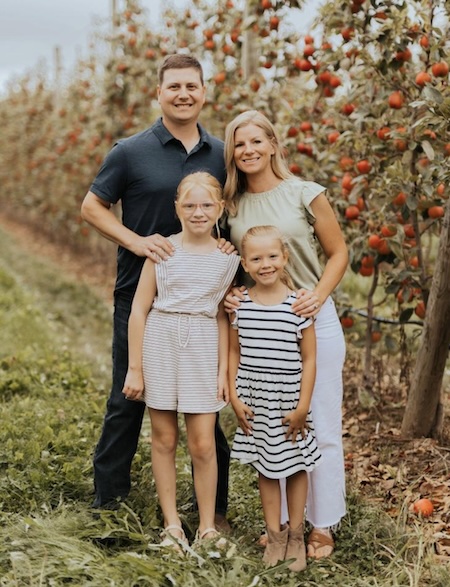
Bobby and Beth Brown are shown with their daughters Emaline and Addison.

The June/July print issues of American Fruit Grower and Western Fruit Grower will feature Brown on its cover. The publications will formally present the award to Brown on July 17 at the Orleans County Apple Social.

Brown, 42, grew up on the grounds of Orchard Dale and worked closely with his late father Bob Brown and his uncle Eric Brown. The younger Brown graduated from Cornell in 2006 and returned to the 400-acre apple business. Bobby’s wife Beth joined the operation in 2013.

American Fruit Grower quotes Jim Bair, President and CEO of the U.S. Apple Association, touting Brown’s long family commitment to the apple industry.

“Bobby is not one to rest on family laurels,” Bair told the magazine. “His support for research, IFTA, and food safety prove his commitment to the industry and his fellow growers. Bobby was one of the first growers I met when I came to USApple. He impressed me then — and still does today.”

Brown has been a leader among the growers, serving with USApple, New York Apple Association, Farm Credit East, Lake Ontario Fruit (current president), Natural Resources Conservation Service, Horticultural Society, and the New York State Apple Research Development Program (current chairman).

Brown received nominations for the award from all sectors of the Western New York apple-growing community.

“He realizes that we all need each other for the western New York apple industry to thrive and survive these uncertain times,” said Michael Keller, Sustainable Agriculture Specialist with Valent U.S.A. “Bobby is always one the first people to step up when issues arise, and he often takes point on many of these challenges. I think he believes that we all need to work together for the apple industry to run properly, and he’s willing to do whatever is needed to ensure the future of New York-grown apples.”

American Fruit Grower shares testimonials from other growers, includign Rod Farrow of Fish Creek Orchards in Waterport: “His development of new high-density super-spindle orchards is second to none in the U.S., and their farm is often a highlight of local, national, and international tours.”

Farrow said Brown has adapted the farm to new technologies, including precision spraying with vision data collection. Orchard Dale was one of the first farms to implement precision crop load management technologies, such as ATV-mounted cameras and drones.

Jason Woodworth of Lamont Fruit Farm in Waterport praises Brown for leading Lake Ontario Fruit during an expansion and addition of new employees.

Tenney says district will benefit from new Farm Bill that passes House

Posted 1 May 2026 at 8:56 am

Press Release, Congresswoman Claudia Tenney

WASHINGTON, DC – Congresswoman Claudia Tenney (NY-24) on Thursday applauded House passage of H.R. 7567, the Farm, Food, and National Security Act of 2026, legislation that strengthens support for American farmers, bolsters rural communities, and reinforces agriculture as a core component of national security.

The Farm, Food, and National Security Act (Farm Bill) reauthorizes key U.S. Department of Agriculture programs through 2031, modernizes farm policy, and strengthens the agriculture safety net to help producers navigate rising costs, market uncertainty, and supply chain disruptions.

The legislation includes major investments in conservation, crop insurance, rural development, and agricultural research, while promoting U.S. exports and reducing regulatory burdens. It also enhances oversight of foreign ownership of American farmland and reinforces agriculture as a national security priority.

As part of the bill, Congresswoman Tenney secured adoption of her Fairness in Vineyard Data Act, which requires the U.S. Department of Agriculture to produce a comprehensive report on national grape production. The report will include detailed data on total acreage, production levels, utilization, acreage by grape type and variety, as well as county-level breakdowns and planting timelines. This data will provide greater transparency and market insight for our viticulturists, including those in the Finger Lakes region, and allow USDA to better support our vineyards.

“House Republicans are backing the farmers and ranchers who feed, fuel, and sustain this country,” said Congresswoman Tenney. “This Farm Bill delivers real support for producers facing rising costs and uncertainty, while strengthening the tools they need to manage risk and stay competitive.

“In districts like mine, where agriculture drives our economy, this legislation helps ensure our farmers and family farms can continue to grow, hire, and invest in their communities. It also takes important steps to protect American farmland from foreign adversaries, such as the CCP, and reinforces that agriculture is national security. This legislation puts our farmers first and makes sure the United States remains a global leader in food production.”

Tenney says Canada using unfair trade practices on U.S. agriculture

Posted 22 April 2026 at 5:05 pm

Press Release, Congresswoman Claudia Tenney

WASHINGTON, DC – Congresswoman Claudia Tenney (NY-24) today questioned United States Trade Representative Jamieson Greer during a House Ways and Means Committee hearing on the Administration’s 2026 Trade Policy Agenda, highlighting Canada’s refusal to substantively engage on longstanding trade barriers harming Upstate New York producers.

During the hearing, Congresswoman Tenney highlighted Canadian actions that are devastating NY-24 producers, including Canadian restrictions and prohibitions on the export of dairy, wine and bulk produce.

These issues are all highlighted in the National Trade Estimate Report as foreign trade barriers harming the U.S.-Canada relationship. These policies, Tenney emphasized, are placing Upstate New York farmers and producers at a competitive disadvantage despite repeated U.S. efforts to resolve these issues through negotiation.

As Ambassador Greer stated “I think we’re kind of at the end of our rope… there are two countries that have retaliated economically against the United States in the past year: The People’s Republic of China and Canada. So that’s kind of the company they’re running in.”

“Upstate New York farmers and producers are some of the best in the world, but they are not getting a fair shot,” said Congresswoman Tenney. “Canada continues to block our dairy, our wine, and our produce while expecting free and open access to our markets. That is not how a fair trade relationship works. I hear from these producers every day, and they are frustrated because of Canada’s discriminatory treatment and refusal to engage on these issues meaningfully and substantively. We need to hold Canada accountable, strengthen USMCA, and make sure our farmers and businesses can compete and win in the international marketplace.”

CCE offering ‘Farming Under Pressure’ workshop for stress management, suicide prevention

Posted 27 February 2026 at 9:32 am

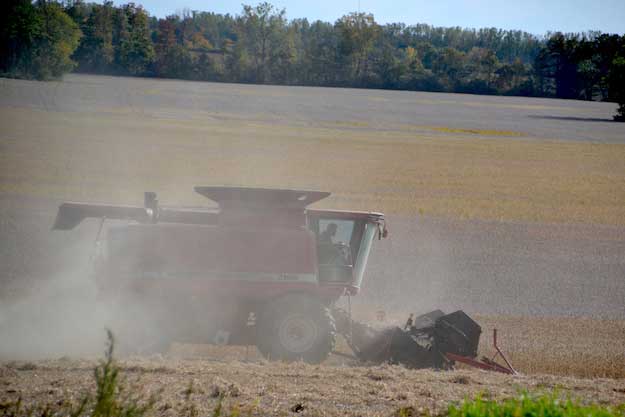
Photo by Tom Rivers: A farmer harvests soybeans on East Barre Road in Barre on Oct. 13, 2019.

Press Release, Cornell Cooperative Extension in Orleans County

KNOWLESVILLE – “Farming Under Pressure,” a stress management and suicide prevention workshop designed for farmers, farm families, growers, and agricultural professionals will occur at the Orleans County Fairgrounds.

The workshop will take place on March 19 beginning 8:30 a.m. at 12690 State Route 31, Albion, in the Harrington Classroom. The presentation is open to growers and members of the public.

This educational session will feature speakers from FarmNet and GOW Pathway to Hope. Together, they will address the unique pressures facing those in agriculture and provide practical tools to support mental wellness in farming communities.

Topics will include:

  • Common stressors in agriculture and how they impact mental health
  • Practical stress management tools participants can use immediately
  • Warning signs of suicide risk
  • How to start conversations and support someone who may be struggling
  • Available local and regional resources for farmers

Farming is demanding work. Long hours, financial pressure, isolation, and unpredictable conditions can take a toll. This workshop is designed to provide practical guidance in a respectful, stigma free environment and to strengthen support networks within the agricultural community.

The program is offered in partnership with FarmNet, Tobacco-Free, and GOW Pathway to Hope.

There is no cost to attend. Pre-registration is not required.

For more information, contact Orleans County Cornell Cooperative Extension at 585-798-4265, orleans@cornell.edu or visit https://cce.cornell.edu/orleans.

USDA distributing $1 billion for specialty crop growers due to market disruptions

Posted 13 February 2026 at 7:37 pm

Apples, onions, cabbage among the crops eligible for payments

Press Release, US Department of Agriculture

WASHINGTON – U.S. Secretary of Agriculture Brooke L. Rollins announced that the U.S. Department of Agriculture (USDA) is providing $1 billion in Assistance for Specialty Crop Farmers Program assistance for specialty crops and sugar, commodities not covered through the previously announced Farmer Bridge Assistance (FBA) program.

These one-time bridge payments will help address market disruptions, elevated input costs, persistent inflation, and market losses from foreign competitors engaging in unfair trade practices that impede exports. Specialty crop producers have until March 13 to report 2025 acres to USDA’s Farm Service Agency.

“President Trump has the backs of our farmers, and today we are building on our Farmer Bridge Assistance program with the Assistance for Specialty Crop Farmers Program,” said Secretary Rollins. “Our specialty crop producers continue to feel the negative effects of four years under the Biden Administration, suffering from record inflation, a depleted farm safety net, and delayed disaster assistance.”

The Assistance for Specialty Crop Farmers Program is authorized under the Commodity Credit Corporation Charter Act and will be administered by FSA.

Eligible Specialty Crops

  • Almond, Apple, Apricot, Aronia berry, Artichoke, Asparagus, Avocado
  • Banana, Bean (Snap or green; Lima; Dry edible), Beet (Table), Blackberry, Blueberry, Breadfruit, Broccoli (including Broccoli Raab), Brussels Sprouts
  • Cabbage (including Chinese), Cacao, Carrot, Cashew, Cauliflower, Celeriac, Celery, Cherimoya, Cherry, Chestnut (for Nuts), Chive, Citrus, Coconut, Coffee, Collards (including Kale), Cranberry, Cucumber, Currant
  • Date, Dry Edible Beans and Peas
  • Edamame, Eggplant, Endive
  • Feijou, Fig, Filbert (Hazelnut)
  • Garlic, Gooseberry, Grape (including Raisin), Guava
  • Horseradish
  • Kiwi, Kohlrabi
  • Leek, Lettuce, Litchi
  • Macadamia, Mango, Melon (All Types), Mushroom (Cultivated), Mustard and Other Greens
  • Nectarine
  • Okra, Olive, Onion, Opuntia
  • Papaya, Parsley, Parsnip, Passion Fruit, Pea (Garden; English or Edible Pod; Dry edible), Peach, Pear, Pecan, Pepper, Persimmon, Pineapple, Pistachio, Plum (including Prune), Pomegranate, Potato, Pumpkin
  • Quince
  • Radish (All Types), Raspberry, Rhubarb, Rutabaga
  • Salsify, Spinach, Squash (Summer and Winter), Strawberry, Suriname Cherry, Sweet Corn, Sweet Potato, Swiss Chard
  • Taro, Tomato (including Tomatillo), Turnip
  • Walnut, Watermelon

ASCF payments are based on reported 2025 planted acres. Eligible farmers should ensure their 2025 acreage reporting is factual and accurate by 5 p.m. ET on March 13.

Commodity-specific payment rates will be released by the end of March. Crop insurance linkage will not be required for the ASCF Program. However, USDA strongly urges producers to take advantage of the new One Big Beautiful Bill Act (OBBBA) risk management tools to best protect against price risk and volatility in the future.

More information on ASCF is available online at www.fsa.usda.gov/fba or producers can contact their local FSA county office.

Gillibrand urges USDA to expedite payments to farmers, increase funding to specialty crops

Posted 14 January 2026 at 1:08 pm

Press Release, U.S. Senator Kirsten Gillibrand

WASHINGTON, D.C. – U.S. Senator Kirsten Gillibrand (D-NY) joined Senators Amy Klobuchar (D-MN) and Elissa Slotkin (D-MI) and nine of their Senate Democratic colleagues in pressing U.S. Department of Agriculture (USDA) Secretary Brooke Rollins to expedite and increase payouts, especially for specialty crop farmers, in disaster and economic assistance programs in the face of trade uncertainty, rising input costs, and natural disasters.

“Farmers across the country and in New York are facing soaring input costs, increasing uncertainty caused by this administration, and the growing impacts of natural disasters, and they cannot afford further delays in critical assistance,” said Senator Gillibrand. “New York’s farmers are the backbone of our Upstate economy, and I will continue pushing this administration to ensure farmers in New York and across the nation have the resources they need to thrive.”

“As farmers face continued trade uncertainty, rising input costs, and natural disasters, we encourage you to expedite economic and disaster assistance that will benefit all farmers, including specialty crop growers,” wrote the senators. “While significant assistance flowed quickly to farmers in the summer and fall, payments were limited to 35 percent of approved applications.”

“As a result, less than $6 billion out of the $16 billion available has been paid out to farmers more than a year after Congress provided the funds and nearly three years after some farmers faced losses,” the senators continued. “Farmers are talking to their lenders right now to make plans. Adjusting the factor and making additional top-up payments now will expedite assistance now when farmers need it most.”

The senators also highlighted that of “the Farmer Bridge Assistance program of $12 billion, just $1 billion of that total is for specialty crops, sugarbeets, and other crops.” The senators urged USDA to develop “a program that reflects the unique needs of specialty crop growers. We also encourage you to ensure this assistance truly meets the needs of all farmers.”

Along with Gillibrand, Klobuchar and Slotkin, the letter was signed by Senators Michael Bennet (D-CO), Cory Booker (D-NJ), Chris Van Hollen (D-MD), Tammy Duckworth (D-IL), Tina Smith (D-MN), Ben Ray Luján (D-NM), Raphael Warnock (D-GA), Adam Schiff (D-CA), and Angela Alsobrooks (D-MD).

USDA sets payment rates per acre for $12 billion ‘Farmer Bridge Assistance Program’

By Tom Rivers, Editor Posted 5 January 2026 at 8:34 am

The U.S. Department of Agriculture has announced the per-acre payment rates in the $12 billion Farmer Bridge Assistance Program.

The money comes at a time for a reeling agricultural sector that is seeing higher costs from tariffs and inflation, and shrinking markets for their crops, especially from a trade war with China.

“These one-time payments give farmers the bridge to continue to feed and clothe America and the world while the Trump Administration continues opening new markets and strengthening the farm safety net,” U.S. Secretary of Agriculture Brooke L. Rollins said on Dec. 31. “USDA is making this process as simple and seamless as possible so producers can focus on what they do best – feeding and fueling our nation.”

The funding includes $11 billion in one-time payments.

These are payment rates per acre for the FBA eligible commodities:

  • Barley: $20.51
  • Canola: $23.57
  • Chickpeas (Large): $26.46
  • Chickpeas (Small): $33.36
  • Corn: $44.36
  • Cotton: $117.35
  • Flax: $8.05
  • Lentils: $23.98
  • Mustard: $23.21
  • Oats: $81.75
  • Peanuts: $55.65
  • Peas: $19.60
  • Rice: $132.89
  • Safflower: $24.86
  • Sesame: $13.68
  • Sorghum: $48.11
  • Soybeans: $30.88
  • Sunflower: $17.32
  • Wheat: $39.35

The remaining $1 billion of the $12 billion in assistance is reserved for specialty crops and sugar. Timelines for payments to producers of these crops are still under development and require additional understanding of market impacts and economic needs, the USDA said.

In Orleans County, the top crops in acres include 39,354 in corn for grain, 24,739 in soybeans for beans, 14,208 for vegetables, 11,590 in forage (hay/haylage), and 6,953 acres of apples, according to the county’s 20122 census of agriculture.

That census reported there are 444 farms in Orleans County that generated a market value of $223.6 in farm products in 2022. The $233.6 million in Orleans ranked 15th highest out of the 62 counties in the state.

Kludt third in state in corn yield contest, tops 300 bushels

By Tom Rivers, Editor Posted 23 December 2025 at 9:22 pm

KENDALL – Matt Kludt of Kludt Brothers Farm is back on the leaderboard among the top corn growers in the state.

Kludt finished third in New York with 307.8705 bushels in strip-till, minimum-till, mulch-till, ridge-till non-irrigated class.

Matthew Swede of Piffard was first at 311.2497 bushels, with Ryan Swede of Pavilion second at 309.0837 bushels.

Kludt won the state title three straight from 2014 to 2016.

The National Corn Growers Association has held the yield contest for 61 years. This year there were nearly 7,800 entries from farmers in 47 states. Entrants across 10 production categories had verified yields averaging 269 bushels per acre.

The highest yield for the year came out of Charles City, Virginia – 572.2589 bushels per acre in Class H (strip-till irrigated) for David Hula.

“The Yield Contest is really about finding out what this crop is capable of,” said Ohio grower and NCGA President Jed Bower. “And as corn farmers, we get to show what we’re made of, too. It challenges participants to find innovative ways to succeed and contribute to decades of agronomic data that prove that American farmers are great at what we do.”

The winners will be honored at the Commodity Classic in San Antonio, Texas, from February 25-27.

NY Farm Bureau lists state legislative priorities for 2026

Posted 18 December 2025 at 3:42 pm

Organization states support for nuclear energy, ‘strongly opposes’ all-electric mandates

Press Release, New York Farm Bureau

ALBANY — New York Farm Bureau has announced its state legislative priorities for 2026. These priorities are based on grassroots policy development over the course of the past year, which culminated at the organization’s State Annual Meeting earlier this month. Delegates from 50 counties discussed and voted on a number of wide-ranging issues at the meeting.


NYFB public policy staff identified NYFB’s priority issues as those listed below.

  • Support critical funding for current agricultural animal health, promotion, research and environmental programs in the final FY 26/27 state budget.
  • Support for a significant funding investment in the Cornell University College of Agriculture and Life Science to forward its mission of collegiate agricultural education, research and extension.
  • Extend the refundable investment tax credit and allow construction costs for farmworker housing to be eligible for the tax credit.
  • Move the administration of product marketing and research orders from Empire State Development to the Department of Agriculture and Markets.
  • Remove the requirement for overtime payment on the weekly consecutive 24-hour rest period when total work hours are still below the overtime threshold.
  • Support legislation that would develop a Clean Fuel Standard.
  • Support funding for the NY Center for Agricultural Medicine and Health to do research and promote education on temperature-related working conditions before any legislation (such as the Temperature Extreme Mitigation Program Act) is passed.
  • Support the exemption of agricultural businesses from Extended Producer Responsibility legislation until a cost-effective and practical agricultural recycling program is established and funded by the state.
  • Support mandating that fire, rescue, library and other ad valorem taxing districts use agricultural assessment values when calculating property taxes.
  • Support renewable energy policies that incorporate common-sense timeframes for adoption based upon grid capacity and support for the use of other energy sources including nuclear. Strongly oppose all-electric mandates and bans on the use of propane, wood burning, oil or natural gas appliances.

NYFB will release federal legislative priorities by early spring.