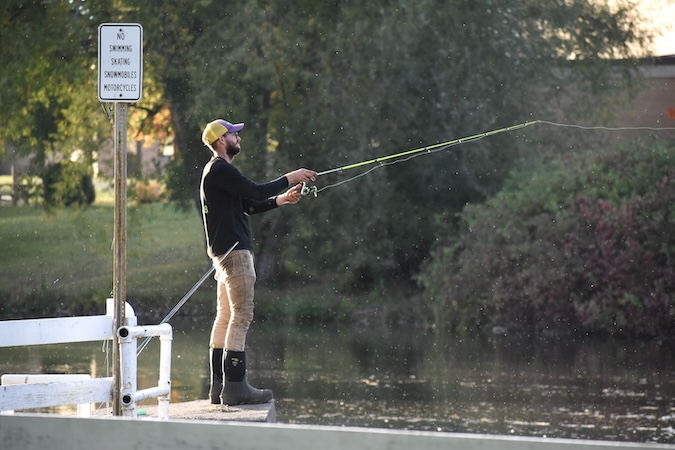
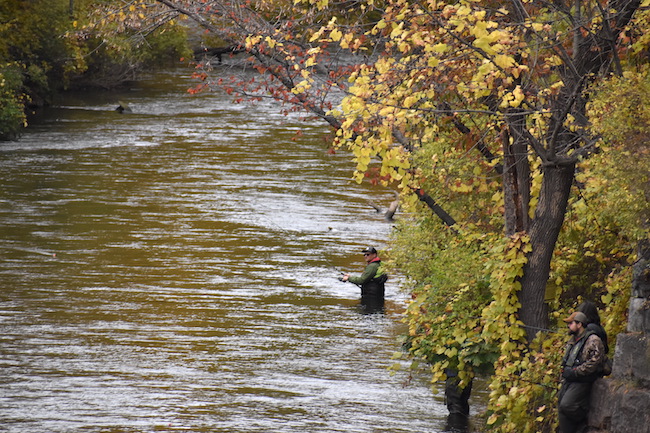
Photo by Tom Rivers: Dylan Cote of Pavilion casts a line out on at Johnson Creek in Lyndonville on Oct. 10. This is a spot near the top of waterfalls at the dam.
Press Release, NYS Department of Environmental Conservation
New York State Department of Environmental Conservation Commissioner Amanda Lefton today announced that a Free Fishing Weekend in New York State will take place June 27–28.
The weekend is part of six designated Free Fishing Days that take place each year in New York State. During these days, the fishing license requirement is waived for freshwater fishing on New York’s waters.
“With summer officially here, the timing of these free fishing days couldn’t be better,” said Commissioner Lefton. “New York is home to thousands of angling opportunities across our abundant freshwater lakes, ponds, streams, and rivers. Fishing is an affordable and rewarding pastime and I encourage everyone to get outside and visit New York’s waters during this Free Fishing Weekend.”
DEC’s Free Fishing Days program began in 1991 to give New Yorkers who might not fish a chance to try the rewarding sport of freshwater fishing at no cost, introduce people to a new hobby, and encourage people to support conservation by purchasing a New York State Fishing License.
Free Fishing Day participants are reminded that although the requirement for a freshwater fishing license is waived during free fishing days, all other fishing regulations remain in effect. Outside of free fishing days, anglers over the age of 16 must have a valid fishing license.
The remaining Free Fishing Days of 2026 will take place on September 26 (National Hunting and Fishing Day) and November 11 (Veterans Day).
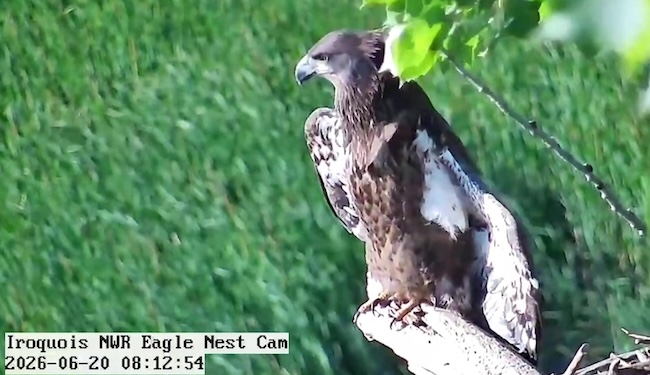
Photo from Pixcams, Inc.: The eaglet featured on a nest cam at the Iroquois National Wildlife Refuge has been named Skanon. The eaglet took flight for the first time on Sunday.
By Dick Moss, president of Friends of Iroquois National Wildlife Refuge
BASOM – The eaglet that has been the focus of attention at Iroquois National Wildlife Refuge took flight for the first time Sunday morning.
The fledging occurred just a day after Amy Merritt of Corfu, a member of Friends of Iroquois National Wildlife Refuge (FINWR) and one of the lead eagle camera moderators, announced the eaglet’s new name.
The name is Skanon (pronounced Skä•noñh), a name with deep Seneca roots meaning peace and wellness. It was suggested by FINWR board member Marvin Jacobs of Cheektowaga, an elder of the Seneca Wolf Clan, and was one of three names that interested observers chose among.
Skanon has many meanings and also expresses: Continuance — the idea that life, culture, and responsibility carry forward; as well as journey — walking a path guided by the Great Law of Peace.
Skanon spread her wings and took off from the nest at 7:31 a.m. Sunday, aged 79 days, and swooped down toward the marsh. She returned later in the morning after her adventure, and settled for a time on a branch near the bald eagle camera operated by FINWR before returning to the nest.
“Skanon had what we call an intentional fledge,” Merritt said. “She wanted to fly! You look for a poop shoot first, she will extend her neck out looking for a target, judging distance, wings extended. Then a spring from the legs, as if you were jumping off a diving board!”
The name was chosen from among three possibilities by FINWR members, participants in the eagle cam chat and followers of FINWR’s web pages who made a small donation to the nonprofit to participate in the voting. The other two options were Oneida and Casey.
FINWR’s eagle camera committee also named Skanon’s parents Cayuga and Seneca, in tribute to the Haudenosaunee legacy of the land the refuge sits on.
The mother bald eagle, previously designated IF1, will now be known as Cayuga — a name rooted in the People of the Great Swamp, reflecting strength, resilience, and deep connection to the waters and wetlands that cradle this nest.
The father, previously IM1, will now be known as Seneca — honoring the Keepers of the Western Door, a name that carries the spirit of guardianship, wisdom, and watchful protection.
Merritt said that in the post-fledge period, expect Cayuga and Seneca to continue to bring food to the nest, or wherever Skanon happens to be.
“She will explore, as she did today,” Merritt said.
“She seems to be a strong flyer,” said FINWR Vice President Emma DeLeon of Williamsville, who has shared the main moderator duties with Merritt and is one of the people most responsible for the eagle camera and its setup. “Over the next 4-6 weeks, the parents will continue feeding her as she learns to hunt and scavenge. Gradually she will spend more time independently and more time outside of the parents’ territory. She will be fully independent and have left the territory by this fall.”
The eagle camera idea was born mostly from comments and feedback from visitors to the refuge Visitor Center asking if the original eagle cam was still working. It had stopped working over 20 years ago, said FINWR past president and current board member Garner Light of Gasport.
“The inquiries happened often enough that it seemed like a good idea to propose installing a new camera,” he said. “The camera was installed on a beautiful warm day in October of 2024. This was the culmination of a year’s worth of research, consultations, permissions, discussions and a lot of logistics.”
Many people were involved in making the camera a reality, among them the state Department of Environmental Conservation, U.S. Fish & Wildlife Service, Iroquois NWR management, Bill Powers of Pixcams Inc. of Export, PA, Treeman Tom LLC of Wilson, DeLeon and Light.
Dick Moss of Medina is president of Friends of Iroquois National Wildlife Refuge, a 501(3)c nonprofit, all-volunteer corporation that helps support and maintain the refuge for future generations.
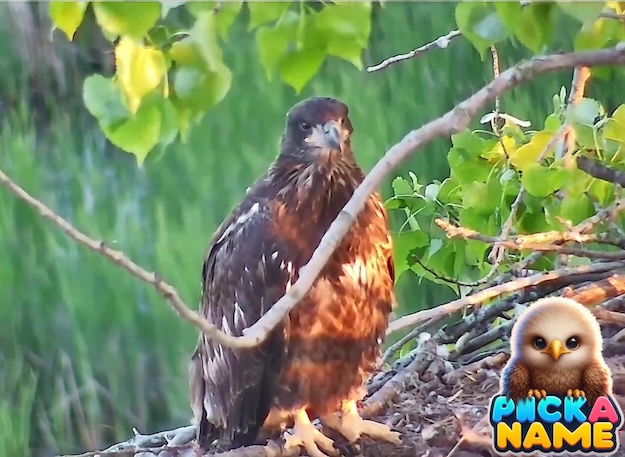
The Friends of the Iroquois National Wildlife Refuge invites the public to pick among three name options for an eaglet that hatched on April 3.
Photo and announcement from Friends of Iroquois National Wildlife Refuge
BASOM – Cayuga and Seneca’s beautiful eaglet is growing strong, and is almost ready to take flight! We’re excited to be launching a small naming fundraiser. Every vote supports the continued protection, monitoring, and storytelling of this remarkable eagle family.
Name choices are Inspired by the Land and Its legacy:
Oneida — Honoring one of the original Haudenosaunee nations, symbolizing unity, endurance, and deep cultural roots.
Casey — A tribute to Casey Road, where the headquarters stands watch over the refuge, grounding the eaglet’s story in the very place that protects it.
Skanon — A Seneca Nation word meaning peace and wellness, reflecting the calm strength and timeless cycle of life carried forward in this nest.
To cast your vote visit our website donation page (click here) make a suggested $5 donation and write your choice for the name into the “specific cause” box.
Together, we honor the land, the culture, and the future, taking wing right before our eyes!
A link to the bald eagle nest camera can be found at the Friends website, FINWR.org.
By Tom Rivers, Editor Posted 21 May 2026 at 9:25 am
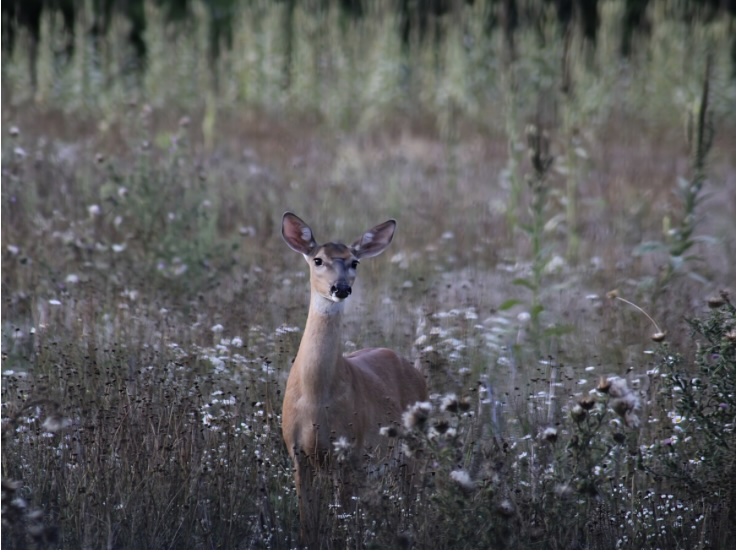
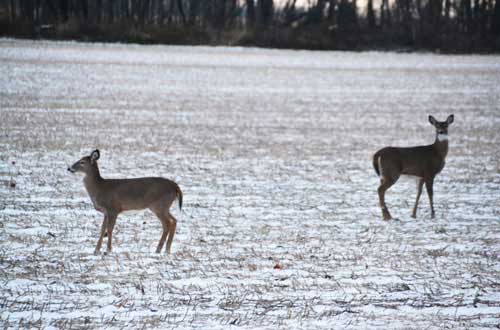
Robbie Weit took this photo of a deer. This image was the November cover in Orleans County’s 2026 calendar put together by the county tourism department.
The New York State Department of Environmental Conservation is reporting hunters harvested 227,032 white-tailed deer during the 2025-26 hunting seasons, 2 percent more than the 2024 season and within 1 percent of the 5-year average.
The DEC recorded 4,494 deer taken in Orleans County in 2025, including 1,911 adult male, 232 male fawn, 2,087 adult female, and 264 female fawn.
The DEC documented widespread adoption of crossbows following an amendment to the Environmental Conservation Law in 2025 that allowed deer hunters to use a crossbow in the same seasons, places, and manner as a vertical bow.
In 2025, crossbows accounted for 55% of the total archery season deer harvest. For comparison, in 2024, crossbows accounted for 33% of the total archery harvest, the DEC reported.
“It is clear that deer hunters took advantage of expanded crossbow hunting opportunities this past season,” said DEC Commissioner Amanda Lefton. “We are pleased that more hunters can participate in New York’s archery deer seasons and contribute to effective deer management into the future. The results from this past season continue to demonstrate that New York has much to offer for deer hunters.”
NYS calculated deer take in recent year:
2025 – 227,032
2024 – 223,304
2023 – 209,781
2022 – 231,961
2021 – 211,269
2020 – 253,990
2019 – 224,190
The biggest year in recorded history is 2002 with 308,216 deer harvested.
Other highlights from the 2025 report include:
The 2025 antlered buck harvest of 120,909 was 1% less than 2024, but finally passed a landmark in buck age structure. For the first time in modern history, New York hunters harvested as many 3.5-year-old or older bucks (28.1%) as yearling bucks (28.0%). For comparison, 25 years ago only 10% of harvested bucks in New York were 3.5 years old or older and 67% were 1.5 years old.
The 2025 antlerless deer harvest of 106,123 was up 5% from 2024. However, antlerless deer harvest throughout much of New York was still below what is necessary to achieve deer population objectives, the DEC said.
No wild deer tested positive out of 3,050 tests for Chronic Wasting Disease, as efforts continue to “Keep NY’s wild deer CWD-free.”
530,808: The number of licensed NY hunters during the 2025 deer hunting seasons, an estimated 85% of whom actively participated in deer hunting.
11%: The estimated percentage of hunters who used the newly-offered E-tags for all of their 2025 deer hunting. An additional 19% of hunters used a combination of E-tags and paper tags throughout the hunting seasons.
63%: The portion of successful deer hunters reporting their harvest as required by law. This is well above the five-year average of 49%.
2,567: The estimated deer harvest by 12–15-year-old hunters during the Youth Firearms Season.
Photos and information from Friends of Iroquois National Wildlife Refuge
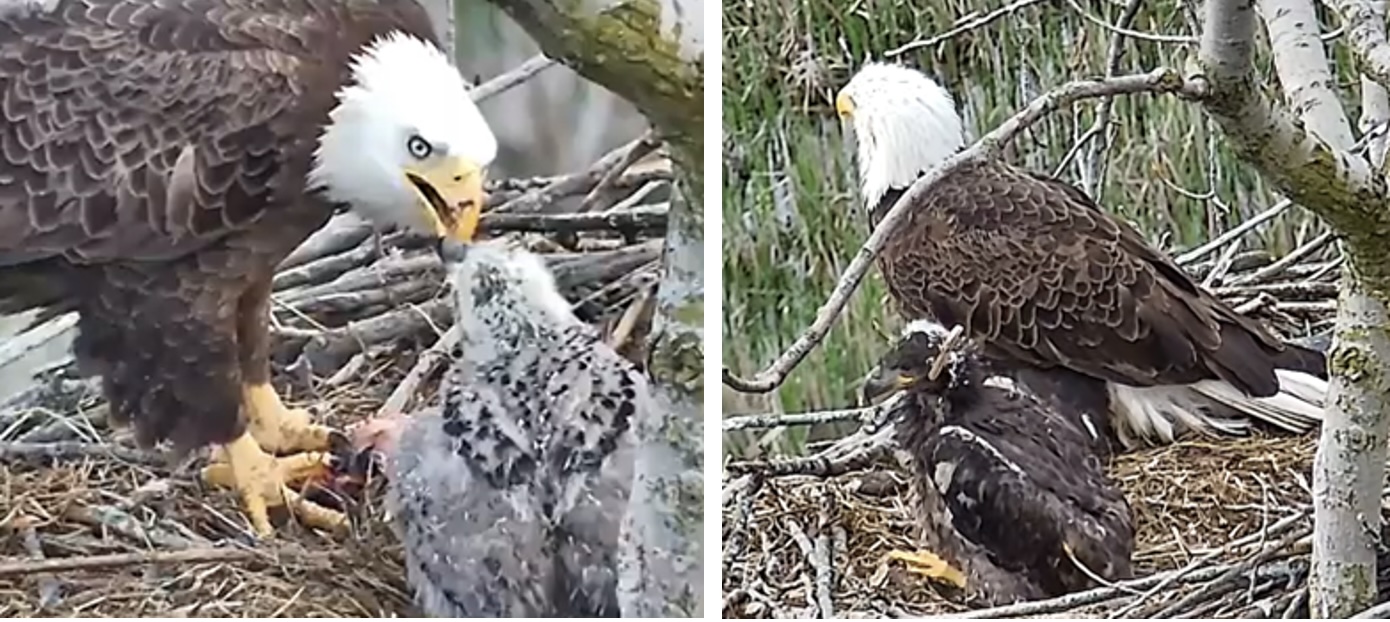
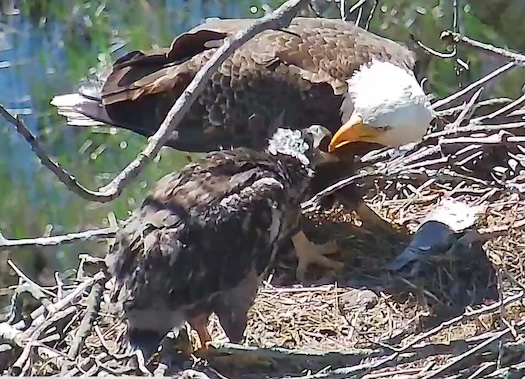
The eaglet at Iroquois National Wildlife Refuge that many have been following through the bald eagle nest camera was 38 days old as of Monday and is growing by leaps and bounds.
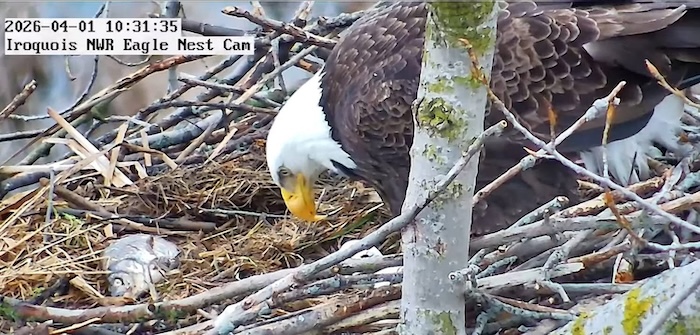
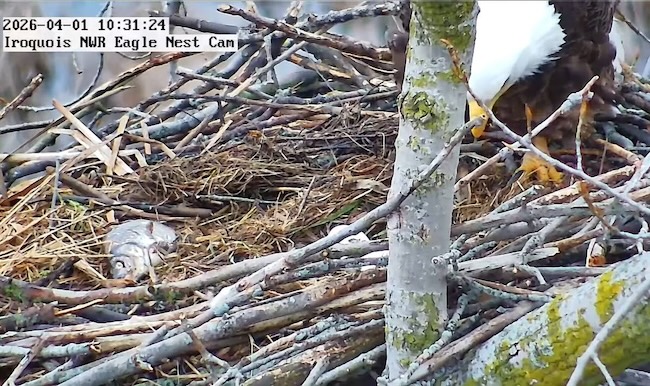
Just like human babies, the eaglet is doing a lot of eating and sleeping. Sometimes both: Mother eagle brought in a juicy catfish the other day and the chick wasn’t hungry so used the catfish for a pillow – at least when the catfish stopped flopping about. Another time father eagle brought in a stick, disappointing the chick who was looking for some fish bits.
As an only chick, the eaglet is being fed very well so is growing fast and hitting all its important behavioral and physical milestones.
It is taking much larger bites of food, including being able to digest fur, feathers, scales and small bones. It reaches toward the parents and pecks at them to ask for food. It partly helps itself by picking up and eating dropped pieces of food. Its body feathers are growing in and the primary flight feathers can be seen poking out of the sheathes at the wings and tail.
The eaglet is also entertaining camera viewers with more “wingersizing” – an eagle version of calisthenics. It is gaining more strength in its legs, and you will see the eaglet standing up more often. Once it gains more stability in those legs ─ “riding the rails” is a term used on eagle cameras ─ the chick will start to perch near or on the sticks surrounding the bole.
The camera was funded and installed by the Friends of Iroquois National Wildlife Refuge, with assistance from Pixcams Inc., out of Pittsburgh, and Treeman Tom tree service out of Wilson. You can watch the feed on a monitor in the refuge Visitors Center on Casey Road in the town of Alabama, or through a link at the Friends group’s website, FINWR.org.
If you’re keeping track, the eaglet is about halfway through its nestling phase.
Next the eaglet will be doing more standing and walking in the fully upright adult posture instead of scooting around using its hocks and wings. It is already starting to do this, but it will happen more often. In the next few weeks, it will also start doing more practice flapping to build breast and wing muscles.
In about four weeks it will start hopping and flapping to practice hovering above the nest. At this point its feathers will be much more grown in and the bird will be fully dark brown. It will also be able to feed itself from prey items brought to the nest, although the parents will continue to feed it.
Toward the end of June, the juvenile will be able to balance and perch on branches, hover reliably above the nest and flap from branch to branch. The primary wing and tail feathers will be almost entirely grown. It should fledge (be ready for its first real flight) in late June or early July at around 72 days old.
The eaglet will typically hang around a few weeks after fledging but then head off to seek its own territory. It will retain its dark brown coloring for several years and won’t develop its adult plumage ─ the iconic white head and tail feathers of a bald eagle ─ until it’s almost five years old. Until then it is scoping out other territories, play learning with other juveniles and perfecting its hunting techniques.
A final note: Friends group President Dick Moss would like to thank everyone who came out to Iroquois National Wildlife Refuge for Saturday’s Spring Spectacular. Everyone had a great time and the eaglet and its parents were one of the main topics of conversation.
“A special thanks to the vendors who shared their environmental expertise, and especially to the refuge staff who made it all possible,” Moss said.
This eaglet update was a collaboration of Friends of Iroquois NWR group members Dick Moss, Emma DeLeon, Amy Merritt and Garner Light.
Courtesy of Pixcams, Inc. – The eaglet who is the focus of the Iroquois refuge’s nest camera has been growing by leaps and bounds. The chick hatched on April 3.
Press Release, Friends of the Iroquois National Wildlife Refuge
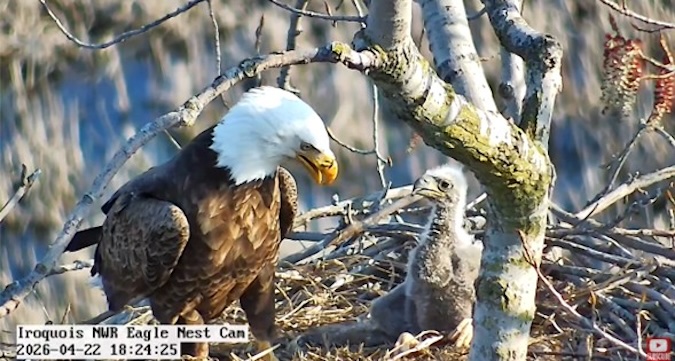
BASOM – The baby eaglet that’s in focus at Iroquois National Wildlife Refuge is now over two weeks old, is getting a lot bigger and is entertaining nest cam watchers with its antics.
The eaglet is in a nest that belongs to one of several nesting pairs of bald eagles at Iroquois National Wildlife Refuge, on the border of Genesee and Orleans counties. The nest camera was put in place and maintained by Friends of Iroquois National Wildlife Refuge, with the help of Pixcams, Inc., Treeman Tom and others.
The chick is standing upright more often and using its wings to move itself around and balance. It is much more aware of its surroundings and now reliably tracks the parents’ movements, approaches them for food and grabs it from them directly instead of waiting for them to place food in its mouth.
It is taking much bigger bites of food – most often fish, including a lot of carp ─ and eating larger, less frequent meals (separated by hours-long food comas!). You can usually see its visibly full crop.
The eaglet’s first wispy white down is being replaced by a more insulated grey thermal down so it can thermoregulate better and no longer needs to be incubated as intensively. You can sometimes see the father eagle, especially, since he’s the smaller parent, struggling to stuff the chick under him to brood. The chick is also doing some practice preening as its new feathers come in.
On these warmer days the parents have been leaving the chick alone in the nest for longer periods of time. When they aren’t on the nest at least one of them is usually on guard nearby. If viewers are seeing the parents gone for longer now, this is normal. The chick is much more independent and the adults are still out there guarding against predators and intruders.
The chick’s antics have included a “Lady and the Tramp” moment when the mother eagle had one end of a string of duck intestine and the chick had the other. To see moments like these, tune in the nest cam streaming through the link at FINWR.org.
A quick recap, for those who may not have been following along: Our eagle parents laid three eggs at the end of February and they hatched the first week of April. Unfortunately, two of the chicks died due to accidents in the nest. But that has left the middle chick, the one that survived, as the sole focus of mother and father and ─ without any competition ─ the recipient of an enormous amount of fish bits.
The chick’s flight feathers are beginning to emerge. In the next few weeks, it will develop more substantial feather growth on its head and back and will take on more of an “awkward teenager” look, and the parents will spend even less time brooding.
Around 5 to 6 weeks, the chick will start to stand more steadily and will begin wing flapping in earnest. At 6 to 8 weeks, the eaglet will get very large, almost adult sized. At 8 to 10 weeks – the end of May and beginning of June ─ it should be feathered enough to look like a dark juvenile bald eagle, and its first few unsteady flights might begin by mid-June. The typical fledgling window is 10-12 weeks after hatching. Even 4 to 6 weeks after fledging, roughly mid-July, the eaglet will still be dependent on its parents for food and flight training.
If all goes well, by late summer or early fall the chick will be a full juvenile and out on its own, but it won’t develop its white head and tail feathers until it’s 4 to 5 years old.
This article was a collaboration of Friends of Iroquois National Wildlife Refuge members Richard Moss, Emma DeLeon, Amy Merritt and Garner Light. If you have a bald eagle question for the team, send it to Richard Moss at heron@finwr.org and we may answer it in a future release.
Press Release, Friends of Iroquois National Wildlife Refuge
Photo shows screenshot taken from Pixcams. The second and remaining chick is being fed.
BASOM – A second eaglet has died in the bald eagle nest being watched at Iroquois National Wildlife Refuge.
The eaglet, the third chick to hatch, died at about the same age as the first one and in a similar manner.
In this case, the chick ended up falling out of the nest after getting going in the wrong direction.
“We are wondering if perhaps this being a newly built nest means it is shallower than most of the more established nests that are seen on cameras,” said Emma DeLeon, vice president of the refuge Friends group. “We could be seeing things happen that occur in nature regularly, but are not usually observed.”
The moderators of the eagle cam are sad about this unfortunate event but are rooting for INWR2, the second chick to hatch, who is still doing well.
INWR2 is almost twice as old as either of the chicks who died, so hopefully it is beyond the most dangerous phase.
“Please remember that what seems tragic to us is part of life for these eagles, and that the parents and remaining chick will continue on as before,” said DeLeon.
“Nature has its own way, and we can’t change that,” said Friends group President Richard Moss. “But we can continue to watch and learn from INWR2 and its parents.”
Egg 1 was laid on February 20, hatched April 1 and died April 6. Egg 3 was laid February 27, hatched April 7 and died April 12.
The remaining eagle chick was laid February 23 and hatched April 3, making it 10 days old today, or twice as old as its two siblings were when they died.
The Friends group’s Eagle Watches on Saturdays at the Cayuga Overlook are drawing a crowd — over 100 people this past weekend. And the Friends Facebook page, which tracks developments on the nest camera, has seen a dramatic increase in views and comments, Moss said.
A link to the bald eagle nest camera can be found at the Friends website, FINWR.org.
By Tom Rivers, Editor Posted 2 April 2026 at 2:29 pm
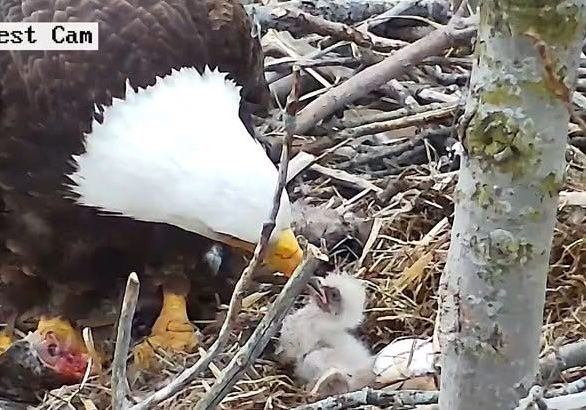
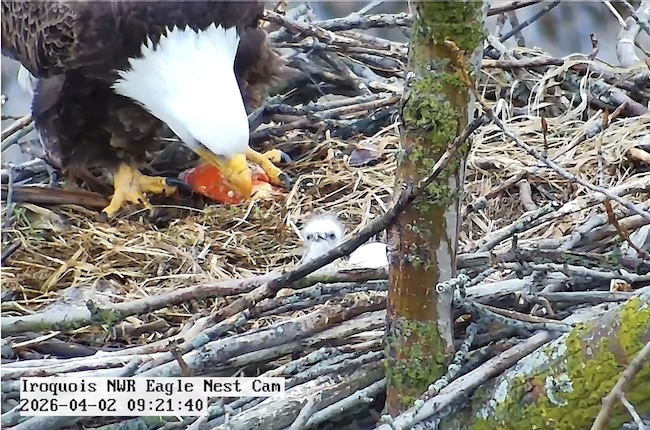
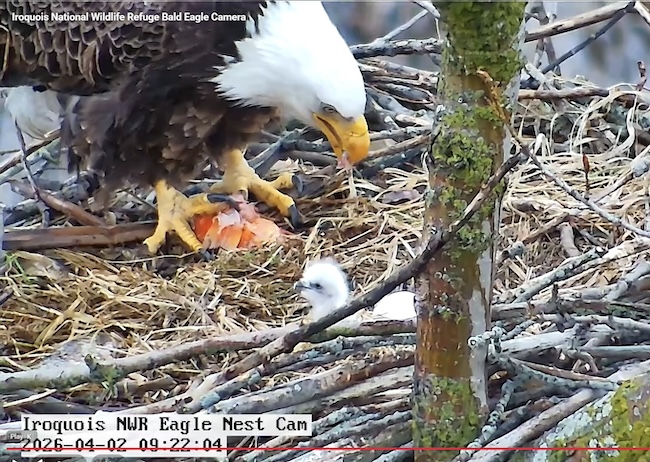
BASOM – These still photos from this morning show an eaglet making its debut in a bald eagle nest. Yesterday the eagle cam showed three eggs in the nest.
The eaglet was first seen on camera at 6:45 a.m. today, said Dick Moss, president of the Friends of the Iroquois National Wildlife Refuge.
The Friends have an eagle cam on the nest where people can check in for a livestream. There are two other eggs in the nest.
The first egg was laid at 5:06 p.m. February 20; the second at 5 p.m. February 23; and the third at 2:34 p.m. February 27.
Eagle eggs typically take 35 days or so of incubation before hatching.
Photos and press release from Friends of Iroquois National Wildlife Refuge
BASOM – A crack in the shell of a bald eagle egg was spotted and confirmed late Wednesday morning in Basom at the Iroquois National Wildlife Refuge.
The eagle parents and their nest have been the focus of a livestream run by the Friends of INWR.
There are three eggs in the nest. The first egg was laid at 5:06 p.m. February 20; the second at 5 p.m. February 23; and the third at 2:34 p.m. February 27.
Presuming the oldest egg is the one that cracked first, it took its time. Eagle eggs typically take 35 days or so of incubation before hatching.
To follow along with the eagle adventures, you can find a link to the livestream at FINWR.org.
By Tom Rivers, Editor Posted 24 March 2026 at 11:38 am
File photo by Tom Rivers: These deer are pictured on Nov. 20, 2014 when they were close to the road on the west side of Route 279 in Gaines, just south of Route 104.
The NYS Department of Environmental Conservation is reporting 2025 was the safest in New York’s recorded history with seven hunting-related shooting incidents.
Those incidents include five which were self-inflicted and two involved more than one person. One incident involved an unlicensed individual who was hunting illegally, the DEC said. There were no hunting-related shooting fatalities.
“The historic low number of incidents observed in 2025 demonstrates that hunting is safe and is getting safer thanks to the efforts of DEC’s Hunter Education Program, volunteer instructors, and the vigilance of New York’s hunters,” said DEC Commissioner Amanda Lefton. “In addition to being safe, hunting is ecologically important, helping manage wildlife populations, promoting conservation-related behaviors, and providing a local, affordable food source. I am proud of our team’s efforts to grow New York’s hunting community.”
Hunting remains one of the most popular forms of wildlife-related recreation in the state with nearly 600,000 New Yorkers participating annually, helping achieve state wildlife management objectives and safely enjoying time outdoors, the DEC said.
The DEC reported these hunting-related shooting incidents:
Small Game Hunting:
Jan. 3 in Ulster County – While rabbit hunting, a 60-year-old hunter slipped and unintentionally discharged a round of birdshot into their left forearm.
May 13 in Orange County – While turkey hunting, the 64-year-old shooter fired one round, striking the victim approximately 40 yards away with multiple pellets. The victim sustained injuries to their right eye, left ring finger and left shoulder. (The shooter was not legally hunting, and had no hunting license, but injured a legal hunter during an open hunting season.)
Sept. 27 in Livingston County – During squirrel hunting, the 28-year-old hunter was shot with one round of pellets, causing superficial penetrative injuries on the front of their body from chin to abdomen.
Big Game Hunting:
Oct. 30 in Erie County – A 59-year-old hunter sustained a self-inflicted crossbow injury to the left foot while afield hunting deer.
Nov. 15 in Sullivan County – While exiting the woods after deer hunting, a 46-year-old hunter’s holstered handgun discharged one round into the upper thigh.
Nov. 19 in Chautauqua County – While pulling a loaded firearm from a vehicle, the 14-year-old hunter unintentionally discharged one round, which entered and exited their mid-torso.
Nov. 21 in Delaware County – While tracking a deer, the 68-year-old hunter tried to remove a handgun from its holster and accidentally discharged a round into their left calf.
The seven incidents in 2025 follows 11 in 2024, and 12 in 2023. In 2020, there were 22 incidents. The 10-year average shows 12.7 incidents a year, according to the DEC.
There were no fatal incidents last year. There was one in 2024 and two in 2023.
State-wide there was 4 percent increase, with none taken in Orleans County
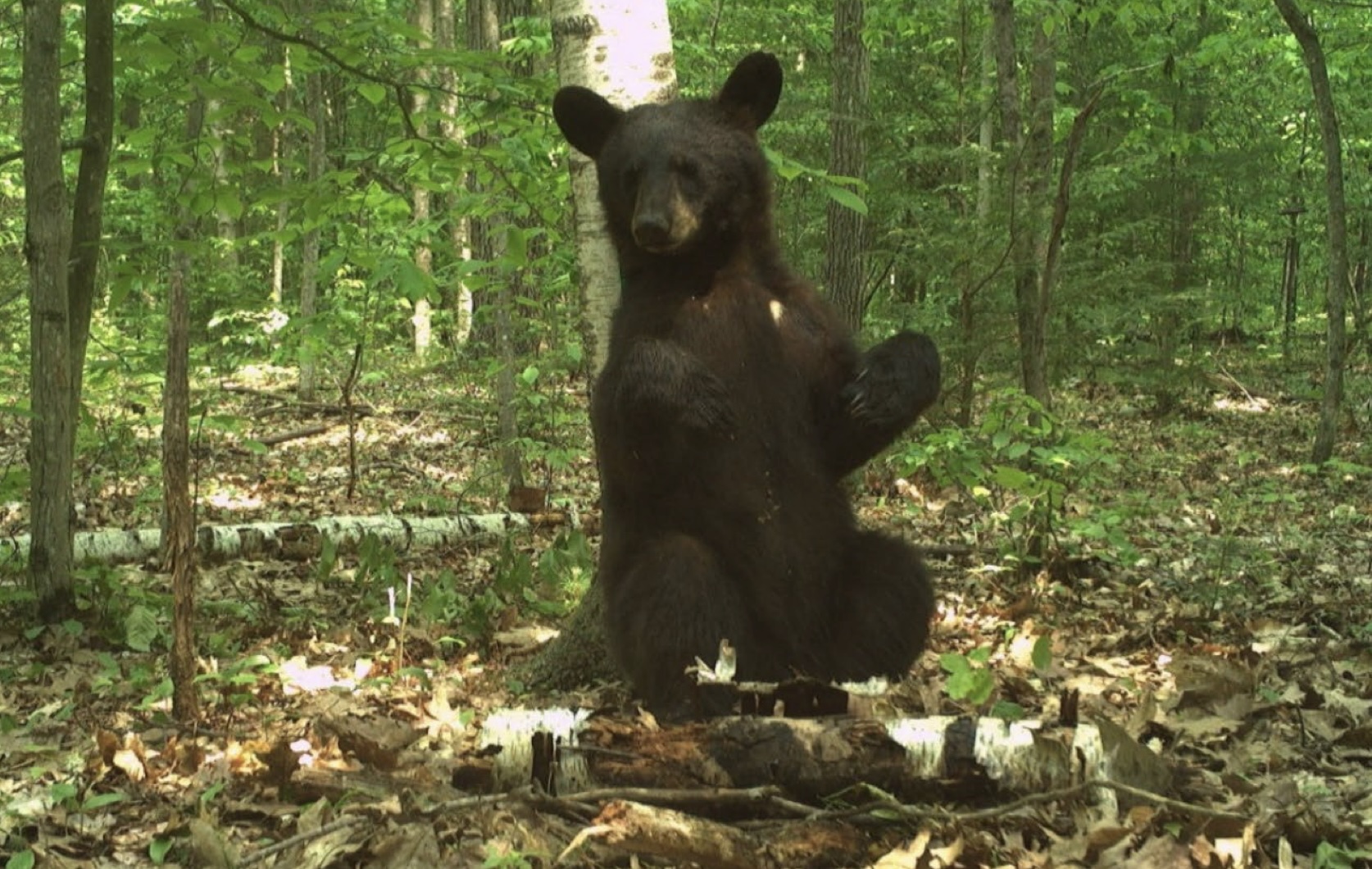
Photo from DEC: A bear marks a tree in Steuben County. This image was captured through Snapshot NY, a project launched in 2025 to monitor NY wildlife through remote cameras operated by DEC and citizen scientists.
Press Release, NYS Department of Environmental Conservation
New York State Department of Environmental Conservation (DEC) Commissioner Amanda Lefton today announced that hunters harvested an estimated 1,759 black bears during the 2025-26 hunting seasons, with none reported in Orleans County.
According to DEC’s tracking of the annual bear harvest since 1955 (PDF), the 2025 statewide bear harvest was second only to the 2003 season and Southern Zone estimates set a new harvest record.
“The recovery and growth of New York’s bear population is testament to DEC’s vigilant wildlife management efforts,” said Commissioner Lefton. “New York’s big game management plans help maintain populations at levels that are acceptable for local communities and provide sustainable hunting opportunities.”
Statewide, hunters harvested approximately 4% more bears than the 2024 season and 18% above the 10-year average. The Southern Zone take included an estimated 1,202 bears taken, including the 10 heaviest bears recorded for the year. The Northern Zone harvest estimate of 557 bears was slightly lower than 2024, but still above the 10-year average.
The record-setting bear season in the Southern Zone is the culmination of a long-term pattern DEC documented in New York’s bear populations. In the 1950s, bears only occupied the most remote and mountainous regions of New York, such as the Adirondack, Catskill, and Allegheny mountains. Over the past 70 years, bears gradually expanded their range in the State, and DEC began opening new areas for bear hunting.
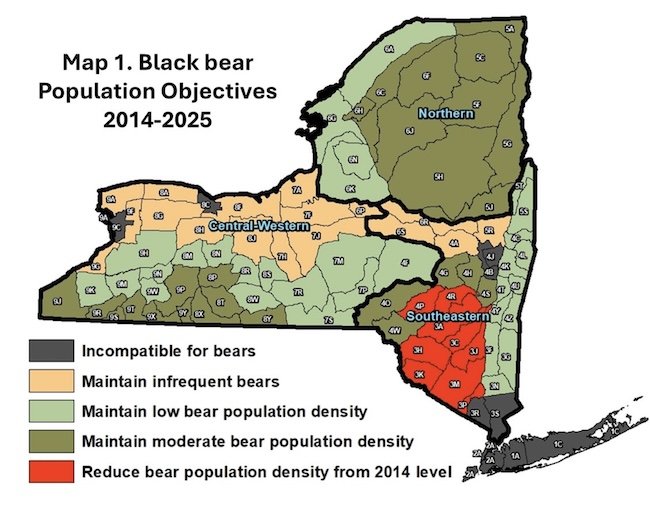
Map from NYS Department of Environmental Conservation
Bears now occupy most areas of the state except Long Island and New York City, and all areas of the state are open to bear hunting except Long Island and areas closed to big game hunting. The expansion of bear range was particularly notable in the Southern Zone. The Southern Zone bear harvest exceeded the Northern Zone for the first time in 1998 and accounted for most of New York’s bear harvest for the past 20 years.
While bear populations and hunting opportunities increased in the Southern Zone, the Northern Zone remains a traditional destination for many New York bear hunters. Northern Zone bears typically grow slower in the wilderness ecosystems of the Adirondacks but tend to survive to older ages than their Southern Zone counterparts. All but one of the oldest bears on DEC record were taken in the Northern Zone.
Notable Numbers from the 2025 Bear Season:
74: The number of Wildlife Management Units (WMUs), out of 88 open to bear hunting, with reported 2025 bear harvests.
562 pounds: The dressed weight of the heaviest 2025 reported bear, harvested in the town of Olive, Ulster County, WMU 3C.
668: The number of harvested bears from which DEC received pre-molar teeth to determine the bear’s age in 2025.
26 years: The age of the oldest bear harvested in 2024 (the most recent year for which age data are available). The bear was harvested in the town Mooers, Clinton County, WMU 5A.
21: Bears harvested per 100 square miles in WMU 3C, the highest harvest density of any WMU for the 2025 seasons.
Black bear harvest data are gathered from two main sources: harvest reports required of all successful bear hunters, and the physical examination of bears by DEC staff, cooperating taxidermists, and meat processors.
Harvest estimates are made by cross-referencing these two data sources and determining the rate at which hunters report their bear harvests in each zone. In fall 2026, DEC will send a commemorative 2025 Black Bear Management Cooperator Patch and a letter confirming each bear’s age to all hunters who reported their bear harvest and submitted a tooth for age analysis.
For more information, click here to see the DEC’s black bear harvest report.
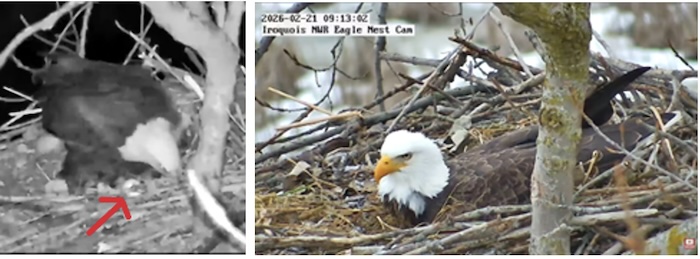
Photos courtesy of Pixcams.com: (Left) The red arrow points to the egg that was spotted overnight. (Right) Mother Eagle incubates the egg.
Press Release, Friends of Iroquois National Wildlife Refuge
BASOM – An egg has been sighted in one of the bald eagle nests at Iroquois National Wildlife Refuge.
The Friends of Iroquois NWR observers whose camera is trained on the nest believe the female bald eagle laid her first egg at 5:05 p.m. Friday, Feb. 20. That belief was based on behavioral cues like fluffing of feathers, standing up and sitting down, and reaching under to rotate the egg.
At 1 a.m. Saturday, observers caught sight of the egg as the eagle parents switched places. Eagles typically lay 2-3 eggs and incubate them for about a month before hatching, so the Friends expect at least one more egg.
“Just because eggs are laid is no guarantee of hatching,” said Friends President Richard Moss of Medina. “Nature can be merciless, and all kinds of bad things can happen to prevent hatching. But this is definitely an exciting development.”
This year is the 250th anniversary of the United States, and the bald eagle has been seen as a symbol of the country for much of that time.
Moss wanted to send out thanks to Bill Powers and Pixcams Inc., out of Export, PA. Pixcams helped the Friends group set up the camera and has continued to provide logistical support. Moss also wanted to thank the Friends members who are moderating the eagle camera chat.
A link to the eagle nest camera is available at the Friends website, FINWR.org. Watching it should be very interesting for the next few months, Moss said.
Photo by Tom Rivers: Anglers try to catch salmon and trout in the Oak Orchard River in Carlton on Oct. 20, 2023.
Press Release, NYS Department of Environmental Conservation
Governor Kathy Hochul and the New York State Department of Environmental Conservation today announced the 2026 dates for Free Fishing Days in New York.
The requirement for a freshwater fishing license is waived during the following six days in 2026: February 14–15, June 27–28, September 26 (National Hunting and Fishing Day) and November 11 (Veterans Day).
“Free Fishing Days provide the perfect opportunity for residents and visitors to affordably explore, unplug, and get outside,” Governor Hochul said. “New York State’s waters offer some of the best fishing opportunities in the nation, hosting memorable fishing experiences that increase tourism and benefit the economy. In addition to the many health benefits associated with recreating outdoors, fishing can provide more opportunities to connect with family and friends, something that seems harder and harder to do with increasing demands on time in today’s world.”
DEC’s Free Fishing Days program began in 1991 to give New Yorkers who might not fish a chance to try the rewarding sport of freshwater fishing at no cost, introduce people to a new hobby, and encourage people to support conservation by purchasing a New York State Fishing License.
Free Fishing Day participants are reminded that although the requirement for a freshwater fishing license is waived during free fishing days, all other fishing regulations remain in effect. Outside of free fishing days, anglers over the age of 16 must have a valid fishing license. For more information on purchasing a license visit DEC’s website.
A year ago, volunteers identified 12,000 birds in annual count
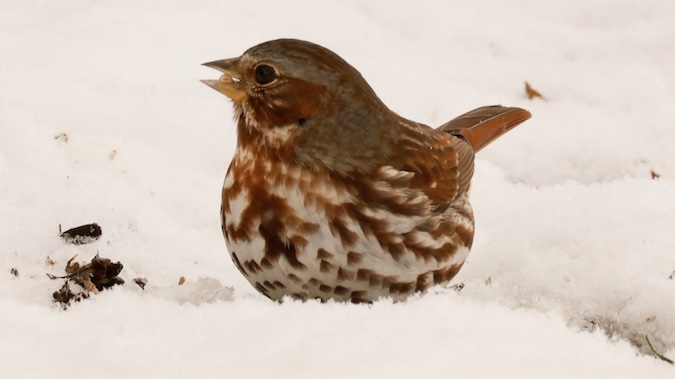
Photos courtesy of Celeste Morien: A fox sparrow is shown in this photo. Volunteers will be out for the annual Oak Orchard Christmas Bird Count on Monday. Last year, 41 counters found 70 species and just over 12,000 individual birds.
By Celeste Morien, count compiler for Oak Orchard Swamp Christmas Bird Count
BASOM – It’s nearly time for the Oak Orchard Christmas Bird Count! The count began in December 1968. The National Audubon Society has been sponsoring Christmas Bird Counts since their inception.
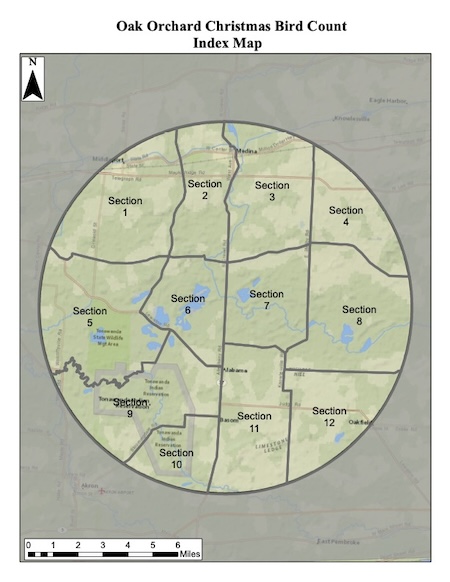
This map shows the area where volunteers will be out counting birds on Dec. 29.
Count compilers Celeste Morien and Brandon Connare would like the public to be alert for participants with spotting scopes and binoculars in on Dec. 29. We will be searching for birds inside the map circle from dawn to dusk.
Filling bird feeders now and keeping them stocked ahead of the count helps fulfill the count objective of counting all wild birds seen and heard within the circle.
The Oak Orchard count circle is centered on Iroquois National Wildlife Refuge at the Orleans and Genesee County line on Route 63. Count volunteers follow routes staying inside the designated 15-mile diameter circle. The day’s total is not just a species tally; individual birds are counted, giving an indication of the total number of birds per species in the circle that day.
If you are at home on count day within the circle, you may report the birds that visit your feeders. To do so, please contact celeste.morien@gmail.com.
According to the Audubon website, “Prior to the turn of the 20th century, hunters engaged in a holiday tradition known as the Christmas ‘Side Hunt.’ They would choose sides and go afield with their guns—whoever brought in the biggest pile of feathered (and furred) quarry won.”
Conservation was in its beginning stages in that era, and many observers and scientists were becoming concerned about declining bird populations. Beginning on Christmas Day 1900, ornithologist Frank M. Chapman, an early officer in the then-nascent Audubon Society, proposed a new holiday tradition—a “Christmas Bird Census” that would count birds during the holidays rather than hunt them.
So began the Christmas Bird Count. Thanks to the inspiration of Chapman and the enthusiasm of 27 dedicated birders, 25 Christmas Bird Counts were held that day. The locations ranged from Toronto, Ontario to Pacific Grove, California.
From December 14 through January 5 each year tens of thousands of volunteers throughout North America, Latin America, the Caribbean and Pacific Islands brave snow, wind, or rain, and take part in the effort. Audubon and other organizations use data collected in this long-running wildlife census to assess the health of bird populations, and to help guide conservation action.
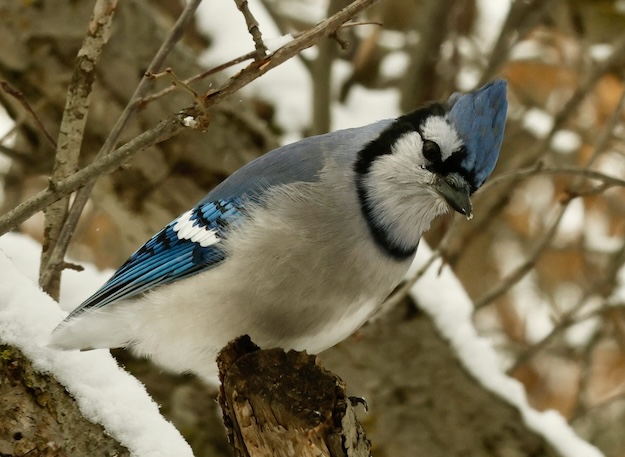
A blue jay is shown in this photo. Last year there were 283 identified during the annual bird count.
The data collected by citizen scientists allows researchers, conservation biologists, wildlife agencies and other interested individuals to study the long-term health and status of bird populations across North America. When combined with other surveys such as the Breeding Bird Survey, we are provided with a picture of how the continent’s bird populations have changed over the past 125 years.
The long term perspective is vital for conservationists. It informs strategies to protect birds and their habitat, and helps identify environmental issues with implications for people as well.
Please consider donating to the Christmas Count here since the Audubon Society no longer collects fees from each participant. www.audubon.org/GiveCBC
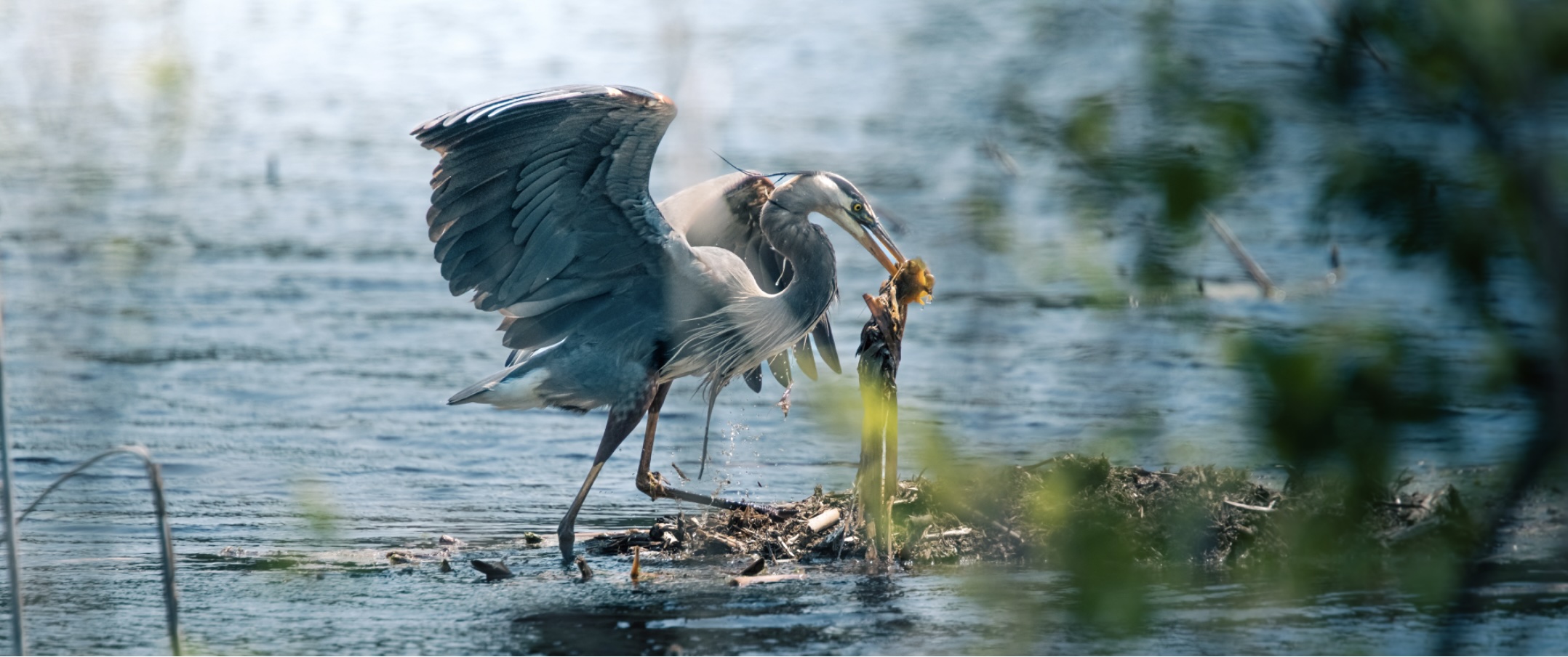
Sam Ramos of East Amherst took this photo of heron that won the $100 first prize in the birds category.
Press Release, Friends of Iroquois National Wildlife Refuge
MEDINA – The winners of the 2024-25 photo contest held by Friends of Iroquois National Wildlife Refuge were announced Saturday at the nonprofit group’s annual meeting at Lee-Whedon Memorial Library.
First, second and third place were chosen in three categories: birds, other wildlife, and landscape. Three professional photographers judged the photos: Max Schulte of WXXI in Rochester, Tina MacIntyre-Yee of USA Today Co., and Matt Wittmeyer of Matt Wittmeyer Photography in Rochester.
Tina Wescott of Clarence won first place in the “Other Wildlife” category for her photo of a frog.
Winning first place in the birds category and garnering the most support from the judges in the contest was a photo of a heron by Sam Ramos of East Amherst, who won a $100 prize. Second place and a $50 check went to Derick Dietrich of Newfane for a photo of a Sandhill crane; and third and a $25 check went to Jay Terkel of Corfu for his photo of a heron.
The winning entry in the other wildlife category went to Tina Wescott of Clarence for her photo of a frog, which gained the second-highest level of support among the judges. Second place went to Jessica Waite of Oakfield for her photo of a bee; and third to Sandy Geschwender for her photo of a butterfly.
Rudy Edlund of Lockport won first place in the landscape category for his dramatic photo of storm clouds over the refuge. Second place went to Kathy Robinson of Le Roy for a photo of Oak Orchard River; and third to Gary Robinson of Le Roy for a photo of trees mirrored in water.
Photos for next year’s contest can be taken anywhere from August of this year through Sept. 1 of 2026.
“Thank you to all those who participated in this year’s contest. Photography is one of the many ways people enjoy using the refuge, and there are so many opportunities there,” said Richard Moss of Medina, president of Friends of Iroquois NWR. “If you are a photographer who uses the refuge on a regular basis, please consider participating in the 2025-26 version of the contest.”
FINWR, which works to support and enhance the Iroquois National Wildlife Refuge, is a 501(3)c corporation and is celebrating its 25th year.