By Tom Rivers, Editor Posted 10 February 2018 at 10:02 pm
Photos by Tom Rivers
ALBION – A young spectator watches a bonfire start at a pile of Christmas trees at Bullard Park.
The snow-covered trees were slow to become engulfed in flames.
The bonfire capped a series of snow competitions and games at Bullard Park. There was sledding snowboarding and a snowman competition, as well as food and other games.
The Village of Albion, the Albion Fire Department, Energize Albion, the Albion Merchant’s Association and United Structural, LLC organized the event at Bullard.
By Tom Rivers, Editor Posted 10 February 2018 at 10:04 am
Photo by Tom Rivers
ALBION – Christmas trees are piled up at Bullard Park on Friday. Today they will be set on fire in a bonfire at the park.
Bullard is hosting sledding, snowboarding and snowman building competitions at the park today from 3 to 7 p.m. Winners for all contests will be announced immediately prior to the lighting the bonfire. All contests and games are free.
At 3:30, the contests start with sledding until 4 p.m. Judges will be measuring distance for sledders from the top of the hill. That is the same for the snowboarding contest from 4 to 4:30 p.m.
There will be a snowman building competition from 4:30 to 5:30 p.m.
Albion has hosted winter games at Bullard twice before, but this is the first time there is lots of snow on the ground.
“We’ve never had the proper weather to do this,” said Kim Remley, one of the organizers. “Last year there was no snow.”
There will also be kiddie games at Pee Wee Park, the little kids’ section of Bullard, from 3 to 5 p.m.
At 6 p.m., the trees will be set ablaze for the bonfire.
There is also free hot chocolate and S’mores while supplies last. Other food items will be available for purchase.
The Village of Albion, the Albion Fire Department, Energize Albion, the Albion Merchant’s Association and United Structural, LLC have organized the event at Bullard.
By Tom Rivers, Editor Posted 10 February 2018 at 9:07 am
Photos by Tom Rivers
ALBION – The 20th annual Father-Daughter Dance drew 250 people to the Ronald L. Sodoma Elementary School cafeteria on Friday evening. Jeremiah Knight of Albion was a first-time attendee. He is dancing with his daughter McKinley, wearing the red and black dress.
Harvest Christian Fellowship in Albion organizes the annual dance held on the Friday near Valentine’s Day.
The 250 attendees just missed setting a record for the biggest crowd ever for the dance. Last year there were 260. The event has grown in popularity over the years. Prior to last year, it had only topped 200 people once. Some of the fathers and daughters have been attending the event each year for more than a decade.
Many of the girls who attended the event were happy to dance with their friends, as well as their fathers.
By Matthew Ballard, Orleans County Historian Posted 10 February 2018 at 8:32 am
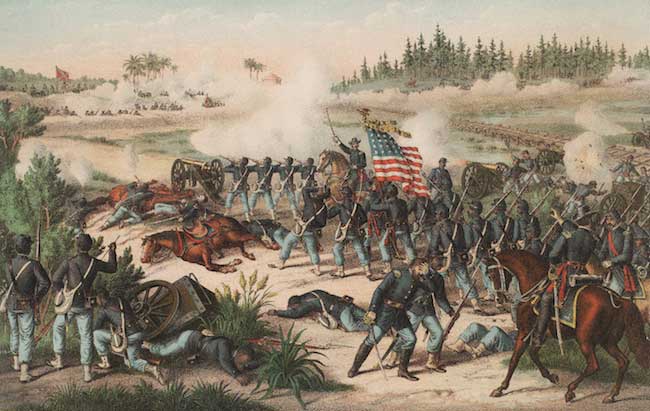
The Battle of Olustee, Chromolithograph by Kurz & Allison
“Overlooked Orleans” – Vol. 4, No. 6
Last week’s article featured the story of Henry A. Spencer, born to ex-slave parents who arrived at Western New York following the Civil War. As the first African American student at the University of Rochester, his story is an important one not only for that institution but also for Orleans County. Another African American from Orleans County, Isaac Hawkins, represents another significant tale in the progression of the involvement of black soldiers in the Union Army during the Civil War.
The son of Richard and Caroline Hawkins, Isaac was born at Medina in 1843. As indicated by early census records, Richard was a grocer who was enumerated immediately before John Ryan, the pioneer stone mason who opened the first commercial sandstone quarry in Medina. An 1842 deed shows that Hawkins purchased a parcel of land from David Evans for the sum of $200 at the point where West Street crossed over the Erie Canal (lot 41). This lot would have sat near the current intersection of Glenwood and Ryan streets.
It is likely that Isaac was born on this site, working for his father as a young man before the outbreak of the Civil War. In 1863, the twenty-year-old Hawkins enlisted at Medina and was placed with the 54th Massachusetts Volunteer Infantry, the unit once under the command of Robert Gould Shaw. Shaw was killed at Ft. Wagner on July 18, 1863, months before Hawkins enlisted with the Union Army. However, Isaac was with the regiment for approximately two months when the unit engaged Confederate troops in Baker County, Florida at the Battle of Olustee on February 20, 1864 (the only major battle fought in Florida).
Isaac survived the battle, which claimed the lives of over 200 Union troops, but was captured and sent to Andersonville as a prisoner. The camp became infamous for its poor and inhumane treatment of white prisoners, who were given bread made from ground corn cobs, maggot-filled meat, and rotten vegetables. Blankets were scarce, tents were often non-existent, and men were forced to defecate in areas that contaminated drinking water.
One can imagine that the treatment of African American prisoners was far worse. In his pension documents, Hawkins noted that he received 250 lashes for forging a pass; he was stripped naked, forced to lie across a log, and whipped from head to foot. He was shackled and returned to work in the graveyard, where he was threatened with similar treatment if he stopped working for even a few moments. Following the war, this particular event was referenced by two witnesses in the trial of Henry Wirz. This testimony and the testimony of other prisoners resulted in Wirz’s sentence to death by hanging.
In addition to the whipping he received while at Andersonville, it was recorded that he had suffered a sabre wound to his arm and a gunshot wound to his arm and foot; the latter injury mangled his foot and required the use of a cane for the remainder of his life. His brother, Charles R. Hawkins, also enlisted in the Union Army in November of 1864 at the age of sixteen and removed to New Jersey following the war where he worked as a barber. His brother Walter relocated to Pennsylvania and worked the same profession. As for Isaac, he later removed to Washington, D.C. where he died on August 25, 1902; he was buried in Arlington National Cemetery.
By Tom Rivers, Editor Posted 9 February 2018 at 4:44 pm
YATES – The Yates Town Board has approved revisions to the town’s wind energy facilities law that bans wind turbines from within 3 miles of the Lake Ontario shoreline and also requires bigger property setbacks of at least a half mile.
The proposed revisions also insist turbines be quieter than the current regulations.
The Town Board passed the law on Thursday evening in a 4-1 vote. Wes Bradley voted no, while Town Supervisor Jim Simon and board members Harold Suhr, Jim Whipple and John Riggi approved it.
Taylor Quarles, project manager for the proposed Lighthouse Wind, said last month during an Orleans County Planning Board meeting that the Yates proposal represents “a wind energy ban.”
Apex Clean Energy wants to put as many as 70 turbines in Yates and Somerset that would be about 600 feet high as part of Lighthouse Wind.
Simon, the Yates town supervisor, said the bigger setbacks will protect “non-participating land owners” and help to preserve the rural nature and character of the town.
Simon said 3-mile buffer from the shoreline follows a recommendation from the U.S. Fish and Wildlife Service, which sees the 3-mile section along the shoreline as an important flyway for birds.
The changes in the Yates ordinance also include:
Reducing the allowable noise decibels to “residential receivers” from 45 during the day (7 a.m. to 8 p.m.) to 42, and from 40 at nighttime to 39 decibels. Simon said that follows recommendations from the Vermont Public Service Board for lower decibels. Simon said the turbine noise and “infrasound” can disturb sleep, causing negative health effects for people. The infrasound is a lower frequency of noise that can disrupt a person’s equilibrium, Simon said.
The setbacks from non-participating property lines was a minimum of 3 times the turbine height for land with houses or buildings, and 4.5 times the turbine height for vacant land. The change now increases the minimum setback to a half-mile (2,640 feet) or 6 times the turbine height, whichever is greater.
The setback from roads and public right-of-ways was a minimum of 1,800 feet or 3 times the height of a turbine. Yates has increased that to a half-mile or 6 times the turbine height.
The setback from the boundary of the Village of Lyndonville was 1,800 feet or 4.5 times a turbine height. Yates increased that setback to a minimum of 1 mile.
The setback from the boundaries from other towns was 1,800 feet or 3 times a turbine’s height. Yates now requires a half-mile setback or 6 times a turbine’s height, whichever is greater.
The setback from residences was 1,800 feet or 4.5 times a turbine height. Yates increased that to a half-mile or 6 times a turbine’s height.
In addition, Yates now has setbacks of 1 mile from schools, churches, and cemeteries. The town law didn’t include setbacks for those sites.
Genesee/Orleans Council on Alcoholism and Substance Abuse (GCASA) has been named one of the Best Companies to Work for in New York State for 2018.
The agency is one of 27 organizations recognized with 15-99 employees. The New York State Society for Human Resource Management has been recognizing “Best Companies” for the past 11 years.
“As a non-profit organization it is often difficult to be competitive with compensation and benefits offered by the for profit sector,” said John Bennett, GCASA executive director. “Here at GCASA, we are always looking to enhance employees’ day-to-day job satisfaction in meaningful ways. Being honored as a best company is the result of servant leaders, a dedicated professional staff and a wonderful board of directors.”
GCASA will be honored at a public awards dinner to be held in Albany at the Marriott on April 18. During the event, GCASA will learn its rank among the 27 companies in the category for small employers with 15-99 U.S. employees.
GCASA has been serving Genesee and Orleans counties for over 40 years. Services include prevention education and outpatient and residential treatment for individuals with substance use disorders, and an employee assistance program.
The New York State Society for Human Resource Management created the awards in 2007. The society evaluates and ranks the best places of employment. This statewide survey and awards program is designed to identify, recognize and honor the best places of employment in New York, whose practices benefit the state’s businesses, economy, and workforce.
To be considered for participation, organizations had to fulfill specific registration eligibility requirements, then participate in a two-part survey of employee satisfaction and engagement, as well as workplace practices and policies. Best Companies Group, an independent firm that manages Best Places to Work programs on state, regional and national levels around the world, conducted the survey, then evaluated the results and determined the best places of employment in the Empire State.
The New York State Police are investigating a scam letter that is being sent to residents of Western New York.
State Police are warning residents about a scam letter purportedly issued from NatWest Bank in the UK, which promises an inheritance opportunity. Several residents within Erie County have reported receiving the letter.
Anyone who receives such a letter is advised to refrain from providing any information; do not respond to the letter in any way.
State Police are continuing to investigate.
State Police urge people who receive this letter to not respond to it.
The National Weather Service has issued a winter weather advisory for Orleans County from 10 a.m. today until 6 a.m. Saturday, when 3 to 6 inches of snow is expected.
The Weather Service said to plan on slippery road conditions, especially for the evening commute.
“Light snow will spread north across the Niagara frontier by midday becoming moderate at times this afternoon into tonight,” The Weather Service said. “Snowfall rates are expected to peak near a half inch per hour during the evening commute, which will result in slippery travel conditions and reduced visibility.”
WASHINGTON, DC – Congressman Chris Collins (NY-27) today voted in support of the Bipartisan Budget Act that keeps the government funded through March 23, 2018 as Congress works toward finishing the Fiscal Year 2018 appropriations process.
The legislation also includes a sensible compromise on budget caps, boosts defense spending, raises the debt ceiling, and includes funding for community health centers, the opioid epidemic, infrastructure, agriculture programs, and disaster relief.
“This legislation is critical to our national security as we are giving Secretary Mattis the funding he needs to rebuild our military and keep Americans safe,” said Collins. “This bill is a big win that accomplishes many of our priorities and provides budget certainty so we can move forward on other important tasks.”
Under this agreement, Congress has ended the sequester for the next two years, providing greater certainty and a much-needed increase in funding for national defense. After eight years under President Obama, our military was left inadequately prepared to defend our country. This agreement also provides for America’s veterans by helping reduce the maintenance backlog at the Veterans Administration.
This deal increases the debt ceiling to March of 2019 so we don’t default on our nation’s obligations. The Bipartisan Budget Act includes $6 billion over two years to combat the opioid crisis and support mental health programs and boosts National Institutes of Health spending. The Children’s Health Insurance Program (CHIP) will be funded for 10 years, community health centers for two years, and multiple Medicare payment policies also received significant extensions.
Additionally, this legislation includes provisions that are critical to farmers in New York State, including improving the Margin Protection Program (MPP) for dairy producers, which offers protection to farmers as prices in milk and feed fluctuate. The legislation also removes a $20 million cap on the Federal Crop Insurance program, which protects against natural disasters or the loss of revenue due to a decline in price, giving livestock and dairy farmers more options.
Collins added: “I am pleased that we were able to work across the aisle to keep the government open while making sure the brave men and women in uniform can succeed on the battlefield, and have the resources they need when they return home.”
Provided photo and article from Girl Scouts of WNY
LYNDONVILLE – Girl Scout Troop 82040 is selling cookies with a special goal once again. Last year, the girls in the troop decided to send their donated cookie purchases directly to American military troops stationed in Camp Arifjan in Kuwait.
The girls were able to send 56 boxes of cookies. The girls in the troop range from Kindergarten Daisy Scouts through Cadette Girl Scouts in middle school.
Troop co-leader Amanda Nowicki’s husband, Army Sergeant First Class Greg Nowicki, previously served with Chief Warrant Officer 2 Timothy Slaght, who at the time was deployed to Kuwait.
Nowicki encouraged the girls to support local deployed soldiers. The girls decided to send the cookies for the camp to enjoy. When the package arrived, the boxes were put in the mess hall for everyone to share. CW2 Slaght requested a flag be flown over the post in honor of the girls and was later sent to the Girl Scouts with a certificate as a thank you.
The girls used the money they earned from cookie sales for flowers in a memorial garden in honor of Elaina Webb, an Albion girl who passed away from leukemia a age 2 ½ on Feb. 7, 2017.
Navarra’s Greenhouse matched the number of flowers the Girl Scout troop purchased to ensure the garden would be lush and beautiful. The girls are planning another visit to Navarra’s to replenish the garden again this year.
The troop also used their cookie sale funds to attend Darien Lake for a day of play and a Kid’s Bop concert. They also used it for a Painting with a Twist class, a candy dish painting class at Brushstrokes in Medina, a Disney on Ice event in Buffalo, and are considering also using the money for membership dues in the upcoming scouting year. Girls that sold enough cookies were also able to attend a week of Girl Scout summer camp free of charge.
Throughout the year, the troop tries to work on a Girl Scout badge every meeting. The girls contribute a Christmas tree for the annual Lyndonville Christmas Tree Festival and march in the annual Lyndonville Fourth of July parade. They also try to do community service on a regular basis, including working on the community garden at a Lyndonville church and will be participating for their first time this summer in the annual FLED Foundation Kickball Tournament that supports children with leukemia and their families.
Troop 82040’s goal for this year is to get 100 cookie box donations for the Army, as well as an overall troop goal of 5,000 cookie boxes. They typically set up a cookie booth outside of Miller’s Amish Store in Lyndonville on Rt. 104.
Governor Andrew M. Cuomo today directed New York State Department of Health Commissioner Dr. Howard Zucker to authorize emergency assistance funding to counties as flu diagnoses continued to increase in communities across the state.
This action provides enhanced reimbursement to counties and will help fund expanded efforts to promote and increase access to flu vaccines statewide. Governor Cuomo is calling on all 58 local health departments to expand efforts to more readily accommodate New Yorkers still needing a flu shot.
“As flu diagnoses and hospitalizations continue to increase to epidemic proportions, this administration is doing everything in its power to protect New Yorkers from this especially durable strain of influenza,” Governor Cuomo said. “I ask all New Yorkers to take advantage of this expanded access to flu vaccines and join us in slowing down and stopping the spread of this virus in the Empire State.”
With 15,753 laboratory confirmed influenza cases reported to the New York State Department of Health, and 2,349 New Yorkers hospitalized with confirmed influenza, these numbers are again the highest weekly numbers in both categories since reporting began in 2004 and exceed last week’s record high 11,683 confirmed cases and 2,221 hospitalizations.
Governor Cuomo has also directed local health departments to re-focus enhanced outreach to vulnerable populations, including daycares, nursing homes, senior centers, and homeless shelters, to reemphasize the need for flu vaccinations, provide targeted education regarding the signs and symptoms of flu, and to identify and assist those populations with low vaccine rates. Furthermore, local health departments will coordinate with local school superintendents to identify schools experiencing an increase in absenteeism rates due to illness among students and staff and link them to ongoing education and vaccination efforts. These partnerships will further ensure effective education and guidance is provided to protect children.
Last month, the Governor signed an executive order allowing pharmacists to administer flu vaccines to children ages 2 to 18 – increasing vaccine accessibility for New York children and families as influenza continues to spread across New York. The executive order suspends the section of state education law that limits the authority of pharmacists to administer immunizing agents to anyone under age 18 to allow vaccines to be administered to anyone age 2 and up.
Parents and guardians are encouraged to call pharmacies ahead of their visit, to ensure they are ready to receive patients in this age group. Parents and guardians with children between the ages of 6 months and 24 months are still encouraged to see their primary care provider for the vaccination. As a result of the Executive Order, more than 5,400 children have been reported as being vaccinated in pharmacies.
In addition to getting a flu shot and staying home when sick, it’s essential to practice good hand-hygiene:
• Unlike some viruses, influenza is easily killed by soap and hot water.
• Wash your hands often with soap and hot water for at least 20 seconds to protect yourself from germs and avoid spreading them to others.
• Carry an alcohol-based hand sanitizer to use when soap and water are not available. Choose a product with at least 60 percent alcohol.
• Do not cough or sneeze into your hands. Instead, cover your mouth and nose with a tissue. People with the flu are infectious for up to seven days after symptoms begin.
Press Release, United States Attorney Grant C. Jaquith of the Northern District of New York
ALBANY – Nathaniel P. Lorenz, 46, of Holley was arraigned today on charges that he submitted fake invoices to the New York State Department of Transportation in order to conceal that he was not buying the materials needed to perform contracts for which his company was ultimately paid more than $1 million.
Lorenz is charged with 8 counts of wire fraud and 1 count of mail fraud. The charges in the indictment are merely accusations. The defendant is presumed innocent unless and until proven guilty.
The announcement was made by United States Attorney Grant C. Jaquith of the Northern District of New York; Todd A. Damiani, Special Agent in Charge of the New England Regional Office of the United States Department of Transportation, Office of Inspector General (USDOT-OIG); New York State Inspector General Catherine Leahy Scott; and Robert L. Keihm, Chief Investigator for the NYSDOT Investigations Bureau.
According to the indictment, Lorenz’s company, ACME Powerwashing Inc. of Holley contracted with NYSDOT in 2015 and 2016 to clean and seal the road portions of bridges, known as concrete bridge decks. The work involved powerwashing bridge decks with water and then sealing them with a chemical that makes the concrete more resistant to penetration by water, chlorides and waterborne contaminants, which might cause the deterioration of the bridge deck. The Federal Highway Administration, part of the United States Department of Transportation, provided most of the money for these contracts.
Each of these contracts required ACME to purchase a certain amount of sealing chemical, based on how many feet of concrete bridge deck was sealed. According to the indictment, on three contracts in 2015 and 2016, Lorenz submitted fraudulent invoices to NYSDOT in order to conceal that he was not buying the amount of the sealing chemical required by the contracts. Lorenz falsely claimed that he was buying sealing chemicals from S.E. Brett, Inc., another company that he owned that does not sell anything.
On these three contracts alone, NYSDOT paid ACME a total of $1,139,119.74 for bridge sealing work, and an additional $759,002.64 for bridge washing and other work. ACME has been a NYSDOT contractor since 2010.
Lorenz appeared today in Albany before United States Magistrate Judge Christian F. Hummel, and was released pending a trial scheduled before Senior United States District Judge Norman A. Mordue in Syracuse.
If convicted, Lorenz faces up to 20 years in prison, a maximum $250,000 fine, and up to 3 years of post-imprisonment supervised release. He may also be ordered to pay restitution to one or more government agencies. A defendant’s sentence is imposed by a judge based on the particular statute the defendant is charged with violating, the U.S. Sentencing Guidelines and other factors.
This case is being investigated by USDOT-OIG, NYSDOT’s Investigations Bureau, and the Office of the New York State Inspector General, and is being prosecuted by Assistant U.S. Attorney Michael Barnett.
Albion also will start using “less-lethal” bean bag projectiles
Press Release, Roland Nenni, chief of Albion and Holley police departments
All Albion and Holley police officers have been trained in the use of the newest form of Naloxone, commonly known as Narcan. Every officer has completed the required training and will be carrying the lifesaving drug.
Naloxone is a drug that temporarily blocks the opiate from acting on the body and allows enough time for more advanced medical treatment. Naloxone is safe and will not cause harm if it is administered to someone suffering from an overdose of a non-opiate or other medical condition. Naloxone is administered via a Nasal Atomizer and does not require a needle.
“With the rise in the use of heroin and other opiates there have been many overdoses that have caused death and other serious long term medical issues,” Police Chief Roland Nenni said.
Police officers from Albion and Holley often are the first on scene at medical emergencies. If a person has overdosed on an opiate and is in serious condition, officers will be able to administer Naloxone in an attempt to save the person’s life. The administration of Naloxone has saved many lives across the country.
“These saved lives have not been isolated to drug users but have also involved children that have accidently ingested an opiate,” Nenni said.
This is only one of the many initiatives that the Albion and Holley police departments are conducting to fight this horrible epidemic that are impacting lives of not only the persons using illegal opiates but the families and associates of users.
The Albion Police Department has recently placed into service a “Less Lethal Program” that will allow officers additional options other than lethal force in certain situations.
Less-lethal guns that fire a Drag Stabilized Bean Bag Projectile have been placed in each Albion patrol vehicle. While less-lethal is not always an option in volatile fast-moving situations, it gives officers additional tools to use when appropriate, that will hopefully reduce death and injuries, Nenni said.
While every police officer carries a Taser, this option requires close proximity, increasing the officer’s likelihood for injury. The Drag Stabilized Bean Bag Projectile allows for greater distance for deployment, reducing the risk of injury to officers and suspects.
This type of less-lethal option was only available to officers in Orleans County by the Multi Agency SWAT Team, which has an array of less-lethal options.
“The problem with only SWAT having this type of less lethal option is the time involved in getting SWAT operators on scene,” Nenni said. “Often the types of incidents that can be handled by less-lethal are quickly evolving and time is of the essence.”
The Albion Police Department being the only road patrol at this time having this option will respond anywhere they are requested to assist other agencies.
The training that Albion Police Officers went through to be certified consisted of both classroom instruction and live-fire range qualification.
The cost of the program was minimal as the guns that are used were obtained through a legal seizure process from guns that were possessed by the Police Department. The guns were seized in cases involving a crime or weapons that were turned over the department because of other situations.
“The goal of the Albion Police Department is to save lives in any way that we can,” the police chief said. “Human life regardless if a victim or suspect is precious and we must always work toward the protection of life.”
By Tom Rivers, Editor Posted 8 February 2018 at 11:43 am
Photo by Tom Rivers: Lyndonville high school students have the highest graduation rate in Orleans County at 97 percent.
The graduation rates in Orleans County improved from 87 to 89 percent, according to data released on Wednesday by the State Education Department.
Lyndonville has the highest graduation rate at 97 percent for the Class of 2017 while Medina is the lowest at 84 percent.
State-wide, the graduation rate was 80.2 percent of the students in the Class of 2017. These are students who entered high school as freshmen in 2013 and completed the necessary coursework to graduate four years later. That was up by 0.5 percent from the 79.7 percent of students who entered high in 2012 and had four years to graduate with the Class of 2016.
In Orleans, the graduation rate improved to 89 percent. The percentage of students graduating with a Regents diploma with an advanced designation also increased from 28 percent to 36 percent. (Regents with advanced designation means at least 22 units of credit at 65 percent or higher in comprehensive English, three math courses, global history, U.S. history, science and a language other than English.)
The percentage of students who graduated with a Regents diploma decreased from 54 to 49 percent. (Keep in mind there was an increase in students attaining Regents with advanced designation.)
Other facts about Orleans students include:
• The percentage of graduates with a local diploma went from 5 to 4 percent.
• The dropout rate increased from 5 percent (24 out of 514 students) to 6 percent (26 out of 468).
• The number students in the cohort dropped from 514 in 2016 to 468
• Girls have a 90 percent graduation rate compared to boys at 88 percent for 2017.
• White students graduated at a 90 percent rate in 2017, while black students were at 84 percent and Hispanic students at 86 percent.
• Students who weren’t economically disadvantaged (223 out of the 468 students) graduated at a 93 percent rate while students considered economically disadvantaged (194 out of 468) graduated at an 85 percent rate.
A snapshot from each district in Orleans includes:
• Albion – Graduation rate stayed at 88 percent from 2016 (156 students) to 2017 (126 students). However, the percentage of students earning Regents with advanced designation increased from 38 to 45 percent. The percentage receiving Regents with distinction or Regents stayed at 85 percent, while the percentage of dropouts increased from 6 to 7 percent, or 9 students for both cohorts.
• Holley – Graduation rate increased from 89 percent in 2016 (93 students) to 91 percent (94 students in 2017). The percentage of students earning Regents with advanced designation increased from 22 to 24 percent, and Regents advanced and Regents is up from 80 to 84 percent. Holley’s dropout rate decreased from 5 to 2 percent.
• Kendall – The graduation rate decreased from 94 percent (71 students in 2016) to 90 percent (59 students in 2017). The percentage earning Regents with advanced designation increased from 35 to 41 percent. Students with Regents or Regents advanced dropped from 89 to 87 percent. The percentage of dropouts increased from 1 percent (1 students in 2016) to 5 percent (3 students in the 2017 cohort).
• Lyndonville – The graduation rate increased from 93 (44 students in 2016 cohort) to 97 percent (64 in 2017). The percentage earning Regents with advanced designation was up from 23 to 36 percent, and students with Regents or Regents advanced increased from 87 percent in 2016 to 95 percent. Lyndonville had two dropouts (5 percent) in 2016, compared to one dropout or 2 percent in 2017.
• Medina – Medina made progress with the 2017 cohort, increasing the graduation rate from 79 percent (150 students in 2016) to 84 percent (125 students with 2017 cohort). The percentage of grads attaining Regents with advanced designation jumped from 21 percent to 34 percent. The combined percentage of grads earning Regents and Regents advanced increased from 77 to 80 percent. The dropout rate increased from 5 percent (7 out of 150) to 9 percent (11 out of 125).