By Tom Rivers, Editor Posted 10 April 2020 at 11:17 am
Photos by Tom Rivers
ALBION – Flags throughout Orleans County and New York State have been lowered in honor people who have died from Covid-19 in the state.
The top photo shows the flag on the Courthouse lawn with the First Presbyterian Church of Albion in the background.
Gov. Andrew Cuomo on Wednesday ordered that flags be lowered for the Covid-19 victims. The deaths in the state from the virus totaled 7,067 deaths as of Thursday.
“That is so shocking and painful and breathtaking, I don’t even have the words for it,” Gov. Cuomo said on Thursday. “We’ve lost so many New Yorkers to this silent killer. It has been a silent explosion that just ripples through society.”
The flags will be lowered while the state is on “Pause,” with schools and nonessential businesses closed until at least April 29.
The state has about 160,000 confirmed cases of Covid-19, more than any country besides the United States.
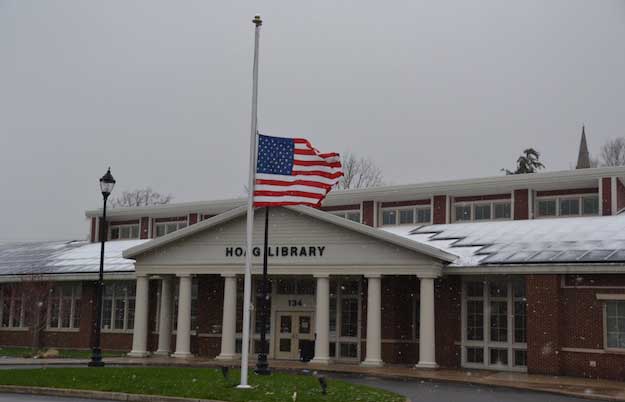
The flag is at half-staff in front of Hoag Library in Albion.
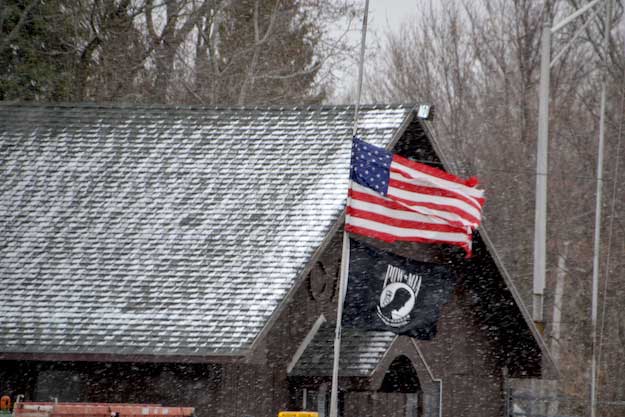
The American flag and POW/MIA flag are lowered at the Canal Corporation’s maintenance facility in Albion.
Ace Hardware in Albion has its American flag lowered out of respect to the victims of Covid-19.
Facing an unprecedented spike in unemployment insurance applications related to the COVID-19 pandemic, the New York State Department of Labor and the New York State Office of Information Technology Services announced a “Tech Surge” in partnership with Google Cloud, Deloitte, and Verizon to improve the reliability of the state’s online and telephone-based unemployment insurance application systems.
The Tech Surge will include critical upgrades to the Department of Labor’s technology systems that will increase its capacity to accept and process applications, making it easier for New Yorkers to apply for benefits.
Importantly, the Tech Surge will include a new, streamlined, and more reliable online application system – available at labor.ny.gov. New Yorkers are urged to use the new online system, which can handle most applications from start to finish, dramatically reducing the number of New Yorkers who must speak to a claims specialist on the phone.
In addition, the Department of Labor will roll out a new “call back” system, allowing their staff to proactively call New Yorkers who need to submit additional information to support their existing unemployment assistance application. This means New Yorkers who have already filed partial claims under the old system and had been told to call the hotline to finish their application should not — instead, the DOL call center will call these New Yorkers directly.
“I recognize that this is an extremely challenging time for all New Yorkers,” NYS Department of Labor Commissioner Roberta Reardon said. “I have been unemployed. I understand the urgency. We want you to be aware of the steps that we are taking to respond to each of you, as quickly as we can. We know that your livelihood depends on it and we assure you that you will get your benefits.”
Since the COVID-19 pandemic began, the New York State Department of Labor’s unemployment insurance filing system has faced an unprecedented increase in volume — with peak weeks seeing a 16,000% increase in phone calls and a 1,600% increase in web traffic, compared to a typical week.
The Department of Labor Tech Surge is providing critical upgrades to New York State’s unemployment insurance filing system during this crisis. These efforts are expected to increase capacity and reliability. Specific actions include:
• Google Cloud has worked with the State Office of Information Technology Services to create a more user-friendly, streamlined, and reliable unemployment insurance application for the Department of Labor.
Specific upgrades include:
Leveraging Google Cloud’s infrastructure to increase reliability and allow the application to scale, so it can handle a high volume of users;
Allowing users to save an incomplete application and pick up where they left off;
Providing an “every device experience,” so New Yorkers can file from smartphones, tablets, and laptops; and
Streamlining the number of questions so the application is shorter and easier to understand.
• Deloitte is opening an additional unemployment insurance call center staffed by hundreds of experienced customer service professionals, which will dramatically increase the number of calls that can be handled; and
• Verizon is expanding the number of phone “ports” for the Department of Labor’s call center from 1,750 to over 10,000 by the end of this week – increasing the center’s call capacity.
• The Department of Labor will begin rolling out a “call back” feature which allows state representatives to call New Yorkers with incomplete unemployment insurance applications and finish their applications over the phone. This means those who fully complete their claim online will NOT need to call the state themselves. New Yorkers who had previously been told to call the hotline should not — instead, the DOL will call them to complete their application. To prevent fraud, state representatives will verify their legitimacy by providing New Yorkers’ claim type and filing date.
In addition, the Department of Labor has:
Drastically expanded the call center’s hours, including opening on Saturdays and Sundays:
Monday – Friday: 8 a.m. to 7:30 p.m.
Saturday and Sunday: 7:30 a.m. to 8 p.m.
• Increased the number of servers that support the online filing system from 4 to over 60;
• Implemented a new, more efficient filing system based on the first letter of the applicant’s last name (alphabetical order):
A – F : Monday
G – N : Tuesday
O – Z : Wednesday
Missed your day: Thursday through Sunday
• Streamlined the claims process, automating additional processes and reducing the situations in which a filer has to call and speak with a representative; and
• Dedicated 1,000 staff to the Department of Labor’s unemployment insurance Telephone Claim Center — compared to roughly 400 who typically staff the call center — with plans to bring an additional 1,200 staff on board, including those at the new Deloitte call center.
Last week, the Department of Labor also launched a new PSA that provides information on how to apply for unemployment benefits and reassures New Yorkers that if their unemployment filing is delayed, they will still receive full unemployment benefits. The PSA is also available with Spanish subtitles here.
In addition, earlier this week Governor Cuomo announced he had directed the Department of Labor to immediately make $600 in additional weekly unemployment benefits available to all New Yorkers. The additional benefits were included in the Federal CARES Act, but, unlike other states, New York began delivering the extra unemployment insurance to unemployed individuals before Federal funds are disbursed to the states. New York is also extending the period covered by unemployment benefits for another 13 weeks, for a total of 39 weeks.
The New York State Department of Labor is dedicated to ensuring that every New Yorker who is entitled to unemployment insurance benefits will receive all benefits due. New Yorkers seeking to file an unemployment insurance claim should visit labor.ny.gov or call the Telephone Claim Center at (888) 209-8124.
By Tom Rivers, Editor Posted 10 April 2020 at 8:19 am
HOLLEY – The federal Environmental Protection Agency is temporarily suspending a $20 million cleanup project at the former Diaz Chemical site in Holley.
The EPA is planning to have about 20 personnel on site for phase 2 of the cleanup on Jackson Street.
The EPA has already spent $12.5 million on the cleanup, using money from the Superfund. The EPA has removed buildings, pipes, drums and tanks. Only two warehouses remain from Diaz, which declared bankruptcy and abandoned the site in 2002. The company operated for about 30 years in Holley.
The next phase – thermal treatment of contaminated soil and groundwater at the site – will cost $20 million, the EPA said.
“As we continue to adjust to the evolving COVID-19 situation, EPA is taking the necessary steps to ensure that decisions about ongoing cleanup activities at Superfund sites are made with the health and safety of communities, EPA staff, state and tribal partners, and contractors as the priority,” the EPA said in a community notice.
Besides EPA staff, the phase 2 includes personnel from the U.S. Army Corps of Engineers and contractors. They are temporarily suspending bringing equipment and staff to the Superfund site.
“The suspension of work is a temporary measure as we adjust to the ongoing situation with COVID-19,” the EPA said. “We will be periodically reassessing this decision moving forward and are prepared to come back to the site to continue work as soon as possible. The decision to suspend work was made in consultation with, or at the recommendation of, the Village of Holley.”
The EPA has been working on cleaning up the site for nearly 20 years. With phase 2, the EPA will tackle the contaminated soil on the 5-acre site. The soil poses a threat to the groundwater, EPA officials said.
The dirt can’t simply be carted off the premises until it has been treated to remove the contaminants. The EPA and a contractor will drill 600 wells, spaced about 13 to 15 feet apart, and install an underground system where the soil will be heated up. That will remove below-ground contaminates from soil.
Water vapors also will be collected and treated, and then filtered and discharged into the sewer.
Once the contaminant level drops in the soil, about 100 truckloads are expected to be hauled away to a landfill.
The EPA will have 100 truckloads of clean soil brought to the site. Project managers went over the work with the Holley Village Board in February.
The schedule before Covid-19
The schedule before the delay caused by Covid-19 included contractors drilling test wells and crews starting to mobilize this spring, with soil to be excavated in the summer, with drilling and well installation.
The first stage of the thermal treatment system will go in next winter through summer 2021. A second stage of drilling and well installation is planned for the spring-summer 2021 with the second stage of the thermal treatment system to be installed from winter 2021 to summer 2022.
A concrete cover is part of the project during the treatment stage. The concrete will be removed once the treatment is done.
The project will be substantially complete in the winter of 2023, according to the EPA timeline. A final layer of topsoil and grass will be added to complete the project.
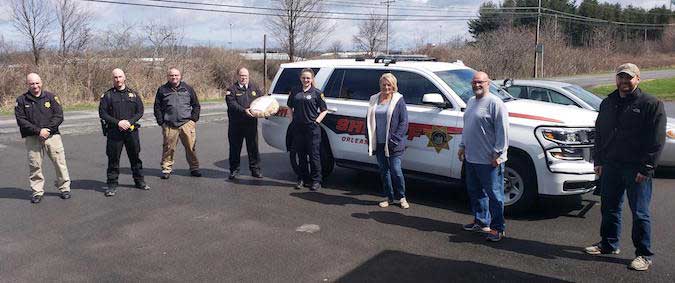
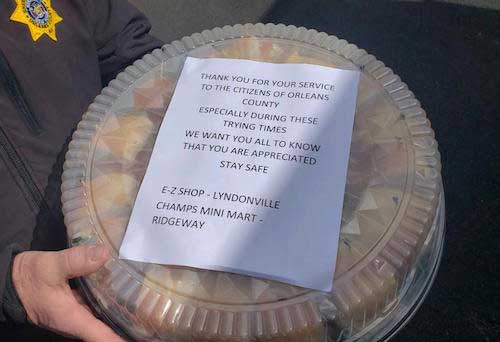
ALBION – Orleans County Sheriff Chris Bourke holds a food tray that was donated today for the staff of the Sheriff’s Office. John Chapman, owner of Champs Mini Mart in Ridgeway and the E-Z Shop in Lyndonville, donated the food that was shared at noon and 4:30 p.m. with deputies, dispatchers, civil clerks and corrections officers.
“Thank you for your service to the citizens of Orleans County especially during these trying times,” read the message on the food tray from Chapman. “We want you all to know that you are appreciated. Stay Safe.”
Bourke said the food was well received by the staff at the Sheriff’s Office.
“We greatly appreciate this gesture of kindness to our front line essential employees,” Bourke said. “The employees of the Orleans County Sheriff’s Office continue to report to work every day and do their job for the citizens of Orleans County. It does not surprise me because we have excellent employees that do great work everyday.”
By Mike Wertman, Sports Writer Posted 9 April 2020 at 6:07 pm
A revised executive order, issued today by Gov. Andrew Cuomo, now lists golf courses as nonessential businesses and must close.
His previous executive order did not distinguish that they were nonessential so many courses, including Shelridge, Hickory Ridge and White Birch locally, had opened while adhering to social distancing mandates.
“It’s disappointing but not unexpected,” said Shelridge Manager Brett Decker. “We’ve had a bunch of golfers out playing. We’ve followed the social distancing guidelines and there didn’t seem to be any problems. Hopefully this will be a short term situation.”
In addition, the governor’s executive order also deemed that boat launches and marinas are also nonessential while parks and public spaces remain essential except for playgrounds.
Cuomo has stated that this executive order closing nonessential business will remain in effect until at least April 29.
By Tom Rivers, Editor Posted 9 April 2020 at 4:10 pm
Genesee County has 9 new confirmed cases for 63 total
Orleans County has three more confirmed cases of Covid-19 for 24 total, the Orleans and Genesee County Health Departments is reporting today.
The new cases include two people who reside in the central part of Orleans County and one on the western part of the county.
Of the new cases, one person is in the 30s, another in the 50s and one in the 90s.
One of the positive cases is connected to a confirmed positive case and is in mandatory isolation.
Genesee County has nine new confirmed cases today for 63 positives total. Eight of the individuals who tested positive reside in the central part of the county and one person lives in the eastern part of the county.
Of the ages, one is in the 20s, five in the 30s, one in the 40s, one in the 50s, and one person is in the 60s.
Three of the new positive cases were under precautionary or mandatory quarantine when they became symptomatic.
Contact tracing has been initiated for all new cases with known contacts already in mandatory quarantine. They will be swabbed to be tested for Covid-19 if symptoms become present.
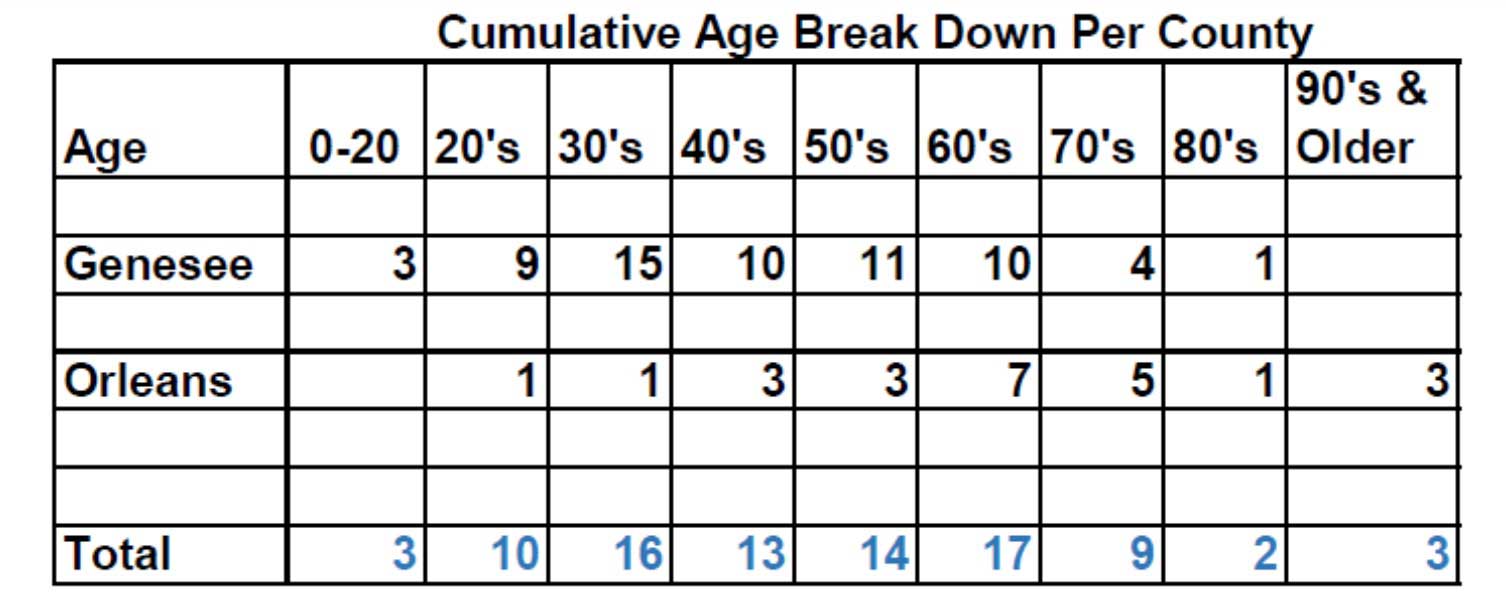
The two Health Departments have broken out the ages by decade for all of the cases in the two counties.
The department wants to show that many of the cases involve younger adults. Initially the department was only reporting the cases as people under age 65, or 65 and older.
Of the 87 cases in the two counties, 14 are people in their 70s, 80s or 90s. People in their 60s make up 17 of the cases, which is the most of any decade by age, but it’s only one more than the 16 for people in their 30s.
There are 56 cases of Covid-19 for people under age 60, or 64 percent of the total.
The Health Departments report that four people have recovered from Covid-19 in Orleans and 12 have recovered in Genesee. No one has died from the virus in Orleans in the past month while one has in Genesee County.
Click here to see a map with more details about the cases in the two counties.
Passover / Holy Week / Easter Holiday
In regards to Passover and the upcoming Easter holiday, the Health Departments remind people that gatherings of people, including among families for parties or celebrations, are canceled or postponed until at least April 22, per an executive order from Gov. Cuomo.
“Many houses of worship have been live streaming their services which allows them to share their message and touch base with their congregations,” according to an advisory from the Health Departments. “As challenging as this is to do, especially over the holidays, it is vital everyone stay home. Consider celebrating with a phone call, or a social app so you can see one another and remember the life you may be saving by staying home could be one of your loved ones. This is temporary.”
Because Covid-19 is circulating locally, the Health Departments again stressed the importance of social distancing and staying home.
The Genesee and Orleans County Health Departments also advised the following:
The Use of Cloth Face Coverings
The CDC recommends wearing cloth face coverings in public settings where other social distancing measures are difficult to maintain (e.g., grocery stores and pharmacies). The cloth face cover is meant to protect other people in case you are infected. Recent studies have suggested that COVID-19 may be spread by people who are not showing symptoms. Continue to keep about 6 feet between yourself and others. The cloth face cover is not a substitute for social distancing or proper hand washing.
The cloth face cover should:
• fit snugly but comfortably against the side of the face
• be secured with ties or ear loops
• include multiple layers of fabric
• allow for breathing without restriction
• be able to be laundered and machine dried without damage or change to shape
The cloth face coverings recommended are not surgical masks or N-95 respirators. Those are critical supplies that must continue to be reserved for healthcare workers and other medical first responders, as recommended by current CDC guidance.
Cloth face coverings should not be placed on young children under age 2, anyone who has trouble breathing, is unconscious, or otherwise unable to remove the mask without assistance.
Mental Health
Everyone reacts differently to stressful situations and having to socially distance yourself from someone you love can be difficult. Below are resources that can help you connect to a professional that can help you through these challenging times:
• Care + Crisis Helpline is available 24/7 at 585-283-5200 or text ‘Talk’ to 741741
• New Yorkers can call the COVID-19 Emotional Support Hotline at 1-844-863-9314 for mental health counseling
• Head Space: A mindfulness app called Headspace is offering some meditations to listen to for free to ease minds in such a stressful time. The app is free to download and includes meditations, sleep, and movement exercises to help with the varying emotions you may be feeling. The app does include in-app purchases. Click here for more information.
Assemblyman Steve Hawley (R,C,I-Batavia) is thanking a longtime local business for supporting the community during this current healthcare crisis.
Chapin Manufacturing in Batavia, a staple business since 1884, is donating 1-gallon and 3-gallon spraying containers for the purposes of disinfecting buildings during the virus outbreak.
“When the CEO reached out to me last week, I was absolutely thrilled to hear and couldn’t say yes fast enough,” Hawley said. “It’s good to see that despite all of the confusion and concern throughout the state and the country, people are still stepping up to help their neighbors. It gives me the hope and reassurance that after all this is over, our community will come back together stronger than ever.”
The sprayers will be distributed to emergency management offices in Genesee, Orleans and Monroe counties. The EMOs will coordinate with local hospitals, fire departments, EMTs and schools to ensure that everyone has an opportunity to participate in using these generous gifts.
By Tom Rivers, Editor Posted 9 April 2020 at 12:23 pm
New York State has a new record high in deaths from Covid-19 after 799 died from virus on Wednesday. That is more than the 779 who died on Tuesday and the 731 on Monday.
The state has now suffered 7,067 deaths from Covid-19.
“That is so shocking and painful and breathtaking, I don’t even have the words for it,” Gov. Andrew Cuomo said during a news conference today. “We’ve lost so many New Yorkers to this silent killer. It has been a silent explosion that just ripples through society.”
The state is bringing in funeral directors due to the many deaths.
Cuomo said he expects the death toll will drop because the number of new hospitalizations, new intubation and intensive care patients has been dropping in recent days.
He sees the state flattening the curve, and he thanked residents for their efforts to stay home as much as possible and practice social distancing. Those efforts need to continue to keep the virus from spreading at a faster rate.
“You’re not out of the woods,” Cuomo said. “Now is not the time to misunderstand what is happening. We have done great things and we have saved lives because we have followed policies. The moment you stop following policies, you will go right back and see those numbers shoot right through the roof.”
He said the state is working to address is overloaded computer and phone system for unemployment claims. The state now has 1,000 people processing unemployment claims and a new computer system will be activated at 7 p.m. today. Staff will call people back within 72 hours, rather than residents having to call the Department of Labor.
By Tom Rivers, Editor Posted 9 April 2020 at 12:11 pm
Photos by Tom Rivers
ALBION – The area was hit with a blast of snow this morning. These photos are looking south towards the Main Street lift bridge in Albion at about 9:15 a.m.
Today is forecast to be mostly sunny with a high of 45.
Orleans County could see more snow showers on Friday morning before the temperature goes up to a high of 41, according to the National Weather Service in Buffalo.
A high wind advisory is in effect from 11 a.m. today to 6 p.m. on Friday.
By Tom Rivers, Editor Posted 9 April 2020 at 11:11 am
Photos by Tom Rivers
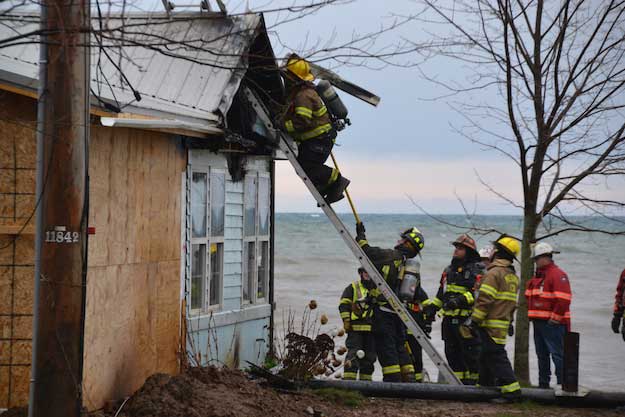
YATES – Firefighters put out a chimney fire this morning and make sure there aren’t any hot spots in the cottage by Lake Ontario.
Lorrie and Ed Thering are thankful there wasn’t more damage to their cottage on Fisher Lane. Mrs. Thering called to report the fire at 8:58 a.m. Her husband arrived on the scene and was able to fill buckets of water from mud puddles, helping to contain the fire.
There are strong westerly winds this morning. If it had been easterly winds, the fire likely would have spread through the house, Mr. Thering and firefighters said.
The Therings are putting an addition on the cottage, hoping to make it a year-round residence. The site has been in Mrs. Therings family for about 70 years.
There was a big turnout of firefighters from Lyndonville, Ridgeway, Shelby, Medina and Carlton. That isn’t the normal situation on a Thursday morning, but many of the firefighters are home from work right now due to the coronavirus pandemic.
The Therings are hopeful they can have the room repaired soon.
Kyle Morgan of the Ridgeway Volunteer Fire Company carries a ladder back to a fire truck.
Donato Rosario of the Medina Fire Department removes some of the metal roofing.
By Tom Rivers, Editor Posted 9 April 2020 at 9:01 am
ALBION — The Albion Village Board has put together a $6,872,286 budget that keeps the tax rate at $17.80 per $1,000 of assessed property.
The budget would increase the tax levy, what the village collects in taxes, by $17,252, or by less than 1 percent (0.6 percent). The tax levy would go from $2,730,417 in 2019-2020 to $2,747,669 in 2020-21.
The board held a public hearing on the budget Wednesday. Residents could only comment through the Zoom online option because the village hall is currently closed to the public due to the coronavirus pandemic. No one commented on the budget during the hearing.
The board is scheduled to adopt the budget at 6 p.m. on April 22. The fiscal year starts June 1 and runs to May 31, 2021.
Mayor Eileen Banker is pleased the budget doesn’t increase the tax rate. She is concerned state and county revenues that are in the budget may not come through at the budgeted amounts. That includes road paving and maintenance funding from the state (CHIPS) and some of the local sales tax revenue distributed by the county.
If those revenues don’t meet expectations, the village will likely have to make some adjustments.
A wind advisory is in effect from 11 a.m. today until 6 p.m. Friday for Orleans, Monroe, Wayne and northern Cayuga counties.
There will be westerly winds from 25 to 35 miles per hour with gusts up to 50 mph, the National Weather Service in Buffalo said.
“Gusty winds could blow around unsecured objects,” according to the Weather Service. “Tree limbs could be blown down and a few power outages may result.”
The Weather Service urges extra caution when driving, especially if operating a high profile vehicle. Secure outdoor objects.
U.S.Senator Chuck Schemer, D-NY, unveiled a COVID-19 “Heroes Fund,” a proposal to reward, retain, and recruit essential workers.
The Schumer-led, proposed “Heroes Fund” consists of two major components: a $25,000 premium pay increase for essential workers, equivalent to a raise of $13 per hour from the start of the public health emergency until December 31, 2020, and a $15,000 essential worker recruitment incentive to attract and secure the workforce needed to fight the public health crisis.
Schumer says essential frontline workers are the true heroes of the COVID-19 pandemic response in America. In working to craft the proposal with his colleagues, Schumer says that providing premium pay to frontline workers during this pandemic is important to reward essential workers’ for their great personal sacrifices, but also to ensure the retention of essential workers who are working grueling hours on the frontlines of this crisis as well as the recruitment of additional workers who will be needed in the months ahead.
“Thousands of New Yorkers across the city, Long Island and upstate are leading this fight and reporting to the frontlines of our state and nation’s pandemic response each and every day, placing themselves squarely in harm’s way to serve the needs of others,” said U.S. Senator Charles Schumer. “And this proposed ‘Heroes Fund’ would provide premium pay to these essential workers—the doctors and nurses, grocery store workers, transit workers, and more who are central to fighting this crisis—and would establish an incentive system to retain and recruit the workforce needed for the long months to come.”
The COVID-19 “Heroes Fund”
Proposal for Pandemic Premium Pay to Reward, Retain, & Recruit Essential Workers
Essential frontline workers are the true heroes of America’s COVID-19 pandemic response. Senate Democrats believe in providing premium pay to frontline workers during this pandemic to reward essential frontline workers, ensure the retention of essential workers who are working grueling hours on the frontlines of this crisis, and promote the recruitment of additional workers who will be needed in the months ahead.
As the Congress looks at a potential fourth COVID-19 bill, the following proposal is meant for consideration by Members of Congress, key stakeholders, and the American people.
Our proposal consists of two major components:
• A $25,000 pandemic premium pay increase for essential frontline workers, equivalent to a raise of an additional $13 per hour from the start of the public health emergency until December 31, 2020.
• A $15,000 recruitment incentive for health and home care workers and first responders to attract and secure the workforce needed to fight the public health crisis.
Structure of the Pandemic Premium Pay
To meet the goals of reward, retention, and recruitment, we propose a set dollar amount per hour with a maximum amount for the year, for a definite duration, and with an additional bonus for workers who sign up to do such essential work during this crisis.
Amount of Pay Premium. Our proposal—
• Uses a flat-dollar amount per hour premium model in order to ensure it is clear, simple, and lifts up particularly those workers making lower wages.
• Would give each essential frontline worker $13/hour premium pay on top of regular wages for all hours worked in essential industries through the end of 2020.
• Would cap the total maximum premium pay at $25,000 for each essential frontline worker earning less than $200,000 per year and $5,000 for each essential worker earning $200,000 or more per year.
Duration of Premium. The premium pay period—
• Must be for a specified and clear duration of time to ensure workers can rely on it for their economic security and plan for needs like additional child care.
• Should cover all hours worked by each essential frontline worker through December 31, 2020, or until the worker’s salary-based maximum premium pay is reached.
Premium Pay as a Recruitment and Retention Incentive. In order to recruit the additional health care workers, home care workers, and first responders needed over the coming months, our proposal—
• Would provide a one-time $15,000 premium for signing on to do essential work.
• Would limit eligibility for this incentive premium to essential health and home care workers and first responders that are experiencing severe staffing shortages impeding the ability to provide care during the COVID-19 pandemic.
Premium Pay and Worker Incentives Delivery Mechanism
Our proposal would fully federally-fund the premium pay and recruitment and retention incentive. We will continue to seek input on the specific mechanism for delivering the pay to workers, as well as the universe of “essential workers” to be covered. The new federal fund would partner with entities designated as an “eligible employer” – states, localities, tribes, and certain private sector employers – to issue the funds premium payments to eligible workers. Frontline federal employees would also be granted the new benefit of up to $25,000.
COVID-19 Heroes Fund.
The new COVID-19 Heroes Fund would provide funds directly to eligible employer-partners so that they could distribute the premium payments.
Employers in industries engaged in “essential work” would apply to the Heroes Fund for funds to be used to add line-item premium pay to employees’ or independent contractors’ paychecks. The eligible employer would track these payments, provide payroll records demonstrating premium payments, and return any unspent funds to the agency.
No employer would be required to participate, but all would be strongly encouraged to and the program would be widely advertised.
An entity that contracts directly with the state, locality, Tribe, or the federal government (e.g., to provide care to people with Medicare and Medicaid coverage) would be considered a private sector employer, and employees of this entity who are designated as “essential” would be eligible for premium pay. Similarly, an eligible employer is also an individual who hires someone designated as “essential” through programs established through the State (e.g., self-directed care arrangements). This would help ensure coverage of the 2.2 million home health aides, direct service providers, and personal care workers who provide services to more than 12 million Americans.
Eligible employers would submit applications for the recruitment and retention incentive premium on a rolling basis.
Federal Workforce. Our proposal would ensure all federal government essential frontline employees receive the same $25,000 premium pay benefit provided to other essential workers.
Coverage should be expansive to capture all federal employees with public-facing positions. This includes Title 5 employees and employees of all other federal personnel systems.
The benefit would be limited to frontline and public-facing positions – employees who are not teleworking from their homes.
Additional Background and Commentary
Precedents. Disasters require exceptional flexibility in standard work schedules and assignments and often put first responders and other essential workers in dangerous situations. To ensure this critical workforce is compensated appropriately, there are precedents for funding hazard premium pay and worker incentives through a federal program.
FEMA, through the Robert T. Stafford Disaster Response and Emergency Assistance Act and the Disaster Relief Fund, is currently authorized to reimburse state, local, and tribal governments for straight-time and premium pay associated with disaster response. Extraordinary costs (such as call-back pay, night-time or weekend differential pay, and hazardous duty pay) for essential employees who are called back to duty during administrative leave to perform eligible Emergency Work are eligible for reimbursement in certain circumstances.
This authority has been used many times over the last few years to pay for personnel costs associated with enforcing curfews, facilitating evacuation routes, and restoring critical infrastructure. Past usage illustrates precedent for federal funding of critical state, local, and tribal employees performing essential response functions that keep our communities safe in times of disaster.
Essential Frontline Worker definitions. As mentioned above, the definition of essential frontline workers for purposes of both the premium pay increase and the recruitment-retention incentive will be the subject of debate. This proposal is not meant to exclude any worker from this conversation. Rather, we hope this proposal will encourage a discussion about how large and diverse this universe of workers truly is. Our goal is to make federal, state, tribal, local and private sector essential workers that are at risk eligible for this benefit.
Retroactive Pay. Workers who have been on the frontlines since the initial declaration of the Public Health Emergency on January 27, 2020, could receive a lump sum of backpay of $13 per hour for work before enactment. These workers would continue to receive the $13 per hour premium pay on top of regular wages moving forward, but these workers would still be subject to the maximum premium pay cap outlined above.
Additional Benefits for Essential Health and Home Care Workers and First Responders. The employers of frontline health and home care workers and first responders should be eligible to apply for a second round of premium pay funds of up to $10,000 as those workers continue to combat the virus.
Death Benefits. It is a deeply disturbing but unfortunate reality that some of our frontline workers are making the ultimate sacrifice to the nation through their work fighting COVID-19. Their families rightfully deserve to receive the full amount of the premium pay as a lump sum in addition to all other forms of death benefits.
Protections from Corporate Expense Shifting. Certain large corporations engaged in the provision of essential services and goods employ essential frontline workers who are deserving of premium pay. However, massive corporations should make investments in providing premium pay of their own accord before trying to participate in this program.
Protecting Workers and PPE. Senate Democrats have been fighting to give essential workers the protections and equipment they need to stay safe. The CARES Act provided billions of dollars for PPE, and Democrats have pushed the Administration to appoint a czar to handle all manufacturing and distribution of critical PPE. We must do more to ensure all frontline workers have the protective gear they need to perform their jobs safely, and we need a strong emergency temporary standard to protect all workers.
Photo by Tom Rivers: The lighthouse at Golden Hill State Park in Barker is pictured on Aug. 7, 2016 during a sunset on Lake Ontario.
The board that manages water levels at Lake Ontario expects the water levels this spring to be higher than normal for Lake Ontario, but shouldn’t surpass 2017 and 2019, years of destructive flooding along the southshore.
Spring is a critical period for Lake Ontario outflow regulation, the International Lake Ontario-St. Lawrence River Board said. That group is closely coordinating with the Ottawa River Regulation Planning Board during the Ottawa River snowmelt to have the highest outflow from Lake Ontario while balancing impacts upstream and downstream on the St. Lawrence River.
Inflows from Lake Erie, precipitation, runoff, snowpack, along with the snowmelt in the Ottawa River basin are the primary drivers of water level fluctuations this time of year, the International Lake Ontario-St. Lawrence River Board said in a news release.
These conditions are different each year, made more challenging by dynamic spring weather, making it difficult to accurately forecast water levels.
Last month there was a record outflow from Lake Ontario, the third straight month of record-high outflows under the International Lake Ontario – St. Lawrence River Board’s deviation strategies.
The delayed opening of the St. Lawrence Seaway, in combination with seasonable weather and favorable conditions in the Ottawa River basin, allowed the Board to remove an extra 3.46 cm from Lake Ontario. This would not have been possible had the Seaway opened on March 20.
Lake Ontario had been rising gradually for the past couple of weeks, but very slowly recently. As of April 6, the level was 75.26 m (246.92 ft). This is 42 cm above average, but 38 cm below the record-high for this time of year.
It is important to remember that there is still a lot of snow to melt and the possibility of active and wet spring weather in the coming weeks. Even at the current levels, storms and strong winds can also cause severe damages, and it is always good to have a coastal resiliency plan in place, the International Lake Ontario – St. Lawrence River Board said in its news release.
ALBION – The Albion Central School District has been named a Best Community for Music Education for 13 years in a row!
This designation comes from The NAMM Foundation for Albion’s outstanding commitment to music education.
Now in its 21st year, the Best Communities for Music Education designation is awarded to districts that demonstrate outstanding achievement in efforts to provide music access and education to all students.
To qualify for the Best Communities designation, Albion answered detailed questions about funding, graduation requirements, music class participation, instruction time, facilities and support for the music programs. Responses were verified with school officials and reviewed by The Music Research Institute at the University of Kansas.
This award recognizes that Albion is leading the way with learning opportunities as outlined in the Every Student Succeeds Act (ESSA). The legislation guides implementation in the states and replaces the No Child Left Behind Act (NCLB) which was often criticized for an overemphasis on testing-while leaving behind subjects such as music. ESSA recommends music and the arts as important elements of a well-rounded education for all children.
“Making music is the artistic synthesis of all academics,” said High School Choral Director Gary Simboli. “When presented in a public forum, not only does it allow students to demonstrate their skills in real world settings, but it also enriches the lives of those giving and receiving the performances.”
The pep band enlivens the crowd during the homecoming football game on Oct. 5. Albion runs an active music program in the elementary, middle and high schools. The high school puts on two full-scale musical and students also perform in several different instrumental and choral groups. In all, high school musicians perform numerous times during the school year.
Research into music education continues to demonstrate educational/cognitive and social skill benefits for children who make music. After two years of music education, research found that participants showed more substantial improvements in how the brain processes speech and reading scores that their less-involved peers and that students who are involved in music are not only more likely to graduate high school, but also to attend college as well.
Everyday listening skills are stronger in musically-trained children that in those without music training. Significantly, listening skills are closely tied to the ability to: perceive speech in a noisy background, pay attention, and keep sounds in memory. Later in life, individuals who took music lessons as children show stronger neural processing of sound; young adults and even older adults who have not played an instrument for up to 50 years show enhanced neural processing compared to their peers. Not to mention, social benefits include conflict resolution, teamwork skills, and how to give and receive constructive criticism.
A 2015 study supported by The NAMM Foundation, “Striking A Chord,” also outlines the overwhelming desire by teachers and parents for music education opportunities for all children as part of the school curriculum.
About The NAMM Foundation
The NAMM Foundation is a nonprofit supported in part by the National Association of Music Merchants and its approximately 10,400 members around the world. The foundation advances active participation in music making across the lifespan by supporting scientific research, philanthropic giving, and public service programs. For more information about the NAMM Foundation, please visit www.nammfoundation.org.
The High School performed The Big Bad Musical in November, one of two musicals scheduled for the high school drama program. The middle school also typically does two musicals. In this photo Chase Froman, sitting, stars as the Big Bad Wolf and Aubrey Boyer is Sydney Grimm, a flashy reporter for a cable news channel, EFN – Enchanted Forest News. In back from left are the Wolfettes, from left: Olivia Morrison, Hannah Coolbaugh, Hannah Brewer and Sydney Mulka.
You’re here checking the site, so you know: Orleans Hub is a vital resource for our community. Day in and day out, we share information and insights that matter to those who live and work in the towns, villages and hamlets of our county. Local advertisers help make the Hub possible, and so can you.
Donate today to keep Orleans Hub healthy and accessible to all. Thank you!