By Tom Rivers, Editor Posted 12 September 2016 at 1:42 pm
Photos by Tom Rivers
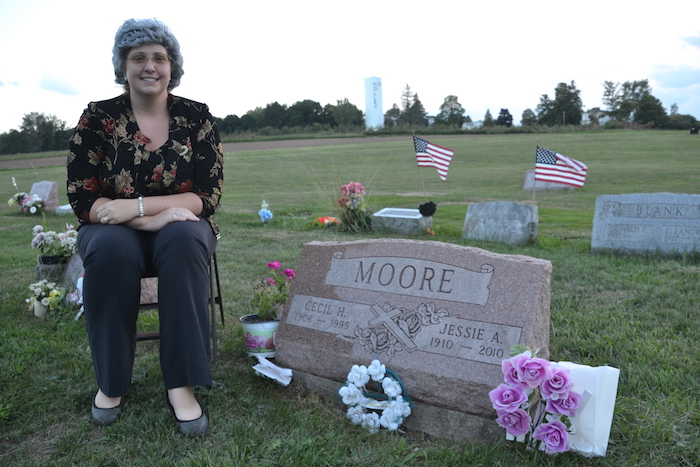
CLARENDON – Sheena Hamiter, a high school social studies teacher at Holley, portrayed her great-grandmother Jessie Moore during Saturday’s Ghost Walk at Hillside Cemetery. Jessie had 13 kids, and her grandchildren and great-grandchildren total about 250. She lived to be 100.
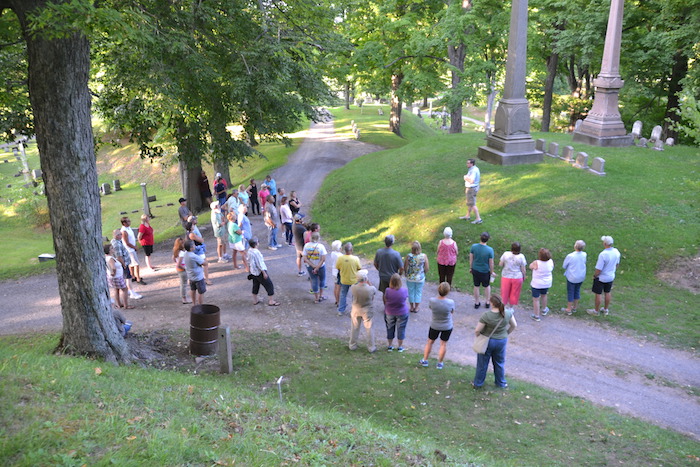
Hillside Cemetery highlighted prominent people in this historic cemetery with the Ghost Walk, an event that was part of the Orleans County Heritage Festival. About 50 people attended the Ghost Walk before it was called off due to a lightning storm.
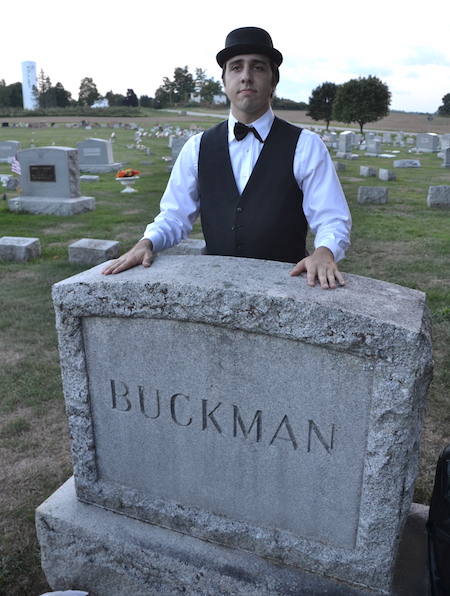
Allen Smeltzer, a Genesee Community College student, portrayed Jewell Buckman, the first soldier from Orleans County to be killed in World War I about a century ago. The American Legion Post in Holley is named in Buckman’s honor. Several GCC students volunteered to serve as ghosts and guides during the Ghost Walk.
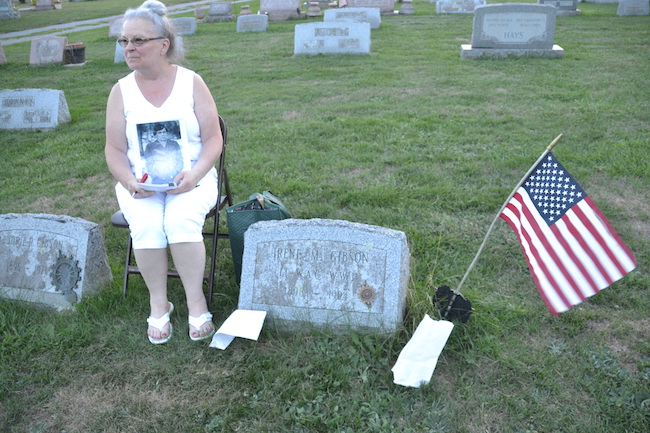
Cindy Davis, Clarendon’s town assessor, portrayed Irene Gibson, a lieutenant in the Women’s Army Corps during World War II. Gibson was also a teacher. “She was a rather remarkable woman,” Davis said.
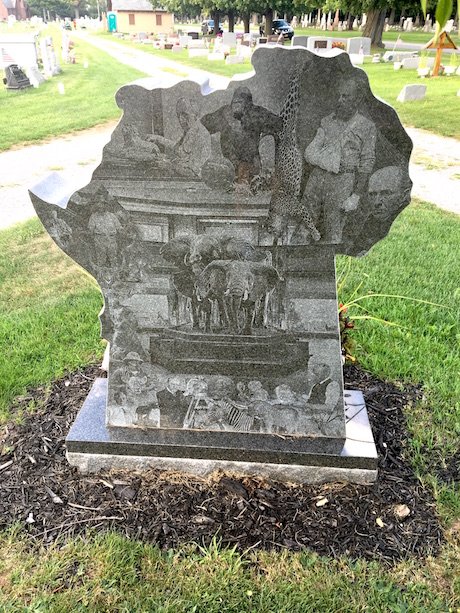
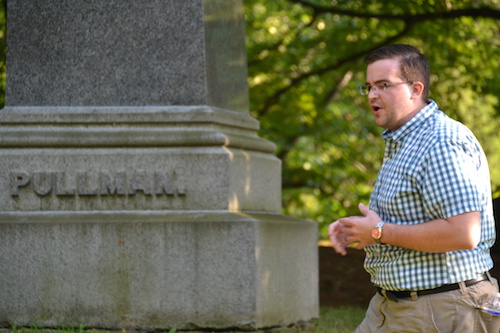
This is the backside of a monument dedicated on May 19 to Carl Akeley, the famed taxidermist who grew up in Clarendon. Akeley was portrayed at the Ghost Walk by Tom Rivers, the Orleans Hub editor. Akeley is buried in the Congo. He died there in 1926 after getting the fever. The memorial stone is carved from black African granite and bears the shape of the continent that Akeley worked tirelessly to preserve and protect.
By Matthew Ballard, Orleans County Historian Posted 12 September 2016 at 8:36 am
Site was precursor to Albion Correctional Facility, the current women’s prison
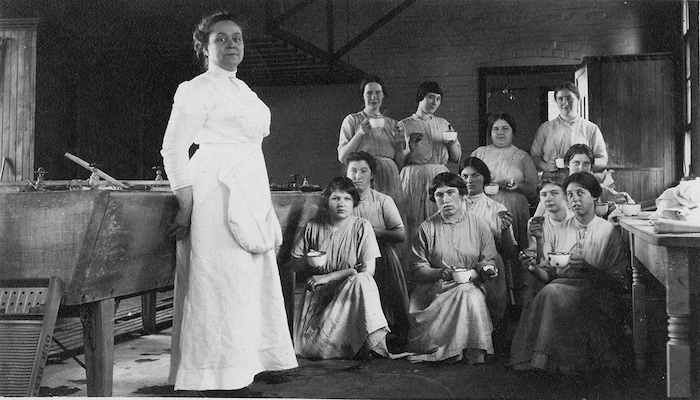
Photos courtesy of Orleans County Department of History: These images taken in the early quarter of the 20th century show some of the inner workings of the institution. A group of young women are shown posing with cups of soap in preparation to do laundry.
“Overlooked Orleans” – Volume 2, Issue 37
Nearly 125 years ago, the Western House of Refuge was constructed on farmland located west of the village of Albion.
It was largely due to the work of E. K. Hart that this location was selected as the site for this new establishment, which was opened on Dec. 8, 1893. For nearly a month, the institution went without receiving a single inmate until the first woman was “brought in” during the early part of January 1894.
The House of Refuge provides insight into an interesting period in the U.S. penal system. Women ages 16 to 30 who were charged with crimes ranging from petit larceny to public intoxication, prostitution, or “waywardness” would find themselves confined to the Refuge for a period of three to five years.
During a time when crimes of a sexual nature, such as prostitution, provided a double standard in society between males and females, women were sent to the House of Refuge by cuckolded husbands or families.
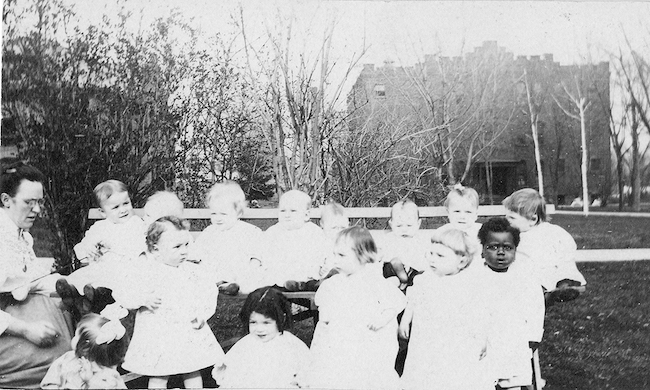
This image shows a group of children, those born to “inmates” at the House of Refuge. Many women who entered the institution were there under unfortunate circumstances and some of the babies were born as a result of those circumstances.
In its earliest years the House of Refuge would have fit the character of a minimum security institution where the grounds were surrounded by a short fence, far from the chain-link fence and razor wire used at prisons today. The goal of the institution was to train women in the various domestic duties assumed by good wives and housekeepers.
The fundamental belief was that by providing a basic grade-school education along with vocational training in sewing, knitting, cooking, laundry, and good etiquette, women would be well equipped to marry or enter into employment as a housekeeper upon their release.
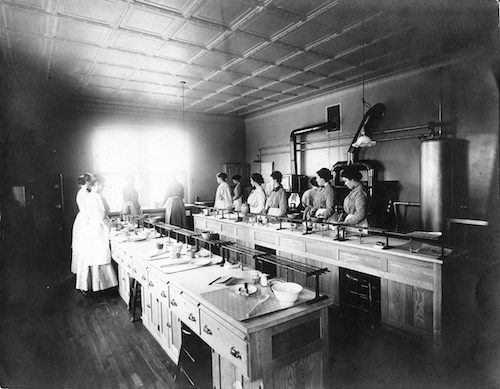
This image shows the women receiving instruction in “domestic science” taught by Mrs. Ruth Webster Howard. The House of Refuge had both gas ranges and coal/wood stoves to prepare women for work in homes with either setup.
Here are a few interesting happenings and crimes involving women at the Western House of Refuge:
• 1894 – All of the inmates escaped from the Western House of Refuge through a second story window. Of course, the institution was only open for one month and the population consisted of three inmates.
• 1910 – Six young women escape from the House of Refuge and are chased to Albion by attendants of the institution. The women arm themselves with clubs and stones in an effort to confront their pursuers. Eugene Mahoney, the engineer at the House of Refuge is struck in the head with a rock and knocked unconscious. To avoid capture, the women threaten to throw themselves in front of an oncoming freight train but are apprehended before they are able to follow through on their threat.
• 1914 – Alice Stearns, 18, and Margaret Trapasso, 20, of Buffalo escape while hanging clothes outside; they were left unattended only for a few moments.
• 1915 – Antoinette Carron, a Utica woman, is sentenced to three years at the Western House of Refuge for stealing $1,000 worth of fine laces, embroidery, silks, feathers, and other expensive apparel.
• 1931 – Eva Young and Rose Babyak of Jamestown escape from the Western House of Refuge and were later arrested with an accused murderer and thief named Lyman Miller at Buffalo.
• In another case, date unknown, a 17-year-old girl was sentenced to three years at the House of Refuge after she was taken advantage of and “ruined” by a 38 year old man whom she was working for as a domestic servant. The man was sentenced to four months of hard labor; a fine example of the double standards of the time.
By Tom Rivers, Editor Posted 10 September 2016 at 1:46 pm
Photos by Tom Rivers
MEDINA – There are many impressionists and re-enactors from U.S. history at GCC in Medina today as part of the inaugural Orleans County Heritage Festival.
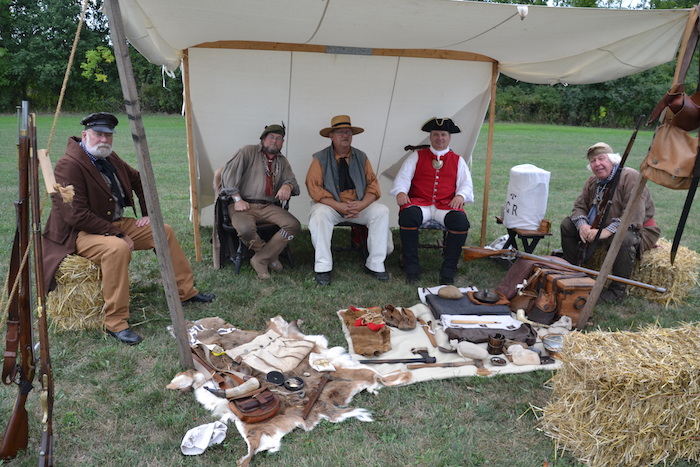
This group, includes, from left: Tom Schobert of West Seneca, an Alamo defender from 1836; Mark Houseman of Medina, a colonial militia ranger from the French and Indian War from 1756-1763; John Della Penna of Batavia, a member of the militia in the War of 1812; John Snyder of Lancaster, portraying Sir William Johnson (Indian agent for the British Empire during French and Indian War); and Tom Faith of Elma, a British ranger in the French and Indian War.
They are pictured with weaponry and leather leggings, moccasins, provisions, powder horns and other artifacts. “The public doesn’t realize the hotbed of history sitting here in Western New York,” Snyder said.
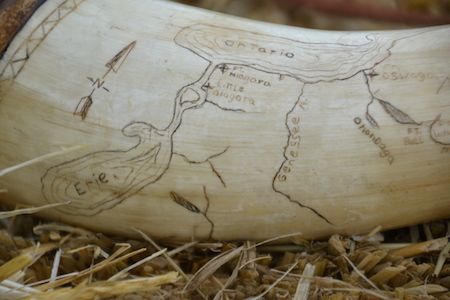
Snyder’s replica powder horn includes a map of WNY that details sites visited by a soldier, which would help in case he got lost. Snyder made the powder horn as a replica or what one would have looked like about 250 years ago.
Raymond Ball of West Seneca portrays a member of the Corps of Engineers who served in the Mexican-American War in 1846-1848. Ball said his father is descended from a unit that served in that war.
“This is a very overlooked part of American history,” Ball said. “There was a huge land grab and the war established the U.S. Army as a force to be reckoned with.”
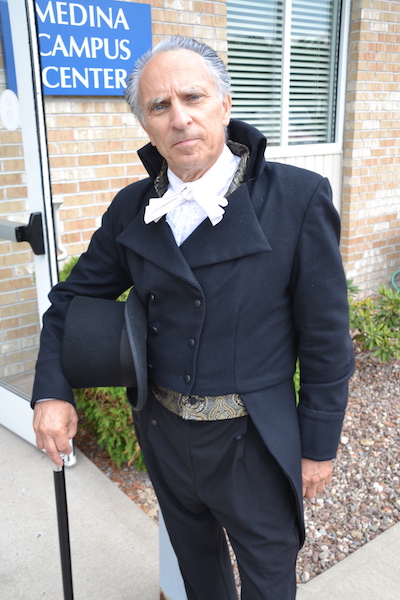
Gary Costello of Buffalo is James Madison, the fourth U.S. president who served during the War of 1812. Costello first portrayed Madison in 2012 at 200th anniversary observance of the War of 1812, which included action in Buffalo.
Melinda Grube is in costume as Elizabeth Cady Stanton, sharing stories of the leader of the suffrage movement from Seneca Falls.
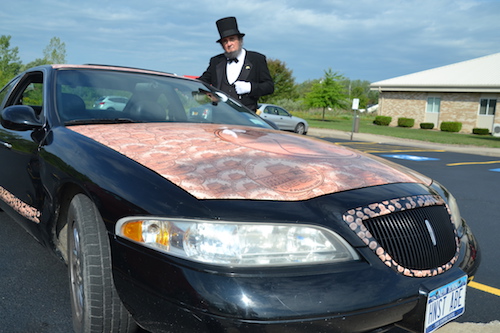
David Kreutz of Depew is a prominent Abraham Lincoln impersonator. He is pictured with his “Penny Car,” which includes a vinyl wrap of Lincoln. Kreutz’s license plate reads “HNST ABE.” He has travelled 150,000 miles in his Lincoln car, attending events all over the country. Kreutz said the car functions as “a roving schoolhouse.”
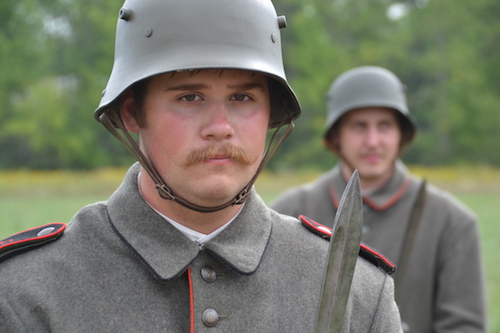
Sam Maryjanowski of Medina, front, and Steven Burley of Barker are dressed as German soldiers from World War I.
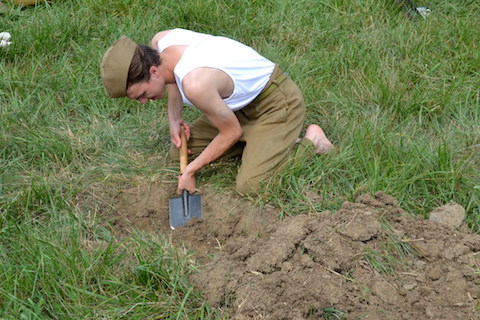
Andy Tripp, a Niagara University student, portrays a Russian soldier from World War I. He is digging a rifle pit to hide in. He said the pits where a way to avoid gunfire.
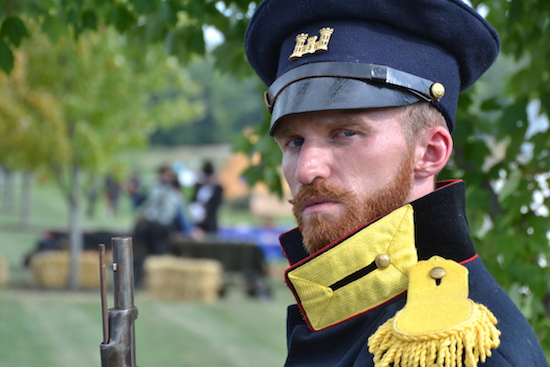
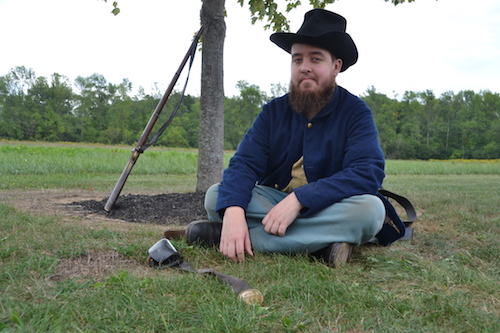
Caleb Avery of Lockport is dressed as a Union solider in the Civil War during 1864. Avery said he was part of the 78th NY, which included infantry from the Buffalo area. Avery is working on an impression of a World War II soldier. Many of the other participants are Civil War re-enactors who have developed other characters from different eras of U.S. history, Avery said.
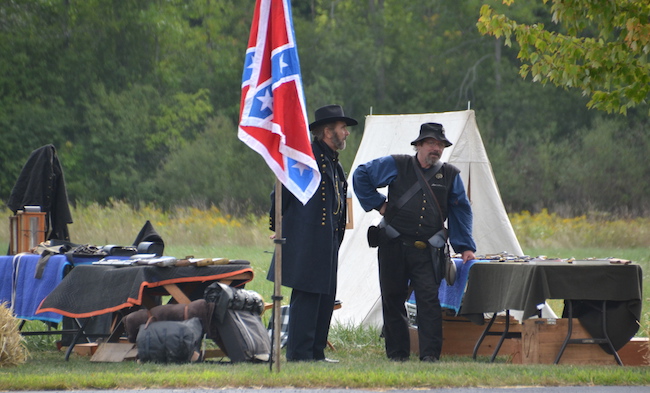
Ed Brodbeck, left, of Cheektowaga is Gen. Ulysses Grant. Jay Black, right, of Batavia portrays a provost marshal. Black brought along a collection of weapons that were used in the Civil War for people to look over.
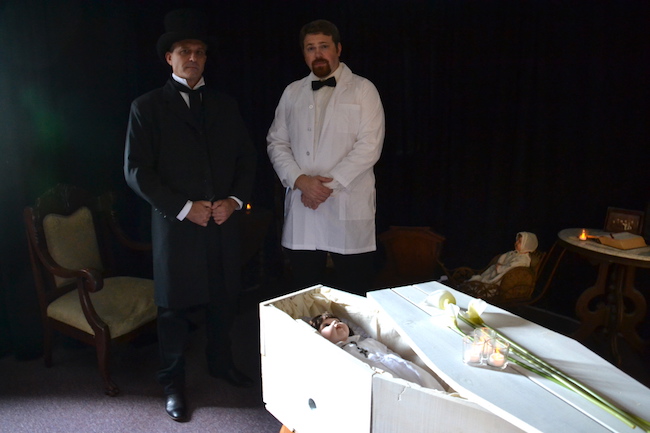
GCC professors Tracy Ford (an undertaker), left, and Matt Pettit (an embalmer) are part of Victorian mourning display at GCC in Albion. A doll represents a child. Many children never reached adulthood during the 1800s, victims to disease, sickness and other ailments.
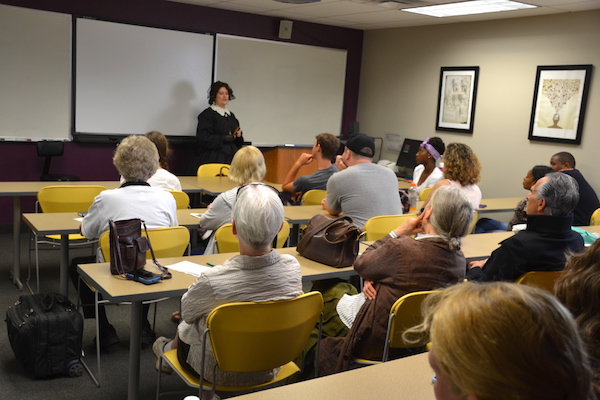
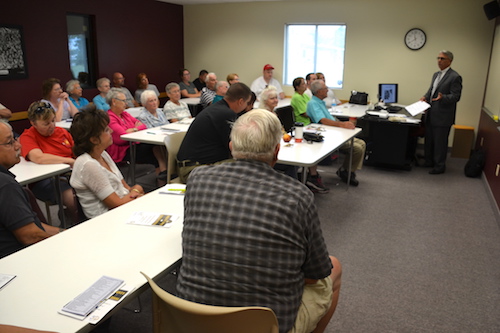
District Attorney Joe Cardone drew a packed house for his discussion on famous crimes and murders in Orleans County.
In addition to the activities at the GCC campus centers today, 29 sites in Orleans County are available for tours. Click here to see the schedule for the Heritage Festival.
By Tom Rivers, Editor Posted 7 September 2016 at 4:54 pm
MEDINA – The Village of Medina and the Boxwood Cemetery Commission will dedicate a new historical marker on Saturday at noon. The marker notes the cemetery was listed on the National Register of Historic Places in 2015.
The marker is by the entrance of the cemetery, next to the chapel built in 1903 from Medina sandstone in a Gothic Revival style.
After the marker is dedicated at noon, Village Historian Todd Bensley will lead a tour of the cemetery which opened in 1850. He will discuss funerary art and some of the residents buried in the cemetery on North Gravel Road.
The tour is part of the Orleans County Heritage Festival, which highlights many of the cemeteries in the county, as well as “historic gems,” transportation and agriculture.
For more on the festival, which runs from Sept. 9-11, click here.
By Matthew Ballard, Orleans County Historian Posted 3 September 2016 at 8:38 am
George Pullman
Volume 2, Issue 36
As many of us prepare to enjoy a few moments of vacation time this Labor Day, it is important to reflect upon the origins of the holiday.
Today, we see the first Monday in September as an official end to the summer season; a day for picnics, trips, and rest. Yet over 100 years ago, the federal holiday was established as a day to honor the American labor movement and the continued commitment of the U.S. labor force to the development of the country.
In the 1840s, a young George Pullman arrived in Albion with his father’s family and settled down in the village. Pullman’s father, James, was a prominent member of the Universalist Church in Brocton (Chautauqua County, NY) and often filled the pulpit in that vicinity in the absence of a minister.
Upon their arrival in Orleans County, the Pullmans attended the nearest Universalist society, which was located in the town of Gaines.
As a young man, George worked with his father as a cabinet maker and worked several contracts with the Erie Canal relocating warehouse buildings during various expansion projects. Upon his father’s untimely death in 1853, George took responsibility for supporting his mother and siblings by taking over the family business.
It was thanks to his work on the Canal that he was awarded several engineering contracts in Chicago where he would partner with Charles Henry Moore of Albion. During a train ride between Chicago and Western New York, Pullman realized that there was a need for clean and comfortable railroad travel.
Utilizing his experience as a cabinet maker, he experimented with compact sleeping accommodations after partnering with Benjamin Field, a New York senator and resident of Albion. The men built two prototypes, converting those railcars with moderate success. The partnership was short-lived and Field traded his interests back to George for future loans.
Pullman was an entrepreneurial and industrious man and used the money he earned in Chicago to purchase a ranch in Colorado. Along with Spafford Field of Albion, the two men were responsible for supplying western travelers with fresh teams of animals before venturing through the mountains.
In addition, some interest in mining helped expand their financial resources and the 1,600 parcel of land became known as a basecamp for prospectors in Colorado. With his new found wealth, Pullman returned to Chicago to invest his new earnings in the Pullman Palace Car Company.
As the business grew, there came a need to expand the physical production plant. Solon Spencer Beman was hired to draw up plans for this new facility and in addition, the town of “Pullman” was planned adjacent to this new factory. Although he was praised for this magnificent creation, the town became increasingly profitable at the expense of his employees.
In order to quell unrest, Pullman restricted open discussion, town meetings, and independent newspapers, the local church sat vacant due to the lack of an “approved” denomination, and private charitable organizations were banned.
This, of course, did more to create unrest rather than prevent it. Employees often remarked, “We are born in a Pullman house, fed from the Pullman shops, taught the Pullman school, catechized in the Pullman Church, and when we die we shall go to the Pullman Hell.”
As his business began to decline in the early 1890s, he began the process of cutting jobs and wages. Instead of adequately reducing rent and utilities in the town of Pullman, prices were stagnant resulting in great disgust and anger from the workers. The result was the Pullman Strike of 1894, a rather peaceful strike made violent by the intervention of President Grover Cleveland.
Despite all of this, George Pullman attended ceremonies for the laying of the cornerstone of the Pullman Universalist Church at Albion the following week.
Federal intervention in the strike resulted in the deaths of 30 workers and nearly $80 million in property damage. In an effort to reconcile with organized labor forces in the United States, Cleveland pushed to designate Labor Day as a national holiday nearly a week after the conclusion of the strike.
File photo by Tom Rivers: Susan B. Anthony is depicted in this statue down the street from the Susan B. Anthony House on Madison Street in Rochester.
ROCHESTER – U.S. Senator Kirsten Gillibrand today announced the bipartisan Women’s Suffrage Centennial Commission Act (S.3073) at the National Susan B. Anthony House.
This legislation would establish a Women’s Suffrage Centennial Commission in honor of the 100th anniversary of the passage and ratification of 19th Amendment to the U.S. Constitution, which guaranteed women the right to vote.
The Commission would work with federal, state and local governments, private organizations, as well as Congress to develop and coordinate educational activities for Americans to learn about the suffrage movement.
Under this legislation, the Commission would have the ability to award grants to organizations in the Rochester-Finger Lakes Region and across the country to support programs commemorating the anniversary of the 19th Amendment.
“This legislation would help educate young people around the country about the unparalleled importance of the women’s suffrage movement in American history” said Senator Gillibrand. “The women’s suffrage movement was born in New York, and nearly a century after the 19th Amendment was passed, our state continues to be at the forefront of fighting for women’s rights, from paid family leave to equal pay for equal work. I will urge all of my colleagues in the Senate to support the Women’s Suffrage Centennial Commission Act, so that our nation can properly commemorate this pivotal moment in American history.”
Gillibrand also stopped at The Buffalo History Museum today to promote the initiative.
The State of New York was the birthplace of the women’s suffrage movement and it hosts some of the most legendary landmarks that helped shape this monumental gain in America’s history. New York was a powerful force in the movement for equal rights for women and the passage and ratification of the Nineteenth amendment.
This bill provides the opportunity for New York to be recognized as an instrumental part in the struggle for women’s suffrage by providing grant funding for programs and activities that commemorate the efforts of the movement and the role of New Yorkers who promoted the core values of our democracy.
Senator Gillibrand is joined by U.S. Senators Barbara Mikulski (D-MD), Susan Collins (R-ME), Debbie Stabenow (D-MI), Mazie Hirono (D-HI), Patty Murray (D-WA), Dianne Feinstein (D-CA), Barbara Boxer (D-CA), Heidi Heitkamp (D-ND), Maria Cantwell (D-WA), Elizabeth Warren (D-MA), Tammy Baldwin (D-WI) and Amy Klobuchar (D-MN) on the Women’s Suffrage Centennial Commission Act.
By Tom Rivers, Editor Posted 1 September 2016 at 9:53 am
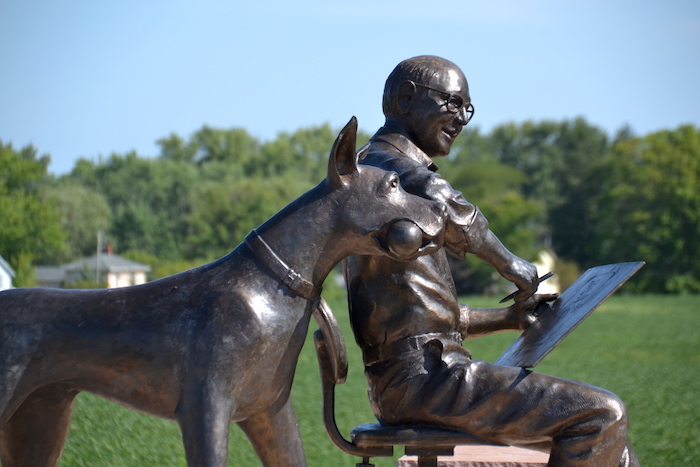
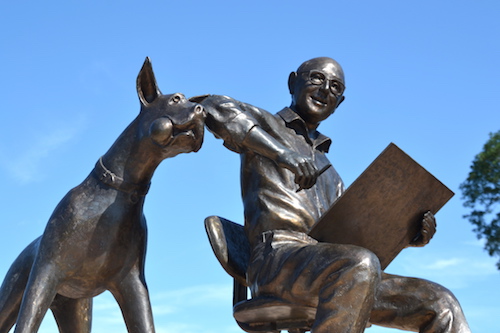
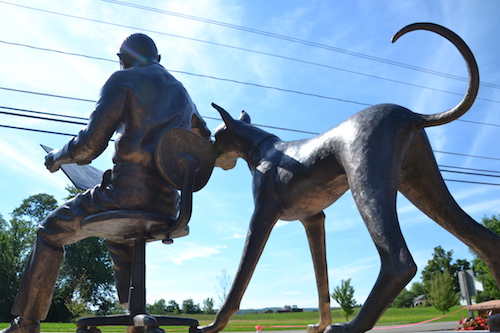
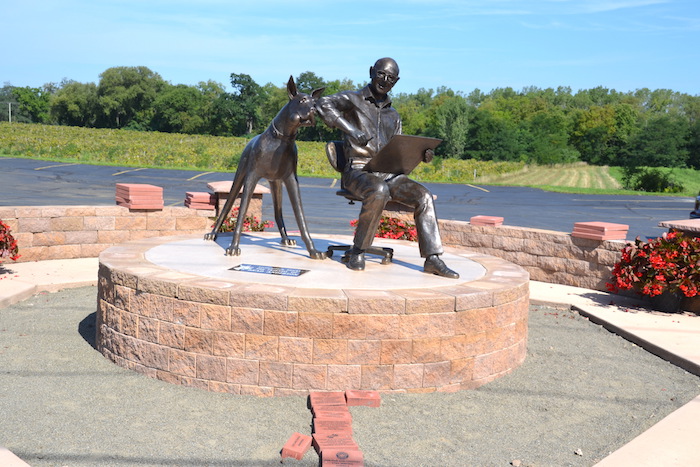
Photos by Tom Rivers: These statues of Marmaduke and his creator Brad Anderson were unveiled on July 2 in Brocton, a community in Chautauqua County where Anderson grew up.
BROCTON – For 61 years artist Brad Anderson shared stories of a Great Dane, 20,000 comic strips in all of Marmaduke. At its peak, Marmaduke appeared in more than 600 newspapers in 20 countries.
Anderson was 91 when he died on Aug. 30, 2015. Many of his friends and admirers in his hometown already had been working on a bronze statue of Anderson and Marmaduke when Anderson died. It took four years of fund-raising and planning to make the project a reality.
The statues of Marmaduke and Anderson were unveiled over the July 4th weekend in Brocton, a small village in Chautauqua County in the Town of Portland.
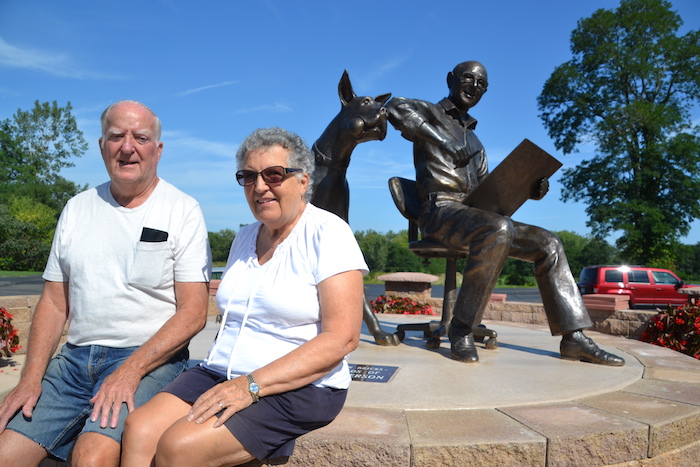
Charles Krauth and his wife Barbara are on the Brad Anderson Recognition Committee that has pushed for the statue.
The group was able to accept tax-deductible funds through the Brocton Portland Development Corporation. It also had an online Kickstarter campaign that raised more than $30,000.
The group is continuing to sell memorial bricks, and many people are buying them in memory of beloved pets.
“It takes a lot of time and everything costs money,” Mr. Krauth told me on Saturday.
The statues are about 5 miles from my mother’s house. While visiting her this past weekend, I went to check out Marmaduke. Krauth happened to drive by when I was at the statue, which was built on donated land next to the Portland Town Hall. He stopped to chat about the project.
Charles and Barbara Krauth are pleased to see the statues of Marmaduke and Brad Anderson in their community.
Krauth said having the Brocton Portland Development Corporation was a key in getting the project going. That group was a conduit for people to donate tax-deductible money.
Krauth said the fund-raising was slow in the beginning, but the Kickstarter campaign made a big difference. However, there was a lot of pressure because the community needed to raise 100 percent of its $30,000 goal through Kickstarter. It wouldn’t be able to collect on the donations unless it reached the goal. It raised $31,470. (Click here to see the Marmaduke Kickstarter.)
Nearby Westfield has two bronze statues – Abraham Lincoln and Grace Bedell. The community put those up to honor the girl who wrote the letter to Lincoln, urging him to grow a beard. Grace grew up in Albion but lived in Westfield briefly. (Albion has a historical marker for Grace Befell by her home on West State Street.) She mailed the letter from Westfield and that’s where she met Lincoln on his inaugural journey by train. He stopped at Westfield to see her. The statues were created by Westfield native, Don Sottile, who has a studio in Penn Yan.
Marmaduke is poised and ready to play in the statue created by Don Sottile.
Sottile was hired to create Marmaduke and Anderson in Brocton. Sottile met with Anderson before he died when Anderson was in town for a class reunion in 2012.
Sottile shows Anderson sitting at his art board with Marmaduke giving him a playful nudge. The Great Dane has a ball in his mouth, ready to play fetch.
Krauth said the statues have been an attraction the past two months.
“People stop by all the time,” he said.
The group looked at putting Marmaduke in the downtown area, but Krauth said the committee didn’t think there was enough room.
The Town Board made land by the Town Hall available. Krauth said people park by the Town Hall and go see the statues. The site isn’t quite done. Krauth said memorial bricks, many with dog prints in honor of beloved pets, are being set around the base.
Many people have bought memorial bricks at the Marmaduke-Brad Anderson site.
He and his wife said they are grateful they joined the committee and worked on the project.
“I’m retired,” he said. “I wanted to do something good for the community.”
Anderson, who served in World War II with the Navy, lived in Montgomery, Texas. He was interviewed in 1999 by The Dallas Morning News. Anderson told the newspaper he didn’t want to give Marmaduke a human personality.
“He’s not a talking dog,” Mr. Anderson told the newspaper. “He doesn’t have a balloon above his head, he doesn’t walk on his hind legs. He walks and does things a real dog would do.”
Anderson was happy to chronicle the amusing antics of an awkward but lovable dog.
“I wanted a dog that doesn’t know it’s a big dog, because big dogs don’t realize how large they are,” Anderson said in the 1999 interview. “They want to sit in your lap.”
The site for Marmaduke and Brad Anderson is still under construction with the memorial bricks being installed at the base. The bricks have been popular for people wanting to honor their beloved pets.
Photos by Tom Rivers: Orleans County Historian Matt Ballard leads a tour of Mount Albion Cemetery on Sunday evening. Ballard is pictured at the grave of Lorenzo Burrows, who established a bank in Albion, served as the county treasurer and was the state’s comptroller from 1856 to 1857. He also ran unsuccessfully for governor. About 40 people attended the tour on Sunday.
ALBION – The first-ever Orleans County Heritage Festival is less than two weeks away – Sept. 9-11. The festival will focus on four themes – Agriculture, Transportation, Historic Gems and Historic Cemeteries.
One of the four themes emphasized this year is Historic Cemeteries. Participating cemeteries include: Beechwood and Greenwood in Kendall, Boxwood in Medina, Hillside in Holley, Mt. Albion and Union Cemetery at Watt Farms – both in Albion.
Beechwood Cemetery on Woodchuck Alley in Kendall was established in 1828.
Cemeteries are a rich source of local history and culture, if people take the time to appreciate them, said Derek Maxfield, a history professor at Genesee Community College and one of the chief organizers of the Heritage Festival. The cemetery art contained on the many grave stones contain information about families, military service and values. The symbols and iconography give us a window into the culture of the time, he said.
Several of the participating cemeteries this year will give people the opportunity to learn more about these wonderful outdoor museums, Maxfield.
At Boxwood Cemetery in Medina, Village Historian Todd Bensley will lead tours on Saturday (Sept. 10) and Sunday (Sept. 11) beginning at noon and 2 p.m. There is no admission charge.
Mt. Albion will also feature cemetery tours led by former Orleans County Historian Bill Lattin. Tours will be led on Saturday (Sept. 10) from 3 to 5 p.m. and will begin every half hour from the chapel. There is no admission charge.
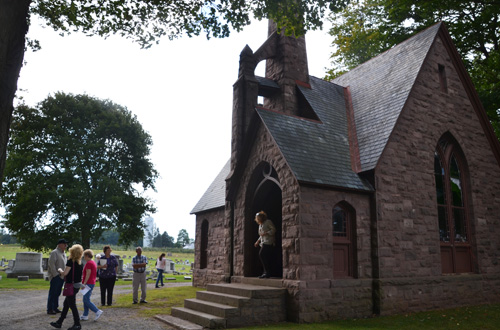
The chapel at Hillside Cemetery in Holley/Clarendon will be open for tours on Sept. 10. The cemetery is listed on the National Register of Historic Places.
At Hillside Cemetery in Holley visitors can take a self-guided tour on Sept. 10 of the remarkable Gothic Revival chapel built in 1894 and cemetery from 9 to 11 a.m. – beginning from the chapel, and/or go on a “Ghost Walk” in the evening.
Established in 1866, the cemetery has a split personality. The older section of the cemetery reflects the romantic era of antebellum America and Guilded Age of the late 19th century. The newer section reflects the Lawn Cemetery style of the twentieth century.
The Clarendon Historical Society began raising money a few years ago in an effort to preserve the beautiful chapel at Hillside Cemetery.
The “Ghost Walk” on Saturday (Sept. 10) will benefit the restoration fund. Walks will begin from the chapel at 7 and 8 p.m. Admission is $10 per person. Among the fascinating “ghosts” will be Carl Akeley, the famed taxidermist, who will be portrayed by Tom Rivers, editor of the Orleans Hub. Also featured will be Francis Cole, who was a POW for 29 months during World War II, and Jewell Buckman who had the distinction of being the first local soldier killed in World War I.
The cemeteries in Kendall, Beechwood and Greenwood will feature self-guided tours from 10 a.m. to noon on Saturday (Sept. 10) as will Union Cemetery at Watt Farms in Albion. A brochure will be available at the Watt Farms Market which will highlight the graves of veterans of the War of 1812 and the Civil War.
Folks interested in American death ways will want to check out events and exhibits at Genesee Community College’s Albion campus center. “Death, Mourning and Justice in Orleans County” will feature a recreated wake in a Victorian parlor. A beautiful glass casket from the late 19th century will be on display.
Matt Ballard stops at the Pullman family grave at Mount Albion on Sunday. James Lewis Pullman, father of sleeping car magnate George Pullman, is buried at Albion’s historic cemetery.
There will also be two public lectures at the Albion campus: at 11 a.m. Orleans County District Attorney Joe Cardone will speak on famous crimes and murders. Lattin, the retired historian, at noon will talk about Victorian memorials featuring human hair. There is no admission charge for any GCC events or exhibits.
Visitors who wish to take advantage of the great opportunities afforded by the Heritage Festival should begin by procuring a festival brochure, which is available at all participating organizations and from GCC campus centers in Albion and Medina. A list of participating organizations is available at the festival website (click here).
Once the brochure is in hand, participants are encouraged to visit at least three locations to be eligible for prizes. As guests visit each location, they will be provided with a colored ribbon. Once they collect three ribbons of any color, they are eligible for a collectable button featuring artwork that reflects the four themes.
They also become eligible for a drawing for prizes. For more information about the Orleans County Heritage Festival go to orleansnyheritage.com or contact Derek Maxfield at ddmaxfield@genesee.edu.
By Tom Rivers, Editor Posted 28 August 2016 at 2:10 pm
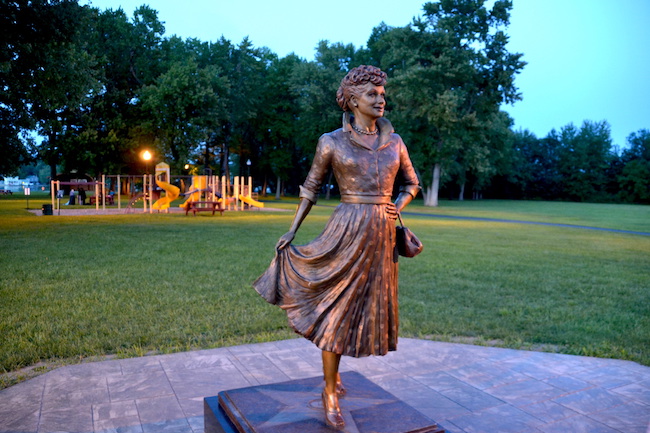
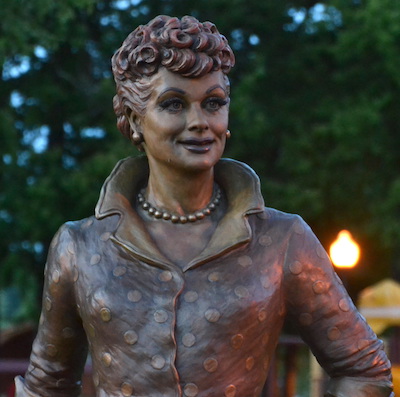
CELORON – A bronze statue of Lucille Ball graces a park in Celoron, Ball’s hometown near Jamestown. The statue was unveiled on Aug. 6 after much controversy and international ridicule for the first statue of the First Lady of Comedy, a work of art that became known as “Scary Lucy.”
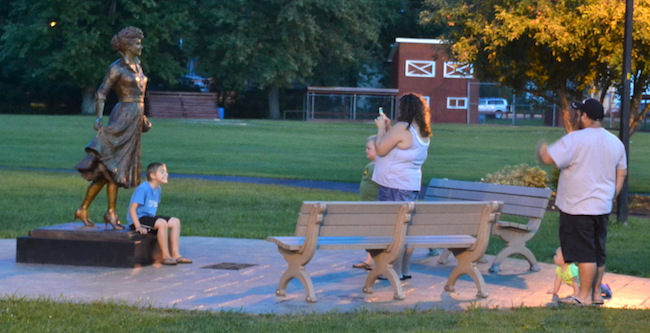
I saw the statue on Saturday evening. It definitely has the “wow effect” and drew a crowd of people with cameras. One group was from Rochester.
I grew up in Chautauqua County and was home Saturday for my cousin’s wedding. (I missed the Steampunk Festival on Saturday at Leonard Oakes Estate Winery in Medina.)
But I had to see Lucy. My 10-year-old daughter is named Lucy and seeing the new statue was a fun ending to an eventful day back home.
I’m also on the committee in Albion that wants to have a Santa statue in honor of Charles Howard, the man who started a Santa Claus School and who portrayed Santa in the Macy’s Thanksgiving parades for nearly 20 years. Howard died 50 years ago, but the Santa School continues in his name in Midland, Mich.
I think a Santa statue could be a draw for Albion. After seeing the Lucy statue in tiny Celoron, I’m more convinced a Santa statue would be a fitting tribute for Howard and an attraction for Albion. (A group in Medina also is working on a bronze statue of a World War I soldier that would go outside the former Armory, now the YMCA on Pearl Street.)
Carolyn Palmer was hired to create the new sculpture of Ball, picked out of 60 proposals for the project.
The statue was unveiled to much hoopla on Aug. 6, which would have been Ball’s 105th birthday.
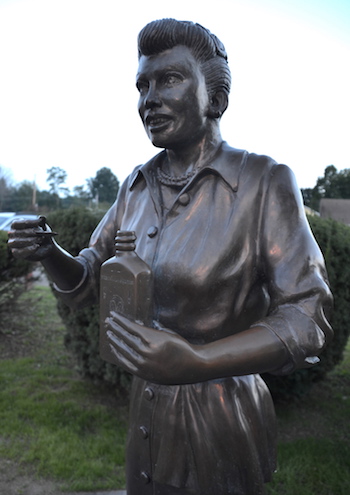
Scary Lucy became an international subject of scorn.
Mark & Jetta Wilson wanted to recognize Celoron’s most famous daughter in 2009. A bronze statue was commissioned. It was a horrible depiction. Four years ago a public movement began to replace Scary Lucy (right) with a better tribute of Ball.
The money was initially slow in coming in, but a Massachusetts car dealer and numerous anonymous donors stepped forward.
Palmer watched and rewatched episodes of I Love Lucy, the groundbreaking sitcom that made Ball a TV star in the 1950s. Palmer sought to capture Ball’s movements and a sense of the ’50s era.
“I not only wanted to portray the playful, animated and spontaneous Lucy, but also the glamorous icon,” Palmer told Richard Gonzales of NPR. “I just hope that all the Lucy fans are pleased and that Lucille Ball herself would have enjoyed this image of her.”
“Scary Lucy” was sculpted by artist Dave Poulin. This statue depicts Ball holding a bottle of the fictional nutrition elixir Vitameatavegamin from the 1952 “I Love Lucy” episode “Lucy Does a TV Commercial.”
This bronze figure has been compared to a menacing zombie. A Facebook group, “We Love Lucy! Get Rid of this Statue” formed to push for the new likeness of Lucy.
Poulin publicly apologized for his “most unsettling sculpture” in an April 2015 letter to The Hollywood Reporter.
“I take full responsibility for ‘Scary Lucy,’ though by no means was that my intent or did I wish to disparage in any way the memories of the iconic Lucy image,” Poulin wrote in the letter.
Many people of all ages are stopping to have their picture taken with the new statue of Lucy.
Celoron has kept Scary Lucy at the Lucille Ball Memorial Park. It’s the first statue that greets you. Scary Lucy is an attraction, and is rumored to be destined for the new Comedy Hall of Fame in Jamestown.
Scary Lucy is freaky. It is a sharp contrast to the new Lucy. Having the old statue near the new one shows how graceful the new one is of Lucy.
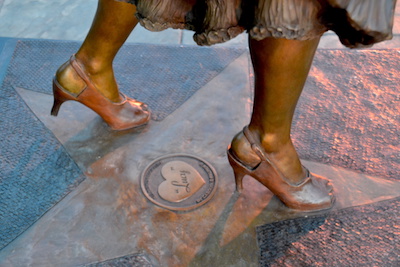
The Lucy statue includes the nice touch of having her standing on a replica of her Hollywood star.
After the statue was unveiled to much fanfare on Aug. 6, the crowd assembled sang the theme song to “I Love Lucy” and “Happy Birthday” to Lucy.
The site has stayed popular for people seeking selfies with one of the most famous women of the 20th Century.
By Matthew Ballard, Orleans County Historian Posted 27 August 2016 at 11:28 am
Volume 2, Issue 35
ALBION – On October 11, 1870, Ezra Titus Coan started his career as a private banker when he established “Coan’s Bank” in Albion.
The establishment was fairly successful and in 1884 relocated to the Burrows Block to occupy the space previously inhabited by the First National Bank. That institution collapsed earlier that year when Albert S. Warner absconded with the bank’s assets. Of course, that is a different story for another time.
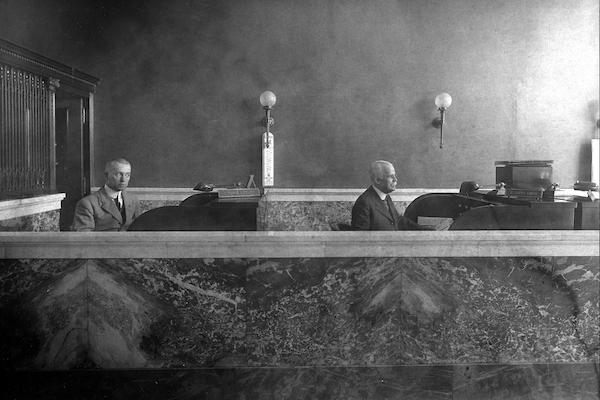
This picture shows the interior of Citizens National Bank, the name given to the organization after it was reorganized on July 8, 1895. Seated right is Robert Titus Coan, son of Heman Coan of Lyndonville.
At the time this photograph was taken, Coan was the president of the bank, having succeeded his uncle following his death in 1900. Robert is handling bank documents while seated at his desk; a copy of the Orleans Republican newspaper also sits on the desk. Seated to the left is Charles Royce Sawyer, the bank’s cashier at the time.
On November 22, 1911, the bank reached $1,000,000 in deposits, an accomplishment that was noted in papers throughout Western New York. The bank remained in operation until the early 1930s when it closed. The institution’s assets were liquidated in 1937 and the building eventually sold to Arnold Pilon and Carl Rowe when it was converted to a grocery store, becoming Dale’s Supermarket.
Robert Coan, the nephew of E. Titus Coan, was active in the banking industry throughout Western New York, serving as a director of the Genesee Valley Trust Company in Rochester. Before the bank was reestablished as Citizens National Bank, he served as Orleans County Treasurer from 1891 to 1894, treasurer of the Albion Cold Storage Company, and was postmaster at Albion for several years around the turn of the century.
Royce Sawyer was also actively engaged in local civic organizations and banking interests. He served as a director for both the Albion Cold Storage Company as well as Growers’ Cold Storage at Waterport, and was a director of the Niagara Suspension Bridge Company.
Sawyer also served two terms as Orleans County Treasurer and was treasurer of Mt. Albion Cemetery. An active member of the local fire department, he was largely responsible for mechanizing the Albion Fire Department and was an active member of the Western New York Volunteer Firemen’s Association.
While returning from a convention of the Republican Party, Sawyer was involved in an automobile accident. Although shaken up, he only suffered minor injuries and returned home to rest. Roughly two weeks later, he suffered a serious heart attack while working at the bank. He returned home on S. Main Street, but never recovered and died shortly after.
Royce Sawyer was the great grandfather of Michael Sawyer who recently passed away August 18, 2016. I had the pleasure of meeting Mike on several occasions to discuss his interests in supporting historical organizations in Orleans County. His father, John, was an ardent supporter of establishing a museum locally to share the rich history of his family’s home. Mike carried on his father’s legacy and interests by continuing that discussion. It’s clear that the passion and desire to better Orleans County was deeply rooted in his lineage; our community suffered a great loss with his passing.
The Department of History will host its final tour of Mt. Albion Cemetery this Sunday, starting at 6 p.m. at the cemetery chapel. I want to thank all of those who have shown an interest in the tours this season; from the preliminary headcounts we have seen roughly 200 people over three tours which is a monumental accomplishment. This week’s tour will focus around the Soldier’s & Sailor’s Monument and feature some of area’s more prominent and well-known politicians, businessmen, and educators.

















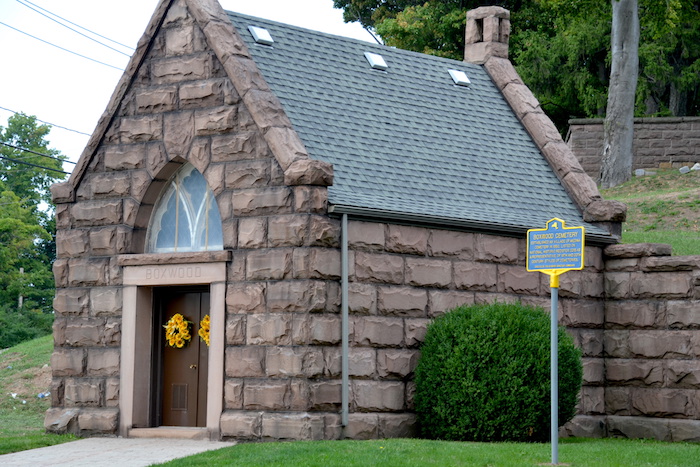
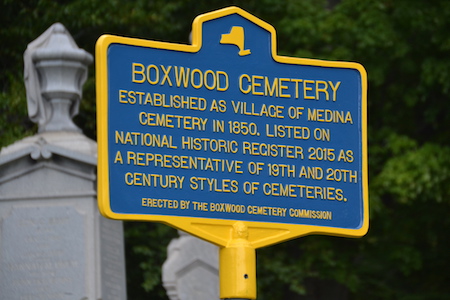 The marker is by the entrance of the cemetery, next to the chapel built in 1903 from Medina sandstone in a Gothic Revival style.


 Scary Lucy is freaky. It is a sharp contrast to the new Lucy. Having the old statue near the new one shows how graceful the new one is of Lucy.