









In August of 1958 my father Cary Lattin, in the stern of the canoe, took my friend Lee Stevenson, son of Don and Ruth Stevenson, and myself, in the bow of the canoe, on a trip.
We started in North Tonawanda on the Erie Canal, came through the locks at Lockport and camped on the canal bank overnight around Gasport.
The next day we arrived back in Albion. It was a lot of paddling!
I was 13 years old at the time. Wishing us bon voyage from the dock are Angie Brown, Polly Rosch and my mother Avis Lattin.
ALBION – In this picture from the early 1960s we see the Atlantic gas station that was located at the southeast corner of routes 31 and 98 in Albion.
Rollie Kast operated this service station at the time. Note the three overhead doors.
In the righthand background, we see a new Marti’s Motel. This site was later acquired by the Eckerd Drug Co. and now serves as a location for the Rite Aid store.
GAINES – Cousins Arthur Poelma, left, and Ralph Poelma posed together for this picture in 1920. They are standing on a Minneapolis Moline tractor that had an electric starter, electric head lights and a front-wheel drive.
The photo was taken on one of the Poelma Farms at East Gaines.
Editor’s note: Ralph Poelma died on July 7 at age 98. He was a full-time farmer until he was 87. He gave 28 gallons of blood as a donor, a period spanning about 75 years. His cousin Arthur lived to be 88. He died on Oct. 4, 2004. Both are buried at Mount Albion Cemetery.
Photos by Sue Cook
MEDINA – Todd Bensley, the village of Medina historian, talks about the cold storage building on Main Street and why its stone is gray. Bensley was one of the speakers of the downtown historical walk today set up by the Medina Sandstone Society.
Orleans County Historian Bill Lattin explains the cornerstone location on the Medina City Hall.
Todd Bensley discusses some of the downtown buildings, including O’Brien’s Tavern. Today’s tour followed 11 interpretive panels about Medina history that were recently installed as part of a project by the Orleans Renaissance Group.
Bill Lattin tells the group about the hose-drying tower used by the firemen.
Bensley talks about the variety of downtown buildings and why so many are made of different materials.
By Bill Lattin, Orleans County Historian
ALBION – The Albion High School football team had this picture taken in 1924.
The player seated on the floor is unidentified. In the front row, from left: the first two are unidentified followed by Pete Costello, Abel Brown, S. McNaughton, and John Donovan.
Second row: S. Reed, H. Sands, Chas. Barcelona, Chauncy Miller, Rexford Briggs, and unidentified.
Third row: The first two players are unidentified, followed by Don Higley, and another unidentified player.
Back row: D. Sprague, J. Simpson, G. Sprague, M.W. Cole, and Dell Fisher, coach.
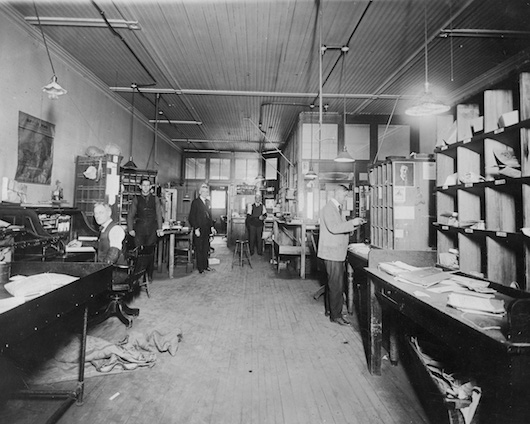
ALBION – In this photo from around 1912 we see 10 unidentified men by a wrecked auto on Orchard Street in Albion.
The touring car shown here obviously had a head-on collision with bent fenders and a broken radiator.
Two other autos with tops show behind the men along signage. In the distance a sign states “Jake Forman,” who was a junk dealer.
All the buildings here are gone except the one with the Michelin tire sign, which is now the back end of the Lake Country Pennysaver and Orleans Hub at 170 North Main St.
EAST SHELBY – It is believed this photo was taken around 1910 in East Shelby. It shows the Hagerman children.
The buggy is being pulled by one horse that is wearing a fly net. This helped keep horse flies from landing on the horse and biting. As the horse moved, the fly net jiggled.
No doubt the photographer who took the picture thought it was very cute with one child holding the reins.
ALBION – Printed information on this photo indicates it was taken on June 5, 1908, when the Independent Order of Odd Fellows Temple was dedicated in Albion.
A grand arch made of bunting was erected over Main Street to welcome everyone. The symbol for the Odd Fellows – the three links of chain for friendship, love and truth – is prominently displayed.
A speakers’ stand in the middle of our picture is draped in flags. The temple rooms were located on the second floor with three store fronts at the street level.
The one to the right was an early move theater known as Bijou Dream. Next to it was a restaurant called The Iroquois. Looking up Main Street to West State, we note that it was a dirt street.
By Tom Rivers, Editor Posted 2 August 2014 at 12:00 am
Cobblestone Museum has straight edges, house call bag, and numerous other items from era
Photo by Tom Rivers – Matt Ballard, co-director of the Cobblestone Society Museum, stands in the Danolds Room in the Cobblestone Universalist Church where artifacts, portraits and other information about the medical profession from more than a century ago are on display. The portrait in back shows Orson Nicholson, M.D. Nicholson, who lived from 1795 to 1870, was a pioneer physician in Orleans County. The portrait was donated by his grandson, Francis E. Stewart, M.D.
The display includes a collection of medicines and medical equipment, including a 1913 fully intact syringe with the Diptheria Antitoxin.
GAINES – If you think going to the doctor’s office gets a little frustrating now, sometimes having to wait an hour, imagine what it was like in the 1800s.
It could take days for doctors’ to make a house call. They had to be fetched and would then travel by horse through the wilderness of Orleans County.
“When the county started there were one or two doctors to cycle around and miles and miles of open space,” said Matt Ballard, co-director of the Cobblestone Society Museum.
He put together an exhibit – “Medicine at the Museum” – about medical care in the 1800s. The museum had an extensive collection of artifacts, and many were also donated from community members for the exhibit, which runs until Oct. 12.
“Medicine at the Museum” features photos and write-ups on many of the pioneer physicians and pharmacists in the county.
The display includes the sign for Dr. Eugene Everett Barnum, a doctor who grew up in Kendall. He earned medical degree from UB Medical School in 1881. He was born 1854 and died in 1904 at age 50. He worked out of Waterport and also was a farmer. The crutches are from the Civil War era.
This house call bag belonged to Dr. Dorothy Ollswang Cooper.
Some of the doctors and pharmacists had influences that stretched beyond Orleans County. Henry C. Lawrence of Knowlesville was a mentor to Col. Eli Lilly. Silas Mainville Burroughs of Medina was a founding partner of Burroughs, Welcomme and Co., which helped to develop compression power in medicine that was used in tablets and pills. Francis E. Stewart, M.D., worked in the research department at Parke, Davis & Co.
For medicine, pharmacists would mix concoctions. There were a lot of herbal and natural treatments, tinctures, tonics and syrups.
The museum received this collection of pharmacology items from a former Rexall store in Albion. They were donated to the museum about 40 years ago.
One of the bottles included aqua ammonia.
Doctors used straight edges for surgeries, with a barber sometimes doing a lot of the work.
Ballard consulted with local historians, reviewed local history books and used Internet research to compile the biographies of many physicians who worked in the county in the 1800s.
Doctors often teamed with barbers for surgeries, using straight edges.
“Our physician history is not very well known,” Ballard. “Those doctors had to do a little bit of everything.”
Ballard also has arranged for four lectures to be given about Orleans and WNY medical history. Those lectures will be 4 p.m. on Sundays on Aug. 17, Aug. 31, Sept. 14 and Sept. 28.
Ballard said the medical exhibit and lectures should be a draw for the museum, which is a National Historic Landmark with many structures located near the intersection of routes 98 and 104.
“Every time you go here you see something new and learn something new,” he said. “It’s not a one and done museum.”
For more on the museum and its upcoming events, click here.
ALBION – In this color post card, which was mailed in May 1909, we see the Tower or Soldiers and Sailors Monument at Mount Albion Cemetery.
At that time there was a fountain over the cistern west of the tower, which shows here in the foreground.
When the water works was first put in, a windmill pumped water from a well up to the cistern for then gravity fed water to the various faucets throughout the cemetery.
In 1906 the windmill was replaced with a pumphouse over the well where a gasoline engine then pumped up the cistern.
Historian to lead tours of cemetery on Sundays in August
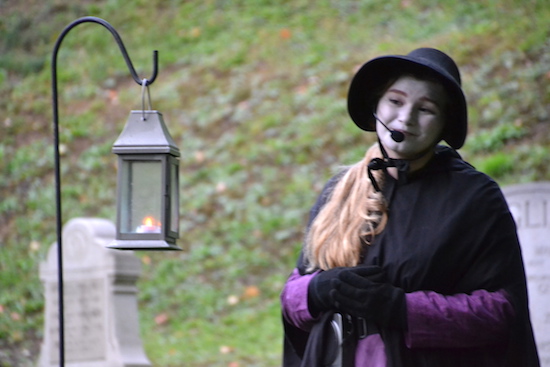
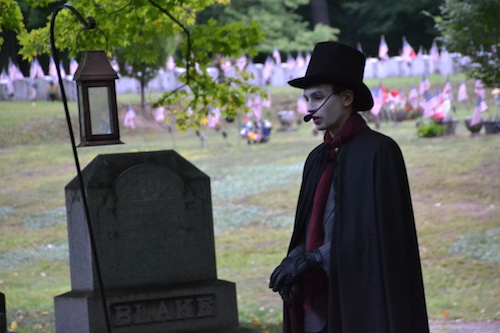
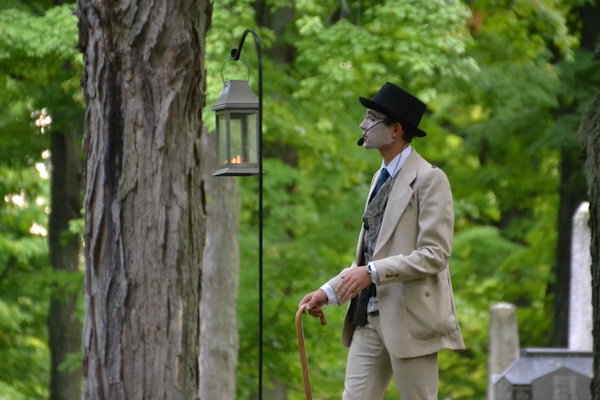
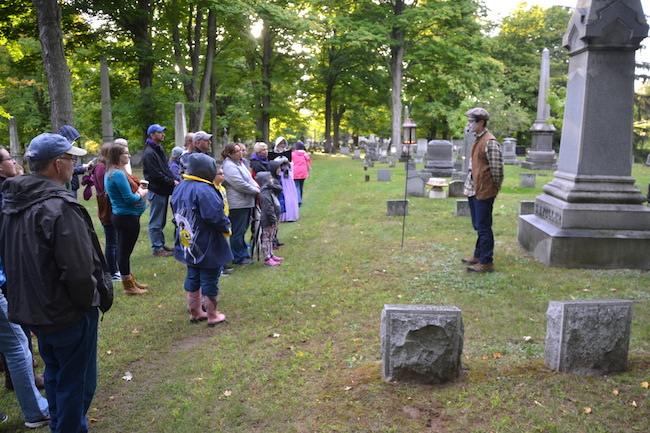
Editor’s Note: Tours of Mount Albion will take place every Sunday evening in August at 6 p.m. The tours begin at the main gate and will be led by Bill Lattin, the county historian.
ALBION – Back around 1960 the Albion Lions Club provided trash barrels for downtown Albion. They were painted silver with black letters stating, “Help Keep Albion Clean.”
Shown here, from left, are Kenneth Scharett from Scharett & Mitchell Funeral Home; “Ted” Church, an attorney from Church and Church; and Mayor John D. Robinson.
The A & P Food Store shows in back of Ken Scharett’s head while “Jack” Robinson wipes the can clean.
GAINES – The Cobblestone Society Museum will kick off a new four-part lecture series next month about medical care and its history in Western New York.
The lectures all begin at 4 p.m. on Sundays at the Cobblestone Church, 14389 Ridge Rd. There is a $5 suggested donation. That price includes admission to an exhibit about early physicians and medicine in Orleans County.
That exhibit is in the first floor of the historic church and highlights more than 20 doctors from the county. The exhibit includes some of their tools and equipment, including a bag used for house calls. (Orleans Hub will feature that exhibit in a separate article to be posted soon.)
The lecture series is designed to bring more visitors to the museum and highlight pioneering medical care in the region.
The following lectures are planned at the museum:
The Development of Buffalo’s Medical School
Dr. Ronald Batt
Dr. Ronald Batt from the University at Buffalo will be the first speaker in the series on Aug. 17.
Founded on May 11, 1846, The University of Buffalo was established to train local physicians in the Buffalo area. Opening in 1847, the University welcomed Millard Fillmore as the first chancellor. He filled the position in a part-time capacity while serving as President of the United States. The establishment of Buffalo’s Medical School represents an important part in the growth of Western New York.
Batt is a professor of clinical gynecology at SUNY University at Buffalo. His master’s thesis was focused around the development and formation of Buffalo’s Medical School and the history of the Buffalo area.
The museum will have a special artifact on loan for this event: a death mask of Dr. Roswell Park. Several masks were cast following Dr. Park’s death in 1914, including those in the collections of the Buffalo Historical Society and the University at Buffalo’s Medical Sciences Library. This is believed to be the third of three that were cast.
The Search for Health: Sanitariums and Health Resorts of WNY
Erica Wanecski of the Medina Historical Society will discuss health resorts during a lecture at 4 p.m. on Aug. 31.
Wanecski has worked in the medical field for more than 20 years. She currently works in the education field with deaf children.
Provided photo – Pictured is the Battle Creek Sanitarium in Battle Creek, Mich. It first opened in 1866 as the Western Health Reform Institute and was operated by John Harvey Kellogg (inventor of corn flakes) in the mid-1870s.
With an interest in history, she became curious about the history of the Castle on the Hill, a health resort and sanitarium in Dansville. She researched health spas, patent medicines and other medical-related topics. This presentation will focus on the history of Sanitariums and Health Resorts in Western New York.
Sanitariums existed during a time when medicinal treatments for ailments such as Tuberculosis were non-existent. The concept of health resorts and sanitariums developed into an idea similar to luxury resorts where members of the middle and upper class would travel away from home to experience state-of-the-art medical treatments guaranteed to improve their quality of life.
Trivial Tales of Orleans County Physicians
Orleans County Historian Bill Lattin will give this lecture at 4 p.m. on Sept. 14. Lattin will share human-interest stories from his up-and-coming book.
The program will include stories about several of the physicians featured in the Cobblestone Museum exhibit and others who have practiced throughout the area in the last 100 years.
Come join us as we hear the history of Orleans County’s finest physicians, told from an amusing and entertaining perspective.
Dying on Script: A Look at Victorian Attitudes Towards Illness and Death in the 19th Century
Derek Maxfield, GCC professor
Derek Maxfield, a history professor at Genesee Community College, will give a lecture, “Dying on Script: A Look at Victorian Attitudes Towards Illness and Death in the 19th Century.”
Maxfield’s presentation at 4 p.m. on Sept. 28 will explore the effects of medicine on the lives of families during the Victorian era. Looking back, many would consider the attitudes relating to death to be a morbid fascination or obsession.
Social norms developed around extended periods of mourning, a dictation of mourning dress, and exorbitant and extravagant funerals. A “Cult of Death” seemed to develop as families invested in mourning art, jewelry made from the hair of deceased loved ones, post-mortem photographs, and expensive cemetery monuments adorned with symbolism.
Maxfield will highlight a unique aspect of Victorian culture, representing the “final stage” in the 19th century treatment of severe medical ailments.
The lecture series is made possible through Genesee-Orleans Regional Arts Council and the New York State Council on the Arts.
By Tom Rivers, Editor Posted 30 July 2014 at 12:00 am
Photos by Tom Rivers
GAINES – The cobblestone structures get a lot of the attention – as they should – at the Cobblestone Society Museum, but the museum also includes six outhouses, including the one used by Rufus Bullock and his family.
(In the top photo, museum co-director Sarah Karas is pictured with the Bullock outhouse, which is located behind the Ward House next to the Cobblestone Church.)
Bullock grew up in Albion and went on to be the governor of Georgia during Reconstruction after the Civil War. He gained prestige as president of the Macon and Augusta Railroad in 1867. He was elected governor and served from 1868 to 1871. Bullock was an abolitionist and successfully fought accusations of corruption while he was governor in Georgia.
He returned to live out his life in Albion and is buried at Mount Albion Cemetery. His house still stands at the northwest corner of West Park and Liberty streets.
The Cobblestone Church was built in 1834 and is the oldest cobblestone church in North America. But it’s not the oldest structure on the museum grounds. That distinction goes to this outhouse that was erected in the early 1830s.
The finest of the six outhouses is this one, which has five seats inside. This outhouse is next to the Farmer’s Hall.

By Matt Ballard
Cobblestone Society Museum co-director
LYNDONVILLE – This small building, standing on the east side of Main Street in the Village of Lyndonville, once served as the office of Dr. John D. Warren.

Later, this same building was used by Dr. Warren’s son-in-law, Dr. Charles E. Fairman. It was common practice for a physician to have a smaller building located near their home for use as an office. Many homes had separate wings or extensions that served as the location for their practice.
Dr. Warren was well known for his interest in fruit and vegetable drying. Around 1880, he submitted a patent for “Warren’s Vegetable Soup Package,” the precursor to the instant soup packets we currently use today. Later that same year, Gaines farmer A. J. Palmer assigned half of the patent for his fruit dryer to Dr. Warren. The Cobblestone Museum has the patent model of Palmer’s fruit dryer on display in the Farmer’s Hall.
Editor’s Note: The Cobblestone Museum is hosting an exhibit, “Medicine at the Museum,” through Oct. 13, The exhibit displays a collection of medical artifacts from the Rexall Drug Store in Albion and features over 20 local physicians and pharmaceutical giants.
The museum in August and September also will have a four-part lecture series about the development of the medical profession in Western New York. The series starts with the development of Buffalo’s Medical College in the 1840s, and goes through the progression of 19th century medicine from the establishment of WNY health spas and sanitariums to the trivial and candid stories of Orleans County physicians. The series will conclude with a look into the Victorian culture surrounding death and illness in the 19th century.
For more information about the museum and its events, click here.
ALBION – State Sen. Austin Erwin is seen on Aug. 28, 1960, laying the cornerstone at the new Orleans County Infirmary on Route 31 in Albion.
On the 25th anniversary of this event, the name was changed to the Orleans County Nursing Home. It is now known as The Villages of Orleans Health and Rehabilitation Center.