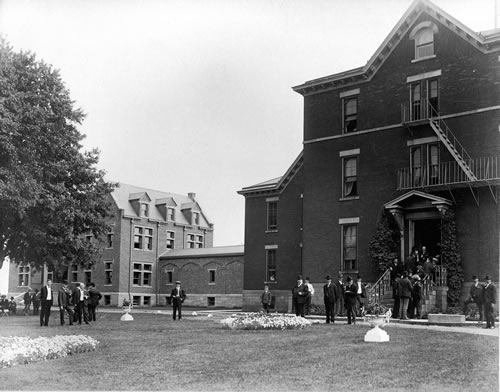










ALBION – This photo is the earliest view of downtown Albion that is known to exist.
It is labeled “Old ‘Empire Block’ burned Dec. 18th 1868.” Therefore our picture was taken before that.
This is the corner of Main Street and East Bank Street. The second block to the left is still there now housing Snell Realty and Fischer’s Newsstand. To the very far left is the old Burrows Block, part of which now houses Krantz Furniture.
Other buildings in this scene are long gone. Signage on the Old Empire Block includes: “Orleans American” (newspaper), “Dentist” and “Job Printing.”
Note the number of chimneys on all these buildings for heating stoves in a day and age before central heat.
By Tom Rivers, Editor Posted 4 June 2014 at 12:00 am
Lift bridges, guard gates, waste weirs would get elevated historical status
Photos by Tom Rivers – The Eagle Harbor lift bridge is one of seven in Orleans County and one of 17 that remain from the canal’s widening from 1905 to 1918.
The Erie Canal gets a lot of attention from preservationists and heritage-minded New Yorkers. But the Barge Canal, which opened in 1918 as an enlarged and deeper Erie Canal, may soon get some recognition.
The Erie Canalway National Heritage Corridor wants the Barge Canal to be recognized on the state and national registers of historic places. The New York State Board for Historic Preservation is scheduled to vote on the Barge Canal application on June 12.
“We want to elevate its importance,” said Jean Mackay, director of communications and outreach for the Corridor. “This would be another layer of recognition.”
The guard gates on the canal are 55 feet wide. This photo shows the gates in Albion, just east of the Gaines Basin Road bridge. These gates were built in 1913.
Congress in 2000 declared the canal as a National Heritage Corridor, one of 49 such areas in the country.
When the 363-mile-long waterway opened in 1825, it transformed Upstate New York into an economic powerhouse, raising the fortunes of canal towns such as Medina, Albion and Holley.
When railroads started to threaten the canal in the mid- to late-1800s, state officials moved to widen and deepen the canal. In 1918, after 13 years of construction, the Barge Canal was born, and many of the structures from that upgrade – lift bridges, single-truss bridges, guard gates, terminals and waste weirs – remain along the system today.
“There are a tremendous number of really interesting and historical sites along the canal corridor,” Mackay said.
This waste weir was constructed in 1910. It is used to drain water from the canal. The waste weir is located off State Street behind Community Action, west of Brown Street in Albion.
The Erie Canalway National Heritage Corridor’s application is 267 pages long. It identifies 566 contributing structures along the canal that add to the historic significance of the barge system.
In Orleans County, the contributing structures include:
Murray – Bennetts Corners Road bridge from 1911; Holley Waste Weir built in 1914; Holley Embankment (the tallest on the system, rising 76 feet above the valley of the East Branch of Sandy Creek); East Avenue Lift Bridge constructed in 1911; Holley Terminal, constructed in 1915 as a 16-foot by 30-foot wood frame freight house;
Guard Gate that is west of North Main Street and constructed 1914; Telegraph Road Bridge built in 1911; Groth Road Bridge built in 1911; Hulberton Road Lift Bridge constructed 1913; Brockville Waste Weir east of Fancher Road Bridge, constructed 1911; Hindsburg Road Bridge constructed 1911; and Transit Road Bridge constructed 1911.
Albion – Densmore Road Bridge constructed in 1911; Keitel Road Bridge built in 1912; Butts Road Bridge constructed 1912; Brown Street Bridge from 1912 (includes a sidewalk); Albion Waste Weir off State Street behind Community Action, constructed in 1910; Ingersoll Street Lift Bridge from 1911; Main Street Lift Bridge from 1914;
Albion terminal and shops for Canal Corporation, built in 1917; Lattins Farm Road bridge from 1911; Guard Gates from 1913; Gaines Basin Road bridge from 1912; Eagle Harbor Waste Weir that includes three drain gates, built in 1912; Eagle Harbor Lift Bridge, built in 1910 with a wood frame tower; Allens Bridge Road Bridge built in 1909; and Presbyterian Road Bridge from 1909.
The Allens Bridge Road canal bridge was built in 1909 and is nearly 200 feet long.
Ridgeway – Knowlesville Lift Bridge from 1910 (During a 1975 rehabilitation, the tower was replaced by one-story brick control building on east side at south end of bridge.); Knowlesville Terminal, west of Knowlesville lift bridge, and built in 1910; Culvert Road (This is the only place where a road passes under a branch of the New York State Canal System. There has been a road culvert under the canal here 1823. Stone portals at either end of the enlarged Erie Canal culvert were dismantled and re-erected when it was extended to its current 200-foot length as part of Barge Canal construction, according to the Barge Canal application to the state.);
Beals Road Bridge from 1909; Bates Road Bridge constructed in 1914; Guard Gate, west of Bates Road bridge, and constructed in 1914; Pleasant Street/Horan Avenue Bridge built in 1914; Oak Orchard Creek Aqueduct, constructed in 1914. (The Oak Orchard Creek span is the only true aqueduct on the Barge Canal system. The structure consists of a concrete arch over Oak Orchard Creek at the head of Medina Falls with concrete walls on either side of the channel.)
Medina Terminal, a 24- by 70-foot frame freight house constructed in 1916; Eagle Street/Glenwood Avenue Bridge, constructed 1914; Prospect Avenue/ Route 63 Lift Bridge, built in 1914; Marshall Road Bridge from 1909; and a Guard Gate near Middleport, from 1913.
In this photo from Orleans County Historian Bill Lattin, crews work on the retaining walls at the Canal Basin in Medina on April 3, 1914.
The couple in this picture from around 1870 are dressed in full mourning attire. They are dressed in black, the woman most noticeably because of the mourning veil and huge black ribbon under her chin.
On the back of this photo is found: “P.J. Mathewson, Photographer, Marble Front, Medina, N.Y. – Duplicates may be had at any time without further sitting.” Marble Front was a block to the east side of Main Street.
No doubt a close relative of this couple died for whom they were expressing their grief in true Victorian style. It could have been a parent, sibling or perhaps a child.
KNOWLESVILLE – In this post card from around 1910 we see the Knowlesville High School.
This two-story building with a four-story tower was built in 1887. It was used for educational purposes until 1956 when it was centralized into the Medina system.
However, years prior to this high school students were either shifted to Albion or Medina. This brick structure remains today for residential uses.
HOLLEY – In this picture from December 1910 we see a temporary concrete mixing plant east of Holley.
It would have been used when the canal was last enlarged. Note a steam engine in the right side of the picture. Power poles in the background are that of the B. L. & R. trolley system which ran from 1908 to 1931 through Orleans County.
This snapshot from the 1890s shows an unidentified artist working on a landscape painting along the marshes of Oak Orchard River.
He is seated in a row boat wearing a velvet suit consisting of knickers, vest and coat. This is topped off with a beret. He also appears to be smoking a pipe while sketching.
A canvas appears in the foreground. The case supported on his lap contains tubes of paint and brushes.
ALBION – Early on the morning of May 8, 1913, a fire broke out on the fourth floor of the Albion High School on East Academy Street.
As we see in this photo, extensive damage was caused by a Bunsen burner which had been left on overnight in the chemistry lab. Albion firemen are seen in this picture putting out the fire.
The high school was built in 1906. After a new high school was built on East Avenue in 1932, the older building became the Albion Grammar School. This fine Medina Sandstone structure remains today as an apartment building for senior citizens with the first floor used for the Meals on Wheels and Nutri-fair programs.
By Tom Rivers, Editor Posted 26 May 2014 at 12:00 am
Photos by Tom Rivers
The statue of Mary on the sandstone base with a bronze plaque is a memorial for Orleans County residents who died in World War II. That statue is located in front of the Catholic rectory at the corner of Main and West Park streets.
ALBION – She has stood at the corner of Main and West Park streets for nearly seven decades, but most people may not realize the statue of Mary is part of a World War II Memorial.
The statue stands on a sandstone base with a bronze plaque that declares “For God and Country: In sacred memory of our soldiers and sailors who made the supreme sacrifice.”
The memorial was dedicated on May 25, 1947. It includes a verse from John 15:13:
“Greater love than this no one has, than one lay down his life for his friends.”
The back of the statue in the lower left corner bears the name Kaletta Studios, St. Louis, Missouri. It is marked as number 480 from 1947.
By Tom Rivers, Editor Posted 26 May 2014 at 12:00 am
Photos by Tom Rivers – Phil Warne, a past commander for the American Legion in Albion, led the Memorial Day service in Albion in front of the middle school.
ALBION – The circular stone structure that serves as a flag holder and speaking platform in front of the Albion Middle School is actually a memorial that was erected in 1950 by the American Legion Sheret Post in Albion.
The memorial is dedicated to all veterans – “Heroes” – in World Wars from the central Orleans towns of Barre, Albion, Gaines and Carlton. It was built back when the middle school was the high school.
I didn’t realize it was a memorial until today. There is also a monument in front of that memorial to Vietnam Veterans from the community.
By Tom Rivers, Editor Posted 25 May 2014 at 12:00 am
Photo and article by Tom Rivers
GAINES – John Proctor is often referred to by historians as the Paul Revere of Ridge Road. On a December night in 1813, he rode by horseback on the Ridge from Gaines to Clarkson to warn of the approach of British and the Indians after the burning of Lewiston.
The following morning he joined a regiment that was headed to Lewiston. The regiment would capture the enemy quartered at Molyneaux Tavern. A historical marker on a large stone shares the story of Proctor. The stone is on the south side of Ridge Road, a few houses west of the Route 98 intersection.

The marker was put up in 1935 by the State Education Department and the Daughters of the American Revolution. It is one of a series of historical markers along Ridge Road that were erected in the 1920s and ’30s.
The Proctor marker also notes that the site was once a primitive log cabin owned by Elijah Downer. When Gov. DeWitt Clinton passed through in 1810, looking at land for a possible Erie Canal, he stopped at the cabin for breakfast.
Today, Justin and Adrienne Kirby and their three children make their home on the property.
Here are links to previous articles about the historic markers along the Ridge:
WATERPORT – In this picture from a photographic post card we see a view of the railroad crossing at Waterport in 1911.
The produce business of George D. Thompson is most prominent. Painted in large letters we see “Apples, Beans and Wheat Wholesale & Commission.” On the side of the building facing the tracks is painted: “The Home of Good Coal.”
In the center of our photo is a flagman’s shanty at this RR crossing with two men sitting by it.
By Tom Rivers, Editor Posted 24 May 2014 at 12:00 am
Photos by Tom Rivers – Dan Capurso unveils the sign for Gilbert Creek by Ridge Road in the town of Gaines.
The creek runs about 6.5 miles from near Brown Road northeast to Marsh Creek in Carlton.
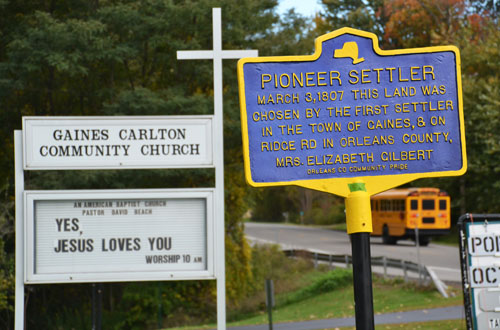
GAINES – A painted wooden sign was unveiled at about noon today. “Gilbert Creek” is on the sign by Ridge Road, next to the Gaines Carlton Community Church.
The sign and the name of the creek honors a woman from more than 200 years ago, the first settler on Ridge Road in Orleans County. Elizabeth Gilbert and her husband built their cabin in 1807. Mr. Gilbert died soon after they settled, and his wife was lef to raise a family and make a life in the wilderness of the Niagara frontier.
State Sen. George Maziarz, right, addresses a group on the lawn next to the Gaines Carlton Community Church near the spot where the Gilbert family built a cabin more than 200 years ago.
She stayed for two years with her children, and helped other settlers. She let them stay in her cabin while she helped build a cabin for at least one pioneer family. She used her oxen to haul wagon loads of timber for the cabin.
Al Capurso admires the grit of the pioneer settlers in Orleans County. In early 2013 he and his son Kenny noticed a creek along Brown Road in Gaines. They followed its path across Ridge Road and to Carlton. It flows 6.5 miles northeast and connects with Marsh Creek about 2.4 miles south of Lake Ontario.
Capurso did some research and realized the stream that starts by Brown Road didn’t have a name. He wanted the waterway to honor Elizabeth Gilbert. It took a year of lining up local support, and gaining permission from the federal Bureau of Geographic Names. The agency on April 10 formally approved the naming request.
Al Capurso and his son Dan performed four songs today in honor of Elizabeth Gilbert and the pioneer settlers of Orleans County.
“Today, we dedicate this creek to the pioneering efforts and spirit of Elizabeth Gilbert, the Gilbert family and the town of Gaines,” Capurso said at a ceremony on the church lawn next to the creek.
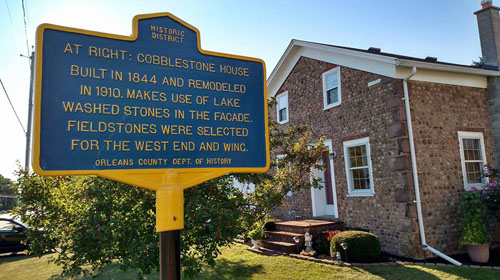
Capurso not only did the research and pressed the government officials for the creek naming, he also made the sign. He thinks it blends in with the historic corridor on Ridge Road. The Cobblestone Society Museum is down the road to the west.
Capurso and his family were praised by town, county and state officials for their efforts.
“There is no better title than a citizen who loves his community, who respects his community,” said State Sen. George Maziarz.
The state senator admitted he had never heard of the federal Bureau of Geographic Names until Capurso launched his effort. Maziarz commended him for working through the bureaucracy to get the creek named for one of the county’s pioneers.
Town Historian Delia Robinson said pioneers often don’t get much appreciation from today’s residents, with women even getting less attention from historians. She noted the settlers looked for land that was “high and dry” and near water so they had the resource readily available for cooking and cleaning.
“When the settlers came it was just wilderness,” Robinson said. “There were no neighbors, there was no village, there were no stores.”
Town Supervisor Carol Culhane, Cobblestone Museum Co-Director Matt Ballard and County Legislator Fred Miller all spoke at the dedication.
“It’s wonderful to have someone from the community do this kind of effort,” Miller said. “It adds another attribute that people can look at when they come see the Cobblestone Museum.”
MEDINA – Almost one year later, Medina’s efforts to install interpretive signage throughout the Downtown Historic District are complete.
Jimmy Swain of The Print Shop in Medina installed the finished panels today, and the results are remarkable.
“This is one of the best projects I have ever been associated with,” said Chris Busch who headed up the project with the help of Ken Daluisio, owner of The Print Shop. “It’s been an absolute success and I think folks will be quite pleased with how they look – and they look simply fantastic.”
There are 11 signs placed throughout the district, each telling a chapter of Medina’s fascinating history with old photographs and written text. Busch said these signs will be invaluable to Medina’s tourism efforts.
“We see more and more visitors wandering Main Street, snapping photos and marveling at the architecture,” he said. “These panels will provide a much more meaningful experience for them and will keep visitors lingering in our business district.”
The sign bases were purchased through The Print Shop, which also donated the actual panels. Research, design and panel layout was done by Busch. The Medina DPW installed the bases.
Sponsors of the project include the Medina Business Association, Gabrielle and Andina Barone, Andrew Meier, ORG, Dave and Gail Miller, Hartway Motors, Rita Zambito/Zambito Realty, Medina Sandstone Trust, Marcia Tuohey, Chris and Cynthia Busch, and the Medina Fire Department.