









WASHINGTON, DC – Congressman Chris Jacobs (NY-27) has been officially appointed to the House Agriculture Committee.
“Agriculture is immensely important to both our Western New York community and economy, and I am honored to represent our great family farms in Congress,” Jacobs said. “Right now, my focus is on ensuring our farmers have the resources needed to continue their important operations providing food for families during this challenging time, but I am also looking toward the future to develop policies that allow for future generations of farmers to thrive in Western New York.”
A major need in the Western New York community is improving access to rural broadband. The Agriculture Committee currently oversees this area and is tasked with developing ways to provide reliable expanded coverage.
“I have been a vocal advocate for the need for greater broadband access in our area, not only do our farmers and their machinery rely on it, but it is also critical for small businesses, students, and telehealth services – which have become increasingly important,” Jacobs said. “While I fight for our great farming industry, I will also be working to improve the lives of all Western New Yorkers by addressing this critical need.”
Press Release, NYS Commissioner of Agriculture Richard A. Ball
ALBANY – NYS Commissioner of Agriculture Richard A. Ball issued the following statement about reports of mislabeled packages of seeds from China.
“Our office has received questions from a few New Yorkers who have received unsolicited packages allegedly sent from China that are marked as containing jewelry but which actually contain plant seeds.
“Similar packages have been received in other states and the United States Department of Agriculture is investigating. People who receive seeds should not plant or handle the seeds. They should store them safely in a place children and pets cannot access and email USDA immediately at erich.l.glasgow@usda.gov for instructions.
“Seeds imported into the United States are rigorously tested to ensure quality and prevent introduction of invasive species, insects and diseases. We will continue to monitor this issue and will pass along guidance as it is received from USDA.”
Consumers who email the USDA should include their full names and telephone numbers, pictures of the package and any other relevant information.
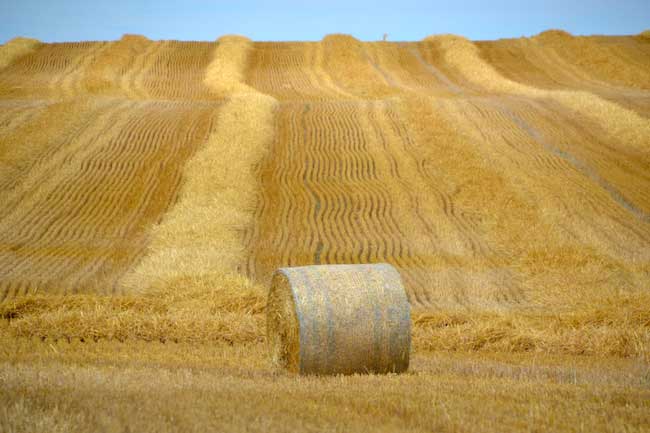
Photo by Tom Rivers: A bale of hay is in a field on Route 31A in Shelby on Tuesday.
Posted 22 July 2020 at 11:00 am
‘What we found with this survey is that no farm was untouched by the pandemic or the economic fallout.’ – NYFB President David Fisher
Press Release, New York Farm Bureau
New York Farm Bureau, the state’s largest farm organization, unveiled the results of a member survey that found 65% of the state’s farms and agribusinesses have been negatively impacted financially by the Covid-19 pandemic.
“What we found with this survey is that no farm was untouched by the pandemic or the economic fallout,” said New York Farm Bureau President David Fisher. “All of this underscores the need to continue to invest in our food system while also making health and safety a priority.”
More than 500 NYFB members participated in the informal survey conducted in mid-June that asked a dozen wide-ranging questions about the rural economy, health and safety of farm families and their employees as well as access to necessary personal protective equipment (PPEs). Respondents also described how they were personally affected. Here are some key findings.
43% of farms have lost sales during the pandemic.
More than a third of farms and agribusinesses (37%) are experiencing cash flow issues.
Almost half (47%) say they have reduced spending to local vendors and suppliers or will do so in the future.
An overwhelming majority of farms (84%) have a plan in place to train and assist their employees to mitigate the spread of the virus.
46% of respondents say they are concerned about their mental health or that of someone they know.
“Farmers are doing their best to make sure food production doesn’t stop, but we need to maintain the ability to process, distribute and market what we produce,” Fisher said. “As the state and federal governments look toward potential budget cuts and additional Covid-19 assistance, agriculture must be a part of the discussion. It really does take all of us working together to have a strong, sustainable food system that supports the farm community and feeds yours.”
Editor’s Note: Some survey responses from farmers include:
An Orleans County livestock farm owner who said they are storing more farm products, meats and eggs. “Very difficult time getting cattle processed,” the Orleans livestock farmer said.
An Oswego County vegetable and fruit farm said it hired more workers to meet demand.
A Wyoming County maple farm was able to produce maple syrup before the pandemic but now the farm is storing the syrup rather than selling it.
A Saratoga County equine farm cut back on feed, tack and equipment purchases.
A Jefferson County dairy was forced to sell the entire herd due to lack of market.
A Suffolk County nursery and landscape business said it is selling more retail and wholesale while the landscape division “has been severely affected.”
A Schuyler County equine farm lost three months of farm income during the peak of the seasonal agritourism business.
A Yates County winery reports it had to cut 90 percent of its workers because it couldn’t sell wine to visitors. With the loss of employees “nothing is getting done on the farm.”
To cope with the changes in the marketplace farmers have been forced to respond. A Chautauqua County dairy farm reports it cut milk production by 15 percent. A Suffolk County aquaculture business shifted to more internet direct sales.
A Wayne County fruit farm hired an employee to develop a Covid-19 plan, monitoring employee health and implementing sanitation practices daily for vehicles, farm equipment, worker housing and offices.
An Orange County vegetable farm is doing its farm stand business by online orders only, with customer pickup at curbside.
A Cayuga County dairy farm reports it put an expansion on hold. It is looking into risk management options and added daily sanitation.
By Tom Rivers, Editor Posted 8 July 2020 at 11:12 pm
Photos by Tom Rivers
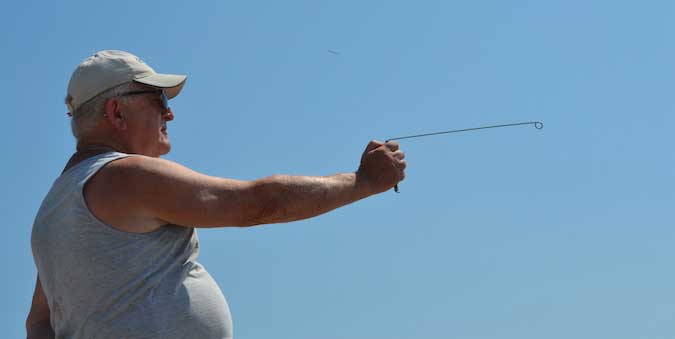
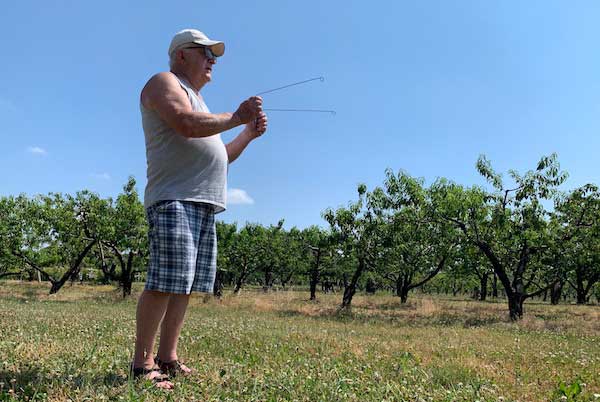
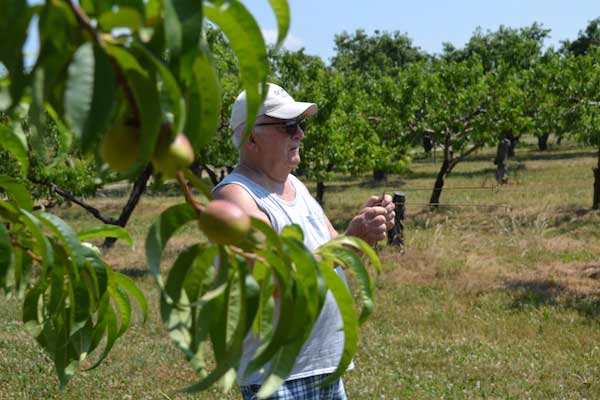
ALBION – Dave Porter, a dowser from Wellsville, visited Watt Farms in Albion today, trying to summon rain. He holds a divining rod which directs him to a spot in an orchard off Route 98 near the Watt Farms Country Market.
Porter, 73, is a retired school administrator. For the past 18 years, he has been a dowser, helping people find water as a hobby. He usually is called to help find an ideal spot to drill a well or to locate a spring. Today was his first time trying to activate rainclouds.
“You have to connect yourself to the earth because the earth has all kinds of energies,” Porter said.
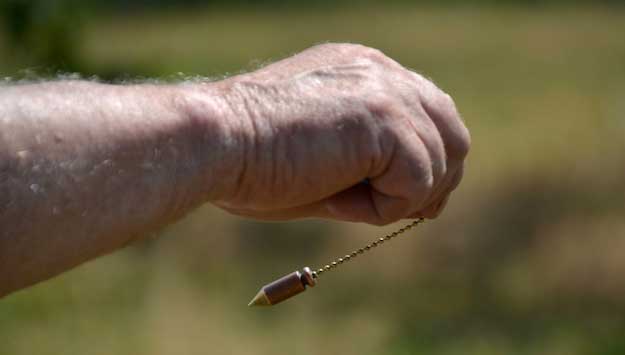
Porter holds a pendulum that was swinging wildly in the first row in the orchard, just south of the road behind the farm market. When the pendulum swings in a fast pace, Porter said there is a lot of energy in that location.
Then he brings out two divining rods. He asks a higher being for permission to be a dowser in that location. If the rods cross, the answer is yes. He received that OK and then requested permission to ask for rain to come to the area. The divining rods again crossed, signifying “yes.” Porter said he doesn’t cause the rods to either cross or move apart.
Porter asked if there would be significant rain in a week? The divining rods moved apart, for a “no” answer. He asked if it would be in five days, and the rods stayed apart. He asked if it would be four days – again they wouldn’t cross.
When Porter asked if there would be a significant rain in three days, the divining rods slowly crossed.
He asked if it would rain in two days, but the rods stayed apart.
He believes the divining rods are predicting rain in 3 to 3 ½ days. This was on Wednesday at 11:30 a.m. That would mean the area should expect rain on Saturday.
“We’ll see what happens,” he said.
Dave Porter holds the divining rods in the Watt Farms fruit orchard off Route 98 in Albion.
Karen Watt of Watt Farms invited Porter to try dowsing at the farm. She said the local farms are in dire need of rain. The region could use a major soaking. That could make a $50 million difference on the local agricultural economy, she said.
“We need a whole day of nothing but rain,” she said.
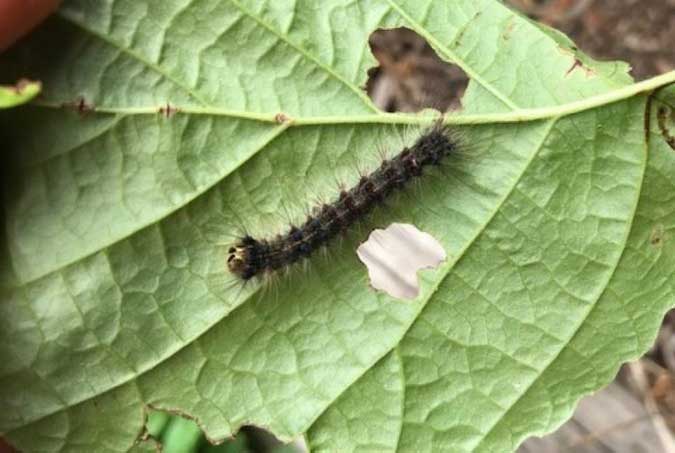
Photo by Sarah Bacon – A European Gypsy Moth caterpillar is in Shelby. A distinctive feature of the GM caterpillars are the pairs of blue spots directly behind the head followed by pairs of rust-colored spots.
Posted 25 June 2020 at 9:03 pm
Press Release, Katie Oakes, horticulture educator for Cornell Cooperative Extension in Orleans County
KNOWLESVILLE – The Orleans County Cornell Cooperative Extension office is receiving high volumes of calls from homeowners concerned about the defoliation of trees and shrubs by small hairy caterpillars.
These pests are the larval stage of the Gypsy Moth Lymantria dispar, an invasive species that can cause massive defoliation in home landscapes and woodland forests.
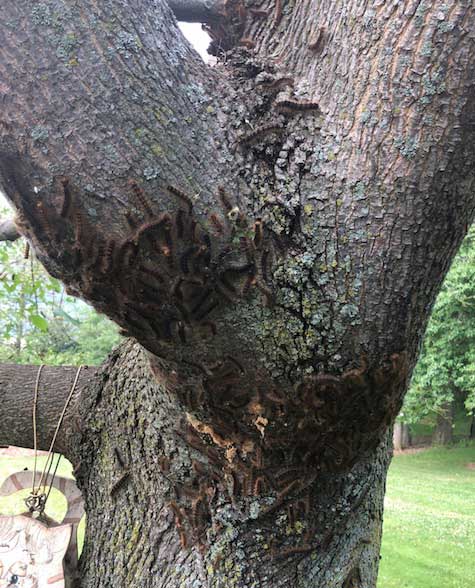
Photo by Kathy Brooks – Gypsy Moth caterpillars congregate on an affected tree in Albion.
The Gypsy Moth was accidentally introduced to the US in the late 1800s and has become widespread across North American ever since. Gypsy Moth is one of the most destructive forest pests in the country.
The moth goes through four distinct life stages: egg, larvae, pupae, and adult – usually just one generation per year. The larval stage is the only one that causes damage. The adult moth doesn’t feed at all, its only purpose is to reproduce and lay eggs. But the larvae can cause significant damage while it is active.
Caterpillars of the Gypsy Moth are hairy and can be identified by the pairs of blue and rust colored spots running the length of their bodies. The caterpillars go through 5 or 6 molts (or instars), during which they feed voraciously on shade trees and some shrubs.
The majority of the feeding happens in the last two instars, which usually occurs in late June to early July. The caterpillars prefer tree species such as oak, birch, apple, willow and linden, However they are not host-specific and will feed on a variety of other species of trees and shrubs.
After the caterpillars complete their development, they drop to the ground and seek a place to pupate. After about 10-14 days in the resting pupal stage, the adult moths emerge. Adult moths only have about two weeks to reproduce and lay eggs before dying.
Deciduous trees that suffer a small amount of defoliation will usually not suffer long-term. Trees that suffer complete or near complete defoliation will be stressed, which can lead to secondary problems, but they should be able to send out a second flush of leaves and recuperate a bit before the growing season is over.
Keep defoliated/refoliated trees evenly watered throughout the rest of the growing season and avoid fertilizer until next spring. Evergreen trees such as pine and spruce can die from one single season of defoliation, so if you’re noticing heavy feeding on these trees and they are valuable to you in your landscape, you should consider treating for the caterpillars.
Many homeowners wonder what they can do to manage exploding populations of hungry caterpillars. If the caterpillars are under 1-inch long, the recommended pesticide to use is one that contains a naturally occurring bacteria: Bacillus thuringensis var.kurstaki (Btk).
Once the caterpillars enter later life stages, Btk is less effective. There are other insecticides labelled for use against Gypsy Moth caterpillars as well. However, when the caterpillars are longer than 1 inch and they are found feeding high in the canopy of shade trees, treatment can be difficult and a call to a tree service is often recommended. When using any pesticides, the label is the law and must be followed exactly.
Homeowners can also try banding methods of management – tying a piece of folded burlap around the affected tree trunks. In later life stages, the caterpillars typically move down the trees during the day then climb back up at night to feed. The folded burlap will trap caterpillars between the layers and homeowners can then destroy them.
After the caterpillars finish feeding, the best option for control is destroying egg masses to reduce populations the following year. Look for the tan colored, fuzzy splotches on tree trunks, buildings, fences or other objects anytime from fall until April. Remove the egg masses by scraping them off into a bucket of soapy water and leaving for a few days.
For more information check out the Cornell Insect Diagnostic Lab factsheet or contact Orleans County CCE Horticulture educator Katie Oakes by calling 585-798-4265 ext 125 or emailing klo54@cornell.edu.
Sources: Cornell Insect Diagnostic Lab
UConn Ladybug Blog “Gypsy Moth”
University of Wisconsin-Madison Extension Factsheet on Gypsy Moth
Press Release, NYS Department of Agriculture and Markets
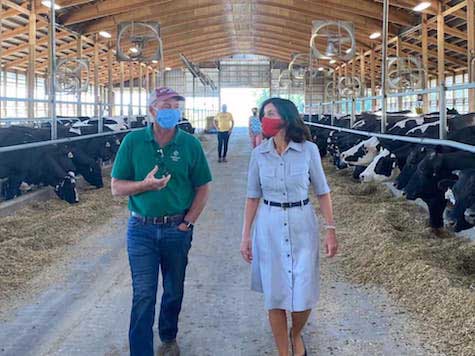
Photo from Lt. Gov. Kathy Hochul’s Facebook Page: Kathy Hochul gets a tour of Noblehurst Farms and Creamery in Pavilion on Wednesday.
Nourish New York, Governor Cuomo’s initiative to get food from farmers to families in need during the COVID-19 outbreak, reached a milestone this week as the amount of surplus dairy and produce provided through New York’s food banks reached more than three million pounds.
As of Wednesday, food banks have purchased more than $3.2 million in Nourish NY product from New York’s farmers and processors. This includes 1.36 million pounds of dairy products, including fluid milk, yogurt, cheese, cottage cheese, and sour cream, and more than 1.6 million pounds of produce, such as fruits and vegetables, that have been provided to more than 100,000 New York households.
There have been more than 350 Nourish NY distribution events across the state since the program was launched in May, including food distribution sites in Orleans County.
The Nourish New York initiative aims to quickly reroute New York’s surplus agricultural products to people who need them through the state’s food banks. The state is providing $25 million to food banks and other emergency food providers so they can buy surplus milk, yogurt, cheese, vegetables, fruit and more.
The Nourish New York program also provides support to the state’s food producers who have lost markets as a result of school and restaurant closures. The program is administered by the State Department of Agriculture and Markets and the New York State Department of Health.
Lieutenant Governor Kathy Hochul highlighted the Nourish NY program on Wednesday during a stop at Noblehurst Farms and Creamery in Pavilion, Genesee County, saying, “Nourish New York has connected local farmers with food banks to help struggling New Yorkers put food on the table during the COVID-19 pandemic. The state-funded initiative has delivered more than three million pounds of food and dairy from across the state to those in need since its launch in May. Nourish New York is helping to support local farms and grow the agriculture industry as we continue to work to make sure New Yorkers have the resources they need as we reopen and build back better for the post-pandemic future.”
New York State Commissioner of Agriculture Richard A. Ball said, “As the Governor has said, Nourish New York is all about connecting our farmers who can’t sell their products right now to consumers who are facing challenges in being able to buy them. The need on both sides is critical and I am pleased that Nourish New York allows us to rise to meet that need.”
New York Farm Bureau President David Fisher said, “New York Farm Bureau commends the Nourish NY program for quickly reaching this milestone just a few weeks after its launch. The effort provides a new distribution channel for the state’s farmers at a time when the pandemic seriously disrupted the food chain. By connecting the dots, Nourish NY is eliminating food waste, compensating farmers, and feeding our fellow New Yorkers with healthy, locally produced food.”
Chris Noble, farm partner in Craigs Creamery said, “When COVID-19 hit, we as dairy farmers temporarily lost many markets for our products, including schools and restaurants. The Governor’s Nourish NY initiative has helped local demand for milk and dairy recover more quickly by providing hunger relief for our local communities, specifically from New York farmers and food producers. We are hopeful that we can continue to build on these new supply chains by creating a local and more resilient food system.”
Kirby’s Farm Market co-owner Chad Kirby said, “I think Nourish NY is a fantastic program for the community and for farmers. It’s been a huge benefit and it has made a massive difference.”
The State is asking any philanthropies that would like to help the State’s food banks to contact Fran Barrett, Director of Non-Profits at COVIDPhilanthropies@exec.ny.gov.
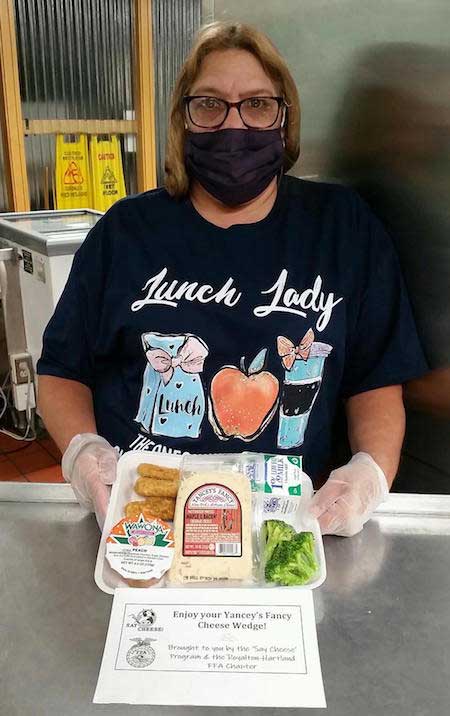
Provided photo: Peggy Burgess holds a lunch tray that includes cheese wedges from Yancey’s Fancy in Corfu.
MIDDLEPORT – Students, parents, families, and members of the Royalton-Hartland community are enjoying over 400 pounds of Yancey’s Fancy famous cheese wedges.
This delicious donation was made possible by a partnership with the “SAY CHEESE” philanthropic effort and the Royalton-Hartland FFA Chapter. SAY CHEESE is a new effort designed to provide nutritious extended shelf life dairy products to people in need, and at the same time, support and promote the dairy industry.
Thanks to the donations of Western New York agriculturists, over 775 Yancey’s Fancy cheese wedges have been shared with the Royalton-Hartland community.
There were 550 cheese wedges provided to Roy-Hart students and families through the school’s weekly bagged meal pick-ups. Additionally, the FFA Chapter donated over 100 wedges to both the Middleport and Gasport food pantries.
The effort was coordinated by the Royalton-Hartland FFA Chapter, under the direction of Matthew Sweeney, Roy-Hart Agriculture Teacher/FFA Advisor; Julie Feurch, Royalton-Hartland Food Service Director; and Feurch’s food service team.
During these challenging times, Sweeney urges the public to continue to support our farmers by purchasing locally sourced food products.
The Royalton-Hartland FFA Chapter strives to make a positive difference in the lives of students by developing their potential for premier leadership, personal growth, and career success through agricultural education. FFA is an intra-curricular activity open to all Royalton-Hartland students grades 5-12.
By Tom Rivers, Editor Posted 10 June 2020 at 3:56 pm
Photos by Tom Rivers
KNOWLESVILLE – Natalie Mrzywka, a 4-H administrative assistant at the Cornell Cooperative Extension in Orleans County, carries a 20-pound box of produce to a vehicle this afternoon at the 4-H Fairgrounds.
Extension staff and volunteers were at the site early this morning for the delivery of 1,200 boxes. Cars started to line up by 8:30 for a distribution that was scheduled to start at 10.
By 1 o’clock, about 750 boxes had been given away for free to local residents. Extension staff expect there will be boxes later this afternoon until about 6 p.m.
Gabrielle Lanich, an education nutrition coordinator for the Extension, carries a box in 90-degree heat this afternoon. She works for the Extension in Orleans, Erie, Genesee and Wyoming counties.
The Extension is hosting the distribution of USDA farmers-to-families produce boxes that include potatoes (1-5 pounds), oranges (1-4 pounds), apples (1-3 pounds), onions (1-3 pounds), green vegetables (1-3 pounds of broccoli, cabbage, green pepper, etc.), and carrots (1-2 pounds). Some of the produce items come from Orleans County farms.
The Extension hosted the first distribution on May 29 and will have another one in two weeks on June 24, beginning at 10 a.m.
James Desiderio Inc. of Buffalo is the distributor of the produce.
Kim Hazel, administrative assistant in the agricultural program at the Extension, brings a box to an RTS Orleans bus.
Press Release, U.S. Senators Charles Schumer and Kirsten Gillibrand
WASHINGTON, DC – U.S. Senate Minority Leader Charles E. Schumer and U.S. Senator Kirsten Gillibrand today announced $1,448,839 in federal funding for agricultural research and development in rural New York.
The funding is provided through the U.S. Department of Agriculture’s (USDA) National Institute of Food and Agriculture (NIFA), and will be used to address food insecurity and support economic development in rural agriculture. Specifically, this research will investigate solutions to increase food security through improved access to food banks, federal assistance, and engineered corn production.
“New York’s farmers and the New York agricultural industry is the lifeblood of the state’s economy and our nation’s food supply,” said Senator Schumer. “This federal funding is an investment into our rural agriculture, helping New York State address food insecurity, especially in a time of crisis. I am proud to secure federal support, and I will not rest until New York farmers have the resources they need to help Americans get food on the table.”
“Rural communities are at the heart of New York and this funding will strengthen rural economies by providing new opportunities for our farmers and producers,” said Senator Gillibrand, member of the Senate Agriculture Committee. “This critical research will strengthen the fight against food insecurity in Upstate New York and will make federal assistance widely available to all families. I will always fight for the resources our communities need to thrive.”
Cornell University received $498,839 to study the causes of rural food insecurity and identify solutions to help eligible families enroll in necessary federal assistance programs, such as SNAP.
The Boyce Thompson Institute and the Cold Spring Harbor Laboratory Association, Inc. have each been awarded $475,000 to engineer corn with greater seed production and better chilling-tolerance to allow New York farmers to plant earlier for the best prices of the season. Sweet corn is worth about $40 million to $60 million annually to New York.
As a member of the Senate Agriculture Committee, Senator Gillibrand has worked to protect farmers and reinforce the nation’s food supply, especially throughout the COVID-19 crisis. Last month, Senator Gillibrand introduced the Food Bank Access to Farm Fresh Produce Act, which would address disruptions in the food supply chain caused by the coronavirus pandemic and directly connect farms to food banks by providing $8 billion in block grants to food banks in the top vegetable and fruit producing states.
Photo by Tom Rivers: A corn field behind the Albion school district on Clarendon Road is off to a good start this growing season. It is shown last evening near the school’s Land Lab.
By Tom Rivers, Editor Posted 3 June 2020 at 1:23 pm
This spring has offered much better weather conditions for farmers to get their crops planted, compared to 2019, when frequent rain and waterlogged fields resulted in 23,170 acres of corn and soybeans not being planted in Orleans County.
Farmers in Orleans County typically plant about 125,000 acres of those crops each year.
There were about 90,000 acres that went unplanted in Orleans, Genesee, Niagara and Monroe counties last year.
The weather the next few days includes partly sunny and a high near 76 today, followed by sunny and high near 84 on Thursday, and a chance of showers on Friday with a high near 84. Saturday is forecast to be partly sunny with a high near 76.
By Tom Rivers, Editor Posted 2 June 2020 at 11:53 am
Provided photo
The new Niagara-Orleans dairy princess was crowned on Sunday. Sadie Klumpp of Newfane, left, will serve as an ambassador for the dairy industry. Hayley Roehling of Akron, right, is the dairy princess alternate.
Both Sadie and Hayley are sophomores in college and attend Morrisville State College for Agricultural Science. They both have shown dairy cattle in 4-H for many years. They are eager to promote dairy and share knowledge with the public.
Dairy princesses attend events and meetings to promote dairy products and to talk about the dairy industry, including the nutritional value of milk.
By Tom Rivers, Editor Posted 29 May 2020 at 12:36 pm
Photos by Tom Rivers
KNOWLESVILLE – Boxes of produce are stacked on pallets at the Orleans County 4-H Fairgrounds this morning as part of a distribution from the USDA farmers-to-families produce initiative.
Their were cars lined up on Wood Road by 7 this morning for the distribution that was scheduled to start at 10.
By 11 a.m., about 800 boxes had been picked up out of the 1,200. Each box weighs about 20 pounds.
John Gabalski carries a box to one of the vehicles. He volunteered to help with the distribution.
Jose Iniquez, a member of the board of directors for the Orleans County Cornell Cooperative Extension, loads a box into a truck of a car. It started raining hard at about 10:30. Iniguez is vice president of Lamont Fruit Farms in Waterport.
Aeddon Cayea of Medina also volunteered during the distribution.
The USDA farmers-to-families produce boxes include potatoes (1-5 pounds), oranges (1-4 pounds), apples (1-3 pounds), onions (1-3 pounds), green vegetables (1-3 pounds of broccoli, cabbage, green pepper, etc.), and carrots (1-2 pounds). The cabbage, apples and onions all came from Orleans County farms.
James Desiderio Inc. of Buffalo served as the distributor of the produce.
Robert Batt, CCE executive director, urged people to call the office today at 798-4265 to see if boxes are left. Given how fast the boxes were going at the beginning of the distribution, he didn’t expect they would last too long during the day.
Some of the boxes went to Community Action’s food pantry, Calvary Tabernacle’s food pantry in Medina and some to the Arc of Genesee Orleans.
Photo by Tom Rivers: An apple orchard on Riches Corners Road in Albion is in bloom in this photo taken Saturday from Mount Albion Cemetery.
Press Release, Orleans County Department of Planning and Development
ALBION — Orleans County is accepting enrollment of additional parcels in certified agricultural districts during the month of June, pursuant to New York State Agricultural and Markets Law.
This annual 30-day window is for inclusion of property which is predominantly viable agricultural land. During this time period, land may only be added and not removed from County Agricultural District No. 1, which in 2016 became the sole agricultural district in the county as a result of a consolidation process.
This opportunity supplements, but does not replace, enrollment in an existing agricultural district during the eight-year, formal review process. It allows a once-a-year opportunity for a property owner to request that the County Legislature add parcel(s) to Orleans County Consolidated Agricultural District No. 1 (District C-1).
The next eight-year anniversary review — the only time parcels can be both added and removed — will not occur until 2024. Presently, there are over 116,700 acres in County Agricultural District No. 1.
Requests for inclusion in agricultural district will be reviewed, in order, by the Orleans County Agriculture and Farmland Protection Board, the Orleans County Legislature, and the New York State Department of Agriculture and Markets.
To enroll, owners must complete and sign and a “Letter of Intent for Annual Enrollment” form. Enrollment forms are available from the Orleans County Department of Planning and Development. (Click here for more information.)
Completed and signed forms should be sent by June 30th to:
Thomas Lampo, Planner
Orleans County Department of Planning and Development
14016 Route 31 West
Albion, NY 14411-9382
Please note that requesting enrollment during this 30-day time period is not a guarantee that an owner’s property will be added to Agricultural District No. 1. Moreover, it will not automatically qualify land for a reduced agricultural property tax assessment. For information on obtaining a reduced agricultural property tax assessment, please contact the local town assessor.
By Tom Rivers, Editor Posted 22 May 2020 at 11:12 am
Photos courtesy of Adam Krenning
KNOWLESVILLE – A bee pollinates a flower in an apple orchard this morning on Howlett Road in Knowlesville.
The weather has been perfect for pollination, an important week or so where bees spread pollen in orchards. Pollination is critical for apples and other fruit to grow.
Farmers expect some damage in the crop due to the cold weather in early May. But early indicators have apple growers optimistic there will be a good crop.
New York has about 50,000 acres of apple orchards and is the second-leading apple producing state in the country, behind only Washington. New York apple growers produce about 30 million bushels of apples a year.
Orleans is among the top apple producers in New York, trailing only Wayne County and Ulster County.
New York Farm Bureau is launching a new system to connect farms in need of labor during the COVID-19 pandemic.
During this time of uncertainty, farms may temporarily be down some employees who may have to quarantine due to the virus or to take care of a sick family member. This could potentially create issues on the farm, especially when livestock need to be cared for or during a critical time of the growing season.
In turn, there is now an online database for farmers to turn to and for people who may be looking for additional, temporary agricultural work, perhaps someone who is in need of employment, may be retired from farm labor, or would like to add additional hours.
Anyone who is interested and willing to work on a farm is encouraged to submit their information to the new database to potentially be matched up with a farm in need in their area. Click here to view the database.
New York Farm Bureau hopes this will serve as a resource for its members to have needed staff on hand throughout this pandemic while also providing an opportunity for job seekers. It will be up to the individual farm to appropriately screen and hire any potential employees.
In addition, New York Farm Bureau is still making its COVID-19 resource page on its website, www.nyfb.org, open to all farms, regardless of membership to provide the latest information and guidance to all of agriculture in these difficult times.
New York Farm Bureau is encouraging all farms to continue to take this pandemic seriously, follow all of the recommended safety guidance and protocols, and have a plan in place to mitigate the spread, both in the workplace and in farmworker housing should it be provided. Protecting farmworkers and fellow family members is a priority for the agricultural community.