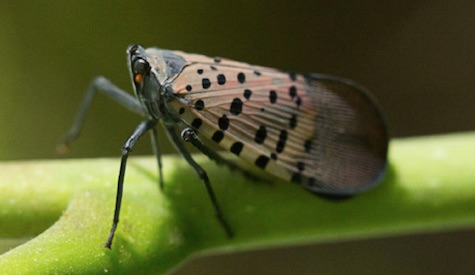
Photo by Michael Houtz: The Spotted Lanternfly as an adult.
Press Release, U.S. Sen. Kirsten Gillibrand
WASHINGTON, D.C. — U.S. Senator Kirsten Gillibrand, member of the Senate Agriculture Committee, is calling on Congress to deliver $16.066 million in funding to combat the spotted lanternfly, an invasive species that threatens specialty crops, including grapes, across the Finger Lakes and Hudson Valley.
In a letter to appropriators, Gillibrand called for full funding of the Animal Plant Health Inspection Service (APHIS) Specialty Crop Pest program in the final FY21 Agriculture Appropriations bill, and specifically provide $16.066 million for the spotted lanternfly, consistent with the House funding level.
“The spotted lanternfly has proven to be an invasive and destructive pest that threatens New York State’s specialty crops, especially vineyards throughout the Finger Lakes and Hudson Valley,” Gillibrand said. “If not contained, this pest will have devastating economic consequences on agriculture, tourism, and residential homes, at a time when our economy needs these industries for a strong recovery. Congress must ensure the Specialty Crop Pest program is fully funded to prevent further spread.”

The spotted lanternfly is thought to have arrived in the United States in 2012. According to Cornell University, the first infestation was found in Berks County, Pennsylvania in 2014.
“Although quarantine measures were taken in the infested townships and efforts were taken to eradicate this pest, spotted lanternfly has proved difficult to contain,” Gillibrand wrote Dec. 11 in a letter Sen. Richard Shelby, Chairman of the Committee on Appropriations. “It is imperative that this pest is contained before it further invades the Eastern Seaboard and eventually makes its spread across the United States.”

Residents urged to familiarize themselves with insect and report any sightings
Press Release, Katie Oakes, horticulture educator with Cornell Cooperative Extension in Orleans County
Photo by Michael Houtz: The Spotted Lanternfly as an adult.
KNOWLESVILLE – A relatively new invasive species, Spotted Lanternfly Lycorma delicatula, has been discovered in New York State this fall.
This destructive insect (native to Asia) was first discovered in Pennsylvania in 2014 and has since spread to several neighboring states, including just recently to New York. Most of southwestern Pennsylvania is under quarantine for this insect, restricting the movement of landscaping or construction waste, tree parts, or any other material that could harbor a life stage of the insect.
Discoveries of both live adult Spotted Lanternfly (SLF) and egg masses have been found in specific areas of Staten Island, the Hudson Valley, and the Southern Tier of New York State. SLF does not sting or bite, and it does not pose a direct health hazard to pets or humans. However, SLF has the potential to severely impact the agricultural and tourism industries of NY, as well as the forests and delicate ecosystems in our natural areas.
Spotted Lanternflies are not really flies at all, but rather a type of insect called planthoppers that have specialized mouthparts that puncture plant tissue and suck the underlying sap. After sucking the plant sap, the insects will excrete a clear sticky substance called “honeydew”.
In addition to weakening the plant and making it more susceptible to other disease and insect attack due to the insect’s feeding, the excreted honeydew can cover anything below the infested area, making crops unmarketable and impeding human activity.
The honeydew itself is an annoyance, but often a black fungal growth called sooty mold will grow on the excreted honeydew, making the area beneath an infestation unsightly and difficult to clean.
Spotted Lanternfly will feed on over 70 species of plants, but the preferred hosts are the Tree of Heaven (Ailanthus altissima), Black Walnut (Juglans nigra), Maples (Acer spp.) and Grapevines (Vitis spp.).
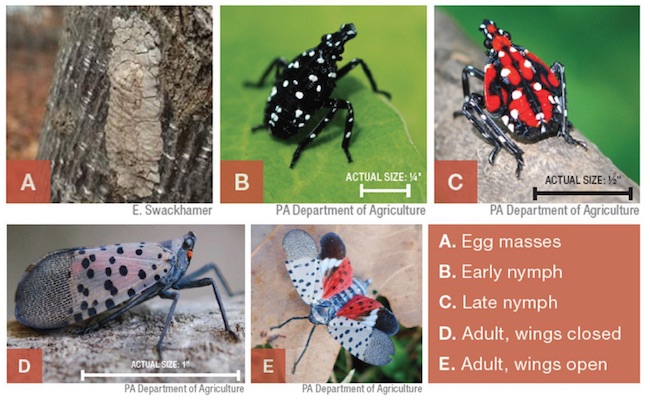
The life stages of a Spotted Lanternfly.
The biggest concern in New York is the impact this insect could have on vineyards, orchards and hardwoods. Levels of SLF in NY are currently relatively low, but have potential to increase quickly. Management of any invasive species is best done before an infestation is established. Residents are urged to familiarize themselves with Spotted Lanternfly and report any sightings as soon as possible.
Adult SLF are about an inch to inch and a half long, grayish tan in color with black spots on their folded wings and a yellow underside to their abdomen. When their upper wings are spread, the lower wings are distinctively bright red with black spots. Adults can be active through December but will be killed off with the harsh winter temperatures.
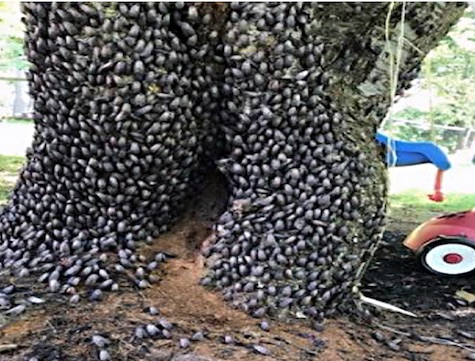
Photo from Pennsylvania Department of Agriculture: Spotted Lanternfly adults massing on a tree.
The insect overwinters in egg masses that were laid in late summer and fall. The egg masses are about an inch long, brownish-gray in color, and look like a clump of cracked mud (they are not hairy like a Gypsy Moth egg mass). The nymphs (juvenile SLF) will emerge from the egg masses as early as April, and they will be wingless, black with white spots. They turn red with black and white spots before transforming into the winged adult, usually around July.
SLF can hop and fly short distances, but their primary means of spreading is by human activity. The adults can be in plant material or logs that are moved place to place. The egg masses can also be laid almost anywhere, making it extremely important to check vehicles, camping equipment, boats, outdoor gear, furniture, etc. when traveling in and around places where SLF might be present.
The infestations found in NY this past fall have been assessed by experts and a meticulous IPM (Integrated Pest Management) plan is in place to monitor and manage surrounding areas. It is likely that there are more SLF present in New York that just have not been detected yet, so it is important for the public to be aware of this invasive insect and to be vigilant in detecting and reporting any further sightings.
If you think you’ve seen Spotted Lanternfly, please report the sighting to the NYS Department of Ag and Markets via their Spotted Lanternfly Public Report. Photos and exact location will be useful.
For more information, or to inquire about this or any other invasive species, contact Orleans County Cornell Cooperative Extension’s Horticulture Educator Katie Oakes at klo54@cornell.edu.
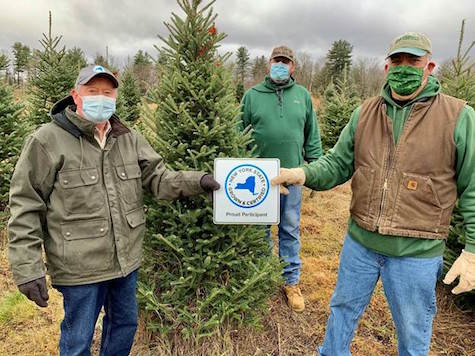
Provided photo: Agriculture Commissioner Richard A. Ball, left, was at Goderie’s Tree Farm on Monday to promote Christmas tree farms in the state.
New York State Agriculture Commissioner Richard A. Ball on Monday visited Goderie’s Tree Farm in Johnstown, Fulton County, for the annual tree cutting to promote New York’s Christmas tree farms and encourage New Yorkers to shop at local agricultural businesses this holiday season.
Following State Covid-19 guidelines, New York tree farms offer families a fun and safe way to celebrate the season. By purchasing from any of the 750 local tree farms in the State, New Yorkers can support this important agricultural industry, which has an economic impact of $13.8 million, according to the Christmas Tree Farmers Association of New York.
Commissioner Ball said: “It is more important this year than ever that New Yorkers support local farmers and businesses when doing their holiday shopping, whether they’re looking for a Christmas tree or a delicious addition to their holiday meal. Visiting a tree farm this year to cut your own tree is great, socially distanced, and fun way to celebrate this season while supporting your local farm and the agricultural economy.”

With approximately 300,000 New York-grown trees sold by more than 750 farms in Upstate New York, the state ranks sixth in the U.S. for the number of acres dedicated to growing Christmas trees.
Robert Schoch, Interim Executive Director of the Christmas Tree Farmers Association of New York, said: “Selecting a New York State grown Christmas tree offers a family experience in the outdoors. As you visit farms, be aware that New York growers have developed safety plans to ensure that this is a safe and rewarding experience. When other holiday experiences are limited this year, selecting a New York grown tree provides an opportunity to enjoy the season and continue a family tradition.”
Pete Goderie, owner of Goderie’s Tree Farm, said: “With nearly 800 tree farms in New York State, consumers can easily support a local tree farm, providing a shot in the arm to our industry. Visiting a New York tree farm to pick your own tree is the perfect way to gather with your family this season for a holiday tradition while being safe and socially distanced.”
Cost of classic Thanksgiving dinner increases from $46.37 to $49.23
Press Release, New York Farm Bureau
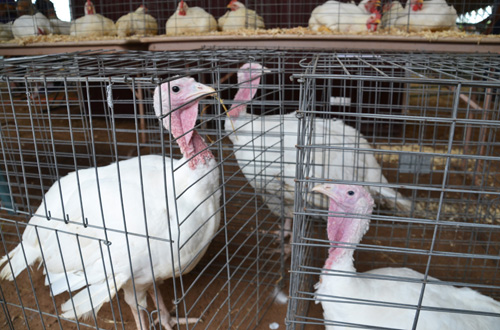
File photo by Tom Rivers: These turkeys were part of the 2014 meat auction at the 4-H Fair in Knowlesville. The cost of a turkey is up about $2 compared to Thanksgiving a year ago.
New York Farm Bureau’s 2020 Market Basket Survey shows the price of a traditional Thanksgiving dinner saw a modest 6 percent uptick from last year’s meal.
The average total price, which includes a 16-pound turkey and other common items found on a holiday dinner table, is $49.23 or a $2.86 increase over last year. (The survey showed the average price for the Thanksgiving dinner was $57.54 in 2018.)
Turkey prices are about $1.41 per pound in New York State, which is about an 11% increase over last year’s average price in this informal survey. Prices found by volunteer shoppers ranged from $.68/lb. to $1.69/lb. This price is above the national average of $1.21/lb. As we move closer to Thanksgiving, turkey prices may continue to drop in the stores, reflecting sales in the final days before the holiday.
The New York numbers revealed price increases in several categories including for a gallon of whole milk, Libby’s Pumpkin Pie Mix, fresh cranberries and a 14-ounce package of cubed stuffing. Some ingredients saw decreases. These include whipping cream and a carrot/celery veggie tray.
This year’s survey also includes a more notable increase for an expanded menu that includes a four-pound ham, five-pound bag of russet potatoes and a package of frozen green beans. When those prices are included, the total meal price jumps to $64.31, more than $4 over last year’s number.
The survey highlights that the classic meal remains affordable with a price point of under five dollars per person for a 10-person meal. The affordability demonstrates that although farmers and ranchers dealt with significant issues this year related to market and distribution disruptions due to the pandemic, consumers are still benefiting from relatively low retail prices, in part because the actual cost of the food – the portion paid to farmers – is only eight cents of each dollar consumers spend on food at the store.
“It has been a challenging year for every New Yorker, but farmers haven’t stopped doing what we do best, growing quality, nutritious food. Market disruptions have affected some prices, but overall, our volunteer shoppers found the traditional dinner remains affordable for many shoppers,” said Darleen Krisher-Meehan, chair of New York Farm Bureau’s Promotion and Education Committee. “While the holiday season may look a little different this year, we should all give thanks that our food supply remains strong and stable thanks to our farmers and employees who have proven to be essential workers in 2020.”
This survey is one of the responsibilities of the NYFB State Promotion and Education Committee and is part of the national effort with the American Farm Bureau Federation. AFBF’s 35th annual informal national price survey found the average national cost of this year’s feast is $46.90, about $2 less than New York’s number.
New York Farm Bureau’s volunteer shoppers sampled prices at 14 different supermarkets throughout the state trying to get the best prices available, but they did not use promotional coupons or special deals such as “buy one-get one free.” They were also encouraged to use online shopping because of the pandemic.
The shopping list includes 15 common Thanksgiving food items ranging from turkey and rolls to stuffing and celery to pumpkin pie mix, enough to feed 10 people around the dinner table. An average for miscellaneous ingredients, like flour and butter, is also included. The 2020 Thanksgiving survey displayed considerable price variation across the state. The best advice for shoppers is to compare prices to save money.
By Tom Rivers, Editor Posted 14 November 2020 at 7:48 am
Group looks to improve tracking and tracing system for produce grown in the state
File photo by Tom Rivers – Dirk Biemans co-owner and CEO of Intergrow Greenhouses, built its first 15-acre greenhouse in the Town of Gaines in 2003. The company has done multiple expansions since then. Biemans is serving on the new Produce Traceability Blue Ribbon Task Force. The company recently started construction on a new site in Ontario, Wayne County.
A new state task force includes agricultural leaders from throughout the state, including three with Orleans County connections.
State Agriculture Commissioner Richard A. Ball announced on Friday the members of the Produce Traceability Blue Ribbon Task Force, which met for the first time Thursday.
The task force, which is made up of New York farmers and representatives from produce distributors and retailers. The task force will build on New York’s leadership in food safety practices, Ball said.
The task force will review and make recommendations to further advance New York’s tracking and tracing system for produce grown in the state. An improved system will help consumers to more easily identify where products were grown and processed and allow the state to more quickly trace the origin of a product during foodborne illness investigations.
“We look forward to the work of this taskforce as a next step in the evolution of our food safety mission,” Ball said. “Food safety is everyone’s business, and this task force consists of all parts of the produce supply chain— from the farmer that grows our fruits and vegetables to the distribution center that sorts and/or bags it to the retailer who sells it. Understanding the sophisticated tracking systems that are already in place and how those systems communicate throughout the supply chain is key to supporting our farms, strengthening our food system, and reducing foodborne illness.”
Dirk Biemans, co-owner and president of Intergrow Greenhouses on Route 98 in Gaines, is a member of the task force. The company grows tomatoes hydroponically, offering consistent size and taste throughout the year.
Photo by Tom Rivers: Steven Karr, CEO of Pride Pak, gives a tour of the 68,000-square-foot vegetable processing site in Medina on Nov. 30, 2016. The company trims lettuce and packages it for salads for Wegmans.
Steven Karr, CEO of Pride Pak, and his son Angelo, Pride Pak vice president, opened a new vegetable processing facility on Maple Ridge Road in Medina in November 2016. They are both on the new state task force.
Pride Pak’s new 68,000-square-foot facility in Medina trims lettuce and packaging it for salads for Wegmans. Medina gives the company a U.S. site. Pride Pak also has facilities in Mississaugua and Newfoundland. It is the largest vegetable processor in Canada, and 35 percent of its produce comes to the U.S.
Pride Pak currently gets most of its lettuce, baby spinach, cauliflower, broccoli, turnips, carrots and other vegetables from Yuma in Arizona, California and Oregon.
Kaari Stannard, owner of New York Apple Sales, Inc., also is on the task force. She has served as chairwoman of the U.S. Apple Association. She is a partner in both Pomona Packing and Lake Ontario Fruit, which are apple packing facilities located in western New York. Stannard is also a partner in Fish Creek Orchards, located in Orleans County. Lake Ontario Fruit also is in Orleans County on Ridge Road in Gaines.
The complete list of members of the Task Force are:
Dr. Elizabeth Bihn, Cornell University, College of Agriculture and Life Sciences
Mike Durant, Food Industry Alliance
Steve Ball, Wegmans
Jim Calvin, New York Association of Convenience Stores
Michael King, Krasdale Foods
Renee St. Jacques, New York Farm Bureau
Dale Ila Riggs, New York State Berry Growers Association
Bethany Wallis, Northeast Organic Farming Association
Joy Crist, Crist Bros. Orchards
Jim Bittner, Bittner-Singer Farm
Paulette Satur, Satur Farm
Steve and Angelo Karr, Pride Pak
Erica Battisti, Stewarts Shops
Michael Muzyk, Baldor Specialty Food
Jim Hans, Driscoll’s
Kaari Stannard, NYS Apple Sales
Luke George, Upstate Growers & Packers
Dirk Biemans, Intergrow
Alisha Albinder, Hudson River Fruit Packers
Darby Greco, NYS Department of Health
Currently the Food and Drug Administration does not require a tracing system for produce. Unlike manufactured products, which are traceable through serial numbers, consumers generally cannot identify where fresh produce was grown.
In addition to the health and safety risks, this is costly to the entire supply chain, from the producers to retailers.
Kaari Stannard is a New York apple marketer, packer and grower.
The task force will analyze today’s existing tracking and tracing system, identify potential gaps and areas in need of improvement, and recommend uniform operating standards and practices for each point of the supply chain. This will provide consumers with more information about the source of the food they eat and expedite investigations of foodborne illness.
“New York State’s focus on traceability through the Produce Traceability Blue Ribbon Task Force is truly forward thinking,” said Betsy Bihn, College of Agriculture and Life Sciences at Cornell University Director of the Produce Safety Alliance. “With the FDA proposing to establish additional traceability recordkeeping requirements, it is imperative to understand current practices as well as any challenges that are preventing effective produce traceability from farm to fork. As the Cornell CALS representative, I am grateful to have the opportunity to facilitate this discussion as this work is important for food safety, but also important for NY growers and consumers.”
Mike Durant, President/CEO of the Food Industry Alliance of NYS, Inc., said, “New York’s retail food industry is committed to ensuring quality products to our customers and promoting food safety is paramount to that effort. As the industry evolves, so too does the entire food supply chain. This task force will be a collaborative effort to both further advance best practices in food safety and help preserve public trust. We are pleased to be part of this important effort.”
Assemblyman Mike Norris (R,C,I,Ref-Lockport) has written to the New York Farm Labor Wage Board to ask them to freeze the overtime provisions for farm laborers at its current limitation of 60 hours per week.
Norris was opposed to the creation of the wage board and voted against the legislation in the first place because he felt it delegated authority away from the state Legislature and placed unreasonable restrictions on the agricultural community – a community and leading economic industry that faces unpredictable factors, such as weather, and is in need of flexibility.
“As we have seen just this year alone with the pandemic, there was a greater need for locally-produced food because of travel restrictions and production being slowed down elsewhere; however, because of this new requirement many farmers in our state have had to cut back on their plans in order to afford a more limited staff,” said Norris. “Ultimately, it is the consumer who suffers, and our state is less competitive. Grocery stores will be stocking cheaper items from out of state when they can because that’s what will drive sales.”
During this pandemic shutdown, the wage board began holding limited hearings online and is now considering reducing the workweek even further beyond the established 60 hours. With farmers already stretched too thin, Norris hopes the wage board will delay any consideration of further restrictions until after the pandemic is resolved, if not permanently.
“We must give our farms a fighting chance to survive in New York,” he said. “Our agricultural community provides us with our necessary food supply and we must do everything possible to keep them fully operational especially during this pandemic.”
Governor Andrew M. Cuomo announced an additional $10 million is being dedicated to the Nourish New York program, bringing the total funding dedicated to the program to $35 million.
The funding will allow New York’s emergency food providers to continue to purchase surplus products from New York farmers and dairy manufacturers and deliver it to New York families in need through the end of the year, including during the holiday season, which can be a challenging time for families.
Nourish New York was first announced by the Governor in April 2020 in response to the financial hardships New York’s dairy farmers were facing with the loss of key markets and the significant, increased demand New York’s food banks were seeing as a result of the Covid-19 pandemic. Since the program started, more than 16 million pounds of dairy, fresh fruits and vegetables, meats and more have been purchased and provided to 823,883 households.
“The pandemic has been difficult for all of us, including our agricultural community and the families they feed. The Nourish New York program has successfully bridged the gap between our families, our food banks, and our farmers,” Governor Cuomo said. “Still, there is a very clear need in our communities. By extending the Nourish New York program and providing another $10 million to our regional food banks and local food providers, we can continue to support and help New Yorkers put food on the table while ensuring an economic benefit to our farmers through the holiday season, which can be a challenging time for families.”
Funding for this second round of the program is being provided from the federal Coronavirus Aid, Relief, and Economic Security Act. It will be reallocated to food banks and emergency food providers through existing contracts extended through December 31, 2020. Emergency food providers can spend the money allocated to them by:
Setting up food-drive through events/giveaways (guidance available by clicking here);
Distributing dairy vouchers that can be redeemed in grocery stores for products like cheese, yogurt, milk, sour cream, and butter, throughout the state, and/or;
Purchasing products directly from New York dairy/food manufacturers for their feeding programs.
“I am proud of the program’s reach and the relationships that have been forged,” said State Agriculture Commissioner Richard A. Ball. “Nourish New York has provided families with fresh and nutritious local food and a much-needed market for our agricultural producers and processors. We have made great progress as a state in fighting this pandemic. However, the economic challenges continue for so many. I look forward to the next phase of this meaningful program and its lasting impact on our agricultural community and our neighbors.”
Since its launch, the $25 million Nourish New York initiative has supported 3,438 food distributions, providing New York dairy, such as milk, yogurt, cheese, cottage cheese, and produce, meat, seafood, eggs and more to 823,883 households. Through the food banks’ purchases, 4,140 farms have been impacted, relieving farmers from having to dispose of surplus milk and providing growers with a place to sell their produce. The $25 million investment is on track to be spent by the end of October.
As a result of the COVID-19 pandemic, New York food banks have seen a dramatic increase in demand, in some regions up to 200 percent, as many New Yorkers struggle to put food on the table. At the same time, New York’s farmers and producers have faced their own unprecedented, extreme financial difficulties. Many temporarily lost up to 50 percent of their markets through the closure of schools and restaurants.
By Tom Rivers, Editor Posted 24 October 2020 at 2:02 pm
Photo by Tom Rivers: Ariyanna Boccacci, 14, of Albion helps with a food distribution on Wednesday at the Orleans County 4-H Fairgrounds. Volunteers distributed 3,000 boxes of food – 1,000 each of meat, dairy and produce. Each vehicle could receive one of each.
The U.S. Department of Agriculture announced on Friday it will be extending a food distribution program for another two months through Dec. 31.
The USDA has authorized $500 million for a fourth round of purchases for the USDA Farmers to Families Food Box Program. USDA is issuing solicitations for the fourth round to existing Basic Ordering Agreement (BOA) holders and expects to award contracts by Oct. 30 for deliveries of food boxes from Nov. 1 through Dec. 31, 2020.
“I’m gratified by the overwhelmingly positive response to the Farmers to Families Food Box program from families, distributors, food banks, faith-based organizations and non-profits in communities across the country,” said U.S. Secretary of Agriculture Sonny Perdue. “We recently surpassed 110 million boxes delivered, and millions more are headed to Americans in need. I’m very pleased that we are able to extend this program and continue our relief efforts for American farmers and families.”
In Orleans County there have been distributions most Fridays at either Albion, Holley or Medina and every other Wednesday at the Orleans County 4-H Fairgrounds.
There will be a distribution this coming Friday in Albion at the Main Street Store parking lot, beginning at about 8:30 a.m.
In the fourth round, as in the third round, states have been allocated boxes based on the internal need of the state. The program will continue the purchase of combination boxes to include fresh produce, dairy products, fluid milk and meat products, the USDA said.
Congressman Chris Jacobs, R-Clarence, said he was pleased to hear the program will continue for two more months.
“I commend the USDA and the Administration for continuing to make American families and farmers a top priority,” Jacobs said. “The Farmers to Families Food Box program has been a highly successful program that has provided healthy nutritious food to millions of American families. I have seen how it supports farmers and agri-businesses right here in NY-27 and will continue to advocate for programs that support local agriculture.”
Press Release, NY Senate Republican Conference, led by Rob Ortt
ALBANY – New York State Senate Republican Leader Rob Ortt and members of the Senate Republican Conference on Friday sent a letter to Governor Cuomo asking for clarity and a reverse course on any potential changes to the highly successful Farm to School Incentive program.
Recent information provided by stakeholders suggests that forthcoming Executive policy will result in half of all New York schools losing eligibility for the program.
“Long championed by the Senate Republican Conference, the Farm to School Incentive program should be a shining example of how we can do good for our communities as elected leaders,” said Ortt, R-North Tonawanda. “The program helps families and children struggling with food insecurity. It helps struggling farmers who have been drowning in New York overregulation for years. And it helps schools put locally sourced food on the table for a bargain. It’s not too late, Governor Cuomo – you can and should reverse course to save the Farm to School Incentive program for the sake of all New Yorkers.”
According to information provided by New York Grown Food for New York Kids, the potential changes to the Farm to School Incentive would result in increased food insecurity, another crippling blow to New York’s already-struggling farmers, and an irreparable loss of faith between school districts and the program.
Combined with the exacerbating circumstances of the Covid-19 pandemic, heaps of red tape recently thrust upon small farmers, and a dismal state economic outlook, a policy change that renders half of all schools ineligible for Farm to School would mean more dire outcomes for New York farms and families.
“Agriculture is one of the most important industries in our great state. We know that even the tiniest seeds of investment we plant as state lawmakers can return massive yields for all New Yorkers. I hope the administration reconsiders this potential change, because farmers, families, and schoolchildren cannot afford for us to go back at the precise time we should be moving forward to expand this program,” said Senator George Borrello of Sunset Bay in Chautauqua County. He is ranking member of the Senate Committee on Agriculture.
While in the Majority, Senate Republicans worked with the School Nutrition Association to adopt language in the state budget that provided an additional incentive for districts to source food from in-state growers and producers.
“In story after heartbreaking story, we have witnessed the plight of food insecurity spread throughout our state this year. Whether it’s long lines at food banks or record unemployment rates, it is clear that New York families and children have been through enough crises this year to last a lifetime. The last thing parents need to worry about right now is what their children eat at the lunch table. Significant changes to the Farm to School program would not only harm our farmers and schools, but the families and children who rely on them,” said Senator Jim Tedisco of Glenville in Schenectady County. He is ranking member of the Senate Committee on Children and Families.
By Tom Rivers, Editor Posted 2 October 2020 at 3:36 pm
Photos by Tom Rivers
KNOWLESVILLE – Mary Lee Knights stands with some of the bigger pumpkins for sale at Knights Giant Pumpkins on Knowlesville Road. Some of the big ones are about 80 pounds.
Knights and her husband Ken started selling pumpkins 48 years ago from their home. Initially they sold eight that Mrs. Knights decorated with hair.
“It was a joke,” she said.
But the pumpkins sold fast.
The following year, Mr. Knights planted an acre of pumpkins. They have been hot sellers every fall since then.
The pumpkin sales helped their three kids pay for college.
Mary Lee Knights holds a pumpkin near hay bales that are decorated for the season.
The Knights family needed to modify this year’s setup due to Covid-19 guidelines from the state. They still have a corn maze and many “goofy” gourds, but there is no petting zoo, bounce house, wagon rides or bake sale and gift shop.
Knights said she continues to look forward each year to the pumpkin season. Many of the customers have been coming back for years – even decades.
Knights Giant Pumpkins is open seven days a week from 10 a.m. to 6 p.m. at 3246 Knowlesville Rd. Customers are urged to wear masks.
Press Release, Katie Oakes, horticulture educator for Cornell Cooperative Extension in Orleans County
KNOWLESVILLE – Gardening has always been a therapeutic hobby, and this year saw an increase in new gardeners across the world as the pandemic forced people to seek out new ways to keep themselves busy at home.
As more and more people gain interest and skills in gardening, it’s important to be aware of and on the lookout for an invasive worm that has been found in both Erie and Monroe counties.
The “Asian Jumping Worm” is the common name for three different species of earthworms in the Amynthas and Metaphire genera. As the common name suggests, these worms originated in Asia.
There are actually no native earthworms here in Orleans County. The ones we commonly see on rainy days are actually species from Europe, brought over during colonization. These jumping worms pose a greater threat than the European species, however, because they consume organic matter in the soil at far greater rates than the naturalized European species.
This rapid consumption causes big problems for both plant and animal life that relies on healthy soil. Jumping worms leave behind nutrient stripped castings that make it difficult for plants to thrive.
These castings are pretty distinctive in appearance, often being compared to dried coffee grounds. The worms also disturb the soil to such extent that, in heavy infestation areas, the forest floor has actually been dropping due to the diminishing soil organic matter.
The soil disturbance can also encourage an inhospitable environment for vital soil fauna and those that depend on them for survival like salamanders, birds, and other animals. These earthworms can also reproduce without mating, so they can multiply rapidly creating high densities in the soil.
Jumping worms can be distinguished from European earthworms by their behavior and their “clitellum” (the distinct band near the head of the worm). In the jumping worm, the clitellum is often whitish in color and smooth (the European species tend to have raised clitellum that are pinkish-brown in color). The jumping worms will also often have “crazy” behavior, wriggling and thrashing erratically when exposed.
The good news? There have been no confirmed occurrences here in Orleans County yet. You can do your part to keep it that way! Invasive worms are spread exclusively through human activity, so some easy ways to stop the spread include:
Do not buy or use jumping worms for bait, vermicomposting or gardening.
Only sell, purchase or trade compost that was heated to appropriate temperatures and duration following protocols for reducing pathogens.
Clean compost, soil and debris from vehicles, personal gear, equipment, and gardening tools before moving to and from sites.
Dispose of all live worms in the trash or place them in a bag and leave out in the sun for at least 10 minutes. Then throw bag away.
Be careful when sharing and moving plants. Always check for worms and know where your plantings come from. Buy bare root stock when possible.
Check your property for earthworms using a mustard pour (it won’t harm your plants!) Mix a gallon of water with 1/3 cup of ground yellow mustard seed and pour slowly into the soil. This will drive any worms to the surface. If you have jumping worms, report it and avoid moving plants or soil from your yard.
If you think you might have jumping worms on your property, please report them by clicking here. You can also call Orleans County Cornell Cooperative Extension at 585-798-4265 ext. 125 or email klo54@cornell.edu with any questions.
By Tom Rivers, Editor Posted 8 September 2020 at 8:37 am
LYNDONVILLE – H.H. Dobbins hosted a tour for state legislators and a member of Congress on Friday, and the company shared concerns about filling job openings and the prospect of having the overtime threshold drop from the current 60 hours a week.
The state on Jan. 1, 2020 instituted an overtime threshold for agriculture for the first time, with workers getting time-and-a-half after 60 hours in a week as part of the Farm Laborers Fair Labor Practices Act.
That 60-hour cap before overtime could be reduced. A Wage Board is holding public hearings about the issue.
Assemblyman Steve Hawley of Batavia was on the tour on Friday at Dobbins, an apple packing and storage company. Dobbins is looking to hire 20 people.
“The dilemma for many businesses, including agriculture, is finding enough people who want to work even regular hours,” Hawley posted on Facebook after the tour.
Other farmers were at the tour to tell the elected officials the reduced overtime threshold would hurt their businesses, making them less competitive with agricultural operations in other states and countries.
“We were joined by other area farmers who all expressed grave concern about the lowering of hours/week requiring OT pay,” Hawley said.
State Sen. Robert Ortt said many farmworkers are bypassing New York so they can be in other states where they can work as many hours as they want. New York’s farm labor law is actually resulting in smaller paychecks for workers, Ortt said.
Farmers worry the Wage Board could lower the overtime threshold to 40 hours.
“The Wage Board will increase costs for farmers and agriculture,” Ortt said. “They will drive businesses and workers out of New York State.”
The Wage Board includes the following members: David Fisher, President of the New York Farm Bureau; Denis Hughes, former President of the New York State AFL-CIO; and Brenda McDuffie, President of the Buffalo Urban League.
Congressman Chris Jacobs also toured Dobbins on Friday. He is a member of the House Agriculture Committee
“H.H. Dobbins has an extremely impressive operation packaging and distributing fruit that harnesses the power of local labor and innovative technology,” Jacobs said in a statement. “However, they are also a testament to USDA programs’ success and the ability for local businesses to adapt. They took advantage of the Farmers to Families Food Box USDA program developed to aid growers and processors affected by COVID-19. This allowed them to keep their staff employed and supply families in need with nutritious food all around the country. These programs are vital to the restoration of our agriculture industry and seeing the benefits first-hand will make me that much stronger of an advocate for their continuation as we defeat COVID-19.”
Press Release, Cornell Cooperative Extension of Orleans County
Provided photos: Master Food Preserver volunteers Kevin Bedard and Karen Desjardin during a past Sourdough MFP workshop.
KNOWLESVILLE – As the state begins to reopen, Orleans County Cornell Cooperative Extension has re-scheduled several in-person classes for this fall.
“We really are so excited to be able to offer some in-person options for educational programming,” said Katie Oakes, Horticulture Educator at Orleans County CCE and coordinator of both the Master Gardener and Master Food Preserver volunteer groups. “I think that the public as well as our volunteers have been craving some human interaction and opportunities to learn and teach that take them out of their homes for a brief time.”
• The first in-person opportunity offered at Orleans County CCE will be a Botany Basics class at 6 p.m. on Sept. 14. The class will be taught by Scott Russo, president of the Buffalo Bonsai Society, and will cover the basics of getting started in Bonsai gardening.
Bonsai is the ancient Japanese art of manipulating trees to enable them to reach maturity while staying small (often under two feet tall). This class will be held outdoors under the Curtis Pavilion. Cost is $5, masks and social distancing will be required.
• There will also be a 3-part series of Master Food Preserver workshops, re-scheduled from earlier in the summer. The Master Food Preserver program is a group of local volunteers who go through an extensive 3-day food preservation training through Cornell Cooperative Extension, then lead classes themselves to the public using the research-based and trial-tested preserving techniques.
The shutdown put a pause on the entire MFP workshops series this year, but the volunteers are excited to get back to educating the public on food preservation. Each of the three classes below will be offered demonstration-style in the Trolley Building. Masks and social distancing will be required as well.
Fresh pasta is made during a previous Master Food Preserver workshop.
• Home Beer Brewing will be the first in the 3-part series on Saturday, Sept. 26, 9 a.m. to noon. Led by Master Food Preserver and home brewing enthusiast Kevin Bedard, the class will cover topics such as necessary equipment, basic steps, brewing timelines and more. Unfortunately, a beer tasting is not included in the class, but you will leave with lots of inspiration! Cost: $10.
• MFP volunteer Julie Baker will teach a Garlic class on Wednesday, Oct. 7, at 6 p.m. Learn all about how to grow and preserve this versatile vegetable! There will be some hands-on activities and take-home products made in class. Cost: $15.
• And finally, MFP volunteer Eileen Sorochty will lead her always popular pasta-making class on Wednesday, November 4 at 6 p.m. Eileen will teach basic techniques in making your own pasta from scratch, including unique recipe variations and best methods preserving the fresh pasta. Cost: $10.
And for those who still prefer to learn online, Master Gardener Erica Joan Wanecski has planned a Zoom presentation entitled “Finding Respite with Olmsted Gardens in WNY” on Monday, Sept. 28 at 6 p.m. Frederick Law Olmsted designed one of the world’s most famous parks – Central Park in NYC, but many are not aware that he had a hand in designing several parks and gardens across Western New York! Click here to register.
Please contact klo54@cornell.edu or call (585) 798-4265 with any questions.
By Tom Rivers, Editor Posted 1 September 2020 at 12:20 pm
Photo by Tom Rivers: Claire, 4, of Lyndonville pets a sheep as part of a petting zoo that also included goats and a donkey during the community’s Christmas tree celebration last Dec. 7. There were many activities as part of the community celebration, which was highlighted by 76 trees being lighted up for the holidays. Gov. Andrew Cuomo announced today that petting zoos won’t be allowed this fall for agri-tourism businesses.
Press Release, Gov. Andrew Cuomo’s Office
Governor Andrew M. Cuomo today announced new state guidance for agritourism businesses as New York State enters the Fall season.
The businesses, which include corn mazes, pick-your-own fruit and vegetable operations, hayrides and haunted houses, are considered low-risk outdoor arts and entertainment and are permitted to operate under New York’s NY Forward guidance.
New Yorkers can also visit the state’s farmers’ markets and craft beverage trails, which have remained open under state guidance, supporting agriculture and tourism in the state.
“New York State’s amazing outdoor attractions and recreational opportunities are a boon for families and communities during the fall season each year, and we want New Yorkers to be able to enjoy this time with their family responsibly and safely,” Governor Cuomo said. “The new guidance announced today will ensure that these businesses can open to the public, allowing families to enjoy their favorite fall activities while providing a boost for our farming communities and local economies.”
Corn Mazes – permitted consistent with Low Risk Outdoor Arts and Entertainment guidance and the following conditions: Reduced capacity, face coverings required and social distance maintained between individuals/parties.
Hayrides – permitted consistent with Public Transportation guidance and the following conditions: Mandatory face coverings, social distance required between individuals/parties, frequently touched surfaces, such as handrails, cleaned and sanitized between rides.
Pick-Your-Own Fruit/Vegetables Operations – permitted consistent with Low Risk Outdoor Arts and Entertainment guidance and the following conditions: Reduced capacity, face coverings required and social distance maintained between individuals/parties.
Haunted Houses – permitted consistent with Low Risk Indoor Arts and Entertainment guidance and the following conditions: Reduced capacity, face coverings required and social distance maintained between individuals/parties.
Petting zoos are not permitted.
The New York State Department of Agriculture and Markets has issued a full slate of guidelines for the agricultural industry, including guidance for farmers’ markets and for its food and beverage producers. All guidance can be found by clicking here.
“As one of the nation’s top agricultural states, New York traditionally comes together in the fall to celebrate the harvest—from apples to grapes to pumpkins,” said State Agriculture Commissioner Richard A. Ball. “This year, while things may not look exactly the same on your favorite farm, I am happy to say we can still celebrate agriculture’s bounty and the many family-friendly activities that go with it. With this new guidance, we hope New Yorkers will be able to enjoy some of the best of New York agriculture in a safe and socially distanced manner.”
The New York State Departments of Agriculture and Markets, Health, and Labor are encouraging farmers to register for the Covid-19 testing initiative for seasonal workers, as announced by Governor Andrew Cuomo last week.
The state is making available free, on-farm Covid-19 testing to agricultural workers in Wayne, Orleans, Genesee, Ulster and Clinton Counties, which see the highest number of out-of-state workers during harvest season. The registration page is available by clicking here.
Farms who hire seasonal workers in these counties are being offered an opportunity to have workers tested. This initiative is voluntary, free and will be set up at sites selected by the farms who participate.
Farms who participate in these events must also ensure that they:
Have read, understood and comply with the State’s guidelines in the documents listed below.
Have a plan, including housing available to isolate workers if they are positive and quarantine workers who are identified as contacts to a case.
Have a plan to supplement their current workforce, if the need arises.
Pre-register using the link above.
An FAQ on the testing initiative is available in English here and in Spanish here. The flyer, which is being distributed in these counties, is available in English here and in Spanish here.
The prevention and testing initiative also includes partnering with the county health departments, local/community health care providers, county Cornell Cooperative Extensions and New York Farm Bureau to directly engage and educate farmers and farmworkers on the State’s prevention and quarantine protocols.
Farms will continue to partner with their local health departments to address the screening, isolation and quarantine status, and housing needs of their workers. Farmworkers are considered essential workers and may continue to work while under quarantine, provided the required conditions are followed.
As New York began its phased reopening, New York State outlined mandatory protections for essential workers in its NY Forward guidance. In addition, the Department of Agriculture and Markets implemented, with assistance from county Cornell Cooperative Extensions, a robust statewide effort to ensure farms had access to personal protective equipment, such as masks and sanitizer.