By Mike Wertman, Sports Writer Posted 17 October 2021 at 5:38 pm
Section V and Section VI soccer playoff competition will get underway on Tuesday while the Niagara-Orleans League field hockey and volleyball seasons will both wrap up early this week.
Weekly Schedule Monday Football – Akron at Medina, 7 p.m. Field Hockey – Medina at Roy-Hart, Akron at Wilson, Newfane at Barker, 4:30 p.m. Volleyball – Medina at Akron, Roy-Hart at Newfane, Albion at Wilson, 6:30 p.m.
Tuesday Section VI Boys Soccer – Tapestry at Medina/Lyndonville, 3:30 p.m., Albion at Maryvale, 5 p.m.; Salamanca at Roy-Hart, 6:30 p.m.; Newfane at Alden, 5 p.m.; Akron at Fredonia, 7:20 p.m. Section V Girls Soccer – Greece Odyssey at Lyndonville/Medina, 6 p.m. at Vets Park.; Alexander at Holley, 6 p.m.; Kendall vs. Bolivar-Richburg, 5 p.m. at Letchworth. Field Hockey – Akron at Kenmore, 7 p.m. Volleyball – Akron at Medina, 6:30 p.m.
Wednesday Section V Boys Soccer – Perry at Kendall, Holley at East Rochester, 6:30 p.m. Section VI Girls Soccer – Depew at Albion, 3:30 p.m.; Akron at Alden, 5 p.m.; Newfane at Falconer/Cassadaga Valley, 6 p.m. Volleyball – Newfane at Akron, 6:30 p.m.
Friday Football – Albion at Medina, Lake Shore at Roy-Hart/Barker/Lyndonville, 7 p.m.
By Tom Rivers, Editor Posted 17 October 2021 at 9:25 am
Photo by Tom Rivers: The sun sets last week in this photo on East Park Street in Albion.
The high temperatures this week won’t be in the 70s like last week. The National Weather Service in Buffalo is forecasting highs in the 50s and 60s this week in Orleans County.
Today will reach a high of 56 and be partly sunny, followed by 55 and sunny on Monday. Tuesday will be sunny with a high near 65, followed by sunny with a high near 68 on Wednesday.
The latter part of the week includes a mostly cloudy Thursday with a high near 65, followed by a high of 55 on Friday, and 54 on Saturday, according to the Weather Service.
By Tom Rivers, Editor Posted 17 October 2021 at 9:13 am
Photos by Tom Rivers
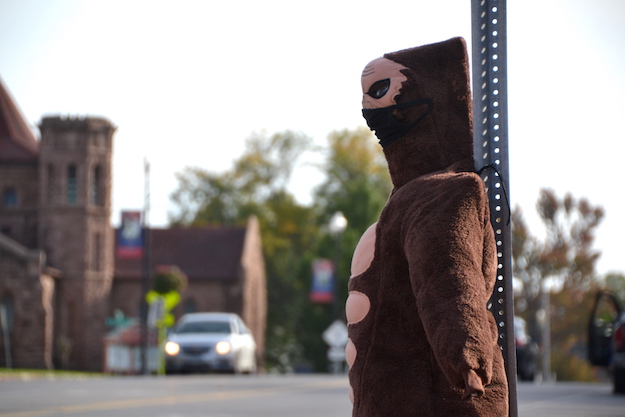
ALBION – This scarecrow of the Hulk is among 30 to 35 on display in downtown Albion in a contest. Community members are welcome to vote for their favorite scarecrows.
The ballots are available at the Downtown Browsery and Krantz Furniture. The categories are: Most Traditional, Scariest, Cutest and Funniest. Voting runs through Monday, Oct. 25.
The winners will be announced in the “Dining & Entertainment” section of the Lake Country Pennysaver in the Saturday, Oct. 30 edition.
The Bigfoot scarecrow has been on the move. Here he is shown in front of the former Swan Library at the intersection of Main and State streets.
By Doug Farley, Cobblestone Museum Director – Vol. 2 No. 39
GAINES – One of the very unique buildings located in the Hamlet of Childs is a historic “Voting House,” given to the Cobblestone Museum in 1999.
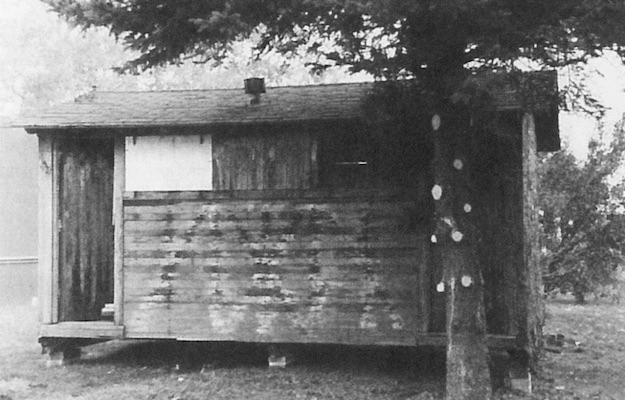
This interesting structure was donated to the Museum by the Town of Hamlin in Monroe County. Mary Smith, Town of Hamlin Historian, explained that the old voting house dated back to 1909. The exact date that the building was taken out of service for voting is not certain, but can be estimated to be sometime around 1970. But, what is known, is that the building had reached a high level of deterioration over the years. The photo above shows the building at the time of its arrival at the Museum in the fall of 1999.
I was recently asked by an observer, what exactly is a Voting House? The concept of having a unique and separate building that is only used for voting once or twice a year seems pretty foreign today. I admit that in my lifetime, I have seen the evolution from “voting booths,” which were actual booths, usually closed off with curtains, to the present day system of electronic voting machines that are delivered to select locations when needed for voting, but I never voted in a Voting House.
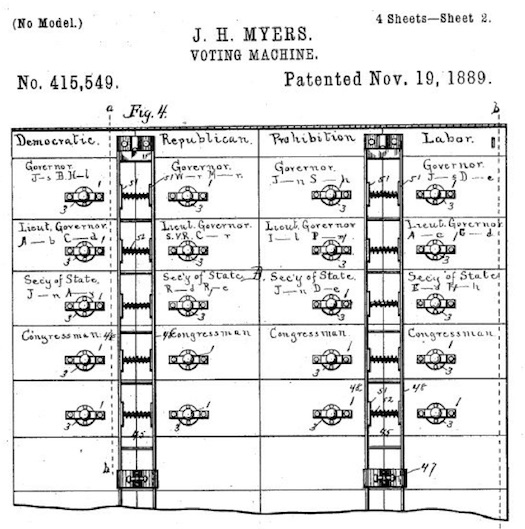
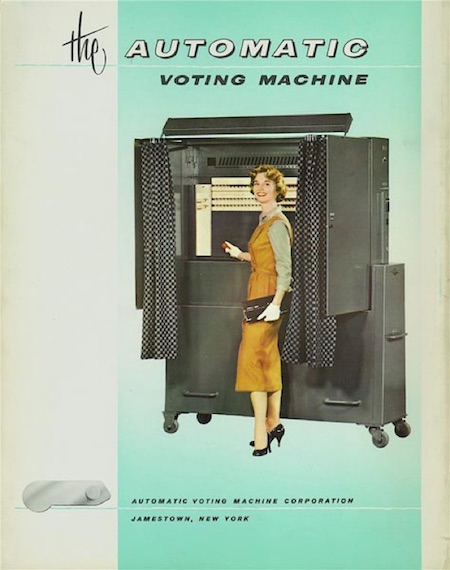
The history of voting in Orleans County pretty much follows the trend of all voting in this country, from paper ballots or “tickets” to mechanical voting devices. The invention of the later is credited to Jacob Meyers, who operated a company that made safes in Rochester, NY. His introduction of the Meyers Automatic Voting Booth set the course for a trail of successors that even today, follow his model.
Meyer’s voting machine used many of the same security measures he built into his safes, and in many ways, the first voting machines resembled a large vault, about ten feet square containing two doors at the front and no windows. The voters would enter through the door on the right. The poll watcher would then close and lock the door while with the aid of kerosene lamps for lighting, the voter pressed in a series of knobs next to the names of their candidates.
When finished, the voter would exit through another door and slam the door shut. This process would lock the exit door, record the vote and release the lock on the entrance door, allowing the next voter to enter. Meyers declared that his new voting machine would “protect mechanically the vote from rascals and make the process of casting the ballot perfectly plain, simple and secret.”
The first application of the Meyers machine in the United States came on April 15, 1892 in the Town of Lockport when at 8:45 a.m., incumbent supervisor, John G. Freeman, entered the machine and cast the first mechanical vote for his own re-election. The “Lockport Union” reported that six persons voted in the first minute – a truly remarkable feat.
For the benefit of those who could not read, the slate of candidates for each party were printed in different colors – yellow for Democrats, red for Republicans and blue for the Prohibition Party. The newspaper went on to report that the voting was “unquestionable, untrammeled, incorruptible and correctly counted.” (It would be safe to presume there were no “hanging-chads.”) Within a minute after the polls closed at 5:30 p.m., the re-election of Supervisor Freeman was announced and within minutes, the name of every other successful candidate was also known. It was a remarkable feat in a day and age when voting results usually required many hours or days of counting paper ballots by hand.
Even the old voting “booths” that I remember used to take up a lot of real estate in a polling place and were generally stored at the voting site which also created storage issues. However, I really have never seen or frequented a voting house in my lifetime, so I thought the question pertaining to voting houses to be pretty valid.
We know for a fact, that the voters in the Town of Gaines would have exercised their Constitutional authority to participate in free, local elections by entering their vote within the town’s polling place. This was first accomplished through paper ballots placed in a ballot box, and eventually progressed to mechanical registry by pulling a lever on a voting machine.
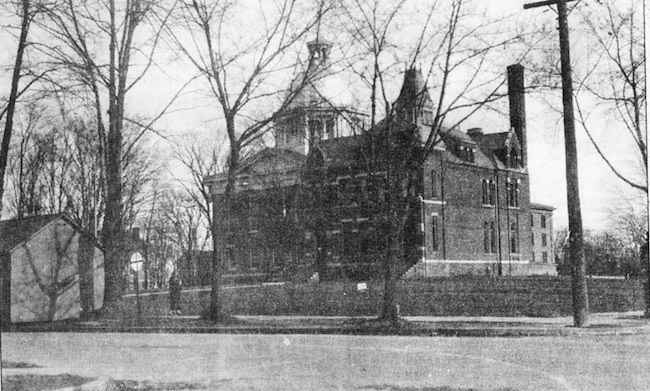
Voting House (lower left above) on Courthouse Square, Albion. As seen from Christ Episcopal Church, c. 1930.
Former Orleans County Historian Bill Lattin remembers seeing voting houses used in various locations in Orleans County, although they were gone when he was old enough to vote. In the early 1900s, Voting Houses for each voting district were placed on a flat-bed wagon and pulled by horses to sit within the voting district. They placed them between the sidewalk and the street, but they usually extended out into the road.
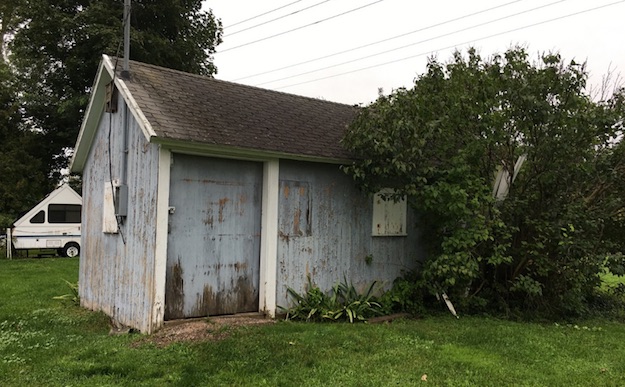
An old Voting House now used for storage on West Academy Street, Albion.
Bill recalls seeing a photo of a Voting House at the Court House Square in Albion and an old Voting House on West Academy Street. After Election Day, the Voting House was again carted off to be stored on county property. Primary voting at that time took place in September, so the Voting Houses were left in place from Primary Day in September to Election Day in November.
Larger municipalities used Voting Houses, but small towns used public buildings for voting, similar to today. Cary Lattin, Bill’s father, served as a Voting Inspector in the Town of Gaines and fulfilled his duties at the Voting District #1 in the old Town Hall. He served as a Republican Inspector along with Nellie Vagg. The two Democrat Inspectors were Mae Wolfe and Mrs. House. Gaines also had other Voting Districts, some casting ballots in the Schoolhouse at Eagle Harbor and others at the East Gaines Church. The number of voting districts was controlled by state law based on population density.
Bill noted that the Voting Houses were “always painted battleship grey.” They had two doors, with the door on the left used as an entrance and the door on the right side of the house used for an exit only. Bill said, “The exit door didn’t even have an outside doorknob to prevent people from entering the wrong door and disrupting the voting process.” The buildings were heated with a kerosene stove and lit with kerosene lamps. Inside the building, a railing was placed to separate someone who was voting from people waiting to vote. There were lots of windows to provide illumination.
At some point in history, towns, cities and villages stopped using voting houses and instead enlisted the help of churches and other community buildings to serve as temporary polling locations. The rest of the year, the sites continued in their normal course of business.
The Voting House that was given a new home at the Cobblestone Museum was one that had originally been commissioned by the Monroe County Board of Elections in 1909. It was used in the city of Rochester until it was taken out of service. Town of Hamlin Historian Mary Smith acquired it for part of a Town of Hamlin Museum, made up of several small buildings, located just north of Walker, NY. When it was decided to no longer have a Town Museum, Mary Smith offered the former Voting House to the Cobblestone Museum. Highway Superintendents in both Hamlin and Gaines assisted with moving the structure. The remaining buildings at the Walker, NY site were removed and the lot was cleared.
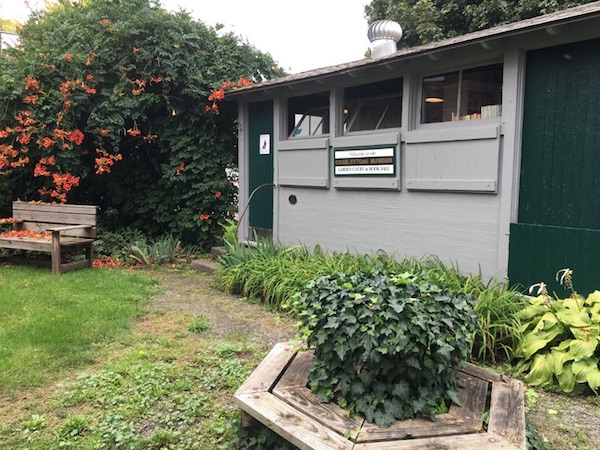
All this having been said, the Voting House at the Cobblestone Museum was a welcome addition to the Museum campus in 1999. A great deal of restoration work was completed at that time. Don Ross and Dick Cook rewired the building for lighting and Ken Root helped install a system of shelving units.
This allowed the historic structure to become a place to display used books for sale to the general public as a fundraiser for the Museum. This purpose has continued, even to this day, with a wide selection of hardcover and softcover books, none more than $1. The Book Building is located behind the Cobblestone Church and is open pretty much around-the-clock until snow flies. Plastic bins are located outside the Book Building to accept used books from community members. All of the proceeds from the book sales have provided valuable funds over these twenty some years to help cover Museum expenses.
A beautiful Garden Court was also added in 2000 that was made possible by a donation from Marcia Hart Conrad in memory of her father, Homer C. Brown and her mother Marcia Brown Hart. A Bronze Plaque was also donated by Glen and Irene Woolston of Waterport and placed on the Voting House.
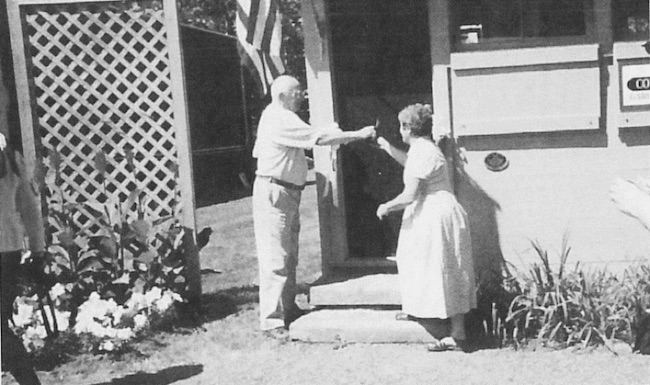
The photo above shows the Book Building’s official opening with Cobblestone Museum Treasurer Don Ross and President Mary Anne Braunbach cutting the ribbon. The addition of the Book Building was a big part of the Museum’s 40th Anniversary Celebration in the year 2000. (By the way, the celebration went off without a hitch in spite of all of the “Y2K” hoopla that was prevalent in the year 2000 when doomsday pundits believed computers would melt down in a tizzy when they rolled over from 1999 to the new millennium.)
There were a lot of activities that took place at the Museum on September 10, 2000 to celebrate this milestone 40th anniversary. Here is a list of volunteers who made the celebration possible:
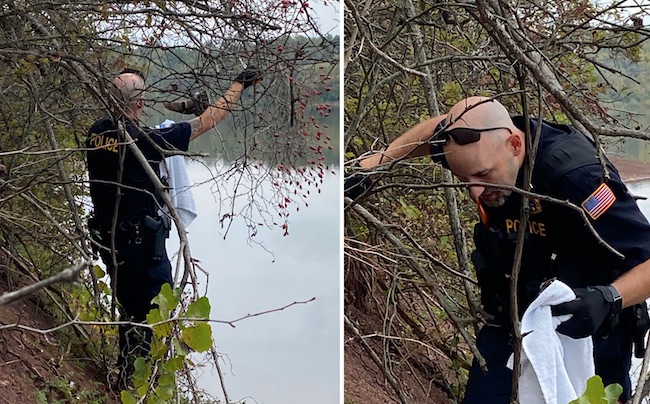
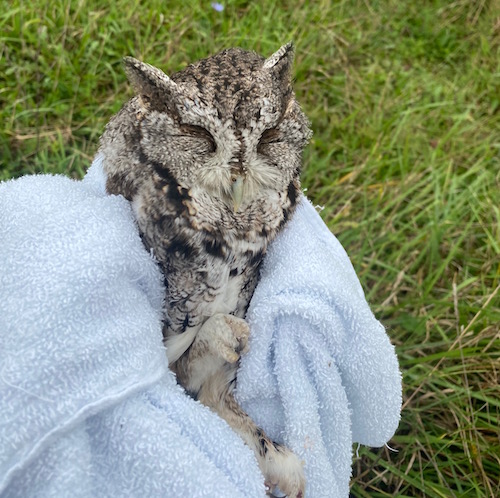
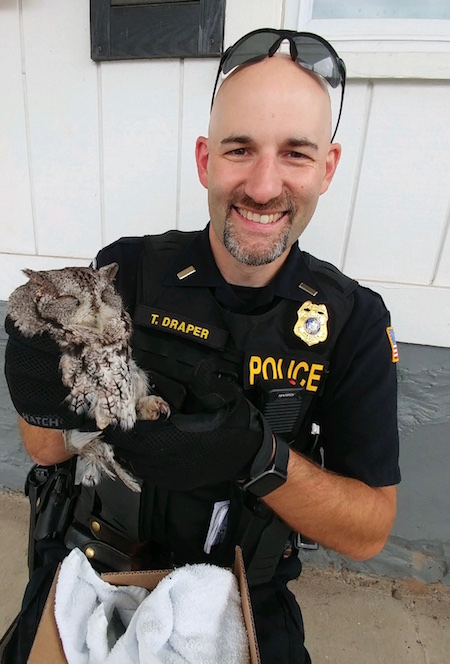
MEDINA – Medina Police Department Lt. Todd Draper rescued an Eastern Screech Owl on Friday afternoon.
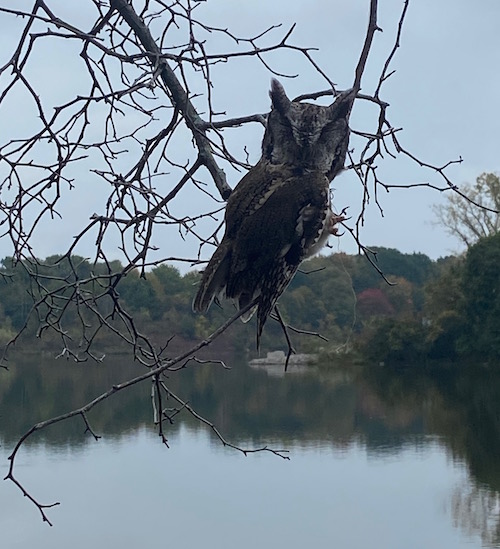
One of the bird’s talons had become hopelessly entangled in discarded fishing line and was hanging helplessly from a hawthorn shrub hanging out over the water at the boat launch/fishing area just south of Boxwood Cemetery.
Draper pushed his way through thorns and some precarious footing to cut the bird out of its predicament.
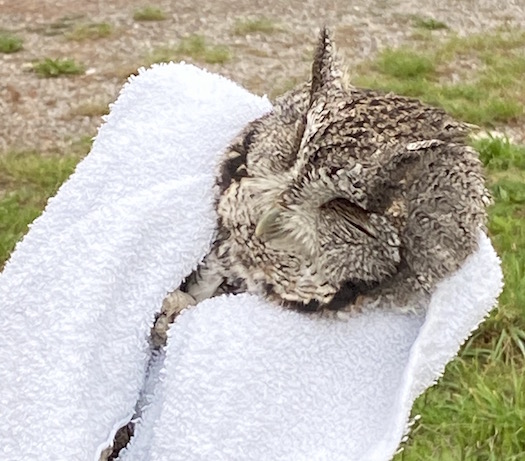
Draper said the owl was lethargic for about 45 minutes, but started to move more as it was turned over to Bob Humbert from Wolcottsville Wildlife Rescue, a state and federally licensed rehabilitator.
Humbert told Draper the owl was a fully grown screech owl, maybe a year old.
“He said the owl was likely extremely dehydrated but was confident it will make a full recovery,” Draper said.
Here are additional photos courtesy of Lt. Draper:
Lowering 60-hour overtime threshold among the concerns
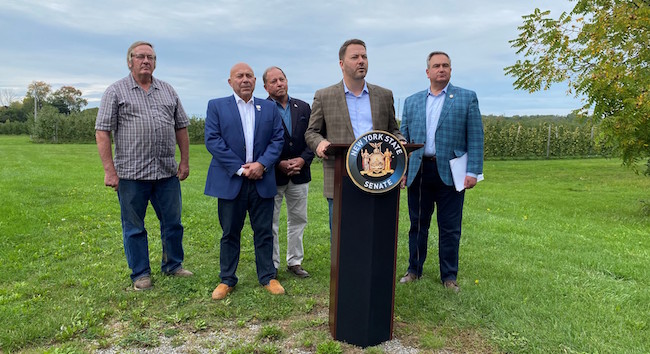
Provided photo: State Sen. Rob Ortt joins other state legislators for a listening session on Friday with local farmers at Bittner-Singer Orchards. Pictured from left include Bittner-Singer Orchards President Jim Bittner, Assemblyman Angelo Morinello, Assemblyman Steve Hawley, Sen. Rob Ortt and Sen. George Borrello.
Press Release, State Senate Republican Leader Rob Ortt
APPLETON – Senate Republican Leader Rob Ortt, along with members of the Senate and Assembly Republican Conferences, on Friday held a listening session with local farmers and stakeholders to hear about the pressing issues facing the agriculture industry.
Discussions revolved around the potential impacts of lowering the 60-hour overtime threshold. Later this year, the New York State Farm Labor Wage Board will revisit the threshold set in 2019 and make a determination on whether to lower the threshold to 40 hours. Lawmakers also heard from participants about the issues they’d like to see as priorities in the upcoming legislative session.
“The agriculture industry continues to struggle under burdensome state mandates and the lingering effects of the Covid-19 pandemic,” Ortt said. “I want to thank the farmers and stakeholders who shared their perspectives, particularly regarding the negative consequences that will occur if the wage board further lowers the overtime threshold. My colleagues and I will continue to advocate on behalf of our farmers, and I urge the wage board to listen to those who will be directly affected by their actions.”
Senator George Borrello said, “New York farmers are among the most hardworking and resilient individuals anywhere. They are the foundation of our state’s $6 billion agriculture industry, which is known for producing some of the finest meat, dairy and produce in the world. However, the strength and viability of our farming community is threatened by burdensome mandates and misguided policies from Albany that are making it harder than ever to stay in business. At the top of the list of challenges are the Farm Labor Act and potential changes to the 60-hour overtime threshold. My conversations with farmers and farm workers in recent months have echoed the comments we heard today about how harmful this change would be for everyone. The agricultural community is united on this issue.”
Senator Edward Rath said, “The agriculture industry is critical to our state’s economy and the character of our rural communities. Reducing the overtime threshold for farmworkers would have a devastating impact on the New York State agriculture industry at a time when many farms are struggling. To do so after so many farmers have stepped up and continue to step up to donate products to those in need during the pandemic, is unacceptable. Now is not the time to play politics, we need to listen to stakeholders and industry experts. The future of New York State’s agriculture industry depends on it. The evidence is clear; lowering the overtime threshold hurts farmers, workers and consumers.”
Senator Patrick M. Gallivan said, “Agriculture is one of the state’s most important industries, directly and in-directly employing thousands of hard-working residents. As we prepare for a new legislative session, it is important that we hear from farmers and others in the agriculture industry about the challenges they face, especially potential changes to the Farm Labor Act and other burdensome regulations that threaten the future of farming in New York. I look forward to working with those throughout the industry to improve the state’s business climate.”
Assemblyman Steve Hawley said, “In upstate New York, agriculture is more than an industry, it’s a shared heritage and way of life. The proposal to lower the 60-hour overtime threshold for farm laborers jeopardizes farming in New York as we know it today. It makes it less feasible to grow labor-intensive crops that New Yorkers expect to see on grocery store shelves and in their farmers markets. While our farm workers are some of the hardest working people in our state, I fear the unintended consequences of this policy could limit their opportunities and weaken agriculture in New York entirely.”
Assemblyman Mike Norris said, “Every farmer matters in New York State. Agriculture is a multibillion-dollar industry in New York, yet unfortunately, state regulations affecting our farms are far too often created by representatives who have never stepped foot on a farm. I have had the privilege of touring small, medium and large sized farms in various agricultural industries throughout Western New York, and I commend Minority Leader Ortt for hosting this roundtable because it is critical that we continue to gain valuable feedback on issues affecting our agriculture industry so we can ensure the future of farming in New York State is bright.”
Assemblyman Angelo Morinello said, “We must be cognizant of the reality of farm work. Seasons, crop readiness for harvest and weather conditions cannot be scheduled in the same manner as traditional manufacturing. Farmers provide perishable goods that dictate their readiness for market. Remember if you ate today, thank a farmer.”
By Tom Rivers, Editor Posted 16 October 2021 at 8:36 am
MURRAY – The recycling pick up on Friday was delayed in the town of Murray, south of the canal.
That recycling should be collected today by Modern Disposal Services, said Jack Welch, Orleans County chief administrative officer.
“We apologize for any inconvenience this creates for our residents along the affected routes,” Welch said. “If these residents leave out their recycle bin, Modern Disposal will have your items collected as soon as Modern is able.”
By Mike Wertman, Sports Writer Posted 15 October 2021 at 9:41 pm
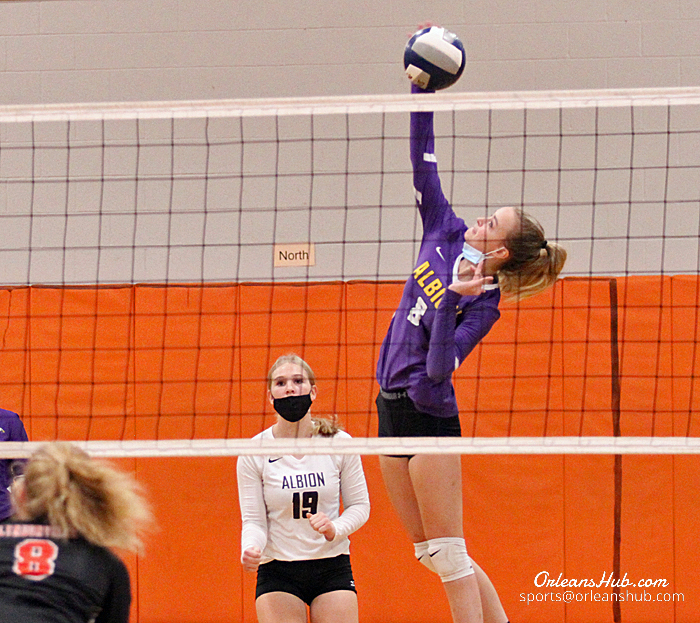
Photos by Cheryl Wertman – Lyndonville’s Karlee Rounds spikes the ball as Albion’s Samantha Rogers goes up for a block attempt during this evening’s non league match at Lyndonville.
Lyndonville bested visiting Albion in four sets 25-15, 18-25, 25-15, 25-16 in a non league volleyball match this evening.
Gracie Johnson had 3 service aces and 5 spiking kills, Lorelei Dillenbeck 7 kills and 6 assists, Ashlee Stephens 11 assists and 2 kills, Addison Dillenbeck 5 aces and 5 kills and Haley Shaffer 3 aces and 12 digs for Lyndonville.
Shaffer served up eight points in a row (6-13) and Addison Dillenbeck scored a total of six (2-4, 22-24) in the first set to help get Lyndonville rolling.
Maya Knaak scored seven points (2-3, 14-18) in the second set to help pull Albion even. She had a total of 5 aces in the first two sets.
In a Genesee Region League match Kendall defeated Oakfield-Alabama 25-16, 25-17, 22-25, 25-21.
Albion’s Maya Knaak spikes down the line for a point.
By Tom Rivers, Editor Posted 15 October 2021 at 2:45 pm
‘The best kind of parent is a loving parent. It’s always better to err on the side of love.’ – Curt Follman, peer counselor
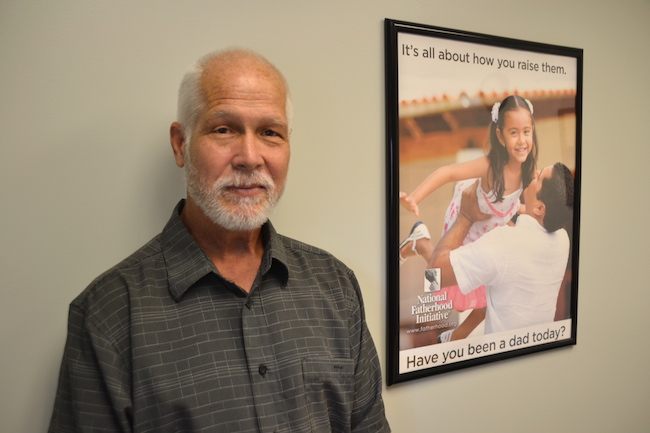
Photos by Tom Rivers: Curt Follman, a father of seven, has volunteered as a peer counselor at Care Net for five years. He has worked with about 30 young men.
ALBION – An organization that provides ultrasounds and many services to women and children also runs a peer counseling for men.
Care Net of Greater Orleans has peer counselors who meet regularly with men, going through a parenting workbook and offering encouragement and strategies for coping with stress and expressing love.
Care Net is celebrating its 30thyear in Orleans County. Wende Swick, the director, wanted the community to know about the peer counseling program.
“We’re not just a center for women,” she said.
Curt Follman, a father of 7 and a retired school teacher, has met with about 30 men over the past five years. He meets with three guys a week. He typically meets with the men for 8 to 10 weeks. They go over a “Homes with Honor” workbook.
“It’s all about respect, showing love and valuing each other as a family,” Follman said. “It’s about honoring those in the home.”
Follman will help the men in other ways, if needed. He taught one to drive so he could get his license. He stays in touch with many, long after the program ends. Some sign up for additional classes.
Follman said he wished he went through the program when he was a young dad.
“Parenting doesn’t come with a manual,” he said. “It’s difficult.”
He stresses to the men that becoming a father brings new responsibilities.
“Your life is no longer your own,” he said. “It’s not just about you anymore. Now it’s also about this mom and child, and you need to step up to the plate.”
Follman discusses parenting styles and encourages responding to others with grace and understanding.
“The dominant style is the worst,” he said. “The best kind of parent is a loving parent. It’s always better to err on the side of love.”
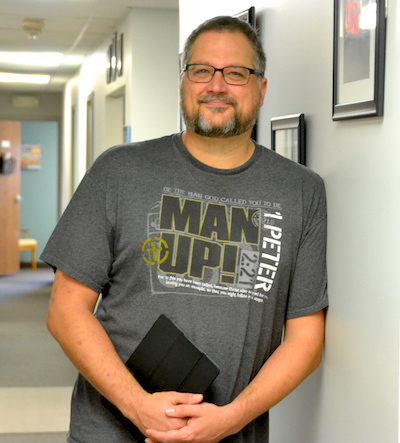
The Rev. Randy LeBaron also volunteers as a peer counselor at Care Net.
Randy LeBaron, a local minister and father of four, also volunteers as a peer counselor.
“Most people have a father wound,” LeBaron said.
He has volunteered at Care Net for 17 years, including the past two years as a peer counselor helping with parenting classes for men.
“I can honestly say that it has been one of the most fulfilling things that I get to do week to week,” LeBaron said. “The guys that I get to work with are often in crisis mode, sometimes coming as a mandate from the court, but I have found each one to be open and wanting to learn how to be a better parent and a better man.”
LeBaron sees transformed men in the process.
“One of my favorite things is getting to see change happen when they let down their guard and open their lives up to God,” he said. “At the end of each session I offer to pray with them and even those most reluctant at first anticipate this and often share needs well beyond the scope of our meeting together.”
Some of the men are assigned to the program through court or Child Protective Service through DSS. Others sign up on their own.
LeBaron said he tries to refrain from judging people who are court-appointed and have a CPS referral. He finds fathers in these situations are often very caring.
“One of the reasons that I got involved working with men at Care Net is because I have a testimony that includes being healed from a father wound and I find that many of the men I meet have experienced something similar and are also looking for healing so that they do not perpetuate the hurt by causing pain as a parent,” LeBaron said. “I also see, within the context of Care Net, the need to not only show love and support to a mother and her child but to recognize the significance of the father’s potential role in that child’s life whether or not the two are still a couple or are separate but choosing to co-parent.”
Follman also said he doesn’t judge. He said people make mistakes.
“God is the God of second chances and some of these people need second chances,” he said.
Follman has a spinal injury and he shares how he was injured diving in a pool about 40 years ago. He was paralyzed from the chest down initially but was able to walk out of a VA Medical Center in Cleveland after six months. He has some limited mobility and needs to give people a nub, instead of a firm handshake.
“They see I don’t have everything in control,” Follman said about his injury.
Follman said he isn’t an all-knowing peer counselor. He strives to listen as much as offering insight.
Swick, the Care Net director, praised the peer counselors and also the men in the program for being vulnerable and wanting to be better parents.
“Here, we’re gentle and not in your face,” Swick said. “We show God’s love to everybody.”
For more on Care Net of Greater Orleans, click here.
Assemblyman Steve Hawley (R,C,I-Batavia) has announced that he will be holding a pet costume contest on his Facebook page in order to help his constituents get into the Halloween spirit.
On the Facebook post (click here), the photo of a costumed pet that receives the most likes or reactions will receive an Assembly Citation, have their photo submitted to the local newspaper, and a photo of their pet will be displayed at his Legislative Office in Albany during the 2022 Legislative Session.
The contest rules can be found below:
Dress your pet up in their best Halloween costume
Post a photo of your pet in the comment section. Only one submission per owner can be posted.
Vote by liking pet photos. Voting ends on Thursday, Oct. 28 at 7 p.m. The pet with the most likes/reactions wins!
Winner will be announced on Friday, Oct. 29.
The contest is open to all pet owners living in the 139th Assembly District. This includes all of Genesee County, all of Orleans County except Shelby, and the towns of Hamlin, Clarkson, Sweden, and Riga in Monroe County.
“After what has been something of a frightful year for many, I wanted to do something fun for the season and give residents an opportunity to show off their costumed companions,” said Hawley. “As a lifelong animal lover with a fond appreciation for all things Halloween, I look forward to seeing what people and their pets can pull off!”
MEDINA – Assemblyman Steve Hawley (R,C,I-Batavia) is continuing his series of visits to local small businesses to commemorate National Women’s Small Business Month by visiting Revival Beauty Parlor in Medina.
Having already visited Gilliana’s Diner in Batavia, he will continue to visit local women-owned small businesses in the 139th Assembly District throughout the month of October.
Gretchen Carr is someone who lived and worked in Medina all her life. Coming from a family of hair stylists, she always dreamed of owning her own salon one day. After working her way through the BOCES cosmetology program, she began working for a salon the following summer, earning her license.
After serving in the industry for 25 years and carefully saving up to do so, Gretchen and her husband purchased the building that formerly housed a salon known as Vision 2000. They turned it into “Revival Beauty Parlor,” a fitting name after she worked to breathe new life into the business.
“Gretchen’s story of finding success in doing what she loves is a living testament to the idea of the American Dream, and the dedication her and her staff have in serving their customers, even while contending with rapidly-changing restrictions, is truly admirable,” Hawley said.
Since opening in 2018, Gretchen and her staff have faced an uphill battle against restrictions and mandates placed upon them throughout the Covid-19 pandemic. These restrictions limited their ability to serve as many customers as they had grown accustomed to, and even forced them to close their doors entirely for a nearly three-month period.
In recent months however, Gretchen has since been able to once again open the doors to her salon, and welcome new and existing customers as the business’ operations have come closer to pre-pandemic normalcy.
Hawley will be visiting the business, located at 521 Main St., Medina at 11:45 a.m. on Saturday, Oct. 16. During the visit, they will discuss the challenges the business has faced in recent months. Assemblyman Hawley will honor Gretchen for her efforts to bring a new business to Medina and persevering in the face of obstacles to the business’ success.
“I look forward to visiting the salon to discuss with her how she’s been able to succeed in the industry, overcome challenges she faced when opening her salon, operating it through a pandemic, and what hopes she holds for the future of Revival Beauty Parlor,” Hawley said.
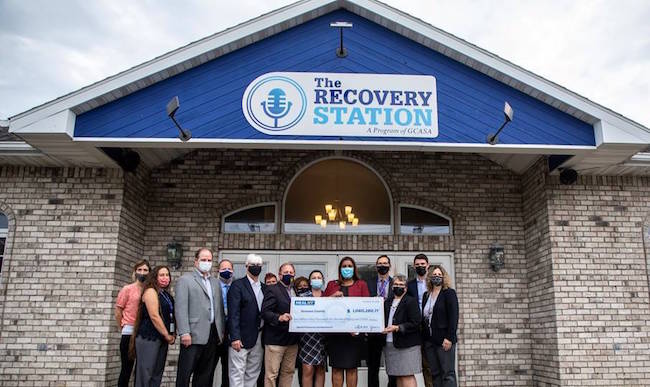
ROCHESTER/BATAVIA – New York Attorney General Letitia James was Thursday visited Rochester and Batavia as part of her statewide “HealNY” tour of the state.
She is announced funding for the Finger Lakes as part of $1.5 billion in a settlement to combat the opioid crisis in counties across New York state.
The Finger Lakes counties are to receive $29.2 million to $53.1 million of those funds. The share for Orleans County is a minimum of $356,743 to a maximum of $615,993.
The allotments for Finger Lakes counties include:
Genesee County: $614,045 to $1,060,280
Livingston County: $586,539 to $1,012,784
Monroe County: $11,143,437 to $19,509,989
Ontario County: $1,131,905 to $1,954,475
Orleans County: $356,743 to $615,993
Seneca County: $334,269 to $577,187
Wayne County: $858,979 to $1,483,210
Wyoming County: $355,707 to $614,204
Yates County: $214,215 to $369,887
“For more than two decades, the Finger Lakes Region has been ravaged by the opioid crisis, but, today, we are finally starting to heal New York by announcing that we will be delivering up to $53 million to the area to invest in the prevention, treatment, and recovery programs,” James said. “No amount of money will ever make up for all the addictions, all the deaths, and all the communities devastated by opioids, but these funds will be essential in helping the Finger Lakes Region turn the tide on this epidemic.”
Every region in the state will receive millions of dollars for prevention, treatment, and recovery programs to combat the opioid crisis.
The AG filed a lawsuit in 2019 that her office said was, at the time, the nation’s most extensive lawsuit against the various manufacturers and distributors of opioids. These manufacturers and distributors were responsible for heavily marketing opioids to doctors, hospitals, health care systems, and others, which led to the over prescription of the drugs across New York and the rest of the nation over the last two decades, James said.
The manufacturers named in Attorney General James’ complaint included Purdue Pharma and its affiliates, as well as members of the Sackler Family (owners of Purdue) and trusts they control; Janssen Pharmaceuticals and its affiliates (including its parent company Johnson & Johnson); Mallinckrodt LLC and its affiliates; Endo Health Solutions and its affiliates; Teva Pharmaceuticals USA, Inc. and its affiliates; and Allergan Finance, LLC and its affiliates. The distributors named in the complaint were McKesson Corporation, Cardinal Health Inc., Amerisource Bergen Drug Corporation, and Rochester Drug Cooperative Inc.
Last month, a settlement with Endo was announced that has already delivered $50 million to New York state and Nassau and Suffolk counties to combat the opioid crisis and remove the opioid manufacturer from New York’s ongoing opioid trial.
Also, last month, a settlement that secured more than $4.5 billion – at least $200 million of which will be earmarked for New York – from the Sackler family and foundations that they control, ends the Sacklers’ ability to manufacture opioids ever again, and will shut down Purdue Pharma was announced.
In July, a settlement with McKesson, Cardinal Health, and Amerisource Bergen that will deliver up to $1 billion to New York state to combat the opioid epidemic was announced.
In June, a settlement that ended Johnson & Johnson’s sale of opioids nationwide and that will deliver $230 million to New York alone was announced. The deals with Johnson & Johnson, McKesson, Cardinal Health, and Amerisource Bergen have a global value of approximately $26 billion.
The cases against Mallinckrodt and Rochester Drug Cooperative are now moving separately through U.S. Bankruptcy Court.
The trial against the two remaining defendants – Teva Pharmaceuticals USA and Allergan Finance – is currently underway and continues in state court.
By Tom Rivers, Editor Posted 15 October 2021 at 11:04 am
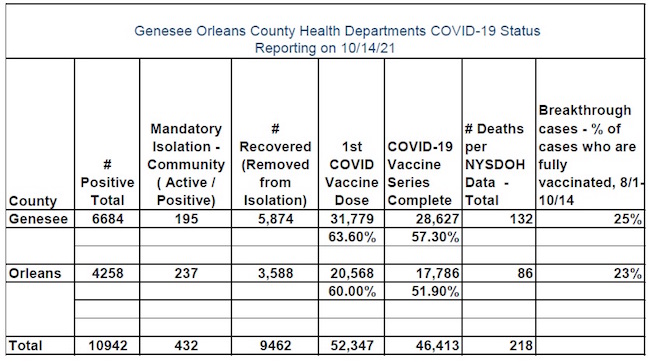
The number of active Covid cases in Orleans County continues to trend up and is getting close to passing the high during the Covid-19 pandemic.
Orleans was at 237 active cases on Thursday, up from 212 on Tuesday. The county’s record high was 279 cases on Jan. 7, 2021.
Orleans reported 72 new positive cases from Tuesday through Thursday, and 47 more recoveries, or people who completed their 10-day isolation and have been removed from mandatory isolation.
Orleans currently has three people hospitalized due to Covid, according to the Genesee and Orleans County Health Departments.
In Genesee, the active cases dropped from 249 on Tuesday to 195 on Thursday. Genesee reported 99 new cases in the two days, and 152 more recoveries. Genesee currently has 12 people hospitalized with Covid.
By Tom Rivers, Editor Posted 15 October 2021 at 9:33 am
3,800-foot path last piece of upgrades at Albion site
Provided photos
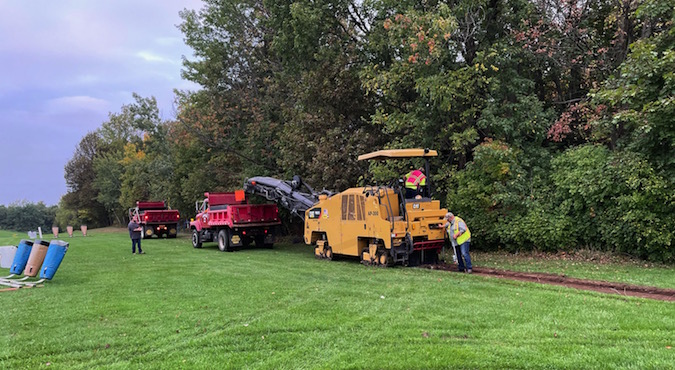
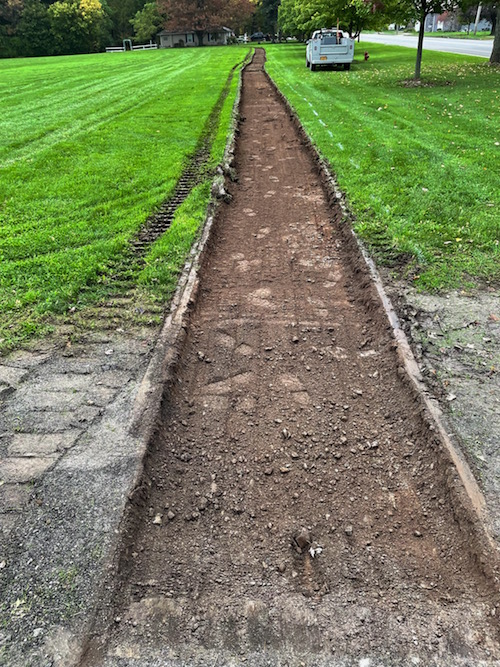
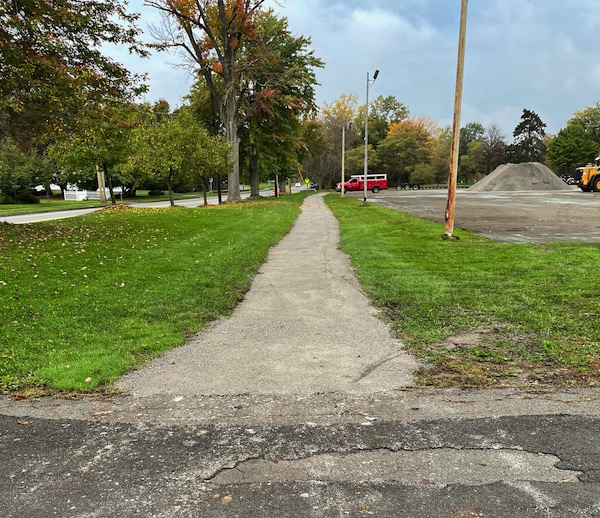
ALBION – The Village of Albion is putting in a new 3,800-foot-long walking/running trail around the perimeter of Bullard Park.
The Village of Albion Department of Public Works is doing most of the work, with assistance from a private contractor with a milling machine.
The walking trail is the last piece of an $800,000 improvement project at Bullard, a village park on Route 31.
Other upgrades include a new splash park, amphitheater, utility building with bathrooms and a pavilion.
The village dug six inches down for the new trail, which is 5 feet wide. There will be a fabric on the bottom, then crusher run stone, with a finer stone on top. It will be similar to the Erie Canal towpath, said Jay Pahura, the village DPW superintendent. The village started digging the trail two days ago.
The Albion Running Club donated $5,000 to the village to help pay for the walking/running trail.
The new trail stays on the high ground at the park, and doesn’t go down near the lower part of the park near Sandy Creek on the west side of Bullard.
The village in December 2016 was awarded a $499,605 state grant for the Bullard projects. The village also received $97,500 from the county and $45,000 from the town of Albion, money that was through a revolving-loan fund by the Orleans Economic Development Agency. Those latter funds paid for improving handicapped accessibility at parks. Albion used the EDA money to put in sidewalks to the amphitheater and splash pad, to make them accessible to people in a wheelchair.




















 Assemblyman Steve Hawley (R,C,I-Batavia) has announced that he will be holding a pet costume contest on his Facebook page in order to help his constituents get into the Halloween spirit.