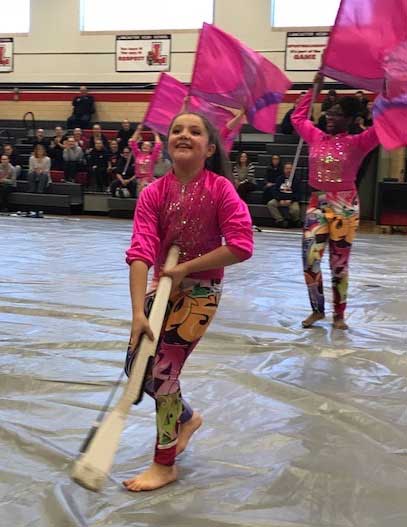
Provided photo: The Medina Cadet guard competes at Lancaster on Saturday.
MEDINA – Medina will host a WinterGuard competition this Saturday at the high school with 22 guards competing. The event begins at 4:35 p.m. and includes the three guards from Medina.
“It is a great opportunity to see these students and adults perform without having to travel too far,” said Kathy Dreyfus, publicity chairwoman for the Medina Mustang Band.
The Boosters also want to thank the community for supporting the Basket Raffle on March 3 after postponing it because of inclement weather on Friday.
All three of Medina’s WinterGuard units competed at Victor on Feb. 17. The Novice Guard came in second place while the Cadets took first place with a score of 57.58. The Varsity guard earned first place in the Scholastic A class with a score of 68.26.
This past Saturday, two of the Medina guard units traveled to Lancaster for competition. The Cadets won first place in their class with a score of 61.51 along with the Varsity guard taking first place in the Scholastic A class with a score of 73.28.
By Tom Rivers, Editor Posted 2 March 2018 at 9:16 pm
Photos by Tom Rivers
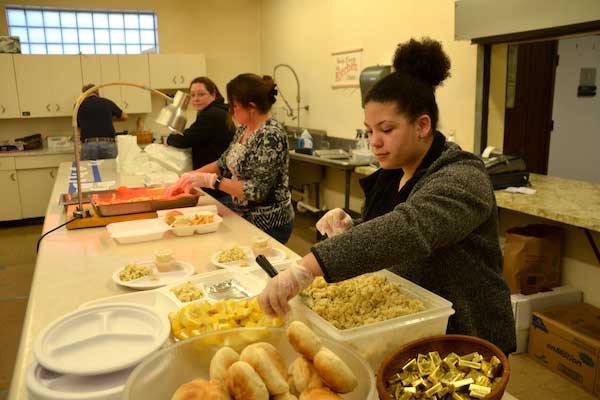
MEDINA – Chloe Nashwenter is part of the team of volunteers in the kitchen at the Sacred Heart Club, serving up about 150 fish fry dinners.
Sacred Heart serves Lenten fish fry dinners and also offers chicken finger dinners with fries.
Sacred Heart has been doing Lenten fish fries for about 15 years. They are a good fundraiser for the club, and also a chance to welcome community members to the site on North Gravel Road.
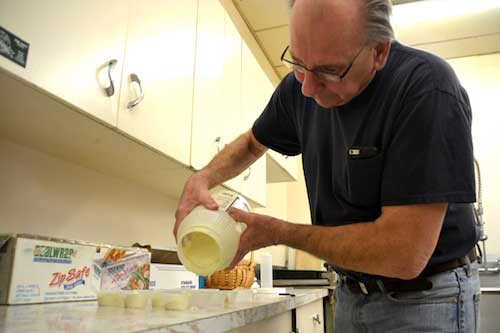
Mike Hartway, president of Sacred Heart, gets the tartar sauce ready. Sacred Heart will be serving the dinners every Friday right up to Easter. Hartway said the proceeds from the dinner go towards a big Christmas party for Sacred Heart members’ children and grandchildren, as well as some other kids in the community.
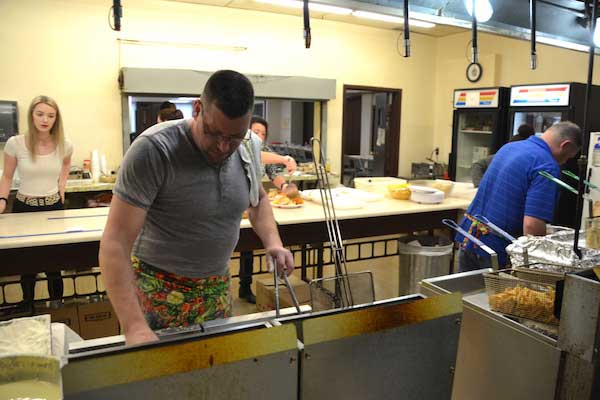
Mike Miller runs the kitchen for the Sacred Heart Club. He said the club’s members step up and work together for the fish fry dinners.
Another dinner is ready to go.
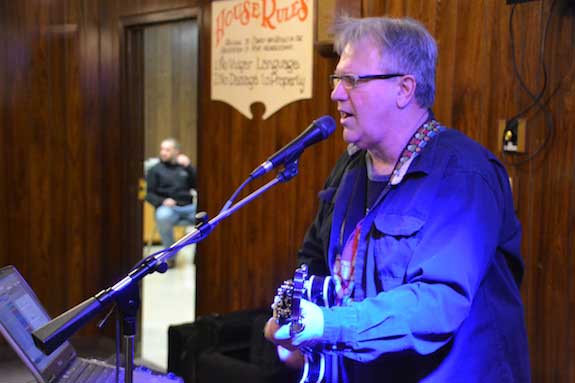
Mike McCauley sings and plays his guitar on many Fridays during the Lenten season at the Sacred Heart Club.
By Tom Rivers, Editor Posted 1 March 2018 at 10:41 am
Photos by Tom Rivers
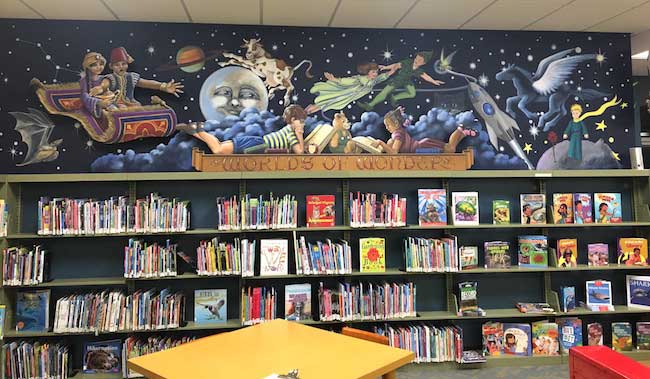
MEDINA – Judith Villavisanis, an artist, spent more than a month creating this mural on the south wall in the children’s section of Lee-Whedon Memorial Library. She finished the “Worlds of Wonder” mural on Monday.
Villavisanis is a former Albion resident who now lives in Florida. Villavisanis in 2014 created the new entrance leading to the children’s section. That entrance resembles a giant book and features many characters from children’s books, such as Wilbur, the pig from Charlotte’s Web.
Her latest project is a tribute to two people who each served the library for over 20 years: Maryellen Dale as President of the Board of Trustees and Elaine Jamele as Children’s Librarian.
Villavisanis is shown working on the mural on Feb. 7. She is painting Pegasus, the mythical winged devine stallion, one of most recognized creatures in Greek mythology.
The boy in the lower right is The Little Prince.
Peter Rabbit appears in this cutout hanging from the ceiling near the mural.
The library has books by the mural that are the inspiration for many of the characters featured in the large painting.
Peter Pan and Tinker Bell appear in the mural above the Cheshire Cat from Alice in Wonderland.
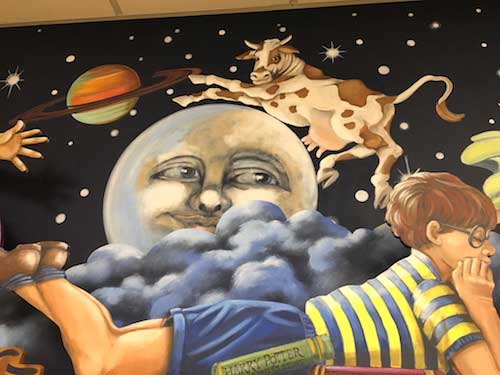
The cow jumped over the moon from the popular nursery rhyme, “Hey, diddle, diddle,” by Mother Goose.
Villavisanis included characters for younger children through teens, and also drew from different eras. This character is of Mary Poppins, who became popular after a 1964 Disney film. She first appeared in a series of children’s books starting in 1934.
By Tom Rivers, Editor Posted 28 February 2018 at 9:22 pm
Photos by Tom Rivers
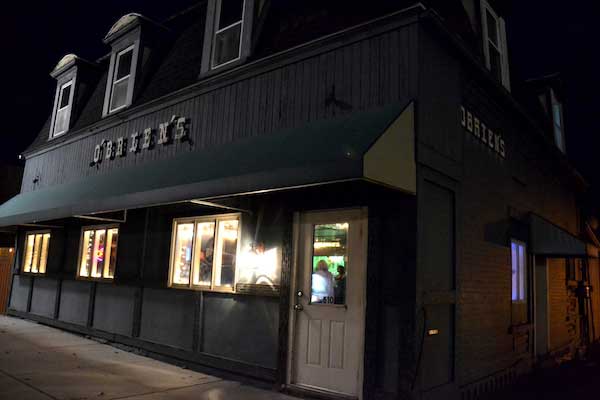
MEDINA – Today is the last day for Alicia Hogan as owner of O’Brien’s Tavern on Main Street in Medina. Hogan, left, is pictured with her daughter Allie Hogan at O’Brien’s just before an open mic night. When Hogan started as owner 6 ½ years ago, there was an open mic the first night.
Many musicians are expected to be part of the celebration tonight.
The Irish pub has a long tradition in Medina, with Hogan saying the site has been a bar for more than a century.
Hogan said she looks forward to a new chapter in her life, but will miss the O’Brien’s customers.
“The bar business is a hard business,” she said. “I love this place, and I love the people. I pretty much know everyone by first name.”
By Tom Rivers, Editor Posted 28 February 2018 at 2:00 pm
A Medina man was killed Saturday in a tragic accident in Rochester, when he was walking on the sidewalk and was struck by a drunk driver.
Jordan Askew, 26, was standing on the sidewalk on Lyell Avenue near Child Street when he was hit by a car that jumped the curb at about 2:49 a.m. Saturday, according to news reports.
Askew died at the scene. He was with Alex Krunz, 21, who was also hit by the car and is critically injured and remains hospitalized.
The Rochester Police Department has charged Chermasia Collins, 29, of Rochester, with aggravated vehicular assault, driving while intoxicated and reckless driving and many traffic tickets.
Askew has many family members in Medina, Albion and Orleans County. He was also known as “Shug.” He is survived by his mother, Stephanie Askew, and his fathers, Greg Griffin and William Coley.
Calling hours are scheduled from 9:30 to 11 a.m. Saturday at Glad Tidings Baptist Church in Medina, where his funeral service will follow.
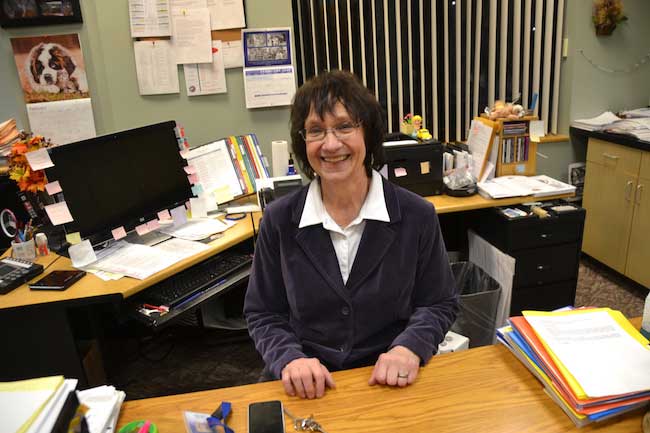
Photo by Tom Rivers: Janice Jovanelly, Medina district clerk/secretary to the superintendent, will retire on June 30. The Board of Education on Tuesday named Julie Kuhn, secretary to the middle school principal, to succeed Jovanelly.
By Tom Rivers, Editor Posted 28 February 2018 at 12:05 pm
Janice Jovanelly has been steady presence while district had changes in superintendents
MEDINA – Janice Jovanelly is the “voice of the school district” and often the first face people see when they stop by the district office.
Jovanelly is the district clerk and secretary to the school superintendent. Her voice is also on the district’s phone system.
She has worked in her current job since 2001. Since then the school district has had five superintendents with Judith Staples, Richard Galante, Neil Miller, Jeff Evoy and Mark Kruzynski, as well as several interim school leaders.
Jovanelly has been a steadying influence in the district office, and also been a key resource for the superintendents, helping them to connect with staff, community leaders and other school officials in Orleans and Niagara counties. She knows all of the district’s 330-340 employees.
Jovanelly will retire on June 30.
Mark Kruzynski, Medina’s district superintendent, said Jovanelly has been an important asset for the school district.
“Janice is irreplaceable, and her knowledge of the district and how things operate has been invaluable to me and every other superintendent,” he said. “I am especially going to miss her kindness and her sense of humor.”
The Board of Education on Tuesday named Julie Kuhn, the current middle school principal’s secretary, to succeed Jovanelly. Kuhn will get to work alongside Jovanelly for three months before taking over July 1.
That will give her a chance to go through a school election. As district clerk, Jovanelly has to line up the election inspectors, have the ballots ready and the the voting machines. She also has to post the legal notices.
Jovanelly joined the school district after working 10 years at the Orleans County Mental Health Department, first as a receptionist for two years and then as secretary to the director for eight years.
She is looking forward to having summers off, and expects to be active in her garden.
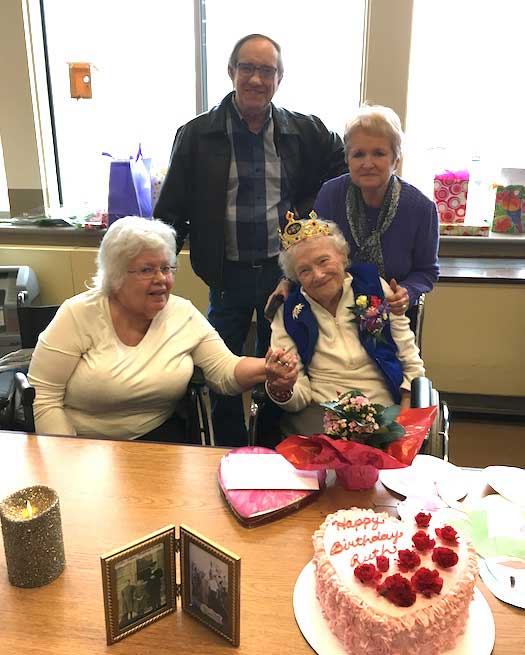
MEDINA – A local resident turned 100 on Feb. 13. Four days after her birthday, Ruth Harold was joined by her family and friends at a party in the North Wing and Medina Memorial Hospital.
Ruth Harold is shown with her children at the celebration. Betty Sargent, left, and Karen Matusak are joined by their brother, Kent.
Ruth was born in Wolcottsville and moved to Middleport. She and her husband raised three children – Kent, Betty and Karen. The two daughters both worked at Orleans Community Health.
Ruth’s three children, grandchildren, great-grandchildren and great-great-grandchildren attended her party on Feb. 17.
She attributes her longevity to her mother’s German cooking and her German recipes.
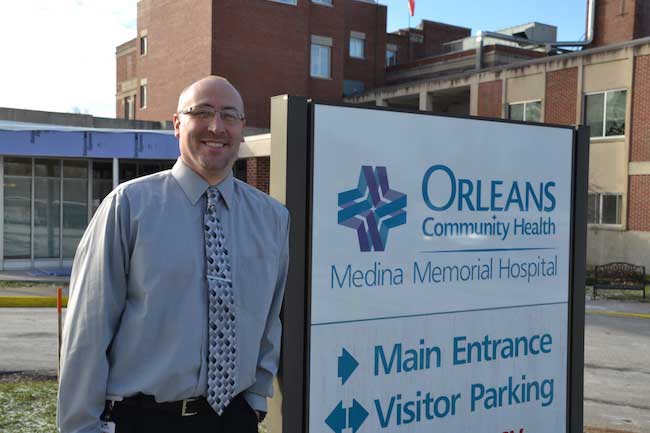
Photos by Tom Rivers: Mark Cye, the interim chief executive officer for Orleans Community Health, is pictured by Medina Memorial Hospital, which is part of the Orleans Community Health.
By Tom Rivers, Editor Posted 26 February 2018 at 1:44 pm
MEDINA – Mark Cye, the interim president and CEO of Orleans Community Health, said healthcare organizations are struggling with reimbursements that don’t cover the cost of care. It’s particularly difficult for small, rural hospitals that serve populations with a high percentage on Medicaid. The Medicaid rates are “awful,” Cye said.
He started as the hospital leader on Jan. 1 and also has been Orleans Community Health’s chief financial officer the past three years. He has worked the past 20 years in the healthcare field.
The following interview was conducted recently by Tom Rivers as Cye’s office at the hospital on Ohio Street.
Question: I wonder how you got interested in the healthcare field?
Answer: When I think about it, it was maybe by mistake. I actually started off in dietary at the Lockport hospital and I worked there for five years. At that point I was going for my accounting degree and a position opened up in patient accountings so I transitioned up there to see what that was like. As I was going through there I got my bachelor’s degree in accounting.
The day I was actually going to resign, because I had accepted another job as an accountant, I had to have my appendix removed that morning. When I went into work that morning at the hospital, the controller asked me about taking the accounting position at the hospital.
I took that and it was healthcare, healthcare, healthcare all the time. I was three years in that job at Lockport hospital. Then what happened is the controller had transitioned out to the Olmsted Center for the Visually Impaired. He called me and asked me to follow him. He was there three years and then he asked me to follow him to BryLin Hospital (on Delaware Avenue in Buffalo). I was there for three years.
I actually worked here as the controller from 2006 to 2008 and then went back to BryLin for seven years, and came back here. I’ve been in healthcare for about 20 years.
Question: Has the number-crunching got more stressful?
Answer: Oh yeah. With healthcare, the days of having dollars there are gone. Now it’s being more creative with how we’re doing things. In healthcare there is always downsizing to really get it to providing the same care but more efficiently. The days of Medicare and the states giving money have gone by the wayside. That’s the more stressful part.
Question: It seems like there is only so much you can cut.
Answer: That’s why in these days if you don’t affiliate with someone, those places don’t make it. With an affiliation you get synergies of service. Maybe you could have a CEO run this hospital and manage that hospital. With the upper level management you have cost reduction and it’s spread out.
Question: Is Medina affiliated with anyone right now?
Answer: Not yet. We’re in the process. It’s pretty close. We’re under a confidentiality agreement until it’s written. We were affiliated at one point with Catholic Health, which to us didn’t provide us a lot of subsistence, so we ended that about six to nine months ago.
Question: They seemed to be at events.
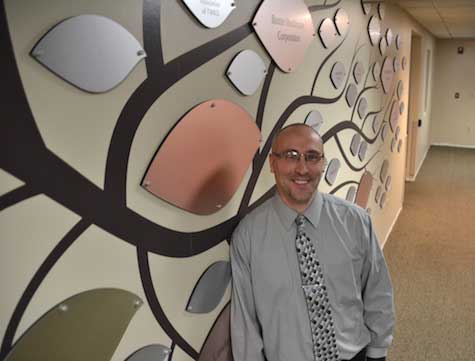
Mark Cye is pictured with a wall that recognizes some of the hospital’s bigger donors.
Answer: Yes, they would present but what we need from an affiliate is as a small, rural hospital we don’t have the ability to attract doctors here and bring other services. Without that, those services go elsewhere, they go 25 miles to the east or 25 miles to the west at another healthcare facility.
We need to attract those doctors here. That was what they were supposed to do but it didn’t pan out.
A good example is in our state it took us 18 months to attract a primary care doc at Albion. Other hospitals have 10 of them sitting there. That’s your main piece in an affiliate. That’s what we’re looking for in an affiliate is how can we keep people in this community getting service in this community.
We don’t want your elders having to drive a half hour to get a procedure when it can be offered here.
Question: It seems like a crisis for rural healthcare.
Answer: Yes. Knock on wood, luckily of all critical access hospitals, New York State is the only one that hasn’t had one close yet, but there have been up to 100 critical access hospitals that have closed in the last couple of years. That’s where the collaboration with other larger affiliates will come into play.
Question: It seems the other nearby hospitals have been aggressive in Orleans County of late. The Batavia hospital just added a family doctor in Medina.
Answer: With most critical access hospitals, they are up on their own. In Watertown, there is no one around for an hour. For us, we’re in a special area where we have big systems sitting on both sides of us. That’s why at some point we have to get stronger with one of them to make it work.
Question: I think you can say that with the local hospital and many local institutions the local people tend to be critical. That must be tough for the Medina hospital because there is some criticism.
Answer: It’s a battle. For us we always try to promote the positives. But you get that one negative comment out there and it blows a lot of the good you’re doing. We could be opening up a new ED today but someone could say the care stunk when I went there, and that’s what people focus on. Which is sad because at the end of the day, and this is what I try to stress to everyone here, is we’re all marketable as employees. Could I go somewhere else? Probably. Could the nurses go somewhere else? Probably. But at the end of the day that would affect the 20,000 people in this community who need the service. It could be your family member who needs that ambulance, who is having a heart attack or stroke and isn’t going to make it if they have to go 25 miles this way or that way.
Question: Is the care really as bad as some people make it out to be?
Answer: Some people come to the ED because they need a medication, they want their drug. We’re going to turn you away.
Some people come here and they don’t want to wait 10 minutes. To them 10 minutes is terrible, but to a normal person they would go there all day long.
Question: Isn’t there a standard of response? I tend to think a smaller hospital would be much faster than a bigger one. You could probably sit there for many hours in Rochester.
Answer: Right. What you always push in these type of settings is a quick turnaround. That is how you keep and attract patients to your area. Here the goal is hour and half from the time you get through the door until you get out.
There are reports that come through about quality, where patients do the questionnaire where they are asked, “Would you recommend the hospital or would you not?” You get some people who will rate your quality a 2, but then two questions later they give you a 9 for, “Would you recommend this place?” So that is of course what the data feeds into and it gets published that you’re a one-star facility, yet 90 percent of the time they would recommend you. You look at some of the metrics and does it even make sense?
They come in and we’re changing your meds, we’re changing your food pattern on you, and to them it’s terrible.
For us it even makes it worse because we’re a low volume. If we have four discharges that month and this is one of them, we look bad. A lot of things end of skewed for the smaller hospitals.
Question: Why did you want to come back to Medina? It seems like it would be easier in the city at a bigger facility.
Answer: Healthcare is healthcare. It’s one of things where I went back to BryLin, they were in bankruptcy when I was there. With my previous boss we went back to BryLin to fix it, to get it out of bankruptcy. They got out of bankruptcy. Then this opened up. I decided to come back here because there was a whole new leadership team. I knew they were struggling.
I want to make a place work. I can’t fix it on my own, obviously, but here there is a challenge.
I like a challenge. I’ve never been the type who just liked to sit in the office and say, “Here’s your financial statement.” I want to broaden and learn.
Anne Outwein, a volunteer with the Twig organization, greets people at the hospital lobby, which is being upgraded.
Question: You’ve been the CFO here for how long?
Answer: Two years. I can in as controller on March 2015, and officially CFO in January 2016.
Question: Are you doing the two jobs, the CFO and the CEO?
Answer: Yes. Again as you look at the hospital and the ways its volumes are changing, our volumes are down dramatically. We’re trying to ramp that up and fix it.
What does a 25-bed or a 10-bed hospital really need to run? If you don’t change with those times, what’s going to happen?
Question: When you say they’re down dramatically, is that compared to five or 10 years ago?
Answer: Two years ago. Is part of it a change from going to an acute hospital to a critical access hospital? People may think we’re a critical access hospital so we can’t handle certain things. That’s one of those things that you don’t fix overnight. We have to rebuild it up. As a critical access hospital we have a 96-hour rule. We are required to have the patient in and out within 96 hours to keep our critical access designation, which is a four-day window.
That doesn’t mean every patient has to be four days. You have some for seven days and some for three days, as long as you average for the year. Some of the doctors didn’t understand that and if a patient was going to be five or six days, they would transfer they out.
We are looking at everything. Does it make sense to keep running as we’re running or do we change some things?
Question: With the focus on preventive care and shorter stays is there less money coming in?
Answer: The good thing for a critical access hospital, from a Medicare standpoint – and that typically goes with your elder population and we have an elder population here – the Medicare dollars are reimbursed at the cost.
You come in for pneumonia and it costs you $5,000 to take care of the patient, we’re going to reimburse you $5,000 instead of say $3,000. But we also have a high Medicaid population, and Medicaid reimburses awful. They haven’t increased their ER rate in five years.
Medicaid is what hurts us. Our clinic is probably 40 to 50 percent Medicaid/managed Medicaid, and the reimbursements are just awful.
Question: Is there a chance things could get worse for reimbursements?
Answer: I don’t think Medicaid could get any worse. The problem with Medicaid is it’s stagnant. If my costs go up 3 percent, they don’t put a 3 percent increase in for inflation. It’s always, “Here’s a half percent, here’s a half percent” and that’s what weighs down a lot of the organizations. It’s not going up to meet your costs, and that’s what’s putting a strain on a lot of us.
Question: And that’s despite New York spending $70 billion on Medicaid. You wonder where it all goes?
Answer: There’s a lot going to the other ancillary type things when we should be putting more into healthcare.
Question: How worried should the community be about the hospital?
Answer: As long as we can work with the union, work with doctors out there, and bring a closer-knit affiliate, that will be the shot in the arm that is needed here. I think we’re very close to getting that.
As those affiliations get closer, the state looks favorably on a struggling facility like us and is able to say we’ll give you an extra million dollars this year and next year, as you work through the affiliation, I know in two years you’re not going to ask for 4, 5, 6, 7 or 8 million dollars.
When we go with an affiliation, now I can go to the state with a huge backer with me who can say, “We’re willing to work with them and they need some assistance to get from where they’ve been to where they need to be.”
By Tom Rivers, Editor Posted 23 February 2018 at 9:45 pm
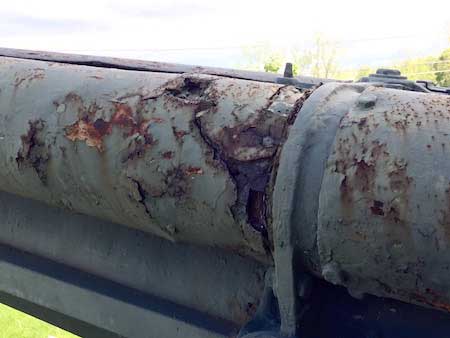
Provided photos: A cannon that was used in World War I about a century ago will be removed from State Street Park in Medina on March 12 and taken for restoration work in Altoona, Pa.
MEDINA – A cannon used in World War I that has been a prominent memorial at State Street Park will get much-needed restoration work beginning next month.
The cannon, manufactured in 1916, was fired during World War I. Every Memorial Day for about 80 years, the Medina community has gathered by the cannon for the solemn ceremony.
The cannon, however, has become badly deteriorated and will be restored for $40,000. George Bidleman of Orleans Ford is raising the funds for the project.
The Orleans Renaissance Group first pushed for saving the cannon about two years ago. The VFW and American Legion both supported the effort.
“She is in dire need of being restored – not just the paint but the whole body,” said David Kusmiersczak, a member of the Legion.
The cannon has become badly deteriorated. It will be refurbished and should last another century.
The cannon will be moved on March 12 and taken to Altoona, Pa. That is the location of Seed Artillery Reproduction and Restoration.
The cannon will be stripped down. The parts will be repaired and re-manufactured if necessary. The gun will be primed and painted with epoxy primer and finished to match the original WWI paint scheme.
Seed Artillery will try to have the project done in time to be back in Medina for Veterans Day in November, said Steve Johnson, American Legion commander in Medina.
The cannon will return to a concrete base and landscape improvements. The Orleans Renaissance Group also is working to add new flagpoles and an interpretive sign at the site.
The cannon is a British Heavy Field Gun known as a B.L. 60 Pounder, manufactured in 1916 by Elswick Ordnance Company, Newcastle upon Tyne, England.
It weighs 6 tons, is a 5 inch/127mm caliber, 21 feet in length and 6 feet in width. The gun was originally issued to battery in France, April 1917 and fired 2,871 rounds during its first tour. It was returned to England in 1917 for repairs and reissued to battery in France, September 1918, firing an additional 1,471 rounds.
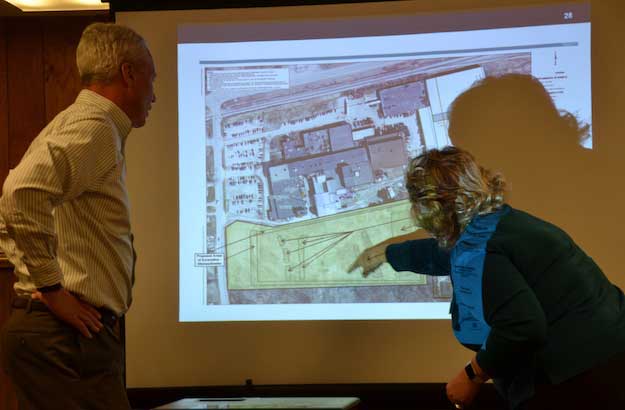
Photos by Tom Rivers: Charlotte Theobald, an environmental engineer with the state Department of Environmental Transportation, goes over a plan for remediating 9.5 vacant acres of the former Abex manufacturing facility in Medina. Theobald discusses the plan with Jim Whipple, chief executive officer of the Orleans Economic Development Agency.
By Tom Rivers, Editor Posted 23 February 2018 at 1:28 pm
MEDINA – The state Department of Environmental Conservation said it was a significant milestone to have an accepted remediation plan for 9.5 acres of vacant land that was contaminated by the manufacturing processes at the former Abex, at the corner of Bates Road and Route 31.
The DEC did soil borings, well water samples and other tests on the land and developed a cleanup plan.
The DEC is proposing excavating and hauling away 5,700 cubic yards of soil to a permitted landfill. The plan calls for bringing in a foot of cover over the 9.5 acres which could be soil, crusher-run or recycled concrete. If pavement is installed or some other impervious cover, less than a foot of cover material may be accepted, the DEC said.
The estimated cleanup is about $5 million. The DEC doesn’t have that budgeted. The agency would be willing to work with developers if private funds paid for the cleanup. There would be tax credits available for a developer for working on a brownfield site, the DEC said.
The DEC also would be open to allowing sections of the site be remediated, rather than the entire 9.5 acres at once, DEC leaders said during an informational meeting on Wednesday evening at the Ridgeway Town Hall.
“I think we could do it in pieces,” Charlotte Theobald, an environmental engineer with the DEC, said during the meeting.
The site is next to the current Brunner, which has done several expansions at the former plant. The 9.5 acres is just east of the plant in a wooded area.
Jim Whipple, chief executive officer of the Orleans Economic Development Agency, thanked the DEC for doing the cleanup study and plan. The project has been in the works for more than a decade.
Whipple said the land is an asset, with potential for a parking lot of perhaps a storage warehouse.
The site’s contamination doesn’t pose a high-priority threat to warrant Superfund dollars, the DEC said. That means the cleanup costs will likely be borne by a developer with perhaps help from a local government.
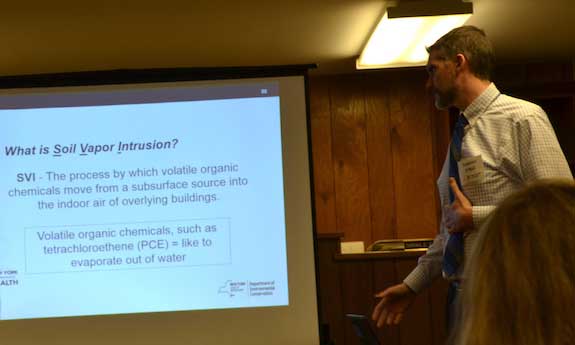
Eamonn O’Neil from the State Department of Health said the cleanup plan meets the standards for protecting public health.
Theobald of the DEC went over the site history during the meeting on Wednesday.
The former Abex foundry was constructed in the early 1950s. Prior to development the parcels were undeveloped woodland and tilled farmland. Lagoons were used to collect wash water from the foundry process as well as storm water discharge.
The former foundry and manufacturing facility used foundry sands for the casting of metal parts. Foundry sands and waste have been identified across the site and within the settling lagoons. Settled foundry sands in the lagoons was reclaimed for reuse at the former foundry facility by staging adjacent to lagoons or were collected for disposal.
Several Phase I and Phase II Environmental Site Assessments were conducted on the site and the adjoining Brunner parcel from 1990 to 2008, the DEC said. The Phase I and Phase II Environmental Site Assessments indicated the disposal of remaining foundry sand inventory on site, accumulation of sediment in two of the lagoons, reclaimed foundry sand was staged near the lagoons, and total petroleum hydrocarbons (TPH) concentrations in foundry sand disposal area exceeded state standards and guidance values.
The DEC is accepting written comments about the proposed remedial action plan for 45 days, from Feb. 2 through March 19. For more information, click here.

























 A Medina man was killed Saturday in a tragic accident in Rochester, when he was walking on the sidewalk and was struck by a drunk driver.