GAINES – The history of the Liberty Pole in the Hamlet of Childs is interesting and unique. The pole is dedicated to the “People of Gaines,” and is located next to Farmers Hall on the Cobblestone Museum’s Route 98 artisan campus.
The Liberty Pole at the Museum is a replica of one that was located at the Mansion House Hotel on the north bank of the Erie Canal in Albion during the 1800s. The hotel, located on this 1852 map of Albion shown above, burned to the ground in 1882. Before that, in 1859, the Mansion House played a role in the Erie Canal bridge collapse tragedy that killed 15 people. The infamous tightrope walker that attracted the ill- fated crowd, strung his slack line across the Erie Canal with one end attached to the Mansion House. Today, the Mansion House site is occupied by Tinsel/Lockstone.
Colonists Erecting a Liberty Pole – Courtesy Library of Congress
The first Liberty Poles, sometimes called Liberty Trees, were erected by the American colonists to display their assertion of independence from England. A famous Liberty Tree was found in Boston and was the site of many rallies to denounce British oppression. In hopes of dispersing the Sons of Liberty from these rallies, the British cut the tree down. The colonists were not to be driven away, so they put up a pole in its place, thus the first Liberty Pole. Later, Liberty Poles were also seen in the 1800s when political parties crafted their own poles to serve as rallying points to deliver their individual platforms.
Cobblestone Director/Curator Bill Lattin received inspiration for the Liberty Pole project from an Orleans Republican newspaper column of reminiscences from 1922 that was written by the paper’s editor, Lafayette H. Beach. Mr. Beach posed the question, “Do you remember the tall Liberty Pole (that) stood on the north side of the canal near the Mansion House, with a perch half way up on which rested a big wooden eagle?”
In 1982, Bill Lattin rallied the local “troops” to create and erect a community Liberty Pole, complete with a carved eagle, to celebrate the Bicentennial Year of the American Bald Eagle. Larry Baun of Lyndonville started with a 4-foot tall 1/10 scale model of the pole (shown above) to provide a visual perspective for the size of the eagle. He then very graciously carved a 3-foot tall eagle from a single piece of cedar, to be mounted on a 40-foot “decommissioned” power pole donated by Niagara Mohawk, the precursor of National Grid.
Milford Heye assisted by creating a similarly impressive round wooden sphere to be attached over the top of the pole. Bill Lattin remembers helping volunteers paint the pole the patriotic colors of red, white and blue. Niagara Mohawk again came to the rescue by erecting the completed Liberty Pole next to Farmers Hall. Leo LaCroix of Brigden Memorials in Waterport engraved a large stone marker donated by Cary Lattin to be placed next to the pole.
On July 4, 1982, a formal dedication for the Liberty Pole took place, with festivities beginning in at the Village Inn where a Continental Breakfast of juice, coffee and Danish pastries were served at 10am. Proceeding to the Cobblestone Church at 11 a.m., the Liberty Pole was officially dedicated to the “People of Gaines,” by NYS Assemblyman R. Stephen Hawley, father of current assemblyman, Stephen M. Hawley.
Mary Ann Janus Spychalski sang patriotic songs, accompanied by Kate Echanez on piano. The Orleans Chapter Daughters of the American Revolution conducted a flag ceremony. Other presenters included Mrs. Gerald (Janice) Thaine, Mrs. E. Kirke (Marcia) Hart, Mr. C. W. Lattin, and Mr. Theodore Swiercznski. Mr. Philip Greaser served as organist, and Bill Robinson and Make Thaine were ushers.
Those assembled in the photo include: (Seated far left) American Legion Color Guard. (Seated Front Row-Left to Right) Ronald Radzinski (R), Town of Gaines Supervisor; James Hubbell (D), Councilman; David Vagg (R), Councilman; Roger Rush (R), Councilman; David Vagg (R), Councilman; Richard Cook, Chairman Cobblestone Museum Buildings & Grounds Committee; Arthur “Dick” Eddy (R), Chairman Orleans County Legislature; Janice Thaine, Cobblestone Society Board; and Marcia Hart, Vice President Cobblestone Society. (On Platform-Left to Right) Charlett D’Andrea, Orleans Chapter DAR; Myrtle Marsielje, Regent DAR; and Marge Radzinski, Chaplain DAR.
Following the patriotic service in the Cobblestone Church, the Sheret American Legion Post Color Guard led a procession to the site of the Liberty Pole next to Farmers Hall. From there, Town of Gaines Supervisor Ronald Radzinski cut the ribbon, officially recognizing the tribute to the people of Gaines. Pictured above at the dedication are: (Left to Right) Richard Cook, chairman of buildings and grounds for the museum; Arthur “Dick” Eddy, Orleans County legislator; Steve Hawley, state assemblyman; James Hubbell, Gaines town councilman; Roger Rush, Gaines town councilman; Ronald “Butch” Radzinski, Gaines town supervisor; and David Vagg, Gaines town councilman. Sheret Post No. 35 Color Guard stands in the background.
The block of stone is inscribed as follows: “To the people of Gaines this Liberty Pole Replica was erected in the ‘Year of the Eagle’ 1982 by the Cobblestone Society.”
In more recent years the Liberty Pole has provided the backdrop for other community gatherings. Seen here is a cadre of youth in 19th century attire depicting a scene for the Cobblestone Museum’s Ghost Walk in 2018. The girls include, from left, Liana Flugel, Autumn Flugel, Ella Trupo, Julia Knight, Madalyn Ashbery and Mallory Ashbery.
Photographs and historical information courtesy of Glad Tidings Baptist Church: This photograph shows the first members of Glad Tidings Baptist Church.
Posted 24 February 2021 at 3:22 pm
Illuminating Orleans, Volume 1, No. 7
By Catherine Cooper, Orleans County Historian
MEDINA – In 1925, Sister Mary Johnson, a member of the Baptist Church of Rochester, felt called to assist the Black people of Medina who had been searching for a spiritual haven. With the assistance of Elder Caldwell and Rev. Henry Young of East Rochester, Sunday services were held at 811 Genesee Street, Medina, the home of Sister Johnson. At first, attendance ranged from five to 12 people.
They were given the use of a 12- by 18-foot building at 404 West Oak Orchard Street, which had been purchased for $20. The first service was held in this building on December 15, 1926. There were nine members: Sister Mary Johnson, Brother Thomas and Sister Martha Chambers, Brother John Royal, Brother Arthur and Sister Lydia Johnson, Sister Grace Schyler and Sister Alice Jones. The first offering was 10 cents a week, with special offerings on Sundays and holidays. Church history records that the location was “tried by fire and water”, once flooded and once almost destroyed by fire.
In 1929, the community purchased the lot at 404 West Oak Orchard Street from Charles Gilbert for $500. The cornerstone for the new wood frame building was laid in the winter of 1930 and it was erected by Brother Robert Johnson and Deaconess Sister Mary Johnson with the help of others who donated their time and labor.
Deaconess Mary Johnson gave her first lesson in the new Glad Tidings Baptist Church building on Dec. 11, 1931.
The name “Glad Tidings Missionary Baptist Church” was formally adopted in May 1937. Membership increased from 65 members in 1952 to 125 in 1956. A basement was completed in 1954 and an addition to accommodate the growing congregation was completed in 1957. A flood in 1968 destroyed church records and the basement kitchen. The church was also incorporated in this year.
By 1973, the condition of the 1930s building had deteriorated and a decision was made to replace it with a new Barden pre-structured building at an estimated cost of $50,000.
This ambitious project was completed under the leadership of Pastor Oscar Amos, and the new church, with the distinctive cross in front, was dedicated May 23, 1973.
The Mission has been served by many dedicated pastors including Rev. Willis Eavens who served from 1932 to 1954.
Dr. Rev. Lambert Duncan is the current and longest serving Pastor of the church, having served for 35 years. He has been New York Chaplain for six years. Originally from New York City, he lives in Rochester and is retired from Kodak. He holds three Doctorates from the Carolina University of Theology. His wife, Sister Elaine, holds a Doctorate in Christian Counseling and is also active in the church. Pastor Duncan’s focus is on outreach to the entire community.
Elder Neil Samborski and his wife, Kathy, have been associated with Glad Tidings for ten years. This Lyndonville couple are actively involved with the food ministry, distributing food from the Open Door Ministry in Rochester. Elder Samborski is also actively involved with the Medina Area Association of Churches.
In keeping with the church’s missionary goal, the Samborskis have undertaken several missionary trips to Malawi in South Africa, through the African Mission for Christ Worldwide. Elder Samborski is also a bishop of the newly founded church at Ntaja, Malawi.
Current officers of the church are: Elders: Elder Nathan Little and Elder Neil Samborski, Mothers of the Church: Sister Mattie Jackson and Sister Glennis Chinn, Deacons of Ministry: Deacon Gregg Boose and Deacon Jack Byrd. The Deaconesses of Ministry are: Mother Mattie Jackson, Sister Kathy Samborski and Sister Easter Boose. Sister Elaine Boose is President of Usher Ministry.
The church takes as its motto the words of Matthew 28: 19-20, urging members to spread the Christian message. Glad Tidings Missionary Baptist Church has been the “Mother Church” for the establishment of several other churches locally. The legacy of Sister Mary Johnson and the original founding members flourishes.
The Glad Tidings congregation has gathered in prayer at this 404 West Oak Orchard St., Medina, location for 95 years.
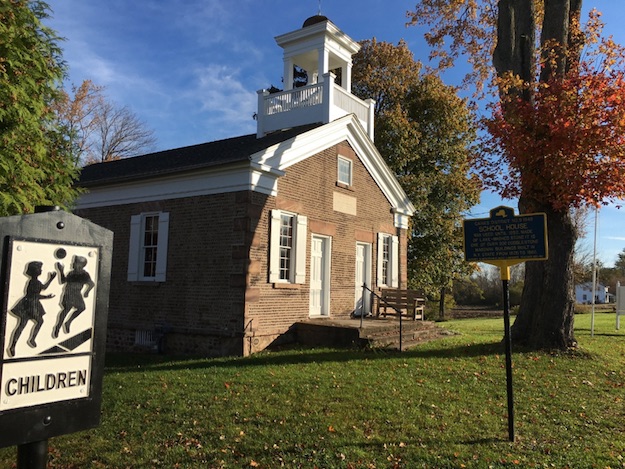
Note from Doug Farley, Cobblestone Museum Director: We are pleased to present this autobiographical essay written by Nancy Jane Wilson Berger (1935-2015). Nancy spent her childhood living in a cobblestone house near and attending the Cobblestone District #5 Schoolhouse in the Hamlet of Childs. We are very grateful to Nancy’s husband, Frank Berger, for sharing this wonderful retelling of Nancy’s childhood memories.
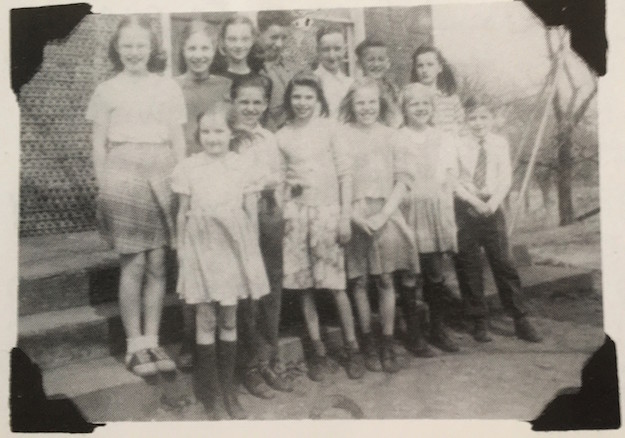
School District #5 in 1946 – Phoebe Beales, Teacher. (Front Row, from left) Nancy Covis, William Covis, Evelyn Becker, Edna Becker, Kathleen Covis and Alan Kidder. (Back Row, from left) Sandra Kidder, Marjorie Becker, Nancy Wilson, Walter Klatt, Edward Janus, Daniel Janus and Laura Klatt.
By Nancy Jane Wilson Berger
I wondered why my mother had tears in her eyes when I left for school for the first time. It was a typical fall day and one that I had been looking forward to for some time. I had reached the ripe old age of six and thought I was pretty well grown up to be able to go to school with the rest of my friends.
It was Gaines District #5, a country school located on Route 104 commonly called the Ridge Road. A one-room country school with grades 1 through 7, one teacher with a visiting music teacher, a religious education teacher, and even a very old retired physician who came once a year to give us a physical exam.
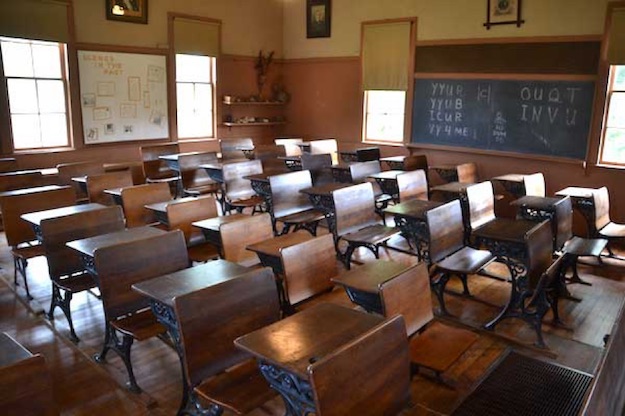
It was a typical one-room schoolhouse with rows of desks running parallel with each other. They grew in size as the children grew – thus the small ones were to the left and they got progressively larger as the rows went to the right. We could hardly wait until we were big enough to sit in the “special” desks. These were separate units with swivel seats and the tops opened up so that you could see what was inside. A student had to earn the right to claim one of these seats as their own.
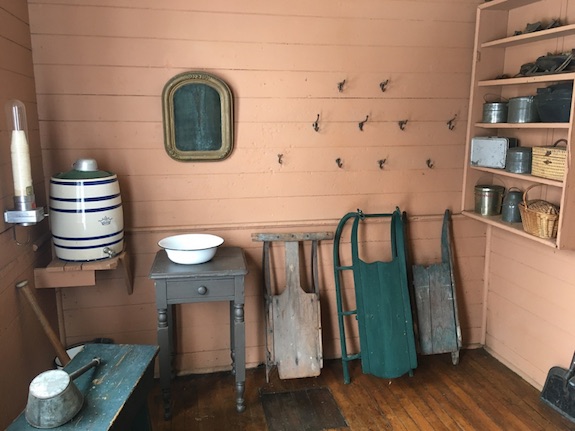
The front door opened into the entry. There was a “U” shaped coat rack supplied with plenty of hangers. To the left of that was a series of shelves which held lunchboxes, etc. On the front wall, next to the door was a shelf with a sink and a clay water-cooler. Perpendicular to that was a bench which helped in the removal of boots and which provided storage space underneath for these. To the right was the door to the basement which housed a mammoth old coal furnace, a huge coal bin and a multitude of other things that we were never brave enough to explore.
The furnace, however, was something of a monster which seemed to have a life of its own. Many a morning throughout the seven years that I attended this house of learning, we were met at the door by our teacher who told us to return home because the coal gas was so strong we surely would have been overcome. No one knew exactly why this happened, but I think that occasionally this mysterious hulk decided that it needed a day of quiet and no children’s footsteps overhead to give it a headache so it spewed forth this nauseous gas like an octopus spitting out its “ink” to scare away predators. At any rate, the opening of windows and some sort of magic performed by the teacher would usually bring this problem to its knees and we would be back to normal by noon.
Occasionally, instead of nauseous gas it decided to try smoke. Sometimes it would be so thick you couldn’t see more than three feet away. Another vacation! However, it did have its good points. Besides keeping us warm and cozy it provided an oven for baking potatoes. Teacher would place whole potatoes just inside the furnace door on a little shelf and by noon we had yummy baked potatoes for lunch. I don’t think baked potatoes have ever tasted that good since.
So, you see, we didn’t have snow-days like they do today. We had smoke and gas days! We did have a snow day sometimes, but they were few and far between. Because we provided our own transportation which was usually by foot, if we could plow through the snow we went to school. If we couldn’t, we stayed home.
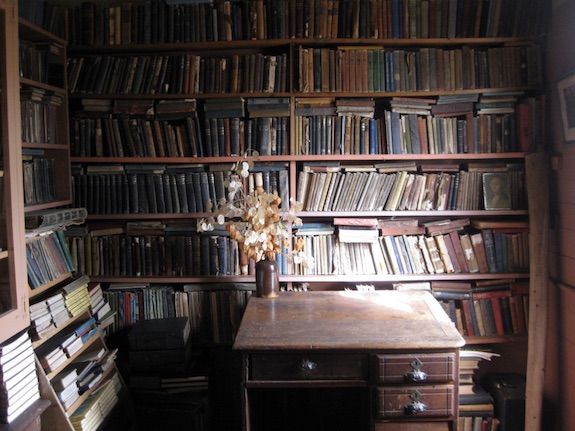
At the opposite end of the front of the school was the library, which also served as a whipping room. Yes, back in those days we got a good spanking if we didn’t behave. I was lucky enough to never get one. (I was such a good little girl.) However, I did get reprimanded more than once for talking or laughing. I was usually lucky enough to blame it on my friend Ed Janus who, more than once was taken to the whipping room and got his seat tanned!
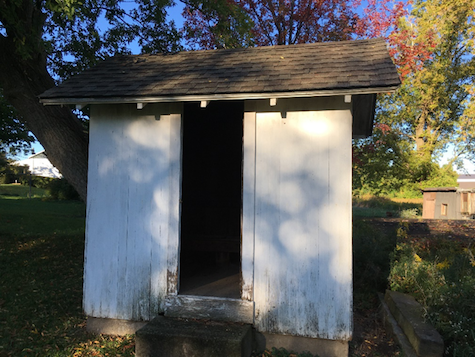
The “bathrooms” were small buildings – one for the girls and one for the boys – behind the school with privacy fences a few feet from the doors. If we needed to go visit the privy (as it was called) we had to raise our hand and when we were given permission to go, we had to put our initials on a small blackboard at the front of the room because only one person could go at a time. I have some stories about the “privies” also.
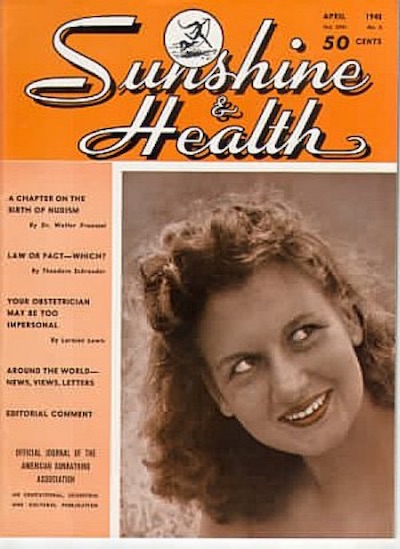
We had a boy in school whose name was Walter. Walter took it upon himself to teach the boys about the anatomy of the opposite sex. It seems that he had found some magazines called “Sunshine and Health” which was published by the nudists. In it were many pictures (uncensored) of nudists playing volley ball, tennis, and just lounging in the sun. So one day Walter decided to hang some of these pictures on the wall of the boys’ privy providing his own little art show of sorts. There seemed to be a steady stream of boys using the privy that day!
Also attending school was a small boy named Vernon. Now Vernon had a habit of stuttering when he got excited. This particular day Vernon hadn’t heard about the “d’art exhibit” in the boys’ privy and hadn’t had the call to visit it until afternoon. Vernon raised his hand and was given permission to go. He signed his initials and left. In less time than it takes to shake a stick twice, Vernon came running back into the room yelling “T-t-t-teacher! Th-th-th-there’s p-p-p-pictures of b-b-b-bare naked w-w-w-women in the p-p-p-privy!”
Our teacher, Miss McAllister, didn’t have much of a sense of humor. After she calmed Vernon down, she picked up her switch and holding it in her right hand and smacking it lightly against the palm of her left hand, she paced back and forth in silence in front of the students studying the faces of the boys. Sure enough – Walter was looking guilty as sin. She asked him if he knew anything about these pictures. He admitted he did and was taken for a short walk to the whipping room. He and the teacher returned to the classroom, one smiling, one not. Guess which was which!
Now I had another use for the privy. I was a rather timid little girl and when anything was about to transpire that I wasn’t sure about, I would ask permission to go to the privy, sign out and head for home. One such instance was the first time that good old Dr. Burbank came to examine us. He was a round roly-poly elderly man with little round glasses that didn’t quite make it to the correct spot on his nose that would make it easier to see, so he had to tip his head up to see through them or down to see over them. He had very little hair and what he had was white. He was hard of hearing and despite his glasses could not see very well either. He spoke in mumbles with a lot of “hammphs.”
Well, I had never seen a man like him before and I didn’t have a clue what a physical examination was, but I decided not to take any chances. I got permission to go to the privy, signed out and hightailed it for home and as fast as my long skinny legs could go. I arrived home yelling – my mother probably thought I had been beaten! When I explained that I didn’t want a physical ‘zamination, she laughed and assured me that I would live through it and promptly escorted me back to school. The teacher wondered why she was there because this all transpired in no longer a time than it would have taken me in the privy. Dr. Burbank thought the whole affair was quite humorous and Mom stayed while I was being ‘zamined!
Dr. Burbank was a very frugal physician. He did not want to waste tongue depressors, so decided it would not do any harm to use the same one on each child. Miss McAllister, on the other hand, did not agree with him. After a short dissertation between the two of them, they arrived at a solution. The tongue depressors were sawed in half thus satisfying both.
Each student took his\her turn going into the library stripping to the waist and donning a white gown of sorts that tied in the front. Good old Doc Burbank sat in a chair facing the class, therefore, the student being examined would have his/her back to the class – a rather clever arrangement wouldn’t you say?
Well, in our little school room was a girl by the name of Lorraine. Now that I think about her, I’m not quite sure if she was developing early or if she had missed a few grades and was older than most students. Oh well, it really doesn’t matter. Anyway, when Lorraine made her appearance before Doc, he looked at her and said, “Didn’t I examine you?” as he opened the front of her gown – and without a hesitation said “Oh no, I didn’t!” We all wondered why the teacher turned and snickered.
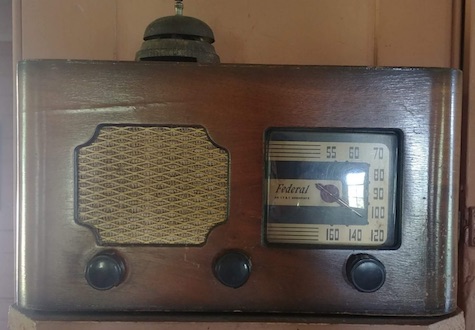
The year I started school was 1941. There was much unrest in the world and there was talk of war. We were too young to really understand what that was all about, but we gathered it was something we didn’t want to happen to our country. When the Japanese bombed Pearl Harbor, I remember having the radio on in school the following day. The teacher turned it too low for us to hear, but she listened to it all day. At one point, she turned to the class with tears in her eyes and said we were at war. No one talked to us very much about it, but we knew it was bad news.
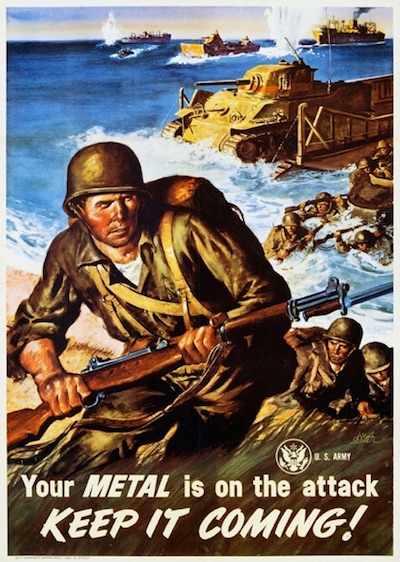
In the weeks and months that followed, we started collecting all kinds of metals and made a huge scrap pile in the school yard. I can’t remember for sure, but I recall that ours was the biggest one around. I also remember running out of the school every time we heard a plane, because this was something quite new to us. I also recall collecting milkweed pods for parachutes. If I remember correctly, we were paid so much a bag for them. I can’t remember what we used the money for, but because there was an ice-cream shop next to the school, I have a feeling we were all treated to ice-cream cones.
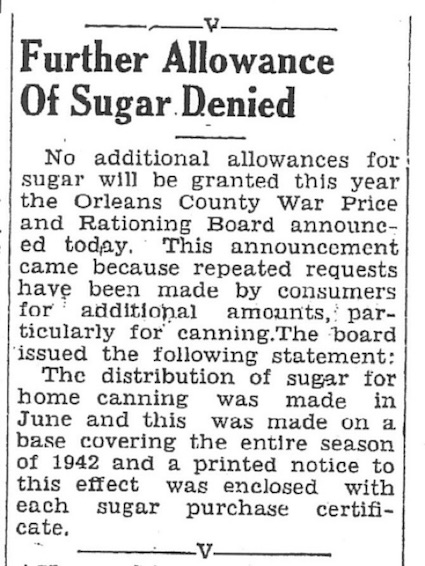
During the war years, I also remember “rationing”. There was a shortage of sugar, meat, flour, gasoline and other things. We had to have a ration book to be able to buy these items. Because of these shortages, it caused there to be shortages of everything that depended on these commodities for their production. No automobiles were manufactured, because all the factories were making planes, bombs, etc. for the war.
We had “blackouts” – this was in case the enemy decided to attack the United States they would not be able to see us at night. We would have to turn out all our lights and leave them out until the whistle blew telling us it was OK to turn them back on. My dad was an air-raid warden. When the whistle blew telling us of the warning my dad and several other volunteers would walk around the neighborhood and make sure no lights were on. As a child of seven, I rather liked the excitement of it and it was sort of an occasion.
The worst part of this whole time was when my Uncle Art was drafted. I recall very vividly the day he left for camp. Everyone was crying and hugging. He was in the Air Force and stationed in California. I wrote letters to him every week, and once he sent me a box of sea shells that he had picked up from a beach in California. These were real treasures. After he left, I was afraid that my dad would have to go to war. I prayed every night that he wouldn’t have to go and luckily he was just over the age limit for being drafted, so he never had to go. We were all very grateful.
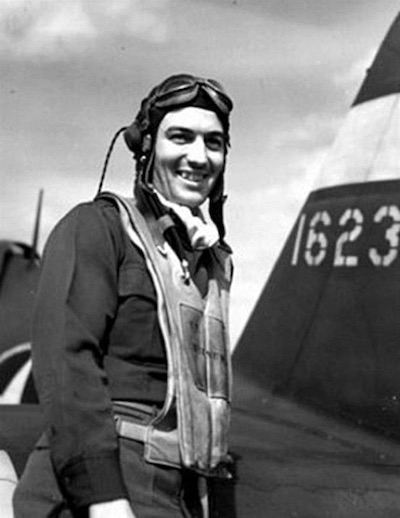
Captain Eugene Everett Barnum, Jr. (1917-1944)
One of my worst memories of this time, was when the word came that Bill Barnum was killed in action. They were neighbors of ours and it hit everyone very hard when this news came. Then, a few weeks later, the news came that his brother Eugene had also been killed in action. We didn’t know how one family could bear the hurt of losing both of their sons. They were both pilots and whenever we heard the song that was popular then, “Coming in on a Wing and a Prayer,” we always thought of them.
Besides recipes, cookbooks provide a local history resource
By Catherine Cooper, Orleans County Historian – Volume 1, Number 5
The spiral-bound cookbooks published as fundraisers for churches and community groups are a familiar sight in our kitchens. A collection of local cookbooks was just recently donated to the Orleans County Dept. of History. With their brightly illustrated covers and domestic content, they contrast with the largely black and white documents that comprise the majority of the Department’s collection.
At first glance, they might seem an unlikely resource, but in fact, these locally specific cookbooks are treasure troves of local history. They are of interest now and their value to social historians will only increase as time goes by.
The cookbooks in this donation represent Albion, Barre, Clarendon, Gaines, Knowlesville, Lyndonville, Medina, Shelby and Waterport. Most were published in the ’70s and ’80s, though the most recent is from 2010.
Many cookbook projects were church sponsored, but there are also cookbooks from schools, hospitals, a prison, the Lake Plains YMCA and groups such as the Senior Citizens of Western Orleans and the Orleans County Historical Association. Morris Press was the primary publisher. Cookbook projects were undertaken to mark anniversaries or for specific fundraising projects.
In some cases, the cookbooks are a testament to churches or groups that now no longer exist. The now-defunct list from this donated collection includes: The Journal-Register, Medina Association of Women, Sacred Heart Church, and Arnold Gregory Memorial Hospital. Also, the local advertisements provide a record of business and services. Some still continue, many are no longer, reflecting business and economic trends.
These advertisements are a treasure trove for local historians.
Advertisement page from “What’s Cooking”: Twig Association, Arnold Gregory Memorial Hospital, Albion, NY, 1975
Community cookbooks were almost always compiled by women. For many contributors, this may have been the first time their name was in print. This was a source of pride, an affirmation of identity, of belonging to a recognized group.
Part of the pleasure – and historical value – of looking through the cookbooks is that of seeing familiar names among the contributors, family members or neighbors, many now departed. When viewing the cookbooks with a friend, the conversation invariably turns reminiscent, as stories and connections are recalled. In years to come, these cookbooks will be treasured as heirlooms by contributors’ descendants.
Advertisements from Knowlesville United Methodist Church cookbook, 1983
The saying “An army marches on its stomach” has been attributed to Napoleon Bonaparte. Women well know that families also march on their stomachs. History is as much about families as it is about armies.
The humble spiral-bound community cookbook is a succinct tactical manual to fall back on when faced with that dreaded question “What’s for supper?” Internet recipe searches can be overwhelming. The new cookbooks on the market now are either very specialized in terms of ingredients or techniques, or feature celebrities discovering the joy of cooking. Sometimes you just want a quick recipe for banana bread. The stained or dog-eared page of the trusty spiral-bound cookbook will lead the way.
The recipes are short, practical, straightforward, and thrifty. There are no “diet”, “lite” or ingredient intolerant options. If a recipe calls for milk, it is implied that the source will be a cow, not an almond. Some of the recipe titles are intriguing: The $100 Cake, Easy-Peasy Pudding, Glenda’s Pie, Elephant Stew, Crab Louis, Lovelight Icing. All of the recipes are “keepers”, having been tested and honed over time by those most merciless of critics: family members.
Some of the recipes have not aged well. We might look askance at the Fruit Salad recipe which was a fairly common submission:
1 can mandarin oranges, 6 cups miniature marshmallows,
1 can crushed pineapple, 1 cup sour cream, 1 cup coconut.
Drain cans, mix ingredients well, chill
No doubt, this recipe will remind many of their grandmothers. We should keep in mind that this recipe evolved at a time when grocery stores were not stocked all year long with the luxury of out of season fruit that we are accustomed to.
The cookbooks reflect the culinary traditions and food practices of a certain time, when households were transitioning from stay-at-home mothers to moms who worked outside the home. Family dinners were still the norm, so cooking practices adapted to simpler recipes. Convenience ingredients such as cans of mushroom soup or cans of cream of chicken soup were widely used.
We can observe major changes in food preferences and health considerations in the short time since these cookbooks flourished. Jell-O and Velveeta cheese are no longer in fashion. We have the luxury of access to a wide range of fresh food, varied sources of protein and ethnic foods. Our cooking technology has changed – rice cookers, air-fryers, Insta-Pots. Pizza and take-out proliferate and there are more options for those who have food intolerances. We take these trends for granted, but they are all part of ever changing culinary history
Cooks love to share recipes. This collection attests to the generosity of spirit of our Orleans County cooks.
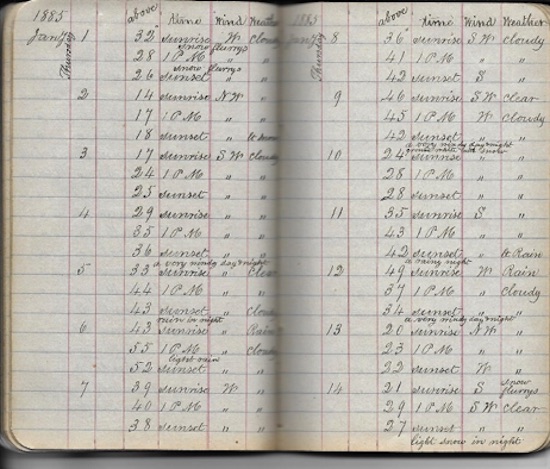
Courtesy of Department of History: This diary offered a daily record of weather in Medina in 1883.
Illuminating Orleans, V1, No. 4 By Catherine Cooper, Orleans County Historian
At the beginning of a new year, it is not unusual for people to resolve to keep diaries or lists. Our subject this week is an example of such, from the collection at the Medina Historical Society Museum. It is a sturdy tan note-book, with a plain cover. The first page contains the following inscription which describes its purpose:
“A Weather Record kept at Medina, Orleans County, NY, from Jan. 1st 1883 to “
The columns of the pages of this ledger type note-book were labeled to indicate the Year, Date Temperature, Time, Wind and Weather. The temperature for each day was neatly recorded at three times every day: Sunrise, 1 p.m. and Sunset.
The prevailing wind direction was noted, as well as the general weather condition, whether Cloudy, Clear, Rain, Snow, Sleet, or Fog. There are occasional notations in tiny handwriting: “a very windy day and night” or “3 or 4 inches of snow in night”
The destructive windstorm of 1885 is noted: “1885, Jan. 26, A terrible windy night, 50 chimneys reported blown down in the village”
There are notations about fires:
“1883, Feb. 10, about 5 am, fire broke out in the pail factory of Johnson & Wigley on East Center St., the fire went into the adjoining building known as the Union Mills, owned and occupied by S. C. Hoag, both buildings nearly all burnt up, with contents.”
“1883, Nov. 1, Fire alarm at 9:45 pm, fire discovered in Mrs. Alford’s barn, in the alley between Park Ave. and Center St., burnt down, with J.C. Davis barn adjoining & Pat Horan & A.M. Barry barns on the north side. The next adjoining shed was Newell’s, which to stop the fire he ordered pulled down & the fire was stopped, thus preventing a spread of the fire, as a strong SW wind was blowing, a terrible fire would have been the result”
These descriptions highlight the destruction that could ensue from a single fire, at a time when many buildings and most barns were of wooden construction.
And how do the summer temperatures compare with ours?
In 2020, we had one 93-degree day in May, one 90-degree day in June, and in July eight consecutive days of 90 degrees or higher, as well as the hottest day in 63 years at 98 degrees.
In the summer of 1883, there was one 90-degree day, 15 days with a temperature between 80 and 84, and 3 days with a temperature between 85 and 89.
In the summer of 1885, there was no 90-degree or higher day, 21 days with a temperature between 80 and 84 and 2 days with a temperature between 85 and 89.
We are so accustomed to having detailed weather information right at hand, on our phones. Local newspapers in the 1880’s were weekly and did not include weather forecasts. But, by 1882, Pool’s Signal Service Barometer, “the Best in the World” was advertised regularly. It could be ordered “on receipt of $1, or 6 for $4” from J.A. Pool’s Oswego Thermometer Works, Oswego, NY.
The weather records in this notebook run from Jan. 1883 to August 21, 1886, the last full entry on the next to last page. We can deduce that this record keeper was methodical and precise. But what of the person’s identity?
The answer is provided at the end of the very last page of this notebook. The notation reads:
“Levan W. Merritt died at 1:15 a.m., August 23, 1886. Funeral services at 3 p.m. Aug. 26th, 1886. Burial about 4:30 p.m. under a perfectly cloudless sky.”
Born in Connecticut in 1806, Mr. Merritt came to Medina in 1833. He operated a flouring mill. In 1841, when he built his sturdy red brick home at 406 West Ave., the location was considered to be “out in the country”. He helped design the layout of Boxwood Cemetery, was a founding member of the first fire company and is credited with planting the first shade trees on the Village streets. He would, no doubt, have appreciated that “perfectly cloudless sky”.
The holiday season invariably evokes memories of times past and the terrifyingly magical experience of a visit with Santa Claus is one that remains vivid.
The top image is an evocative photograph showing children at G.C. Murphy’s store on Main Street, Medina. The photo is courtesy of Medina Historical Society.
A Medinian recalls: “I remember walking to the back of Murphy’s store, Santa was seated on a throne.”
Several people recall a Santa situated at the back left corner of Newberry’s store in Albion, he gave out candy canes and coloring books. This photo is from the Orleans County Department of History file.
Photo from the Orleans County Department of History
But, the most famous Santa of all, of course, was right in Albion. Visiting Christmas Park during the year was a thrill, as was the opportunity to feed the reindeer or ride on the Christmas train.
An Albion lady recalls the ultimate Santa experience:
“I sat on Charles Howard’s lap at Christmas Park. Near his seat was a ‘fishing pond,’ where, for probably 25 cents, you’d put a pole with some sort of clothes pin on the line over the barrier – you’d feel a tug, and reel in some little toys that are probably collectibles today. I remember getting a bag with 2 comic books in it.”
Ridge Road Station image courtesy of Medina Historical Society
More recently, a generation of children (and their accompanying adults) experienced the wonder of Christmas at Ridge Road Station in Holley. This 30,000 square-foot emporium was in operation from 1992-2011. It was the largest independent toy and Christmas store in New York State.
The inventory and displays were absolutely breathtaking. Garlands and stars, ornaments of every description, a mesmerizing train layout, a wealth of imaginative toys and collectibles.
But, commerce is inextricably intertwined with Christmas. G.C. Murphy’s, Newberry’s, Christmas Park and Ridge Road Station no longer exist in the physical dimension, but they live on vividly in the memories of those who experienced them.
By Doug Farley, Cobblestone Museum Director; and Bill Lattin, former Director
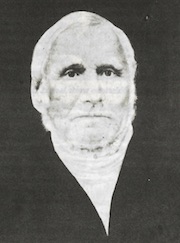
John Proctor
GAINES – The presence of water was an important consideration for pioneers to this region when they were looking to purchase property. Plentiful fresh water was important for livestock, crop irrigation and much more.
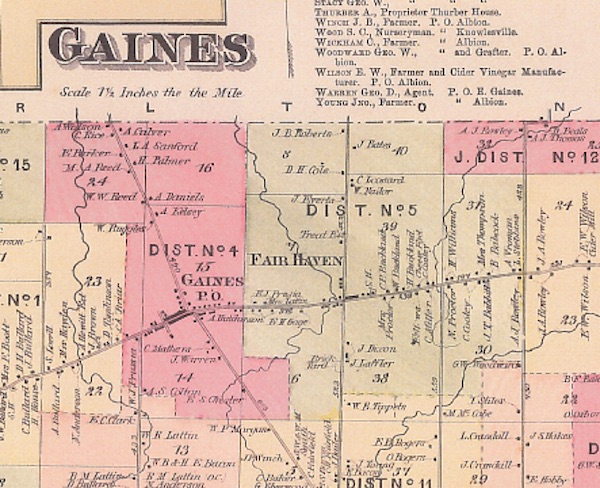
John Proctor would have pondered the same considerations when he acquired his land from the Holland Land Company in the early 1800s. The meandering brook that now bears his name probably played heavily in his decision to locate his prototype community of Fair Haven (now Childs) at the intersection of the Ridge Road and Oak Orchard Road.
When and how Proctor Brook got its name is not recorded, but most likely honors the community’s founding father.
Time marches on, and over time, little attention was paid to Proctor Brook, so little, that folks had pretty much forgotten its name. Town of Carlton Historian Lysbeth “Betsy” Hoffman recalls “re-discovering” the name in the 1980s when she was reviewing 1820s Town Board Minutes.
In those documents, she saw frequent references to the name Proctor Brook, which grabbed her attention and got her thinking about the probable location of this mystery waterway. Betsy contacted Mike Slack from the abstract office at the County Clerk’s Office, and he verified that Proctor Brook was indeed the historic name assigned to the little tributary that crosses the Ridge Road at Childs while winding through the towns of Gaines and Carlton.
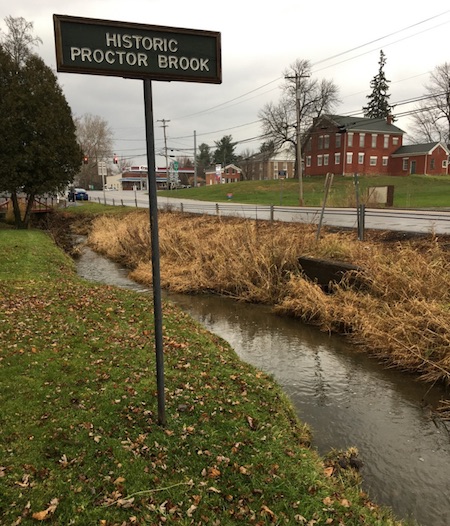
In an effort to make sure the community didn’t forget the name of Proctor Brook again, and to commemorate John Proctor for posterity, a fitting sign was built by Cobblestone Museum volunteer George Callard and erected near the brook on the grounds of the Museum’s Route 98 campus.
Assisting in this effort was Town of Gaines Historian Dee Robinson, Town of Carlton Historian Betsy Hoffman, and Orleans County Historian Bill Lattin. A dedication ceremony for the sign took place on September 11, 1988.
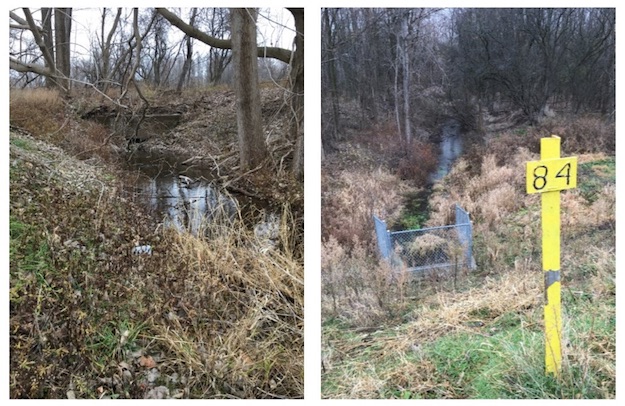
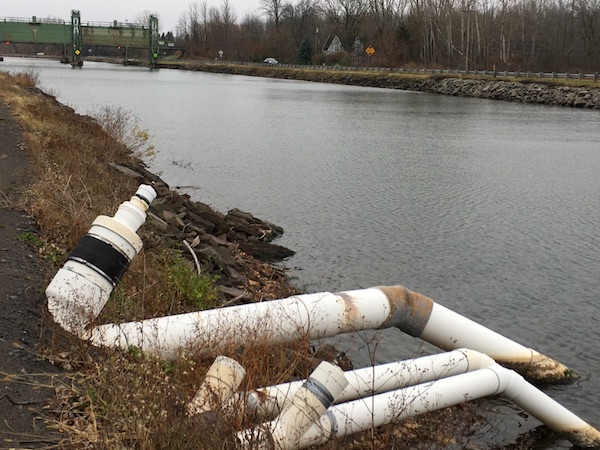
Proctor Brook has its geographic beginning in a marshy area around the present day Sheret American Legion Post on Gaines Basin Road. From there it travels north and approaches the Erie Canal as shown above left. Then it goes under the canal through a sleuth located west of the canal guard gate and exits on the north side of the canal bank as seen above right. It then meanders mainly northward, but sometimes east and west, too.
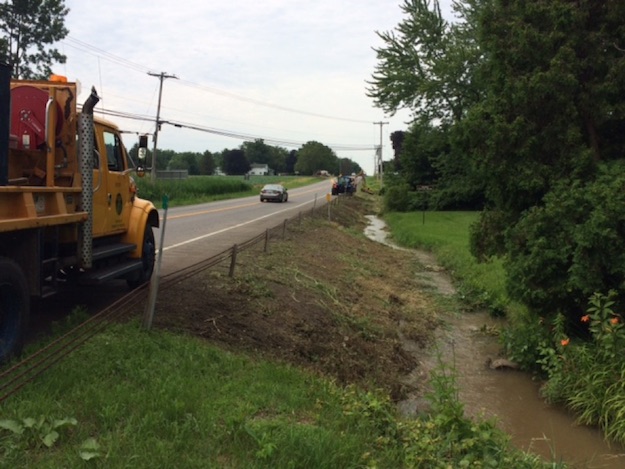
Proctor Brook enters the Hamlet of Childs alongside Route 98 near the Cobblestone Museum’s artisan buildings as seen here with the NYS DOT crew cleaning up the bank. The brook then travels through the Museum campus and crosses Route 104 just west of the Village Inn. From there it continues through the Town of Gaines until reaching Carlton where it joins forces with Marsh Creek and heads on to Lake Ontario.
At some point in the mid- 20th century, Proctor Brook received a boost with a new supply of water diverted through an Erie Canal syphon. As seen here, the syphon is located west of the canal guard gate.
Farmers can petition NYS to receive a permit to use that water supply for their crops or other needs. Excess water from the syphon drains into Proctor Brook. Jim Kirby utilized the syphon for his farming for many years. Former Orleans County Historian Bill Lattin recalls one year in the late 1900s when Kirby said the syphon stopped working. He investigated the situation and discovered a large turtle had been sucked into the vortex and got stuck, effectively closing off the water supply. Kirby said, “Getting that thing out of there was a nasty job.”
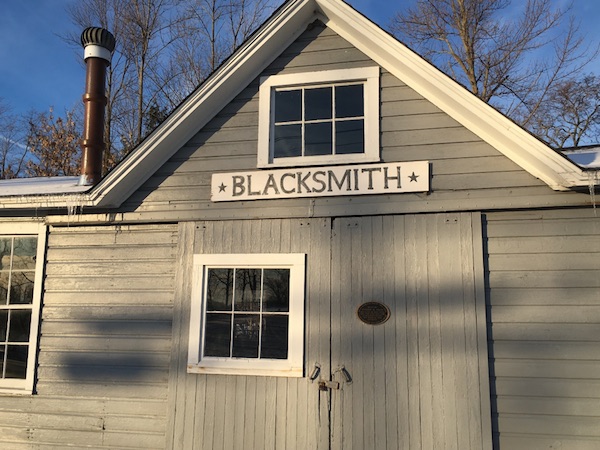
Proctor Brook has had some man-made adjustments made to its course, too. In 1921 the original Blacksmith Shop at the corner of Routes 104 and 98 caught fire and burned to the ground. Local farmers knew the absence of a local blacksmith shop would negatively impact their livelihood. Bill Lattin described their desperation, “The farmers, while the embers were still hot from the fire, pitched in to help blacksmith Joseph Vagg rebuild his shop.”
But, this time they decided to site the blacksmith shop a little further south to help protect Joe’s home from catching fire, too. To do so, they needed to relocate Proctor Brook which would have gone right through the new shop. So, the farmers and Vagg set about moving Proctor Brook about 20-25 feet south to make way for the new structure. They did that by dropping boulders into the creek bed that effectively moved the brook, making a sharp turn to the west, and then follow its current course to the south of the shop.
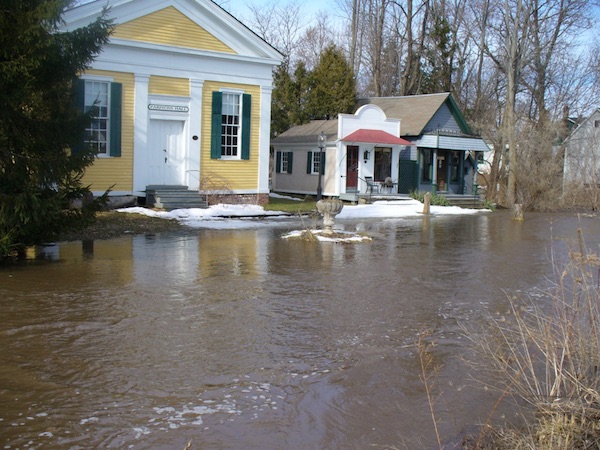
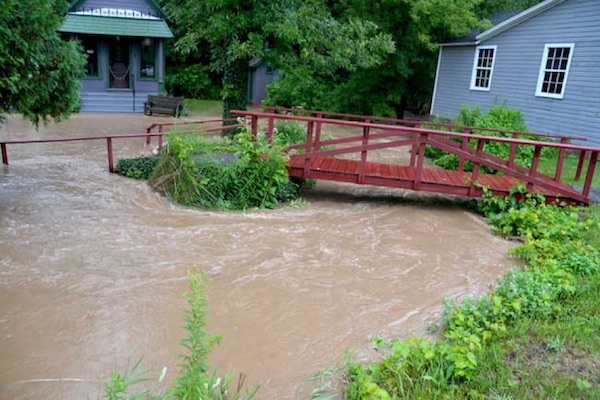
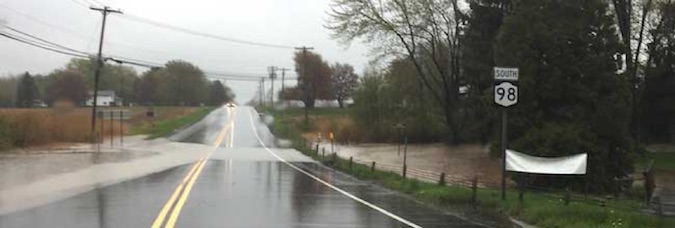
Proctor Brook, usually a very gentle little stream, is known to have an annual freshet or spring flood, usually in May or June. Some have been pretty severe. Melva Vagg Warner, Joe Vagg’s daughter, recalled that during one particularly severe flood, she kept track of Proctor Brook’s high water point by placing a mark on the side of her barn that sits next to the brook.
That marking came in handy in 1977 when the Cobblestone Museum was relocating its Print Shop to the grounds on the banks of Proctor Brook, and pondered how high to elevate the shop to avoid potential flooding. Bill Lattin said that Town of Gaines Highway Superintendent Cliff Kelley used a transit and Melva Warner’s water mark to determine a presumably safe position.
That theory was tested in the 1980s when the spring thaw resulted in flooding that came to within one inch from overflowing the floor of the Print Shop.
At that point, the water rose to over 1 foot above Route 98. It was during that flood that the Cobblestone Museum’s historic wooden cattle trough, usually located in front of Farmers Hall, floated downstream and ended up at the cobblestone house on Route 104.
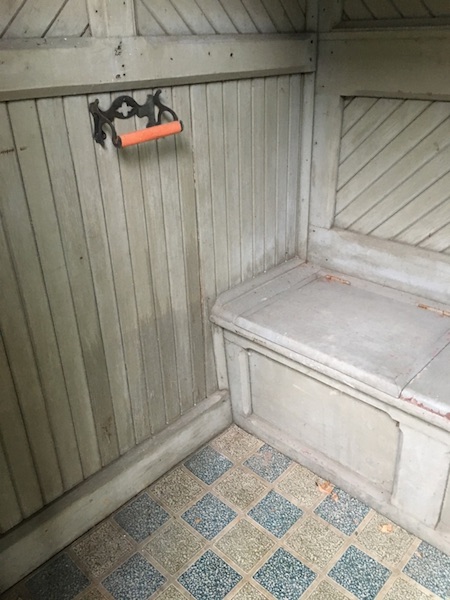
The high water mark for that flood is still visible inside the Eastlake outhouse located next to the Print Shop. The water line is just above the row of seats.
By Doug Farley, Director Cobblestone Museum; and Bill Lattin, Retired Director
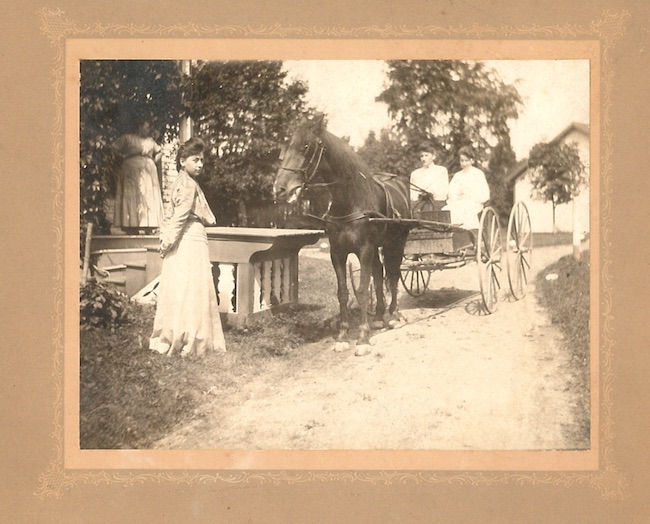
CHILDS – The impetus for this article surrounds this historic photo circa 1905 which Bill Lattin recently purchased at an antique shop. Notice here the set of steps used for mounting and dismounting a horse, wagon or buggy.
On the back of the photo is written Miss A. D. Reidel. The name of the presumed photographer, August Christe, is also stamped on the back with a rubber stamp. Retired Cobblestone Resource Center Director Dee Robinson researched these two names and found them in the 1900 U.S. Federal Census.
Annie Reidel was 14 years of age and living on Bessell Avenue in Buffalo. Albert Augustus Christie was age 33 and lived on Fifth Street, also in Buffalo. Through this little bit of detective work, we can guess this picture may have been taken in Erie County.
Notice again in this picture of the steps how the platform overhangs the base. This was done intentionally so the hub of the wheels on the democrat wagon, shown in the picture, could roll under the platform. This arrangement reduced the gap between the wagon box and the mounting steps. There had to be innumerable wooden mounting steps and platforms in use in the area in horse and buggy days.
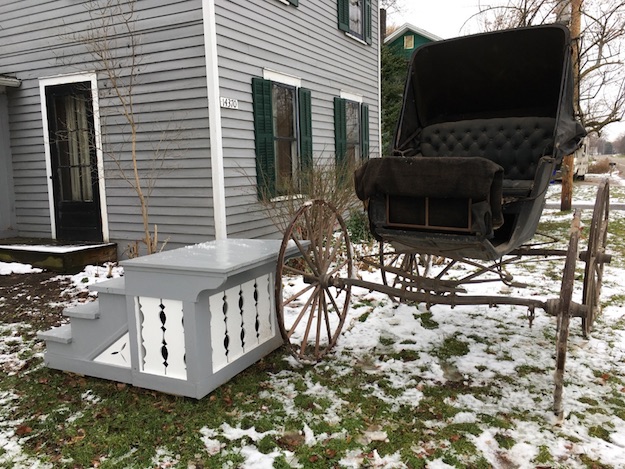
Using the historic photo as a guide, Bill Lattin recently built a replica set of mounting step, seen here in this modern photo, now located in front of the Vagg House in Childs.
The buggy in the photo was donated to the Cobblestone Museum by Bill, Tom and Mark Tillman in the 1980s when they renovated their old barn to become what is now the Carriage Room at the Village Inn Restaurant. The buggy is one of several historic vehicles that are planned for a new exhibit in the Vagg Carriage Barn located behind the Vagg House. Tours of the house and barn will begin in 2021.
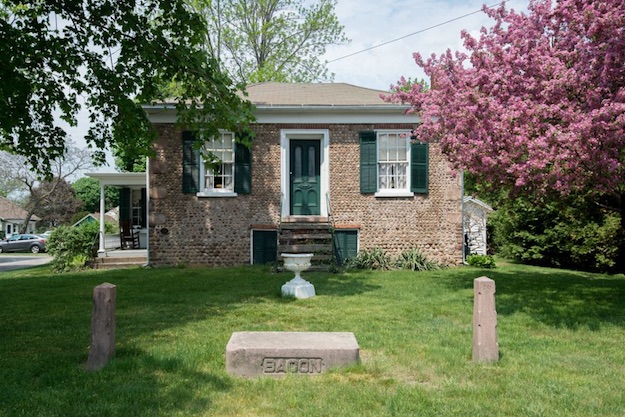
Also typical of the era, are the horse block or carriage stone seen here in front of the Ward House at the Cobblestone Museum. The large stone blocks had the advantage of not being easily moved and did not rot.
This piece of beautiful Medina Sandstone has the local family name “Bacon” carved into it. Bill Lattin recalls this horse block was given to the Museum around 1970 by Earl Harding. It was once located in front of the brick house at Five Corners. The Bacon horse block was moved to the Ward House about 1977 along with two fine Medina Sandstone hitching posts donated by former Orleans County Historian Cary Lattin. Each hitching post has the number 74 on it. Lattin said these came from 74 West State Street in Albion.
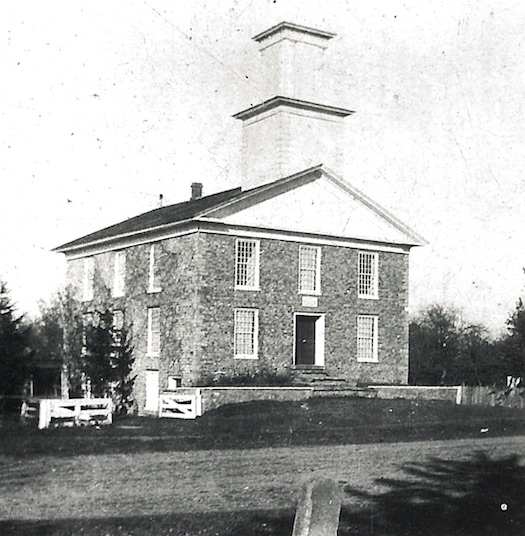
Because carriages and wagons were high off the ground it was advantageous to have a step, especially for ladies with long skirts, to embark and disembark such conveyances. This historic photo of the Cobblestone Universalist Church at Childs shows a high terrace in front for the same purpose.
It seems originally there was only a very high flight of wooden stairs up to the front entrance. In 1874 an earth ramp, brick platform and stone steps were added to the front of the church. This was so carriages on Sunday could pull right up in front and ladies and children could disembark on the level.
The driver of the buggy could then drive around to the carriage shed behind the church for the duration of the church service. Note a small portion of the shed shows on the left side of the photo behind the evergreens.
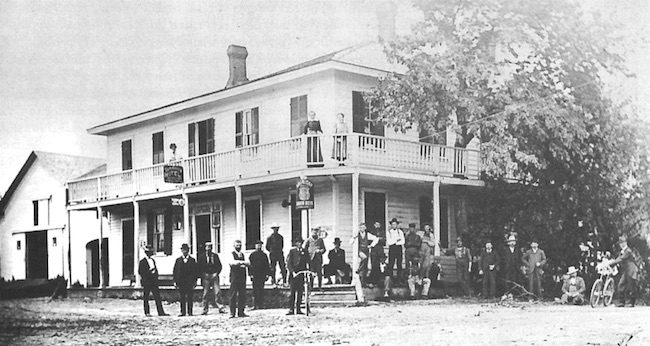
A similar situation existed at the Fair Haven Hotel, circa 1903, now the Village Inn at Childs. Notice the steps are at the corner. The rest of the porch is high across the front so carriages could pull right up close for people to easily step off onto the porch.
When carriage blocks were not in sight, the nearest stump often served as an easy way for the horse back rider to mount or dismount his steed.
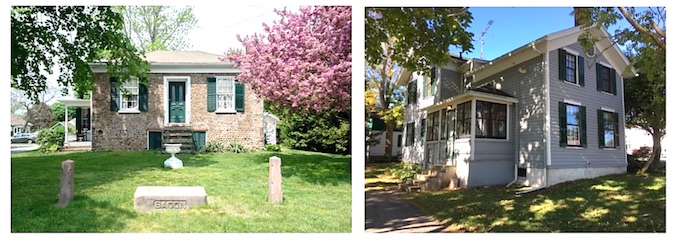
Photos courtesy of Cobblestone Museum: The Ward House, left, is a cobblestone home on Ridge Road next to the Cobblestone Universalist Church. The Vagg House is at the southwest corner of the intersection of Route 98 and Ridge Road.
Posted 5 December 2020 at 1:26 pm
By Doug Farley, Cobblestone Museum Director
CHILDS – The Hamlet of Childs is fortunate to have two homes from two very different time periods that are open for public tours in season. The Ward House (left) showcases life in the Victorian Period, before the advent of electricity, and the Vagg House (right) depicts the arrival of the electric age from the 1920s-1940s.
The differences in these two homes are striking. This is the fourth article about electricity coming to the Hamlet and the changes that took place. Today we take a closer look at labor saving devices usually found in the kitchen.
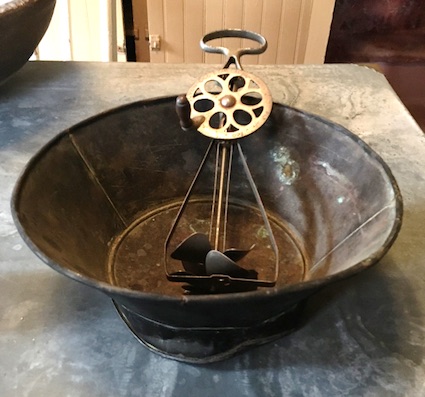
If the Victorian homemaker wanted to serve her family pancakes or waffles for breakfast, she would first mix up pancake batter using a hand mixer. It was a simple mechanical device that when hand cranked, would spin its metal mixing blades to beat the lumps out of the pancake batter.
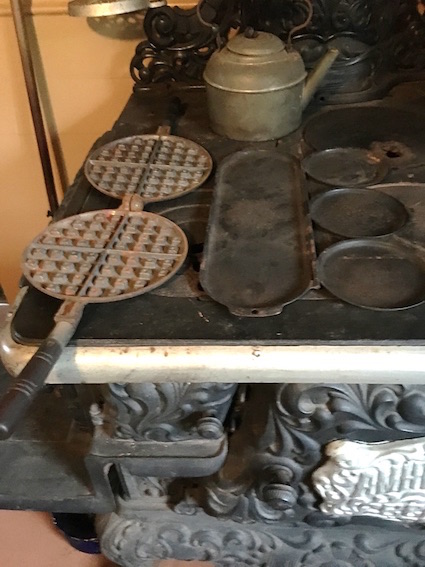
The next step would be to heat up a waffle iron or pancake griddle on the wood stove in the kitchen. In the photo above the implement on the right is a pancake maker. The liquid batter was poured into the attached receptacle cups. Then the hot metal plate could be folded over the batter to cook both sides of the pancake at the same time. This was actually a step up from simple “flapjacks” that required flipping the pancake from side to side.
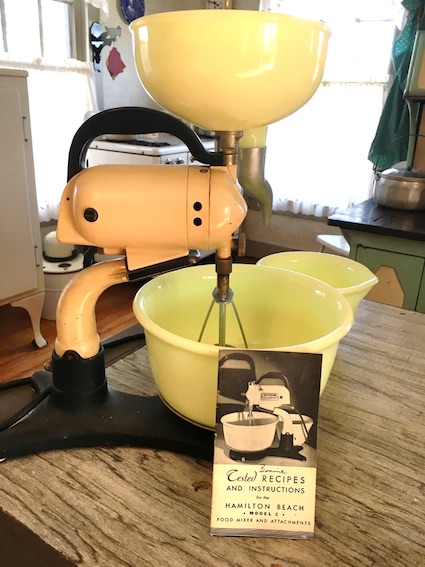
In the photo above we see how time marched on in the kitchen. In the Vagg House, the electric household would most likely use an electric mixer to beat their pancake batter saving time and human energy. The mixer shown here is a Hamilton Beach Model C with Juicer attachment at the top.
This appliance was first made in 1910 and became fairly common around World War II. So common, in fact, that the original owner sold the Hamilton Beach Company and moved to Millionaire’s Row in Miami Beach after just a few decades in business. Hamilton Beach Brands was originally located in Racine, Wisconsin. The company is still doing business today, but all of their appliances are now made in China.
Once the batter was prepared in the electric mixer, the homemaker would probably use an electric waffle iron or pancake cooker to complete the process.
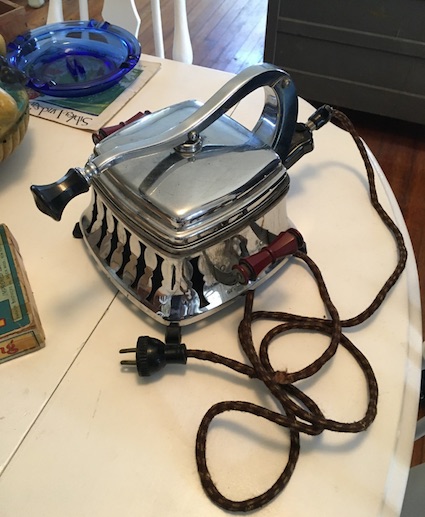
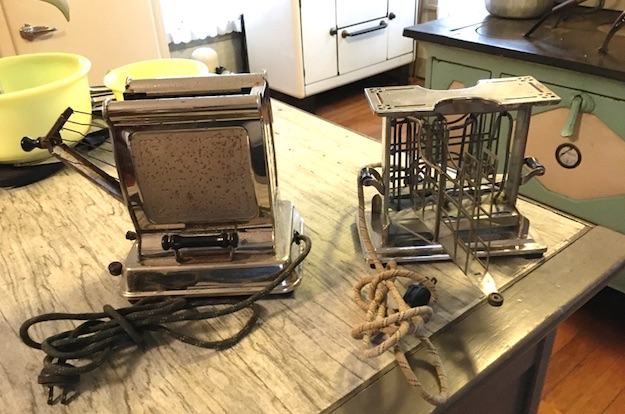
If all you wanted was toasted bread, the process in the 19th century involved heating bread on your wood stove or in front of an open hearth fireplace. Of course, the process at the 20th century Vagg House used an electric toaster.
Over the years, many different types of electric toasters have evolved to improve upon toasted bread. The appliance on the left made one slice of toast at a time while the unit at the right prepared two slices.
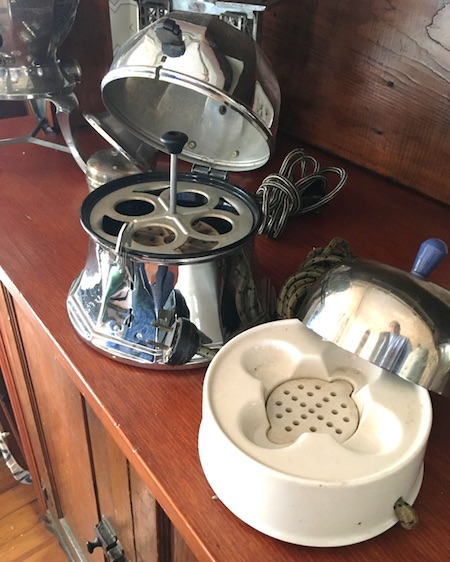
If you wanted to enjoy eggs with your toast at the Vagg House, you might have used either of these two electric egg steamers from the mid-1900s.
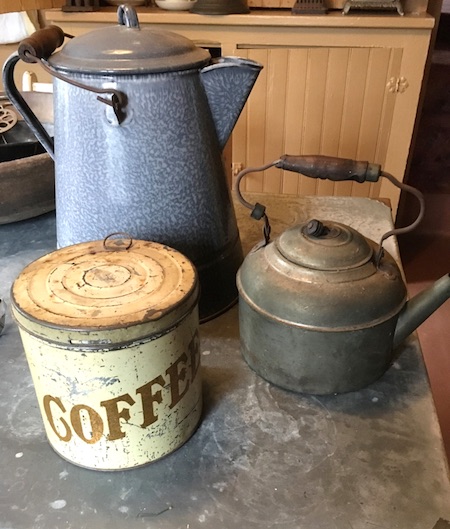
Making coffee over the years has evolved, too. In the Ward House, making coffee involved heating water in a teapot or kettle on the wood stove.
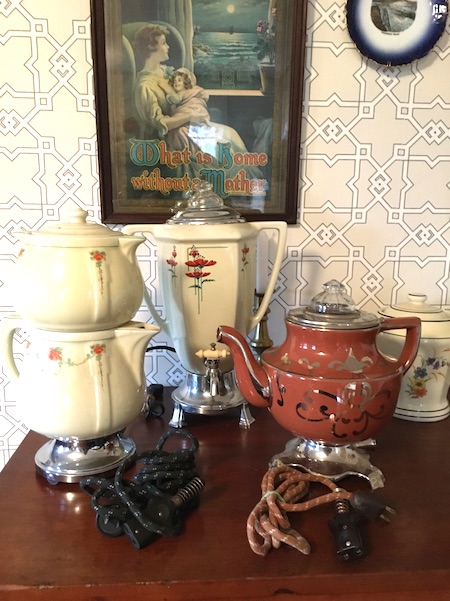
A wide variety of coffee appliances were present in the all-electric home like the Vagg House. The appliance on the left is called a Drip-O-Lator. The coffee maker in the center has a spigot to fill coffee cups, and the ceramic pot on the right is a percolator.
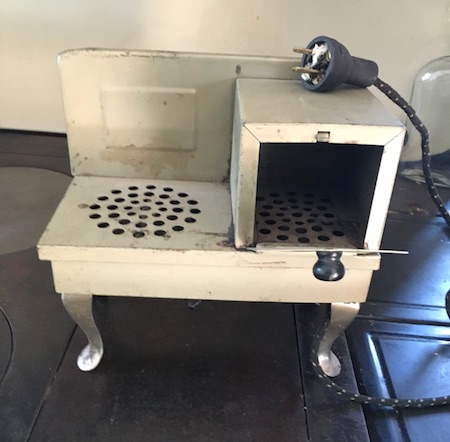
In the 1900s, electricity was even considered appropriate for children’s toys. The child’s oven shown above is probably a precursor of today’s Easy Bake Oven. This “toy” was plugged into an actual live electrical circuit which provided 120 volts of power to heat up an electric coil inside the mini-oven which got hot enough to cook food. Let’s hope there was some parental involvement, too!
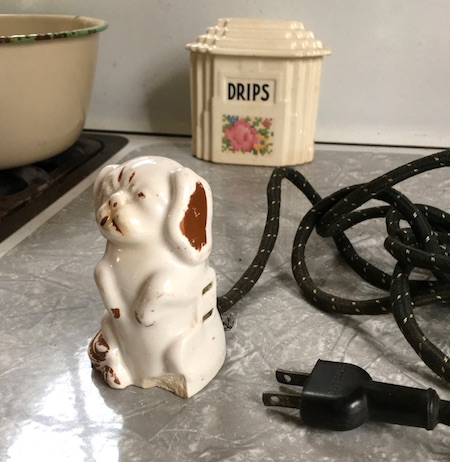
With the vast number of electrical appliances in the Vagg House, finding an open electrical outlet in 1940 must have posed a problem. So, another electrical gadget was created to solve the dilemma. This ceramic device provided outlets for three other electric appliances.
Our next installment about Historic Childs will take us back to look at horse and buggy days in the Hamlet.
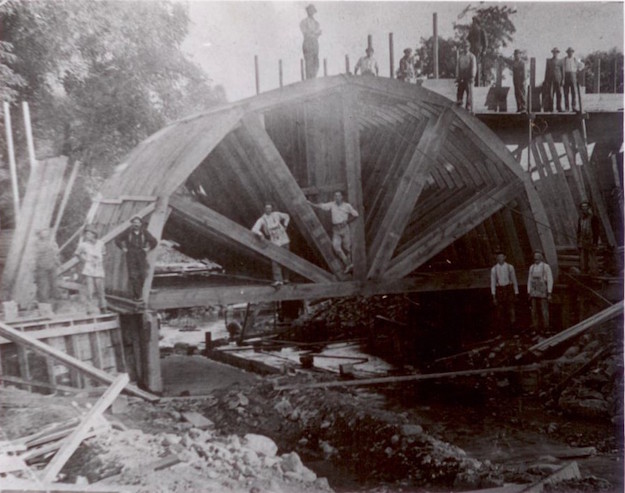
Bridge building, Jeddo, 1916, Orleans County History Department collection.
By Catherine Cooper, County Historian – Vol. 1, No. 2
RIDGEWAY – Part of the fascination of local history is that it adds layers of depth to our experience of our surroundings.
The accompanying photograph is of men building a bridge at Jeddo in 1916. However, the background brings into consideration several factors: the determination of the early settlers, how a determined re-routing of water led to the formation of a vibrant settlement, and an appreciation of oral history for preserving the details that enhance the story.
On June 11, 1916, the steel bridge spanning Jeddo Creek on Ridge Road collapsed and fell into Johnson Creek. The Medina Daily Journal of June 12, 1916 reported:
“The water raised so high Saturday and Sunday that it washed out the abutments and foundation of the bridge spanning the creek.”
Town of Ridgeway officials acted quickly. Highway Superintendent Harry Waldo and Town Supervisor Burt Smith declared the bridge a “total wreck” and on June 14 at a special meeting, the Town Board called for a proposition to raise taxes by the sum of $5,000 to construct a concrete archway or bridge over Jeddo Creek at Ridge Road, this proposition to be voted on July 5.
On June 22, 1916, it was reported that a “substantial temporary bridge which could be crossed by a detour has been completed over the creek at Jeddo, consequently travel on the Ridge highway will not be interrupted while the stone arch, planned to take the place of the old bridge, is being erected.”
This bridge was completed by November.
The 1916 bridge collapse was not the first such at Jeddo. A severe flood in 1897 washed out a dam and the foundation of the mill. Yet another flood occurred in 1902. Jeddo residents may have wondered if these occurrences were the result of a stealthy re-routing of the creek by earlier settlers. This intriguing item of local lore has thankfully been preserved in an oral history interview conducted by former Historian Arden McAllister with Horace Bird in 1978.
According to Mr. Bird, the land around the Jeddo area was wet and swampy, and was referred to as “Wild Cat Swamp.” The creek then was but a stream which moved sluggishly along the south side of Ridge Road and joined the Oak Orchard River south of Ridgeway Corners.
Pioneer settler, Jeremiah Brown, took his oxen and dug a trench across Ridge Road to divert the water. Farmers on the north side were furious as their land flooded, so they filled in the trench. Jeremiah persisted with re-digging the trench and soon the volume of water draining north created a channel which joined with Johnson Creek and necessitated the construction of a bridge. The drained farmland proved very suitable for fruit orchards. The volume of water proved suitable for a mill and soon the settlement grew to include a saw mill as well as a cooperage, a blacksmith shop, a store, and for some time, a jelly factory.
Too often, we traverse historic Route 104, aware of the hamlets only as areas to reduce speed. Next time, take note of the jaunty oversize bowling pins at Jeddo Mills Antiques and salute the determination of the settlers, bridge builders, millers and merchants who lived there.

















 MEDINA – In 1925, Sister Mary Johnson, a member of the Baptist Church of Rochester, felt called to assist the Black people of Medina who had been searching for a spiritual haven. With the assistance of Elder Caldwell and Rev. Henry Young of East Rochester, Sunday services were held at 811 Genesee Street, Medina, the home of Sister Johnson. At first, attendance ranged from five to 12 people.



 The spiral-bound cookbooks published as fundraisers for churches and community groups are a familiar sight in our kitchens. A collection of local cookbooks was just recently donated to the Orleans County Dept. of History. With their brightly illustrated covers and domestic content, they contrast with the largely black and white documents that comprise the majority of the Department’s collection.


 At the beginning of a new year, it is not unusual for people to resolve to keep diaries or lists. Our subject this week is an example of such, from the collection at the Medina Historical Society Museum. It is a sturdy tan note-book, with a plain cover. The first page contains the following inscription which describes its purpose:

 The holiday season invariably evokes memories of times past and the terrifyingly magical experience of a visit with Santa Claus is one that remains vivid.


 Ridge Road Station image courtesy of Medina Historical Society