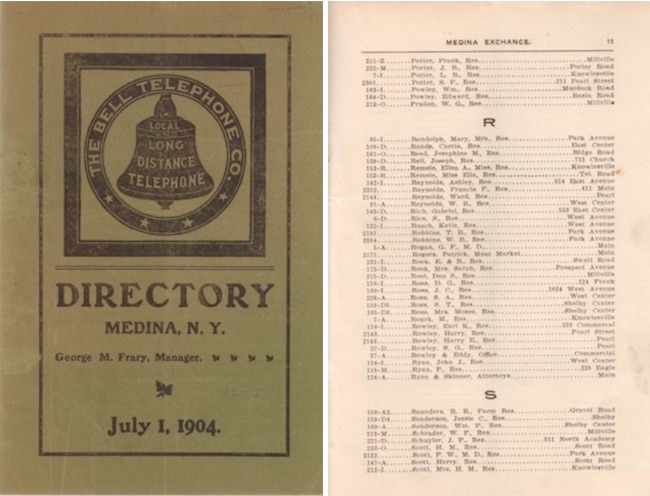
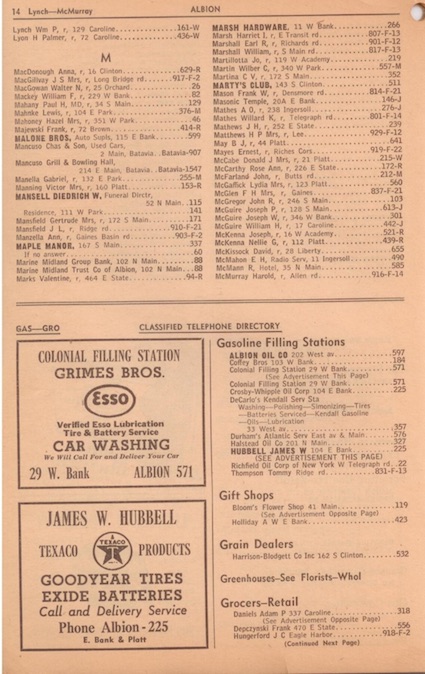
This is an early phone book, a simple alphabetical listing, with advertising only on the covers. Courtesy Medina Historical Society.
By Catherine Cooper, Orleans County Historian
“Illuminating Orleans” – Vol. 1, No. 16
We took them for granted. We used them as coasters. We used the covers as notepads. We even used them as flyswatters on occasion. Yes, we also used them for their intended purpose: to locate telephone numbers, addresses and businesses.
Now, we miss them, their comforting bulk, the reassuring feeling that all of the accurate local contact information we would need was contained therein. We save the last phone book issued to us because it still contains relevant information.
But, we have cut the land lines and “gone digital.” Our new technology is sleek, but only scammers can find phone numbers, it seems.
However, over time, the humble telephone books have become valuable research tools since they directly chronicle societal and economic trends at the local level.
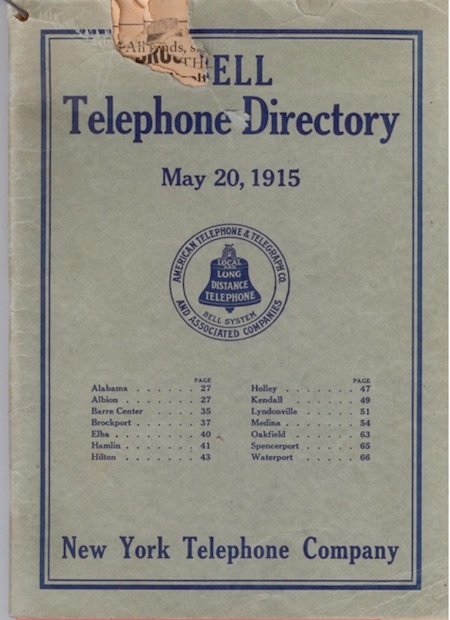
The Orleans County Dept. of History collection includes several early local telephone books. This 1915 Bell Telephone Directory covered a wide area as indicated on the cover. A “Classified Index to Advertisers” lists the businesses featured.
Indicative of the transition from horse-power to automobiles, the Index includes listings for one Blacksmith, two Carriages Makers, one Harness Maker and two Livery providers, while there are six Auto Repair providers and six Auto Suppliers.
The 1945 Albion Telephone Directory features a split page presentation, with residential listings on the top and business listings underneath. The 1953-54 Directory is the first with the familiar Yellow Pages layout.
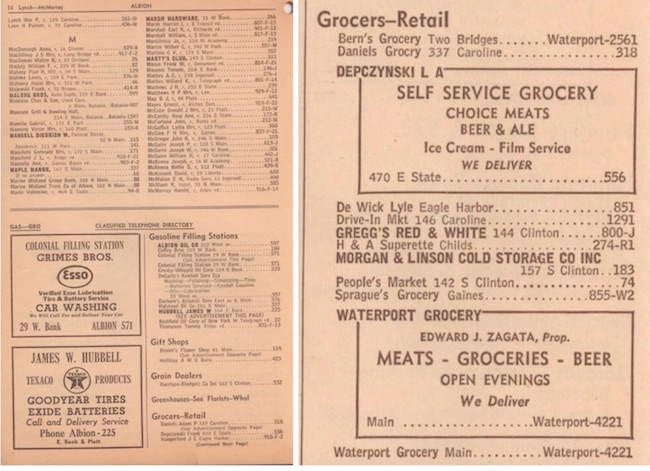
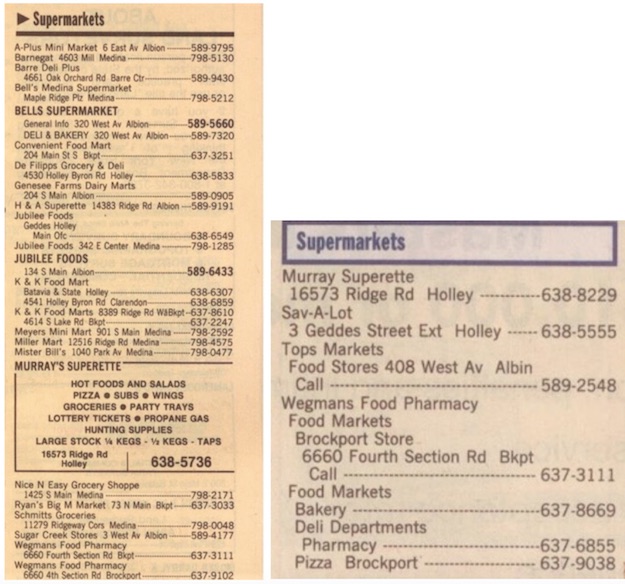
The disappearance of the “corner grocery store” is frequently lamented. That trajectory is reflected in the telephone books, as seen from these listings from 1953 to 2012. The independent grocers of 1953 were superseded by the corporate “Supermarkets.”
Listing of Grocers, Albion Telephone Directory 1953-54 is at left with the listing of Grocers, Albion Telephone Directory, 1974 at right.
The category changed to “Supermarkets” in the 1995 NYNEX Yellow Pages for Albion and vicinity at left. The listing for “Supermarkets” in the Verizon SuperPages, Albion area, 2012 is at right.
This is but one of the many sociological observations one can make from perusing telephone books. As you “Spring clean” or prepare for estate sales, please set aside any telephone books you may find. They will make a welcome addition to the local history treasure trove at the Orleans County Dept. of History.
Privies could be conduits for spreading infectious diseases
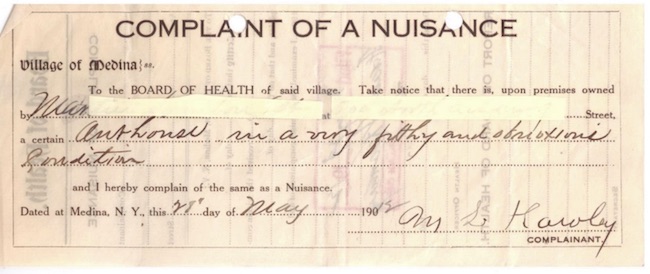
This is a ticket for a “complaint of nuisance in Medina more than a century ago. With these tickets the investigating officer would note observations on the reverse of the complaint docket. Typical observations might include: “found complaint justified” or “has connected with sewer”
By Catherine Cooper, Orleans County Historian
Illuminating Orleans, Vol. 1, No. 12
The recent article on the collection of outhouses at the Cobblestone Museum prompted us to consider the matter further.
While farm outhouses had the advantage of space and could be relocated if necessary, conditions were more crowded in villages and cities. Municipal sanitation control was a significant issue as reflected in village ordinances.
Initially, the disposal of household wastes was the responsibility of the homeowner. Typically a nearby vacant lot or body of water would be used.
The earliest drains were installed primarily to accommodate rain storms and melting snow but also carried sewage. Odors were the main concern as the prevailing belief was that odors transmitted germs. The connection between contaminated water and diseases was not recognized until 1854 when John Snow, an English physician, carefully mapped cholera cases in London and narrowed the cause down to a contaminated well pump. In Buffalo, for example, outbreaks of typhoid and cholera persisted until discharges were routed south of the city’s water intakes.
Privies with vaults and leaching cesspools were an advancement, but they still had to be cleared periodically. The following references are to the Village of Medina, but the same patterns of development prevailed throughout the county.
The Board of Health Ordinance published the following in the Medina Tribune on July 2, 1874:
“No person shall have any privy upon any lot or premises within said corporation limits, without a vault under it at least four feet deep, and such vault shall be properly cleansed by using lime or other disinfecting substance therein.”
“No person shall be allowed to drain from any privy, vault, sink or cesspool in any street, alley or lane shall be properly secured by stone or other substantial covering.”
By 1893, these regulations were much stricter:
“No privy cesspool or reservoir into which any privy, stable or water-closets, sink or other receptacle of refuge or sewage is drained shall be constructed or maintained in any situation or in any manner whereby, through leakage or overflow of its contents, it may cause pollution of the soil near or about habitations, or of any well, spring or other source of water used for drinking or culinary purposes; nor shall the overflow from any such receptacle be permitted to discharge into any public place whereby danger to health may be caused.”
Furthermore, it was specified that receptacles of refuse or sewage were to be built of stone, the sides and bottom were to be tightly sealed with cement. A penalty of ten dollars a day ($267 currently, according to the Inflation Calculator) per day would be imposed for any violation.
The Board of Health was appointed annually by the Board of Trustees. According to the 1901 Charter and Ordinances of the Village of Medina, it was comprised of three members, with a “competent physician” as Health Officer. Practicing physicians were required to report any occurrences or pestilential or infectious diseases. The Board of Health had the power to publish ordinances. In addition, the Board had the power to regulate the height of water to be maintained in any race, stream, artificial water-course or feeder within the Village during the months of July, August and September and also to prescribe penalties for any violations of such.
The 1901 village Charter clearly outlined resident’s responsibilities with regard to
“Depositing putrid matter in the waterway” (five dollar fine for each offense),
“Throwing putrid matter upon sidewalk” (three dollar fine)
“Providing a convenient privy, at least three feet deep”
A comprehensive sewer system in the village was completed in 1893. Indoor plumbing was adopted gradually. There was some resistance to indoor plumbing at first, as the fear of sewer gases persisted, but plumbing improvements eliminated that problem. By 1908 the rates for household water charges included water-closets:
• Private house, 5 rooms: $5
• Each two additional rooms: .50c
• Bath tub in house: $2
• Water closet with house use: $4
• (Meter rates 50c per M gallons)
But, while domestic sanitation improved, the overall disposal system remained problematic as most municipal systems continued to discharge into local waterways for many years. The development of primary and secondary wastewater treatment plants took some time.
By Doug Farley, Cobblestone Museum Director, Vol. 2 No. 23
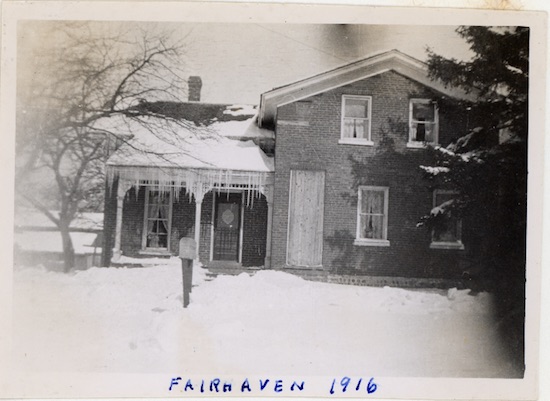
The life and times of former NYS Attorney General John Cunneen is intrinsically tied to the Hamlet of Childs through his presence here as a teacher in the one-room cobblestone schoolhouse, Town of Gaines District #5 in 1873. From there his path was directed to the County government where he served as Clerk, and once admitted to the NYS Bar, he rose to the highest New York State legal office, State Attorney General.
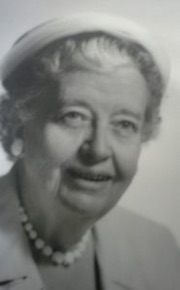
Charlotte Cunneen Hackett
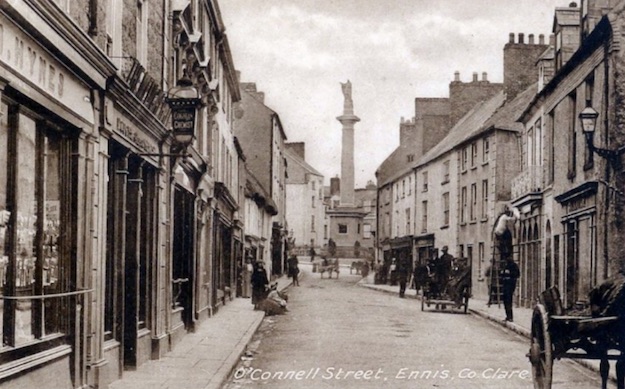
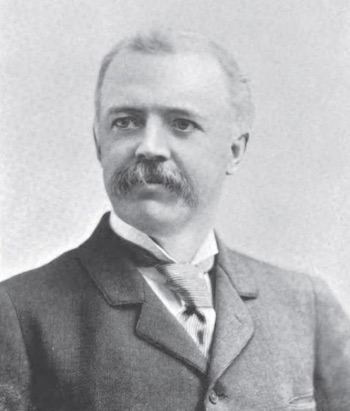
John Cunneen was born in Ennis, County Clare, Ireland, on May 18, 1848. (Late 1800s image shown above.) He was the oldest of seven sons whose parents, in good Catholic tradition, named all of their sons after the Apostles. The family was very poor, residing in a baked mud hut with thatched roof.
From a very young age, John worked several jobs and saved a portion of his meager wages with a goal to book passage on a sailing ship to the United States. One of his early jobs in Ireland was to collect eggs on his family farm, then walk five miles to sell them to a general store in Ennis.
John’s daughter, Charlotte Cunneen Hackett, shown at left, also an attorney, provided commentary on her father’s life through his diary that dates to his journey across the ocean in 1860 at the age of 12.
In 1966 she wrote, “Coming across the ocean on a sailing vessel, he was cold, hungry and seasick. He spent most of the voyage huddled against the mast or a smokestack for warmth.
Reaching Albany by railroad he made the trip to Albion by packet boat where he was met by a cousin named Scanlan and lived with them for a period of time in the 1836 Brick House now owned by the Cobblestone Museum (shown above). Shoes and socks were a big problem. During the next three years he worked on a farm for his room and board while attending school. No clothes were furnished.
His jobs were many and varied while he managed to get an education, study law, and was finally admitted to the bar. But he always said he found the trades he had learned to be of the utmost value in questioning laborers and workmen in accident cases because he knew what they were talking about. His ability soon marked him as one of the best trial lawyers in Western New York.”
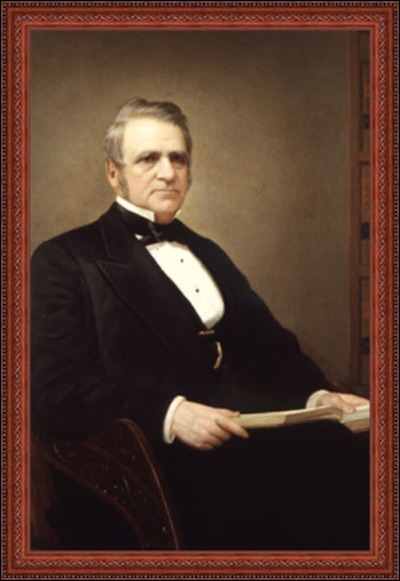
While teaching in Childs, John Cunneen studied law in Albion under the direction of Chief Justice Sanford E. Church, shown above. (Current Orleans County Judge Sanford A. Church is a direct lineal descendant of Sanford E. Church.)
Cunneen’s repeat trek, by foot, from Albion to Fair Haven (Childs) each day, involved a six-mile round trip. He remarked in his diary that, “Now and then someone came along with a team and gave me a lift.”
Another entry stated, “School went very well today. Mrs. Wilson, Mrs. Bass and Miss Elizabeth Bass visited the school today, which pleased me.”
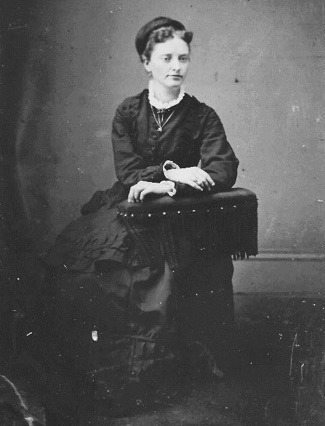
I believe he was “very pleased” with Elizabeth, because the two became husband and wife in 1876. Elizabeth’s photo is shown above.
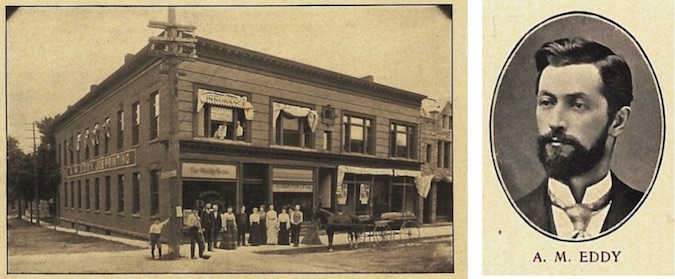
John Cunneen established a newspaper in Albion known as the Weekly News. In 1891 the publication was sold to Arthur M. Eddy, shown here in 1905 at the corner of Bank and Platt Streets. Cunneen was also instrumental in organizing the Orleans County Bar Association serving as their first Secretary.
Many Albion locals told him his decision to represent an Albion youth who was alleged to have murdered his father was ill advised. However, the case actually served to increase his prominence and his law business flourished. Shortly thereafter, Cunneen started his own law practice and eventually hired several other attorneys.
In another landmark case, Cunneen argued against seven corporate lawyers in a case that became known as The Franchise Tax case. The day that the case was decided in Cunneen’s favor, President Theodore Roosevelt, a Republican, sent Cunneen, an Irish Democrat, a congratulatory telegram. His daughter later stated, “It was an odd coincidence that some 40 years before, John Cunneen had come to America as a lonely boy of twelve years with all his worldly possessions tied up in a bandanna handkerchief slung over his shoulder from a stick poked through the knot.”
Cunneen served as a member of his local school board and secretary of the Orleans County Board of Supervisors, a precursor to the county legislature, for seven years. Cunneen became the only Democrat to win a statewide election in 1902 in his successful bid to serve as New York State Attorney General, a post he held from 1903-1904. Being an Irish immigrant and Catholic created a huge uphill climb for Cunneen, as he dealt with discrimination in both camps throughout his political career.
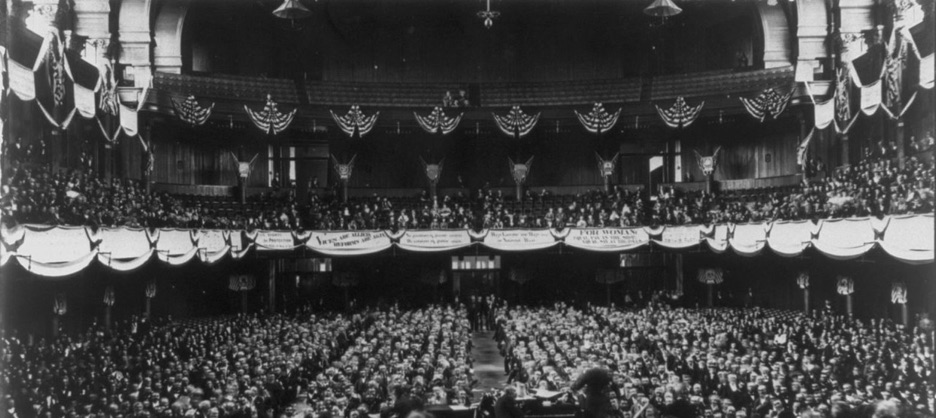
National Prohibition Party Convention, 1892, Cincinnati, Ohio
In the end, political pundits say that it was Cunneen’s cross-registration with the Prohibition Party that provided enough votes for him to win the statewide election for Attorney General.
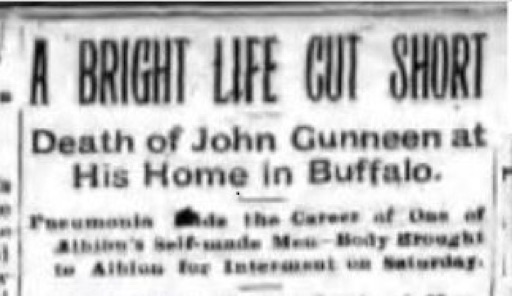
Just a few short years later, John Cunneen’s obituary in 1907 stated, “A Bright Life Cut Short.” His daughter commented, “In February 1907 my father developed a severe cold and died of pneumonia ten days later. He was scheduled to deliver an important Washington’s Birthday address. He was 58 years old. We buried him in the Catholic Cemetery in Albion.”
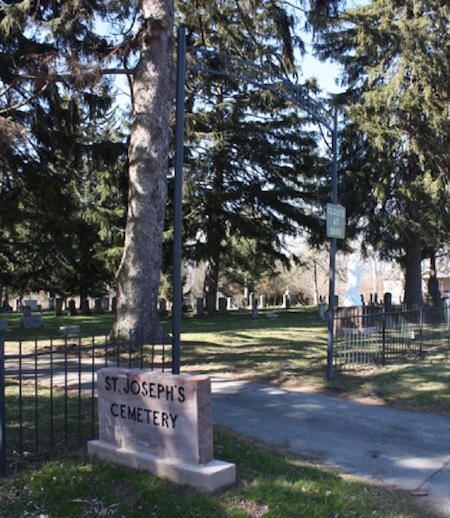
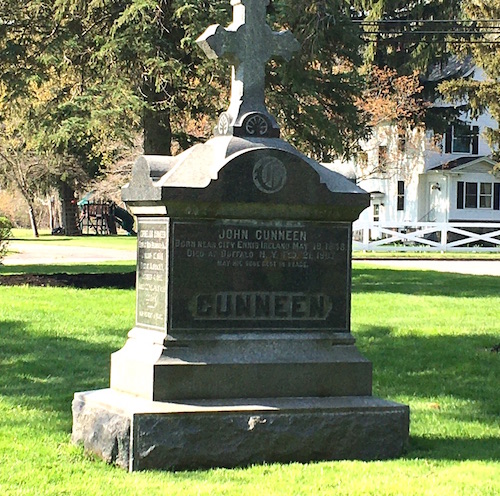
The original burial took place in what we know today as the Old St Joseph’s Cemetery on Brown Road. The Bishop of the Catholic Diocese of Western New York accompanied Cunneen’s body on the funeral train from Buffalo to Albion in 1907 with many other mourners.
Later, circa 1920, Monsignor Francis Sullivan approached the families of those interred in the old cemetery, seeking permission to move the bodies to the new St. Joseph’s Cemetery on East Avenue, west of Mount Albion Cemetery in the village. Rev. Sullivan scored an early “coup” in his attempt to move the cemetery when an agreement was reached with the Cunneen family to have John’s body moved to a prominent location in the new cemetery, shown above.
Once that commitment was in place, many other families agreed to have their loved ones moved to the new St. Joseph’s Catholic Cemetery, too. In another strange quirk of circumstances. John Cunneen’s wife, Elizabeth (Bass) Cunneen, died in 1917 but was never allowed to be buried alongside her husband. Elizabeth was a Protestant and as such, was not allowed to be buried in a Catholic cemetery. Cunneen’s daughter later reflected, “Since the days when Father taught school at the Cobblestone Schoolhouse we have cherished our friendship with the Church family. His life proves that America is indeed the land of opportunity.”
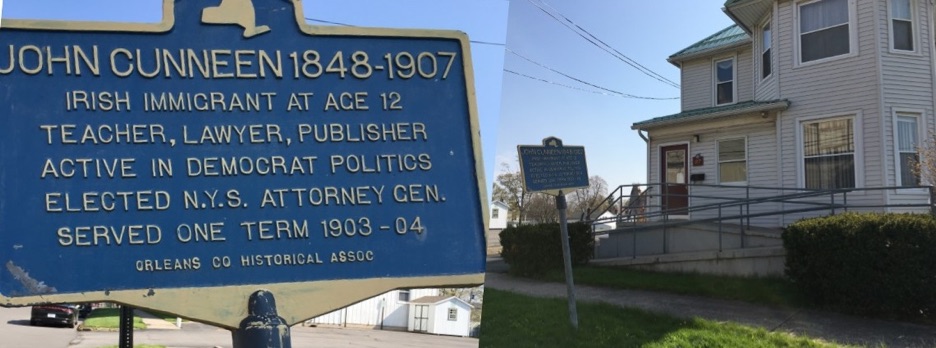
To honor Cunneen’s accomplishments, a NYS Historic Marker was erected at 27 Platt Street, late in the 1900s, in front of what was known then as Cunneen Hall. The building was owned at that time by Orleans County and served as the County Sheriff’s Office. Later, the building was sold and serves now as a counseling facility.
In closing, John Cunneen’s eulogist, Judge W. C. Ramsdale, offered remarks that can help inform our thoughts today, “Cunneen was a self-made man. Whatever success he attained in life is due to his own industry, perseverance, ability and character. A poor boy, he became what he was at the time of his death, a good man, a firm and steadfast friend, and influential and respected citizen and an imminent lawyer. Attorney General John Cunneen, the Irish immigrant, in his rise to fame, remained a true friend.”
ALBION – Weather temperatures have been higher than “normal” of late, but not quite on par with the 119 degrees registered on the Albion Federal Savings and Loan Association sign in this undated photo from the William A. Monacelli photograph collection at the Orleans County Department of History.
The Albion Federal Savings and Loan Association was formed by local businessmen Hon. Sanford T. Church and Freeman E. McNall in 1934, following the closing of the Citizens National Bank in 1932.
On the occasion of the Association’s 25th anniversary, Sanford B. Church attributed the success of the Association in large part to its enthusiastic board of directors and hard-working and conscientious staff. From the beginning, the Association paid as large a dividend as was possible, beginning with 3 percent per annum in 1935. During World War II, the rate fell to 1 ¼ per cent in December 1945, but climbed steadily afterwards.
In support of Albion’s Downtown Restoration Program and the National Bicentennial in 1976, the Association undertook the restoration of the former home of Lorenzo Burrows at 48 North Main Street for use as its expanded headquarters. Albion Federal opened a Brockport office in 1997. Both were acquired by First Niagara in March 2000. First Niagara in turn was acquired by KeyBank in 2016. The pace of change in the banking industry has been as dizzying as the temperature in our photograph, though the interest rates are distinctly chillier.
A Gold Star pilgrimage mother at the grave of her son.
We are familiar with the term “Gold Star Mother” as a reference to those mothers whose son or daughter died or became missing in action while serving with the United States Armed Forces.
The symbol which originated in World War I referred to the flags hung by servicemen’s families in the windows of their homes. Each living family member in the Armed Forces was represented by a blue star. A gold star represented a son or daughter who had died in combat.
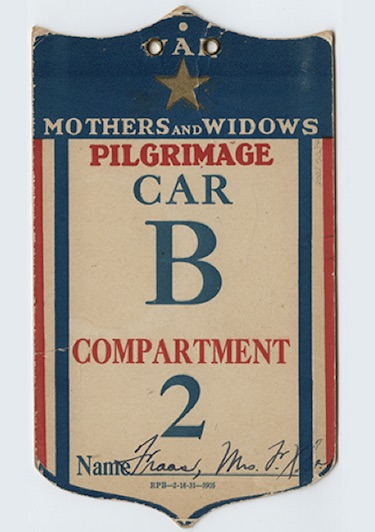
The World War I Gold Star Mother Pilgrimages are less well known. This unique program acknowledged the grief of those mothers and widows whose loved ones had perished in the Great War and who were buried in Europe. It also acknowledged the healing power of standing by a loved one’s place of burial.
Wartime burial of the deceased servicemen of WWI was a daunting task as well as a sensitive and hotly debated one. Some soldiers indicated their wishes to their families. Quentin Roosevelt, for example, told his family to “Let the young oak lie where it fell.” Others indicated that they wished to be buried alongside their brothers-in-arms. The Allies felt that the war dead should be buried in Europe, honoring their sacrifice for the land they fought to free. But many families chose repatriation and about 46,000 remains were returned. Some 30,791 were buried in Europe, in eight cemeteries: six in France, one in Belgium and one in England.
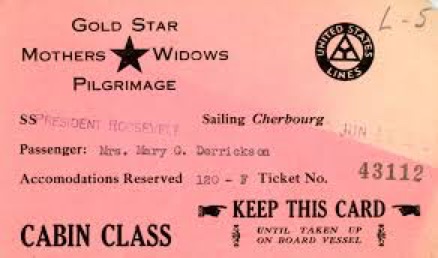
Boarding passes and tickets were issued to Gold Star mothers and widows.
After the war, many of the families who could afford to went to visit the grave of their loved one. Accompanied by her son, Theodore Jr., Edith Roosevelt went to visit her son Quentin’s grave in France in Feb. 1919. Poet Joyce Kilmer’s parents visited his grave in Sept. 1920. These visits were publicized, and they encouraged other families to do likewise. Throughout the 1920’s Gold Star Mothers traveled on privately funded trips, or in 1929, as part of the American Legion’s 2nd American Expeditionary Force Convention held in Paris in 1927.
Congressman Fiorello LaGuardia, NY, introduced the first bill proposing publicly funded European cemetery visits for mothers, fathers and widows of servicemen. The bill was defeated, but a bill finally passed in 1929 which authorized the Secretary of War to arrange for pilgrimages to the European cemeteries: “by mothers and widows of members of military and naval forces of the United States who died in the service at any time between April 5, 1917, and July 1, 1921, and whose remains are now interred in such cemeteries.”
Later, mothers and widows of men who died and were buried at sea or who died at sea or overseas and whose places of burial were unknown were also included for eligibility.
The Office of the Quartermaster General, under the supervision of Major-General Cheatham, was charged with overseeing the program which was to run from 1930-1933. Those who had visited the graves were not eligible. Also, widows who had remarried were not eligible. It was determined that 17,389 women were eligible. Then came the daunting task of contacting them. Many had moved, remarried or died since the end of the war and indeed, many letters were returned unclaimed. There were 11,780 responses. But many of those who responded declined the offer, due to age or ill-health.
All told, 6,654 women made the pilgrimage. They were to be allowed two weeks for the trip, all at government expense with an allocation of $840 each.
An article in the Medina Daily Journal March 7, 1930, indicated that seven Gold Star Mothers from Orleans County were deemed eligible:
Mrs. Virginia Arnett of Millville, whose son, Dr. John Arnett, was a first lieutenant with the Medical Reserve Corps and who was buried in Flanders Field.
Mrs. Lillian A. Brooks, 13 East Ave., Albion, whose son, Jesse S. was a private with Company E of the 108th Infantry and who was buried at Somme.
Mrs. Orrin F. Butts of Medina, whose son, Revenue James, was a private with Company B of the 53rd Engineers and who was buried at Oisne-Aisne.
Mrs. Edna A. Clark of 357 South Ave., Medina, whose son James P. a corporal in Company F. of the 108th Infantry and who was buried at Somme.
Mrs. Ester Kuramski, of 7 Brown St., Albion, whose son, John, was a private in the 51st Company of the 5th Regiment of the United States Marine Corps and who was buried at Oisne-Aisne.
Mrs. Grace Mott, of 738 Church St., Medina, whose son, Dewey Graydon was a private in the 82nd Company of the 6th Regiment, United States Marine Corps and who was buried at Oisne-Aisne.
Mrs. Effa Stevens of 21 West State St., Albion, whose son, John H., was a second lieutenant with the 147th Aero Squadron and who was buried at Oisne-Aisne.
Grave of Lieut. Dr. John D. Arnett of Millville is shown at Flanders Field, Belgium. His mother visited the site on a trip in 1931 for Gold Star Mothers.
The Medina Daily Journal of April 10, 1931, reported that three of the mothers planned to make the trip. Mrs. Effa Stevens of Albion was to sail on the liner America on May 13, while Mrs. Edna Clark and Mrs. Virginia Arnett were to sail on June 25 on the President Roosevelt.
Upon their return, Mrs. Arnett and Mrs. Clark reported in the Medina Daily Journal of July 27, 1931, that every consideration had been shown them on their trip. They enjoyed a calm voyage along with a group of 99 other Gold Star Mothers and Widows. Two of the mothers on board had lost sons at sea and memorial services for these men were held on the journey over.
The group spent several days in Paris and then divided into groups of 25 for the visits to the cemeteries. Each group had a doctor, two nurses and a lieutenant in attendance. Mrs. Clark recounted that there was an American caretaker at each cemetery, and that the white marble headstones were polished to a glittering brightness. Flowers could not be planted on the graves and the grass was close trimmed. Each mother was given a large bouquet of cut flowers and a large wreath to place on the grave and was allowed time at the grave. An official photographer captured the image of each woman at her loved one’s grave. The groups stayed in the vicinity for a few days, so that mothers could get a sense of the area where their son or husband had died.
Following a few days of relaxation in Paris, they returned on the President Washington. They encountered rough seas which lasted for four days but arrived safely home. They felt much comforted by the trip.
For additional information on this remarkable event, read The Gold Star Mother Pilgrimages of the 1930’s by John W. Graham, available through the NIOGA Library System.
Residents urged to send in photos of barns to Department of History
By Catherine Cooper, Orleans County Historian
Illuminating Orleans, Vol. 1, No. 11
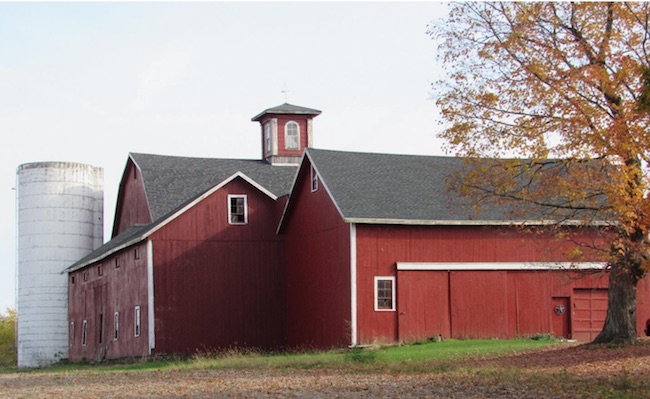
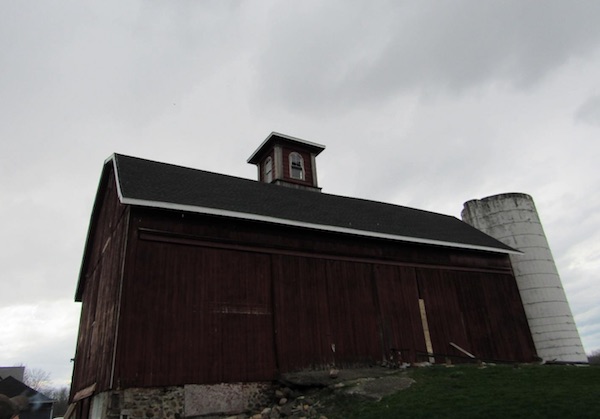
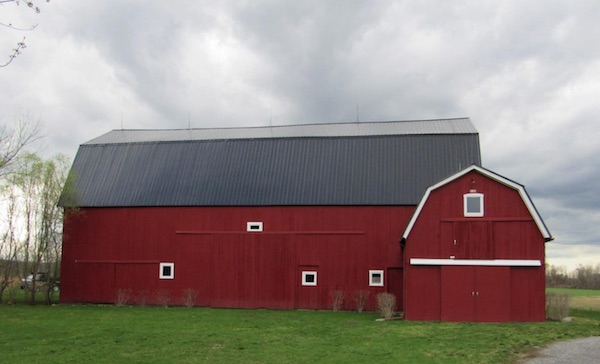
MEDINA – The Allis Farm barns on Bates Road in Medina are described in the 1913 New Century Atlas of Orleans County. Then owned by Jay Allis, the farm included “a general barn, 40×75 feet with ornamental cupola; horse barn 20×30; and sheep shed 30×60.”
Barns photograph well in every season even when set against a glowering sky, as in this view of the general barn. Allis Farm features two massive single stretch 75 ft. beams. The cupola may be ornamental, but it was also functional, as it provided ventilation.
Celebrating Barns
Who can walk into an old barn and not feel a powerful sense of another time, a connection with the previous generations who worked there?
It is difficult to articulate these feelings, but author Thompson Mayes best explains them in his book “Why Old Places Matter,” published in 2018 for the National Trust for Historic Preservation:
“old places affect us very deeply and intuitively,
“old places…..connect us to the struggles of a previous generation,”
“old places….help us recall who we are and where we came from,”
“old places….are imbued with the spirit of those who made them,”
“their building materials and craftsmanship deserve respect as they will never be available again.”
Barns represent our agricultural heritage. They remind us of our connection to the land, our elemental dependence on agriculture for survival. Simple, stoic, unassuming, unpretentious, none alike, each with its own story, barns make the past present.
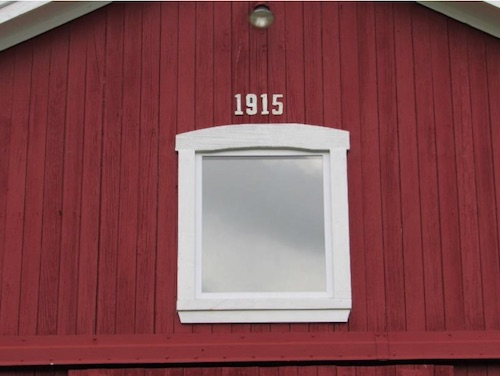
But they are disappearing from our landscape. We invite you to share your barn photographs and stories with us at the Orleans County Dept. of History. As part of our mission to record history, we plan to maintain a visual record of these structures which so enhance our rural skyline. We look forward to your contributions.
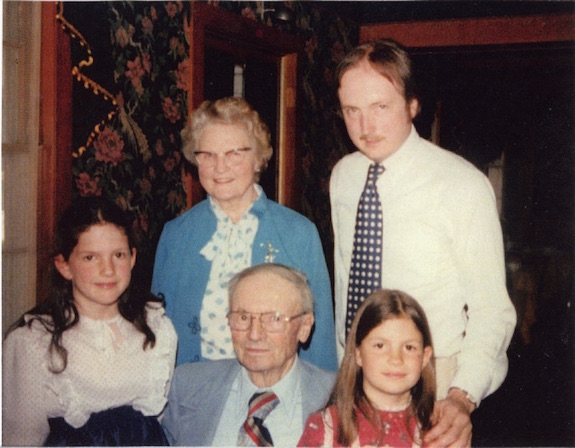
Adrienne Kirby selected this family photo as one of her favorites. It was taken in 1983, most likely at the Village Inn for the celebration of her grandfather’s 85th birthday. Adrienne is seen at left, next to her grandfather, Cary Lattin and her younger sister, Allison Lattin. Standing in back is her grandmother, Avis Lattin and her father, Bill Lattin.
By Doug Farley, Cobblestone Museum Director
(Author’s note: It became obvious to me while working on what turned out to be Part 1 of the History of the Lattin family in the Hamlet of Childs and environs, that one article alone would not do the story justice. So, without further ado, here is the second installment. (If you missed article 1, you may want to back up a week and check it out or click here.)
Adrienne (Lattin) Kirby, current Town of Gaines Historian, is happy to explain how she is the third rung in the ladder of historic preservation, so to speak, as both her father, C.W. (Bill) Lattin, and grandfather, Cary Lattin, have greased the wheel by providing her so much interesting historical information over her 46 year lifetime.
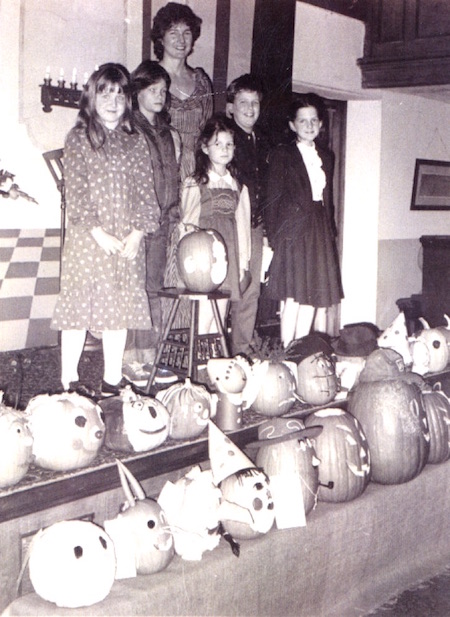
The Lattin family and the Cobblestone Museum, have in many ways become synonymous over the years with community engagement. Whether it was hosting school tours for up to fifty classrooms each year, or inviting the community to take part in the Pumpkin Festival, with prizes given to historic themed entries.
Adrienne remembers this particular Festival in 1982 because of the pumpkin sitting on the stand next to her. She recognized the “O.C.” which stood for Orleans County, and a carved cello which was the instrument that Pamela Frame played for this program in the Cobblestone Church. The children taking part in this photo include (Left to Right): Marsha Bolton (now Rivers), DeeDee States (now DiMarco), Allison Lattin, Richard Bowen, and Adrienne Lattin (now Kirby). The adult in the center of the photo is Pamela Frame, the cellist who played for the event.
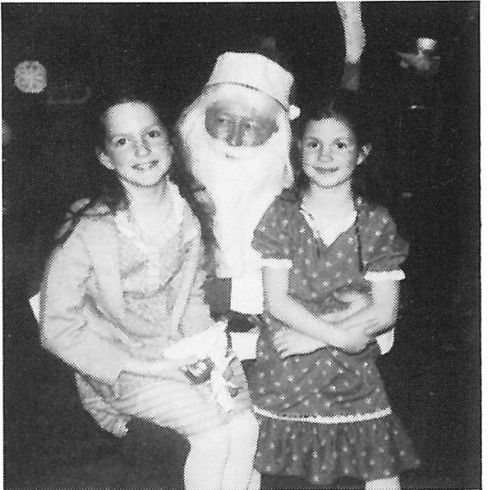
Another fond remembrance for Adrienne was the annual Christmas pageant at the Schoolhouse. “Janice (Thaine) did those for many years, and I remember them fondly. I was in a skit called ‘The Christmas Belles’ about 3 sisters, whose names were Laurabelle, Clarabelle, and Isabelle.” Adrienne (left) and sister, Allison, are seen here in 1982 with Santa (Gerald Thaine) at the Schoolhouse.
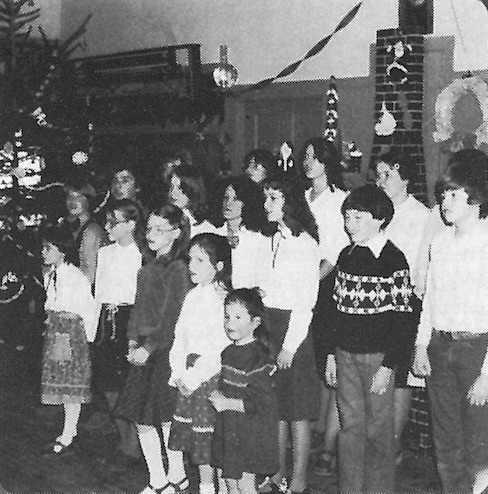
Janice Thaine offered up the Christmas pagents in the 1970s and 1980s. Here we see Adrienne and Allison Lattin at the right side of the first row of children.
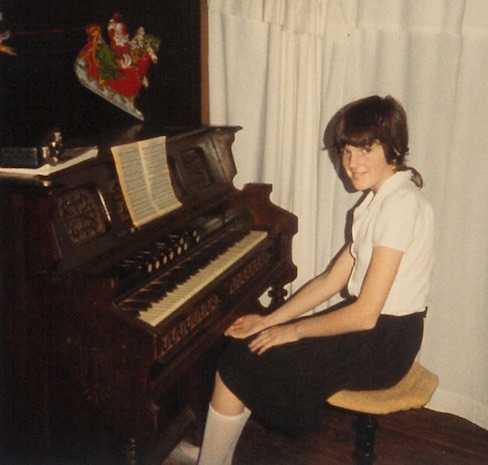
A makeshift “theater” was created each Christmas at the schoolhouse, by stringing a collection of sheets across the front of the classroom for a makeshift stage curtain, as seen here. The audience sat in the student’s desks. Adrienne said, “I’m sure I played the organ for the program in 1985 (pictured here), I would have been taking lessons with Miss DiGuilio. She was in Albion, but a lot of people around here will remember her.”
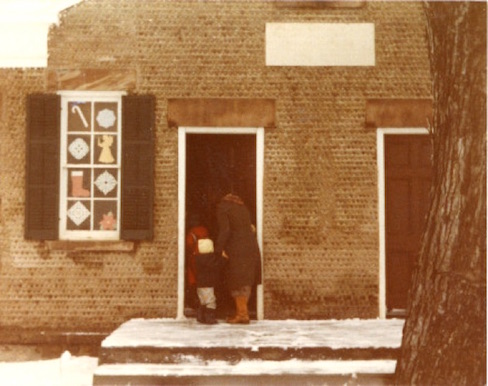
Young actor, Danny Capurso, age 4, with his mother, Chris Capurso, are seen arriving at the schoolhouse in 1983. Some of Janice Thaine’s handmade Christmas decorations are displayed in the window. The program was composed of children reciting seasonal poems, short skits and music.
Adrienne said, “Every year, we sang ‘Up on the Housetop.’ I seem to remember having to snap my fingers at the ‘click, click, click,’ and a few other hand gestures. The show always closed with Janice sitting in the teacher’s chair, reading ‘Twas the Night Before Christmas,’ with all the kids sitting on the floor around her. Her husband Gerald, would dress up as Santa Claus and kids would take turns sitting on his lap. I think the wire for the curtain is still there. The curtain was just some white sheets pinned together.”
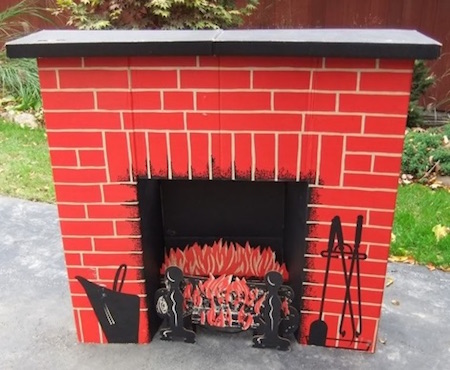
Adrienne reminisced, “ I distinctly remember when I was in 1st grade wearing lace up shoes with rather thick, soft rubber soles, because that was fashionable in 1980. I stood on the metal grating above the furnace long enough for it to melt an imprint into the bottom of my shoe. I remember Janice also brought in a cardboard fireplace, most likely from the 1950s, as sort of a backdrop.”
Folks who have toured the Farmers Hall at the Cobblestone Museum probably remember the large smokehouse and bin there were created from sycamore limbs. What they may not know is the artifacts’ connection to the Lattin family. Sometime in 1870s, Adrienne’s great-great grandfather, Bartlett decided to cut a huge sycamore tree in Kuck’s Woods. He was assisted by a friend, and the two men decided to each take half of the wood.
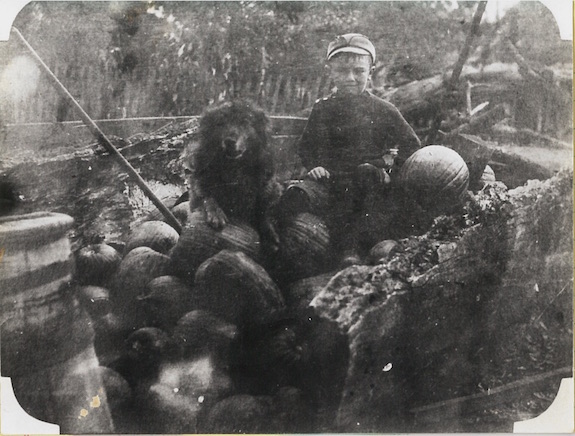
The sycamore tree they selected was 90 feet tall, six feet in diameter, and about 20’ in circumference. One of the characteristics of sycamore trees is they usually become hollow on their own. Bartlett used half of the trunk to create a log bin, seen here occupied by Cary Lattin in 1902, and Barlett’s friend used the other half of the trunk for a chicken coop.
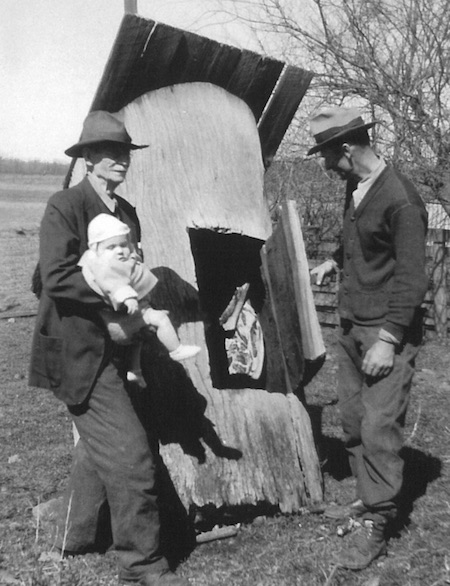
Bartlett also used one limb measuring three foot in diameter for a smokehouse. The sycamore smokehouse is shown here in 1945, with Cary Lattin at right. Cary’s father, Nahum, is holding his grandson, Bill Lattin. The family trio is inspecting meat hanging inside the smokehouse. In 1980, Cary gave the sycamore smokehouse to the Cobblestone Museum to preserve.
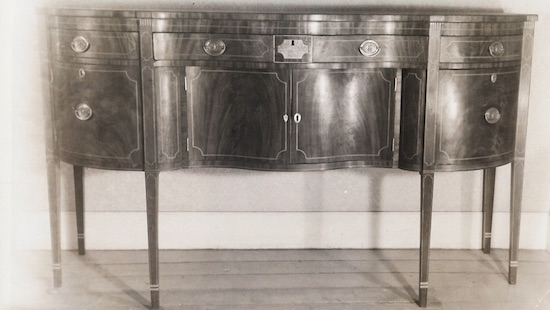
It’s no secret that the Lattin’s have enjoyed collecting antiques. Bill has even “set up shop” at regional antique stores. One of the items that Cary and Bill were fond of is displayed in their homestead and has a six generation connection to the Lattin family. Adrienne’s great- great-great-great grandfather, Nathaniel Lattin, purchased a Hepplewhite sideboard in a shop in New York City in the 1830s. It was second hand at that point, and the family tells the story that it was once owned by a sea captain and was used in his cabin on a sailing vessel. Nathaniel recognized it as quality furniture.
When Nathaniel died, he passed it on through the “greats,” first to Joseph, then to Joseph’s son, William. The story is told that Bartlett Lattin, William’s brother, liked the piece of furniture so much that he offered a milk cow in exchange, if his brother William would give him the sideboard. Succeeding with the barter, Bartlett took his newly acquired sideboard home. His wife, Phebe, was very upset with the trade. She said, “You traded our best milk cow for that old, second-hand piece of furniture – What were you thinking?! You can’t put that in my dining room!”
After some serious give and take, Phebe relaxed her indignation enough to say the Hepplewhite sideboard could go in the woodshed, where she used it to store odds and ends. When Phebe died in 1886, Barlett moved the sideboard in to the house and gave it a place of rightful honor.” Bartlett died in 1900 and the cabinet was inherited by his son, Nahum Lattin.
Bill Lattin said, “Nahum was offered $500 for the sideboard in 1902. Luckily, he didn’t sell it and it sits in my dining room today.” Bill appreciates it, certainly for its value, but probably more so for its wonderful family provenance that includes stories of sea captains and a traded milk cow. You see, a historian is really a seasoned story teller.
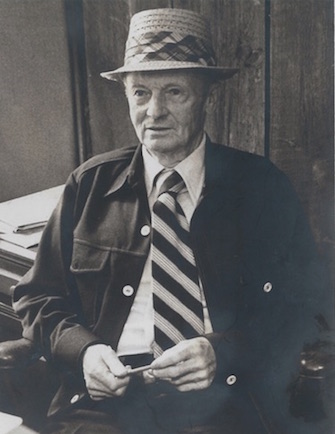
Cary H. Lattin (1898-1988) began a family legacy of historic preservation that continues today.
GAINES – The Lattin family name is well known to anyone with an interest in local history. Three generations of Lattins have lived and worked here with a mission to preserve the stories, architecture and culture of our shared history in Orleans County.
Adrienne (Lattin) Kirby, current Town of Gaines Historian, has been preceded by her father, C.W. (Bill) Lattin, former Cobblestone Museum Curator and Orleans County Historian; and her grandfather, Cary Lattin, seen here circa 1980, who also served as Orleans County Historian. The Lattins come from a long line of pioneers that have been present in the community for eight generations.
Adrienne shared recently that history, and historical preservation, were literally in her blood, Lattin blood. After all, she was the child of Bill Lattin and grandchild of Cary Lattin. From her youngest days she would eat, drink and sleep history. Her childhood home on Gaines Basin Road was built in the 1820s.
Adrienne said, “The house had the original plaster walls and was painted historic colors.”
She reflects on life surrounded by antiques and objects from a bygone era. Adrienne’s father, Bill, was working as curator of the Cobblestone Museum at that time, and she recalls that she was always being drawn into his work, sometimes by request, and sometimes because, “Dad pressed me into service.”
For Adrienne, born in 1974, seen here, front right, reflected that while some kids would be playing tag or hide-and-seek, she might have been cleaning the historic windows in America’s oldest Cobblestone Church.
“Though I did wash a lot of windows in the church, my sister, Allison, and I played a lot, too,” Adrienne said. “When we played ‘house,’ it was in the Ward House. When we played ‘school’ we had a real schoolhouse to play in. Most kids probably don’t play ‘church’ but we had one to play in, so we did.”
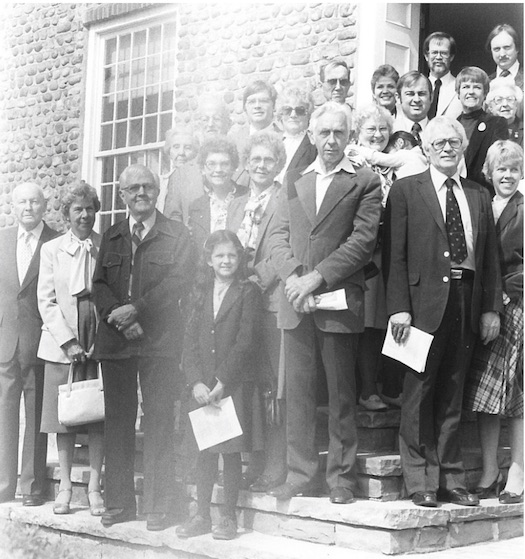
Others assembled here in June 1982 for the dedication of the John Brush plaque in the Church lobby include: Front Row (Left to Right): Three representatives from First Universalist Church of Rochester, Adrienne Lattin, age 7. Row Two: Signe Maine, Melva Roberts, Elton Roberts, Mr. and Mrs. Jack Brush. Row Three: Florence James, Lee Maine, Rev. Richard Hood, Dorothy Pratt, Jean Bistoff holding her granddaughter, Joani Loss. Row Four: John Pratt, Lenore Houck, Richard Hoffman, Betsy Hoffman, Ruth Needham. Back: Dr. Douglas Houck and C.W. (Bill) Lattin.
Adrienne Kirby speaks during an unveiling ceremony for a sign for Beardsley Creek on July 28, 2018.
By the age of 9 years old, Adrienne could be found helping her father by giving museum tours. “I started by giving tours in the Church where Dad could keep an eye on me,” she said. Soon, Adrienne was leading Museum tours, on her own, up the road to the National Landmark Cobblestone Schoolhouse.
“When you think about it, no one gave it a second thought, a third grader leading total strangers alongside a busy state highway to a destination 2/10s of a mile away,” she said. “Times were different then!”
Adrienne said she really enjoyed giving Museum tours. She recalls that one group of Museum visitors was so pleased with their tour, that they gave her an “E-T” shirt. The guests told Adrienne that she was “Just so darn cute!” Another fond memory was, because she was “always at the museum,” at lunchtime, her dad would give her a dollar and send her to the H&A next door to buy a Twinkie and a comic book. At 7 years old her favorite comic book was “Richie Rich,” or “Mad Magazine.” “But if I bought a Mad Magazine, I couldn’t buy a Twinkie because I wouldn’t have enough money!” Sounds like a valuable life lesson was learned.
When Adrienne was about 9 years old, she recalls that her father took her up to the Cobblestone Schoolhouse and showed her how to use a riding lawn mower. She said, “This was terribly exciting to me, because a riding lawn mower was practically like DRIVING! After instructing me on use of the pedals and so forth, he instructed me to mow the back lawn. Giddy with all the possibilities driving allowed me, my father watched me as I proceeded to make a figure 8 and make all sorts of mazes and cool designs in the grass. He never said a word, but I didn’t get to use the riding lawn mower again!” However, Adrienne did mow a good deal of lawn behind the church and on Route 98 (with a self-propelled mower). Adrienne also remembers what a “pain in the neck” it was to use the old canister Electrolux to vacuum in the Cobblestone Church. She said, “I was so happy when some kind soul donated an upright vacuum cleaner to the Museum.”
Adrienne also enjoyed the Cobblestone Museum’s annual Flea Market. She said, “There was so much history to be seen and touched.” The pie booth held in the old railroad flagman’s shanty on the Museum grounds was another favorite. Adrienne added, “Over the course of two summers, my Dad taught me how to use the printing press at the Print Shop on Route 98.”
Adrienne’s grandfather, historian Cary Lattin, died when she was in 7th grade. She said, “My dad and grandfather both enjoyed telling stories. But, there was a big difference. Dad always stuck to the facts, but Grandpa was more prone to add some tall tales.”
Following college, Adrienne lived and worked for a brief while in Albany before returning to her hometown to live, work and raise a family. In 2012 she and her husband, Justin Kirby, purchased the old Proctor homestead in Childs, one of its oldest residences, once owned by the community’s founding father, John Proctor. Adrienne said, “Buying this house was the opportunity of a lifetime! We had been living on Ingersoll Street in Albion, but it was just too small. And, it was in the Village. Not that villages aren’t nice, but it was not Gaines. There’s just an amazing appeal to the land of my roots.”
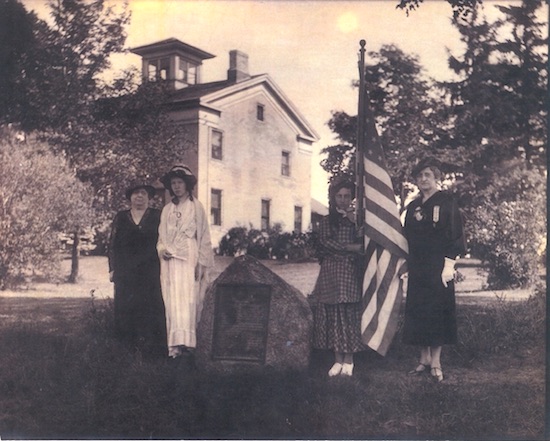
The John Proctor House is seen here in this image from October 12, 1935 on the day of the dedication of the historic marker to honor Proctor. Katherine Rowley, first Orleans County Historian, is on the far left. This is probably the last photo of her, as she passed away three days later. Next to Miss Rowley is Barbara Balcom, and the girl holding the flag is Elda Barnum, both great-great-grandnieces of John Proctor. The woman at the far right is Grace Bliss, then Regent of the Orleans Chapter, D.A.R. The historic marker, seen here, was originally placed on the west side of the Proctor House. About 15 years ago, the marker was moved to the east side in order to make it more visible to the public.
In 2018, Adrienne said she got her “dream job.” She was appointed to be Town of Gaines Historian. The job itself is part time, but it allows her to pursue her love for local history and still take care of her young family, who need her help with homeschooling and much more. While on the job, she has really enjoyed exploring the community’s connection to abolition. She said, “There are many primary documents. It’s like solving a mystery!” Adrienne is particularly interested in the Robert Anderson papers. She said, “Anderson was a possible Liberty Party candidate for Lt Governor in 1848.”
Adrienne said she enjoys her role as Historian, because it allows her time to write. “The town has been very fortunate that it has had historians who like to write, like Cary and Bill Lattin, Howard Pratt, Dee Robinson, and Al Capurso.” She said she finds their historical research and writing fascinating. Adrienne reflected, “Cary Lattin and J. Howard Pratt used to enjoy some friendly rivalry when it came to history. Mr. Pratt would say, ‘My family came to America on the Mayflower,’ and Grandpa would reply, ‘Well one of my ancestors was Native American, so who was here first!’”
Adrienne also explained that as Gaines Historian, she is glad she has been able to digitize many old records. “I’ve been working on the Congregational Church records. The Church recently re-discovered some of their old records. It’s helping me a lot with my research on abolition. Many churches split at that time over the subject of slavery.” Adrienne shared, “Even after 46 years, I’m still learning new things I hadn’t known about.”
Adrienne’s advice to everyone: “Write things down. Put names on the back of pictures. Write down the family stories. If you don’t, so much history is lost forever.”
Bill Lattin couldn’t be prouder of both of his children, Adrienne who serves as Town of Gaines Historian and Allison who works in Albany with the NYS Office of Parks, Recreation and Historic Preservation. History was certainly in Bill’s blood, too. His father, Cary Lattin, served as Orleans County Historian from 1957-1975.
Cary lived in a cobblestone house on Gaines Basin Road that was built in 1842. Four generations of Lattins have now lived in that house, culminating in Bill’s occupancy. Cary enjoyed a membership in the Sons of the American Revolution, a lineage based organization whose members all descend from Revolutionary War patriots. Cary got started in the job of County Historian, following the death of his friend, Joe Achilles, who served in that role before him. Cary became the fourth person to serve in the role of Orleans County Historian, following in the footsteps of Katherine Rowley, then by Theta Brown and Joe Achilles.
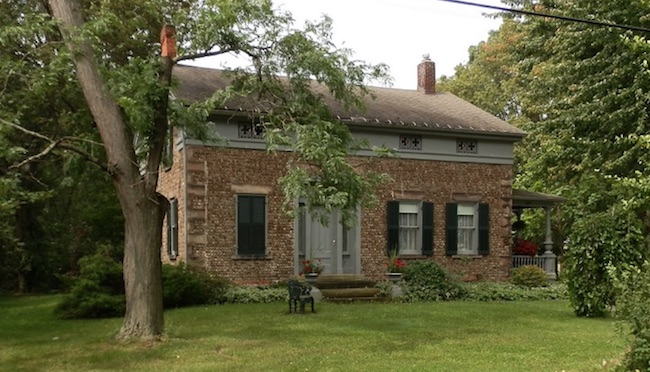
Owning a cobblestone home is a good start on becoming an “historian.” Most anyone who has owned a cobblestone home will tell you it’s a love-hate relationship. They love the history, character, beauty and charm, and also dislike the cold winters, hot summers, and continual need for vigilance with the historic mortar. Cobblestone home owners enjoy telling others about the history of their residence. The next logical step is telling the story of the community and families where your house is located. So, the next thing you know, you’re a historian.
Cary Lattin used his time in “office” to write a weekly column entitled, “Out of the Past,” that was printed in several local newspapers. Early in his appointment as County Historian, he became involved with a group of men and women, largely led by history teacher, Robert Frasch, who formed a grass-roots group to explore and do something about the increasing decay and destruction of 19th century cobblestone buildings.
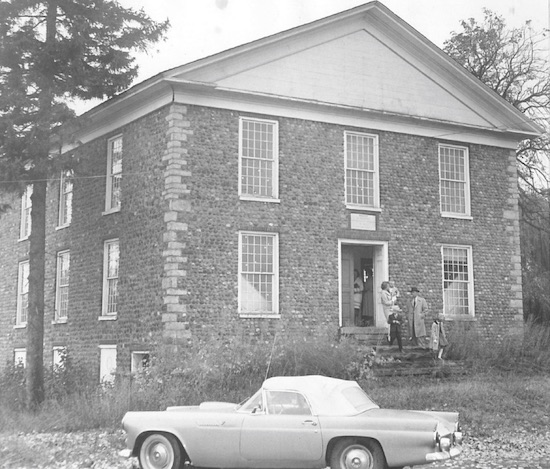
The group’s initial interest was the former Cobblestone Universalist Church in Childs. Weekly services in the church had ended about 70 years earlier. The church is seen here in this 1960 view, prior to restoration. Note the iconic church tower is missing; it was torn off the building in 1919 and wasn’t replaced until 1964.
At the time of this photo, the lower level of the church was being used to store cabbage, the roof was deteriorated, windows broken, terrace missing, and the historic mortar pointing was in rough shape. Without a doubt, the building was destined for destruction without a concerted effort to save it.
Cary Lattin and Robert Frasch joined with the others to create the necessary momentum, and the Cobblestone Society was formed in 1960. He served on the first board of directors, a role he held for many years.
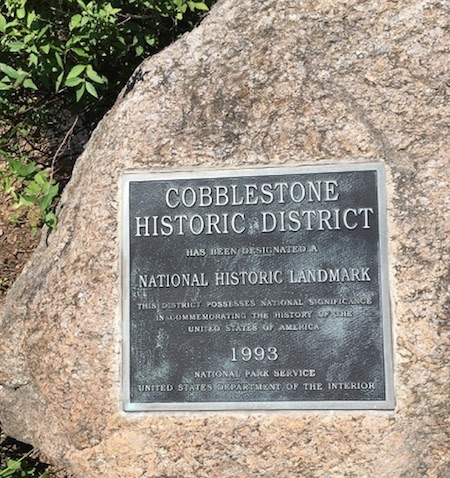
Over the ensuing years, the Cobblestone Society grew in size and mission to save other local cobblestone buildings which in 1993, became the basis for designation as the Cobblestone National Historic Landmark District. This national recognition honors select properties that not only demonstrate an importance to local history, but also tell a story important to the history of our nation.
Cary Lattin was followed in his role as County Historian by Arden McCallister who became the county’s fifth County Historian. Cary’s son, Bill, picked up the torch for historical preservation, too. He lives in the family’s cobblestone house, and accepted a part time job as curator of the Cobblestone Museum in 1971, later expanded to full time. It was a job he held for 40 years, until 2010. During that period, he followed in his father’s footsteps as Orleans County Historian in 1979, and served in that role for 35 years until 2014.
Matt Ballard followed Bill as County Historian and Catherine Cooper followed Matt, becoming the eighth County Historian in the county’s history.
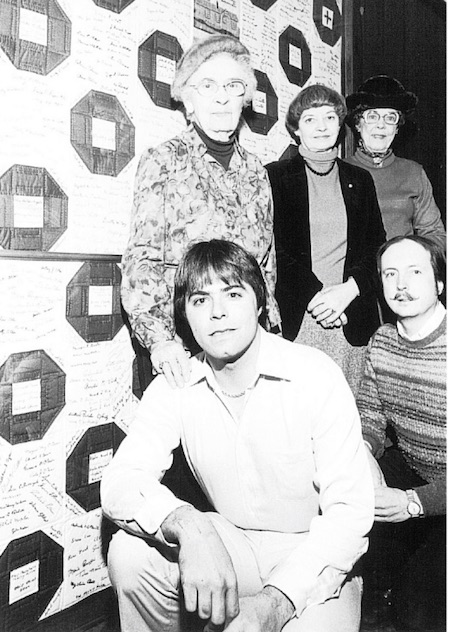
An attempt to list all of Bill Lattin’s activities and accomplishments in the field of historic preservation would be a challenge for sure, if not impossible. Suffice it to say, we will scratch the surface. Here we see Bill (lower right), beside Mark Tillman, in 1983, with the Signature Quilt that was mounted for display at the Village Inn. Behind the men are (left to right) Josephine Howard, Beverly Leigh and Marcia Hart who were in charge of embroidering over 700 names on the quilt. The quilt and its collection of signatures of local individuals from the past is still on display at Tillman’s.
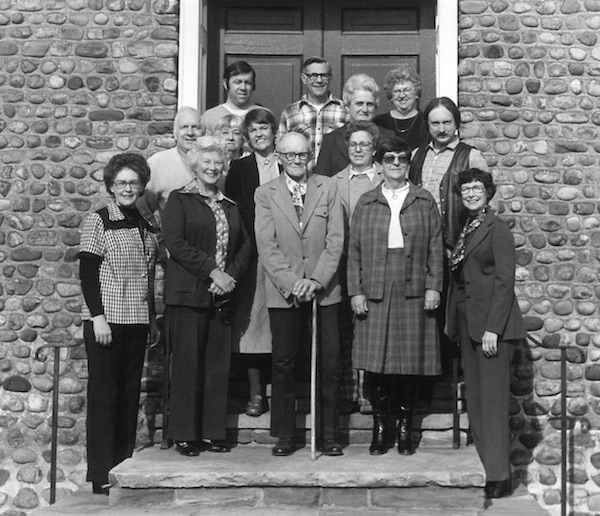
Bill enjoyed the many years of fellowship with other historians, and the thousands of visitors he greeted at the Cobblestone Museum complex, seen here with the Orleans County Municipal Historians circa 1982.
Those present included: Front row (Left to Right): Dee Robinson, Gaines Deputy Historian; Ceil White, Medina Historian; Virginia Cooper, Yates & Lyndonville Historian; Helen McAllister. Second Row: Arden McAllister, Orleans County Historian retired; Eleanor Wilder, Village of Albion Historian; Betsey Hoffman, Carlton Historian; Alice Zacher, Shelby Historian; Bill Lattin, Orleans County Historian. Back Row: Alan Isselhard, Clarendon Historian; Frank Berger, Orleans County Legislator; Evelyn Allen, Ridgeway Historian; Helen Mathes, Barre Historian.
In reflecting on his role at the Museum, Bill said, “I guess I am most thankful that I was able to inspire the Museum Board to look beyond the status quo, and accept a greater mission that led to the creation of the museum’s Route 98 campus of buildings.”
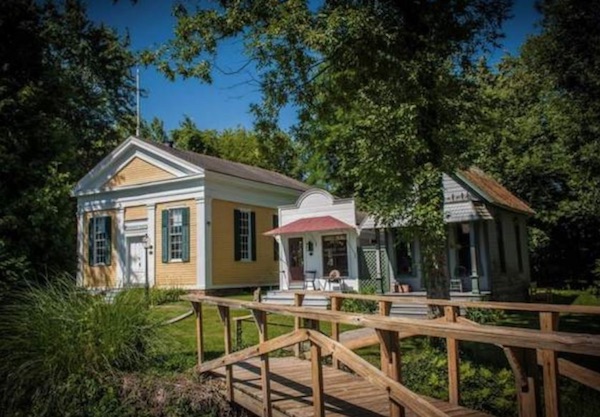
That campus started with the acquisition of the Joseph Vagg Blacksmith shop at the corner in 1975, and grew to include the Print Shop, Harness Shop and Farmers Hall. The latter being the old Kendall Universalist Church (and Town Hall) that was disassembled and moved to the museum, board by board, to be reassembled by Bill and three part-time, unskilled, CETA workers in 1975. Most would describe it as a Herculean task. Bill said recently, “If I knew then what I know now, I wouldn’t have started!” The Cobblestone Board went on to dedicate that structure in Bill’s name when he retired as Museum Director in 2010.
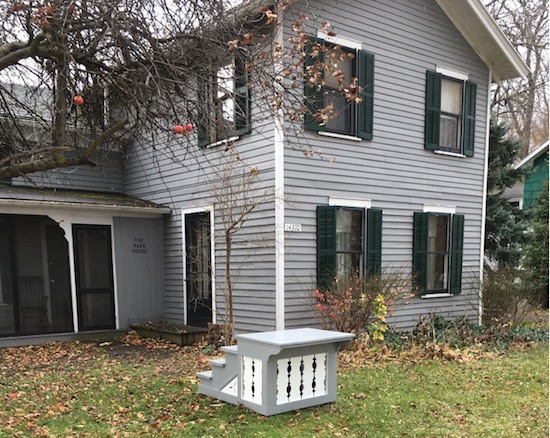
Even after Bill’s tenure as Museum Curator/Director ended, he remained actively involved in historical preservation in Childs. He continues to serve on the Museum’s Board, and assisted in the actuation of the Vagg House in 2020, a “John Proctor Era” home, that was once the residence of blacksmith Joseph Vagg and his wife, Nellie.
Nellie was well known for her organizing efforts regarding the Temperance Movement. The home is now interpreting life in the 1920s and is available for public tours. In the photo of the Vagg House, we see a replica 19th century carriage stand that Bill researched and built using a period photograph in his collection as a guide.
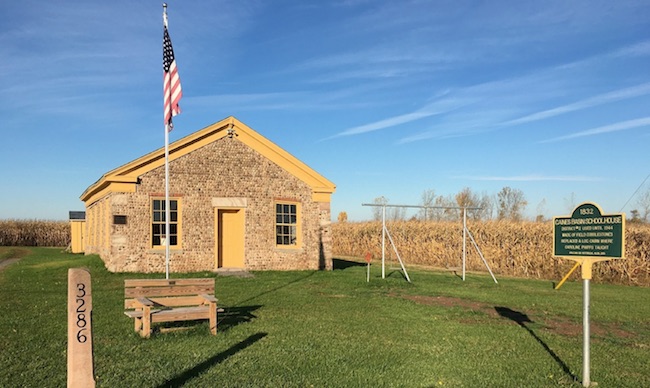
Bill also serves as Vice-President of Orleans County Historical Association (OCHA), a group that recently completely restored the county’s oldest cobblestone building, Gaines District #2 Schoolhouse, built in 1832. The Association also moved an early 20th century replica of a 19th century pioneer log cabin to their site on Gaines Basin Road, within eyesight of the northernmost point on the Erie Canal.
Even while completely dedicated to historic preservation tasks, Bill found time for public service, having served, over the years, as Town of Gaines Councilman and Town Supervisor. He also was named a “Heritage Hero” in April 2014 by Genesee Community College and Orleans Hub for a lifetime of working to preserve and promote the county’s history.
As County Historian, Bill, like his father before him, enjoyed writing a weekly newspaper column, Bill’s articles were entitled, “Bethinking of Old Orleans.” Bill said, “I wrote an article, every week, for 35 years.” By anyone’s standards, this is an impressive achievement.
40-foot-high obelisk was planned for Courthouse Square
By Catherine Cooper, Orleans County Historian
“Illuminating Orleans” – Volume 1, No. 9
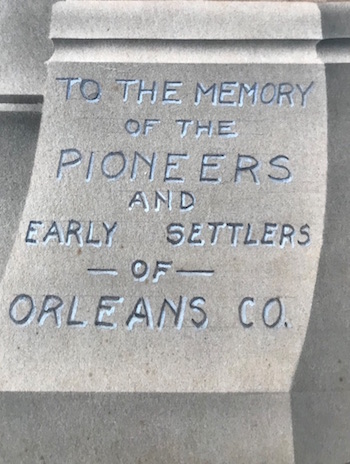
ALBION – A recent reference question brought this impressive design to light. This image of a towering 40-foot obelisk was one of several submissions under discussion in 1912 for a proposed monument in memory of the Pioneers of Orleans County which was to be erected in Albion at the Courthouse Square.
The Orleans County Pioneer Association was formed in 1859 “to preserve and perpetuate the remembrance of interesting facts connected with the early history of the settlement of Orleans County” and to pay tribute to the settlers who could ”recollect when here was nothing but a dark, unbroken wilderness.”
In June 1910, in anticipation of the upcoming centenary of the original settlement of the county, the Pioneer Association appointed a committee to take charge of the formation of the Orleans County Pioneers Monument Association which would be charged to raise $3,000 to erect a suitable monument in memory of the pioneers.
At a special meeting of the Orleans County Pioneer Association held on Feb. 23, 1911, President John Bidleman was authorized to get approval from the Legislature to erect the monument on the County Courthouse Square. He was also instructed to “secure assistants in the towns to circulate subscription papers among the families of the pioneers for funding the monument.”
The Medina Daily Journal of July 10, 1911 reports the appointment of the following as committee members of the Orleans County Pioneers’ Monument Association: President: Dr. R.W. Bamber, Two Bridges, Supervisor: Daniel D. Daum, Clarendon, Vice-President: Dr. John A. Hartman, Albion, Secretary: Harry E. Colburn, Albion.
It was noted that Dr. Bamber would try to raise $10,000 for the project.
On July 20, 1911, a committee was formed to obtain designs and an estimate of costs. Members included Irving L’Hommedieu of Medina, Lafayette H. Beach of Albion, Jacob Tillis of Gaines, Harry Wellman of Kendall and Dr. W.R. Bamber of Carlton.
A meeting was held on November 23, 1911 to inspect the designs. “Several prominent monument manufacturing concerns and some noted sculptors appeared before the committee and presented miniature models” (Medina Tribune). The cost of the models presented ranged from $3,000 to $15,000. It was reported that the committee hoped to secure a design for less than $10,000.
A final choice was made on December 17, 1911, according to the Democrat and Chronicle. The design, by sculptor Alfred Dreyfus of New York, was of a pioneer woodman in bronze, with long hair, bare-headed, sleeves rolled to elbows, long skin coat, with belt leather leggings, portrayed with uplifted axe, swinging it to chop a fallen log. The total height of the monument would be 18 feet and the cost $6,000.
However, the project did not come to fruition after all. There is no record available of how much money was actually gathered. And, it would seem that there was some dissension. The Medina Daily Journal of June 17, 1912 “decried the action of the Pioneer Association in opposing the Ridge Road Centennial” as “unfortunate.” The Centennial, planned for 1913, was to honor the State’s appropriation in 1813 of $5,000 for the improvements which made it “a great military and emigration highway.”
In actual fact, the two publications which chronicle the Association (Pioneer History of Orleans County, New York, by Arad Thomas and Record of the Orleans County Pioneer Association,) are more evocative than any monument, for they contain compelling first-hand accounts of the settlers’ early trials and tribulations.
They may be accessed at your favorite library or online at the following links: Pioneer History of Orleans County, New York (click here) and the Record of the Orleans County Pioneer Association (click here).
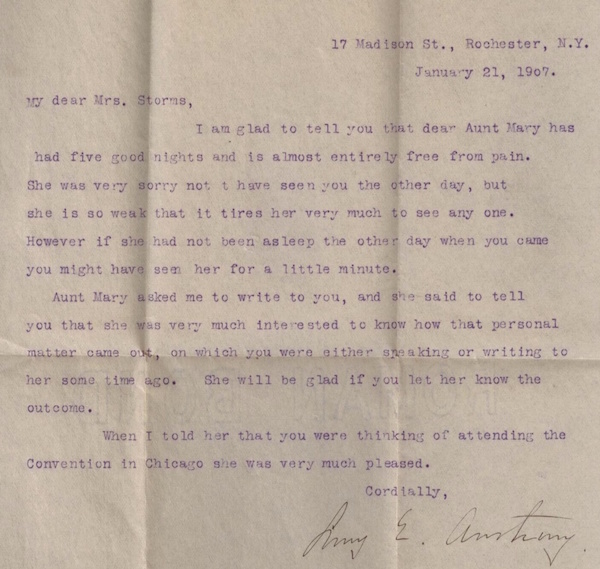
HOLLEY – A box of documents and letters in the Orleans County Department of History collection has yielded several treasures. The contents pertain to the Storms and Stierer families from Holley.
The envelope shown above, postmarked January 2, 1907 from the National-American Woman Suffrage Association in Rochester, caught our attention:
And inside – a treasure indeed! A letter, signed by Lucy E. Anthony, explaining that her “Aunt Mary” had been unwell when Mrs. Storms came to discuss a “personal matter”. Of course we were intrigued! The search was on.
“Aunt Mary” was Mary Stafford Anthony, younger sister of Susan B. Anthony. Mary S. was actively involved in suffrage in her own right. She worked as a teacher and principal at Rochester area schools. She supported Susan B. Anthony’s campaigns financially, lived with Susan B. at 17 Madison St., managed the household and cared for several family members as well.
Mary S. was instrumental in establishing the concept of the Political Equality Club, a local forum for both men and women to discuss the ethical concerns of the day and promote the goal of women’s suffrage. There were active clubs throughout the state, including one in Holley.
The time frame of this letter is of interest. Dated Jan. 21, 1907, it was just a short while before Mary S. Anthony’s death on February 5, at the age of 80. On her deathbed, she composed a message for the Feb. 14, 1907 Convention of the National American Woman Suffrage Association, “the Convention in Chicago” referred to in the letter. Mary S. was buried at Mount Hope Cemetery in Rochester, next to her sister, Susan B., who had died in 1906.
Lucy E. Anthony, who composed the letter, was a niece of Susan B. and Mary S. Anthony and cared for both of them. She became a secretary and companion to Anna Howard Shaw, later president of the National American Woman Suffrage Association.
The Anthony home at 17 Madison St. in Rochester was the headquarters of the National American Woman Suffrage Association while Susan B. Anthony was president. Sold in 1907, the home was later purchased by the Rochester Federation of Women’s Clubs and is now the National Susan B. Anthony Museum and House, open for scheduled visits.
And what of the recipient of the letter, Mrs. Clark Storms of Geddes St. in Holley? From census records (http://orleans.nygenweb.net/) and directories, we learn that Ida Storms lived at 91 Geddes St. in Holley. Her husband Clark was a retired farmer, they had a daughter, Millicent who married Lyell Storer. Ida died in 1927, Clark in 1928. They are buried at Hillside Cemetery.
Ida was a member of the Holley Political Activity Club, which is most likely the clue to the reason for her visit. As for that “personal matter” referred to and the outcome? Unless the other letters in the box shed some light, we may never know.


















 The recent article on the collection of outhouses at the Cobblestone Museum prompted us to consider the matter further.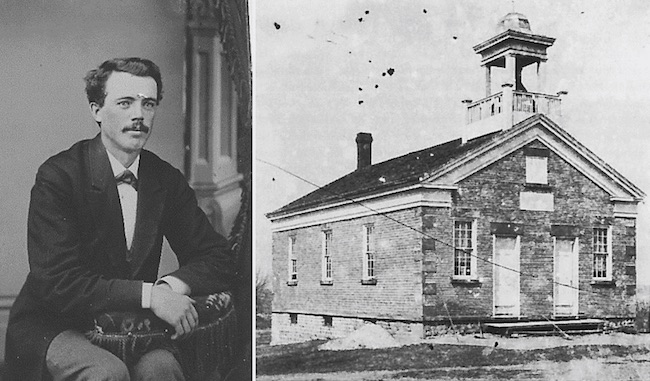
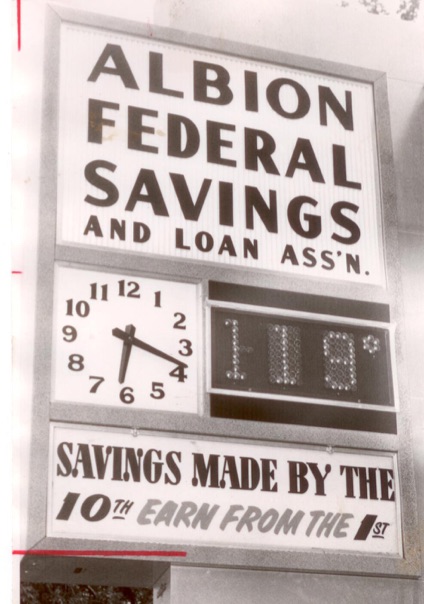 ALBION – Weather temperatures have been higher than “normal” of late, but not quite on par with the 119 degrees registered on the Albion Federal Savings and Loan Association sign in this undated photo from the William A. Monacelli photograph collection at the Orleans County Department of History.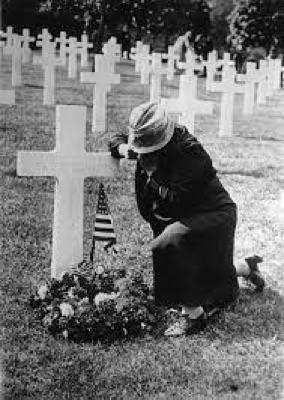
 All told, 6,654 women made the pilgrimage. They were to be allowed two weeks for the trip, all at government expense with an allocation of $840 each.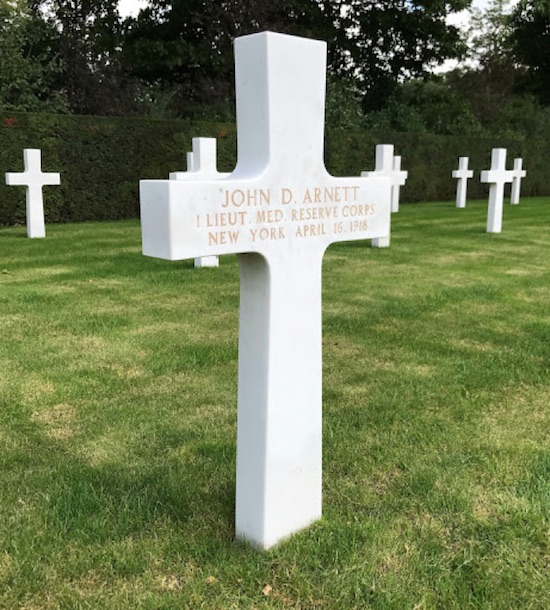

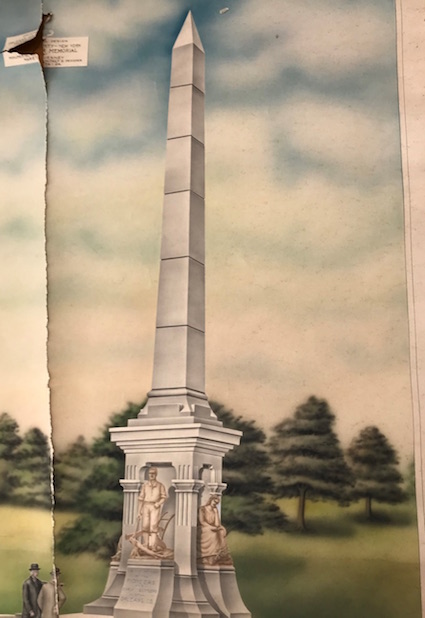 ALBION – A recent reference question brought this impressive design to light. This image of a towering 40-foot obelisk was one of several submissions under discussion in 1912 for a proposed monument in memory of the Pioneers of Orleans County which was to be erected in Albion at the Courthouse Square.
 A final choice was made on December 17, 1911, according to the Democrat and Chronicle. The design, by sculptor Alfred Dreyfus of New York, was of a pioneer woodman in bronze, with long hair, bare-headed, sleeves rolled to elbows, long skin coat, with belt leather leggings, portrayed with uplifted axe, swinging it to chop a fallen log. The total height of the monument would be 18 feet and the cost $6,000.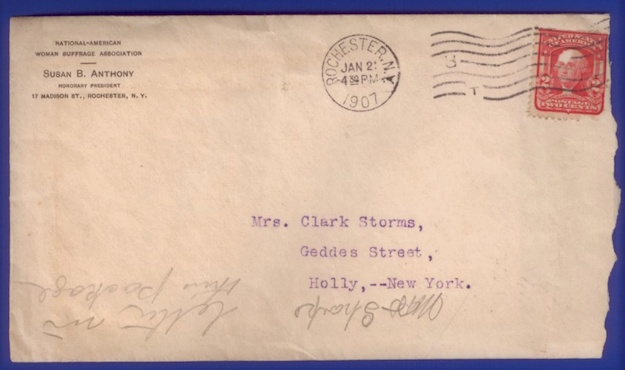
 HOLLEY – A box of documents and letters in the Orleans County Department of History collection has yielded several treasures. The contents pertain to the Storms and Stierer families from Holley.