By Tom Rivers, Editor Posted 7 February 2021 at 10:08 am
Photos courtesy of Kendall Lions Club
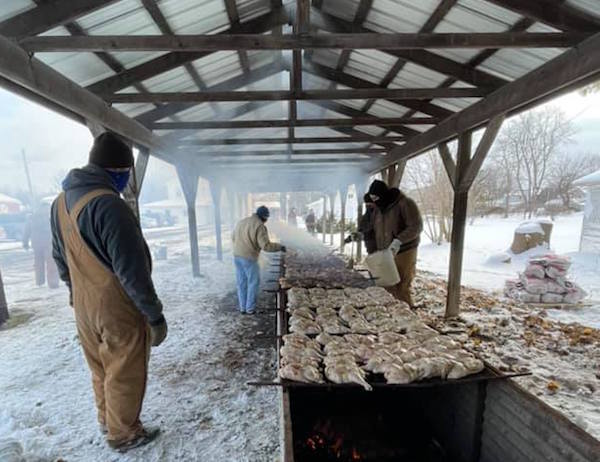
KENDALL – The Kendall Lions Club cooks chicken halves on Saturday during the club’s annual winter chicken barbecue.
The club served about 1,250 dinners. The event was take-out and drive-through only at the Kendall United Methodist Church.
Proceeds from the dinner will go to Stacy Lynaugh, a local resident battling cancer. The Lions Club does that every year with the dinner, using the funds to help a local resident with medical bills or another unexpected crisis.
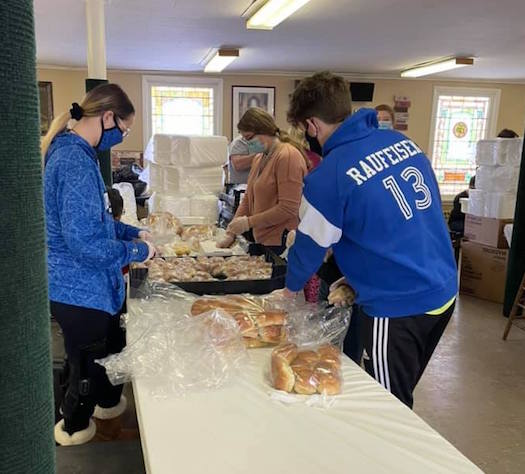
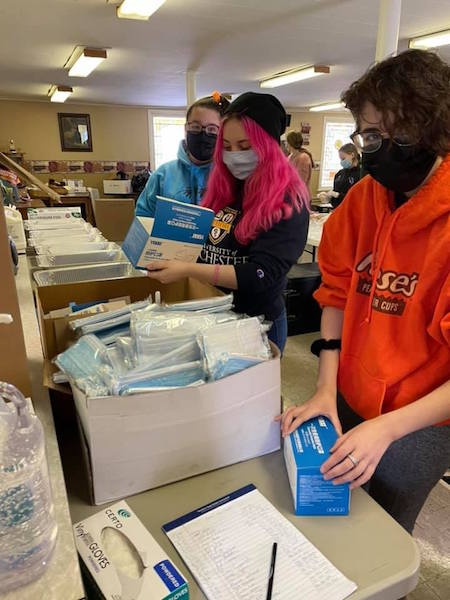
Kendall Lions and members of the Leos Club at the high school package the meals, which were delivered to vehicles who lined up at the church entrance off Crandall Avenue.
The Lions Club also prepped food for the big meal on Friday.
Kendall Leos assisted with the big effort on Saturday.
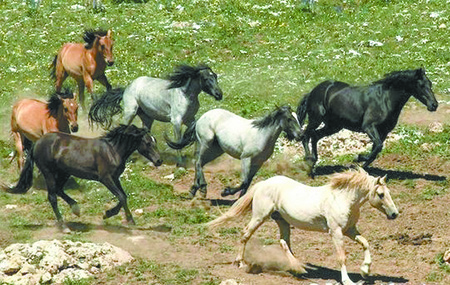
Have you ever seen wild horses in the wild? Not on TV, but truly running wild in a pack in the vastness of the meadows and mountains. On a trip out West, we headed to The Pryor Mountains in Montana. It was an exploration trip that stays with you. It was quite a drive out to the Pryor’s, but it was magical and awe-inspiring.
Being from Western NY the only horses I have seen are ones that have been broken. Kind of a defining term “broken”. Broken horses have shelter, warmth, guaranteed food, and hopefully love. But the life of a broken horse does not hold the freedom or spirit of a horse that is free to run. The unbroken horse controls its own path. It is tough and needs to self sustain, which is all empowering.
When a horse is broken it becomes dependent on another to care for it, keep it safe, make sure it survives. Those that feel secure in being dependent and crave being cared for will feel secure in the situation of the broken horse. But for those who crave freedom, self reliance and self control, the containment of the broken horse is not coveted. Freedom is at their core.
Breaking a horse and its wild spirit is a long process. Curious how one actually breaks a horse, I went to Google. First you must build trust because animals have an innate ability to sense when they are being threatened. If an animal senses their freedom is being taken away, it will resist. The person breaking the horse needs to show great patience. Interact with the horse daily, perhaps offer rewards for non resistance like giving the horse a carrot for submitting. Once the submission starts, the person breaking the horse will introduce the horse to the bridle, the bit, the ear piece, the saddle.
After much resistance the horse will begin to submit, even to the bit, which is most uncomfortable to a species that wants to run free. Once the breaking is underway the horse will need to be accustomed to the tightening of the girth and accept mounting of its trainer and finally give into the reins. It is quite a process to break a horse and broken horses have served wonderful purposes to those that utilize horses since the beginning of time. For war, for labor, for companionship. The broken horse is loved, no doubt. However the broken horse serves those who broke it and will never run away or be free.
Watching the horses in the Pryor’s and seeing how they run free and cautiously watch us with their soulful eyes as we drive in their “yard”, it is clear that freedom of any species is a beautiful thing to witness. If you ever have the opportunity to witness a wild and free horse, go to the Pryor’s. It is a vast space holding the unbroken spirit. It demonstrates the power and grit of survival by caring for oneself and protecting the herd. I aspire to be free like the unbridled horse and keep my spirit unbroken.
To see a Free Spirit Flying, visit My Blog live online (click here) and catch up on Weekly Photo Perks and past Sunday Posts. Like and share your comments.
By Tom Rivers, Editor Posted 6 February 2021 at 6:11 pm
Orleans County, however, has highest rate in Region
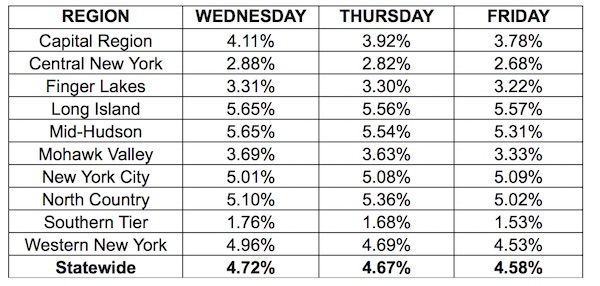
Information from Governor’s Office on seven-day positivity rate for the 10 regions of the state.
The Finger Lakes Region, which was a Covid hotspot in the state about a month ago, now has one of the lowest positivity rates in the state and has reduced the numbered of people hospitalized with Covid by more than half.
The Finger Lakes, which includes Orleans County, had a positivity rate for Covid-19 at 10.29 percent on Jan. 5. That was the seven-day average for percentage of tests that were positive for Covid.
The 7-day average was down to 3.22 percent on Friday, the third lowest of 10 regions in the state. The Southern Tier at 1.53 percent is the lowest and Long Island, at 5.57 percent, is the highest.
Statewide the 7-day positivity average ending Friday was at 4.58 percent, according to data from Gov. Andrew Cuomo’s Office.
Although the positivity rate in the Finger Lakes Region is at 3.2 percent over the last 7 days, in Orleans County it’s at 7.2 percent the past week, the highest of the nine counties in the region.
The rates for the other counties include Genesee, 2.9 percent; Livingston, 5.8 percent; Monroe, 2.8 percent; Ontario, 3.3 percent; Seneca, 3.0 percent; Wayne, 3.2 percent; Wyoming, 6.1 percent; and Yates, 4.4 percent.
The Finger Lakes also led the state on Jan. 5 with the highest percentage of its population hospitalized due to Covid at 0.08 percent, which was double the state average. The Finger Lakes had 934 residents hospitalized with Covid on Jan. 5. A month later the region had 448 hospitalized with Covid or 0.04 percent of its population.
New York on Friday had 7,804 patients hospitalized statewide with Covid, the lowest since Dec. 27, Cuomo said.
There were 11,252 new Covid cases out of 261,285 tests, for a positivity rate of 4.31 percent. The state has now had 1,460,747 individuals test positive for Covid during the pandemic.
Cuomo also reported there were 158 more deaths from Covid, including one each in Orleans and Genesee counties. The state is now reporting 36,079 total deaths from Covid during the pandemic.
“New York’s positivity and hospitalization numbers continue to decline from the holiday surge, a reflection of the discipline New Yorkers have shown to defeat the virus,” Cuomo said in a statement. “The ultimate weapon to win the war is the vaccine and we are getting needles into arms every day, but we need more supply because we have the operational capacity to do much more. Super Bowl weekend is here and while the instinct may be to celebrate together, we cannot get cocky – we must continue doing the things we know are effective at taming the virus: wear a mask, adhere to social distancing, and avoid gatherings. We can beat this thing, but we must stay smart.”
LEWISTON – A 16-year-old girl was killed after striking a tree at the bottom of a hill while sledding at a park in Lewiston, the Niagara County Sheriff’s Office reported.
The Niagara County Sheriff’s Office Dispatch Center was called at 10:14 a.m. with a 911 reporting the accident on the sledding hill at the Clyde L. Burmaster Park in the Town of Lewiston.
Responding members of the Town of Lewiston Police Department and Niagara County Sheriff’s Office located and confirmed two injured parties, the 16-year-old girl and a 3-year-old boy. They were riding a sledding tube.
Members of the Pekin Fire Company and Tri Community Ambulance responded to the scene to render aid. The two were then transported by ambulance to the John R. Oishei Children’s Hospital in Buffalo for treatment.
Subsequent to arrival at the hospital, the girl was pronounced deceased due to her injuries. The boy was treated and released, the Sheriff’s Office stated in a news release.
The incident is under investigation by the Town of Lewiston Police Department and the Niagara County Sheriff’s Office. The sledding hill at the Clyde L. Burmaster Park is closed at this time.
By Tom Rivers, Editor Posted 6 February 2021 at 3:13 pm
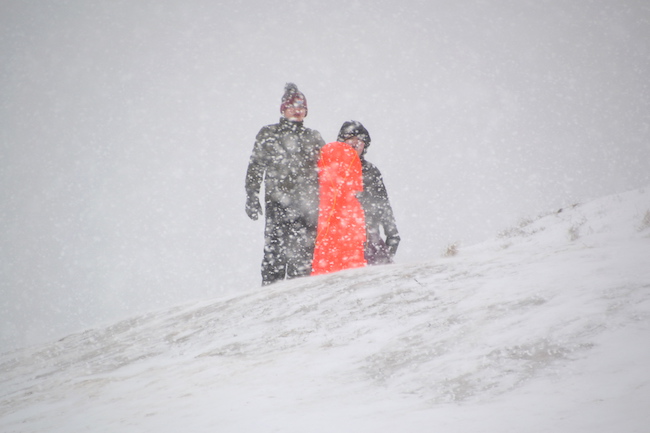
Photos by Tom Rivers: Two friends make it to the top of the Bullard Park sledding hill in Albion at about 2 p.m. today. The hill was icy and fast.
After a fairly easy winter locally through mid-January, the cold and snow have been steady in recent weeks. Today was one of the harshest winter days this year.
It’s in the low 20s, with blowing snow and gusty wind. Orleans County is forecast for several inches of snow today, particularly south of Route 104.
It could be worse. Parts of Genesee County, including Batavia and Le Roy, already had a foot of fresh snow by early afternoon.
In Orleans County, a winter weather advisory is in effect until 10 tonight. The National Weather Service in Buffalo at about 1 p.m. said 3 to 5 more inches of snow could fall today “in the most persistent lake snows.”
The winds gusting as high as 40 miles per hour will produce blowing and drifting snow, the Weather Service said.
Sunday is forecast for a high of 26 degrees in Orleans County with another inch of snow possible. Monday is forecast for a high of 22. It will partly sunny with snow showers possible in the afternoon.
A basketball hoop at Bullard Park manages to stand out in the snow early this afternoon. Part of the splash park is visible in the background.
New record highs for Northern Saw-whet Owl, Common Raven, Brown Creeper, Carolina Wren, Winter Wren and European Starling
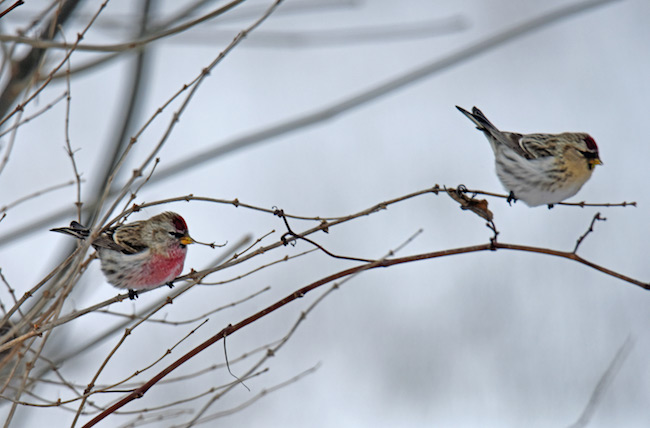
Photo by Celeste Morien: This photo of a Common Redpolls was not taken on count day of Dec. 28, which was very windy.
By Celeste Morien, Count Compiler for Oak Orchard Swamp Christmas Bird Count
SHELBY – The numbers are in and it was another successful Oak Orchard Swamp Christmas Bird Count.
On Dec. 28, 31 volunteers participated in the 53rd annual Oak Orchard Swamp Christmas Bird Count. The National Audubon Society, in collaboration with the U.S. Fish and Wildlife Service, sponsor Christmas Bird Counts annually throughout the country and beyond in the Americas. Each count consists of a tally of all birds seen within a 15-mile diameter circle on one day during a 15-day period at the end of December and the beginning of January. Audubon Christmas Counts provide valuable information on the range expansion or narrowing of wintering bird populations and have been taking place for 120 years.
The Oak Orchard Swamp Count Circle
The circle center for the Oak Orchard count is the point at which the Genesee-Orleans County line crosses Route 63. The 15-mile diameter circle includes the Iroquois National Wildlife Refuge, Oak Orchard and Tonawanda State Wildlife Management Areas, the Tonawanda/Seneca Native American Reservation, the Townships of Alabama and Shelby, the villages of Indian Falls, Medina and Wolcottsville and portions of Middleport and Oakfield.
Weather Factors
Weather can make or break the day for our observers, but we forge ahead! Count hours were cold and wet, with a low of 27F and high of 39F. The early morning began with rain and winds from the south at 11 MPH, which then began gusting throughout the afternoon from the WSW at 16 -21 MPH, making the temperatures essentially feel 10 degrees colder. By afternoon, birding was essentially precipitation free. Late morning and afternoon visibility was good.
Observers
Our 31 intrepid observers went afield in 23 parties from 6:15 a.m. until 6:45 p.m. These folks volunteer to attend from as far away as Rochester and Buffalo, and even with the Covid-19 restrictions in place, persevered in their determination to ensure that the 2020 count would become another accurate contribution in the collection of scientific information about wintering bird populations.
In 106.25 total hours, observers covered 25.75 miles on foot and 535.5 miles by car, which included 37 hours on foot and 69.25 hours by car! Two observers counted birds at home feeders. Participants also clocked 9 nocturnal hours and 39.25 miles searching for owls.
In total, these awesome observers tallied 73 species and 20,843 individual birds! As the compiler, I say thank you all and thank you again to Douglas Beattie, Elaine Dart, Don Bemont, Daniel Rosentreter, Thomas Morien, Garner Light, Judy Light, Rory Kuczek, Paul Hess, Kathryn Brenner, Janie Mellas, Robert Buckert, Jules Wagner, Greg Lawrence, William Wolanske, Denise Appleby, Pat Martin, Kim Hartquist, Bev Seyler, Bob DeLeon, Jennifer Caughel, Donna DeLeon, Emma DeLeon, Mike Vickner, Mike Galas, Gerry Rising, Chuck Mitchell, Heidi Kennedy, Tad Gerace, Christopher Hollister and Iroquois NWR and the NYS DEC.
Winter Diversity
Counters commented on good diversity overall with a few exceptions, such as the lack of waterfowl in the region because of the freeze in early December. Still, we had all three swan species and a smattering of waterfowl. Lack of snow cover on the ground and heavy winds made finding birds at roadside difficult, but there were birds to be found for those who had the opportunity and spent time walking. With a total lack of snow cover, participants reported that birds were difficult to see in fields and were not present at the roadsides. Wished-for irruptive species (those that visit in winter from the boreal forest when cone crops there are low) such as Evening and Pine Grosbeak were not found although they have been seen in other areas of the state, and even in our circle this fall. Irruptive species we did find: a few Pine Siskins, Common Redpolls, which have shown a recent uptick and Red-breasted Nuthatches.
Highs and Lows
Notable highest counts ever: Northern Saw-whet Owl, Common Raven, Brown Creeper, Carolina Wren, Winter Wren and European Starling.
Gerry Rising found the Saw-whet Owls and stated he’d never had an experience quite like this one in his many years of watching birds. Both owls flew out of conifers in response to a recording played in the early morning.
Common Ravens are increasing their presence in the Great Lake plains area, resulting in a total of five of these fascinating and intelligent corvids on count day. Fox Sparrow was the single “new to the count” species this year; Janie Mellas, one of our many sharp-eyed participants, found it lingering on the Iroquois Refuge. A single Red-winged Blackbird was recorded as a new low count. Count week birds seen in the three days before or after the count date, but not on the actual count date, were Sandhill Crane and Northern Pintail.
The Friends of Iroquois, Inc. usually sponsor our evening refreshments at the refuge, but because of the Covid-19 pandemic that was not possible. The INWR Staff was still able to contribute time and effort in covering the refuge areas. The NYS DEC staff also volunteered to report birds while on duty and conducted their winter raptor survey on count afternoon. Many thanks go out to everyone who participated! A list of species follows.
The 2021 Count
We rely on volunteer support every year to continue this important tradition. I might add that for next year, I welcome any homeowner in the circle who wants to count birds at their feeding station to contact me through the NYS Ornithological Association (NYSOA) or Buffalo Ornithological Society websites two weeks before the count. We also welcome permission for counters to access any private property trails or field edges within the circle for walking.
Look for the count date to be announced by mid-November and please put us on your calendar!
A list of species observed at the 2020 count includes (The asterisk represents an all-time high):
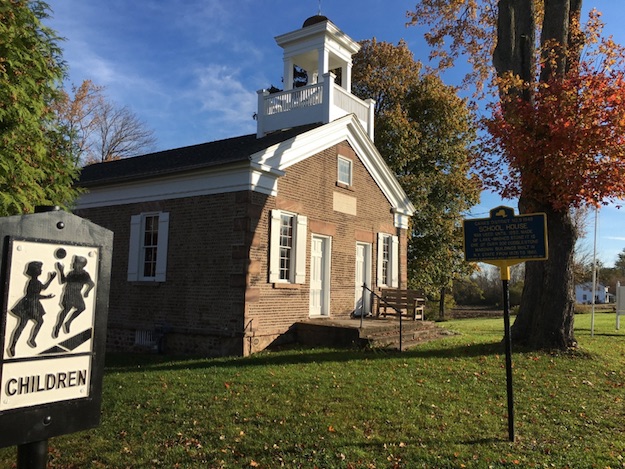
Note from Doug Farley, Cobblestone Museum Director: We are pleased to present this autobiographical essay written by Nancy Jane Wilson Berger (1935-2015). Nancy spent her childhood living in a cobblestone house near and attending the Cobblestone District #5 Schoolhouse in the Hamlet of Childs. We are very grateful to Nancy’s husband, Frank Berger, for sharing this wonderful retelling of Nancy’s childhood memories.
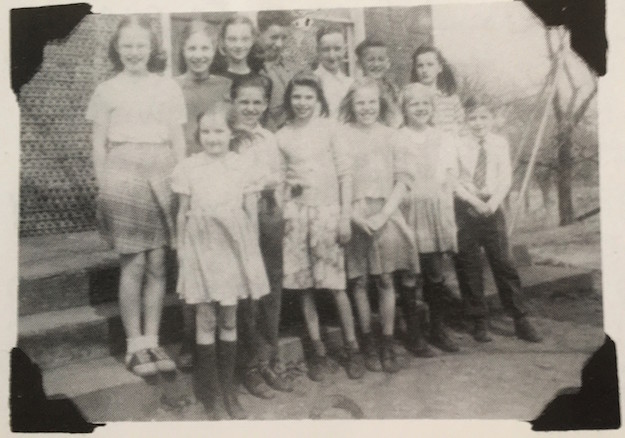
School District #5 in 1946 – Phoebe Beales, Teacher. (Front Row, from left) Nancy Covis, William Covis, Evelyn Becker, Edna Becker, Kathleen Covis and Alan Kidder. (Back Row, from left) Sandra Kidder, Marjorie Becker, Nancy Wilson, Walter Klatt, Edward Janus, Daniel Janus and Laura Klatt.
By Nancy Jane Wilson Berger
I wondered why my mother had tears in her eyes when I left for school for the first time. It was a typical fall day and one that I had been looking forward to for some time. I had reached the ripe old age of six and thought I was pretty well grown up to be able to go to school with the rest of my friends.
It was Gaines District #5, a country school located on Route 104 commonly called the Ridge Road. A one-room country school with grades 1 through 7, one teacher with a visiting music teacher, a religious education teacher, and even a very old retired physician who came once a year to give us a physical exam.
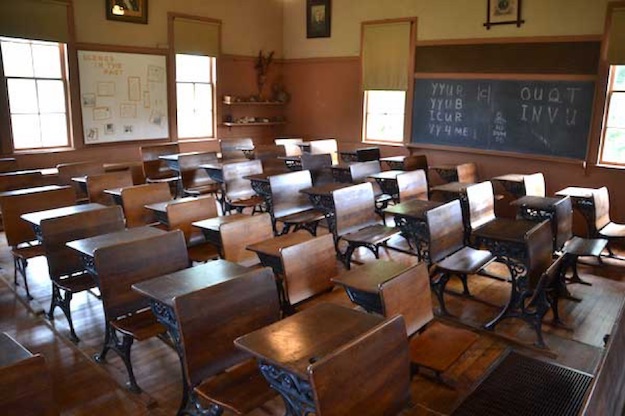
It was a typical one-room schoolhouse with rows of desks running parallel with each other. They grew in size as the children grew – thus the small ones were to the left and they got progressively larger as the rows went to the right. We could hardly wait until we were big enough to sit in the “special” desks. These were separate units with swivel seats and the tops opened up so that you could see what was inside. A student had to earn the right to claim one of these seats as their own.
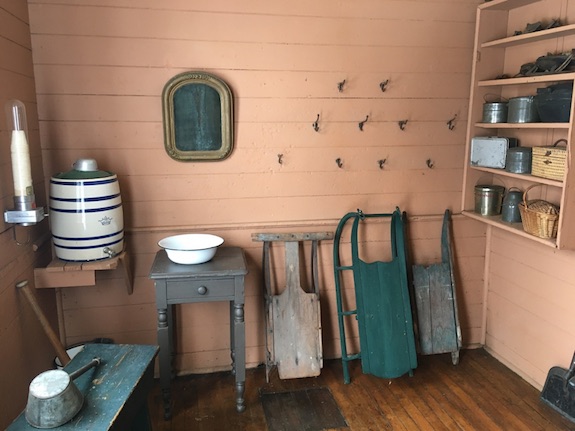
The front door opened into the entry. There was a “U” shaped coat rack supplied with plenty of hangers. To the left of that was a series of shelves which held lunchboxes, etc. On the front wall, next to the door was a shelf with a sink and a clay water-cooler. Perpendicular to that was a bench which helped in the removal of boots and which provided storage space underneath for these. To the right was the door to the basement which housed a mammoth old coal furnace, a huge coal bin and a multitude of other things that we were never brave enough to explore.
The furnace, however, was something of a monster which seemed to have a life of its own. Many a morning throughout the seven years that I attended this house of learning, we were met at the door by our teacher who told us to return home because the coal gas was so strong we surely would have been overcome. No one knew exactly why this happened, but I think that occasionally this mysterious hulk decided that it needed a day of quiet and no children’s footsteps overhead to give it a headache so it spewed forth this nauseous gas like an octopus spitting out its “ink” to scare away predators. At any rate, the opening of windows and some sort of magic performed by the teacher would usually bring this problem to its knees and we would be back to normal by noon.
Occasionally, instead of nauseous gas it decided to try smoke. Sometimes it would be so thick you couldn’t see more than three feet away. Another vacation! However, it did have its good points. Besides keeping us warm and cozy it provided an oven for baking potatoes. Teacher would place whole potatoes just inside the furnace door on a little shelf and by noon we had yummy baked potatoes for lunch. I don’t think baked potatoes have ever tasted that good since.
So, you see, we didn’t have snow-days like they do today. We had smoke and gas days! We did have a snow day sometimes, but they were few and far between. Because we provided our own transportation which was usually by foot, if we could plow through the snow we went to school. If we couldn’t, we stayed home.
At the opposite end of the front of the school was the library, which also served as a whipping room. Yes, back in those days we got a good spanking if we didn’t behave. I was lucky enough to never get one. (I was such a good little girl.) However, I did get reprimanded more than once for talking or laughing. I was usually lucky enough to blame it on my friend Ed Janus who, more than once was taken to the whipping room and got his seat tanned!
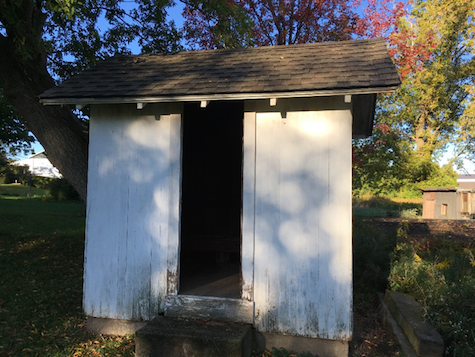
The “bathrooms” were small buildings – one for the girls and one for the boys – behind the school with privacy fences a few feet from the doors. If we needed to go visit the privy (as it was called) we had to raise our hand and when we were given permission to go, we had to put our initials on a small blackboard at the front of the room because only one person could go at a time. I have some stories about the “privies” also.
We had a boy in school whose name was Walter. Walter took it upon himself to teach the boys about the anatomy of the opposite sex. It seems that he had found some magazines called “Sunshine and Health” which was published by the nudists. In it were many pictures (uncensored) of nudists playing volley ball, tennis, and just lounging in the sun. So one day Walter decided to hang some of these pictures on the wall of the boys’ privy providing his own little art show of sorts. There seemed to be a steady stream of boys using the privy that day!
Also attending school was a small boy named Vernon. Now Vernon had a habit of stuttering when he got excited. This particular day Vernon hadn’t heard about the “d’art exhibit” in the boys’ privy and hadn’t had the call to visit it until afternoon. Vernon raised his hand and was given permission to go. He signed his initials and left. In less time than it takes to shake a stick twice, Vernon came running back into the room yelling “T-t-t-teacher! Th-th-th-there’s p-p-p-pictures of b-b-b-bare naked w-w-w-women in the p-p-p-privy!”
Our teacher, Miss McAllister, didn’t have much of a sense of humor. After she calmed Vernon down, she picked up her switch and holding it in her right hand and smacking it lightly against the palm of her left hand, she paced back and forth in silence in front of the students studying the faces of the boys. Sure enough – Walter was looking guilty as sin. She asked him if he knew anything about these pictures. He admitted he did and was taken for a short walk to the whipping room. He and the teacher returned to the classroom, one smiling, one not. Guess which was which!
Now I had another use for the privy. I was a rather timid little girl and when anything was about to transpire that I wasn’t sure about, I would ask permission to go to the privy, sign out and head for home. One such instance was the first time that good old Dr. Burbank came to examine us. He was a round roly-poly elderly man with little round glasses that didn’t quite make it to the correct spot on his nose that would make it easier to see, so he had to tip his head up to see through them or down to see over them. He had very little hair and what he had was white. He was hard of hearing and despite his glasses could not see very well either. He spoke in mumbles with a lot of “hammphs.”
Well, I had never seen a man like him before and I didn’t have a clue what a physical examination was, but I decided not to take any chances. I got permission to go to the privy, signed out and hightailed it for home and as fast as my long skinny legs could go. I arrived home yelling – my mother probably thought I had been beaten! When I explained that I didn’t want a physical ‘zamination, she laughed and assured me that I would live through it and promptly escorted me back to school. The teacher wondered why she was there because this all transpired in no longer a time than it would have taken me in the privy. Dr. Burbank thought the whole affair was quite humorous and Mom stayed while I was being ‘zamined!
Dr. Burbank was a very frugal physician. He did not want to waste tongue depressors, so decided it would not do any harm to use the same one on each child. Miss McAllister, on the other hand, did not agree with him. After a short dissertation between the two of them, they arrived at a solution. The tongue depressors were sawed in half thus satisfying both.
Each student took his\her turn going into the library stripping to the waist and donning a white gown of sorts that tied in the front. Good old Doc Burbank sat in a chair facing the class, therefore, the student being examined would have his/her back to the class – a rather clever arrangement wouldn’t you say?
Well, in our little school room was a girl by the name of Lorraine. Now that I think about her, I’m not quite sure if she was developing early or if she had missed a few grades and was older than most students. Oh well, it really doesn’t matter. Anyway, when Lorraine made her appearance before Doc, he looked at her and said, “Didn’t I examine you?” as he opened the front of her gown – and without a hesitation said “Oh no, I didn’t!” We all wondered why the teacher turned and snickered.
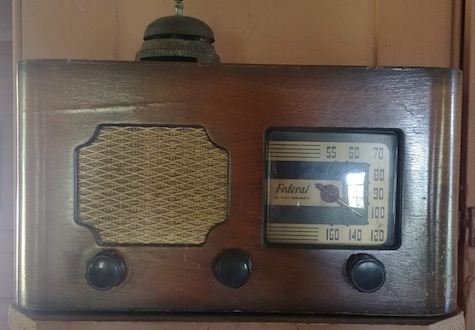
The year I started school was 1941. There was much unrest in the world and there was talk of war. We were too young to really understand what that was all about, but we gathered it was something we didn’t want to happen to our country. When the Japanese bombed Pearl Harbor, I remember having the radio on in school the following day. The teacher turned it too low for us to hear, but she listened to it all day. At one point, she turned to the class with tears in her eyes and said we were at war. No one talked to us very much about it, but we knew it was bad news.
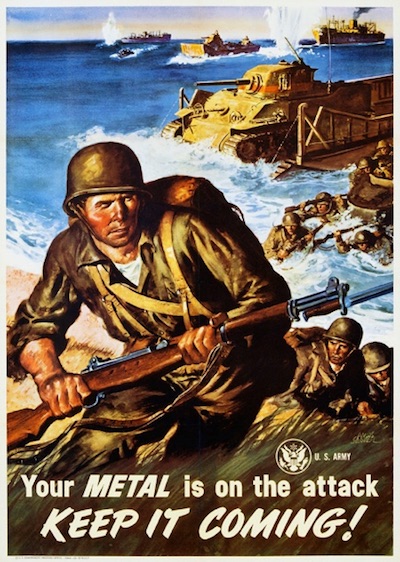
In the weeks and months that followed, we started collecting all kinds of metals and made a huge scrap pile in the school yard. I can’t remember for sure, but I recall that ours was the biggest one around. I also remember running out of the school every time we heard a plane, because this was something quite new to us. I also recall collecting milkweed pods for parachutes. If I remember correctly, we were paid so much a bag for them. I can’t remember what we used the money for, but because there was an ice-cream shop next to the school, I have a feeling we were all treated to ice-cream cones.
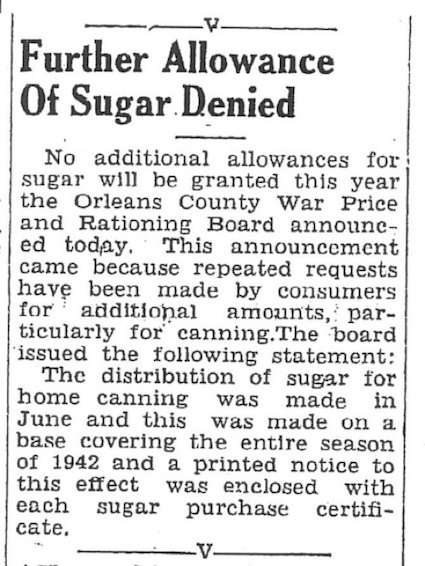
During the war years, I also remember “rationing”. There was a shortage of sugar, meat, flour, gasoline and other things. We had to have a ration book to be able to buy these items. Because of these shortages, it caused there to be shortages of everything that depended on these commodities for their production. No automobiles were manufactured, because all the factories were making planes, bombs, etc. for the war.
We had “blackouts” – this was in case the enemy decided to attack the United States they would not be able to see us at night. We would have to turn out all our lights and leave them out until the whistle blew telling us it was OK to turn them back on. My dad was an air-raid warden. When the whistle blew telling us of the warning my dad and several other volunteers would walk around the neighborhood and make sure no lights were on. As a child of seven, I rather liked the excitement of it and it was sort of an occasion.
The worst part of this whole time was when my Uncle Art was drafted. I recall very vividly the day he left for camp. Everyone was crying and hugging. He was in the Air Force and stationed in California. I wrote letters to him every week, and once he sent me a box of sea shells that he had picked up from a beach in California. These were real treasures. After he left, I was afraid that my dad would have to go to war. I prayed every night that he wouldn’t have to go and luckily he was just over the age limit for being drafted, so he never had to go. We were all very grateful.
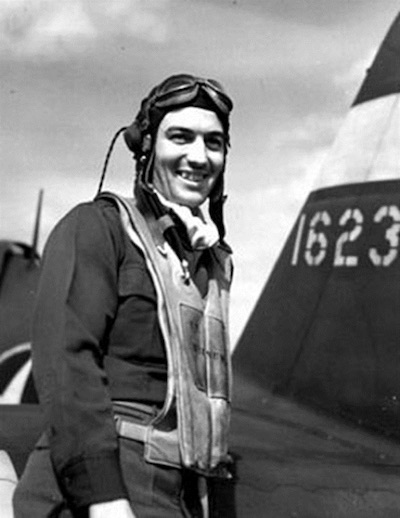
Captain Eugene Everett Barnum, Jr. (1917-1944)
One of my worst memories of this time, was when the word came that Bill Barnum was killed in action. They were neighbors of ours and it hit everyone very hard when this news came. Then, a few weeks later, the news came that his brother Eugene had also been killed in action. We didn’t know how one family could bear the hurt of losing both of their sons. They were both pilots and whenever we heard the song that was popular then, “Coming in on a Wing and a Prayer,” we always thought of them.
By Tom Rivers, Editor Posted 5 February 2021 at 4:26 pm
Active cases in 2 counties drops from 292 a week ago to 222 today
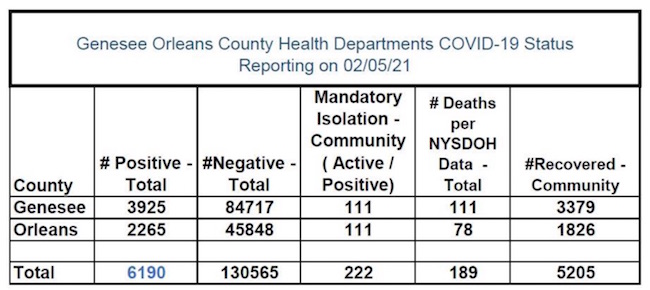
Orleans and Genesee counties combined are reporting 24 new confirmed cases for 6,190 since last March, the Genesee and Orleans County Health Departments reported this afternoon in a news briefing.
The two counties also currently have 222 active cases, which is down from 292 a week ago.
In Orleans County there 13 new positive cases of Covid-19 for a total of 2,265 positive cases since last March.
The positive cases reside in the West Region (Yates, Ridgeway, Shelby), Central Region (Carlton, Gaines, Albion, Barre) and East Region (Kendall, Murray, Clarendon). The individuals are in the age groups of 0-19, 20s, 30s, 40s, 50s, 60s and 70s.
Of the new cases, 5 were on quarantine prior to testing positive. One of the new cases is an inmate at the Orleans Correctional Facility, a men’s prison in Albion.
Orleans also is reporting 26 more of the previous positive individuals have recovered and been removed from the isolation list. The number of active cases in the county has dropped from 127 to 111 in the past week.
Orleans also is reporting 3 of the current positive individuals are hospitalized.
Albion Central School reported a student from the High School has tested positive for Covid-19. The student is a hybrid learner and was last in the building on Jan. 21. Due to the 48-hour look-back period, the Department of Health determined there is no need to quarantine any additional students or staff, the district stated on its website.
Holley Central School is reporting that two students have tested positive for Covid-19. One student attends the Alternative HS program at the Elementary School, whose last day in-person was Jan. 22. The other attends the MS/HS, whose last day in-person was Feb. 4.
The health department has indicated that there is currently no additional quarantining required of other students or staff members due to close contact with these particular cases. These cases are not connected to the report from yesterday, Brian Bartalo, the district superintendent, said in a letter on the district website.
Medina Central School said today a middle school student tested positive. The Department of Health is working with the school district to identify any potential close contacts and is notifying families who may have to quarantine, Mark Kruzynski, the district superintendent, said in letter on the district website.
In Genesee County there are 11 new positive cases for a total of 3,925 positive cases since last March.
The new positive cases reside in the West Region (Alabama, Darien, Pembroke), Central Region (Alexander, Batavia, Bethany, Elba, Oakfield) and East Region (Bergen, Byron, LeRoy, Pavilion, Stafford). The individuals are in the age groups of 0-19, 20s, 30s, 40s, 60s and 80s.
Genesee is reporting 30 more of the previous positive individuals have recovered and been removed from the isolation list. The number of active cases in the county has dropped from 165 to 111 in the past week.
Genesee has 18 residents currently hospitalized due to Covid.
There has also been another Covid-related death reported in the county, bringing that total to 111 since last March.
“The individual was over the age of 65,” the Genesee and Orleans County Health Departments stated. “We will not be reporting any further information to protect the privacy of the individual and their family. We extend our deepest condolences to the family and friends of this individual at this very sad time.”
Governor Andrew M. Cuomo today released the list of comorbidities and underlying conditions that New York State will use to determine eligibility for the Covid-19 vaccine. New Yorkers who have one of the comorbidities on the list will be eligible for the vaccine beginning February 15.
“New Yorkers with comorbidities and underlying conditions exist throughout the state’s population—they’re our teachers, lawyers and carpenters, in addition to the doctors who keep us safe every day, and they are a highly affected population,” Cuomo said. “We’re committed to vaccinating vulnerable populations that have suffered the most as we distribute a strictly limited supply of vaccines, and people with comorbidities are 94 percent of the state’s Covid deaths. That’s why we’ll open eligibility to people with comorbidities starting February 15 and give hospitals the ability to use extra doses they have to address that population. Local governments have a week to prepare for the new change—they need to get ready now.”
The full list of comorbidities and underlying conditions is available below. The list is subject to change as additional scientific evidence is published and as New York State obtains and analyzes additional state-specific data.
Adults of any age with the following conditions due to increased risk of moderate or severe illness or death from the virus that causes Covid-19:
Cancer (current or in remission, including 9/11-related cancers)
Chronic kidney disease
Pulmonary Disease, including but not limited to, COPD (chronic obstructive pulmonary disease), asthma (moderate-to-severe), pulmonary fibrosis, cystic fibrosis, and 9/11 related pulmonary diseases
Intellectual and Developmental Disabilities including Down Syndrome
Heart conditions, including but not limited to heart failure, coronary artery disease, cardiomyopathies, or hypertension (high blood pressure)
Immunocompromised state (weakened immune system) including but not limited to solid organ transplant or from blood or bone marrow transplant, immune deficiencies, HIV, use of corticosteroids, use of other immune weakening medicines, or other causes
Severe Obesity (BMI 40 kg/m2), Obesity (body mass index [BMI] of 30 kg/m2 or higher but < 40 kg/m2)
Pregnancy
Sickle cell disease or Thalassemia
Type 1 or 2 diabetes mellitus
Cerebrovascular disease (affects blood vessels and blood supply to the brain)
Neurologic conditions including but not limited to Alzheimer’s Disease or dementia
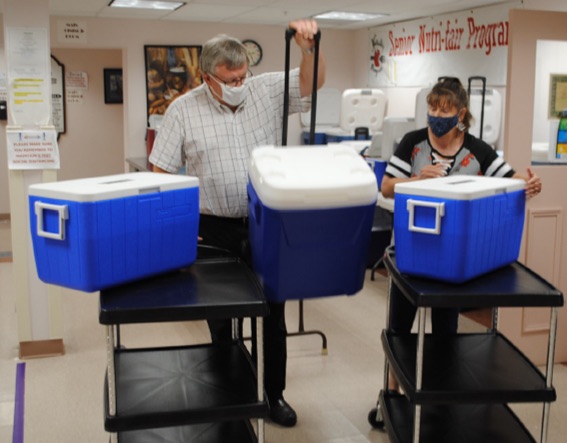
Provided photo: Paul Saskowski, Director of Business Services, and Vicki Havholm, Nutrition Program Manager, pack up food for the Meals on Wheels program in Orleans County.
Press Release, Arc of Genesee Orleans
ALBION – United Way of Orleans County recently shared great news with the Arc of Genesee Orleans.
“I am pleased to tell you that we have sent $5,000 to your agency to support the Orleans County Meals on Wheels program,” said Dean Bellack, United Way executive director.
The funding came from the Western New York Covid Community Response Fund that Bellack said has been very generous during the pandemic.
“I am very appreciative of the outside funding which has found its way to Orleans County,” Bellack said. “We are thankful we had the means to offer some extra help. The dollars we have received this year only support 50 percent of our requests for funding.”
Arc of Genesee Orleans has operated the Meals on Wheels program in affiliation with the Orleans County Office for the Aging since 2009. In Genesee County, the non-profit has fulfilled the Meals on Wheels contract since 2012.
“Funding our programs and services is always a challenge – even prior to the pandemic,” said Arc GO Director of Development Shelley Falitico. “We are thankful for this unexpected gift and United Way of Orleans County’s continual support of our agency and individuals we serve.”
By Tom Rivers, Editor Posted 5 February 2021 at 10:54 am
Committee members say Sheriff’s Office is responsive to community, embracing more training to de-escalate volatile situations
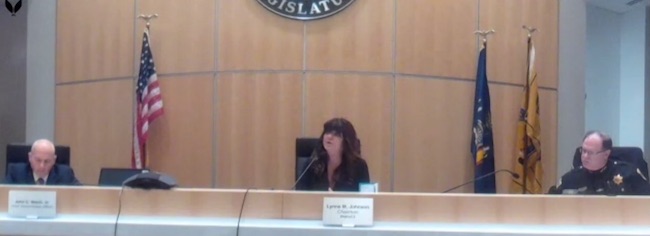
This screen shot from Thursday evening’s public forum through Zoom shows, from left, County Chief Administrative Officer Jack Welch, County Legislature Chairwoman Lynne Johnson and Sheriff Chris Bourke.
ALBION – Orleans County Sheriff Chris Bourke on Thursday evening led the first of two public forums on police reform, which is required by all 500 police agencies in the state.
Gov. Andrew Cuomo in June issued an executive order, mandating the law enforcement agencies review policies on use of force and de-escalation, with training of officers on bias in profiling. The governor urged each department to form a committee to review the policies and solicit feedback from residents.
Each department needs to submit a plan to the state by April 1, or they could be cut off from state funding.
Bourke and his committee will hold another public forum at 7 p.m. on Monday, Feb. 8. Click here to see a link to the Zoom instructions for the meeting.
“What we are really boiling this all down to is we want the community, no matter your background, that when they deal with law enforcement they are getting a fair shake,” said District Attorney Joe Cardone.
He is a member of the Police Reform and Reinvention Collaborative Committee for both the Orleans County Sheriff’s Office and Medina Police Department.
Cardone spoke at the Sheriff’s Office public forum on Thursday. He said the committee wants to hear from the public if they have concerns when they have interactions with law enforcement. There is also a form (click here) for people to submit comments about the Sheriff’s Office that will be directed to the committee.)
Joanne Best, the county’s public defender, also is on the committee. She asked residents to fill out the form or be part of the Feb. 8 public forum.
“We welcome input from community on how things could be done better,” she said.
That feedback can help the Sheriff’s Office and the committee work on policies that may need improvement and possibly more training for officers.
“Even though it can be adversarial it’s important the population feels respected and that law enforcement is dealing with them in a fair manner,” Cardone said.
‘We heard about defunding our police. For all that our Sheriff’s Department does for our county I wish that we could fund them more.’ – Lynne Johnson, County Legislature leader
The Sheriff’s Office website currently lists policies on de-escalation of force, implied bias, community relations, citizen complaints and investigation of hate crimes.
Bourke said deputies have received more training in responding to people in a mental health crisis. They are trained to help de-escalate those and other potentially volatile situations.
The Sheriff’s Office operates with the purpose that “all persons have the right to dignified treatment under the law; protection of this right is a duty which is binding upon all members,” according to the community relations policy.
The policy about bias-based profiling states that all members of the Sheriff’s Office “will not affect a stop, detention, or search of any person which is motivated by race, color, ethnicity, age, gender or sexual orientation.”
Bourke said the Sheriff’s Office has about 100 employees with 45 at the county jail. There are usually 22 to 24 deputy sheriffs, which includes two investigators, three sergeants, a lieutenant and one civil sergeant. The Sheriff’s Office currently has two vacancies for deputies and an investigator.
Jeff Gifaldi, the chief deputy, said the Sheriff’s Office has three patrol cars out 24-7, except on the weekends, when it is increased to four cars.
The Sheriff’s Office also runs a marine patrol from April 1 to Nov. 1 with a full-time deputy and 10 part-timers. The work in 26 miles of water along Lake Ontario, as well as Lake Alice, Glenwood Lake, the Erie Canal and other smaller bodies of water, Bourke said.
The Sheriff’s Office also runs the 911 dispatch center with nine full-time dispatchers and two part-timers. Last year they handled 32,000 calls.
County Legislature Chairwoman Lynne Johnson said the Sheriff’s Office could use more funding to carry out its mission.
“Last years in the events of civil unrest throughout nation, we heard about defunding our police,” Johnson said. “For all that our Sheriff’s Department does for our county I wish that we could fund them more. Defunding our police is not an option in Orleans County.”
She praised the Sheriff’s Office for its community outreach efforts, and increased training for officers.
“I can’t see how we could have better peacemakers,” she said. “Orleans County supports the law enforcement we have 100 percent.”
Terry Wilbert of Albion asked the lone question from the community during Thursday’s forum. He asked about the diversity of the workforce, including if there are women among the deputies.
Bourke said there two women among the deputies, which includes an investigator and a school resource officer. There are four corrections officers who are Black and one of the seasonal marine deputies is Latino, Bourke said.
Thaddeus Nauden, a community member on the committee, said the Sheriff’s Office and local law enforcement have the trust of the community.
“My problem isn’t with the police department in Orleans County,” he said during the forum. “In Orleans County I haven’t seen any problems. The problem is with justice system after the arrest. Too many criminals are put out on the street after their arrest.”
Eddie English, pastor of The Lord’s House in Waterport, also commended the Sheriff’s Office for “doing a great job” and for building many partnerships in the community.
Margie Aldacco, director of a safe house in the county, also is on the committee. She said residents likely aren’t aware of the many programs by the Sheriff’s Office.
James White, a seasonal deputy on the Marine Division, also serves on the committee.
“It’s not just about writing tickets,” he said. “It’s about effecting real change in the community.
We have a good department, with good leadership and they strive to serve the community.”
Trellis Pore, another committee member, said the Sheriff’s Office is embracing training and is focused on serving residents.
“It’s a breath of fresh air to see our Sheriff’s Department wants to have a safe community,” he said.
Bourke said a “few bad apples” among police officers have given law enforcement “a black eye.” He said incidents of police brutality “turn my stomach.”
He said the Sheriff’s Office will continue to have officers trained in de-escalation with mental health and other crises.
“My opinion is the training never stops,” he said. “You have to adjust with the times.”
By Tom Rivers, Editor Posted 5 February 2021 at 9:06 am
Winter weather advisory goes from Friday afternoon until 10 p.m. Saturday
A wind advisory is in effect from 7 a.m. until 4 p.m. today in Orleans and Genesee counties. The National Weather Service in Buffalo said there will be southwest winds from 25 to 35 mph with gusts up to 50 mph.
“Gusty winds could blow around unsecured objects,” the Weather Service stated. “Tree limbs could be blown down and a few power outages may result.”
There is also a winter weather advisory in effect from 4 p.m. Friday until 10 p.m. on Saturday for Orleans and Niagara counties.
Lake effect snow is expected with total snow accumulations of 4 to 8 inches in the most persistent lake snows. Winds gusting as high as 40 mph will result in considerable blowing and drifting snow, the Weather Service said.
By Tom Rivers, Editor Posted 5 February 2021 at 8:57 am
Cuomo says funding needed for state and local governments, restaurant industry
Governor Andrew M. Cuomo on Thursday issued a letter asking New York’s Congressional delegation for fair and proportional funding in the next COVID-19 aid package that helps New York State and localities, repeals the SALT cap, provides relief/mortgage relief, and helps restaurant workers.
The letter asks the Congressional delegation to avoid politics by funding state and local governments based on need, directly funding governments rather than bypassing them to fund schools, hospitals and organizations directly, repealing the SALT cap and helping the restaurant industry.
“These are trying times, my friends, and they are also highly consequential,” Cuomo wrote on Feb. 4. “I believe the COVID relief bill that you will pass shortly is paramount to this state and nation’s recovery. The politics and incompetence of the past federal administration has brought the nation to the brink.”
The Biden administration has proposed $350 billion in direct aid to states and local governments. Cuomo said distributing those funds shouldn’t be a “typical pork barrel exercise.”
New York should receive more than a proportional share of the funding because the state was disproportionally hit by Covid.
If Congress distributed the $350 billion funding by the number of lives lost to Covid, New York State would receive $20.7 billion and local governments would receive $13.8 billion, Cuomo said.
If the distribution formula reflected Covid related unemployment, New York State would receive $15.1 billion and local governments would receive $10.1 billion, he said.
“Ironically, even if Congress was wholly political and disregarded all legitimate need factors and distributed only by a state’s population – which would be a repulsive policy – New York State would still receive $12.4 billion and local governments would receive $8.3 billion,” Cuomo wrote in the letter.
He urged the Congressional delegation to pursue federal funding for local schools, but not through Title formulas which he said don’t address all areas of the state fairly.
The governor also continued to rail against the SALT legislation, calling it unconstitutional and double taxation. The tax cut plan approved in the Trump administration imposed a $10,000 limit on the SALT deduction, so regardless of how much is paid in state and local taxes.
“New York State is still in litigation against the federal government to end SALT,” Cuomo said. “Repeal is a priority as every month costs New Yorkers over $1 billion in additional taxes. Every day SALT is not repealed costs New Yorkers almost $34 million. It must be repealed now.”
Without significant aid from the federal government, Cuomo said the state and local governments will be forced to do layoffs, reduce funding to poor schools, reduce funding to safety net hospitals, and increase taxes – “we will see a situation go from bad to worse.”
He also urged the Congressional delegation to find solutions to the “looming eviction crisis” among homeowners and renters.
And he urged the delegation to provide “real financial support to restaurants statewide to ensure they are able to reopen and support the tens of thousands hardworking men and women they employ.”
















 The Unbridled Spirit