By Tom Rivers, Editor Posted 9 February 2021 at 12:44 pm
Cases are down significantly so far in February
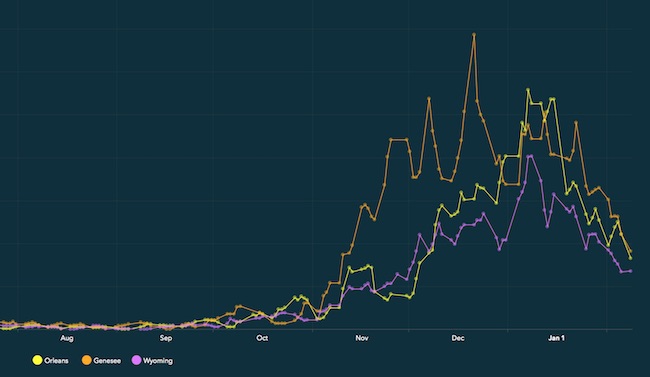
January was another month of huge Covid-19 caseloads in the three local rural counties of Orleans, Genesee and Wyoming.
The three counties combined had 2,814 cases. That isn’t as many as in December when there were 2,993 confirmed cases in the three counties, but it is still near the peak of the pandemic, which is nearing a year locally.
The three counties had nearly 3,000 cases each of the past two months. That is far more than the 2,108 cases in the three counties – from March through November.
The cases began a sharp upward trajectory in November with 1,133 cases in the three counties.
So far in February, the numbers are going down significantly.
Genesee, which averaged 45.8 new cases a day in January, so far is averaging 13 new a day in February. Orleans has decreased from 25.4 cases a day in January to 18 so far in February. Wyoming averaged 19.6 cases daily in January and has an average of 10 so far each day in February.
The average daily caseloads in January were about how many each county had for the total of July and August, when the counties often didn’t have any confirmed cases in a day. Orleans only had 22 cases total in July and August, while Genesee had 55 and Wyoming recorded 30 in those two months.
Once the weather got colder and more activities moved inside in November, cases really took off, with Gov. Andrew Cuomo saying 74 percent of those cases were from household spread.
Here is a monthly breakdown of the Covid cases in the three counties:
Orleans County (population: 40,352)
First case reported on March 18.
March – 6 cases (6 cumulative cases)
April – 89 cases (95 cumulative)
May – 126 cases (221 cumulative)
June – 45 cases (266 cumulative)
July – 10 cases (276 cumulative)
August – 12 cases (288 cumulative)
September – 29 cases (317 cumulative)
October – 82 cases (399 cumulative)
November – 224 cases (623 cumulative)
December – 753 cases (1,376 cumulative)
January – 788 cases (2,164 cumulative)
Genesee County (population: 57,280)
First case reported on March 17.
March – 13 cases (13 cumulative cases)
April – 136 cases (149 cumulative)
May – 37 cases (186 cumulative)
June – 40 cases (224 cumulative)
July – 32 cases (256 cumulative)
August – 23 cases (279 cumulative)
September – 30 cases (309 cumulative)
October – 66 cases (375 cumulative)
November – 579 cases (954 cumulative)
December – 1,495 cases (2,449 cumulative)
January – 1,419 cases (3,867 cumulative)
Wyoming County (population: 40,085)
First case reported March 17.
March – 8 cases (8 cases cumulative)
April – 60 cases (68 cumulative)
May – 12 cases (80 cumulative)
June – 9 cases (89 cumulative)
July – 18 cases (107 cumulative)
August – 12 cases (120 cumulative)
September – 12 cases (132 cumulative)
October – 69 cases (201 cumulative)
November – 330 cases (531 cumulative)
December – 745 cases (1,276 cumulative)
January – 607 cases (1,883 cumulative)
Source: Orleans Hub research, local health departments, Census Bureau 2019 estimates for population
ITHACA – New York state farm operators can expect a tight labor market and rising wages in the year ahead, in addition to continued pandemic precautions, debate over immigration reform and potential changes to overtime pay, according to a Cornell agriculture expert.
“Ag labor is going to remain scarce due to … underlying demographics and labor market factors, even if we get immigration reform,” said Richard Stup, agricultural workforce specialist in the College of Agriculture and Life Sciences and at Cornell Cooperative Extension. “Wages are going to continue to climb from both market and regulatory pressure.”
Stup offered his outlook for the sector during the Charles H. Dyson School of Applied Economics and Management’s 2021 Agricultural and Food Business Outlook Conference, held virtually Jan. 25. The conference also featured presentations on the outlook for the U.S. economy and for the dairy, fruit, vegetable and wine markets.
Long-term demographic trends have made it more challenging for farms to find workers, Stup said. Those trends include a more urbanized U.S. population, declining flows of new immigrants and – prior to the pandemic – unemployment near 50-year lows.
“The overall unemployment rate was so low, it’s no wonder farms are having a hard time identifying people,” he said. “People don’t show up at the farm office anymore just looking for work.”
Overall, roughly 11,000 New York farms employed nearly 56,000 workers in 2017, down from 61,000 in 2012, according to the 2017 Census of Agriculture. Fruit and tree nut farms accounted for 24% of the hiring, followed by dairy cattle and milk production at 22%.
Stup highlighted Pew Research Center data showing that unauthorized immigration, upon which the agricultural sector has relied heavily, declined nationally between 2007 and 2016, with New York experiencing the second-largest drop after California.
And among the estimated 11 million current unauthorized immigrants, according to Pew, 66% are long-term residents who have been in the country for more than 10 years. Stup said that was evident on many farms in the state, where unauthorized immigrants who arrived in the 1990s are now middle managers, have families and are established in rural communities – a different image from one many people have had over the years, he said.
“It’s important for us to upgrade that image and modernize that image of who the unauthorized immigrant workforce really is,” said Stup. “This industry is changing as we watch it.”
President Joe Biden is calling for comprehensive immigration reform, something the federal government hasn’t achieved since 1986, Stup said. At the same time, he said, legal hiring of temporary agricultural guest workers under the H-2A visa program has grown dramatically in recent years. New York’s 8,482 certified H-2A positions last year was more than double its total in 2012 and was in the top 10 nationally, according to the U.S. Department of Labor.
“I suspect it will continue to grow here in New York because of the continued demand,” Stup said.
Regarding wages, Stup noted that New York state is moving toward a mandatory $15 minimum wage. Long Island farms must pay at least $14 per hour this year and move to $15 next year, Stup said. The upstate minimum is now set at $12.50, with the timing of future increases uncertain.
Nationally, farm wages have grown at a faster rate than non-farm wages over the last 30 years, Stup said, but haven’t caught up, now representing about 60% of non-farm, non-supervisory wages. “There’s room to grow,” he said.
In addition to wages, Stup said New York farms will be closely monitoring any state action on overtime pay. Farm employers currently pay overtime for work in excess of 60 hours per week, not 40 hours as in most other sectors. A state wage board may consider lowering that threshold later this year, Stup said, a potential concern for growers with the highest labor costs, including vegetable farms, tree farms and nurseries.
New York’s farm workforce did an “outstanding job” complying with prevention measures and limiting the spread of coronavirus last year, Stup said, avoiding many of the outbreaks seen in other states.
“For the 2021 growing season, in spite of the fact that there will be vaccinations coming,” he said, “we’re going to see a lot of the same restrictions … to protect the farm workforce going forward.”
By Tom Rivers, Editor Posted 9 February 2021 at 10:22 am
MEDINA – Today is the deadline for candidates to file petitions to run for a position on the Medina Village Board. The election is March 16.
The petitions usually require at least 100 signatures from registered voters in the village. The governor issued an executive order reducing the number of signatures required due to the Covid-19 pandemic.
Candidates still need about 60. The governor’s executive order allowed for a minimum threshold of 3.3% of the total number of votes case for governor at the last gubernatorial election, which would be about 60.
The executive order also states the minimum would 70% of the statutory minimum number provided for by election law, which would be 70 percent of 100 or 70. The executive order said to take the lesser of the two, which would be 60.
The petitions are due to the Village Clerk’s Office by 4:30 p.m. today.
The seats for Owen Toale and Todd Bensley are both open. Toale has already submitted signed petitions to run under the Accountability Party. Jessica Marciano, a member of the Parks Committee, also has submitted petitions to run under the Accountability Party.
Albion also has its election on March 16 for one spot on the Village Board. During party caucuses on Jan. 26, The Republican Party backed Joe Martillotta and Democrats picked Zack Burgess to be their candidates.
The Village of Lyndonville is in an off election year and won’t have an election on March 16. Holley holds its election in June.
By Tom Rivers, Editor Posted 9 February 2021 at 9:18 am
State paying 75% of project to reinforce wall, upgrade lighting and doors
File photo by Tom Rivers: Sandra Shaw, director of the Community Free Library in Holley, holds a puppet at the library’s puppet theatre in this photo from February 2016. The library will be upgrading a wall, lighting and the front doors at the site.
HOLLEY – The Community Free Library will be upgrading the site at 86 Public Square with a $100,000 project.
The public library has been approved for a $75,000 state library construction grant, said Sandra Shaw, director of the Community Free library.
That will pay 75 percent of the cost to reinforce a wall in 110-year-old building, replace lighting and put in two sets of handicapped accessible doors, one for the front entrance and the other inside the foyer. The library will pay the other 25 percent of the expense.
The wall that will get needed attention is on the back side of the children’s library. A contractor, Tower Construction of Albion, will be excavating, digging a trench and then replacing some of the brick in the wall that had disintegrated, Shaw said.
Tower will rebuild part of the wall, reinforce it and put on waterproofing sealant.
The two sets of doors will be enabled with push buttons. They will make it easier for people in wheelchairs, walkers or who have children in strollers, Shaw said.
“We want to do anything we can to help our patrons get in and out of the building,” she said.
Jedamski Electric will replace the electric fixtures and put in energy-efficient LED lights. Shaw said that will reduce the library’s ongoing electricity costs.
She expects the electric work will be started in about two months and the work on the exterior wall getting started in late spring or summer.
By Ginny Kropf, correspondent Posted 9 February 2021 at 8:14 am
Matt Grammatico sees wife in person for first time since October
Provided photos: Matt and Rhonda Grammatico are able to hug each other Monday for the first time since Oct. 16, when Matt entered the Cleveland Clinic to prepare for a heart and liver transplant.
An Albion man who has been in the Cleveland Clinic since Oct. 16 waiting for a heart/liver transplant was released Monday afternoon and able to see his wife in person for the first time in nearly four months.
Matt Grammatico underwent a successful double transplant on Jan. 12 and 13. Since then, he has continued to amaze doctors, coming off his respirator four hours after surgery and leaving the hospital less than four weeks later. He will have to stay at a nearby hotel with his wife Rhonda for a month, so he can report back to the Cleveland Clinic daily.
Rhonda has been in Cleveland since October but hasn’t been able to see her husband in the hospital due to Covid restrictions. She said it was their faith which got them through these challenging times.
“Our hearts were lifted to the Lord daily, hourly, asking for comfort for Matt, for healing, for a chance,” Rhonda said. “We knew the statistics. We knew the outcome we wanted was not a guarantee. We made a resolution to trust God’s plan. We put Matt in God’s hands and watched and we waited. And now here we are in the middle of an absolutely glorious story. A God story.”
Matt said in a phone call last week his wish, other than to see his wife, is to not be in pain, return home and get back to a normal life. He said he is still very weak and will focus on getting his strength back.
Rhonda Grammatico was very happy to pick up her husband from the hospital on Monday. He underwent a 19-hour heart/liver transplant on Jan. 12 and 13.
Grammatico, 48, worked as a truck driver for 17 years and then owned his auto repair business in Hamlin. His father, Mike Grammatico, was a long-time music teacher at Albion.
Matt was born with a congenital heart defect called Hypoplastic Right Heart Syndrome. He had major heart surgery as a baby followed by an open-heart reconstructive surgery when he was 11. He has needed multiple procedures and surgeries throughout the next 30-plus years of his life.
During one of the surgeries as a child, he was unknowingly given a Hepatitis C tainted blood transfusion. The virus attacked his liver, undiscovered, for more than 20 years, further complicating his health. He has endured end-stage liver disease.
Grammatico’s health deteriorated in the past year, and Cleveland Clinic kept him in good enough condition for the surgery. He was in the operating room for about 19 hours.
He is very thankful for the medical team, the organ donor and for a supportive community.
People with underlying conditions can try to get vaccine beginning Feb. 14 at state-run sites
Press Release, Gov. Andrew Cuomo’s Office
Governor Andrew M. Cuomo today announced that New Yorkers with comorbidities and underlying conditions can make appointments at state-run mass vaccination sites beginning Feb. 14, with the first appointments scheduled for Feb. 15.
Excess vaccine supply meant for hospital workers can be used to open eligibility for New Yorkers with comorbidities and underlying conditions. Local health departments will determine how, where and when to schedule appointments in their jurisdictions, and those appointments will begin as early as Feb. 15. No local jurisdiction should accept appointments until the allocations are known, and no earlier than Feb. 14.
“As the state’s effort to vaccinate health care workers nears completion this week, we are now shifting those doses to prioritize those New Yorkers with comorbidities and pre-existing conditions – a group which has felt the brunt of Covid’s destructiveness first-hand,” Governor Cuomo said. “I want to remind newly eligible New Yorkers to please be patient when beginning to schedule appointments – we can only administer as many doses as the federal supply allows and we’re continuing to fight for more every day.”
To show they have comorbidities or underlying conditions, New Yorkers must provide documentation as required by the facility where they are getting vaccinated which must be either:
Doctor’s Letter, or
Medical Information Evidencing Comorbidity, or
Signed Certification
New York State will audit local systems. The New York State Department of Health will host a call with county executives and local health departments to discuss strategies and compliance associated with vaccinating New Yorkers with comorbidities and underlying conditions.
The full list of comorbidities and underlying conditions is available below. The list is subject to change as additional scientific evidence is published and as New York State obtains and analyzes additional state-specific data.
Adults of any age with the following conditions due to increased risk of moderate or severe illness or death from the virus that causes COVID-19:
Cancer (current or in remission, including 9/11-related cancers)
Chronic kidney disease
Pulmonary Disease, including but not limited to, COPD (chronic obstructive pulmonary disease), asthma (moderate-to-severe), pulmonary fibrosis, cystic fibrosis, and 9/11 related pulmonary diseases
Intellectual and Developmental Disabilities including Down Syndrome
Heart conditions, including but not limited to heart failure, coronary artery disease, cardiomyopathies, or hypertension (high blood pressure)
Immunocompromised state (weakened immune system) including but not limited to solid organ transplant or from blood or bone marrow transplant, immune deficiencies, HIV, use of corticosteroids, use of other immune weakening medicines, or other causes
Severe Obesity (BMI 40 kg/m2), Obesity (body mass index [BMI] of 30 kg/m2 or higher but < 40 kg/m2)
Pregnancy
Sickle cell disease or Thalassemia
Type 1 or 2 diabetes mellitus
Cerebrovascular disease (affects blood vessels and blood supply to the brain)
Neurologic conditions including but not limited to Alzheimer’s Disease or dementia
Provided photo: Assemblyman Steve Hawley holds an award from the New York Beef Producers Association.
Press Release, Assemblyman Steve Hawley
Assemblyman Steve Hawley (R,C,I-Batavia) has been awarded the New York Beef Producers Association 2020 Friend in Government award, which he received during their annual meeting held virtually on Zoom.
Hawley has been supportive of New York agriculture as a lawmaker and as a citizen for decades, as he is a 42-year member of the New York State Farm Bureau, previously served as president of the Genesee County Farm Bureau and has been a member of the New York State Assembly Committee on Agriculture for 15 years.
The award from the Beef Producers is given to legislators who have been notably vocal advocates for those in the industry of beef production, and Assemblyman Hawley is one of only two legislators to receive this award this year. Assemblyman Andy Goodell of Chautauqua County also was recognized with the honor.
“As a former farmer myself, it has been my honor to stand up as a voice for everybody who works in agriculture in our state, including beef producers,” said Hawley. “I look forward to continuing to champion the causes of our farmers, and even as we face a challenging year ahead I look forward to working with producers to make the best of it and assure their voices are heard in our Legislature.”
By Tom Rivers, Editor Posted 8 February 2021 at 4:46 pm
Recoveries outpacing new cases in Orleans, Genesee and Wyoming
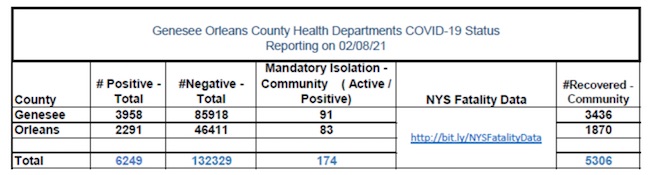
This chart from the Health Departments in Genesee, Orleans and Wyoming counties shows how the actives cases started to increase in November and have been decreasing in the past few weeks.
The number of active cases in Orleans, Genesee and Wyoming counties has fallen to its lowest level in about two months. There are currently 242 active cases in the three counties with 83 in Orleans County, 91 in Genesee and 68 in Wyoming.
A month ago on Jan. 7 there were 718 active cases in the three counties. (Click here to see a three-county database about Covid cases.)
The 83 in Orleans compares with a pandemic high of 279 on Jan. 7. It’s also the fewest active cases in Orleans since there were 77 on Dec. 4.
The 91 in Genesee County is the lowest number in the county since there were 89 on Nov. 12. Genesee, as recently as Jan. 22, had 241 active cases.
Wyoming County today is reporting 68 actives cases, which is down from its pandemic high of 202 on Jan. 8. Wyoming was at 67 active cases on Friday, the lowest since 70 on Dec. 1 and 58 on Nov. 30.
Orleans reports 26 new Covid cases, Genesee 33 more since Friday
In its first update since Friday, the Genesee and Orleans County Health Departments today are reported 26 new positive cases in Orleans County and 33 more in Genesee.
In Orleans County the 26 new confirmed cases bring the total to 2,291 positive cases since last March.
The positive cases reside in the West Region (Yates, Ridgeway, Shelby), Central Region (Carlton, Gaines, Albion, Barre) and East Region (Kendall, Murray, Clarendon). The individuals are in the age groups of 0-19, 20s, 40s, 50s, 60s and 70s.
Of the new cases, 6 were on quarantine prior to testing positive.
The new cases include 7 residents of The Villages of Orleans Health & Rehab in Albion and 3 inmates at the Orleans Correctional Facility, a men’s prison in Albion.
“Orleans County is currently seeing an increase of positive cases in non-county regulated facilities, which is increasing the daily positivity rate,” the Health Departments said in an afternoon news briefing.
Orleans also is reporting 44 more of the previous positive individuals have recovered and been removed from the isolation list.
Three of the current positive individuals are hospitalized, the Health Departments said.
In Genesee County the 33 new positive cases bring the total to 3,958 confirmed cases since last March.
The new positive cases reside in the West Region (Alabama, Darien, Pembroke), Central Region (Alexander, Batavia, Bethany, Elba, Oakfield) and East Region (Bergen, Byron, LeRoy, Pavilion, Stafford). The individuals are in the age groups of 0-19, 20s, 30s, 40s, 50s, 60s and 70s.
Genesee is reporting 57 more of the previous positive individuals have recovered and been removed from the isolation list.
Genesee has 18 residents currently hospitalized due to Covid.
By Tom Rivers, Editor Posted 8 February 2021 at 1:49 pm
Issue highlighted as county tries to build support for expanded broadband coverage
ALBION – Orleans County senior citizens, who are feeling desperate to get an appointment for a Covd-19 vaccine, are struggling to access online websites to sign up, Orleans County Legislature Chairwoman Lynne Johnson said today.
Lynne Johnson
Instead of trying online to register for the vaccine, 500 seniors have instead called the Orleans County Office for the Aging to get on the waiting list.
She highlighted the issue today during a Zoom conference call with Congressman Chris Jacobs, news reporters and members of the Orleans Digital Literacy Initiative Steering Team.
“They dial the Office for the Aging because they don’t have internet or don’t know how to use internet,” Johnson said during the news conference.
In rural Wyoming County, Jacobs said he was told about half of the available vaccines administered in the county have been claimed by people outside Wyoming because that county also struggles with spotty or nonexistent internet service.
Johnson has been working nearly a decade to expand broadband in Orleans County, including by partnering with neighboring Niagara County. Cost estimates to fill the gaps in coverage in the two counties are about $10 million, including $4 million for the areas in Orleans County.
‘This issue (high-speed internet) is critical to the future prosperity of the region. This is the rural electrification of years ago and we need to view it as such.’ – Congressman Chris Jacobs
Orleans hasn’t been unable to make significant progress in expanding the service locally. Johnson said the county has been bypassed by the state and federal governments for funding.
Johnson is optimistic, however, that federal funding soon will be available for the county. She praised the Orleans Digital Literacy Initiative Steering Team for helping to documents the need in the county. That group has received nearly 3,000 surveys from residents, and conducted more than 50 interviews with business and community leaders, which all quantifies the woes of inadequate or nonexistent internet service.
It effects students trying to do homework online, businesses that need to file reports, residents trying to fill out job applications and anyone trying to enjoy a movie through Netflix.
Johnson said about 20 percent of the county does not have high-speed internet service available, and more places have subpar coverage. It’s a major issue as the county tries to retain and attract residents and businesses.
Chris Jacobs
Jacobs thanked the local officials and the Orleans Digital Literacy Initiative Steering Team for their work on a “critically important issue” that he said “cuts across entirety of 27th Congressional District.”
The gaps in coverage has been even more apparent during the Covid-19 pandemic, with more students forced to school remotely at home and more people trying to work from their residence.
One issue to resolve in Orleans is a clear data map that shows where coverage doesn’t exist in the county, and current addresses where it needs to be upgraded. Johnson said local officials have gone house by house and have showed 20 percent doesn’t have access to the service.
That differs from state maps which put coverage at about 98 percent. That’s because if one house in a census block has high-speed internet, the state considers that block covered, Johnson said.
Jacobs said he will be pressing the Public Service Commission at the state to provide accurate data maps about where the service isn’t currently available.
“This issue is critical to the future prosperity of the region,” Jacobs said. “This is the rural electrification of years ago and we need to view it as such.”
In Orleans County, nearly 3,000 people have already completed online surveys in English or Spanish about their internet needs and current service. There are also printed surveys at local libraries and some non-profit agencies.
The survey will remain available until the end of February. The Steering Committee welcomes more feedback from residents through the surveys.
“The more people that fill out the survey, the more accurate data will be and we can make a more compelling case,” Jacobs said.
The Steering Committee also is moving to a solutions phase and already has about 250 people committed to 2-hour sessions to help brainstorm solutions, said Mary Beth Debus, a consultant hired to assist the county with the project, which is led by the Orleans County United Way.
The response from the survey and the commitment to attend the sessions shows the widespread support and determination from residents and community leaders to improve the situation, Debus told Jacobs.
Dean Bellack, executive director of the United Way, told Jacobs the county needs more than just expanded connectivity with high-speed internet. Many people, including seniors, lack expertise to use the service and devices.
The Steering Committee is looking to have trained people available to help people use technology, including telemedicine services. The county may also want to look at technology literacy camps, including for youths, Bellack said.
“These are some of the hundred different ideas we’re putting together,” he said.
Here are some other highlights from the survey so far:
81% of Orleans County residents who do not have internet at home (15% of respondents) do not have an option for getting internet because it isn’t available to them.
When asked how reliable their internet is, only 23% said it was very reliable. A larger percentage (27%) described it as spotty or not working well at all. (The remaining said they had occasional problems.)
78% said that they experience problems if there are multiple devices being used at the same time.
35% of residents need to always, often, or sometimes leave their homes in order to do activities on the internet.
One in five students is having trouble using the device their school provided them.
32% of students do not have an adult in the house who can help them with their technology needs.
59% of respondents could work from home all or part of the time.
67% of respondents have been asked to work from home all or part of the time by their employers but 12% of them were unable to. 60% of those who did encountered poor and/or slow connectivity.
About 15% of job seekers are having trouble with digital literacy interfering with job search process (filling out job applications, using email, etc.)
Press Release, Tops Market and Price Chopper/Market 32
Photo by Tom Rivers: The Tops store on Maple Ridge Road in Medina is pictured in September 2018. Tops also operates a store in Orleans County in Albion.
WILLIAMSVILLE/SCHENECTADY — Price Chopper/Market 32 and Tops Markets today announced that they have entered into a definitive merger agreement that creates a powerful alliance between the two storied independent grocery chains, as it nearly doubles their collective footprint in the Northeast.
This transaction unites two iconic New York-based grocery chains with deep ties to their local communities and shared commitments to service, savings, and convenience. With increased scale across their almost perfectly contiguous footprints, the merged companies are expected to be better positioned to compete and offer even more value and outstanding services to their customers across the Northeast.
Scott Grimmett, Price Chopper/Market 32’s President and CEO, will be CEO of and serve on the Board of Directors of the new parent company which will oversee the operations of nearly 300 Price Chopper, Market 32, Market Bistro and Tops Markets stores and collectively employ more than 30,000 teammates.
Frank Curci, Tops Markets Chairman and CEO, will serve on the Board of Directors of the new parent company and as a consultant to assist in the transition. Blaine Bringhurst, Price Chopper/Market 32’s Executive Vice President of Merchandising, Marketing and Store Operations, will lead the Price Chopper/Market 32 business. John Persons, Tops Markets President and Chief Operating Officer, will lead the Tops Markets business.
The new parent company will be headquartered in Schenectady. The Price Chopper/Market 32 and Tops Markets businesses will retain main offices in Schenectady and Williamsville and will continue to be managed locally by their respective leaders.
“This merger marks a major step forward and collectively elevates our ability to compete on every level,” said Grimmett. “It leverages increased value for our customers; advances shared opportunities for innovation; fortifies the depth of our workforce, community and trade partnerships; and ultimately accelerates our capacity to deliver a distinctively modern and convenient shopping experience. Given the vital role that supermarkets and their workforces play in our communities, particularly this past year, I am excited to lead the parent company of these two historic grocery retailers.”
“We have long believed that this merger makes sense both strategically and based on the similar ways in which we each put customers first, go to market and treat our people,” said Curci. “We look forward to working closely with the Price Chopper/Market 32 team and together becoming an even stronger competitor with more scale, as we continue serving our customers and communities.”
“I’ve seen tremendous change in our industry across my 65-year career and have long been an advocate for the promise of innovation and partnership, like that which has driven this merger forward,” said Neil Golub, Price Chopper/Market 32’s Executive Chairman of the Board. “I can assure you that our commitment to sustaining and improving the communities in which we operate remains steadfast.”
“Tops has always put serving customers and providing an exceptional shopping experience at the center of everything we do, and this merger is no different,” said Persons. “Our associates, who take pride in their work and recognize the importance of the role they play in taking care of customers and communities, will continue to be the backbone of our company.”
With formative roots dating back to the 1920s, both Tops Markets and Price Chopper/Market 32 have grown exponentially over the last century, building and acquiring stores across Upstate New York and throughout the Northeast. The merged companies are committed to serving their markets across the Northeast.
The transaction is expected to close in the coming months, subject to regulatory approval and customary closing conditions. Financial terms of the transaction were not disclosed.
PJ SOLOMON is acting as exclusive financial advisor to Price Chopper. Harter Secrest & Emery LLP and Wilson Sonsini are serving as legal advisors to Price Chopper. Deutsche Bank Securities Inc. is acting as exclusive financial advisor to Tops Markets. Paul Weiss LLP and Hogan Lovells US LLP are serving as legal advisors to Tops Markets.
About Price Chopper/Market 32
Based in Schenectady, Price Chopper/Market 32 operates 130 Price Chopper and Market 32 grocery stores and one Market Bistro, employing 18,000 teammates in New York, Vermont, Connecticut, Pennsylvania, Massachusetts, and New Hampshire. The American-owned company, founded by the Golub family in 1932, prides itself on longstanding traditions of innovative food merchandising, cutting edge brand development and store design, leadership in community service, and cooperative employee relations. For additional information, please visit www.pricechopper.com
About Tops Markets
Based in Williamsville, Tops Markets operates 162 grocery stores in New York, Pennsylvania, and Vermont, including five that are run by franchisees. As the largest private, for-profit employer in Western New York, with more than 14,000 associates, the company is dedicated to providing sustainably sourced, high quality products, while helping its communities flourish via support for programs that eradicate hunger and disease, educate youth and reduce environmental waste and energy consumption.
By Tom Rivers, Editor Posted 8 February 2021 at 11:20 am
Photos by Tom Rivers: In this photo from April 9, 2020, Donato Rosario of the Medina Fire Department removes some of the metal roofing from a cottage in Yates, which was damaged in a chimney fire.
MEDINA – The Fire Department responded to fewer calls in 2020, mainly due to the impact of Covid-19, especially early in the pandemic in March, April and May.
Medina firefighters responded to 2,437 total calls in 2020, which was down by 10.3 percent from 2019. The restrictions early in the pandemic closed schools and many businesses, and many people avoided non-essential travel. People were also nervous to seek medical treatment out of fear of being exposed to the coronavirus.
Medina firefighters handled 87 calls last year involving people who contracted Covid, according to the annual report compiled by Fire Chief Matt Jackson.
He said 2020 brought many personnel and operational changes. Former Chief Tom Lupo retired and Jackson was appointed to lead the department on Jan. 13. There were three promotions in the department and other new firefighters were hired to fill vacancies.
The Medina FD also needed to respond to the Covid-19 pandemic with added cleaning and safeguards to protect staff and the public.
“Our department has willingly accepted the ever-changing demands that this pandemic sprang on us,” Jackson said in his annual report. “I continue to be impressed by the passion that the personnel of the Medina Fire Department bring to the job and their ability to adapt and overcome in this dynamic environment.”
Medina had six of its 22 full-time staff test positive for Covid in December.
The calls by month include: January, 248; February, 179; March, 161; April, 138; May, 178; June, 217; July, 312; August, 196; September, 217; October, 204; November, 208; and December, 179.
July was the busiest month with 312 calls, partly due to rain storm on July 27 when 7 inches of rain fell in one day and many basements needed to be pumped.
The department averaged 203 calls a month, but the first three months of the pandemic were well below that, with April the slowest month with 138 calls.
The fire chief’s report shows that 5 p.m. is the busiest hour of the day while 4 a.m. is the slowest. Mondays are also the busiest day of the week with Sundays the fewest calls.
The average response time was less than 2 minutes throughout the year, Jackson said.
He also reported that firefighters completed 2,638 total training hours, including 2,409 training hours for fire service and 229 hours for EMS training. Firefighters also taught CPR training to 75 students.
Some other highlights of the report include there were 2,140 emergency medical calls, 572 non-emergency medical transfers from Medina Memorial Hospital, and 297 fire calls, including three house fires in the village.
The calls were nearly split between day and night shifts: 1,268 (52%) for night shift and 1,169 (48%) for day shift.
Medina promoted leaders in the Fire Department. This trio is pictured on Jan. 13, 2020 inside the fire hall after taking their oaths of office. From left include Captain Michael Young, Fire Chief Matt Jackson and Lt. Jacob Crooks.
By Tom Rivers, Editor Posted 8 February 2021 at 9:52 am
U.S. Senate Majority Leader Charles Schumer is pressing the Biden administration to forgive up to $50,000 in federal student loan debt per borrower, saying it would help to jump-start the economy.
Biden is open to cancelling $10,000 to student loan debt per borrower. Schumer and other members of Congress want to see Biden do more. The senator from New York was joined at a news conference last week at the U.S. Capitol with Sen. Elizabeth Warren of Massachusetts, U.S. Rep. Ayanna Pressley of Massachusetts, U.S. Rep. Ilhan Omar of Minnesota and U.S. Rep. Mondaire Jones of New York. They called on Biden to take action on student loan debt.
“This debt holds people back from buying cars, going on vacations, from starting families,” Schumer said during the news conference. “It’s a huge anchor on the entire economy.”
Schumer said the debt is a “Civil Rights issue” with people of color bearing far more debt. He said the federal government charges people an “outrageous rate of 7 percent” on student loans.
Warren said wiping out $50,000 in student loan debt would result in more people starting businesses, buying homes, and spending more to stimulate the economy.
Pressley said the mounting student loan debt, more likely for people of color, is a form of “policy violence.” Biden could cancel student debt by executive action, providing relief to millions of families, Pressley said.
Schumer and Warren said more than 43 million people in the United States are weighed down by $1.6 trillion in federal student loan debt.
“The Covid-19 crisis is worsening the massive inequities in our economy and society, but even before the pandemic the student loan debt crisis was already crushing millions of Americans,” Warren said. “By cancelling up to $50,000 in federal student loan debt for borrowers, President Biden can take the single most effective executive action available to provide a massive stimulus to our economy, help narrow the racial wealth gap, and lift this impossible burden off of tens of millions of families.”
More than 300 civil rights, climate, health, labor, consumer rights, and student organizations have called on President Biden to cancel federal student debt using executive action, including American Federation of Teachers, National Education Association, The Education Trust, Hispanic Federation, NAACP, National Urban League, UnidosUS, League of United Latin American Citizens, Minority Veterans of America, National Women’s Law Center, SEIU, the American Psychological Association, Sunrise Movement, the United States Student Association, and Young Invincibles, Warren said in a news release.
“During a time of historic and overlapping crises, which are disproportionately impacting communities of color, we must do everything in our power to deliver real relief to the American people, lift up our struggling economy and close the racial wealth gap,” Schumer said. “Democrats are committed to big, bold action, and this resolution to cancel up to $50,000 in federal student loan debt is one of the strongest steps the president can take to achieve these goals.”
By Tom Rivers, Editor Posted 8 February 2021 at 8:03 am
In WNY, only Chautauqua County tops high prices in Orleans
Gas prices are an average price of $2.56 a gallon in the state today, which is up from $2.37 a month ago, AAA Western and Central New York reported this morning.
The price is up about 5 cents from a week ago. Compared to a year ago, when the price was an average of $2.635 a gallon, the price is down about 7 cents.
The average price per gallon in Orleans County at $2.515 is among the highest in Western New York. Only Chautauqua County, at $2.544 is higher. Gas is more expensive in northern New York. The average price in Essex County, for example, is at $2.740.
Here are the average prices in WNY counties:
Allegany, $2.452
Cattaraugus, $2.439
Chautauqua, $2.544
Erie, $2.482
Genesee, $2.438
Livingston, $2.497
Monroe, $2.497
Niagara, $2.463
Orleans, $2.515
Wyoming, $2.489
AAA said this morning reported that the price of crude increased by more than $57, which is the highest settlement price of the year. Crude prices rose last week after the Organization of the Petroleum Exporting Countries (OPEC) agreed to collectively reduce their crude production by 7.2 million barrels per day.
The group decided to hold the cuts steady and expects output to remain low this year, since demand is forecasted to be lower than expected throughout 2021 due to ongoing crude demand concerns as the pandemic continues to keep travel restrictions in place, AAA said.
By Tom Rivers, Editor Posted 7 February 2021 at 3:20 pm
Orleans County saw an increase in its unemployment rate and the number of people unemployed in the county in December, after the rate and unemployed had been on the decline.
The state Department of Labor reported the unemployed rate was 6.4 percent in December, with 1,100 people unemployed in Orleans. That 6.4 percent rate was up from the 5.4 percent in December 2019.
The DOL reported there were 15,600 people working in Orleans County December 2020, which was down from 15,800 in November and 16,700 December 2019.
Here are the unemployment rates and number of unemployed in the Orleans County during the Covid-19 pandemic:
March: 5.4 percent, 900 unemployed
April: 15.9 percent, 2,700 unemployed
May: 11.5 percent, 1,900 unemployed
June: 10.8 percent, 1,900 unemployed
July: 12.7 percent, 2,300 unemployed
August: 9.8 percent, 1,700 unemployed
September: 5.5 percent, 900 unemployed
October: 6.0 percent, 1,000 unemployed
November: 5.4 percent, 900 unemployed
December: 6.4 percent, 1,100 unemployed
Orleans County, with the 6.4 percent unemployment rate for December, is about in the middle of the pack among WNY counties.
Here are the rates for the other counties in the region: Allegany, 6.2%; Cattaraugus, 6.4%; Chautauqua, 7.8%; Erie, 7.6%; Genesee, 5.4%; Livingston, 5.5%; Monroe, 6.9%; Niagara, 7.3%; Orleans, 6.4%; and Wyoming, 6.1%.
Statewide, Tompkins had the lowest unemployment rate at 4.3% while the New York City metro has the highest rate at 11.0%, with Bronx, 15.1%; Kings, 11.3%; and Queens, 10.7%, all above 10%.
In New York State, the unemployment rate is up from 3.7% in December 2019 to 8.1 percent in December 2020. The number of people working in state dropped by 812,100 from 9,116,400 to 8,304,200. The number of unemployed more than doubled from 351,900 to 733,200 during that time.