By Kristina Gabalski, Correspondent Posted 18 January 2018 at 11:02 am
Says district didn’t properly notify residents of project, and veered from scope of work approved by voters
Photo by Tom Rivers: Kendall’s capital project included a dramatic change to the exterior and front entrance of the junior-senior high school.
KENDALL – Julie Christensen, school district superintendent, on Wednesday evening responded to a recent critical audit by the State Comptroller’s Office.
The Comptroller’s Office faulted the district for not informing the public enough about the $25.2 million capital project, which stretched from 2012 to 2017.
Key findings of the audit released Jan. 5 criticized the Kendall Central School District for not properly informing district residents prior to voting on a proposition for a district-wide capital improvement project because the Board and district officials did not develop or provide the public with a formal project plan detailing the scope and related costs, the Comptroller’s Office said.
The audit also states that because bids for the project came in significantly lower than anticipated, the Board decided to expand the original scope and spend the remaining authorized appropriations.
“Project reports did not include cost information or sufficient information to allow the Board to properly monitor the project’s progress or determine whether expenditures were properly authorized, funding sources were being used properly, or sufficient funds remained,” the audit states.
The State Comptroller’s Office recommended that the district provide voters with specific information on what will be included in proposed capital projects, including detailed descriptions of the improvements to be made and the locations where work will be performed as well as ensure the district stays within the scope of a capital project, and actively monitor capital project activity.
Christensen spoke during Wednesday’s Board of Education meeting. She said the audit results were frustrating as the State Comptroller’s Office, “doesn’t really understand” the process the district must follow. She said the district does not have project details when a capital project is first proposed as the expense of design work is significant and is not undertaken until after a project is approved by voters.
She also called some of the detailed expenses the Comptroller’s Office would like to see reported, “unreasonable, we may not have access to all the details,” Christensen said.
Kendall School Board President Nadine Hanlon said the Comptroller’s Office, “should let us know what our duties are when it comes to a capital project.”
The district recently held a public information meeting regarding the next capital project it would like to pursue. Christensen said that moving forward, the Board of Education will make certain to take action on budget summaries of capital projects to ensure that they are included in board meeting minutes.
In their written response to the Comptroller’s Office, Christensen and Hanlon noted the district provided the community with information about the proposed capital improvement project during a public forum in April 2013. Information about the scope and locations was posted on the district website, in the district newsletter and displayed on boards in the offices and at events beginning in Jan. 2013 and continuing through the duration of the capital project.
“The Board will continue to provide the community with information about the scope and location of work; including as much detail as possible given required design work and unforeseen conditions that may impact scope. This information will continue to be shared at the Board meetings, on our website and in District newsletters,” Christensen and Hanlon wrote.
A written project and budget was shared with the board and monthly updates on the plan and budget was reviewed at board meetings for the duration of the project, Christensen and Hanlon wrote. “In the future, the Board will ensure that these documents are formally approved and clearly reflected in the Board minutes.”
The response noted that the capital improvement project stayed within the voter authorization of $25.2 million and, “in actuality, the District stayed below the authorized amount … The Board will continue to stay within the scope of the capital project as authorized by the voters. The Board and District will ensure an updated project plan is available at the District Office for public review,” the District’s response states.
Additionally, the response states that Turner Construction Company and the Turner Project Manager attended most Board of Education meetings before, during and after construction to directly answer questions, and that the Board will continue to monitor project activity and individuals responsible for oversight through regular communications.
Christensen and Hanlon state that they are pleased, “the Comptroller’s Office will be developing a guidance document on Board roles and responsibilities during a Capital Improvement Project to ensure expectations are understood clearly from your office’s perspective.”
To see the Comptroller’s report on Kendall’s capital project, click here.
By Tom Rivers, Editor Posted 18 January 2018 at 7:52 am
The Republicans in the State Senate last week presented a “Blueprint for a Stronger New York.” The state senators in the majority want to reduce property taxes, especially for senior citizens.
Their proposal: freeze school taxes for the elderly and eliminate those taxes for seniors in 10 years.
The Senate majority also wants to make the tax cap permanent, limit state spending increases to 2 percent annually and boost the property tax rebate by 25 percent.
The blueprint falls short, mainly by neglecting to address that AIM (Aid and Incentives to Municipalities) funding from the state has been frozen for several years. That $715 million goes to cities, towns and villages. Cities get 90 percent of the money. The town and villages get morsels.
Cities get an average of $277 per capita from the state while the towns and villages only get $7 per capita. (Most of the smaller cities get about $100 to $150 per capita with bigger cities getting much more.) The cities are population centers and are public service-intensive, with police, parks, streets, fire and ambulance, water and sewer, cemeteries, and other services.
Towns don’t tend to offer services to that level, but villages often do – yet there is little state aid to help with the cost. That is a main driver in the villages sky-high tax rates, especially in Orleans County where the situation is compounded by a small sliver of the local sales tax going to villages. More sales tax would bring down the village tax rates in Orleans, but county officials say it would then push up the county rate.
Giving the villages AIM funding at even $100 per capita (still about a third of the city average) would bring down village tax rates by about 20 to 25 percent in Orleans County. In Albion and Medina, the largest local villages – each with about 6,000 people – $100 of AIM per person would be about $600,000 per village.
I would argue villages with police officers should get far more in AIM (because they are saving the state from adding troopers or the county from adding more deputies). These villages also have a higher concentration of poverty and elderly residents.
Consider that the Village of Albion and its 6,056 residents receives $38,811 in AIM funding. Salamanca in Cattaraugus County is nearly the same size with 5,815 people. Salamanca gets $928,131 in AIM funding. The difference: Salamanca is a city.
It’s disappointing that more AIM funding didn’t even make get a mention in the “Blueprint for a Stronger New York.”
If the State Senate Republicans were serious about easing the taxes of some of the poorest senior citizens in the state, the GOP would push for more AIM for the villages.
If the GOP wanted to make rural New York more business friendly, it would push for more AIM for villages. Right now, many new businesses set up just outside villages, avoiding the village tax while still tapping village water and sewer lines, and having access to their population centers.
If the GOP was serious about stemming the population decline in our small counties, it would insist on more AIM funding for villages.
If the GOP wanted to put more money in the pockets of young families, it would demand more AIM funding for villages.
The State Senate Republicans, who represent many villages, should consider the structural discrimination imposed on the villages by the state, which redistributes so little in AIM to villages.
Give the chart below a look and ask how villages are supposed to function, providing critical government services without overwhelming taxpayers? The crumbs of AIM funding force villages to resort to property taxes for most of their revenue.
These villages can’t even get on the radar of the state politicians. There is no plan for the 2 million village residents in New York, who are about 10 percent of the state’s population.
City (County)
State aid
Population
Per Capita
Salamanca (Cattaraugus)
$928,131
5,815
$159.61
Dunkirk (Chautauqua)
$1,575,527
12,563
$125.41
Batavia (Genesee)
$1,750,975
15,465
$113.22
Sherrill (Oneida)
$372,689
3,071
$121.35
Norwich (Chenango)
$1,089,279
7,190
$151.50
Waverliet (Albany)
$1,210,193
10,254
$118.02
Cortland (Cortland)
$2,018,330
11,183
$180.48
Beacon (Dutchess)
$1,537,478
15,541
$98.93
Gloversville (Fulton)
$2,302,592
15,665
$146.99
Johnstown (Fulton)
$1,388,910
8,743
$158.86
Canandaigua (Ontario)
$1,119,304
10,545
$106.15
Geneva (Ontario)
$1,942,613
13,261
$146.49
Rensselaer (Rensselaer)
$1,137,317
9,392
$121.09
Mechanicville (Saratoga)
$662,392
5,196
$127.48
Ogdensburg (St. Lawrence)
$1,708,659
11,128
$153.55
Village (County)
State aid
Population
Per Capita
Albion (Orleans)
$38,811
6,056
$6.41
Medina (Orleans)
$45,523
6,065
$7.51
Holley (Orleans)
$17,786
1,811
$9.82
Lyndonville (Orleans)
$6,251
838
$7.46
Brockport (Monroe)
$110,171
8,366
$13.17
Fredonia (Chautauqua)
$89,140
11,230
$7.94
East Aurora (Erie)
$50,569
6,236
$8.11
Le Roy (Genesee)
$34,391
4,391
$7.83
Geneseo (Livingston)
$72,701
8,031
$9.05
Whitesboro (Oneida)
$73,012
3,772
$19.36
Cobleskill (Schoharie)
$36,461
4,678
$7.79
Massena (St. Lawrence)
$132,671
10,936
$12.13
Potsdam (St. Lawrence)
$111,864
9,428
$11.87
Bath (Steuben)
$103,906
5,786
$17.96
Monticello (Sullivan)
$46,903
6,726
$6.97
Newark (Wayne)
$65,833
9,145
$7.20
Source: New York State Division of Budget for state aid. Population is from U.S. Census Bureau, 2010 population count. Orleans Hub calculated the per capita numbers.
By Tom Rivers, Editor Posted 17 January 2018 at 3:50 pm
‘Cassadaga Wind’ includes 48 turbines in Chautauqua County
ALBANY – A siting board in Albany approved a large-scale wind turbine project today in Chautauqua County, the first project to be approved by the New York State Board on Electric Generation Siting and the Environment.
This is the board that will determine whether the turbines projects proposed in Yates-Somerset and Barre will go forward. Those projects haven’t reached the final application to go before the Siting Board.
Many local and state officials don’t like the new “Article 10” review process, where a state board has the final say on a project instead of a local government. Elected officials see Article 10 as usurping “Home Rule.”
The Alliance for Clean Energy called the decision today “a milestone” that followed “a comprehensive multi-year review process.”
The Cassadaga Wind Project will be 126 megawatts, up to 48 wind turbines, and will be located in Chautauqua County in the towns of Charlotte, Cherry Creek, Arkwright and Stockton. The project has been under development since 2009. The developer, Everpower Renewables, submitted its first Article 10 filing, the Public Involvement Program (PIP) in November 2014. The Preliminary Scoping Statement was submitted in September 2015, and the application in May 2016.
“Approval of the Cassadaga Wind Farm is the first under the 2011 siting law, and will set the bar for future energy projects,” said Anne Reynolds, executive director of the Alliance for Clean Energy New York. “We are pleased that the first project has reached the end of the review process, since New York is striving to achieve its ambitious 50 percent renewable energy by 2030 goal.”
John Droz, an anti-wind-power activist and founder of Alliance for Wise Energy Decisions, said it was “bad news” for Western New York that the Cassadaga project will move forward.
Towns need “a well-written genuinely protective local wind ordinance” if they want to keep out the large-scale turbines, Droz said.
“In this situation, there was no such local wind ordinance to defend, so the Article 10 result was effectively pre-determined,” he said.
GAINES – The Orleans County Chamber of Commerce is planning its annual Legislative Luncheon for Jan. 26 when local and state elected officials discuss community issues and ways to improve the business climate. They are also expected to respond to the Governor’s proposed budget that includes new taxes and fees.
The event will be at Tillman’s Village Inn from 11:30 a.m. to 2 p.m. RSVPs are due Jan. 24. So far more than 60 people have committed to attending, said Rebecca Charland, director of the Chamber of Commerce. Call (585)-301-8464 or email director@orleanschamber.com for more information, including to suggest a question to be asked.
Confirmed speakers include State Sen. Rob Ortt, State Assembly members Steve Hawley and Michael Norris, County Legislature Chairwoman Lynne Johnson and Michael Kracker, and deputy chief of staff for Congressman Chris Collins.
In addition, Ken Pokalsky of the NYS Business Council, will break down state legislative proposals. Last year 84 people attended the luncheon.
By Tom Rivers, Editor Posted 17 January 2018 at 10:57 am
Photo by Tom Rivers: The entrance to Lyndonville Central School is pictured recently. Lyndonville would see a 1.2 percent increase in funding, according to the governor’s proposed budget.
The governor’s budget includes a 3 percent increase in education funding for 2018-19. However, for Orleans County school districts the increase in foundation aid ranges from 1.0 to 1.4 percent.
Cuomo said his budget directs 70 percent of the proposed $769 million increase to poorer school districts.
For Orleans County districts, the proposed funding in foundation aid includes:
• Albion – $20,466,937, up 1.1 percent or $224,529
• Holley – $10,153,563, up 1.1 percent or $112,858
• Kendall – $7,644,017, up 1.0 percent or $79,346
• Lyndonville – $6,179,242, up 1.2 percent or $73,168
• Medina – $17,231,623, up 1.4 percent or $234,439
Foundation aid doesn’t include capital funding or the Smart Schools funding for technology upgrades. Albion and Medina also receive Community Schools Aid which includes $171,687 for Albion and $135,337 for Medina.
The governor’s proposed increase in education falls short of what was recommended by the Board of Regents.
“Preliminarily, we are pleased the Governor recommends funding many of the important initiatives he announced in his State of the State address – initiatives like expanding the reach of PreK and afterschool programs,” said Board of Regents Chancellor Betty A. Rosa and State Education Commissioner MaryEllen Elia. “We are, however, concerned with the recommended increase of $769 million in State Aid funding, which is less than half of that proposed by the Board of Regents. We need to invest in the education of all New York State students. The Regents State Aid request would ensure schools continue to improve and better prepare our children while also acknowledging the State’s fiscal realities.”
The State Legislature and governor will push to finalize the state budget before April 1. The state aid for education typically is increased from the governor’s proposals as part of the budget negotiations.
By Tom Rivers, Editor Posted 17 January 2018 at 10:07 am
Provided photo
An Albion student finished in second place on Sunday during the district competition of the American Legion Oratorical Contest in Buffalo.
Pictured from left include: Skip Merrick, Commander for the Oratorical Contest in Allegany County; first place winner Aiden Heaney of Belfast High School; second place winner Melissa Barnosky of Albion; and Oratorical Contest Zone 5 Chairman Lee Brucino.
Melissa Barnosky of Albion won the school and county competitions. By placing in the top two at district, she qualifies for the zone level contest on Feb. 3 at Mount Morris. If she wins at the zone level, she will advance to the state competition.
State Assemblyman Steve Hawley, R-Batavia, released this statement on Tuesday about Governor Andrew Cuomo’s budget proposal:
“The governor’s budget address seemed to hinge on two potentially devastating ideals today, more taxes and more spending even as we face a $4 billion budget shortfall.
“We spend over $160 billion in taxpayer money each year, and for the governor to proclaim that we cannot find ways to curb spending by eliminating many of these ‘optional’ Medicaid programs is disingenuous. We spend nearly $60 billion a year on Medicaid, more than Texas and Florida combined.
“While the governor continues to blame Washington for our problems, I will be focusing on what we can control here. This budget deficit of $4 to $6 billion is his responsibility resulting from the budget he signed into law last year – not Washington D.C.’s.
“I will remain focused on reducing our tax burden, making New York more business friendly, reforming our charitable gaming laws and repairing our crumbling infrastructure.”
WASHINGTON, DC – Congressman Chris Collins (NY-27) introduced legislation on Tuesday that would create a national federal registry of communications infrastructure to help address the lack of high-speed internet access in rural areas.
This registry will help determine which assets are available for lease to better expand access and will facilitate coordination between federal, state, and local governments, as well as between carriers.
“It is almost unbelievable to think that approximately 65 percent of my district is underserved by broadband technology and about 3 percent is completely unserved,” said Collins. “Broadband access is important to our rural communities as our reliance on the Internet continues to grow for education, starting and administrating a business, receiving care from a doctor, or just plain shopping.”
Broadband companies have found it time-consuming, expensive, and complicated to reach the communities that currently lack access, Collins said. This inventory would be available to communications providers, and include a description of assets, their locations, and a point of contact from each agency for more information on a given asset.
Collins sits on the Energy and Commerce Committee Subcommittee on Communications and Technology, which will be holding a series of hearings in the coming weeks to address removing barriers to infrastructure buildout, supporting innovation, and strengthening the public safety benefits that come with access to broadband internet.
“We need to think about things like public safety, making sure law enforcement has the ability to receive notification of an emergency and quickly respond,” Collins said. “Our communities need broadband internet access to stay connected, and I am confident we are taking steps in the right direction.”
For more information about the Inventory of Assets for Communications Facilities Act of 2018, click here.
By Kristina Gabalski, Correspondent Posted 17 January 2018 at 9:14 am
KENDALL – “Healing is a process and a journey,” observed Don Snyder, a local clergy member and chaplain of the Orleans County Sheriff’s Department.
Snyder spoke during the conclusion of an “Evening of Healing” on Tuesday at the Kendall Jr./Sr. High School. Snyder said he felt an “incredible power of family” during the event which included a panel discussion, a short informational film featuring personal stories of those who have survived the suicide of a loved one, and an opportunity for questions and answers.
Snyder was part of the panel discussion which covered topics surrounding sudden traumatic loss of a loved one – either through suicide, accident, or medical emergency – and the grieving process of those left behind. Snyder said when people talk about their shared emotions, help and healing are the result.
“Tonight, we are better, and that’s the reason for this gathering tonight,” he said. “There are many caring people here in Orleans County, we know our neighbors here in Orleans County.”
Members of the panel from left to right: Don Snyder, retired minister and chaplain Orleans County Sheriff’s Office; Holly Baxter, program director of The Care and Crisis Helpline; Paula Callahan, Orleans County Department of Mental Health; Danielle Figura, clinic coordinator for Orleans County Department of Mental Health; Meredith Minier, who lost her husband Lee to suicide and is an Orleans County Suicide Prevention Coalition volunteer; Nola Goodrich-Kresse, public health educator and member of the Suicide Prevention Coalition. Panel members said there is no way to get around the hurt of sudden traumatic loss, but “you don’t have to do it alone, you don’t have to do it without help.”
The evening was sponsored by the Orleans County Suicide Prevention Coalition and the Orleans County Department of Mental Health.
Mark O’Brien, director of the Department of Mental Health, served as emcee for the evening. He noted the Kendall community has suffered much loss over the past several months with the deaths of two young people and four parents.
“There is healing,” O’Brien told those in attendance. “The pain is real. Together we will get to the other side … We are here with you, we are here for you.”
O’Brien said local agencies, including the Department of Mental Health, provide support services.
Advice was also provided for those who know people suffering from depression or thoughts of suicide. Warning signs of suicide such as hopelessness, withdrawal from normal social activities and curiosity about ways to harm oneself, were discussed. Panel members told those attending to “be there” for those who might try to harm themselves – “engage them in conversation.”
A number of local agencies including the Mental Health Association, GCASA, Orleans County Veterans Service Agency, Community Action, Hospice and the county Department of Mental Health provided information on services available locally to those in attendance.
Proposes 3% percent increase for schools, while Excelsior Program eligibility expanded
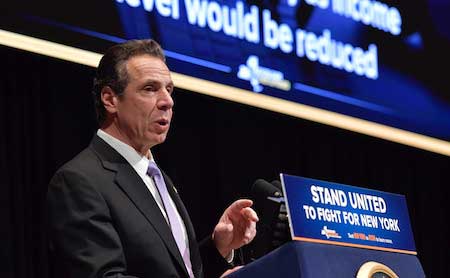
Photo from Governor’s office: Gov. Andrew Cuomo outlines his executive budget today in Albany.
Governor Andrew M. Cuomo today unveiled the FY 2019 Executive Budget, which he said includes a number of proposals – fighting the federal tax assault to ending the opioid epidemic by holding pharmaceutical companies accountable to investing record amounts in education.
“For the past eight years, we have restored fiscal discipline while achieving historic progressive accomplishments and strengthening middle class New Yorkers,” Cuomo said. “Together, we will continue to deliver on the promise of progressive government – even while tackling unprecedented challenges head on. We will restore citizen confidence and ensure management competence. This bold agenda charts a path forward toward a better future for all New Yorkers.”
Highlights of the FY 2019 Executive Budget:
• State Operating Funds spending is $100.0B – an increase of 1.9 percent (State Operating Funds exclude Federal funds and capital)
• All Funds spending $168.2 billion for FY 2019
• Protects New Yorkers from federal tax assault
• Closes carried interest loophole
• Increases School Aid by $769 million – doubling the statutory School Aid growth cap and bringing total investment to $26.4 Billion
• Provides $7.5 billion in State support for higher education in New York- an increase of $1.4 billion or 24 percent since FY 2012
• Provides $118 Million to continue the successful Excelsior Scholarship and extend the income cap to $110,000
• Establishes a new opioid epidemic surcharge
• Imposes a Healthcare Insurance Windfall Profit Fee
• Defers Large Corporate Tax Credits
• Continues the phase-in of the Middle Class Tax Cut for six million New Yorkers – saving households $250 on average and $700 annually when fully effective.
For 8th straight year, spending limits spending growth to 2 percent
For the eighth consecutive year, the Budget is balanced and limits spending growth to two percent – a record of spending restraint unparalleled in State history.
The Executive Budget holds annual spending growth in State Operating Funds to 1.9 percent.
Protect New Yorkers from Federal tax changes
The recently enacted federal tax law is an assault on New York, Cuomo said. By gutting the deductibility of state and local taxes, the law effectively raises middle class families’ property and state income taxes by 20 to 25 percent. New York is fighting back against the federal plan and the loss of both income tax deductibility and property tax deductibility.
First, New York will challenge this unprecedented federal double taxation in court as unconstitutional, because it violates states’ rights and the principle of equal protection. Second, New York will lead the nation’s resistance to the new law, starting a repeal-and-replace effort: “Tax Fairness for All” campaign.
Third, at Governor Cuomo’s direction, the Department of Taxation and Finance is exploring restructuring options and issuing a preliminary report to outline options for State tax reform in response to the Federal legislation. The preliminary report is expected to outline a series of proposals for consideration and comment, including the potential to create additional opportunities for charitable contributions to New York State, the possibility of reducing income taxes by shifting income tax from an employee paid system to an employer paid system, and the option to add tax deductibility through a new statewide unincorporated business tax, among other options.
As New York launches this massive and complicated undertaking, the state will engage tax experts, both houses of the legislature, employers, and other stakeholders in a thorough and collaborative process to produce a proposal that promotes fairness for New York’s taxpayers and safeguards the competitiveness of New York’s economy.
Investing in Education
The FY 2019 Executive Budget includes a $769 million annual increase in School Aid — doubling the statutory School Aid growth cap and increasing education aid 35 percent since 2012. The Budget includes support for several key initiatives, including the Governor’s sixth consecutive investment in high-quality prekindergarten, a second round of Empire State After School awards to high-need districts, the continued transformation of high-need schools into community hubs, the largest State investment ever in computer science and engineering programming and instruction, and additional funding for early college high schools.
Expanding Access to Higher Education
The FY 2019 Executive Budget expands access to higher education by launching the second phase of the first-in-the-nation Excelsior Scholarship program, advancing a comprehensive plan to combat exploding student loan debt, and passing the DREAM Act. The Budget also includes strategic investments that will ensure no student goes hungry on college campuses and provide New Yorkers with the tools and skills they need in the 21st century economy.
The Excelsior Free Tuition Program will see the income eligibility threshold increase, allowing New Yorkers with household incomes up to $110,000 to be eligible. To continue this landmark program, the budget includes $118 million to support an estimated 27,000 students in the Excelsior program. Along with other sources of tuition assistance, including the generous New York State Tuition Assistance Program, the Excelsior Scholarship will allow approximately 53 percent of full-time SUNY and CUNY in-state students, or more than 210,000 New York residents, to attend college tuition-free when fully phased in.
Protecting the Health & Safety of Our Communities
Governor Cuomo is committed to expanding access to quality and affordable health care for all New Yorkers. From redesigning Medicaid to reduce costs and improve care, to embracing the Affordable Care Act and enrolling nearly one in five New Yorkers through the state’s marketplace, Governor Cuomo has transformed health care in New York State. This year, New York will continue to expand access to affordable and quality health care across the State while tackling the major health challenges facing our communities.
• Establish an Opioid Epidemic Surcharge: New York State, like much of the country, is battling a harrowing opioid epidemic. The Executive Budget imposes a new surcharge of 2 cents per milligram of active opioid ingredient on prescription drugs, directing all proceeds to the Opioid Prevention and Rehabilitation Fund. This new fund will expand prevention, treatment, and recovery services, with the express goal of cutting opioid-related deaths in half by 2021.
• Preserving the Children’s Health Insurance Program: Congress has yet to pass long-term funding for CHIP, which directs Federal support to Child Health Plus, a successful program that has provided health coverage to approximately 350,000 children in New York State. Should funding be allowed to lapse for the program many of these children may lose health insurance coverage. The FY 2018 Budget authorizes program modifications, if necessary, to preserve CHIP.
• Establish a Health Care Insurance Windfall Profit Fee: The Federal tax plan gives health insurers a 40 percent cut on their corporate taxes while also transferring health care costs to the State. Accordingly, the Budget imposes a 14 percent surcharge on health insurer gains to recapture $140 million of those corporate tax savings and reinvest it in vital health care services for New Yorkers.
• Support Direct Care Workers and Not-for-Profits: The Budget includes funding of $262 million, an annual increase of $237 million, to support the 6.5 percent salary increase provided to direct care professionals (3.25 percent in January 1, 2018 and 3.25 percent in April 1, 2018) as well as the April 1, 2018 3.25 percent salary increase for clinical workers employed by not-for-profit organizations rendering mental hygiene services on behalf of OPWDD, OMH or OASAS.
Driving Economic Growth & Development
The Executive Budget continue the 10 Regional Economic Development Councils. In 2011, Governor Cuomo established 10 Regional Economic Development Councils (REDCs) to develop long-term regional strategic economic development plans. Since then, the REDCs have awarded $5.4 billion to more than 6,300 projects. This strategy has resulted in 220,000 new or retained jobs in New York. The Executive Budget includes core capital and tax-credit funding that will be combined with a wide range of existing agency programs for an eighth round of REDC awards totaling $750 million.
• Launch Next Round of the Downtown Revitalization Initiative: The Downtown Revitalization Initiative is transforming downtown neighborhoods into vibrant communities where the next generation of New Yorkers will want to live, work and raise families. Participating communities are nominated by the State’s ten REDCs based on the downtown’s potential for transformation. Through two rounds of awards, each winning community was awarded $10 million to develop a downtown strategic investment plan and implement key catalytic projects that advance the community’s vision for revitalization. The FY 2019 Executive Budget provides $100 million for the Downtown Revitalization Program Round III.
As a result of new pistol permit recertification requirements that are in effect this year for the first time due to the SAFE Act, Gov. Cuomo’s controversial gun control measure passed in 2013, State Assemblyman Steve Hawley (R-Batavia) has joined a host of bi-partisan legislators from both the Assembly and Senate in writing to Gov. Cuomo requesting that the recertification deadline within the NY Safe Act be extended.
Recent changes to New York State Penal Law require license holders to recertify every five years. Individuals who were issued a Pistol /Revolver License before January 15, 2013, must recertify by January 31, 2018. The deadline to recertify for those issued a license on or after January 15, 2013, is five years from the date the license was issued.
There are currently about 1.2 million pistol permit holders in New York State, but only around 230,000 have recertified as of Jan. 2, 2018, Hawley said.
“We are urging you to extend the pistol permit deadline, which would allow the County Clerks and Sheriffs of this State the appropriate amount of time to process recertification requests,” Hawley and other legislators wrote to the governor. “We believe this action will help law-abiding gun owners comply with the current law, without the risk of turning them into felons overnight.”
Hawley has consistently voiced his opposition to the SAFE Act since 2013 as an infringement on constitutional rights and the fact that the bill was rammed through the Legislature in the middle of the night by use of a Message of Necessity by Gov. Cuomo, overriding the mandated three-day aging process of legislation before it is voted upon.
“The SAFE Act was one of the worst pieces of legislation I’ve ever seen as a state legislator,” Hawley said. “It was rushed through the legislative process under the cover of darkness and hidden from public criticism using a technique that is supposed to be reserved for emergencies.”
“Despite the problems with this legislation, it is important that gun owners adhere to the law and do not lose their pistol certifications,” Hawley continued. “We are seeing many local governments overburdened with paperwork, and they need more time to get the word out and ensure that law-abiding gun owner can comply with new regulations. I implore Gov. Cuomo to extend the deadline in light of these many concerns.”
ALBANY – A Task Force looking at the “scourge of plastic bag waste” in New York has sent a report to Gov. Andrew Cuomo and the State Legislature for consideration.
The Task Force has eight options for reducing plastic bags, including banning them or charging a fee for each bag.
Across New York, residents use 23 billion plastic bags annually. A significant number of these bags make their way into the environment causing litter and damaging wildlife, which can be seen within our waterways, along our streets and in our oceans and lakes. Moreover, these bags do not biodegrade – they persist for years.
“As states across the nation and world struggle with the environmental and financial costs of plastic bag waste, New York is developing a comprehensive solution,” said Basil Seggos, commissioner of the State Department of Environmental Conservation and chairman of New York’s Plastic Bag Task Force.
Convened in March 2017, the Task Force was directed to study the growing issue of plastic bag waste and develop a comprehensive statewide plan to address the detrimental impact plastic bags have on the environment.
The options to address plastic bag waste in the report include:
• Strengthen and enforce existing New York State Plastic Bag Reduction, Reuse and Recycling Act – Continue implementation of the existing New York State Plastic Bag Reduction, Reuse and Recycling Act while increasing education, enforcement and reporting requirements.
• Manufacturer Responsibility for Recycling of Single-Use Plastic Bags – Require manufacturers to fund and implement a program for the collection and recycling of single-use plastic bags.
• Fee on Single-Use Plastic Bags – Institute a fee on single-use plastic bags.
• Fee per Transaction for Single-Use Bags – Under this option, rather than a fee per bag, a single fee would be imposed for the use of single-use bags (i.e., a fee would be assessed whether a consumer received one bag or 10 bags).
• Fee on Single-Use Plastic and Paper Bags
• Ban Single-Use Plastic Bags – Implement a ban on the sale and use of single-use plastic bags.
• Hybrid – Implement a ban on plastic bags with a fee on the allowable alternatives.
• Continue Existing Policies – Continue implementation of the existing New York State Plastic Bag Reduction, Reuse and Recycling Act.
In addition, the report notes the need for any approach taken to include an education and outreach campaign to make consumers aware of the problems with plastic bags for the environment and waste stream, encourage the use of reusable bags and how to properly recycle plastic bags.
As part of the education and outreach campaign, the report recommends providing funds to support the distribution of reusable bags with a focus on low and fixed income individuals. If the policy approach taken includes fees, the report suggests that any funding received by the State be dedicated to the Environmental Protection Fund.
Now in its fifth year, Genesee Community College and the Orleans Hub are proud to continue the Orleans County Heritage Heroes Awards which recognize the dedication and hard work of dedicated citizens who strive to protect and preserve local history. They are now seeking nominations for the awards. Nominations will be accepted through Feb. 19.
“One of the most remarkable aspects of living in Orleans County is the many people who share a vested interest in our local heritage,” said Jim Simon, associate dean of GCC’s Orleans County Campus Centers in Medina and Albion. “Now in our fifth consecutive year, we recognize the time and investment of individuals who work tirelessly to preserve and protect our local history-be it oral or written histories, as well as the people, places, artifacts, buildings or landmarks in our homeland.”
Nominees for Heritage Heroes Awards can be any age but posthumous nominations will not be accepted. History professionals and GCC employees are also not eligible for the award, nor are those who serve on the awards selection committees. Nominees must be Orleans County residents.
The six winners honored last year included: Jim Hancock, Ken McPherson, Richard and Shirley Nellist, Gretchen Sepik, and Alice Zacher received the special C.W. “Bill” Lattin Award for Excellence in Municipal History. Because nominations are not retained for future consideration, residents who made previous nominations are encouraged to re-submit a nominee again for this coming year.
“The Heritage Heroes Awards program recognizes the members of our community who are dedicated to preserving the local treasures that add to the quality of life and character of our community,” Tom Rivers, Orleans Hub editor said. “These residents are from all over the county and they work hard on restoring historic houses and protecting numerous community assets such as museums, churches, monuments and numerous buildings that make up our unique landscape.”
To nominate someone for the Heritage Heroes Awards, write up a brief statement outlining the person’s contributions, projects and community affiliations. Anyone sending in a nomination should provide their name (anonymous nomination packages will not be accepted), address, phone number and email address. The more in-depth the detail provided in the nomination, the stronger the submission. Submit the nomination to:
ATTENTION: Heritage Heroes Committee
Genesee Community College / Medina Campus Center
11470 Maple Ridge Rd.Medina, NY 14103-9675
Nominations may also be emailed to Jim Simon at jsimon@genesee.edu. Please write Heritage Heroes Nomination in the subject line.
A screening committee made up of community members, history professionals and GCC students will review the nominations and select finalists. From those finalists, a committee including GCC Associate Dean Jim Simon, Associate Professor Derek Maxfield and Orleans Hub Editor Tom Rivers will choose the Heritage Heroes.
“The Heritage Heroes Awards is a point of pride in our community, and the ceremony is always a highlight of my year,” Prof. Maxfield said. “Recognizing the unsung heroes who work hard to ensure local history survives into the next generations is vitally important to the cultural life of our community.”
The Heritage Heroes will be recognized during a ceremony at Genesee Community College in Medina in April 2018.
Brett and John Kast embrace new technology, apple varieties and other crops
Press Release, NYS Agricultural Society
SYRACUSE – An Albion farm was recognized recently with a “Next Generation Farmer Award” at the New York State Agricultural Society annual meeting.
Kast Farms is a Century Farm dating back to 1884. Brett and John Kast are brothers who represent the fifth family generation to operate this diversified fruit, vegetable and grain operation in Orleans County.
Using new precision technology, partnering with Cornell University and others, and trying their hand at experimental crops like industrial hemp has enabled the brothers to uniquely challenge the status quo to help grow farm profitability, the Ag Society said.
The Kast family got their start in farming in 1884 when Aldelbert Chapman purchased the original 140-acre farmstead. Since that time, the Albion-based operation has grown to 4,500 acres. It’s a diversified fruit, vegetable, and grain operation that takes full advantage of Orleans County soil and climate afforded by its proximity to Lake Ontario.
John and Brett Kast pursued separate careers off the farm prior to returning home within the last 10 years. Until 2012, John was employed by the Buffalo and Fort Worth zoos. Brett worked in the Texas oil business before returning in 2008. The family business has immediately felt their combined impact. Owned and leased orchard acreage has increased, and the brothers created their own land limited liability corporation, adding another 600 acres of crop land.
Using new precision technology has allowed the pair to put their own stamp on Kast Farms, including prescription planting, fertilizing and spraying. Working with Cornell University and others, new consumer-friendly apples such as RubyFrost and SnapDragon are being grown on tall spindles and the future may dictate even more diverse varieties. For the past four years, Kast Farms has been malting barley and growing industrial hemp. Partnering with Farm Fresh First, they’ve expanded into spinach production, all with an eye to adapt and drive efficiencies for where customers and new markets are driving.
Both brothers believe that having off-the-farm work experience has enabled them to uniquely challenge the status quo to help grow farm profitability. But they’re quick to look to long time employees, vendors and Cornell to mine for new ideas, efficiencies and mentoring. “It’s this combination that has allowed the farm to continue to grow and be profitable,” John said.
Established in 1832, the mission of the NYS Agricultural Society is to foster, promote, and improve the NYS food and agricultural industry through education, leadership development and recognition programs. It has played a vital role in the development of the NYS Department of Agriculture and Markets, Cornell University’s College of Agriculture & Life Sciences, the NYS Agricultural Experiment Station, the NYS Fair, and the Empire State Food and Agricultural Leadership Institute (LEAD NY). In 2011, the NYS Agricultural Society Foundation was formed.
By Tom Rivers, Editor Posted 15 January 2018 at 4:21 pm
Photo by Tom Rivers: The Lake Ontario State Parkway in Orleans County has suffered from deteriorating road conditions in recent years, which has deterred some motorists from using the road. A study is looking at the future of the Parkway.
An Orleans County legislator believes keeping the Lake Ontario State Parkway in its current form as a four-lane divided highway offers the best benefit for the Orleans County and likely makes the most sense for the state financially.
Ken DeRoller, a county legislator and member of the board of directors for the Orleans Economic Development Agency, is part of a committee looking at the future of the Parkway in Orleans County.
The Genesee Transportation Council in Rochester and the county are studying the future of the Parkway, looking at possible alternatives for the westernmost 12.7 miles of the Parkway that runs along the lake through Kendall and part of Carlton.
One idea was to close the northern side, currently the western lanes, and have the Parkway be a regular two-lane state road on the south side. That could free up the northern side for possible housing development. Except, DeRoller said, there wouldn’t be enough room to accommodate new development because the road is too close to the lake.
DeRoller said the idea of lakefront housing by the northern lanes of the parkway “is a fallacy.”
“There is not enough room to build on the north side,” DeRoller told the EDA board on Friday.
The Transportation Council also is considering closing off either the north or south sides to traffic and designating one side for cyclists and snowmobiles. But DeRoller said snow doesn’t seem to “stick” too well on the Parkway surface.
And the state would need to modify the interchanges if traffic was allowed on only one side. The cost of redoing the interchanges might negate any maintenance savings from closing off one side to traffic, DeRoller said.
The committee looking at the Parkway also is considering a reduced speed of 40 miles per hour for the Parkway, or perhaps an elevated speed limit to make the road faster for motorists.
DeRoller told the EDA board he favors more maintenance and paving in the current Parkway setup. He thinks the roadway should be better marketed as a connector to popular state parks at Lakeside Beach in Carlton and Hamlin Beach. Those two state parks together draw 443,000 visitors annually, DeRoller said. They each have about 250 camp sites.
The state Department of Transportation last year resurfaced the Parkway from Route 19 in Hamlin to Payne Beach Road in Parma. This year the resurfacing will continue west from Route 19 in Hamlin to Route 237 in Kendall in 2018. Altogether, the DOT is spending about $14 million on the paving projects.
DeRoller sees the road – when it’s in good shape – as an asset for the county, leading to the state park in Carlton, sites at Point Breeze, and a revamped marina and other businesses in Kendall.
“It’s very important to our southshore and tourism,” DeRoller said about the Parkway.
To complete a survey about the future of the Parkway, click here.