By Tom Rivers, Editor Posted 27 February 2018 at 11:44 am
‘There’s too much drugs in Orleans County.’ – Judge Sara Sheldon
ALBION – Two people were sentenced to state prison on Monday for drug crimes in Orleans County.
Leonel Lopez-Sanchez, 45, of Rochester received the longest sentence at 3 years in prison.
Lopez-Sanchez in December admitted to having cocaine in Orleans County. He pleaded guilty to attempted criminal possession of a controlled substance in the third degree with intent to sell.
Lopez-Sanchez faced a maximum of 3 ½ years in state prison and two years of post-release supervision.
Sara Sheldon, interim County Court judge, gave him less than the maximum at 3 years in prison. Lopez-Sanchez has taken drug treatment programs in jail. He also doesn’t have any prior felonies, although he has four misdemeanors in Miami, Dade County, Florida.
He also will be on post-release supervision for two years, and may be deported to Cuba.
Lopez-Sanchez was arrested on Feb. 16, 2017 after an investigation by the Orleans County Major Felony Crime Task Force and a the execution of a search warrant on North Main Street by the Albion Police Department.
“I made a mistake,” Lopez-Sanchez said in court on Monday. “It will never, ever happen again.”
• A co-defendant in the case also was to be sentenced to up to 3 years in state prison on Monday. But the judge wanted to hear more from the District Attorney’s Office about Patricio A. Borquez’s involvement.
Borquez and his attorney Mark Lewis said Borquez was involved in one drug transaction.
Borquez developed a drug addiction after fracturing his skull in a construction accident and using pain medication, his attorney said.
He became addicted to the pain pills and then started using heroin.
He sold drugs to support his drug habit, Lewis said.
Since he has been in jail for just over a year, he has completed drug treatment programs through GCASA and also is a regular attendee of a Bible study.
“He has been attempting to better himself,” Lewis told the judge.
Borquez told Judge Sheldon he wants to become a pastor, and be “the father I used to be.”
His attorney asked the judge to sentence Borquez to time served after more than a year in jail.
Sheldon adjourned sentencing until March 5 to hear more from the DA’s office about Borquez’s role in the drug sales.
“There’s too much drugs in Orleans County and you were helping to bring drugs into Orleans County, whether it was one time or three times,” Judge Sheldon said.
• In another case, Andrew Coley, 20, of Albion was sentenced to 2 years in prison, plus a year of post-release supervision for selling crack cocaine.
His attorney, John Zimberlin, said Coley’s drug addiction has fueled his criminal actions.
“I’m not justifying it, I’m just pointing it out,” the attorney said.
Coley didn’t speak during his sentencing and also wasn’t cooperative with probation staff in a presentencing report, Judge Sheldon said.
“Unfortunately Mr. Coley you need an attitude adjustment or you will continue down this path,” she said.
ALBION – Catholic Charities Finger Lakes is pleased to announce the availability of a Targeted Permanency Resource Center (TRPC) based in Albion that provides post adoption and post guardianship services for Orleans County.
The program goal is to improve safety, sustain permanency, and promote the wellbeing of the whole family. The program is offered to any post adoptive or post guardian family, and there are no income restrictions. The TRPC is funded through a NYS Office of Children and Family Services grant.
“Parenting is difficult, add to that complexity the dynamics of adoption or guardianship, and there is increased possibility for challenges and an increased need for programs and services that support families,” said Ellen Wayne, executive director of Catholic Charities of the Finger Lakes. “This program helps us work directly with these families to navigate the bumpy roads, and to make sure that the family remains strong as the children grow.”
The TRPC offers: Home case management, assessments, monthly support groups, advocate, referrals, educational support and workshops, individualized support, linkages to services for treatment of trauma, assistance to local resources unique to client needs, parent training, peer support, mentoring, navigation for cross-system needs, counseling and respite care.
If you are interested in this service, please call Catholic Charities at (585) 737-0892 and ask for Emily Sorenson, or email her at emily.sorenson@dor.org.
Since 1982 Catholic Charities of the Finger Lakes has served Ontario, Seneca, Yates, and Cayuga counties by providing quality human service programs and by advocating for social justice. The organization work with faith communities, government, elected officials, business leaders, and other human service organizations to meet human needs and effect public policy that addresses the needs of all people.
Photo by Tom Rivers: A wind turbine is pictured on the Tug Hill Plateau in northern New York.
Press Release, Save Ontario Shores
A diverse group of organizations has joined forces to stop Apex Clean Energy’s Lighthouse Wind project, which has been proposed for the towns of Somerset and Yates.
The mission of the POWER Coalition (Protecting {Lake} Ontario’s Waterfront, Environment, and Resources) is to highlight the broad opposition to the current proposal by Apex to site up to 70, approximately 600-foot-tall industrial wind turbines along the Lake Ontario shoreline.
“We are in favor of renewable energy, but the Lighthouse Wind project does not meet our standards,” said Shawn Graff, vice president, Great Lakes Region, American Bird Conservancy. “The American Bird Conservancy believes that the proximity to the lakeshore makes this project toxic for migrating birds, bats and raptors and this alone should be enough to stop the project. There are several environmental organizations who agree.”
Each member organization opposes this project based on one or more of the following concerns:
• That this project is being proposed in a major bird migratory corridor and will be devastating to large populations of birds and bats;
• Will visually degrade the waterfront, negatively impact tourism, and violate the Local Waterfront Revitalization Plans (LWRP) adopted by the towns of Somerset and Yates, and accepted by New York State;
• Disrupt hunting and fishing opportunities;
• Increase noise levels for local and seasonal residents;
• Possibly interfere with operations at the Niagara Falls Air Reserve Station, potentially jeopardizing the future of the base in the next round of base closures.
It is the position of all POWER Coalition members that renewable energy is a legitimate and important goal for New York State to pursue. But no energy project should ever be free of assessing and balancing all its impacts on other vital aspects of our environment, economy and quality of life.
The POWER Coalition acknowledges the importance of standards for the proper siting of these projects based on eliminating or significantly mitigating the negative aspects any project might present. The POWER Coalition believes that the Apex proposal for Somerset and Yates fails to meet these standards and should be rejected by New York State.
POWER Coalition members include: American Bird Conservancy, Braddock Bay Bird Observatory, Burroughs Audubon Nature Club, Federation of Monroe County Environmentalists, Genesee Valley Audubon Society, Great Lakes Seaway Trail, Hawk Migration Association of North America, New York State Ornithological Association, Niagara USA Chamber, Orleans County Federation of Sportsmen’s Clubs, Rochester Birding Association, and Save Ontario Shores, Inc.
The POWER Coalition will continue to advocate for the withdrawal of this project through direct advocacy with government officials, by hosting forums, and disseminating information which will show the tremendous negative impact this industrial wind project will have on Niagara and Orleans counties’ lakeshore regions.
By Tom Rivers, Editor Posted 26 February 2018 at 4:45 pm
Tom Marano, Dean Covis admit to falsifying time sheets for security work while they were also on the clock for Sheriff’s Department
ALBION – Two Orleans County sheriff’s deputies pleaded guilty in County Court today to petit larceny and falsifying business records.
Dean Covis
Tom Marano and Dean Covis last July were indicted on felony grand larceny in the third degree after both were accused of falsifying time sheets when they were hired for security by Brookfield Renewable Energy Partners, which operates a hydroelectric plant in Waterport.
Marano and Covis submitted time sheets for Brookfield when they were allegedly also working shifts for the Orleans County Sheriff’s Department.
Both Marano and Covis have to pay restitution to Brookfield. As part of a plea deal today, the felony charges were reduced to a misdemeanor. There was no sentencing promises in court today. Judge Sara Sheldon said the charge carries a maximum of a year in jail.
Marano and Covis will both be sentenced on May 7.
Tom Marano
Covis, 53, admitted to filing false time sheets for about 690 hours at Brookfield from approximately Nov. 26, 2013 to Jan. 3, 2015. Covis agreed to pay $12,915 in restitution. He is disputing paying an additional $1,000 in restitution for $13,915 total.
Larry Friedman, the Genesee County district attorney, prosecuted the case for the Orleans DA’s Office. Friedman said he and Covis’s attorney would attempt to resolve the issue about the additional $1,000 in restitution.
Marano, 46, admitted to claiming 240 hours at Brookfield while he was on the clock working as a deputy between Jan. 12, 2014 and Jan. 1, 2015. He agreed to repay $4,800 in restitution.
The charges were refiled today after the original charges were dismissed over technicalities. Judge Sheldon said the spread sheet of time cards was not presented as evidence for the grand jury. There were also 192 counts or falsifying business records that should have been presented to grand jury with a vote on each count individually, Sheldon said.
The original indictment lists 140 counts of first-degree falsifying business records and one count of third-degree grand larceny against Covis. Marano faced 101 counts of falsifying business records and one count of third-degree grand larceny.
Both Covis and Marano are waiving their right to appeal as part of the plea. They have both been on unpaid leave, pending the outcome of the case.
By Tom Rivers, Editor Posted 26 February 2018 at 1:44 pm
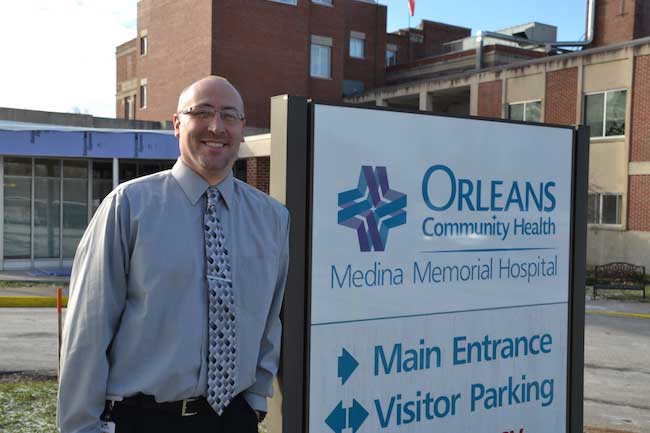
MEDINA – Mark Cye, the interim president and CEO of Orleans Community Health, said healthcare organizations are struggling with reimbursements that don’t cover the cost of care. It’s particularly difficult for small, rural hospitals that serve populations with a high percentage on Medicaid. The Medicaid rates are “awful,” Cye said.
He started as the hospital leader on Jan. 1 and also has been Orleans Community Health’s chief financial officer the past three years. He has worked the past 20 years in the healthcare field.
The following interview was conducted recently by Tom Rivers as Cye’s office at the hospital on Ohio Street.
Question: I wonder how you got interested in the healthcare field?
Answer: When I think about it, it was maybe by mistake. I actually started off in dietary at the Lockport hospital and I worked there for five years. At that point I was going for my accounting degree and a position opened up in patient accountings so I transitioned up there to see what that was like. As I was going through there I got my bachelor’s degree in accounting.
The day I was actually going to resign, because I had accepted another job as an accountant, I had to have my appendix removed that morning. When I went into work that morning at the hospital, the controller asked me about taking the accounting position at the hospital.
I took that and it was healthcare, healthcare, healthcare all the time. I was three years in that job at Lockport hospital. Then what happened is the controller had transitioned out to the Olmsted Center for the Visually Impaired. He called me and asked me to follow him. He was there three years and then he asked me to follow him to BryLin Hospital (on Delaware Avenue in Buffalo). I was there for three years.
I actually worked here as the controller from 2006 to 2008 and then went back to BryLin for seven years, and came back here. I’ve been in healthcare for about 20 years.
Question: Has the number-crunching got more stressful?
Answer: Oh yeah. With healthcare, the days of having dollars there are gone. Now it’s being more creative with how we’re doing things. In healthcare there is always downsizing to really get it to providing the same care but more efficiently. The days of Medicare and the states giving money have gone by the wayside. That’s the more stressful part.
Question: It seems like there is only so much you can cut.
Answer: That’s why in these days if you don’t affiliate with someone, those places don’t make it. With an affiliation you get synergies of service. Maybe you could have a CEO run this hospital and manage that hospital. With the upper level management you have cost reduction and it’s spread out.
Question: Is Medina affiliated with anyone right now?
Answer: Not yet. We’re in the process. It’s pretty close. We’re under a confidentiality agreement until it’s written. We were affiliated at one point with Catholic Health, which to us didn’t provide us a lot of subsistence, so we ended that about six to nine months ago.
Question: They seemed to be at events.
Mark Cye is pictured with a wall that recognizes some of the hospital’s bigger donors.
Answer: Yes, they would present but what we need from an affiliate is as a small, rural hospital we don’t have the ability to attract doctors here and bring other services. Without that, those services go elsewhere, they go 25 miles to the east or 25 miles to the west at another healthcare facility.
We need to attract those doctors here. That was what they were supposed to do but it didn’t pan out.
A good example is in our state it took us 18 months to attract a primary care doc at Albion. Other hospitals have 10 of them sitting there. That’s your main piece in an affiliate. That’s what we’re looking for in an affiliate is how can we keep people in this community getting service in this community.
We don’t want your elders having to drive a half hour to get a procedure when it can be offered here.
Question: It seems like a crisis for rural healthcare.
Answer: Yes. Knock on wood, luckily of all critical access hospitals, New York State is the only one that hasn’t had one close yet, but there have been up to 100 critical access hospitals that have closed in the last couple of years. That’s where the collaboration with other larger affiliates will come into play.
Question: It seems the other nearby hospitals have been aggressive in Orleans County of late. The Batavia hospital just added a family doctor in Medina.
Answer: With most critical access hospitals, they are up on their own. In Watertown, there is no one around for an hour. For us, we’re in a special area where we have big systems sitting on both sides of us. That’s why at some point we have to get stronger with one of them to make it work.
Question: I think you can say that with the local hospital and many local institutions the local people tend to be critical. That must be tough for the Medina hospital because there is some criticism.
Answer: It’s a battle. For us we always try to promote the positives. But you get that one negative comment out there and it blows a lot of the good you’re doing. We could be opening up a new ED today but someone could say the care stunk when I went there, and that’s what people focus on. Which is sad because at the end of the day, and this is what I try to stress to everyone here, is we’re all marketable as employees. Could I go somewhere else? Probably. Could the nurses go somewhere else? Probably. But at the end of the day that would affect the 20,000 people in this community who need the service. It could be your family member who needs that ambulance, who is having a heart attack or stroke and isn’t going to make it if they have to go 25 miles this way or that way.
Question: Is the care really as bad as some people make it out to be?
Answer: Some people come to the ED because they need a medication, they want their drug. We’re going to turn you away.
Some people come here and they don’t want to wait 10 minutes. To them 10 minutes is terrible, but to a normal person they would go there all day long.
Question: Isn’t there a standard of response? I tend to think a smaller hospital would be much faster than a bigger one. You could probably sit there for many hours in Rochester.
Answer: Right. What you always push in these type of settings is a quick turnaround. That is how you keep and attract patients to your area. Here the goal is hour and half from the time you get through the door until you get out.
There are reports that come through about quality, where patients do the questionnaire where they are asked, “Would you recommend the hospital or would you not?” You get some people who will rate your quality a 2, but then two questions later they give you a 9 for, “Would you recommend this place?” So that is of course what the data feeds into and it gets published that you’re a one-star facility, yet 90 percent of the time they would recommend you. You look at some of the metrics and does it even make sense?
They come in and we’re changing your meds, we’re changing your food pattern on you, and to them it’s terrible.
For us it even makes it worse because we’re a low volume. If we have four discharges that month and this is one of them, we look bad. A lot of things end of skewed for the smaller hospitals.
Question: Why did you want to come back to Medina? It seems like it would be easier in the city at a bigger facility.
Answer: Healthcare is healthcare. It’s one of things where I went back to BryLin, they were in bankruptcy when I was there. With my previous boss we went back to BryLin to fix it, to get it out of bankruptcy. They got out of bankruptcy. Then this opened up. I decided to come back here because there was a whole new leadership team. I knew they were struggling.
I want to make a place work. I can’t fix it on my own, obviously, but here there is a challenge.
I like a challenge. I’ve never been the type who just liked to sit in the office and say, “Here’s your financial statement.” I want to broaden and learn.
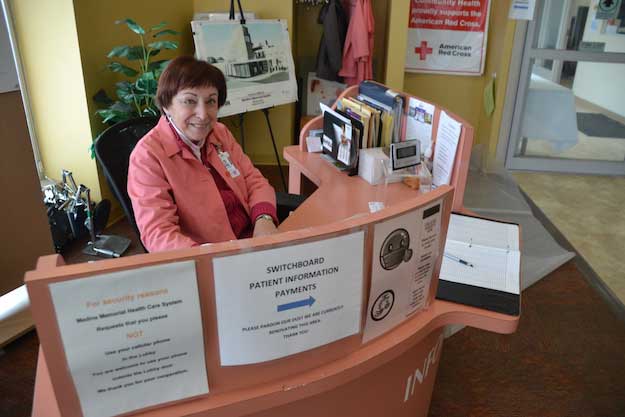
Anne Outwein, a volunteer with the Twig organization, greets people at the hospital lobby, which is being upgraded.
Question: You’ve been the CFO here for how long?
Answer: Two years. I can in as controller on March 2015, and officially CFO in January 2016.
Question: Are you doing the two jobs, the CFO and the CEO?
Answer: Yes. Again as you look at the hospital and the ways its volumes are changing, our volumes are down dramatically. We’re trying to ramp that up and fix it.
What does a 25-bed or a 10-bed hospital really need to run? If you don’t change with those times, what’s going to happen?
Question: When you say they’re down dramatically, is that compared to five or 10 years ago?
Answer: Two years ago. Is part of it a change from going to an acute hospital to a critical access hospital? People may think we’re a critical access hospital so we can’t handle certain things. That’s one of those things that you don’t fix overnight. We have to rebuild it up. As a critical access hospital we have a 96-hour rule. We are required to have the patient in and out within 96 hours to keep our critical access designation, which is a four-day window.
That doesn’t mean every patient has to be four days. You have some for seven days and some for three days, as long as you average for the year. Some of the doctors didn’t understand that and if a patient was going to be five or six days, they would transfer they out.
We are looking at everything. Does it make sense to keep running as we’re running or do we change some things?
Question: With the focus on preventive care and shorter stays is there less money coming in?
Answer: The good thing for a critical access hospital, from a Medicare standpoint – and that typically goes with your elder population and we have an elder population here – the Medicare dollars are reimbursed at the cost.
You come in for pneumonia and it costs you $5,000 to take care of the patient, we’re going to reimburse you $5,000 instead of say $3,000. But we also have a high Medicaid population, and Medicaid reimburses awful. They haven’t increased their ER rate in five years.
Medicaid is what hurts us. Our clinic is probably 40 to 50 percent Medicaid/managed Medicaid, and the reimbursements are just awful.
Question: Is there a chance things could get worse for reimbursements?
Answer: I don’t think Medicaid could get any worse. The problem with Medicaid is it’s stagnant. If my costs go up 3 percent, they don’t put a 3 percent increase in for inflation. It’s always, “Here’s a half percent, here’s a half percent” and that’s what weighs down a lot of the organizations. It’s not going up to meet your costs, and that’s what’s putting a strain on a lot of us.
Question: And that’s despite New York spending $70 billion on Medicaid. You wonder where it all goes?
Answer: There’s a lot going to the other ancillary type things when we should be putting more into healthcare.
Question: How worried should the community be about the hospital?
Answer: As long as we can work with the union, work with doctors out there, and bring a closer-knit affiliate, that will be the shot in the arm that is needed here. I think we’re very close to getting that.
As those affiliations get closer, the state looks favorably on a struggling facility like us and is able to say we’ll give you an extra million dollars this year and next year, as you work through the affiliation, I know in two years you’re not going to ask for 4, 5, 6, 7 or 8 million dollars.
When we go with an affiliation, now I can go to the state with a huge backer with me who can say, “We’re willing to work with them and they need some assistance to get from where they’ve been to where they need to be.”
By Tom Rivers, Editor Posted 26 February 2018 at 10:18 am
Local party leaders will make endorsement after hearing from Nate McMurray, Nick Stankevich
Nate McMurray
ALBION – The Orleans County Democratic Party Committee will host a forum on March 6 with the final two candidates seeking the Democratic endorsement for the 27th Congressional District.
The forum will be form 7 to 9 p.m. at the QWL Building on Washington Street in Albion. The event is open to the public, including people who aren’t Democrats.
After hearing from Nate McMurray and Nick Stankevich, Democratic Party leaders from Orleans expect to endorse one of the candidates, said Jeanne Crane, party chairwoman.
Nicholas Stankevich
There were five Democrats seeking to challenge incumbent Chris Collins, a Republican from Clarence. But the following have recently dropped out of the race: Joan Seamans, owner of a photography studio in Williamsville; former Erie County Assistant District Attorney Sean B. Bunny; and engineer Thomas P. Casey of Erie County.
“There is a lot of money involved and that discourages people,” Crane said today.
McMurray, the Grand Island town supervisor, has the backing of Turn 27 Blue, a coalition of left-learning grassroots groups as well as many Democratic Party leaders. McMurray currently lives just outside the 27th District. He grew up in North Tonawanda which is in the district. McMurray’s campaign noted that Chris Collins lived outside the district when he challenged John LaFalce for Congress in 1998. LaFalce was re-elected.
Since the endorsement from Turn 27 Blue, the Democratic field has narrowed with only Nick Stankevich, a businessman from Mumford in Livingston County, remaining to challenge McMurray for the Democratic line.
Stankevich, in a statement on Sunday, said he will force a Democratic Party primary.
“You deserve the freedom of a primary, and you deserve a rural candidate who lives in the district,” Stankevich said in his statement to supporters. “I’ve shown you, my neighbors, that I have a plan to beat Chris Collins come November, and it starts with you.”
By Tom Rivers, Editor Posted 26 February 2018 at 8:12 am
Initiative raises funds and awareness for domestic violence
Provided photos: Genevieve Riviere overcame adversity and was devoted to her children and community.
An Albion native, Genevieve Monacelli Riviere, is one of two women being honored in an inaugural event to take place March 4.
Riviere was ahead of her time and never gave in to adversity, her son, Patrick Riviere said. She became a single mother during a time uncommon to this type of family dynamic, and she experienced the loss of a child.
When challenged with tragic moments in her life, she carried on for her family and for her own well-being. Volunteering her time, and always keeping her faith, “Mama Gen” was the heroine in her own story. Passing away on March 4th, 1997, she left her family with inspirational memories. For those who remember her, especially her family, we recognize how she always “Marched Forth.”
The Unwritten Women’s Society brings together women who want positive change in their lives by encouraging personal growth and providing opportunities to meet other inspirational women. It is with that spirit (and a Facebook exchange between old friends) that the inspiration for #MarchForth was born.
In memory of Genevieve (and Patricia Zoltoski of Grand Island, NY), the Unwritten Women’s Society of the Philadelphia suburbs will celebrate the Inaugural March Forth event this Sunday. Embracing the difficult moments in life and celebrating our ability to rise above adversity, we will #MarchForth. UWS will also be encouraging people across the country to participate in their own way to honor these women and the special women in their own lives.
Jess Alaimo Filpo, a friend of Patrick Riviere’s, is the organizer of March Forth. Riviere lives on Cape Cod and is a professional actor and playwright.
His mother endured prejudice as an Italian-American, and also battled rheumatic fever and double leakage of the heart as a young girl. When she was a student, she worked in a local canning factory and on a farm.
Patrick Riviere is pictured with his mother, Genevieve.
“She was a child of the Great Depression so she never took things for granted and had an amazing work ethic,” her son writes about her on the Unwritten Women’s Society website. “When her father refused to help her with college after her older sister dropped out, she worked her way through night school to become an accountant. She got a job with the General Accounting Office (GAO) in Washington DC working for the government in a department dominated by men. Early on in her life, she marched forth.”
She gave up her career to have a family. Her first child, Jackie, was born with Down syndrome. Patrick was born 2 years later. His mother raised both of boys as a single mother after her husband walked out, Patrick says.
“My brother Jackie died when he was only 16,” Patrick writes. “I remember going to visit my mom at The Ronald McDonald House on my 14th birthday. She felt guilty that she wasn’t doing more for my special day. My brother died the next day. I’m really not sure how my mom survived it. And yet, out of the depths of her sorrow, she marched forth.”
His mother worked at the grammar school, did taxes during tax season and sold Avon. She was a woman of faith who insisted on tithing to the church, even during lean times financially.
Genevieve was 72 when she died on March 4th, 1997. “Her life was a testament for all of us to #MarchForth,” Patrick writes.
To support the March Forth movement, the Unwritten Women’s Society is holding a t-shirt fundraiser. Proceeds from the fundraiser will be donated to the prevention of domestic violence. Domestic violence is an “equal opportunity offender.” It can happen to anyone of any race, age, sexual orientation, religion or gender. It affects people of all socioeconomic backgrounds and education levels.
To read more about the Unwritten Women’s Project, and Genevieve and Patricia’s story and learn how you can support March Forth, visit http://www.unwrittenwomenssociety.org/marchforth/.
Patrick Riviere stars in Super Bowl ad
Patrick Riviere (pictured in a new ad) is an Albion native who works as a professional actor and playwright (and also helped manage a bed and breakfast for a few years in Cape Cod). He appears in a regional ad for the Rhode Island and Western Massachusetts market. The ad for a law firm debuted during the Super Bowl. Click here to see it.
“This biz is a crazy roller-coaster,” Riviere wrote in an email. “Each time I think I might have come to the end of the ride, I find myself buying another ticket.”
By Tom Rivers, Editor Posted 25 February 2018 at 4:28 pm
Photos courtesy of Kerri Neale
HOLLEY – The fierce winds today knocked down two trees at Kerri Neale’s home that is just north of the Erie Canal. One of the trees landed on his house by the front door.
Neale has lived there for 40 years. He never had a tree come down from the wind, even last March when powerful winds left the majority of the county without electricity.
Neale said the tree-clearing in Holley along the canal left his property without a buffer to absorb strong winds. Today, the National Weather Service in Buffalo said the strongest gust in Orleans County was 47 miles per hour in Medina.
“We didn’t have any damage in last March’s wind storm,” he said. “Today, we have a marginal wind storm and two trees come down.”
Neale said a neighbor also had trees toppled by the wind today. Neale said his property gets hit harder by the wind since the tree clearing.
“Right after they cut the trees we noticed the wind chimes were rattling more and we had stuff blow over that never would,” Neale said. “Even the snow drifts a little different.”
The trees came down about 2 this afternoon. Neale took this photo from his roof, looking over the fallen trees toward the canal.
By Tom Rivers, Editor Posted 25 February 2018 at 1:46 pm
Photos by Tom Rivers
OLCOTT – The Polar Bear took off in a sprint in this morning’s 22nd annual Polar Bear 5K and Kids Race at Olcott. The race in its first 21 years was run by the YMCA as a benefit for Camp Kenan. When the Y decided not to continue running the race this year, the Olcott Volunteer Fire Company took it over.
The Polar Bear was quite animated with its stretching routine and calisthenics, including push ups, before the race.
There were 188 runners registered for the race today. The event included a pancake breakfast. Runners who finished ahead of the bear received a T-shirt that said, “I Beat The Bear.” All of runners beat the bear, which stopped along the course to cheer on the runners and give high-fives.
There also was a “fun run” before the 5K and the Polar Bear joined this group of kids in the race that was about a half mile.
The Polar Bear cheers on some of the kids in the fun run.
The top finishers in the 5K included Collin McCabe of Newfane for the males in a time of 19:05 and Kelli Dimon of North Tonawanda for the females in a time of 22:28.
Olcott next Sunday on March 4 will host the 49th annual Polar Bear Swim for Sight, when about 1,000 people are expected to plunge into the lake.
By Tom Rivers, Editor Posted 25 February 2018 at 8:06 am
Photo by Tom Rivers: Main Street in Lyndonville is shown on Saturday. The downtown has several vacancies. Village officials are hopeful that a tax exemption for renovations will entice businesses to Main Street.
LYNDONVILLE – In an effort to draw investment to Main Street, the Lyndonville Village Board plans to offer an exemption for upgrades to buildings in the downtown.
Property owners who invest in the historic commercial buildings would not see the assessments increase for five years, and would then see 20 percent increases over the next five years, until the sites are at full assessment.
John Belson, mayor of Lyndonville, said he is concerned about the many vacant or underutilized buildings in the downtown. Medina offers a similar exemption, and Belson said it has provided temporary relief for some building owners after they made significant investments in the downtown.
The Orleans County Legislature also is scheduled to vote on offering the exemption in Lyndonville at this Wednesday’s Legislature meeting at 4:30 p.m. Belson would like to see the school district and Town of Yates offer it as well. The Village Board will have its own public hearing on the issue at 6:05 p.m. on March 5 at the Village Hall.
Properties on Main Street, from Eagle Street to Riverside Drive, would be eligible for the exemption if it is approved.
“If we don’t do something we’re in trouble,” Belson said.
He doesn’t want to see buildings fall into more disrepair.
He noted the village and taxing entities aren’t losing any revenue based on the existing taxes from the sites. The taxing jurisdictions are, however, forgoing an increase in taxes for five years with the sites, but would then see a 20 percent increase annually from years 6 to 10 for the additional assessed value based on improvements.
By Tom Rivers, Editor Posted 25 February 2018 at 7:46 am
Photos by Tom Rivers
ALBION – Some of parts of the Ere Canal banks where trees were cut down late last year have been hydro-seeded in recent days. These photos show a section in Albion just west of the Brown Street bridge.
The seeding caught some people by surprise because the banks are littered with branches and chunks of trees.
The Canal Corp. stated on its website that brush and trees will be removed from the site or may be chipped on site.
“Eventually the tree stumps will be excavated and removed and the affected area will be regraded. As the work progresses, all disturbed areas will be restored by establishing a grass surface that the Canal Corporation will maintain,” the Canal Corp. stated on a Q and A about the tree-clearing project.
The canal hired a contractor to take down trees from Medina to Fairport. The trees have roots that can burrow into the soil, going under the towpath and reaching the canal walls. That can make the canal vulnerable to leaks and weaken the walls, Canal Corp. officials said.
By Tom Rivers, Editor Posted 24 February 2018 at 3:03 pm
Republicans also back Ortt, Hawley and Norris in State Legislature
ALBION – The executive committee of the Orleans County Republican Party was unanimous today in voting to endorse Chris Collins for a fourth term in Congress.
Congressman Collins
The 80-member committee also endorsed State Sen. Robert Ortt, and State Assembly members Steve Hawley and Michael Norris.
“We are very fortunate we have good representatives,” said Ed Morgan, the GOP chairman. “They all work hard at what they do. They listen to their constituents on issues, whether lake levels, immigration or broadband.”
The committee met at Tillman’s Village Inn. The group isn’t voting to endorse yet on state-wide positions, including governor.
“It’s still wide open,” Morgan said about the governor’s race.
Collins, R-Clarence, represents the 27th Congressional District with includes Orleans and seven other counties. He attended the session this morning and met with the local Republican leaders.
“Chairman Ed Morgan and the Orleans County Republican Committee have done a tremendous job electing Republican candidates who will fight for a smaller, more accountable government and I am truly humbled to have once again earned their endorsement,” Collins said in a statement. “Their unwavering support will allow me to continue working closely with President Trump to ensure protecting our shorelines, expanding rural broadband access, and strengthening Orleans County’s agriculture industry will remain a top priority for the Trump Administration.”
Ortt of North Tonawanda is seeking a third two-year term as state senator since he succeeded George Maziarz in a district that includes Orleans, Niagara and a portion of Monroe counties.
Hawley of Batavia was first elected assemblyman in 2006. The 139th District includes all of Genesee County, nine of the 10 towns in Orleans, and a portion of western Monroe County.
Norris of Lockport is seeking a second term for the 144th District which includes Shelby in Orleans, and portions of Niagara and Erie counties.
By Tom Rivers, Editor Posted 24 February 2018 at 1:59 pm
ALBION – The Orleans County Legislature has a resolution on its agenda next week to formally join State Assemblyman Steve Hawley in opposing a free tablet program for inmates.
There are about 2,000 inmates in state prisons in Orleans County with about 1,000 women at the Albion Correctional Facility and 1,000 men at the Orleans Correctional Facility.
“The Orleans County Legislature also demands that this program be shut down immediately and the laptops be used for law-abiding citizens, students in our schools, provided to our library systems, or veterans organizations,” according to a resolution to be voted on Wednesday during the Legislature’s 4:30 p.m. meeting at the County Clerks Building, 3 South Main St.
Hawley, R-Batavia, sent a letter to Gov. Cuomo asking the program not go forward for inmates.
“If it’s this easy to encourage vendors to provide free tablets to inmates, why aren’t they being provided to our students in disadvantaged school districts or to libraries across the state as a community resource?” Hawley said.
The Department of Corrections and Community Supervision said the tablets will keep inmates better connected with their families, and also provide some educational and productive opportunities for inmates, which will reduce recidivism, ultimately making communities and the prisons safer.
By Matthew Ballard, Orleans County Historian Posted 24 February 2018 at 8:08 am
Former Poor House took in elderly, destitute and other residents with physically and mentally debilitating conditions
“Overlooked Orleans” – Vol. 4, No. 8
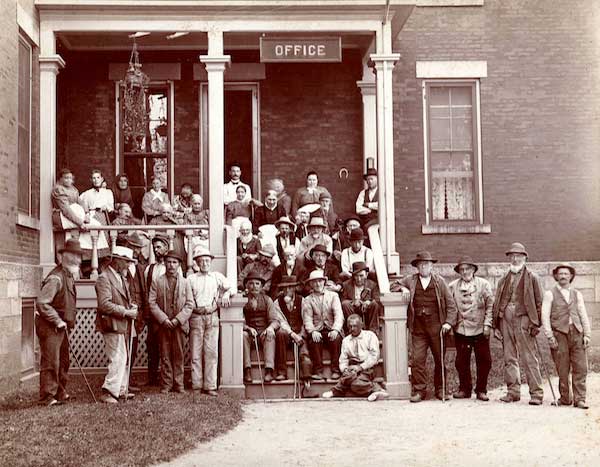
ALBION – As I perused the pages of a death ledger from the Orleans County Home, covering the years 1873 to 1902, the phrase “inmate” appears quite regularly. Today we associate that term with people who are involuntarily held at a jail, prison, or psychiatric facility; a rather focused description which has evolved over the last few centuries.
In its earliest meaning, dating back to the 1500s, inmate was used to describe someone who shared a residence such as a visitor at a hotel, a boarding house, or a college student living on or around campus.
The Poor House was a common place for “inmates” to gather, not because they were confined to a cell as we have come to accept the word, but because they shared a common residence. In many cases, the confinement of one to a county poor house was, in fact, involuntary. A wife whose husband skipped town may not be capable of financially supporting herself or her children. An elderly man may be physically disabled with no family and no means to support himself. In other cases, individuals suffered long-term, physically or mentally debilitating conditions that made self-sufficiency nearly impossible.
The records of the County Poor House are filled with antiquated terminology that is reflective of the infancy of medicine and of the mentalities of the past. Phrases such as “idiot,” “lunatic,” and “dumb” were commonplace. As an example, the phrase dumb was a derivative of “dum” in Dutch or “dumm” in German meaning “stupid,” as if a person’s ability or inability to speak was based solely on mental capacity. Although offensive by today’s standards, they provide a window into how medical conditions were approached over 100 years ago. By understanding the context in which the phrases were used, we can learn far more about the past than using a current lens.
In 1880, the federal government instituted the “Defective, Dependent, and Delinquent” schedules for the U.S. Census. Surfacing in the earlier years of “new immigration,” the government sought new ways to restrict immigration, focusing on physical disability as a common factor for evaluation. The schedule sought to pinpoint those who were blind, deaf, dumb, “idiotic,” insane, “maimed, crippled, or bedridden,” and those in prison, in orphanages, or in poor houses. Perhaps one of the more iconic cartoons appearing in Harper’s Weekly in the early 1880s was that of the “Poor House from Galway,” depicting a ship with Irish passengers aboard; those destined to become charges of the public and residents of the local poor houses.
Although a great deal could be written about the Orleans County Poor House and the development of the physical institution locally, more should be said about the lives of those forced to live the remainder of their lives at the institution due to situations beyond their control. The County Home, as it was often called, was supplemented financially by the 155 acre farm that raised livestock and grew crops. Those who passed away while living in the home were occasionally interred at local cemeteries by family and loved ones. Others, who had no financial means or families to support such a burial, were laid to rest under sandstone markers with numbers in the County Home burial ground now located off of West County House Road.
In paging through the ledger of deaths, I thought it might be worthwhile to share a few bits of information on local inmates and residents who appeared both in the ledger and in the 1880 schedule with the U.S. Census:
Lorenzo A. Smith of Medina suffered from deafness as the result of exposure during the Civil War. He was treated at Fort Monroe for approximately four months before he was discharged.
Rebecca Sherwood of Ridgeway developed melancholia and was kept under lock and key for her own safety. Today we might recognize the condition as depression.
Jeanette Clark of Gaines developed dementia at the age of 32 and suffered with the illness for 26 years when the 1880 census was taken.
Solomon Pierson of Albion was listed as an “idiot” from birth. The census schedule noted that he had a “large skull” and was an inmate of the County Home. It was known locally that Pierson had a penchant for demolishing buildings and in a “fit of mania” in 1906; he escaped from the County Home and proceeded to tear apart an old barn. He continued this work until the walls gave way, collapsing on top of him and killing him instantly; he was a step-brother of Alice Wilson who was murdered by her husband in 1887.
Of those names that appear in the pages of the ledger, their entries are preceded by a number indicating the headstone marking their grave. One entry is simply marked “No. 18 is Unknown.”
By Tom Rivers, Editor Posted 23 February 2018 at 9:45 pm
Provided photos: A cannon that was used in World War I about a century ago will be removed from State Street Park in Medina on March 12 and taken for restoration work in Altoona, Pa.
MEDINA – A cannon used in World War I that has been a prominent memorial at State Street Park will get much-needed restoration work beginning next month.
The cannon, manufactured in 1916, was fired during World War I. Every Memorial Day for about 80 years, the Medina community has gathered by the cannon for the solemn ceremony.
The cannon, however, has become badly deteriorated and will be restored for $40,000. George Bidleman of Orleans Ford is raising the funds for the project.
The Orleans Renaissance Group first pushed for saving the cannon about two years ago. The VFW and American Legion both supported the effort.
“She is in dire need of being restored – not just the paint but the whole body,” said David Kusmiersczak, a member of the Legion.
The cannon has become badly deteriorated. It will be refurbished and should last another century.
The cannon will be moved on March 12 and taken to Altoona, Pa. That is the location of Seed Artillery Reproduction and Restoration.
The cannon will be stripped down. The parts will be repaired and re-manufactured if necessary. The gun will be primed and painted with epoxy primer and finished to match the original WWI paint scheme.
Seed Artillery will try to have the project done in time to be back in Medina for Veterans Day in November, said Steve Johnson, American Legion commander in Medina.
The cannon will return to a concrete base and landscape improvements. The Orleans Renaissance Group also is working to add new flagpoles and an interpretive sign at the site.
The cannon is a British Heavy Field Gun known as a B.L. 60 Pounder, manufactured in 1916 by Elswick Ordnance Company, Newcastle upon Tyne, England.
It weighs 6 tons, is a 5 inch/127mm caliber, 21 feet in length and 6 feet in width. The gun was originally issued to battery in France, April 1917 and fired 2,871 rounds during its first tour. It was returned to England in 1917 for repairs and reissued to battery in France, September 1918, firing an additional 1,471 rounds.