By Tom Rivers, Editor Posted 22 June 2019 at 6:35 pm
CARLTON – The community is welcome to attend an open house on Sunday from 11 a.m. to 2 p.m. at the Carlton Rec Hall, where firefighters will be giving tours of fire trucks, an ambulance and doing demonstrations, including one with auto extrication equipment.
The fire company usually does an open house in April but moved it back until June 23 to increase the chances of better weather.
The open house will be a chance to meet firefighters and EMTs.
The Emergency Management Office will also have a fire safety trailer on site where people can learn about fire prevention and develop a fire escape plan.
The Sheriff’s Office will also be at the open house with K9 Otto and deputies will do a child car seat check for families.
The Fire Company will also share opportunities to serve as firefighters, EMTs or as social members. The age of membership recently was lowered to 16.
Community members can also help with events at the Rec Hall, serving as bartenders, on buildings and grounds or with administrative duties.
By Tom Rivers, Editor Posted 22 June 2019 at 5:59 pm
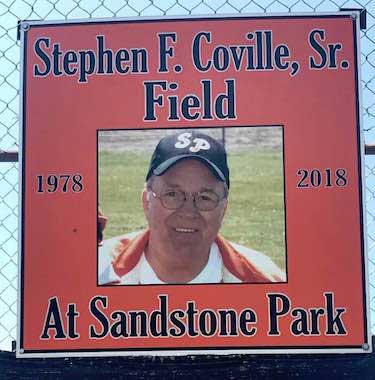
ALBION – Sandstone Park named its field in honor of the late Steve Coville Sr., who volunteered for 40 years, with 22 years as a coach and then as groundskeeper for the park as well as running the concession stand.
A sign with Coville’s smiling face is now on the backstop at Sandstone Park. Coville spent many hours each season the past 40 years at Sandstone.
Coville passed away at age 76 on Jan. 17. He loved helping the Little League team on East State Street.
The team has only had four head coaches since 1956, when the Albion Midget League formed. Sandstone was one of the original six teams. Sandstone was first coached by Guido Mannella. He did it from 1956 to 1966. He was followed by Leonard Sidari, who led the team from 1967 to 1978. Then Coville took the reins from 1979 to 2001. (He also helped coach in 1978.) Dan Bartlett has been the head coach since 2002.
Leonard Sidari’s sons, David and Peter, attended today’s field dedication and praised Coville for his devotion to the team for four decades.
Bartlett, the current coach, said it has taken many volunteers to try to fill the void from Coville’s passing.
“He gave his heart,” Bartlett said. “He worked up here at Sandstone Park for half of his life.”
Coville would mow the expansive lawn and work on the field at Sandstone. He ran the concessions to raise money for the team to buy baseballs and other equipment.
Coville’s wife Annette attended the dedication today, and was joined by the couple’s four children – Steve, Marcus, Gloria Lear and Tina Bauder. Many of Coville’s grandchildren and great-grandchildren also joined in the dedication.
“For my dad it was about the youth,” Gloria Lear said. “He had a bag full of gloves, sneakers and hats. He worked with the parents and would pick kids up if they needed a ride. It definitely a priority in his life.”
When he stepped back from coaching, Coville still felt pride in the team and wanted a nice place for them to play.
“He enjoyed it and wanted the kids to do well,” Lear said.
The family appreciates the recognition at the park.
By Tom Rivers, Editor Posted 22 June 2019 at 8:34 am
Photo courtesy of Sean Pogue
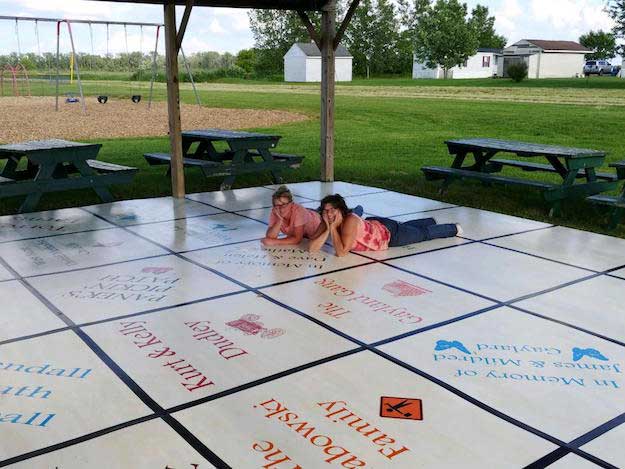
BARRE – Kelly Dudley (left), president of the Barre Betterment Committee, and Cindy Van LieShout, the vice president, are pictured Friday on the dance floor under the pavilion at Barre Town Park.
The park is hosting a square dance from 6 to 9 p.m. today. Cabin Fever will be playing the music and Margaret Matthews will be the caller for the event, which has no admission charge. There will also be hot dogs, soda, basket raffles and 50/50 raffles.
“We’re just trying to hold some fun events for the community to get together,” Dudley said this morning. “We’ll have beautiful weather. Hopefully we can get the community together and have fun. If you don’t want to dance you can still come out and talk to people.”
The Betterment Committee officially formed this spring. It organized its first event last year with a tractor parade down Route 98 on Dec. 15.
The group’s volunteers have also planted flowers around the town’s signs.
By Matthew Ballard, Orleans County Historian Posted 22 June 2019 at 8:10 am
“Overlooked Orleans” – Vol. 5, No. 24
ALBION – With the recent announcement that David Bellavia would receive the Medal of Honor on June 25, 2019, he becomes the fifth Orleans County native and second Lyndonville native to receive the United States’ highest military decoration.
Since Abraham Lincoln signed Joint Resolution No. 82 on July 12, 1862, the President of the United States has presented more than 3,400 Medals of Honor to members of all branches of the military, including over 1,500 medals to Civil War soldiers. It is important to note that during that time, the Medal of Honor was the only military decoration attainable and as a result, many soldiers who received the honor would not meet the stringent requirements of the medal today.
Over the course of this past year, the Congressional Medal of Honor Society and the Medal of Honor Historical Society have endeavored to locate the final resting place of Charles D. Harris of Albion. Born in July of 1846 to Nathaniel and Cornelia Harris, Charles enlisted as a private with Company D of the 151st New York Infantry on October 22, 1862. According to the “Chronicles of the One Hundred Fifty-First Regiment New York State Volunteers,” Harris was captured on September 19, 1864 at Opequon, Virginia, during the Third Battle of Winchester and paroled the same day.
On September 23, 1869, a Sgt. Charles D. Harris of Albion, New York was present at Red Creek, Arizona, with Company D of the 8th U.S. Cavalry. On that date, the 8th Cavalry engaged a group of Apache Indians during the Apache Wars, which resulted in three men receiving the Medal of Honor. John Walker, George Ferrari, and Harris all received the medal for “Gallantry in Action,” but the specifics of the engagement and the actions that warranted the awarding of the medal remain shrouded in mystery. In the years following the war, Charles Harris returned to Albion and lived a quiet life until his passing on September 6, 1895.
The Medal of Honor Historical Society has attempted to prove that Pvt. Charles D. Harris of the 151st New York Infantry and Sgt. Charles D. Harris of the 8th U.S. Cavalry were one and the same. After several months of searching for documentation to prove the connection, a V.A. master file confirmed that Sgt. Charles D. Harris was also a member of the 151st New York Infantry during the Civil War. Although a military gravestone exists in Mt. Albion Cemetery, the stone contains no notation that he was awarded the Medal of Honor. The Department of History received confirmation this week that a new stone will contain an inscription that calls attention to the award.
On September 28, 1859, the then thirteen-year-old Charles Harris mourned the loss of his eleven-year-old sister Lydia who was killed during the collapse of the Main Street Bridge in Albion.
By Tom Rivers, Editor Posted 22 June 2019 at 7:50 am
Photos by Tom Rivers
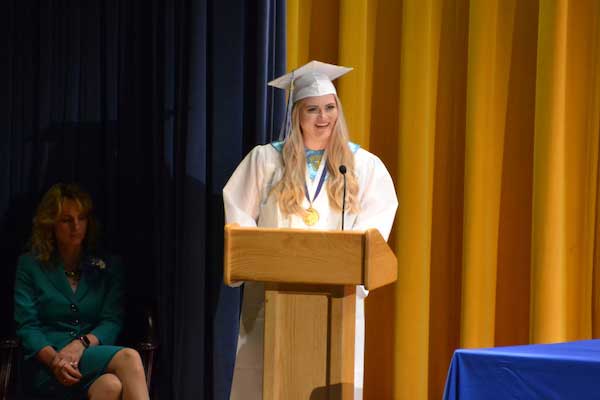
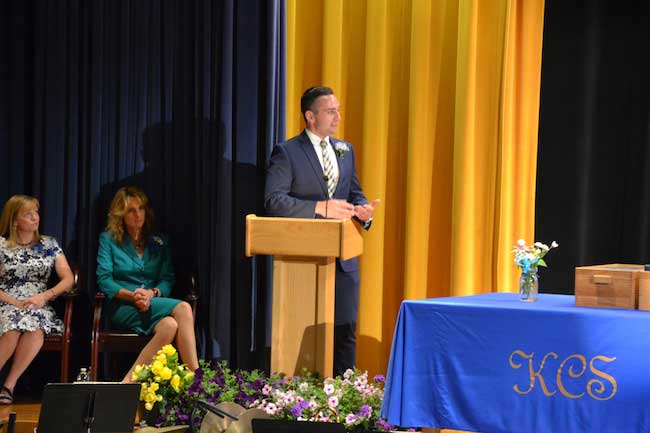
KENDALL – Anna Oakley, salutatorian for the Kendall’s Class of 2019, speaks at commencement on Friday evening at the Kendall Junior-Senior High School.
This year’s class has 41 students. That is a small group by size for Kendall. Oakley said the class has a strong bond and will leave a big imprint on the community and world.
She urged the students to push themselves and go outside their comfort zones. The world is melting pot, and Oakley urged her classmates to be open and accepting of others.
She will major in Integrative Neuroscience at Binghamton University.
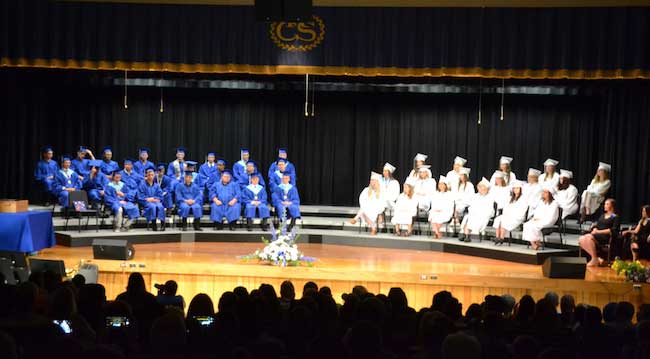
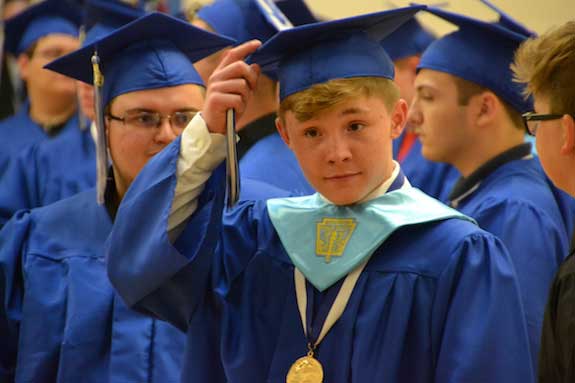
The class sits on stage at the start of graduation.
Julie Christensen, the district superintendent, welcomed the community and graduates. She said the small-town roots for the class have given them a solid foundation as they begin the next stage of their lives.
The students have developed strong relationships with their classmates, staff and teachers. She said a small-school environment is an asset, fostering close relationships and confidence among the students.
Matthew DiNatale and his classmates wait in the gym just before the start of the ceremony.
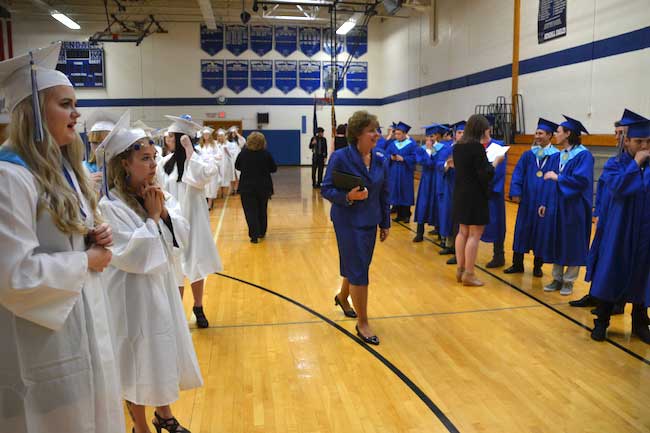
Carol D’Agostino, the high school principal, gives some last-second instructions to students before they head out of the gym.
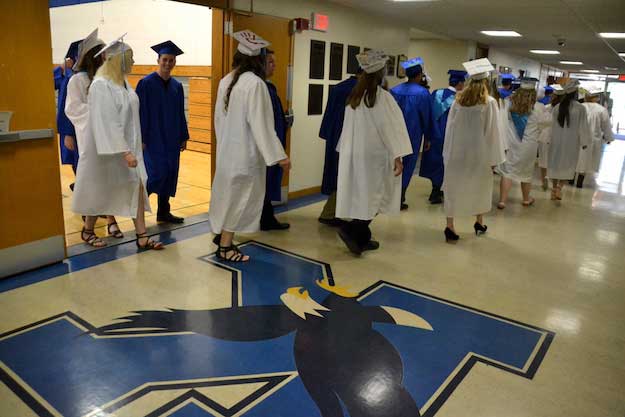
The class walks out of the gym and down the hall to the auditorium for commencement.
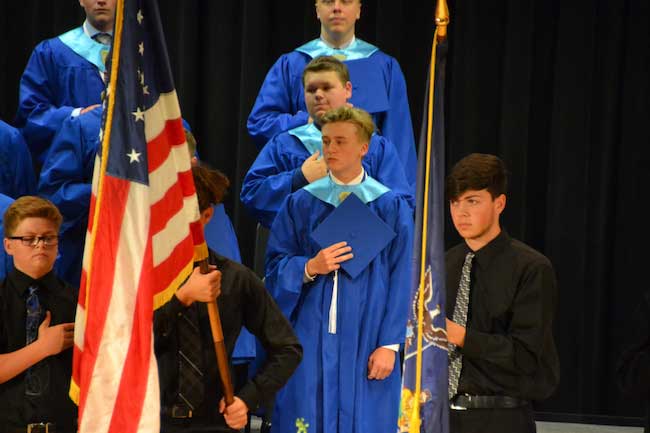
John Rath, center, is the class valedictorian. He has his cap off for the national anthem. Mason Kuhn carried the American flag while Brian Shaw holds the New York State flag. Those two are both headed to Boys State.
Rath said he feels fortunate to have attended Kendall. He said being on the soccer, basketball and baseball teams helped develop his leadership skills. He enjoyed the community spirit at the school, especially at homecoming.
“It is a small school and everyone knows everybody,” he said before the ceremony.
He will be attending Oswego State College to major in Business Marketing.
Tanner Jubenville, a Kendall grad and current reporter for 13 WHAM in Rochester, addressed the graduates. Nadine Hanlon, president of the Board of Education, is at far left, next to Julie Christensen, the district superintendent.
After Kendall, Jubenville graduated from St. Bonaventure University in 2015 with a degree in journalism and mass communications. He has worked in the news business for four years, the first two in Elmira and the last two in Rochester.
Jubenville was an announcer at sports games while at Kendall. He said he was scared when he was at his commencement from Kendall less than a decade ago.
His advice to the graduates was to follow the “three B’s.”
First, “be yourself,” Jubenville said. When he was at Kendall, he weighed more than 300 pounds, and then added 30 more his first semester at St. Bonaventure. Jubenville then got serious about exercising, eating well and living a healthy lifestyle.
He loved St. Bonaventure but it took some time to fit in and make friends. He had to force himself to stay at the college initially when he was homesick. He developed many deep friendships with his classmates and professors at St. Bonaventure.
Second, he said to “Build your circle.” Jubenville said people will only develop deep friendships by being a good friend to others.
“You get what you give,” he said.
Third, “Bend but don’t break.” Jubenville said the news business can be difficult, with long hours and low pay, especially for people breaking into the profession.
When he was at Elmira for two years, he often felt alone and was consumed with the demands of the job. He is grateful for the opportunity to work in Rochester and be closer to family and friends.
He began his speech with a crisp 50-dollar-bill. He then crumpled it, but noted it hadn’t lost its value.
“You will be tested at work, and with your friendships and relationships,” Jubenville said. “Remember you can bend but don’t break.”
Jessica Coble has a message on her graduation cap, “She Believed She Could Do So She Did.” She will study radiation therapy at Erie County Community College. She enjoyed going to Kendall.
“It has been a blast,” she said. “You are so close with everybody.”
By Tom Rivers, Editor Posted 21 June 2019 at 10:56 pm
Community prays for healing for Sean Weis, who was seriously injured in the accident
Photos by Tom Rivers
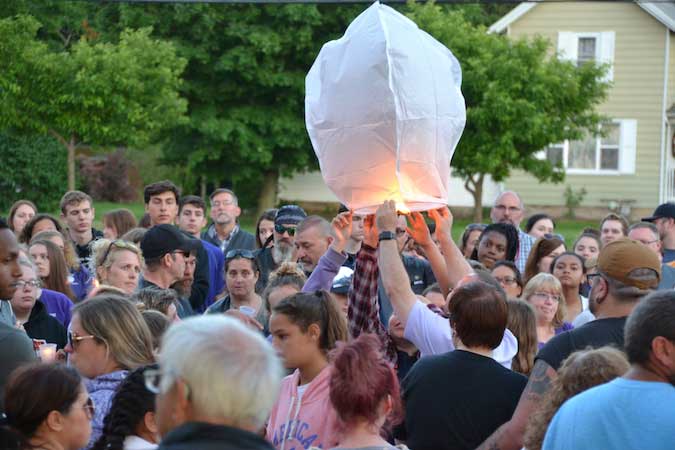
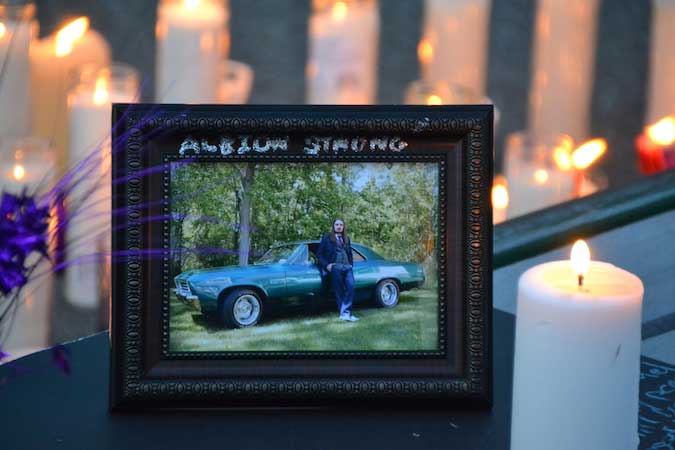
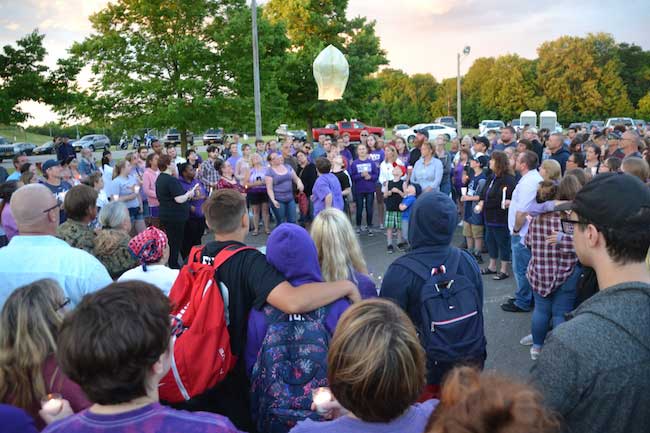
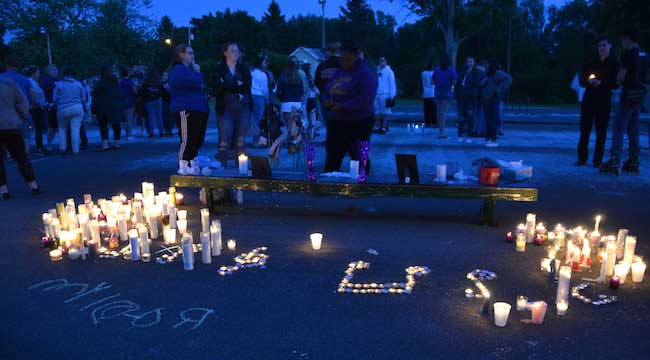
ALBION – About 500 people gathered at Bullard Park this evening for a candlelight vigil in memory of Brennan Moody, an Albion High School senior who was killed in a car accident just after midnight on Tuesday.
Brennan, 17, had many friends at school. He was very active in the music program with the band, chorus and musicals.
During the vigil at Bullard, a recording was played of Brennan singing with his father Erin Moody during last month’s high school talent show. The father and son performed, “Don’t Let the Sun Go Down On Me.”
Brennan was also a kind and friendly person who reached out to everyone, especially shy students, many people said.
His parents, Erin and Rhiannon, attended the vigil.
“The whole town has been amazing,” Mr. Moody said. “We appreciate all the support.”
The Moodys want to help Brennan’s classmates during their loss, especially the three seniors who were in the car with Brennan during the accident. Two of them were treated and released at a hospital, while Sean Weis was in the backseat of the car with Brennan and has serious injuries. He is recovering at Erie County Medical Center.
Mr. Moody said his son Brennan was “amazing” and loved to perform and be with his friends. He was at a bonfire on Monday night with several friends.
The funeral for Brennan will be 11 a.m. Wednesday at the First Presbyterian Church in Albion.
Kiara Smith speaks at the vigil, reflecting on Brennan Moody and asking people to keep Sean Weis in their prayers.
Brennan worked part-time at McDonald’s in Albion. One of his co-workers, Kiara Smith, put on Facebook there would be a vigil this evening at 8 p.m. That message spread.
Kiara said she felt like the community needed to come together to share their grief. She didn’t know what to expect when she arrived at Bullard. There was a big group of people.
“We want to show the families that we have their back,” Kiara said.
Brennan was a hard worker and worked well with the public in his job at McDonald’s.
“He worked up front with the customers,” Kiara said. “He was a really happy kid.”
Albion students write messages for Brennan Moody and Sean Weis during the vigil.
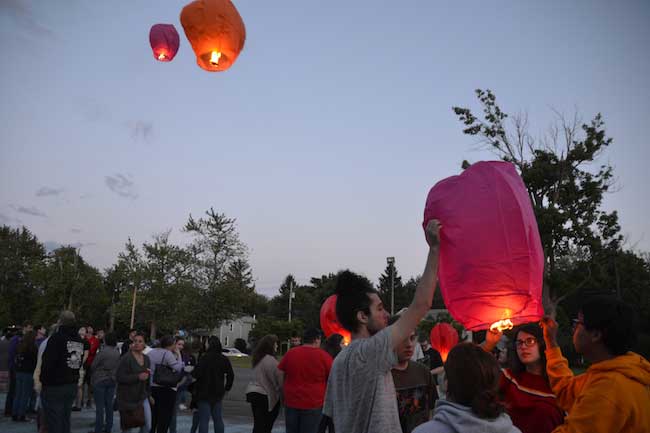
Several lanterns were released during the vigil at the park.
Sean Weis also is in the thoughts and prayers of many in Albion. His family said he had a surgery today that went well. He is recovering from a fractured skull, a broken neck, fractured scapula, bleeding on the brain and other injuries.
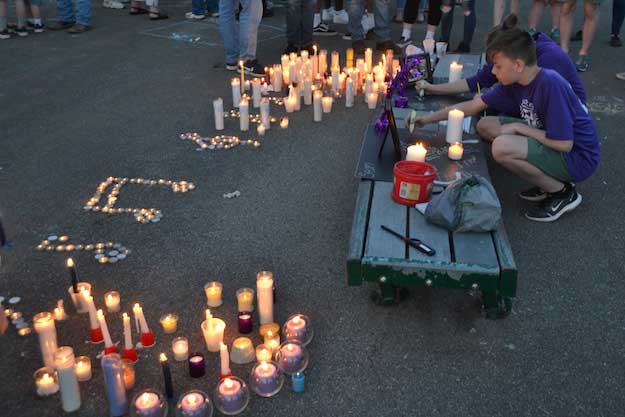
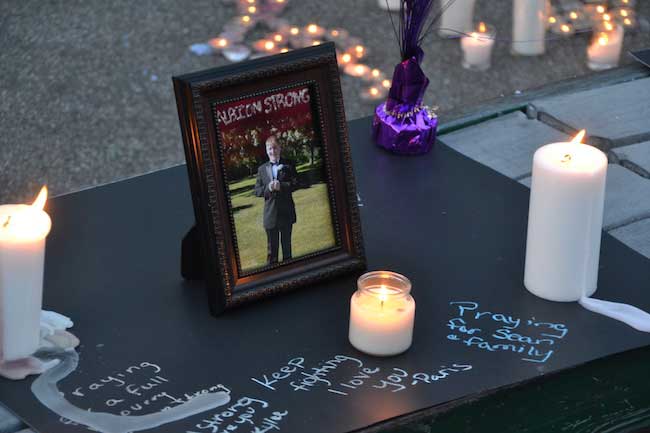
People also wrote messages in chalk for Brennan and Sean.
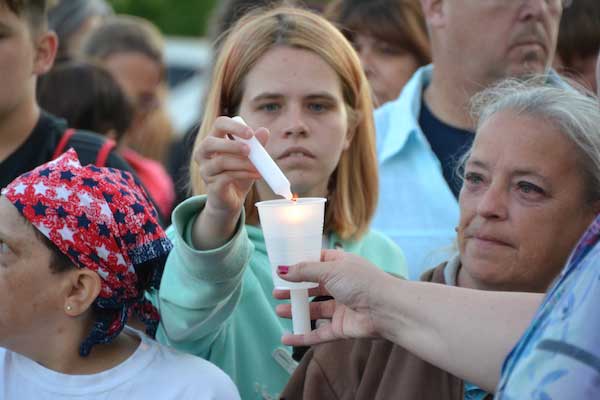
The community gathered to light candles in memory of Brennan Moody and to lift up Sean Weis, an Albion senior with serious injuries.
Several of the lanterns were released by people in mourning.
Many people stayed past 9:30 p.m. at the vigil, where some of the candles were arranged to resemble musical notes to show Brennan’s love for music.
By Tom Rivers, Editor Posted 21 June 2019 at 5:47 pm
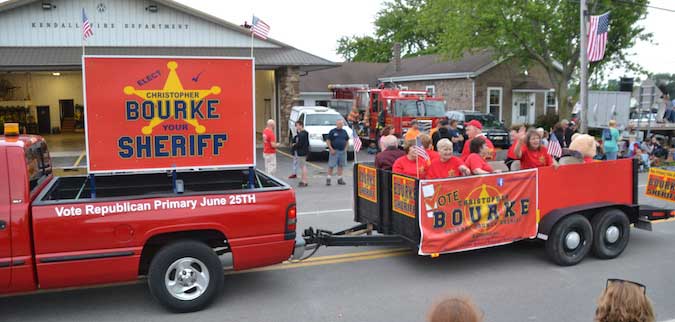
Photos by Tom Rivers: Chris Bourke, undersheriff of the Orleans County Sheriff’s Office, waves during the Albion Strawberry Festival parade on June 8. He is joined by Chief Deputy Michael Mele, who will serve as undersheriff if Bourke is elected as sheriff.
Chris Bourke, a Carlton resident, has been the undersheriff for the past three-plus years. He has worked with the Orleans County Sheriff’s Office for 35 years, starting his career as a correction officer and then was a deputy sheriff before working 18 years as a lieutenant. He was supervisor of the Marine Patrol, and also was a K9 officer for 20 years.
Bourke, 57, says he has built up numerous contacts in law enforcement among other agencies in the region that help the county, often bringing in a helicopter or bloodhound for a search or other resources for assistance.
Bourke is married to Suzanne. His daughter Maria, 24, is disabled and attends a day program through the Arc of Genesee Orleans.
Bourke is in Tuesday’s Republican primary for sheriff against Brett Sobieraski. Bourke also has secured the Conservative and Independence party lines.
Orleans Hub editor Tom Rivers interviewed Bourke on June 14 at Hoag Library.
Question: How did you get interested in law enforcement and why have you stuck with it?
Bourke: It’s always been a passion of mine. I was always fascinated by police officers. I wasn’t one of those kids who got into a lot of trouble. I always thought, “Why would you do that because that is wrong.” I wasn’t a perfect kid, nobody is.
I was fascinated by law enforcement. I actually started out in the construction world and I was working under an electrician as an electrician’s helper, and eventually I was going to be an electrician. I loved the building and the construction world, and I still do. But I still had this burning desire to work in law enforcement.
So I was hired in 1984 by Dave Green (sheriff at the time) as a part-time corrections officer in the Orleans County Jail for $5.30 an hour. I thought well I’ll get my foot in the door, and I just loved it, and eventually became a full-time corrections officer and for a short period of time attained the rank of corporal. Then there was the opportunity to move to the criminal division as a deputy sheriff, so on Jan. 1, 1986, I was appointed a deputy sheriff. That was like a lifetime dream for me came true.
So then I had the privilege of attending Niagara County Community College at Niagara’s Law Enforcement Academy for four months and for me it was a dream come true.
So I’ve loved the Orleans County Sheriff’s Office and I always have, and I still do. I always fight for the deputy sheriff that I think sometimes gets the short end of the deal. In the old days they weren’t considered as good as police officers. They were called political policemen and all these things. So eventually Civil Service came into the Sheriff’s Offices across New York State. You had to pass the test to be a deputy sheriff.
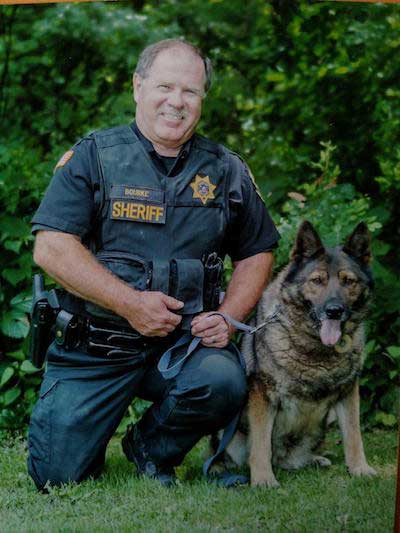
Provided photo: Chris Bourke, shown with K9 Cim, was a K9 officer for 20 years with the Sheriff’s Office.
Question: So how did that work back then?
Bourke: It wasn’t a Civil Service position and you were hired by the sheriff. The requirements were the same. The Bureau of Municipal Police would set the standards for the academy. So a deputy sheriff still had to be a certified police officer.
So you didn’t get away with it just because you were a friend of somebody and got the job. You still had to meet the requirements that every other police officer in New York State had to meet. You had to pass the Police Academy, and it was difficult. It’s a tough thing to get through the academy and anybody who has done that I have respect for.
Question: When you started as a deputy were you on nights? Is that generally how it starts?
Bourke: What is unique to the Sheriff’s Office at that time is there really weren’t any public safety dispatchers. There were only a couple. Deputy sheriffs would dispatch and work the road.
I spent a lot of time in what is now called the 911 center, pre-911.
Question: Wasn’t it in the jail back then? (Now at Public Safety Building)
Bourke: It was located in the jail in a narrow long room in the back. The civil office was up front. Everything was contained in the jail building. So those earlier days you’re obviously not going to be on days. I was in the evenings and did 7 ½ years of afternoons, which was a great learning experience because in the beginning I would be dispatching, some days riding with another person, and the other days until I completed the academy it was what you call field training in today’s world.
So I thought the time I spent in that dispatch center was excellent training as well. You got to learn the other side of it. When deputies were being phased out of there, that was around the time that 911 was just started to be phased in.
We used to have a bank of phones with a whole bunch of different phone numbers. Every fire company had their own phone number, and it was more less mechanical buttons that you had to do the fire tones and be timed to do the next tones. Now, it’s push one button and then the Zetron will cycle through the tones.
It was different back then but it was a great experience for me because it allowed me to learn another phase, another division of the Sheriff’s Office.
Question: When you think about, the Sheriff’s Office has come a long way since then. I remember when the office was in the little house across from the jail.
Bourke: It was so tiny. (The Sheriff’s Office moved to the Public Safety Building, a former furniture store, about 20 years ago.)
Question: It seemed very substandard before the move to the Public Safety Building. I remember when Dick Metz was the undersheriff and people had to walk through his office to use the bathroom.
Bourke: Yes. And we had a manual typewriter in the dispatch. You’ll hear a police officer or deputy say, “Punch me a card.” They still use that old terminology but today of course it’s done with a computer. But in those days you physically punched a 3-by-5 card with a time stamp machine. You put it in the manual typewriter and you assigned it a number, and you typed the complaint on a 3-by-5 card.
Now we’re clicking on a computer and creating a digital card or complaint number with everything time stamped. It’s so different than when we started.
Question: Is that the dispatchers doing that?
Bourke: Yes.
Chris Bourke greets residents on Thursday during the Kendall Fireman’s Carnival Parade.
Question: I wonder about having the laptops in the patrol cars and how that is better?
Bourke: The deputies in the car or a police officer in this county can actually create their own complaint card from the car so it can happen either way right now with our CAD system (Computer Aided Dispatch).
It’s a nice system, it’s a mapping system. On top of that everything is time stamped and digitally saved. It’s a quicker and better system than a 3-by-5 card with a manual typewriter.
Question: Are deputies and police officers out in the field more often with the new system, rather than inside typing the reports?
Bourke: Yes, there are still things you need to come into the office to do. But every car has a computer with several systems running on the computer. So it’s basically the deputy has his office right in the car. There’s also a printer in the car. There’s a digital reader for licenses and registrations. So there’s no more hand-writing tickets or hand-writing accident reports.
Actually, SJS the police report is all done on the computer now. The only thing that is still hand written is the domestic incident reports. I would assume that will be changing soon to a digital format. It is a completely different world from when I started.
I have respect for what we have now, but I have appreciation for how we did our work back then as well. You had to come in at the end of your shift and go on to a manual typewriter out back and type your reports. It was a big deal when we had an electric typewriter at one point in time. It was like whoa, we’re really moving forward here.
Question: People might wonder where the technology is going. The body cams are becoming more common. I don’t think the Sheriff’s Office has gone to that yet, while many other local agencies have.
Bourke: We have not gone to that at this point in time. Cost is one of the issues. They are expensive. And it’s not just the body camera. It’s the storage of the data, complete policy has to be put in place. How is that data transferred to the office? How long do you save it? What do you release if somebody requests information?
So I think we’ll probably be there at some point in time.
I do reject the notion that unless it’s on video the police officer is not telling the truth. I think we’ve kind of gone in that direction. I think most of the time, probably 99 percent of the time, it will show the police officer acted properly and did the right thing. But some folks think it’s not on video so the police officer is lying. I reject that argument.
Our cars, as far as technology, I would put our patrol cars up against anybody, anywhere. The features that we have on those Chevy Tahoes and the technology in those cars is second to none.
Those G-Tack mobile data terminals – Las Vegas just bought 600 of them – they are cutting edge in mobile technology.
‘We make it work. Our people – the staff in the jail, the dispatch, the deputies on the road, and the office staff – they are unbelievable. They make it work. They should get all the credit.’
Question: Is that all in the last few years?
Bourke: We’ve had mobile data terminals for many years. But these G-Tacks are the latest and greatest. They have the swipe for the license right in the computer. You’re able to hit buttons and log onto the scene instantly.
Like I said, connectivity is a constant issue we have to maintain, connecting through a virtual private network. We have all of these cars out there and they have to connect to our system. We are in constant communication with computer services over an issue with this car or that car. Sometimes things happen with connectivity and we have an issue from time to time.
Our cars are equipped with AR-15 Bushmaster rifles. That is a change from many years ago when you had a shotgun in the trunk or maybe mounted up front. In today’s policing, police can be outgunned by some of these crazy weapons that are out there very easily.
The standard now is to have an automatic weapon available to the officers. It used to be that was kind of a SWAT team weapon, but they’re standard in all of our cars. We were able to obtain some grant money.
The theory and the plan for that is as we know every day or every week we see some incident across the country and those incidents are over with in a very short period of time, so are responding deputy sheriffs and police officers in this county are going to be the first defense in one of those kinds of incidents. We want our people to be as prepared as they can be. We want them to go to threat and take the threat out if we have a shooter in a school or business. With just a handgun you may be outgunned immediately. So most police officers these days have a rifle in the car. Some of our cars have a rifle and a shotgun.
This is big step up from where we were years ago and it’s an important step. For the safety and security of the folks we need to be able to address these threats immediately.
Yes, you’re going to be getting your SWAT team together. But those folks might be coming in from home. The immediate threat is there and we have to be able to deal with it.
Some of the Bourke supporters are shown during Kendall’s parade on Thursday.
Question: What is the total employees with all the departments in the Sheriff’s Office? Isn’t it about 110?
Bourke: Yes. We’re short deputy sheriffs right now. We’ve had some retirements and other issues where people separated from the department and some of that was in litigation. So the county doesn’t fill spots that are held by another individual so there’s actually a delay sometimes in filling spots. My mission is to get us back up to full staff, which is around 24.
Question: Does the 24 include the Kendall and Lyndonville school resource officers?
Bourke: Yes. It includes investigators and the three assigned to the courthouse. So when you take three investigators out of that and three from the courthouse who are assigned, then two at Kendall and Lyndonville schools, you’re left with, in my opinion, relatively small numbers to do the 24-hour patrol duties of the Sheriff’s Office.
Question: Why do we have deputies at the courthouse and not lower-salaried security officers?
Bourke: That is governed by the Unified Court System. If you are going to provide the security services to the court system, they tell you how many and how you’re going to do it.
Mike Mele, the chief deputy, on a daily basis is actually filling the fourth deputy over there many days of the week, but the court system many times will change that on us at the last minute, and tell us I’m sorry that case was cancelled and we only need three today. Now we have a person in on overtime to fill your spot. They dictate that.
Many other counties have switched over to unified court officers. Erie County and some of the other counties started this transition, but when they got to a certain point, they stopped. We have not changed over. We still have deputy sheriffs doing that work. The Office of Court Administration pays the cost. They pay the wages of the deputies at the courthouse.
And as a negotiated agreement with Kendall and Lyndonville, the schools pay the wages of the deputy plus a little overtime for special events and a vehicle.
So that does reduce our number of actual deputy sheriffs. Now any of these deputies could sign up for an overtime shift, because we are running extra shifts.
Question: I thought with the resource officers the county would create two new positions and not take from the current deputies?
Bourke: They did create two positions, but we’re still short.
Question: They were deputies who then shifted to the resource officers.
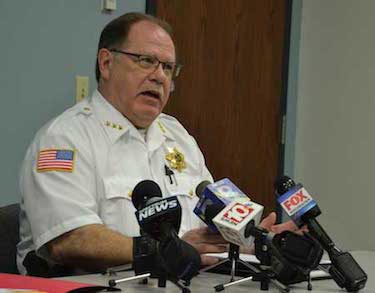
Chris Bourke speaks during a press conference on May 4, 2018 after a mother and son in Kendall died from carbon monoxide poisoning.
Bourke: And their (old) spots haven’t been filled. There will eventually be two additionals. We were short to begin with and we took two and put them there (at the schools). We’re still catching up.
Hiring a deputy isn’t a short process. Sometimes we can pick up a lateral transfer from another department. That still requires 14 weeks of field training.
But if you do not pick up a trained officer, then you’re talking about four months of the police academy if they make it through, then 14 weeks of field training. If they make it through the field training OK then you have an officer you can use.
We have some potential lateral transfers that we’re looking at now, but you also have to do a background investigation to make sure you’re not getting somebody else’s problem.
Question: I wonder why you would want to be sheriff being of retirement age when there are a lot of headaches with the job?
Bourke: I love the Sheriff’s Office. I like to get a challenge and say give me something so I can fix it and make it work. I think I’m creative and you have to be in Orleans County. For example our training budget is so small in the grand scheme of things. And I’m not blaming the County Legislature. Everybody goes to the budget hearings wanting their share of the pie and the sheriff does, too.
How many people in this county say, “Yes, I’d love to pay more taxes.” Probably not too many. So you have to be creative with what you have. I think I’m good at that. We find ways to get the funding to get the training. We do it in-service so you’re not bringing people in on overtime. But I like those problems to try to solve and make it work.
We just negotiated a very good agreement with the Niagara County Sheriff’s Office. Our SWAT team vans basically rusted into the ground. They were secured by the Task Force many years ago as seizure vehicles. They basically rotted away and had to be towed away. So really our SWAT team doesn’t have a good vehicle to move our team.
I have great relationships with all of the surrounding counties and the agencies in the county. I was in a discussion with the sheriff at Niagara County one day at a lunch and he said they were getting a new SWAT van. I said, “What about the old one?” He said, “Do you want it?” They bought a new $170,000 van to transport their people. We bought their old one for $6,500. It’s in excellent condition even though it has some years on it.
We’re in the process of upfitting that right now. Those are the kinds of things I feel I can do for the county and the people, by making connections and making things work because you don’t have the resources, the money and the people to roll 10 cars up at a violent scene.
We’re going to roll 2, 3 and hopefully a couple state troopers and we’re going to handle the situation.
If you see on the news on the TV in some of the big cities, you’ll see 10 or a dozen patrol cars there. We don’t have that luxury. I’ve learned it, I lived it to be creative and make it work here, and we make it work. My goal is always to make it work for the people at the lowest cost we can. Because I, like everybody else, aren’t interested in paying a lot in more taxes. I wish we could have a blank check. You’d have everything you want. You’d have all the people you want. But we make it work. But our people – the staff in the jail, the dispatch, the deputies on the road, and the office staff – they are unbelievable. They make it work. They should get all the credit.
Question: With the Task Force, is that something you would push for to have under your control?
Bourke: I’m not pushing for anything with the Task Force. Sheriff Bower has pushed for that. He has asked a lot of questions, and in the course of asking those questions he has got into an adversarial relationship with the DA and the Task Force.
Mike Mele and myself have continued to work with the Task Force and talk with those guys and tried to make a working relationship. I think the Legislature would confirm that. By constantly asking these questions it’s become a difficult relationship. I think they would tell you, the DA and the guys on the Task Force, that I have tried to work with them to the best of my ability.
Sixty other counties in the state do it (the Task Force) a different way than we do. But I understand how we got to where we are today. Under the Hess administration it was changed over to the DA’s Office for various reasons. The county has funded the Task Force. They funded it again in ’19.
So as long as the county is going to fund the Drug Task Force under the DA’s Office, I’m not going to be in a position to say you’re wrong, and you’re wrong. If they want to run that Drug Task Force through the DA’s Office, number one I don’t have the power to change it. Number two, I don’t have the power to take money away from them nor could I fire them and nor would I fire them. This notion that I would fire people as soon as I got in is ridiculous. It a ridiculous statement. I couldn’t do it if I wanted to and I don’t want to.
So my position would be to get us in the room more often, work together more often, and then if at a different date the DA comes in and decides he doesn’t want to run the Task Force then we may at some point go back to a multi-agency task force like we had years ago with a person assigned from all the various police departments.
Right now it’s funded, it’s there and that’s the way it’s going to be.
Question: You also hear that the county doesn’t train with the other agencies and the Sheriff’s Office isn’t cooperative with the other agencies. Is that true?
Bourke: Some people with their own self-serving agendas make statements like that. We just had our CIT training, the crisis intervention training for mental health, in Medina Fire Department. It was a multi-agency training.
We train every month with at least one training with our SWAT team, which is a multi-agency SWAT team with Albion, Medina, Holley and the Sheriff’s Office. Even including Department of Environmental Conservation officers.
Question: Is Rollie Nenni, the Albion and Holley police chief, the leader of the SWAT team?
Bourke: That is another unique setup. There is a committee that oversees, I guess that’s the word, and they get to elect a commander. At this time Rollie Nenni is the commander. Rollie Nenni lives and breathes SWAT and SWAT training. He is an excellent trainer, he is very knowledgeable. I have no intentions of changing that. Rollie and I speak several times a week usually on various issues. But we do train together. I’m of the opinion we can always do more training together.
We recently had the New York State Sheriff’s Association Institute do a civil process training. In my time here I have never been officially trained in civil process. I’ve had a lot of hand-me-down information and learned a lot over the years.
I invited Medina and Albion to come, not that they serve civil process, but a lot of it had to do with eviction and eviction process. It’s things that they deal with as police officers on a daily basis. Even though we do all the service and handling of that stuff, other police officers do as well. So I always invite them.
I think they would tell you that I would be in favor of any training we could do together. Do we do enough now? I don’t think it is ever enough.
‘I also feel with my experience and my connections that I’ve made over the years, I can pick up the phone and call any surrounding agency from federal, state, and county and local and have whatever we need to get the job done. We work together constantly with the state police. I can pick up the phone and tell one of the commanders I need a bloodhound, I need a helicopter, commercial vehicle enforcement, and it’s there.’
Question: I know from going to many of the accidents and fires over the years that you are often there at the scene. Even from your days as the K9 officer you’ve had a high profile with the Sheriff’s Office and seem drawn to the action.
Bourke: I do love the action. My wife isn’t exactly thrilled with this but I listen to that radio all day, every day. I listen to it up until I go to bed. I have it in my vehicle, even if I’m in my private vehicle I have the portable (radio) because I feel a sense of responsibility to listen and to make sure we get it right, the best we can.
I was out the other night on a search for an individual on Hulberton Road til midnight, from 7 to midnight. We’re small enough from the top person to the newest deputy there isn’t that many spaces. I don’t consider myself above anything. If I need to go walk through a swamp to help, that’s what I’ll do.
So I feel that sense of responsibility that I need to respond to things that are serious. The other reason is we can use the help with the man hours. Mike Mele and myself we respond to most things that are of any serious nature, and we do the best that we can.
I also feel with my experience and my connections that I’ve made over the years, I can pick up the phone and call any surrounding agency from federal, state, and county and local and have whatever we need to get the job done. We work together constantly with the state police.
I can pick up the phone and tell one of the commanders I need a bloodhound, I need a helicopter, commercial vehicle enforcement, and it’s there.
I have through Niagara County’s sheriff and undersheriff, they have said don’t just keep calling me when you need the helicopter, just call the helicopter pilot directly yourself. Usually there is a chain that has to be approved. So now I call Ron Steen, he is their pilot and I’ve known him for 25 years. I call him directly and I say, “Hey, we have a search and we need a helicopter, can you come up and fly?” He says, “yup, we’ll be up in five minutes.”
You build those relationships up over the years and it benefits the people of Orleans County. Are we going to have a helicopter? I don’t think so but I can have one here within a few minutes.
Question: I think of the missing Barre earlier this year. There were a lot of agencies out here.
Bourke: Absolutely. We had the divers from the State Police. We had a helicopter from the State Police. We had Niagara County’s helicopter. We had the State Police drone unit. We had Niagara County’s drone unit. We had the State Police’s bloodhound. We had the forest rangers who are experts at search and rescue.
It’s about pulling all of those people together. I think I’m good at that. We can’t have every resource in Orleans County. We just don’t have the money but we can know how to get them and that’s what I feel I am good at, pulling people together.
By Tom Rivers, Editor Posted 21 June 2019 at 5:28 pm
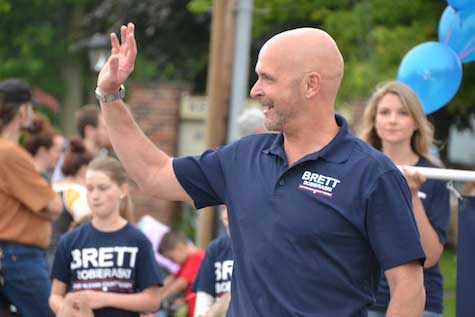
Photos by Tom Rivers: Brett Sobieraski waves to the crowd while walking in the Kendall Carnival Parade on Thursday.
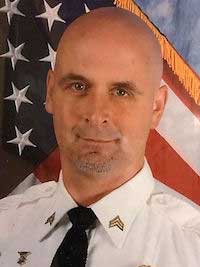
Brett Sobieraski, a Kent resident, is running in the Republican Primary on Tuesday for sheriff against Chris Bourke, the current undersheriff.
Sobieraski, 52, is a sergeant in the Rochester Police Department. He started his career in Lockport and worked there for four years. He grew up in Lockport, where his late father John was a detective. His uncle also worked for the Lockport PD and Sobieraski’s cousin is a police officer for Lockport.
Sobieraski’s son Zachary, a Kendall graduate, is a Rochester police officer and his other son Gabriel works for the Postal Service in Henrietta.
Sobieraski joined the RPD about 26 years ago. He supervises the Greater Rochester Area Narcotics Enforcement Team and is a team leader on the SWAT Team. Sobieraski also is an instructor at the Monroe County Law Enforcement Academy.
He has lived in Kent the past 27 years.
The following interview with Sobieraski was conducted by Orleans Hub edtor Tom Rivers on June 4 at Hoag Library in Albion.
Question: Why do you like being a police officer?
Sobieraski: My big influence was my father who was a police officer. I always looked up to him. He would take me around to the police department when I was younger and visit the guys. I think that’s when it really got in my blood. I never remember not wanting to be anything other than a police officer my entire life.
At certain times maybe I wanted to go into the FBI or be a homicide detective, but I always wanted to be a police officer for many different reasons. One of them, with my mom and dad, I’ve always had a very strong moral compass. Even when I was younger if I saw people cheating at school or sports, it always upset me because it wasn’t right.
When I became a police officer, it was the greatest job ever. Part of it is the action and the excitement of it. I would never say it’s not. The job I have now, executing search warrants, whether regular narcotics or on the SWAT team, it’s an exciting job. You can see a difference with these drug investigations where people get their neighborhoods back, even if it’s just for a day or two. They get some peace in their neighborhood when we take out these drug houses.
I’m a year away from maximum retirement, not age, but I’ll have 32 years in the system. Initially that was my plan to work until 2020 and then figure out the next part of my life. I still feel like I have so much horsepower to give. I still love to go to work. Ninety percent of the time I go to work and I can’t believe they pay me what they do.
Question: So why not stay in that role, seeing that you like it so much and I know you’re well regarded?
Sobieraski: This was not in my plans, but then I would run into folks at the law enforcement academy from folks that work out here, and not just from inside the Sheriff’s Department but the adjoining village police departments, and the state police. They would relay to me the issues that are out here mostly stem from leadership or the lack thereof, and the way they have been doing business out here forever.
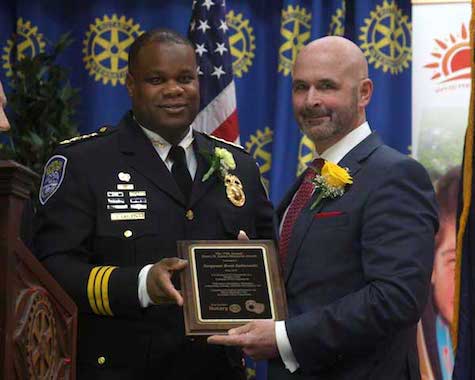
Photo courtesy of Tom Smith: Rochester Police Chief La’Ron Singletary presents an award on May 7 to Brett Sobieraski. He received the Rochester Rotary Club’s Henry H. Jensen Memorial Award, the highest community award presented to a Rochester police officer.
I would get phone calls from people inside the organization. I would get phone calls from citizens. Most of it dealt with, “This is Orleans County and this is the way we’ve always done it.”
I’ve talked with police officers who have come out here and worked at other jurisdictions. They get here and they ask, “Where are the General Orders?” The General Orders in any department govern how you do business in the day in and day out, whether it’s property or vehicle stops, or arrest procedures or juvenile procedures. They come up to this office and they ask where the General Orders are and they say, “We don’t have them. We don’t know where they are at.”
You just learn from other folks, which is malfeasance at the best. Just the philosophy that there’s not much expectations from the leadership out here. I’ve said it’s not a deputy problem, it’s a leadership problem.
The policemen out here want to do the right thing. The folks who work in the jail, the dispatchers want to do the right thing, but when there is no expectation of doing the right thing or being great, then you just kind of do what you want to do.
What I want to do is stop the A Team and B Team out here and make it one team.
Question: With the current leadership, I think some people would say they see successes, from getting deputies in the schools at Kendall and Lyndonville, grants for canal patrols, animal shelter improvements, and other projects. Do you think that’s the perception in the community, that there is a leadership problem?
Sobieraski: I don’t know if it’s the perception. If you don’t use the system you may not know how broke it is. Part of it is a law enforcement agency, with true law enforcement. If you look at the Pennysaver with their monthly stats, where are the law enforcement stats? Where are the number of DWIs?
Their STOP-DWI funding dropped by 29 percent from 2018 to 2019. Where are the stats? When you don’t have the stats, you don’t put them out. We have the most unsafe roads in the entire state because of serious physical injury accidents and fatal accidents and everyone wants to point to the deer. In 2017, not one deer collision caused a fatality or a serious accident. Because there is no traffic enforcement. That is leadership at the top. That’s why we have unsafe roads.
When you talk to your village chiefs, ask how often there is communication between them and the Sheriff’s Office administration. Those bridges have all been burned, partly because of that consolidation study which started very apolitical, and then because of power-mongering and empire build, it turned very political out of the Sheriff’s Office.
What you have is fragmented law enforcement across the board out here.
‘I’ve been a leader for 22 years. I made the mistakes and I learned from them. The worst thing you can bring into a place is an ego because it immediately is going to turn everyone off and then no one wants to work with that person.’
If you really dove down deep into what the Sheriff’s Office is now, with the injection of all the politics in this last campaign cycle, where again the undersheriff, a road sergeant, a road investigator, all of sudden get put on committees, and committees where they don’t even live in the jurisdiction, just to secure a nomination for the incumbent sheriff. The proposed undersheriff is now the vice chairman (for the Orleans County Republican Party). All of this gets ejected into there and it causes that place to be dysfunctional.
You had a true politician enter in as the sheriff and then with that came all the politics that followed. As opposed to having a real law enforcement leader with a law enforcement leadership background.
Question: With the Task Force, you do hear rumblings that it should be under the Sheriff’s Office, rather than being run out of the District Attorney’s Office. Would you push to have the Task Force be run through the Sheriff’s Office?
Sobieraski: It was initially under the Sheriff’s Department, and then sometimes in the early 2000s, it basically went defunct. There were issues with the municipalities. That was when Albion, Medina and Holley all gave a person.
The Sheriff’s Office had big control of it. And then it just went under. As to why, there are many different reasons. And then when it went under, Joe Cardone, the DA, resurrected it, and put it under his office. If he didn’t do that it wouldn’t exist out here. When you think about it, not having a Drug Task Force in the middle of the largest public health crisis we’ll see with the opiate epidemic, it would be disastrous.
He ended up rebuilding it. It’s definitely a bone of contention. Folks don’t feel it should be in the District Attorney’s office. But when it really comes down to it the funding is approved by the County Legislature. They ultimately decide where it lies and right now it lies in the District Attorney’s Office.
So what I tell people is the current sheriff has been trying to wrestle control of that over the last 3 ½ years and has been unable to do so. What that has resulted in is politics in front of people’s lives, which I’ll never do.
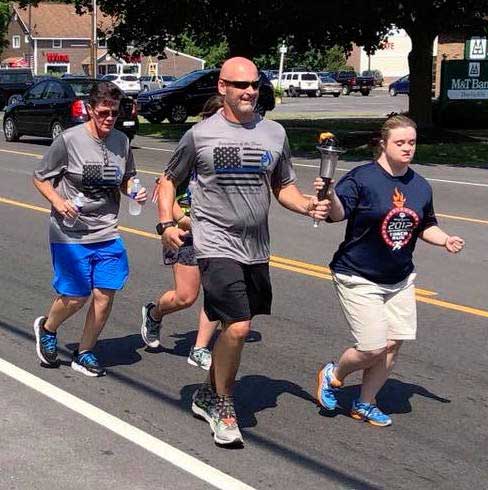
Provided photo: Brett Sobieraski runs the final stretch of a 50-hour journey on July 15, 2018, carrying a torch for the Special Olympics. He started in Buffalo on July 11 and would run more than 6 1/2 consecutive marathons in six different counties. He finished the challenge at the State Police Trooper Barracks in Elbridge, a town in Onondaga County, west of Syracuse. He has completing several endurance challenges to raise money for the Special Olympics, veterans and police officers.
So the current administration, they don’t work with the Drug Task Force. They don’t have a person assigned to the Drug Task Force. There is no flow of information.
I want to work with them. In the end if the Legislature sees my style of leadership – and I’ve run a Drug Task Force for almost 20 years – and then want to have some hybrid and go back to some kind of council overseeing it, and if they want to put it in the Sheriff’s Office, that’s fine. But what I’m never going to do is try to wrestle that away, because let’s face it the incumbent sheriff has tried for 3 ½ years and he couldn’t do it, and he’s as political as they get.
My plan is to be apolitical. I want to work with the Legislature. But in the middle of an opioid epidemic, I’m not going to play politics and not work with those folks. It’s almost criminal to not work with them with the amount of fatal and non-fatal overdoses we’re having in this county.
Question: People wonder who you would make your undersheriff. Can you talk about that?
Sobieraski: Absolutely, I get questions about who it is. My whole plan is once I win I want to interview internal candidates first. The reason I can’t interview internal candidates now is it would risk, minimally, their careers and jobs, should I not win.
If I go in and start interviewing people what would happen if someone jumped in on my ticket and I lost? They would be blackballed forever.
I’m going to wait until I win. I’m going to interview internal candidates and I’m going to interview external candidates. I’m going to pick the person, the guy or gal whose beliefs most line up with mine and who is brave enough to tell me when I’m wrong.
The only thing I will guarantee is it will be a person from Orleans County. There is a rumor out there that I’m going to bring a city guy in as the undersheriff. That is completely false.
Question: Has being on the campaign trail made you want to be sheriff even more?
Sobieraski: It has. I don’t like the politics part of it. I’ve seen a very dysfunctional side, I’ve seen a very nasty side so far, with innuendos, lies and stuff not based in facts put on social media against me.
But what I’ve done is meet so many great people. You kind of go in, thinking you know what folks want and what their needs are and what are their expectations.
Then you talk to folks and you’re like oh my gosh that’s not it. That’s what’s really been informative, meeting all of these people. I’ve been to over a hundred different events, taking to folks. I like me less talking and me more listening to what they expect from their Sheriff’s Office and how they want their community to be.
They all talk about safety. They all talk about sense of community and how this county is so great. That’s why I stay here when I could have moved to six other counties.
When someone is ill or in need, this community rallies like no other community I’ve seen, and it’s great. But I think with most people what we talk about is guarding what we have now. It’s the broken window theory, so we don’t become like other maybe urban areas that end up with decay. It could happen out here. And to think it couldn’t we’re not facing reality.
We have to work hard. If we work hard in law enforcement and we all become unified, which is my goal, then we could definitely maintain and make our county safer than it ever has.
So meeting folks is the greatest part. I love talking to folks and meeting them, and hearing their concerns.
Question: What are some of the concerns people share with you?
Sobieraski: One of them is animal control. We all know pets are like family, especially out here. I feel like everyone has a dog. That is one that came up that wasn’t on my radar. I started talking to folks and they said they would call about a stray dog and no one would come out until the morning. They said to either tie it up, bring it into your house or let it go. This kept coming up.
I heard someone say there was a dangerous dog outside by their house and their kid couldn’t go to school in the morning because they (animal control) weren’t going to come until business hours.
This has to change. The way I see it is if you find a stray, and it’s a friendly stray that shows up outside your door, then you call a deputy. If I can put a bad guy in the back of a car I bet I can put a friendly dog inside a car and take it to a shelter so it can be reunited.
If it’s a dangerous dog, who wants a dangerous dog roaming around? So we’re going to call our animal control people. That is one that really broadsided me.
It was a result of the consolidation study. It was all consolidated under the Sheriff’s Office. Back when it was under the villages, they had their own people. It was 24-7, you called them and they came.
You would think animal control isn’t on the radar, well it is if it’s your dog.
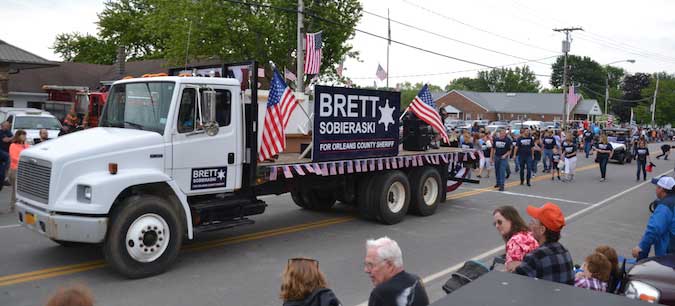
Some of Sobieraski’s supporters joined him in the Kendall parade on Thursday.
Question: So you’re saying the deputies could pick up a dog in some cases. If it’s a friendly dog they could just bring it to the shelter?
Sobieraski: They don’t because they’ve never done it before. You can’t be above that. You can’t be above helping a dog.
You have to look at things in a different lens and I think that is the biggest problem out here is the lens looking over the Sheriff’s Department is probably been the same for many, many years with very little outside influence. That department has become stale. It is not a 2019 department.
I don’t want to turn it into RPD. But what I want to do is take all the good things that I’ve learned there and all the leadership that I’ve acquired there between there, and the police academy and the SWAT team and bring it out here.
One of the examples that I talk about is I’m not going to go in there and turn everything upside down. You can’t make meaningful change by coming in like a whirlwind or a tornado. It’s going to be small, incremental changes. I’m going to keep the stuff that works.
We’re going to expand upon or do better programming. An example I talk about is awards. There is a process in the Sheriff’s Department to demote people, to fire people, to suspend people, to reprimand people. But they don’t have a policy for great behavior. That is unheard of. You can’t have one without the other. And in order to implement that first of all you have to care.
The second thing you have to do is know, to have some kind of knowledge of one. So out here, no awards. That’s going to be one of my first things because it’s low-hanging fruit, it’s easy to do.
Let’s craft a policy on different types of awards you could get, for everyone, whether you’re a road deputy, in corrections, you’re in dispatch, animal control, civilian. You make this criteria and then people, usually supervisors, but your peers can put you in. And then I’m not going to decide because I may be biased.
So you make a committee up and take someone out of corrections, someone from road patrol, take a civilian staff, take a dispatcher. Make a committee and they review the nominations.
I want to add that anything I propose in this county will not raises taxes or cost more money.
So for $2 I’m going to get these award bars like they do in the military. You see people in the military with all their bars on their chest. Those are awards and they can proudly wear it.
You have to recognize great behavior. It’s your duty as a leader to recognize it. Not to have it again is because it’s been looked at under the same lens and some of it is initiative based. It’s going to take a little bit of work to do it and you have to care to do it.
Question: And it might be fun.
Sobieraski: On my gosh, we just had it (at the RPD) and my son (Zachary), I’m so proud, he got a life-saving award. A young man got shot and Zachary had to put direct pressure on it because he couldn’t get a tourniquet on it because it was too high in the groin.
The young man got to the hospital, and modern medicine is awesome because he had almost no blood left in him, but they saved him. What a proud moment to see your son, your family member, up on the stage getting an award.
You give out these awards as they come and then once a year, you call Medina, Albion, the State Police and say we need you to cover for four hours because we’re all going to get together as a family and have an awards ceremony, and bring your families.
Question: It might be good to have the Orleans County law enforcement banquet and invite all the agencies, including Albion, Holley, Medina, State Police and the DEC.
Brett Sobieraski
Sobieraski: How great would that be where we could recognize great behavior because it is going on out there and unfortunately it is going unrecognized.
Just the unity in local law enforcement out here, to include all of those entities and to meet once a month. I call it the law enforcement council. We’d around a table and talk about the issues that face us all because the issues are the same in Medina, Albion, Holley, Carlton, Barre, it’s all the same and we’ll get on the same page. We’ll understand them and attack them together.
The important part is we’ll train together and have a unified response. What that will do, besides better public safety, is save money.
When you think about it, the Sheriff’s Department right now no longer trains with the other agencies. So when they train, they need trainers. When you go to range and shoot, you need trainers. You end up taking your trainers off the road and that creates overtime because you have to backfill those spots.
What about if you all start training together and the Sheriff’s Department gives a person, and Medina gives a person, Albion gives a person and no one takes a big hit.
So it’s almost like consolidation. Nobody empties out their rank and file for a training day. Everyone gives a little and no one hurts a lot, and we all come together. That’s how you breed cohesiveness among the other agencies is sweat and toil together, shoulder to shoulder so when it really happens you’re shoulder to shoulder and respond in the same way.
Question: It seems like with the current sheriff some of the other law enforcement leaders haven’t really accepted him since day one?
Sobieraski: When you become a new boss there are certain learning curves. Part of being a new boss is you tend to be egotistical at times, you tend to think you’re rank is maybe too important. You can come in way too hard and way too high that you’re in charge of everyone else. That was part of it.
He would recruit officers from other villages. What you don’t do is fish in your pond. So some chiefs took exception to that. “Why are you recruiting my officers? I worked hard to get these folks here.” So go recruit somewhere else. So that was part of it and I think it was a lack of willingness to work together and to check ego at the door and realize that you are peers with the other chiefs. You’re not better than them just because you command 110 people and they command 15. You’re no more of a person, you’re no more of a leader than they are. I think that is really where the divide came over leadership style.
I got that all out of my system. I’ve been a leader for 22 years. I made the mistakes and I learned from them. The worst thing you can bring into a place is an ego because it immediately is going to turn everyone off and then no one wants to work with that person.
‘You have to look at things in a different lens and I think that is the biggest problem out here is the lens looking over the Sheriff’s Department is probably been the same for many, many years with very little outside influence. That department has become stale. It is not a 2019 department.’
Question: I know you’re involved in many community efforts, with the Special Olympics and the Luther Doyle recovery group. Do you have anticipate being involved in community causes here outside of the Sheriff’s Office?
Sobieraski: I will have a bully pulpit to advocate for causes that I find near and dear to my heart that the community will – for recovery, for GCASA, for Orleans – Recovery Hope Begins Here, for United Way.
RPD, we give a lot of money to the United Way because of the way they structure their campaigns towards law enforcement. I want to bring that here to our United Way. We’re going to raise a lot of money for United Way which goes to great causes. The money stays in Orleans.
I see it as a big bully pulpit to make meaningful social changes also. I’ve been doing it now for the last eight years. I’m not going to stop. I’m going to get behind the causes that are important in this community and I’m going to stay behind them. The benefit will not just be awareness it will be fundraising.
When we talk about awareness with this opiate epidemic, the more you talk about it, the more stigma gets erased and the less it becomes us versus them, or they deserve what they get, especially with opioids and the way people get addicted.
You got to have meaningful dialogue and I love going to Hope Recovery Begins and you hear the stories and the success stories of folks who are in active recovery and that it can happen. To think we are going to arrest our way out of this is ridiculous.
To just think you’re going to throw people in jail at $70 to $80 a day that we’re paying, and look at the associated crime. The people breaking in your houses and cars are drug addicts fueling their addiction.
Getting behind that cause would be priority number one, getting behind GCASA. I have an 18-year background in recovery (on the board of Luther Doyle). That is a huge part of pushing back this opioid epidemic.
I’m excited. There’s a lot I could do out here.
Question: Anything else you want to say?
Sobieraski: I’ve lived over half of my life here, for 27 years. I’m 52 years old. I understand the culture of Orleans County. I love the culture of Orleans County. That’s why I stay here. I have a vested interest in making Orleans County remain as safe as it can or safer than it’s ever been.
I’m sure over half the citizens of Orleans County drive somewhere else to go to work. It doesn’t make them any less citizens when they drove to Kodak or when they drove to Delco, and then came back here.
To say I don’t understand the culture out here, or I don’t understand rural or suburban police work is ridiculous, it really is.
By Tom Rivers, Editor Posted 21 June 2019 at 3:23 pm
Photos courtesy of State Department of Transportation
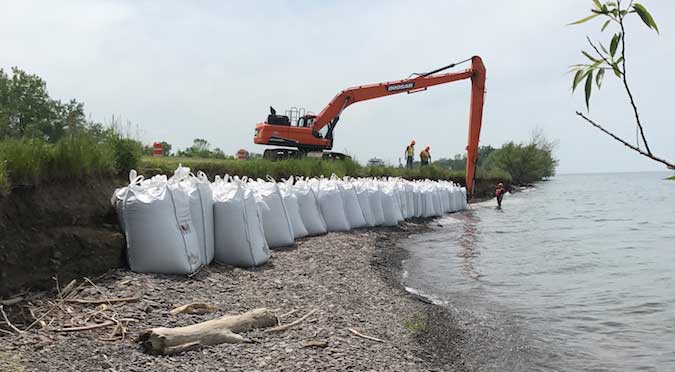
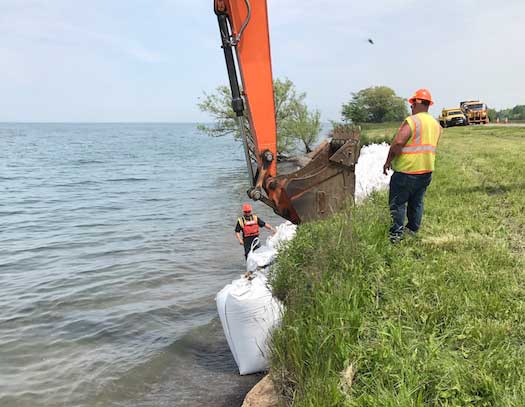
KENDALL – The New York State Department of Transportation this week has put many bulk sandbags that are approximately 3,000 pounds each at two locations in Orleans County. The sandbags will help protect the Lake Ontario State Parkway from erosion.
The high water levels in Lake Ontario are chewing away some of the shoreline along the lake.
The DOT worked at a section in both Kendall and Carlton, placing the sandbags by using an excavator.
The Carlton location is in the area of Reference Marker 1055, just east of the Lake Shore Drive exit. The Kendall location is Reference Marker 1091, about 1 ¼ mile West of Route 237.
The larger bulk bags were tied to guiderail posts that were driven into the soil.
By Tom Rivers, Editor Posted 21 June 2019 at 12:21 pm
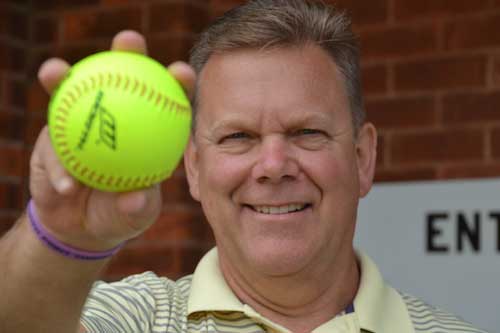
Mike Outten, pastor of North Point Chapel in Albion, is bringing a baseball and softball academy to the community next month that will include instruction from retired Major League Baseball pitcher Chris Hammond.
BARRE — An Albion church is bringing a retired major League Baseball pitcher and one of the New York Yankees owners to the community next month for a baseball and softball academy.
North Point Chapel has previously held basketball camps and a baseball clinic. This is the first time a former professional athlete will lead one of the programs for North Point.
The academy will be from July 15-19 and is open to boys and girls, ages 8 to 18, in Orleans County and other nearby communities outside Orleans. The program will be at the Barre Town Park from 9 a.m. to 3 p.m. The cost is $50 per children if signed up by June 24. Then the cost increases to $65. The maximum cost will be $100 per family if more than one child signs up for the camp. The price includes lunch.
“It’s an outreach to the community, and the kids will become better ballplayers,” said Mike Outten, pastor of North Point Chapel.
Chris Hammond will lead drills each day with instructors from NextLVL Sports Institute in Georgia. Hammond pitched 14 seasons in the big leagues with the Reds, Marlins, Red Sox, Braves, Yankees, A’s and Padres. He had his best season in 2002 with a 0.95 ERA with the Braves. He is only the third pitcher in the history of the Major Leagues to maintain an ERA under 1.00 for a full season.
Chris Hammond
Grant Cagle, a partner with the Yankees, will be at the camp on Thursday. He is friends with Hammond.
“You’re not going to get an owner of the New York Yankees in our area very often,” Outten said.
NextLVL wants to expand its camps and wants to see a big number of kids for the program at the Barre park. The players will be taught hitting, agility and footwork, as well as strength training, diamond work and the fundamentals of the game. Each player should bring a bat, hat and glove.
In addition to the camp, Hammond will lead a father/child seminar on Wednesday evening that week. Friday night there will be a cook-out and concert.
A registration form is available on the North Point Chapel Facebook page. For more information, contact Outten at 716-622-0628.
By Tom Rivers, Editor Posted 21 June 2019 at 11:38 am
ALBION – A Medina man was sentenced to 2 1/3 to 7 years in state prison on Thursday by Orleans County Court Judge Sanford Church.
Stacy Moss, 29, previously pleaded guilty to third-degree grand larceny. That charge could have been reduced if he had successfully completed a court diversion program, but Moss didn’t meet the conditions for that program.
He appeared in court on April 18 after being wanted on a warrant since November.
Moss was removed from the diversion program because he hasn’t been going to a drug treatment program or showing up for court appearances.
By Ginny Kropf, correspondent Posted 21 June 2019 at 10:39 am
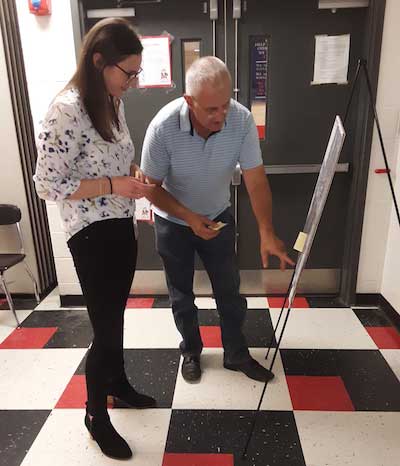
Photos by Ginny Kropf: Jim Simon, right, associate dean of Genesee Community College’s Medina and Albion campuses, explains his concerns about traffic in front of the Medina campus to Laura Byer, planning manager for Alta Planning and Design.
MEDINA – There was an open house and presentation at Medina High School on Thursday to hear representatives from Alta Planning and Design outline proposed plans for improvements to the Maple Ridge corridor from Bates Road to Salt Works Road.
The improvements are designed to improve safety and traffic flow for vehicles, bikers and pedestrians along that two-mile stretch of road.
For Mike and Nancy Blount, who own property adjacent to Family Dollar, this would be fantastic. The couple is pleased to see a turning lane is among the proposals.
Mayor Mike Sidari welcomed the residents and explained why there was a need to address traffic issues along this stretch of road.
“Maple Ridge Road is getting crowded because of the growth of the businesses,” Sidari said.
He praised the efforts of those who have been serving on the committee of 10 since last fall, since the village received a $50,000 Genesee Transportation Council grant to study pedestrian and bicycle accommodations from Bates Road to Tops and the former Ames Plaza.
While the overall planning includes Maple Ridge Road from Bates Road to Salt Works Road, the core of the improvements focus on Main Street to Tops.
The first thing the planning committee did was put the proposal out for bids, awarding the contract to Alta Planning and Design, a company with headquarters in Portland, Ore., with offices in Albany.
Kristie Di Cocco, project manager, said the company focuses on vehicle and pedestrian transportation. The steering committee included representatives from Medina Business Park, Medina Central School, the village of Medina, Genesee Transportation Council, town of Shelby, Orleans County Department of Planning and Development, Orleans County Economic Development and state Department of Transportation.
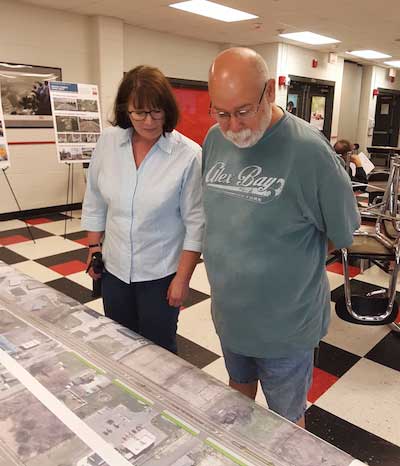
Mike and Nancy Blount of Medina look over maps outlining proposed improvements to Maple Ridge Road.
They did an initial assessment in November and met with the steering committee in December. They also did a web survey and got a huge response, Di Cocco said. They received 560 responses, which she said was impressive, including almost 60 from Medina Estates (Ricky Place).
Di Cocco said they are looking at the concept of “complete streets,” which means they are not just looking at the fastest way to get vehicles from one destination to another, but rather streets which are designed to handle all forms of travel, including bikes, pedestrians and trucks.
In the future, she said Medina Business Park is going to blossom and other businesses continue to grow, adding to traffic.
Plans also include how they can connect the village’s historic district downtown with Maple Ridge Road. This includes a path from Ricky Place into the village.
They will recommend implementation of strategies which will make the project competitive for grants, Di Cocco said.
Their studies included seven intersections from Tops to Bates Road, and the one which experienced the longest delays in exiting to Maple Ridge Road was West Avenue.
A study of the crash history in the last five years showed accidents attributed to animals topped the list, with rear-end collisions second.
Laura Byer, project planner with Alta, said time lapse cameras were installed on Maple Ridge Road to see how people were walking, and they were walking in all conditions and at night.
“There is a precedent for establishing pedestrian and bike paths,” Byer said.
She also said a pedestrian bridge across Oak Orchard Creek is in the works.
Barriers to the proposed improvements include available funding, coordinating with NYDOT and roadway geometrics, i.e., a dip in the road west of Tops which hides oncoming vehicles.
Byer said Medina Central School officials are supportive of their measures and have shared their input.
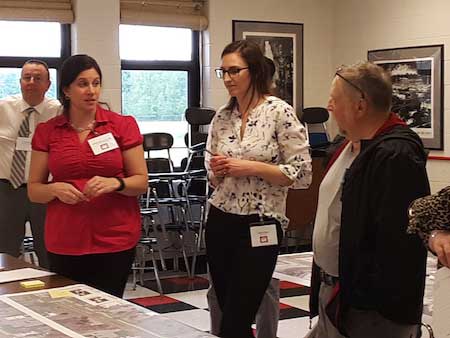
Kristie Di Cocco, left, project manager with Alta Planning and Design, and Laura Byer, planning manager, discuss proposed improvements to Maple Ridge Road with Jim Lustumbo, owner of Lake Village Mobile Home Park. At left rear is Jim Bensley, director of Orleans County Planning and Development.
Mayor Sidari stressed the importance of the study, and said they are looking to make these improvements for the safety of motorists and pedestrians.
“This is something that needs to be done,” he said. “We are going to see increased vehicle traffic to the Business Park, with the new hotel and the college. Funding is our biggest obstacle.”
A portion of the evening was allocated for residents to share their concerns and ideas. There was a lot of discussion regarding safety of vehicles, especially school buses, exiting Mustang Drive. Di Cocco said they did a traffic analysis there and are going to recommend a traffic light.
She also said there had been a lot of talk about lowering speed limits, but although it is a state road, the village owns that stretch of Maple Ridge Road.
Placing medians in front of Aldi’s and Medina Bowling Lanes to discourage left turns is another proposed option.
Jim Simon, associate dean of the Medina and Albion campuses of Genesee Community College, was concerned about the fact the speed limit changes from 45 to 55 mph right in front of the college. He said when the new hotel goes up, this developing corridor is going to get a lot busier.
He also suggested a pedestrian bridge installed at the back of Ricky Place would create an easy route for employees of Pride Pak, for instance, who want to go downtown for lunch. It would also be a direct line for students who want to walk home in the village. A pedestrian bridge has already been funded, he said.
Other traffic issues included the problem for residents of Lakewood Village who want to exit onto Maple Ridge Road, especially those making a left turn.
Park owner Jim Lustumbo said a 75-foot right-of-way between McDonalds and his storage buildings was established several years ago and agreed to by the landowner. A roadway there would allow residents to drive behind McDonalds and into the former Ames parking lot, where they could then exit onto Maple Ridge Road at the traffic light.
Copies of three concepts for the Maple Ridge Road improvements were made available for residents to vote on, and those who did not attend Thursday’s presentation are encouraged to pick one up at the village hall and fill it out.
Residents can not only pick their favorite concept, but can indicate if there is one or more thing they don’t like about a concept or something they would like to keep.
By Tom Rivers, Editor Posted 21 June 2019 at 8:25 am
Photos by Tom Rivers
KENDALL – Joey Cooper, 5 months, has his ears covered during the Kendall Fireman’s Parade on Thursday. He is held by his grandmother, Debbie Rockow. Joey’s parents are Ben and Amanda Cooper.
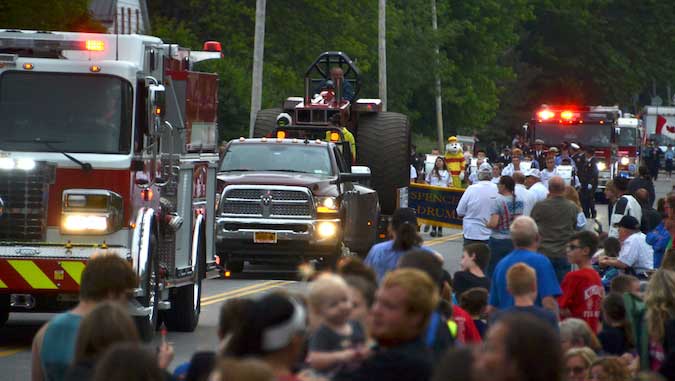
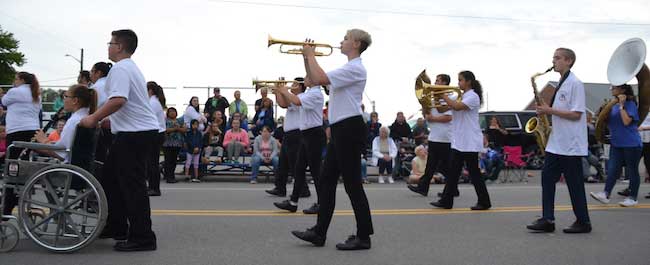
The family enjoyed an hour-long parade to kick off the Kendall Fireman’s Carnival. Normally the carnival is in July, but the date was moved up due to the schedule for the company that provides the rides/midway.
Despite the change in the schedule, a big crowd of community members watched the procession of floats, marching bands and fire trucks. Lloyd Christ of Murray brought his big tractor to promote the Murray Tractor Pull on June 29-30 on Groth Road.
Ken DeRoller, an Orleans County legislator from Kendall, acknowledges friends in the crowd on Kendall Road. Many local elected officials and candidates were part of the parade, many making a pitch for votes at the June 25 primaries.
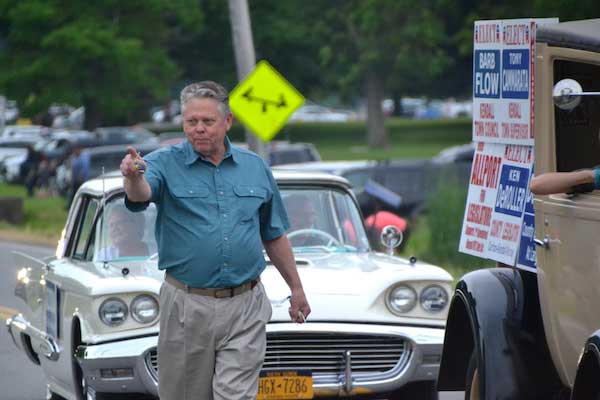
Kendall Town Councilwoman Margaret Lynn Szozda is in the 1959 Thunderbird with former Town Supervisor Jack Gilman.
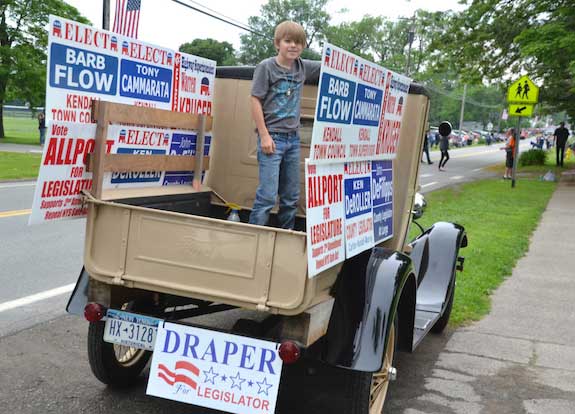
Aiden Barnard, 9, joined his grandfather Warren Kruger in the parade. Kruger is the Kendall highway superintendent who displayed many campaign signs on his 1929 Ford pickup.
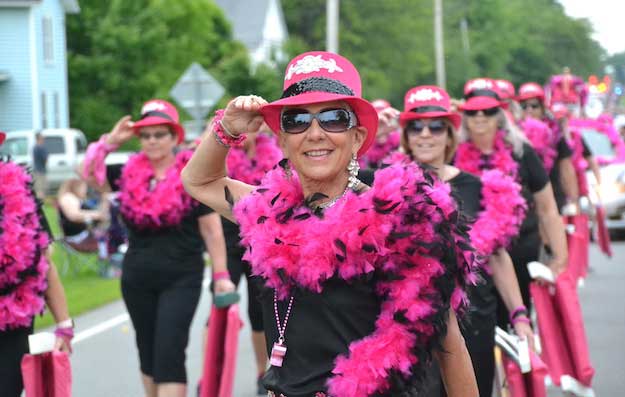
Kim Corcoran and the Kendall Lawn Chair Ladies performed to “New York, New York” by Frank Sinatra. They have been a crowd favorite for several years.
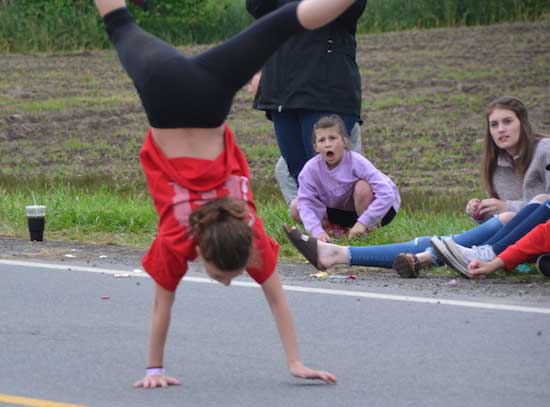
A member of Head Over Heels Acrobatics & Dance in Holley impresses the crowd with a handstand during the parade.
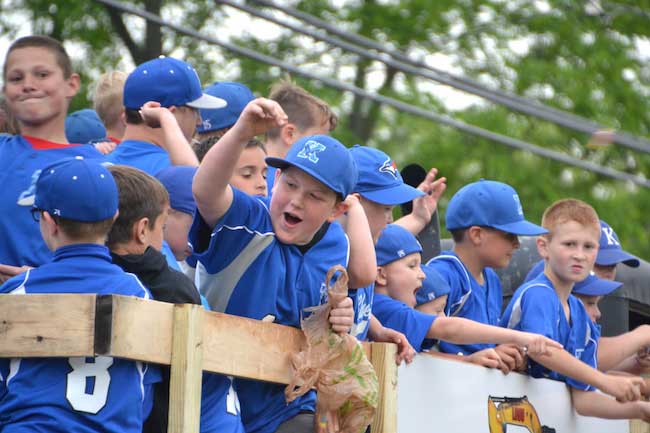
Kendall youth baseball players tossed candy to the crowd. The players were given a ride in the parade by Lake Ontario Shore Development.
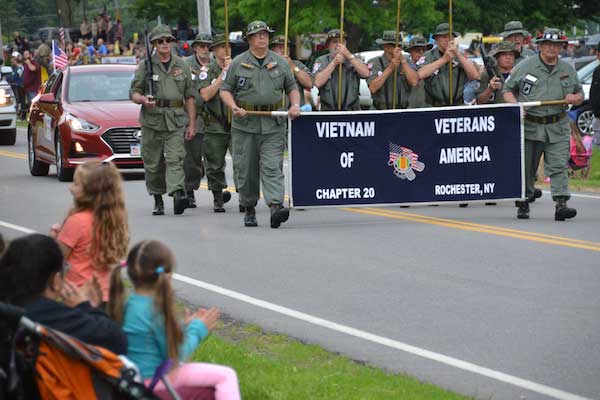
Vietnam Veterans of America based in Rochester marched near the front of the parade. They received a standing ovation from many in the crowd.
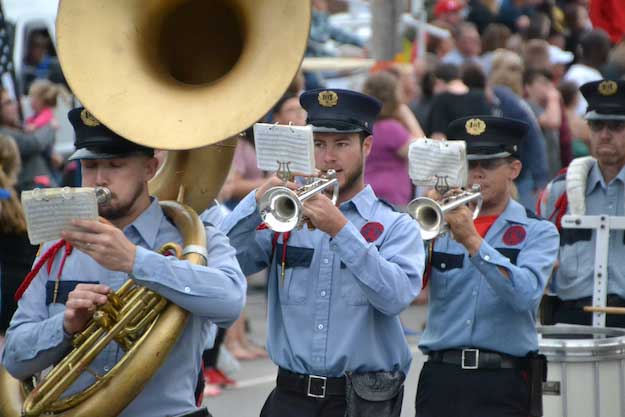
The Alexander Fireman’s Band plays for the crowd.
Callie Updike, center, performs with other members of the Holley-Kendall marching band.
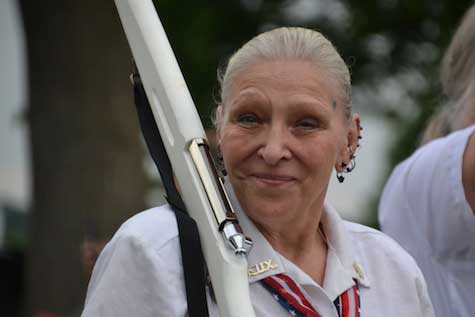
Karen Jensen, a member of the VFW auxiliary in Hamlin, had fun in the parade.
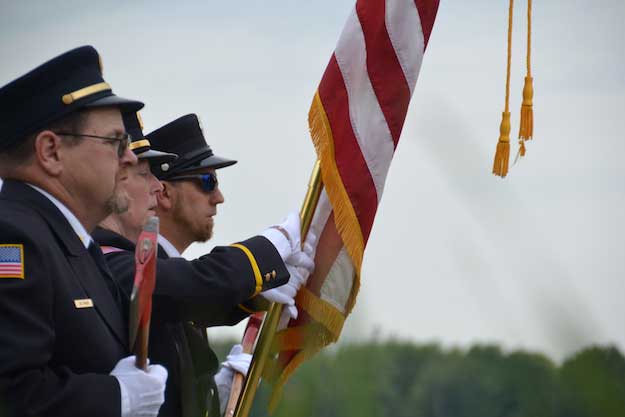
The honor guard for the Kendall Fire Department leads the group in the parade.
To see a schedule of events at the carnival, click here.
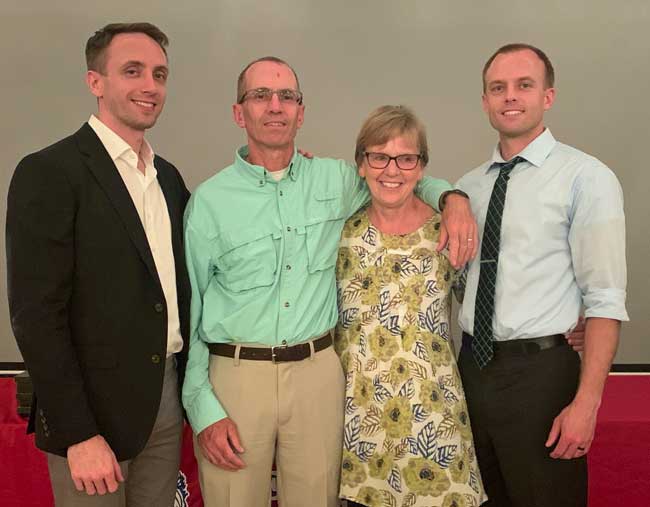
Contributed Photo – Medina High’s newest Mustang Hall of famers, brothers Matt and Dan Tierney meet here with their parents Tim and LouAnn Tierney.
Two new members, brothers Matt and Dan Tierney, were inducted into the Mustang Sports Hall of Fame at Wednesday’s annual Medina High Block ‘M’ Banquet.
Dan, a 2004 Medina graduate, captured the state high school pole vault championship in 2004 and went on to place fifth at the nationals. He won both the Niagara-Orleans League Pole Vault and High Jump titles that spring.
Medina’s pole vault record holder at 16-1, he also won the national high school indoor championship in 2004.
In college at Ashland University, he was a two time indoor and one time outdoor conference pole vault champion.
In NCAA national championships, he finished second in the outdoor pole vault competition in 2008 and won the indoor championship in 2009.
Matt, a 2006 Medina graduate. was a five time N-O All-League track honoree in the 100, 200, 400 and 1600 Relay. He was a member of the Section VI champion 1600 Relay in 2001.
While at MHS he also earned first team N-O All-League honors in soccer in 2001.
In college at the University of Rochester, he set a total of nine school records in track including indoor marks in the 55, 200, 400, 500, 800 Relay and 1600 Relay and outdoor marks in the 400, 400 Relay and 1600 Relay.
He was a nine time New York state (NYSCTC) champion.
By Tom Rivers, Editor Posted 20 June 2019 at 5:50 pm
ALBION – A Rochester man admitted in Orleans County Court today to selling fentanyl and heroin to an informant with the Orleans County Major Felony Crime Task Force.
Jonathan Velasquez, 25, on Tuesday pleaded guilty in federal court to conspiracy to distribute over 40 grams of fentanyl. That charge carries a minimum penalty of five years in prison, a maximum of 40 years, and a $5 million fine. Velasquez is accused of conspiring with others to distribute quantities of heroin throughout Western New York, including Orleans County.
Velasquez pleaded guilty in Orleans County today to attempted criminal sale of a controlled substance in the third degree, and will receive a maximum sentence of 2 years in state prison. That sentence will be served concurrently or with the federal sentence.
District Attorney Joe Cardone said in court an informant made a call from Orleans County to Velasquez about buying fentanyl and heroin. The informant went to Monroe County to get the drugs, which were analyzed by a lab in Niagara County and found to be heroin and fentanyl.
In other cases in County Court this afternoon:
• A Medina man pleaded guilty to course of sexual contact against a child in the second degree.
Jeffrey Woodroe, 39, admitted to sexual contact with a girl under age 12 on a least two occasions between April 2008 and April 2012.
He will face up to six months in the county jail and 10 years of post-release supervision when he is sentenced on Aug. 15. Judge Sanford Church also issued an order of protection for the victim.
• Kayla Rowling, 28, of Medina admitted she had cocaine on Nov. 28, 2018. She pleaded guilty to attempted criminal possession of a controlled substance.
As part of a plea agreement she will avoid state prison, but could be sentenced to up to a year in the county jail when she is sentenced on Aug. 15. She is a first-time felony offender.