By Tom Rivers, Editor Posted 26 September 2016 at 11:36 am
Company files public involvement plan for ‘Heritage Wind’
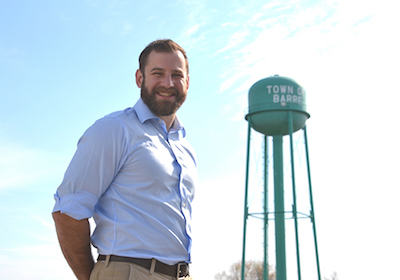
Photo by Tom Rivers: Ben Yazman, Heritage Wind project developer for Apex Clean Energy, is pictured in this photo from may by the Barre town water tower.
BARRE – Apex Clean Energy has filed a Public Involvement Plan for a wind energy project in the Town of Barre.
The company tells the state Public Service Commission it wants to build a 200-Megawatt project in Barre. This is the second project Apex is working on in Orleans.
The Charlottesville, Va. company has proposed Lighthouse Wind for the towns of Yates and Somerset near the southshore of Lake Ontario.
Apex has been working on the Barre project for several months, meeting with landowners and community members. Ben Yazman, project developer for Apex, said the project has been well received by many landowners.
“We have been talking to many stakeholders in and around the project area for months,” Yazman said. “There is widespread interest in this project and we look forward to this formalization of the process with the filing of our final Public Involvement Program. We want every stakeholder to have a clear path to providing input to our project, and I encourage any interested parties to reach out to us directly to schedule consultations.”
Apex is required to file a draft Public Involvement Program (PIP) plan under Article 10 of the Public Service Law. The PIP is designed to inform and gather input and involvement from the public and interested agencies on the Heritage Wind project throughout the Article 10 process, which Apex expects will take two to three years to complete, Yazman said.
Local officials and residents are welcome to submit comments for 30 days from the Sept. 23 filing of the PIP. The Department of Public Service will review the draft PIP, and will determine if it is adequate or if Apex needs to take additional measures for public involvement.
Yazman said Apex will be opening an office soon in Orleans County. He said members of the Apex team working on Heritage Wind can be reached at 585-563-5137 or info@heritagewindpower.com.
Once the office is established, the Heritage team will welcome the public to stop by if they have questions or want information on the project. Community members can also schedule a more formal meeting or presentation.
Yazman said the entire town of Barre is under review for the project except for a 2-mile buffer around the Pine Hill Airport. Local wind monitoring confirms that the area under consideration is ideal for a project of this size, which Yazman said will produce enough safe, pollution-free energy to power approximately 53,000 U.S. homes.
Heritage Wind will create jobs and generate a new source of long-term revenue for the local community, the company said in a press release today.
“The total direct financial impact to the region is likely to be in the millions of dollars over about 30 years, with additional indirect economic benefits greatly exceeding that number,” Apex stated in the press release.
By Tom Rivers, Editor Posted 23 September 2016 at 8:19 am
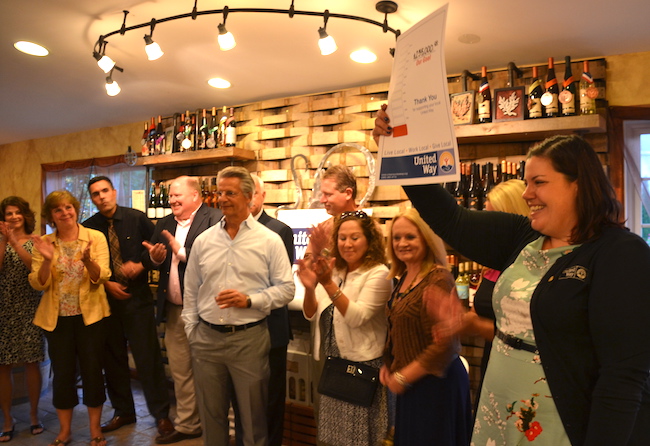
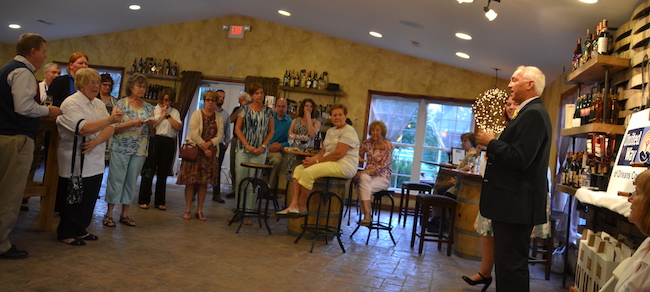
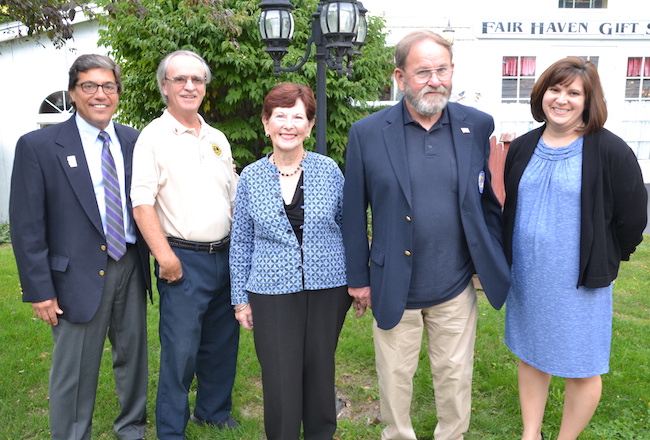
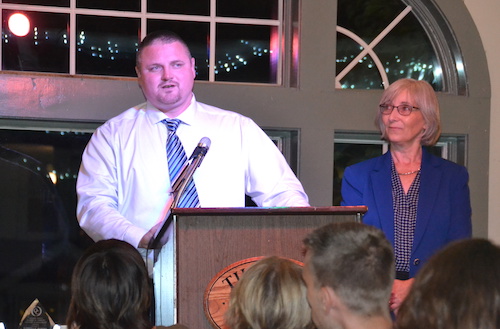
Photos by Tom Rivers: Jessica Downey, the United Way of Orleans County executive director, announces the $235,000 fund-raising goal during a kick-off event Thursday at Leonard Oakes Estate Winery in Medina. Members of the board of directors are pictured with her.
MEDINA – The United Way of Orleans County is asking residents to open their hearts and wallets to support 16 agencies that receive funds through the annual fund-raising appeal.
The United Way kicked off the campaign on Thursday with a $235,000 goal. The money supports agencies that serve youth, senior citizens, people with disabilities and people in crisis.
Jessica Downey, the United Way’s executive director, said the campaign can bring needed funding to the agencies. United Way has reduced its goal from $279,104,98 last year and $325,000 two years ago.
Orleans County has experienced population loss, which has hindered efforts to reach previous goals, Downey said during a kick-off event at the Leonard Oakes Estate Winery. Some of the appropriations to member agencies have had to be reduced, but Downey said the new goal represents a realistic target for the community.
She is the lone full-time employee for the United Way, which has moved to a rent-free office at CRFS, where Downey was a vice president. She said United Way doesn’t have any frivolous spending and is dedicated to helping the local agencies.
The agencies said the United Way funding is important for them to carry out their work.
“We don’t get any money from the government,” said Nyla Gaylord, the director of development for the Genesee-Orleans Ministry of Concern. “We are extremely bare bones. There is nowhere left that we can cut.”
The United Way funding helps support the Just Friends mentoring program through GOMOC and also the furniture program, where the Ministry of Concern picks up donated furniture and delivers it to residents who need stoves, refrigerators, couches and other larger household items.
“A lot of people we serve are working poor and they fall through the cracks,” she said.
Mary Lee Knights is president of the Orleans County Adult Learning Services, which provides tutoring and family literacy programing. It has 22 tutors and 15 students in the adult literacy program and 11 tutors in the family literacy program.
OCALS provides its services for free, but needs United Way support for three part-time employees as well as educational materials. Knights said the United Way funding helps the agency in its mission. Those educational services help people develop skills and become more self efficient.
Some workplace campaigns have already begun, and Downey welcomed any business or group to invite her to give a presentation. She can be reached by email at jdowney@orleansunitedway.org. (She also said retired residents are welcome to give. Anyone can send a contribution to the United Way of Orleans County at P.O. Box 468, Albion, NY 14411.)
David Cook (right), president of the United Way board of directors, urged the community to be supportive of the United Way and the 16 agencies that receive funding in the annual campaign.
David Cook is chairman of the board of directors. He said many of the county’s largest companies have representatives on the board, including the leaders from CRFS, Brunner, and Takeform Architectural Graphics. There are also representatives from the Lyndonville and Kendall school districts, Iroquois Job Corps Center, Pawlak’s Save-A-Lot, Bank of Castile, Orleans Community Health, The Daily News of Batavia, and the Catholic Family Center.
The kickoff event also included representatives from Baxter in Medina, which has been critical to the most recent campaigns, with fund-raising there topping $60,000.
Cook of Lyndonville was working at Kodak 25 years ago when he led a workplace campaign in his department. He has stayed committed to United Way. He now works as territory manager for Innovative Surface Solutions. He said he travels the county and region and sees the need.
The agencies that benefit from the campaign include:
4-H Youth – Cornell Cooperative Extension; Arc of Orleans County Camp Rainbow; Arc of Orleans County Meals on Wheels & Nutri-Fair; Boy Scouts of America – Iroquois Trail Council, Inc.; Christ Church Community Kitchen; Community Action – Main Street Store Employment Support Project; GCASA; Girl Scouts of Western New York; Hospice of Orleans Martin-Linsin Residence; Ministry of Concern; Orleans County Adult Learning Services; Regional Action Phone; Senior Citizens of WNY; YMCA; Just Friends; Medina Youth Commission; Independent Living of Genesee Region; Community Action: Holley Community Center; Ministry of Concern, Last Resort; and the Town of Yates, Summer Recreation Program. Donors can also request their donation go to another agency.
For more on the United Way of Orleans County, click here.
By Tom Rivers, Editor Posted 20 September 2016 at 4:41 pm
Chamber honors 5 clubs for good deeds
Photos by Tom Rivers: Leaders from the five Lions Clubs in Orleans County are pictured on Friday when the clubs were presented Community Service Awards from the Orleans County Chamber of Commerce. Pictured from left includes: Kendall President Tom Minigiello; Medina Past President Jim Hancock; Mary Janet Sahukar, president of the Albion Lions; Kevin Johnson, Clarendon’s president; and Terry Stinson, third vice president for Lyndonville.
GAINES – Lions Club members have been giving back in Orleans County for nearly a century, beginning in 1924 when the Albion club was chartered.
There are now five clubs in the county with about 200 members. They tackle many community service projects, from planning an annual music festival, to community cleanups, to running the Fourth of July bash in Lyndonville. They serve hot dogs, provide scholarships, and look out for residents in need.
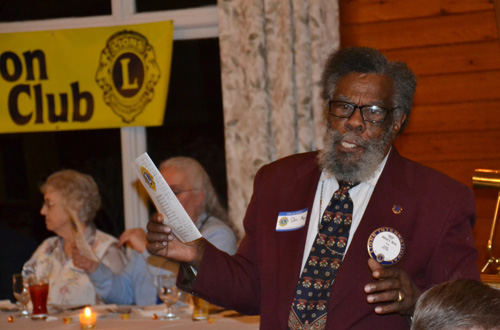
The Rev. Wilfred Moss, a past president of the Lions Club and a member since 1997, leads the group prayer during the Club’s 90th anniversary celebration in 2014.
The Orleans County Chamber of Commerce has recognized the Lions with a Community Service Award. The five clubs all had representatives at Friday’s awards dinner, when the plaques were handed out.
The Lions founder, Melvin Jones, was in insurance business in Chicago and pushed to start the humanitarian organization in 1917. Jones had a motto: “You can’t get very far until you start doing something for somebody else.”
• Albion
The club in Albion is the second oldest in the region between Niagara Falls and Rochester. Only the Lions in Rochester predate the club in Albion.
The club currently has 22 members. They are active in the annual Rock the Park music fest, which raises funds for Bullard Park.
The Albion Lions sponsor a youth baseball team and works on other community projects, raising money with a sausage booth at the Strawberry Festival, and by selling roses on Mother’s Day and geraniums during Memorial Day.
• Clarendon
The Clarendon Lions were chartered in 1998 after being sponsored by the club in Kendall. There are 23 Lions in Clarendon and they help at the Holley Community Center, and with other service projects.
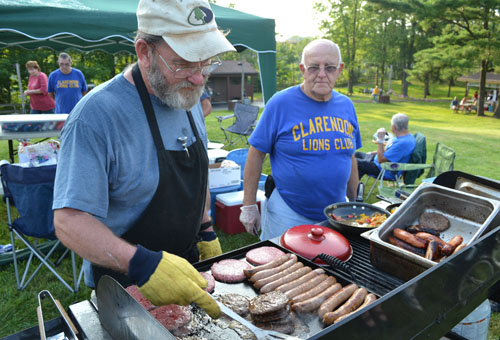
This photo from July 2013 shows Kevin Johnson, left, and Don Knapp. In addition to serving food at the OONA concerts, the Clarendon Lions also serve hot dogs and hamburgers at the annual Tonawanda Valley Kennel Club dog shows over the Labor Day weekend. The Clarendon Lions Club serves hamburgers and sausage at the Oak Orchard Neighborhood Association concerts at the Orleans County Marine Park.
N Kendall
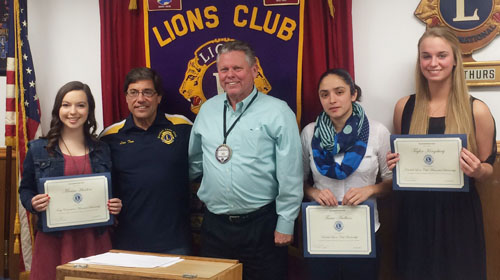
Provided photo: Pictured include scholarship winners recognized in January 2016, from left: Marisa Hanlon (attending Daemen College), Lions President Tom Minigiello, Lions Club member Ken DeRoller, Tania Arellano (attending Roberts Wesleyan College), and Taylor Kingsbury (attending St. John Fisher). Not pictured is the other scholarship winner, Luke Rath, who has enlisted in the United States Marine Corps.
Each year the Kendall Lions awards four scholarships for $250 each to deserving seniors. The Kendall Lions in January presented scholarship checks to three of the 2015 recipients.
The Kendall Club has 61 members, making it the largest Lions Club in Orleans County.
The Kendall Lions has a Leo Club in the school, where high schoolers work on service projects.
The Kendall Club started in 1975 after being sponsored by the Medina Lions Club.
The Kendall Lions do an annual community cleanup day. They also purchased a defibrillator for the Kendall Fire Department, and they collect used eyeglasses to be given to people who need glasses.
• Lyndonville
The Lyndonville Lions formed in 1951. The club’s 47 members are busy throughout the year with a host of projects, including running a medical equipment closet where residents can borrow wheelchairs, port-a-potties and other equipment.
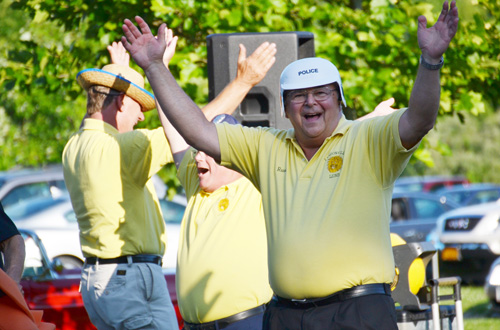
Russ Martino, a member of the Lyndonville Lions Club, leads the crowd in doing the motions to the song “YMCA” during a concert by Crash Cadillac in July 2014. The band from Buffalo performed at the Yates Town Park along Lake Ontario at the end of Morrison Road. Martino was the town supervisor when Yates created the park about seven years ago. Current Town Supervisor John Belson, center, and Jeff Johnson join in the dance. The concert was sponsored by the Lions Club, which also takes the lead in the annual Lyndonville Fourth of July celebration.
The Lions do a roadside cleanup along Route 63, a pumpkin carving contest and give out awards to the best-decorating homes during the holiday season.
Lyndonville Central School plans to implement a new Leo Club. The Leo Club gives students in grades 7-12 the opportunity to serve their communities and make a positive impact. It offers a great way to have fun, make new friends and develop valuable leadership skills.
There will be an informational meeting Thursday from 2:35 to 3:15 at the school.
• Medina
The Medina Lions Club formed in 1935 and has 55 members.
The club and other community volunteers decorate the State Street Park in Medina each holiday season, putting lights on Christmas trees, and setting up a Nativity scene and other signs of the upcoming holiday season.
The Medina Lions also do a community cleanup, organize a community-wide garage sale, run a scarecrow fest and maintain a park by the canal, as well as other projects.
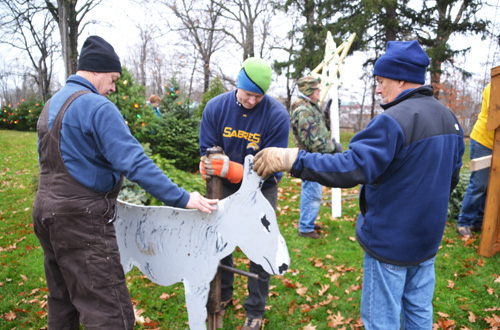
Medina Lions Club members Dave Denny, left, and Dave Bellucci, right, work with Ben Kaiser, a volunteer, to set up one of the animals at State Street Park last November. Kaiser’s father Pete supervises the set up and tear down of the display.
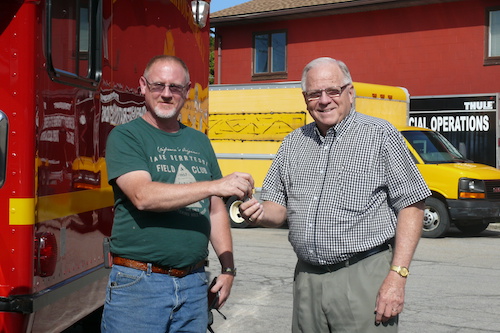
Provided photo: Chris Chilson (left), Fancher-Hulberton-Murray Fire Chief, hands the keys to a truck to Laverne Bates, executive director of the Genesee-Orleans Ministry of Concern. They are pictured by a low mileage truck in red that was purchased by GOMOC from FHM. The previous truck in yellow needed costly repairs.
ALBION – A furniture program operated by the Genesee-Orleans Minsitry of Concern should be back on the road later this month after the agency purchased a low-mileage truck from the Fancher-Hulberton-Murray Fire District.
The program has been suspended due to a disabled truck that was too costly to repair. The 2004 GMC Savana van had about 160,000 miles and needed another engine, and other repairs totaling $8,000.
The predicament was highlighted in news stories by the Orleans Hub and The Daily News of Batavia, resulting in donations from the public for a replacement truck.
“Generous donations from the community provided the needed finances to complete the deal,” GOMOC stated in a news release today. “The Furniture Program will be back and fully operational before the end of September.”
GOMOC picks up used appliances and furniture and matches them with people in need in Orleans and Genesee counties. There are about 100 people on a waiting list for furniture and appliances – refrigerators, stoves, washers and dryers.
Two part-time employees run the furniture program, which on average makes deliveries to 23 families each month or nearly 300 a year.
“This great team effort will provide needed furniture, bedding and appliances to families in need for years to come,” GOMOC said in a statement. “Many poor and working poor in our community are cash strapped when it comes to having the money to buy expensive household items such as stoves, refrigerators, beds and other household furnishings. To meet basic needs, they often have no alternative but to turn to rent-to-own businesses or make credit arrangements with high interest rates. They end up paying three times the amount they would have paid if they had the upfront cash to buy new.”
The GOMOC service helps people who have gently used household items to donate by providing free pick-up.
“We are grateful to our donors and to the Fancher-Hulberton-Murray Fire Department for the role they have played in getting getting our furniture program us and running again,” GOMOC stated. “ With ongoing support from our donors to pay for staff working in the program we will continue to provide this valuable service to the community.”
By Tom Rivers, Editor Posted 17 September 2016 at 9:50 am
Photos by Tom Rivers: Matt Beadle, plant manager for Freeze-Dry Foods in Albion, and Karen Richardson, company co-owner and president, accept the award for Business of the Year on Friday from the Orleans County Chamber of Commerce.
ALBION – The Orleans County Chamber of Commerce honored local businesses, entrepreneurs and community members for their work to build a stronger community during the 18th annual awards banquet for the Chamber on Friday. Nearly 200 people attended the event at Tillman’s Village Inn.
The following were recognized:
Business of the Year: Freeze Dry Foods of Albion.
The company took over the former Lipton’s plant in Albion in 1999 after the former Ontario Foods (now Associated Brands) left Albion for a bigger plant in Medina.
Freeze-Dry has steadily grown in the past 17 years, overhauling the plant and adding new product lines. It has 60 workers that make freeze dry food products. (The company removes moisture and oxygen from meats and food to prevent the products from deteriorating at room temperature.)
Karen Richardson, company co-owner and president, said Albion has been a good fit for the company, which is based in Oakville, Ontario.
She thanked “a very supportive community,” including local economic development leaders, for helping the company grow and invest in Albion.
Lifetime Achievement: Gabrielle Barone (vice president of business development for the Orleans Economic Development Agency).
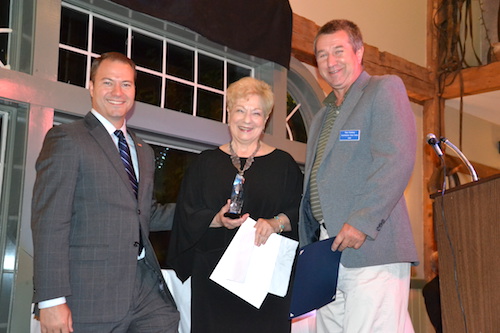
Gabrielle Barone accepts her award with congratulations from State Sen. Robert Ortt, left, and Barry Flansburg, representing State Assemblyman Steve Hawley.
Barone has worked for the Orleans Economic Development Agency for nearly 15 years, and has had a role in many of the economic development projects around the county, putting together deals and lining up infrastructure for companies.
Barbara Waters said Barone has always been a hard-worker since she was a kid growing up in a family business in Medina.
“She is humble,” Waters said. “She is poised, articulate and a lovely lady and friend who is an inspiration to all woman.”
Barone has shown a drive and enthusiasm to better the community throughout her career, said Waters, who accepted the Lifetime Achievement last year on behalf of her late husband, Robert Waters.
Barone praised the team at the Orleans EDA, local municipal officials and the business owners for bringing many of the projects to reality.
“Achievement is a joint effort,” she said. “Achievement is about partnering.”
Barone said many economic development projects are years in the making.
“At the core of achievement is persistence,” she said. “I always felt better when I gave it one more try.”
Phoenix Award: The Print Shop, owner Ken Daluisio.
Ken Daluisio
An eyesore on East Center Street was radically revamped by Daluisio, who expanded his Medina business into what was a dilapidated storefront, a former laundromat at 124-126 E. Center St.
On March 19, 2015, Daluisio took possession of the former laundromat building. One year and one day later, a vastly improved building was ready for The Print Shop.
When doing renovations for the expansion, Daluisio needed 13 dumpsters to haul out laundry machines and dryers, as well as the old floor, ceiling, partition walls and other debris. It took seven dump truck loads to remove bricks and dirt from the basement. The building was stripped down to four bare walls and then rebuilt with new floor, a roof, electrical system and other upgrades. Daluisio’s brother John managed the construction project.
Daluisio said the renovation follows Kathy Blackburn’s work at Meggie Moos and other work on East Center Street.
“We couldn’t have done it without the support of the community,” he said. “It’s a whole new neighborhood on East Center Street.”
Tim and Crystal Elliott
New Business of the Year: Brushstrokes Studios of Medina (owners Tim and Crystal Elliott).The Elliotts last November opened the new business at 409 Main St., the former home of The Journal-Register in Medina.
At Brushstrokes, customers can paint their own ceramics and glass. The Elliotts have brought a new family friendly activity to the community, and have expanded classes.
Co-owner Tim Elliott thanked the dedicated customers at Brushstrokes and urged the community to “shop small” and support locally owned businesses.
Community Service Award: Lions Clubs in Orleans County (Albion, Clarendon, Kendall, Lyndonville and Medina).
The five clubs do a range of community service projects, from running festivals to providing scholarships. They serve food at local events and collect medical supplies and used glasses for people in need.
Tom Minigiello, president of the Kendall Lions Club
Albion has the longest-lasting Lions Club. It started in 1924. Clarendon has the most recent charter with a club that started in 1998. The five clubs combined have about 200 members with Kendall the largest with 61.
Tom Minigiello, president of the Kendall club, accepted the award that will be presented the Lions district.
“It’s very important to give back to your community,” Minigiello said. “Do your part and it will make our community better.”
Community Service Award: Cindy Robinson of Medina.
Robinson has been president of the Medina Business Association the past decade and has been instrumental in running many of the MBA’s popular events, including wine- and beer-tastings, and the Olde Tyme Christmas celebration.
Cindy Robinson accepts the Community Service Award.
She also is a downtown business owner with the English Rose Tea Shoppe, and serves with other organizations, including the Orleans Renaissance Group, the Chamber of Commerce, and Medina Historical Society.
Robinson encouraged everyone to find a way to volunteer with at least one organization. She said that would build a stronger community with more events and opportunities.
Agricultural Business of the Year: Root Brothers Farm in Albion.
The Root family has been farming in Orleans County since 1852. Today, Robin and his brother Scott Root work about 5,000 acres. The two brothers have been farming together since 1970. There are now six generations of Roots that have been farming in Orleans County.
The brothers have had many lean years, Robin said, but they weathered the storms with help from friends and family.
Robin Root
“You could have a million dollars, but it’s better to have a million friends,” Robin told the Chamber crowd.
He and his brother are the son of the late Pierson Root, a former Orleans County Farm Bureau president. Robin said their father had good advice and helped the brothers during one tough stretch in the early 1990s.
“My dad was a hell of a man,” Robin said. “I really appreciate it.”
The brothers grow corn, cabbage, zucchini, tomatoes, potatoes and other crops in a diversified operation.
Business Person of the Year: Ward Dobbins, owner of H.H. Dobbins in Lyndonville.
Ward Dobbins
Dobbins has led the apple packing and sales company in Lyndonville to expansions. The site handles about 1 million bushels of apples a year, with on-site capacity for up to 300,000 bushels.
Dobbins has 75 employees. The company was started by Ward’s great-grandfather. Ward joined the business 30 years ago. He is active in many of the industry associations.
Ward said the company works with some of the best apple growers in the world.
Small Business of the Year: Paper Boys (owners Ryan Pritchard and Chasen Lee).
Pritchard and Lee opened an office supply business about six years ago after the former Garlock’s Office Supply store in Medina closed.
Pritchard, 31, had been living in Boston for six years when Garlock shut down. He teamed up with Lee, 28, to establish PaperBoys, the new office supply store.
The business at 509 Main St. has expanded to develop web sites and lead small business classes.
Chasen Lee, left, and Ryan Pritchard
Pritchard and Lee say the office supply business remains very important for PaperBoys, but the business has expanded its services for small businesses by building websites, and helping the local businesses use social media and e-mail marketing to attract and keep customers.
With its expanded line of services, the business is now PaperBoys Media, and calls itself ‘The Agency for the Underdog.”
Pritchard thanked the Chamber, Medina Business Association and local businesses for working with PaperBoys.
“We are not successful unless all of the small businesses are successful,” Pritchard said.
By Tom Rivers, Editor Posted 16 September 2016 at 12:10 pm
Gabrielle Barone is recognized for ‘Lifetime Achievement’ by Chamber of Commerce
Photos by Tom Rivers: Gabrielle Barone, vice president of business development for the Orleans Economic Development Agency, has worked on many big projects in Orleans County the past dozen years.
ALBION – Add it all up, and the investments top $200 million.
Since Gabrielle Barone joined the Orleans Economic Development Agency in April 2002, companies have spent lots of money upgrading facilities or building new in Orleans County.
Barone, vice president of business development for the Orleans EDA, had a role in many of the undertakings, helping to guide local and state government support for the projects, whether it be with infrastructure upgrades for the sites or securing tax credits or grants to make the projects a reality in Orleans County.
She is being honored this evening with a “Lifetime Achievement” award from the Orleans County Chamber of Commerce. The Chamber has its annual awards banquet at Tillman’s Village Inn.
There have been significant projects all across the county in Barone’s tenure with the EDA. The ethanol plant in Medina is the biggest investment at $90 million-plus by Western New York Energy.
Barone and the EDA worked to upgrade Bates Road, a rail line, and secure low-cost hydropower and other incentives for the project to come to the community.
Jodi Gaines, center, is chief executive officer and co-owner of CRFS in Albion. She is pictured in September 2013 with Orleans Economic Development Agency officials Gabrielle Barone, left, and Jim Whipple after CRFS announced it would expand in the vacated former Chase building.
Just down from the ethanol plant, she has been a part of several expansions at Brunner, including the most recent one in 2014 that topped $15 million.
Just west of the ethanol plant on Maple Ridge Road, Pride Pak is building a new $15 million vegetable processing facility. Takeform Architectural Graphics also expanded and moved into the former Trek building on Maple Ridge.
“She is very knowledgeable and strong willed,” said Jim Whipple, executive director of the Orleans EDA. “She has great people skills and a natural feel for politics.”
Barone is part of a three-person EDA staff that puts together many complicated economic development deals. The EDA board of directors and local officials also have been active with many of the projects, Barone said.
“No one achieves on their own,” she said.
Barone said it takes takes determination to see the projects through to the last detail. While juggling work with existing companies in the county, the EDA also needs to be laying the groundwork for projects that could be many years away.
That takes a commitment from local governments to put in water and sewer infrastructure, roads and other infrastructure, knowing the payoff may not be right away, Barone said.
The EDA has worked for years to make a 125-acre site “shovel ready.” The Keppler site in Shelby is just south of Maple Ridge Road by GCC. The infrastructure is in place to serve a manufacturer that would be a big user of water and sewer.
Steve Karr (right), chief executive officer for Pride Pak Canada, last October meets Medina village officials and others working on the company’s new 64,000-square-foot vegetable processing facility. He is pictured with Mauro LoRusso, vice president of finance for Pride Pak (center); Gabrielle Barone, vice president of business development for the Orleans Economic Development Agency (far left); and Marguerite Sherman, village trustee (second from left).
She thinks about how the EDA chipped away at many sites, sometimes spending hundreds of thousands of dollars to clear land, do environmental cleanups, and get infrastructure in place. Many in the community second guess the work, questioning the wisdom of the upfront expense.
“You’re going to get roasted,” Barone said about some of the skeptics. “It can take years laying the groundwork. If you’re going to do this kind of work you better be resilient. You better be able to take a setback and bounce back.”
Barone said the EDA often has often been a finalist for a project, after months and sometimes years of working with a developer. And then they pick someone else.
“These companies are looking all over – not just in New York State,” she said
But sometimes Orleans County emerges as the top site. Many companies based in Canada look to Orleans as a spot to set up operations in the United States. That is the case with Pride Pak, which will soon open a new vegetable and fruit processing site on Maple Ridge Road in Medina.
There have been many big projects around the county, including a new controlled atmosphere storage building by H.H. Dobbins in Lyndonville, an expansion and new CA storage in Gaines by Lake Ontario Fruit, several expansions by Intergrow Greeenhouses in Gaines, the Cottages at Troutburg at the former Salvation Army camp in Kendall, Precision Packaging Products and Magc Inc. in Holley.
Gabrielle Barone in February 2014 discusses a plan for a 48,000-square-foot addition at Brunner with Town of Ridgeway Planning Board members, from left: Charles Pettit, Tom Fenton (chairman) and Richard Swan. Barone in her role with the EDA needs to line up local support and approval for many of the economic development projects in the community.
In Albion, the EDA worked to bring CRFS in the vacated former Chase building, preserving several hundred jobs. A former warehouse on McKinstry Street was also renovated and is now home to Bomet, an electronic recycling company. The EDA also worked with the Town of Albion to establish the Albion Business Park at Butts Road and Route 31, which is home to an urgent care site run by Orleans Community Health.
There are numerus other projects that Barone and the EDA have had a hand in, from Freeze-Dry Foods in Albion, the addition at Tillman’s Village Inn in Gaines, to projects at Associated Brands, Hinspergers Poly Industries and the Ace Hardware at the former Jubilee in Medina.
The EDA also runs a small business training program that makes low-interest loans available to graduates of the program. Barone and the EDA have offered advice for the entrepreneurs in getting the businesses off to a good start.
Barone has been active in the community in other ways, including leadership in the former League of Women Voters chapter in Orleans County. She serves on the Job Corps Advisory Council, represented Orleans on the GLOW Workforce Investment Board and is currently on the Orleans County Comprehensive Plan Committee.
Gabrielle Barone is pictured at the Orleans EDA suite at 121 North Main St. in Albion with some of the recent EDA-assisted projects in Orleans County.
The comprehensive plan will help guide development and land use in the county for many years to come.
Barone sees opportunities for growth, improved job prospects and a better quality of life in the county. But she said all levels of local government need to be working to improve the communities, including plans for upgrading the local housing stock and “curb appeal” of the villages and hamlets. That includes aesthetics, signage, even logos for the communities.
The comprehensive plan should identify strengths in Orleans and areas that need improvement.
Barone can look across the Orleans County landscape and see a more diversified, and stronger local economy in the past 15 years.
Barone left a career with the Modern Corp. in Niagara County to return to work in her home community.
“I wanted to see if we could make a difference in the type of businesses we draw here, once we understood what we had to offer,” Barone said.
By Tom Rivers, Editor Posted 14 September 2016 at 8:53 am
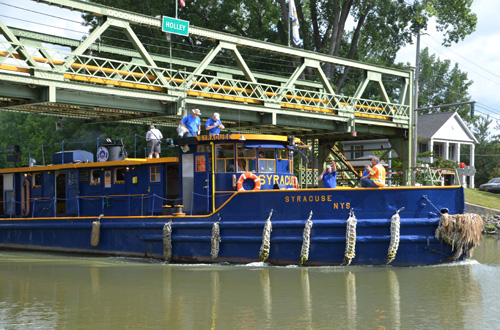
File photo by Tom Rivers: The Tug Syracuse carries inspectors and officials from the State Canal Corporation after checking the lift bridge in Holley in August 2014. Canal inspectors will be in Orleans today to check hydraulic, mechanical and electrical on the lift bridges
The State Canal Corporation will have a team of inspectors in Orleans County today, looking over the lift bridges and other canal infrastructure.
This is a visual inspection of the canal system. The State Canal Corp. team travels by tugboat to inspect the shoreline, navigation aids, and working components of each lock and lift bridge.
“They also take a look at the cleanliness of each facility, paint and concrete surfaces, signage, etc. There is a score chart completed for each item,” said Shane Mahar, Canal Corp. spokesman. “The results are reviewed and if an item needs attention, it’s factored into our maintenance and operations plan.”
The locks, lift bridges and tugs that are in excellent shape and score well will receive an award flag the following year.
Orleans County has seven of the 16 lift bridges on the canal system, the most of any county. Canal inspectors are scheduled to be in Medina at 8 a.m., Knowlesville at 9:20, Eagle Harbor at 10:20, Albion at 11:20 (2 lift bridges in Albion), Hulberton at 1:45 p.m., Holley at 2:55, before ending the day in Brockport to look at their two lift bridges.
By Tom Rivers, Editor Posted 13 September 2016 at 10:18 pm
No one votes in Shelby in primary for 8th Judicial Convention
MURRAY – Joe Sidonio was elected to the Murray Town Republican Committee in a rare primary today for a spot on a town GOP committee.
Sidonio received 87 votes for District 4. He was elected along with Kimberly DeFrank, who received 71 votes. Edwin Bower got 57 and won’t be on the committee.
There were also races in Gaines for spots on the committee. Chairman Guy Smith was knocked off the committee. Other candidates who were part of a group that forced primaries were unsuccessful in winning a spot on the town committee. Each district has two committee members.
Here are the results:
District 1: • Susan Heard, 64; • Lorienda Smith, 59; Ray Burke, 23; and James Hood, 22.
District 2: • Bruce Blanchard, 32; • Joseph C. Grube, 29; and Guy D. Smith, 18.
District 3: • Donald Allport, 47; • Lisa Mannella, 41; and David Alchin, 17.
While the races in Gaines and Murray were fiercely fought, in Shelby no one voted in primary to pick delegates to the 8th Judicial District Convention.
The primary was open to the 107 members of the Independence Party in Shelby. None of the delegates or delegate alternates live in the county. David Haylett Jr. and Ryan Rooney were both on the ballot for delegates, and William Rooney and Clara Haylett were choices for alternates.
By Kristina Gabalski, Correspondent Posted 12 September 2016 at 7:51 am
Registered Republicans in the Town of Gaines and the Town of Murray District 4 will head to the polls Tuesday to select pick members of the Republican committees.
To have a primary for a town committee is “very unusual,” said Ed Morgan, chairman of the Orleans County Republican Party and also the Murray Town Republican Committee.
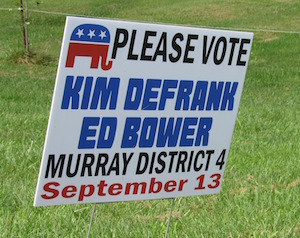
Photos by Kristina Gabalski: Tuesday’s primary is a rare event with active public campaigns to serve as committee members on the Murray Town Republican Committee. These signs tout Kimberly DeFrank and Edwin Bower.
In Murray for District 4, Kimberly DeFrank and Edwin Bower are seeking re-election. Joseph Sidonio is hoping to become a member of the committee and forced a primary.
Morgan said the committee term is two years. Typically those interested file petitions with the Board of Elections.
“If more than two people filed with the Board of Elections, that generates a primary,” Morgan said.
The town Republican committees meet a couple of times each year, Morgan explains, to seek out candidates for elected positions in the town. The same is done at the county level by the county committee.
Members interview potential candidates and look into their background to see how they have been involved in their community. Selected candidates are given the party’s endorsement and additional support during the campaign process.
“It’s a way to be involved in the community,” Morgan said of participation on a town committee. “It’s a very meaningful position. You are involved in selecting candidates from the very beginning.”
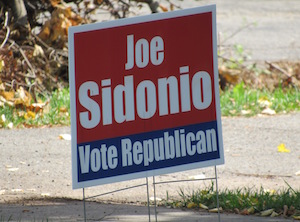
Joe Sidonio forced a primary and has signs out urging support on Tuesday during the primary.
Each voting district in the town has two members on the town committee. The Town of Murray has six districts for a total of 12 members, Morgan said.
Orleans County Board of Elections staff members said only residents in District 4 will be able to vote in Tuesday’s primary. District 4 covers the southeast portion of the town, outside the Village of Holley. The boundaries are Hulberton Road north to Telegraph Road, east to Hurd Road, north to Route 104, east to County Line Road and south to the town line.
The Town of Murray polling place in the Holley Jr./Sr. High School. Polls will be open from noon to 9 p.m. on Tuesday.
In Gaines, there are primaries for three of the district committees.
In District 1, Republicans will elect two committee members among Ray Burke, Susan Heard, James R. Hood and Lorienda Smith. In District 2, Joseph C. Grube, Guy D. Smith and Bruce Blanchard are running for two spots. In District 3, Lisa Mannella, Donald J. Allport and David T. Alchin are vying for two positions. Voting is from noon to 9 p.m. at the Town Hall, 14087 W. Ridge Rd.
By Tom Rivers, Editor Posted 11 September 2016 at 2:59 pm
Photos by Tom Rivers
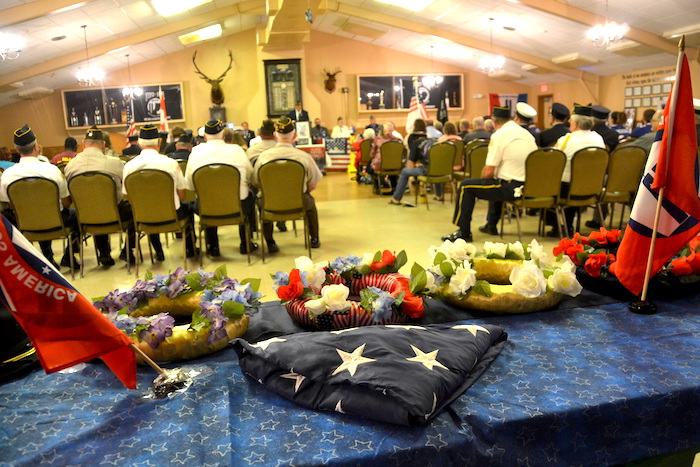
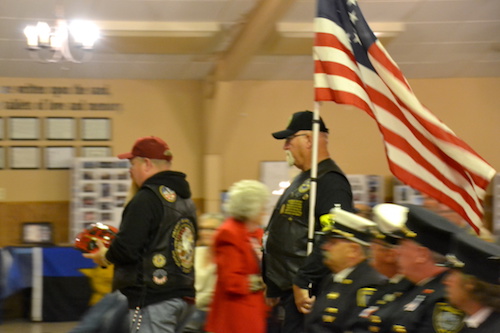
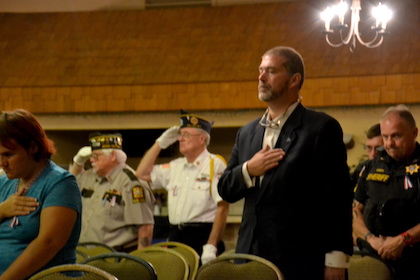
ALBION – The Elks Lodge in Albion hosted a memorial service this morning on the 15th anniversary of the Sept. 11 terrorist attacks.
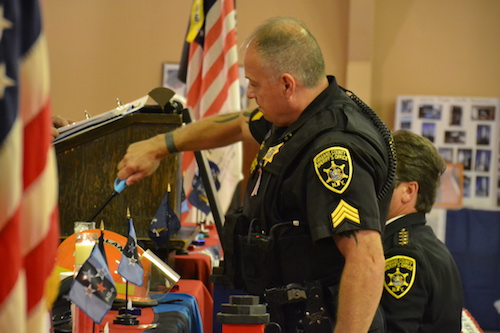
Representatives from local police, fire department, ambulance, K-9 and other first responders laid these memorials upfront during the service.
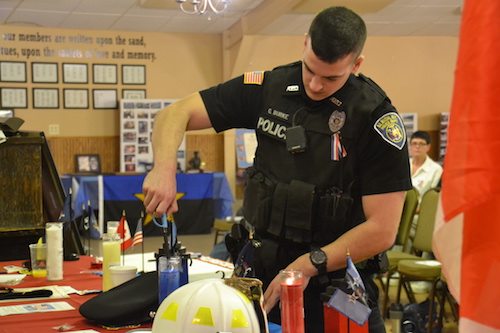
Guy Burke, an Albion police officer, lights a memorial candle during the service. During the terrorist attacks, 72 police officers were killed in New York City.
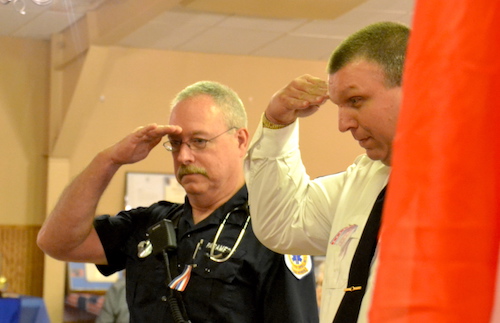
Jeff Tuohey, left, and Guy Scribner from Central Orleans Volunteer Ambulance in Albion salute after lighting a memorial candle for paramedics killed during the terrorist attacks.
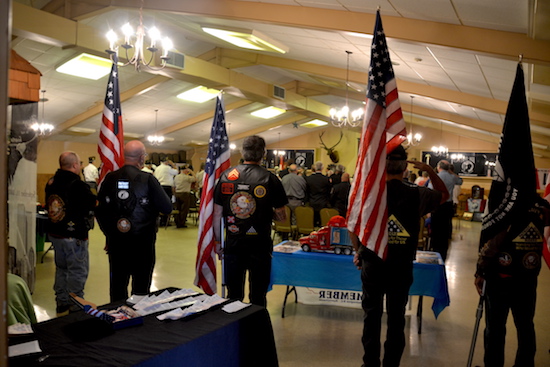
Members of the Patriot Guard stand at attention during the beginning of the service at the Elks Lodge. About 75 people attended the event.
These Patriot Guard members, Captain Pat Jordan, left, and Lee Sage with American flag carry a memorial helmet in honor of motorcyclists.
Orleans County Coroner Scott Schmidt observes a moment of silence during the service today. Schmidt served as a mortuary officer in New York City following the terrorist attacks, helping to collect and identify human remains.
Orleans County Deputy Dean Covis, left, and Sheriff Randy Bower light a memorial candle for law enforcement officers.
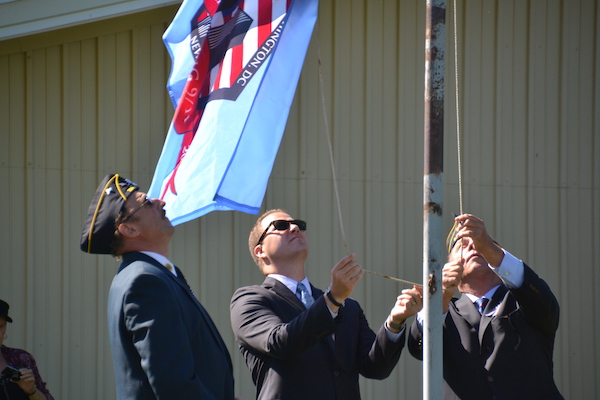
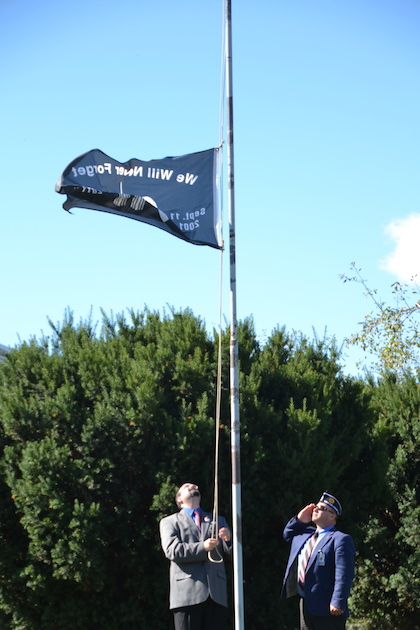
State Assemblyman Steve Hawley (right), State Sen. Rob Ortt (center) and Larry Montello, memorial organizer, prepare to raise the 9-11 memorial flag.
Hawley said the country remains “stunned by the enormity of the devastation and loss of life.” Americans rallied in the aftermath of the attack. The New York City skyline has been rebuilt and the country has taken “extraordinary measures” to fight further devastating attacks from terrorists, Hawley said.
“We are a diverse people but as long as we stand together we are strong,” he said.
Ortt said Sept. 11 is a day to put aside differences and come together as Americans. It is also a day to recognize the service and commitment of first responders, said Ortt, who served a tour in Afghanistan as a member of the National Guard.
Orleans County Legislator Don Allport also spoke during the service and the said the country needs to remain vigilant in the fight against terrorism.
Montello said the day is a time to reflect on the loss of the life that day and also to remember the sacrifice of the “hometown heroes” who sacrificed their lives going to the rescue of others.
Joshua Ames (left), the exalted leader of the Elks, and Earl Schmidt, director of the Orleans County Veterans Service Agency, raise a 9-11 memorial flag.
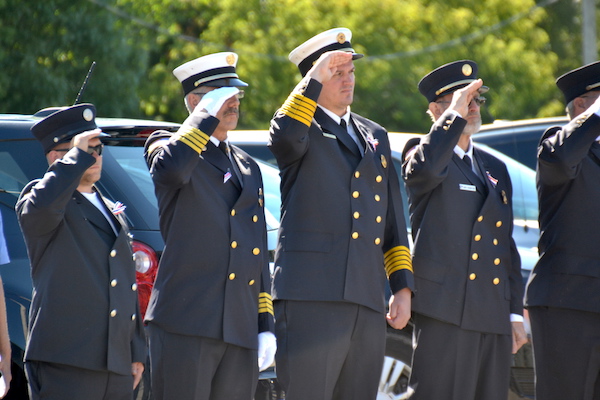
These firefighters, including Kendall Fire Chief Mike Schultz, salute while the flags are raised.
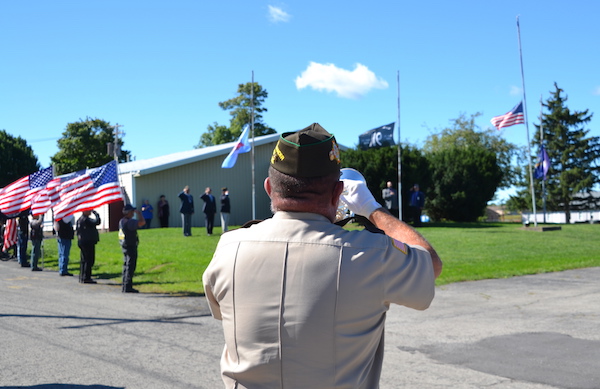
Thomas Walders of Medina plays Taps to conclude the memorial service, which included raising flags.
There will be another service at 6 p.m. today on the courthouse lawn in Albion.