









Gaines

Historic Childs: Markers highlight local history in Gaines hamlet
Posted 20 February 2021 at 8:15 am

By Doug Farley, Cobblestone Museum Director

GAINES – Orleans County is fortunate to have over 100 historical markers and monuments that have been erected, largely in the 20th century, to highlight the region’s storied past.

Many are NYS Historic Markers, previously made of cast iron, but more recently aluminum, which are painted the traditional colors of blue and gold. The small Hamlet of Childs is also fortunate to host six of the historic markers.

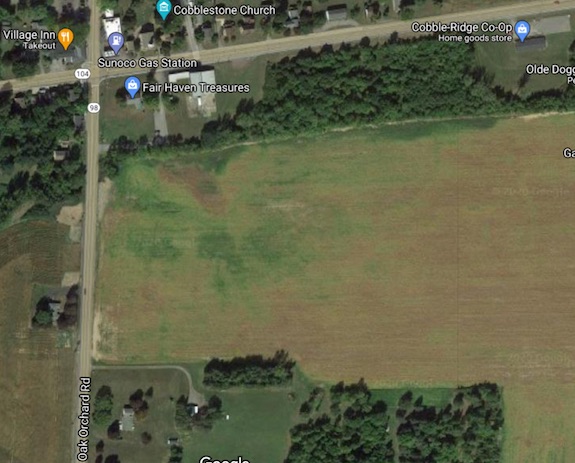
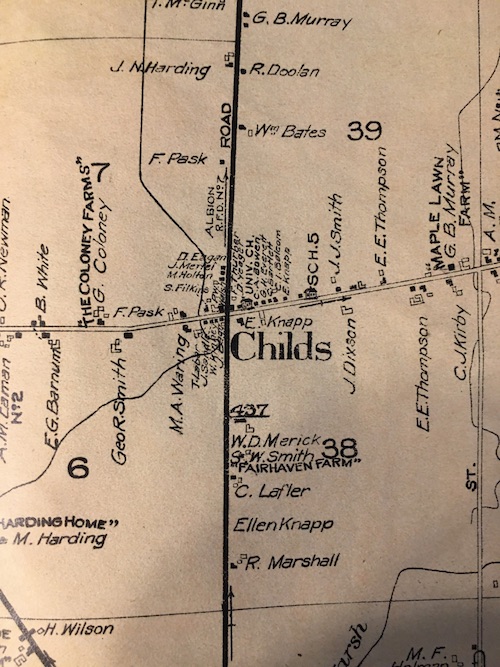
Part of the problem with counting the number of markers in Childs is that the geographic boundaries of the hamlet are not well defined. No local government exists solely in the hamlet, but the old Town of Gaines School District #5 gives a good approximation of boundaries for Childs, centered on the intersection of Routes 104 and 98, and running about a half mile in each of the four directions.
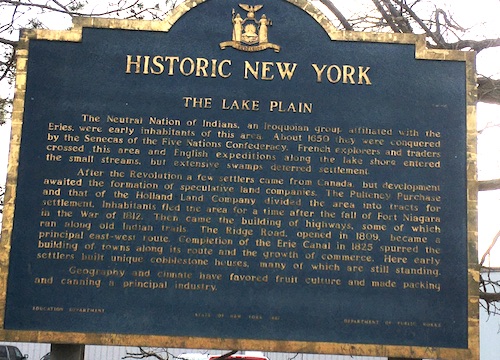
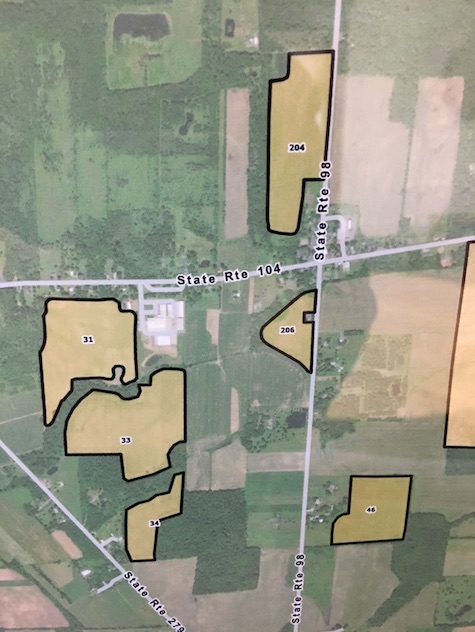
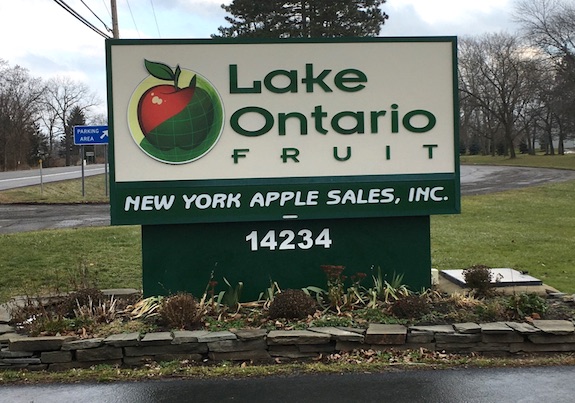
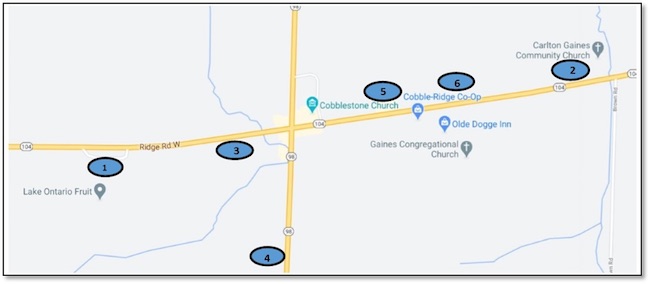
(Map location 1) The largest historic marker in Childs is located in the parking area in front of the Lake Ontario Fruit plant on Route 104.  It might qualify as one of the largest markers erected in New York State. The history of the historic marker, itself, is now an interesting story.

This marker didn’t come into existence without a little controversy along the way. Linda Schwartz was a youngster when her father, Robert Schwartz, transferred title to the New York State for the farm land used to create the parking area. Linda said, “The state took the land by eminent domain. They told my father to accept what he was offered or he would end up with nothing.”

Schwartz agreed when NYS promised to build a complete year-round rest stop with heated restrooms and picnic tables. A quick inspection of the parking area today would indicate the powers-to-be at NYS dropped the ball. John Russell, co-owner/manager of Lake Ontario Fruit, said he reluctantly took the bull by the horns several years ago and placed a rented portable restroom on the site to make it more user friendly and to make up for its lack of amenities. Russell said he’d love to get that item off his budget, but without another source of funding, he feels obligated to continue.

To history buffs, the state historic marker erected in the parking area is a bright spot in a less than satisfactory fulfillment of a state promise. Former Orleans County Historian Bill Lattin remembers that his father, Cary Lattin, was asked to create the text for the large historic marker in the parking area in 1961 during the latter’s tenure as County Historian. The actual text he used was:

HISTORIC NEW YORK – THE LAKE PLAINS

The Neutral Nation of Indians, an Iroquoian group affiliated with the Erie, were early inhabitants of this area. About 1650 they were conquered by the Senecas of the Five Nations Confederacy. French explorers and raiders crossed this area and English expeditions along the lake shore entered the small streams, but extensive swamps deterred settlement.

After the Revolution a few settlers came from Canada but development awaited the formation of speculative land companies. The Pulteney Purchase and that of the Holland Land Company divided the land area into tracts for settlement. Inhabitants fled the area for a time after the fall of Fort Niagara in the War of 1812. Then came the building of highways some of which ran along old Indian trails. The Ridge Road opened in 1809 became a principal east-west route. Completion of the Erie Canal in 1825 spurred the building of towns along its route and the growth of commerce. There early settlers built unique cobblestone houses, many of which are still standing.

Geography and climate have favored fruit culture and made packing and canning a principal industry.

Education Department – State of New York 1961. Department of Public Works
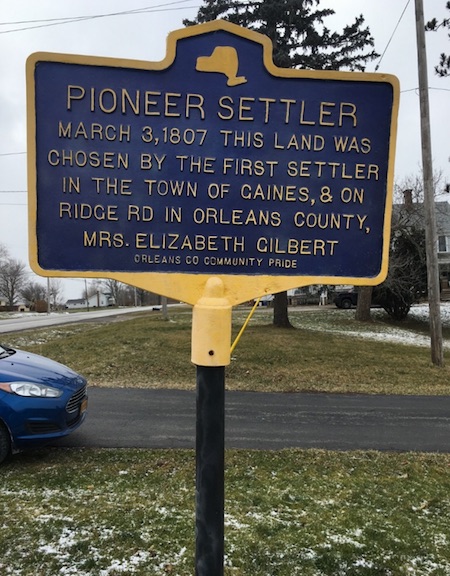
(Map location 2) The “Pioneer Settler” historic marker is located at Gaines Carlton Community Church at the end of Brown Street Road and Ridge Road. It celebrates Elizabeth Gilbert, described as the first settler in the Town of Gaines, who purchased 123 acres of land at this location in 1807, at a time that usually saw men owning property. Local history books retell the stories of “Widow Gilbert” who used her team of oxen to assist other settlers move their belongings onto their own recently purchased parcels of property. The full text of the sign reads:

PIONEER SETTLER

March 3, 1807 This land was chosen by the first settler in the Town of Gaines,

And on Ridge Road in Orleans County, Mrs. Elizabeth Gilbert.

ORLEANS COUNTY COMMUNITY PRIDE
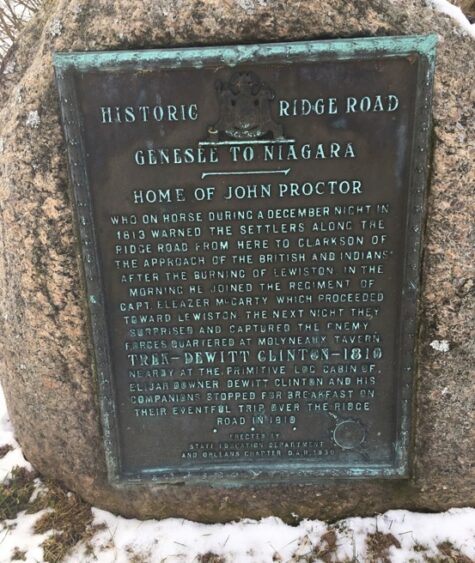
(Map location 3) The founding father of the Hamlet of Childs (once known as Proctor’s Corners and Fairhaven), John Proctor is often referred to by historians as the Paul Revere of Ridge Road. On a cold December night in 1813, Proctor rode by horseback on the Ridge Road from Gaines to Clarkson to warn the settlers of the approach of British and the Indians after the burning of Lewiston during the War of 1812.

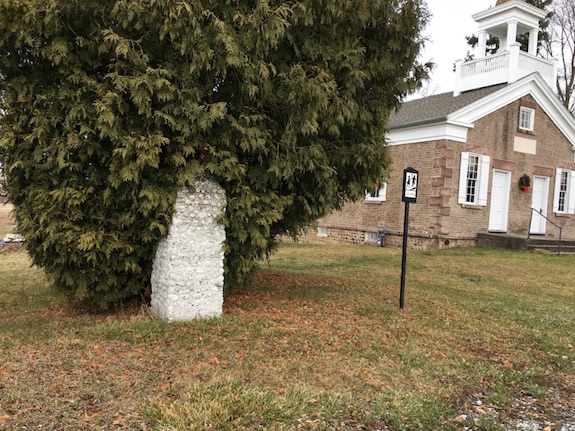
A historical marker on a large stone explains the story of John Proctor. The stone is on the south side of Ridge Road, a few houses west of the Route 98 intersection, in the lawn of a home currently occupied by Town of Gaines Historian, Adrienne Kirby, and her family.

The marker was put up in 1935 by the NYS Education Department and the Daughters of the American Revolution (DAR). It is one of a series of historical markers along Ridge Road that were erected in the 1920s and ’30s.

The Proctor marker also notes that the site was once occupied by a primitive log cabin owned by Elijah Downer. When Gov. DeWitt Clinton passed through in 1810, looking for a possible route for the Erie Canal, he stopped at the cabin for breakfast.

The full text of the monument reads:

HISTORIC RIDGE ROAD

GENESEE TO NIAGARA

HOME OF JOHN PROCTOR

Who on horse during a December night in 1813 warned the settlers along the Ridge Road from here to Clarkson of the approach of the British and Indians after the burning of Lewiston. In the morning he joined the regiment of Captain Eleazer McCarty which proceeded toward Lewiston. The next night they surprised and captured the enemy forces quartered at Molyneaux Tavern.

TREK – DEWITT CLINTON – 1810

Nearby at the primitive log cabin of Elijah Downer, Dewitt Clinton and his companions stopped for breakfast on their eventful trip over the Ridge Road in 1810.

Erected by the Ridge Road Improvement Association

Orleans Chapter DAR State of New York 1935
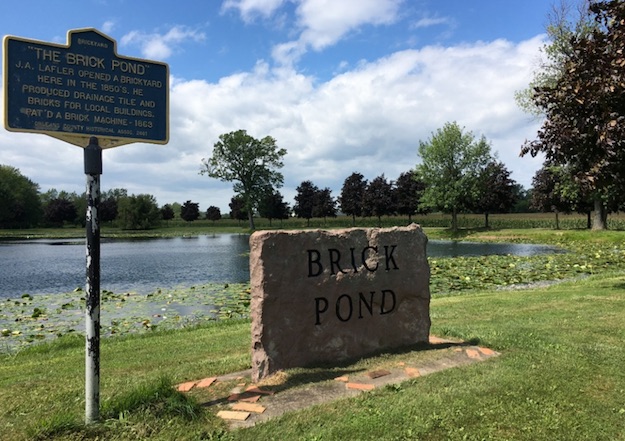
(Map location 4) The Hamlet of Childs is the site of historic Laffler Brick Yard built in the mid-1800s, and a state historic marker and a massive stone monument mark the spot on Route 98 a half mile south of Ridge Road.  The Laffler Brick Yard had a storied history that included some game-changing technology for the time. Laffler built and patented an Iron Clad Brick Machine that changed brickmaking from a hand pressing process to mechanical. His invention was said to produce 2,000 to 3,000 bricks per hour. Enough bricks to build the average house could be made in a few hours instead of several days. Laffler’s machine took the first place award at the New York State Fair in the 1860s for several years running.

The full text of the historic marker reads:

BRICKYARD – THE BRICK POND

  1. A. Laffler opened a brickyard here in the 1850s. He produced drainage tile and brick for local buildings. Patented a brick machine – 1863.

Orleans County Historical Association 2001
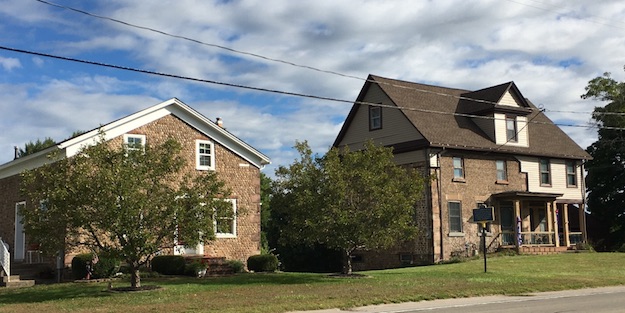
(Map location 5) The Historic Hamlet of Childs is home to the National Historic Landmark Cobblestone District with three cobblestone structures that comprise a portion of the buildings owned by the Cobblestone Society & Museum. In addition, two other cobblestone buildings serve as private residences for their current owners and are the subject of a two-sided state historic marker located between the two houses on Ridge Road depicted here.
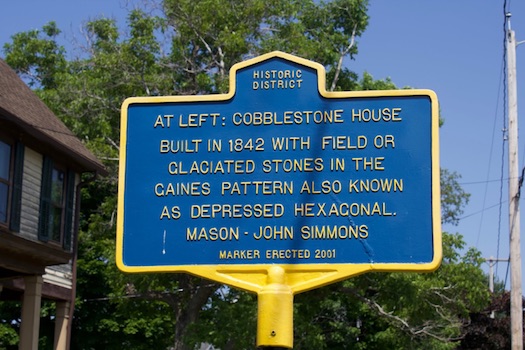
The sign facing west reads:

HISTORIC DISTRICT

At left: Cobblestone House built in 2842 with field or glaciated stones in the Gaines Pattern also known as Depressed Hexagonal. Mason – John Simmons

Marker Erected 2001
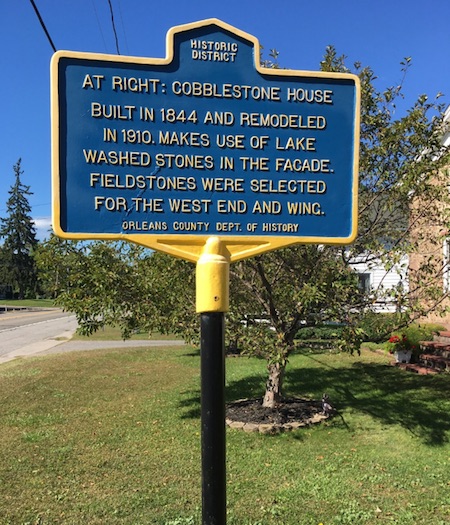
The sign facing east reads:

HISTORIC DISTRICT

At right: Cobblestone House built in 1844 and remodeled in 1910. Makes use of lake washed stones in the façade. Fieldstones were selected fro the west end and wing.

Orleans County Department of History
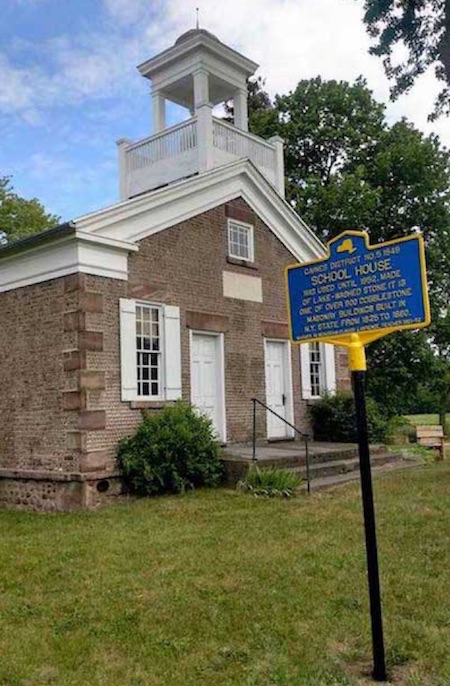
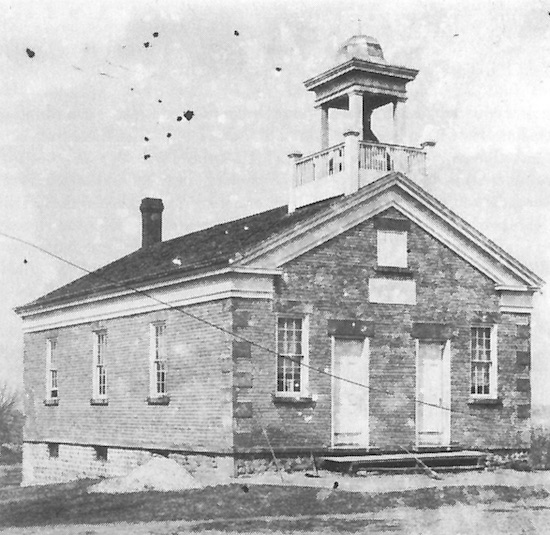
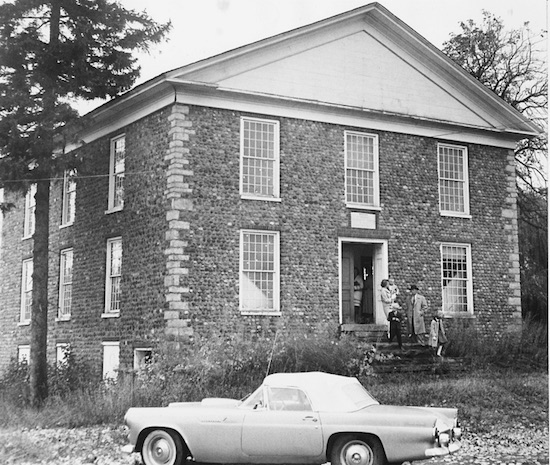
(Map location 6) The National Historic Landmark Cobblestone Schoolhouse (District #5) has its own state historic marker. The school, built in 1849, was constructed with a wooden frame and a facade of lake washed cobblestones. The one-room schoolhouse was used from 1849 to 1952 until the small local school districts were centralized and included in the Albion School District. The school serves as a time-capsule of early education in the county.

The sign reads:

GAINES DISTRICT No. 5 1849 – SCHOOL HOUSE

Was used until 1952. Make of lake-washed stone, it is one of over 900 cobblestone masonry buildings built in N.Y. State from 1825 to 1860.

Marker in Memoriam Elwood Lawrence, Teacher 1951-1952
Historic Childs: Reflections, Part 2
Posted 14 February 2021 at 11:45 am

Mary Ann (Janus) Spychalski recalls 5-cent ice cream, button collection, doll hospital and her family’s service station

By Doug Farley, Cobblestone Museum Director

Author’s note: It was a great pleasure to meet and share Mary Ann (Janus) Spychalski’s life reflections. At 90 years young, she is remarkable force to be reckoned with. I greatly enjoyed our short time together. 

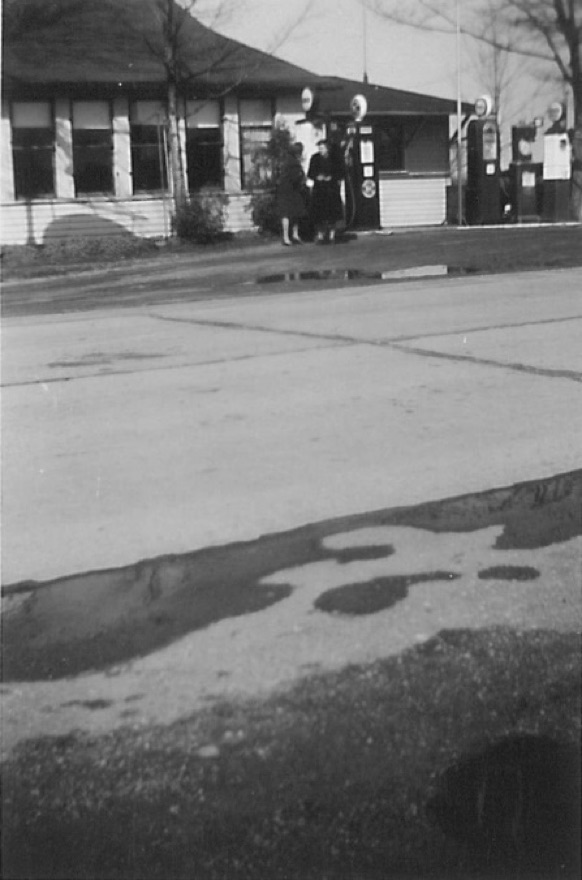
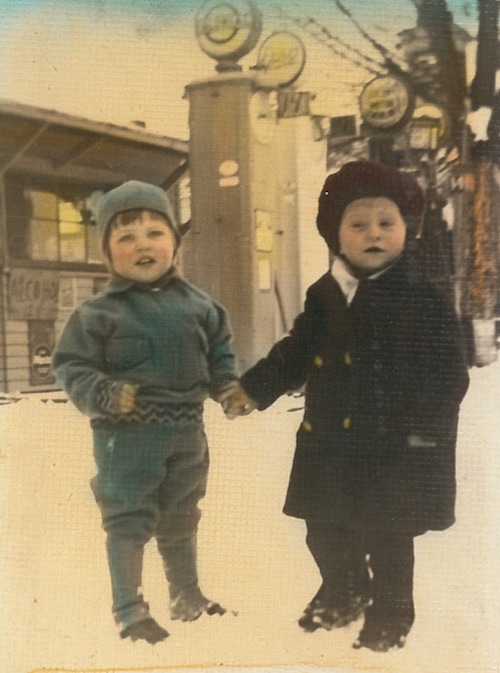
Mary Ann (Janus) Spychalski, (right) at age 3 with her cousin John Stucko, has many stories to tell about growing up in the Hamlet of Childs. Her father and mother, Joe and Lucy Janus, bought the filing station on the north side of Ridge Road (next to the Cobblestone Schoolhouse) in 1926. The gas station pumps are also shown in this image looking north from Ridge Road.

Mary Ann, now 90 years old, said, “I was born in the house at the filing station in 1930. I went to school next door at the cobblestone school through the seventh grade, then finished up in Albion.” 

Mary Ann shared that living next door to the school opened up some interesting opportunities for her family. She said, “It’s true that it takes a village to raise kids.” Her mother, Lucy, was known to keep watch over the children as they arrived for school. If any of them had happened to get dirty on their walk to school, which seemed to be a frequent occurrence, especially for the boys, Lucy would dust them off and take a washcloth to their face and hands. Lucy said she didn’t want the teacher to have to look at dirty faces all day. Mary Ann described her mother as a hard worker. She was one of 9 children in her family and she went to work at age 14 and never stopped working. 

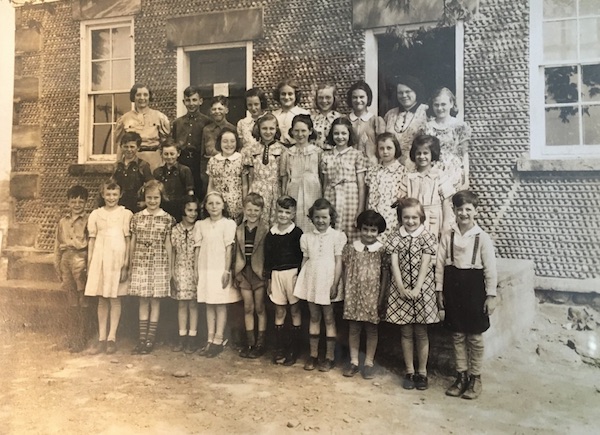
Mary Ann was 8 years old in 1938 when this class picture was taken at the District #5 Schoolhouse in Childs. Her teacher shown at top left was Mae Hollenbeck. Mary Ann (front row, second from right) said, “The girls wore dresses to school every day.”  

The students shown are: (Front row) Jack Murray, Janice Murray, Phyllis Brown, Geraldine Hewitt, Lillian Wildschultz, George Ingraham, Russell Williams, Rosalie Canham, Frances Burgio, Mary Ann Janus and Tony Burgio. (Row 2) John & George Donovan (twins), Janice Barnum, Betty Janus, Elizabeth Nickerson, Beverly Murray, Peggy Donovan and Joyce Ellis. (Top row) Mae (Canham) Hollenbeck, Bob Moore, George Murray, Iva Pask, Martha Henshenmacher, Edith Knickerbocker, Marian Williams, Virginia Kelly and Doreen Brown. 

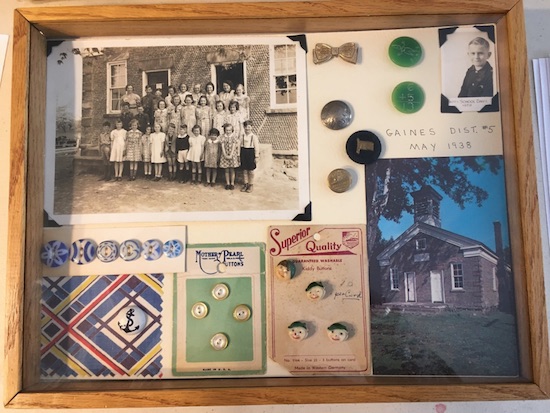
Mary Ann has become an ardent button collector and has even made a shadow box using her class picture and a swatch of the dress that she wore for the photograph. She remains a button collector today. 


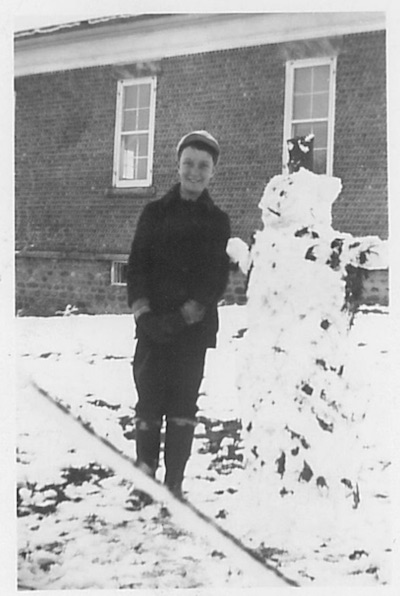
Mary Ann’s brother, Ed, is shown here with a snowman he made in the school’s side yard. Mary Ann has many great memories of life at the District #5 School including how her teacher, Julia McAllister, would make baked potatoes in the school’s wood furnace in the basement. During the WWII years, Mary Ann remembers Miss McAllister making hot cocoa using war surplus cocoa provided by the federal government. Also in the winter, Mr. Barnum would bring his sleigh to the school and take all the kids for a sleigh ride.  

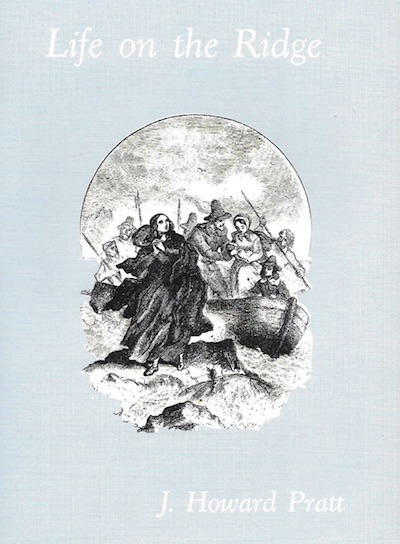
Another highlight of Mary Ann’s one room schoolhouse education were visits by Howard Pratt. Mr. Pratt came to the school to teach children about their local history. He went on to write several books about life on the Ridge Road which are still widely enjoyed today.  


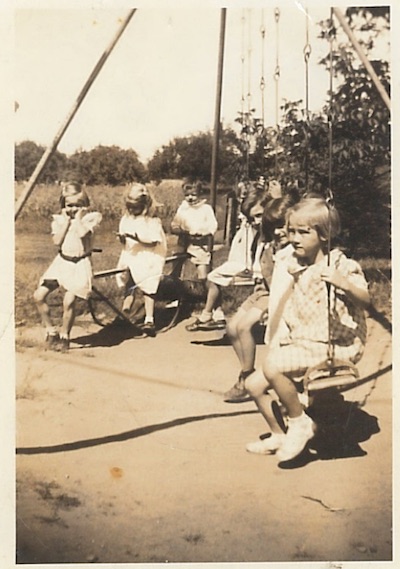
Mary Ann also enjoyed playing on the swings at the school playground at recess. Her father, Joe Janus, was a school trustee for several years in the 1930s. Mary Ann said that even though she lived right next door and could walk home for lunch, she would rather bring a bag lunch so she could eat with the other students and spend more time on the playground. 

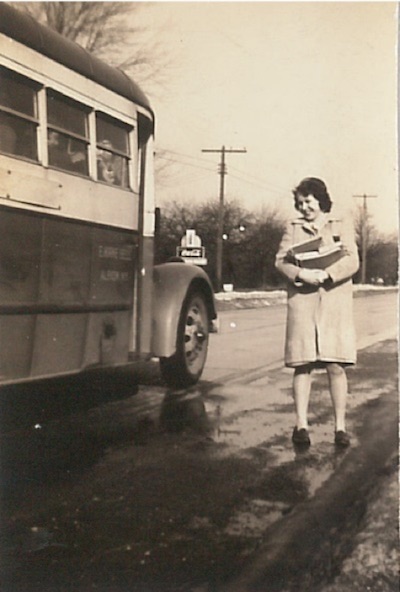
Advancing into her teen years, Mary Ann, seen here at age 15, said the kids would hang out at Balcom’s Store at the intersection in Childs. The store sold food and farm supplies to local residents. Kids would walk to Balcom’s to get the school bus to Albion High School. Mary Ann still remembers the name of her bus driver, Kirke Bell. While at Balcom’s the kids would catch up on the latest neighborhood news away from earshot of their parents.  


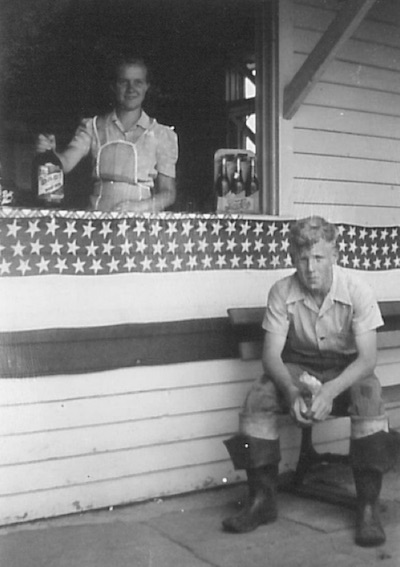
Mary Ann said, “Life at my family’s Service Station was always exciting.” Her mother pioneered roadside cuisine in a day-and-age before fast food.  “My mother served up ‘minute steaks’ and hot dogs to hungry motorists. She made her own homemade pickle relish.”  The service station had the first freezer in the community so Lucy could freeze meat and ice cream to serve at the lunch counter. Mary Ann’s sister Betty and neighbor, Levi Woodcook, are seen here at the roadside window in the 1940s. 


Photograph courtesy Spencerport Depot & Canal Museum

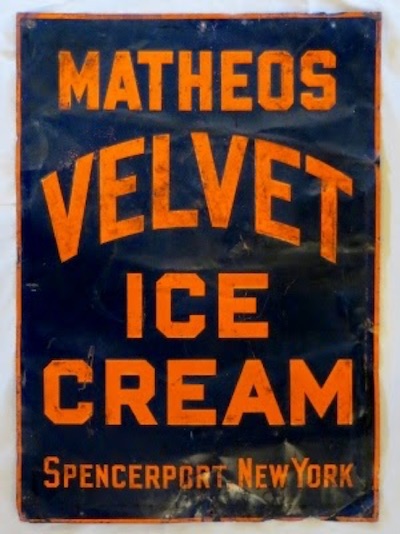
Mary Ann recalls how much she enjoyed the ice cream cones, two dips for 5 cents. The Service Station bought their ice cream from Matheos Brothers in Spencerport. “Velvet Ice Cream” was delivered in three gallon metal containers. Mary Ann fondly remembered an ice cream treat called “OO-La-La’s,” which was a chocolate covered confection on a stick.  She said, “If lucky, the stick would say ‘FREE,’ meaning your next treat was on-the-house.” 


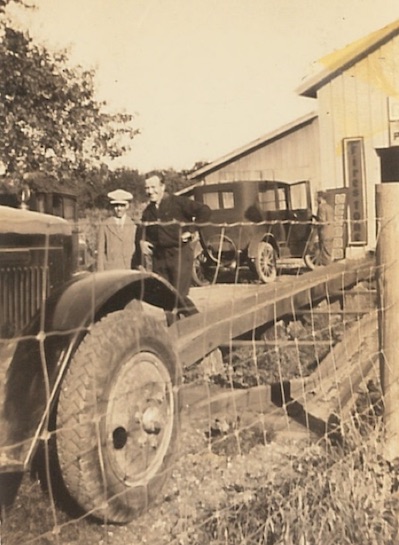
To better serve local farmers, Mary Ann recalled that her father, Joe, built a jitney of sorts, an old car chassis with four wheels and a welding machine attached to the top.  Joe drove that contraption right into the farmers’ fields and used it to weld and repair their farm equipment, on the spot. Joe and his brother, Phil, are seen here in 1932 working at the Service Station’s open grease pit that was used to service tractors and cars.  A ladder extended down into the pit so Joe could service the vehicles, standing up, underneath. Remnants of the pit still exist today next to the schoolhouse. Mary Ann said, “Mom and Dad warned us kids to stay away from the pit. We didn’t listen very well, but the worst thing that happened was we got pretty dirty playing down there.” 

 

Mary Ann said her father died in 1945, and his brother Frank Janus and Frank’s wife Vicky took over the operation of the Service Station, as seen here in 1946. She said, “Frank and Vickie had lived in the city in Buffalo, and it was a big shock moving out to the country. It took a while for the pair to get used to country life and also for the ‘locals’ to get adjusted to them.”  She reflected, “In the end, it worked out well, and they extended the life of the service station another couple decades.” 

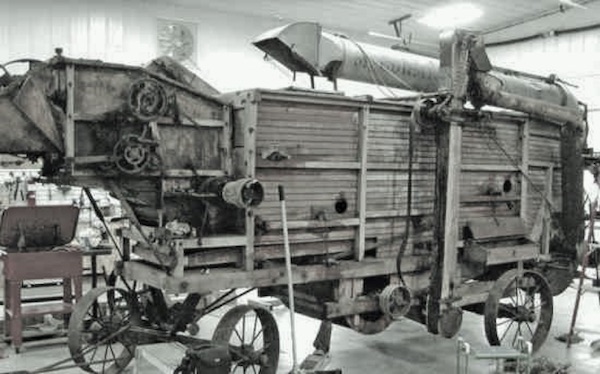
McCormack-Deering Wooden Thresher – 1923

Mary Ann recalls the excitement each year surrounding the arrival of Charley Plummer’s threshing machine when it was time for wheat harvesting.  All the neighborhood kids would gather around and watch the machine at work.  She said, “The kids were told to stay out of the way of the threshing machine. Good advice, but sometimes not well heeded.”

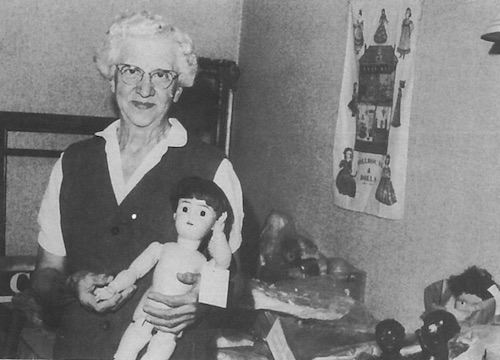
Another highlight for Mary Ann was the Doll Hospital at the Murray Farm in Childs. Mary Miller Murray, shown here, took in “injured” dolls and would repair their broken limbs and smudged faces. The Doll Hospital was a local landmark that had a following that stretched across the country. 


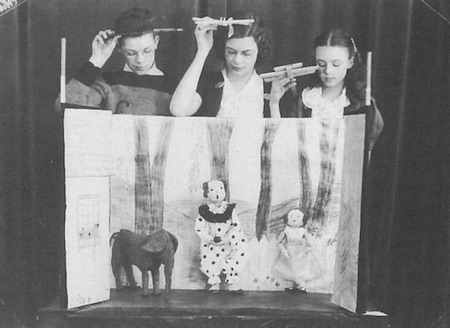
Mrs. Murray and her children, George, Joyce and Janice, known as the “Marionette Merrymakers,” created a “Disneyesque” experience for local children complete with marionettes and stage and much more.  The Murrays would put on puppet shows, a wonderful diversion in a day and age preceding television.  


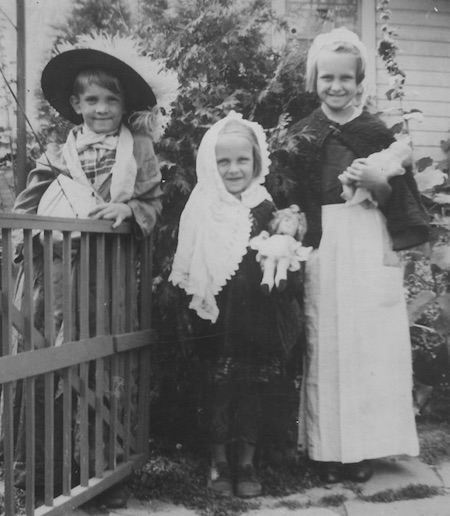
Mary Ann said, “Mrs. Murray even made me a doll using my own hair for a wig. I had braided hair then, and she used one of the braids to give my doll, ‘Shirley Temple,’ that look-like-me appearance. Coming off the Depression, this was great fun!” Mary Ann and her doll, are shown in the center of this dress-up-day photo. Her cousin, Herman, and sister, Betty, joined in the fun.

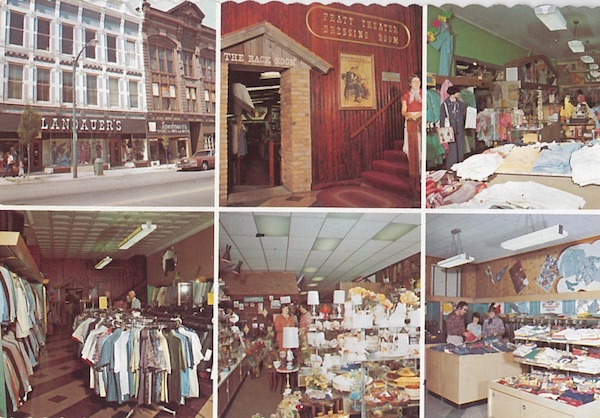
In 1949, after her school days, Mary Ann went to work at Landauer’s at age 19. She sold fabric, notions and buttons. (Perhaps this is how she developed her life-long fascination with buttons.) The store, opened in 1865, was located on the west side of Main Street in Albion at the site of the current Browsery.  Mary Ann left her employment after a few years to marry and raise her family, but returned for Landauer’s last two years of operation before closing.  

Historic Childs: History of Agriculture, Part 6 (a focus on the Swierczynski family)

Posted 30 January 2021 at 9:22 am

Loss of processing plants in Albion hurt family farms in Childs

By Doug Farley, Cobblestone Museum Director

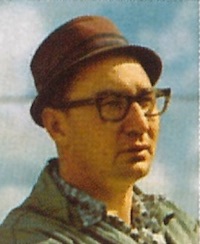
Ted Swierczynski in 1966

GAINES – Stanley Swierczynski got involved with farming in Gaines during the Great Depression. In 1950 he and his son Frank acquired 104 acres in the Hamlet of Childs on the south side of Ridge Road.

Later, Frank’s brother Ted got involved in the farm in the 1950s after he came home from the Korean War. The principal crops in the region at the time were tomatoes and cucumbers.  They operated under the banner of Fair Haven Farms.

Fair Haven also had a small peach orchard across from the Cobblestone School.  During this time period most local farmers sold peaches at the side of the road. Ted said, “It was easier then, less regulation.”

Ted Swiercznski remarked, “We later acquired or rented more land to eventually farm a couple thousand acres in the region.  We had to use migrant farm labor out of the southern states.  Still in need of even more laborers, we bussed in about 200 laborers a day from Rochester to hand pick snap beans and tomatoes.”

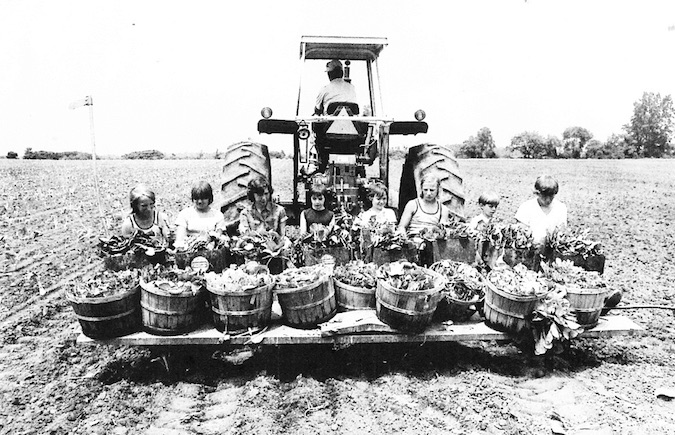
Ted Swiercznski considered his farm to be a family operation, seen here in 1977 driving tractor with the help of a few neighbors to round out his cabbage planting team. Manning the planter were (left to right) John Stirk, Colleen Swiercznski, Maureen Swiercznski, Cathy Swiercznski, Chris Swiercznski, Tim Stirk, Patrick Swiercznski and Tod Swiercznski.

Chris and Karen Watt are well known in the local farming community.  In addition to their Farm Market at Five Corners, they have maintained orchards in Childs, too. In 1990, Chris took over farming Eugene Leigh’s apples on Route 98 and also his pears on the south side of Route 104 in Childs.

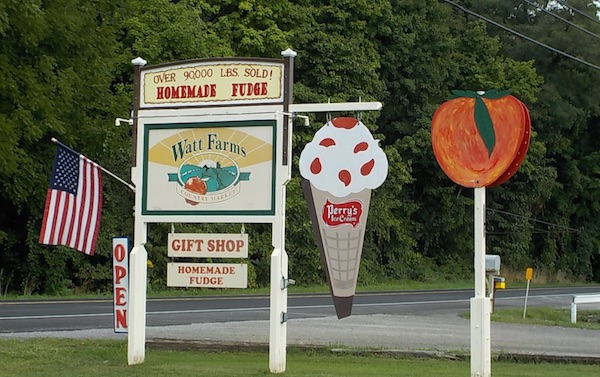
Chris said the Farm Market got started with a tent by the side of the road. In the 1980s, he and Karen worked under a tent for several years and then decided to build the Watt’s Farm Country Market to avoid the elements. They later added the ice cream stand. Watt Farms sells a large variety of local fruit including apples, pears, cherries, peaches, strawberries and melons. Chris said, “We farmed a total of seven different farm orchards.”

When questioned about the future, Chris said, “What we used to call a farm, is nothing but a field today.” Farms are getting bigger and bigger. “I’m winding down. I’ve got no kids who are interested in farming, so the operation might eventually become part of a larger farm. I’ve held the same job for 40 years. How many people can say that?”

In a small way, even the Cobblestone Museum can trace its own roots to a history of agriculture in Childs. In the period 1930-1960, before the Cobblestone Society was formed, the Cobblestone Universalist Church was rented out by the Balcom Brothers, Walter and Oris, to store cabbage in the church basement.  Mike Zambito, who operated Zambito Produce across the street from the church reflected on this. “The Balcom’s were notorious for storing cabbage in every available space.  They rented out every conceivable nook and cranny they could to store cabbage. They filled the space by hand, starting by laying down straw and then stacking cabbage on top of that up to the rafters.”

He recalled that the cabbage was delivered using 10 wheelers or “canvas trucks.”  He said, “Those old trucks had charcoal heaters.” Years of cabbage storage had taken a toll on the Cobblestone Church and one of the early tasks that the Cobblestone Society tackled in the early 1960s in preparation for public tours was adding a concrete floor to the Church basement.

Photo courtesy Orleans County Historian

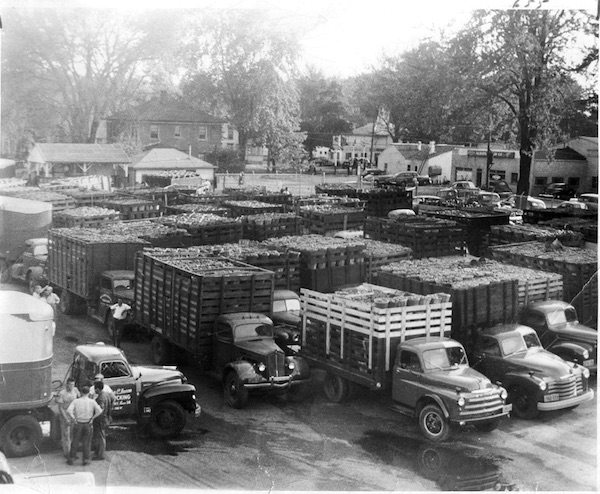
In its heyday, most local farms sold their tomatoes to Snider Packing in Albion which became a part of the Birdseye Division of General Foods in 1943, and then became Hunt-Wesson. An early morning delivery tie-up at the Snider plant is shown here in the 1950s. Ketchup, chili sauce and tomato paste were the principal products produced here.

Albion also had Dailey’s sauerkraut plant which processed 500 tons of cabbage each year and employed 100 workers.  A canned cherries plant and several other local food plants thrived in the area following WWII including Comstock, Duffy-Mott, Lipton, Forman’s Pickles, Tree Pickles and H. J. Heinz.

The large food processing plants in Albion left the region in the 1960s and moved on to greener pastures in California. Ted Swiercznski said, “In the late 60s and 70s it all disappeared. Albion couldn’t compete with the better weather and longer growing season in California.” Local farmers also needed to find hundreds of hired hands to harvest their crops, and finding those hand laborers became increasingly more difficult. Machines were used to harvest the crop in California, making it much easier and cheaper to process food there instead.

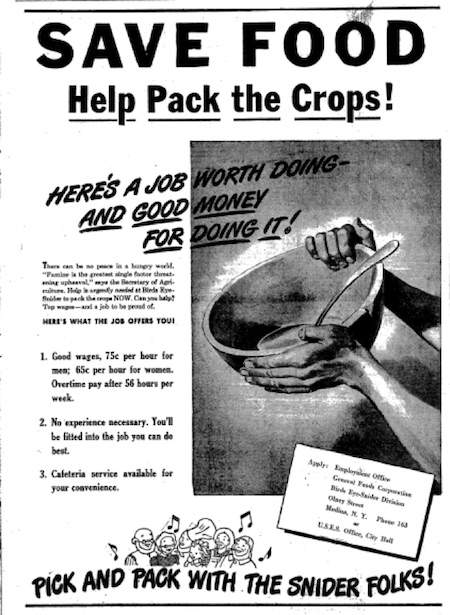
Food processing plants, just like the farmers, had a hard time securing enough labor to package the food products. Here, in 1946, Snider Packing is shown with one of their expensive full page newspaper ads that they used each week to try to get workers to process all of the crops that farmers took to the plant. Snider Packing supplemented its labor force during WWII by operating a prisoner-of-war facility behind their plant. German war prisoners were barracked on site and used as laborers in the food plant.  Similar provisions were used in nearby Medina, as well as Youngstown in Niagara County where prisoners were housed in special barracks at Fort Niagara and were used to harvest the fruit crops.

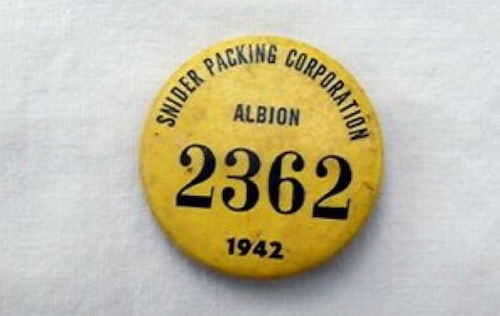
An employee badge from Snider Packing is shown here. The demise of the local processing plants eventually led to the end of the small family farm era in Childs, too. Orleans County IDA administrator Raymond Pahura remarked in 1977 that the region had been lulled into a false sense of complacency in the post WWII years. He said, “I can remember a few years back when people were smug about our employment situation. Heinz, Hunt-Wesson, Duffy-Mott and Birds-Eye were fixtures in our community. We woke up one morning and they were all gone.”

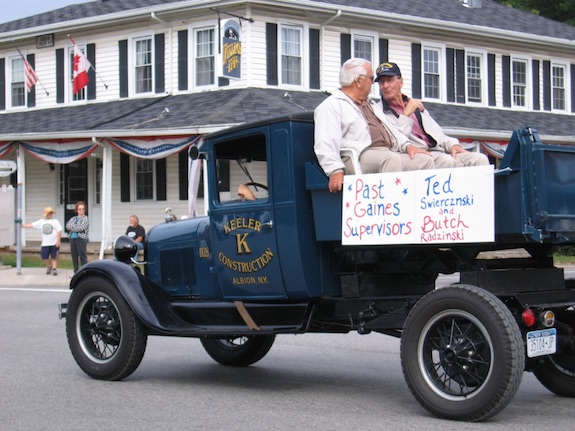
Ted Swiercznski eventually sold his farming interests in 1981.  He also served as Town of Gaines Supervisor, along with Ron Radzinski (left), who are both seen here in Childs participating in the Town’s Bicentennial Parade in 2009.

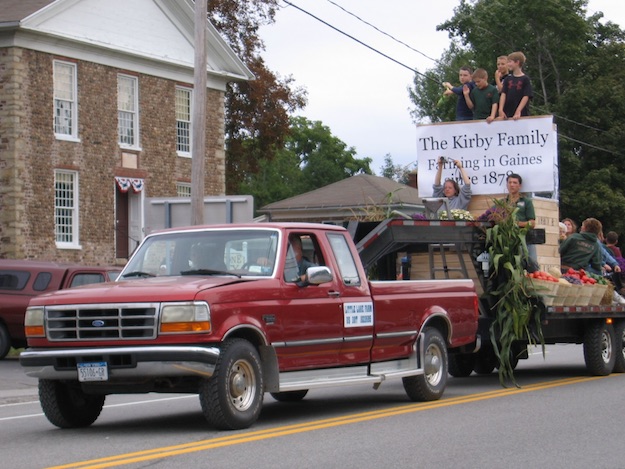
Agriculture in the Hamlet of Childs is now continued in part by Kirby Farms.  Their lineage is traced to brothers Robert, John, Francis and George Kirby. Now, Bob’s son Jim is farming both sides of Ridge Road in Childs, along with his son Adam.

Sadly, for the most part, the era of small family farms came to an end in the 1970s and large corporate farms took their place.  In Childs, the Zambito, Albanese and Swiercznski families actually joined forces to form ZAS Inc. to continue the farming tradition into the transition years. The three local farming families purchased an old building on Route 31 (across from current day Tops Market) where A&P Packing packaged onions and potatoes during the 1960s and 70s.

The Swiercznski family legacy continues in the region today operating in conjunction with Dragan Farms headquartered in Albion.  Dragan principals, Steven Swiercznski and his cousin Tod Swierczynski, are farming about 2,000 acres of soybeans and wheat in the region with Dragan Farms.

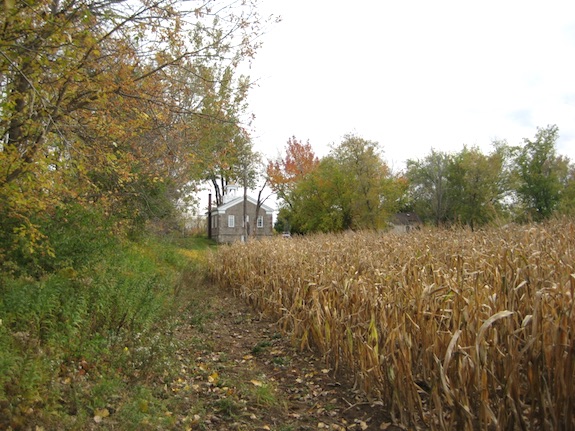
Jim Kirby has continued his family’s farming legacy stretching back to 1878, including tending this field of corn behind the Cobblestone District #5 Schoolhouse in Childs.

History of Childs: Farming – Part 5

Posted 23 January 2021 at 2:06 pm

Before Intergrow, Harding family worked the land on 98, north of Cobblestone Museum

By Doug Farley, Cobblestone Museum Director

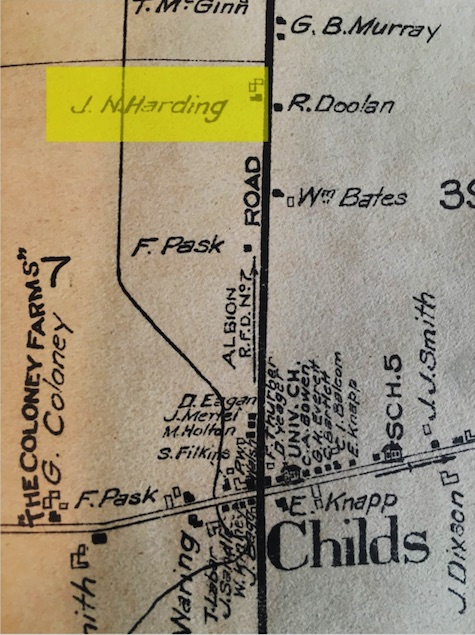
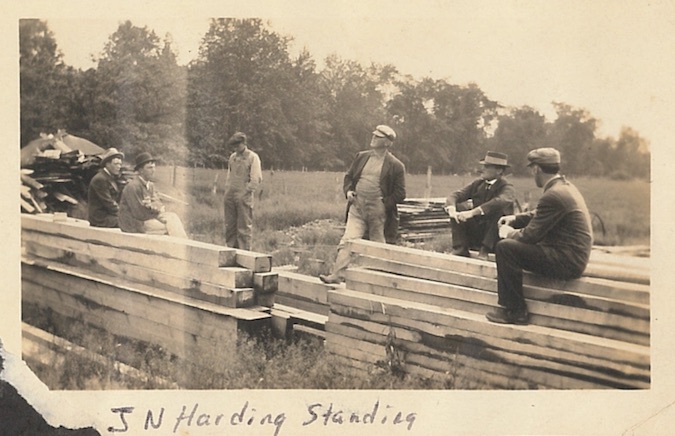
GAINES – The Harding family is another long standing farming family in the Hamlet of Childs, going back to Joseph Napoleon “J. N.” Harding, in the late 1800s. J.N.’s granddaughter, Linda Harding Prince, remembers several family stories that have been passed down to her by her father, Joseph Lee Harding and mother, Dorothy.

“I was told that my grandfather, J.N., took the train to Michigan and came home with a bride, Bertha Lee Harding,” Linda said.

Bertha had been teaching school in Mt. Pleasant and came back to Childs to be a farm wife.  Linda said, “Bertha was just a little bitty thing, she wasn’t used to preparing meals for everyone on the farm.”

J.N. Harding, shown above, and his wife, Bertha, had several children including Joseph Lee, born 1911, and his twin sister Josephine who died at birth, Hannah born 1913, Gertrude born 1916 and died two years later with complications from measles, Mary Jo and twin sister Ruth born in 1921, and Barbara born in 1923.

Linda Prince remembers being told that just before the children were born, J.N. sent Bertha to stay with his three sisters, Ruth, Mary and Hannah, who did midwife duties.

“Sometimes Grandma would stay for several weeks,” Linda said.

Linda shared that during the birth of the last set of twins, the three aunts kept the baby girl, Ruth, and raised her as their own. Linda remarked, “It sure sounds strange today, but times were different then.”

J.N.’s sister, Ruth, had a dairy farm and lived in the cobblestone house just north of Five Corners. (Dr. Mary Ruth Neilans lives in her ancestral property today.) From that farm, Ruth ran a milk-house and delivered milk and dairy products all around Albion for many years.

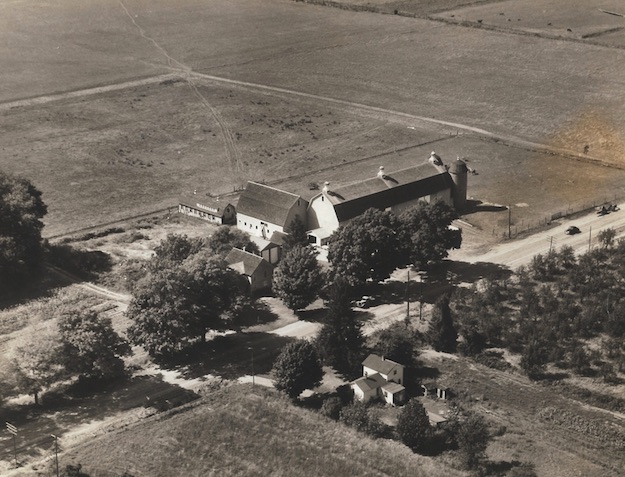
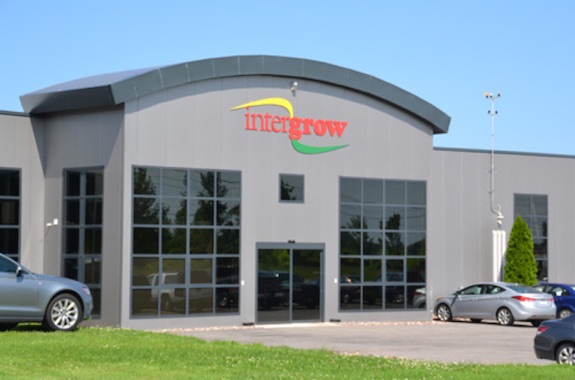
The Hardings established four farms in the area, about 100 acres each. They maintained a dairy operation at the homestead on Oak Orchard Road (shown above) at the site of what is now Intergrow. They also raised sheep and kept chickens.

“Growing up with sheep was an interesting experience!” Linda said. “When lambs were born, my Dad would stay up all hours of the night. If a little lamb was having trouble, Dad would bring it in the house and set it in front of the oven with the door open to keep it warm.”

She also remembered Roy Ford from Kent Road who would come to the farm every winter to shear the sheep.

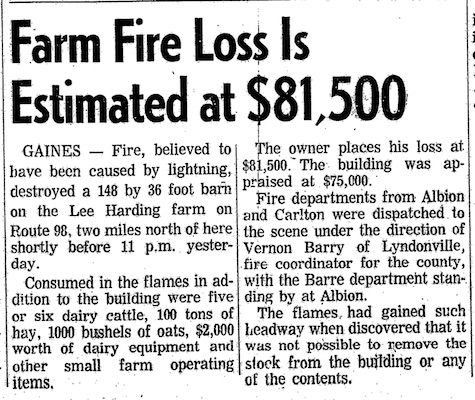
Medina Daily Journal, Tues. May 26, 1970

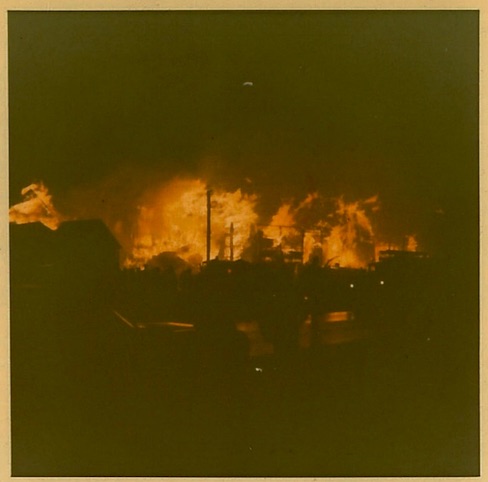
Tragedy struck the Harding Farm on the late night hours of Monday, May 25, 1970.  A lighting storm went through Childs about 9:30 p.m. Linda’s mother Dorothy went to bed around 10:30 p.m. and looked out the window to see that all was okay. At 10:45 p.m. she heard pounding on her window by Terry Williams, who had been driving by the farm and saw the fire. That’s when Dorothy saw the upper story of the dairy barn fully engulfed in flames.

Terry got a hold of a Trooper and the two men, along with Lee Harding and his son Howard, got all of the cows out of the stanchions and the heifers out of their pens.

“Unfortunately, like animals sometimes do, six cows ran back into the barn and were killed,” Linda said.

The barn was a complete loss. Without a place to keep the animals, Lee sold them all the next day to a farmer from Spencerport.

Linda said, “My father and brother were always very careful to turn off the electricity in the barn after they were finished with chores for the night.” The neighbors told the Hardings later that they believe they saw some bicycles at the runway leading up into the barn. Authorities speculated the fire could have been started by kids playing with matches or by lightning from the storm. They were never sure of the cause.

Linda recalls that after the fire, her father, Lee, was never quite the same. Linda’s mother, Dorothy, tried to keep the farm going for a few more years but couldn’t make it work. Lee Harding died in 1991 and Dorothy passed away in 1993. Linda said, “Lynn Roberts rented the farm for a few years, and I eventually sold the farm to Intergrow in 2002.”

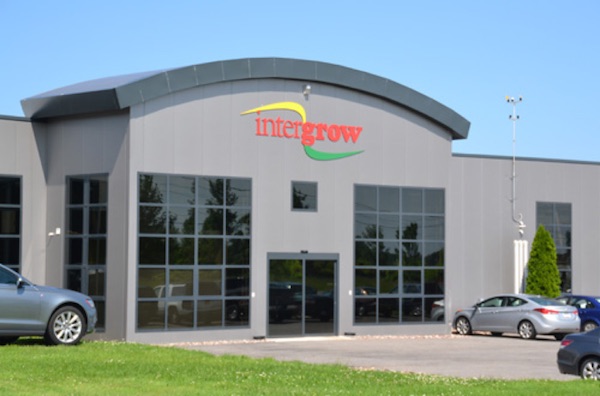
The Hamlet of Childs is home to a new generation of agribusiness that stands out as unique among local farming interests, namely Intergrow Greenhouses located on Oak Orchard Road.   The business was sited at its current location because of its flat terrain and easy access to transportation.

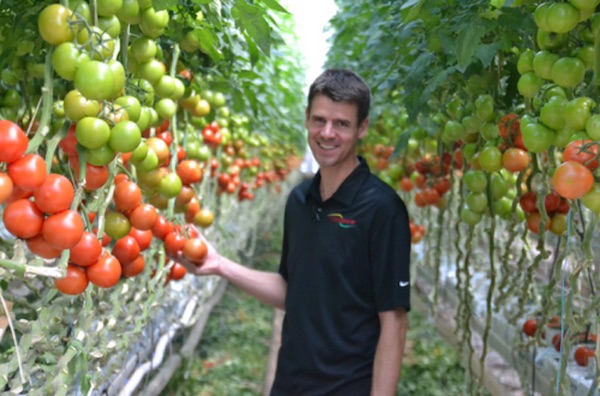
Intergrow got started in the Town of Gaines in 2003 with a 15-acre facility built by owner Dirk Biemans, shown above.  It was the second greenhouse the company established after being formed in 1998 with an initial farm in Alleghany County. With several multimillion dollar expansions, the greenhouse operation has grown to over 55 acres under-glass in Orleans County. Additional greenhouses have also been added in Ontario County.

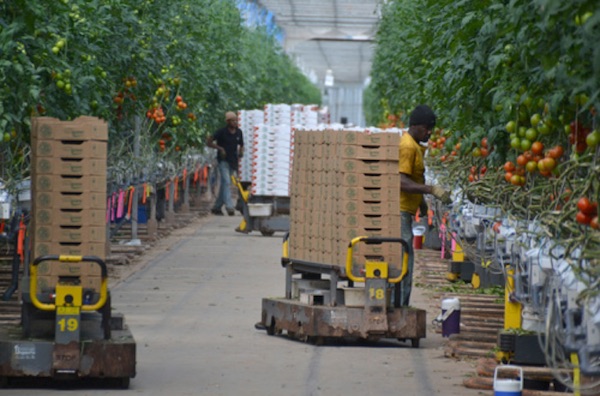
With a workforce of over 100 employees, Intergrow has maintained year-round production of many popular tomato varieties, supplying products to nearly all local supermarkets including Aldi, Tops and Wegmans.

Utilizing artificial light in the winter, Intergrow can create optimal growing conditions to produce delicious tasting tomatoes even during the cold winter months. The company’s computer controlled environment provides a safe, environmentally friendly solution to year-round farming.

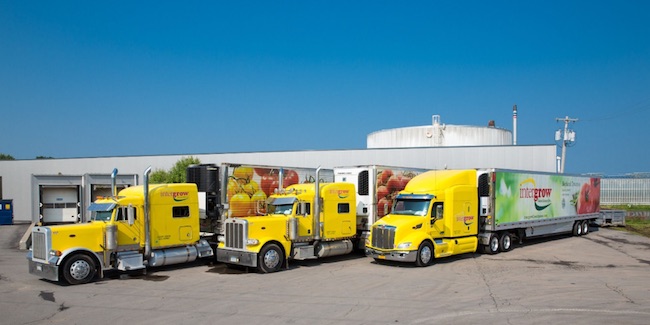
Intergrow tomatoes are always fresh-picked and picked-fresh.  At just the right moment in their growth cycle, tomatoes are picked and shipped to their destination within 24 hours of ripening.  Intergrow utilizes their own fleet of trucks to get their product to their customers as quickly and efficiently as possible.

Historic Childs: History of Agriculture, Part 4

Posted 16 January 2021 at 9:17 am

Kast Farms, Lake Ontario Fruit have been innovative leaders

By Doug Farley, Director, Cobblestone Museum

GAINES – What we know today as Kast Farms, Inc., headquartered on Densmore Road in the Town of Gaines, also has had significant farming interests in the Hamlet of Childs for decades, including farm land on both sides of Ridge Road and adjoining Route 98.

With roots to 1885, the progenitor of the Kast family farm was John T. Kast, who married Ruth (Chapman) Kast in 1915. Ruth’s family members were also farmers, going back another generation to her father, Adelbert Chapman.  John T. and Ruth Kast had son, J. Stanley Kast, who took over the farming interests from his parents in the 1950s.

Stanley, born in 1917, recently celebrated his 103rd birthday. He is still a source of information for the family farm today. Stanley’s son, David Kast, became a partner with his father in 1966. In 1989, Stanley passed the full ownership reins to his son, David Kast and wife Kathy, who are both very involved in the family farm today, along with their sons John & Brett. David and Kathy’s daughter Laura teaches school in Batavia.

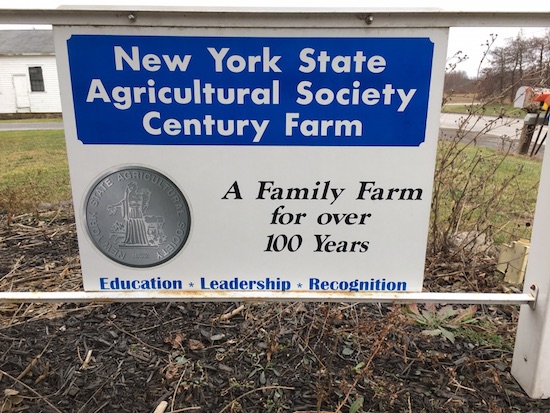
The Kast Farm was recognized as a “Century Farm” by NY Agricultural Society in 2015.  In addition to farming, David, Kathy and sons have remained active in many farm, church and civic organizations.

Kast Farms is highly diversified, farming over 4,000 acres, growing apples, sweet cherries, green beans, sweet corn, field corn, winter wheat and more recently, malting barley. David said, “We’re pretty progressive, willing to try new methods and technologies.” Perhaps that willingness to innovation resulted in the farm being chosen to receive the “I Love NY Farmer Award” in 2006. Gary Davy is the farm’s general manager today.

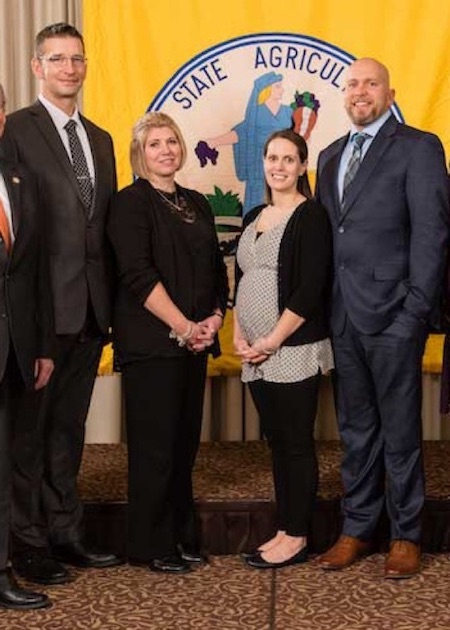
Brothers John and Brett Kast also received the “Next Generation Farmer Award” in 2018. John & Cheryl and Brett & Amanda Kast are seen here. They represent the fifth generation to operate their family farm.

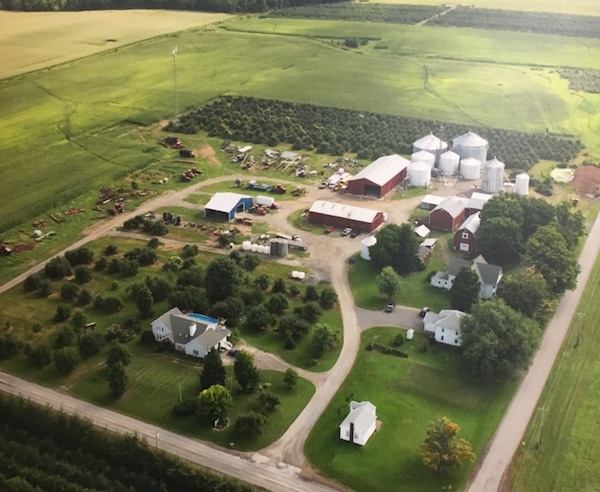
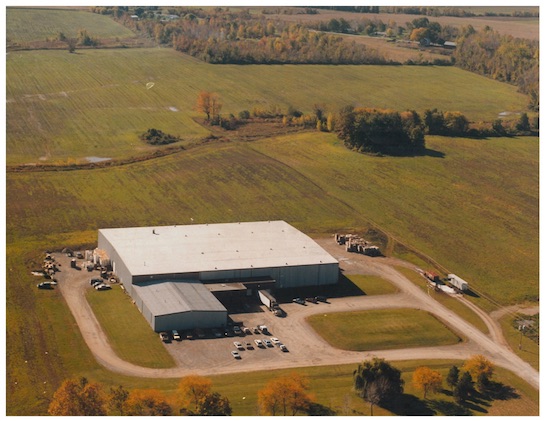
Dave Kast purchased over 100 acres of land on the west side of the Hamlet of Childs in the 1960s from Robert Schwartz. He continued to pick the fruit there for several years, and then made a decision to remove the orchards. The older trees in Childs had become more of a liability than an asset. David said, “Bob Kirby farmed next door to us, and he was in the process of bulldozing his orchard there, so I asked him to keep going and take down our trees, too.”  Kast Farm continues farming in Childs with owned and managed properties as seen in this aerial photo.

In the 1980’s, David Kast said he made the fortuitous decision to sell 10 acres of land in Childs to support another “new-concept.” At that time, local apple growers had pretty much maxed out the capacity of their primary buyer/packer, George LaMont. George, and his brother Roger, ran one of the area’s main packing/storage facilities for apples on their Densmore Road farm for many years.

By the end of the 1970s, that operation was not able to keep up with production and the demand for sales. George approached about a dozen local farmers to see if there was an interest in forming a partnership for the purpose of expanding fruit packing and storage in the area. The decision that they reached resulted in the formation of Lake Ridge Fruit Company, LLC in 1982 with 11 original partners from the local farming community.

The siting of the plant in Childs resulted in convenient access to highway transportation and plenty of room for future expansion. Lake Ridge Fruit formed the operating company Lake Ontario Fruit to expand their sales force to market their apples to a larger geographic area.

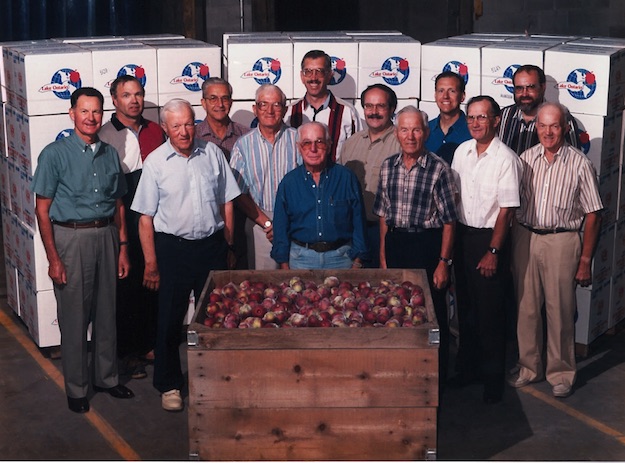
Photo Courtesy: Photos by Bruce & Assoc.

The original partners in Lake Ridge Fruit were: Pete Nesbitt (Pine Hill Farm), Roger LaMont (LaMont Farm), Francis Kirby, Ralph Brown, Bob Kirby, David Kast, Don Nesbitt & Fred Nesbitt (Silver Creek Farm), George Kirby, Bob Brown, George Lamont, John Kirby and General Manager Bill Gerling. David Kast served as President of the association for about 20 years.

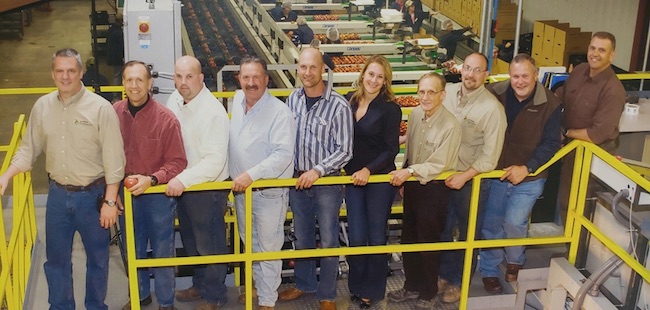
The current ownership group pictured here are (left to right) John Russell, Robert Brown II, Jason Woodworth, Steve Nesbitt, Mike Zingler, Kaari Stannard, George Lamont, Patrick Wodworth, Rod Farrow and Eric Brown. Not pictured are Scott Henning, Robert Brown III and Jose Iniguez. It is with great sadness that the team noted the passing of George Lamont in 2020, a man who first saw the vision for the apple plant and worked to make it a reality.

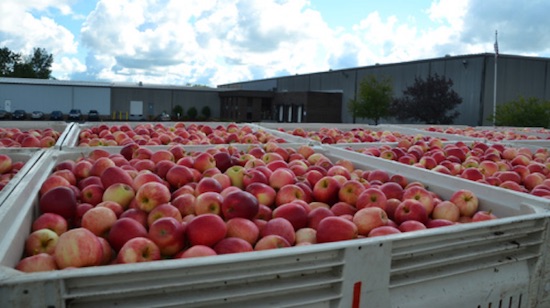
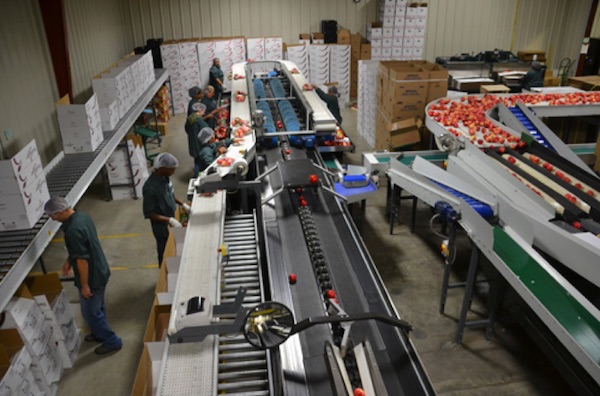
Lake Ontario Fruit, Inc. has grown into one of the largest apple packing and storage operations in the Northeast. The apple plant packages over a million bushels of fresh apple each year. Bins of Gala apples are shown here.

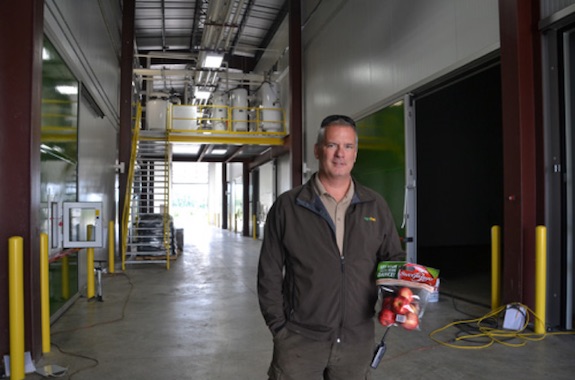
The consortium is led today by John Russell, President/CEO and Partner. Russell is a natural for this position, coming from a highly respected farming family in Niagara County. He said, “Many of our member-growers have recently planted more acreage of popular apple varieties, such as Honeycrisp and SweeTango. Prior to the last expansion, Lake Ontario Fruit needed to rent additional storage facilities at other locations, but all apples are now stored at our own facility.”

Photo Courtesy: Photos by Bruce & Assoc.

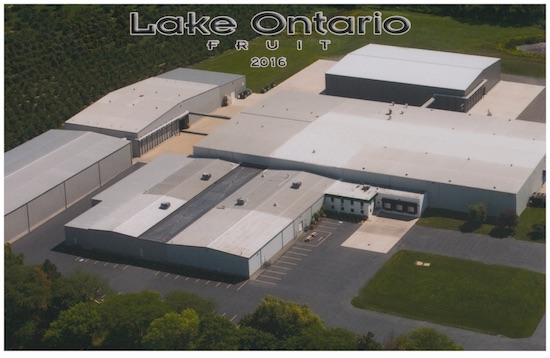
Multi-million dollar expansions were made to the original plant in 2010 and 2013, bringing the total square-footage under roof to 185,000 square feet.

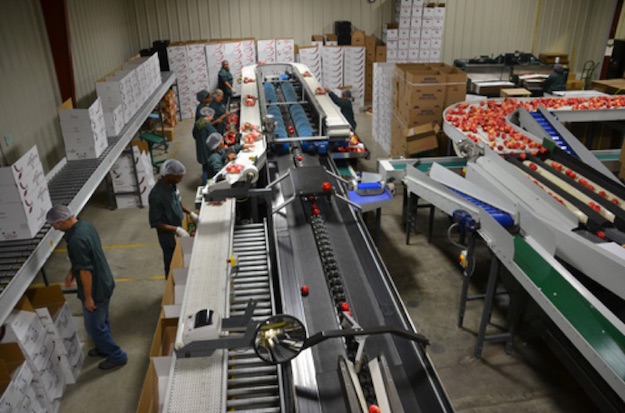
Modern packing equipment is a boost to the local economy that employs about 100 workers in the peak season. Many local and national supermarket chains carry Lake Ontario Fruit apples including Wegmans, Wal-Mart, Tops, and Aldi’s. You can find Lake Ontario Fruit apples in supermarkets under the “NY Apple Sales” label or the newly added “Yes! Apples.” John Russell added, “Apples are all we do and our future is bright. Many of our local apple growers have moved into newer varieties to meet growing consumer demand. We stand by our moto: Great People, Great Apples, Great Future.”

Historic Childs: History of Agriculture in the Hamlet, Part 3

Posted 9 January 2021 at 9:14 am

By Doug Farley, Cobblestone Museum, Director

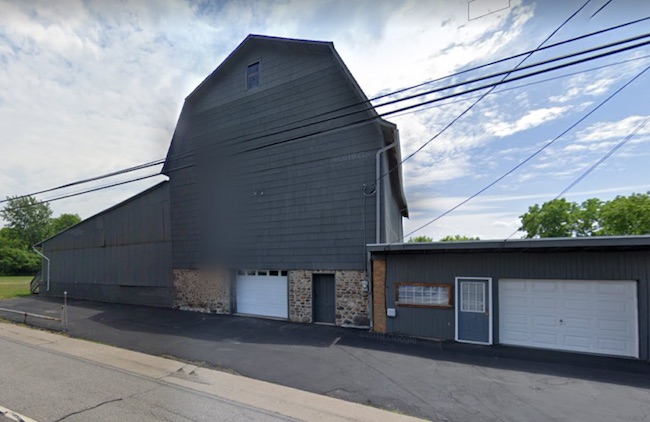
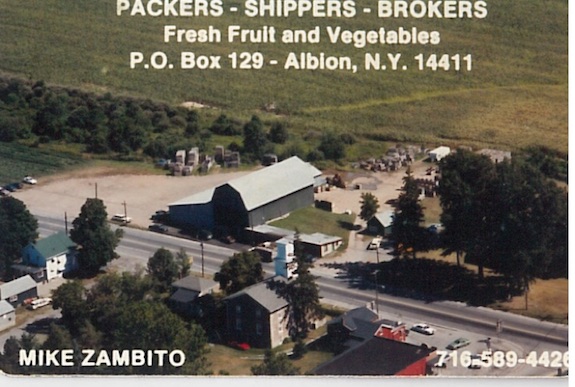
GAINES – Another farm operation in the Hamlet of Childs is attributed to Alphonse Zambito who operated Zambito Produce in 1950s in the gray barn across from the Cobblestone Museum on the south side of Ridge Road.

Al got started in the produce business working for the A&P food chain after WWII as their head produce buyer for 13 states.  The company offices were located to the right of the barn in the photo above.

Here in Childs Al Zambito ran one of the largest sorting facility for cucumbers in the area.  Processing pickles were graded and packed on the ground floor level of the produce company. On the upper floor, fresh market cucumbers were packed with a capacity there up to 5,000 bushels a day.

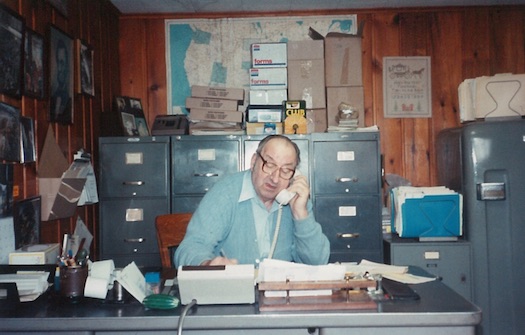
The plant also packed tomatoes, acorn squash, and cabbage. Al’s son, Michael Zambito, carried the torch forward for many more years, into the last quarter of the 20th century. Mike said, “I remember we brought in loads of red cabbage from Holland and green cabbage from Michigan and Virginia. My dad also brokered onions and beets. We were a very busy place.”

Mike Zambito recalled that his father got started after leaving school in the 6th grade. Al worked to help build the Lipton Plant in Albion and then left for the service. Mike said, “After the war, Dad teamed up with Mike Kodish from NYC who gave him some money to start his packaging plant in Childs. Dad eventually bought out Mike Kodish!”

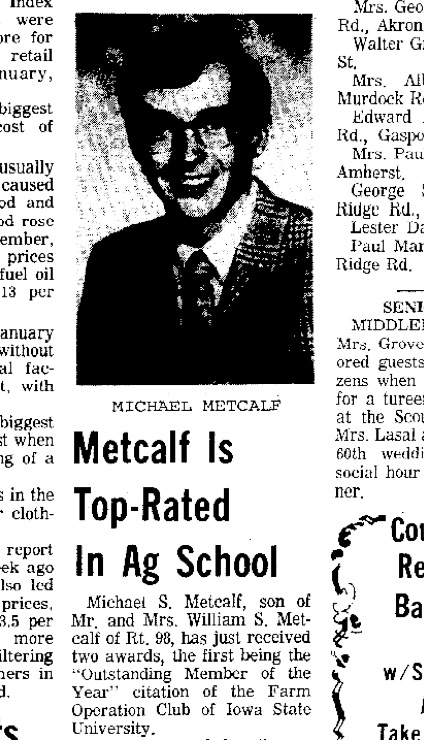
Mike Metcalf offered his reflections on farming in the Hamlet of Childs, too. He grew up on the east side of Route 98, about one-half mile north of Route 104. Mike’s dad, William, was a Soil Conservation Service Officer. This was a federal position that supervised farm drainage and construction of farm ponds.

As a child, Mike recalls that Lee Harding and John Murray raised sheep on their adjoining farms in the 1950s. Mike said, “Growing up with all the sheep, it was like a giant playground.” He recalls the sheep creating trails that crisscrossed the pastures that he and his brother and two sisters would enjoy running through.

Mike received his farm training, graduating in 1974, from Iowa State University, where he received the “Outstanding Member of the Year Award,” from the University’s Farm Club, and the “Real Guy Award,” the highest honor bestowed by the Iowa State University College of Agriculture. Immediately following college, Mike became involved in Orleans County farming, including animal husbandry and crop farming. Mike’s current farming interests include about 300 acres on Route 279 and has held many leadership positions in Orleans County Farm Bureau.

Mike Metcalf also remembers the fire in 1970 that destroyed Lee Harding’s barn on Route 98. After the fire, Harding sold his property to what would become the large corporate farm, Intergrow, a farm operation that deserves its own story in a later article.

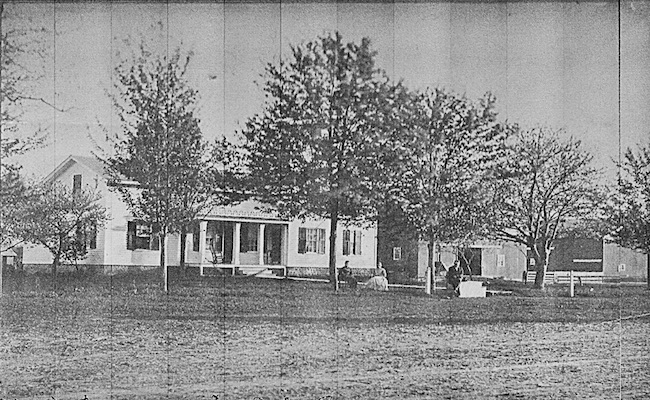
Another historic farm on the west end of the Hamlet of Childs was called Coloney Farms, dating back to the early 1800s.  The progenitor in the Coloney family was George Coloney who purchased the farm from Russell and Betsey Gillett in 1885. George started the farm keeping horses and grew the farm to over 160 acres, primarily on the west side of Childs. George and his wife, Bertha Balcom Coloney, built a 2,700 sq. ft. house on the property in which the extended family still resides today.

George and Bertha Coloney had six children (shown above): Orson, George, Jr., Rosabell, Marian, Marjorie and Eleanor. Eleanor’s son, Gerald Coloney Monagan and his wife, Beverly (Thompson) Monagan, now live in the Coloney family homestead. Jerry explained that the Coloney homestead (shown above) passed out of the family for about 16 years until his purchase of the property returned it to the extended Coloney family line. Jerry professed, “I’m really just a gentleman farmer. Eugene Leigh farmed the back 128 acres. I bought 32 acres and raised about 10 acres of cucumbers.” Jerry’s principal livelihood was employment at Kodak in Rochester.

George Coloney’s sons, Orson and George, Jr., continued the Coloney farming legacy and managed 2,000 acres, primarily in Carlton. They produced tomatoes that they sold to Hunt’s in Albion and also maintained a labor camp for field workers who came up from the southern states in the summer.

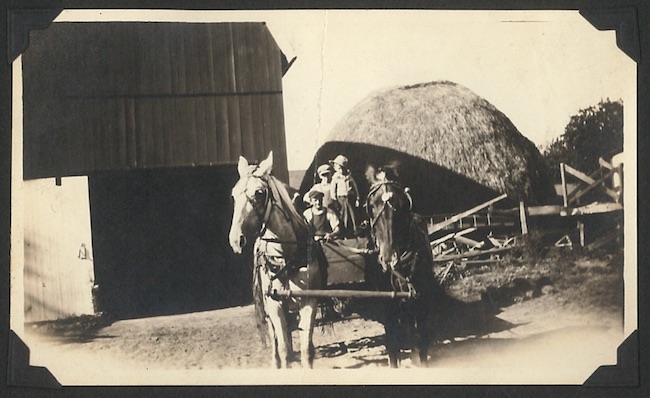
Coloney Farms with its active horse stables, needed a plentiful supply of fresh straw for bedding. Here we see an early 1900s straw stack on the farm.

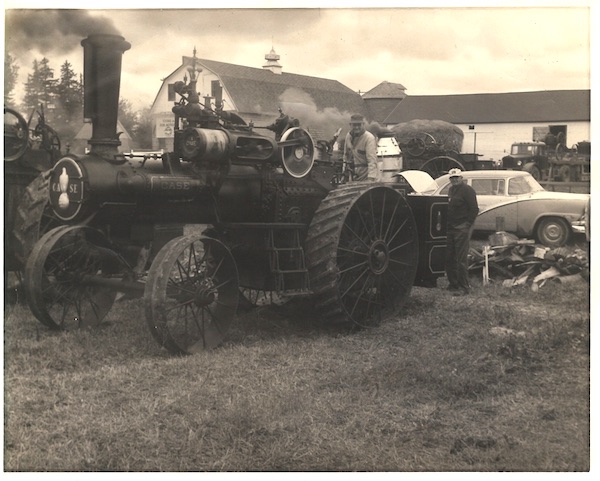
Horses provided the “horsepower” to do many farm chores during the 1800s and early 1900s.  The next generation of horsepower was provided by steam engines.  Here, in this 1950s farm scene, we see an early Case Steam Tractor at work.  This tractor displays the “Old Abe” eagle logo on its front, a Case trademark beginning in 1865.

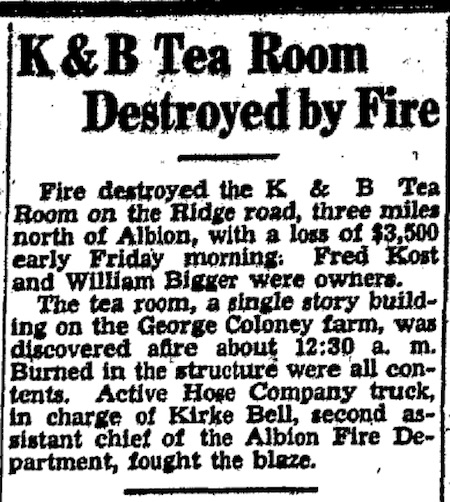
Tragedy struck Coloney Farm on Friday, November 22, 1935 when the K&B Tea Room, a small structure on the farm, was destroyed in an early morning fire.

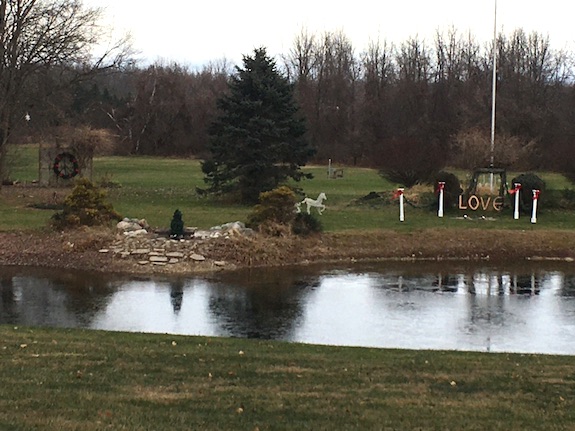
Current farm residents Jerry and Bev Monagan always had a problem with standing water near the house, so they decided to dig a pond.  Gerry said, “We went down 14 feet and hit bedrock, but never hit water.”  The 14’ deep pond is just filled with surface water.” The family has used the pond for swimming and has kept Black Labs that have enjoyed the water, too, along with some coy fish and bass that have been stocked.

Historic Childs: Agriculture in the Hamlet, Part 2

Posted 2 January 2021 at 9:06 am

By Doug Farley, Cobblestone Museum Director

GAINES – The Thompson family farm is another longtime farming operation in the Hamlet of Childs whose roots go back to the early 1800s.  In 1872 Henry Williams bought the farm to the east at the corner of Brown Street Road and Route 104 thus enlarging the farm to 235 acres.

Elmer Thompson of East Barre married Henry’s daughter, Theda Williams, and moved into the homestead on Ridge Road. Their son Charles Thompson inherited the farm from his father. He married Hannah Harding and they had four children: Gary, Gail, Ruth and Ross. The Thompson farm as seen is this picture from the late 1800s shows an unpaved Ridge Road.  Paving was not accomplished until the 1920s.

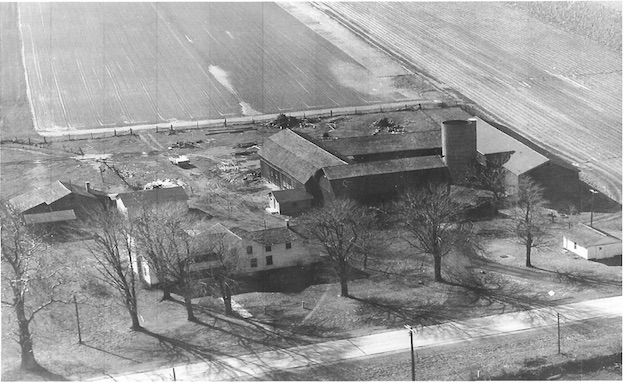
Charles Thompson operated the dairy and cattle farm on both sides of Ridge Road.  He started with Black Angus beef cattle and added 35 milking cows. The beef cattle were out to pasture on the north side of the road, except during the winter months when they were housed in the west barn. The dairy cows were put out to pasture during the day on the south side of the road. The picture shows the dairy barn and milk house on the east. The Thompson farm also included a farm seed business that supplied corn, wheat and other seeds to local farmers.

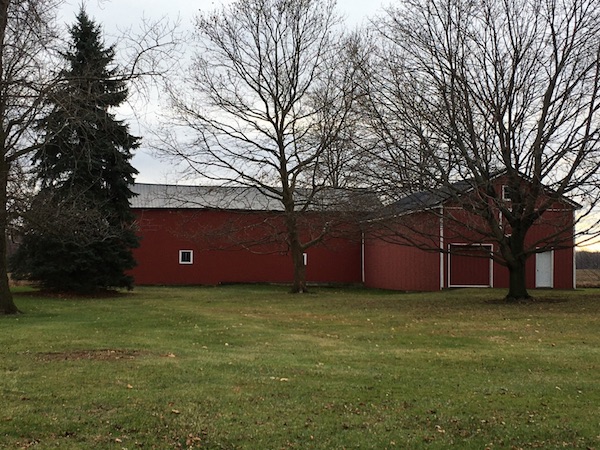
Historian Bill Lattin examined the large hand-hewn beams in the back barn that is still standing and dated its construction to the 1820s.

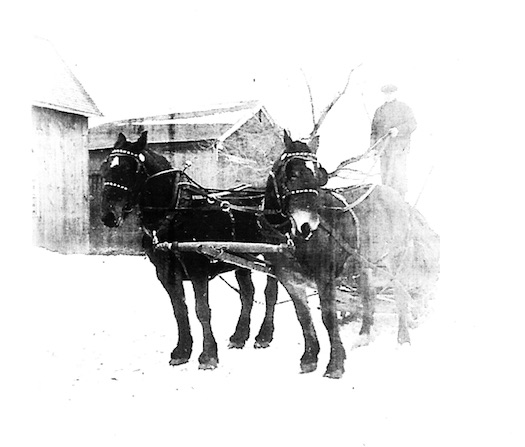
Activity on the farm continued year around.  As late as the 1940s, farm chores were done in the winter using horses to pull a sled.

Charles Thompson’s daughter, Gail (Thompson) Johnson, who still lives on land once held by the farm, has many fond memories of family life growing up. She said, “I really enjoyed playing outdoors. We stayed home. I played in the corn picker and pretended it was a spaceship.” Gail said she learned her simple philosophy of life from her father and mother. Charles did not spend money foolishly. He lived a frugal life and only bought what he could pay for with cash, including all of the farm equipment.

Gail remembers when the family first bought a television set in the 1950s. They watched it together as a family about one hour every evening. Gail recalled that at a certain point in time the TV broke and Charles decided they wouldn’t get it repaired. He said, “You kids should do your homework instead.” And, that’s what they did.

Gail’s mother Hannah lived a simple life, too. She was a thrifty homemaker and canned farm produce to make meals for her family. Following her husband’s death, a friend asked Hannah if she was going to can some fruits and vegetables for the winter. Hannah remarked, “No! I am not going to be a slave to another vegetable.”

Gail said her father stopped farming around 1960 and put his land in the Soil Bank Program instead. She said, “The state kept coming up with new regulations, year after year, like demanding that the barnyard be paved with cement. Dad had complied for years with the state but it became very difficult to make a living. He had gone from simple milk cans to bulk milk tanks which had cost quite a bit of money.”  The Soil Bank paid farmers not to grow crops, but to mow the grass instead. Gail said government regulations forced a lot of the small farmers in the region to go out of business.

Gail remembered that her parents were involved in many farm related activities including Gaines Grange. She said, “My mother used to sell donuts at the Grange square dances on Saturday evenings.”  She also recalled attending family picnics at Indian Falls, probably related to her father keeping Brown Swiss cows. She said, “Our farm was pretty much self-sufficient. Beef and dairy cows brought in meat and milk, and chickens supplied eggs.” Like most farms, the Thompsons had a large vegetable garden to provide their daily needs.

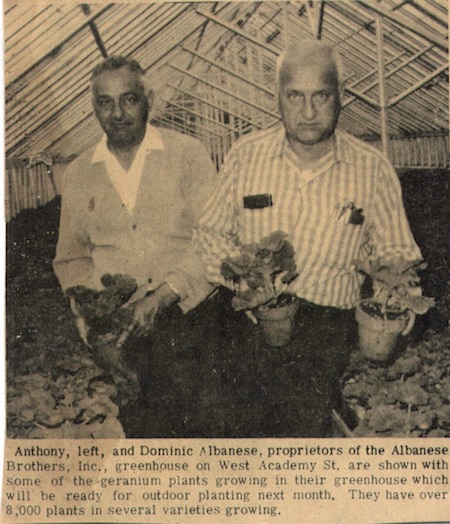
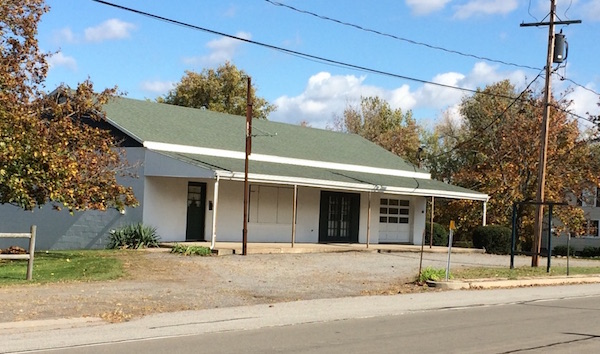
The Albanese brothers – Anthony, Dominick and Frank, farmed about 50 acres along the north side of the Ridge in Childs between the Cobblestone School and Church in Childs. They also operated the Orleans Hotel in Albion from 1944-1955. Their farming enterprise included a large farm on Sawyer Road where they grew Apples, cabbage and tomatoes, among other crops.  They also had a large labor camp on Sawyer Road to house about 100 migrant laborers who came up from the south to harvest the crops.

In the 1950s the brothers built a combination liquor store and farm market on Ridge Road. They sold a large variety of homegrown produce in their roadside stand, seen here, in Childs. Anthony’s son, Robert Albanese, remembers working at his father’s Sawyer Road farm during High School.  Bob said, “I worked weekends on the farm. They had over 300 acres of orchards and all-in-all we picked 100,000 bushels of apples each year.” In addition to the roadside stand, the farm sold produce to Comstock Foods. Farming continued there until about 2000.

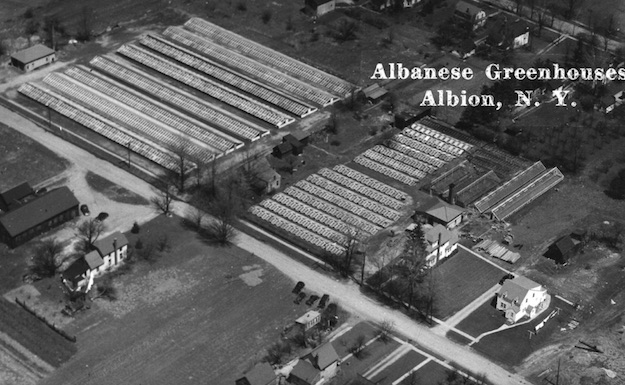
The Albanese Brothers farming operation also included greenhouses on West Academy Street in Albion that raised over 5 million tomato plants each year. They sold these to local farmers and to the tomato industry. The greenhouse operation continued into the 1990s before they were all removed.

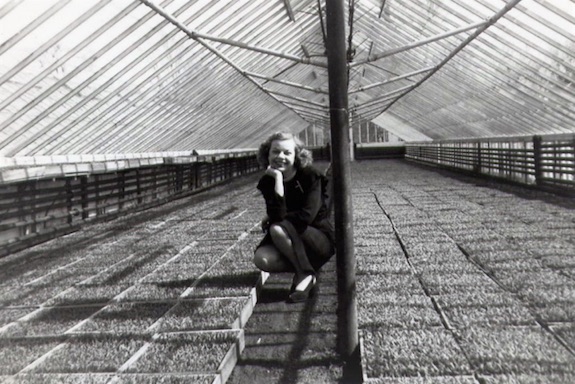
Robert’s mother, Eleanor Albanese, is shown inside one of the greenhouses in about 1950.

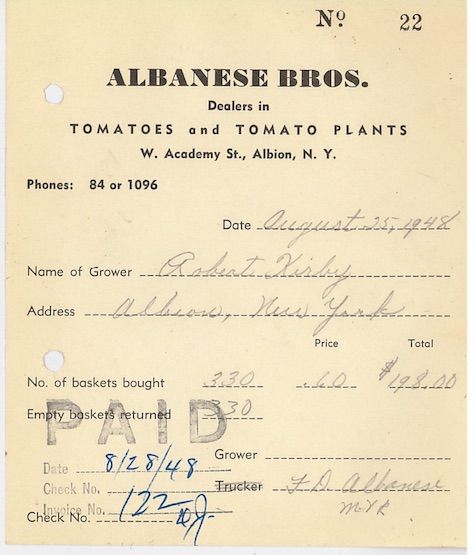
Bob Albanese recalled that each tomato flat contained 118 young plants which were started each year from seed. He remembers having to track down all of the empty wooden flats again in the fall so the process could start all over again each year. Here we see an Albanese Brothers invoice for Robert Kirby’s purchases of 300 flats of tomato plants in 1948. While $198 was a lot of money in 1948, it averaged out to one-half cent per tomato plant.

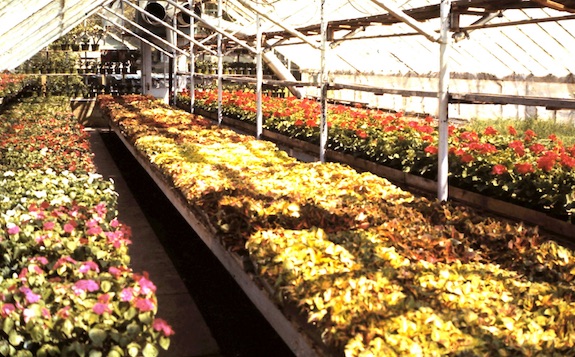
Here are some of the colorful annual bedding plants grown in the Albanese greenhouses that kept gardeners coming back year after year.

Businesses that supplied goods and services to farms and farm workers were also important to any farming community, and Childs was no exception. One of these businesses was the Janus Service Station and Garage located between the Cobblestone Schoolhouse and Albanese Farm Market on Route 104. Owner Frank Janus sold Sinclair Gas and convenience store items to farm workers and highway passersby beginning in the 1900s. He also specialized in repairing cars, trucks and farm equipment.  Frank’s wife, Victoria, operated a lunch room on the premises before the NYS Thruway opened in 1954. Historian Bill Lattin remembered, “I bought the last drop of gas sold there in 1970s. The pump ran out of gas in mid-fill and that was the end of that.”

Very little remains of the Janus Service Station today, except two “cobblestone” style pillars that once held Sinclair Gasoline globes.

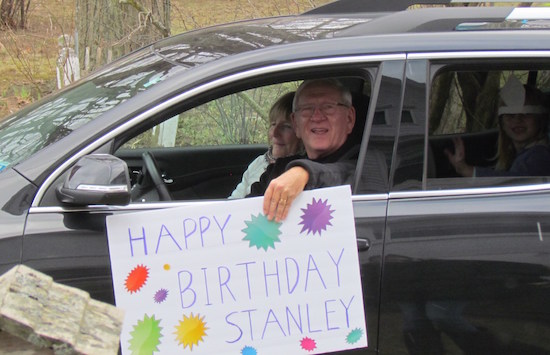
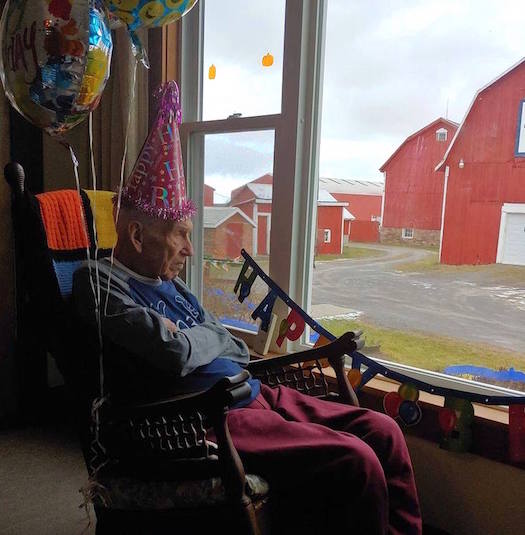
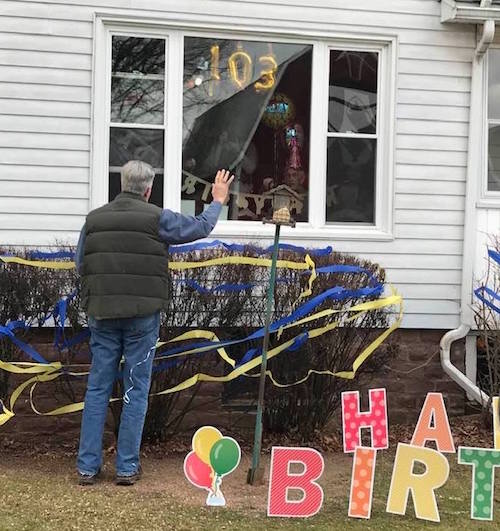
On his 103rd birthday, Stanley Kast receives many greetings and an Assembly citation

By Tom Rivers, Editor Posted 29 December 2020 at 7:09 pm

Kast ran a tractor until he was 97 and still keeps an eye and the daily comings and goings at the farm

Photos courtesy of Kathy Kast

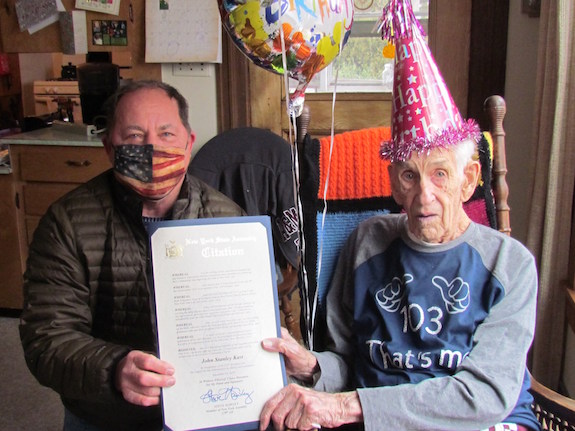
ALBION – State Assemblyman Steve Hawley stopped by Stanley Kast’s home on Densmore and West Transit roads today and presented him with a special citation from the State Assembly for Kast’s 103rd birthday.

Kast was born in the house and has worked the farm in Gaines his entire life. He was out in the orchards operating a tractor until he was 97. He still keeps track of the daily comings and goings on the farm, including the corn truck traffic, what varieties are being planted in the orchards, and what fruit trees are being trimmed, sprayed or picked.

About 20 cars stopped by and family and friends waved to Kast from his window. The people came from the Albion area, with some from Buffalo, Rochester and Williamson.

Stanley Kast watches the parade of people – wishing him a happy birthday today.

He was married to Evelyn Denagel Kast and raised two sons, David and Paul. Kast has three grandchildren and seven great-grandchildren.

Stanley Kast is greeted outside his window on his birthday.

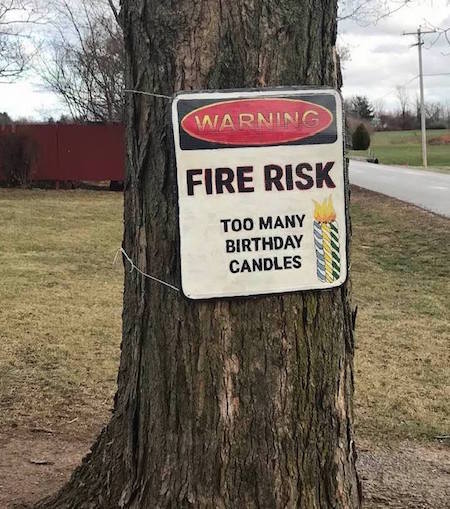
There was some friendly teasing from his family on his birthday.

Historic Childs: Agriculture has been a leading industry in the hamlet (part 1)

Posted 25 December 2020 at 2:06 pm

By Doug Farley, Cobblestone Museum Director

GAINES – The Hamlet of Childs has a long history of agriculture on both the north and south sides of Ridge Road and the adjoining properties on Oak Orchard Road.  Some of the original families that farmed the land or processed the farm products, are still involved in farming, but most have sold their interests to other businesses as smaller family farms gave way to larger corporations. Over the next several articles we will look at many of those local farms.

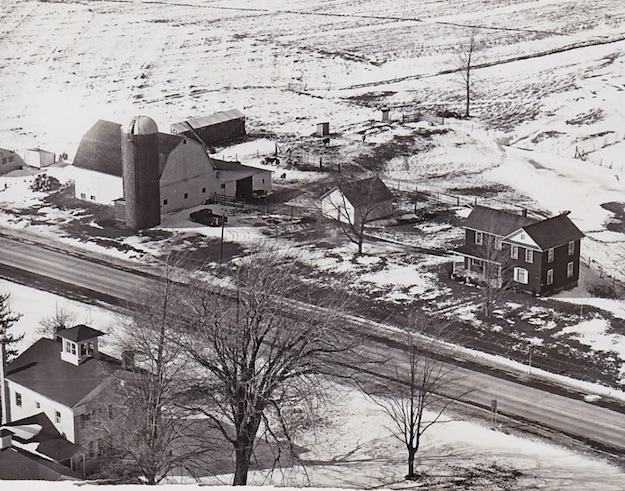
John and Neva Dahlquist Murray were one of the farm families in the Hamlet of Childs. They were married in the mid-1920s. Their farm (pictured above) surrounded the old John Proctor homestead on the south side of the Ridge and encompassed a region running about one mile along Oak Orchard Road (Route 98) heading south out of the Hamlet.

The farm also extended to the north side of the Ridge. John and Neva had two children: Beverly June Murray Leigh and son John (Jack) Riley Murray, who went to work for the Gas Company following his service as a medic in the Korean War.

All in all, the John Murray family, which included his son-in-law Eugene Leigh, who married John’s daughter Beverly in 1946, farmed about 300-400 acres into the 1980s, which included some muck land in Elba. Their principal tree crops were apples, cherries, pears and peaches, as well as truck farming crops of corn, tomatoes, cabbage, soy beans and cucumbers. Bev and Gene Leigh moved into the farm house (shown above) when they were married in 1946 and Gene still lives there today, although the barns are now gone.

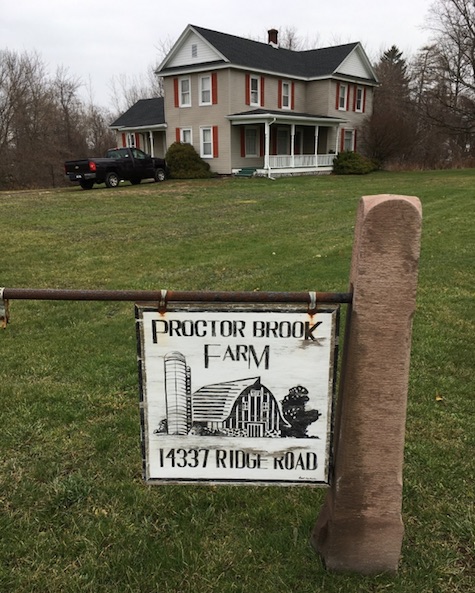
Bev Leigh named the family farm, “Proctor Brook Farm” after her parents died. Bev and Gene Leigh had three children: Valerie Leigh Hatch, Meredith Leigh Minier and John Murray Leigh.

A sign, shown above, still marks the driveway of the farm homestead today.  The stone tie up for horses that it is attached to is also an object of fond remembrance for the family.  Meredith said, “My sister and I used to hang from it upside down years ago. Mom brought it over to her place when Grandma died and I hope to do the same someday to keep it in the family.”

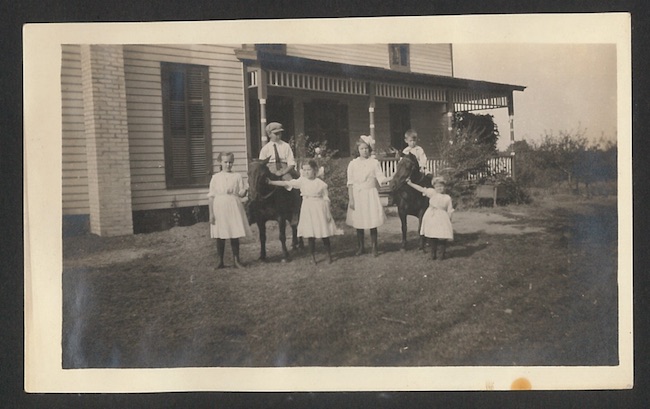
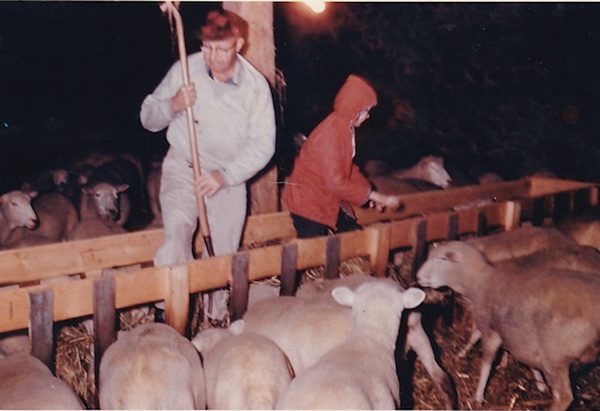
Proctor Brook Farm also raised animals including sheep, cows, pigs and horses. Gene’s daughter Meredith Minier (above right) recalls that her grandfather, John Murray (above left), took care of the sheep, and her father, Gene Leigh, took care of the cows. Meredith said, “Grandpa had work horses in his barn, too, until I was about three, I believe, and then we must have gotten a tractor!!”

She said her grandpa used to train sulky horses as a young man before he farmed and she remembers having a pleasure horse for a time, but when her grandfather had retina surgery they had to sell it because he couldn’t ride anymore.

Meredith said, “I remember writing my mother the first month I was married and had moved to Denver, because I couldn’t believe I had to pay 99 cents for a bag of apples in 1974!” John and Neva had a beautiful summer garden. Meredith recalled, “Grandpa would often leave a cantaloupe on our back step for us for breakfast in the summer. All the fruits and vegetables we could imagine and beef all the time too.”

Her Grandma and Grandpa also had lovely flowers with sweet peas being her favorite. “I remember Grandma bringing over bouquets of sweet peas, she had so many, and lilacs, too. Some things you don’t understand or appreciate until you are older!”

Meredith reflected further on her childhood memories:

“My memories are many and I was so fortunate for what they provided us. Dad worked sunrise to sunset seven days a week; he ran in at lunch and ate in ten minutes and back outside. He would fix his own equipment and send my Mom to the John Deere store for parts. I remember my Grandpa walking over one day in the summer holding his arm – he had caught it in the hay baler and off he and Mom went to the hospital with a broken arm! And my Dad was on the combine going south around the corner of 98 and 104 when the combine started on fire and Dad had to jump off onto the road to escape, 8-10 feet onto the pavement.  He couldn’t walk for several days and has suffered from that injury since then. Mom was a wonderful farm wife, raising three children while Dad worked to provide for us; she could cook, can, sew, decorate, do the outside work, even make most of my sister and my clothes from dresses to coats and took up quilt making as we left the house and she had more time. All this as she lovingly raised a special needs son. Even in the days of modernization as it was in the ’50s and ’60s and ’70s it was not an easy life.”

The story of how John Murray got his start in farming is also very interesting.  When John was growing up in the early 1900s, his father, George, owned property that they farmed on the north side of the Ridge Road by Brown Street Road. George acquired his farm in 1895 from the Miller Family who acquired it from the Rowley Family, who were early settlers to the area.  When George Murray died in 1932, he left the family farm to his oldest son Curtis, which was the usual way property was passed down during that time period. However, “Curt” was indeed his brother’s keeper, in that he took a mortgage on his inherited property and gave some of the proceeds to his younger brother John, so he could buy a farm.  John then bought the John Proctor farm located about a mile west on Ridge Road and his property became known as Proctor Brook Farm as previously described.

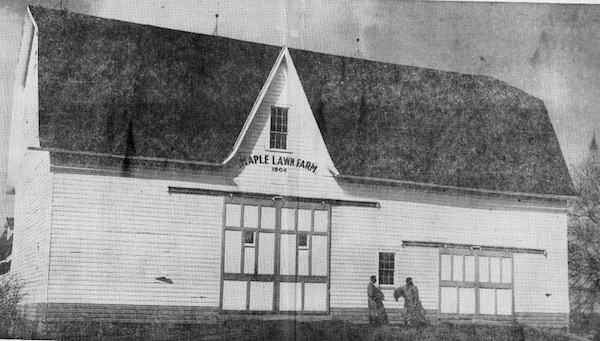
After his act of brotherly love, Curtis Murray (shown above right) carried on the farming legacy on George Murray’s property located on the north side of the Ridge by Brown Street Road. Curt’s farm was known as “Maple Lawn Farm,” named after a row of maple trees that once lined the property.

The Curtis Murray family was involved in dairying, and sold cream and butter on the farm.  They also grew cash crops like cabbage, corn, and cucumbers.  Curt’s daughter, Janice Mann Beech, recalls when her father removed an old barn on the property.  She said, “To do that he hired an explosive expert to take down a free standing silo next to the barn. It took three attempts with dynamite to finally knock it down.”

Later, a parcel from Maple Lawn Farm was sold to the Gaines Carlton Community Church for their new building in 1969.

Farming in the “western end” of Childs can be traced to 1816 when the Hutchinson family acquired land on the south side of the Ridge from Holland Land Company. Hutchison progeny carried on the farming tradition into the 20th century when his daughter Florence married Everett Barnum and took over the farm.

Everett Barnum had planned on passing the farm down to one of his two sons, but fate had another plan. Both sons, Eugene and William, went off to war during WWII and neither returned alive from the war in Europe. 2nd Lt. William Barnum and Capt. Eugene Everett Barnum, Jr. (shown above) were buried next to each other in the Netherlands American Cemetery, Limburg Netherlands.

In 1958, Robert Schwartz, Jr. purchased the 100-acre Barnum farm, which he expanded to 160 acres. The Schwartz purchase marked the first time the farm had been out of the extended Hutchinson family since the early 1800s. The Schwartz farm raised dairy cattle along with fruit and vegetables. Robert’s daughter Linda Schwartz said her dad “always grew a cash crop, too.”  Robert had three daughters, and without a son to pass his property on to, he sold the farm in 1984 to Dave Kast, Town of Gaines.

Dave Kast used some of the land to start Lake Ridge Fruit and its subsidiary Lake Ontario Fruit, one of the largest apple packing and storage facilities in the Northeast. Dave was one of the original 11 investors that started the plant in the 1980s. This multi-million dollar business has its own incredible story and will be the subject of another article in the near future.

Volunteer honored for creating digital database of cobblestone sites in NY and beyond

By Tom Rivers, Editor Posted 1 December 2020 at 12:48 pm

Landmark Society of WNY gives special citation to Greg Lawrence

Courtesy of Cobblestone Museum: This photo of the Alexander Town Hall in Genesee County is among about 5,000 images in the new digital archive available through the Cobblestone Museum. This building was erected in 1837 as a boarding house. It later became a school and then the town hall. It is listed on the National Register of Historic Places.

GAINES – The Landmark Society of WNY has presented its annual awards for people who have tackled ambitious preservation projects in the region.

Greg Lawrence

A Clarendon resident is among the winners. Greg Lawrence was recognized with a special citation from the Landmark Society for his efforts in creating the digital repost for all 800 known cobblestone buildings in New York State, as well as in some other states and Canada. Altogether, the database includes nearly 1,000 cobblestone sites.

This archive includes about 6,500 images in a database created by Lawrence, who took on the project as a volunteer.

Lawrence worked to digitize a collection of photographs, with most of the images are from Robert L. Roudabush between 1976 and 1980. The images and scans of maps are available online by clicking here.

The database includes cobblestone buildings in 28 counties in NY, and cobblestone sites in Colorado, Illinois, Massachusetts, Michigan, New Mexico, Ohio, Vermont and Wisconsin, as well as structures in Canada, England and France.

Lawrence is retired after 31 years at Kodak in micrographics (microfilm) and high volume, commercial document scanners.

Erin Anheier, the Cobblestone Museum president, approached Lawrence in Spring 2018 with a proposal to digitally duplicate the “Robert Roudabush Survey of Cobblestone Buildings in New York State” archived at the Landmark Society of Western New York.

Lawrence accepted the challenge and expanded it to include an information base with a platform to maintain, update, and import information as desired. Lawrence said it is “a growing, living library of information, a repository of all known and found about cobblestone structures that can be accessed worldwide.”