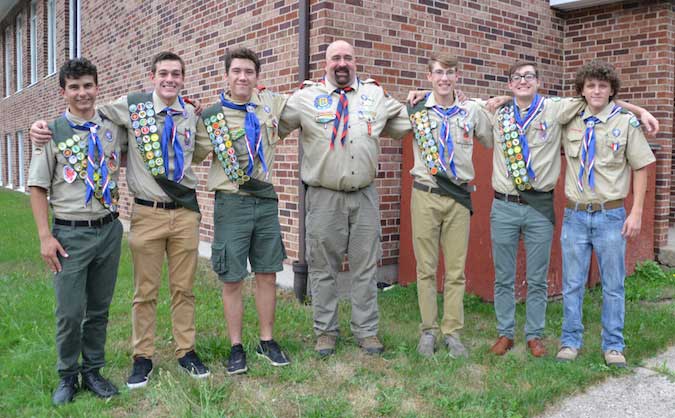
Photos by Tom Rivers: These six Boy Scouts are pictured with Scoutmaster Jak Kohmann at a Court of Honor celebration on Wednesday evening at the Disciples United Methodist Church in Clarendon. Pictured from left include: Xander Apicella, Matt DeSimone, Dalton Thurley, Jak Kohmann, William Harrington, Jake DeSimone and Ben Downey.
By Tom Rivers, Editor Posted 2 August 2018 at 8:07 am
32 have now earned Scouting’s top rank from Troop 59 in past 16 years
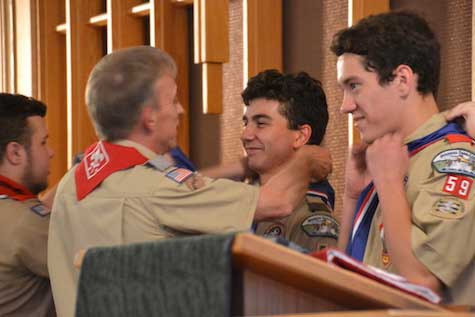
Ron Boyd, a mentor and volunteer in Troop 59, puts the Eagle kerchief on Xander Apicella. Jake Thurley, not in photo, put the kerchief on his brother Dalton Thurley, right.
CLARENDON – Six Boy Scouts from Troop 59 in Clarendon are the latest to earn their Eagle rank, bringing the number of Eagle Scouts to 32 in the past 16 years from the troop.
Xander Apicella, Matt DeSimone, Dalton Thurley, William Harrington, Jake DeSimone and Ben Downey held their Court of Honor celebration on Wednesday at the Disciples United Methodist Church, where the troop meets every Thursday at 6:30 p.m.
Scoutmaster Jak Kohmann praised the scouts for their dedication. They pushed themselves to earn merit badges and complete projects in the community.
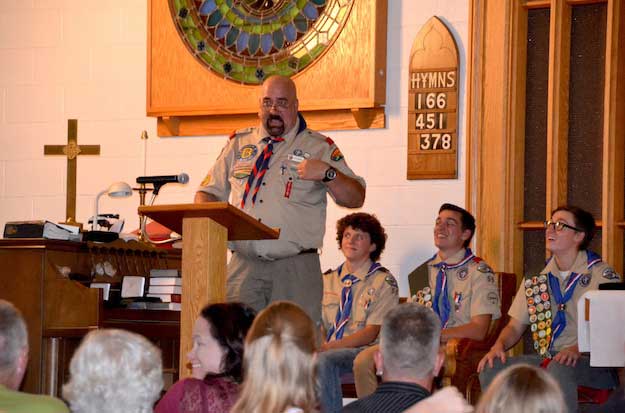
“They do the work,” Kohmann told the group gathered at the church for the Court of Honor. “They have a true commitment. Without that dedication these six wouldn’t be up here today.”
Eagle Scouts need to earn at least 21 merit badges, but many of the scouts in Clarendon go well beyond that. They have completed projects at Hillside Cemetery, the Clarendon Historical Society, Clarendon Fire Hall and the town park. The projects need to take at least 100 hours, but Kohmann said the Clarendon Scouts put in at least 150, with some taking 400 hours to complete.
“They turn into young men and they get jobs,” Kohmann said about the Eagle Scouts. “We stay in touch and I see these people out in the community and they are pillars of the community.”
Jak Kohmann speaks during the Court of Honor on Wednesday evening. He said the Eagle Scouts are self motivated. Behind him include Ben Downey, Matt DeSimone and Jake DeSimone.
The six new Eagles all presented Kohmann with a mentor pin during the Court of Honor. They also recognized John Crandall, the assistant scoutmaster, and others who have supported their Scouting journey.
Xander Apicella began as a Webelos in the fifth grade. He created a firemen’s memorial at the Clarendon Volunteer Fire Company for his Eagle Scout project. He is entering his junior year at University of California at Santa Barbara, where he is majoring in physics and minoring in writing.
Jake DeSimone started as a Tiger in the first grade. For his Eagle project, he constructed and landscaped a flower bed at the Clarendon Fire Hall. He is pursuing a business degree at Monroe Community College.
Matthew DeSimone, Jake’s younger brother, also started scouts in the first grade as a Tiger. He renovated the park pavilion in Clarendon for his Eagle project. He is pursuing a degree in business/pre-law at Geneseo State College.
Ben Downey started scouts in the second grade as a Wolf. For his Eagle project, he installed a fence at the memorial at Hillside Cemetery. He is currently doing commercial and electrical work for Edwards Electric and Communications in Rochester.
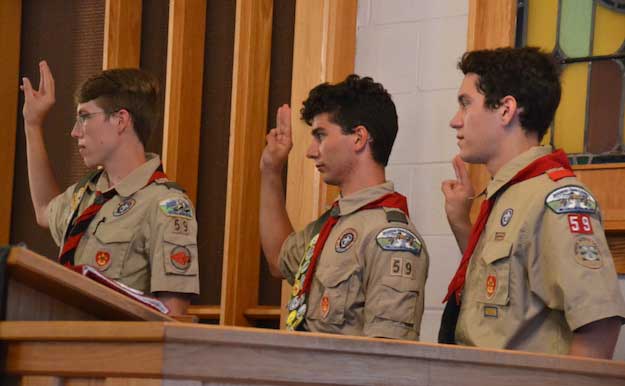
These new Eagle Scouts recite the Scout Oath. They include Will Harrington, Xander Apicella and Dalton Thurley.
William Harrington started as a Tiger Scout in the first grade. He constructed a display wall with lighting in the Clarendon Historical Society for his Eagle project. He is majoring in biology, chemistry and music in a pre-vet program at Elmira College.
Dalton Thurley joined scouts in the first grade as a Tiger. He cleaned and repaired the veterans’ section of Hillside Cemetery for his Eagle project. He will be studying mechanical electrical engineering technology at Alfred State beginning this fall.
Kohmann has served as Scoutmaster for 16 years, including several years after his son aged out of the program. Derek Kohmann, now 27, was the third of the 32 scouts to earn his Eagle under Kohmann.
Kohmann worked 30 years at Kodak and then another eight years at the Holley Pharmacy until he retired in April. He found scouting to be a needed break from the stresses of his job.
“This was a nice release from that,” he said. “I have a good time here.”
The Clarendon troop also has many engaged parents and several active volunteers. Kohmann does the paperwork after the scouts earn their badges and ranks.
He intends to stay active in the troop “as long as the kids keep coming.”
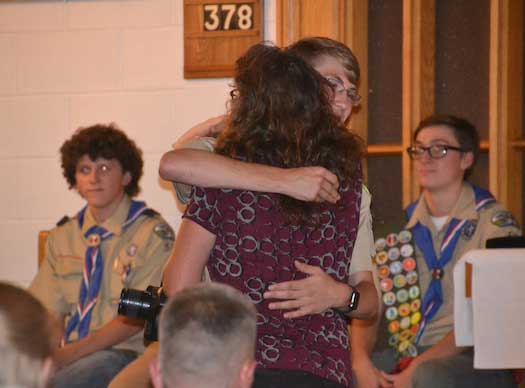
Will Harrington hugs Melissa Ierlan after presenting her with a mentor pin. Irelan helped many of the Eagle Scouts identify their projects in the community.
John Crandall, the assistant Scoutmaster the past nine years, says the many Eagle Scouts in the troop show others that the coveted rank is attainable.
“Once they see their peers get an Eagle, it inspires them,” Crandall said.
His son Jacob, 20, earned his Eagle. Another son, Jeremy, needs three more merit badges and has to complete his project to become an Eagle. Jeremy, 17, expects to become an Eagle next year.
Crandall also praised Melissa Ierlan for connecting many of the Eagle Scouts to their projects. Ierlan is president of the Historical Society and the town’s code enforcement officer.
“She helps with the logistics,” Crandall said. “She has tons of contacts.”
Ultimately, Crandall said Kohmann sets the tone in the troop, and keeps the scouts engaged.
“Jak is very regimented and available for the boys,” Crandall said. “You won’t find someone more dedicated to Boy Scouts. He makes it attainable to the boys.”
Kohmann said the troop welcomes more scouts. They can stop by the Disciples United Methodist Church on a Thursday evening for more information.
CLARENDON — The man killed Tuesday night in a motor vehicle accident in Clarendon has been identified as Matthew Gardner, 25, of Hamlin.
He was driving a 2013 Chevrolet pickup truck eastbound on Route 31A when a 1994 Ford flatbed truck pulled into the intersection at Fancher Road, Chief Deputy Michael Mele said.
The 1994 Ford was driven by Kevin Lupiani, 40, of Medina, who failed to stop for a stop sign, the Sheriff’s Office said.
Both vehicles came to a rest in a cornfield on the southeast side of the intersection at about 10:30 p.m. Lupiani was taken to Strong Memorial Hospital in Rochester by Monroe Ambulance.
Gardner was taken to Strong West in Brockport and was pronounced dead.
The accident is under investigation by the Orleans County Sheriff’s Office.
CLARENDON — The Orleans County Sheriff’s Office is investigating a two-car fatal motor vehicle accident in the Town of Clarendon on Tuesday night.
At approximately 10:35 p.m., a call came to the Orleans County 911 dispatch center reporting a rollover accident at the intersection of Route 31A and Fancher Road.
After a preliminary investigation, it appears that a 1994 Ford flatbed truck operated by Kevin Lupiani, 40, of Medina failed to stop at a stop sign at the intersection and struck a 2013 Chevrolet pickup truck that was traveling eastbound on Route 31A.
Both vehicles came to rest in a corn field on the south east side of the intersection. Lupiani was taken to Strong Memorial Hospital in Rochester by Monroe Ambulance and is in stable condition.
The driver of the pickup truck was taken to Strong West in Brockport where he was pronounced dead. The name of the deceased is being withheld until notification of the family is complete.
In both vehicles, the driver was the sole occupant. The accident remains under investigation by the Orleans County Sheriff’s Office.
By Matthew Ballard, Orleans County Historian Posted 7 July 2018 at 8:42 am
“Overlooked Orleans” – Vol. 4, No. 27
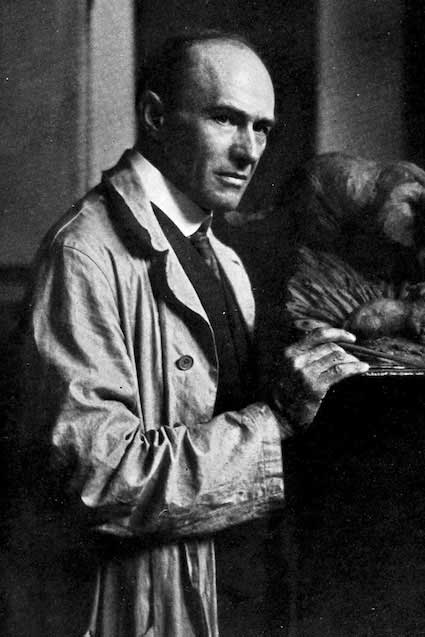
Carl E. Akeley, circa 1914, The American Museum Journal
The story of Carl Ethan Akeley is one of my favorite tales of a local boy who traveled beyond the boundaries of Orleans County to leave a lasting impact on the world. This prolific naturalist, taxidermist, artist, and inventor was born May 19, 1864 to Daniel Webster Akeley and Julia Glidden.
He grew up as a child in the family home on Hinds Road where he took an early interest in the preservation of animal specimens. To his family, this “morbid curiosity” earned him the reputation of being “odd,” that was until he mounted his aunt’s beloved yellow canary that died one cold evening.
He entered the tutelage of David Bruce of Sweden, New York, an artist and taxidermist known locally for his mounting of bird specimens for E. Kirke Hart (now on display at the Cobblestone Museum). Akeley’s time with Bruce was short, the latter recognizing his pupil’s unusual proficiency and skill in the art of taxidermy. At the age of 19, Akeley found employment with Ward’s Natural Science Establishment in Rochester, officially launching his professional career in mounting animal specimens.
It was during his tenure at Ward’s that he became attuned to the disconnection between taxidermy as an art and taxidermy as a science. To Akeley, these mounted specimens lacked the context that came from showing animals in their natural habitats. Although he held strong feelings on the direction of the profession, it was not until his work on the mounting of Jumbo, P.T. Barnum’s East African circus elephant in September of 1885, that he developed an expert’s voice.
Two years after his first major project, he left Ward’s for a part-time position with the Milwaukee Public Museum where he developed his trademark of setting animals against painted backgrounds. These backgrounds mimicked the natural habitat of the focal specimen, adding the necessary context to the piece. It was this particular type of work that earned Akeley his reputation as a premier taxidermist and eventually led to his appointment as chief of the department of taxidermy at the Field Columbian Museum (now the Field Museum) in Chicago. During his tenure in Chicago, Akeley experienced his first of five African expeditions. It was on this trip that he first stared death in the face, killing a leopard with his bare hands.
Over the course of his life, Akeley was responsible for the invention of a “cement gun” used for spraying plaster under newly mounted animal skins. The device was used in the repair of the exterior walls of the Field Museum and earned him the John Scott Legacy Medal of the Franklin Institute in 1916. It was thanks to Akeley’s work that we have motion picture footage of the First World War. His 1916 patent of the Akeley Motion Picture Camera, dubbed the “pancake camera,” was developed out of his efforts to capture moving images of animals in the wild. The U.S. War Department adopted the camera for capturing war footage, which later received the John Price Wetherill Medal of the Franklin Institute in 1926.
Much more can be said of Akeley’s life; his commitment to the American Museum of Natural History in New York City, his insistence on shooting animals for the sake of preservation instead of sport, his friendship with Theodore Roosevelt, or his numerous encounters with death while on expeditions in Africa. His lasting legacy, however, is defined by the establishment of the Albert National Park in Africa. In 1921, he visited Mt. Mikeno on his fourth expedition to collect gorilla specimens. It was during this visit that his ideas on the collection and preservation of animal specimens fundamentally changed. Thanks in part to Akeley’s work, King Albert I of Belgium set aside land for the first national park in Africa in 1925. That park remains intact today as the Virunga National Park.
This UNESCO World Heritage Site is home to the bush elephant, the endangered bonobo, and Akeley’s endangered mountain gorilla. News media announced recently that the Democratic Republic of Congo is now exploring the possibility of opening this important refuge to oil drilling. With this news comes the possibility that Akeley’s legacy could come to an end in our lifetime. It was thanks to his foresight that we can view these beautiful animals in a recreation of their natural habitat. It was his lifelong vision that we should never lose the ability to view these living species in the wild, if we should so choose.
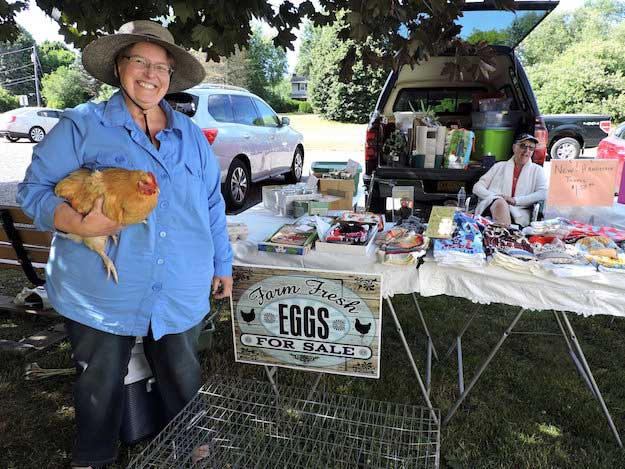
Photos by Ginny Kropf: Nyla Gaylord, who pushed to start a Farmers’ Market in Clarendon, holds her pet chicken Goldie during the market’s opening day Thursday. At right is vendor Terry Garrison of Albion, who sold homemade hand towels and other crocheted items. Gaylord also sold brown eggs from her farm.
Posted 22 June 2018 at 8:06 am
Theresa Jewell of Clarendon demonstrates weaving alpaca during opening day of the Clarendon Farmers’ Market Thursday.
By Ginny Kropf, correspondent
CLARENDON – For the first day, the Clarendon Farmers’ Market was a big hit.
Understandably, vendors will increase as produce becomes more readily available, but market organizer Nyla Gaylord couldn’t have been more pleased.
A variety of vendors offered tomatoes, garlic bulbs, plants, crafts, beef jerky, fudge, baked goods, spice mixes, vegetable and flower plants, crocheted items and goats milk soap, to mention a few.
Gaylord sold out of her brown eggs, and enjoyed showing off her pet chicken, Goldie.
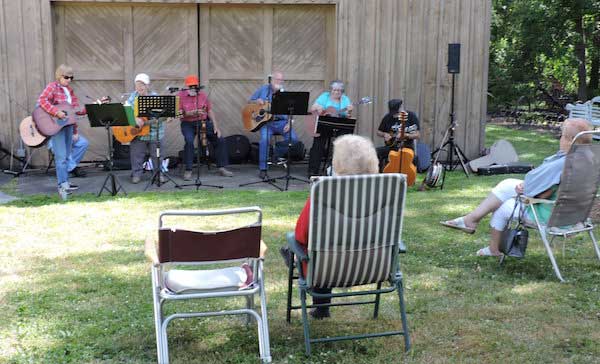
Many who stopped to shop took time to listen to the band Fox Run play country/western music. The band, whose members are nearly all in their 80s, was started by Gaylord’s aunt Joyce Tyler of Brockport and Marilyn Lafferty.
Kim’s Kitchen offered samples of homemade fudge and used the market as an opportunity to promote their new business which offers a variety of soup and spice mixes, gluten- and sugar-free meals and catering.
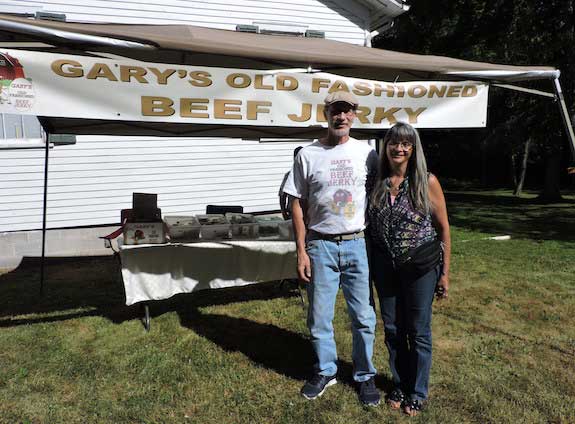
Gary and Rita Casale with their homemade beef jerky were among the vendors for the first ever farmers’ market in Clarendon, which opened Thursday afternoon.
Another vendor was Theresa Jewell of Stoney Meadows Alpacas and Stone Mountain Looms on Glidden Road, who was weaving an alpaca shawl. She was also selling a book she and Ashley Couch wrote on continuous strand weaving, which she said was selling very good. In addition, she had goats’ milk soap which her daughter makes.
“I think the market has potential,” Jewell said. “There has been a lot of community support and when the produce season gets going, I think it will bring more people out.”
Gary and Rita Casale, who make homemade beef jerky, were delighted with the local opportunity to sell their goods.
“When it’s this easy and this close, we’ll be here every week,” Gary said.
The market will run from 3:30 to 7 p.m. every Thursday through the end of October on the grounds of the Clarendon Historical Society. Any interested vendors or entertainers are urged to contact Gaylord at (585) 703-0564 or by e-mail at Clarendonfarmersmarket@aol.com.
Shoppers take a break to listen to the country/western band Fox Den during opening day of the Clarendon Farmers’ Market.
CLARENDON – A new farmers’ market in Clarendon is a dream come true for Nyla Gaylord, a Clarendon native who also is a proponent of home-grown food.
In the spring, Gaylord suggested the idea of opening a farmers’ market in Clarendon and on Thursday afternoon, her idea will become a reality.
The Clarendon Farmers’ Market will debut on the grounds of the Clarendon Historical Society and will be open from 3:30 to 7 p.m. every Thursday until the end of October.
Six vendors have already signed up, and more are welcome.
“Locating the market at the Historical Society complements the friendly ‘old time country’ feeling the market seeks to promote,” Gaylord said.
She first became interested in starting a market last winter when she canvassed local farmers’ markets in search of a local venue to sell the eggs she raises on her family farm.
“I’ve always enjoyed raising chickens and envisioned I would spend my early retirement years working part time selling eggs and other farm products I could produce on my own property,” Gaylord said. “I was surprised to learn the smaller farmers’ markets in Orleans and adjoining counties were not accepting new vendors. While my research supported the idea there is a growing demand for locally produced food, it seemed there was no local venue for small producers to get the food to consumers. So, the best alternative seemed to be starting one in Clarendon.”
Melissa Ierlan, historian for the town of Clarendon and president of the Clarendon Historical Society, has always been a supporter of new ideas to promote the town and its history, Gaylord said.
“Melissa pointed out the antique farm equipment and facilities at the Historical Society would be an ideal backdrop for the old fashioned public market I envisioned,” Gaylord said. “We surveyed about 35 residents and got their input on what should be offered, where and when. It seems Thursday afternoons will not conflict with other public markets and community events. We hope to attract commuters who travel Route 31A, as well as local residents and groups of tourists.”
With the support of the Clarendon Historical Society and the town of Clarendon, Gaylord wrote two proposals for funding for advertising and staff for the market. And while they were not funded, Gaylord said she made some valuable contacts and learned a lot about starting and running a market.
“Clearly, it’s a lot of work, but I decided ‘if it is to be, it is up to me,’ and jumped in to do what is needed to make it happen,” Gaylord said. “This is my home town and we need something like this to help build community, stimulate the local economy and make fresh food easily available to our neighbors, many of whom are older and have limited transportation.”
In the future, the market will accept Food Stamps and the Senior Nutrition Farmers Market coupons.
Vendors will offer eggs, baked good s, vegetables, crafts and more.
Opening day at the Clarendon Market will also feature music by the bluegrass/gospel group, the Fox Den.
Interested vendors and musicians who would like to take part in the market are encouraged to contact Gaylord at (585) 703-0564 or e-mail Clarendonfarmersmarket@aol.com. There is no fee to set up a table, but donations to help with the cost of advertising are gratefully accepted.
Clarendon Historical Society is located on Route 31A, just east of the center of town.
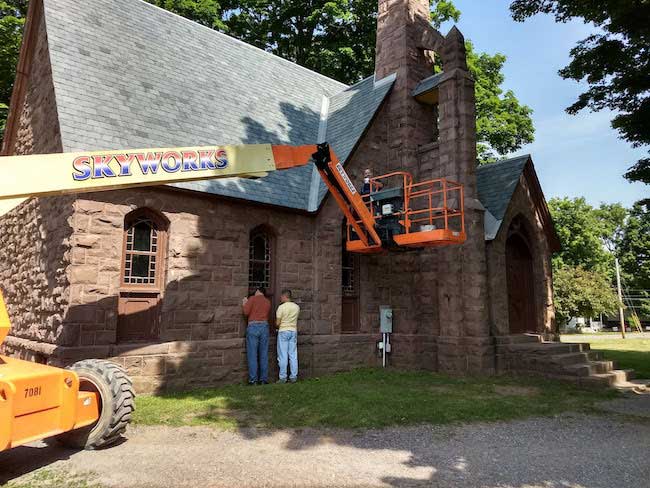
CLARENDON – This photo shows Tim Wheeler of TSW Masonry on the lift as Russ Bosch, project engineer, and Steve Swiat of Northwood Historic Restoration discuss the window restoration project for the chapel at Hillside Cemetery.
Wheeler has repointed the interior walls of the basement and the chimney and ventilating tower. That project was completed last week.
Swiat has begun scraping and repairing the decorative wooden frames of the windows. He will remove the sashes when Clarendon has a ship date for the replacement glass and he will restore them and replace broken panes, said Erin Anheier, a member of the Clarendon Historical Society which has helped spearhead the project. Unbroken panes will be reused. The replacement glass is being specially made to match the color and texture of the original glass. The glass has an 18-week lead time.
Soon, Tom DiFante will be repainting the wooden eaves.
The state has approved a $126,210 matching grant for work on the chapel at Hillside Cemetery. Matching funds are a combination of other local grants (Elisabeth Dye Curtiss and Rochester Area Community Fund), cash donations from local residents, some funds that the Town of Clarendon received from the Cemetery Association when the Association disbanded and fundraising events run or coordinated by the Clarendon Historical Society.
The chapel’s roof has already been replaced as part of the efforts to preserve the chapel, which was built in 1894 of locally quarried Medina Sandstone in a Greek Revival style.
Hillside Cemetery was placed on the State and National Registers of Historic Places in 2013 with the chapel being a major contributing asset. In 2014, the Landmark Society of Western New York named the chapel to its “Five to Revive” list.
The next step is to restore the interior. Clarendon is currently awaiting for the specifications to be approved by the State for that work.
By Tom Rivers, Editor Posted 21 April 2018 at 5:40 pm
‘It’s now officially spring. It’s not spring until there’s a grass fire.’ – Byron firefighter
Photos by Tom Rivers
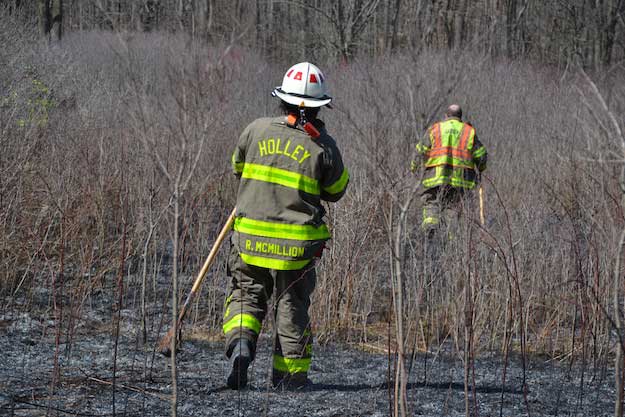
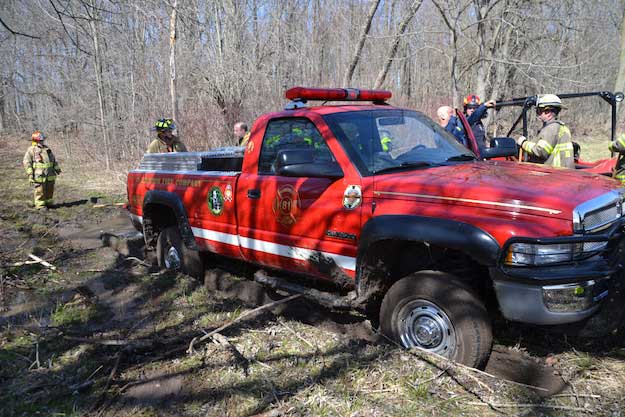
CLARENDON – Firefighters from several departments were dispatched about 2:30 p.m. today to a grass fire that became out of control for the property owner on Holley Byron Road, near the Glidden Road intersection.
The field was back from the road about a quarter mile.
Mud by a small creek made it impossible to get a pickup truck close to the scene.
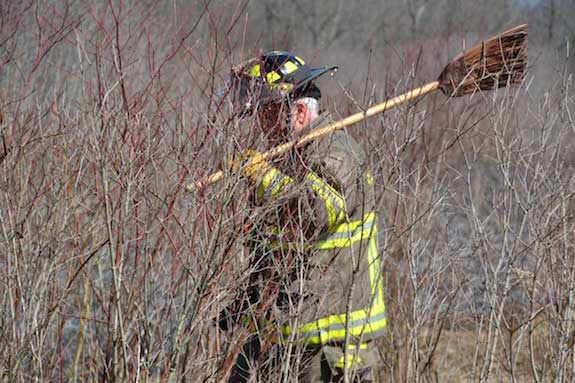
Firefighters used brooms to stop the fire. The property owner said he went for a walk to the field to enjoy a long-awaited sunny day in the 50s. He lit a cigar and then the grass and field were on fire. He tried to stomp on the fire, but it was moving too quickly. He thanked the firefighters for hustling to get back and prevent the fire from spreading to a nearby wooded area.
Jon Salber, a Clarendon firefighter, looks for hot spots in the field.
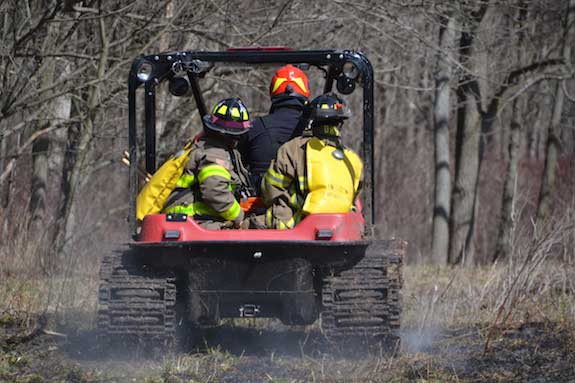
Firefighters used this Argo all-terrain vehicle to get to the scene. They have Indian tanks on their backs with water.
Firefighters from Clarendon, Holley, Fancher-Hulberton-Murray and Byron responded to the scene. Barre and Elba were also called, but then that was cancelled, said Jon DeYoung, Clarendon fire chief.
“It’s now officially spring,” said a Byron firefighter. “It’s not spring until you have a grass fire.”
By Tom Rivers, Editor Posted 25 March 2018 at 6:28 pm
Provided photo
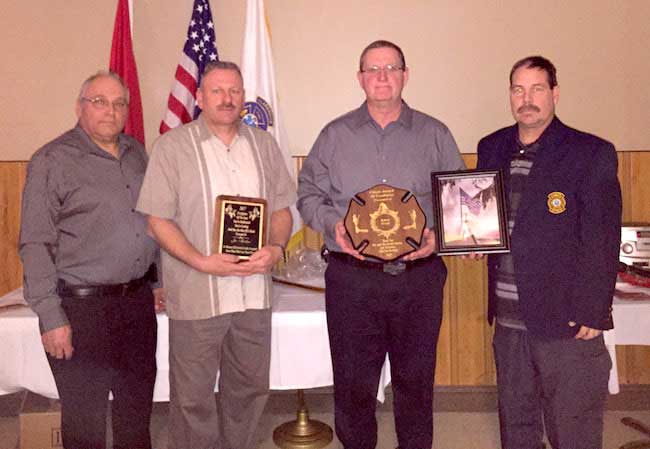
CLARENDON – The Clarendon Volunteer Fire Company held its annual banquet on Saturday evening and presented its awards.
Pictured, from left, include: Dan Campbell – Director, past chief, safety officer, and banquet MC.
Joe Morlino – Firefighter of the year, lieutenant, and vice president. Morlino was a past chief at Fancher-Hulberton-Murray before joining Clarendon. He is very dedicated and also helps with fundraising for the fire company.
Bob Margis – Recipient of the Chief’s Award. He is a director, past chief, and safety officer. Margis was diagnosed with thyroid cancer this year but never slowed down with the fire company, responding to many calls.
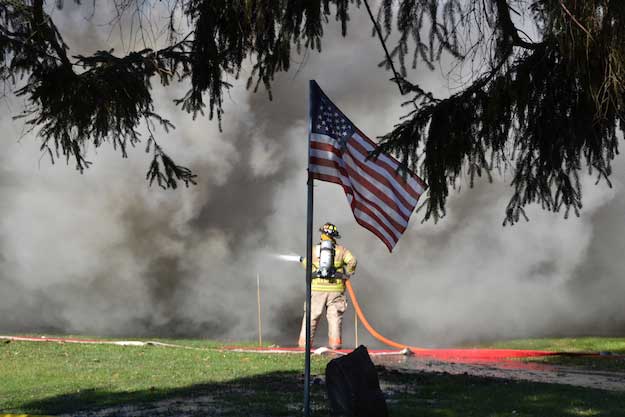
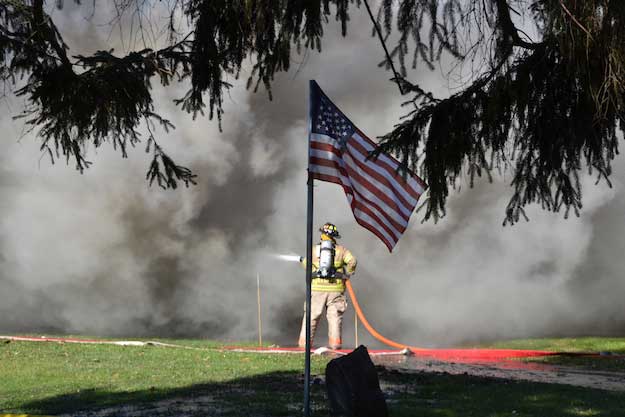
Chief Jon DeYoung – He is holding a picture of Bob Margis at a structure fire from Nov. 28.
The photo includes lots of smoke and an American flag in the foreground. (The photo of Margis was originally published on the Orleans Hub.)
By Tom Rivers, Editor Posted 24 March 2018 at 4:43 pm
Photo by Tom Rivers
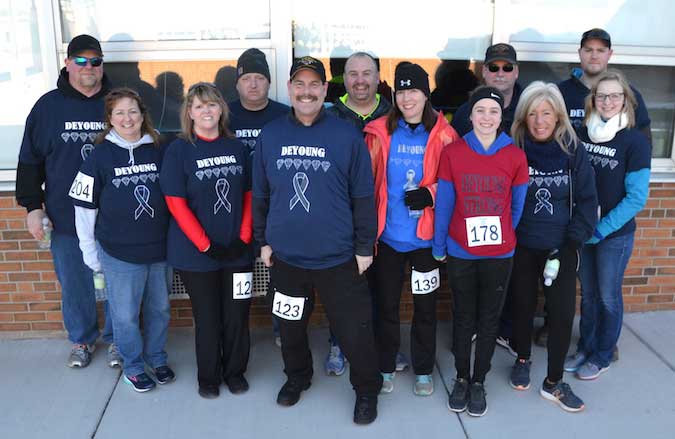
ALBION – Jon DeYoung, front center, was joined by about a dozen friends and family this morning at the Wayne A. Burlison-Colon Cancer Awareness 5K Run and Walk in Albion. The event is in memory of an Albion elementary school teacher who died at age 36 on March 26, 2014. Burlison fought colon cancer.
DeYoung, 52, is the Clarendon fire chief. He is now fighting colon cancer for the third time. He was diagnosed around Christmas. He completed his chemo treatments.
He walked the entire 3.17-mile course this morning with his wife Brenda, son Jon and his wife Jessica, brother Jim and his wife Jackie, and several firefighters. Some of the firefighters wore their turnout gear while walking the course. The group also wore “DeYoung Strong” shirts.
DeYoung wanted to be at the event to raise awareness for colon cancer. He urged people to get checked for the disease.
By Matthew Ballard, Orleans County Historian Posted 20 January 2018 at 8:43 am
“Overlooked Orleans” – Volume 4, Issue 3
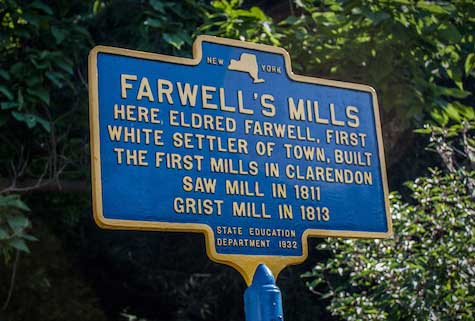
CLARENDON – Of the New York State Historic Markers erected by the NYS Department of Education, the overwhelming majority cover locations deemed significant to the earliest history of Orleans County including Native American and pioneer sites. The marker situated at the Town Park on Holley Byron Road in Clarendon calls attention to one of the earlier settlements in our area.
The marker reads, “Farwell’s Mills, here Eldred Farwell, first white settler of town, built the first mills in Clarendon, saw mill in 1811, grist mill in 1813.”
While consulting several seminal publications on early Orleans County history, the spelling of Farwell’s name is clearly debated; here, the State Department of Education uses a shortened spelling. Arad Thomas records Farwell’s name as Eldridge in Pioneer History of Orleans County, New York, but this historian would prefer to reference Farwell’s name as spelled by David Sturges Copeland in his History of Clarendon from 1810 to 1888 where he records the name as Eldredge.
Perhaps this is a detail that would only concern Farwell himself, but his contributions to the early settlement of Clarendon are also duly noted within the pages of these books. Born to William and Bethel Eldredge Farwell on March 6, 1770 at Charlestown, New Hampshire, Eldredge settled in the vicinity of Clarkson along the Ridge Road. From other publications, we know that his brother Isaac settled nearby to the west of the Ridge Road and Lake Road intersection in the same location.
As so many historians have recorded, the story of Clarendon’s foundation occurred by happenchance after the unfortunate escape of Isaac Farwell’s horse around 1810. Following the animal’s trail along the bank of Sandy Creek, it is said that Eldredge stumbled upon a waterfall and while recognizing its potential for power, decided that he should settle the area. Farwell purchased approximately 210 acres the following year and relocated his wife and five children to the area in the spring of 1811. With that acreage upon which the beautiful waterfall sat came the mill privilege, providing him with the opportunity to construct a grist mill on the site.
In the unsettled wilderness of Orleans County, the role of the mill owner was one of significance, prestige, and prominence. Grist millers held the key to survival, providing an invaluable service to settlers who needed to grind corn and wheat into flour. Settlers could travel west, east, or south to “nearby” locations to grind their grains, but trips to these areas were marred by unimproved roads, swamps, and waterways without bridges. The convenience of a local miller, of course, was preferred and Ambrose Ferguson was hired to labor in the mill at the astonishing rate of $20 per month.
Farwell’s establishment of a grist mill in 1811 followed by a saw mill in 1813 provided a significant amount of political capital to the 43-year-old pioneer. When the town held early elections for the position of supervisor, he was selected by his neighbors to the post. He operated the first post office at the location then known as “Farwell’s Mills,” which his sons later assisted in delivering mail to Byron Center by horseback when the stagecoaches operated between Rochester and Buffalo. He was later selected as a judge in the court of common pleas and from that point on was known locally as Judge Farwell.
When William Morgan disappeared in 1826, presumed to have been kidnapped and murdered by Masons, a series of trials took place in Orleans County involving local men accused of participating in the conspiracy. Elihu Mather, brother of Gaines pioneer James Mather, was accused of driving the carriage carrying Morgan through Orleans County. The exhaustive process of selecting unbiased jurors resulted in Judge Farwell’s participation in the defense’s challenge of Stephen Martin as a potential juror. According to Farwell, Martin had expressed an opinion of guilt, telling him explicitly that the masonic institution was corrupt, that Morgan was forcibly carried by carriage along Ridge Road, and that Morgan was most certainly in the carriage driven by Mather. The testimony resulted in Judge Addison Gardiner setting Martin aside as a juror.
The site on which this marker sits was donated to the Clarendon Grange in 1940 by Morris Brackett, Chief Game Protector of the NYS Conservation Department and a descendant of Farwell.
Erratum: Volume 4, Issue 2 noted that B. T. Roberts was removed from the pulpit of the Methodist Church in Albion – Roberts was living in Albion and relocated to Pekin, NY, but did not serve as pastor of the Albion Methodist Church. A huge thank you to Pastor Randy LeBaron for the correction!
By Tom Rivers, Editor Posted 28 November 2017 at 12:56 pm
Photos by Tom Rivers
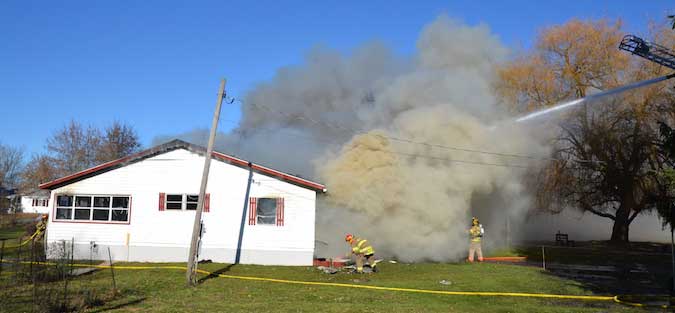
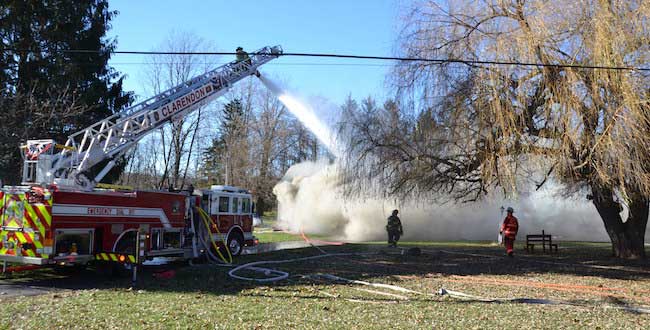
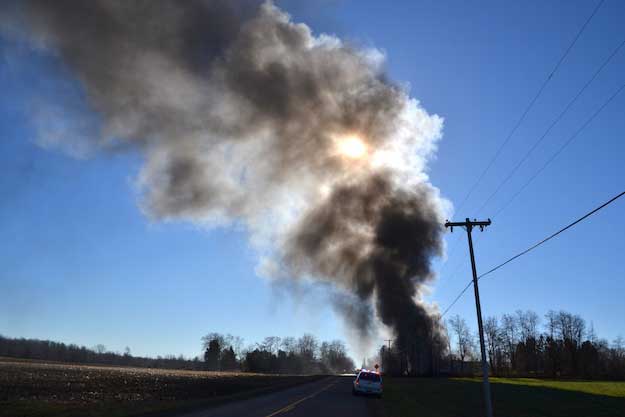
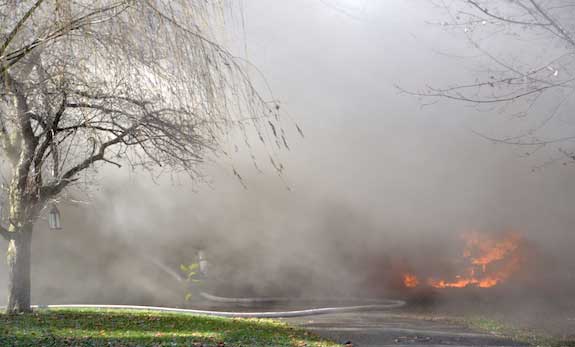
CLARENDON – A fire late this morning destroyed a house and garage at 4214 Fancher Rd. The fire was reported at about 11:30 a.m. The house is owned by Jim and Marge Dale.
The fire is under investigation and no cause has been determined, but firefighters said it looks like the fire started in a garage and quickly spread into the house.
The fire spewed dark smoke on Fancher Road, north of Route 31A and south of Route 31.
Several fire departments responded to the scene, including Clarendon, Holley, Fancher-Hulberton-Murray, Albion and Brockport.
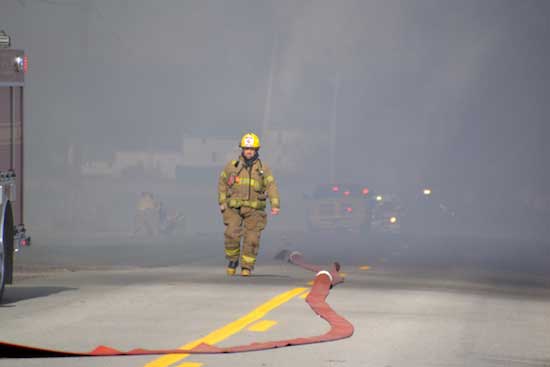
Robert Margis, a Clarendon firefighter, keeps a steady stream of water on the fire.
Rob Conner of Albion helps straighten the hose so firefighters could get more water on the fire.
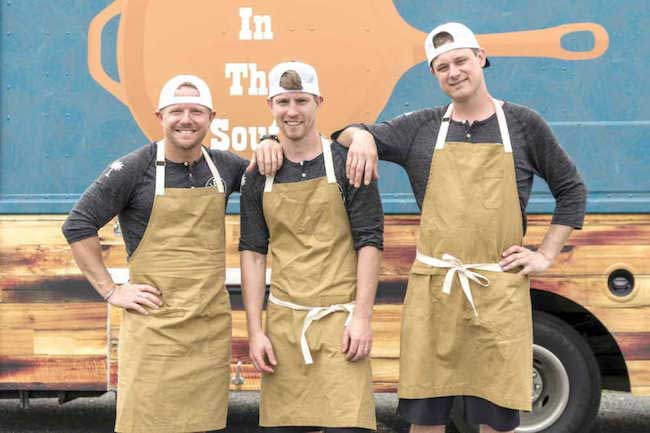
Food Network: Nick Hunter, Steven Klatt (center) and Brandon Lapp are teammates in Braised in the South which won the Food Network’s “Great Food Truck Race.” Klatt is a Holley graduate.
By Tom Rivers, Editor Posted 24 September 2017 at 10:42 pm
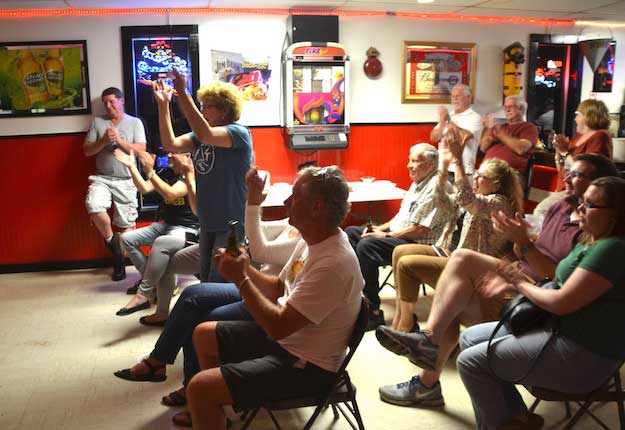
CLARENDON – When the winning team was announced on the Food Network’s Great Food Truck Race, the Clarendon Rec Hall crowd jumped out of their seats and hollered in joy.
Steven Klatt, 31, and his teammates on Braised in the South took home the top prize, $50,000. Klatt grew up in Clarendon and graduated from Holley. He is the son of Ryan Klatt and Susan Colby, the Clarendon town clerk.
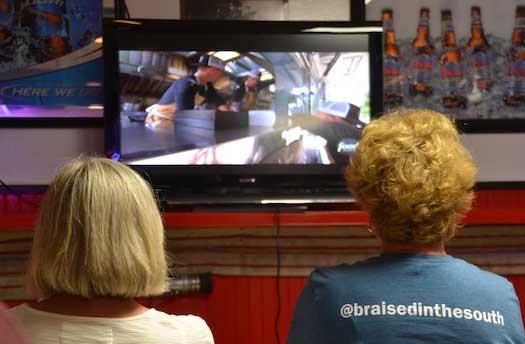
Susan Colby, standing, jumps out of her seat after her son’s team won the “Great Food Truck Race” on the Food Network. The show aired from 9 to 10 p.m. on Sunday.
Colby watched the finals at a viewing party at the Clarendon Rec Hall with about two dozen people. She had tears rolling down her face after Klatt and his team won the grand prize.
“We’re pretty darn proud,” Colby said. “He deserves all the credit.”
Braised in the South is based in Charlotte, South Carolina. It faced Mr. Po’ Boys from Dallas, Texas, in the finals in Savannah, Ga.
The team that sells the most food is the winner. Braised in the South created dishes with shellfish, scallops and clams to win the finals.
The competition features Southern-style food. The Great Food Truck Race started with seven teams, but each week one is eliminated, the team with lowest sales.
Susan Colby, right, watches the show wearing a Braised in the South shirt.
Colby said her son and his teammates are planning to go into the food truck business. They all work as chefs in Charleston.
Klatt and his wife have two children.
“It’s the most humbling experience I’ve ever been a part of,” Klatt said on the show. “It’s all worth it.”
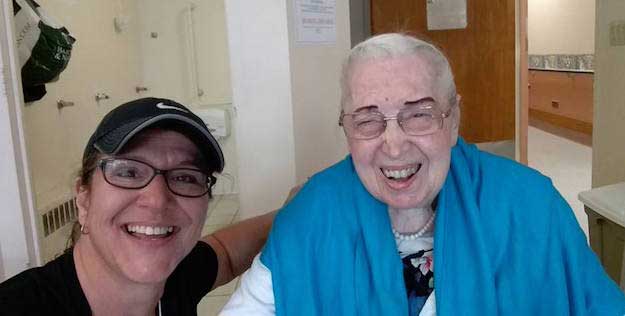
Photos courtesy of Melissa Ierlan: Clarendon Town Historian Melissa Ierlan is pictured last July with Ida M. Brace Cook.
Posted 29 August 2017 at 3:50 pm
By Melissa Ierlan, Clarendon Town Historian
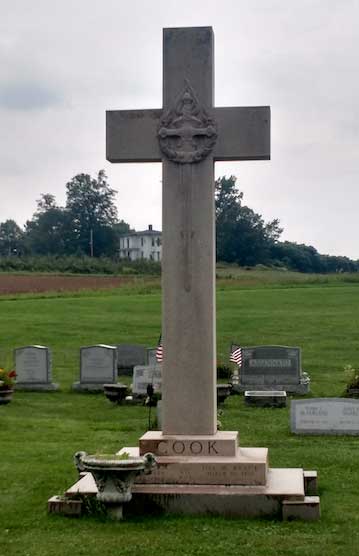
The Cook family monument is prominent at Hillside Cemetery.
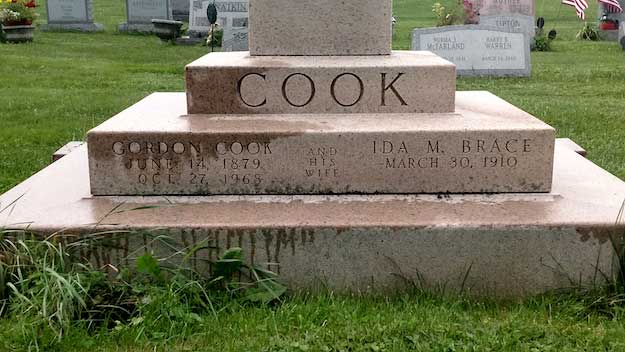
CLARENDON – Ida M. Brace Cook born March 30, 1910. The first time I saw this I was sad to think that a person had passed away and a date of death wasn’t on her headstone.
This was probably 2012 and little did I know that this woman was still alive. I discovered that she was living in New York City somewhere. Several years went by and I thought of her every time I was in the cemetery. I learned a little more about her and her connection with a well known family from Clarendon.
I discovered that an old family photo album of the Cook family had been donated by her to our county historian who then donated it to the Clarendon Historical Society.
Fast forward to 2016, and I find myself in NYC visiting the Museum of Natural History. By this time I was able to locate and contact Mrs. Cook with the help of Bill Lattin and made arrangements to visit her. Mrs. Cook was 106 years old when I met her and lived in a nursing home in NYC. She visited with me for an hour or so and told me the story of how she grew up in Albion and how she met Gordon Cook, a descendant of Lemuel Cook, the Revolutionary War soldier who lived in Clarendon.
She spoke of his family, especially his mother who made her way to the USA with an ox cart and her children by herself. Gordon was many years older than Ida when they married but they made a life and did quite well.
Mrs. Cook was very independent up until an accident in 2013 which left her in a wheelchair. She went from assisted living into a nursing home. She had a very sharp mind and although she was almost deaf, she would respond to written questions and speak about anything you could ask.
Before I left the nursing home, she was giving me suggestions of places in NYC that I might go to eat. She even gave directions on how to get to several places. She was a very remarkable woman and I feel fortunate to have met her even for a short visit.
Mrs. Cook passed away last week on Aug. 22. She will be laid to rest on Wednesday, August 30, at 1 p.m. at Hillside Cemetery in Clarendon. There will be a graveside service. The public is welcome to attend.
Mrs. Cook will be laid to rest at the family plot that includes her husband Gordon.






















 “Overlooked Orleans” – Volume 4, Issue 3