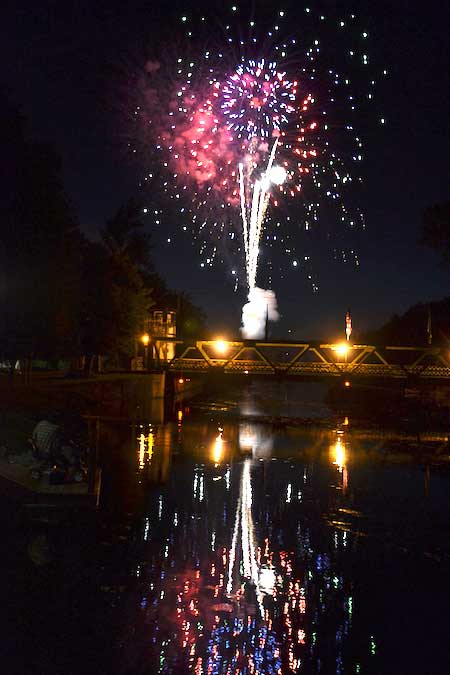
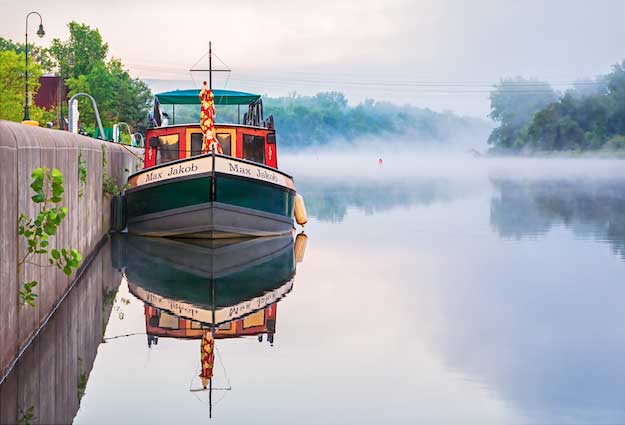
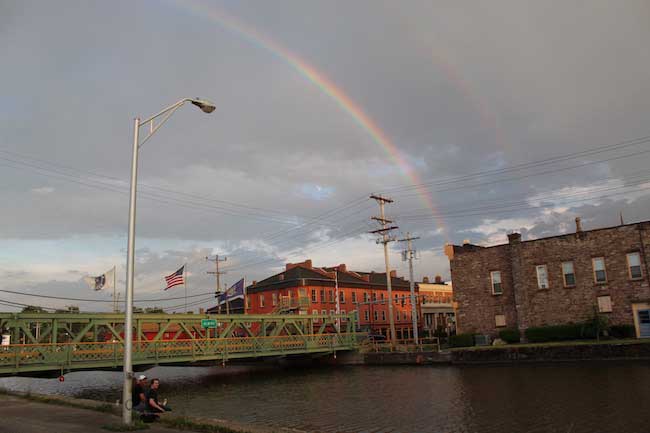
This photo of the Canal Park in Waterford won first place in the Canal Communities category of the 14th Annual Erie Canalway Photo Contest. It was taken by Wesley Merritt, Clifton Park.
By Tom Rivers, Editor Posted 2 October 2019 at 10:08 am
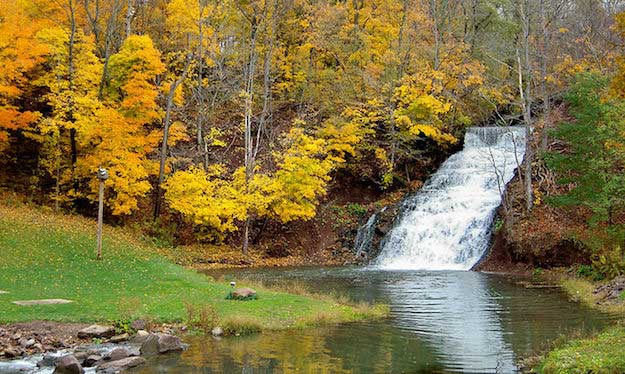
Image of Holley Waterfalls receives an honorable mention
The winning photos in the 14th Annual Erie Canalway Photo Contest have been announced by the Erie Canalway National Heritage Corridor.
The 12 winning images will be showcased in the 2020 Erie Canalway National Heritage Corridor calendar, which will be available for free at libraries and visitor centers beginning in December.
The first place winner in “Classic Canal” shows the Tugboat Erie in Little Falls. The photo was taken by Frank Forte of Little Falls.
Judges selected first, second and third place photographs in four contest categories from nearly 250 entries. In addition, twelve photographs received an honorable mention, including one that shows the Holley Waterfalls.
“These beautiful photos showcase the dramatic landscapes, rich heritage, and vibrant communities along this historic waterway,” said Bob Radliff, Erie Canalway Executive Director. “We hope they inspire people to explore this extraordinary place and celebrate the canal that built the Empire State.”
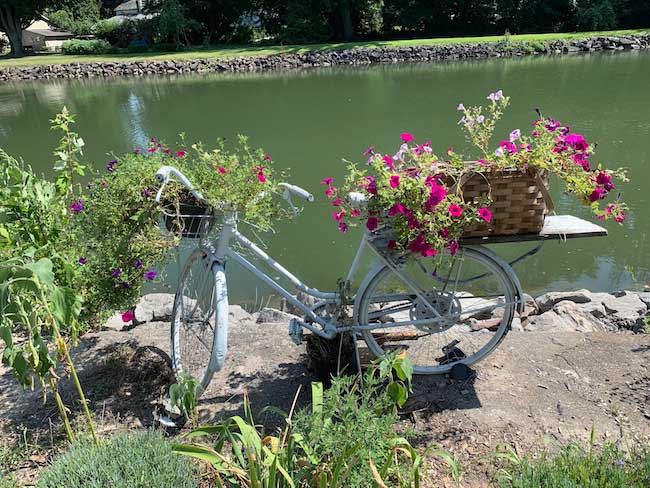
Photo by Tom Rivers: A bicycle is dressed up with flowers to beautify the canal path in Hulberton in this photo from last week.
Posted 12 August 2019 at 9:38 am
Press Release, Erie Canalway National Heritage Corridor
WATERFORD- Amateur and professional photographers are invited to submit entries for the 14th annual Erie Canalway Photo Contest. Photos should convey the wealth of things to do and see along the waterway and express the beauty and unique character of the canal and canal communities. Winning photos will be featured in the 2020 Erie Canalway calendar.
Entries must be postmarked by Aug. 30. Submissions must be horizontal format only. Photos must be taken within the Erie Canalway National Heritage Corridor. The Corridor spans 524 miles across the full expanse of upstate New York. It encompasses the Erie, Cayuga-Seneca, Oswego, and Champlain canals and their historic alignments, as well as more than 230 canal communities.
Judges select first, second, and third place winners based on creativity, photographic quality, and effectiveness in conveying the beauty and unique character of the Canalway. Winning images are displayed in the annual Erie Canalway Calendar.
Nearly 200 years after its construction, the Erie Canal remains an iconic symbol of American ingenuity and determination. The Erie Canalway National Heritage Corridor preserves our extraordinary canal heritage, promotes the Corridor as a world-class tourism destination, and fosters vibrant communities connected by more than 500 miles of waterway. It achieves its mission in partnership with the National Park Service, New York State agencies, non-profit organizations, local residents, and more than 200 communities across the full expanse of upstate New York.
Governor Andrew M. Cuomo today signed legislation (S.5685/A.4853.A) – or Brianna’s Law – to phase in requirements that all operators of motorized watercraft must complete a state-approved boating safety course.
Brianna’s Law is named after Brianna Lieneck, an 11-year-old Long Island girl who was killed in a 2005 boating accident. The Governor also directed State Parks to launch a boating safety promotional campaign to remind boaters of the new requirement to take a safety course.
There are nearly 439,000 registered powerboats in the state, according to the 2018 state Recreational Boating Report. The law does not apply to operators of sailboats, kayaks, standup paddleboards, rowboats or canoes.
“Boating has become much more popular and our rules and our laws really have not kept pace with it,” Governor Cuomo said. “There should be a basic level of knowledge that you have before you’re given the permission to go out there and operate a boat, and making a safety course mandatory is common sense. It protects the operator of the boat and everyone that operator could come into contact with, and it will make our waters safer. It took a horrific accident to make this situation real for people, but through this law Brianna is saving lives and her love lives on.”
The measure expands an earlier law signed by Governor Cuomo that requires boaters born after May 1, 1996 to complete a safety course before operating a motorized watercraft. Under the phase-in, all motor boat operators born on or after Jan. 1, 1993 must complete a safety course to operate a motor boat beginning in 2020.
Those born after Jan. 1, 1988 must complete a safety course beginning in 2022. Those born on or after Jan. 1, 1983 must complete a safety course beginning in 2023. Those born on or after Jan. 1, 1978 must complete a safety course beginning in 2024.
The requirement would extend to all motor boat operators beginning in 2025, regardless of age. Failure to comply could result in a fine of between $100 and $250 under the new law that goes into effect Jan. 1, 2020.
The Office of Parks, Recreation and Historic Preservation, which administers the law, estimates that there are nearly one million boaters who will have to take the safety courses before the end of the phase-in on Jan. 1, 2025.
The law allows for the continued acceptance of State Parks approved internet-based learning and certification to meet this new demand. Classroom courses will also continue to be available. Information about both internet and in-classroom courses can be found on the State Parks’ website.
Governor Cuomo also directed State Parks to launch a boating safety promotional campaign to ensure that boaters are aware of the new requirement to take a course online or in person and to promote safety on our waterways, including radio and social media advertisements; distribution of informational materials to law enforcement, the U.S. Coast Guard, marinas, boating education instructors and boating safety partners; and State Parks website updates.
State Parks Commissioner Erik Kulleseid said, “New York State offers some of the best boating and fishing adventures in the country. The best way to enjoy these adventures is to do so safely. It makes sense that for every boater to learn the basics of boating safety before operating a motor boat.”
By Tom Rivers, Editor Posted 3 August 2019 at 11:24 am
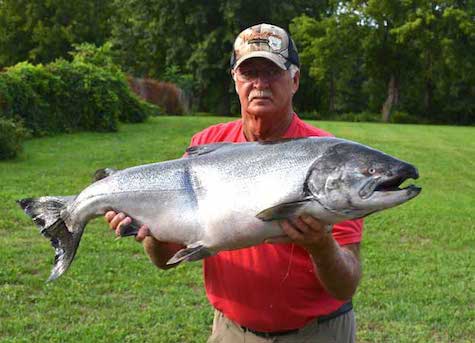
Photo by Tom Rivers: Kent Morgan, owner of Let It Ride Charters in Carlton, holds the grand prize fish from the 2018 fishing derby organized by the Albion Rotary Club. The 29-pound, 14-ounce salmon was caught by Morgan’s customer, Joseph Miller of Harrisburg, Pa. The big fish won the $4,000 grand prize.
The annual Rotary Fishing Derby starts today and continues until Aug. 18 with $8,800 in prizes available. The angler who catches the biggest fish in the derby wins $4,000.
Participants in the derby can enter fish in four divisions: Chinook salmon, brown trout, rainbow trout, and lake trout.
Besides $4,000 for the biggest fish, the four division leaders each get $500, followed by $300 for second, $200 for third, $100 for fourth and $50 for fifth.
There is also a $200 prize to the Orleans County resident who catches the biggest fish.
The derby is sponsored by the Albion Rotary Club, and proceeds go towards community projects. The Rotary Club has been organizing the derby for more than 30 years, seeing the event as a way to promote tourism businesses and the local fishing scene.
This year the derby has been rebranded as the Rotary Fishing Derby after being known as the Orleans County Fishing Derby.
Marlee Diehl, a member of the Albion Rotary Club, is chairwoman of the event and has lined up many businesses to sell registrations which are $15 a day or $25 for the entire 16-day derby. Click here to see the sites.
She wants to top at least 500 registrants for the derby.
The Rotary Club runs the derby to promote tourism and the fishing resources in the community. The derby is also a fundraiser for the Rotary Club, which uses the proceeds for community service projects.
“Orleans County is a destination,” Diehl said. “We’re fortunate to have a Tourism Department that realizes it and promotes our fishery.”
An awards celebration at 4 p.m. on Aug. 18 at the Carlton Rec Hall is open to the community. There will be sausage and hot dogs served, and a chance to see the winning fish.
The derby coincides with an initiative from Gov. Andrew Cuomo to offer free fishing on Lake Ontario, the St. Lawrence River and the lower Niagara River from Aug. 2 through Labor Day, Sept. 2.
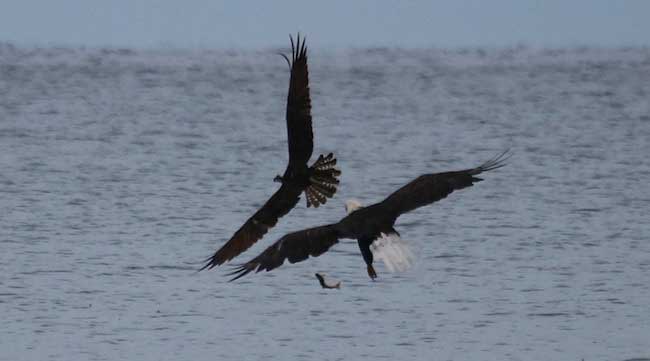
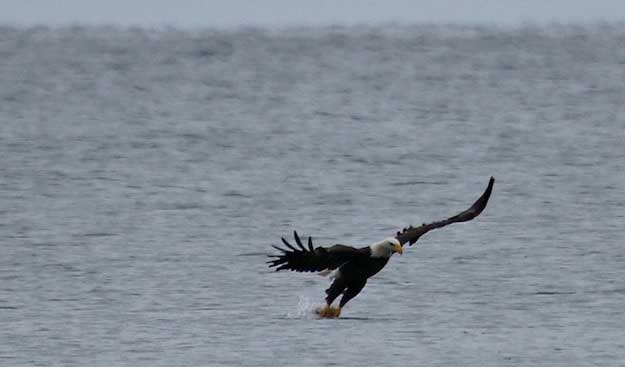
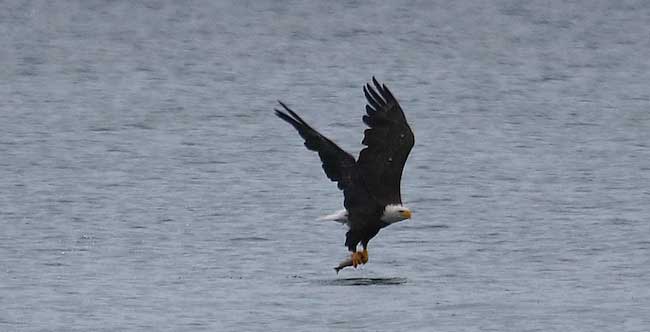
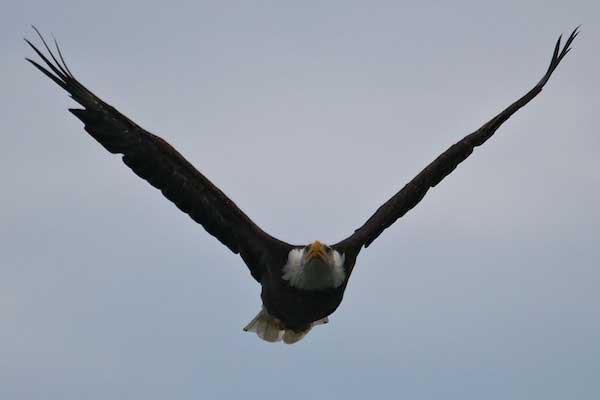
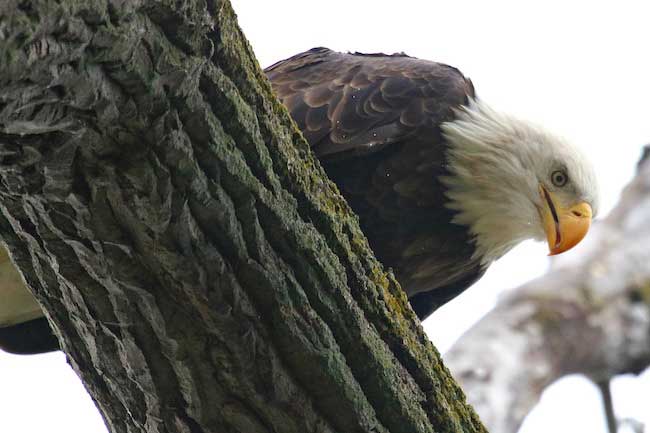
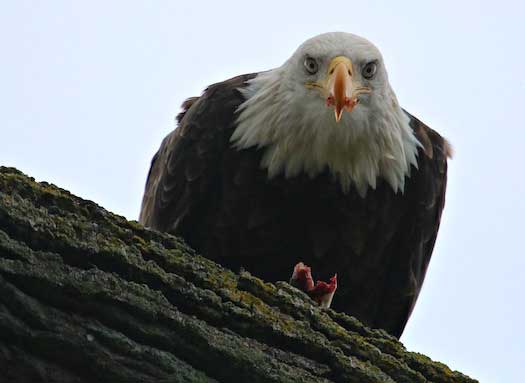
YATES – Beth Carpenter of Lyndonville was at a friend’s property this morning by Lake Ontario in Yates when she saw a bald eagle swoop out of a dead tree and go after an osprey that had just caught a fish.
“For me wildlife photos is all about being at the right place at the right time,” she said. “I don’t consider myself a professional. Today was one of those moments.”
She clicked away while the eagle chased the osprey, which then dropped the fish in the lake. The bald eagle then went for the fish and got it.
“I am so happy to see more eagles in our area!” Carpenter said.
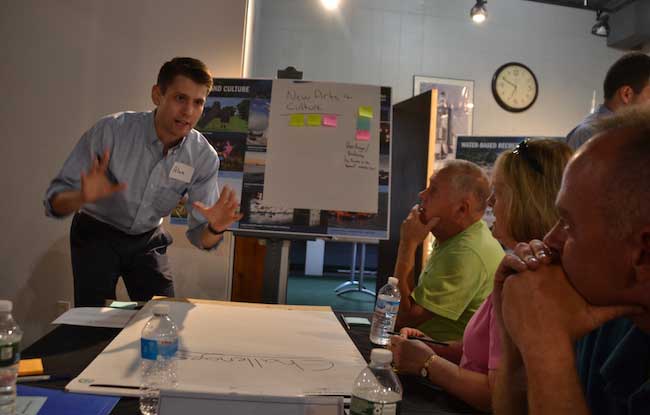
Photos by Tom Rivers: Alex Morse, a researcher with the Rockefeller Institute of Government in Albany, leads a group focused on Arts and Culture opportunities with the Erie Canal. About 60 people discussed ideas to better promote and use the Erie Canal during a discussion Monday at the Challenger Learning Center in Lockport. There will be another discussion today in Brockport at Cooper Hall at Brockport State College.
By Tom Rivers, Editor Posted 16 July 2019 at 10:20 am
LOCKPORT – The Sate Canal Corp. wants to hear from residents in canal communities on how the state can better promote the canal to visitors and made the canal a better asset to local residents.
The Canal Corp. has scheduled a series of community engagement sessions to hear from residents. There was a meeting on Monday in Lockport, and there is another today in Brockport. (Click here to see the schedule of sessions.)
“This comes at a very exciting time,” Brian Stratton, director of the State Canal Corp.
The Erie Canal is celebrating an 8-year bicentennial of the construction from 1817 to 1825. Stratton says the Canal Corp. is developing a vision for the next century of the canal.
Gov. Andrew Cuomo last year announced the “Reimagine the Canals” initiative and two winners were picked from 145 entries in a $2.5 million competition.
One of the winners includes the Erie Armada, a group of boats passing along the canal carrying people tasting craft beers. That armada will be Sept. 20-22 at the Macedon Canal Park.
Brian Stratton, director of the State Canal Corp., said the state welcomes feedback to increase the impact of the canal in communities along the historic waterway.
The Canal Corp. also picked a plan to develop a pocket neighborhood in Canastota, turning open spaces and former industrial areas along the canal turned into space for housing and community space.
But the Canal Corp. wants more ideas and going to the canal communities for inspiration.
At the Lockport meeting, there were the following focus groups – Tourism, Parks and Public Spaces, Arts and Culture, Nature and Environment, Water Recreation, Local Business and Events and others.
About 60 people attended the session at the Challenger Learning Center.
State Assemblyman Mike Norris, R-Lockport, was among the officials at the meeting. He is pleased to see the state putting resources into the canal, and seeking feedback from the canal communities.
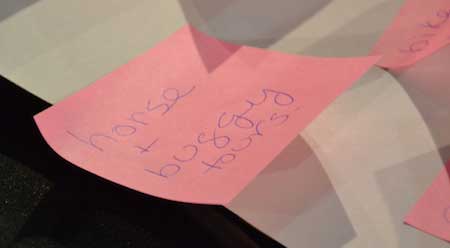
One of the ideas submitted includes using horse and buggy rides in canal towns.
The ideas at the sessions will be compiled by the Rockefeller Institute of Government and put into a report for the Reimagine the Canals Task Force. Former Lt. Gov. Bob Duffy, the current CEO of the Greater Rochester Chamber of Commerce is one of three co-leaders of the Task Force, with Duffy focusing on the western end of the canal.
The canal has changed from a commercial shipping hub in the 1800s to a recreational use today.
Some of the people at Monday’s meeting would like to see the canal develop heritage sites in each canal town, to help people understand and appreciate the history of the canal communities and the canal’s role in shaping them. That could include using bronze states, interpretive panels, murals and public arts projects to tell those stories.
Other ideas mentioned include:
• There is shortage of quality housing in many canal communities. Creating affordable and attractive living spaces should be a priority.
• There should be shuttle options on the canal. For example, if people take a kayak on the canal, they could then ride a bicycle back to the original destination.
• The canal is cleaner than in the past, but illegal dumping should remain a priority. Some people would like to see “fish ladders” to help fish travel in creeks and streams. Sometimes the canal is a barrier for fish in nearby creeks.
• More dining and lodging options needed along the canal.
• More festivals and events needed in canal towns.
• Making the canal more accessible to people with mobility challenges, and adding more handicapped accessible ramps for boats, canoes and kayaks.
• Some of the groups cited a lack of funding in making the projects a reality, and a difficulty in building consensus among local and state officials in what projects to pursue and then manage.
Photo courtesy of Char Olick: A double-rainbow appeared over the Main Street lift bridge and downtown Albion on Saturday evening.
There will be community engagement sessions this week in Lockport and Brockport as part of the State Canal Corp.’s goal to “Reimagine the Canals.”
There will be a session today in Lockport from 6 to 8 p.m. at the Challenger Learning Center, 160 Washburn St.
Then Brockport will host a session on Tuesday from 6 to 8 p.m. at the SUNY Brockport Cooper Hall.
The Rockefeller Institute of Government is leading the series of community engagement sessions this month for Reimagine the Canals, a state-sponsored initiative to identify new uses for the Erie Canal.
The initiative, launched in May by Governor Andrew M. Cuomo, builds on last year’s Reimagine the Canals Competition, which sought innovative ideas to boost local economies, increase recreation and strengthen environmental resilience along the Erie Canal.
“These sessions are a great opportunity for the public to help shape the future of the Erie Canal,” said Joanie Mahoney, the Reimagine the Canals Task Force chair. “The public’s input will be crucial in formulating the final recommendations about the Canal that will be sent to Governor Cuomo.”
First opened in 1825, the Erie Canal spans more than 360 miles. Today it is overseen by the New York State Canal Corporation, a division of the New York Power Authority.
As the Canal nears its third century, Governor Cuomo viewed this as the time to reimagine the future of this essential piece of New York State infrastructure as a resource for agricultural irrigation, ecological restoration, flood mitigation, boating, fishing and tourism.
The community engagement sessions will integrate the voices of Canal communities into the Reimagine initiative. Community members will learn about Reimagine the Canals and will discuss the Canal’s current uses and its potential future. The insights from these sessions will be presented to the Reimagine the Canals Task Force.
Participants can RSVP prior to attending. The Reimagine the Canals website offers more information about the initiative, as well as a portal where members of the public can submit feedback if they are unable to attend a community engagement session. The Rockefeller Institute will hold a second series of meetings later in the summer.
By Ginny Kropf, correspondent Posted 28 June 2019 at 6:07 pm
MEDINA – An accomplished musician and educator with a particular interest in the Erie Canal will be at The Book Shoppe from 11 a.m. to 1 p.m. on Saturday to sign copies of his new book.
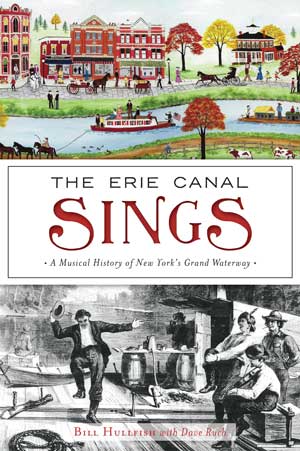
William Hullfish, professor emeritus of music at Brockport State College, will take readers on a musical journey along New York’s historic Erie Canal in his 240-page book, The Erie Canal Sings: A Musical History of New York’s Grand Waterway.
Hullfish’s career began with six years with the United States Air Force Band and Singing Sergeants. He has toured extensively in State Department tours to South and Central America, the Far East and Southeast Asia, as well as with various music groups in every state except Alaska. He has played at the White House, Kennedy Center, Constitution Hall, Mormon Tabernacle and Carnegie Hall.
In Europe, he has played concerts in Germany and Austria, and has played summers in every Canadian Exhibition from the Pacific Northwest Exhibition in Vancouver to the Calgary Stampede, Red River Exhibition, Toronto and Ottawa Exhibitions and the Montreal Music Festival.
Founder and director of the nationally recognized Golden Eagle String Band, Hullfish is an expert in American music, especially Erie Canal songs. He was awarded a Gold Medal by the Smithsonian Institute as a Smithsonian/Folkways recording artist for his cultural contributions. He has several publications and recordings published by the American Canal Society, of which he is a member.
Hullfish performs in several orchestras, including the Brockport Symphony, Gateswingers Big Band, Greece Community Orchestra and Greece Summer Symphony. At a special concert appearance with the Albany Symphony, he was named a “National Treasure” by music director David Alan Miller.
Life working along the banks of the Erie Canal is preserved in the songs of America’s rich musical history, and while Thomas Allen’s, “Low Bridge, Everybody Down” has achieved iconic status in the American songbook, Hullfish writes that its true story has never been told until now.
Copies of his book will be available at The Book Shoppe, 519 Main St.
Photo by Tom Rivers: Fireworks go off in Holley near the canal and lift bridge last June 3, 2018 when the village capped its annual June Fest celebration.
ALBANY – The members of a task force established to reimagine the Erie Canal were announced on Friday. The panel will make sweeping recommendations to Governor Andrew M. Cuomo and the Board of Trustees of the New York State Canal Corporation as to how this historic waterway can be used to address resilience challenges and leverage economic development and recreational opportunities along its 363-mile route.
The task force will lead the Reimagine the Canals initiative announced last month by Governor Cuomo, who is seeking new opportunities for the 195-year-old waterway, which helped transform New York from an agrarian state to an industrial powerhouse, to directly benefit the communities it travels through. It is expected the panel will develop a set of strategic recommendations for the canal system to be presented to the Governor.
“This is a unique opportunity to improve upon one of New York’s most valuable assets,” said Joanie Mahoney, chair of the task force. “With the experts we have to serve on the task force, I know the future of the Erie Canal is in very good hands.”
The task force will focus on several areas affecting the Erie Canal, including:
• Potential new uses to improve the quality of life for New Yorkers
• How the Canal can support and enhance economic development
• New opportunities to enhance recreation and tourism
• Ways the Canal can mitigate impacts from flooding and ice jams, improve resiliency and restore ecosystems in canal communities
• Opportunities to use Canal infrastructure to expand irrigation for Western New York farms
In addition to serving as task force chair, Mahoney, New York State Thruway Authority chair and former Onondaga County Executive, will serve as regional lead for the central region. Former Lieutenant Governor Bob Duffy will be regional lead for the Western region, while former Department of Environmental Conservation Commissioner Joe Martens will be regional lead for the Mohawk Valley.
The task force is slated to hold its first meeting later this month. Several public meetings, to be held across the state this summer, will be announced soon. The task force is expected to present its recommendations to Governor Cuomo by the end of the year.
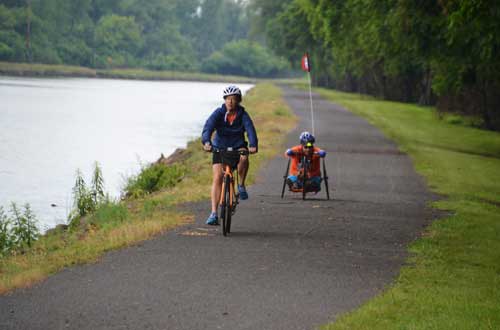
John Robinson, a member of the new canal task force, is pictured on June 30, 2015 on his third ride along the Erie Canal, going 363 miles from Buffalo to Albany. He is pictured with his wife Andrea. They are close to the Main Street lift bridge in Albion. Robinson used an adaptive-use bicycle to make the trip on the towpath. He runs a business, Our Ability, which promotes inclusivity in the workplace for people with disabilities in the workplace.
The task force members are drawn from a variety of fields with active stakes in the canal’s future, including maritime recreation, tourism, agriculture, historic preservation, resilience and environmental conservation. They are:
• Michael Arcuri, Arcuri Ward Law, Utica
• Leslie Becraft-Corrigan, General Manager, Winter Harbor Marina, Brewerton
• Andy Beers, Director, Empire State Trail/Hudson River Valley Greenway
• David Buicko, President & CEO, Galesi Group
• John Courain, Operations Director, Genesee Waterways Center
• Marie Cramer, Canal New York
• Maureen Doyle, President, Central NY Waterways
• Robin Dropkin, Executive Director, Parks and Trails New York
• John Garver, Professor, Geology, Union College
• Stuart Gruskin, Chief Conservation and External Affairs Officer, the Nature Conservancy
• Chris Lajewski, National Audubon Society
• Ross Levi, Executive Director of Tourism, Empire State Development (I Love NY)
• Cornelius Murphy, Professor, SUNY College of Environmental Science and Forestry
• Bill Nechamen, Executive Director, NYS Floodplain and Stormwater Managers Association
• Derrick Pratt, Program Director, Chittenango Landing Canal Boat Museum
• Bob Radliff, Executive Director, Erie Canalway National Heritage Corridor
• John Robinson, CEO, Our Ability
• Bruce Van Hise, Executive Director, Corn Hill Waterfront & Navigation Foundation
• Jeff Williams, Public Policy Director, New York Farm Bureau
Ex-Officio Members
• Richard Ball, NYS Agriculture and Markets Commissioner
• Eric Kulleseid, NYS Parks, Recreation and Historic Preservation Commissioner
• Rossana Rosado, NYS Secretary of State
• Basil Seggos, NYS Department of Environmental Conservation Commissioner
• Brian Stratton, NYS Canal Corporation Director
• Howard Zemsky, Empire State Development President and CEO
Helping guide the task force will be the Nelson A. Rockefeller Institute of Government, a part of the State University of New York. It will oversee the series of public meetings across the canal region, where residents, business owners, municipal leaders and other stakeholders can offer their ideas and insights about the Canal’s future.
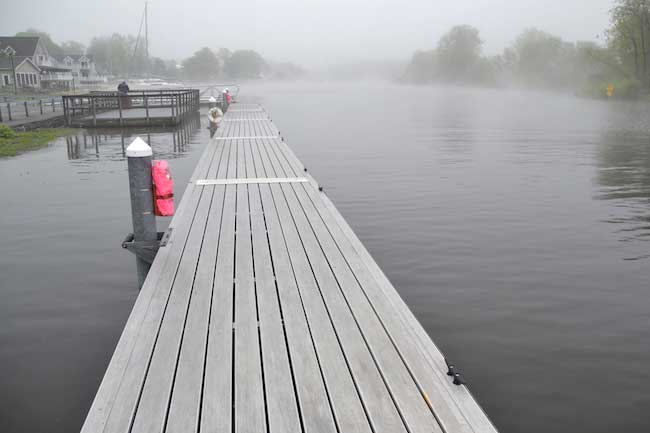
Photo by Tom Rivers: A dock in the Oak Orchard Harbor is shown on a foggy Tuesday afternoon. The water levels are up this year in Lake Ontario and tributaries.
Staff Reports Posted 31 May 2019 at 12:54 pm
A lakeshore flood watch is in effect from 6 p.m. Sunday until 6 p.m. Tuesday, according to the National Weather Service in Buffalo.
The flood watch includes the counties of Orleans, Niagara, Monroe, Wayne, northern Cayuga and Oswego counties.
“The combination of very high lake levels and moderate to strong northwest winds will result in greater wave action and an increase in lakeshore flooding on the southern shoreline of Lake Ontario,” the Weather Service said.
Lakeshore flooding may increase, especially in bays, inlets, and other low-lying areas along the shoreline with wave action producing an increase in shoreline erosion, the Weather Service said.


















 MEDINA – An accomplished musician and educator with a particular interest in the Erie Canal will be at The Book Shoppe from 11 a.m. to 1 p.m. on Saturday to sign copies of his new book.