Staff Reports Posted 13 September 2016 at 12:30 pm
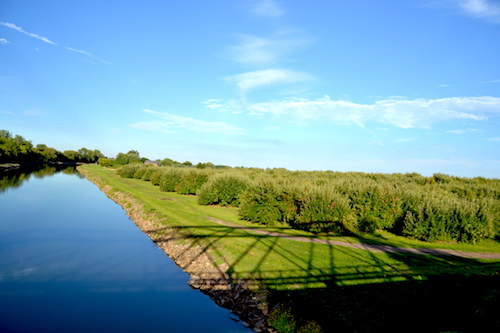
Photo by Tom Rivers: An apple orchard is pictured late Friday from the canal bridge on Presbyterian Road in Albion.
WASHINGTON — Orleans County has joined the list of counties in New York that have been declared primary natural disaster areas due to the drought conditions.
Orleans farmers were eligible for disaster relief because the county was contiguous to Genesee County, which made the list last month as a primary natural disaster area.
But now Orleans has its own designation following the the Sept. 9 designation by the US Department of Agriculture. Allegany, Cattaraugus, Cortland and Onondaga counties all were named to the list on Friday, bringing the total to 20 counties with primary designation, and six more that are contiguous.
Qualified farm operators in the designated areas are eligible for low-interest emergency loans from USDA’s Farm Service Agency, provided eligibility requirements are met.
Farmers in eligible counties have eight months from the date of the declaration to apply for loans to help cover part of their actual losses. FSA will consider each loan application on its own merits, taking into account the extent of losses, security available and repayment ability. FSA has a variety of programs, in addition to the EM loan program, to help eligible farmers recover from adversity, the USDA said.
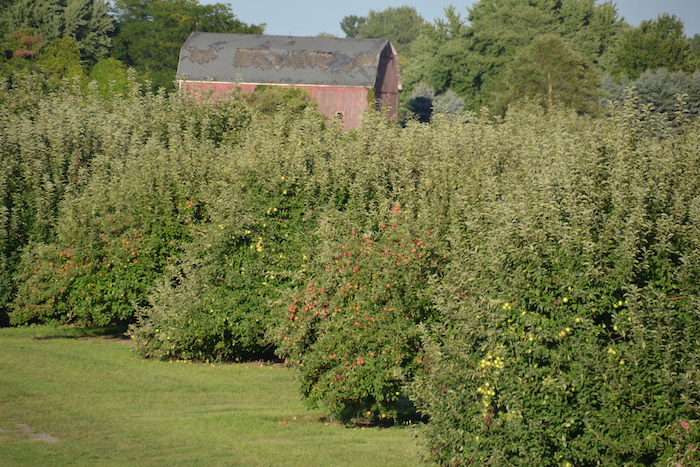
Photos by Tom Rivers: An orchard is pictured on Presbyterian Road in Albion, near the Erie Canal.
Apple growers in Orleans County and New York State are in harvest-mode, and they expect a nice crop despite drought conditions.
New York is the country’s second-leading apple producer with an average harvest of 28.6 million cartons annually the last five years. (Orleans County is the second leading apple county in the state, behind only Wayne County.) This year’s crop is expected at 30 million cartons, which would top the annual average, according to the New York Apple Association.
“By the time this crop gets off the trees and to market, all New York state apple fans are going to see is ‘great’ – great variety, great quality and great flavor,” said New York Association President Jim Allen.
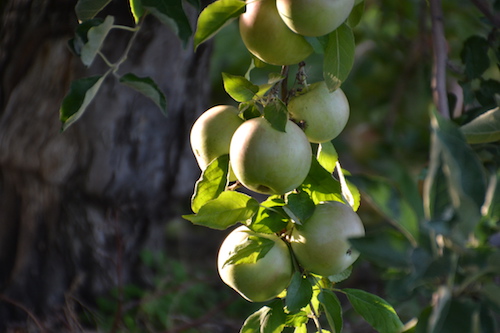
These apples are pictured on Allens Bridge Road in Albion.
Besides the drought, some apple growers battled a frost during the spring bloom and hail in some parts of the state.
The apples will be a little smaller this year because of the drought, Allen said.
“There are plenty of fruits on the trees this year, they’re just smaller in size than usual,” he said.
The drought has apples crunchier and sweeter. With less water content, the concentration of sugars in each apple is higher.
“Even downsides can have upsides in this industry,” Allen said.
Growers have been switching some of their acreage to high-density plantings of popular varieties, such as Honeycrisp, and new varieties – Zestar, SnapDragon and RubyFrost.
“Our growers produce more apples now on fewer acres because of technology – smaller trees that produce more fruit, computer-aided packing and sorting, and high-tech cold storage that puts apples to sleep until they are ready to ship to stores,” Allen said.
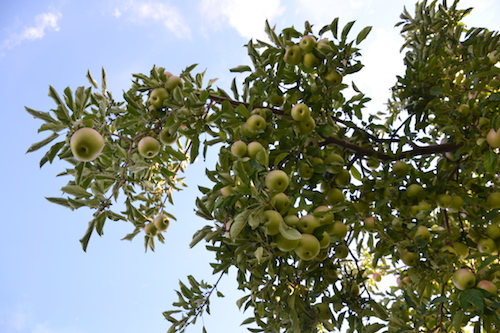
The orchards in Orleans County are loaded with apples that will be picked in the next two months. These apples are pictured at an orchard on Allens Bridge Road.
The New York Apple Association also is touting apples as healthy snacks. The association has launched the Big Apple Salad Challenge this fall, encouraging people to eat one salad a day with an apple included.
Fans who take the Big Apple Salad Challenge are invited to try NYAA’s salad recipes, and to send pictures of their own apple salads to NYAA – the association will share fan photos on its website and Facebook page. (Click here to see the NYAA website.)
“Whatever your health goal – eating cleaner, feeling better, losing weight – salads are a deliciously easy way to eat better without sacrificing flavor or satisfaction,” says NYAA Registered Dietitian Linda Quinn. “Apples add crunch, texture and flavor – as well as nutrients and fiber-related fullness – to any salad. Plus, apple cider and cider vinegar make great salad dressings!”
Quinn has developed a number of apple salad recipes to help apple fans get started on the Big Apple Salad Challenge, including: New York Apple Slaw with Sweet and Sour Cider Dressing; New York Apple-cado Salad (a fruity, crunchy twist on traditional guacamole), New York Apple Seasonal Salad with kale, quinoa and dried cranberries in a cider vinaigrette dressing.
There is also New York Grilled Apple Salad with a tangy cider mustard vinaigrette dressing, and New York Apple BYO Salad with Apple Cider Drizzle – build your own salad with what’s in your fridge.
Send NYAA a favorite salad recipe or salad photo by Oct. 31, and you will be entered in the Big Apple Salad Sweepstakes. NYAA will share sweepstakes winners’ photos after the sweepstakes has concluded. (You can also simply fill out and submit the sweepstakes entry form – no purchase, photo or recipe is necessary.)
By Kristina Gabalski, Correspondent Posted 11 September 2016 at 9:35 am
Murray farm one of 6 agriculture sites featured in Heritage Festival
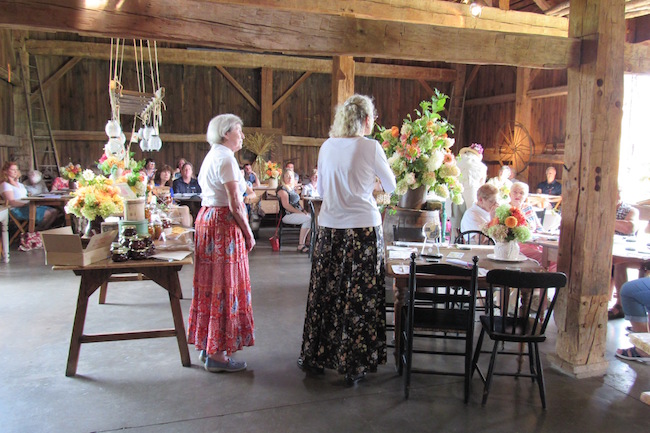
Photos by Kristina Gabalski: Sue Hurd Machamer, left, and her daughter Amy Machamer discuss the history of the canning industry which included information on food preservation basics and personal stories such as, “Aunt Helen Salisbury and the Birdseye Research Lab.”
MURRAY – Hurd Orchards on Ridge Road was one of six farms taking part in the agricultural facet of the Orleans County Heritage Festival on Saturday.
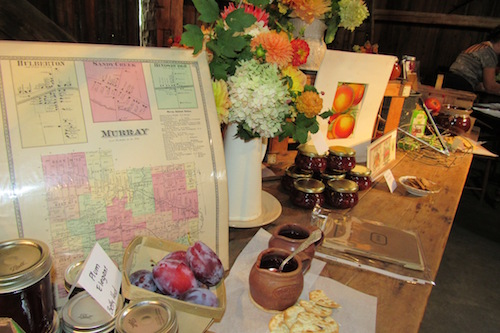
Colorful displays at Hurd Orchards featured information about the canning industry in Orleans County, vintage cookbooks, maps and produce labels.
The Hurd Orchards program included a Living History Lunch and Lecture on “The Cannery.”
Amy Machamer and her mother, Sue Hurd Machamer discussed how agriculture and the food processing industry have been the foundation of the local economy for more than 100 years.
The Machamers explained that during the 19th and 20th centuries, almost every village in Orleans County had its own cannery, surrounded by the fields and orchards which provided fruit and vegetables for processing. Examples include the Morton Canning Company in Morton, Hunt’s in Albion and H.J. Heinz in Medina.
The Machamers also shared stories about the packing houses, trucks, characters, and the enterprising business of producing fruit for the local canneries.
The luncheon that followed included fresh baked breads with heritage preserves made from original Orleans County recipes.
A portion of the program was subsidized by the Bayer Corporation. Hurd Orchards won Bayer’s 2016 Produce Innovation Award for their educational efforts in the field of agriculture including the luncheons, classes and tastings they hold each year at their farm.
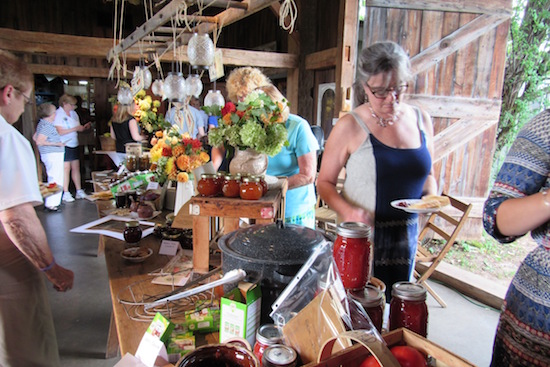
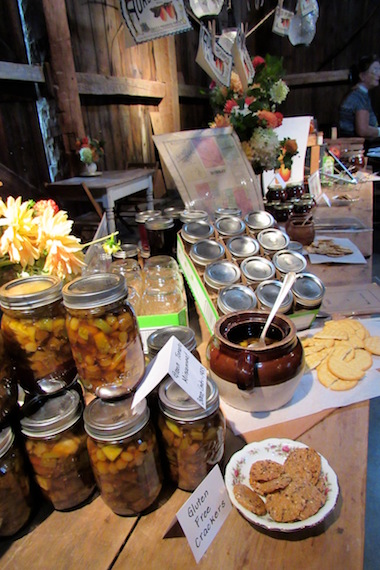
Orleans County Heritage Festival goers Saturday enjoy a luncheon at Hurd Orchards. The menu included freshly baked bread and heritage preserves including Green Tomato Mincemeat and Plum Elegant.
Hurd Orchards offered Heritage Festival visitors samplings of heritage preserves and information about the history of the canning industry in Orleans County.
The luncheon dessert featured an apple/plum cobbler with vanilla ice cream.
Other farm operations included in the Heritage Festival included Leonard Oakes Estate Winery & LynOaken Farms in Medina, Orleans Poverty Hill Farms (dairy) in Albion, Partyka Farms in Kendall, Roberts Farm Market in Medina, and Watt Farms Country Market in Gaines.
Photo by Tom Rivers: A lone sunflower stands tall in a field of corn on Route 31 in Albion near the Long Bridge Road intersection.
Local counties, including Orleans, Genesee and Monroe, are among the 24 counties that have been designated natural disaster areas and are eligible for assistance through the United States Department of Agriculture Farm Service Agency.
State Assemblyman Steve Hawley, R-Batavia, said the designation should help farmers weather a tough growing season, when a drought stunted crops and reduced yields. State officials will be conducting on-site assessments of the damage to local farms and working with Cornell University experts to devise recovery solutions, Hawley said.
“Farmers are the backbone of New York’s already excellent, diversified and growing agriculture sector,” Hawley said. “As the former owner and operator of our family farm for many years, I can personally attest to the determination of our famers to battle ever-changing weather and devastating floods and drought in Western New York. It is important to protect the livelihood of our producers and assist them when unforeseen circumstances threaten their prosperity. I am pleased the federal government is offering our famers this much needed assistance.”
Disaster declaration is based on reporting of crop loss to the federal Farm Service Agency and an “Extreme Drought” designation by the U.S. Drought Monitor. The federal government declared 15 counties as primary natural disaster areas and an additional nine counties as contiguous disaster counties due to a recent drought. (Orleans is a contiguous disaster county.)
In addition, several other counties in the North Country, the Finger Lakes, Central New York, and the Southern Tier regions are also requesting primary disaster declarations, Gov. Andrew Cuomo’s office said.
The primary counties included under this designation are in Western New York, Finger Lakes, Central New York, and Southern Tier.
“Strong agriculture is critical to the vibrancy of Upstate New York and this year’s hot, dry summer have created significant challenges to this crucial industry,” Governor Cuomo said. “From Western New York to the North Country, New York’s growers and producers are major drivers of our economy and the benefits they provide to the community are immeasurable. In these difficult times, we must ensure that they have full access to all the resources necessary for making a full recovery.”
The Farm Service Agency office in Orleans County is located at 446 West Ave., Albion. The phone number is (585) 589-5320.
“Our hearts go out to the farmers and ranchers affected by the drought in New York,” said United States Agriculture Secretary Tom Vilsack. “President Obama and I are committed to ensuring that agriculture remains a bright spot in our nation’s economy by sustaining the successes of America’s farmers, ranchers, and rural communities through these difficult times. We’re also telling New York producers that USDA stands with you and your communities when severe weather and natural disasters threaten to disrupt your livelihood.”
By Tom Rivers, Editor Posted 5 September 2016 at 9:30 am
GAINES – The canal bridge on Gaines Basin Road is pictured on Sunday afternoon. This is close to the spot that is the northernmost point on the entire canal. A historical marker is west of the bridge noting that significance.
The U.S. Drought Monitor no longer considers Orleans County to be in a severe drought after recent rainfall helped bring some green back to local lawns and the landscape.
The latest report from the Drought Monitor on Sept. 1 considers Orleans in a moderate drought. Some counties south and east of Orleans continue to face extreme drought conditions, including Genesee, Monroe and Ontario counties. Visit http://droughtmonitor.unl.edu/Home/StateDroughtMonitor.aspx?NY to see the map of drought conditions in the state.)
The U.S. Department of Agriculture announced late last month that 15 counties in NY are considered “primary natural disaster areas.” Orleans isn’t on the list, but Genesee is included. Because Orleans is contiguous to Genesee, farmers may be eligible for some aid in low-interest emergency loans due to diminished crops and added costs for using water.
A boater stops in Albion along the Erie Canal on Friday evening between the lift bridges on Main and Ingersoll streets.
Provided photos: Kara Bentley of the Barre Volunteer Fire Company portrays a trapped firefighter in a grain bin during a training exercise Aug. 20 at Carlton.
ALBION – Orleans County firefighters and some local area farmers had the opportunity to attend a training involving the rescue of a person trapped in a grain bin.
The training on Aug. 20 was provided by the National Education Center for Agricultural Safety with sponsorships by The Agricultural Safety and Health Council of America, Farm Credit East, New York Farm Bureau Member Services and The Evans Insurance Agency.
NECASAG Director Dan Neenan was the course instructor. Orleans County firefighters attended from Albion, Barre, Carlton, East Shelby, Fancher-Hulberton-Murray, Holley, Kendall and Shelby.
They participated along with representatives from Orleans County Emergency Management and Elba Fire Department.
Following a short slide presentation, the participants spent the rest of the morning performing the hands-on rescue evolutions in victim removal and safe methods to lower the grain level in the bin.
The evolutions were completed using grain rescue equipment purchased by Carlton. This was to ensure that local responders were familiar with the tools available to them in the county.
Firefighters worked in pairs in the grain bin simulator to free victims who were trapped waist deep in corn. The rescue tool allows responders to build a wall around the victim. The grain entrapping the victim can then be removed from inside the wall which facilitates the victim’s removal.
The firefighters in the bin were assisted by other responders who handed them equipment as well as offering advice and encouragement. All firefighters entering the bin wore full body harnesses and were secured to the frame of the simulator. The grain depth is also maintained at a level that will not allow an adult to be submerged.
Responders also received training in the proper size and location to cut vents in the side of a grain bin to safely lower the grain level in the bin. Lowering the level assists with victim location and removal.
Jim Panek of Panek Farms in Albion arranged steel bin sections for cutting. Andrew Niederhofer, the Carlton fire chief, arranged corn from Lynn-ette Farms to be in the grain bin.
The training is provided by the National Education Center for Agricultural Safety and is the first in a series of safety trainings for the WNY region through a grant received by Erie County on behalf of the WNY Region. Sessions were held in Allegany, Cattaraugus, Chautauqua, Erie, Genesee, Livingston, Niagara, Orleans, Steuben and Wyoming counties between Aug. 4-20.
Dan Neenan, an instructor with the National Education Center for Agricultural Safety, discusses grain bin safety and rescue during an Aug. 20 trainign class at the Carlton Recreation Hall.
Carlton firefighter Ben Diltz, front, is cutting, and Carlton Lt. Justin Niederhofer and firefighter Tom Niehaus are observing during the training drill.
Firefighters from several departments in Orleans County attended the training.
By Tom Rivers, Editor Posted 5 August 2016 at 5:21 pm
Photo by Tom Rivers – A field of corn is pictured Wednesday on Brown Road in the Town of Gaines, just south of Ridge Road.
ALBION – Orleans County has added 9,788 acres to its newly consolidated agricultural district. That represents a 9.3 percent increase in ag district acreage, bringing the county total to 115,518 acres.
The county this year moved to consolidate three ag districts into one. The change should make it easier for farmers for the reviews every eight years.
Many of the farms work land that cross town boundaries. Some of the ag districts had different review cycles and farmers might inadvertently leave land out of an ag district if they didn’t send in paperwork.
“This has gone smoother than we thought,” Planning Director Jim Bensley advised the County Legislature last week.
The ag community has responded to the process as evidence by the increase in land for the ag district. Farmers will still have an option every June to add land to the ag district. However, if farmers want to remove land from the district they need to wait eight years for the next review.
The county used to have 10 ag districts and shrunk it to three, with a northern district in the towns of Yates, Carlton and Kendall; a middle district with Ridgeway, Gaines, Albion and Murray; and a southern district with the towns of Shelby, Barre and Clarendon.
Now all of the towns are in one consolidated district. The County Legislature approved the change in January, saying it will be simpler and more convenient for farmers, and also be more efficient for the County Planning Department, which administers the ag district.
Agricultural Districts are established by New York State Agriculture and Markets Law to provide for the protection of agricultural lands. Farmers with land in an ag district are protected from lawsuits from neighbors who complain about normal farm practices, such as odors, dirt on roads, and working in fields early in the morning or late at night.
The changes in the county’s ag district go before the state Department of Agriculture and Markets for review, and are expected to get a final OK by the County Legislature in October.
By Kristina Gabalski, Correspondent Posted 31 July 2016 at 3:19 pm
KNOWLESVILLE – Fair Royalty for 2016 was crowned during the awards ceremony Saturday afternoon at the Orleans County 4-H Fair.
The front row, includes, from left: Dominic Hinkley, prince alternate; Nate Shaw, prince; Olivia Kroening, princess; and Mackenzie McGrath, princess alternate.
Back row: Will Gregoire, duke alternate; Zac Albright, duke; Riley Seielstad, dutchess alternate; Saleya Williams, dutchess; Claudia Drechsel, queen; and Megan Blackburn, queen alternate.
Saturday also featured the top small animal showmen in eight different animals in the Small Animal Grand Master Showman competition. Rachel Gregoire of Murray, left, won the title and Amelia Sidonio of Holley was picked Small Animal Reserve Grand Master Showman.
4-H’ers in the competition were evaluated on their ability to show animals they were given (not their own) in eight different animal areas.
Nicole Mrzywka of Holley competes in the Small Animal Grand Master Showman competition Saturday morning. Nicole was the Fair’s Dog Master Showman. Those in the Saturday contest had to show a dog, chicken and rabbit.
Grant Moy of Clarendon was Reserve Dog Showman earlier in the week. Here he shows a chicken as part of the Small Animal Grand Master Showman competition.
Rachel Gregoire shows a rabbit during the Small Animal Grand Master Showman competition. Rachel was both the Rabbit and Poultry Master Showman. She was chosen Small Animal Grand Master Showman at the Saturday morning competition.
By Tom Rivers, Editor Posted 30 July 2016 at 3:09 pm
KNOWLESVILLE – Jayne Bannister, 18, of Point Breeze shows a dairy animal and answers a question from judge Tanya Nickerson during Friday’s Grand Master Showman Competition at the Orleans County 4-H fair.
Jayne won the title, one of the most prestigious honors at the fair. The contest includes the top showman in eight different animals: horse, dairy goat, meat goat, sheep, swine, llama, dairy cattle and beef cattle.
Jayne, a past winner of the grand master showman, won the title in her final year in 4-H. She qualified for the competition after winning the swine showmanship on Monday.
Jayne in May finished her freshman year at Kansas State University, where she is a double major in animal science and agriculture education. She said showing animals the past decade at the fair has helped her in her goal of teaching the public about agriculture and how food is grown and raised.
After the Grand Master Showman competition, Jayne changed clothes to try the grease pole climbing contest for the first time.
Jesse Suttura, 16, of Greece shows a dairy cow during the Grand Master Showman competition. She qualified after winning the horse showmanship. The competition has the winners of each competition earlier in the week show all of the different animals on Friday evening.
The Small Animal Grand Master Showman competition is today at noon.
These competitors in the Grand Master Showman event hold dairy animals while keeping an eye on the judge. The four showmen in this photo include, from left: Rylie Lear, Jesse Suttura, Mel Klossner and Justin Robinson.
Justin Robinson, 16, of Albion shows a dairy animal on Friday. He qualified for the event after winning the dairy showmanship.
Natalie Mrzywka, 17, of Holley shows a sheep during Friday’s event. Natalie won the grand master showman title last year. She qualified this year by winning the meat goat showmanship.
Natalie said she enjoys the grand master showman event because she learns about so many different types of farm animals. The competition last more than two hours.
“It’s fun to be in the ring,” she said.
The showmen try to get the sheep squared and set up for the judge. The 4-H’ers include, from left: Jayne Bannister, Nicole Mrzywka (the reserve grand master showman), Justin Robinson and Natalie Mrzywka.
Rylie Lear of Waterport shows a dairy animal. She qualified after winning the beef cattle competition.
Justin Robinson leads a beef animal around the show ring while other competitors show the animals to judge Tanya Nickerson.
By Tom Rivers, Editor Posted 17 July 2016 at 12:00 pm
Photos by Tom Rivers-Jayne Bannister, 18, is pictured with her pig, Edith, that will be auctioned off July 30 at the Orleans County 4-H Fair. Proceeds will go to Hospice of Orleans.
Jayne walks with Edith the pig on Saturday at the family farm on Route 98 in Point Breeze.
Robert Bannister, right, serves as auctioneer for the 4-H Market Meat Auction. His sister Jayne Bannister is in the ring with the lone steer at last year’s auction. Panek Farms paid $4.50 a pound or $5,378 for the 1,195-pound animal.
KENT – Jayne Bannister later this month will end her 4-H experience after about a decade of showing animals at the Orleans County 4-H Fair. Bannister has won numerous ribbons for showing pigs, cows and other animals.
She wants to make her final time in the show ring special. Instead of going for a blue ribbon, Jayne, 18, is using her 4-H finale to raise money for Hospice of Orleans.
Jayne has been raising a pig that will be auctioned off July 30 during the 4-H Market Meat Auction. The auction is at 7 p.m. on Saturday, the last day of the fair.
Jayne said she appreciates the care provided by Hospice about a year ago when her grandmother, Doris Bannister, was dying. Hospice sent nurses to help care for Doris so she could be at home in her final days.
“It was really great for our family,” Jayne said about having her grandmother at home instead of at a hospital. “We could see her as the mother and the grandmother we knew.”
Doris stayed close to her loved ones and the farm, even joining her son Roger on a Kubota for a ride in the orchard.
“It was so much better for her to be able to be at home rather than in a hospital bed,” Jayne said. “She had a sense of freedom, which was always important to her.”
Doris Bannister was 97 when she died peacefully last July 30.
Jayne in May finished her freshman year at Kansas State University, where she is a double major in animal science and agriculture education.
She has been getting three pigs ready for the fair since she came home. One of the pigs she calls Edith will be in the auction with proceeds going to Hospice. Edith weighs about 240 pounds. Jayne is hoping the pitch will fetch more than $1,000 at the auction.
Edith is named for one of the sisters in the popular PBS show, Downton Abbey. Two other pigs that Jayne named Mary and Sybil – also Edith’s sister in Downton – will also be going to the fair. Jayne is calling the trio, ” Downton Hammy.”
The auction starts at 7 p.m. with a buyer’s preview and reception at 6:30. Steer, pigs, lambs, meat goats, meat rabbits, chickens and turkeys will all be up for auction.