
















Rockin’ Bagel business born during pandemic


 Return to top
Thom and Tracy Jennings of Albion used downtime from Covid to develop new venture

Photos by Tom Rivers: These bagels are fresh out of the oven on Friday night. Thom and Tracy Jennings use the certified commercial kitchen at the Orleans County 4-H Fairgrounds to make about 400-450 bagels each week.
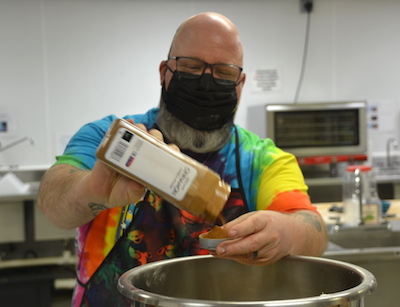
Thom Jennings measures cinnamon while making a batch of Papa Thom’s Rockin’ Bagels on Friday night. He started the business about a year ago with his wife Tracy. It quickly outgrew their kitchen at home in Albion.
ALBION – Last April, more than a month into the Covid-19 pandemic that closed schools to in-person learning, Thom Jennings was bored with more time on his hands than usual.
Jennings works as a social studies teacher. He also was performing stand-up comedy routines and writing music reviews for the Niagara Gazette.
But last April his schedule slowed down and he was watching a lot of the Food Network. One episode showed someone trying to make bagels.
Jennings watched the show with his wife Tracy, who loves to bake and experiment in the kitchen. She suggested her husband give bagel-making a try. Never, he replied.
But soon after, when he his wife was out of the house, Jennings made a batch of plain bagels. He didn’t think it would be too difficult. He worked at a Rochester restaurant as a young adult and felt comfortable making bread and had plenty of experience with yeast. He also grew up in Brighton where there are many bagel shops.
When Jennings pulled the bagels out of the oven for the first time, they were a disaster to behold. They were comically flat.
“The first ones were just horrible,” he said. “I became obsessed with mastering the bagel instead of the bagel mastering me.”
Jennings tried again and again and by the third batch felt like he was getting a knack for it. He started giving the bagels to friends. He received good feedback.
“This was never on my radar,” said Jennings, 54. “I never envisioned myself as a bagel maker.”
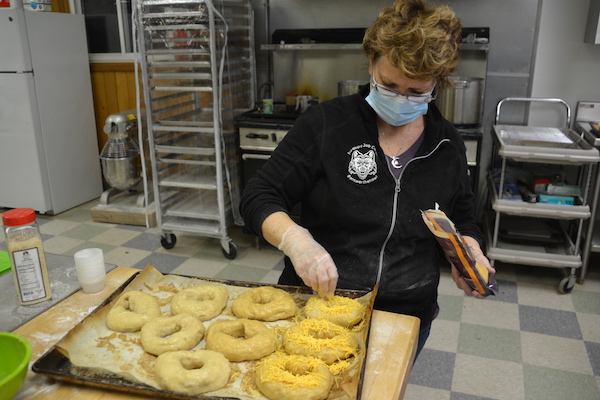
Tracy Jennings sprinkles cheese on Jalapeño cheddar bagels that were made Friday night. Papa Thom’s currently offers about 12 different types of bagels.
He had a feeling the bagels, made in small batches and without preservatives, would be popular in the Albion and Orleans County community.
He secured a home processor’s license from the state that allowed him to sell the bagels. The business by July outgrew his home kitchen.
“We were baking all night because there was only so much oven space,” he said.
Jennings told people he baked the bagels while listening to some of his favorite bands and musicians. He decided to make a small business out of it, and called the bagel making enterprise, Papa Thom’s Rockin’ Bagels. He is “Papa Thom” to four grandchildren.
He guarantees not only a great-tasting bagel, but that they are “born” to music. The label on each batch notes which band or musician was on while Jennings made the bagels. On Friday, the bagels were born to music by the Grateful Dead.
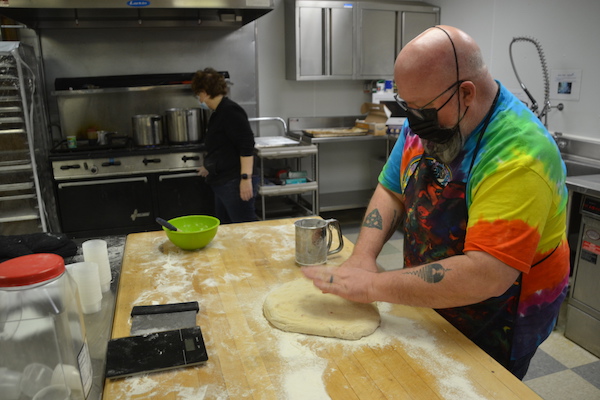
Thom Jennings works on the dough for the bagels while his wife boils and bakes the bagels. Thom wore a tie-dyed shirt on Friday while playing Grateful Dead music.
Thom and Tracy have been making the bagels since last summer at the commercial kitchen at the Orleans County 4-H Fairgrounds. The couple arrive Fridays around 6 p.m. and typically are there to 1 or 2 in the morning. Then it’s an early morning Saturday to make deliveries from Rochester to Middleport. Most bagel-making nights they are joined by assistant Zoe Seniuk, 16, of Albion. She has joked she wants to start her own bagel enterprise some day called “Zoe Doughy.”
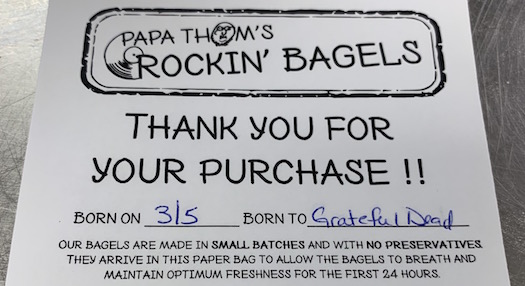
The label of this order of bagels note they were made on March 5 while being “born” to Grateful Dead music.
The Papa Thom’s business has taken off so much that they have added Thursday evenings to bake the bagels. Papa Thom’s is now making about 400-450 bagels a week and they are booked for orders about a month out. They currently offer bagels in the following varieties:
Traditional – plain, everything, sesame, onion, garlic, poppy and cinnamon raison.
Specialty – Asiago cheese and sundried tomato, everything inside and out, pumpernickel rye, Jalapeño cheddar, Rosemara (rosemary olive oil and sea salt).
The bagels sell for $7 a half dozen or $12 for a dozen. Thom and Tracy continue to experiment with flavors and recipes. They made a red-and-blue Buffalo Bills bagel for the weekend when the Bills faced the Kansas City Chiefs for the AFC Championship on Jan. 24.
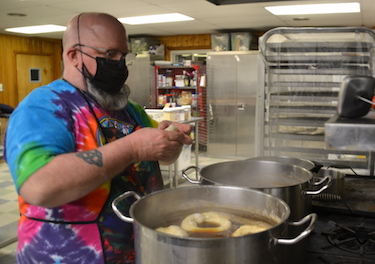
Thom Jennings sets some of the bagels in the boiling water on Friday. Each side is boiled for about 90 seconds.
Jennings continues to work as a social studies teacher in Buffalo and Mrs. Jennings works at the Iroquois Job Corps in Shelby, where she is the data integrity records manager.
The couple has a good system in the kitchen. Thom experiments with the recipes and makes the dough. Tracy does the baking, boiling each side of the bagels for about 90 seconds and then baking them in the oven for about 24 minutes.
The Jennings said they have made many new friends through Papa Thom’s, including the the owner of HeBrews 5:9, a coffee shop in downtown Albion that sells about 10 dozen of the bagels each week.
“My hope is it will become a family business,” Mr. Jennings said. “We like to take our time on it. It’s not like we’re a bagel factory.”
They also take requests from customers on new flavors and bands to listen to while the bagels are being born. One customer recently requested Frank Zappa.
“Everything we’ve done has come from customer feedback,” Jennings said.
For more on Papa Thom’s, click here.
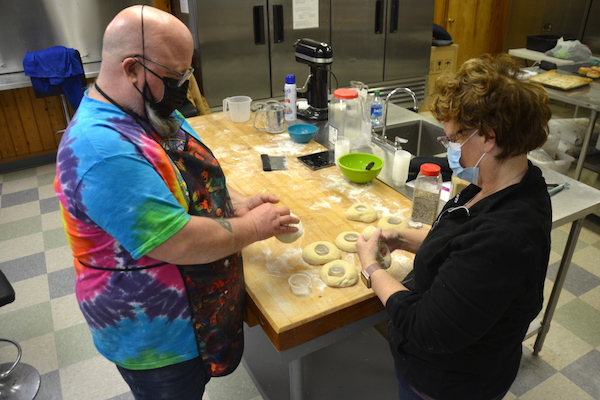
Thom and Tracy Jennings shape the bagels before they were boiled and then baked.
New Covid cases reported since Friday include 11 in Orleans, 25 in Genesee
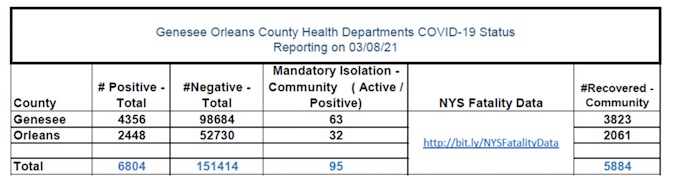
In the first update since last Friday afternoon, there are 36 new cases of Covid-19 to report today in Genesee and Orleans counties, which brings the total cases to 6,804 in the two counties since last March.
In Orleans County there are 11 new positive cases for a total of 2,448 positive cases during the pandemic. The new positive cases reside in the West Region (Yates, Ridgeway, Shelby), Central Region (Carlton, Gaines, Albion, Barre) and East Region (Kendall, Murray, Clarendon).
The individuals are in the age groups of 0-19, 20s, 30s, 40s and 70s. One of the newly positive people was under mandatory quarantine prior to testing positive, the Genesee and Orleans County Health Departments reported.
Orleans is reporting 13 more of the previous positive individuals have recovered and been removed from the isolation list.
There is currently one county resident hospitalized due to Covid.
In Genesee County there are 25 new positive cases for a total of 4,356 positive cases during the pandemic.
The new positive cases reside in the Central Region (Alexander, Batavia, Bethany, Elba, Oakfield) and East Region (Bergen, Byron, LeRoy, Pavilion, Stafford). The individuals are in the age groups of 0-19, 20s, 30s, 40s, 50s, 60s, 70s and 90s.
Among the new cases 1 is a resident of the New York State Veterans’ Home at Batavia and 1 is an inmate at the Buffalo Federal Detention Center in Batavia.
Genesee is reporting 26 more of the previous positive individuals have recovered and been removed from the isolation list.
There are currently 4 individuals from Genesee hospitalized due to Covid.
Testing Clinic: Due to Tuesday’s vaccination clinic, there will not be a testing clinic this week in the two counties. The testing clinic link will be live when clinics are scheduled. This will be determined week-to-week.
Return to top
Photos: Lyndonville Pennysaver building comes down on Main Street
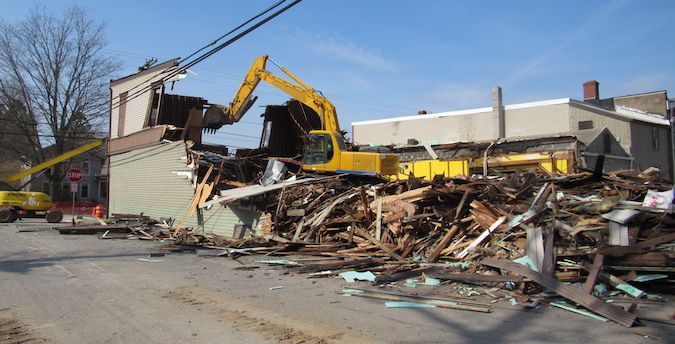
Photos by Ginny Kropf
LYNDONVILLE – Art Hill Excavating of Medina started taking down the Lyndonville Pennysaver Market building at about 8:30 this morning and by 1 p.m. the building was nearly down.
The roof of the building collapsed on Feb. 22 with heavy snow and ice on the roof. The building from 1899 also had suffered deterioration with its support beams.
The Village Board met on Feb. 22 and declared the structure unsafe after an engineer’s inspection.

Aaron Young of AGC Construction in Holley assists his father-in-law Art Hill with the building’s demolition. Young is shown preparing to hook a strap on the teeth of the excavator to pull the front section of the building at Main and Eagle into the rubble, so it wouldn’t fall on Main Street.
Art Hill Excavating owner Jennifer Hill-Young expects the company will be on site most of this week, hauling the demolition debris to a landfill.
Return to top
Gillibrand urges people who lost job or added a dependent last year to file 2020 taxes right away
$1,400 in stimulus checks per child and adult dependent for qualifying families
Press Release, U.S. Sen. Kirsten Gillibrand
WASHINGTON, D.C. – U.S. Senator Kirsten Gillibrand is urging New Yorkers who added a dependent or whose income dipped under $80,000 in the past year to file their 2020 taxes as soon as possible, in order to qualify for the $1400 stimulus checks allocated under the Senate-passed American Rescue Plan.
Under the American Rescue Plan, individuals that make under $80,000 and couples that make under $160,000 qualify for stimulus checks and will receive additional $1,400 checks per child and adult dependent.
In addition, filers must be under the income threshold to qualify for the dependent checks. Because the IRS determines eligibility using an individual’s most recently filed federal taxes, it is critical that individuals file their federal taxes as soon as possible, especially if a drop in income level has dropped them into the qualifying range for checks, or if they have had a child or added a dependent.
“I am urging New Yorkers who added a dependent or whose income dipped under $80,000 last year to file their federal taxes as soon as possible to ensure they receive every cent allocated to them under the American Rescue Plan,” said Senator Gillibrand. “If your income level dropped you into the qualifying range, or you had a child or added a dependent, you may qualify for stimulus checks, even if you didn’t qualify last time around. File your taxes and receive relief—it is both simple and extremely important.”
Return to top
Hawley reads to local students through Zoom for ‘Read Across America Week’


Assemblyman Steve Hawley reads to children from local schools through Zoom on March 5.
Press Release, Assemblyman Steve Hawley
Assemblyman Steve Hawley (R,C,I-Batavia) joined students from his Assembly District in celebrating Read Across America Week by reading Dr. Seuss’ “What Pet Should I Get?”
Hawley read to the students virtually on March 5, sharing the story with elementary school classes in Monroe, Orleans and Genesee counties. The Assemblyman would normally join classes in person but due to Covid-19 restrictions, he joined them virtually through Zoom.
“It was my pleasure to join students this year in celebrating reading by sharing a book from classic American children’s author Dr. Seuss,” Hawley said. “The passion they showed for reading and learning bodes well for our future, and I encourage everyone with children in their lives to join me in sharing the joy of books with our young ones.”
Classes participating included Mrs. Kristen Barber’s first-grade class at Ginther Elementary School, Mr. Mark Skurzewski’s second-grade class at Ronald L. Sodoma Elementary School, Mrs. Stefanie Clark’s first-grade class at Oakfield- Alabama Elementary School, and Mrs. Michelle Patnode’s first-grade class at Wolcott Street School in Le Roy.
Assemblyman Hawley represents the 139th District, which consists of Genesee, most of Orleans and part of western Monroe County.
Return to top
Demo of Lyndonville building will take about a week
Photos by Tom Rivers
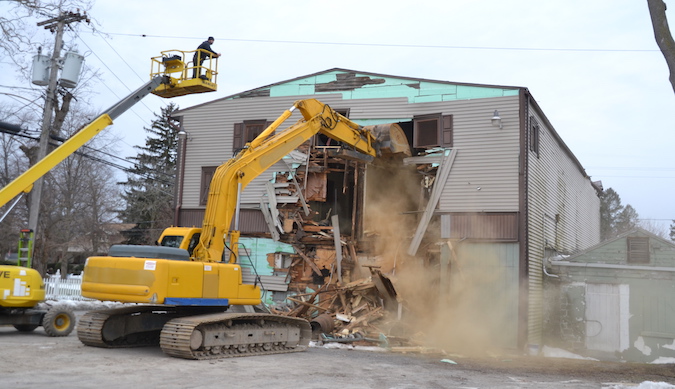
LYNDONVILLE – Art Hill Excavating begins taking down the Lyndonville Pennysaver Market building this morning.
Art Hill is operating the excavator. His son-in-law, Aaron Young of AGC Construction in Holley, is in the lift as a guide and to keep an eye on the demolition. (Click here to see a video of some of the demolition.)
Hill started in the back of the building and plans to slowly work through the site, a dominant structure at the corner of Main and Eagle streets in the village.
The Village Board declared the site an unsafe structure after the roof collapsed on Feb. 22.
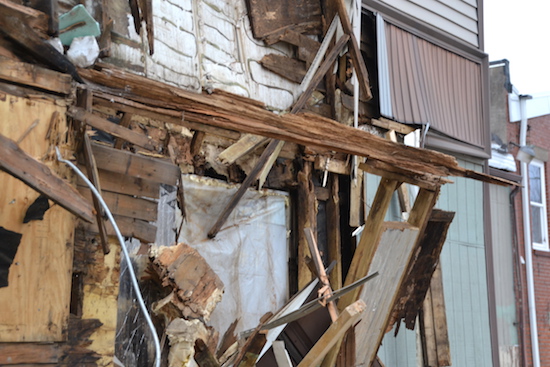
The support beams in the back of the building were badly decayed, Hill said.
“They were like powder,” he said.
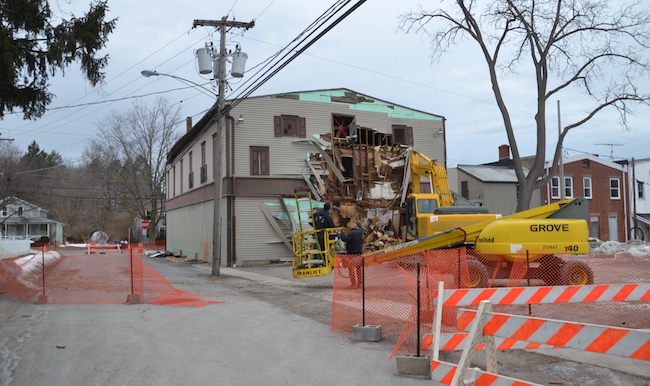
Hill’s daughter Jennifer Hill-Young is the owner of Art Hill Excavating and her father is the vice president. They said the demolition of the building is planned to take five days. The building should be knocked down by later this afternoon. Hill will then work to remove the materials the rest of the week.
Hill-Young said it is a delicate demolition because of the presence of Main Street in the front of the building, power lines on two sides and a neighboring, adjoining structure.
Before the demolition started, her husband, Aaron Young, went inside the building on the second floor and put in straps to pull the walls in as the excavator worked through the structure.
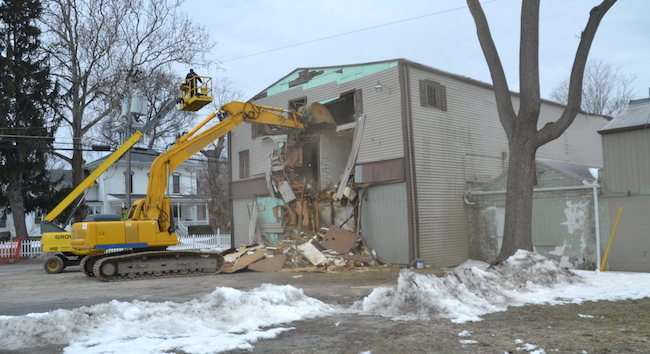
Robert Smith, a Lyndonville native who now lives in California, owns the building and three others on Main Street. He had grand plans for the Pennysaver site with hotel rooms and retail space. He has been working to transform the block of four structures.
The Pennysaver Market closed in April 2013 after 35 years in business by Sharon Gray. She offered grocery items, hardware, videos, a deli, finger foods and pizza. The market was the first job for many teen-agers in the Lyndonville community.
Return to top
Lyndonville’s Pennysaver building expected to be torn down this morning
LYNDONVILLE – A part of Lyndonville’s Main Street for more than a century is expected to be knocked down today.
The roof on the Pennysaver building collapsed on the morning of Feb. 22, making the building an unsafe structure, village officials said.
The Village Board met Feb. 22 and declared the building an emergency and a threat to the community.
“It’s a bad situation in a bad spot,” Mayor John Belson said at the meeting.
The village has worked with the building owner, Robert Smith, on a demolition plan. Smith owns the Pennysaver site and three others on Main Street.
The area near the Pennysaver has been blocked off to pedestrians and traffic. The village cordoned off the area in front of the building and part of Eagle Street near Main Street.
The demolition is expected to start around 8:30 this morning.
The building was last used by the Pennysaver Market. It closed in April 2013 after 35 years in business by Sharon Gray. She initially offered grocery items and then expanded to hardware, videos, a deli, finger foods and pizza.
Return to top
NY will increase capacity in restaurants from 50 to 75% starting March 19
NYC restaurants remain at 35% capacity
Gov. Andrew Cuomo announced today that the state will allow restaurants to increase their indoor capacity from 50 to 75 percent beginning March 19. This is for restaurants outside New York City. In NYC, restaurants will remain at 35 percent capacity.
Cuomo said the declining number of Covid hospitalizations in the state and other progress in the pandemic shows that restaurants can operate safely with strict health protocols.
Cuomo today reported the positivity rate for Covid tests was 2.98 percent on Saturday and the number of Covid hospitalizations, at 4,789, was the lowest since Dec. 6.
“Our fight in the war against Covid-19 continues, but we are encouraged by the decrease in infection and hospitalization rates and the rise in vaccinations,” Cuomo said. “As we expand our vaccine distribution and celebrate the arrival of the Johnson & Johnson vaccine, we have never been closer to defeating this beast once and for all. It is critical that New Yorkers not succumb to Covid fatigue and remain vigilant.”
Other states also are increasing restaurant capacity. Massachusetts went to 100 percent on March 1 and Connecticut will go to 100 percent on March 19.
“It’s not just good news for the restaurant owners,” Cuomo said. “Remember you have a lot of staff at restaurants, there are a lot of jobs, there are a lot of suppliers, so we’ll go to 75 percent. We also think that 75 percent is what the consumer is ready for. All the same safety capacities remain in effect but we will go to 75 percent.”
Return to top
State Senate Dem leader calls on Cuomo to step down
‘For the good of the state Governor Cuomo must resign.’ – Andrea Stewart-Cousins
ALBANY – The leader of the State Senate, one of the most powerful Democrats in the state government, has called for Gov. Andrew Cuomo to step down.
Andrea Stewart-Cousins, the Senate Majority Leader, issued this statement this afternoon:
“Everyday there is another account that is drawing away from the business of government. We have allegations about sexual harassment, a toxic work environment, the loss of credibility surrounding the Covid-19 nursing home data and questions about the construction of a major infrastructure project.
“New York is still in the midst of this pandemic and is still facing the societal, health and economic impacts of it. We need to govern without daily distraction. For the good of the state Governor Cuomo must resign.”
Many Republicans in the state Legislature, including Senate Minority leader Rob Ortt of North Tonawanda and Assemblyman Steve Hawley of Batavia, have urged Cuomo to resign. Many elected Democrats, however, have urged the public to hold off on condemnation until an investigation is completed by the State Attorney General’s office on the accusations against Cuomo.
Assembly Speaker Carl Heastie didn’t call for the governor’s resignation but said the allegations are “deeply disturbing.” Heastie followed Stewart-Cousins with this statement:
“The allegations pertaining to the Governor that have been reported in recent weeks have been deeply disturbing, and have no place whatsoever in government, the workplace or anywhere else. I too share the sentiment of Senate Majority Leader Stewart-Cousins regarding the Governor’s ability to continue to lead this state. We have many challenges to address, and I think it is time for the Governor to seriously consider whether he can effectively meet the needs of the people of New York.”
Cuomo in a conference call with reporters today urged the public to let the process go forward with the Attorney General’s Office. The state has a system based on due process and determining the credibility of allegations, he said.
“There are some legislators who suggest that I resign because of accusations that are made against me,” Cuomo said. “I was elected by the people of the state, I wasn’t elected by politicians. I’m not going to resign because of allegations. The premise of resigning because of allegations is actually anti-democratic and we’ve always done the exact opposite.”
Return to top
Schumer counts $100 billion to NY in American Rescue Plan
$1,400 Stimulus checks; aid for small businesses, local governments and schools; and a focus on cutting child poverty
Press Release, U.S. Sen. Majority Leader Charles Schumer
Just back from Washington, U.S. Senator Charles Schumer announced today that “help is on the way” to New York and New Yorkers as he detailed specifics from the American Rescue Plan he just led to passage in the U.S. Senate.
Schumer detailed the plan’s tentative impact to New York as $100 billion. The deal includes an additional round of direct stimulus checks, extends enhanced unemployment insurance benefits, will help solve New York State and Upstate New York municipalities budget woes. The assistance marks a not-too-soon moment of relief for countless families, workers, restaurants, more independent venues and small businesses across the state. As part of the deal, more than $23.8 billion flows directly to New York State government(s) on top of increased education funding, transit funding and highways, vaccine distribution, Covid health funding, emergency rental and housing assistance and more included for New York in this bill.
“The deal we reached with the help of a new president, and a new democratic Senate marks real relief to the tune of $100 billion for workers, families, healthcare, small businesses, including our hard-hit industries like restaurants, and New York—the things we need to support to weather this crisis and then work to recover,” said U.S. Senator Charles Schumer. “This marks the second biggest stimulus bill in the nation’s history—second to the CARES Act—and it comes just in time, because Americans and New York still need real help to get through this.”
The details and the impact on New York appear in the breakdown below. These numbers are tentative.
STATE & LOCAL FISCAL RELIEF
$23.8 billion for New York – Total amount of funding provided to New York State through the state and local fiscal relief fund, to keep first responders, frontline health workers, and other providers of vital services safely on the job as states and local governments roll out vaccines and fight to rebuild Main Street economies.
Funding can be used for assistance to households, small businesses, nonprofits, aid to impacted industries such as tourism, travel, and hospitality, investments in water, sewer, and broadband infrastructure, and to provide premium pay to frontline workers. Local governments of every size, including all counties, cities, towns, and villages, receive dedicated federal aid awards. A new $10 billion capital projects program also support state broadband deployment efforts. Funds are allocated in New York as follows:
- $12.569 billion for New York State Government
- $6.141 billion for New York’s Metro Cities
- $3.907 billion for New York’s Counties
- $825 million for New York’s Small Cities, Towns, and Villages
- $358 million for a New York State Broadband Investment Program
ADDITIONAL AID TO NEW YORK
- $3.1 billion: Medicaid FMAP increase ($2.1 billion already delivered from Schumer pushing President Biden to extend through the end of the calendar year, in addition to $1 billion from a targeted enhanced FMAP for home and community-based services from this legislation)
- $7+ billion: New York Area Transit ($6.5B to MTA) The New York State Department of Transportation will receive $12M directly to support rural transit systems. The remainder will support county bus services, and upstate transit agencies.
- $418 million: New York’s hard-hit airports to continue operating safely during the pandemic. Port Authority Airports will receive: $218M for JFK, $107M for LGA, $4M for Stewart, and $164M for EWR. This includes $60M in relief at the four airports for large and small concessionaire businesses that have been hard-hit by the pandemic and unable to pay minimum guarantees to airports.
- $1.7 billion – Relief for Amtrak to help maintain operations and other expenditures during the pandemic, especially in New York.
- $15 Billion – The CARES Act Airline Payroll Support Program which will save thousands of New York airline and airline contractor jobs by keeping workers on payroll without furloughs or reducing pay rates and benefits until March 31, 2021 New York will receive sizable share of these funds.
EDUCATION – K-12 SCHOOLS & INSTITUTIONS OF HIGHER ED
- $9 billion to K-12 Schools: These flexible funds will support school districts in reopening safely for in-person instruction and addressing the many needs that students are facing due to the pandemic. A portion of the funds are targeted towards addressing learning loss, providing resources through the Individuals with Disabilities Education Act (IDEA), and implementing summer enrichment and afterschool programs.
- $2.6 Billion to Colleges and Universities: Institutions must distribute half of their allocation to students in the form of financial aid awards to address hardships caused by Covid-19. The remaining portion of the funds can be used on reopening costs, revenue losses, classroom retrofits, PPE, and other expenses.
- $257 Million to Private K-12 schools: These funds are administered by the state educational agency to provide public health and related assistance and services to private K-12 schools.
CHILD CARE & HELP FOR NY FAMILIES
- $1.8 Billion for Child Care: Through the Child Care Stabilization Fund and the Child Care Community Development Block Grants (CCDBG), these funds ensure that the child care sector will continue to assist working families, and to support child care providers in meeting their increased operation costs during the pandemic.
- $59 Million to Head Start: This is emergency funding that will continue to provide access of services for children and their families.
- $7.03 billion: Child Tax Credit payment to New York families
- $786 million: Earned Income Tax Credit payment to New York families
- More than $1 billion in additional Emergency Rental Assistance and assistance for preventing homelessness
- $575 million in mortgage and utility assistance for homeowners
- $1.07 billion: Nutrition Assistance ($810 million for Pandemic EBT Benefits, $227 million for SNAP)
UNEMPLOYMENT IINSURANCE AND DIRECT CHECKS TO NEW YORKERS
An estimated $21.7 Billion for NY in Enhanced Unemployment Insurance Benefits. This bill provides billions in additional federal relief for struggling New Yorkers – who are out of work through no fault of their own – by extending the historic unemployment insurance reforms established in the CARES Act, through September 6, 2021.
- Importantly, it continues the critical lifeline of the enhanced unemployment assistance, providing an additional $300 per week on top of all state and federal unemployment benefits. The bill extends the Pandemic Unemployment Assistance program for the self-employed, gig workers, freelancers and others in non-traditional employment, as well as the additional weeks of federal unemployment insurance for workers who exhaust their regular state benefits. Notably, this legislation excludes up to $10,200 of unemployment benefits received in 2020 from taxable income, providing much-needed tax relief for workers making less than $150,000.
- Over $22 Billion in Direct Payments for NY – The American Rescue Plan includes an additional round of Economic Impact Payments of $1,400 for individuals making up to $75,000 per year and $2,800 for couples making up to $150,000 per year. Eligible families will also receive an additional $1,400 payment per child and adult dependent, amounting to $5,600 for an average family of four. Nearly 9 million New York households will receive another round of direct payments, helping them to cover essential expenses like food, rent or mortgages, and medical bills during this crisis.
COVID VAX & TESTING EFFORT ACROSS NY
- Roughly $4 billion to support more vaccines, testing and healthcare in New York
NEW RELIEF AVAILABLE FOR NEW YORK SMALL BUSINESSES, RESTAURANTS, NONPROFITS, ARTS AND CULTURE VENUES, AND TOURISM SECTOR
- $28.6 billion for Restaurants – A new restaurant relief fund, modeled on the widely support, bipartisan RESTAURANTS Act, which will provide flexible grants through the Small Business Administration (SBA) as a lifeline for New York’s restaurant industry, one of the hardest hit by the economic effects of the Covid pandemic.
Food service or drinking establishments, including caterers, brewpubs, taprooms, and tasting rooms, that are not part of an affiliated group with more than 20 locations will be eligible. To provide comprehensive support to local restaurants, grants from the fund could be used alongside first and second Paycheck Protection Program (PPP) loans, SBA Economic Injury Disaster Loan assistance, and the Employee Retention Tax Credit.
The new restaurants relief fund will be designed to provide flexible grants of up to $10 million per restaurant group, $5 million per individual restaurant, that can be used to cover payroll, mortgages or rent, setup for outdoor seating, PPE, paid leave, food and other supplies, or debt and other expenses. Grants can be spent on eligible expenses from 2/15/20 through 12/31/21 and the SBA Administrator may extend the period through two years from enactment if conditions warrant. $5 billion of the $25 billion total is reserved for restaurants with less than $500,000 in gross receipts in 2019 for the first 60 days of the program. During the initial 21-day period, the administrator will prioritize awarding grants to eligible entities that are owned or controlled by women or Veterans or are socially and economically disadvantaged businesses.
- $1.25 billion and a Key Fix for Save Our Stages – The bill provides an additional $1.25 billion for hard-hit independent live venues, performing arts organizations, independent movie theaters, and cultural institutions. The bill also includes a critical fix that allows venues to access a PPP loan and a Shuttered Venue Operators Grant, deducting the PPP loan amount from the grant amount. Including access to both programs will provide a much-needed source of additional capital as these struggling businesses and nonprofits try to stay afloat during the crisis.
- $15 billion for SBA Targeted EIDL Grants – This funding will provide hard-hit, underserved small businesses with increased flexible grant relief. These grants will be particularly helpful for very small businesses and sole proprietors, which include over 90 percent of minority-owned businesses that have been disproportionately devastated by this crisis.
- Expanded PPP Eligibility for Nonprofits – This bill makes additional 501(c) nonprofits eligible for PPP. It also makes local offices of larger nonprofits eligible for PPP assistance as long as those locations are not larger than 500 employees for first PPP loans or 300 employees for second PPP loans, expanding access to vital relief for nonprofit organizations that are critical to local services and the economy.
- Community Navigator Program for Underserved Businesses – $100 million is included to fund community organizations and community financial institutions with a focus on and experience working in minority, immigrant, and rural communities to serve as community navigators to help connect small business owners in these communities to critical resources, including small business loans, business licenses, and federal, state, and local business assistance programs.
- $10 billion for Small Business Opportunity Fund – This funding available through the Treasury Department is modeled on the State Small Business Credit Initiative and will support state and local capital and technical assistance initiatives for small businesses responding to and recovering from the pandemic, which will be particularly beneficial to minority-owned and other underserved small businesses.
- $3 billion for Economic Development Grants, Including for Tourism and Travel — $3 billion is included for the Economic Development Administration to provide flexible grants for rebuilding the local economies of communities that have experienced significant job loss from Covid-19. A $750 million set-aside is included for assistance to states and communities that have suffered from job and GDP loss in the tourism, travel, and outdoor recreation sectors.
- Extended Employee Retention Tax Credit – The bill extends through the end of 2021 the refundable payroll tax credit designed to help employers keep more of their valued workers on payroll during this economic crisis. This tax credit is available to struggling New York companies and nonprofits of all sizes, and is equal to 70% of qualified wages up to $10,000 per employee per quarter.
CONNECTING MORE NY FAMILIES TO BROADBAND
- $632 Million – The American Rescue Plan includes $7.172 billion nationally to close the homework gap by providing internet and connected devices to vulnerable students and educators. New York is estimated to receive around $632 million in funding to help students and educators
REDUCING POVERTY FOR NEW YORKERS
The American Rescue Plan includes a significant expansion of two of the most powerful and effective anti-poverty tools the federal government has – the Child Tax Credit and the Earned Income Tax Credit – for 2021:
- Makes the CTC fully refundable and increases the credit amount from $2,000 to $3,000 per child age 6 to 17 (and $3,600 per child below the age of 6). An estimated 3.56 million children across New York will benefit from this expanded tax credit, and it will lift 680,000 children in the state above or closer to the poverty line.
- Strengthens the EITC for childless workers, many of whom are in lower-paid but essential jobs on the frontlines of the COVID-19 pandemic response, benefitting 910,000 of these workers in New York.
PROVIDING FINANCIAL STABILITY FOR NY WORKERS AND RETIREES
The American Rescue Plan importantly delivers critical relief for ailing multi-employer pension plans – which have experienced significant additional challenges as a result of this economic crisis – without cutting the hard-earned benefits of retirees. In New York State alone, there are more than 1.3 million participants in multiemployer pension plans, and around 624,600 New Yorkers are participants in plans that are expected to receive relief directly through this legislation
Return to top
Medina mayor worries detour from 104 bridge project will damage village streets
MEDINA – Mayor Mike Sidari is concerned that redirected traffic from Route 104 through the village will result in damage to village streets.
The state Department of Transportation has hired a contractor, Union Concrete and Construction Corp. of West Seneca, to replace a bridge on Route 104 over Oak Orchard Creek. The bridge will be closed to traffic beginning April 26 and the new bridge is expected to open in early September.
Traffic will be re-routed to routes 63 in Medina and 98 in Albion and then to Route 31.
Sidari on Friday sent a letter to the DOT and the contractor, saying he is concerned the additional large vehicles, such as tractor trailers and farm tractors pulling implements, that will be using Route 63 heading north through the village. He worries the larger vehicles may go over a curb and onto grass and a sidewalk at the intersection West Avenue and Prospect.
“Also, with the extra several hundred cars and trucks a day driving on Rout 63 which is owed and maintained by the Village I believe there may be damage to our village streets,” Sidari wrote in his letter.
He asked for the DOT to record the portion of Rt. 63 that is owned maintained by the village of Medina, as well as the intersection of West Avenue and Prospect, to show the condition before the detour.
“At the end of the project any damages done because of the detour (should) be repaired to the specs of the Village of Medina DPW Superintendent,” Sidari wrote.
The mayor a portion of the state-owned section of 63 in the village – from the Oak Orchard Bridge to Village line east – “is in deplorable condition.”
“With the extra heavy traffic the pavement will break down considerably more which can result in vehicles going out of control,” Sidari wrote. “The NYSDOT must come out and inspect that section and make temporary repairs (before and during bridge work) as well as milling and paving once the bridge project is completed.”
Return to top
Holley will take public comments on police reform on March 11
HOLLEY – The Holley Police Department will have a public forum at 7 p.m. on Thursday at the village office as part of the requirement to meet Gov. Andrew Cuomo’s executive order issued last June on police reform.
The governor mandated that law enforcement agencies review policies on use of force and de-escalation, and with policies on training of officers on bias in profiling. The governor urged each department to form a committee to review the policies and solicit feedback from residents.
Each department needs to submit a plan to the state by April 1, or they could be cut off from state funding.
Holley is having a public meeting to get feedback from residents. The session will be in the meeting room at the recently reopened old Holley High School at 1 Wright St.
District Attorney Joe Cardone and Public Defender Joanne Best are expected to attend the meeting to discuss recent changes in the criminal justice system.
Residents who want to speak at the meeting are asked to call the village office at (585) 638-6367 to be put on the agenda.
Return to top
Warmup into 50s, even 60 coming this week


Robert Pollock Jr. sent in this photo of the sunset last evening on Townline Road near Albion.
The temperatures will be on the rise this week. Today is forecast to be sunny with a high of 27 and then climbs to a high of 45 on Monday in Orleans County, according to National Weather Service in Buffalo.
Tuesday is forecast to be mostly sunny with a high near 50, and a mostly sunny Wednesday with a high near 60.
Thursday is forecast to reach 59, followed by a high near 47 on Friday and then a high near 37 on Saturday.
Return to top
Sunday Morning Positive Perks from your Sassy Small Town Missus
On International Women’s Day, thinking of a former boss who empowered women
 Another year, another (IWD) International Women’s Day. Last year this woman decided to recognize her Dad for helping her become the woman she is today.
This year I am going to celebrate by thanking another man. Why? Because men are awesome too and often get little cred for what they do to support women, so I choose to revel in my day by honoring all genders. And sometimes I just like to be contrary.
His name was Chris and he was my boss. He was a big city, big wig and his office was in corporate. He saw something in this small town girl and allowed her to sparkle. It was the mid 1990s and the glass ceiling was being cracked. At first he was a bit intimidating because he was a big guy with strong facial features and other men were a bit scared of him… but I held my own.
It was a ride up the corporate banking ladder that was spurred by his belief in me. I was nearly in my mid-20s and heading for managerial titles and officership. Many times I did feel like a minnow in a sea of sharks and jellyfish. However he always helped to bring me back to believing in myself.
It wasn’t too difficult because my parents taught me that I was not going to use my gender as an excuse to not succeed. My brain was programmed to believe that we are the only ones that create victimhood within our own minds. The kind of victim mentality that allows us to believe that others are holding us back or we can not do something because we are a certain age, gender, race, religion, political affiliation or whatever. These are limits we put onto ourselves, not by others.
If you have grit and passion and belief in yourself you can overcome. Often I expressed to Chris that I felt a bit insecure being of a young age and the youngest officer in my large building filled with many officers and “Suits”. Being a small town girl with freckles on my face, 5’ 2” and using words like “Zeepers”. With his encouraging words let me know that I was only doing myself a disservice allowing my mind to believe such things.
While traveling for business he shared stories of his wife and how he admired her strength. When they were in a sticky situation he allowed her to handle it. He was a strong person, but he trusted in the equality and strength of the women in his life. He was a bit older than me, well traveled, educated and I valued his opinion and truly appreciated him being a cheerleader in my growth of becoming a businesswoman.
I still have some insecurities at times, but I remember his words of faith in me and it helps to propel me forward. No matter who you credit for helping you to pave your path in life, give them a shout out into the universe today, because without these “Believers” who knows what we might have become. I have not heard from Chris in over 30 years but his kindness and support will never be forgotten. Who believed you could?
I would like to dedicate this post to my Aunt Ann Burgoon Wood. She was an exceptional woman.
Visit My Blog live online (click here) and catch up on Weekly Photo Perks and past Sunday Posts. Like and share your comments.
Truly,
Debbie London
Orleans County slated to receive nearly $8 million from American Rescue Plan
The $1.9 trillion “American Rescue Plan” that passed the U.S. Senate today includes nearly $8 million for the Orleans County government. The plan now goes to vote to the House of Representatives next week and then President Biden for his signature.
The New York State Association of Counties is praising the Senate for approving the funding, which includes $2.2 billion for 57 counties in the state. The funding is divvied up to counties based on population.
NYSAC said the funding amounts for local counties includes:
- Orleans, $7,887,187
- Genesee, $11,195,927
- Livingston, $12,297,147
- Wyoming, $7,790,825
- Niagara, $40,905,985
- Monroe, $144,986,083
- Erie, $179,569,145
The New York State Association of Counties issued the following press release this afternoon:
After a year of fighting on the front lines of the COVID-19 pandemic, counties applaud the Senate’s passage of the $1.9 trillion American Rescue Plan and encourages swift adoption by the House of Representatives, according to the New York State Association of Counties (NYSAC).
The package, passed today, includes $350 billion in emergency funding for state, local and territorial governments, including $65 billion for counties, a restoration of $5 billion as championed by the Senate Majority Leader Charles Schumer. This emergency funding provides direct aid to counties, supporting the essential local government workers who have been on the front-line of the pandemic response.
“We commend our great Senate Majority Leader Charles Schumer and many members of the New York Congressional Delegation for fighting to ensure that our local governments get the help they deserve. This historic legislation supports the local heroes who have been fighting this pandemic on the front lines and also makes key investments in the future prosperity of our communities,” said NYSAC President Jack Marren, chairman of the Ontario County Board of Supervisors.
The American Rescue Plan includes $3.8 billion for the 57 counties ($2.2 billion) of New York State and New York City ($1.6 billion) based on population. New York City will receive another $4.0 billion through CDBG formula funding.
This funding can be used to respond to the public health emergency caused by the coronavirus as well as address the economic devastation that came with it, including assistance to households, small businesses and nonprofits, aid to impacted industries such as tourism, travel and hospitality. The funding may also be used to help governments provide services and make investments in water, sewer and broadband infrastructure.
“This is a victory for all of the counties in the State of New York and the residents we serve. In a time when so much of our politics is bitterly divided, county leaders from both ends of the political spectrum advocated for this package because it will help them help their communities recover from this pandemic,” said NYSCEA President and Dutchess County Executive Marcus Molinaro.
“We acknowledge the leadership of Senator Schumer and the members of New York’s Congressional Delegation who supported our local governments throughout this pandemic. Without our Senator Schumer, this package would not have included the federal assistance to counties and local governments. He has always been there for New Yorkers, and his resolve has only been strengthened during this this pandemic,” said NYSAC Executive Director Stephen Acquario.
Return to top