Press Release, Genesee and Orleans County Health Departments
Do you know a dad that has been in a public place with their baby and unable to find a changing table inside the men’s restroom?
Changing table inequalities have been in existence for years. In 2018, they came to the forefront when a father from Florida posted a picture on social media showing that he had to squat and change his son’s diapers on his lap because there wasn’t a changing table available in the men’s restroom.
A nationwide survey found that 9 out of 10 dads have gone into a public restroom unable to find a changing table. As a result, Pampers created the “Love the Change” campaign to provide changing tables to businesses and not-for-profits across the United States to install in men’s restrooms. Pampers has already donated 3,557 changing tables, but they are pledging to donate 1,000 more by the end of 2021.
The Genesee and Orleans County Health Departments (GO Health) are collaborating with Pampers to identify local businesses and not-for-profits throughout Genesee and Orleans counties that would be interested in receiving a changing table for their men’s restroom. This is 100 percent free of charge and the only requirement is that businesses install their own changing table.
If you are a not-for-profit or business owner that is interested in receiving a changing table for your men’s room, please contact the Genesee County Health Department by calling 585-344-2580 ext. 5578 or emailing Kayla.Shuknecht@co.genesee.ny.us.
By Tom Rivers, Editor Posted 13 August 2021 at 9:43 am
Orleans has gone from 3 cases on Aug. 2 to 46 on Aug. 12
The number of active Covid-19 cases continues to rise locally after there were nearly no cases about a month ago.
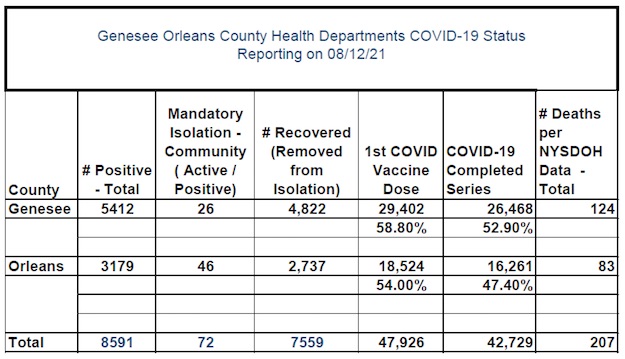
Orleans County had 46 active cases on Thursday and Genesee was at 26 for a total of 72 in the two counties. On July 8, there was only 1 active case in both counties (in Orleans), according to data from the Genesee and Orleans County Health Departments.
In an update on Thursday, the Health Departments said there are 27 new positive cases of Covid in Orleans since Monday, and those individuals are in the age groups of 0-19, 20s, 30s, 40s, 50s, 60s and 70s.
One resident from Orleans is hospitalized due to Covid. Orleans also is reporting 7 more of the previous positive individuals completed their 10-day isolation and have been removed from mandatory isolation and are no longer active cases.
In Genesee, there are 18 new cases since Monday. The individuals are in the age groups of 0-19, 20s, 30s, 40s, 50s, 60s, 70s and 80s.
There are 2 from Genesee currently hospitalized due to Covid. Genesee also is reporting 11 more of the previous positive individuals have completed their 10-day isolation and have been removed from mandatory isolation and are no longer active cases.
The federal CDC currently has Orleans County considered to have “substantial level of community transmission” while Genesee is at the lower moderate level.
Monroe County has been elevated to “high” rates of transmission, a level above Orleans.
By Tom Rivers, Editor Posted 13 August 2021 at 8:08 am
Julie Christensen will retire Dec. 31; Kendall seeks community input in picking next superintendent
Photos by Tom Rivers: Julie Christensen, the Kendall school district superintendent, speaks during commencement on June 26, 2020, which was held outside at the Kendall Fire Department grounds. Being outside in a drive-in setup was a way for the class to be together for graduation with attendance restrictions limited to 150 people although each vehicle counted as one person each the group stayed at the truck or car.
KENDALL – Julie Christensen, Kendall’s school superintendent for 14 years, has announced her plans to retire on Dec. 31.
She has led the district through $40 million of capital construction projects in the past decade, as well as lofty academic standing. Kendall is routinely recognized by the U.S. News and World Report for its academic performance and the district typically has a 100 percent graduation rate.
Christensen joined Kendall in 2007 after working as assistant superintendent for administration and personnel at Gates Chili Central School.
“It’s been a wonderful community,” Christensen said. “I feel good about what we’ve achieved. We have awesome students and a great staff, and a great community.”
Christensen’s three children all graduated from Kendall. Her oldest son was a freshman when the family moved to Kendall and Christensen said her son was quickly welcomed by his classmates when he was the “new kid.”
That friendly and caring community is part of the Kendall culture of valuing everybody, she said.
“At the end of the day it’s all about kids first,” she said. “This is a very welcoming at district. My kids felt that.”
She said the smaller school environment makes it easier for administrators and teachers to be creative and implement new programs. She cited a new Lego team at the elementary level that programs Legos for tasks and other STEAM programs.
Members of the Kendall Board of Education are pictured with district superintendent Julie Christensen, third from left, on Oct. 14, 2014 behind the existing cafeteria, where a new one will be built. The board members include, from left: Martin Goodenbery, Vice President Chris Gerken, President Nadine Hanlon, Chaley Swift and Charles Patt.
The school leaders celebrated the ground-breaking for a $25 million construction project for an array of improvements at both the elementary school and junior-senior high school building. The project includes new roofs for both school buildings, as well as energy efficient improvements, heating and ventilation work, and updated security measures. Both sites will also see improvements to parking lots and sidewalks.
The junior-senior high school was built in 1971 in an “open classroom” model that didn’t include contained classrooms. The capital project gave all the classrooms four walls and their own door.
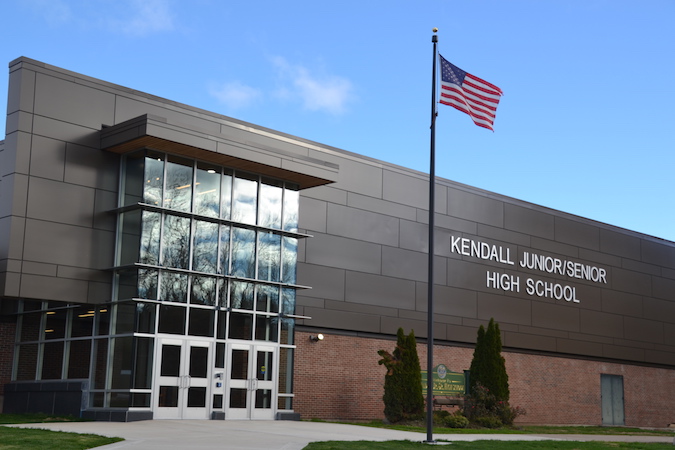
Provided photo: This photo from July 2016 shows employees for the Elmer W. Davis of Rochester tearing off the roof of the Kendall Jr./Sr. High School. The building’s front entrance was given a radical new look over that summer.
One of Kendall’s capital project included a dramatic change to the exterior and front entrance of the Kendall Jr./Sr. High School as well as many interior upgrades.
“We’ve totally transformed both buildings, and all the fields,” Chrstensen said about the capital projects. “It will great instructional space for years to come.”
Lisa Levett, president of the Kendall Board of Education, issued this statement on behalf of the board:
“During Julie’s years at KCS, her commitment to the academic success of students led to high graduation rates and test scores, as well as the implementation of one-to-one devices for kindergarten through grade 12 and a ranking among the top seven percent of schools nationally.
“Her leadership advocating for student excellence kept our schools open five days a week during the 2020-21 school year. She led us through two beautiful state-of-the-art capital projects and many extracurricular program accomplishments. We are thankful for her knowledge and dedication to the success and continued development of KCS. Congratulations and best wishes to Julie in the next chapter of her life.”
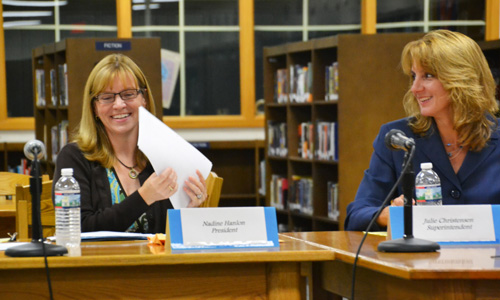
Former Kendall Board of Education President Nadine Hanlon, left, smiles with Julie Christensen, school district superintendent, after the Board of Education accepted seven different construction bids on Sept. 24, 2014 for upgrades to the elementary and junior-senior high school. Those bids totaled $16.4 million.
Hanlon was the BOE president for seven years until her term expired June 30, 2020.
“Julie did a great job for the district she was very conscientious to provide quality education on the taxpayers’ budget,” Hanlon said. “She led the teachers and staff in providing a quality education.”
She said Christensen supported bringing in more resources for students, including mental health professionals and a school resource officer.
“People want to come to Kendall schools,” Hanlon said. “We have great graduation rates and Regents scores. She has been a great leader of all the staff.”
Kendall is working with Monroe 2-Orleans BOCES 2 District Superintendent Jo Anne Antonacci to pick the next superintendent.
A survey has been mailed to district residents and also is available online to assist the search committee in picking Kendall’s next superintendent. Click here to see the survey.
Some of the questions asked include:
What are the three most essential considerations regarding experience and background in hiring the next Kendall Central School District superintendent?
What are the three most essential personal/professional characteristics that should be sought?
In your opinion, what is the single greatest need for the Kendall Central School District right now?
In your opinion, what is the single greatest need for the Kendall Central School District in the next three to five years?
What is it about Kendall Central School District that makes you the most proud?
The Monroe 2-Orleans BOCES website will provide updates about the search process, including future forums to meet the finalists. Those forms are tentatively planned for Oct. 21, 27 and 28. The goal is to have the next superintendent begin on Jan. 1, 2022.
Click here to see the section on the BOCES website about the Kendall superintendent search.
‘I would gladly give up all of my interest in a rocket to the moon to go back again to 1910 and ride once more behind that old horse in the dust of the Fair Haven Road.’
By Doug Farley, Cobblestone Museum Director– Vol. 2 No. 31
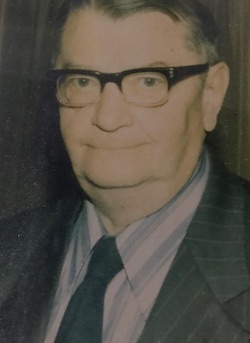
Sanford B. Church, family photo
GAINES – The Hamlet of Childs was by its very location, front and center, during the celebration of the Sesquicentennial of the Town of Gaines in 1959. The milestone of the passage of 150 years of time from 1809-1959 was indeed cause for celebration amongst locals and onlookers, alike. As part of the Sesqui, a 32-page publication was produced that talked about the overall history of the town and reflected on many of the changes that have taken place in the town over the years.
This week’s installment of “Historic Childs” takes a look at an article that was included in the Sesquicentennial publication that featured the reflections of one of its citizens, Sanford B. Church (1904-1976). In his lifetime, Mr. Church practiced law for 40 years and was a founding director of Albion Federal Savings and Loan Association.
He was the owner of the Orleans Republican newspaper, a member of Christ Episcopal Church and Renovations Lodge of Masons. Mr. Church was also the grandfather of current Orleans County Judge Sanford A. Church. The photos included this week were not part of the original essay, but have been included to bring additional understanding to Mr. Church’s remarks.
“Requiescat (Prayer) in Limbo,” by Sanford B. Church, 1959.
This is a chronicle, of sorts, designed with the intention of recalling to the minds of those who read it, some of the customs, practices, institutions which have ceased to be a part of our way of life here in the Town of Gaines during the past fifty years. “Limbo’, according to Webster, is a place or condition of neglect or oblivion, and it is into oblivion that many things we have all known well have passed since 1909. While the loss of some of these causes us no regret, others give a nostalgic tug at our heartstrings and bring back fond memories of a bygone era.
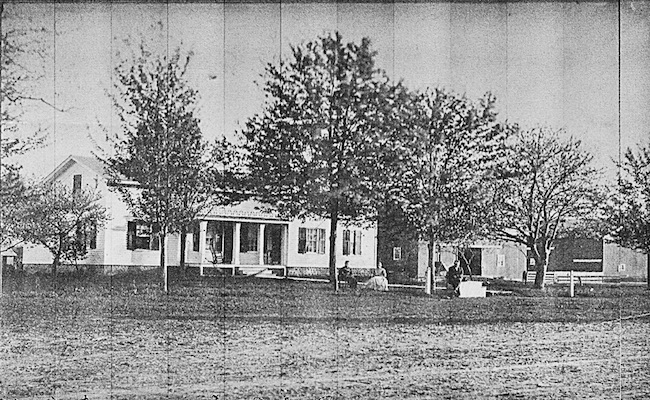
Thompson Farm, Ridge Road, Gaines, late 1800s, showing unpaved Ridge Road. Paving of Ridge Road was not complete until the 1920s.
First and foremost on my list is the passing (or almost) of the dirt road in our town. Certainly, with one exception I can think of, the dirt road as it was fifty years ago has completely ceased to exist. Frankly, I’m sorry. While the modern highways bearing their streams of automobiles from farms to town and maybe still farther away, are an essential part of our current way of life, the little dirt road had a definite charm of its own, and I have always had a special fondness for it in my heart.
In this connection, it is interesting to note that the end of the era of the dirt road was just beginning in Gaines fifty years ago right now. In 1908 the “macadam” road to Gaines was built, and two years later the blacktop road to Fair Haven and beyond was under construction.
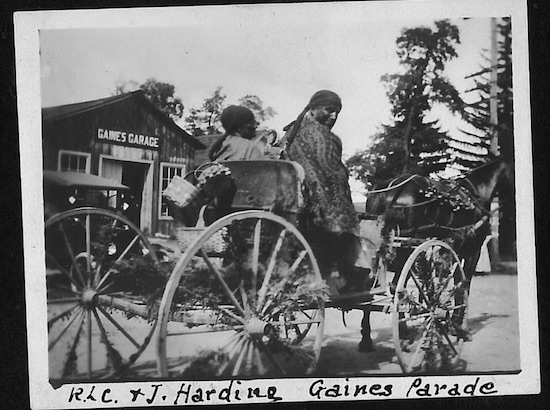
Democrat Wagon from Coloney Farm, Gaines Centennial Parade, 1909
Although I was pretty small back in those days, I can well remember coming home from Oak Orchard in my father’s ‘‘democrat wagon’’ (I suppose it was the station wagon of the time) on a summer’s evening in 1910. At that time there was a large camp for the road workers, and as I recall it was on the west side of the Oak Orchard Road, about a half mile north of the Ridge.
I remember it was dusk, and as the horse plowed his way through the dust, the men were singing and the darkness sparkled with their little fires. In point of time, it was a long drive from Albion to the lake in those days, and many is the buckboard, buggy or democrat we passed on the way, to say nothing of an occasional surrey or phaeton, or a farm wagon creaking and groaning under its load of hay or grain. Such vehicles as these are all gone, so long gone, in fact, that I was startled to see a manure spreader recently on the road not far from Fair Haven (Childs, if you like) drawn by a team of brown horses.
Erie Canal towpath, Gaines Basin, c. 1900 before Barge Canal expansion
Well do I remember blacksmith shops (Joe Vagg’s was the last one to go in Gaines, wasn’t it?). Clure White and his fabulous pond full of goldfish, the old stone mill north of Eagle Harbor, the golf course and country club north of Eagle Harbor, which has both come and gone within this half-century, the towpath along the Erie Canal, the machine shop (maybe you know what work was done there; I don’t) in the rear of the Bacon house in the triangle at Five Corners, the East Gaines store (at the corner of the Kent Road and the Ridge – a vacant lot now), the Congregational Church at Gaines which burned in 1950, Huskin’ Bees, Bees to clear out the drifted roads in winter, and many, many other pleasant, friendly, everyday things.
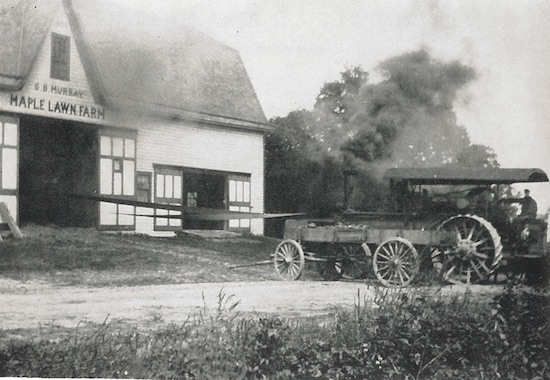
Traction Engine, Maple Lawn Farm, Childs, early 1900s. Note the belt driven power system extending from the engine into the barn.
I can’t remember back to the old, old threshing machine which was propelled by horsepower, and any way that’s back before 1909. But I can distinctly recall the so-called old-fashioned threshing machine, drawn and propelled by a great, smoke-spouting steam “traction engine” which is gone from these parts (although it is in common use in New England, parts of Pennsylvania, and even in other parts of this state).
Almost as good as the arrival of a circus, was the advent of the threshers with their fascinating equipment on a hot summer’s morning. As a child I’ve stood many times in front of the farmhouse where Dan Bolger and his family lived, and seen the men set up the machine, connect the great belt to the traction engine, and bring the wagons loaded with wheat into line. Presently the engine would he belching smoke higher than the barn, the huge spout of the threshing machine would he spewing out straw in a never-ending stream, and the golden grain would run out into the waiting sacks.
Straw stack, Coloney Farm, Childs, c. 1900.
At noon, the activity would suddenly cease, and after a hasty cleaning-up session, the threshers would crowd about the tables to consume the meal the women had prepared. Then, afterwards, the threshing went on all the afternoon, until all the wheat was threshed, the straw stack was two stories high, and the wheat was sacked and ready for market. It was always an eventful day, an interesting and enthralling sight at the time, and a pleasant memory now.
Windmills exist no longer in Gaines, as far as I know. At least, there are no working ones. But they are by no means totally extinct. There are some still in use in this county, and still more in parts of Genesee and Wyoming. Down in the central part of the state, and in parts of New England, they are very common. For those of you who are doubting Thomases, I respectfully refer you to a brand new aluminum one a half-mile east of Navarino on U. S. 20 (south of Syracuse).
George B. LaMont, horse drawn binder, c. 1930.
To the best of my knowledge, no horse-drawn farm tools are in use in the Town. But, like windmills, they are much in use elsewhere for instance, in eastern Pennsylvania and New England. Likewise with the ‘‘little red schoolhouse.” If you are lonesome for these relics of our youth here in this land of the centralized school of university proportions, go to rural New England. There you will find all of them your heart desires (and without swimming pools!).
One of my informants has assured me that there are no outside privies remaining in Gaines, but I can assure him that he’s wrong. While they are on the wane, they definitely are still very much with us, and I have an idea that they will be for a long, long time to come. But hitching posts (except for ornamentation) are a thing of the past, along with dry houses and evaporators.
Picking and sorting apples in 1904, LaMont Farm, note use of barrels for storage and shipping.
In my opinion, the cooper shop is deserving of a memorial from the apple growers of the past in Gaines, because the heyday of the barrel was also the heyday of the apple industry in all of this area. In the early part of this century the crop was usually good, and there was an ever-ready seller’s market, particularly overseas. Am I not correct that many of the fine, old homes of Gaines owe their existence to the fact that around 1900 apples were selling at $14 a barrel in foreign ports, notably in the free port of Hamburg.
Gaines Sesquicentennial Parade float from Coloney Farms, 1909
And what about circuses and the thrilling parades which always preceded them? And don’t tell me there have been no circuses or circus parades in the Town of Gaines since 1909, because I know better. I’ve watched many a parade go past mv house headed north, turn about (with considerable difficulty) at North Street, and head back up Main Street, with bands playing, flags flying and elephants joined tail-by-trunk in a long line.
Calliope as seen at Krull Park, Olcott NY, July 2021.
Perhaps the most thrilling part of the parade (to me, at any rate) was the steam calliope, and I can well remember one in particular, which was huge. Of course, as always, it brought up the rear of the parade, and was giving out great clouds of steam all along the route. The player sat on a fancy settee which overhung the rear wheels, and as the vehicle passed under the trees in front of what is now the Lions Club house, the steam descended, completely enveloping player, calliope, horses and all.
As for circuses themselves, I can well remember three back on the Church farm, at least one of which was within the past twenty-five years. But they’ve gone now, not only from Gaines, but from almost everywhere and circus parades, I understand, have completely drifted into oblivion, forever obscured from their clouds of steam from their now silent calliopes.
While modern economists tell us it is a good thing, and a sign of progress, the passing of the small farm makes me sad. The little farm, usually a one-man operation or certainly a one-family operation, was for a long, long time the measure of the American way of life. For generations the families which worked these small places were the real “grass roots” of the country, and the salt of the earth. It is true that some of these small farms are still with us, but each year a few more of them drift into the limbo of the past, along with the asheries with which Gaines was once so liberally blessed.
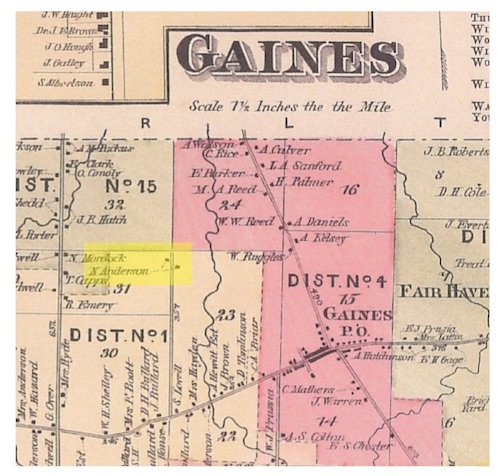
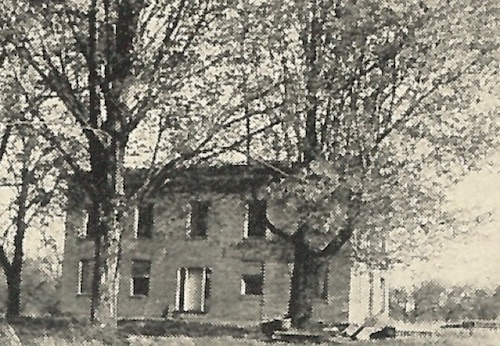
Paradise Road, not existing today, as seen on this 1913 map, at one time had two cobblestone homes at its northern terminus, north of Ridge Road. One home was owned by Nahum Anderson, great-great-grandfather of retired Historian Bill Lattin. Bill noted that Nahum said the soil on Paradise Road was so poor that “it was only good to hold the rest of the world together.”
And Paradise! Have you ever been to Paradise while the half-dozen houses were still standing? Back then, there was no need of going to the “wild west” to find a ghost town. We had our own right here in Gaines. Just when it was finally abandoned, I don’t know, but it has completely fallen to pieces in the last half-century, and now consists of stones scattered about the meadow at the end of the old Paradise Road.
Gaines Academy after a third story had been removed 1930s, Courtesy Town of Gaines Historian
So it was, too, with the old Gaines Academy, except that this institution is marked by a State sign on the south side of the Ridge, across from the Town buildings. The Academy building has completely collapsed into rubble during the past fifty years, but it was, I am informed, abandoned long before that.
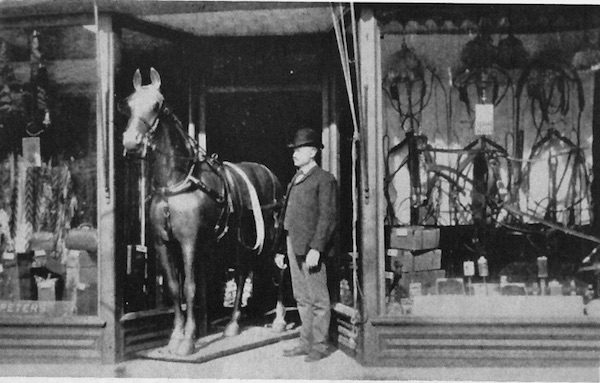
Harness maker Philo Henry Peters is shown here at the entrance of his harness store in Albion, 1905. A sampling of the numerous types of leather goods he produced is seen in the store windows and also on the life-sized horse mannequin he moved outdoors in fair weather.
Harness shops are gone, kerosene lamps (except in emergencies) are no more, and the gas-light era has long since passed. So with the kind of well with an “old oaken bucket” (there were a lot of them fifty years ago).
Blind Man’s Bluff, Bisque Figurine, circa 1890
And think of the old children’s games, like Blind Man’s Bluff, Cops and Robbers, and the like. And the songs which have come, been sung and loved, and gone…and the dances…and the celebrations…and the weddings…and all of “those we have loved long since and lost awhile.”
When I come to read this over, now that the space allotted to me is exhausted, I realize something I never thought of when I started: This little chronicle is a half-century slice carved out of the life-time in the Town of Gaines, in the County of Orleans, State of New York. It tells of the way of life in this community during the period 1909-1959, and all that is set forth in it is now history – a history which many of us living have helped to shape.
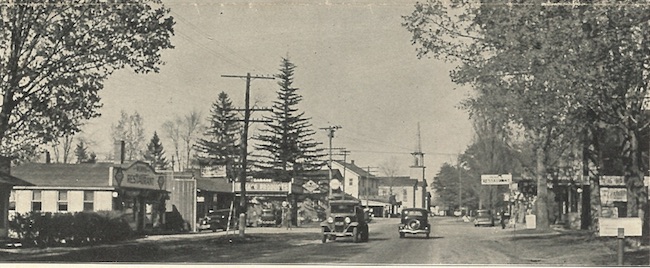
View of Gaines business section looking east along the Ridge Road, 1930s, during the period of recollection by Sanford B. Church.
Progress is wonderful, so I’m told, and we should be duly thankful that we’re living in this modern day and age, with all of its many wonders. Probably this is right, and probably a psychologist would say that I’m simply wishing for my irrevocable youth when I would gladly give up all of my interest in a rocket to the moon, to go back again to 1910 and ride once more behind that old horse in the dust of the Fair Haven Road.
By Tom Rivers, Editor Posted 12 August 2021 at 3:56 pm
County stays over 40,000 — barely
The U.S. Census Bureau today released population counts for each county in the United States. The data shows a 5.9 percent decline in Orleans County, which was biggest drop among Western New York counties and most in the GLOW region.
Orleans shrunk by 2,540 people in the 10 years, according to the U.S. Census Bureau, dropping from 42,883 in 2010 to 40,343 in 2020.
The county managed to stay above 40,000 people in the census count.
The Orleans County population in recent counts include 42,883 in 2010, 44,171 in 2000, 41,846 in 1990, 38,496 in 1980 and 37,305 in 1970.
The percentage drop from 2010 to 2020 in Orleans County is the most among Western New York counties and the GLOW region. All of those counties declined except Erie and Monroe.
Here is a breakdown of the population changes in WNY and GLOW:
Genesee, down 2.8 percent from 60,079 in 2010 to 58,388 in 2020
Livingston, down 5.4 percent from 65,393 in 2010 to 61,834 in 2020
Orleans, down 5.9 percent from 42,883 in 2010 to 40,343 in 2020
Wyoming, down 3.9 percent from 42,155 in 2010 to 40,531 in 2020
Monroe, up 2.0 percent from 744,344 in 2010 to 759,443 in 2020
Erie, up 3.8 percent, from 919,040 in 2010 to 954,236 to 2020
Cattaraugus, down 4.1 percent from 80,317 in 2010 to 77,042 in 2020
Chautauqua, down 5.4 percent from 134,905 in 2010 to 127,657 in 2020
Some counties experienced a bigger population loss, by percentage, than Orleans. They include:
Schoharie, down 9.3 percent from 32,749 in 2010 to 29,714 in 2020
Franklin, down 7.8 percent from 51,599 in 2010 to 47,555 in 2020
Delaware, down 7.7 percent, from 47,980 in 2010 to 44,308 in 2020
Madison, down 7.4 percent from 73,442 in 2010 to 68,016 in 2020
Herkimer, down 6.8 percent from 64,519 in 2010 to 60,139 in 2020
Otsego, down 6.0 percent from 62,259 in 2010 to 58,524 in 2020
By Mike Wertman, Sports Writer Posted 12 August 2021 at 3:06 pm
Photos by Cheryl Wertman – The new Medina Skatepark at Butts Park is rapidly taking shape. This a a panoramic photo of the facility which will be named the Luke Nelson Skatepark in memory of the Middleport skateboard enthusiast who spent a lot of time at the old Medina skatepark. His family has contributed to the project and has spearheaded a major fundraising effort. That effort by the Medina Skate Society raised some $250,000 which was matched by a grant from the Ralph C. Wilson Jr. Foundation to finance the $550,000 project.
The old skatepark was removed by the Village of Medina in January and ground was broken for the new facility in early June. The project is scheduled to be completed by early September.
The skatepark will include areas and features for beginners, intermediate and advanced levels for skateboards, bikers and in-line skaters.
Photo courtesy of GCASA: Jessica Budzinack is GCASA’s parent/family support and project specialist.
The Healthy Moms, Healthy Babies program at Genesee/Orleans Council on Alcoholism and Substance Abuse is making a difference in the lives of women dealing with substance use issues while trying to raise a family, according to Jessica Budzinack, the agency’s parent/family support and project specialist.
“During the past year, we have been able to connect with parents or family members that need individualized support, putting a primary focus on pregnant and post-natal women and women who have children that were exposed to substances in the womb,” Budzinack said.
“Parents in recovery or parents that struggle with addiction have different needs and different barriers that they need to overcome.”
The initiative is supported by the Health Resources and Services Administration of the U.S. Department of Health and Human Services as part of a financial assistance awarded totaling $500,000, said Rosalie Mangino-Crandall, GCASA’s director of Project Innovation and Expansion.
Mangino-Crandall said the specific program is funded by an HRSA Rural Communities Opioid Response Program-Neonatal Abstinence Syndrome (RCORP-NAS) grant.
The HRSA RCORP-NAS program places emphasis on pregnant women, mothers, and women of childbearing age who have a history of, or who are at risk for, substance use disorder or opioid use disorder, and their children, families and caregivers.
At GCASA, Healthy Moms, Healthy Babies specifically supports pregnant and post-partum women with substance use disorder and their partners and children as well as anyone caring for a child exposed to substances in the womb.
Services include case management (including connections to treatment, healthcare coordination, and assistance with social determinants of health), parenting peer support, recovery peer support, and transportation and childcare assistance.
Budzinack said the program offers “coach-like peer support to parents and their families.”
“We work with them to overcome obstacles, such as navigating the Family Court system, helping them find extra support for their children and helping them … connect to different organizations or resources that they need to help them be successful parents,” she said. “We also connect them with our Prevention team, which offers active parenting classes and other forms of education.”
She noted that she also has been able to assist mothers with children in foster care.
“We do what we can to help during the process of trying to bring them home. We help them navigate in that area to achieve those goals,” she said.
Healthy Moms, Healthy Babies staff are committed to lifting mothers and children with self-esteem issues as well.
“Another thing that they face is stigma,” Budzinack said. “They kind of feel like the world is shaming them for making that decision. Our job is to make them feel comfortable and responsible, and educate them to the best of our ability. Education is a big thing.”
Mangino-Crandall said the project utilizes the research-based Positive Direction Model created by Dr. Davina Moss-King to help pregnant women prevent and mitigate the effects of substances taken during pregnancy on their babies.
“This includes properly taking prescription medication such as MAT (medically-assisted treatment) medications as well as illicit drugs, alcohol and misused prescription drugs,” she said. “Women who receive medically-assisted treatment have different needs, and there’s much to consider in those cases.”
Budzinack mentioned the high level of uncertainty and fear faced by pregnant women on MAT who have just given birth.
“They have so much to think through,” she said. “How does this affect my pregnancy? What’s going to happen after I have the baby? Just to have someone that they can talk to without judgment, to make sure they know the importance of her health and the health of that child.”
She said she worked with a woman last summer who was pregnant and had two daughters in temporary foster care.
“We helped her to meet the criteria for the Office of Children and Family Services to bring her children back home while she underwent medically-assisted treatment to maintain recovery,” she explained. “Through support of a case manager, participating in The Recovery Station (on Clinton Street Road) and taking advantage of active parenting classes, things are working out for her.”
Budzinack said the woman has made a concerted effort to get her children back and that commitment has paid off. Her baby is going to be a year old in a couple months and both of her older daughters are back home with their mother.
Healthy Moms, Healthy Babies is backed by a consortium that includes the following original partners: Oak Orchard Health, Lake Plains Community Care Network, and Genesee and Orleans County Health Departments.
More recent partners include Oak Orchard WIC (Women, Infants and Children), Genesee and Orleans County Mental Health Departments, United Memorial Medical Center, UMMC Moms Program and Orleans Recovery Hope Begins Here.
For more information or to make a referral, click here or call Budzinack at 585-813-8583.
By Tom Rivers, Editor Posted 12 August 2021 at 11:25 am
HOLLEY/MEDINA – U.S. Senators Charles Schumer and Kirsten Gillibrand have announced $460,000 in federal funding in Orleans County for two railroad projects.
The Orleans Economic Development Agency submitted the application to the Northern Border Regional Commission for funding to reconstruct the public siding train track in Medina and to build a new siding track in Holley. The funding will go through the EDA’s Orleans Land Restoration Corp.
With the money, the EDA will reconstruct and build new siding tracks in Medina and Holley, and complete preliminary engineering, Schumer and Gillibrand said in a joint news release.
This will extend rail access to the new Medina Business Park South in Shelby.
“This vital access will provide for future industrial development in Orleans County, as well as retain existing jobs,” the two senators said.
The grant was part of $4,661,981 in federal funding for eight projects that range from critical infrastructure, like broadband and sewage, to housing analysis. The funding was allocated through the Northern Border Regional Commission’s State Economic & Infrastructure Development Investment Program to support infrastructure projects and other initiatives that create jobs, support entrepreneurs, and strengthen the economy in northern border communities.
“The Northern Border Regional Commission has a special role to play spurring economic development and creating jobs. This funding will provide support to communities across Upstate New York, working to complete priority projects,” said Senator Schumer. “I am proud to support this essential funding in congress and will continue to fight to ensure it supports critical projects across Upstate New York.”
The NBRC is a federal-state partnership focused on the economic revitalization of communities across the Northern Border region, which includes northern Maine, New Hampshire, Vermont, and New York. The Commission is composed of the governors of the four Northern Border states and a federal co-chair, and provides financial and technical assistance to communities in the region to support entrepreneurs, improve water, broadband, and transportation infrastructure, and promote other initiatives to improve the region’s economy.
The northern border region of New York State includes 28 counties: Cayuga, Clinton, Essex, Franklin, Fulton, Genesee, Greene, Hamilton, Herkimer, Jefferson, Lewis, Livingston, Madison, Montgomery, Niagara, Oneida, Orleans, Oswego, Rensselaer, Saratoga, Schenectady, Seneca, St. Lawrence, Sullivan, Washington, Warren, Wayne, Yates.
“After more than a year of grappling with financial hardship caused by the pandemic, New York communities are relying on investments like this to attract new businesses, create good-paying jobs, and revitalize our communities,” said Senator Gillibrand. “Now more than ever, I am grateful for our valuable partnership with the Northern Border Regional Commission that will help New York’s local economies recover from the massive financial losses incurred during the pandemic and will continue to spur economic growth for years to come. I will continue fighting for funding that will help sustain Upstate New York economies through this difficult time and make necessary investments in infrastructure and other critical resources.”
MURRAY – Supportive Care of Orleans (formerly known as Hospice of Orleans County) is pleased to announce its 24th Annual Golf Tournament will be held on Friday, Sept. 17, at Hickory Ridge Golf Resort.
Since its inception, and with the community’s help, this single annual event has raised more than $250,000 toward palliative and supportive care services in Orleans County.
“After the ‘pause’ of 2020, we can’t wait to celebrate with all our friends, and look forward to enjoying great company, great golf and as always, a great time!” said Elisa Chambery, CEO of Supportive Care of Orleans. “We are so grateful and appreciative of all our community members and businesses for your ongoing support, generosity, and commitment of Supportive Care of Orleans.”
Now that we have been able to begin inviting back our volunteers, we have been able to welcome the dedicated members of our Golf Committee to assist us in making this tournament a huge success.
Registration is required and the form will be available online in addition to being mailed to your home. As in the past, space is limited to 144 golfers and reservations are being taken on a first come, first serve basis.
For further information on registration, please call 585-589-0809 or email Maggie Stewart at mstewart@scorleans.org. You can also click here for additional information and downloadable registration forms.
By Tom Rivers, Editor Posted 12 August 2021 at 10:28 am
Photos courtesy of Erin Reed
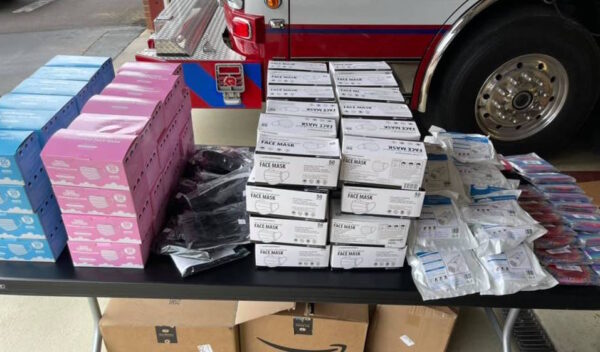
HOLLEY – Hunter Salamaca, an EMS officer with the Fancher-Hulberton-Murray Fire Company, is shown at the fire hall in Holley today where there are free face masks, sanitizer and thermometers being given away from 10 a.m. to 2 p.m. at 7 Thomas St.
“Due to the unknown of the new Covid variant (Delta), the possibility of mandated masking and your children going back to school, we would like to take some stress off of you,” Murray Joint Fire District officials said in a Facebook post. “Stop down and grab a box or two of masks and some hand sanitizer free of charge.”
The masks are in children’s and adult sizes.
Erin Reed, an EMS lieutenant, was able to secure the PPE (personal protective equipment) for today’s event.
The Murray Joint Fire District includes Holley and FHM firefighters.
By Tom Rivers, Editor Posted 12 August 2021 at 9:38 am
Village will have Planning Board and committee continue to look for ways to fill business locations
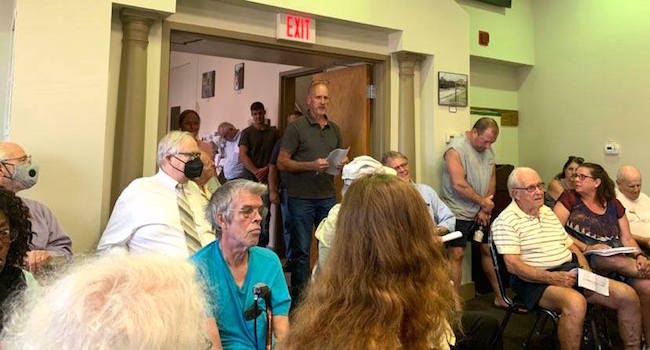
Photos by Tom Rivers: Chad Fabry (standing by door), owner of the former Swan Library site at 4 North Main St., said a proposed law from the village for vacant commercial buildings was “an unreadable piece of junk.” The meeting room was packed on Wednesday evening for a public hearing on the proposed law. Fabry said the proposed law, with fines at $1,000 or more, treats the building owners with vacancies like criminals. “You’re punishing a building owner who is already struggling,” he said.
ALBION – The Village Board, after an outcry against a proposed law assessing fees for vacant commercial buildings, voted to reject the proposed law and will start from scratch in looking for ways to fill business sites in the village.
Albion was considering a law that would have assessed a $250 fee if a commercial site went vacant for more than 30 days, with $1,000 tacked on if the site was empty for a year, $2,000 if it went a second year, $3,000 for a third year and $4,000 for each subsequent year.
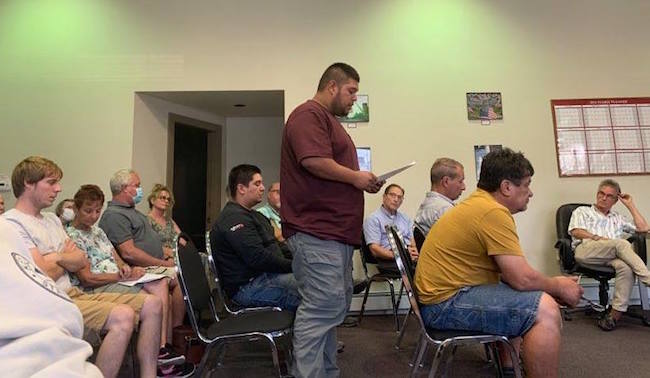
The Village Board meeting was packed with building owners for a public hearing on Wednesday. Many of them thanked the board for attempting to address vacancies in the downtown and other business districts. But they said the proposed law wasn’t a good way to deal with the situation.
“I compare it to hitting a fly with a sledgehammer,” said Ron Vendetti, the village former code enforcement officer who owns a building on Bank Street.
Vendetti said the village already has laws for property maintenance that could be used to make the sites look better. The village also could do fire inspections to make sure the sites are safe, Vendetti said.
The law comes a terrible time for the property owners, who haven’t been able to evict non-paying tenants due to a moratorium on evictions and have had many of the business tenants struggle during the Covid-19 pandemic, he said.
Lucy and Tom Miller of Buffalo own a commercial site in Albion and they haven’t been able to rent or sell it for four years, despite trying really hard to market the former banking location.
“Albion is a good place,” Mrs. Miller said during an hour-long public hearing. “It just needs some TLC.”
She echoed the comments that a “punitive” law, costing buildings owners more money during a pandemic, is a bad idea.
“These are hard times right now,” she said. “People are suffering. Until we get through this pandemic, we should be kind to one another.”
Natasha Wasuck, owner of the Tinsel and Lockstone site just north of the canal, urged the board to approve the law. She said other communities – Medina, Le Roy, Troy and many others – have used vacant commercial registries and laws to strongly encourage the building owners to get their space occupied. The vacancies are a detriment to the other merchants in Albion, she said.
She suspected some building owners keep the space unfilled as tax write-offs. That comment drew a response from several others in attendance.
Angel Javier Jr. owns the former hardware store location on Main Street, which has been vacant for nearly two years. Javier said it is costly to bring the historic locations up to date with electricity and other needed infrastructure. He is doing much of the work gradually, with help from his family, to avoid an astronomical bill.
If he paid to have the work done, he doesn’t think he could find tenants who could pay enough rent to justify that expense. He said he has been approached by some possible tenants but they don’t want to pay enough to cover his costs for upgrading the building.
“Projects take money and ingenuity,” he said.
Javier said the building owners all are committed to Albion and want to see the community succeed with a vibrant business district.
Angel Javier Jr., who owns the former hardware store site on Main Street, shares concerns about Albion proposed law. He said building owners like himself are often paying as they go and getting a rehab of a historic site can take years of work.
Gus Revelas, owner of the former Gus’s Soda Shoppe on Main Street, said he has declined some offers to rent his building because he didn’t think those businesses would have been good for the community. His daughter, Athena Nichols, is an art teacher and she said she is looking to open a business in the location at some point.
She told the board her family – which has owned the site for more than a century – continues to pay taxes and maintain the location. They shouldn’t be penalized because the building isn’t currently used for a business, she said.
“You are creating heartache and problems for people who want to continue their business,” she said.
Other speakers questioned the wording in the law, and what they saw as unconstitutional provisions about entering the buildings without a warrant for inspections.
Corey Black, one of the downtown building owners, was among the speakers who said the proposed law was “very ambiguous” and wasn’t clear on what is considered a “vacancy.” In one section it says an unoccupied “portion” of the building could make the location considered vacant, but another spot said it applies only to the main floor of the building.
Black said the law could force building owners to be less choosey about tenants, which could be detrimental to the downtown and community.
“You can’t legislate yourselves out of a problem,” Black said. “We can’t legislate ourselves to look like Medina.”
Karen Conn, a Planning Board member, said that board had worked on the proposal for about a year, looking for ways to encourage the reuse of the buildings. She welcomed more input from the building owners to help encourage a vibrant downtown and other business districts in the village. The Planning Board’s intention wasn’t to make it more difficult for the property owners.
Michael Bonafede owns three of the historic locations in the downtown. When he and his wife Judy Koehler bought the Pratt and Day buildings about 15 years ago, the sites only had one tenant. Now they have 11 and that includes the Downtown Browsery with 40 vendors.
Bonafede said Albion has long wanted to have a more vibrant business district, but has struggled to chart a course with everyone working together.
“I admire what you’re trying to do,” Bonafede told the Village Board. “We just don’t know how to go forward as a community.”
He said “polarization” holds the community back. He said the proposed law would be a “huge hardship” on the building owners. There are other options and he cited a report from the National Trust for Historic Preservation which provided a detailed report for Albion’s Main Street about a decade ago.
Bonafede said there are many resources that would assist Albion in a resurgence.
Mayor Eileen Banker thanked the building and business owners for attending the meeting and voicing their opinions. There was an initial public hearing about the law last month and there weren’t any comments. The board decided to send a copy of the proposed law to all the property owners in the business districts in the village so they would be aware of the proposal and to give them a chance to provide input.
“I’m thrilled you are all here,” Banker told the crowd. “This is absolutely what we want. We want to make it a community effort.”
By Tom Rivers, Editor Posted 11 August 2021 at 5:38 pm
Photos by Tom Rivers
EAST SHELBY – Nathan Gray, 6, is shown at his produce stand on East Shelby Road this afternoon.
Nathan started selling produce from the stand last month. He grew most of the vegetables with his father Justin Gray at their home on Dunlap Road. That is a low-traffic area so they decided to sell the produce from a spot in Nathan’s grandparents’ front yard just south of the East Shelby Fire Hall.
Nathan and his dad Justin are shown at the stand this afternoon. Justin has had a garden for years and his son likes to help him grow vegetables. Some of the items are from other growers, but Mr. Gray said about 90 percent comes from their garden.
Nathan wanted to sell some produce to make some money to go towards a small 4-wheeler. He also welcomes the chance to chat with customers who stop by.
“He has the gift of gab,” his dad said. “He likes to talk to people.”
Nathan will be a second-grader at Medina next month. He said he likes to meet people who stop by the stand.
“A lot of the people are nice,” he said.
Right now corn and tomatoes are the most popular items. They have a lot of pumpkins that will be ready in the fall. The Grays expect the will keep Nathan’s Produce Stand going until early November.
“We’re trying to teach him that hard work pays off,” Mr. Gray said.
Photo courtesy of Justin Gray: Nathan Gray operates a rototiller and works the soil this spring. He said he gets out early in the morning to work in the garden.
By Tom Rivers, Editor Posted 11 August 2021 at 3:23 pm
‘It’s not something that we expected or asked for, but I’m fully prepared to resume the responsibilities of the State of New York.’
This is a screenshot of Kathy Hochul speaking during a news conference this afternoon in Albany.
ALBANY – Lt. Gov. Kathy Hochul held a news conference today, her first since Andrew Cuomo announced he will be resigning as governor on Aug. 24.
Hochul thanked Cuomo for his service, but made it clear she and Cuomo didn’t have a close working relationship. She said there would be turnover among his key staff members and she vowed her administration would not be described as a “toxic work environment” like Cuomo’s was in a report from Attorney General Leticia James.
That report was presented last week and detailed sexual harassment from Cuomo against 11 women. He made the announcement on Tuesday he would resign in 14 days to allow for a smoother transition to Hochul.
“I’ve been traveling the state and do not spend much time in his presence or in the presence of many in the state Capitol,” Hochul said during the news conference.
She said she is ready to take over as governor and already has talked with the leaders of the state Legislature, and other key business and religious leaders.
Hochul will serve the remainder of Cuomo’s term, which is about 16 months. She has been the lieutenant governor for about 6 ½ years, twice winning state-wide elections.
“I want people to know that I’m ready for this,” Hochul said. “It’s not something that we expected or asked for, but I’m fully prepared to resume the responsibilities of the State of New York.”
She will articulate a vision for the state soon after she takes office as New York’s first female governor on Aug. 24. She said continuing to fight Covid-19 and move the state forward after the economic devastation from the pandemic will be top priorities.
She also said she will work to “enhance” some of the state’s progressive policies. She promised she would “fight like hell” for all New Yorkers.
“Over the next two weeks I will continue meetings with my current and potential cabinet officials,” Hochul said. “I’ll build out my senior staff, and I’ll do what I’ve always done: Travel the state to meet New Yorkers and listen to them to assure that I have their backs and I will take their concerns and bring them to the state capitol. I’ll work with our partners at every level of government to come to solutions. People will soon learn that my style is to listen first and then take decisive action.”
She said she will keep up her annual traditions of attending the Erie County Fair and State Fair.
“I know this year and a half has been so challenging for families and businesses across our state and sometimes it doesn’t feel like it’s getting any easier,” she said. “The Delta variant is still raging and it’s going to take all of us to defeat it.”
She acknowledged school districts are preparing to soon open and they want to do safely.
“Our children are heading back to school soon, and there is a lot of anxiety from moms and dads I speak to, and teachers as well,” Hochul said. “It’s going to take all of us working together to keep our children safe, our teachers safe, and anyone who works in schools safe.”
She said the Cuomo administration leaves “a legacy of accomplishment” on many fronts, and she rallied support statewide for many of those policies.
“I was out there in the streets fighting for raising the minimum wage, fighting for paid family leave, and I was a champion of policies to eradicate the spectra of heroin abuse, something that has touched my family personally,” she said. “Child care issues, I’ve been out there making announcements on affordable housing, clean energy projects and economic development. So that will continue, those policies will continue and be even more enhanced.”
WASHINGTON, DC – Congressman Chris Jacobs (R-NY) and Senator Mike Lee (R-UT) led a bicameral letter with 29 members of Congress to President Biden calling for the administration to change course and end its unconstitutional eviction moratorium.
“We strongly oppose the Biden administration’s latest eviction moratorium issued by the Centers for Disease Control and Prevention (CDC). This latest action is plainly unconstitutional and will only serve to further distort the market and create a housing affordability crisis,” the lawmakers said. “Additionally, any further restrictions on evictions at this point are counterproductive. The economy is open, jobs and vaccines are abundant, and federal rental assistance is a reality.”
In a recent Supreme Court case, Alabama Association of Realtors v. Department of Health and Human Services, five members of the Supreme Court effectively acknowledged that CDC exceeded its authority in issuing the moratorium. Justice Kavanaugh stated that “clear and specific congressional authorization (via new legislation) would be necessary for the CDC to extend the moratorium past July 31.”
“Instead of pursuing an unconstitutional moratorium, the Biden administration should be focused on distributing the nearly $50 billion in rental assistance that was appropriated through three separate stimulus packages,” the lawmakers said. “As long this moratorium remains in place, property owners will continue to struggle financially. These property owners must still pay mortgages, taxes, and maintenance for the dwelling. If this continues much longer, we will see a wave of bankruptcies, foreclosures, and blighted properties.”
Most states require the tenant to take the initiative when applying for rental assistance. A recent Treasury report found very little of the federal rental assistance money has been disbursed so far, and the new moratorium will act as an additional disincentive for tenants to apply for this aid, leaving property owners on the hook.
“We demand the Biden administration end this moratorium and allow the rental assistance funds to do what they were intended to do. This government overreach must end,” the lawmakers said.
Senators signing the letter include: Mike Lee (R-UT), James Lankford (R-OK), Roger Marshall (R-KS), Jerry Moran (R-KS).
Representatives signing the letter include: Scott Perry (R-PA-10), Rick Crawford (R-AR-01), Bob Gibbs (R-OH-07), Louie Gohmert (R-TX-01), Greg Steube (R-FL-17), Barry Moore (R-AL-02), Michael Cloud (R-TX-27), Fred Keller (R-PA-12), Brian Mast (R-FL-18), Bruce Westerman (R-AR-04), Andrew Garbarino (R-NY-02), Diana Harshbarger (R-TN-01), Dusty Johnson (R-SD-AL), Jody Hice (R-GA-10), Debbie Lesko (R-AZ-08), Nicole Malliotakis (R-NY-11), Jack Bergman (R-MI-01), Tracey Mann (R-KS-01), Jay Obernolte (R-CA-08), John Rutherford (R-FL-04), Brad Wenstrup (R-OH-02), Andrew Clyde (R-GA-09), Ted Budd (R-NC-13), Lisa McClain (R-MI-10), Austin Scott (R-GA-08) and Bill Posey (R-FL-08).
By Tom Rivers, Editor Posted 11 August 2021 at 12:16 pm
Village holding public hearing today at 6 p.m.
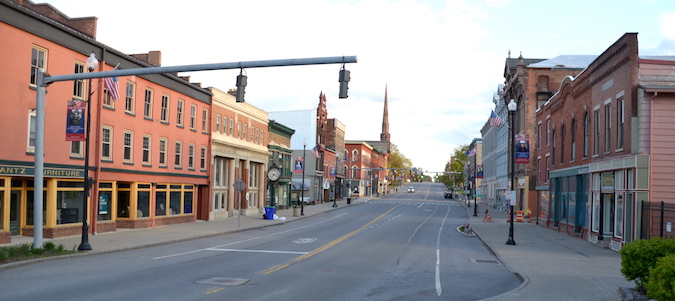
Photo by Tom Rivers: This photo shows Main Street in downtown Albion on an evening in May. The Village Board has proposed a law for vacant commercial buildings where property owners have to pay to be on a vacant building registry and pay annual fees if the sites remain empty.
ALBION — The Village Board wants to encourage commercial building owners to keep their sites occupied. The board sees many of the vacant sites as “unsightly, unsafe and discourages business traffic in the village,” according to a proposed law.
The village will have public hearing today at 6 p.m. to receive feedback about the law that the Village Board says will establish a process for identifying and tracking vacant commercial units, set forth responsibilities for the vacant sites, and to speed the renewed use of the buildings.
Some of the building owners have already sent letters to the Village Board, outlying concerns that the proposed law is unconstitutional and could have the opposite intended effect of making a building too costly to own.
The proposed law applies to commercial buildings in the Central Business District, General Business District, Planned Commercial Development District, Residential Offices/Limited Business Districts or Light Industrial Districts.
The proposed law would require the owner of properties to register the site with the code enforcement officer no later than 30 days after it becomes vacant or no later than 30 days after being sent a notice from the code officer that the building needs to be registered as a vacant building.
The code officer may identify a vacant site through the routine inspection process or through notification by residents, neighborhood associations or community groups that the site may be eligible to be on the vacant building registry.
The owner of the site needs to submit a vacant building plan which could include a plan for securing and maintaining the site if it will remain vacant and a reason why it will be vacant, a rehabilitation plan that shouldn’t exceed 365 days to return the building to appropriate use, or a demolition plan and time frame for demolition.
If the site isn’t maintained, the village has grounds to remediate the building and bill the costs to the owner, revoke the rehabilitation plan, and subject the owner to fines and penalties, according to the proposed law.
The proposed law also says the building owner needs to pay a $250 registration fee to be on the vacant building registry. If the building remains vacant, the owner will be charged an annual vacant building fee of $1,000 for buildings 20,000 square feet or less, or 5 cents per square foot for sites over 20,000 square feet. That would be $1,500 for a 30,000 square foot site, for example.
Conrad Cropsey, owner of the Briggs Building in the downtown, said the proposed law violates due process and doesn’t include grandfather provisions for bringing buildings up to current code, which could make many of the historic buildings “unsalable,” he said in a letter to the board.
“You will end up owning them for taxes and fines,” Cropsey wrote in his Aug. 3 letter to the Village Board. “Your own building (Village Hall) is included if it is not fully used.”
Cropsey, an attorney, said the village also can’t legislate implied “consent” to enter a building.
“The law is that you can enter if there is an emergency to health and safety or you have established a probable cause of a violation of a valid and constitutional law,” Cropsey wrote. “Couple this with several bad and or overly broad definitions and your proposed law is a train wreck waiting for a litigator.”
Cropsey said the board has a good motive in the law but the proposal “is not the way to achieve it.”
Nathan Lyman, another attorney with a building on Main Street, also wrote to the board with his concerns. In his letter on Aug. 2 , he said downtown real estate values haven’t go up in 20 years.
Compared to 1982 when Lyman was a village trustee, the building owners today face less business activity in the downtown, a higher tax burden and “a pandemic where property owners are prohibited by executive fiat from commencing evictions if the rent is not paid.”
Lyman said the board has good intentions with the proposed law, but it comes during a challenging time for the building owners. The proposed law is also unconstitutional, he said.
Many of the buildings have multiple units and could be 75 percent occupied. But by the proposed law’s definition, the building could be required to be registered with the village as a vacant site, Lyman said.
“If I have chosen not to develop the third floor of my building because of fire code requirements, what right does the Village have to call the building vacant because that area is empty and not viable from an economic perspective?” Lyman wrote. “The same is true of Five Star Bank building, which does not utilize the space on the second and third floors of their building. The determination of the Code Enforcement Officer could easily lead to challenges based upon the subjective vagueness in definitions and selective enforcement by the Village.”
Lyman said requiring owners to register makes them give up their Fourth Amendment right to be free from unreasonable search and seizure – “By registering a building, an owner consents to an Enforcement Officer inspecting the premises…”
The Village Board would be putting taxpayers at risk for costly litigation with the law, which Lyman said wouldn’t stand up in court.
The village also can’t mandate a storefront to be occupied, “or that the property owner magically generate a rent-paying tenant or else pay a penalty to the Village,” he wrote in his letter.
The village can, however, enforce health and safety regulations such as the building code, but it does not have the right to compel a property owner to lease or occupy a building, Lyman said.
“So long as the building, which is already subject to safety and fire inspection, meets those codes and pays the real property taxes, the village cannot mandate that a storefront be occupied, much less assess a fee if it is not,” he said.
Lyman said the business climate in Albion “is challenged at best.” The Covid-19 lockdowns “decimated” many small businesses in downtowns. In Albion, “the building inventory does not meet the requirements of national franchises, which is why none are located downtown,” he said.
He said putting a vacant building on a registry would likely further diminish the value of the site and could result in a lower tax assessment and hurting the village’s tax base.
“I am reminded of the adage that it is easier to attract flies with honey than with vinegar,” Lyman said. “Isn’t it a wiser strategy to do positive things to help the business community which is struggling to recover from pandemic mandates, as opposed to adopting more punitive mandates?”




























 The U.S. Census Bureau today released population counts for each county in the United States. The data shows a 5.9 percent decline in Orleans County, which was biggest drop among Western New York counties and most in the GLOW region.