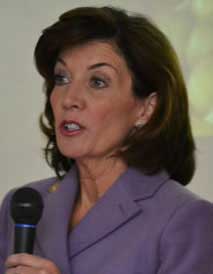
New York Farm Bureau released its 2022 state legislative priorities on Monday that address the needs and challenges of the state’s diverse agricultural community in New York State. This included reaction and next steps to address Friday’s Farm Labor Wage Board decision to lower the overtime threshold from 60 to 40 hours over the next decade.
Overtime Threshold Decision
New York Farm Bureau President David Fisher, who is on the Department of Labor’s Farm Labor Wage Board, expressed his serious concerns with the 2-1 decision passed late Friday that will begin dropping the threshold in 2024. He said it will be extremely difficult for farmers and farmworkers to absorb and will change the face of New York agriculture.
He also questioned why more of the submitted video testimony was not played for the full wage board to hear and consider.
“In the end, the decision was made with little deliberation or reflection of the testimony. I would have hoped my fellow board members would have considered more of the impacts that this will have on agriculture,” said President Fisher.
About 70-percent of the testimony was in favor of keeping the overtime threshold at 60. Many farmers and farmworkers testified that anything lower will hurt farmworkers. It will mean fewer hours, less income and force those wanting to work more to find a second job or leave New York State for employment. New York State can’t afford to lose its skilled workforce. Fisher also expressed on the call how this will negatively impact farms operating under thin profit margins as well as New York’s food system and access to local food.
“We saw how important that was in the pandemic for consumers and food banks. We heard testimony that labor will be too expensive, and hours will be limited so there won’t be that excess product to give away,” he said.
New York Farm Bureau is asking Gov. Hochul to find an alternative to the wage board’s recommendation. The organization appreciates that she is looking for a creative solution by proposing a tax credit to offset overtime pay, but many farmers have expressed concern over having to cash flow the high overtime costs before they could see any income from the tax credit, potentially a year later. New York Farm Bureau is asking for more discussion around this with the governor and legislature.
“So much is at stake. This is a priority issue for New York Farm Bureau and all of agriculture. We have worked closely with our partners in the Grow NY Farms coalition and will continue to fight forward together,” said Fisher.
Food Processing
Farmers are still feeling the repercussions from the pandemic with market disruptions, supply shortages, and inflation that has increased the costs for many things needed to farm.
Another NYFB priority aims to alleviate some of the pressure farms experienced when national supply chains were disrupted. While New York State has some outstanding dairy and food processing plants, there is a lack of processing for some commodities, including meat processing.
Nearly all of the USDA certified processing facilities in this state are small scale. While they are critical to the state’s food infrastructure, many times it takes farmers months to secure slots to process livestock, often turning to larger facilities out of state.
“New York Farm Bureau recognizes that there are no easy answers, but it is clear that there is a demand. New York Farm Bureau is asking the state to continue the discussion, perhaps bring interested parties together in a round table to look for needed solutions. This could address supply chain issues that will undoubtedly happen again in the future,” said Eric Ooms, NYFB Vice President.
State Budget
The New York State budget will be a major focus for NYFB as well. The spending plan put forth by the governor is truly one of the best NYFB has seen in years. She fully funds a number of important animal health, promotion and research programs. The governor also is doubling the workforce retention tax credit from $600 to $1,200 which would offset some rising labor costs that continue to put New York farms at a competitive disadvantage. The governor is also proposing to increase an investment tax credit to 20 percent for farms to recoup some expansion costs if they qualify with a tax liability to take it. NYFB is asking for that to be a refundable tax credit.
The governor is also proposing a record $500 million in spending for the Environmental Protection Fund. This includes $2 million more for farmland protection and nutrient management programs, $4 million dollar increases for both Soil and Water Conservation Districts, that help administer sustainability efforts, and invasive species programs. There is also $17 million earmarked for climate resilient farming initiatives.
“This funding addresses another of our major priorities to support farmers in their efforts to adapt to and mitigate climate change. These programs will fund critical programs that will help farmers to continue to invest in soil health practices and support on-farm renewable energy to meet the state’s net-zero climate goals. Farmers are actively involved in reducing carbon emissions, and this funding recognizes that those efforts are working,” said Jeff Williams, NYFB’s Public Policy Director.
The State Senate has already advanced another one of our priorities for the session. It passed Senator Anna Kaplan’s bill (S.6791A) that adjusts how much employers contribute to the unemployment insurance program.
“Because of the need during the pandemic, employers had to pay increased unemployment taxes which can be challenging for farms that operate under thin profit margins. The bill looks to replenish the trust fund without overburdening the state’s small businesses,” said Ooms.
Direct Sales for Farm Beverages
NYFB is prioritizing legislation allowing for direct-to-consumer shipping for all New York produced farm beverages, including beer, cider, and distillates. There are several proposed bills in both the senate and assembly addressing the issue. The Covid-19 Pandemic was extremely challenging for the farm beverage industry.
Tasting rooms were shut down for a time, and these businesses suffered a loss in revenue, like many small businesses. Providing direct-to-consumer sales for craft spirts, hard cider and beer would be a new market opportunity for the industry, provide safe, contactless transactions, and put them on parity with the state’s wineries.
Extended Producer Responsibility Legislation
NYFB is concerned about the Extended Producer Responsibility legislation. This bill looks to pass the cost and responsibility of recycling packaging away from the consumer and to the source of the product, in this case farms and food processors who need things like milk containers, wine bottles and food packaging to sell what they produce. This puts an extraordinary financial burden on to the state’s farms and businesses, a burden that they cannot pass on to consumers, according to the bill.
“Farms may not have been the target of this legislation, but they are among the unintended casualties should it pass without addressing the problem. We are asking lawmakers for an exemption for agriculture,” said Williams.
“In the end, it is imperative that we all work together to expand opportunities and capitalize on what we do well in New York. We have one of the most diverse agricultural sectors in the country. It is worth it to each of us to maintain that strong connection to food and farm production,” said President Fisher.
By Tom Rivers, Editor Posted 31 January 2022 at 5:23 pm
‘Career Prep Centers’ suggested to change stigma at BOCES, which offers training in building trades
A new report from a State Assembly Task Force suggests many ways to bring more people in trades and other jobs that are in high demand, yet go unfilled.
Michael Norris
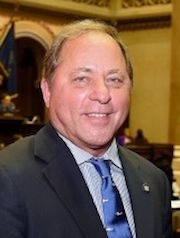
Assemblyman Mike Norris of Lockport was co-chairman of the Assembly Minority Task Force on Learning for Work. The group spent three years researching the issues and presenting recommendations to close the job gap for many industries.
One of the recommendations is rebranding the 37 BOCES in the state as “Career Prep Centers.” Many students, teachers, superintendents and even private industry told the Task Force that BOCES suffers from a stigma that drives some students from enrolling in the career and tech programs.
“BOCES has a reputation for being an educational environment that caters solely to academically challenged students and those with significant behavioral/discipline problems,” according to the executive summary of the report from the Task Force. “This bias has resulted in a lack of desire to explore the options BOCES offers because students are afraid of being labelled or looked own on by their peers. It is critical this perception is changed and this stigma is eliminated.”
Rebranding BOCES with the state paying for new signs and marketing would draw more students to the program, and get more people into the trades and other high-demand careers that don’t require college degrees, the Task Force said.
“The truth of the matter is that our workforce and our educational system don’t match,” Norris said. “There’s a huge segment of our population that no one was talking about for far too long and that’s why I wanted to create this task force. The ‘middle-skills’ gap is a highly-trained workforce that we need more of, or as I call them ‘professional-skills.’ These are good jobs and in high demand.”
Norris and the Task Force said BOCES prepares many students for high-paying jobs right out of high school. Those students can enter into rewarding careers without burdensome college debt.
Norris led the Task Force along with Assemblyman Ken Blankenbush of the Adirondacks. The Task Force suggested BOCES teachers get paid more, and have a less burdensome teacher credential process to allow experienced professionals in the trades to lead classes.
The state should also make full-day BOCES an option. Right now some students need to travel up to an hour on the bus for two to three hours of instruction. There should also be an option for remote BICES classes so students spend less time on a bus.
Some other recommendations from the Task Force:
Implement “Learning for Work K-12 Information Initiative” to introduce age-appropriate Career Technology Education programs and their benefits to students and parents beginning in elementary school.
Develop career open house programs with local businesses to introduce students and parents to the benefits of BOCES, CTE programs, and the correlation to future employment opportunities in their communities.
Increase apprenticeship program access and awareness.
Increase Technology Education baccalaureate programs offered by SUNY and CUNY institutions.
Create more CTE teacher programs at SUNY and CUNY.
Automatically grant college credits to a student in their specific apprenticeship discipline.
The Task Force said immediate action is needed to get more people working the trades.
“This is creating a dangerous skills gap where the trade workers who have filled these jobs for decades are reaching retirement age with no one with the skills required to replace them joining the workforce,” the task Force stated in the executive summary of their report. (Click here to see the document.)
One of the Task Force events was Oct. 15, 2019 at Orleans/Niagara BOCES in Sunburn. Other meetings were in Central New York, North Country, Capital Region, Nassau County and Rochester.
Copies of the report have been sent to Gov. Hochul and legislative leaders. Norris said he hopes they will consider taking action on the legislative proposals in the plan, and that he will continue urging them to do so.
“I am immensely proud of the work that has gone into this, the patience and perseverance of all of the participants,” Norris said. “This plan is so much stronger, and will make our workforce and our economy so much stronger as a result. Ultimately it’s about keeping New Yorkers together, families together. The pandemic has reminded us all how important family and home really are. That’s what our plan is really all about. Enabling today’s students for rewarding, financially viable careers that will allow them to stay in the communities they love and call home for generations to come.”
By Tom Rivers, Editor Posted 31 January 2022 at 4:04 pm
Winter storm watch in effect from 10 p.m. Wednesday until 1 p.m. Friday
The National Weather Service in Buffalo has issued a winter storm watch from 10 p.m. Wednesday to 1 p.m. on Friday for Orleans County and all of western New York and north central New York.
The storm could bring 9 inches or more of snow, making travel very difficult to impossible on Thursday, when the snow will be the heaviest, the Weather Service said.
The forecast for Tuesday calls for sunny with a high near 38, followed by cloudy on Wednesday with a high near 38. On Wednesday rain and snow are likely before 7 p.m., then snow later that night.
On Thursday, the snow could be heavy at times. The high is forecast for 28 with a low of 16.
On Friday, there is a chance of snow before 1 p.m., then snow showers after 1. The high is forecast to be near 16.
By Tom Rivers, Editor Posted 31 January 2022 at 2:25 pm
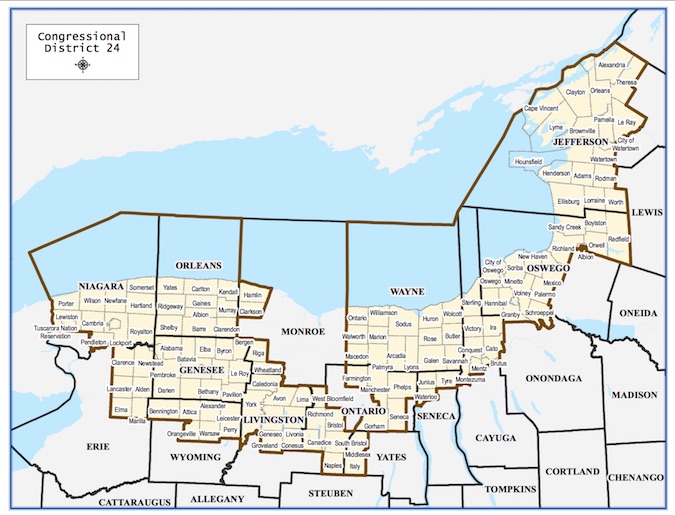
Congressman Chris Jacobs said today he plans to run for the 24th Congressional District, a map that shifts his current district to the east and into the North Country.
Congressman Chris Jacobs (NY-27) announced today he will be seeking re-election in November.
Jacobs is currently the congressional representative for the 27th Congressional District, an eight-county district that includes Orleans.
Chris Jacobs
Jacobs said today he will run for the redrawn 24th Congressional District that runs from Niagara County to Watertown, bypassing most of metro Rochester. Jacobs lives in Orchard Park, which isn’t included in the proposed 24th .
The map of the district was released on Sunday by the Democratic majority in the State Legislature. The 27th Congressional District includes about 720,000 residents in the following counties: Erie, Livingston, Ontario, Monroe, Orleans, Wyoming, Niagara, and Genesee.
The redrawn 24th includes all of parts of the eight counties in the 27th, and five more counties. The district shifts to the east to include all of parts of Wayne, Cayuga, Seneca, Oswego and Jefferson counties, while eliminating parts of Erie, Wyoming and Livingston. The 24th includes about 400,000 of the residents in the current 27th.
Jacobs issued the following statement about re-election:
“Serving the people of Western New York for the past two years in the House of Representatives has been the honor of my life. We have made great progress, but this upcoming election is paramount to the future of our nation. We face one-party rule in Washington, D.C. and a President who campaigned as a moderate who would unite the country but has governed like a far-left socialist who has stoked division, presided over record inflation, ordered a disastrous withdrawal from Afghanistan and generally left America weaker at home and abroad.
“Now more than ever we need strong, conservative leaders to put the needs of our country and their constituents first while this President routinely ignores them. We have an inflation crisis, a southern border crisis, an international credibility crisis, a crime crisis, and a President who demonizes concerned parents. I have worked to combat the reckless spending and partisan policies of this administration and I will continue to do so.
“Western New Yorkers value our families and our freedom and our shared commitment to these values binds us together. The renumbered NY-24 contains over 400,000 constituents I currently represent, and I am excited to get to better know a few new communities.
“The challenges our country faces are many and they are deeply consequential, but we are more than equipped to face them and emerge more prosperous. The coming elections are a chance for conservatives to elect majorities in Congress who will check the Biden administration’s disastrous policies, reimplement the successful policies of the Trump administration, and put our country on a solid foundation once again. I am committed to fighting for your constitutional rights, your economic prosperity, and our future – just as I have for the past two years.”
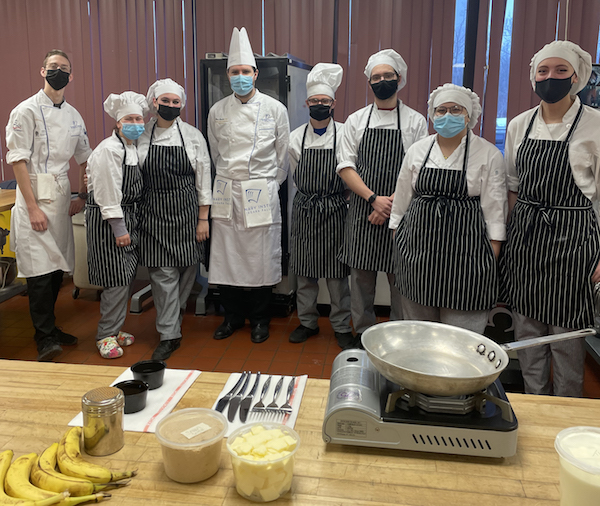
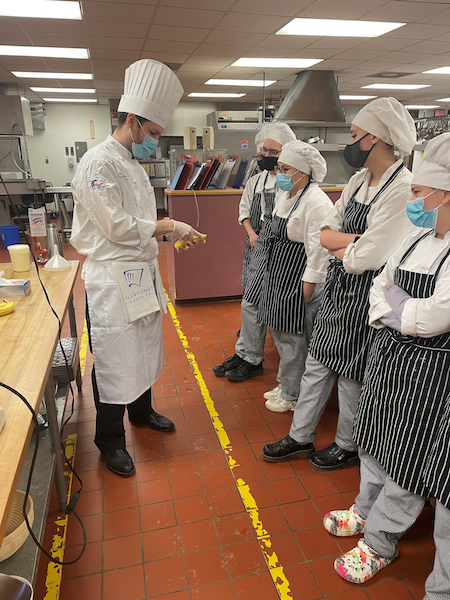
Photos courtesy of Orleans/Niagara BOCES: Pictured from left include Melanie Nagel (Newfane), Amber Campanini (Lockport), Angelo Soliday (Medina), Chef Benjamin Loomis, Troy Avery-Kelley (Medina), Diana Del Carmen Moreno (Albion) and Grace Hodkin (Newfane).
Press Release, Orleans/Niagara BOCES
MEDINA – Niagara Falls Culinary Institute Executive Chef and Hospitality Instructor, Benjamin Loomis, recently spent time with the culinary arts students at the Orleans Career and Technical Education Center.
Chef James Atzrott, who teaches the program, invited Chef Loomis in to talk to the students about careers in culinary and the classes at the Institute. The students were definitely inspired by his demonstration which was Bananas Foster and making homemade ice cream from liquid nitrogen.
“Cooking is chemistry,” Chef Loomis explained to the students. “Liquid nitrogen boils at negative 320 degrees and it can be dangerous if not handled correctly.”
Chef Loomis showed the students the safety procedures to make the ice cream and some of the students were able to put on the safety garb and make the dessert. Everyone got a chance to participate with the hands-on demonstration and then got to enjoy the finished product.
“The students really enjoyed the demonstration and the dessert,” Atzrott said. “I really appreciate Chef Loomis taking the time out of his busy schedule to come in and talk to my students.”
Executive chef Benjamin Loomis speaks with students in the culinary arts class.
By Tom Rivers, Editor Posted 31 January 2022 at 9:33 am
AAA is reporting the average cost for a gallon of gas in New York State is up another 5 cents in the past week, from $3.496 a week ago to $3.547 today.
A month ago the average price was $3.493 in the state. It was about a dollar cheaper a year ago – $2.514 a gallon.
The national average price for a gallon of gasoline is $3.37, up 4 cents from last week. One year ago, the price was $2.42, AAA said.
The average price per gallon locally includes:
Orleans: $3.546
Genesee: $3.505
Wyoming: $3.56
Niagara: $3.436
Erie: $3.505
Monroe: $3.545
Livingston: $3.572
AAA issued a press release today that stated:
“According to the Energy Information Administration, gasoline demand is in a typical range for the winter driving season, equivalent to mid-January 2020.
“Continued growth in the price of crude oil has helped to keep pump prices elevated. If crude prices continue to climb, pump prices will likely follow suit.
This morning, oil prices are in the high $80s to low $90s per barrel. Tension between Russia and Ukraine pushed crude prices up last week. Amid tight global supply, there are market concerns that a looming invasion could contribute to a volatile market, pushing prices higher.”
By Mike Wertman, Sports Writer Posted 31 January 2022 at 7:15 am
Medina will face rival Albion in a key home and home Niagara-Orleans League basketball series this coming week.
Looking to stay in the thick of the N-O boys title race, defending champion Medina will visit Albion on Wednesday in a make-up game and then host the Purple Eagles on Friday. Before that, the Mustangs also face a key contest at Akron (3-2) on Tuesday.
The Mustangs are currently 4-2 and a game behind front-running 5-1 Roy-Hart in the N-O title race while Albion is looking to snap an 0-5 league record.
The Medina girls will host Albion on Wednesday and then visit the Purple Eagles on Friday.
Albion has won two in a row after an 0-3 start to the N-O campaign while Medina is 1-5.
Weekly Schedule Today Girls Basketball – Roy-Hart at Akron, 6:30 p.m.; Albion at Pembroke, 7 p.m.
Tuesday Boys Basketball – Wilson at Barker, 6 p.m.; Medina at Akron, Newfane at Roy-Hart, 6:30 p.m. Girls Basketball – Akron at Medina, Roy-Hart at Newfane, 6:30 p.m; Wheatland-Chili at Lyndonville, Oakfield-Alabama at Holley, Kendall at Pembroke, 7 p.m. Wrestling – Albion at Lyndonville, 5 p.m.
Wednesday Boys Basketball – Medina at Albion, 6:30 p.m.; Lyndonville at Wheatland-Chili, Holley at Oakfield-Alabama, Pembroke at Kendall, 7 p.m. Girls Basketball – Barker at Wilson, 6 p.m.; Albion at Medina, 6:30 p.m.
Thursday Girls Basketball – Lyndonville at Notre Dame, Holley at Pembroke, Attica at Kendall, 7 p.m.
Friday Boys Basketball – Roy-Hart at Barker, Akron at Wilson, 6 p.m.; Albion at Medina, 6:30 p.m.; Lyndonville at Notre Dame, Kendall at Attica, 7 p.m. Girls Basketball – Medina at Albion, Barker at Roy-Hart, Wilson at Akron, 6:30 p.m. Swimming – N-O vs. G-R meet at Gates-Chili, 6 p.m.
Saturday Girls Basketball – Kendall at Albion, 1:30 p.m.; Lyndonville at Oakfield-Alabama, 7 p.m.
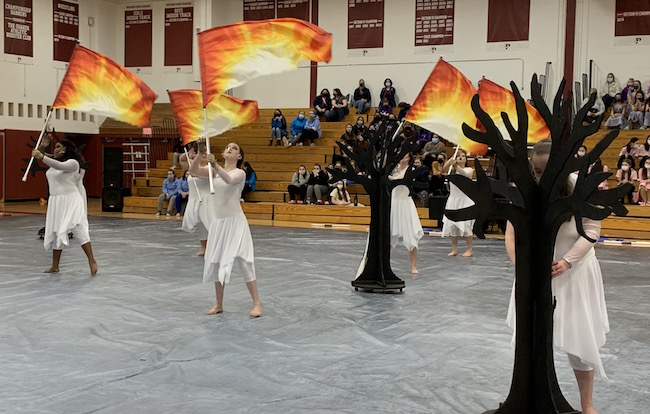
ORCHARD PARK – Medina opened its winter guard season on Saturday, competing in Orchard Park.
The guards performing now have not performed in the past two years. Therefore they haven’t had the opportunity to deal with the stress of competition despite now being involved in higher, more skilled divisions.
Medina’s varsity guard consists of 18 students in grades 9-12. This year their show is “Wake Up.” The group asks, have you ever considered that the dreams you dream and the passing thoughts that you think are not all your own?
The show at Orchard Park consisted of 16 guard units in seven different classifications. Medina performed in the SA (scholastic A) class with three other guards and came in 4th place with a score of 54.96. Victor and Orchard Park tied for 1st place with 59.98 while Jamestown came in 3rd at 56.86.
Winners in the other classes were Hinsdale Starliners in Novice with 35.89; Victor Cadet in cadet class with 45.39; Gates Chili RA at 48.32; Lancaster in A1 class with 53.09; Gates Chili 1A with 59.34 and Luminosa in SR class at 55.35.
Medina’s next competition is Feb. 12 at Victor followed by Batavia on Feb. 19, Lancaster on March 5 and Medina’s home show on March 12.
Winter guard is a hybrid art form that combines elements of music, dance and military-like precision marching in a competitive arena into a total entertainment package.
Winter guard started about 30 years ago and involves the manipulation (spins, tosses, flips) of equipment (rifles, flags, sabers) while moving around the performance space.
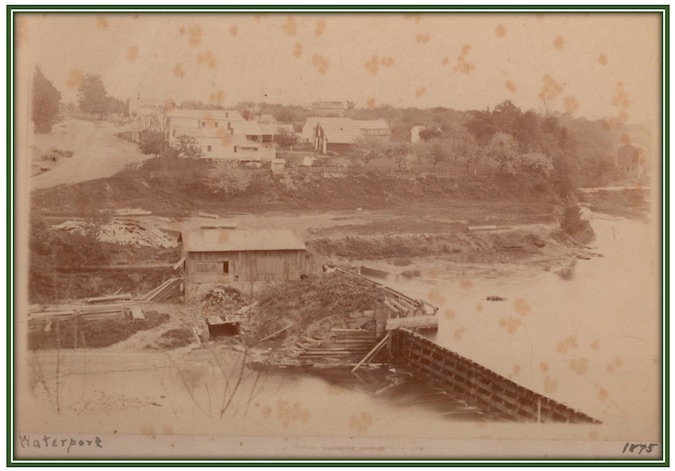
CARLTON – We have had the privilege of becoming acquainted with the daily lives of Hosea and Sarah Ballou on their farm on the Oak Orchard River Road in Carlton from Hosea’s diary entries, beginning in January 1851.
He continued the diary through the year, but his entries became more perfunctory, brief descriptions of the major tasks of the day:
August 29: Plowed in forenoon. Prepared for threshing.
He harvested wheat in July, sowed wheat in September (14 acres, 22 bushels seed), then threshed in October. As the year went on, he logged, butchered hogs, husked corn, buried turnips, dug carrots, On November 1, he went to Eagle Harbor with wheat which he sold for 87 ½ cents. That price must have been acceptable, because he went again the next day with two loads, 156 bushels. He then paid bills:
November 7: Paid up Kuck and Co. 28 dollars and 88 cents due. Paid up Mr. Thompson for land.
George Kuck, for whom Kuckville is named, operated a grist mill, a sawmill, a warehouse, an ashery and a general store there. On December 30, Hosea paid $3.03 for taxes at The Bridges. He did not elaborate, but money must have been a concern, for on December 6 he wrote:
Went to Kendall to see Mr. Reed about money. Got none, hard times.
1852 – Another Point of View
Tiring of the chore of daily record-keeping, Hosea turned the task over to his wife, Sarah, in 1852. In his diary entries, Hosea would refer to Sarah’s visitors and where she went visiting, but he rarely referred to what she did. Her entries were more detailed and give a better insight into the daily life of a woman at that time. In addition to the regular housekeeping chores of the day, she made clothes for many family members:
January 1: Snowed a little in the morning. Hosea went to Mr. Stillwells in the afternoon to get his boots mended. I began Ashbel’s shirts.
January 2: I finished one shirt. I began my dress. Hosea to work for VanRiper.
January 3: Finished my dress. Hosea went to The Bridges with butter, got 14c per pound. Got 14 lbs. of tallow of D.V. Simpson.
January 5: More pleasant, washed and put candle wicks in the rods.
Tuesday 6: Dipped 12 doz. Candles, snows all day. Hosea went to the P.O. I finished a shirt.
Sarah was a busy seamstress throughout the year, sewing pants, shirts, skirts and dresses for relatives and neighbors. She noted whom each garment was made for: “a skirt for Belinda, a shirt for Andrew,” and may have used the diary entries as a ledger. She does not refer to cash payment for her work.
She got some flax to spin in March and went to a quilting. She went to the store in May – a rare occurrence – and bought a lawn dress and some gingham for a sunbonnet. In October, she “brought home cloth to make six shirts for Frank Jones, 4 fine ones & 2 coarse.”
In December, she and Hosea went to Albion – also a rare occurrence. She bought a shawl, $4.75, a delane dress, a calico dress and a sieve. (A “delaine” dress was made of high-grade wool, while a calico dress was a work dress.)
Sarah’s entries also included some brief references to health. She had two teeth pulled in May though she had not referred to toothache issues prior to that and did not indicate where she went for the extractions. She complained of “a sick headache” in November. A very matter of fact entry for May 14 read: “Pleasant. Hosea helped Ralph plant corn. I went down home. I was weighed. Weighed 123 and three quarters.”
Hosea froze one ear coming home from Mr. Stillwell’s one cold January day. He had his finger caught in the threshing machine in August, “he had to have it cut off at the first joint.” It was very painful for some time, he had to go to the doctor’s to get it dressed and later to have stiches removed but was able to go berrying in September.
In October, Sarah wrote that she “sat up with George Miller’s child,” inferring that she took her turn helping a neighbor who had a sick child, as was the custom. Several days later, she wrote: “Geo. Miller’s child buried today.”
She did not mention the child’s name or age, or the mother’s name. Other entries also point to women’s secondary status at that time: Hosea went to town meetings and to funerals, he attended debates at The Bridges. In October, he went to hear Governor Church lecture at Waterport and several days later, he heard him lecture at The Bridges. On November 2, Hosea “went to Election” (presumably to vote) while Sarah stayed at home and “made a pair of drawers.”
(“Governor Church” was Sanford Elias Church (1815-1880) of Albion, a Democrat, who had served as Lieutenant Governor for Washington Hunt and was re-elected to that position in 1852, with Horatio Seymour as Governor)
Sarah noted her birthday on November 30: “I am 26 today,” their anniversary on December 16: “It is five years ago today that we were married.”
She noted Christmas in passing: “December 25 Christmas. Moderate. Hosea and I went to his mother’s.”
On December 30, they went to a wedding (Edwin and Elizabeth’s) and “it was two o’ clock this morning before we got home from the wedding.” A good way to end the year.
GAINES – For our forth image in this series we have selected the print entitled, “Alice Blue Gown,” which hangs in the Vagg House at the Cobblestone Museum campus.
The print measures 11 by 14 inches and is a portrait of Alice Roosevelt Longworth, eldest child of President Theodore Roosevelt. She was born in 1884 and died in 1980. During her early lifetime, she became very popular as a trendsetter and remained a Washington, D.C. socialite most of her life.
This picture became immensely popular in the 1920s and it was widely published in various sizes. The original painting which this print was copied from was created by English painter, Arthur Paine Garratt. However, during the 1920s, Garratt spent several years in New York. He is best remembered as a fine portrait artist, with considerable success during his lifetime.
Arthur Paine Garratt (1873-1955)
Many of Garratt’s female subjects were elegant, high-society ladies who expected a high degree of finish and detail in their portraits. Lavish gowns of exotic textiles were usually a feature. This painting of Alice was no exception. She was a beautiful young girl who was the equivalent of a princess and whose style signature were her azure blue gowns.
The press constantly followed her around to record many of her escapades. Her portrait would suggest a demure young woman but quite the contrary was true. Her father, the President, once said, “I can run the country, or I can control my daughter, but I cannot do both.” She often smoked in public which was a “no-no” for women at the time. She had a pillow in her salon embroidered with the statement, “If you don’t have anything nice to say, come sit by me.”
In the portrait above, we note that it is signed in the lower left corner, “Arthur Garratt.” It is entitled, “An Old Sweetheart of Mine.” No publisher is noted on this print which measures 11 by 15 inches.
“Alice Blue Gown” is purposely displayed in the Vagg House (shown above) which represents the Teens, ’20s, and ’30s through its furnishings. Our print appears to be in the original frame which we believe is circa 1930. Framing of this time period is much more simplistic than picture frames of earlier decades.
It is not unusual to find “Alice Blue Gown” in antique malls today, because it was once so popular. This small 5 by 7 inch copy was framed in an octagonal frame.
The painting likely partly inspired the song “Alice Blue Gown” written by Harry Tierney with lyrics by Joseph McCarthy. It was sung by Edith Day in the 1919 play “Irene.” It became a top seller in 1920 and was revived several times in the following decades. You can listen to the 1920 recording by clicking here.
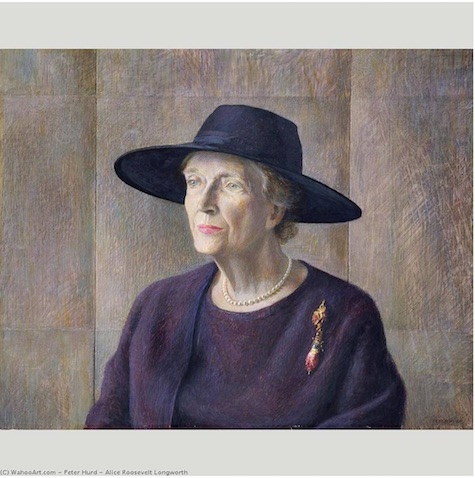
We end this story with a portrait of Alice Roosevelt Longworth done by Peter Hurd in 1965. This is a Tempura on Masonite and hangs in the National Portrait Gallery at the Smithsonian Institution.
‘I sincerely hope that Governor Hochul will be able to put aside her partisanship and stop this policy’s implementation for the sake of our farmers, families, and rural economies throughout the state.’ – Steve Hawley
Press Release, Assemblyman Steve Hawley
Steve Hawley
Assemblyman Steve Hawley (R,C,I-Batavia), a former farmer and member of the Assembly Committee on Agriculture, is expressing grave concern following a 2-1 decision by the Farm Laborers Wage Board to implement a 40-hour overtime threshold for farm laborers in New York state.
Hawley has joined farmers and advocates from across the state throughout the last several months to speak out against this proposal, arguing that since farms operate on schedules that are at the mercy of the weather and other unpredictable factors, that lowering the threshold would prove fatal for farms which barely turn a profit when paying their laborers under the existing 60-hour threshold.
“Farm operators and farm laborers alike have been more united than ever in opposing this mandate, but sadly it seems their voices were ignored, and I now fear the decision will come at the cost of countless multi-generational family businesses who will now have no choice but to cease operations,” Hawley said. “Being someone with origins in upstate New York, I sincerely hope that Governor Hochul will be able to put aside her partisanship and stop this policy’s implementation for the sake of our farmers, families, and rural economies throughout the state.
“For the millions of people who love everything about agriculture as we know it here in upstate New York, it would be truly tragic if our local farms became nothing more than memories of a better time.”
Press Release, International Lake Ontario-St. Lawrence River Board
The average Lake Ontario outflow for January 2022 is currently the 4th highest on record since 1900 (following 2020, 2021, and 1987), and the January mean Lake Ontario level is the 15th highest on record since 1918.
Although flows have been reduced, the outflows remain relatively high compared to the historical record.
Ice conditions continue to be closely monitored. The Board will make outflow adjustments as necessary and share updates and information. The operational outflow adjustments are consistent with and accounted for in the design of the regulation plan
Ice has formed in the critical sections of the St. Lawrence River in the Beauharnois Canal and on Lake St. Lawrence. Ice began to form in early January along the St. Lawrence River as air temperatures remained consistently well-below freezing for several days.
This year since January 10, 2022, outflows from Lake Ontario have been adjusted (decreased and increased), as conditions have required to manage ice cover formation.
Outflow adjustments to support stable ice cover formation occurs most every year. Several ice booms are also used in the river to assist in ice cover formation. A stable ice cover is important to reduce the likelihood of ice jams that can damage shorelines and cause flooding.
A stable ice cover also prevents unconsolidated ice from flowing into and clogging hydropower intakes; ice jams or blockages of hydropower intakes could result in prolonged outflow decreases leading to higher Lake Ontario levels. As ice conditions stabilize, outflows from Lake Ontario will be increased in accordance with the rules of the plan.
By Tom Rivers, Editor Posted 29 January 2022 at 9:19 am
Database lists local products and services from Orleans County contractors, vendors and suppliers
Photo by Tom Rivers: Art Hill Excavating did the site work for the new hotel in on Maple Ridge Road in medina. That hotel will be a Comfort Inn & Suites and is expected to open in March.
ALBION – The Orleans Economic Development Agency is urging local businesses to register or renew their listing with the “Only in Orleans” database.
The EDA created the site in 2017 as a database of available products and services from Orleans County contractors, vendors and suppliers. Companies doing projects in the county could then easily see options for working with local businesses for new construction or other projects. There is no charge to be included on Only in Orleans.
“The Only in Orleans database gives us an overview of the local products and services that might be available for projects coming down the pipeline,” said Michael Dobell, chief executive officer of the Orleans EDA. “A reliable list of local companies that can be plugged in to new development or expansion projects gives us a competitive strength.”
General, electrical and mechanical contractors and those who perform site work, masonry, roofing, paving, excavating, survey, engineering and landscaping services can review the criteria and registration form at Only in Orleans.
Vendors that also supply equipment or materials for HVAC, plumbing, electrical, roofing or excavation projects or have lumber, computers, fixtures, furniture or greenhouses in Orleans County are also encouraged to register on the website.
The Only in Orleans database is a resource for companies doing construction in the county that are looking to hire locally for the work.
The Orleans Economic Development Agency cannot advocate for one business over another. There are no guarantees or incentives tied to anything related to registration or listing in the local database, the EDA said.
The “Register” page of “Only in Orleans” contains a link to the registration form which is submitted to the portal upon completion. The database is simply a way for the agency to maintain active contractor and vendor information.
By Tom Rivers, Editor Posted 28 January 2022 at 10:00 pm
Overtime changes to gradually be phased in from 2024 to 2032
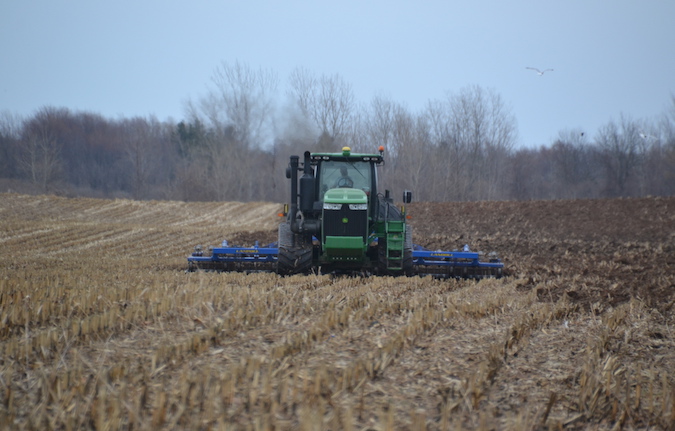
Photo by Tom Rivers: A farmer plows a field on March 26 to get the land on Gaines Basin Road in Albion ready for spring planting.
A three-person Farm Labor Wage Board voted today to gradually reduce the overtime threshold in agriculture from 60 hours a week to 40 hours.
The reduction in the OT threshold would be phased in from Jan. 1, 2024 to Jan. 1, 2032.
Many in the farming community testified at hearings this month the decision would actually hurt workers, who would see smaller paychecks due to working less hours each work. Many farmers said they would be looking to grow less labor-intensive crops.
The decision this afternoon from the Wage Board was called a “disastrous policy” by State Senate Republican Leader Rob Ortt, whose district includes many farm and agricultural operations in Orleans, Niagara and Monroe counties.
“By lowering the overtime threshold from 60 hours to 40, unelected bureaucrats – empowered by Albany Democrats – are jeopardizing the future of New York’s agriculture industry,” Ortt said. “This decision is the result of the 2019 passage of the so-called Farm Labor Act, sponsored by a New York City Senate Democrat who doesn’t have a single farm in her district.
“Everyone agrees that family farmers and farmworkers deserve to be treated fairly,” Ortt said. “With this new burdensome mandate, they will be added to the exodus of people leaving our state. Today will be remembered as the day that family farming died a slow death in our state – and it was radical, out-of-touch Senate Democrats who killed it.”
Grow NY Farms issued the following statement:
“The Farm Laborers Wage Board voted two-to-one to recommend lowering the overtime threshold to 40 hours a week over the next decade, despite 70% of the testimony made by farmers and farmworkers who asked for overtime to stay at 60. It is disingenuous and irresponsible that the data, research, and comments made from those who know agriculture best were cast aside by the majority of the Wage Board. Changing the overtime threshold to 40 hours a week for farmworkers in New York means that these workers will be limited to 40 hours, due to simple farm economics. This is not a win for farmworkers that self-proclaimed worker advocates will claim.
“Agricultural production, diversification, and job availability will suffer. That is no scare tactic. We have already seen farmworkers leave the state for more hours of work and production shift to less labor-intensive crops since the farm labor legislation was enacted in January 2020. Further collapse of New York agriculture is on the hands of those who spread falsehoods and look to destroy the livelihoods of farmworkers they say they represent. This is also a loss for New Yorkers who enjoy and depend on access to local food, something that was highlighted during the pandemic.
“New York Farm Bureau President David Fisher voted against lowering the threshold, simply asking for more time to study the economic impacts of a lower threshold. Governor Hochul and Commissioner Reardon must now do what is right and let the facts be their guide. If this administration cares about the future of upstate New York, Long Island and urban access to locally produced food, they must put a stop to the constant regulatory assault on agriculture.
“Grow NY Farms would like to thank everyone who testified this year. The care and respect they have for their employees were clear from the beginning. No wage board decision can take that away. We all value essential farm work and want the very best for farm employees, that includes the ability to earn a livelihood in the profession they have chosen.”
By Tom Rivers, Editor Posted 28 January 2022 at 9:17 pm
Gov. Kathy Hochul announced today that an indoor mask mandate at public places would be extended from Feb. 1 to Feb. 10, and would be re-evaluated close before Feb. 10.
Gov. Kathy Hochul
Hochul said she is encouraged be the recent data on Covid-19 cases.
On Thursday there were 13,592 new Covid cases with 6.15 percent positive. That compares to Jan. 7 when the state hit an all-time high for Covid cases with The 90,132 cases in one day. The percentage of positive tests that day was 21.17.
Statewide the hospitalizations dropped by more than 2,800 over the past week, Hochul said.
“New Yorkers are doing what is necessary to combat the spread of Covid-19 and the progress is evident in our numbers,” Hochul said.
Hochul first mandated face coverings to be worn in all indoor public places on Dec. 13, unless the business or venue implements a vaccine requirement.
She said the mask mandate has been a key in driving the Covid numbers down.
“I want to thank all the businesses and the people who follow these policies,” she said. “You are the reason our state is going to come out of this far sooner than other states.”


















 CARLTON – We have had the privilege of becoming acquainted with the daily lives of Hosea and Sarah Ballou on their farm on the Oak Orchard River Road in Carlton from Hosea’s diary entries, beginning in January 1851.