By Tom Rivers, Editor Posted 23 February 2023 at 8:06 am
Photo by Tom Rivers: The path through the woods at Mount Albion Cemetery was covered in snow on Wednesday afternoon.
Winter weather is back with snow and sleet since Wednesday afternoon. Orleans County remains under a winter weather advisory until 6 p.m. with mixed precipitation and additional ice accumulations of up to a tenth of an ice, the National Weather Service in Buffalo reported.
“Periods of freezing rain will result in slippery roads and limited visibilities,” the Weather Service said. “Slow down and use caution while driving.”
It’s been an unseasonably warm February so far for most of the month, with some days hitting highs in the 50s and even 60s.
Today is forecast for a high of 32, followed by a high of 22 on Friday and 27 on Saturday.
By Tom Rivers, Editor Posted 22 February 2023 at 9:40 pm
Gates to Recovery says it would invest $1 million into improving site, add 90 to 100 jobs
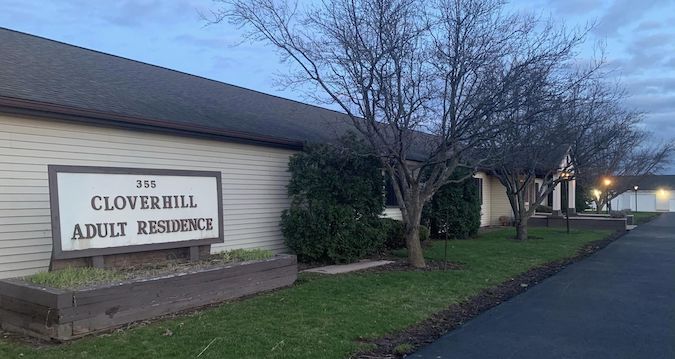
Photo by Tom Rivers: The Clover Hill assisted living site at 355 South Main St. closed last March. It is listed for sale by Snell Realtors for $899,900.
ALBION – An organization that has been overseeing walk-in centers for people fighting addictions wants to operate a residential site in Albion at the former Clover Hill Adult Residence at 355 South Main St.
Randy Cimino, president of Gates to Recovery, said the organization is looking to invest $1 million in interior and exterior improvements to the property. It would like to operate a 35-bed residential treatment program with a focus on mental health.
Cimino, who said he is a recovering addict and is 15 years sober, said the mental health treatment is critical to breaking the cycle of addiction. He also said Gates to Recovery would offer longer supervision and treatment – from 4 to 18 months. He said most treatment programs are only a month – not enough time for many people to be successful in breaking their drug addictions.
“This is about saving lives,” Cimino said in a presentation to the Village Board this evening. “This village could be the one place where it all started, where we change rehabilitation.”
Mayor Angel Javier Jr. said Gates to Recovery hasn’t shown a proven record in running a rehab facility. He told the group the Village Board doesn’t support that use of the Clover Hill site, which is close to many residential properties.
He said he also doesn’t want to see the property become tax exempt, taking away about $30,000 in tax revenue for local governments. Javier said he also envisions the facility putting a strain on local police and ambulance services.
Cimino and Gates to Recovery representatives said they didn’t see the site putting a demand on local services. Cimino said there would be about 90 to 100 employees at the site, about 30 per eight-hour shift.
Cimino said the organization has the financial backing to run the program in the foreseeable future. He said the local governments could be paid any lost tax revenue. He urged the board to support the effort. If Gates to Recovery fails, Cimino said the community would get back an upgraded Clover Hill site with about $1 million in improvements.
“Give us a chance,” Cimino said. “I’m telling you we can do this.”
Deputy Mayor Joyce Riley said Albion already has two drug treatment sites in the community, plus two state prisons.
“We don’t want to be known as the drug rehab center of Western New York,” she said.
Riley said the village can’t stand in the way of Gates to Recovery purchasing the property, which is listed for sale at $899,900. But Gates will need “a certain amount of community buy-in, acceptance and tolerance” to succeed, Riley said.
The organization also will need to find a full staff of professionals to run the site, and Riley, a retired nursing supervisor, said there is a shortage of healthcare professionals.
Gates to Recovery reps said they have some key staff members ready to go, and relationships with colleges for work placements.
Cimino said Gates to Recovery sees the Albion location as ideal for the program. But he doesn’t want to move forward if the board and community are opposed to the effort.
He was joined at the meeting by recently retired Gates Police Chief James VanBrederode. He said the opioid crisis has caused over 100,000 fatal overdoses annually in the country, and numerous related burglaries, larcenies and crimes as people try to feed their addiction.
He said the longer-term residential program will make a big difference for those in the program, who are only there if they choose to be.
“This is a perfect facility for us,” Cimino said. “We could do a lot for your community. I know it works because it worked for me.”
By Tom Rivers, Editor Posted 22 February 2023 at 3:05 pm
Grants not keeping pace with rising construction costs
Photo by Tom Rivers: Kendall Town Supervisor Tony Cammarata said town officials will keeping pursuing state and federal funds to help expand public water in the community.
KENDALL – The Town Board remains determined to expand public water in the community, but Town Supervisor Tony Cammarata said rising construction costs are making the projects too expensive right now.
Kendall will need bigger grants and very favorable loan terms to make the projects affordable for residents, Cammarata said at Tuesday’s Town Board meeting.
The state comptroller sets the affordability for public water projects at $1,040 in annual expense to residents. That includes the cost of water and any debt towards a waterline.
Recent estimates from LaBella Associates put the projects at $1,400 to $1,500 annually – too high for many residents, Cammarata said.
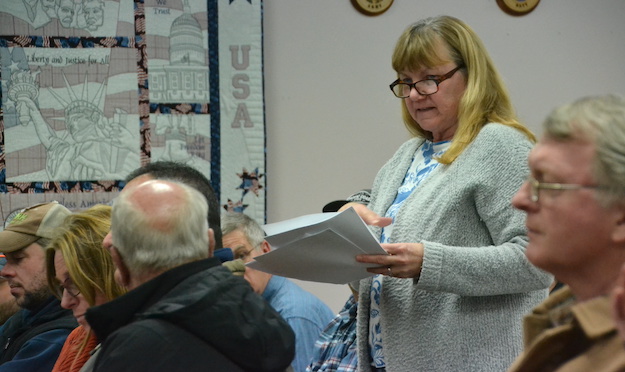
He responded to two residents during Tuesday’s meeting who said they have been asking for public water for several years now.
Truda Slucum of Lakeshore Road would like to be included in the town’s next water project – Water District No. 11.
Beverly Robinson of Lakeshore Road also asked to be included, said the area suffers from sulfur in wells.
Cammarata has been town supervisor for about 10 years. The town has completed four districts during that tenure. But he said they are getting tougher to do as the construction costs rise dramatically.
He is scheduled to meet Congressman Joe Morelle today and would send the message to increase federal grants for the projects. Cammarata also said the town needs low-interest loans through the federal Rural Development, which are 38 years instead of 30. That helps bring down the annual payment to stay below the comptroller’s threshold.
Cammarata said forging ahead now with a district at a $1,500 annual cost to residents would result in “a lot of pushback” because the cost would be too much for many residents.
He said Kendall will continue to look at options to get more public water lines in the ground, including whether smaller districts make a difference in lowering the annual debt costs.
“We’re trying,” he said. “I truly believe to move Kendall ahead you have to have water. We’re going to have grovel to get some funding.”
County Legislator John Fitzak attended the meeting and said residents should consider writing letters to state and federal representatives, explaining the difficulties with their well water. Those testimonials could make a difference, Fitzak said.
“I would suggest a grass-roots efforts with water,” he said about writing the letters. “We need money. Don’t forget us because we pay taxes like everyone else.”
By Tom Rivers, Editor Posted 22 February 2023 at 11:52 am
Many STR owners vow to sue, calling law ‘discriminatory’
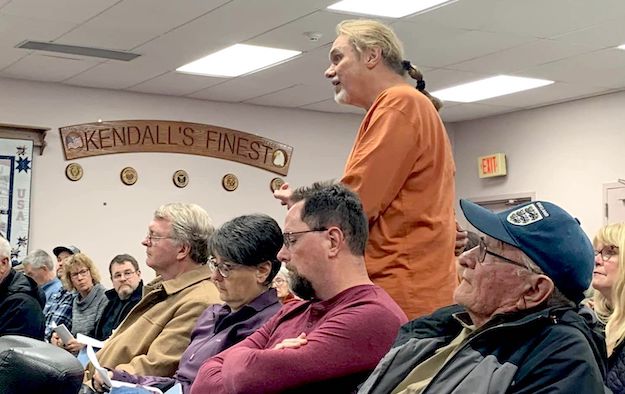
Photos by Tom Rivers: June Chippendale of Kendall asks the Town Board not to pass a law putting regulations on short-term rentals. She is looking to operate an STR in the future.
KENDALL – The Town Board on Tuesday night passed a law regulating short-term rental properties in the town, an action that some of the STR owners said was “discriminatory” and would result in a lawsuit against Kendall.
The new law also bans any new short-term rentals in the waterfront districts, excluding bed and breakfasts which require a separate special use permit. Existing STRs shall be grandfathered in and allowed to continue.
The Town Board said the waterfront districts have houses closer together on private one-lane roads. The STRs are presenting “parking and traffic impacts,” town officials write in the new law.
The board and community have been debating short-term rentals for several months. Town Board members said there have been complaints in recent years with the rise of short-term rentals, such as Airbnbs and Vrbo.
Some of the neighbors of STRs have complained that some of the STRs are loud, especially at night when the homeowners want peace and quiet after working in the city. Some neighbors said those businesses shouldn’t be allowed on one-lane private roads, and STRs also can drive up neighbors’ property insurance costs.
STR owners who spoke at Tuesday’s meetings said the community has a long history of renting out cottages to visitors. The STRs are nothing new, but have become more popular during the Covid pandemic with people seeking a getaway after being confined to their own homes.
Greg Stuckless of Norway Heights said the income from an STR was essential in allowing his family to put in a breakwall to protection from erosion during the flooding in 2017 and 2019. During an economic downturn the STR revenue helped Stuckless keep up with his bills.
“It’s saved me,” he told the Town Board. “We would have lost our house.”
Greg Stuckless said operating a short-term rental gave his family needed funds, allowing them to keep their home.
Stuckless said the fees in the law are not unreasonable but he said he is concerned about the town increasing the STR owners’ liability for having guests on site and in the community.
The Town Board modified the law after a public hearing last month. An annual licensing fee with the town for an STR will be $250 (or $500 over 2 years), which was lowered from the $1,000 annually in the proposed law. Kendall will require a $1 million liability insurance for STR owners, rather than the $3 million in the draft law.
The town had proposed STR owners would lose their permit to operate if they haven’t had any STR business over six months. That has been changed to one year.
The board passed the new law in a 4-0 vote with yes votes from Town Supervisor Tony Cammarata, and board members Barb Flow, Margaret Lynn Szozda and Paul Jennings.
Rich Miller, a resident of Lakeland Beach Road and a real estate agent, said the town’s new law is “ill advised” and an attack on property rights.
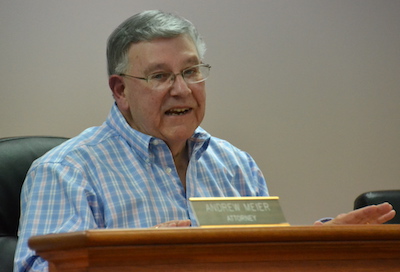
He told the board to expect a lawsuit. About 20 of the rental owners have joined together to hire an attorney to oppose the regulations. They are represented by attorney Steven Barshov of Sive, Paget & Riesel in New York City.
One resident said the STRs are better maintained than most of the properties in the town, with the buildings, lawns and vehicle upkeep. The board should be looking at all properties and not just focusing on STRs, the resident said.
Ken DeRoller, a former county legislator, said Kendall should coordinate its law with the towns of Carlton and Yates as part of a Kendall-Yates-Carlton local waterfront development plan. That LWRP aims for consistency with town regulations along about 25 miles of shoreline. DeRoller urged Kendall to “slow it down” in adopting the regulations.
The town’s property maintenance codes already address issues with poorly maintained structures and don’t require the regulations for STRs, attorney Barshov wrote to the town last month.
Barshov questioned parts of the regulations that limit two people per sleeping room, sprinkler systems above the second floor of buildings used as STRs, and a ban on parking recreational vehicles, campers, trailers or motor vehicles larger than a 1-ton pickup truck.
“The character of a neighborhood is not destroyed by occupants of short-term rental properties doing exactly what residential property can do,” Barshov wrote.
The attorney said the Town Board has misstated the issues with STRs, portraying an “STR war zone” that doesn’t exist. There are only a few isolated incidents and none are “malicious,” he said.
“There are no reports of rampant misbehavior or anything like it at STR properties,” he wrote.
By Tom Rivers, Editor Posted 22 February 2023 at 9:17 am
Photos by Tom Rivers
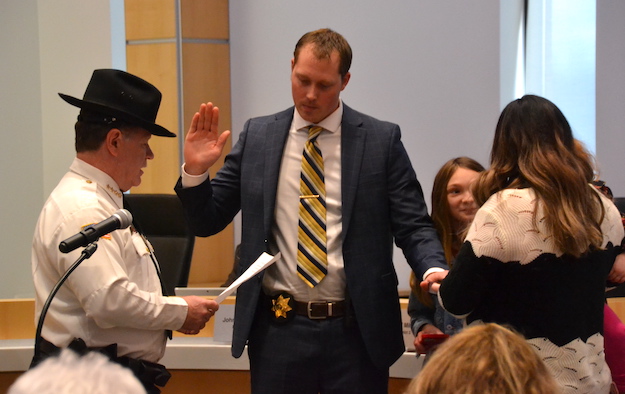
ALBION – Don Draper takes the oath as undersheriff on Tuesday during a ceremonial swearing-in before the County Legislature meeting. His wife Emmy holds the Bible while Sheriff Chris Bourke administers the oath.
Draper replaces Jeff Gifaldi in the role. Gifaldi has retired and works as a code enforcement officer and also part-time in security at Holley Central School.
Draper is a 25-year veteran of the Sheriff’s Office. He worked 20 years as a deputy on road patrol and then as supervisor of court security. He most recently has been a sergeant in charge of the civil division.
“I work for the sheriff,” Draper said about the role as undersheriff. “Whatever he needs done, I will do it.”
Draper is the son of retired Medina Police Chief Don Draper and the brother of Medina Police Department Lt. Todd Draper.
Bourke said the new undersheriff knows all of the positions in the Sheriff’s Office “from top to bottom” and has proven to be very dependable and knowledgeable.
“He’s a solid guy,” Bourke said. “He treats people fairly. That’s what I want.”
The Sheriff’s Office also has a new administrative chief deputy with Steven Ploof. He was unable to attend the ceremonial swearing in. Ploof provides oversight of the Civil Division and the numerous local, state and federal grants managed by the Sheriff’s Office, Bourke said.
Brian Marsceill takes the oath of office as an investigator with the Orleans County Sheriff’s Office.
Marsceill replaces Shannon Brett, who retired from the position. The other investigators in the Sheriff’s Office include Devon Pahuta and Kevin Colonna.
Marsceill started as a deputy at the Sheriff’s Office in 2017. Before that he was as a police officer in Medina and Attica.
The sheriff administered the oath for other staff on Tuesday including Amy Sherman, sheriff’s accounts manager; Tyler Ajitsingh, corrections officer; Kari Hagglund and Jodi Marion as part-time dispatchers; and Theresa Brien as a civil clerk.
Press Release, State Senate Republican Leader Rob Ortt, Assemblyman Mike Norris
New York State Senate Republican Leader Robert Ortt and Assemblyman Mike Norris (R,C-Lockport) are announcing new legislation they have introduced that would assist volunteer firefighters and ambulance workers for costs relating to using their personal vehicles when they are responding to emergencies, reimbursing them at the mileage rate for gas and vehicle wear and tear through a state tax credit (A.4094).
The lawmakers are hoping this measure will help recruitment efforts and encourage more New Yorkers to volunteer for this critical public service.
“In communities across our state, our volunteer fire and medical personnel are our first response to dangerous and time-sensitive emergencies where paid personnel may not be available,” Ortt said. “However, as time goes on, we continue to see these volunteer organizations struggle to retain and bolster their ranks with new recruits, which places an even larger strain on their shrinking numbers. By removing barriers for recruitment and relieving some of the financial burdens on our existing volunteers, we will be helping to ensure that our communities, especially here in western New York, will continue to have reliable and necessary volunteer first response companies.”
Over the past decade, the number of volunteers in fire companies and ambulance services has significantly decreased. In fact, over 20,000 volunteers have aged-out or left service for other reasons in the past 20 years. During that same time, the number of calls have nearly doubled, with many companies within our districts responding to hundreds of calls per year.
Ortt and Norris acknowledge that because volunteers often use their personal vehicles in response to emergency calls, it is appropriate to aid with their gasoline and vehicle wear and tear expenses in the performance of their duties. Specially, their bill would provide a state income tax credit equal to the federal mileage rate.
Volunteer fire and ambulatory services save New York state taxpayers more than $3.3 billion annually.
Ortt and Norris also encourage the public to consider getting involved with their local volunteer fire company. There are many ways to help. You can become a volunteer firefighter, EMT or participate in the fire company as an exempt or auxiliary member. To learn more, please go to www.fireinyou.org.
“The lifesaving services provided by these volunteers is absolutely essential to everyone’s quality of life across our state,” Norris said. “No one knows when they will get into an accident, have a serious or life-threatening health emergency, fall and need assistance, or have a fire-related incident. Having these courageous and selfless men and women on standby night and day is an assurance we all, quite frankly, take for granted. That’s why our state should do everything we can to assist them for this dedicated service. This bill is an important part of that, and I believe it should become law as soon as possible to help address the shortage in recruitment.”
By Tom Rivers, Editor Posted 22 February 2023 at 8:22 am
Photo by Tom Rivers
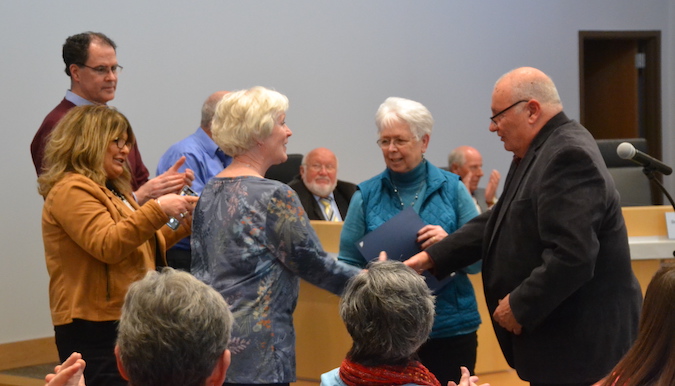
ALBION – Orleans County Legislator Fred Miller shakes hands with Marlene Hill of Medina, one of the board members for Arc GLOW. Miller on Tuesday presented a proclamation on behalf of the County Legislature that declared March as “Developmental Disabilities Awareness Month.”
Arc GLOW officials on hand included Cheryl Englert, board president; John Huber, board member; Martin Miskell, CEO; and Lisa Bors, public relations director.
The former Arc of Genesee Orleans and Arc of Livingston-Wyoming merged in 2021 following 18 months of planning to form the new Arc GLOW. This is the first four-county chapter of The Arc New York. This follows the merger in 2016 of the former Arc of Orleans and Genesee Arc.
In Orleans County, Arc GLOW has homes for individuals with disabilities, operates Orleans Enterprises Work Center in Albion, day habilitation programs, Meals on Wheels/Nutrifare in Albion and Camp Rainbow in Ridgeway. Several programs and departments also share space with the finance department on Caroline Street in Albion, Arc GLOW officials said.
By Tom Rivers, Editor Posted 21 February 2023 at 10:03 pm
MURRAY – Voters in the Murray Joint Fire District approved spending up to $900,000 for a new pumper-tanker fire truck and a refurbished rescue truck that will serve as a mini-pumper.
There was a special election this evening from 6 to 9 p.m. and the expenditures were approved by a 66-45 vote.
The Murray Joint Fire District will be replacing two pumper-tankers that are each about 25 years old. One is based at the Holley fire hall and the other at the Fancher-Hulberton-Murray hall. They each can carry 1,000 gallons of water.
They will be replaced with a new pumper-tanker at a cost of $680,000. Fire district leaders also will convert a rescue truck into a mini-pumper at a cost of $220,000.
The district leaders opted to do the smaller mini-pumper rather than buy two new pumper-tankers to try to reduce the costs to the fire district, said Mark Porter, chairman of the commissioners.
Refurbishing the rescue truck into a mini-pumper also will be easier to get the vehicle into tight driveways and on laneways, Porter said.
The fire district will pursue financing through serial bonds or statutory installment bonds up to 20 years, and may utilize bond anticipation notes for up to five years for the $680,000. For the $220,000, the financing would be for up to 15 years.
By Ginny Kropf, correspondent Posted 21 February 2023 at 3:59 pm
Photo by Ginny Kropf: Megan Johnson (left), director of Orleans Community Health Foundation, and Amanda Luckman, admissions coordinator, hold one of the red hearts given to employees of Medina Memorial Hospital in observance of February as American Heart Month.
MEDINA – With heart disease being the number one killer of men, women and many ethnic groups within the United States, according to the Center for Disease Control, Orleans Community Health is celebrating February as American Heart Month with a number of events and giveaways.
It is reported that one in every four deaths is due to heart disease and approximately 805,000 people have a heart attack every year.
On a positive note, according to information from Scott Robinson, director of marketing at Orleans Community Health, heart disease is largely preventable by following basic tips. These include eating foods that promote heart health, avoiding smoking tobacco products, making sure to get at lease 30 minutes of physical activity for five days a week and talking with your doctor to make sure you’re keeping track of blood pressure and checking for other warning signs.
February was declared American Heart Month by President Lyndon B. Johnson in 1964, nine years after his own heart attack. Orleans Community Health is taking the opportunity this month to highlight the importance of heart health and the fact that heart disease is largely preventable.
“The time is now to take heart disease seriously, and research steps you can take to reduce your own personal risk,” Robinson said.
Medina Memorial Hospital offers several services in the Cardiac Department that can help. Electrocardiograms (or EKGs) are an innovative diagnostic tool. An EKG records the electric signal from the heart and is useful in detecting arrhythmias, heart attacks and heart failure.
An echocardiogram is a type of ultrasound that uses two-dimensional, three-dimensional and Doppler ultrasound waves to create a clear image of the heart. That image can then be used to diagnose conditions that affect the heart’s valves and chambers.
Vascular ultrasounds use similar techniques to form images of blood vessels. At Medina Memorial, this tool is used to diagnose blood clots, blockages and other sources of congestion.
Cardiac stress tests are used to measure the heart’s ability to respond to stress, such as exercise or other stimulation. A stress test is an essential tool for identifying problems with blood flow, like blockages or arrhythmias aggravated by stress.
In addition, the Sands-Constellation Heart Institute opened a location in Medina Memorial Hospital in 2022.
Robinson added February is great time to take advantage of heart health information, and that is why Medina Memorial is celebrating the month by handing out red heart stress balls and sponsoring several other giveaways in an effort to raise more awareness of heart disease.
By Tom Rivers, Editor Posted 21 February 2023 at 2:52 pm
The National Weather Service in Buffalo has issued a winter weather advisory from 4 p.m. Wednesday until 6 p.m. on Thursday for Orleans, Niagara and Monroe counties.
Mixed precipitation expected with total snow accumulations of 1 to 3 inches and ice accumulations of up to three tenths of an inch, the Weather Service said. Winds will be gusting as high as 45 mph.
The periods of snow, sleet or freezing rain will result in slippery roads and limited visibilities, according to the Weather Service, which urged motorists to slow down and use caution.
“Power outages and tree damage are likely due to the ice,” the Weather Service said. “Travel could be nearly impossible. The hazardous conditions could impact the morning or evening commute.”
By Tom Rivers, Editor Posted 21 February 2023 at 12:27 pm
MEDINA – Two candidates for two trustee positions will be unopposed on the ballot after turning in petitions signed by at least 100 eligible voters in the village.
Diana Baker and Jessica Marciano are both running under the Unity Party. Marciano is a current trustee. Owen Toale, the other trustee whose term expires March 31, isn’t seeking re-election to a two-year term.
In the Medina village elections the candidates run as independents without official backing from the major political parties.
Voting will be from noon to 9 p.m. at the Senior Center, 615 West Ave.
By Tom Rivers, Editor Posted 21 February 2023 at 11:02 am
The Orleans County Legislature will vote today to do a once-every-10-year tweaking of the four legislative districts.
There won’t be any major shakeups. The Legislature still plans to keep three at-large districts which are elected countywide.
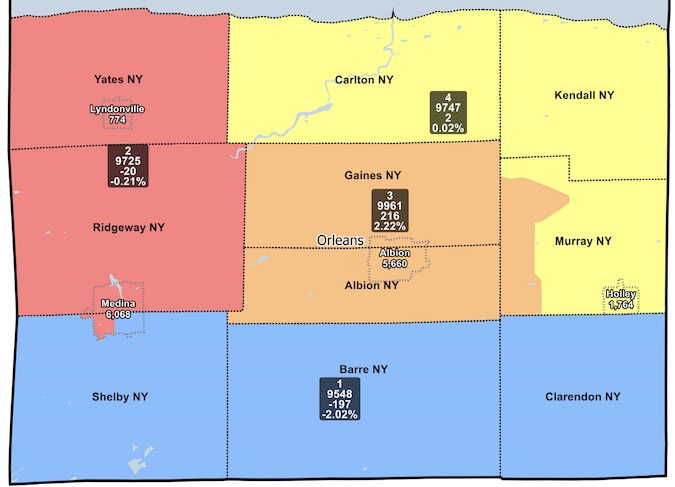
The plan calls for keeping the four legislative districts which are each about 10,000 people. There is some slight shifting to get the four legislative districts within a variance of 5 percent. Some tweaking is needed because the population variance would be an 11.7 percent deviation without changes. That is too much to be legal. (The threshold used to be 10 percent but has been lowered to 5 percent.)
The Legislature started in 1980 following a legal challenge against the previous Board of Supervisors and the principle of “one person, one vote” – that legislators represent districts that are apportioned equally.
The 10 town supervisors used to lead the county government. Some counties still do that, including 2 GLOW counties – Wyoming and Livingston. The towns vary in size so those counties used a weighted-voting system to meet the “one person, one vote” doctrine.
I think it was a good move for the County Legislature to move away from the Board of Supervisors back in 1980. The town supervisors have their hands full leading their towns. It also didn’t seem right to have the county run by the 10 town supervisors and no mayors from the villages.
However, the Legislature has continued to be “town centric” with six of the seven legislators coming from previous roles with town government, either as town supervisors, town councilman, town highway superintendent or a town book keeper. Only Fred Miller, a former Albion village trustee, joined the Legislature after serving on a Village Board.
Miller is also the lone Democrat on the Legislature. The Orleans County Democratic Party has filed a lawsuit in the State Supreme Court, seeking to do away with the at-large positions and seven districts of the same size. Democrats say the current system doesn’t meet the “one person, one vote” standard and also discourages competition, giving Republicans a near-guaranteed victory with the countywide positions. Republicans have a 2-to-1 enrollment advantage in the county.
A redistricting proposal for the County Legislature tweaks the boundaries for the four legislative districts.
Republicans now and back when the Legislature was formed see the at-large as an advantage for residents – that they get to vote for a district legislator and three countywide positions. They actually get to pick a majority of the Legislature. Democrats argue the current system staves off any challengers. In the last election in November 2021, all seven legislators were unopposed.
I’d like to present a different reason for redistricting: We need strong village voices on the Legislature.
The four villages – Albion, Holley, Lyndonville and Medina – account for 14,209 people or 35.2 percent of the county’s total, yet they don’t have much influence on the Legislature.
The villages face big challenges with high poverty rates, vacant homes, shrinking populations, and sky-high tax rates. But those challenges seldom come up in public debate at the county level. A culvert in need of attention in an out-of-the-way spot in the country consumes more passion and money from the current Legislature. They seem to think the villages issues are solely on the villages to resolve.
The Legislature should be redistricted and the villages of Albion and Medina should have their own representative on the body.
The county has 40,343 people, according to the 2020 Census. If that is divided by 7, each district should have 5,763 people. That happens to be very close to the size of the Village of Albion at 5,637 people and the Village of Medina at 6,047 people. If we had two village reps out of seven positions, that would account of 28.6 percent of the Legislature, close to the percentage of village population among the 40,343 total.
The current Legislature hasn’t given the villages (and towns) any more of the sales tax since 2001. Back then, the local sales tax was about $10 million for the year. Last year it totaled $22.5 million.
The county shares $1,366,671 in sales tax with the 10 towns and four villages – $378,777 to the four villages and $987,894 to the towns in 2023.
If the Legislature hadn’t frozen the formula, all the municipalities would have more than doubled their sales tax revenue since 2001.
The Legislature sees the county’s needs – upgraded buildings, roads and infrastructure repair – as top priorities deserving of the full amount of the sales tax increase since 2001. Yet, the village and town needs are seen as less important to the Legislature.
That seven-member body is painfully aloof to the rising tax rates at village level, among the highest in the Finger Lakes region. Those taxes are crushing to the residents, especially younger families and senior citizens. Those rates discourage investment in the villages, and these are the prime spots for businesses which need the village water and sewer services – and their population centers.
The County Legislature seems to cast blame on the villages for their state of affairs, and don’t see the Legislature’s duplicity in driving up the tax rates by hoarding the local sales tax.
Village reps from Medina and Albion would make noise about this situation, rather than the current finger pointing that the village leaders get from the county.
The Village of Albion completed a spray park in June 2021 that has been a big draw for the community. It was part of an $800,000 upgrade at the park on Route 31. The local villages work on quality-of-life issues and essential services despite no increase in the local sales tax since 2001.
If the county agrees to village districts in Albion and Medina, how else should the Legislature look?
With districts about 5,500 to 6,000 people, I would suggest the outside-village portions of Shelby and Ridgeway be in the same district. Together the two towns have 11,505 people. Take out the Village of Medina, and the remainder of those two towns have 5,458 people.
It makes sense to me to have Yates and Carlton in the same district. They are both rural towns along the lake, with many Amish and Mennonite businesses. Together they have 5,402 people.
The towns of Albion and Gaines also should be together. Together they have 10,865 people. Take out the village’s population of 5,637 and the two towns have 5,228 people.
The last two districts aren’t so clear cut. I think it makes sense to have Barre and Clarendon together. They are southern towns in the county, with muckland and wide open spaces. Together they have 5,158 people. I think it makes sense to include about 700 people in the southern part of Murray in this district. About 700 also should be taken from Murray and put in the Albion and Gaines district to bring that one closer to the average.
The last district would have Kendall and the rest of Murray. Kendall has 2,617 people. Murray has 4,796 residents. That’s 7,413 together. But if 1,400 are subtracted (to be included in the Barre-Clarendon district and the Albion-Gaines district) that would put the rest of Murray and Kendall at 6,013.
The county could utilize weighted voting to get the seven districts even closer.
The Legislature will vote at 4:30 p.m. today on its plan to keep the four districts and three at-large. It might not look at redistricting again for about 10 years.
If the redistricting plan passes today, I would encourage the Legislature to look again at having seven districts, and do it in about a year with public hearings around the county. Waiting 10 years is too long for our population and business centers in the village to go without strong advocates on the Legislature.
Contributed by Lydia Fernandez, Orleans County CCE Master Gardener
In many yards, daffodils and other spring-blooming bulbs have already started poking through the soil. Usually, they begin coming up in March or April, but our recent warm weather has woken them a little early.
Not to worry though. Spring-blooming bulbs are very hardy can handle our inevitable return to freezing temperatures. Even if the leaves are damaged by the cold, it should not affect the bulb’s ability to flower. As long as the flower buds stay beneath the soil in freezing weather, they should still bloom when spring actually arrives.
Spring-blooming bulbs such as daffodils, tulips and crocuses spend the winter in dormancy. This resting period comes after months of developing strong roots and making and storing food to produce flowers for the next year.
The leaves and flower buds form at the center of the bulb, where the plant stores its food. Warming soil signals the bulbs to start sending up the leaves and eventually the flower buds. A return of colder weather slows this process until conditions are right again. If the flower buds come up too soon and are damaged by cold, they will not produce a bloom. However, the leaves will continue to produce food to store in the bulb. Let that foliage grow until it dies back naturally, and flowers will likely return next year.
If you get fewer flowers than expected in the spring, it may not be because of erratic winter weather. It could be a sign that you need to divide your bulbs. Bulbs reproduce by forming new bulbs, called offsets, at their base, and when they get overcrowded, they don’t produce as many flowers.
Fewer flowers could also mean that the bulbs were not able to store enough food last year, either because the plant didn’t getting enough sun or because the leaves were removed too soon. Consider relocating your bulbs if they are in too much shade, and wherever they are, be sure to allow the leaves to mature, turn yellow and die back, before removing them.
Spring is officially less than five weeks away, so we won’t have long to wait for these flowers to emerge.
In the meantime, if you have questions about your yard or gardens, call or email Cornell Cooperative Extension of Orleans County at 585-798-4265 or email klo54@cornell.edu.