By Mike Wertman, Sports Writer Posted 30 August 2018 at 7:12 am
Photo by Cheryl Wertman – Senior quarterback Izaiah Rhim will lead Medina/Lyndonville/Barker into Friday’s home opener against Depew.
Medina/Lyndonville/Barker will host Depew (7:30 p.m.) and Albion will visit Olean (7 p.m.) on Friday to open the B2 Division football season.
The other local opener will have Roy-Hart hosting Gowanda/Pine Valley ( 7 p.m.) in a C North Division contest.
The Albion offense is led by the veteran group of quarterback Bryce Pritchard, running backs Ugene Harrison and Brillance Johnson receivers Nate Moore and Matt Kovaleski along with the front line quartet of Kirk Ellison, Ben Restivo, Donamic Farley and Jon DePuy. All are seniors except Johnson who is a junior.
“Olean has some good athletes, no doubt about that, so we will be in for a dogfight,” said Coach Adam Krenning. “It will be a very good test for us.”
Albion defeated Olean 25-14 last fall but the Huskies hold a 4-3 lead over the Purple Eagles in the all time series.
The Medina/Lyndonville/Barker offense is likewise led by a veteran quarterback in senior Izaiah Rhim who passed for 13 touchdowns and ran for 9 last fall.
The Mustangs attack also looks to include running backs William Braswell (senior), Bobby Geiger (Jr.) and Chaise Prest (Sr.); wide receivers Rickie Pitts (Sr.), Brian Fry (Soph.), Tyler Chinn (Soph.) and tight end Zach Johnson (Sr.) along with linemen Tim Roy (Sr.), David Class (Jr.), Blaire Prest (Sr.), Lincoln Pace (Jr.) and Michael Kleinhans (Sr.).
“We’re a little banged up so a big concern now is to keep everyone healthy,” said Coach Eric Valley. “We need to have some of the new kids step up as Depew is always a real physical team.”
The teams last met in 2016 with Medina earning a 50-15 victory. However, Depew holds a 15-12 lead in the all time series which began in 1929.
The Roy-Hart contest will mark the Rams return to being a single school team after merging with Barker the last seven years. It all also mark the debut of new Rams coach Marcus Wyche.
By Tom Rivers, Editor Posted 29 August 2018 at 8:23 pm
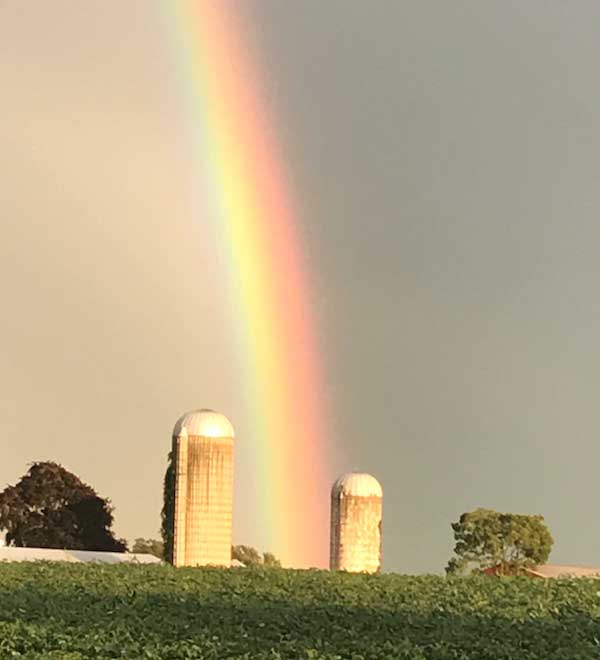
A spectacular rainbow wowed many people in Orleans County this evening. Adam Krenning took this photo of the rainbow on Knowlesville Road, framed between two silos on Ken Knight’s farm.
Dan Hurley sent in this photo of the double rainbow off Lattin Road in Albion.
Samantha Burch sent in this photo of the double rainbow over Saint-Gobain ADFORS in Albion.
The temperatures will take a plunge after three days in the high 80s. It will drop to 65 tonight followed by a high of 71 on Thursday, a high of 77 on Friday and then it’s back in the 80s on Saturday with a high of 82. Sunday is forecast for a high of 84 followed by 86 on Labor Day.
Photo by Tom Rivers – This photo from October 2015 shows apples in an orchard on East State Street near the Butts Road intersection in Albion.
New York City may be the original “Big Apple” but the entire state of New York is worthy of the name too, based on the New York Apple Association’s recent fall harvest estimate. NYAA forecasts New York apple growers will produce 31 million 42-pound cartons of apples this fall, an estimate that is up slightly over last year and on par with the state’s five-year average.
“New York apple lovers know our apples taste great but what they may not realize is just how big our state industry is in the larger picture,” said NYAA President Cynthia Haskins. “New York is the second largest apple producing state in the nation, and the largest east of the Mississippi but that’s not all. Our distinctive flavor gives us a competitive advantage and it is produced by the ideal growing conditions in New York which are unique to our state.”
Apple production in New York takes place on 41,000 acres spanning the state – in orchards near you – where hundreds of varieties are grown. It is likely more varieties than are grown here than anywhere else in the country and most varieties are only available at farm markets and you-pick operations.
A diverse array of New York varieties is also available in retail stores. These include iconic favorites like New York McIntosh; legendary “born in New York” varieties like Empire and Cortland; the popular Honeycrisp and Gala; and exciting new managed varieties like SweeTango and the two “exclusive to New York” varieties, RubyFrost and SnapDragon.
To encourage New Yorkers to enjoy all the apple industry in New York state has to offer, NYAA maintains a locator map on its website, www.nyapplecountry.com, which finds orchards, you-pick operations and cideries by zip code.
NYAA will be engaging with people across New York this fall with pop-up exhibits at Green Markets throughout New York City in September and October. The organization is also sponsoring the Big Apple Crunch, a statewide event involving public schools and millions of New Yorkers biting into a New York Apple at precisely 2 p.m. on Thursday, October 25. NYAA partners with the FarmOn! Foundation to support the event and recently distributed a variety of posters to 780 school districts throughout the state to raise awareness around New York apples and apple products.
Governor Andrew M. Cuomo today announced that 100 percent of all New York State public colleges at The State University of New York and The City University of New York will have a food pantry or stigma-free food access for students in need by the end of the fall semester.
The accomplishment will make New York the first state in the nation to have such a comprehensive program to combat student hunger. Currently, as classes begin, nearly 90 percent of SUNY and CUNY campuses offer these services as part of the Governor’s “No Student Goes Hungry Program.”
“Hunger should never be a barrier for those seeking to achieve their dreams of a higher education,” Governor Cuomo said. “New York is proud to be the first state in the nation to require every public campus to have a food pantry, ensuring that our students have all they need on the path to success.”
In his 2018 State of the State address, the Governor announced a five-point plan to combat hunger for students in kindergarten through college. The plan seeks to provide healthy, locally-sourced meals to the almost one million children in New York who do not have access to the adequate nutrition they need. As part of that plan, the Governor tasked SUNY and CUNY with the establishment of physical food pantries on campus or stigma-free access to free food.
“Food insecurity can affect anyone, including the students enrolled in our campuses,” said SUNY Chancellor Kristina M. Johnson. “Under the Governor’s leadership and with incredible support from all 64 SUNY campuses and partnerships across the state, we are quickly changing not only the conversation about hunger on our campuses, but how we support our students in critical need. Together, we are providing needed nutrition, ending the stigma around food insecurity, and helping ensure no student is forced to drop out because of limited access to the healthy food they need.”
In 2018, directly following the Governor’s announcement, SUNY created a Food Insecurity Task Force, drawing members from a broad spectrum of constituencies, including students; staff; faculty; auxiliary food service providers; food bank associations; civic organizations; and community and philanthropic organizations, to study the issue of food insecurity on college campuses and recommend the necessary changes and best practices to alleviate this serious issue to date.
In addition to the expansion of and access to food pantries, the task force’s efforts have helped establish and grow innovative intervention programs on SUNY campuses, including mobile food trucks, local farm crop sharing, a subsidized on campus grocery store, and programming that allows students to “pay” a campus parking ticket in food donations to an on-campus pantry.
By Tom Rivers, Editor Posted 29 August 2018 at 12:41 pm
Photos by Tom Rivers
BARRE – Flames roar out of a house at 5116 Oak Orchard Rd. today at about noon. Firefighters were dispatched to the house owned by Tracy Flint at about 11:15.
Mr. Flint was out back in his shop when the fire started and wasn’t in the house, his granddaughter said.
Many firefighters were at the scene, including Barre firefighter Chris Flansburg in front.
The fire spread quickly with flames shooting through windows and the roof.
It was smoky while firefighters set up a dump tank for water. The water was then sucked into a pumper fire truck. Hoses were connected to the pumper so the water could be sprayed by firefighters onto the house.
There were firefighters at the scene from Albion, Barre, Elba, East Shelby, Shelby, the Town of Batavia, Oakfield and Byron. The Orleans County Sheriff’s Office and Orleans County Emergency Management Office also responded. National Grid also arrived to shut off the power.
The fire is under investigation.
The Albion Fire Department uses its ladder truck to get water down on the burning house.
Late blight, a devastating airborne disease of tomatoes and potatoes, was detected in Genesee County on Tuesday. Late blight is best known for causing the Irish Potato famine. Late blight is caused by a fungus-like organism that spreads dozens of miles on storm fronts.
Late blight can kill plants in just one week. Disease spots are often dark gray to brown in color and may or may not have a ring of pale green tissue around them. They are typically irregular in shape and size, and frequently become as large as a quarter. Leaf spots will often have small fuzzy white spores on the underside of the leaf in wet and humid conditions.
Late blight will put dark brown to black smears on plant stems. Tomato fruit may also develop large, firm, greasy-looking, brown, gray, or black smears on the upper part of the fruit. Late blight does not resemble lower leaves that yellow and contain numerous small black specks. Potato leaves show dark spots with fuzzy white spores on the underside during humid weather. Potato stems show similar lesions to those seen in tomato.
As this disease is aggressive and very damaging to area farmers, Cornell Cooperative Extension asks that anyone suspecting they have late blight please contact their local CCE office for assistance. In Orleans County, the office can be reached at 585-798-4265. Commercial vegetable farmers may contact the Cornell Vegetable Program at 585-406-3419.
By Tom Rivers, Editor Posted 29 August 2018 at 9:15 am
Photo by Tom Rivers – Walter Jakubowski is pictured in May 2015 when he was setting up his exhibit on the Pratt Opera House at the Salih Studio in Albion.
ALBION – The Genesee-Orleans Regional Arts Council is reopening a gallery in downtown Albion and is seeking submissions from Orleans County artists with the opening reception planned for Oct. 26.
There is no theme for the debut show. Artists are welcome to submit up to two pieces that can be as large as 3-foot by 3-foot.
The Salih Studio at 24 East Bank St. will host the art shows. It will be open seasonally from the fourth week in April to the third week of December, said Gregory Hallock, GO ART! executive director.
The gallery hours will be from 4 to 7 p.m. on Fridays and 11 a.m. to 2 p.m. on Saturdays, with receptions on the fourth Friday of each month from 6 to 8 p.m.
To submit a piece, print, complete and bring in the form found on the council’s website. Pieces can be dropped off at Salih Studio on Oct. 19 from 4 to 7 p.m. or Oct. 20 from 11 a.m. to 2 p.m.
The first show runs from Oct. 26 to Nov. 17.
The second show is a 4-inch by 4-inch display that will be a fundraiser towards GO ART!’s gallery and office space at Salih Studio.
The artwork will be available to purchase at a 7 p.m. event on Nov. 23. All of the pieces will be $15.
Artists interested in donating towards the fundraiser can click here for more information.
Photo by Tom Rivers: Corn is shown in Barker in this photo from August 2013.
Press Release, USDA
U.S. Secretary of Agriculture Sonny Perdue has announced details of actions the U.S. Department of Agriculture will take to assist farmers in response to trade damage from unjustified retaliation by foreign nations.
President Donald J. Trump directed Secretary Perdue to craft a short-term relief strategy to protect agricultural producers while the Administration works on free, fair, and reciprocal trade deals to open more markets in the long run to help American farmers compete globally. As announced last month, USDA will authorize up to $12 billion in programs, consistent with our World Trade Organization obligations.
“Early on, the President instructed me, as Secretary of Agriculture, to make sure our farmers did not bear the brunt of unfair retaliatory tariffs,” Perdue said. “After careful analysis by our team at USDA, we have formulated our strategy to mitigate the trade damages sustained by our farmers. Our farmers work hard, and are the most productive in the world, and we aim to protect them.”
These programs will assist agricultural producers to meet the costs of disrupted markets:
• USDA’s Farm Service Agency will administer the Market Facilitation Program to provide payments to corn, cotton, dairy, hog, sorghum, soybean, and wheat producers starting September 4, 2018. An announcement about further payments will be made in the coming months, if warranted.
The Market Facilitation Program will boost revenues by $4.6963 billion for farmers. Soybeans account for the bulk of the funds at $3.6297 billion or $1.65 per bushel. Corn growers will get 1 cent per bushel for an estimated $96 million total, while dairy farmers receive 12 cents per hundredweight for $127.4 million. Wheat growers will get 14 cents per bushel or $119.2 million. (Click here for more information on other crops.)
• USDA’s Agricultural Marketing Service will administer a Food Purchase and Distribution Program to purchase up to $1.2 billion in commodities unfairly targeted by unjustified retaliation. USDA’s Food and Nutrition Service will distribute these commodities through nutrition assistance programs such as The Emergency Food Assistance Program and child nutrition programs.
The federal government plans to buy $93.4 million worth of apples, $84.9 million in dairy, $14.8 million worth of beef, $48.2million in grapes, $44.5 million in potatoes, and other crops that total $1.2388 billion.
• Through the Foreign Agricultural Service’s Agricultural Trade Promotion Program, $200 million will be made available to develop foreign markets for U.S. agricultural products. The program will help U.S. agricultural exporters identify and access new markets and help mitigate the adverse effects of other countries’ restrictions.
Background on Market Facilitation Program:
MFP is established under the statutory authority of the Commodity Credit Corporation (CCC) and administered by FSA. For each commodity covered, the payment rate will be dependent upon the severity of the trade disruption and the period of adjustment to new trade patterns, based on each producer’s actual production.
Interested producers can apply after harvest is 100 percent complete and they can report their total 2018 production. Beginning September 4th of this year, MFP applications will be available online at www.farmers.gov/mfp. Producers will also be able to submit their MFP applications in person, by email, fax, or by mail.
U.S. has more pregnancy-related deaths than any other developed country
Press Release, U.S. Sen. Kirsten Gillibrand
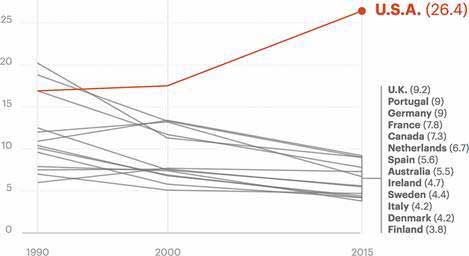
Courtesy of Kirsten Gillibrand’s Office – Maternal deaths per 100,000 live births
WASHINGTON, DC – With maternal mortality rates on the rise across the country and New York State, U.S. Senator Kirsten Gillibrand on Tuesday announced the Modernizing Obstetric Medicine Standards (MOMS) Act, new legislation that would help prevent women from suffering from medical complications or dying before, during, and after childbirth.
The United States has more pregnancy-related deaths than any other developed country in the world, particularly among black women. Each year it is estimated that there are at least 50,000 women who experience a complication during childbirth, and according to an NPR and ProPublica report, for every woman who dies in childbirth in the US, there are 70 women who nearly die.
The Centers for Disease Control and Prevention (CDC) estimates that 60 percent of these deaths and complications are preventable. Hospitals often lack the funding necessary for supplies and proper training to implement standards to prevent complications and deaths arising from pregnancy and childbirth.
“Our state has one of the highest maternal mortality rates in the country, and our country has the highest maternal mortality rate in the industrialized world,” Gillibrand said. “It’s even worse for black women, who are three to four times more likely to die from pregnancy-related complications than white women. This is completely unacceptable and largely avoidable, and it’s a crisis that we can and must solve now.”
Kirsten Gillibrand
The MOMS Act would help reduce maternal deaths and complications in the United States by providing funding to states and hospitals to develop and implement standardized maternal safety best practices, in conjunction with the Department of Health and Human Services (HHS), to prevent and respond to complications arising from pregnancy and childbirth.
New York State has one of the highest maternal mortality rates in the country, and over the past decade, the state has experienced a 60 percent increase in maternal mortality. To date, in August 2018, the rate of maternal mortality in New York State is 20.9 maternal deaths per 100,000 live births. In New York City, where half of the state’s births take place, there have been 22.6 maternal deaths per 100,000 live births so far this year. Racial disparities are also very evident, especially with black women, who are three to four times more likely to die from complications arising during or after childbirth. In New York City, black women are 12 times more likely to die from complications arising during or after childbirth.
“This much-needed legislation would help our hospitals monitor all mothers before, during, and after they give birth for preventable but potentially fatal conditions like hemorrhage and preeclampsia, and it would provide them with the federal funding they need to purchase supplies to implement new procedures and effectively treat patients,” Gillibrand said. “We need to protect and value mothers, and I urge my colleagues to join me in supporting this legislation to address the urgent crisis of maternal mortality and help end racial disparities in our health care system.”
The MOMS Act is cosponsored by Senators Cory Booker (D-NJ) and Kamala Harris (D-CA). This legislation would address the problem of maternal mortality by providing new funding to hospitals with obstetrics and gynecology practices that want to improve their response to pregnancy-related and pregnancy-associated complications by implementing standardized best practices.
Specifically, the MOMS Act would do the following:
• Promote and update maternal safety standards and best practices for hospitals: The MOMS Act would expand the Alliance for Innovation on Maternal Health (AIM) Program at HHS to develop new and update existing standardized maternal safety best practices and to provide technical assistance to states and hospitals to voluntarily implement such standards to prevent maternal mortality and morbidity.
• Create a grant program to help states and hospitals implement the standardized maternal safety best practices developed by AIM: The grant funding would be used to further develop, purchase the necessary supplies for, and conduct training to fully implement the new best practices for preventing maternal death and complications. Funding would be prioritized for hospitals serving low-income, at-risk, and rural populations.
• Improve the CDC Pregnancy Mortality Surveillance System to include reports from state Maternal Mortality Review Committee (MMRC) investigations of pregnancy-related and pregnancy-associated deaths.
• Direct the CDC to provide technical assistance to State MMRCs to review pregnancy-related and pregnancy-associated complications.
Gillibrand’s legislation is supported by Moms Rising, the Black Mamas Matter Alliance, the American College of Obstetrics and Gynecologists, and the Association of Maternal and Child Health Programs. Gillibrand is also a cosponsor of the Maternal Care Access and Reducing Emergencies Act (S. 3363), which would authorize two new grant programs to address the racial disparities in maternal care; the Maternal Health Accountability Act of 2017 (S. 1112), which would provide funding to states and Indian tribes to establish a new, or support the work of an existing, MMRC; and the Quality Care for Moms and Babies Act (S. 2637), which would create new ways to measure the quality of existing maternity and infant care provided through Medicaid and the Children’s Health Insurance Program (CHIP).
By Tom Rivers, Editor Posted 28 August 2018 at 5:25 pm
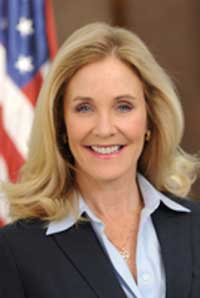
Jane Corwin
A former local state assemblywoman, Jane Corwin, has been nominated by President Donald Trump to serve on the International Joint Commission, a two-country board that is focused on regulating the water levels in the Great Lakes.
There have been calls for a change in leadership at the IJC after last year’s flooding on Lake Ontario.
Corwin of Clarence represented a district that included the Town of Shelby in Orleans County, and portions of Niagara and Erie counties. She was in the Assembly for eight years, and a lost a close election for Congress in 2011 against Kathy Hochul.
“I applaud President Trump’s decision to nominate Jane Corwin for the current International Joint Commission vacancy,” State Sen. Robert Ortt said. “After the disastrous consequences resulting from Plan 2014, it was time for a change in representation and Jane Corwin is the ideal candidate to fill that role. As a leader who once served the same communities that were devastated by the flooding of Lake Ontario, she will ensure the interests of those impacted by the disaster are represented and that their voices are heard. I look forward to Jane Corwin adding on to her brilliant public service record and fighting the wrongs that the IJC and its Plan 2014 have created.”
Along with Corwin, Trump plans to nominate Robert C. Sisson of Michigan and Lance V. Yohe of North Dakota to the IJC. The nominations need to be confirmed by the Senate.
There also are Canadians that serve on the IJC board.
By Tom Rivers, Editor Posted 28 August 2018 at 5:03 pm
ALBION – An Albion man was sentenced to 4 years in state prison for second-degree rape.
Quintion K. Wilson, 21, was charged in December after he allegedly forcibly raped a girl less than 15 years old.
Judge Charles Zambito of Genesee County said Wilson “has a pattern of sexual contact with minors.”
The judge gave Wilson the maximum as part of a plea deal. Wilson also will be on post-release supervision for 10 years. Zambito issued an order of protection for the victim in the case until 2032.
Nathan Pace, Wilson’s attorney, asked for less than the maximum.
“He took responsibility immediately,” Pace said. “He’s remorseful.”
In other cases last Thursday in Orleans County Court:
• A Holley man was sentenced to 3 to 6 years in state prison for promoting prison contraband.
Joshua Grosskopf, 28, tried to bring drugs into the county jail.
Grosskopf apologized in court and said he regretted his actions will keep him away from his children.
“I was wrong,” he said. “It’s hard. I don’t want them to grow up without their father.”
Grosskopf, a second felony offender, has been making progress with sobriety, his attorney Michael O’Keefe told the judge.
• A former Albion resident was sentenced to three months in jail and five years probation for unlawful surveillance.
Jeremy Cooper, 41, now lives in Livingston County. He was arrested in October after placing a hidden camera in a couple’s bathroom. The couple also has children.
“I want to apologize,” Cooper said during sentencing. “I wasn’t in my right mind. I’ve done a lot to become clean and sober.”
Zambito said Cooper betrayed his friends’ trust with the crime.
“This is the kind of case where it’s hard to measure the amount of damage that is done,” he said. “These types of crimes go much deeper.”
• Jade Fayko, 21, of Holley was sentenced to intermittent jail for six months for violating her probation. She was sentenced to three years of probation in December and was ordered to pay $100 a month in restitution until she pays $2,666 as part of a grand larceny crime.
Fayko has paid the full amount each month, was charged with aggravated unlicensed operation of a motor vehicle, failed to notify probation of that charge, and went to Monroe County without probation’s permission. She will be in jail two days a week so she can work at her job.
• Mark Hill, 59, was sentenced to four months of weekends in jail plus five years of probation for felony driving while intoxicated. He also needs to use an ignition interlock device that measures his Blood Alcohol Content when he drives in the future.
• A Rochester man pleaded guilty to attempted criminal sale of a controlled substance in the third degree and faces of a maximum of three years in state prison when he is sentenced on Nov. 15.
Troy Dukes, 24, was charged in October after a traffic stop when he was found with heroin on East State Street in Albion. He admitted in court he was trying to sell heroin in Albion.
• Ryan Childs, 24,of Hilton pleaded guilty to driving while ability impaired by drugs and could face up to a year in jail when he is sentenced n on Nov. 15. He was stopped in Murray on Nov. 17, 2017.
By Tom Rivers, Editor Posted 28 August 2018 at 2:19 pm
Photos by Tom Rivers
ALBION – Neal Muscarella, an Albion stone mason, gets fresh mortar ready as he resets the stone wall at the pond at Mount Albion Cemetery. Muscarella has been working with the cemetery staff for about three weeks in repairing the south and east walls of the pond, which is near Route 31 on the west side side of the cemetery.
Muscarella works with Kent Blake, a cemetery employee. The walls were tipping and were in danger of falling. The Medina sandstone was solid, but the concrete walls on the outside had decayed. Muscarella placed a new concrete wall and then reset the sandstone.
The water has been drained about two feet in the pond, but there is still enough for the big goldfish. Muscarella and the cemetery employees say the job should be complete by the end of the week.
The pond includes a stone spring house. The site is a memorial to local firefighters.
The flags have been lowered in honor of John McCain.
By Tom Rivers, Editor Posted 28 August 2018 at 11:55 am
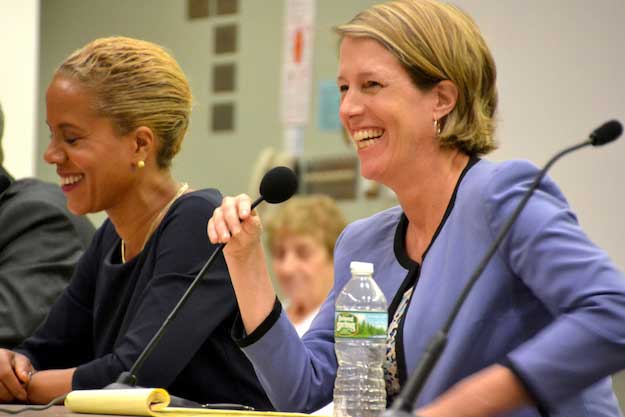
BATAVIA – The four Democratic Party candidates seeking to be attorney general met in Batavia for a forum on Monday evening. All four say an effective attorney general is needed more than ever to protect New Yorkers from the Trump Administration, whether it be safeguarding women’s rights and immigrants, or protecting the environment from an EPA that is catering to “fossil fuel lobbyists.”
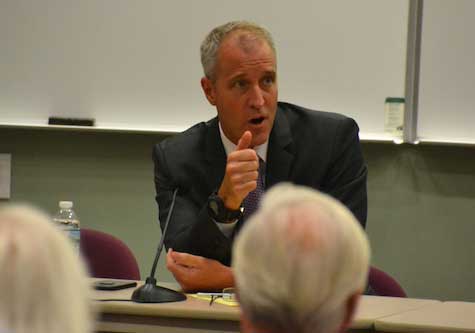
Sean Patrick Maloney said he would push to lower healthcare costs and step up protections for the environment and immigrants.
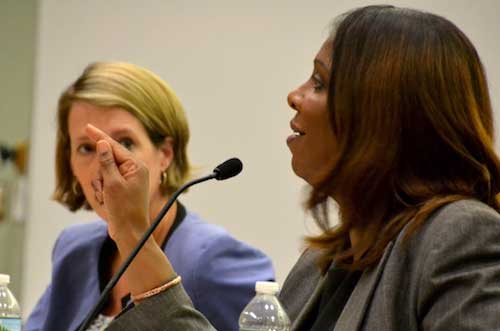
The Democratic Rural Conference of New York State, which represents 47 counties with populations less than 250,000, organized the forum that stretched nearly 2 hours and included Letitia James, Leecia Eve, Sean Patrick Maloney and Zephyr Teachout. The four will be in a primary on Sept. 13.
The state needs to fill the vacancy in the office created in May by the resignation of Eric Schneiderman, who was accused of sexual misconduct.
All four vowed to be fierce advocates in the office, especially for vulnerable residents of the state.
Teachout, a law professor at Fordham University, said the country is in a crisis with the Trump Administration in Washington and a “culture of corruption” in Albany.
She has already been part of a lawsuit against Trump, suing him for violating the Foreign Emoluments Clause by using the presidency to enrich himself.
“Donald Trump is ripping families apart,” Teachout said. “We can’t trust this administration. We can’t trust EPA, which has been taken over by fossil-fuel lobbyists.”
Teachout said she is “an anti-corruption expert” who won’t back down in pursuing graft and wrongdoing, especially among powerful corporations and politicians.
Letitia “Tish” James, the public advocate in New York City, said she would work to protect vulnerable New Yorkers from scams, whether they be senior citizens, farmers or college students.
Letitia “Tish” James, the public advocate in New York City, has a 30-year career of fighting for low-income residents. As the New York City public advocate, she said her office has resolved 32,000 cases, including for some residents who showed up at her office with all their possessions in a plastic bag.
“No one is above the law and no one is below the law,” she said. “I view the law as both a sword and a shield. What is at stake right now is our democracy and the fundamental principle of equal justice of all.”
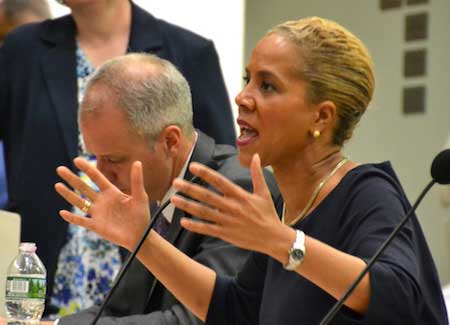
Buffalo native Leecia Eve graduated from Harvard Law School, served as a counsel to Joe Biden and Hillary Clinton and worked as the chief economic advisor to Gov. Andrew Cuomo. Her father, Arthur Eve, was a longtime leader in the State Assembly.
She has a passion for rural New Yorkers and would insist the Attorney General’s Office has a presence in the rural communities.
“I have been fighting for social justice all of my life,” she said, calling herself the most qualified candidate.
Sean Patrick Maloney, a congressman from the Hudson Valley, has worked for the White House as a staff secretary, managing 100 people for Bill Clinton. He also worked as the first deputy secretary for former governors Eliot Spitzer an David Paterson. Maloney is the first openly gay congressman from New York.
“We need someone in Albany who can beat the crooks in Albany,” he said.
The candidates were asked how the attorney general can help the state’s agricultural industry. Teachout said a concentration of large businesses are squeezing profits from farmers. She wants to break up monopolies in seeds, farm equipment and pesticides.
“People are making a lot of money in food, it’s just not farmers,” she said. “ The number of buyers is shrinking.”
The conglomerates increasingly tell farmers “what you can and can’t do,” she said.
Jeanne Crane, chairwoman of the Orleans County Democratic Party, asks a question about helping agriculture during the forum.
Tish James said the Trump Administration’s “horrific tariffs” are hurting agriculture, and an anti-immigration focus from the federal government keeps farmworkers “in the shadows.”
Eve worked with Hillary Clinton to establish the NY Farm Day in the U.S. Capitol, which showcases NY agriculture. She said many regulations that the federal government imposes on farms are overly burdensome for small operations.
The candidates all strongly support uniform voting hours on primary day. In upstate, the voting hours are noon to 9 p.m., while New York City opens the polls six hours earlier.
Leecia Eve, a Buffalo native running for attorney general, speaks during a candidate forum on Monday at Genesee Community College. Sean Patrick Maloney, a congressman from the Hudson Valley, is also one of four candidates in a Democratic primary on Sept. 13.
“I think is absolutely outrageous that rural New Yorkers are unable to fully exercise their right to vote,” Eve said.
She said the state could fund the extra hours to open the polls upstate at 6 a.m.
“We should be doing everything possible to make it easier for New Yorkers to vote,” Eve said.
Teachout said New York has some of the worst voting laws, and most gerrymandered districts. She faults Republicans for “incumbent protections” that suppress the vote.
James wants to see expanded voting rights for people who have been incarcerated, and polling stations need to be handicapped accessible.
Mahoney said voting rights should be a focus for the Democratic Party.
“As Democrats we should never be afraid to let people vote,” he said.
The candidates said the high cost of healthcare a threat to many families, as well as the cost of government.
Teachout said she believes healthcare s “a basic human right,” and pharmaceutical companies need to bring down their costs so medication is affordable.
James said the Attorney General’s Office needs to fight to keep pre-existing conditions, and coverage for children up to 26 should Trump and Congress dismantle the Affordable Care Act.
“I’m proud we were able to stop Trump Care,” said Mahoney, who has served nearly six years in Congress. “ The attorneys general is the check on the Trump Administration that the Congress should be.”
The candidates said the opioid crisis is decimating rural communities, and the pharmaceutical companies, which they say pushed painkillers, need to be held responsible.
“I’m not going to settle for peanuts,” Teachout said. “We have to make sure the true cost is paid. We have to make sure the settlement money goes where people are most hurt.”
She wants a settlement to fund treatment, supportive housing and transportation services in rural communities.
Eve said the country is “at war” in fighting the opioid epidemic. Some states are seeing a decrease in overdoses, while the epidemic is worsening in New York, she said.
“A multi-front war we have to wage to fight this opioid crisis and help communities recover,” she said.
She is in favor of more drug courts where people charged with drug crimes aren’t necessarily imprisoned, but receive treatment and services to fight their addictions.
Mahoney said he carries Narcan in his vehicle in case he encounters someone in an overdose. Narcan can reverse the overdose and save lives.
“Everybody is in this game,” he said about the epidemic.
The candidates also said they support driver’s licenses for undocumented immigrants. The issue has been brought up since Eliot Spitzer was governor more than a decade ago.
Eve said the licenses would give the immigrants more freedom to be in the state, and would also allow officials to know who is in the communities.
“It’s a public safety issue,” she said. “We want people not to be in the shadows. People shouldn’t be fearing every single day of their lives that they or a member of their family will be taken away. This is a long time a coming and I think it’s finally come our way.”
Mahoney said he has visited detention centers where children are being held, separate from family members.
“Mass deportation is racist and absolutely immoral,” he said.
Teachout said she favors having New York be “a full sanctuary state, it’s never been more important than now.”
The candidates said consumer protections would also be a focus, for residents who face scams. Teachout said the Trump Administration has “gutted” seven consumer protection agencies.
The four Democrats also said protecting the state’s natural resources need to be a priority. Teachout said keep fracking out of New York “is one of greatest environmental victories in recent decades.”
She has a strong environmental justice platform.
“We can’t trust the EPA and what is happening in federal courts,” she said. “I believe a nation that poisons its soil, poisons itself.”
Mahoney said he kept large oil barges off Hudson River, and was instrumental in cleanup of PCBs on the Hudson.
Clean water and clean air are critical, he said, and he supports legislation to price and tax carbon.
“That is how you will get clean energy to scale in America,” he said.
James wants NY to divest from fossil fuels. At New York City, she worked on recycling laws and incentives for solar panels.
Eve said it’s fundamental of the attorney general to protect natural resources.
“I will continue the very robust effort to fight against the assault by Donald Trump and his EPA head who is giving polluters free rein across the country,” Eve said. “We are in my humble opinion the most beautiful state and in the most beautiful country in the world.”
The state can make more progress in reducing exposure to lead poisoning, she said.
Mahoney said it’s imperative that Democrats step up, because Trump is winning.
“We have to come together right now because the fight has never been more important than it is now,” Mahoney said. “We will beat Donald Trump by being tough and strong. Democrats have to wake up and get a backbone and get in the game.”
Teachout said she is up for the challenge.
“This is the moment when we are facing the most corrupt administration in American history,” she said. “I am an anti-corruption expert. I know how to use new tools. I know how to use old tools. It will take a determined and tenacious anti-corruption expert to go in and clean up Albany once and for all.”
Press Release, New York State Association of Counties
Last week, nearly 150 county leaders from New York and New Jersey, including three Orleans County legislators, attended a conference at the White House. The meeting was policy-oriented and included opportunities for discussion between the states’ county leaders and White House Administration officials.
Lynne Johnson, Don Allport and Skip Draper from Orleans County joined other county leaders in hearing presentations from 10 administration officials, including senior presidential counsel Kellyanne Conway. The event was part of a series the White House has been holding with county-level officials from around the country. County officials from across the state, representing both parties, were invited.
“It was an important and productive visit to the White House,” said Lynne Johnson, chairwoman of the Orleans County Legislature. “New York county officials have never been invited to hear first hand the direction of the country. This provided us to present our concerns, locally and understand the policies of the Federal government. Agriculture, veterans issues, infrastructure, the opioid crisis were some of the issues we raised. We will be following up with the contacts we made to help our communities.”
The event was run by the White House Office of Intergovernmental Affairs. Officials from the departments of energy, agriculture and education, a U.S. trade representative, and Immigration and Customs Enforcement addressed the delegates as well.
“This was an unprecedented event – it’s the first time any White House has reached out to counties and opened up the discussion,” said Stephen Acquario, executive director of the New York State Association of Counties. “Counties administer federal programs at the local level, so open communication between the levels of government is crucial to developing sound policy.”
Policy discussions focused on agriculture and dairy, the opioid crisis, immigration reform and the impact on New York State, drinking water safety, infrastructure, and changes in tax policy. Each of these issue areas greatly impact New York’s counties and communities.
The New York delegates convened before the White House event for a briefing on national county priorities, hosted by the National Association of Counties.
Select federal issues of concern to New York counties include:
The Proposed Federal Infrastructure Program
On the plus side, the President’s proposed program would reduce regulatory barriers to road and bridge projects and public private partnerships. For example, the proposal would allow for only one environmental review for a project to get green lighted.
On the negative side, the funding proposed would require a 20 percent federal and 80 percent local match. For many current projects this amounts to a complete reversal of federal/local match levels, where federal support can be as high as 80 percent today for major projects. Given the fiscal constraints facing NY counties, local governments would be hard pressed to leverage much of the $200 billion in federal funding for county and town road and bridge projects in NY. The President’s focus on infrastructure is welcome but counties, states and congress will need to work to find a better balance.
Federal Tax Reforms and the Cap on State and Local Tax (SALT) Deduction
While many New Yorkers will benefit from several provisions in the Federal Tax Reforms enacted late last year, many other New Yorkers will be hurt by the $10,000 cap on the state and local tax deduction. New Yorkers pay some of the highest property taxes in the nation, so many homeowners, particularly in downstate area pay much more than $10,000 in combined income and property taxes. It is important to note that the federal tax changes related to SALT will impact downstate areas much differently than most of upstate. However, the negative fiscal impacts generated downstate, because of their large size, will hurt the whole state and over time these impacts will grow.
For many years, going back decades in fact, New York State has been a donor state to the federal government. This means we send far more in federal income taxes to Washington DC than we get back in federal grants and aid. In the most recent year this imbalance was nearly $50 billion. The new federal SALT limitations unfairly shifts even more revenues from New York State, and a handful of others, and redistributes that money to the rest of the nation. The imbalances experienced by donor states like New York, reduces our overall GDP growth compared to the “donee” states – a better balance needs to be found on the SALT provisions going forward.
Battling the Opioid Crisis and Federal Funding
Counties are on the forefront of the battle against the opioid epidemic across the nation and particularly in New York State. We appreciate the President appointing a commission that is focused on reducing over-prescription, cutting off the supply of illicit drugs, and helping those struggling with addiction. We ask that federal funding be streamlined to states and counties to allow us to invest in more community-based programs such as jail-based substance abuse programs.
Immigration Reform and New York
We appreciate the President’s focus on curbing illegal immigration, but we ask the White House to recognize the reliance of New York’s farmers and tourism businesses on immigrant labor. Reforms should allow current, trained workers to stay on farms as well as improve the guest worker H2A visa program to address seasonal and year-round labor needs on our farms and allow for J1 visas for foreign students to work in communities that rely on summer tourism.
US EPA PFOA MCL/US DOD Funding for cleanup and testing near military bases around NY
PFOA and PFOS are fluorinated chemicals used to make carpets, clothing, cookware and other products that are resistant to water, grease, or stains. When they get into drinking water, they are linked to cancers and immune system impairments. The federal budget includes $63.8 million for remediation and research efforts for communities contaminated by PFOS and PFOA. The Department of Defense will receive $43.8 million for identifying and cleaning up former waste disposal sites on military property for the remediation of those two chemicals. New York has several sites in need of remediation.
Local governments also urge the EPA to establish a maximum contaminant limit for PFAS in drinking water.
Passage of the Farm Bill
Agriculture is a significant part of New York’s economy and a central pillar of New York’s agriculture production is dairy farming. Recent trends have hurt dairy farmers significantly and there are provisions within the Farm bill that can help New York’s farmers and we strongly encourage congress to finish deliberations on the Farm Bill to protect all of our farmers.
Internet Sales Tax
The recent U.S. Supreme Court decision regarding the collection of Internet sales tax by states provided an outcome positive for states and that the White House supported. There have been efforts in the past by Congress to change federal laws to create a nationwide standard, but it has been many years since there has been any serious attempt. With the new Supreme Court decision in place, states now have a clear blueprint for how they can move forward and still maintain the rights of all parties impacted. Because of recent events, we do not believe Congress needs to enact any new federal law that imposes a federally mandated one-size-fits all solution. The Supreme Court has provided a clear path forward and states should be allowed to proceed on their own without congressional intervention.