By Tom Rivers, Editor Posted 23 January 2020 at 5:15 pm
Mariah Plain
ALBION – Mariah Plain, an Albion High School senior, has been nominated for the U.S. Air Force Academy by U.S. Kirsten Gillibrand.
Plain has been a first-team Niagara-Orleans soccer selection as a forward/midfielder for the Purple Eagles. She also represented Orleans County American Legion Auxiliaries for a week last summer at Empire Girls State at The College at Brockport.
Gillibrand, Ranking Member of the Senate Armed Services Personnel Subcommittee, today announced her nominations for candidates for three of the nation’s leading service institutions: the United States Military, Naval, and Air Force Academies.
“Our nation’s service academies cultivate exceptional officers, and it is a privilege to nominate some of the best and brightest students from the Rochester-Finger Lakes Region to attend these distinguished institutions,” Gillibrand said. “These future leaders have outstanding academic records and a passion for service. I look forward to watching the successes of all of our nominees as they further their education and serve our nation in the armed forces.”
A selection committee formed by Senator Gillibrand chose the nominees from a large group of qualified applicants. Decisions were based on criteria including academic record, leadership potential, and overall achievement. Final acceptance is determined solely by the service academies.
The United States service academies offer a first-class education as well as a chance for young people to serve our country upon graduation as commissioned officers in the United States Armed Services.
Other candidates from the Rochester-Finger Lakes Region nominated by Gillibrand for the service academies include: Leslie DeGroff (Warsaw, Wyoming County) – United States Military Academy; McKenzie Schaertl (Shortsville, Ontario County) – United States Naval Academy; and Sydney Higgins (Pittsford, Monroe County) – United States Naval Academy.
HAMBURG – Nate McMurray, Democrat running in the special election in NY-27, issued the following statement criticizing the rumored presidential pardon for former Congressmember Chris Collins, who resigned from Congress following pleading guilty to felony insider trading. Collins was sentenced to 26 months in prison on Friday. So far, 14 Trump aides, donors and advisers have been indicted or imprisoned.
“President Trump should not further the injustice inflicted on Western New York,” McMurray said. “His own Justice Department pursued this case and won a sentence that includes prison time for Mr. Collins, a convicted felon. This should not be a Democratic or Republican issue; I urge all Republican candidates in this race, elected officials, and party leaders to stand unified in defense of the rule of law in America. Collins was a wealthy politician who acted as if laws don’t apply to him. We all need to tell him that America’s laws apply to everyone. He must pay his debt to society and not have it wiped away because of his political support for the president.
“I know that these are the same Republican insiders who enabled and protected Collins, long after we all knew he was guilty, while working people paid for his salary and pension. Now is the time for them to do what’s right. Join me.”
Press Release, U.S. Sens. Charles Schumer and Kirsten Gillibrand
Photo by Tom Rivers: Members of the National Guard are pictured in Kendall at the highway garage, filling sandbags on May 12, 2017 that would be placed along the shoreline in Kendall.
Following vicious flooding of Lake Ontario during two of the last three years, with private and public property and infrastructure being destroyed, U.S. Senate Minority Leader Charles E. Schumer and U.S. Senator Kirsten Gillibrand have urged the U.S. Army Corps of Engineers (USACE) to include the Great Lakes Coastal Resiliency Study in its Fiscal Year 2020 Work Plan.
The study, Schumer and Gillibrand said, would seek to both identify vulnerable areas on the Great Lakes’ shorelines and recommend new shoreline protections to fund to increase resilience to various types of damage. The senators said that in the wake of this devastating flooding of Lake Ontario’s shoreline and with its water level substantially higher than average for this time of the year, the need to plan now how to strengthen Great Lakes infrastructure for the future is clear.
Therefore, Schumer and Gillibrand called on USACE to prioritize the Great Lakes Coastal Resiliency Study in its upcoming work plan, a major step toward unlocking essential funding for the study and ensuring that the infrastructure on Lake Ontario, Lake Erie, and the St. Lawrence Seaway is fully capable of weathering the storms and floods of the future.
“After Lake Ontario experienced record flooding in 2017 and again in 2019, with the risk of a severe repeat this year, it is obvious that we need all hands on deck and an all-of-the-above approach, meaning a coordinated response from federal, state and local government, to address the costly vulnerabilities on our Great Lakes. The obvious place to start is by advancing and initiating the Army Corps’ Great Lakes Coastal Resiliency Study,” said Senator Schumer. “The Army Corps has a proven track record of executing blueprints that boost shoreline resiliency and it’s about time they do so on Lake Ontario, Lake Erie and the other Great Lakes. That’s why I’m urging the Army Corps to prioritize this vital study on its Fiscal Year 2020 Work Plan and am vowing to keep fighting tooth and nail until it is fully funded and underway.”
“Lake Ontario has suffered from repeated severe flooding over the past few years. Homes, businesses, and infrastructure along its shoreline have been severely damaged and continue to face vulnerabilities,” said Senator Gillibrand. “With the continued threat of extreme weather and high water levels, these shoreline communities are still in danger. That’s why I was proud to fight for the authorization of the Great Lakes Coastal Resiliency Study, which would help the Army Corps protect communities along all the Great Lakes from future flooding. Now, I’m calling on the Army Corps to fund this study and actually implement it. I will continue to do everything I can to ensure that shoreline communities along Lake Ontario, Lake Erie, and the St. Lawrence Seaway get the help and resources they need.”
Schumer and Gillibrand fought to authorize the Great Lakes Coastal Resiliency Study in the Water Resources Development Act of 2018. As a member of the Senate Environment and Public Works Committee, Senator Gillibrand played a key role in advancing this legislation. The study would cost a total of $12 million over four years, 75% of which would be funded by the federal government, and the other 25% by the eight Great Lakes state governments.
The Great Lakes Coastal Resiliency Study would be run by the United States Army Corps of Engineers (USACE) and is designed to fortify infrastructure and protect both the built and natural areas along the Great Lakes coastline, ensuring that shoreline communities like those along Lake Ontario are better equipped to withstand, recover from and adapt to disruptive events like flooding or storms. The senators explained that in the wake of Superstorm Sandy, the USACE created a similar blueprint that successfully paved the way to then fund new infrastructure projects that are boosting the resiliency of New York’s Atlantic shoreline, showing that the agency is fully capable of doing the same for the Great Lakes through the Great Lakes Coastal Resiliency Study.
Specifically, the Great Lakes Coastal Resiliency Study was developed to safeguard against threats like flooding and erosion and is vital to protecting the Great Lakes’ 5,200-mile coastline, as well as the 4.2 million people who live within two miles of the coastline.
The Study will be an infrastructure investment strategy for the Lake Ontario and Great Lakes coast that will result in a blueprint that identifies vulnerable areas and recommends measures that can be funded to increase resiliency and to protect the coastline.
The study will evaluate and recommend an array of structural, natural, and regulatory measures to protect the coastline such as building breakwaters, adding coastal armoring or protective stone groins, developing new resilient design standards, restoring protective barrier islands, conducting beach sand replenishment, and more.
Without this plan, the Army Corps of Engineers Great Lakes Division has warned the Great Lakes will face an increased risk of coastal damage in the future and will suffer from management strategies that continue to address this problem through a piecemeal approach that is both inefficient and limited in effectiveness.
Protecting this coastline is critical to a robust economy and the tourism industry in the Great Lakes, which includes 60 commercial harbors, a maritime economy valued at $17.3 billion and generating 293,000 jobs, a $14 billion Great Lakes recreation and tourism economy, and a diverse ecosystem of features such as wetlands, bluffs, dunes, beaches, and species that are either threatened or endangered.
The Orleans County Sheriff’s Office and other law enforcement agencies will increase their patrols on Super Bowl weekend from Jan. 31 through Feb. 3.
Law enforcement agencies across the state will crack down on impaired driving during Super Bowl weekend. The STOP-DWI campaign will include underage drinking enforcement, increased patrols and sobriety checkpoints to deter, identify and arrest impaired drivers.
While STOP-DWI efforts across New York have led to significant reductions in the number of drinking and driving fatalities, too many lives continue to be lost due to crashes caused by impaired drivers.
The enforcement crackdown is funded by the Governor’s Traffic Safety Committee.
If people are drinking, Orleans County Sheriff Chris Bourke urges them to plan a safe way to get home. They should call for a ride from a sober friend, family member, taxi or Uber, he said.
By Tom Rivers, Editor Posted 22 January 2020 at 3:27 pm
Small section of first canal also can be seen in Lockport
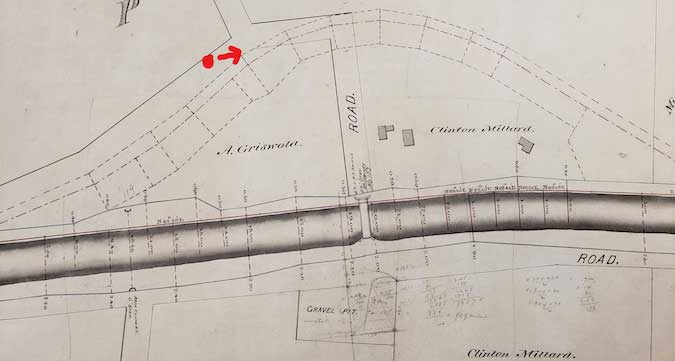
Provided: Craig Bacon, deputy historian for Niagara County, sent the Orleans Hub this section of a survey from 1868 showing where this is a small section of the original Erie Canal remaining in Lockport. This survey shows the then-current path of the canal as well as the outlines of the original canal.
Orleans Hub received an email today from Craig Bacon, the deputy Historian for Niagara County.
Bacon read the report last week in the Orleans Hub about the efforts to clear about 2,000 feet of the original Erie Canal loop in Holley. (Click here to see “Excavators put to work in clearing out old canal loop in Holley.) That section is clogged with trees and heavy brush.
Holley has a historical marker proclaiming this as the last remaining original loop of the Erie Canal. The original canal, completed in 1825, was later enlarged several times, with the last expansion from 1905 to 1918.
In Holley, the canal used to veer sharply to near the Public Square. The canal would later be straightened near Bennetts Corners Road. However, some of the original section would remain and wasn’t filled in.
Turns out, this isn’t the only original piece of the canal, according to Bacon.
“I have seen this claim many times, and wondered about it,” Bacon wrote in an email. “I can tell you, with near absolute certainty, that this claim is incorrect.”
Provided photo: Craig Bacon also sent in this photo showing what looks like a farm lane next to the Synder family farm in Lockport. This is actually part of the original Erie Canal at the intersection of Harrington Road and North Canal Road.
There is another original part of the Erie Canal in the Town of Lockport, at the intersection of Harrington Road and North Canal Road, very near the border with the Town of Royalton.
“What is seemingly a ditch along a farm lane next to the Snyder Family Farm is actually part of the 1825 canal,” Bacon said.
He has studied maps of land records to verify this claim. He sent the Orleans Hub a recent picture of the area as well as an 1868 survey of the Enlarged Canal.
“From this map, it is very obvious that this ditch is actually the old canal,” he said. “The red dot shows approximately from where the new photo was taken, with the arrow showing the direction.”
Bacon said he is “an Erie Canal aficionado” and appreciates canal’s importance to the state and county.
“I find these hidden gems so fascinating,” he said about the original pieces in Holley and Lockport. “It is very amazing that these almost forgotten pieces of the canal are finally getting the respect they deserve. After all, the Erie Canal transformed New York into the Empire State.”
Governor Andrew M. Cuomo today announced legislation in the FY 2021 Executive Budget to make New York’s fracking ban permanent.
The measure would restrict the Department of Environmental Conservation from approving permits that would authorize an applicant to drill, deepen, plug back or convert wells that use high-volume hydraulic fracturing as a means to complete or recomplete a well, protecting the health of New Yorkers and ensuring permanently that our environment is not harmed by this practice. This bill reflects an important step forward toward achieving New York’s clean energy economy goals.
“New York’s leadership on hydraulic fracturing continues to protect the environment and public health, including the drinking water of millions of people, and we must make it permanent once and for all,” Governor Cuomo said. “In the five years since fracking was banned, we have proven that it was in fact, not the only economic option for the Southern Tier. The region has since become a hotbed for clean energy and economic development investment through programs like 76West and Southern Tier Soaring, creating new good-quality jobs that pave the way for further growth.”
High-volume hydraulic fracturing utilizes a well stimulation technique that greatly increased the ability to extract natural gas from very tight rock. High-volume hydraulic fracturing, which is often used in conjunction with horizontal drilling, raises significant, adverse impacts, Cuomo said.
In 2014, a review by the NYS Department of Health found significant uncertainties about health, including increased water and air pollution, and the adequacy of mitigation measures to protect public health. Given the red flags raised by existing research and absent conclusive studies that disprove health concerns, DOH recommended that the activity should not proceed in New York State.
The Department of Environmental Conservation officially prohibited the practice in 2015, concluding a comprehensive seven-year review process that examined potential environmental and health impacts associated with high-volume hydraulic fracturing. New York’s was the first ban by a state with significant natural gas resources.
DEC Commissioner Basil Seggos said, “Governor Cuomo has detailed the biggest and boldest environmental agenda in the nation, and the permanent ban of hydrofracking is a critical part in ensuring the protection of water quality, transitioning from fossil fuels, and continuing our role as a climate leader.”
By Tom Rivers, Editor Posted 22 January 2020 at 10:17 am
Gov. Andrew Cuomo presented his executive budget on Tuesday, a $178 billion spending plan for the state.
Here are some of the reactions to the governor’s proposal:
State Assemblyman Steve Hawley, R-Batavia:
“The governor made a lot of promises Tuesday, specifically to increase funding across the board for every program in the state, including an out-of-control Medicaid program that is the root cause behind a $6 billion deficit. In fiscal year 2018 alone, New York spent more on Medicaid than Texas and Florida combined, despite having around half the population.
“The national economy is booming in almost every metric, yet under one party leadership in New York, we are facing a massive shortfall. Every indication says we need to roll back reckless spending, but Gov. Cuomo continues his handouts, even blaming counties and local governments for causing the state’s woes.
“As budget negotiations intensify, I will be working diligently to see that the governor sticks to his word of no new taxes and that his deficit does not fall on the backs of hardworking taxpayers. Whether it’s property tax relief, road and bridge repair or school funding, western New York deserves its fair share of help, and I will continue to be strong advocate on our behalf as the budget is determined over the coming months.”
State Senator Rob Ortt, R-North Tonawanda:
“New York is already one of the highest-taxed states in the country, yet Gov. Cuomo promised to rely on increased tax revenue and decreased aid to our communities in order to close the $6.1 billion budget deficit that he created. He protects his pet projects like economic development programs tarnished by corruption and billions of tax dollars going to film studios in New York City and Hollywood. He’s doubling down on failed policies that ignore the reality that New York taxes and spends far too much.”
NYS Association of Counties President John F. (Jack) Marren, in response to Medicaid costs:
“In 1966, the State’s new Medicaid program cost county homeowners and businesses $112 million in local property taxes. Today, that cost is $7.6 Billion.
“More than 50 years later, in 2013, to address property taxes at the local level, the state capped increases in local Medicaid costs. On behalf of the 62 counties, including the boroughs of New York City, we are grateful to Governor Cuomo and the Legislature for championing the State’s cap on local Medicaid cost growth. It has proven to be an historic safeguard against property tax growth.
“Once again, counties stand united behind lowering the cost of Medicaid and improving the quality of care for those in need. We will review what is under local control to accomplish this, as well as what parameters are under state control, to insure the integrity of the taxpayer-funded health care program.
“As with any organization, today’s health care costs, especially those embedded in Medicaid, are inherently systemic. Right now more than 1/3 of New York’s population is on Medicaid, more and more Baby Boomers are accessing costly long term care, and other medical coverage—from prescriptions to x-rays to hospital stays.
“Counties stand ready to work with a Medicaid Redesign Team to assist the state with reforming its Medicaid Program.”
New York Farm Bureau President David Fisher:
“Governor Cuomo recognizes that this will be a challenging year in Albany. Many challenges also exist in rural communities across New York State as farm families look to rebound following years of low commodity prices, extreme weather events, trade barriers and mounting regulations.
“Fortunately, Governor Cuomo is proposing significant tax cuts in his State of the State that are priorities of New York Farm Bureau. These include tripling the Current Income Exclusion for farmers who file under the personal income tax. The Governor estimates that this will reduce taxable income and liability for estimated 4,000 farmers. He is also proposing to make the Investment Tax Credit refundable for taxpayers whose primary source of income is from farming operations, allowing farm families to receive the full benefit of their credits earned.
“The Governor is also looking to expand the procurement of New York farm products in schools by expanding the New York Thursday program. New York Farm Bureau also supports further deregulating craft beverage laws and expanding broadband and cell service to rural areas. New York Farm Bureau believes that by working together, we can accomplish many of the goals that unite us all to benefit agriculture, a leading economic engine in this state that we all need.”
New York State School Boards Association Executive Director Robert Schneider:
“Gov. Andrew Cuomo’s proposed $826 million increase in school aid represents a starting point for negotiations with the state Legislature, though the proposal represents less than half of the estimated $2 billion school districts need to maintain educational programs and expand learning opportunities.
“We are particularly encouraged by the governor’s mention of additional funding for prekindergarten, afterschool programs, and early college high school programs, as well as his aggressive efforts to protect students from the health consequences associated with vaping.
“We have concerns about the impact on school districts of consolidating several expense-based aid formulas, given that these aid categories are designed so that lower wealth districts receive higher reimbursement rates.
“We await further details and timing on the governor’s proposed restructuring of the way school aid is distributed. The current foundation aid formula should be updated to measure factors such as poverty more accurately, but fully funding foundation aid at the levels intended when the formula was first enacted in 2007 would go a long way toward accomplishing the governor’s objective: ensuring high-needs districts – indeed, all districts – receive adequate state aid.
“With this year’s allowable tax levy increase below 2%, schools will be watching Albany closely for sufficient aid to support vital educational programs and services.”
Assembly Speaker Carl E. Heastie on Twitter:
“Since I became Speaker, we’ve increased school aid more than $6 billion, and increased funding for higher ed opportunity programs more than 40%. This session, we will continue that investment in our children’s futures.”
State Sen. Rob Ortt, a candidate for New York’s 27th Congressional District, is calling for Democrat- and Working Families-endorsed candidate, Nate McMurray, to give up his recent Working Families Party endorsement.
Recently, the New York State Working Families Party called on candidates to “stop defending taxpayers,” and stated that using the term “taxpayer” is racist.
“Our district is home to around 710,000 ‘taxpayers’ who go to work every day to help support their families and build a better life,” said Ortt. “The fact that a candidate for New York’s 27th Congressional District would accept an endorsement from a political party that explicitly asked prospective candidates to avoid advocating for the taxpayers of our state is embarrassing. As elected officials, we are chosen by the taxpayers of our district to defend their best interests and do the will of the people. Any politician who accepts and endorsement from the Working Families Party clearly shows they have no interest in protecting hardworking taxpayers.”
The Working Families Party, backed by progressive donors, recently stated in the party’s 2020 questionnaire:
Messages that frame “taxpayers” as an aggrieved or marginalized group promotes an anti-tax, anti-government worldview that is often used to justify disinvestment and austerity policies. “Taxpayer” has also become a racially coded term designed to appeal to white individuals and reinforce the misconception that they are paying taxes to support the needs of people (often implied to be non-white) who don’t pay taxes. Will you avoid messaging that centers “taxpayers” or “tax burdens” and instead talk about “public funding” and the public as a whole?
McMurray accepted the endorsement of the Working Families Party line. The New York State Working Families Party has already endorsed several other candidates for 2020, including for U.S. President (Elizabeth Warren), U.S. Congress (Alexandria Ocasio-Cortez), and Democratic candidates for the New York State Legislature. Ortt called on all candidates running for office to denounce the Working Families Party and refuse their support. McMurray did neither.
“By accepting this endorsement, it is clear that Nate has not prioritized representing the best interests of the constituents in New York’s 27th Congressional District,” said Ortt. “Either he is ignorant of the agenda that the New York State Working Families Party stands for, or he has full knowledge of the statements made by this group and has decided that advocating for ‘taxpayers’ is racist. Either one is unacceptable and I call on him to give up his endorsement by this radically socialist party.”
By Tom Rivers, Editor Posted 22 January 2020 at 8:45 am
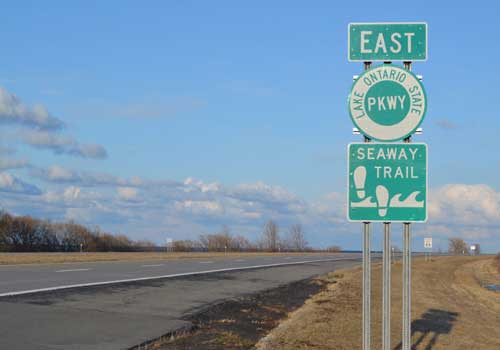
File photo by Tom Rivers: The western end of the Lake Ontario State Parkway runs along 12.7 miles in Orleans County.
KENDALL – The Lake Ontario State Parkway Steering Committee will meet today in Kendall to discuss the future of the recreational route.
The 7 p.m. meeting at the Kendall Town Hall will include a review of alternatives for the Parkway. The public is welcome to attend the session.
The Genesee Transportation Council in Rochester and Orleans County have been studying the future of the Parkway, looking at possible alternatives for the westernmost 12.7 miles of the Parkway that runs along the lake through Kendall and part of Carlton. Altogether, the DOT spent about $14 million on the paving projects.
At today’s meeting, some of the alternatives will be presented as well as estimated costs of implementation. The committee will evaluate some of the future concepts for the Parkway.
Today is the committee’s first meeting in about two years. Since the last meeting, the state Department of Transportation has repaved stretches of the Parkway near Kendall and Hamlin.
The committee has mulled some ideas for the Parkway, including closing the northern side, currently the western lanes, and have the Parkway be a regular two-lane state road on the south side.
That would free up the northern side for possible housing development. Except, in many places, there wouldn’t be enough room north of the road to accommodate new development because the Parkway is too close to the lake.
The Transportation Council also is considering closing off either the north or south sides to traffic and designating one side for cyclists and snowmobiles. But County Legislator Ken DeRoller has said snow doesn’t seem to “stick” too well on the Parkway surface.
And the state would need to modify the interchanges if traffic was allowed on only one side. The cost of redoing the interchanges might negate any maintenance savings from closing off one side to traffic, DeRoller said.
The committee looking at the Parkway also is considering a reduced speed of 40 miles per hour for the Parkway, or perhaps an elevated speed limit to make the road faster for motorists.
DeRoller has said he favors more maintenance and paving in the current Parkway setup. He thinks the roadway should be better marketed as a connector to popular state parks at Lakeside Beach in Carlton and Hamlin Beach. Those two state parks together draw 443,000 visitors annually, DeRoller said. They each have about 250 camp sites.
Expanded free college tuition, increase in school spending and $300 million to Reimagine the Erie Canal among the goals
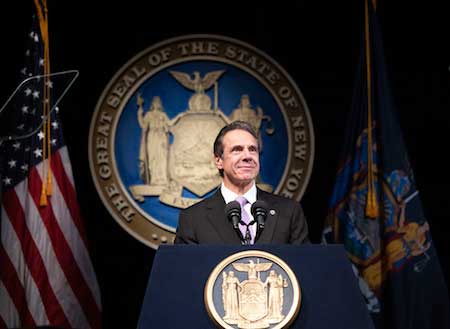
Photo by Mike Groll/Office of the Governor: Governor Cuomo delivers his Fiscal Year 2021 Executive Budget address in Albany today.
Governor Andrew Cuomo today outlined a $178 billion Executive Budget which features a $33 billion five-year plan to combat climate change, including a new plan to streamline government bureaucracy to deliver renewable energy projects faster; a $25 billion expansion of New York’s largest-in-the-nation building program, bringing it to $275 billion; $28.5 billion investment in education (up 3 percent or by $826 million) while reforming funding formulas to prioritize support for poor schools; and an expanded Excelsior free college tuition program to include families making up to $150,000 per year.
The Executive Budget also includes a new proposal to protect our democracy by banning foreign-influenced corporations from making campaign contributions; the most funding in the state’s history – an additional $64 million – to provide services to people who are homeless, including those with mental illness; investments to combat child poverty and $157 million to expand the Empire State Child Tax Credit, serving 400,000 families with children under 4 years old; and an additional $25 million funding to harden security infrastructure at non-public schools and cultural organizations vulnerable to hate crimes.
The budget plan will also promote public health with proposals to ban the sale of flavored e-cigarettes and cap insulin co-payments at $100 per month. It will continue New York’s unprecedented economic and social progress by continuing middle class tax cuts for 4.7 million New Yorkers making under $300,000 a year; cutting small corporate business taxes, benefiting 36,000 taxpayers and saving them $35 million; enacting the strongest Paid Sick Leave program in the nation, impacting 1.3 million New Yorkers; closing the rape intoxication loophole; expanding banking services for low-income people; and proposing an inclusive Equal Rights Amendment.
The Governor’s proposal will reform the current Medicaid system with a new Medicaid Redesign Team co-chaired by Michael Dowling of Northwell Health and labor leader Dennis Rivera. The MRT II will work to reform the program and identify $2.5 billion in savings this year by finding industry efficiencies or additional industry revenue with zero impact to beneficiaries.
For the 10th consecutive year, the Executive Budget is balanced and continues the state’s record of fiscal integrity, the governor said.
“We’re proposing historic investments in climate change and infrastructure programs and fixing the school aid formula to ensure poorer schools get the funding they need,” Governor Cuomo said. “We’re tackling the division and hate that has spread like a cancer in the body politic by funding new security measures for organizations targeted by hate crimes, protecting our democracy from foreign-influenced corporations, and addressing homelessness, child poverty and other barriers facing low-income New Yorkers.”
Photo by Darren McGee/Office of the Governor: Andrew M. Cuomo goes over a $178 billion budget proposal today.
Some other highlights of the budget include:
• Requiring Public Officials to Disclose Their Tax Returns: Governor Cuomo will propose the “Nothing to Hide” Act in the FY 2021 Executive Budget to make our government the most transparent in the nation. The law will require that the Governor, the Lieutenant Governor, the Attorney General, the Comptroller, every state commissioner and every Assembly Member and Senator make their tax returns public. Further, any elected official in the State with a government salary over $100,000 a year will have to do the same.
• New School Aid Funding Formula: Since 2012, New York State has increased funding for education by 43 percent, and this year the Governor’s main goal is to ensure education equity. In 2019 the Governor mandated that districts disclose the amount of funding distributed to each individual school. However, wealthier school districts still spend approximately $36,000 per student as opposed to $13,000 per student at poorer school districts. To ensure State funds are used to reduce funding disparities, the FY 2021 Budget will increase School Aid by $826 million, bringing the total annual investment to a record $28.5 billion, with 85 percent of the Foundation Aid increase going to the highest-need districts. To further prioritize poorer schools and ensure education equity, the Governor is proposing a new School Aid Funding Formula to properly distribute funds and build up underserved school districts.
• Continuing Middle Class Tax Cuts: Governor Cuomo will continue to lower Personal Income Tax rates for middle-class New Yorkers. In 2020, the third year of the multi-year tax cuts enacted in 2016, income tax rates have been lowered from 6.85 percent to 6.09 percent for taxpayers in the $43,000-$161,550 income bracket, and to 6.41 percent in the $161,550-$323,200 income bracket. These cuts are expected to save 4.7 million New Yorkers over $1.8 billion this year. Furthermore, income tax rates will continue to drop to 5.5 percent for taxpayers in the $27,900-$161,550 tax bracket and 6 percent in the $161,550-$323,200 bracket. When the cuts are fully phased in, middle class taxpayers will have received an income tax rate cut up to 20 percent, amounting to a projected $4.2 billion in annual savings for six million filers by 2025. As the new rates phase in, they will be the State’s lowest middle-class tax rates in more than 70 years.
• Lowering Tax Rates by 40 Percent for Small Businesses: To continue the State’s robust economic growth and record of job creation, Governor Cuomo will enact comprehensive tax relief for small businesses, including reducing the corporate tax rate for small businesses from 6.5 percent to 4 percent, which will benefit 36,000 taxpayers and save them $35 million.
• Establishing Paid Sick Leave for Working New Yorkers: To further empower New York’s low-wage workers and protect all consumers in the State, Governor Cuomo will enact paid sick leave. Businesses with five to 99 employees will provide their employees at least five days of job-protected paid sick leave per year and businesses with 100 employees or more will provide at least seven days of paid sick leave per year. Smaller businesses, with four or fewer employees, will guarantee five days of job-protected unpaid sick leave to their employees every year. Small businesses already providing paid sick leave will be able to so.
• Expanding Free College Tuition to More Middle Class Families: To expand the transformational opportunity of the Excelsior Scholarship to more middle class families, Governor Cuomo is proposing to raise the Excelsior eligibility threshold from $125,000 to $150,000 of adjusted gross family income for New York’s families. By increasing the threshold, more than 230,000, or nearly 58 percent of New York resident students will go to a SUNY or CUNY college tuition free.
• Banning Single Use and Packaging Styrofoam Products: To build on the progress of last year’s plastic bag ban, the Governor is proposing new legislation to prohibit the distribution and use of expanded polystyrene, commonly known as Styrofoam, single-use food containers and packaging materials by January 1, 2022.
• Reimagining the Erie Canal: Building on the findings of the Reimagine the Canal Task Force, the New York Power Authority, which now oversees the Canal Corporation as a subsidiary, will invest $300 million over the next five years to integrate the Empire State Trail and Erie Canal through a new program that will stimulate tourism and economic development, address environmental challenges unknown a century ago, and create an asset that will improve the quality of life in communities along the 360-mile spine of the Erie Canal.
A first phase of funding will start this year that will have two parts: a $100 million economic development fund to invest in communities along the Canal and a separate $65 million investment in solutions that will help prevent ice jams and related flooding in the Schenectady area. The remaining $135 million of the plan’s funding will subsequently be allocated to research recommended by the Reimagine Task Force, as well as to solutions related to flood mitigation, invasive species prevention and ecosystem restoration.
• Launching Next Round of the Downtown Revitalization Initiative: The Downtown Revitalization Initiative is transforming downtown neighborhoods into vibrant communities where the next generation of New Yorkers will want to live, work and raise families. Participating communities are nominated by the State’s ten REDCs based on the downtown’s potential for transformation. Through four rounds of awards, each winning community was awarded $10 million to develop a downtown strategic investment plan and implement key catalytic projects that advance the community’s vision for revitalization. The FY 2021 Executive Budget provides $100 million for a fifth round of the Downtown Revitalization Program.
• Legalizing Cannabis: This year Governor Cuomo is proposing a comprehensive regulatory approach to legalize cannabis, creating a new Office of Cannabis Management to specialize in cannabis regulation – overseeing the medical, adult-use and hemp programs. The proposal will administer social equity licensing opportunities, develop an egalitarian adult-use market structure and facilitate market entry through access to capital, technical assistance and incubation of equity entrepreneurs. The proposal will also correct past harms to individuals and communities that have disproportionally been impacted by prohibition. To safeguard public health, the proposal limits the sale of cannabis products to adults 21 and over and establishes stringent quality and safety controls including oversight over the packaging, labeling, advertising and testing of all cannabis products.
By Ginny Kropf, correspondent Posted 21 January 2020 at 4:27 pm
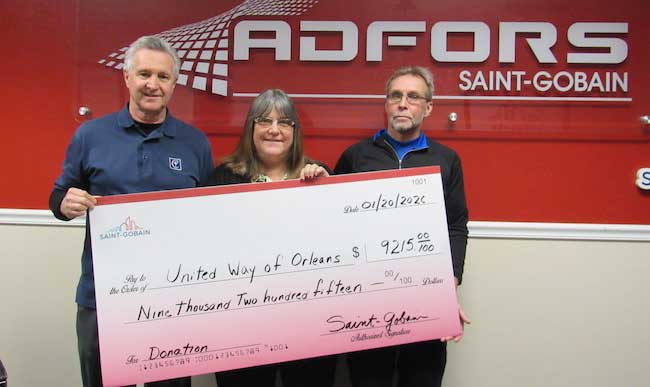
Provided photo: Saint-Gobain ADFORS in Albion recently presented a check for $9,215 to United Way. From left are facilities manager Dave Fink, senior staff accountant Melanie Adams and United Way director Dean Bellack.
ALBION – A local company has come forward for the first time to support United Way of Orleans County. United Way got a big boost to its 2020 campaign with a generous donation from Saint-Gobain ADFORS.
Dave Fink, facilities manager, and senior staff accountant Melanie Adams recently presented United Way’s director Dean Bellack with a check for $9,215.
The check represents employee pledges of $6,715 and a corporate donation of $2,500.
For their support, Saint-Gobain ADFORS received an award at United Way’s event in November at White Birch Golf Course in Lyndonville, featuring guest speaker and Congressional Medal of Honor recipient David Bellavia.
Fink said he has long been a supporter of United Way and was eager to become involved when he was contacted by Bellack last fall. The company took advantage of their annual safety celebration in October to also make it a day for United Way.
Saint-Gobain ADFORS sponsored a chicken barbecue for employees and invited Bellack to come and make presentations to employees. All in all, Bellack said he did six different presentations.
To encourage employees to pledge to United Way, Saint-Gobain ADFORS purchased a 55-inch television, and anyone who made a pledge got a chance in a drawing for the TV. The winner was Ryan Uderitz.
Saint-Gobain ADFORS employs more than 200 people at the Albion plant, which opened in 1975. The company makes reinforcements for sails for America’s Cup, dry wall tape, cement board reinforcements, fiberglass reinforcement material, laid scrim and geotextile for road repairs.
Fink said there are two reasons why Saint-Gobain ADFORS supports the local community.
“First, our corporation encourages community involvement, and second, it requires community involvement,” Fink said. “They give us money for investment in our community.”
Even though the money comes from the corporate level, it is local management which decides how it will be used, Fink said.
“It’s a great philosophy,” Bellack said. “It not only benefits the community, it benefits your company.”
LYNDONVILLE – The Lyndonville Central School District is currently accepting applications for the 4th Annual Educator of the Year Award, to be named in June 2020.
Parents, students, and community members are eligible to nominate a Lyndonville educator for this special honor. Applications need to be submitted by Feb. 7.
The Educator of the Year will also receive a $1,000 grant to be used for special programming in his or her department or grade level.
John Bailey, an elementary music teacher, was the first recipient of the award in 2017, second grade teacher Shannon Arlington was the second recipient, and Math teacher Jeff Qamoos was honored last year.
Nominees for the award must have completed at least four years of teaching at Lyndonville.
Nominees should also:
• Be an exceptionally dedicated, knowledgeable, and skilled teacher;
• Inspire students of all backgrounds and abilities to learn;
• Have a strong sense of values, integrity and professional ethics;
• Actively collaborate with colleagues, administration, parents and families;
• Demonstrate innovative 21st century skills and continuing professional growth;
• Have the respect and admiration of students, parents, and colleagues;
By Tom Rivers, Editor Posted 21 January 2020 at 12:14 pm
KENDALL – David Knapp for the past 18 years has served as a fire investigator in Orleans County, with most of his tenure as the county’s senior investigator.
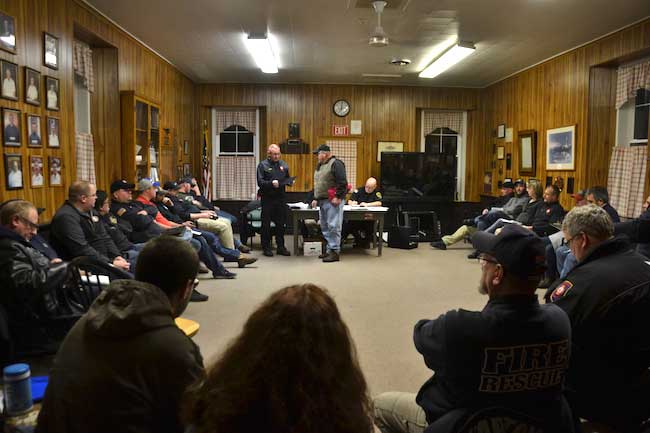
He retired from the part-time position on Dec. 31. The former Holley fire chief was recognized on Monday during a combined meeting of the Orleans County Fire Chiefs Association and the Orleans County Fire Advisory Board.
“It’s been an honor to work with all of these volunteers and to serve the people of the county,” Knapp said.
He said he enjoyed great relationships with the other fire investigators. For most of his tenure he worked with Walter Batt and David Clary as fire investigators. More recently, Steve Cooley and Justin Niederhofer joined the county as fire investigators. Cole Hardenbrook of Kendall replaced Knapp on Jan. 1.
“We melded really well together,” Knapp said. “It’s good to have more than one set of eyes.”
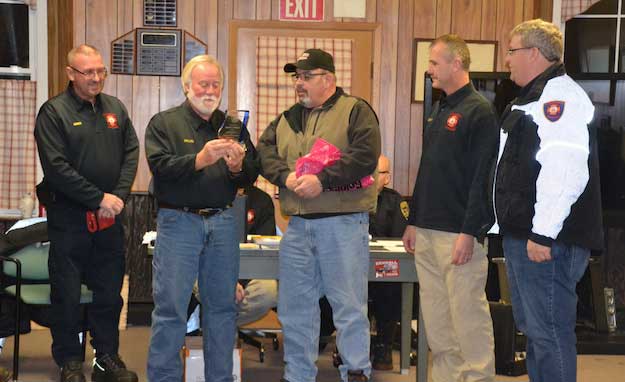
Dale Banker, the Orleans County emergency management coordinator, presents a certificate of appreciation to David Knapp from the Orleans County Legislature for Knapp’s 18 years as a fire investigator. The award was presented during a combined meeting on Monday at Kendall of the Orleans County Fire Chiefs Association and the Orleans County Fire Advisory Board.
Knapp has worked the past 25 years in the construction business. He currently drives a ready-mix concrete truck and would like to retire in about a year.
He joined the Holley Fire Department in 1977. He was just out of college when he was at a restaurant and saw a group of his friends leave to respond to a call. That piqued his interest and he then joined the fire department.
Knapp quickly rose through the ranks. Besides serving as fire chief in Holley, he was a key leader in having the new fire training tower built in Albion on West Countyhouse Road.
Knapp welcomed the chance to serve as a fire investigator.
“It’s very interesting,” he said. “It’s like a mystery. You have to go through a methodical process to determine the cause and origin of a fire.”
Knapp shared some advice for preventing fires. First off, he said to clean chimneys and maintain wood-burning appliances, such as stoves and furnaces.
And don’t overload power strips. “If you overdraw them, that’s where fires start,” he said.
Knapp urged people to keep their houses and garages tidy, and to make sure they have working smoke detectors and carbon monoxide detectors.
He also urged the community to appreciate their firefighters.
“The people you have right now are one of the county’s greatest resources,” he said.
David Knapp is presented with a special award from the emergency management staff for the county. From left include Dale Banker, Emergency Management coordinator; Fran Gaylord, deputy coordinator; Knapp; Jerry Bentley, deputy coordinator; and David Hydock, deputy fire coordinator.
By Tom Rivers, Editor Posted 21 January 2020 at 9:15 am
Mother of 4 works as supervisor at Intergrow Greenhouses
Photo by Tom Rivers: Rosa Santiago, in back, is joined by her daughters during a celebration on Monday after she passed her American citizenship test. Rosa’s daughters include, from left: Tiffany, Michelle and Alexis.
WATERPORT – Rosa Santiago was celebrated on Monday, Martin Luther King Jr. Day, for earning her American citizenship.
Santiago, an Albion resident the past 13 years, passed the citizenship test last Wednesday. She will be sworn in as a new American during a ceremony on Feb. 27 at the U.S. Courthouse in Buffalo.
Santiago, 38, started taking English classes at the World Life Institute in Waterport about two years ago. She also studied American history and prepared for the civics test she needed to pass to become an American.
Her teachers and classmates threw a party for her at the school on Stillwater Road, where she has taken classes on Monday and Wednesday evenings the past two years.
Santiago, a supervisor at Intergrow Greenhouses, said she was motivated by her four children to learn English and pass the test. She has a son, 18, and three daughters, ages 9, 12 and 14.
She has been in the area for the past 13 years, working in agriculture. She was at Lake Ontario Fruit, an apple packing facility in Albion, before going to Intergrow.
A native of Mexico, Santiago said earning her American citizenship gives her security to stay in the country with her family. She also looks forward to voting and having a US Passport.
Cheryl Lieberman, one of Santiago’s teachers, praised Santiago’s persistence in learning English and preparing for the citizenship exam.
“Do not be fooled by this tiny, shy, young lady,” Lieberman said during a celebration for Santiago on Monday. “She has tremendous strength inside of her and a determination.”
Santiago went to her classes on the two evenings each week after a full shift at work.
“Rosa maintained the strong desire to pass this test and she let nothing discourage her from achieving that goal,” Lieberman said. “She fought for it and never gave up.”
Santiago is the 12th student from the World Life Institute to earn American citizenship since 2010. She said seeing the other students reach that goal was a strong motivator and encouragement for her.
WLI runs the program with support from the Orleans-Niagara BOCES Continuing Education. Sue Diemert, a literacy specialist for the program, said the World Life Institute staff are dedicated and caring teachers. She praised Santiago for her success with the program.
“We celebrate out students and our new citizens,” Diemert said.
Provided photo: The staff at the World Life Institute in Waterport celebrated Rosa Santiago on Monday evening. Pictured from left include Linda Redfield, a teacher at WLI; Monica Beck, a teacher; Rosa Santiago; Rosa’s daughters, Tiffany, Michelle and Alexis; and teachers, Gejlana Carter, Harris Lieberman and Malvy Rivera.
Contributed Story Posted 20 January 2020 at 4:57 pm
The Section VI Executive Committee met this morning to review the appeal filed by the Buffalo Public Schools (“BPS”) late Friday, January 17 relating to the January 3 decision by Section VI to return to league-based play for high school football beginning with the upcoming 2020-21 season, Section VI Executive Director Timm Slade stated this afternoon.
“Although the decision to return to league-based play resulted from a process that began in October 2019, Friday’s appeal marks the first instance where BPS has presented concerns to Section VI regarding this matter,” said Slade
“In its appeal, BPS identified a need for “clear guidance, feedback and input from critical stakeholders.” Because scheduling efforts are already underway for the 2020-21 football season, the Section VI Executive Committee voted this morning to suspend any implementation of league-based play in order to allow for further communication, input and guidance with regard to this matter, while alleviating any disruption and uncertainty with regard to the upcoming football season” Slade added.
“As a result, Section VI high school football will continue under its federation-based alignment for the 2020-21 football season,” said Salde
“League-based play is the norm for the overwhelming majority of sports teams within Section VI, and more than 10 of the BPS’s other interscholastic sports teams continue to participate in league-based play within Section VI as they have for many years. There have been long-standing issues raised by Section VI members about the negative impacts of the federation-based alignment for high school football, such as excessive travel time and costs, lack of consistent league rivalries and scheduling difficulties,” added Slade
Section VI President Adam Stoltman provided a further explanation of this morning’s Executive Committee decision:
“The decision to return high school football to league-based play was carefully considered and followed a transparent process through which all Section VI members were provided opportunities for input. Returning high school football to league-based play would reduce travel time and costs for the 63 football teams in Section VI, and would also enhance league rivalries, increase the significance of games for playoff eligibility, foster increased attendance and facilitate long-term scheduling,” said Stoltman.
“Nonetheless, the Section values the perspectives and concerns that have been presented by the Buffalo Public Schools as a continuing Section VI member. The Executive Committee believes that this morning’s action to delay any implementation of the return to league-based play will provide an opportunity to engage in on-going meaningful dialogue with the BPS, as well as the Section’s other members, and to ultimately ensure that a return to league-based play addresses the concerns of the BPS while enhancing the opportunities and experiences of the student-athletes who participate in high school football within the Section,” added Stoltman.
The proposed change would have seen the return of football as a league sport for the Niagara-Orleans League and Lewiston-Porter, which currently is a member of the Niagara Frontier League, had already petitioned to join the N-O for football only.
Today’s vote by the Section VI Executive Committee puts off any change back to a league alignment for football for at least a year.