By Tom Rivers, Editor Posted 29 April 2020 at 9:00 pm
Provided photos
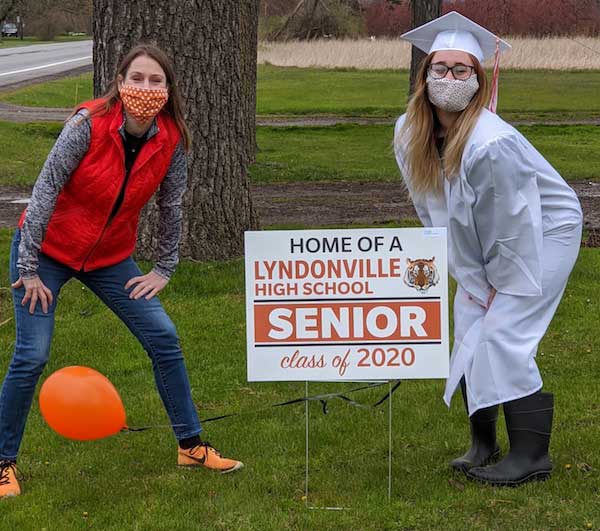
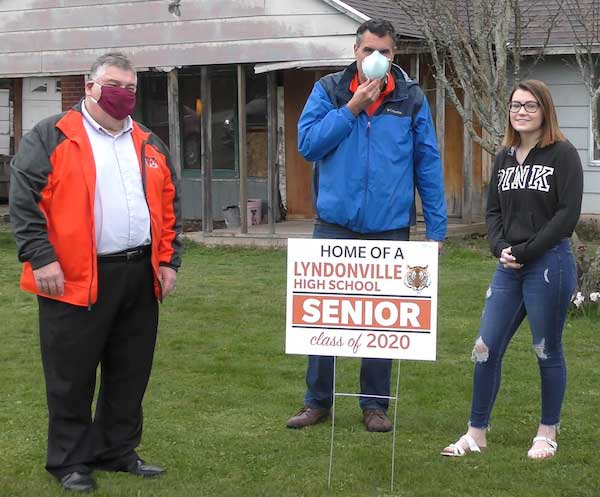
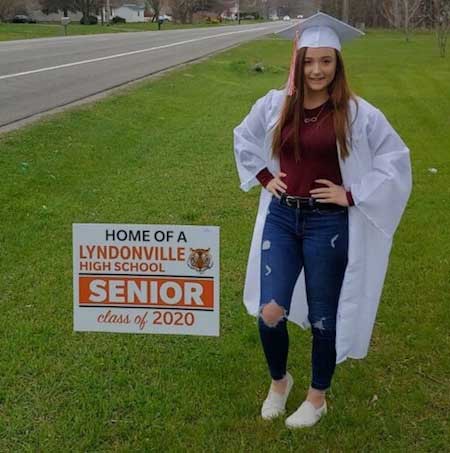
LYNDONVILLE – Dr. Elissa Smith, Lyndonville Elementary School Principal, joins Madison Austin, the Student Council president, after Smith and other school officials delivered the sign and a cap and gown to Madison and her classmates on Tuesday.
Donations form the community covered the cost for the signs, with each of the 45 members of the senior class receiving one.
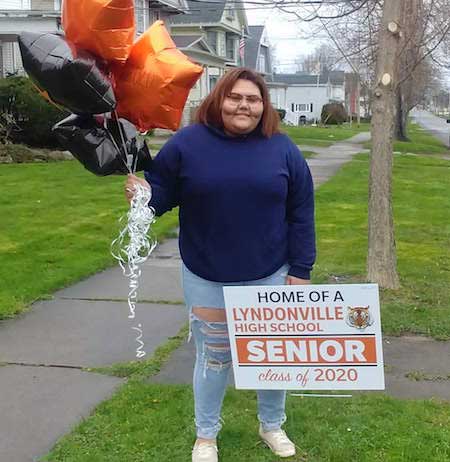
Isabella Carrasquillo holds balloons in Lyndonville’s school colors while standing with her sign.
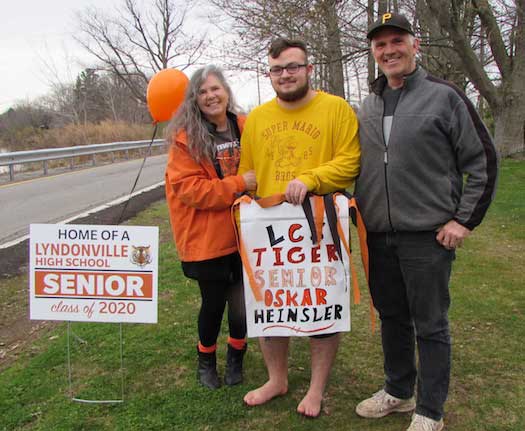
Mitzi Fredericks, a library/media aide at the school, and her husband Merle present the senior sign to their grandson, Oskar Heinsler.
Mason Boyd was happy to receive the signs. Mason and his classmates have had their senior disrupted due to the Covid-19 pandemic. Students have been out of the school building for almost seven weeks, with students work on their schoolwork at home.
Two school administrators – Joe DiPassio (business administrator) and Jason Smith (district superintendent) – present the senior sign to and Faith Chaffee, who is the class president.
Kaci Wittmeyer received a sign from the district on Tuesday.
Cal Stinson feels school pride as a senior at Lyndonville.
By Tom Rivers, Editor Posted 29 April 2020 at 4:45 pm
Photos by Tom Rivers
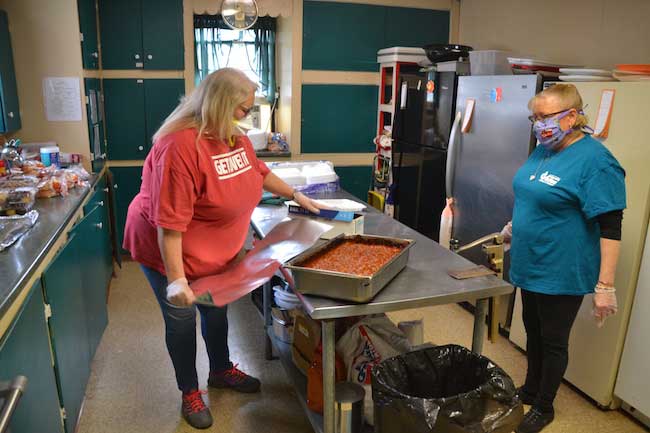
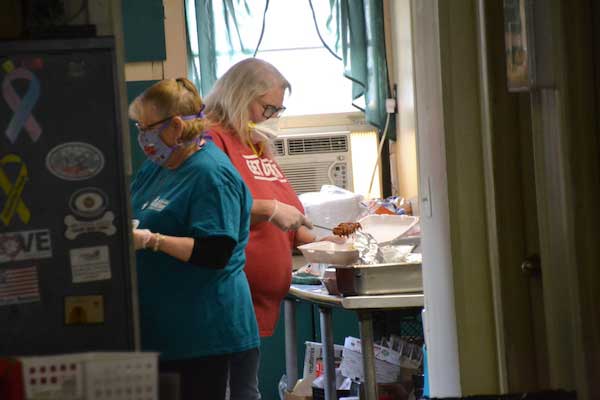
HOLLEY – Rachel Escobar, left, and Debbie Rothmund prepare a pulled pork lunch at the Eastern Orleans Community Center in Holley. The center at 75 Public Square has been serving about 30 take-out lunches each weekday since non-essential businesses were closed by the state on March 22.
Rothmund is director of the center and Escobar has been a volunteer for the past 10 years.
“I just love being here and helping everyone,” Escobar said. “I find this is where I belong. I love the people here.”
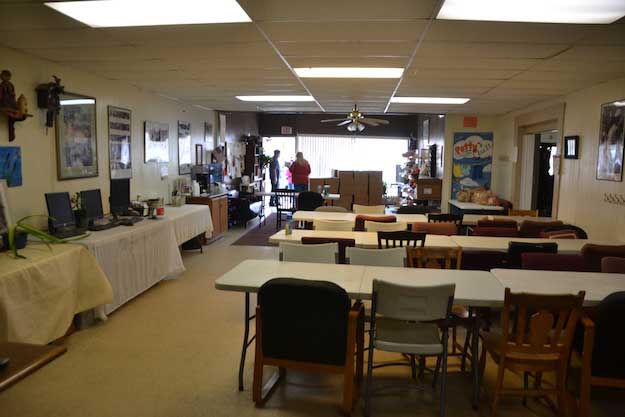
The center is run by Community Action of Orleans & Genesee. The site typically would serve residents in a dining area but that has been off limits to the public for more than a month. The meals are handed off at the front door.
Rothmund has worked at the center for 20 years. When she started there were about 10 regulars who attended the center for lunch. There were about 30 attending more recently, and they would start showing up at 10 a.m. to play cards and Bingo and just to hang out.
Rothmund feels bad that those local residents haven’t been able to socialize very much the past six weeks.
“They are so sad,” Rothmund said about many of the regulars, who stop by now for a take-out meal at the front door. “They miss being here and seeing their friends.”
The center would also bring in speakers to talk about health issues, cooking and other issues. The Health Department also stops by typically once a month to check people’s blood pressure.
Debbie Rothmund, left, and Rachel Escobar get meals ready in the kitchen. They also prepared about 170 emergency food boxes in March.
“I’ve never had that many,” Rothmund said. “I’m seeing people I’ve never seen before.”
Rothmund praised the school district for providing meals for many students while the schools buildings are closed to the public. This is now the seventh week the schools have been off-limits. The food from the schools isn’t enough for many families, and the Holley center is seeing an increased demand, Rothmund said.
“Many of the people here have found themselves out of work,” she said. “They don’t have any groceries.”
Debbie Rothmund and Rachel Escobar pride themselves on preparing quality meals for the residents. This meal included pulled pork, peas, cole slaw and chocolate chip cookies.
“It’s nice to have a home-cooked meal,” Rothmund said.
Some people stop by for emergency food, but they don’t want to take very much.
The center operates through donations from the residents who stop by, and contributions from the Salvation Army, Foodlink and local churches.
“They tell me somebody else needs it more,” Rothmund said. “I tell them we have enough for them and for you. God does provide.”
By Tom Rivers, Editor Posted 29 April 2020 at 4:15 pm
4 more people also have recovered from coronavirus in Orleans
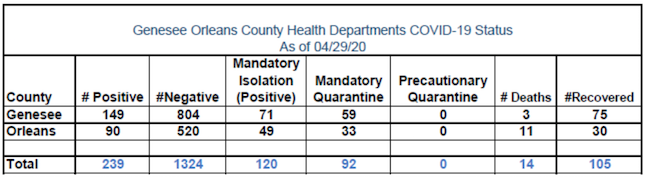
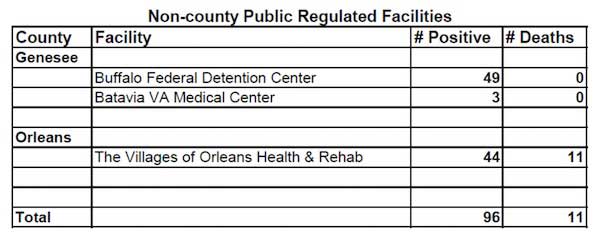
There are four more confirmed cases of Covid-19 in Orleans, including three more at The Villages of Orleans Health and Rehabilitation Facility in Albion.
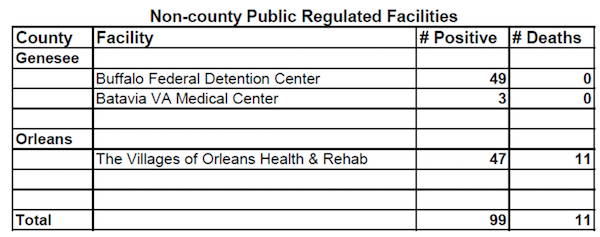
The new cases brings the total confirmed positive cases in the county to 90, with 47 of those at The Villages, a 120-bed nursing home and rehabilitation center.
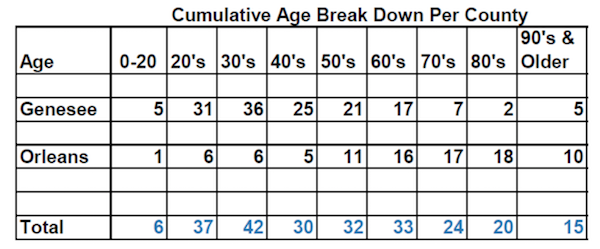
The new cases include one person who lives in Murray, with the others in Albion where The Villages is Located. The Genesee and Orleans County Health Departments also is reporting the ages of people who tested positive include one in the 20s, one in the 60s, one in the 70s and one in the 80s.
One of the newly positive individuals was on quarantine prior to becoming symptomatic. The Health Departments also are reporting that four people have recovered from Covid-19, bringing the county’s total recoveries to 30.
There are five people currently hospitalized from Covid-19.
In Genesee County, the Health Departments said there is one new case, and that person is under age 20 and lives in Batavia. The newly positive individual was on quarantine prior to becoming symptomatic.
Genesee County now has 149 total positive cases. There has been one more recovery, bringing that total to 75 in Genesee.
Of the active cases, three people are currently hospitalized and one person is at a non-hospital regulated facility, the Health Departments reported this afternoon.
Click here to view the online map of confirmed cases in Genesee, Orleans and Wyoming counties.
Governor Andrew M. Cuomo today announced 35 counties have been approved to resume elective outpatient treatments. The Governor previously announced that the state will allow elective outpatient treatments to resume in counties and hospitals without significant risk of COVID-19 surge in the near term.
Governor Cuomo also announced New York State is now conducting an average of 30,000 diagnostic tests for COVID-19 per day. Last week, the Governor announced the state will work with the federal government to double New York’s testing capacity from 20,000 tests per day to 40,000 tests per day over several weeks.
The Governor also announced the results of the state’s FDNY and NYPD antibody testing survey that tested 1,000 New York City Fire Department officers and 1,000 New York City Police Department officers from across all five boroughs. The preliminary results show 17.1 percent of FDNY officers and EMTs have COVID-19 antibodies and 10.5 percent of NYPD officers have COVID-19 antibodies. The state will be conducting further antibody analysis and surveys by race and gender in the future.
The Governor also announced the state is testing today 1,000 transit workers for antibodies to further determine the spread of infections among our frontline workers. The State is working with BioReference to provide antibody tests to first responders and other essential workers from the MTA, State Police, DOCCS and others.
The Governor also directed the MTA to issue a full plan by tomorrow, April 30th, on how it will clean and disinfect every train, every night in response to reported deteriorations of the conditions in the subways during the pandemic.
“We have made tremendous progress to stop the spread of this infection, but we are not out of the woods yet and we need to proceed with caution as we begin our re-opening plan,” Governor Cuomo said. “We know testing is key to re-opening New York – it is the indicator that will show if we are keeping the infection rate down throughout the re-opening process. We have been more aggressive than any state or nation in the world on testing and we are now halfway to our goal of doubling our testing capacity from 20,000 per day to 40,000 per day, but we still have more work to do.”
Finally, the Governor confirmed 4,585 additional cases of novel coronavirus, bringing the statewide total to 299,691 confirmed cases in New York State.
Dr. Thomas Madejski of Albion, a primary care doctor with General Physician, PC, regularly sees patients who have one or more serious underlying health issues. He serves an aging population in his Medina office, and he knows that they, more than anyone, are vulnerable to COVID-19.
“There are patients who don’t feel comfortable leaving their home during this pandemic,” Dr. Madejski says. “And there are also those patients who I don’t feel comfortable with them leaving their home.”
Realizing the growing need to treat such patients, General Physician, PC expanded its telemedicine service to better serve its patients navigating this new frontier of life under social distancing rules.
“We are able to see patients using Skype, of Facetime, or any number of video platforms,” Dr. Madejski says.
According to the New England Journal of Medicine, telemedicine is now offered through more than 50 major health systems in the United Stated. Most importantly for patients, many insurance companies are covering video visits at the same cost they would a traditional office visit.
With more than 80 percent of Americans owning smartphones, telemedicine has become a much more viable option than in years past. For providers like Dr. Madejski, it has offered a lifeline to patients in need.
“The focus right now is on COVID-19, and rightfully so,” he says. “But we still have patients presenting with illnesses and medical needs that aren’t COVID-19 related every day. Other illnesses don’t stop because of this pandemic, so we needed to change how we care for those patients.”
According to a recent survey conducted by the Washington Post, the biggest obstacle doctors report is patients who are uncomfortable with video visits because it is so opposite of what they have always known. As much as people report “white coat syndrome,” born of an anxiety from being in the doctor’s office, the reality, Dr. Madejski says, is that many people feel comfortable with their doctor and want to see them face to face.
“Many of my patients have been coming to me for years, and that is true for doctors across our organization,” he says. “I’m not just some guy coming in the room, I’m a familiar, friendly face. I’m someone they have come to trust with their health.”
Dr. Madejski says he has seen that apprehension in patients when his team suggests a video visit— at least until they have their first virtual experience.
“They are genuinely surprised at how personal the experience still is,” he says. “I’m asking questions and examining them, they are asking questions, it is a very thorough, interactive process, and that surprises people.”
The bottom line, according to Dr. Madejski and his team, is that, at least until COVID-19 is under control, video visits are a great option.
“We are able to take care of most of your needs from home, so it is safer for you right now,” he says. “It will allow us to maintain your health, while decreasing the chances of you contracting COVID-19.”
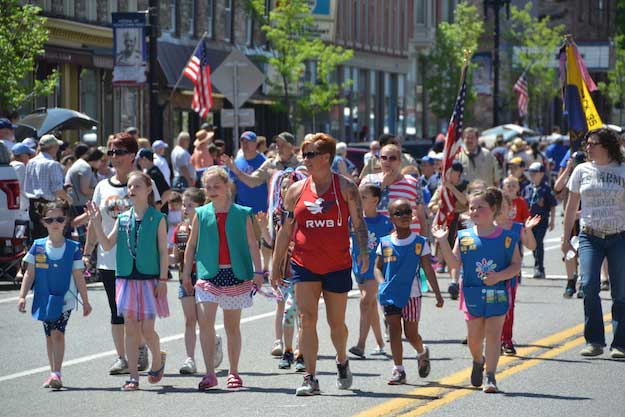
MEDINA — The American Legion and VFW in the Village of Medina, with consultation from village officials, announce that the Memorial Day parade and remembrance ceremony scheduled for May 25th at State Street Park has been cancelled due to Covid-19.
The Honor Guard in the veterans’ groups will meet at 8 a.m. at the VFW to tour the village for a rifle salute at all the cemeteries for their fallen brothers and sisters who gave their lives for the United States of America.
They also ask that on May 25th everyone take time from their day to remember those who paid the ultimate sacrifice defending our country.
WASHINGTON, D.C. – U.S. Senator Kirsten Gillibrand on Tuesday called on Congress to strengthen the United States Postal Service, re-establish postal banking to provide financial security to millions of Americans, and reinvigorate voting rights.
Gillibrand argued that legislation like her Postal Banking Act is desperately needed to protect the Postal Service as it faces renewed attacks from the Trump administration, which is unwilling to provide emergency funding during the coronavirus pandemic. The Postal Banking Act would not only establish essential banking services to low-income and rural communities, but it would create approximately $9 billion in revenue for the Postal Service and safeguard democracy by ensuring Americans across the country have access to vote by mail.
“The Postal Service is an American institution that serves families in every corner of our country and it’s shameful, though not surprising, that the president is willing to let it go bankrupt in favor of privatization,” said Senator Gillibrand. “The Postal Service is in desperate need of reinforcement, and providing postal banking for the nearly 10 million American households who lack access to basic banking services is the first step. The Postal Banking Act would not only revitalize the agency, but it would also strengthen our voting rights. This would make a huge difference for families throughout New York, and I will keep fighting as hard as I can to get this important legislation passed into law.”
Facing decreasing revenue caused by the coronavirus pandemic and burdened by misguided federal policy that requires the agency to pre-fund its pension and health care obligations 75 years in advance, the viability of the United States Postal Service has become extremely threatened. The Postal Service employs 600,000 workers, including nearly 100,000 vets, and millions of Americans depend on it to deliver their paychecks, prescriptions, and their votes. Yet, the Trump administration has refused to consider emergency funding for the agency in coronavirus relief legislation, instead pushing the agency to raise prices and burden consumers, small businesses, and rural communities who rely on its convenient and affordable services.
The Postal Banking Act would strengthen the Postal Service by establishing a nonprofit bank offering low-cost checking and savings accounts, ATMs, mobile banking, and low-interest loans. According to a report from the USPS Inspector General, this proposal would create $9 billion in revenue for the Postal Service each year.
Postal banking would also help the millions of Americans who have been economically devastated by the coronavirus pandemic. Predatory financial services such as prepaid debit cards, rent-to-own stores, and overdraft fees often exploit the most vulnerable populations – including low income households, rural communities, veterans and families of active duty personnel – especially in times of economic crisis. Instead of turning to these predatory services, postal banking would enable struggling families to gain access to traditional basic banking services and safe financial alternatives.
Additionally, as Election Day approaches and public health experts warn that social distancing measures will be needed for the foreseeable future, the Postal Banking Act would safeguard American democracy by ensuring everyone has access to vote by mail. By funding the Postal Service, the legislation will help maintain the more than 30,000 locations across the country that serve voters in every community. While states bolster absentee ballot systems to address the current crisis, the Postal Service would act as the engine for American democracy by allowing voters to conveniently and securely cast their ballots.
By Tom Rivers, Editor Posted 29 April 2020 at 10:11 am
‘We’re all in unchartered waters. Whether you’re a small mom-and-pop business or a major corporation or a bank, we’re all feeling this pain.’ – Robert Duffy
Provided photo: Robert J. Duffy
ROCHESTER – Robert Duffy, the former lieutenant governor who now is president and CEO of Greater Rochester Chamber of Commerce, has a new mission from Gov. Andrew Cuomo.
Duffy has been tasked to lead the reopening plan for the nine-county Finger Lakes region, which includes Orleans County.
Duffy, a former Rochester mayor and police chief, was lieutenant governor in the Cuomo administration from January 2011 to December 2014.
Duffy last week was appointed as special advisor to lead the reopening plan for the Finger Lakes region. In a video conference call with reporters on Tuesday, Duffy said he has had a series of meetings with health and economic development officials in the nine counties.
Gov. Andrew Cuomo announced manufacturing and construction industries will be the first businesses to reopen after the state comes off “pause.” The governor has closed many non-essential businesses until May 15 while the state is on pause to reduce the spread of Covid-19.
Duffy said he is gathering information and listening to health and business experts. There won’t be a big committee or task force formed for the Finger Lakes reopening plan.
“If you don’t want something done have a committee,” he told reporters.
Duffy will give the governor a recommendation on the reopening plan, but ultimately, Duffy said, Cuomo will make the decision on which businesses open first and under what kind of restrictions.
Duffy is hearing loud and clear from businesses.
“People are frustrated who own businesses,” Duffy said. “They want to reopen but they want to reopen safely.”
He cited polls that the public overwhelmingly supports restrictions with social distancing, wearing masks and taking precautions from the coronavirus.
The state and local governments also are feeling the pressure with businesses closed from a revenue standpoint.
“Every day a business is closed there is no sales tax going to the state or county,” Duffy said. “There is a constant loss of revenue for everybody. We’re looking forward to getting to the point where we can reopen safely.”
All of the nine counties in the Finger Lakes region, including the small rural counties, will be heard from Duffy and his team. “We are going county by county,” he said.
Duffy said the economic pain from the shutdowns is widespread. More than 1 million New Yorkers have filed unemployment claims. The state is facing a budget hole of $13 billion.
“We’re all in unchartered waters,” Duffy said. “Whether you’re a small mom-and-pop business or a major corporation or a bank, we’re all feeling this pain.”
Duffy urged business owners to develop a plan for reopening, and not wait until there is an announcement from the state on which businesses can again serve the public.
The plan should include protections for employees and the customers, with utilizing masks or facial coverings, sanitizer and social distancing. The plan should also include people working off site as much as possible to reduce the density in a workplace.
“Business as usual won’t be order of the day,” Duffy said. “This is a great lesson for all of us. It’s not about coming back the same. We should reimagine the future.”
SPENCERPORT — Douglas J. Taylor, 31, of Medina is in Monroe County Jail after being charged with second-degree robbery and second-degree assault.
Monroe County Sheriff’s deputies responded to the Byrne Dairy on Brockport-Spencerport Road on Friday at 4:56 p.m. for a reported assault and theft of a vehicle.
While deputies were responding, another call to 911 reported a motor vehicle accident had occurred in front of the Byrne Dairy.
During this investigation, it was determined that the suspect in the assault/robbery from the Byrne Dairy was also the driver of the vehicle involved in a motor vehicle accident on Brockport-Spencerport Road. The suspect exited the vehicle (which was later reported stolen out of Medina) and proceeded to the Byrne Dairy parking lot. The suspect then entered the victim’s vehicle and drove away while dragging the victim a short distance. The victim sustained physical injuries as a result of the incident.
A short time later, Rochester Police located the stolen vehicle in the City of Rochester after it was involved in a crash. The suspect fled the scene and a K9 track was unsuccessful. The investigation into the incident continued through the weekend. Information was developed as to whom the suspect was and with the assistance to the Rochester Police Department, the suspect was located and taken into custody on Sunday.
The Monroe County Sheriff’s Office Major Crimes Unit investigators arrested and charged Taylor with second-degree robbery and second-degree assault. He was arraigned and remanded to the Monroe County Jail in lieu of $20,000 cash, $40,000 bond or $60,000 secured bond.
The Monroe County Sheriff’s Office would like to thank our partner agencies and members of the community who assisted in bringing this investigation to a successful conclusion.
By Tom Rivers, Editor Posted 28 April 2020 at 9:40 pm
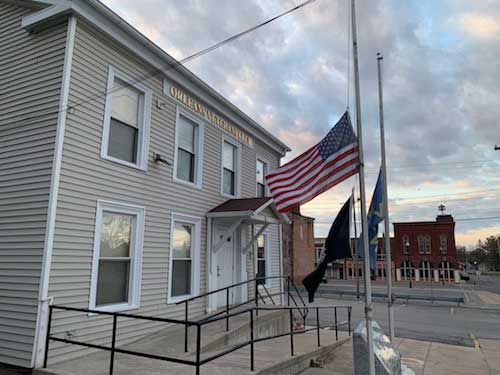
Photo by Tom Rivers: The flag is lowered at the Orleans Veterans’ Club on Platt Street in Albion this evening out of respect for people who have died from Covid-19. Gov. Andrew Cuomo reported today that 335 people died from Covid-19 on Monday, bringing the death toll from the virus in the state to 17,638.
The United States passed 1 million known cases of coronavirus today. The first case was confirmed on Jan. 20 in Washington State.
The coronavirus cases have now spread across the country in three months, including 295,106 confirmed cases in New York State with 86 in Orleans County.
The Covid-19 pandemic has shut down much of the country. In Orleans County, the five school districts are in their seventh week with their buildings closed to the public.
Nearly 2,500 people in Orleans County have filed for unemployment in the past five weeks, since the state closed many non-essential businesses.
Experts believe the number of people who have contracted the virus is much higher. There has been a shortage of testing around the country. Many people also contract the virus and don’t realize it because they don’t show symptoms.
The United States has also suffered 58,917 deaths from Covid-19, surpassing the number of Americans killed in the Vietnam War over 12 years.
There have also been 118,000 people who have recovered from Covid-19 in the United States.
Of the 1 million cases in the United States, New York by far leads the other states with 295,106 cases of Covid-19 followed by New Jersey with 113,856, Massachusetts with 56,462, Illinois with 45,883, California with 43,464, and Pennsylvania with 42,050.
Photo by Tom Rivers: Waves crash on the shore in the Town of Yates in this photo from April 9 on Fisher Lane.
The International Joint Commission sees Lake Ontario water levels peaking well below the record highs of 2017 and 2019, when there was widespread flooding damage.
The water levels are currently well above average, but conditions are expected to improve with more moderate weather. The IJC’s International Lake Ontario-St. Lawrence River Board also has increased Lake Ontario outflows and help the system recover faster following extreme water level periods, the bi-national commission said ina news release today.
Besides increased outflows, beyond those previously perceived as feasible, there has been help from Mother Nature too, the IJC said.
“It’s worth reiterating that no regulation plan can be designed to address every imaginable and sustained extreme weather event and provide total protection for all water uses throughout the system at all times,” the IJC said. “While the Board is encouraged by current and projected water levels, the Board can’t predict what the weather will bring and encourage shoreline communities to not let their guards down.”
A key factor contributing to lower water levels is that the Ottawa River system has reached a peak earlier than in 2017 and 2019, and its current flow is much lower, the IJC said.
The Board has been able to continue increasing Lake Ontario outflows partly because the Ottawa River has been declining and conditions downstream can now handle additional flow.
These conditions have allowed levels on Lake Ontario to see a much more moderate rise this spring, despite extremely high and sustained inflows from Lake Erie.
All four of the upper Great Lakes are at or above record levels, whereas Lake Ontario is well above average, but still well below record levels.
By Tom Rivers, Editor Posted 28 April 2020 at 4:18 pm
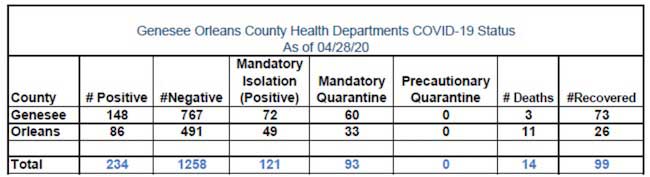
Orleans has 5 more confirmed cases of coronavirus, bringing total to 86
Two more people have died from Covid-19 at The Villages of Orleans Health and Rehabilitation Facility in Albion, the Genesee and Orleans County Health Departments reported this afternoon.
There are now 11 deaths at the nursing home in Albion from Covid-19. There are also two more confirmed cases of coronavirus at the facility, bringing the total to 44 confirmed cases at The Villages.
“Our sincere condolences to the family and friends of these individuals during this difficult time,” the Health Departments said in a statement this afternoon.
There are five more confirmed cases reported today in the county, including the two at the Villages. That brings the county’s total to 86 confirmed cases. Those cases include 26 people who have recovered after having Covid-19. Six people are currently hospitalized with Covid-19.
Of the five new cases reported today, one person lives in Barre, one in Murray, and three in Albion with two of the Albion cases at The Villages.
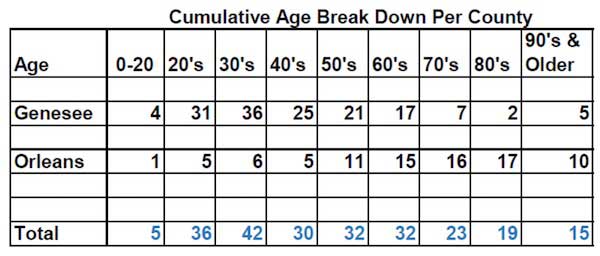
One individual is in the 20s, two are in their 30s, one is in the 50s, and one is in the 90s.
In Genesee County, there are two new positive cases for 148 total. One of the new positives lives in Batavia and the other resides in the Town of Alabama. One is in the 30s and the other is in the 70s.
One of the newly positive individuals was on quarantine prior to becoming symptomatic.
One of the previous positive cases also has recovered and has been released from mandatory isolation. That brings the total recoveries in Genesee County to 73, the Health Departments reported.
Genesee has three people currently hospitalized from Covid-19.
Click here to view the Genesee and Orleans County online map of confirmed cases.
POINT BREEZE – Bob Chaplin sent in this photo he took this morning at 6:15 of the sun coming up at Point Breeze with the Oak Orchard Lighthouse and the Oak Orchard Harbor.
The photo was taken at Oak Orchard on the Lake.
The forecast the next few days includes a high near 70 on Wednesday, with a chance of showers before 2 p.m.
Thursday will be cloudy with a high near 62, followed by a chance of showers on Friday with a high near 55.
‘We have to be smart about this – emotions can’t drive our re-opening process – and we’ve come up with factual data points that each region must monitor as they begin to re-open.’ – Gov. Cuomo
Press Release, Gov. Andrew Cuomo
Amid the ongoing COVID-19 pandemic, Governor Andrew M. Cuomo today outlined additional guidelines for the phased plan to re-open New York on a regional basis. Each region of the state – Capital Region, Central New York, Finger Lakes, Mid-Hudson Valley, Mohawk Valley, New York City, North Country, Long Island, Southern Tier and Western New York – must follow these guidelines as part of the re-opening plan.
CDC Guidelines: Based on CDC recommendations, once a region experiences a 14-day decline in the hospitalization rate they may begin a phased re-opening.
Industries: Businesses in each region will re-open in phases. Phase one will include opening construction and manufacturing functions with low risk. Phase two will open certain industries based on priority and risk level. Businesses considered “more essential” with inherent low risks of infection in the workplace and to customers will be prioritized, followed by other businesses considered “less essential” or those that present a higher risk of infection spread. Regions must not open attractions or businesses that would draw a large number of visitors from outside the local area.
Business Precautions: Each business and industry must have a plan to protect employees and consumers, make the physical work space safer and implement processes that lower risk of infection in the business.
Building Health Care Capacity: To maintain the phased re-opening plan, each region must have at least 30 percent of hospital beds and ICU beds available after elective surgeries resume.
Testing Regimen: Regions must implement a testing regimen that prioritizes symptomatic persons and individuals who came into contact with a known COVID-positive person, and conducts frequent tests of frontline and essential workers. Regions must maintain an appropriate number of testing sites to accommodate its population and must fully advertise where and how people can get tested. The region must also use the collected data to track and trace the spread of the virus.
Tracing System: There must be at least 30 contact tracers for every 100,000 people. The region must also monitor the regional infection rate throughout the re-opening plan.
Isolation Facilities: Regions must present plans to have rooms available for people who test positive for COVID-19 and who cannot self-isolate.
Regional Coordination: Regions must coordinate the re-opening of schools, transportation systems, testing and tracing with other surrounding regions.
Re-imagining Tele-Medicine
Re-imagining Tele-Education
Regional Control Rooms: Each region must appoint an oversight institution as its control room to monitor regional indicators during the phased re-opening, including hospital capacity, rate of infection, PPE burn rate and businesses.
Protect and Respect Essential Workers: Regions must continue to ensure protections are in place for essential workers.
Governor Cuomo also announced the creation of the New York Forward Re-Opening Advisory Board to help guide the state’s re-opening strategy. The advisory board will be chaired by Former Secretaries to the Governor Steve Cohen and Bill Mulrow and includes over 100 business, community and civic leaders from industries across the state. A list of the members of the advisory board is available by clicking here.
“We’ve come up with a phased plan to re-open New York so every region in the state has the same opening template as we begin this process,” Governor Cuomo said. “We have to be smart about this – emotions can’t drive our re-opening process – and we’ve come up with factual data points that each region must monitor as they begin to re-open. We’ve also created a New York Forward Re-Opening Advisory Board made up of business, academic, community and civic leaders from across the state to help guide this process and ensure businesses are following the necessary guidelines to preserve public health as we work towards a new normal.”
Finally, the Governor confirmed 3,110 additional cases of novel coronavirus, bringing the statewide total to 295,106 confirmed cases in New York State.
By Tom Rivers, Editor Posted 28 April 2020 at 12:49 pm
MEDINA — The Medina Village Board approved a $5,925,742 budget on Monday which will increase the tax rate by 13 cents, from $18.32 to $18.45, per $1,000 of assessed value.
The budget increases the tax levy, what the village collects in taxes, by 1.9 percent or by $58,865, from $3,138,194 to $3,197,059. That increase is under the state imposed tax cap, village officials said during a public hearing on Monday.
The budget decreases spending by $16,068, from $5,941,810 to $5,95,742. Although spending is down, the taxes are up because they village is estimating its revenues will be down nearly $80,000, from $2,578,616 to $2,498,683.
Mayor Mike Sidari and the Village Board are concerned the revenues could decline even more, with the uncertainty about local sales tax revenue and reimbursements from the state.
The village’s tax base grew nearly $2 million, from $171,265,416 to $173,229,062.
In other action during Monday’s Village Board meeting:
• The board established a permit fee for electric charging stations. Those fees will be $25 for a residential charging station and $50 for a commercial site.
Burger King has applied to have a charging station. It will need to pay a one-time $50 fee to have the application processed.
• The village is holding off a decision on the summer parks and swimming program. A committee with representatives from the Village of Medina, and towns of Shelby and Ridgeway will discuss the programs as summer gets closer. Mayor Sidari said he is waiting to see what Gov. Cuomo’s directives will be following the May 15 “Pause” for schools and non-essential businesses. The governor has said he is looking to reopen some businesses and activities incrementally, with some parts of the state opening before others where the Covid-19 cases are more widespread.
The Geneses-Orleans Youth Bureau has $2,000 to support the parks and swimming program in Medina. If the program doesn’t happen this summer, the village will have to return the money to the Youth Bureau.
• The Medina Department of Public Works will soon be returning to full strength. The village has been alternating four full-time workers each week. The DPW had been at 50 percent capacity to meet a guideline from the governor.
But work is piling up in the village with parks to maintain, tree work, street repair and other projects. The employees can work in different crews so they aren’t all together on different assignments.
• The village accepted $2,500 from the Town of Shelby towards a new skate park at Butts Park, a village-owned park.
The Medina Skate Society requested the $2,500 from Shelby as part of a local contribution that will be matched. The village is also contributing $2,500 towards new equipment and skate park upgrades.
Medina has been awarded up to $250,000 from the Tony Hawk & Ralph C. Wilson Jr. Foundations with a challenge to match that figure. The money from Tony Hawk & Ralph C. Wilson Jr. Foundations ultimately will be whatever the local community raises. The local funds are over $200,000 so far.
• The board approved spending $18,761 with Hartway Motors for a 2018 Chevy Equinox for the Medina Fire Department. It will replace a Dodge Durango.
• The board accepted Donato Rosario as a permanent career firefighter. He had been a probationary firefighter the past 78 weeks. Fire Chief Matt Jackson said Rosario “goes above and beyond” as a firefighter, and brings positive attitude to the job.
• Named firefighter Adam Fisher as Medina’s municipal training officer, effective June 1.
• The board announced it is working to renew a longer-term lease with the Senior Citizens of Western Orleans. That group uses the former railroad depot on West Avenue, paying $100 a month. The village also provides $1,800 a year to the group for programming.
The Senior Citizens of Western Orleans help with some of the maintenance on the building. The group, for example, is having the building repainted.
A 10-year lease was last signed in 2004 and has been renewed annually since then.
Village officials and the Senior Citizens leadership will meet soon to establish the responsibilities for both the Senior Citizens and the village, as well as the financial obligations of each.



















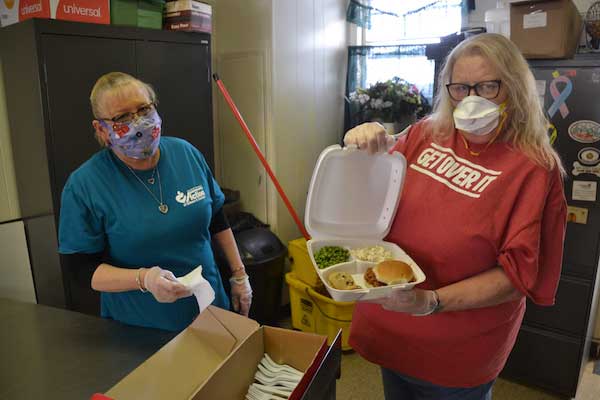
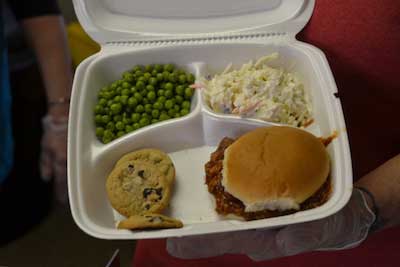 Debbie Rothmund and Rachel Escobar pride themselves on preparing quality meals for the residents. This meal included pulled pork, peas, cole slaw and chocolate chip cookies.