By Tom Rivers, Editor Posted 22 March 2019 at 5:37 pm
ALBION – The Orleans County Legislature next week will name John Papponetti the county highway superintendent, according to the agenda for the meeting on Wednesday.
John Papponetti
Papponetti, a former Albion resident, works as an engineer for Labella and Associates. He will also serve as the county’s engineer.
He is to be appointed during the Legislature’s 4:30 p.m. meeting on March 27. He will succeed Jerry Gray, who retired as highway superintendent on Dec. 30.
Papponetti grew up in Albion and served on the Village Board when he was in his 20s. His father Harry is the Albion fire chief.
Papponetti has worked closely with the County Highway Department in recent years doing an inventory of the conditions of county bridges and culverts. He also worked with the department last year when it poured the concrete slabs and constructed a culvert on Culvert Road in Ridgeway. That was the first time the highway department did that kind of project by itself. It reduced the construction costs by an estimated $180,000.
“Orleans County is proud to announce an important new addition to our staff,” said Lynne Johnson, the County Legislature chairwoman. “John Papponetti has been an instrumental team member as a consultant and now joining our team as a Department director.”
Peter Houseknecht, the deputy highway superintendent, has been acting superintendent since Gray retired. Houseknecht joined the county after serving as the superintendent of the Village of Medina DPW. Johnson said Papponetti and Houseknecht will be a great team leading the department.
In 2014, Papponetti was honored by the Rochester Engineering Society as the “Young Engineer of the Year.” He has worked the past 15 years with Labella and Associates. He is the past president of the Association for Bridge Construction and Design, Western New York chapter.
Papponetti will receive an additional $20,500 stipend to serve as the county engineer. Having him on staff will save the county an estimated $70,000 in engineering expenses, said Chuck Nesbitt, the county’s chief administrative officer.
“Our goal is to be the best run small county in New York State and I think we will take another big step in that direction with the addition of John Papponetti,” Nesbitt said. “We are really excited about our management team going forward.”
By Tom Rivers, Editor Posted 19 March 2019 at 9:12 pm
HOLLEY – The Orleans County Health Department wants to facilitate TeleMedicine for local school districts, where sick students and possibly even staff could have access to a doctor or nurse practitioner. They would diagnose a health problem and prescribe medication. The diagnosis likely would be sent to a child’s primary care doctor.
Frontier Middle School in Hamburg is the first school in the state to offer the program. Frontier started working with Mobile Health Partners in October. Now, Orleans County health officials want to bring the program to local school districts.
“We’re pretty excited,” said Paul Pettit, the county’s Public Health director. “We’ll be one of the first places in the state to try it.”
Pettit said the county’s access to primary care physicians is one of the worst ratios in the state. In Orleans it’s one primary care doctor for every 13,780 residents. That compares to the state average of 1 primary care doctor for every 1,200 people, and a national average of 1 to 1,326 people.
“We want to improve access to care,” Pettit said. “Right now we have one of the worst accesses to health providers.”
Many parents struggle to get students to doctor’s appointments due to work commitments or transportation issues, he said.
With TeleMedicine, students would go the nurse’s office, where the nurse would check pulse and blood pressure. The nurse would direct a robot that can “see” in ears and in throats. Those images could be seen offsite by a doctor, nurse practitioner or nurse’s assistant.
Holley schools officials discussed the program during the Board of Education meeting on Monday. The district likes the idea. The access to health professionals could help prevent illnesses or limit sicknesses to the early stages. That would improve attendance.
“Ultimately our goal would be to have them not be so ill so they can be in school and learning,” Brian Bartalo, the Holley superintendent, told the Board of Education on Monday.
The program would be grant funded for the start-up costs and the first year, with the services also being billed to insurance companies or Medicaid, Pettit said.
Bartalo said parent permissions would be needed for any student to participate in the program.
Pettit said the permissions or parent consent forms could be sent out during the beginning of next school year.
The Health Department has already met with Holley school leaders about the program, and will be having a meeting with officials from all five school districts in the county. The company and the robot would be available for demonstrations to show schools how it works.
Pettit would like to have the program start in Orleans this fall.
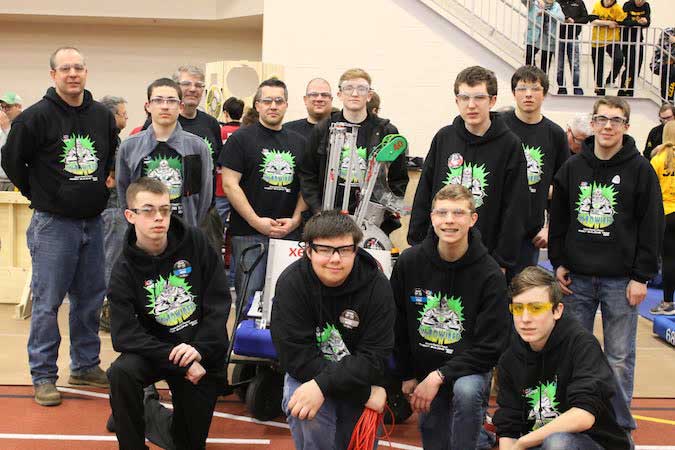
Photos courtesy of Erik Seielstad: The 4-H robotics team includes, front row, from left: Lance Moyer of Albion, Dan Squire Jr. of Medina, Jace Conn of Albion and Zach Neal of Albion. Second row: Jody Neal (mentor), Jacob Draper of Medina, Erik Seielstad (mentor), Jason Foote (mentor), Eric Conn (mentor), Isaac Becker of Lyndonville, Jayden Neal of Albion, Jack Finley of Albion and Jacob Foote of Albion.
By Tom Rivers, Editor Posted 18 March 2019 at 11:10 am
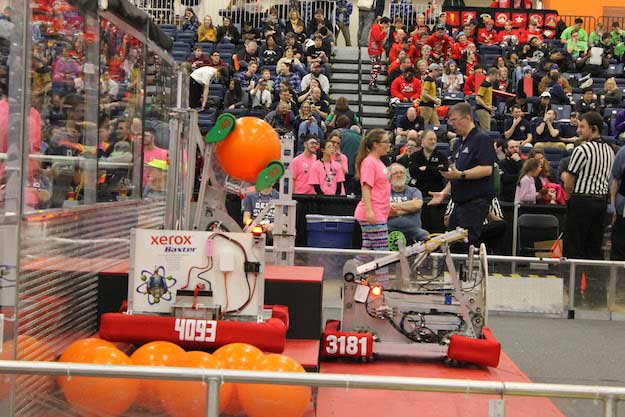
ROCHESTER – The 4-H robotics team competed on Friday and Saturday with 50 teams in the Finger Lakes Regional competition at Rochester Institute of Technology. The Orleans County team finished with a 5-5 record and was ranked 26th overall. The team was 13th for its offensive points.
The five wins is the most since the team started competing in 2012, and the 13th ranking in offense also set a new record for the team.
Jody Neal, one of the mentors/coaches, said the team is pleased with the results.
“The kids are fired up and they want to do it year-round,” Neal said today.
The Orleans team nearly made it to the final round. It was a backup if one of the teams had to bow out.
Some members of the 4-H robotics team get their robot ready for competition on Saturday at Rochester Institute of Technology. From left include Jayden Neal, Jack Finley, coach/mentor Jody Neal, Lance Moyer and Jace Conn.
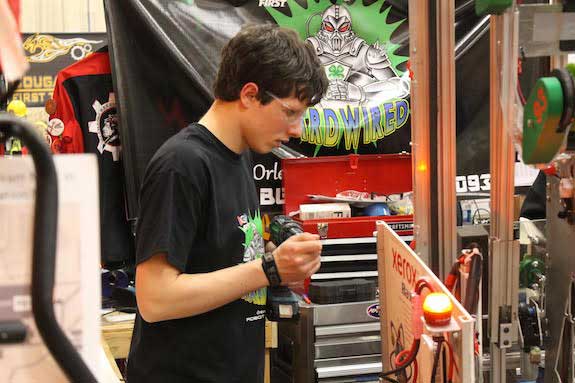
The team needed to build a robot, program it, and design attachments that could pick up balls and disks. They had to cut metal, run wires and program electronics for the robot. They did a lot of trial and error to build a robot that could accomplish the tasks. They used BCA Ag Technologies on Route 31A as a base of their operations.
This is the eighth year the 4-H’ers from Orleans County are competing in FIRST (For Inspiration and Recognition of Science and Technology). There aren’t many robotics teams from rural areas.
They started building their robot in January when they opened a box with a pile of parts. They robot was built and programmed to go to specific spots on a space about the size of a basketball court. The robot moved forward and backward, sideways and diagonally.
The robot for the Orleans County 4-H team, number 4093, picks up a ball during a match at RIT.
The teams were given about six weeks to build the robot. On Feb. 19, all of the teams have to stop work with the robot not used again until the competition.
This year the theme is “Destination Deep Space,” in honor of the 50th anniversary of the Moon landing on July 20, 1969. The course for the FIRST challenge included replicas of cargo ships and rockets, and the robots needed to complete challenges with those elements.
The Orleans team is unusual because it isn’t connected to a school district. Most of the programs are through school districts, with paid staff leading the teams. The Orleans team has members from at least three different school districts, as well as home-schooled students. The team is led by volunteers.
Jack Finley makes an adjustment on the robot during the competition at RIT.
It costs about $15,000 to run the program – to buy the robot and pay the competition entry fees. Xerox in Rochester and Baxter Healthcare in Medina have been the main sponsors for the program.
Jody Neal said the team wants to do more community demonstrations this year with the robot, and will try to expand its fundraising and sponsorships.
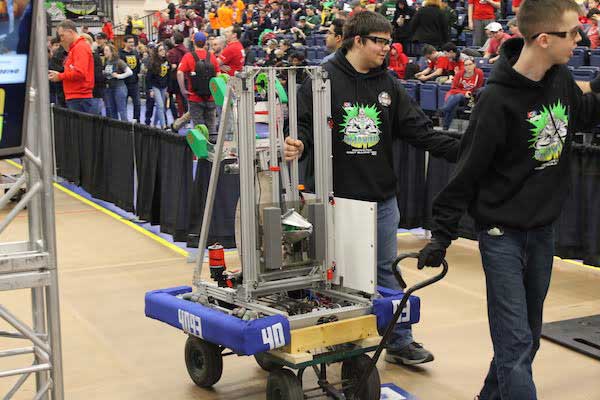
All of the teams have names, and the Orleans team is known as “Hardwired.” It competes under the number, 4093.
Lance Moyer, front, and Dan Squires lead the robot to the the next match at RIT.
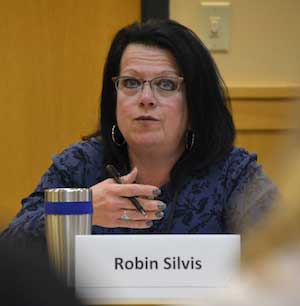
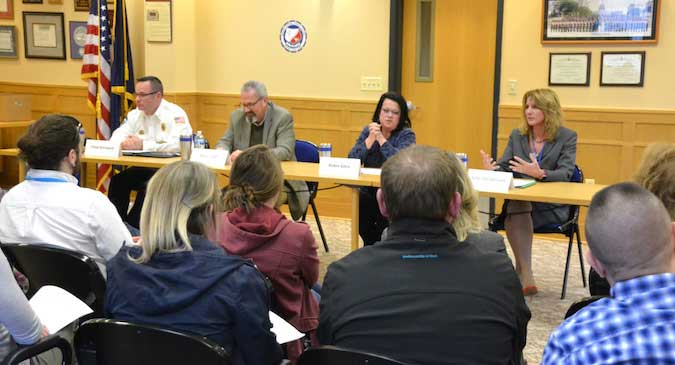
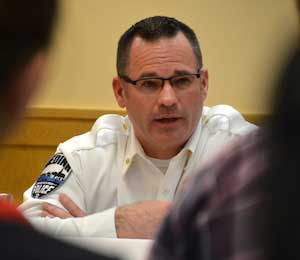
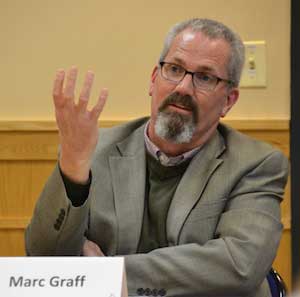
Photos by Tom Rivers: Leadership Orleans heard from four panelists who discussed public school challenges. The speakers include, from left: Chad Kenward, Medina police chief and former Medina school resource officer; Marc Graff, Medina Central School business administrator; Robin Silvis, vice president of Holley Board of Education; and Julie Christensen, Kendall school superintendent.
By Tom Rivers, Editor Posted 15 March 2019 at 5:11 pm
MEDINA – Local school district leaders say they worry about filling teaching positions, especially with many teachers retiring after this school year.
Julie Christensen, Kendall Central School Superintendent
Normally, there is a wave of new applicants but fewer college students have been pursuing the teaching profession. That has districts competing for a smaller number of teachers, especially for sciences.
“We’re having a really hard time,” Julie Christensen, Kendall Central School superintendent, said about filling some openings. “The media really did a number on the teaching profession.”
Kendall is struggling to fill all positions, including elementary teachers, bus drivers and cleaners. Christensen was among a panel of speakers on Thursday afternoon during a session for Leadership Orleans. There are 26 people in the second year of Leadership Orleans. Each month the class goes on tours and focuses on an issue or a sector of the community. This month’s focus is on education.
The panel said it is getting harder to attract teachers to the county. Teachers are in demand, and they can earn more in suburban school districts, and often don’t have to teach a range of sections of a subject. For example, in Medina a French teacher has to lead several classes at different levels of the subject. That means the teacher is preparing multiple lesson plans. In a bigger district, that teacher might only have one or two lesson plans, said Mark Kruzynski, the Medina school superintendent.
Medina expects to have 15 teaching openings to fill after this year, and that number could go up if more teachers retire.
“We’re struggling to find qualified people,” said Marc Graff, Medina school business administrator.
Medina also is seeing fewer student teachers and student observers, he told Leadership Orleans.
Christensen said Orleans County would benefit from better PR, with local officials and residents touting safe and nurturing schools with very high graduation rates.
The school leaders shared their opinions about challenges facing school districts.
Chad Kenward, Medina Police Chief
Christensen said social media has some downsides. Inaccurate information often quickly spreads in the community. Social media also is a conduit for bullying and sexting among students, she said.
Chad Kenward, the Medina police chief, worked for eight years as the school resource officer in Medina. He said school safety remains a priority. He is grateful the school district has continued a partnership with the police department, welcoming an officer into the district as a resource officer. Corey Ambrose is the current school resource officer.
“These days the school resource officer is the first line of defense,” Kenward said. “We are talking to kids every day. We are liaison between the police department the school.”
Kenward would connect with students by participating in gym class, helping coach modified basketball and being an active volunteer with the marching band.
He also taught students about bullying and discussed the role of law enforcement with drug seizures.
Kenward said the role allows the police to build relationships with students in a nonconfrontational way. Kenward said the officer makes the district safer and prevents problems, although that is difficult to quantify.
Graff, the school’s business administrator, said the officer “is worth every cent.” Medina pays the village about $60,000 to have an officer work full-time out of the district during the school year. During the summer, the officer returns to the police department for road patrol.
“Just the fact there’s a (police) car parked out front” is a deterrent, Graff said.
Albion, Kendall and Lyndonville also are paying for school resource officers, and Holley hires COPS security, a private security firm.
Graff said the school districts are feeling the financial pressure. Because they are low-wealth districts in Orleans County, they are very dependent on state aid for their budgets. That amount can vary. Graff said the state hasn’t been providing what districts are due through the Foundation Aid formula.
Districts are preparing their budgets now. They will likely be adopted by the boards of education in April and go before voters on May 21. However, districts still aren’t sure what their state aid will be because the state budget hasn’t been adopted, Graff said.
The state and school districts aren’t on the same fiscal years.
“We’re guessing on revenue,” Graff said. “We’re building a budget on guesswork until we truly know what we’re getting.”
Districts also now contend with the tax cap, which is advertised as a 2 percent cap but can vary based on many factors. Sometimes the tax cap is barely above 0 percent. In 2019-20, Medina has a cap of about 4 percent.
The state implemented the cap in 2012. Since then, the number of voters for school budgets has dropped significantly in WNY because residents feel assured the tax increases will be minimal. Graff presented data that showed the number of voters in 2012 for school district budgets in WNY was 72,379. That was down to 46,302 in 2018.
Robin Silvis, vice president of Holley Board of Education
Robin Silvis, vice president of the Board of Education for Holley, said there is apathy among many community members. They don’t tend to vote or attend meetings. She does, however, hear people’s concerns about the school when she is at the grocery store.
Silvis said the board of education sets policy for the district, without micromanaging. If people complain about a teacher or perhaps other issues at school, Silvis directs them to take those concerns to the building principal.
“You have to go through the proper channels,” she said.
She has been on the board the past 10 years. She is proud of Holley’s transformed school campus and push for academic excellence.
“On the school board I promote communication and awareness,” she said. “The biggest challenge is the budget and that hasn’t got any easier in the past 10 years.”
In addition to the panel discussion about challenges in public education locally, Leadership Orleans toured Medina’s school campus, which is undergoing a $34 million capital project.
The day started at GCC’s campus center in Medina where there was a panel discussion about alternatives and supports to public education. Speakers included Danielle Douglas, adolescent outreach program coordinator for the Brockport Migrant Education Program; Melinda Grimble, continuing education instructor for the Orleans-Niagara BOCES; and Cynthia Blosenhauer, program director for the Orleans County Adult Literary Services.
Leadership Orleans also toured and met with students at the Iroquois Job Corps in Shelby, and also toured the Orleans-Niagara Education Center in Medina, where BOCES offers career and technical programs.
By Tom Rivers, Editor Posted 8 March 2019 at 11:12 am
Editor’s Note: This article has been updated with solid numbers for the three municipalities. The original dollar amounts were higher, but they were amounts that were described as “not to exceed.”
ALBION – The Orleans County Legislature has approved divvying up $223,000 in funding for handicapped accessible projects at Bullard Park in Albion, a pedestrian bridge in Medina and a portion of a waterline in Holley.
The money comes from a revolving-loan fund that was administered by the Orleans Economic Development Agency. The state is requiring those funds be ended with the money staying in the community for projects if they are for handicapped accessible initiatives or if they assist a neighborhood that is predominantly low-income.
The County Legislature had a public hearing on Thursday for the projects in Albion and Holley. The Legislature agreed to have $97,500 go towards Bullard Park in Albion.
That money comes at a perfect time for the village, said Deputy Mayor Gary Katsanis. The village will do a lot of work this year at the park, with a new amphitheater, utility building, splash pad and other improvements.
The village in December 2016 was awarded a $499,605 state grant for Bullard upgrades with the village providing $166,370 with in kind-services or funding.
“We’ve been trying for years to upgrade the park,” Katsanis said during Thursday’s public hearing. “This funding and this kind of support couldn’t have hit us at a better time.”
The $111,500 won’t count towards the village’s local share in the project. It will go towards handicapped accessibility projects.
“We can now carry this through in a way that we wouldn’t otherwise have been able to do,” he told county legislators.
In Holley, the Legislature approved $28,000 towards a new waterline on Thomas Street.
Jim Whipple, the Orleans EDA executive director, praised village officials, including code enforcement officer Ron Vendetti, for getting the paperwork together so Holley was eligible for the funding.
The Legislature last week approved $97,500 to Medina for a new pedestrian bridge over Oak Orchard Creek on Route 31A. The revolving-loan fund also included $55,000 from the Village of Medina for the bridge and $130,000 from the Town of Shelby for the project.
The communities all had economic development projects with the revolving-loan fund. The money can only go to municipalities where businesses used the fund.
The section of Maple Ridge by the creek has become busier with a housing development, several new businesses and also the GCC campus center.
The pedestrian bridge and sidewalks on Maple Ridge have been sought by the village for several years but Medina didn’t receive grants for the project.
Mayor Mike Sidari has said area by the creek is narrow and seems to funnel pedestrians close to the road. It has been identified as a safety concern for several years.
The county decided to equally split $97,500 to the villages of Albion and Medina, which are nearly the same population with about 6,000 residents each. Holley got less than a third of what those two villages are getting. Holley has about 1,800 residents, less a third of the population in Albion and Medina.
By Tom Rivers, Editor Posted 7 March 2019 at 11:53 am
‘The opioid nightmare has touched everybody.’ – Undersheriff Chris Bourke
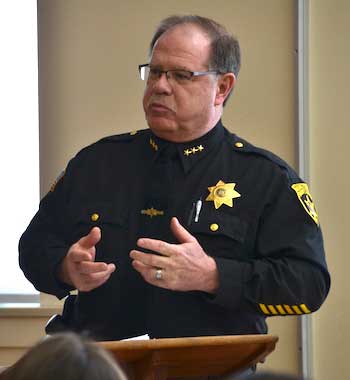
Photos by Tom Rivers: Undersheriff Chris Bourke said drug addiction fuels other crime in the county.
ALBION – The number of overdoses and drug fatalities increased in Orleans County last year, compared to 2017, Undersheriff Chris Bourke told the Orleans United Drug Free Communities Coalition on Wednesday.
“The opioid nightmare has touched everybody,” he said.
In 2017, there were 52 overdoses and 7 deaths in the county from overdoses. That increased to 69 overdoses and 12 fatalities in 2018, with an additional death pending, Bourke said.
He supports the added programs in the county jail and community to help people fighting addictions. Many of the crimes in the county, including burglaries, are often fueled by people in the grip of addiction.
The opioid epidemic isn’t a problem the county can solve only through arrests, Bourke said.
Bourke was joined by Scott Wilson, the county jail superintendent, in addressing the Orleans United Drug Free Communities Coalition.
The said the drug take-back program has been a success, removing 6,880 pounds of prescription medication and sharps since 2012. There is a drop-off box at the Orleans County Public Safety Building during regular business hours. The Albion, Holley and Medina police departments also have drug drop-off boxes.
The box at the Public Safety Building gets about 30-40 pounds a week of medicine that people want out of their homes, said Michael Mele, chief deputy for the Sheriff’s Office.
The Public Safety Building and the Medina and Holley fire departments also will be part of the drug take-back day on April 27 from 10 a.m. to 2 p.m. Those sites will be staffed on April 27 during the event.
Unused prescriptions can be dropped off. The pills and their containers are then packaged and incinerated.
In addition to those sites, there are drug drop-off collection boxes at Medina Memorial Hospital and Rosenkrans Pharmacy in Medina.
About 30 people attended the meeting Wednesday for the Orleans United Drug Free Communities Coalition at Hoag Library in Albion.
In other news at the Orleans United Drug Free Communities Coalition on Wednesday:
• The group reported it is working on the 5th annual National Night Out on Tuesday, Aug. 6, at Bullard Park in Albion from 5:30 to 8 p.m. Human service agencies and community organizations are welcome to participate in the event, which includes demonstrations by first responders, and family-friendly activities, including a Battle of Belts, to see which team of four can get in and out of a car the fastest while using seat belts.
• Lyndonville Central School will host Stephen Hill on April 5 from 8 to 9 a.m. in the school auditorium. He will share a prevention program about vaping and substance abuse.
• Patricia Crowley, the Coalition director, also said the organization is planning to survey students in grades 7 through 12 this fall about their use and perceptions of alcohol, tobacco, marijuana, non-prescribed medications and e-cigarettes.
The Coalition has done the survey every two years, beginning in 2005. Orleans United’s survey includes students in Holley, Kendall, Lyndonville and Medina school districts. Albion does its own survey.
By Tom Rivers, Editor Posted 7 March 2019 at 10:29 am
Photo by Tom Rivers: Scott Wilson, superintendent of the Orleans County Jail, praised the partnership with GCASA for expanded services for inmates.
ALBION – Orleans County has received a three-year grant from the state to expand services in the jail for inmates fighting addiction.
Scott Wilson, the jail superintendent, shared the news on Wednesday with the Orleans United Drug Free Communities Coalition. The “Access Matters” grant will pay for a part-time clinical social worker and a part-time peer recovery advocate.
The jail currently provides Vivitrol to some inmates who are to be released within a month. Vivitrol blocks drug cravings.
The jail will expand its Medication Assisted Treatment to include methadone, a daily dose of opioid maintenance therapy; and also Sublocade, a form of Suboxone in opioid maintenance therapy.
The Access Matters grant will fund a nurse to administer the treatments and medications on the weekends.
Wilson said the goal is to improve the chances for inmates to succeed and stay drug-free as they transition from the jail to the community. Inmates in the program will all be released within 120 days of starting the treatments.
“It’s a voluntary program,” Wilson said. “It’s not court-ordered. We want to make sure the people who want to get clean get the help that they need. We’re hoping to get them on the road to recovery.”
Genesee and Wyoming counties also received Access Matters grants. The three rural counties will meet frequently to share the program’s successes and challenges.
“We want to reduce recidivism,” Wilson said. “Because you’re seeing the same people come in time after time.”
The Orleans County Sheriff’s Office also will strive for a good handoff for the inmates being released to treatment programs through the Genesee-Orleans Council on Alcoholism and Substance Abuse, Wilson said.
The Access Matters grant also will fund transportation and childcare services for people in treatment, said Alyse Shamp, grant coordinator for GCASA.
Transportation and childcare can be barriers to treatment. If the treatment is disrupted, people are more likely to relapse, she said at Wednesday’s coalition meeting at Hoag Library.
GCASA has purchased two vans to transport people to GCASA sites in Genesee and Orleans counties, including the methadone clinic in Batavia. The grant also pays for drivers for the program.
“We want to keep their recovery on track,” Shamp said.
GCASA also has a contract with the Eagle Pride childcare program at the Albion Middle School, which is run by the YMCA. GCASA is looking to staff its own childcare site in Batavia.
If people released from the jail can stay off drugs, Wilson said that should result in less crime in the community and a smaller jail population, saving taxpayer money.
WASHINGTON, DC – U.S. Representative Chris Collins (NY-27) has led a letter calling on the U.S. Senate to finally approve President Trump’s nominees to the International Joint Commission (IJC) which oversee all waters between the United States and Canada.
Currently, the IJC is in limbo because it only has two of its six commissioners in office when a quorum of four is necessary to conduct business.
With the harsh winter and current high lake levels in the Great Lakes, concern is growing about the potential damage to the Lake Ontario shore this spring when levels are likely to be even higher if action is not taken.
“We are again seeing an increase in water levels within Lake Ontario, which is a concern for myself, local governments, homeowners, and businesses,” said Congressman Collins. “We cannot wait until our community is impacted by another flooding disaster to take action, and the IJC cannot act without these nominations moving forward in the Senate.”
Joining Collins on the letter to Senate Majority Leader Mitch McConnell, Senate Minority Leader Chuck Schumer, and leadership of the Senate Foreign Relations Committee, Chairman James E. Risch and Ranking Member Bob Menendez, were United States Senator Kevin Cramer (R-ND), Rep. John Katko (NY-24), Rep. Fred Upton (MI-6), Rep. Mike Kelly (PA-16), Rep. Pete Stauber (MN-8), and Rep. Bill Huizenga (MI-2). The letter requests an expeditious review and approval for the three of IJC Commissioner U.S. nominees as the Lake Ontario water levels are raising at a dangerously high rate.
Last year President Trump nominated Jane Corwin, a former state assemblywoman from Clarence, to serve as U.S. Chair alongside Robert C. Sisson and Lance V. Yohe as U.S. Commissioners at the IJC. These appointments expired at the end of the last Congress, but were re-nominated by the President and are awaiting passage through the Senate Foreign Relations Committee and confirmation by the Senate.
Additionally, the Canadian government is withholding their IJC appointments until the United States has filled its appointments.
“Great Lake communities, especially Lake Ontario, are now facing detrimental impacts if commissioners are not in place at the IJC to take action,” added Collins. “We cannot afford to have a repeat of 2017 when Lake Ontario reached water levels that had not been seen in decades.”
The 2017 flooding damaged homes, businesses, and infrastructure. Due to the more than a hundred miles of coastline damage, Governor Cuomo declared a state of emergency for eight counties on the Lake Ontario shore.
File photo by Tom Rivers – The entrance to Genesee Community College’s main campus is shown in in Batavia.
It’s not commonly known, but community colleges in New York State are funded through a three-way partnership: the state, the student, and county governments.
“This was intended to be an equal partnership. However, the funding formula has shifted considerably since the 1970s. Today’s students fund 43 percent of community college operations while the state picks up less than 25 percent of those costs. We are asking the state to uphold their commitment to these educational systems,” said NYS Association of Counties President Chuck Nesbitt, the Orleans County Chief Administrative Officer.
Counties have raised concerns in recent years regarding the state’s funding commitment to community colleges. The state financing mechanism, linked to the number of full-time equivalent (FTE) students on each campus, creates a roller-coaster state funding impact for students and counties. In addition, over the last decade state support has fallen far short of the rate of inflation.
This is especially concerning at a time when community colleges play a crucial role in workforce development for counties in all parts of New York State.
New funding formula proposed
To alleviate this problem and stabilize the community college system, the SUNY Chancellor is proposing a new methodology that would create a state maintenance of effort for the funding of community college campuses.
The new formula would prevent cuts in base aid and create a state funding floor for each campus. In addition, the Chancellor is calling for an increase in state funding for full time equivalent (FTE) students by $125, from $2,847 to $2,972 per student. New York’s counties support the Chancellor’s proposal, as well as the community college presidents and faculty.
“Community colleges are the key to a trained workforce throughout New York and are the greatest hope to foster social mobility for its citizens,” said Dr. Randall VanWagoner, President of Mohawk Valley Community College. “Establishing a floor in the state aid formula would provide stable and predictable funding to allow for better planning and operations as we anticipate and respond to the ever-changing needs of our community.”
“Community colleges and their students deserve a steady, reliable funding stream. County budgets don’t have capacity to take on the state’s funding responsibility,” said Stephen Acquario, NYSAC Executive Director. “We support the Chancellor’s proposal to stabilize community college financing, and we urge the state to fulfill their obligation to New York’s students.”
Editor’s note: In Orleans, the county is budgeting $1.9 million this year for the local chargeback for community colleges. That cost is up from $680,419 in 2004.
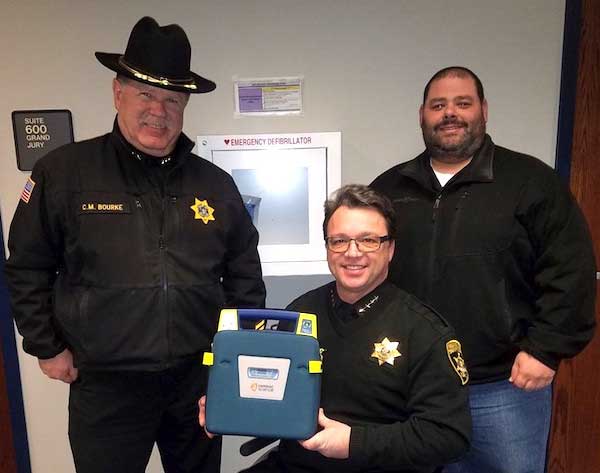
Provided photo: The Orleans County Sheriff’s Office purchased two automatic external defibrillators with a $3,000 grant from Walmart. Pictured from left include Undersheriff Chris Bourke, Sheriff Randy Bower and Kevin Ciccoline, Albion Walmart asset protection manager.
Press Release, Sheriff Randy Bower
ALBION – The Orleans County Sheriff’s Office recently received $3,000 from Albion’s Walmart Supercenter with funding awarded through Walmart Foundation Community Grant.
The grant provided funding for the purchase of two automatic external defibrillators and necessary AED supplies for public access within the community. AED’s are portable electronic devices that automatically diagnose life-threatening cardiac-related problems and treat the ailing person through defibrillation to restore effective rhythm.
The wall mounted AED’s are located in the main hallway at the Orleans County Public Safety Building and the lobby at Orleans County Animal Shelter.
We thank the Walmart Foundation and Albion’s Walmart Supercenter for their generous donation to assist in the safety of our community. In recent years, the Orleans County Sheriff’s Office received funding from the Walmart Foundation Community Grant to defray the cost for K-9 Otto’s food, supplies and vet bills.
By Tom Rivers, Editor Posted 4 March 2019 at 1:39 pm
File photo by Tom Rivers: Voters cast their ballots inside the Hoag Library in Albion on Nov. 4, 2014.
ALBION – The state has approved a number of proposals to expand voting access to boost one of the lowest voter turnout rates in the country.
The state has approved early voting, consolidated federal and state primary dates, and Ok’d voter registration transfers and same-day voter registrations.
The challenge of managing these changes will fall on the Board of Election offices at the counties, and those BOE functions are nearly entirely paid for by county taxpayers.
The Orleans County Legislature last week approved a formal resolution, asking the state to direct funds to the counties to help pay for the added expenses, which includes opening polling sites 10 days prior to any primary or general election, starting with the 2019 general election.
The same-day registration proposal would allow eligible voters to register the day of the election. However, counties would like have to purchase and use electronic polling books and make other investments in their electronic systems, county legislators said.
The County Legislature wants the governor and the State Legislature to create a task force to determine the costs associated with the voting reforms – and those expenses should be paid for by the state, according to the county resolution.
By Tom Rivers, Editor Posted 4 March 2019 at 12:17 pm
Cuomo wants to take county sales tax to cover village, town aid
ALBION – Orleans County legislators are objecting to a proposal from Gov. Andrew Cuomo to have the state share for local AIM funding to come from the sales tax on internet transactions.
The governor in his budget proposal proposed cutting $290,276 in Aid and Incentives to Municipalities in Orleans County. That includes eight towns and four villages. State-wide, the governor wanted to reduce AIM funding by $59 million.
But villages and towns strongly objected to cuts, which would happen while the villages and towns are already in their fiscal years, and weren’t given notice during their budget discussions.
The state doesn’t given much in AIM to villages and towns, and Cuomo picked towns and villages for cuts where AIM is less than 2 percent of their budgets. The towns of Murray and Albion weren’t affected in the governor’s proposal because those 2 coutn on Aim for more than 2 percent of their budgets.
After an outcry from towns and villages, Cuomo last month put the AIM funding back in the budget. However, it wouldn’t be paid for by the state. The governor wants to use sales tax from internet sales, which currently often skirt the sales tax. The tax would be taken from the counties’ local share and be directed to the AIM program.
That has prompted strong opposition from county leaders across the state. Orleans County leaders said the proposal is contrary to the state acting as a good partner with local governments, and amounts to another unfunded mandate on counties.
Counties already use a lot of their sales tax to pay for state-mandated programs, such as Medicaid, Orleans County legislators said in an official resolution.
“Requiring counties to make up for the state’s cut in AIM funding to villages and towns sets an unsustainable precedent and unnecessarily shifts the state’s burden to local taxpayers who already pay some of the highest property taxes in the nation,” the resolution states.
The Legislature said the state should fully restore the AIM cuts from state funding, not from the county sales tax.
These municipalities are slated to lose the following in AIM funding:
Villages: Albion, $38,811; Holley, $17,786; Lyndonville, $6,251; and Medina, $45,523.
By Tom Rivers, Editor Posted 28 February 2019 at 4:49 pm
ALBION – Orleans County legislators on Wednesday approved a contract for up to $393,000 to design and provide technical support for a $6 million improvement project with the county’s emergency communications system.
The Legislature hired Tim Warth from Radio Technologies in Rochester to provide project management and technical services for the design and installation of the system.
Orleans County on Nov. 28 was awarded a state grant for $5,897,141 for new 180-foot-tall radio towers in Albion, Lyndonville and Kendall, as well as technology to connect separate radio systems and new radio channels to strengthen communications between multiple jurisdictions and agencies.
The project will also add radio equipment to the Holley water tower to improve coverage in the Holley area.
The project will fund software and other upgrades for the system, which serves firefighters, law enforcement, highway employees, probation and some other municipal workers in the county.
The system currently has poor coverage in the Holley area, along Lake Ontario and some other isolated locations in the county, especially in buildings with thick walls.
The county in August submitted a grant application through the 2018 Statewide Interoperable Communications Targeted Grant through the NYS Division of Homeland Security and Emergency Services Office. The state is allowing a maximum of $6 million per county for the grants.
Warth, a consultant for the county with Radio Technologies, said in August that Orleans is one of 10 counties in the state identified as “in need.”
The project will also improve interoperability with neighboring Monroe and Niagara counties, allowing personnel to cross county boundaries and still have a radio signal.
The new tower in Albion will be at the Public Safety Building on Route 31. The site in Kendall hasn’t been determined for the new tower, county officials said. The Lyndonville tower will likely be on West Avenue.
The two new 180-foot-high towers in Lyndonville and Kendall would enhance coverage by the lake, and allow a lower strength signal so Orleans isn’t interfering with Canada’s system.
The county currently has towers in Shelby on Maple Ridge Road by the Medina water tank, on Countyhouse Road in Albion by the Emergency Management Office and on Route 31A by the Clarendon Highway garage.
When the upgrades are complete with the grant, the county may pursue another grant to add a tower in Carlton by the town highway building on Route 98.
By Tom Rivers, Editor Posted 28 February 2019 at 9:14 am
ALBION – The Orleans County Department of Social Services will soon have a registered nurse available to help families with addiction issues, including babies born as addicts.
The county has a received a $50,000 state grant to fund a part-time RN. The nurse will be based out of the Public Health Department but will accompany DSS caseworkers on home visits.
Caseworkers are seeing more families affected by substance abuse, withdrawals issues and babies with fetal alcohol spectrum disorder. Those babies have mothers who drank alcohol during pregnancy.
“Our caseworkers are finding serious drug issues right before their eyes,” Tom Kuryla, commissioner of the DSS in Orleans County, told county legislators on Wednesday. “Every other day now there’s a baby born in the hospital that is an addict.”
The caseworkers aren’t qualified to assist families with addiction issues, he said. Kuryla estimated about 25 percent of the caseloads involve families with drug issues.
Orleans and other counties have been pressing the state for help with the problem the past five years. Kuryla would like to see a longer funding commitment from the state on the issue. The $50,000 grant is for one year.
The RN will work with families to develop plans to treat the addictions, including for the babies.
The RN also can educate families on other important issues, including immunizations, lead safety and how to fight chronic health issues, said Brendan Bedard, director of community health services for the Public Health Department.
Lynne Johnson, chairwoman of the Orleans County Legislature, praised DSS and Public Health for working together on the issue.
“What a great tool for Orleans County in our tool belt against the opiate crisis,” she said.
Provided photo courtesy of Modern Disposal: Modern Disposal will be transitioning to 96-gallon garbage totes for Orleans County this year, with a goal to have them in place by July 1.
By Tom Rivers, Editor Posted 28 February 2019 at 7:52 am
ALBION – Bigger recycling carts are headed to Orleans County. The County Legislature on Wednesday approved spending $776,500 for 15,444 recycling carts.
The new carts, at $50.28 each, will hold 96 gallons. The county is leasing them from Rehrig Pacific Company of Erie, Pa.
The county will make a $400,000 down payment on the recycling carts, and will then make three annual payments of $134,720. The state is expected to pay half of the costs for the new recycling totes. Residents won’t be directly billed for the new recycling containers.
Photo by Tom Rivers: The smaller recycling bins will be replaced by much larger totes this year.
The switch to the larger carts will make it easier for Modern Disposal to pick up recycling, and should hold off increases in the costs for picking up garbage and recycling for the next few years, county officials said.
The new totes are expected to be in place by July 1. The county and Modern will have public information meetings before July to prepare residents for the change.
County Legislator Ken DeRoller, R-Kendall, said the county’s recycling rate is currently only 20 percent. That is a low number and he wants to see it go up. Part of the education effort will be encouraging residents to recycle more plastic, paper and metal materials.
Residents currently use recycling bins that are emptied weekly by Modern. The company has two employees per truck, with a driver and another employee grabbing and emptying the bins. It takes about a minute for each stop in the county.
The 96-gallon totes will have covers. Those totes can be grabbed by a mechanical arm, lifted up and emptied into the recycling truck.
Fred Miller, D-Albion, was the only legislator to oppose the agreement for the new recycling carts on Wednesday. Miller thinks the bigger size will be “cumbersome” for many residents. He wanted to look at some other options.
The change to the bigger carts will allow Modern to staff each recycling truck with one employee. The company can also speed up the collection effort, spending an every of 12 seconds per stop. The company will pick up the recycling every two weeks, instead of weekly, once the totes are in place.
“We’re saving the county substantial money,” DeRoller said about the bigger recycling totes.
Residents in 2018 paid $212 for annual garbage and recycling collection. The cost will stay about that price for the next few years with the recycling change, said Chuck Nesbitt, the county’s chief administrative officer.
Without the change, the county would have faced a 10 to 15 percent increase, he said. The County Legislature in October approved a new five-year contract with Modern for garbage and recycling collection. The annual cost is $3,001,495 with the current system of weekly recycling, but drops to $2,707,160 when the new system is fully phased in with the larger recycling totes.






















 Albion, Kendall and Lyndonville also are paying for school resource officers, and Holley hires COPS security, a private security firm.