












Gaines

Cobblestone Museum asks congressman to help with visitor’s center
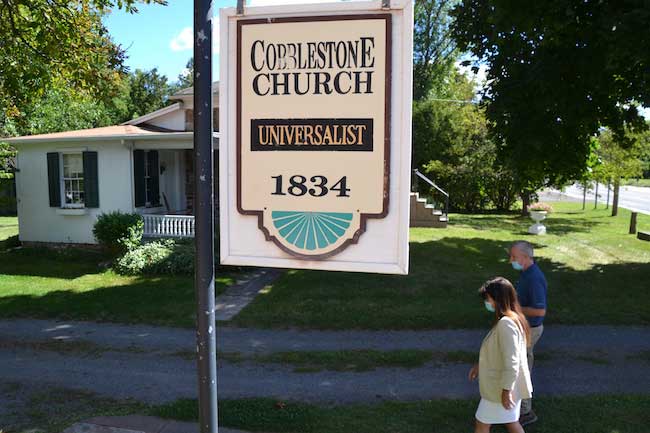
Photos by Tom Rivers: U.S. Rep. Chris Jacobs and Orleans County Legislature Chairwoman walk together on the grounds at the Cobblestone Museum on Route 104 in Gaines on Friday. Jacobs, who was sworn into office on July 21, made his first visit to the museum, which is a National Historic Landmark.

By Tom Rivers, Editor Posted 6 September 2020 at 11:07 am

GAINES – Leaders of the Cobblestone Museum met with Congressman Chris Jacobs for an hour on Friday and asked him to pursue federal assistance for a visitor’s center in the historic Childs hamlet and also to help make the area safer for pedestrians.

Jacobs, who was sworn into office on July 21, made his first visit to the museum, which is a National Historic Landmark, the top historic recognition given by the U.S. Department of the Interior.
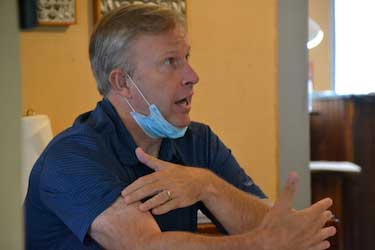
Congressman Chris Jacobs said he has experience with historic properties in Buffalo’s Theater District. He said federal tax incentives are critical for projects at historic sites.

“History is the best thing Orleans County has to sell to visitors,” Erin Anheier, the museum president, told Jacobs.

She thinks the county has many historic sites that could be promoted as part of heritage tourism. The museum could be the center of those efforts, working with other partners in the county, Anheier said.

The museum has expanded its programming, drawing more visitors and members in recent years. (The Covid-19 pandemic has limited the museum to tours by appointment in 2020, but the museum has a full calendar of activities planned for next year, said Doug Farley, the executive director.)

The museum will soon acquire the home next to the blacksmith shop at the southwest corner of routes 98 and 104. It will be decorated in a 1920s style and offers more space for exhibits, Anheier said.

The museum would like to work with other local agencies – perhaps the Orleans County Chamber of Commerce and Orleans County Tourism Department – to develop a visitors’ center in the historic Childs hamlet. The site could be used promote many attractions in the county, including sportsfishing, Farley told Jacobs.

The hamlet in October 2019 was named one of “Five to Revive” by the Western New York Landmark Society. That designation brings awareness to important sites in the region that are in need of protection and investment.
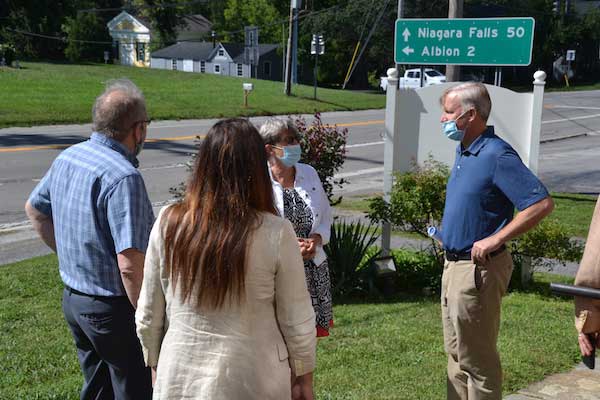
Congressman Chris Jacobs, right, hears from Cobblestone Museum President Erin Anheier about concerns over traffic and available parking near the museum on Route 104.

The hamlet is unusual in WNY, with so many cobblestone buildings and other historic sites on a busy road that is largely devoid of chain store commercialism, said Larry Francer, associate director of preservation for the Landmark Society of WNY.

She praised the museum and other Gaines residents for their work to preserve so many sites from the 1800s.

“This is great example for the rest of our region,” Francer said about the Childs hamlet.

The hamlet would benefit from sidewalks along the stretch of cobblestone buildings that are part of the museum (from the Cobblestone Universalist Church to the former one-room schoolhouse), and historic-looking street lights, said Richard Remley, the museum’s vice president.
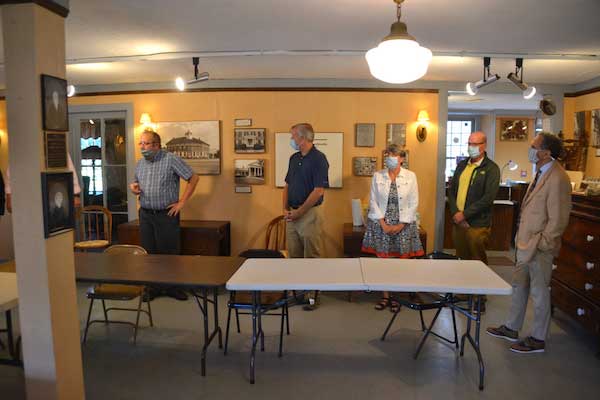
Cobblestone Museum Executive Director Doug Farley, left, speaks in the lower level of the Cobblestone Universalist Church, a building constructed in 1834. Farley said the museum maintains three important cobblestone structures, as well as other important buildings near the routes 104 and 98 intersection. Others in the photo include, U.S. Rep. Chris Jacobs, Cobblestone Museum President Erin Anheier, Cobblestone Museum VP Richard Remley and Larry Francer, associate director of preservation for the Landmark Society of WNY.

Farley said the museum needs more parking. It would like to upgrade its bathrooms for the public, and have meeting space for up to 100 people with a kitchen facility.

It could pursue a new structure for a visitor’s center, but Farley and museum leaders believe a brick house from 1834 across the street from the church offers a lot of potential as a visitor’s center. The 3,000-square-foot site is owned by Ray and Linda Burke and is for sale.

Museum leaders asked Jacobs to help pursue funding for the visitor’s center and the pedestrian improvements in the district.

Lynne Johnson, chairwoman of the Orleans County Legislature, said the county would benefit from a welcome center. She said the Legislature values the museum and has recently contributed $3,000 in annual funding for the organization.

The Legislature also ended a hiring freeze on Aug. 27 and appointed a new county historian, Catherine Cooper of Medina. She recently retired as the director of the Lee-Whedon Memorial Library in Medina.

Jacobs said he knows the value of well-maintained historic sites. As a real estate developer, he worked on several historic rehabs in Buffalo’s Theater District. He said maintaining state and federal tax incentives for those projects is critical for developers.

Return to top

Historic Childs: Nellie Vagg, wife of blacksmith, was active leader in temperance movement

Posted 5 September 2020 at 8:05 am

Editor’s Note: This is the fourth article in a series about historic Childs in the Town of Gaines. The hamlet of Childs lies just north of Albion at the intersection of Routes 104 and 98. In 2019, Childs was selected to be on the Landmark Society of Western New York’s “Five to Revive” list. In 1993, the federal U.S. Department of the Interior declared the Cobblestone Museum in Childs a National Historic Landmark, the first site in Orleans County with that distinction. The NYS Barge Canal was later declared a National Historic Landmark in 2017.)

By Erin Anheier, President, Cobblestone Society

Nellie Vagg

GAINES – In our last installment we learned about Joseph Vagg, the last practicing blacksmith on the Ridge.  This time let’s focus on his wife, Nellie.

You already know that Nellie was civic minded as she donated Joseph’s blacksmith shop to the Cobblestone Museum after his death. She wanted to assure that his legacy was preserved and that future generations learned about the importance of the village blacksmith.

Today we might call Nellie a citizen activist, as she tirelessly worked to improve the lives of her neighbors.

Nellie not only maintained the home, raised two children and frequently assisted Joseph in the blacksmith shop, she was active in the church and community. She was a member of the Home Bureau and Extension Service since its inception.

Nellie Vagg taught many classes for the Home Bureau.

Similar to the Farm Bureau, the Home Bureau sought to bring scientific information to the rural communities in curriculum formulated by Cornell University. Classes for local women which she hosted at her home included Elementary Meal Planning, The Study of Meat, A Place for Everything, General Mending, Nutrition, The Amount of Food Required, Salad Making and Whole Wheat.

She herself conducted classes at other locations including What Makes A Good Day for the Homemaker, Family Fun and Morale in War Time, and Hazards to Our Youth in Our Present World.

Nellie was a long-term member of the Orleans County Women’s Christian Temperance Union rising to the position of delegate to area and state conventions. Her commitment to the Temperance Movement was strong; a local resident recalls that when the corner store across the intersection from her home began to sell beer, she told the proprietor that she would “no longer be able to trade with him.”

The white ribbon of the Women’s Christian Temperance Union

Local residents recall she wore the white ribbon of the WCTU, a symbol of purity, until her death in 1975.

Ironically, she maintained this stance from her home located directly across the road from the tavern that is now Tillman’s Village Inn.

As the Cobblestone Museum uses the story of Joseph and his blacksmith shop to educate visitors about the past, next year they plan to include Nellie’s story.

The Vagg home is being purchased by the museum and will become a new exhibit. The interior of the home maintains the decorative style of the 1920-30’s and will help illustrate rural life in the early 20th century as well as Nellie’s role in the community.

The Cobblestone Museum is acquiring the Vagg home at the southwest intersection of routes 104 and 98.

Return to top

Historic Childs: Blacksmith shop was a vital business in Gaines hamlet

Posted 29 August 2020 at 8:45 am

Editor’s Note: This is the third article in a series about historic Childs in the Town of Gaines. The hamlet of Childs lies just north of Albion at the intersection of Routes 104 and 98. In 2019, Childs was selected to be on the Landmark Society of Western New York’s “Five to Revive” list. In 1993, the federal U.S. Department of the Interior declared the Cobblestone Museum in Childs a National Historic Landmark, the only site in Orleans County with that distinction. The NYS Barge Canal was later declared a National Historic Landmark in 2017.)

By Erin Anheier, President of Cobblestone Society

Two cherished and respected former residents of Childs were Joseph and Nellie Vagg. They lived in the house on the southwest corner of the intersection of routes 104 and 98.

Joseph was the last blacksmith plying his trade on Ridge Road.

The Vaggs moved to Childs in 1909 and lived there the rest of their lives.  When they purchased their home, it included the brick blacksmith shop that sat just south of the house.

The blacksmith shop is pictured here in the background of a photo taken at the Gaines Centennial parade.  Joseph had worked as a blacksmith with Nellie’s brother in Elba and built a successful business here.  However, tragedy struck as the brick building was destroyed by fire in 1921.

Vagg’s blacksmith shop was so vital to the community that the local farmers left their own work to help build a new shop.  This included hauling stones for the foundation and rerouting part of Proctor’s Brook to make room for the new structure.  Today the 1922 shop is a major exhibit at the Cobblestone Museum, graciously donated by Nellie after Joseph’s death.

The forge was salvaged from the fire and installed in the new shop. Joseph worked here until 1956. The forge is still in use today when the Cobblestone Museum holds living history demonstrations, here presented by Henry Ott.

As the automotive age was dawning, horses were fewer and there was reduced need for a blacksmith, so a wood working shop was included in the new building. It was powered by a 1920 International Model 650 hit or miss engine and a complicated series of leather belts overhead.

These belts delivered power to saws, planers, lathe and drill press which are still in the building.  There are no safety guards on any of the equipment.

While the shop has been part of the museum, the Vagg’s house continued life as a private residence, but that is soon to change.

Return to top

Historic Childs: Inn has been mainstay at busy intersection for nearly 2 centuries

Posted 22 August 2020 at 9:20 am

(Editor’s Note: This is the second article in a series about the historic Hamlet of Childs in the Town of Gaines. The hamlet of Childs lies just north of Albion at the intersection of Routes 104 and 98. In 2019, Childs was selected to be on the Landmark Society of Western New York’s “Five to Revive” list.)

By Erin Anheier, President of Cobblestone Society

GAINES – When stagecoaches were the preferred form of transportation, the town of Gaines welcomed visitors with 10 public houses.

The photo above shows the Village Inn in 1898.  It was built in 1824 as a “tavern stand” by Samuel Percival in the heart of the hamlet of Childs.

Today, as Tillman’s Village Inn, it is the only remaining stagecoach stop on Ridge Road still serving the public with food and lodging, having been in near continuous operation since 1824.  For the last seven decades, the Tillman family has preserved and cherished this heritage.  Third generation proprietor Mark Tillman greets guests and will happily share his love of history.

The old hand water pump still stands along Ridge Road. This is where the horses were watered and where male guests were asked to wash themselves. Female guests were invited inside to freshen up.

The second floor held rooms available for the night, along with a ballroom. Today, comfortable lodging is available in two adjacent buildings.

The original inn has been enlarged by incorporating two historic barn structures that previously serviced the horses and carriages of early visitors. This large dining room showcases the original timber frame construction of the carriage barn with antiques and historic photos proudly displayed.

Over the years the Tillmans have served over 1,850 tons of their famous prime rib!

A great place to enjoy a refreshing beverage while soaking up the historic ambience, the Village Inn has been serving thirsty visitors at this bar for almost 200 years. Local lore has it that even during prohibition, clientele were seen stumbling out on a daily basis, much to the dismay of the local Temperance groups.

Return to top

Grube resigns as Gaines town supervisor due to demands with full-time job

By Tom Rivers, Editor Posted 15 August 2020 at 10:51 am

Joe Grube takes the oath of office on Jan. 2, 2018, when he started as Gaines town supervisor.

GAINES – Joe Grube has resigned as Gaines town supervisor after almost three years as the town’s top elected official.

Grube submitted his resignation at the end of the Gaines Town Board meeting on Monday. He was promoted in February as Northeast regional manager for 911 solutions for Motorola. That job keeps him very busy.

“My new duties just don’t leave me enough time to do justice as town supervisor,” Grube said this morning. “I’m the type of person if I can’t put in a hundred percent I don’t want to do it.”

Tyler Allport, a town councilman, was appointed by the board to step in a town supervisor. The position will be up for election in November 2021. Allport works as the Hazard Insurance Manager at KeyBank.

Allport vacated councilman’s position was filled by Kenny Rush, who works on a farm with his father, Gregg Rush.

Grube was first elected town supervisor in November 2017, defeating Carol Culhane, for a two-year position. He didn’t face opposition when he was re-elected last November.

Grube said the town was able to update its zoning in his tenure and was able to bring back its Plannign Board. The Planning Board had been abolished with its duties shifted to the Zoning Board of Appeals. Now the town has a ZBA and Planning Board like most other municipalities.

The Grube-led Town Board formed a Zoning Advisory Committee to review the zoning. That committee worked with LaBella Associates on the project.

The new zoning regulations and map include an expanded commercial district on Route 104, from the Cobblestone Museum going east to Brown Road. That allows for more options for development on Ridge Road that aren’t in a historic district.

The town also eliminated a commercial zoning district in the Eagle Harbor hamlet, while keeping the commercial district at the 5 Corners and expanding the district at the routes 279 and 104 intersection.

The project updated a comprehensive plan for land use, that Grube said was originally adopted in 1983.

The revisions include more detail on development in the commercial districts, especially with signage, and includes samples in the zoning code for signs that fit the historic district.

Other highlights include:

  • Established regulations for R-1 Residential District and Planned Development District as floating zones. They are not specified on the zoning map, but can be added to rezoned land if the Town Board deems either district appropriate.
  • Established new regulations for the Commercial Historic District, including standards for building design, building placement, parking and landscaping, with a goal to prevent incompatible development with the historic district.
  • Added provisions for farm labor and agricultural packing and processing facilities.

“The end change is very good,” Grube said about the zoning regulations. “We solved issues with historic district. We have the Planning Board back. The Zoning Board of Appeals is fully functional with processes more in line with other towns.”

Return to top

Historic Childs: John Proctor was instrumental in shaping hamlet

Posted 15 August 2020 at 9:19 am

Pioneer resident known as ‘Paul Revere of Ridge Road’ for warning of British attack in 1813

By Freeman Lattin, intern at Cobblestone Museum

(Editor’s Note: This is the first article in a series about the historic Hamlet of Childs in the Town of Gaines.)

GAINES – The hamlet of Childs lies just north of Albion at the intersection of Routes 104 and 98. In 2019, Childs was selected to be on the Landmark Society of Western New York’s “Five to Revive” list.

This is the only known photograph of John Proctor.

The Five to Revive draws attention to significant historic aspects of our built environment where redevelopment can become catalytic projects for the communities that surround them.

Tom Castelein, chair of the Five to Revive committee, explained that “the ultimate goal is to return these important historic resources to places of prominence in their respective communities, as economic and social assets that spark even more investment and revitalization.” (Click here for more information on that designation.)

While working with the Landmark staff, we found ourselves enjoying both the history and present-day ambience of Childs and decided to share some of this with a greater audience. It seems appropriate to start this series on the hamlet of Childs at the beginning, with a biography of its founder, John Proctor.

Born to a wealthy family in Massachusetts, John Proctor first came to this area in 1810 at the age of 23 after purchasing several large parcels of land from the Holland Land Office. It’s hard to imagine how wild and unpopulated this area was 200 years ago, but in “Pioneer History,” Proctor says he had to travel seven miles to get bread baked, and the nearest established village was Batavia, about 20 miles away.

He built a cabin in what is now Childs and lived modestly for his first few years in the area, surviving on a few acres of corn, wheat, and potatoes. In 1812 he returned to Massachusetts on foot to marry his first wife, Polly.

Perhaps John Proctor’s most famous accomplishment is his role as the “Paul Revere of Ridge Road.” In December of 1813, Proctor’s nearest neighbor (who lived four miles to the west) woke him in the middle of the night bringing word that the British were invading from Canada and had already burned the village of Lewiston.

Proctor owned the only horse in the area, and so he rode 15 miles from Childs to Clarkson to warn other settlers that the British were coming. Afterwards, Proctor joined the local militia that had been raised and headed west to defend Lewiston. He recounts that he was grazed by several bullets in skirmishes and that he assisted in the capture of a group of redcoats and natives who were caught unarmed and very drunk at a tavern.

Located in front of John Proctor’s home on Ridge Road in Childs, this plaque commemorates his participation in the war of 1812 as well as Governor Dewitt Clinton’s visit to Childs in 1818.

By this point, John Proctor had begun to make a name for himself. He was an active Mason and a prolific public servant, serving as the first collector for the town of Ridgeway as well as an overseer of the poor for the town of Gaines.

Proctor had a vision for the hamlet and began to sell and rent his land to settlers, businesses, and churches that were starting to spring up in and around what is now Childs. In 1834 he paid for the construction of a cobblestone church for the Universalist Society of Gaines, and later sold a house of worship to the Free Congregationalist Church, an abolitionist congregation. Proctor was such a notable figure that before he named the hamlet Fair Haven, it was colloquially referred to as “Proctor’s Corners.”

The Proctor family obelisk, located at Mount Albion Cemetery. The other sides of the monument memorialize Proctor’s wives and children, several of whom died in a typhoid breakout in 1828.

Although he was an outstanding member of the community, Proctor’s personal life was marked by tragedy. John was married four times and had to bury three of his wives, and while he had six children, only two of them survived to adulthood.

Proctor alludes to these troubles in his short autobiography in “Pioneer History of Orleans County,” where he recounts getting out of jury duty in Batavia due to the “situation of [his] family.” I think it’s interesting that he dedicates an entire paragraph to recount a story of him shooting a deer but doesn’t write about three of his wives or any of his children. One can imagine how this might have been a sensitive subject for him.

John Proctor died on January 28, 1868. A Masonic memorial in the Orleans American described him as “an example of energy, frugality, [and] moral excellence.” I think it speaks to his character that his name isn’t plastered all over Childs today.

He owned hundreds of acres around the hamlet and could have named it “Proctorville,” but he chose to call it Fair Haven. There is no Proctor Road, and the brook named after him was only discovered to be named so over a hundred years after Proctor’s death.

In a 1988 pamphlet from the dedication of Proctor’s Brook, Dee Robinson refers to him as a “pioneer entrepreneur,” which seems to me like a fitting title for a man who did so much for his community and put Childs on the map.

Return to top

Happy Independence Day from Gaines!

Posted 4 July 2020 at 8:00 am

By Adrienne Kirby, Gaines Town Historian

The above photograph of an unidentified boy, most likely taken in Gaines, comes from a small photo album that belonged to Virginia Lattin Morrison.

The second image is a photo of Virginia found in that same album. She was a longtime resident of Gaines.

Coincidentally, Virginia was born on July 4, 1906. In 1919, she turned 13. To celebrate her birthday that year, Virginia could have gone to the recently opened ice cream parlor above Mr. Spaulding’s grocery in the rebuilt White’s Hall.

White’s Hall, located on the southwest corner of 104 and 279, was a social hub. Prior to a devastating fire in 1910, it housed a grocery store, post office, grange hall and was the headquarters for town meetings, among other social activities.

She would have been too young to attend the box party that evening with the Swarts Orchestra at the Grange Hall, which had moved across the street in 1915 to what used to be Thurber’s Hotel. Admission to attend the party was $1.00, plus 10 cents war tax.

A box party was essentially a dating game. Women would make a meal for two and put it in a cardboard box they had decorated. Then men would bid on boxes, not knowing what was inside or who the creator was with whom they would share the meal.

Dances and social events like this were common fund raisers for the Grange.

Ballard praised for ‘superb job’ as county historian

By Tom Rivers, Editor Posted 16 June 2020 at 1:19 pm

‘He brought out crowds of people. What historian is able to do that?’

Photos by Tom Rivers

ALBION – Bill Lattin (left), the retired Orleans County historian, presents a card to Matt Ballard, who followed Lattin as historian and served in the role for more than five years. They are shown Monday evening inside the cobblestone schoolhouse on Gaines Basin Road.

Ballard has resigned as county historian. He is leaving Orleans County in about two weeks to take a position at a college in North Carolina. He will be assistant director of Collection Strategies at Davidson College.

Lattin said Ballard put in tremendous effort in a part-time position, while also finishing up a master’s degree and working full-time at Roberts Wesleyan College in North Chili as director of library services.

Matt Ballard, center, is pictured with members of the Orleans County Historical Association on Monday evening. They are next to a cobblestone schoolhouse that the association took on as a project the past five years. They were able to save the building and will use it for their meetings. Ballard served as the group’s president the past 18 months. He credited Al Capurso for leading the effort to preserve the school. Pictured from left include: Frank Berger, Tina Inzana, Jean Sherwin, Adrienne Kirby, Bill Lattin, Jonathan Doherty, Sue Baker, Rick Ebbs, Sandy Freeman and Betsy Kennedy.

Ballard did an in-depth column each week on local history that was featured in the Orleans Hub and The Daily News in Batavia. He also led many historical tours at cemeteries and a very popular tour of downtown Albion that attracted several hundred people.

“This is a real loss for the community,” Lattin said about Ballard’s resignation and his impending move to North Carolina. “It’s going to be a big loss for local history to see him move away. It’s really a shame. He’s done a superb job.”

Lattin teamed up with Ballard in some of the cemetery tours. Lattin watched Ballard grow in the role, especially in the presentations, sharing details of lives from more than a century ago. Ballard would sometimes dress in period costumes for the tours.

“He had a good spiel for each tour,” Lattin said. “He is a wonderful presenter, and he did as a one-man act. He brought out crowds of people. What historian is able to do that?”

Matt Ballard looks at some of the school desks inside the cobblestone schoolhouse on Gaines Basin Road. Those desks were donated by the Cobblestone Museum, which also has a schoolhouse on Ridge Road.

Bill Lattin served as historian for 35 years before being succeeded by Ballard in February 2015. Lattin said Ballard did wonders organizing the Orleans County Department of History records, including creating an online database.

“He deserves all kind of accolades,” Lattin said. “It’s going to be big shoes to fill, not only for county historian but as the president of historical association, which is a position no one wants to do.”

Monday’s meeting also was the first chance for the Historical Association to see several recent improvements at the schoolhouse.

It has a new hardwood floor, which was installed by member Rick Ebbs. The inside walls have been painted by Jerome Ebbs.

The building from 1832 was used as a schoolhouse until 1944 was on the verge of falling down, until a group of volunteers put on a new roof and stabilized the building.

Volunteers from the Historical Association in 2015 cleared most of debris from the inside of the former school. Many pioneer children in Orleans County were taught at the school, which also was used for countless town meetings.

The building also was listed on the State and National Registers of Historic Places in 2017, and a historical marker was added in front to denote its significance. Lattin believes it is the oldest cobblestone building in the county.

The 913-square-foot building hadn’t been used much since it was closed as a school in 1944. Nor had there been much upkeep of the building until 2015.

Later this summer a log cabin will be relocated behind the schoolhouse at this spot. The privy behind the schoolhouse was recently donated by Irene Roth and her daughters, Chris Sartwell, Marge Page and Arlene Rafter.

The log cabin will be moved from the home of Pat and Ralph Moorhouse on Linwood Avenue in Albion. The cabin was built in 1930 by Boy Scouts.

The cabin is 10 feet by 14 feet and about six feet tall at the peak.

Rick Ebbs, a local contractor who has been working on restoration work at the schoolhouse, will lead the effort to move the log cabin.

Return to top

Reporter discovers some hidden artistic talents at Cobblestone class

By Ginny Kropf, correspondent Posted 20 February 2020 at 8:44 am

GAINES – Who says you can’t teach an old dog new tricks?

Ginny Kropf

I recently got a phone call from Doug Farley, director of the Cobblestone Museum, asking if I would be willing to join the upcoming Sunday afternoon art classes taught by Pat Greene of Medina.

Me? I don’t have an artistic bone in my body. At least not the kind of art Pat Greene would teach. Pat actually paints and creates beautiful things. My artistic ability stops at stick figures and paint-by-number.

But I admire Doug and all he is doing for the Cobblestone Society, so I agreed.

The classes are geared to artists (or would-be-artists) of all levels – from beginners to advanced. And Pat said the first class would be different – something that everyone would be able to do.

So with that in mind, I arrived at the Cobblestone Church at 1 p.m. on a recent Sunday and was directed to sit in the front row. I immediately thought Pat realized I was going to need a lot of help and she had me right under her nose.

There were eight of us and I recognized Kim Remley of Albion, who I learned as the afternoon wore on was already a painter.

Pat began unpacking stacks of magazines and spread them out on the table, telling us all to come and pick out several. Then we were to go through them and tear out pages with images which appealed to us. Our first art lesson was going to be collage.

Pat said she decided to do this kind of class because she had done oil painting and watercolors and wanted to try something new. This was a jumping-off point for anything else we might want to do, she said.

Photo by Ginny Kropf: This artistic creation is mostly a collage created by Ginny Kropf, who admits she has little artistic ability. She shared her meager attempt at collage in the Cobblestone Museum’s Sunday painters’ class. Three classes remain.

“You may want to stamp it or stencil it,” Pat said. “It’s good to switch things up a bit. It could be surrealistic or it could tell a story – whatever inspires you.”

I love to cook, so the first thing I saw in the magazine I grabbed was a full-size picture of a pineapple upside down cake. Then a display of multi-colored peppers caught my eye, along with a couple of photos of lobsters. Pat began telling us about color and how we could choose a theme or things of the same color. I seemed to be drawn to things which were yellow and orange – although green is my favorite color.

The first thing we were supposed to do was choose a board – our blank canvas. Pat poured out a little green paint in a tiny paper cup, handed me a brush and told me to paint the entire background. I slathered the paint on so thick it wasn’t dry 45 minutes later, so we stood it on the floor in front of the register.

As we worked, Pat was giving us instructions or suggestions on how to proceed. She suggested tearing out our pictures instead of cutting them to give a more interesting edge. After deciding where we were going to place our pictures, we applied the decoupage and using a straight piece of cardboard, smoothed out the wrinkles.

Seated next to me was Joy Merriman of Waterport, who I soon learned was not a novice, but works in collage with fabric and paint. She had found a picture of a large red bird with giant plumes and massive tail feathers. She began cutting the bird apart and I soon saw her creation take shape.

“It reminds me of decoupage we did in Girl Scouts,” Joy said. “It’s fun to try something new.”

I wanted to try and create texture on my board by using a plastic leaf Pat provided. I held the leaf down like she said and started brushing the paint over it, but when I picked the leaf off, all I had was smudges of paint. So I started pasting my pictures over it in random fashion.

Pat suggested I try to fill in around my pictures by brushing in the spaces with a little paint. So I guess you could say I did paint.

I was put to shame, however, when I saw Kim Remley’s creation. She had decoupaged a dog right in the middle of her board, standing upright on all four legs. Then she painted around him to make it appear he was coming out of fog or clouds. Her talent as a painter was obvious.

As I watched the other women work, I realized how un-artistic I really am. But I’m not going to give up and I promised Doug I’d be back for the next class and whatever that brings.

I see the March class is on “drawing” words, and words are right up my alley, so I’m looking forward to making a better impression in that class.

There are still openings for the remaining classes on the last Sunday of February, March and April, and anyone can sign up by calling the museum at 589-9013 or e-mailing director@cobblestonemuseum.org. Each class will feature a different art form.

Pat promises everyone will start with a blank canvas and go home with a completed work of art.


You’re here checking the site, so you know: Orleans Hub is a vital resource for our community. Day in and day out, we share information and insights that matter to those who live and work in the towns, villages and hamlets of our county. Local advertisers help make the Hub possible, and so can you.

Donate today to keep Orleans Hub healthy and accessible to all. Thank you!


Landmark Society wants to partner with Gaines officials to promote Childs hamlet

Photos by Tom Rivers: Two officials from the Landmark Society of Western New York met with Gaines town officials on Monday to discuss the next steps in promoting and protecting the Childs hamlet. Larry Francer, associate director of preservation for the Landmark Society, and Caitlin Meives is the director of preservation. They are shown speaking with Gaines Town Board members Mary Neilans and Jim Kirby, and Town Supervisor Joe Grube. Town Clerk Susan Heard is in front.

By Tom Rivers, Editor Posted 11 February 2020 at 12:56 pm

Cobblestone Historic District has potential for investment, but issues with parking, pedestrian safety

GAINES – The Childs hamlet, which includes the Cobblestone Museum and several businesses and historic structures, is “a really special place,” Gaines town officials were told by the Landmark Society of Western New York.

Two Landmark Society officials attended Monday’s Town Board meeting, and offered to help coordinate a community forum to get feedback from residents about the hamlet and historic district. The Landmark Society also offered to write grants for the town to pursue funding for sidewalks and streetscape improvements.

The Landmark Society on Oct. 16 named the Childs hamlet as one of “Five to Revive” in the Rochester region, an annual list the Landmark Society presents of sites that have strong public support but are in need of protection and investment.

“We’re saying this place is really great with lots of historic resources – the Cobblestone Museum and other historic buildings – and more economic potential,” Caitlin Meives, director of preservation for the Landmark Society, said in a presentation to the Town Board.

The Five to Revive designation was a key designation in helping to bring attention to the old Holley High School, which will soon open with 41 affordable senior apartments and the Holley village offices, following a $17 million construction project by Home Leasing.

The Five to Revive also helped the Town of Clarendon secure a state grant and other funding to work on the chapel building at Hillside Cemetery.

“We have found the Five to Revive is a great tool to build public momentum and dollars,” Meives said.

The Landmark Society urged the Gaines Town Board to be a strong partner in shaping the Childs hamlet.

Town Supervisor Joe Grube said the town would welcome assistance from the Landmark Society. The next step may be a community meeting led by the Landmark Society, where there will be different stations to measure feedback from residents about the hamlet.

The Landmark Society will also have experts at the meeting to help people interested in getting their home or building on the National Register of Historic Places. That designation brings prestige and also can help with tax incentives for a capital project.

Farmer’s Hall, left, and the harness shop are shown on Monday night on Route 98. They are part of the Cobblestone Museum in the Childs hamlet near the intersection of routes 98 and 104. Local officials would like to make it safer for pedestrians crossing Ridge Road to see the museum’s buildings on Route 98.

Grube said the hamlet could use sidewalks and crosswalks. He said crossing Ridge Road is difficult for many of the Cobblestone Museum visitors. The museum often will have crossing guards at big events to make it safer for people walking at the busy intersection.

The Landmark Society could also facilitate with a parking study that could identify better ways to utilize space in the hamlet for parking.

Several museum board members attended Monday’s meeting. Chris Sartwell, one of the museum trustees, said that parking is a problem, especially when tractor trailers park by the side of the road right in front of the historic Cobblestone Church.

The Landmark Society said it would coordinate with the Cobblestone Museum and the town on when to have a public meeting and at what location.

Return to top