Photos by Ginny Kropf: Larry Albanese and Dick Remley ham it up with a pair of puppets from a Dutch store in Jakarta, Indonesia, which were donated to the Cobblestone Museum’s auction Wednesday night at Carlton Firemen’s Recreation Hall.
By Ginny Kropf, correspondent Posted 16 September 2021 at 8:21 am
CARLTON – The Cobblestone Museum brought back its annual dinner and fundraising auction at Carlton Firemen’s Recreation Hall on Wednesday evening. The crowd was smaller than in recent years, due to concerns over the rising cases of Covid, said Cobblestone director Doug Farley.
“However, we are glad to be back in business again,” Farley said. “This is a great kickoff for our Welcome Center, and it’s good to see people out and enjoying themselves. The money raised tonight will go a long way in helping get the Welcome Center going.”
Dick Remley, finance committee chair and head of the committee to raise money for purchase of the c. 1830 home formerly known as Fair Haven Treasures, said the Visitor’s Center will not only be for the Cobblestone Museum, but for all of Orleans County.
“It couldn’t be more centrally located,” Remley said. “In fact, in the 1800s, Childs was the county seat for a day. This house will give us room to show movies to tourists, ample space for parking and indoor bathrooms, all things we don’t have now.”
He explained their goal is to add a meeting room for up to 100 people, where they can have educational programs all year long and provide office space for Orleans County Tourism.
“This will be a one-stop location for information regarding all of Orleans County, including the Medina Railroad Museum to the fishing industry,” Remley said.
Doug Farley, left, director of the Cobblestone Museum at Childs, scans the audience as former sheriff Randy Bower solicits bids on donated items.
Remley is very encouraged at the support the project has already received. So far $400,000 of the $750,000 goal has been raised for the project. Click here for more information.
“We’ve only been fundraising for four weeks and we are already at more than 50 percent of our goal,” he said. “The Cobblestone Museum is the only National Historic Landmark in Orleans County and we are on the road to making sure it continues for a long, long time.”
The evening continued with dinner catered by Zambistro, followed by a live auction with former sheriff Randy Bower as auctioneer. Bower egged the crowd on to secure the highest bids for each item. There was a variety of donated items, and when there was an occasional item with no opening bid, Bower started the bidding himself.
There were bargains to be had, such as 10 one-day park hopper passes to Disney World, valued at $150 each, which the bidder got for $200, and a pen and ink painting by Roger San Miguel, whose paintings are said to bring $4,000 to $6,000, which went to the highest bidder for $200.
Two unusual puppets from a Dutch store in Jakarta, Indonesia, were more than 100 years old and brought laughs when Remley and Larry Albanese started dancing around with them.
A silent auction followed with three dozen unique items and a basket raffle.
This was the Cobblestone Society’s third annual membership fundraising dinner. Next year’s membership dinner will be May 11 at the Carlton Recreation Hall.
Editor’s Note: Museum Director Doug Farley reported the event on Wednesday raised $10,000 for the museum.
Marty Taber, left, holds a painting by the late Roy Bannister as Larry Albanese points to a bidder during the Cobblestone Museum’s live auction Wednesday night.
By Tom Rivers, Editor Posted 13 September 2021 at 9:45 am
Organization to acquire 1834 ‘Brick House’ with plans for an addition at key crossroads location
Photos by Tom Rivers: The Cobblestone Museum will be acquiring the “Brick House” and will turn it into a welcome center that would promote other tourism sites and businesses in Orleans County.
GAINES – The Cobblestone Museum has announced it has raised $400,000 out of a $750,000 goal for a visitor’s center in the historic Childs hamlet.
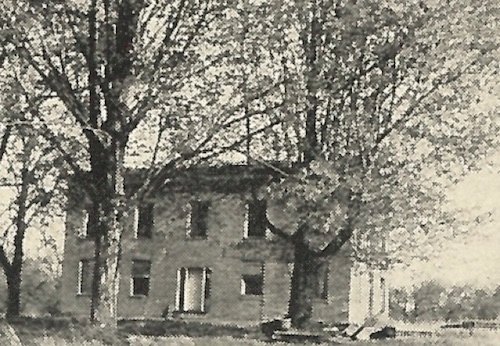
The museum is acquiring the “Brick House,” a 3,000-square-foot building from 1834 at the southeast corner of the routes 98 and 104 and wants to put an addition on the back of the brick building with new modern bathrooms and a meeting space that hold up to 100 people. The property includes 50 parking spaces.
The site would be an Orleans County welcome center and would promote businesses and other tourism sites in the county.
“It’s a win-win,” said County Legislator Fred Miller, who is serving on a fund-raising committee for the project. “It would help all of Orleans County. It’s perfect.”
Miller would like to see the county tourism office be based out of the site, with the county providing some steady revenue to the museum as a tenant in the building.
He sees tourism and the Cobblestone Museum working together to promote other attractions, including fishing, the Medina Railroad Museum, the Niagara Wine Trail (which runs along Route 104) and other historic districts and sites.
“It’s right at Route 98 and 104 which are major routes in the county,” Miller said about the site. “It would be ideal, and it would help everybody. It wouldn’t just be an Albion or Medina thing. Hopefully people will get on board.”
Gail Johnson, a member of the capitol committee for a welcome/visitor center, and Cobblestone Museum Director Doug Farley are pictured by the “Brick House,” a building the museum is acquiring with plans for an addition. The site also has about 50 parking spaces.
Many people already have given to the project. The museum has been doing a “silent” capital campaign and has $400,000 committed. It is making the campaign public this week and welcomes community support.
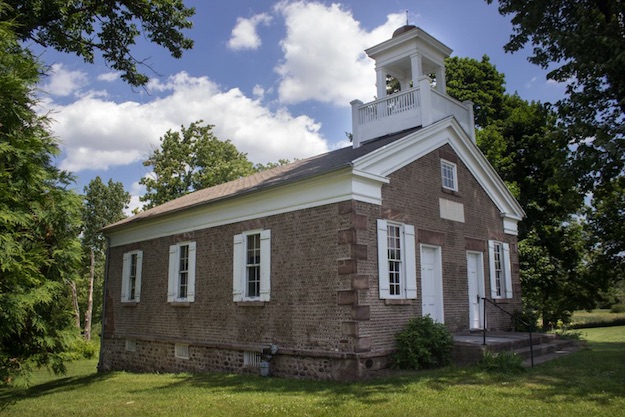
The Cobblestone Museum’s board of directors have considered a visitor’s center as part of the museum’s campus for several years. But there wasn’t enough room for a new building at the museum campus, which is a National Historic Landmark, the only site in Orleans County with that designation besides the Erie Canal.
The Cobblestone group only had to look across Ridge Road from the Cobblestone Church to see a stately red brick home with six fireplaces. That church was also built in 1834.
Ray and Linda Burke fixed up the brick house, added parking and a driveway on Route 98. They opened Fair Haven Treasures in May 2014. They have high-end artisans and crafters at the site. Doug Farley, the Cobblestone Museum’s director, praised the Burkes for their work and care for the property.
“It is ideal for a welcome center,” Farley said about the brick house. “It is high visibility.”
The $750,000 campaign total would fund the following: $260,000 purchase price with closing costs; $200,000 for meeting room addition; $130,000 for theater and interactive exhibits; $100,000 for ADA accessibility; $30,000 for architectural planning; $20,000 for stabilization (roof, septic, windows, masonry, etc.); and $10,000 for historic structures report.
The Cobblestone Welcome Center Fundraising Campaign Committee includes chairman Richard Remley, treasurer Kevin Hamilton, Brett Kast, Andrew Meier, County Legislator Fred Miller, retired county historian Bill Lattin (who was the museum director for 40 years), Gail Johnson, Cobblestone Museum President Erin Anheier and Doug Farley, the museum director.
Ray and Linda Burke, shown in May 2014, gave the site new life as Fair Haven Treasures.
The Burkes in their work on the building removed plywood and linoleum from the floors, and discovered hardwood floors underneath. They took out one wall to make a bigger room that they used for performances and public events.
The museum cited many benefits of the acquiring the Brick House, including:
a highly visible location to promote the museum and other local sites
plentiful additional parking for school and tour buses, and other museum events including weddings
year-round access to bathrooms
further expansion of the Childs historic district
expanding educational programming and visitation with year-round access
kitchenette for use by caterers or small receptions
large community meeting space for educational programming
multi-purpose room
space for Orleans County Tourism Department (currently based at Orleans County Office Building on Route 31)
new exhibit space to interpret Orleans County history
space for viewing an introductory video and new cobblestone interactive exhibits
distribute materials for local attractions including Medina Railroad Museum, Erie Canal, lighthouse at Point Breeze, campgrounds, marinas, bed and breakfast sites, sports fishing, agri-business, wineries and other locations.
The capital campaign includes several opportunities for naming rights, including the building name (for $250,000-plus), large meeting room ($75,000), Orleans County History Room ($30,000), Reception Desk ($25,000), Ground Floor Rooms (5 at $25,000 each), Second Floor Rooms (5 at $20,000 each), Entrance ($20,000), Stairway ($15,000), Meeting Room on lower level ($15,000) and Major Donor Plaque Entry (Heritage level at $10,000 or more).
The donations can be paid over five years. For more information on the capital campaign, click here to be directed to the museum website or contact Farley at (585) 589-9013, or by email at info@CobblestoneMuseum.org.
A group of Santas helped dedicate International Peace Garden at the Brick House property at the corner of 98 and 104 on April 17, 2015. The Santas were in town for a Santa convention.
Dr. Frank H. Lattin had extensive bird egg collection featured at World’s Fair, produced magazines on science – also served as assemblyman and local health officer
By Doug Farley, Cobblestone Museum Director – Vol. 2 No. 36
Frank Haak Lattin (1861-1937), age 26
GAINES – In Part 1 of this article, we explored a 19th century discovery in the Town of Gaines with roots back to the last Ice Age. In this article, we explore how this discovery had a dramatic influence on the life of one of the Town of Gaines leading citizens.
Frank H. Lattin was born in 1861, son of Joseph and Mary (Haak) Lattin of Gaines. Joseph died when Frank was only nine years old, but the setback was only temporary, as Frank went on to graduate from Albion High School, taught school for several years in Gaines, and then began an amazing career buying, selling and collecting natural history objects.
Even at the age of 36, Frank Lattin returned to school and worked his way through medical college and received his M.D. from the University of Buffalo in 1899, beginning a second career in medicine and surgery.
At an early age, Frank developed an interest in geology and natural history. He was especially fascinated by the discovery of “Gilbert’s Hearth” in Gaines in 1864, a prehistoric find that geologists and anthropologists dated to the Paleo-Indian era at the end of the last Ice Age.
His interest in the natural sciences started Frank on a lifelong obsession that led him to leave his mark not only on Gaines and Orleans County, but also all over the world.
“North American Birds Eggs,” 1905, by Frank H. Lattin, MD. Also shown is the birds egg collection of Cary Lattin which he created 1911-1914 at age 13, currently display at the Cobblestone Museum.
At first, Frank’s primary interest was in bird eggs and in 1884 he began the publication of a monthly magazine entitled the “Oologist,” which grew to a circulation of 3,000 copies. In 1894 he exhibited his collection of birds’ eggs at the Chicago World’s Fair and his display alone covered 2,000 square feet in the Anthropological Building.
Frank Lattin’s interests certainly included much more than just bird eggs. Following the World’s Fair, he purchased a world renowned collection of shells once owned by Col. Ezekiel Jewett, former curator of the NYS Museum at Albany. The collection embraced 50,000 separate specimens from over 10,000 species. The Catalog of the Collection made a book of 200 pages.
On February 15, 1895 Lattin began producing a weekly publication entitled, “Natural Science News.” Popularity spread quickly and the publisher needed to employ four workers to meet the demand. Eventually, Mr. Lattin’s many collections within the natural sciences grew to encompass two large warehouses of specimens.
Dr. Frank H. Lattin, 1917
Dr. Frank Lattin’s reputation was equally as strong locally as it was with scientists worldwide. One Gaines resident, Earl Harding, recalled his admiration and appreciation for this small town medical legend.
“Yes, in those days, doctors made house calls. The doctor that delivered me was Dr. Frank Lattin of Gaines. I almost used to try and get ill so my Mother would call him up, because Frank Lattin was very famous as a collector of birds’ eggs. I used to do some of that myself, so if I could get Dr. Frank Lattin up here and talk about birds’ eggs, I’d like it! At that time, there was quite a migration of our people to Wayne County to buy fruit farms, and Frank Lattin was interested in that project, too. He had a farm in Wayne County as I remember.”
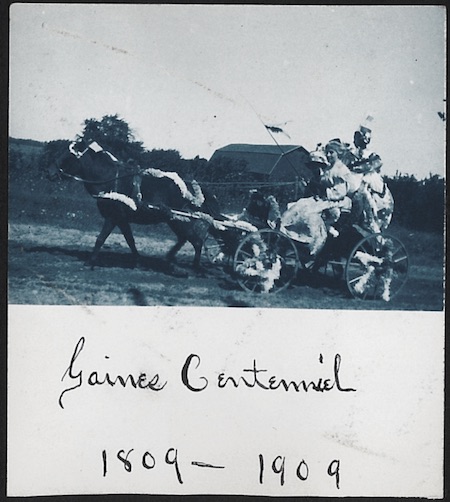
Town of Gaines Centennial, 1909
Mr. Lattin wore many hats indeed during his lifetime. He promoted local history and was a moving force in the Town of Gaines Centennial celebration in 1909. On January 5, 1909 he addressed the Eleventh Annual Convention of New York State Fruit Growers Association held in Convention Hall in Rochester. His topic was “My Experience in Reclaiming Old Apple Orchards.”
From 1917 to 1930 he served in the NYS Legislature as Assemblyman from Orleans County. He contributed to the advancement of public health in the State by endorsing and defending new health measures as the Chairman of the Assembly Committee on Public Health.
In the 1920s, Dr. Lattin was busy organizing the Old Schoolmates Reunion for the District #4 Cobblestone School in Gaines.
District #4 First Reunion, 1924
In addition to his historical research, Frank Lattin produced extensive genealogical information on the Lattin family. He served as health officer for the Town of Gaines until his death in 1937.
Photo courtesy Town of Gaines Historian
One of Dr. Frank Lattin’s favorite activities was judging fruit exhibits at state and county fairs, as seen in this photo from the 1930s.
The Lattin home in the Village of Gaines, shown above, was a great source of community pride over the years. Dr. Lattin himself reflected that it is probably the only home in the world that was secured through the consummation of a single sale of bird eggs.
Frank Lattin married May Bullard in 1885 when she was 19 years old. They had two daughters, Dorothy Root and Virginia Lattin Morrison who later resided in the family homestead on the southwest corner of NYS Routes 104 and 279.
Perhaps, an editorial in the “Orleans Republican” newspaper from 1937 provides the best summary of Dr. Lattin’s character:
“Everything pertaining to natural history attracted him and he gained a broad knowledge by keen observation of everything about him. Step by step he broadened and progressed, not by magic, but by his own unswerving integrity and steadfastness. Honorable, possessed of a keen sense of humor, he radiated cheer wherever he might be. His success meant no man’s downfall, hence all loved him and regarded him as a friend. His life touched many others at home and in foreign countries in a business way that culminated in friendship. He was like the sturdy mountain oak whose roots ever deepen into the rich soil until it stands firm and solid against each blast.”
This 1909 postcard photo taken by W.C. Eaton of Jeddo, shows Main Street, Eagle Harbor, looking north.
By Catherine Cooper, Orleans County Historian
“Illuminating Orleans” – Vol. 1, No. 21
EAGLE HARBOR – The hamlet of Eagle Harbor has seen more traffic of late as many avail of its convenient bridge because the Knowlesville bridge on Route 31 is still “Closed” or “Out.”
Named for the eagle’s nest found in a tree there by Canal surveyors in 1815, Eagle Harbor’s growth was due to Canal trade.
In 1894, it boasted a hotel, livery, wagon shop, meat market, grist mill, school, three general stores, two churches, and two blacksmiths. The following photographs from the History Dept. provide interesting visual images of Eagle Harbor’s history.
The old steel arch bridge is visible in this bustling scene.
This 1911 postcard photo also taken by W.C. Eaton, of Jeddo, shows the early stages of the bridge reconstruction project which was necessitated by the widening of the Erie Canal.
This massive reconstruction project was thoroughly documented by the New York State Barge Canal (Western Division). This photograph is labeled “South Wall of Trough, Eagle Harbor, Looking East, 4/12/12”
A temporary wooden bridge over the Canal at Eagle Harbor, 1912.
The construction of the Erie Canal presented several engineering challenges and lead to the development of several new types of bridge design. The vertical lift bridge at Eagle Harbor is one of the longer spans of this bridge type. It is one of seven lift bridges in Orleans County.
According to www.historicbridges.org: “This bridge features end posts which extend above the top chord, with a tastefully designed curved plate providing a visual and structural transition from the top chord to the top of the end post…..this bridge stands on its own as a beautiful eye-catching landmark for the area.”
By Doug Farley, Cobblestone Museum Director – Vol. 2 No. 35
Our efforts to date with the “Historic Childs” article series have focused on 19th and 20th century history, today we take a venture into much, much earlier territory.
I believe the first printed telling of this historic discovery appeared in the “Holley Standard” newspaper on January 6, 1887. The subject of the article concerned an 1814 discovery in the Town of Gaines that scholars over the years have confirmed to date from a pre-Ice Age, Paleo-Indian settlement, dating back over 12,000 years ago.
The scene of the local discovery in 1814 was at the David Tomlinson Farm located on Ridge Road just west of the Village of Gaines. At that time, the region was largely unbroken forest. About 150’ off the Ridge, there was a well-known fresh water spring that the Native Peoples had shown to the settlers in the early 1800s.
In 1824, the spring was cleaned out and stones were built up to form a well. In 1853, the well failed and was subsequently deepened to replenish the water supply. In 1864, the farm experienced a dry well which necessitated a second re-digging to the 18’ level. It was at that level that the prehistoric discovery was made which was described in detail in the Holley newspaper:
“About 18’ below the original surface, the digger came upon a quantity of brush overlying an ancient fireplace, consisting of three round stones, each about one foot in diameter, placed in the form of a triangle. A mess of charcoal and ashes surrounded the stones, which were burned and blackened by fire and smoke. Several sticks were found thrust between the stones, the inner ends burned and charred as left by the expiring flames. A careful inspection of these sticks by a gentleman thoroughly acquainted with the nature and grain of various woods proved them to be hemlock and ash.
“Some were denuded of bark and had the smooth surface usually presented by water washed wood found on any beach. Several sticks were split and surrounding one was a depressed ring or indentation, as through some dull instrument had been employed in an effort to weaken or break the wood. The ashes were indurated to a degree requiring the use of a pick in their removal and rested upon a stratum of sand which was also in a hardened condition, being taken out in large pieces that proved to be fine grained with a smooth surface, slightly creased in places, possibly ripple marks.
“When first discovered the brush was closely packed over the fireplace and had every appearance of having been forced into position by the action of water. The fireplace and all the details of its narrow surroundings, which were carefully noted, clearly indicated that it had been made upon a sand beach and was subjected to an inundation that washed the mass of brush, possibly gathered for fuel, over the stones and ashes, which were afterwards covered many feet deep by successive strata of the same gravelly soil of which the Ridge is composed, and was preserved for ages unknown.
After ascertaining these facts, and after looking over the ground, the observer reached the conclusion that the fireplace must have been made at a period just before the formation of the Ridge. The Ridge at that point in time must has been a (sand) bar like that on the present lake shore behind which lies a little round pond. The waters of the pond or marsh, finally soaked thru the mud bottom and following a vein or seam, rose to the surface in the formation of the spring. When the marsh land was cleaned and drained the spring failed. All this would go to show that man was a habitant of the lake shore before the existence of the Ridge. The late Lewis H. Morgan thought the discovery an important one and advised its publication.
At a late meeting of the Anthropological Society of Washington, G. K. Gilbert of the U.S. Geological Survey, retold the story of the find as verified by himself on the occasion of his visit to this vicinity.”
Grove Karl (G. K.) Gilbert (1843-1918), Rochester NY
The find, at that time, was labeled “Gilbert’s Hearth.” Professor Gilbert’s findings were recorded in the Handbook of Aboriginal American Antiquities, 1919. He stated that the terrace on which the Tomlinson site sits is located about 175’ above the present level of Lake Ontario. The formation occurred between the ice front on the north and the southern rim of the basin. When the basin was finally free from ice, the lake outflowed via the Mohawk Valley and the present terrace was formed.
Gilbert concluded that the hearth was made in the period following the Ice Age outflow at the Mohawk Valley in a period of time that reflected the decline of the glacial climate.
Next week, in Part 2 of this article, we look at how this local discovery became a dramatic influence in the life of one of Orleans County’s early citizens, Dr. Frank. H. Lattin.
‘I would gladly give up all of my interest in a rocket to the moon to go back again to 1910 and ride once more behind that old horse in the dust of the Fair Haven Road.’
By Doug Farley, Cobblestone Museum Director– Vol. 2 No. 31
Sanford B. Church, family photo
GAINES – The Hamlet of Childs was by its very location, front and center, during the celebration of the Sesquicentennial of the Town of Gaines in 1959. The milestone of the passage of 150 years of time from 1809-1959 was indeed cause for celebration amongst locals and onlookers, alike. As part of the Sesqui, a 32-page publication was produced that talked about the overall history of the town and reflected on many of the changes that have taken place in the town over the years.
This week’s installment of “Historic Childs” takes a look at an article that was included in the Sesquicentennial publication that featured the reflections of one of its citizens, Sanford B. Church (1904-1976). In his lifetime, Mr. Church practiced law for 40 years and was a founding director of Albion Federal Savings and Loan Association.
He was the owner of the Orleans Republican newspaper, a member of Christ Episcopal Church and Renovations Lodge of Masons. Mr. Church was also the grandfather of current Orleans County Judge Sanford A. Church. The photos included this week were not part of the original essay, but have been included to bring additional understanding to Mr. Church’s remarks.
“Requiescat (Prayer) in Limbo,” by Sanford B. Church, 1959.
This is a chronicle, of sorts, designed with the intention of recalling to the minds of those who read it, some of the customs, practices, institutions which have ceased to be a part of our way of life here in the Town of Gaines during the past fifty years. “Limbo’, according to Webster, is a place or condition of neglect or oblivion, and it is into oblivion that many things we have all known well have passed since 1909. While the loss of some of these causes us no regret, others give a nostalgic tug at our heartstrings and bring back fond memories of a bygone era.
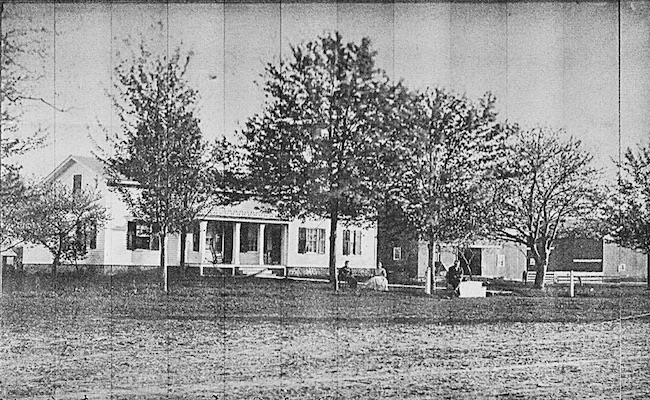
Thompson Farm, Ridge Road, Gaines, late 1800s, showing unpaved Ridge Road. Paving of Ridge Road was not complete until the 1920s.
First and foremost on my list is the passing (or almost) of the dirt road in our town. Certainly, with one exception I can think of, the dirt road as it was fifty years ago has completely ceased to exist. Frankly, I’m sorry. While the modern highways bearing their streams of automobiles from farms to town and maybe still farther away, are an essential part of our current way of life, the little dirt road had a definite charm of its own, and I have always had a special fondness for it in my heart.
In this connection, it is interesting to note that the end of the era of the dirt road was just beginning in Gaines fifty years ago right now. In 1908 the “macadam” road to Gaines was built, and two years later the blacktop road to Fair Haven and beyond was under construction.
Democrat Wagon from Coloney Farm, Gaines Centennial Parade, 1909
Although I was pretty small back in those days, I can well remember coming home from Oak Orchard in my father’s ‘‘democrat wagon’’ (I suppose it was the station wagon of the time) on a summer’s evening in 1910. At that time there was a large camp for the road workers, and as I recall it was on the west side of the Oak Orchard Road, about a half mile north of the Ridge.
I remember it was dusk, and as the horse plowed his way through the dust, the men were singing and the darkness sparkled with their little fires. In point of time, it was a long drive from Albion to the lake in those days, and many is the buckboard, buggy or democrat we passed on the way, to say nothing of an occasional surrey or phaeton, or a farm wagon creaking and groaning under its load of hay or grain. Such vehicles as these are all gone, so long gone, in fact, that I was startled to see a manure spreader recently on the road not far from Fair Haven (Childs, if you like) drawn by a team of brown horses.
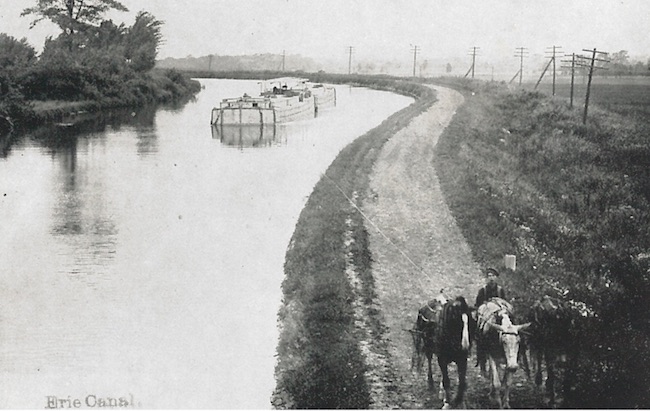
Erie Canal towpath, Gaines Basin, c. 1900 before Barge Canal expansion
Well do I remember blacksmith shops (Joe Vagg’s was the last one to go in Gaines, wasn’t it?). Clure White and his fabulous pond full of goldfish, the old stone mill north of Eagle Harbor, the golf course and country club north of Eagle Harbor, which has both come and gone within this half-century, the towpath along the Erie Canal, the machine shop (maybe you know what work was done there; I don’t) in the rear of the Bacon house in the triangle at Five Corners, the East Gaines store (at the corner of the Kent Road and the Ridge – a vacant lot now), the Congregational Church at Gaines which burned in 1950, Huskin’ Bees, Bees to clear out the drifted roads in winter, and many, many other pleasant, friendly, everyday things.
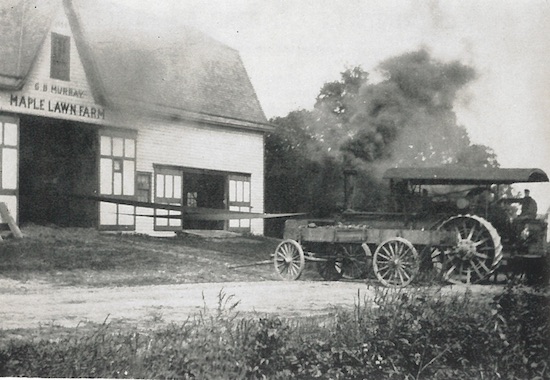
Traction Engine, Maple Lawn Farm, Childs, early 1900s. Note the belt driven power system extending from the engine into the barn.
I can’t remember back to the old, old threshing machine which was propelled by horsepower, and any way that’s back before 1909. But I can distinctly recall the so-called old-fashioned threshing machine, drawn and propelled by a great, smoke-spouting steam “traction engine” which is gone from these parts (although it is in common use in New England, parts of Pennsylvania, and even in other parts of this state).
Almost as good as the arrival of a circus, was the advent of the threshers with their fascinating equipment on a hot summer’s morning. As a child I’ve stood many times in front of the farmhouse where Dan Bolger and his family lived, and seen the men set up the machine, connect the great belt to the traction engine, and bring the wagons loaded with wheat into line. Presently the engine would he belching smoke higher than the barn, the huge spout of the threshing machine would he spewing out straw in a never-ending stream, and the golden grain would run out into the waiting sacks.
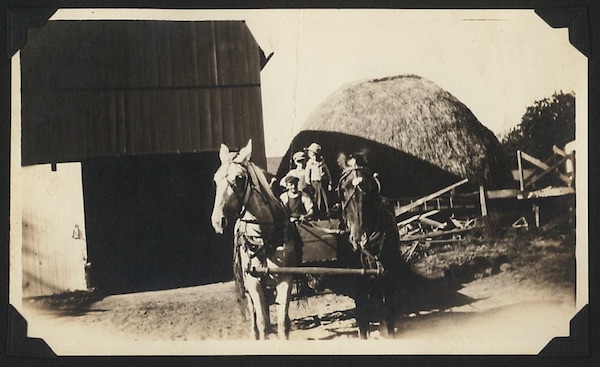
Straw stack, Coloney Farm, Childs, c. 1900.
At noon, the activity would suddenly cease, and after a hasty cleaning-up session, the threshers would crowd about the tables to consume the meal the women had prepared. Then, afterwards, the threshing went on all the afternoon, until all the wheat was threshed, the straw stack was two stories high, and the wheat was sacked and ready for market. It was always an eventful day, an interesting and enthralling sight at the time, and a pleasant memory now.
Windmills exist no longer in Gaines, as far as I know. At least, there are no working ones. But they are by no means totally extinct. There are some still in use in this county, and still more in parts of Genesee and Wyoming. Down in the central part of the state, and in parts of New England, they are very common. For those of you who are doubting Thomases, I respectfully refer you to a brand new aluminum one a half-mile east of Navarino on U. S. 20 (south of Syracuse).
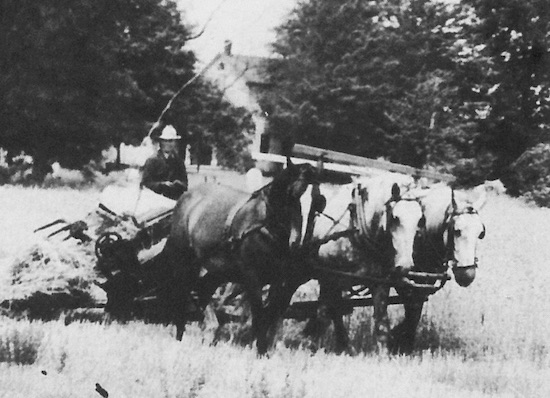
George B. LaMont, horse drawn binder, c. 1930.
To the best of my knowledge, no horse-drawn farm tools are in use in the Town. But, like windmills, they are much in use elsewhere for instance, in eastern Pennsylvania and New England. Likewise with the ‘‘little red schoolhouse.” If you are lonesome for these relics of our youth here in this land of the centralized school of university proportions, go to rural New England. There you will find all of them your heart desires (and without swimming pools!).
One of my informants has assured me that there are no outside privies remaining in Gaines, but I can assure him that he’s wrong. While they are on the wane, they definitely are still very much with us, and I have an idea that they will be for a long, long time to come. But hitching posts (except for ornamentation) are a thing of the past, along with dry houses and evaporators.
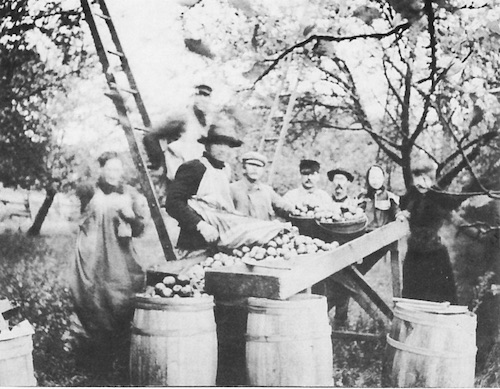
Picking and sorting apples in 1904, LaMont Farm, note use of barrels for storage and shipping.
In my opinion, the cooper shop is deserving of a memorial from the apple growers of the past in Gaines, because the heyday of the barrel was also the heyday of the apple industry in all of this area. In the early part of this century the crop was usually good, and there was an ever-ready seller’s market, particularly overseas. Am I not correct that many of the fine, old homes of Gaines owe their existence to the fact that around 1900 apples were selling at $14 a barrel in foreign ports, notably in the free port of Hamburg.
Gaines Sesquicentennial Parade float from Coloney Farms, 1909
And what about circuses and the thrilling parades which always preceded them? And don’t tell me there have been no circuses or circus parades in the Town of Gaines since 1909, because I know better. I’ve watched many a parade go past mv house headed north, turn about (with considerable difficulty) at North Street, and head back up Main Street, with bands playing, flags flying and elephants joined tail-by-trunk in a long line.
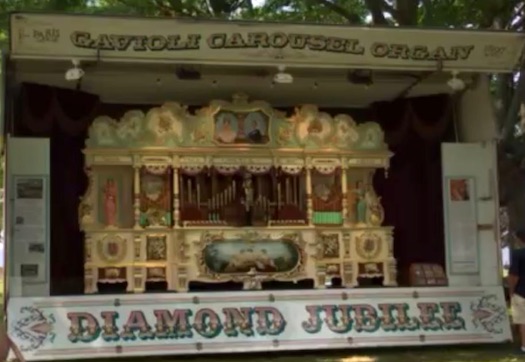
Calliope as seen at Krull Park, Olcott NY, July 2021.
Perhaps the most thrilling part of the parade (to me, at any rate) was the steam calliope, and I can well remember one in particular, which was huge. Of course, as always, it brought up the rear of the parade, and was giving out great clouds of steam all along the route. The player sat on a fancy settee which overhung the rear wheels, and as the vehicle passed under the trees in front of what is now the Lions Club house, the steam descended, completely enveloping player, calliope, horses and all.
As for circuses themselves, I can well remember three back on the Church farm, at least one of which was within the past twenty-five years. But they’ve gone now, not only from Gaines, but from almost everywhere and circus parades, I understand, have completely drifted into oblivion, forever obscured from their clouds of steam from their now silent calliopes.
While modern economists tell us it is a good thing, and a sign of progress, the passing of the small farm makes me sad. The little farm, usually a one-man operation or certainly a one-family operation, was for a long, long time the measure of the American way of life. For generations the families which worked these small places were the real “grass roots” of the country, and the salt of the earth. It is true that some of these small farms are still with us, but each year a few more of them drift into the limbo of the past, along with the asheries with which Gaines was once so liberally blessed.
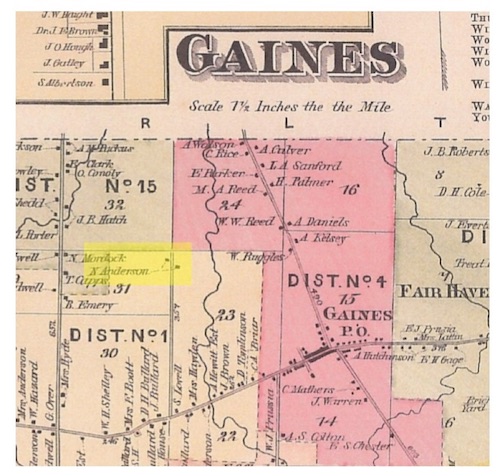
Paradise Road, not existing today, as seen on this 1913 map, at one time had two cobblestone homes at its northern terminus, north of Ridge Road. One home was owned by Nahum Anderson, great-great-grandfather of retired Historian Bill Lattin. Bill noted that Nahum said the soil on Paradise Road was so poor that “it was only good to hold the rest of the world together.”
And Paradise! Have you ever been to Paradise while the half-dozen houses were still standing? Back then, there was no need of going to the “wild west” to find a ghost town. We had our own right here in Gaines. Just when it was finally abandoned, I don’t know, but it has completely fallen to pieces in the last half-century, and now consists of stones scattered about the meadow at the end of the old Paradise Road.
Gaines Academy after a third story had been removed 1930s, Courtesy Town of Gaines Historian
So it was, too, with the old Gaines Academy, except that this institution is marked by a State sign on the south side of the Ridge, across from the Town buildings. The Academy building has completely collapsed into rubble during the past fifty years, but it was, I am informed, abandoned long before that.
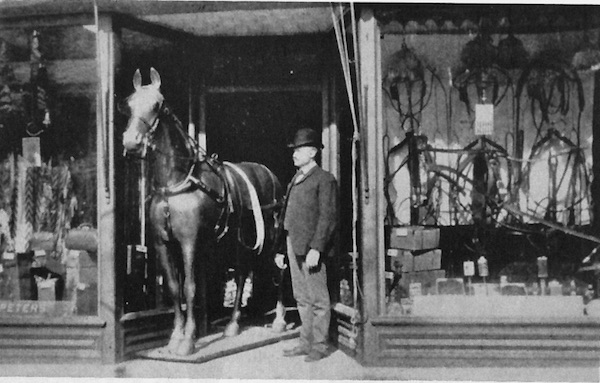
Harness maker Philo Henry Peters is shown here at the entrance of his harness store in Albion, 1905. A sampling of the numerous types of leather goods he produced is seen in the store windows and also on the life-sized horse mannequin he moved outdoors in fair weather.
Harness shops are gone, kerosene lamps (except in emergencies) are no more, and the gas-light era has long since passed. So with the kind of well with an “old oaken bucket” (there were a lot of them fifty years ago).
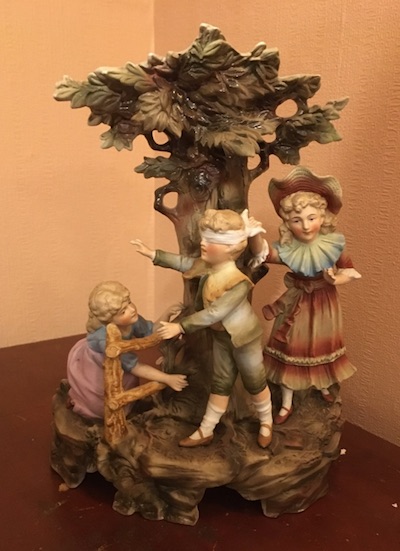
Blind Man’s Bluff, Bisque Figurine, circa 1890
And think of the old children’s games, like Blind Man’s Bluff, Cops and Robbers, and the like. And the songs which have come, been sung and loved, and gone…and the dances…and the celebrations…and the weddings…and all of “those we have loved long since and lost awhile.”
When I come to read this over, now that the space allotted to me is exhausted, I realize something I never thought of when I started: This little chronicle is a half-century slice carved out of the life-time in the Town of Gaines, in the County of Orleans, State of New York. It tells of the way of life in this community during the period 1909-1959, and all that is set forth in it is now history – a history which many of us living have helped to shape.
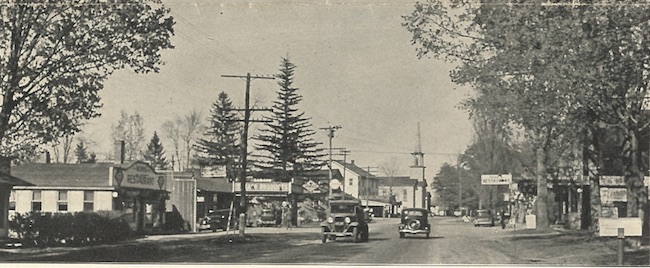
View of Gaines business section looking east along the Ridge Road, 1930s, during the period of recollection by Sanford B. Church.
Progress is wonderful, so I’m told, and we should be duly thankful that we’re living in this modern day and age, with all of its many wonders. Probably this is right, and probably a psychologist would say that I’m simply wishing for my irrevocable youth when I would gladly give up all of my interest in a rocket to the moon, to go back again to 1910 and ride once more behind that old horse in the dust of the Fair Haven Road.
By Tom Rivers, Editor Posted 9 August 2021 at 9:19 am
Photos courtesy of Melissa Ierlan
GAINES – Chris Capurso, center in back, is shown with family members on Sunday afternoon, when a plaque was unveiled in honor of her late husband Al Capurso at the Gaines Basin cobblestone schoolhouse.
The schoolhouse on Sunday also a celebration of the life for Mr. Capurso, who spearheaded saving the schoolhouse from ruin. Mr. Capurso passed away at age 68 on Feb. 17.
Doug Farley, director of the Cobblestone Museum, speaks about Capurso’s support for local history projects. The cobblestone school on Gaines Basin Road is owned by the Orleans County Historical Association, which Capurso led as president.
The building has been repurposed to serve as a meeting space and display for the Orleans County Historical Association.
The plaque notes Capurso was instrumental in saving the 1832 cobblestone schoolhouse on Gaines Basin Road, the oldest documented cobblestone building in the county.
Capurso led a team that put on a new roof, replaced windows and cleaned out junk and debris from the site. They put in new electric, a new subfloor, restored the trim and repaired the facade. He added a historic marker and flag pole. The building has been given new life as a meeting house and display of schoolhouse artifacts for the Orleans County Historical Association, which Capurso led as president.
These painting by Judy Collins shows Capurso playing his guitar. He performed at many community events, often singing songs he wrote about pioneers.
By Doug Farley, Cobblestone Museum Director – Vol. 2 No. 30
Cary Lattin
GAINES – Most local residents probably don’t remember a time before the Cobblestone Society existed. Nearly everyone in the vicinity can remember a school field trip to the Cobblestone Museum, or has attended an Old Timers Fair or two over the years. But truth be told, there was a definite beginning to the Cobblestone Society and a dedicated team of individuals who created a reality from a dream.
The rest of this article is taken from an interview with Historian Cary Lattin, as shown above, on July 24, 1979, undertaken by Orleans County Historical Association (OCHA) in an effort to record the collective memory of the county’s leading pioneers from the late 19th century and early 20th century. The full audio recording of Mr. Lattin’s interview is available in local libraries and also can be view online using this link.
Forming the Cobblestone Society, as told by Cary Lattin
I’ll try and tell a little bit about the history of the Cobblestone Society, why it was formed and how it was formed during the year 1959, when Gaines had the Sesquicentennial celebration, there was going to be a one day celebration or fair. It took about two months to get ready for this Sesquicentennial celebration.
We wanted to visit the points of interest around the town and we wanted to visit the Cobblestone Church at Childs. We went to the Universalist Board in Albion and asked them if they would open the church for one day so we could see the interior of this beautiful old Cobblestone Church. Two or three of us went down to the church and word came ’round, and we went through the building.
The plaster was bad in the ceiling and it was in kind of rough shape. There were many windows that were broken and the Universalist Board decided that it would be risky to have a bunch of children running around in the church. They might jar some plaster and break somebody’s glasses! So we didn’t have the Church to visit. During the Centennial, and after the Centennial, people commenced to ask, “What’s going to happen to the old church?”
When you tell a damn Yankee that he can’t have something, hell is out for dinner-time. Then they want it! They learned that in Prohibition. When they told the American people they couldn’t have booze, they got booze, one way or another. So, people in the neighborhood were concerned. People in the district were concerned, and in the town. “What’s going to happen to this old beautiful church? We had no organization formed that· could maintain the building or had no Society formed that could operate the thing like it is today.
Bob Frasch, 1961
During the winter of 1959 and 1960, Bob Frasch taught school in Holley, history and English, and he formed a Yorker Club in the Holley High School. One of the projects was to find the cobblestone houses in the Town of Murray and get all the information on these 14 cobblestone houses in Murray. There wasn’t too much information available.
He came into the office when I was County Historian and asked me what I knew about a cobblestone house. I said, “I have lived in on one for about 60 years. And by way of talking about cobblestone buildings, there’s a beautiful church building in Childs.” He said, “Let’s go see it.” So we proceeded to go down to Childs, stopping by Homer Brown’s house to get the key to the church. When Bob Frasch saw the interior of this old Cobblestone Church, he really flipped! He said, “This building should be saved.” I said, “Yes, I know it should be saved but how are you going to save it? We have no organization whatsoever to do this. We have no money.”
Well, people commenced to get concerned. The Historian of the Town of Albion, Katharine Billings, whose ancestors had been attendants of this church and the Historian of the Town of Gaines, Howard Pratt were interested. And that’s the way it hung fire. The next fall in 1960, Charlie Thompson called me one morning about six o’clock and said, “Say, they are going to sell the Cobblestone Schoolhouse. We better do something about it.” So I went down to see Charlie, and he said all the district schools have been centralized in the five schools in Orleans County, Kendall, Holley, Albion, Medina, and Lyndonville.
He says, “You know they are going to sell this building next week Tuesday at Albion Central School. They are going to dispose of it.” “Well,” I said, “Charlie, will you go up to the meeting? You can vote. Vote against selling it; to hold us on the table for six months until we can do something?” And he said, “Sure.” So I took it upon myself to go and see about 12 or 14 people in the immediate district, Gaines #5, to see if they would go to the Albion Central School meeting and see if we couldn’t save this, stall this off, for four or five or six months until we could get an organization.”
Bob Frasch and I went to the meeting and asked if we could be heard, and we both talked about holding this up until an organization could be formed. Our main purpose was to save the Cobblestone Church and the Cobblestone School. We gave them a pitch and they listened. Walter Balcom was there. He had gone to school at this Cobblestone School. He had attended the Cobblestone Church when they had their meetings there twice each summer. He had a very fine vocabulary of four-letter-words. He got up and said, “I make a blankety-blank motion that this blankety-blank schoolhouse be left on the table for six months, and if you blankety-blank guys can’t get organized in that time, you don’t deserve the damn school!”
And, they voted unanimously to hold the sale up for six months. They tossed us a torch and then we had to do something. So we got an ad hoc committee, so to speak. We had no money. We had no funds, we had nothing! And on this, we wrote a letter, Bob Frasch, it was in his writing. And, we got Katharine Billings, the Albion Historian, and Howard Pratt, who was Gaines Town Historian, and Morris Wilson, who lived next door to the Church and one or two others. Bob Frasch and the committee and myself, signed this letter. We sent this letter out to 100 people. We went through the telephone directory and looked in there and saw names of people we thought would be interested in saving their heritage. Well, the meeting was called at three o’clock on a cold Sunday afternoon in October 1960.
Some of the first officers and directors of the Cobblestone Society in 1960: (left) Maurice Wilson, Vice-President; Cary H. Lattin, Director; Katherine Billings, Secretary; Robert Frasch, President; J. Howard Pratt, Director; and Hannah Thompson, Treasurer.
You know there were 65 people showed up at that meeting, and we had a slate of officers drawn up. We’d asked all these people if they’d either be a director or an officer, and we told them what we wanted to do at this meeting. There were about 60 people signed up to be members. Some of them paid the $2.00 dues right then. So, we had the thing started. We agreed to meet at the Village Inn in about two weeks and get an organizational meeting. We had a dinner meeting over at the Village Inn and we had the west room pretty well filled up.
There were probably 89 to 100 people there who were interested in saving this building. Carl Schmidt was there. He was also at the first meeting. He had written a book about cobblestone buildings in 1944. The little books that he wrote in 1944 are collector’s items today. So, we had a slate of officers drawn up. We had a cross section of our people, we had an attorney, we had two architects, we had school teachers, we had farmers, and we had businessmen on this thing. We had a cross section of what was going on. With the help of the attorney and Bob Frasch, they came up with a set of by-laws and a constitution.
State Education Department Charter
We asked for a charter from the New York State Department of Education. And we were wise. That was our attorney’s advice. “Get this charter from the state Department of Education if you possibly can.” So we had the application for a charter and it was signed by, I think, the directors and the officers. By the end of the six months we had a temporary charter.
So, when the school-house came up for sale, the next April, that was in 1961, we had $129.00 in our fat little hands to pay for the school- house! That’s what we had to pay for deeds and search and the necessary proper papers that has to be signed to transfer the property. So we owned the building.
We were in business. Carl Schmidt came up with the idea that we would have a tour that spring, 1961. And, we held a Cobblestone Tour and made money. It was held right around this vicinity. That fall we had an auction in the schoolhouse to make money, but our main concern was to save the church. We made some overtures to the Universalist Board in Albion, and they were in our corner, so to speak.
John Brush, who was a director on our society, was in the hierarchy of the State Universalist Convention and his influence didn’t hurt a bit. He was a trustee of St. Lawrence University. He has endowed St. Lawrence University very well. It took about two or three years before the final papers came through. After the papers were signed by the Universalist State Convention and the Universalists over here had relinquished what they had in the building, it seems that they sat for six months in Judge Serve’s office. I saw him one day in the courthouse hall and I said, “You know, Judge, why don’t you hurry that up a little bit? We want to get title to that building and we want to do things!” He said, “You know, Cary, don’t try to coerce a Supreme Court Judge. I wouldn’t want to put you in jail.”
So, in about three years we got clear title to the Cobblestone Church in Childs. We were in business for real. The Cobblestone Society put a roof on that building that cost $2,200 before we owned it. That’s how much we thought of the building. So then we had two buildings.
John Brush, early 1900s
Well, our angel, John Brush, is a good friend of mine. I’ve known him as long as I’ve known anybody around Albion High School, and he is a fairly wealthy man. I said, “You know one day we should restore the tower.” There was a tower on that church when it was first built. The tower was removed in 1918 because it was getting deteriorated. The timbers were rotten. So, the Universalist Society decided to take the tower off. And, John Brush said, “I think so too, and I will pay for it.”
Cobblestone Church tower restoration, 1966
So, John and I went to see Hobart Snell who was the only contractor close by, and John and Hobart made a deal, and the tower was restored. And John Brush paid for it himself. I remember when he was up there the terrace in front of the church was in bad shape when we bought the church. They were all covered over with woodbine. Nobody knew there was a terrace there, just thought there were some steps going up there.
So one day when there were some of the directors down there, we decided to pull up some of the woodbine, and discovered there was a terrace. It looked pretty crummy. One day John said, “I think we better do some repair on the front of the church. I will repair the terrace and furnish some landscaping.”
Pasquale DiLaura
So, we went to see “Pat” (Pasquale) DiLaura, who was the last of the Orleans County quarrymen. He was as fine a gentleman as I ever hoped to know. “Pat” DiLaura was Mr. Stone Quarry, Medina Sandstone.
He was 80 years old at the time, and he said he would take upon the job of restoring the terrace. He still had some influence at the quarries in Hulberton, and he went down there with some of his trucks and got a couple loads of stone to re-lay this terrace. With his stonecutter helper, Sandy Malone, “Pat” DiLaura re-laid the stone.
Frankie Swierczynski let us have four or five of his boys over there to do the grub work. They had to dig out the trench and do some of the heavy lifting. There was “Pat” DiLaura and Sandy Malone that made the terrace and that was laid in 1966. It looked pretty nice. These shrubs that were replanted, came from a nursery up in Newfane, and that first summer they were planted there, they guaranteed these shrubs to live. I said, “That’s awful nice, to guarantee these shrubs!” However, he said, “You got to water them this summer.”
I watered them 27 times that summer. I got water for free from Hank Radzinski’s spigot. You know, neighbors are better than money sometimes. When Hank Radzinski was going to get his license for a Liquor store, right next to the church, he was having problems. The Secretary of the Orleans County Liquor Authority came to me and said, “How many times are you going to have service in your church?” It wasn’t my church and I wasn’t having the service, but that’s what he said. I said, “We don’t know whether we would have any service.” “You know,” he said, “Hank is going to have problems getting a liquor store next to a church.” I said, “If you talk to any Cobblestoner and they try to do anything to stop his liquor store, clobber them!” I told Howard Pratt, and I told a couple of others, “If they wanted to have a liquor store there, he is going to get it. Let’s have his good will.”
So we had his good will. When we wanted water, we had thousands and thousands of gallons of water. I talked to Hank about it and he said, “I know it. I appreciate what you guys didn’t do.” So we were in business.
By Doug Farley, Cobblestone Museum Director – Vol. 2. No. 29
GAINES – Much of the recreational activities of citizens in the Hamlet of Childs and Town of Gaines focused around an organization known as the Grange, or more formally, The Patrons of Husbandry.
While the organization was founded to provide valuable services to farm families, it grew to become a center of community engagement for numerous social activities such as dances, box socials, and even a choir.
The Gaines Grange #1147 was formed on Nov. 30, 1908. In May 1909, 40 people were initiated into membership. The first meeting site was in a building known as White’s Hall, shown above. The building, located on the southwest corner in Gaines, dated to the turn of the century. Albert Anson Appleton ran a store there, but it also served as headquarters for town meetings, post office, Good Templars, and eventually served as the Grange Hall.
White’s Hall suffered a disaster fire on May Day in 1910, disrupting the lives, in one way or another, of most people in the community. The hall was rebuilt following the fire and the Grange continued to meet there until 1915.
In the spring of 1915 the Grange purchased Thurber’s Hotel next to the Congregational Church and transformed it into a new Grange Hall. The third floor was fixed up for a dance hall with a superb hardwood floor being installed at the time. This was considered one of the best dance floors around at the time and one of the largest Grange Halls in the region.
A local resident, Fay Hollenbeck, reflected on the Grange dance floor in 1984 at the celebration of the Town’s 175th anniversary celebration. “In Gaines, this little village has got one of the best dance floors in Orleans County. It’s all narrow boards, laid around, across the end and down the other side, and across the other end. So on a Round Dance you are always dancing with the boards never across them. In those days dances would alternate, first a Round Dance and then a Square Dance.”
Photo Courtesy Orleans County Historian
Here we see officers of the Gaines Grange #1147 posed in front of the Gaines Congregational Church in the 1930s. The women in the picture, from left to right, include: Elinor Cooper, Sarah Bacon, Octavia Mather (chaplain), Kate Crowley, Alice Hatch (secretary), Alma Appleton and Wilhelmina Taylor. The men in the photo include, from left: William Grinelle (trustee), Charles Thompson (trustee), Fred Derisley, Winton Hatch (master), Ronald Spinks, Lewis Reed and William Crowley (trustee).
Local farmer, Charles Thompson (shown in photo above) and his wife, Hannah, were very active in the local Grange. Their daughter, Gail (Johnson) remembered, “My mother used to sell donuts at the Grange square dances on Saturday evenings.” The Gaines Grange formed the basis of much of the Saturday night social life in the community for decades.
WWII presented many challenges to everyday life in the community and the Grange suffered a decline in membership in the 1940s. One local Granger, Sylvia Ball, recalled the trying times. “The war was on its terrible move and soon the boys were leaving in the service. Most of the women in Gaines began working at one type of work or another in the war effort. Help became scarce and even busy farmers worked a four hour swing-shift at some essential plant. With sickness in my home, the war on, I too began working which gave me no time for picking up where I left off in the Grange. When it was so I could return to Grange it was well under way, there was an active membership, the war was coming to a close all about and people could relax.”
The Gaines Grange #1147 received three plaques from the Sears Roebuck Foundation, along with two $25 War Bonds, for outstanding community service. The awards recognized the Grange’s community service at the time when the Congregational Church burned in 1959. The Grange allowed the church to use their hall for services during the rebuilding. The usage included scout meetings, auctions, dinners and home bureau. The Grange also assisted with construction of the church and a community playground, baseball field, and water supply pond.
The Grange Hall, seen in 1959, when Dean Sprague had a store there and also the Town Clerk’s office.
In the 1950s, membership in the Grange reached 105 people. Changing times in the 1960s and 1970s saw membership drop to just a handful of members. The building was then sold in 1979 and the last official act of the Gaines Grange #1147 was its own dissolution in 1979.
The Gaines Grange Hall is currently occupied by Americana Unlimited Antiques, Robin Stelmach, proprietor.
By Tom Rivers, Editor Posted 15 July 2021 at 7:02 am
Provided photos
GAINES – A new historical marker has been added to the Cobblestone Museum with one side of the marker highlighting the Vagg House at the southwest corner of routes 98 and 104. The other side notes the blacksmith shop operated next door by Joseph Vagg.
This side of the marker include the white ribbon that was a symbol of the
Women’s Temperance Union. Nellie Vagg was active in the temperance movement and wore a white ribbon until her dying days. “Nellie was a warhorse on liquor,” said Bill Lattin, retired museum director.
The museum will welcome guests on Saturday for an open house . There is free admission for people who bring bottles and cans from 10 a.m. to 3 p.m. That’s when Upstate Bottle Return will be on site with a truck and an attendant to accept empty cans and bottles from visitors. Upstate will donate the full refund for all cans and bottles collected to the museum.
All buildings on the Cobblestone Museum grounds will be open at no charge for this open house event.
The Vagg House was recently acquired by the museum. The home was last owned by Rene Schasel, who died in March 2019. Schasel, was a supporter of the Cobblestone Museum and an avid collector of antiques dating from 1910 through 1940. He was also a friend of Bill Lattin, former director of the Cobblestone Society, and named his sister Marena Rupert and Lattin as executors of his estate.
The museum kept enough of the things to maintain the integrity of the home and furnish it in the style of the 1920s. “The home is now set up to interpret life as the Vaggs would have lived it in the 1920 and 1930s,” Doug Farley, Cobblestone Museum director, wrote in the Cobblestone’s autumn newsletter.
Joseph Vagg built the blacksmith shop next door in 1921 and Nellie bequeathed it to the Cobblestone Society after she died in 1975.
“This brings the Cobblestone Museum’s buildings to nine,” Farley said. “We have 18 if you count the outhouses. We are very excited to have a presence on this corner. The potential here is unlimited. This house will be included in our future tours.”