CARLTON – In this winter scene we see the old covered bridge at Two Bridges in Carlton. Our photo was taken in 1885 looking west over Oak Orchard River.
This bridge was replaced around 1910 with one made of structural steel. Currently there is no bridge crossing the river here on Marsh Creek Road. The bridge was removed last year.
ALBION – This portrait is of John G. Sawyer, 1825-1898. He was the last person from Orleans County to be elected to Congress.
Sawyer was first elected Orleans County district attorney in 1862 and then county judge in 1863. In 1884, he was elected to Congress on the Republican ticket and served three consecutive terms ending in 1891.
He and his wife Eliza lived in a large house on South Main Street in Albion. This house was torn down in the early 1960s for the A & P store that is now the Sheret Post for the American Legion.
MEDINA – In the lower left corner of this picture we note, “Ideal Restaurant, Medina NY.”
The Niagara-Orleans directory of 1930 lists this as located at 112 East Center St., which would have been the Cooper Block.
The two women in white dresses are probably waitresses while the man in a white shirt is the cook. The tables are set with white linen tablecloths and napkins.
Notice the wild wall paper and exposed heat duct to another floor.
ALBION – In this photo taken around 1915 we see the main office in the administration building at the Western House of Refuge (now Albion Correctional Facility).
Miss Curtin, center, is the superintendent. She is shaking hands with a girl about to leave on parole. Standing at the door looking at the camera is Miss Capitola Grinnell, a parole officer ready to escort the former inmate to the railroad depot for her return home.
HULBERTON – This group of Italian stone-cutters from Hulberton posed for the camera in 1898. They chose to wear their Sunday best rather than their quarry work clothes.
Pictured from left: Michael Belmonte, John Melfi, Tom Vincelli, Joe Melfi, James Vincelli and Pasquale DeMarco. We can assume the youngest one in the picture was the water boy.
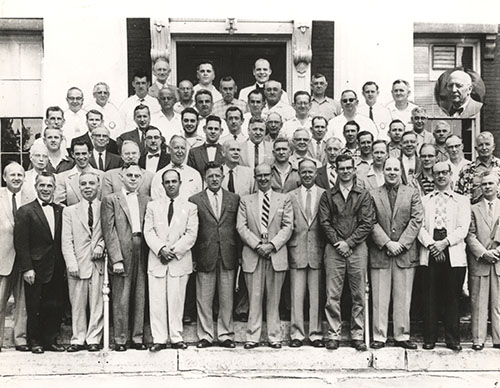
ALBION – This picture taken of the Albion Rotary Club in 1959 or 1960 is a literal Who’s Who of local business men at the time. Although I knew most of these men, my thanks goes out to Brad Shelp for help identifying several faces in the photo.
Front row, from left: Bill Monacelli, teacher/mayor; Don Nesbitt, farmer; Charles Martina, theater owner; unidentified; Harlan Harvey; Wells Harrison, car dealer; Jacob Schanels, Hunt Canning Factory; Dr. Bob Raemsch, veterinarian; Guido Monacelli, food store; Dr. Thomas Orlando, dentist; and George Brunelle, insurance agency.
Second row: Hon. Charles Signor, county judge; Charles Byrne, Birdseye Lab; Franklin Cropsey, attorney; Stanley Landauer, dry goods; Richard Fenton, Bemis Bag; Bill Snowden, Firestone Store; Sidney Eddy, printing; Dr. James Parke, MD; Bob Babbitt, hardware; and Ed Archbald, farmer.
Third row: Brad Shelp, car agency; Neal Beach; Winton Hatch, Department of Labor; Thomas Heard Jr., Marine Bank; R.E. Greenlee, Hunts; Carl Bergerson, Albion Central School superintendent; Roland Kast, service station; Dr. John Ellis, MD; and Dr. John Jackson, dentist.
Fourth row: Bob Root, insurance; Thomas McNall, furniture/funeral director; Arthur (Dick) Eddy, printing; Richard Hollenbeck; “Skip” Landauer, dry goods; George LaMont, farmer; Richard Bloom, insurance; Bill Host, school administrator; Albert Raymond, insurance agent; Francis Blake Jr., cold storage.
Fifth row: Lee Morneau, Liptons; Lee Maine, lumber company; Leonard Depzinski, sign painter; Daniel Marquart, appliance store; Homer Marple, furniture; Ray Severns, auto sales; Sam Shelp, auto agency.
Sixth row: Roy Merrill, funeral home; Gordon Gardner, pharmacist; Walter Martin; James Lonergan, journalist; Henry Keeler, construction; Carlton Wilkinson, electrical store; John Merrill, funeral director; Harold Farnsworth; Rev. Earle Hamlin; Frank Sachali, produce; and Rev. Jack Hillary Smith.
Inset: Homer Luttenton, who was sick at the time.
Years ago the Rotary Club met for lunch at the Presbyterian Church and then later at the United Methodist Church. It was an easy walk across the street to gather on the front steps of the Orleans County Courthouse when this photo was taken. The Albion Rotary Club was founded on April 20, 1922 with 21 charter members who adopted the constitution of Rotary International.
(Editor’s note: The Rotary Club now meets every Thursday for lunch at The Village Inn. Women were excluded from Rotary until a Supreme Court ruling in 1987 opened service clubs to women. Today, about 40 percent of the Albion Club’s membership is women. Brad Shelp remains part of the club today. He has perfect attendance for more than 50 years.)
By Tom Rivers, Editor Posted 5 January 2014 at 12:00 am
First County Legislature took office in 1980
ALBION – In 1980, the first Orleans County Legislature took office after the former Board of Supervisors was disbanded. The new Legislature included front row, from left: Francis S. Nayman, District No. 3 (Albion and Gaines); James Murphy, administrative assistant; Stanley Dudek, at-large (west); Uldine Juhrs, clerk; and Arthur Eddy, at large (central).
In Back: Frank Berger, District No. 2 (Ridgeway and Yates); Raymond Cook, District No. 1 (Shelby, Barre and Clarendon); Thomas Young, attorney; James Piedimonte, at-large (east); and Lyndon Billings, District No. 4 (Carlton, Kendall and Murray.)
For more than 150 years, Orleans County’s government was run by a board of town supervisors. Each of the 10 towns had a town supervisor who not only was the chief executive officer for each town, but also managed the affairs of the county government.
Not everyone thought that was the best way for a county government to function. The bigger towns – Ridgeway and Albion – have about two to three times the populations as the smaller towns in Barre, Kendall, Carlton and Clarendon.
A lawsuit was filed in the 1970s that sought to end the Board of Supervisors and switch to the County Legslature.
I believe the lawsuit contended the Board of Supervisors wasn’t fair to the bigger towns, because the votes from those supervisors counted the same as the votes for the supervisors from the smaller towns. Some counties have a weighted-voting system to account for the population differences.
After the lawsuit in the 1970s, the county created a new seven-member County Legislature. The new setup created four districts that were nearly the same in population, plus three county-wide positions. The system allows residents to vote on the majority of the Legislature every election cycle because they vote for their district representative and the three at-large seats.
The legislative chambers in the County Clerks’ Building includes the photos of each Legislature team since 1980. (There are also many photos of the Board of Supervisors.)
I’ve heard a lot of people say they liked the Board of Supervisors better because the town supervisors seemed more connected to residents and aware of the goings on in the community.
Others have said that form of government clearly favored the towns and left the villages at a disadvantage. I’ve also heard some complaints that some of the town supervisors didn’t bring a countywide approach to decisions at the county level. Sometimes they could be parochial, trying to serve their respective town rather than the county.
ALBION – In this photo taken on May 7, 1959, we see the groundbreaking for the Orleans County Nursing Home and Infirmary, now known as The Villages of Orleans Health and Rehabilitation Center on Route 31 in Albion.
Pictured include, from left: Milton Bowen, Clarendon town supervisor; Justin Robert, Shelby town supervisor; Victor Hawkes, welfare commissioner; Harold Hill, Barre town supervisor; and William Knights, Ridgeway town supervisor. (At the time the county was led by the Board of Supervisors – the town supervisors from the 10 towns. The County Legislature replaced that board in 1980.)
Hill was chairman of the Board of Supervisors at the time while others in the picture served on the building committee for the project.
ALBION – Our photo illustrates a form of skiing that was popular in the 1920s. We do not advise anyone to attempt this dangerous sport.
Here we see the skier holding on to a tow rope, which is attached to the auto. We believe this photo was taken on Gaines Basin Road, looking north in the town of Albion between Allen and Phipps roads.