By Tom Rivers, Editor Posted 12 May 2022 at 8:37 am
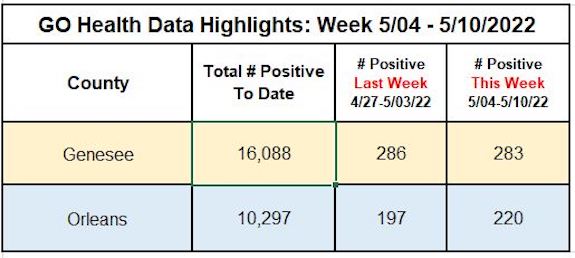
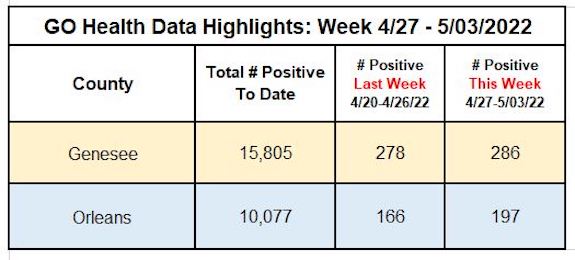
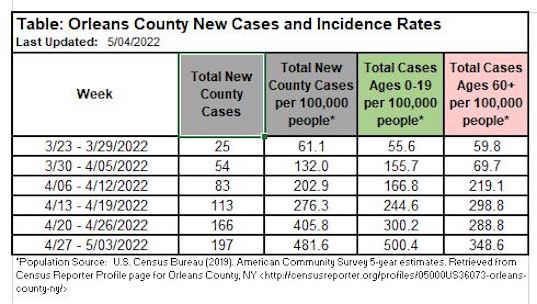
Orleans County continues to see an increase in Covid cases, with 220 from May 4-10, which is up from the 197 the previous week.
The county also had two more Covid-related deaths and now has had 116 residents pass away from Covid during the pandemic that started in March 2020.
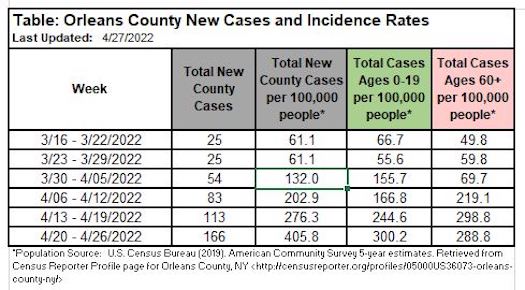
There were 54 confirmed Covid cases in the county from March 30 to April 6. In the following weeks the cases increased to 83 (April 6-12), 113 (April 13-19), 166 (April 20-26) and then 197 (April 27-May 3), according to data from the Genesee & Orleans County Health Departments.
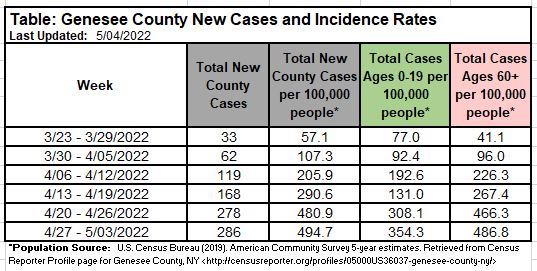
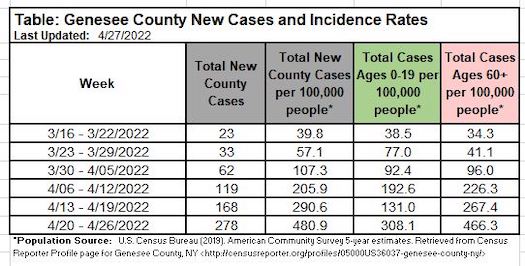
Genesee County also experienced an increase in cases each week for about two months – until this past week, when the cases dropped from 286 from April 27 to May 3, to 283 from May 4 to May 10.
Genesee also reported another Covid-related death in the past week and now is at 187 during the pandemic.
Statewide the 7-day positivity rate is 7.18 percent. It’s much higher in the Finger Lakes region. Those nine counties, including Orleans, are at 13.34 percent over 7 days. The positivity rate is only higher in Western New York at 18.33 percent. The rate is lowest in New York City at 4.80 percent.
“Getting fully vaccinated and staying up to date on booster doses is a key way to prevent serious illness and hospitalization from Covid-19,” Governor Kathy Hochul said in a statement on Wednesday. “I want to thank the more than 75 percent of New Yorkers who have gotten fully vaccinated and are keeping their communities safe and healthy.”
By Ginny Kropf, correspondent Posted 10 May 2022 at 9:05 pm
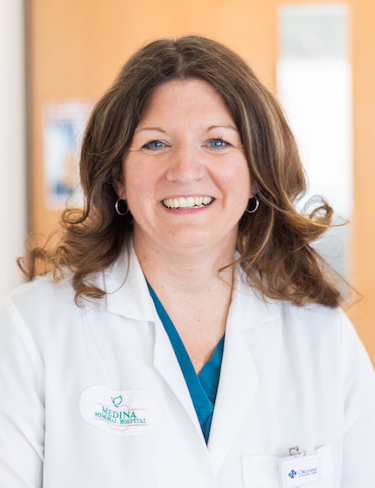
Provided photo: Kim Gray, chief nursing officer at Orleans Community Health, is one of 14 finalists for the 2022 Community Recognized Distinguished Nurse Award.
MEDINA – Orleans Community Health has learned one its nurses, Chief Nursing Officer Kim Gray, is one of 14 finalists for the 2022 Community Recognized Distinguished Nurse Award.
The announcement appeared over the weekend in The Buffalo News, which ran the competition.
The award recognizes a nurse who has long provided care for individuals with serious illness and their families in a manner that has clearly gone well beyond the usual and expected requirements.
A nurse chosen for this award is one whose clinical practice is exemplary and who is generous in mentoring other clinicians. The form on which Gray and other nurses were nominated states the award, in these unprecedented times, “celebrates the courageous Western New York nurses who put the needs of their patients and community first.”
Gray has been employed at Orleans Community Health for 19 years. While she doesn’t know who nominated her, she thanks whoever it was around her who submitted her name.
“I’m blessed to be able to work in my community hospital, to take care of the patients in my community and to work every day with those who want to see this hospital flourish,” Gray said. “I love this team, this hospital, the community and everyone around me. Being a finalist for this award is an amazing honor. More so that someone felt I was worthy of the nomination. I really love what I do. It’s my purpose.”
Scott Robinson, director of marketing, communication and outreach for OCH, shared a bit of information about Gray.
“We’ve all heard the name Nancy Albanese, one of the true giants in the history of Medina Memorial Hospital,” Robinson said. “Albanese would eventually become a resident of the North Wing, and when patients were taken to the surgery department on the third floor, Gray would get a wheelchair and take Albanese up there. She would hand Nancy a clipboard and let her be in her element. If Nancy Albanese had a last hurrah at Medina Memorial Hospital, it was probably thanks to the memories Kim Gray gave her during those days.”
Albanese, a recovery room nurse for 40 years, died about two years ago, and the Recovery Room has since been remodeled and named in her honor.
Winner of the award was Kymmarrie Knose-Weibel from Roswell Park Comprehensive Cancer Center.
By Ginny Kropf, correspondent Posted 10 May 2022 at 8:44 am
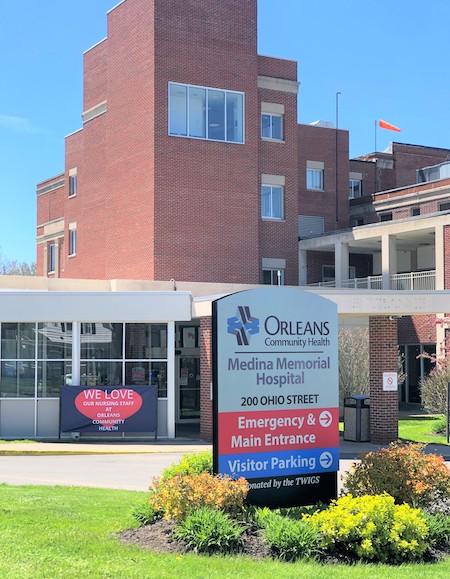
Contributed photo: Orleans Community Health in Medina has a week of special activities planned in observance of National Nurses Week and National Hospital Week. A sign near the front entrance proclaims “We love our nursing staff.”
MEDINA – Orleans Community Health has two reasons to celebrate this week. May 6 to 12 is National Nurses Week and May 8 to 14 is National Hospital Week.
Various activities have been planned throughout the hospital, beginning with a luncheon held on May 6 to honor National Nurses Day.
Both week-long celebrations will highlight the nearly 300-person team within Orleans Community Health and the positive impact they have on the larger community, Scott Robinson, director of marketing, communications and outreach, said in a press release.
Nurses Week will conclude with a birthday celebration Thursday for Florence Nightingale, who is credited with founding modern nursing. Throughout the week, the nursing team will be showcased on social media and with internal announcements.
Kim Gray, chief nursing officer, has organized events for the nursing tea, including adding a banner to the exterior of Medina Memorial Hospital.
“I have the honor of working every day with the skilled and dedicated nursing team within Orleans Community Health,” Gray said. “I wouldn’t trade this group for any other.”
The theme of National Hospital Week is “We are Healthcare,” as determined by the American Hospital Association. Orleans Community Health will further expand on this theme by placing several departments in the spotlight throughout the week.
“While the doctors and nurses rightfully receive a lot of credit when thinking about a hospital, there are so many others who complete our hospital team,” Robinson said. “Our team in environmental services, purchasing, admissions and so many others are just as important to our overall functionality. They help make sure the day-to-day operations run smoothly.”
A committee organized by Joanna Miller, vice president of risk, quality and disaster management, has planned events for the team at Orleans Community Health every day during the week. This includes friendly competitions (Olympics and trivia), a cook-out and even a market and vendor fair. At the Twig Association banquet a week ago, hospital CEO Mark Shurtz announced there would be a first-time dunk tank on Friday, for which he has volunteered.
“National Hospital Week is always an opportunity to have a little more fun,” said Miller. “In addition to that, we want to thank members of our local business community for donating gift cards that will be used as prizes at the end of the week. There’s no question, our community always shows up.”
Shurtz said the last two years have added challenges for their team, challenges they have faced admirably.
“As we maneuver what the future holds, this week is our opportunity to commend our strong team at Orleans Community Health,” Shurtz added. “Whether you’re at Medina Memorial Hospital, the Albion Healthcare Center, either of our dialysis centers or the Middleport lab, you matter to us and the entire community.”
By Tom Rivers, Editor Posted 4 May 2022 at 8:17 pm
Orleans County has passed a milestone in the two-plus years of the pandemic: 10,000 cases.
The county had 197 new confirmed cases in the past week (April 27 through May 3) and now has had 10,077 confirmed cases since March 2020, according to data from the Genesee & Orleans County Health Departments.
The two counties, Genesee and Orleans, also hit a grim milestone with 300 deaths from Covid during the pandemic. Genesee and Orleans each reported a Covid-related death in the past week. Genesee now has 186 deaths and Orleans 114 due to Covid.
Orleans has 40,343 residents, according to the 2020 Census. The 10,077 cases represent about 1 for every 4 residents, although some residents have contracted Covid more than once.
Genesee County, which has 58,388 residents, has 15,805 cases during the pandemic, which is also about 1 for every 4 residents.
The cases continue to increase each week since mid-March. The 197 in Orleans the past week is up from 166 the previous week (April 20-26) and 113 the week before that.
Genesee is reporting 286 new cases from April 27 to March 3, and 278 the week before that, and 168 from April 13-19.
State-wide the 7-day average for positive tests is 6.94 percent, but it’s much higher in the Finger Lakes Region, which includes Orleans. That region is at a 13.02 percent positive over the past seven days. Western New York is the highest at 17.48 percent and New York City is the lowest at 4.44 percent.
Medications reduce withdrawal and cravings which decreases the use of illicit drugs and overdoses
By Mike Pettinella, GCASA Publicist
Provided photo: Melissa Weingarten, right, Wyoming County Jail nurse, makes a point as Kathy Hodgins, chief clinical officer at Genesee/Orleans Council on Alcoholism and Substance Abuse, during the GOW Opioid Task Force meeting at The Recovery Station on Clinton Street Road.
BATAVIA – No matter what term is used – and there are several of them, the practice of combining medication and treatment for people struggling with substance use disorder has a singular goal: Saving lives.
“Medication-Assisted-Treatment – or MAT – is an evidence-based program that has been shown to make a positive difference in saving lives for persons with an opiate use disorder. And it’s considered the gold standard for treatment of opiate use disorder,” said Ann Bowback, clinical director at Spectrum Health & Human Services in Warsaw.
Bowback is the project director for the Partnership to Address Opioid Epidemic and Save Lives in Western New York Through Medication-Assisted-Treatment, a program funded by the federal Substance Abuse and Mental Health Services Administration.
Speaking at the GOW Opioid Task Force quarterly meeting recently, she explained that her program, in collaboration with Evergreen Health, is looking to increase the number of persons receiving MAT within the Spectrum agencies by at least 200 per year.
“We work to link people with a prescriber the same day, if possible, but at the latest within 72 hours of their initial visit with us,” she said. “We also will add two additional data waiver subscribers per year in order to meet the needs of these additional 200 people. And with this grant, our goal is to ensure that all the MAT clients are offered peer services (recovery advocates) within 60 days of admission.”
Other speakers at the meeting, which took place at The Recovery Station on Clinton Street Road and provided access via Zoom videoconferencing, were Melissa Weingarten, Wyoming County Jail nurse, and Kathy Hodgins, chief clinical officer at Genesee/Orleans Council on Alcoholism and Substance Abuse.
Bowback said most substance use disorder providers along with jails and prisons are taking a “whole patient approach” to treatment.
“MAT is more than just medication,” she said. “For some members of the recovery community, including our Evergreen partner, they refer to this as MAR – medication-assisted-recovery. This can be a referred term for some people because it emphasizes a person’s commitment to recovery while using medications, and they may or may not be involved with treatment.”
She also said it can be referred to as MOUD (medications for opioid use disorder), which zeroes in on the importance of medication and addressing opiate use, and also as OTP (opioid treatment program) or OBOD (office based opiate treatment).
“PWUD stands for people who use drugs as we’re ideally trying to get away from some of the stigmatizing language like addicts and things like that,” she added. “OUD stands for opiate use disorder and OTP is where you would get medication such as methadone.”
Currently, the Food & Drug Administration has approved three medications for treatment of opiate use disorder – methadone, naltrexone and buprenorphine, Bowback said.
“All medications work a little differently, but all basically normalize brain chemistry in order to reduce cravings and withdrawal symptoms,” she noted. “Methadone was first used in 1947 to treat opioid addiction and critics complained at that time that methadone merely exchanged one drug for another which led to strict government control over methadone, and that continues today.
“Now, in order to receive methadone for an opiate use disorder, you have to obtain it from an OTP. And although methadone is very effective, some individuals are hesitant to take this medication.”
Bowback said Spectrum offers naltrexone (brand name, Vivitrol), which was approved to treat opiate use disorder in 2010.
“The extended-release formulation is generally preferred for the treatment of opiate use disorder,” she said. “But some individuals do still prefer the pill form. Our prescribers will typically start a person on the pill form prior to prescribing the injection just to ensure the person is able to tolerate it. In order to receive this medication, though, the person cannot have opiates in their system; otherwise, they’ll experience withdrawal. So, you must be abstinent for at least seven days.”
Spectrum also offers buprenorphine (also known as suboxone) for MAT, she said. In the 60s, buprenorphine was developed for treatment of pain and approved for treatment of opiate use disorder in 2002.
“Unlike methadone, a person almost immediately receives a seven-day script and within a very short time is able to receive a script for 28 days, which results in less daily disruption to lifestyles,” she advised. “You don’t have to be present at a clinic daily … and you don’t have to be abstinent for seven days in order to receive the medication.”
Medications reduce withdrawal and cravings and, as a result, decreases the use of illicit drugs and overdose, stabilizes the brain and “most of all, saves lives,” Bowback said.
“It also socially decreases criminal activity and reduces risk of transmission of communicable diseases, reduces risky sexual activity, and increases engagement with treatment.”
MAT is at the core of services at GCASA, which offers an integrated treatment and OTP clinic at its main location in Batavia as well as clinical services at its Orleans County location in Albion, Hodgins said.
“When I started at GCASA in 2002, we were already doing medication-assisted-treatment with alcohol, using naltrexone to treat alcohol dependence,” she said. “And then shortly after, we did start using buprenorphine – suboxone for opiate use disorder individuals that came in.”
Hodgins said GCASA counselors and medical professionals treat medication for substance use disorder “similar to any kind of medication that you take.”
“So, those on medication are definitely in recovery – it just assists with the recovery. And it really does help reduce the cravings and the physical withdrawal.”
Weingarten shared that Wyoming County Jail started its MAT program in early 2020, offering suboxone and naltrexone.
“We provide medication to those who have been on MAT programs in the community, as long as we can verify that they’ve been in treatment and continued to get it,” she said.
She also mentioned that Gov. Kathy Hochul signed legislation that requires all prisons and jails, beginning in October, to provide MAT to inmates.
“So, we’ve started that way before she’s required it,” she said, adding that the jail program includes individual and group counseling – and connection to peer recovery advocates.
Hodgins said “it just makes sense” to keep incarcerated people on medication, especially considering the rising overdose rates. GCASA provides services to inmates in six jails or prisons, including Genesee, Orleans, Albion, Groveland, Wyoming and Attica.
“Our common goal in our community is to save lives and I’m grateful that the state is on board with that,” she said. “I believe the best way to proceed is to start with a thorough assessment while they’re in jail and getting them on the right medication prior to release. That is how we’re going to save additional lives in our community.”
Both counties still high in obesity, adult smoking
Press Release, Genesee & Orleans County Health Departments
According to the 2022 County Health Rankings, released by the Robert Wood Johnson Foundation (RWJF) and the University of Wisconsin Population Health Institute (UWPHI), Genesee and Orleans Counties rank 38th and 54th respectively in overall Health Outcomes. The Rankings are available at www.countyhealthrankings.org.
“As Chief Health Strategists, we use the County Health Rankings to help us identify factors that are important for residents to live long and healthy lives and understand how we compare to other counties in the state. With this knowledge, we work collaboratively with our partners to improve the health of our community,” stated Paul Pettit, Director of the Genesee and Orleans County Health Departments (GO Health). “The county with the lowest score (best health) gets a rank of #1 for that state and the county with the highest score (worst health) is assigned a rank corresponding to the number of total counties ranked in each state. New York State has 62 counties.”
The rankings are broken into to two main categories: Health Outcomes, which include length of life and quality of life, and Health Factors which include health behaviors, clinical care, social and economic factors and physical environment.
The 2022 County Health Rankings findings are:
Genesee County ranked 38 in Health Outcomes and 16 in Health Factors in 2022 as compared to 43 out of 62 counties for Health Outcomes in 2021, a decrease in rank as compared to 2022 and 28 in Health Factors a decrease from 2021.
Orleans County ranked 54 in Health Outcomes and 55 in Health Factors in 2022 as compared to 60 in Health Outcomes in 2021, a decrease in rank as compared to 2022 and 53 in Health Factors an increase in rank from 2021.
“The County Health Rankings show us that where people live plays a key role in how long and how well they live,” stated Pettit. “The Rankings allow local leaders to clearly see and prioritize the challenges they face — whether it’s rising premature death rates or the growing drug overdose epidemic — so they can bring community leaders and residents together to find solutions.”
According to the 2022 Rankings, the five healthiest counties in New York State starting with most healthy are Putnam, followed by Tompkins, Saratoga, Nassau and New York. The five counties in the poorest health, starting with least healthy are Bronx, Sullivan, Cattaraugus, Montgomery and Chemung.
“The County Health Rankings show how Genesee and Orleans Counties rank on factors that influence its overall health ranking,” said Pettit. “For example, Genesee County had a decrease in preventable hospital stays from 4,748 in 2021 to 3,354 in 2022. Genesee County also had a decrease in adults smoking from 23% in 2021 to 19% in 2022. Orleans County had a decrease in the percentage of adults who smoked from 25% in 2021 to 21% in 2022. Additionally, Orleans County had a decrease in the percentage of adult obesity from 37% to 32%.”
Even with the above mentioned positive trends, both counties continue to have challenge areas and are still struggling with health factors specifically with obesity (Genesee – 33% / Orleans – 32%), adult smoking (Genesee – 19% / Orleans – 21%), and local access to clinical care for primary care physicians, dentists and mental health providers. Although the numbers for adult smoking did decrease for both counties, we are still above the top U.S Performers at 15% and New York State at 13%.
The Rankings have become an important tool for communities that want to improve health for all. Working collaboratively with community partners in Genesee, Orleans and Wyoming Counties (GOW), Genesee and Orleans counties are currently working on the GOW 2022-2024 Community Health Assessment and Community Health Improvement Plan to determine the New York State Prevention Agenda priorities to focus on over the next three years.
We analyze the Rankings along with New York State data and community input from the Community Health Assessment survey and Community Conversations with various community groups and county residents. If you have not completed a survey you can access the English survey online here or the Spanish survey online here.
By Tom Rivers, Editor Posted 27 April 2022 at 9:29 pm
Charts courtesy of Genesee and Orleans County Health Departments
The latest update from the Genesee and Orleans County Health Departments shows Covid-19 cases continue to climb locally.
In Orleans, the cases are up 47 percent in the past week (April 20-26) or from 113 from April 13-19 to 166 the past week.
In Genesee, the cases went up 65 percent, from 168 to 278.
GO Health attributes the increase to the new Omicron variant BA.2, which spreads more easily than other earlier variants, local public health officials said.
The Centers for Disease Control and Prevention last week changed the community spread level for Orleans from low to high, and Genesee from low to medium.
Statewide there were 7,693 new cases reported on Tuesday out of 109,304 tests for a positivity of 6.70. The seven-day average for positive tests state-wide is 7.09 percent. However, the Finger Lakes Region which include Orleans and eight other counties is the second highest of the 10 regions with a positivity of 13.93 percent over the past seven days. Western New York is the highest at 16.54 percent. New York City is the lowest at 4.48 percent.
By Tom Rivers, Editor Posted 26 April 2022 at 4:05 pm
Oak Orchard Health says unit will function as primary care site
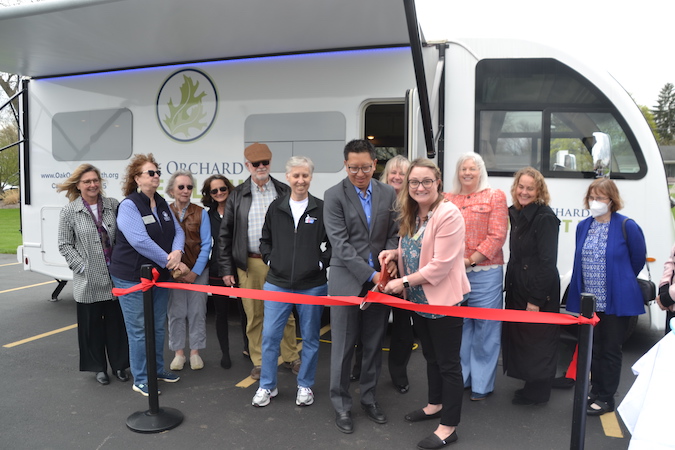
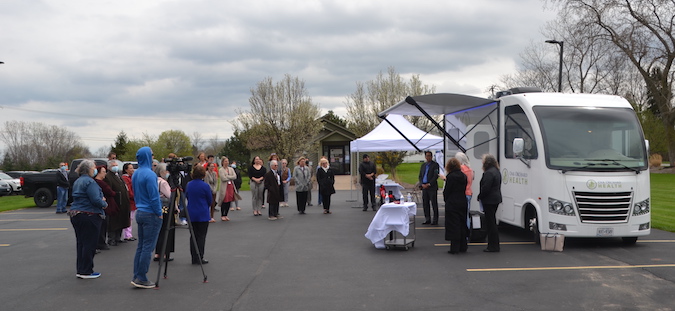
Photos by Tom Rivers
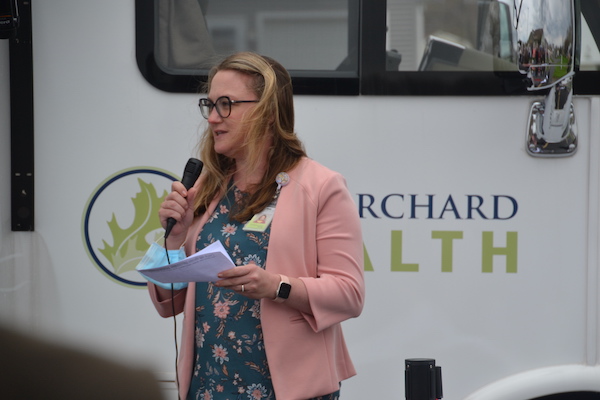
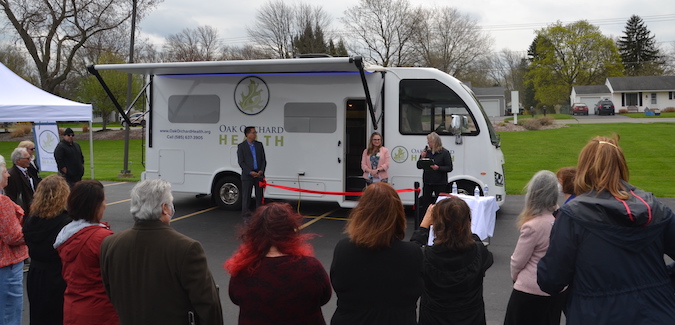
BROCKPORT – Oak Orchard Health today celebrated a new mobile medical unit that will function as a primary care site, brining healthcare to Orleans, Genesee, Monroe and Wyoming counties.
Holding the scissors are Dr. Danielle Renodin-Mead, Chief Medical Officer for Oak Orchard; and Dr. Michael Mendoza, Commissioner of Public Health for Monroe County.
The new unit was paid for with support from the John R. Oshei Foundation in Buffalo.
Mendoza said the mobile medical unit will help bring much-needed medical care to people with transportation issues. The Covid-19 pandemic revealed a gap in access to care for many people, he said.
Dr. Danielle Renodin-Mead said the site has an exam room, EKG machine, lab (for urine, cholesterol and diabetes), and space for well visits, immunizations and vision and mental health screenings.
“There is everything for primary care on this unit,” she said.
Mary Ann Pettibon, CEO of Oak Orchard in front at right, said Oak Orchard will work with local health departments, and agencies that serve homeless people and Head Start children to bring access to medical care.
“We are taking this state-of-art mobile unit to those who need us the most,” she said.
Oak Orchard also plans to work with other agencies, including Community Action, to “serve those disproportionately affected by the lack of medical care,” Pettibon said.
Oak Orchard operates 12 health care sites. The organization also will soon be unveiling a new mobile dental unit.
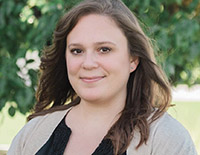
By Erika Pozzuolo, LMHC, PMH-C, Maternal/ Child Health Lead Therapist, Oak Orchard Health, a community health center with 11 locations in the region
You have given birth to your baby, what an exciting time! It can also be an overwhelming time with the middle-of-the-night feedings, sleep deprivation, and maybe there are more children to care for.Wow!
If you can think of seven women you know who have had a baby– statistics suggest that at least one of those women experienced postpartum depression or anxiety (Postpartum Support International)! This is only part of the reason that this year Oak Orchard Health launched our new Mommy and Me program in all locations. This program is an extremely innovative approach to improve child health outcomes in our region, and not only that but to also improve maternal health outcomes, with special attention to mental health in the postpartum period.
This support through the Mommy and Me Program extends to guardians of pediatric patients under the age of 5 at Oak Orchard Health. Patients now, as standard practice, will bemet by a care manager in several of their child’s well visits, from birth to age 4 ½. Through some questions and interviewing, we can identify and help address any needs the family may have. Care managers will be evaluating for postpartum depression and anxiety, and then refer patients to one of our behavioral health counselors specializing in perinatal mental health.
You now have a care manager on your medical team
These care managers will also be helping to track children’s vaccination due dates, referrals for the first dental visit, and more. We will help fill in the gaps financially by referring to WIC (a supplemental nutrition program for Women, Infants, and Children), as well as maintaining a diaper bank to help supplement families struggling with the cost of diapers. This initiative also includes an early literacy program, where pediatricians will be providing age-appropriate books at well visits and education for parents on how to best help their child develop literacy and language.
Why this new program?
The initial idea for Mommy and Me came from our Medical Director and Pediatrician, Dr. Danielle Renodin-Mead. She brought to our attention that the U.S. has some of the poorest health outcomes for children and their birth mothers. Just one large contributing factor to this is our cultures’ approach to postpartum mental health, as well as the stigma that often surrounds this. That stigma is a barrier to mothers seeking the necessary care they need. Most people may have some awareness of “the baby blues,” a very commonly experienced emotional expression of hormonal shifts that take place following the birth of a baby and lasts up to about two weeks postpartum.
There are, however, many new moms who present as more serious than typical “baby blues.” That often means it lasts longer and can be very debilitating. If left unidentified or untreated, these mood or anxiety disorders can have a significant impact on family, sleep, ability to breastfeed, and overall wellness, negatively impacting both Mom and baby. Fathers also commonly experience anxiety and depression. We also will be paying special attention to other guardians, like grandparents or adoptive parents taking in babies.
The Mommy and Me Program at Oak Orchard Health
Part of our team’s mission for the Mommy and Me Program is to break down the barriers to treating postpartum mood and anxiety disorders, such as depression, anxiety, panic disorder, obsessive-compulsive disorder, post-traumatic stress disorder, and psychosis. We want to send the message that these things are somewhat common and very treatable. Oftentimes we already have risk factors prior to pregnancy, that can make us more likely to develop a postpartum mood disorder.
Oak Orchard Health’s Mommy and Me program is also here to support women and families who are experiencing infertility, infant loss, or birth traumas, through counseling support. It’s been my experience that a great deal of shame weighs on women who experience postpartum depression, intrusive thoughts, and intense anxiety, after bringing their baby home. However, when given the right information and platform to share, so many women can identify with these experiences. The more we open up the conversation about postpartum mental health, the more women and families can possibly prepare, or recognize the signs, and seek support earlier.
Coincidently, most of our providers involved with Mommy and Me are also women, and mothers themselves, passionate about supporting the women of our communities and seeing families thrive. We have been so excited to see this program come to life, set an example of support, bring awareness, and maybe even inspire other similar programs to be developed elsewhere.
Because of the Covid pandemic, some children have missed or delayed routinely recommended vaccinations
Press Release, Genesee & Orleans County Health Departments
National Infant Immunization Week is April 24-30. This is an annual observance highlighting the importance of protecting children two years and younger from vaccine-preventable diseases. In the spirit of National Infant Immunization Week, we encourage parents and caregivers to take time to learn about vaccines.
“Childhood vaccinations are one of the best ways to protect infants and children from vaccine-preventable diseases before the age of 2,” stated Paul Pettit, Public Health Director for Genesee and Orleans County Health Departments (GO Health).
Vaccinations not only play a key role in protecting our children from 14 vaccine-preventable diseases such as polio, mumps and the measles, they also protect our community. They are the most successful and cost-effective public health tool available for preventing and reducing the spread of infectious diseases as well as preventing death.
Because of the Covid-19 pandemic, some infants and children have missed or delayed routinely recommended vaccinations.
“Children who may have missed or skipped vaccinations may be at an increased risk of diseases like whooping cough (pertussis) and the measles, which can be serious,” Pettit said. “That is why it is important to stay on track with well-child visits and the recommended vaccination schedule. Please check with your healthcare provider to make sure your children are up to date on their routine vaccinations.”
To learn more about vaccinations and to view the latest immunization schedule visit www.cdc.gov/vaccines or speak with your healthcare provider.
For more information on GO Health’s Immunization Clinics, visit GOHealthNY.org. You can also contact your respective health department:
Both Genesee, Orleans counties report more Covid cases due to new variant BA.2
Press Release, Genesee & Orleans County Health Departments
The Genesee and Orleans County Health Departments (GO Health) are seeing an increase in the number of people who have tested positive for Covid-19. This recent increase in Covid-19 cases is due to the new Omicron variant BA.2, which spreads more easily than other earlier variants.
“We are looking at Covid-19 community levels of high for Orleans and medium for Genesee,” stated Paul Pettit, Director of the Genesee and Orleans County Health Departments.
According to the Centers for Disease Control and Prevention’s weekly metrics used to determine the Covid-19 community level that was updated April 21, Orleans County case rate per 100,000 (this calculation is used to compare larger and smaller counties) is now at 203.21. The new Covid-19 admissions per 100,000 is at 12 and the percentage of staffed inpatient beds in use by patients with confirmed Covid-19 is 4.6%.
“This updated data now places Orleans at a high community level,” Pettit said. “With this increase it is important for everyone, especially those at higher risk of complications to be more attentive with their public health prevention practices.”
Genesee County is currently at medium Covid-19 Community Level: Case rate per 100,000 population is at 19.29. New Covid-19 admissions per 100,000 is 12 and the percent of staffed inpatient beds in use by patients with confirmed Covid-19 is 4.6%.
To learn more on how community levels are determined, visit the CDC by clicking here.
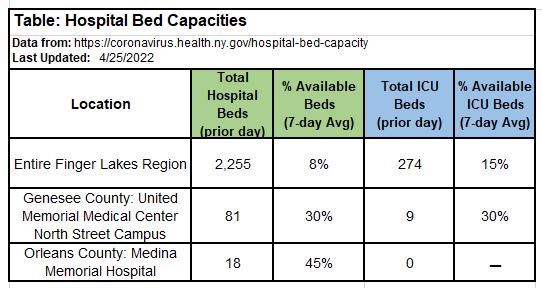
With any new Covid-19 variant circulating, it is not a surprise to see an increase of positive cases. Even with this increase, our health care capacity in the region currently remains stable with the normal bed capacity levels. Generally, the omicron variant (Omicron BA.2) causes more mild symptoms, although some people may have more severe symptoms depending on their Covid-19 vaccination status, the presence of other health conditions, age, and history of prior infection.
We encourage those that have not been vaccinated and those who are not up-to-date on their Covid-19 vaccination, to be vaccinated and to talk with their primary care provider. You can register for Covid-19 vaccination clinics (click here) or check with your pharmacist, primary care provider, or the vaccines.gov website for other vaccination providers.
We continue to encourage residents to practice the following public health precautions to lower exposure to the virus, especially those who are at higher risk:
Wash your hands frequently with soap and water and keep your hands away from your face.
If you are sick, stay home, get tested and talk with your primary care provider.
If you test positive for Covid-19, self-isolate and let your close contacts know to watch for symptoms and that they should consider being tested.If you are required to submit paperwork to your school or employer, you can access that here.
Consider wearing a tight fitting facemask when you are in crowded public places.
Agency’s counselors see increasing demand for services with nearly 500 patients
Provided photo: Pictured from left include Holly Main, assistant director; Kathy Hodgins, chief clinical officer; and Danielle Ludeke, integrated clinic director, at Genesee/Orleans Council on Alcoholism and Substance Abuse.
By Mike Pettinella, GCASA publicist
By integrating the opioid treatment program and outpatient counseling clinic, Genesee/Orleans Council on Alcoholism and Substance Abuse has connected the care warranted in a society dealing with the effects of a global pandemic and the stress caused by economic uncertainty.
“Here at GCASA and, hopefully, at other agencies in the behavioral health field, we take a person-centered approach, and medication and treatment go hand-in-hand,” said Kathy Hodgins, chief clinical officer at the nonprofit agency based on East Main Street in Batavia.
The medication prescribed to a person struggling with substance abuse disorder, whether it be suboxone or methadone, is going to help with the physical symptoms, Hodgins said, while counseling with GCASA trained clinicians is important in unlocking changes in behavior.
“It’s the same with a medical condition, such as diabetes and heart disease. You can give a medication to lower blood pressure, but it’s not going to be as effective if you do not have a change in lifestyle to go along with it,” she added. “We give them the tools, not just medication, to learn how to cope with anxiety, depression and trauma without using illicit drugs.”
The OTP (or methadone) clinic attached to the back of the main building opened in the fall of 2018 as a “standalone” clinic. Hodgins said GCASA recently applied for – and received – a license to integrate the OTP clinic with the outpatient clinic.
“Until now, individuals receiving treatment at the OTP clinic could only participate in services offered through the OTP clinic. This really limited treatment options for individuals in the OTP,” she said.
Staffing flexibility is paramount
With the integration, GCASA has been able to optimize the utilization of its medical professionals and counselors, she said.
“This really allows our counselors to help our patients at the OTP and outpatient clinic by providing a more person-centered approach to care – regardless of whether the individual is on suboxone or methadone. Patients can now attend groups and individual sessions that fit their individual recovery plan and needs,” she explained.
Shannon Murphy, director of treatment at the Batavia clinic, said the integration has additionally resulted in scheduling flexibility for the staff, something of utmost importance in light that about 10 full-time counselors are providing services to around 240 patients in OTP and another 220 or so in the outpatient clinic.
The demand for services has gone up considerably in the past two years, she said, referring to the impact the Covid-19 pandemic has had on those at risk of a reoccurrence as well as other societal factors.
Along with substance use disorder counselors, GCASA’s Batavia clinic also employs a medical director, assistant director, clinical supervisors, two nurse practitioners, five full-time nurses and a physician’s assistant.
Fentanyl: a game-changer
Having the proper number of medical personnel on staff has taken on added significance with the emergence of the deadly drug fentanyl, Murphy said.
“Fentanyl has dramatically changed our work as people are sicker now than ever before,” she offered. “Treatment methods that used to help people – prior to the opioid epidemic are just not enough anymore. Medication Assisted Treatment has become a vital part of the services we offer.
“Before we can start to help someone heal from an opioid use disorder, people need to physically feel better. Fentanyl has made this more challenging due to how harmful it is and how prevalent it has become.”
Murphy said that five or six years ago, individuals would test positive for heroin, for example, and they would be shocked when they learned they also had fentanyl in their system.
“At that time, they were scared. Now, they come in and they’re positive for fentanyl only and they are not afraid of it because they don’t think they will be the next to overdose,” she said. “Similar to when we drive too fast or check a text on our phone while driving. We don’t think getting hurt will happen to us, until it does.”
Allison Parry-Gurak, director of Residential Services, said tests are showing that fentanyl is present in many illicit substances, not just heroin.
“For example, we have individuals with a stimulant use disorder whose primary substance is cocaine. More and more frequently, we are finding when we test them they are also positive for fentanyl but they have no history with opioids.” she said.
The scariest part of the fentanyl epidemic is the frequency of overdose.
“We’ve gotten phone calls from agencies in Rochester and reporting they’ve had six overdoses,” Murphy said. “The hardest part is that the people we see that are having fatal overdoses are patients who have gone long periods without use. And then for various reasons or circumstance they have a reoccurrence, sometimes only one time, and those are the people that are dying because their bodies aren’t used to the fentanyl.”
A continue of care
Parry-Gurak oversees the Atwater Community Residence, as well as several other residential programs offered by GCASA. She said the agency’s ability to expand services over the years gives patients a greater chance in their recovery.
“Well, I think the beauty of this campus is that we pretty much offer the whole continuum of care all on one campus. Additionally, all of our programs have such great working relationships with each other and are able to work collaboratively to support our patients,” she said.
“So, there’s the residences plus now we have the detox center for those in need of medical supervision while they start their recovery journey (usually three to seven days), and then there is the outpatient treatment programs all in one place.”
Hodgins mentioned that the system is working.
“Having a campus like this where we can do the continuum of care is a great thing,” she said. “People will come to detox and then transition to Atwater, and/or walk over to the clinic for their treatment.”
GCASA also offers The Recovery Station, a drug- and alcohol-free social setting at the former Bohn’s Restaurant building on Clinton Street Road, and a shuttle service for those in need of transportation.
For Hodgins and Murphy, both longtime employees at GCASA, integration, effective medications and counseling, and expansion of services provide opportunities for people with a substance use disorder to live healthy lives.
Time to withhold judgement
All three women also mentioned the need to eliminate the stigma associated with substance use disorder.
“We deal with a disease that is encompassed in shame, guilt and hurt,” Parry-Gurak said. “A lot of times, people that are pointing the finger saying to us, ‘What are you doing? You’re not helping them? Or you’re just giving them more ‘drugs’ are either someone who has been hurt by someone with a substance use disorder or someone who truly does not understand how difficult and complex this disease is.”
Murphy acknowledged that substance use disorder is “an ugly disease, and the behaviors that can be associated with it are not pretty.”
“Therefore, the stigma associated with substance use disorder is so strong in our society and this creates an additional obstacle for those with a substance use disorder,” she added.
When asked how she measures success, Hodgins said the word has different meanings for different people.
“It’s really hard to define,” she responded. “People ask me all the time, what’s your success rate? It’s very hard to define because it’s all individualized.”
Access to services
Hodgins, Murphy and Parry-Gurak said they know that many area residents are in need of substance use services and that GCASA has an open access policy where walk-ins are accepted.
Murphy said all prospective patients are assessed to see what treatment is appropriate,
“It’s about having a conversation. With methadone, it’s a little different because things need to be done before they’re actually admitted,” Murphy said. “There’s a very specific process but it all starts with a phone call to our main number, 343-1124.”
For more information about GCASA’s treatment programs, call 585-343-1124 or visit gcasa.net. Walk-in assessments, with no appointment necessary, are done on Tuesday through Thursday prior to 11:15 a.m.
By Tom Rivers, Editor Posted 20 April 2022 at 9:06 pm
Chart courtesy of Genesee & Orleans County Health Departments
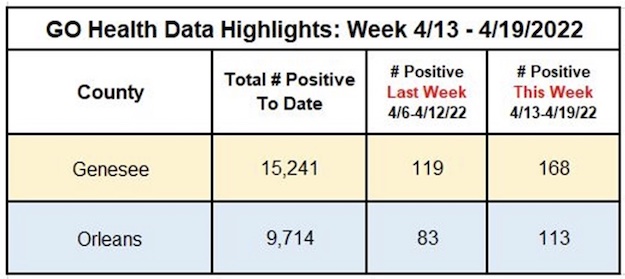
The Covid cases in Genesee and Orleans counties continue to climb, with Genesee at 168 and Orleans at 113 during the week of April 13-19.
That is up from the previous week when Genesee had 119 cases and Orleans had 83, according to data from the Genesee and Orleans County Health Departments.
Statewide the cases are also on the rise. There were 7,862 new cases on Tuesday with a positive test rate of 6.92 percent. The statewide positivity rate in the 7 days is at 5.56 percent. It was 4.35 percent the 7 days before from April 6-12.
Orleans is among the nine counties in the Finger Lakes Region where the 7-day percent positive rate is 11.81 percent, third highest of the 10 regions. Only Western New York at 13.48 percent and Central NY at 13.91 percent are higher. New York Cry is the lowest at 3.67 percent.
The new Covid cases in Orleans in the past week include 29 from home tests and 84 from labs. Genesee’s new cases include 43 from home tests and 125 from lab results.
Gov. Kathy Hochul discussed Covid during a news conference today in Syracuse. She said the state will continue to require masks for public transit, correctional facilities, nursing homes, health care settings, domestic violence centers, buses and train stations.
“With new contagious subvariants circulating, let’s be vigilant in using the tools to keep ourselves and our loved ones healthy and out of the hospital,” Hochul said.
MEDINA – Medina Memorial Hospital is expanding visiting hours beginning today.
Orleans Community Health announced the following update:
Visitors must abide by the following guidelines:
Visiting hours on the Medical-Surgical floor/Transitional Care will be from 10 a.m. to 7 p.m.
Exceptions may be made in end-of-life situations.
All visitors will be required to undergo the Covid-19 screening upon entering the hospital.
Visitors must wear face coverings at all times (covering mouth and nose), regardless of the visitor or patient vaccination status for influenza or Covid-19.
Visitors who fail to wear a face covering and other PPE as requested by the facility will be asked to leave the facility.
Visitors must be 16 years of age or older.
Once in the facility, visitors must remain in the patient’s room throughout the visit, except when directed to leave by hospital staff during aerosol-generating procedures or other procedures or circumstances for which visitors are usually asked to leave or to use the restroom, and must be appropriately distanced from any other patients or staff.
Department visitation guidelines:
General visiting on the Medical-Surgical floor/Transitional Care: Two visitors may be permitted between the hours of 10 a.m. to 7 p.m., except in certain circumstances. On a case-by-case basis, limitations may need to be made due to the clinical condition of the patient or at a patient’s request. In addition, caregiving by family members is encouraged, at the discretion of the family and patient.
Emergency Department: One visitor may be permitted. On a case-by-case basis, limitations may need to me made due to the clinical condition of the patient or the treatment being performed.
Anyone who reports or exhibits shortness of breath, fever, cough, or other potential Covid-19 symptoms
Individuals who have an active diagnosis of Covid-19 or who are persons under investigation for Covid-19.
Individuals wanting to visit a hospital patient who has an active diagnosis of Covid-19 or who is a person under investigation with Covid-19 or had contact with a person who is actively under investigation for Covid-19 within 10 days.
Individuals under quarantine for any other reason as defined by the most current New York State travel advisory.
Press Release, Genesee and Orleans County Health Departments
Lead is a heavy metal that is toxic to our bodies and there is no safe level of lead to have in our blood. Lead can be found in homes built before 1978 (before lead in paint was banned), gasoline, water pipes, toys, ceramics, jewelry, pottery and more.
The effects of lead poisoning are irreversible and can affect a child into adulthood.
“Lead poisoning can affect anyone, but it is especially dangerous for infants and small children because their bodies are rapidly developing,” stated Paul Pettit, director for the Genesee and Orleans County Health Departments (GO Health).
Childhood lead poisoning can damage the brain and nervous system leading to learning difficulties, lower IQ, difficulty in paying attention, hyperactivity, kidney damage, and, at very high levels, it can be fatal. Lead poisoning can also be dangerous for pregnant women because lead can pass to the baby during pregnancy.
Childhood lead poisoning is a concern throughout the year, but cases of lead poisoning increase during the spring and summer months because children spend more time outdoors, on the porch or in the yard.
Homes built before 1978 may have chipping and peeling lead paint on the porch or on siding, which could be more deteriorated than other parts of the house due to the effects of weather. Children playing on the porch can unknowingly pick up lead paint chips and dust on their hands and toys and then place hands or toys into their mouths.
Lead dust can also be found in the soil outside where children are playing. Strong winds can blow lead dust from nearby factories or from the chipped paint off houses and then settle into your yard. Although leaded gasoline was phased out in the 1970s, lead may still be in the soil after it was released into the air from car exhausts and then settled into the ground nearby.
Lastly, many home improvements begin in the spring and summer. Renovations to areas of the home containing lead-based paint can put lead dust into the air, both inside and outside of the area being worked on. Lead dust can also collect on windowsills and in window wells. On warm days when the window is open, lead dust in these areas can blow into the house.
“Lead poisoning in children is completely preventable,” Pettit said. “You can follow these steps to protect yourself and your family from the effects of lead exposure.”
Talk to your doctor about a simple blood lead test. New York State requires that health care providers test children for lead at ages 1 and 2 and whenever there is a risk of lead exposure.
Wash children’s hands before eating and naps or bedtime.
Wash children’s toys regularly.
Have children play in a sandbox, rather than on the ground.
Clean floors with a wet mop and cleaning solution.
Wet-wipe dusty areas such as windowsills, window wells, countertops, and furniture.
Keep your home free of chipping or peeling paint and renovate safely.
Mist surfaces with water before scraping or sanding to prevent creating dust.
Have your children eat a balanced diet rich with iron, vitamin C and calcium.
For more information on GO Health’s Lead Poisoning Prevention Programs, visit GOHealthNY.org. You can also contact your respective health department:





















 According to the 2022 County Health Rankings, released by the Robert Wood Johnson Foundation (RWJF) and the University of Wisconsin Population Health Institute (UWPHI), Genesee and Orleans Counties rank 38th and 54th respectively in overall Health Outcomes. The Rankings are available at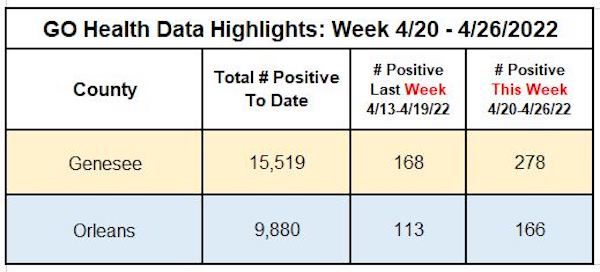
 By Erika Pozzuolo, LMHC, PMH-C, Maternal/ Child Health Lead Therapist,
 National Infant Immunization Week is April 24-30. This is an annual observance highlighting the importance of protecting children two years and younger from vaccine-preventable diseases. In the spirit of National Infant Immunization Week, we encourage parents and caregivers to take time to learn about vaccines.
 The Genesee and Orleans County Health Departments (GO Health) are seeing an increase in the number of people who have tested positive for Covid-19. This recent increase in Covid-19 cases is due to the new Omicron variant BA.2, which spreads more easily than other earlier variants.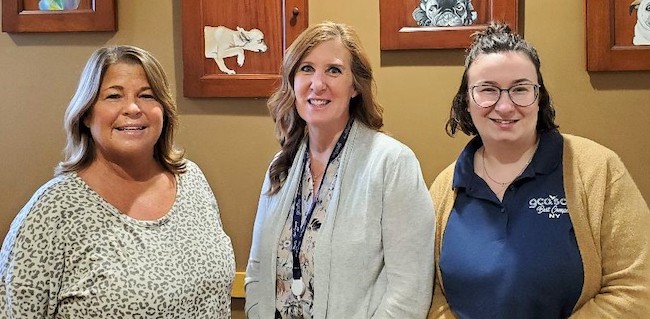
 Lead is a heavy metal that is toxic to our bodies and there is no safe level of lead to have in our blood. Lead can be found in homes built before 1978 (before lead in paint was banned), gasoline, water pipes, toys, ceramics, jewelry, pottery and more.