Press Release, Genesee & Orleans County Health Departments
Replacing the popularity of traditional cigarettes, the e-cigarette was introduced to the market around 2007. Typically branded as a safer alternative to traditional cigarette smoking, e-cigarettes work by using a battery to heat up liquid that usually contains nicotine, flavorings, and other additives and chemicals.
Various flavors and scents have been used as a marketing technique to increase the appeal of e-cigarette smoking to young people.
According to the 2021 CLYDE Survey administered to 7th, 9th and 11th grade students in Genesee and Orleans Counties by UConnectCare (formally GCASA):
3% of 7th grade students reported vaping with nicotine in the past 30 days
19.7% of 11th grade students reported vaping with nicotine in the past 30 days
11.1% of 11th grade students reported vaping with marijuana in the past 30 days
There are many reasons for vaping by teens and young adults, including peer pressure and wanting to fit in with their friends. However, no tobacco product is safe, especially for adolescents.
Many teens believe that vaping is less harmful than smoking and find the lack of smoke and smell, appealing. Young people who believe that e-cigarettes cause no harm are more likely to use them. It is important for parents and educators to work together to teach adolescents about the health risks associated with e-cigarettes.
How can you talk to youth about vaping? Here are some tips:
Make sure you are aware of the facts first, before you talk with youth about vaping. To learn more about vaping, visit the CDC website or the Surgeon General website.
Consider what they are going through and put yourself in their shoes. Think about what pressures they face at school, at home, and with their friends. Encourage an open dialogue and have empathy throughout the conversation.
Set a positive example by staying tobacco-free. If you use tobacco, it is never too late to quit. For more help or information on quitting, contact your healthcare provider. You can also text, chat or call the New York State Smokers’ Quitline at 1-866-NY-QUITS (1-866-697-8487) or visit the New York State Department of Health website.
Wait for the right moment to start the conversation and try to have a more natural conversation, rather than a lecture.
Avoid scare tactics and connect with what youth care about.
If you have questions or need support, talk with your healthcare provider.
After you talk, let them know that you appreciate them for taking the time to listen and for being honest with you.
Continue to follow-up and keep the lines of communication open. New vaping products such as vaping hoodies and vaping flash drives are introduced to youth on a regular basis. Continue to do your research and stay up to date on any new information related to vaping.
Press Release, Genesee and Orleans County Health Departments
November is Lung Cancer Awareness Month. Radon is the second-leading cause of lung cancer after smoking.
According to the Environmental Protection Agency (EPA), if you smoke and live in a home with high radon levels, your risk for developing lung cancer increases. Testing your home for radon is the only effective way to know if you and your loved ones are exposed to toxic levels of this poisonous gas.
“Radon is a naturally occurring, radioactive gas,” said Darren Brodie, Environmental Health Director for the Genesee and Orleans County Health Departments (GO Health). “It has no smell, taste or color. Radon forms from the breakdown of uranium in soil, rock, and water and mixes into the air you breathe. When radon is formed under homes and buildings, it can enter through cracks in the foundation. This leads to high levels of radon, especially in enclosed areas. Any home can have high radon levels and the only way to know is to test your home.”
The Genesee County Health Department Radon Program has a limited supply of short-term radon test kits free of charge for residents in Genesee County. We also offer educational materials and presentations to those interested in learning more about radon and the risks. Residents in other counties can get radon test kits at their local hardware store or through radon testing laboratories found at https://www.health.ny.gov/environmental/radon/
For more information about radon and how to receive a free radon test kit in Genesee County, contact the Genesee County Health Department at 585-344-2580 x5555 or Health@co.genesee.ny.us.
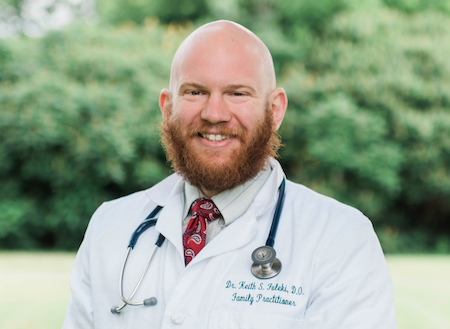
ALBION – Please welcome Dr. Keith Fuleki, D.O. to our Albion location. He previously worked as a family medicine physician at Oak Orchard Health from August 2016 to June 2020.
Dr. Fuleki is a graduate of the Philadelphia College of Osteopathic Medicine and then he completed his residency in family medicine at Niagara Falls Memorial Medical Center.
He is an accomplished Family Medicine physician who has worked extensively in both urban and rural primary care settings, particularly with the underserved. He is excited to return to serve the community he lives in.
Dr. Fuleki emphasizes wellness, preventative medicine, emotional well-being, and helping all patients feel empowered to make informed health decisions. He is capable of all aspects of effective primary care including all aspects of medicine, chronic care management, hypertension, diabetes, GYN, adolescent and adult medicine. Well-versed in modern medicine, Dr. Fuleki has taught a multitude of medical and other health science students over the years.
“We are so glad that Dr. Fuleki has returned to Oak Orchard Health in Albion,” said Dr. Danielle Mead, chief medical officer of Oak Orchard Health. “Our patients need the expertise that he brings to our community. He enjoys working with diverse populations and helping them develop solutions to their health care problems to fit their lifestyle.”
Dr. Fuleki is accepting new patients as are these providers in Albion including: PRIMARY CARE –Minnie Clark, ANP; and Dawn Warriner-Herman, FNP. PEDIATRICS – Lauren Rogers, PA; Tamera S. Suzanne, PNP; and Karen Mawn, MD.
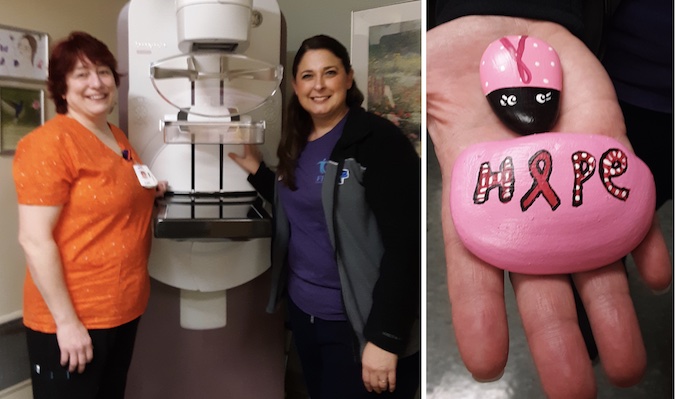
Photos by Ginny Kropf: (Left) Erica Chutko, director of radiology at Orleans Community Health, and X-ray technician Stephanie Aquilina stand next to the hospital’s mammography machine. They are promoting breast cancer awareness during October. (Right) X-ray technician Stephanie Aquilina holds two pink stones promoting breast cancer, which were painted by a local resident and donated to Medina Memorial Hospital to give to patients.
By Ginny Kropf, correspondent Posted 28 October 2023 at 6:39 pm
MEDINA – With October being celebrated across the nation as Breast Cancer Awareness Month, Orleans Community Health is taking advantage of the time to recognize the dedicated staff in their radiology department and to promote mammography and breast cancer awareness.
Erica Chutko, director of radiology, has been employed at Medina Memorial Hospital for 30 years. She started as a student technician and has now been director for more than 10 years.
X-ray technician Stephanie Aquilina has been there 20 years, more than 14 of them in radiology.
Chutko said their state-of-the-art mammography machine installed three years ago has made a big difference in catching early signs of breast cancer, with its 3-D capability.
“Since we have been using that technology, the numbers of women getting a mammography have been going up, and the numbers always go up in October,” she said.
She said the X-ray department never closes.
“We are always here for our patients,” Chutko said.
She added there is no age limit to stop having a mammogram.
Chutko and Aquilina pointed out pink wreaths on the wall, a bouquet of pink flowers and stones with breast cancer themes, painted pink by a local woman who is a former patient.
“Each year she came in for a mammogram, she brought me a painted rock,” Chutko said. “Now she brings in a whole bag full. She hides them all over the county, urging people who find them to go hide them somewhere else. This is her way of promoting breast cancer awareness.”
Women who have no insurance or are underinsured are reminded a mammogram can be free, through Cancer Services of Genesee, Orleans and Wyoming. That is where funds from the For Women Only event go, said Scott Robinson, director of market, communication and outreach at Orleans Community Health.
OCH makes a practice of recognizing its dedicated employees in all its departments.
Recently, the hospital celebrated its housekeeping staff during Environmental Services Week, a national week which honors workers in the housekeeping departments who keep their facilities clean and safe for patients, staff and visitors.
“These people keep our rooms and buildings sanitary and we want to make sure people realize, internally and externally, they are unsung heroes,” Robinson said. “They are the one department which truly sees every single aspect of our buildings. They are everywhere.”
This also includes Orleans Community Health’s for other locations – Albion’s walk-in clinic, the Middleport lab and dialysis centers in Medina and Batavia.
Sue Birch is director of the Environmental Services staff of 17. The employees are trained in different areas, so if one is sick, someone else can fill in, Birch said.
Ed Schutt has been on the job for 28 years and loves his work.
“I was working in Brockport and wanted a job closer to home, so I put my name in here and they hired me,” he said.
His duties are to collect waste and linens. He also sweeps the parking lot and does anything that’s needed, Birch said.
Like the X-ray Department, Birch said their Housekeeping Department is very family oriented.
Kay Ward’s duties are to clean patient rooms, dining areas and nurses’ stations. Like Brenda Potter, who cleans the emergency room, she loves her job.
By Mary Obear, MD, PhD, family physician at Oak Orchard Health
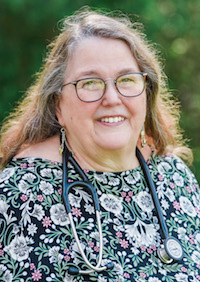
Dr. Mary Obear
Americans are living longer. Over the last four decades, life expectancy in the United States has largely risen, although certain groups have experienced slight decreases in their life expectancy (according to the U.S. Census Bureau). Americans are projected to have longer life expectancies in the coming decades. By 2060, life expectancy for the total population is projected to increase by about six years, from 79.7 in 2017 to 85.6 in 2060.
Since we are living longer, the question is how do we live a healthier life? How can we age gracefully? As a primary care physician, I often discuss this topic with my patients. Here are a few tips for you to consider.
Have a good relationship with your primary care provider (PCP)
This is a simple yet important step to take to live a healthy life. To have a good relationship with your provider, you need to see a medical professional annually, get a physical, and have open, frank discussions. If your primary care provider suggests medical advice that you do not want to do or you don’t see any utility in doing so, don’t just ignore it. Instead, have a conversation about why it is important and try to reach a compromise.
Waiting too long before going to see your primary care provider is not good practice. If you have not been feeling well for a period of time or something has changed, please make an appointment with your primary care provider. Be careful not to seek medical information on the internet. Please reach out to your medical providers for the best advice.
Preventive measures: medications and screenings
As you age, you may be prescribed many different medications and it’s important that you understand why you are taking each and what the long-term benefit is. Have you been taking medications for 20+ years? It may be time to have a conversation with your physician about whether it is still having a positive effect on your health.
Screenings such as a colonoscopy are especially important but so is getting a yearly physical. At your physical, discuss with your PCP which screenings are appropriate for you. Be sure they know your family’s cancer history.
Nutrition and Sleep
Getting a good night’s sleep is a key component to staying healthy so practice good sleep hygiene. There are things that may interfere with your ability to fall asleep and stay asleep. Think about screen time including TV, computers, and your telephone. If watching certain programming upsets you, please avoid it. Consider turning all your screens off two to three hours before sleep time. If you need entertainment, an enjoyable book or magazine will help relax you. Sleep in a cool dark room with no stimulation on and avoid drinking a lot before you sleep. Also, the timing of your medication is important. Again, be sure to discuss this with your PCP.
Of course, the food you put into your body is another way to age gracefully. Eating real food and not processed food is the key to healthy living. Processed food can have a lot of salt or ingredients that contain salt, and that is not good for you. Everyone needs a little sodium in their diet but avoiding fast foods is a good idea. Eating well also includes drinking well. Be careful not to drink empty calories in soft drinks and flavored coffees. Coffee can be fine, but most creamers do not contain natural ingredients.
I know many people think of cooking as a chore, but mealtimes can be a pleasant way to nurture your body. Spend time thinking about what healthy foods you can cook quickly or consider “batch cooking” where you make three or four meals and freeze them. If you have healthy foods in the house, you are more likely to eat healthily.
Also, the Mediterranean diet is one of the healthiest choices because it emphasizes seafood, fresh fruit and vegetables, plants, and whole grains.
Exercise
I want to close on an important thought about aging. Be sure to exercise. Walking is one of the best exercises but please be sure you are doing it in a safe location. Be careful not to trip or fall. In the winter, the mall, community centers, and schools are better places to go. They are warm and safe.
If you need a primary care provider, please call Oak Orchard Health at (585) 589-5613.
(Oak Orchard Health, celebrating our 50th anniversary, with offices in Albion, Alexander, Batavia, Brockport, Pembroke, Hornell, Medina, and Warsaw.)
By Stephanie Aquilina, mammographer at Medina Memorial Hospital
In our busy lives, it’s easy to overlook routine health check-ups until we are faced with a problem. However, some screenings, like a mammogram, are crucial to ignore.
Stephanie Aquilina
Mammograms are not just for those with a family history of breast cancer or older women; they hold immense importance for every individual. In this article, we will delve into the significance of mammograms for everyday individuals and the role it plays in early detection and prevention.
Understanding Mammograms
Mammography is a specialized medical imaging used to examine breast tissue. It involves taking X-ray images of the breasts, which are then interpreted by radiologists. Mammograms can detect abnormalities in the breast tissue, such as lumps or masses, often before they can be felt through physical examination.
Early Detection Saves Lives
One of the most compelling reasons for individuals to consider yearly mammograms is the role they play in early detection. Breast cancer, when caught in its early stages, is highly treatable. The American Cancer Society reports that the five-year survival rate for localized breast cancer (cancer that has not spread outside the breast) is around 99%.
Yearly mammograms can detect breast cancer in its earliest stages, most often before symptoms develop. This means that the individuals can receive treatment when the cancer is most responsive to therapy, increasing their chances of survival and minimizing the need for aggressive treatments.
Early detection means taking it upon yourself to do monthly self-breast exams. Early detection can also mean easier treatment.
For Every Age and Risk Level
Contrary to popular belief, mammograms are not exclusively for older women. While breast cancer risk increases with age, it can affect individuals of all ages and genders. In fact, approximately 1 in 8 women in the United States will develop breast cancer during her lifetime.
Mammogram guidelines vary, but generally, women should start considering annual mammograms around the age of 40. However, it’s essential to consult with a healthcare provider to determine the most appropriate screening schedule based on individual risk factors, which could include family history, genetics, and personal health history.
Approximately 50% of females have dense tissue in their breast. The dense tissue is normal but it will increase the risk of breast cancer. Talk to your doctor about your preventative measure for this dense tissue.
Moreover, breast cancer is not limited to women. Men can develop breast cancer as well, though it is rare. Men with a close relative with breast cancer or certain genetic mutations may benefit from genetic testing as a preventive measure. 1 in 5 men with breast cancer have a close relative with breast cancer.
Peace of Mind
Beyond the medical benefits, mammograms can provide help peace of mind. Many people worry about their health, especially when there is a family history of breast cancer. Yearly mammograms can offer reassurance, knowing that you are actively monitoring your breast health.
Additionally, for those who are experiencing breast symptoms such as pain or changes in breast tissue, diagnostic mammograms can help rule out serious issues. Talk to your doctor for your next step. This can reduce anxiety and ensure that the individual receives appropriate medical care when needed.
Financial Considerations
Some may argue that mammograms are expensive, but many health insurance plans cover them as part of preventive care. Under the Affordable Care Act in the United States, mammograms are one of the essential health benefits that insurers must cover without cost-sharing.
Even for those without insurance, many healthcare facilities offer free or low-cost mammogram screenings, particularly during Breast Cancer Awareness Month in October. These resources make it more accessible for everyone to prioritize their breast health.
Remember, mammograms are not just for a select group of individuals. They are a vital tool in the early detection and prevention of breast cancer, which can affect people of all ages and genders. Yearly mammograms can save lives, provide peace of mind, and offer financial support through insurance coverage and community resources.
Taking charge of your health should be a priority, and mammograms are a crucial step in that journey. Consult with your healthcare provider to determine the right screening schedule for you. Remember that early detection through mammograms can make a significant difference in your overall health and well-being. Don’t wait until a problem arises; prioritize your breast health today.
(Stephanie Aquilina is a member of the Imaging Department at Medina Memorial Hospital (Orleans Community Health), where she has been for 20 years (as mammographer for the last 14 years). She is a radiologic technologist, registered rad tech, and registered mammography.)
Press Release, Genesee and Orleans County Health Departments
BATAVIA – The Genesee and Orleans County Health Departments (GO Health) will be holding their Local Early Intervention Coordinating Council (LEICC) Quarterly Meeting.
The meeting is scheduled for Wednesday, October 25, from 4 to 5 p.m. at the Genesee County Health Department (3837 W. Main Street Road Batavia, NY 14020) or by Zoom video conferencing. During the meeting, advocacy will be discussed and the election of officers will take place. Refreshments will be provided.
The LEICC is a supportive group made up of county officials, early intervention providers, child care providers, parents of children with disabilities and other community members. The members of the council are encouraged to collaborate and voice their opinions to help raise concerns to better the program, and ultimately, help the children.
The goal of the LEICC is to afford the opportunity for parents and other members to voice their thoughts and concerns on the strengths and weaknesses of the Genesee and Orleans County Early Intervention Program and to work together to improve the program. The Genesee and Orleans County Health Departments are encouraging parents to attend and to offer input as to how we can best meet the needs of all infants and toddlers.
For Zoom connection information or for more information on the meeting, please contact Sarah Kathryn McLaughlin, Early Intervention Service Coordinator for Genesee County, at 585-344-2580 ext. 5503 or 585-589-3147.
Press Release, Genesee and Orleans County Health Departments
The Genesee and Orleans County Health Departments (GO Health) have identified a concerning trend of elevated cocaine use locally that is causing fatal fentanyl overdoses.
Fortunately, these deaths are preventable, and resources are available locally to help.
Since 2021, there have been 29 fatal fentanyl overdoses confirmed in Genesee County, and at least 72% of these deaths have also involved cocaine. In some instances, bystanders reported that the person who died of a fentanyl overdose thought they were taking only powder cocaine or crack cocaine.
In Orleans County, there were 10 fatal fentanyl overdoses during this same time period, of which 40% involved cocaine.
GO Health has also identified through wastewater analysis that cocaine consumption is very high in Batavia and Le Roy compared to other areas nationally. GO Health regularly analyzes wastewater samples from wastewater treatment plants throughout Genesee and Orleans counties for high-risk substances to better understand local patterns in drug consumption and these trends are compared to upwards of 160 sites nationally by the wastewater epidemiology company Biobot Analytics.
In August, the estimated cocaine consumption in Batavia was higher than 94% of other tested sites in the United States, and in Le Roy it was higher than 95% of other tested sites.
Substance use is estimated in each sewershed by taking the amount of the metabolite found in the wastewater and dividing by the size of the population served by the wastewater treatment plant.
“For the last several years, Genesee County’s opioid overdose death rates have surpassed the state’s average, and been higher than neighboring counties too,” stated Paul Pettit, the Public Health Director for GO Health. “Unfortunately, what we are seeing here are indications of a relatively high amount of cocaine use locally, and when that cocaine is contaminated with fentanyl, it is causing preventable overdoses and deaths.”
Fentanyl is a powerful synthetic opioid that can be prescribed by physicians to treat patients’ severe pain that is not responsive to other medications, such as in cases of advanced-stage cancer.
Because it is 50 times stronger than heroin, illegally-made fentanyl has largely replaced heroin and other opioids in the U.S. drug supply, and is commonly mixed with other drugs like cocaine and methamphetamine, according to the Centers for Disease Control and Prevention (CDC).3 Many people who use street drugs like cocaine or counterfeit pills are unaware that what they are taking may contain a lethal dose of fentanyl.
Individuals who are aware of the risks of fentanyl overdose when using cocaine are empowered to make safer choices that could save their life or the life of a loved one, and a number of resources are available:
• Narcan (naloxone) nasal spray can be used to reverse an opioid overdose, and should be administered to anyone who is showing signs of having difficulty breathing or who is not breathing at all, regardless of whether the person is known to have taken an opioid. Narcan is available for free from the Genesee-Orleans-Wyoming Opioid Task Force simply by texting “KIT” to 1-877-535-2461.
• Fentanyl test strips, which can be used to check for fentanyl in drugs, are available for free from the MATTERS Network at mattersnetwork.org/individual-request.
• People who use cocaine or other drugs can reduce their risk by never using alone, taking turns when using drugs with others, or calling the Never Use Alone Hotline at 1- 800-484-3731.
• Treatment for substance use disorders is available locally from Hope Haven at 585-922- 9900, from Horizon Health Services at 585-815-0247, and from UConnectCare (formerly GCASA) at 585-343-1124 (Genesee County) or 585-589-0055 (Orleans County).
• Entry points to treatment are also available in person 24 hours a day at the City of Batavia Fire Department, the City of Batavia Police Department, the Genesee County Sheriff, and the Le Roy Police Department through the Public Safety Assisted Addiction and Recovery Initiative (PAARI).
For information on Health Department programs and services, visit GOHealthNY.org or call your respective health department at:
Orleans County Health Department: (585) 589-3278
Genesee County Health Department: (585) 344-2580 ext. 5555
By Tom Rivers, Editor Posted 19 October 2023 at 7:54 am
Many students addicted to vaping, with unknown long-term health effects
Photos by Tom Rivers: Mary Wright, a prevention education with UConnectCare (formerly GCASA), discusses some of the signs of a vaping addiction including difficulty with concentrating on school work when can’t vape, inability to go anywhere without the vape and taking a few puffs, and strong cravings to vape when waking up in morning and going to bed at night.
ALBION – Many students in middle and high schools are addicted to vaping, and battle strong cravings to vape during school days.
That is a problem, not only due to the unknown long-term health consequences of vaping, but also because vaping is prohibited on school campuses and people under 21 can’t legal buy vaping or tobacco products.
Despite that, health officials at a Vaping Summit in Albion estimate 10 to 20 percent of teen-agers are chronic vaping users.
“Vaping is a serious public health issue facing the youth in our community,” said Paul Pettit, public health director in Genesee and Orleans counties.
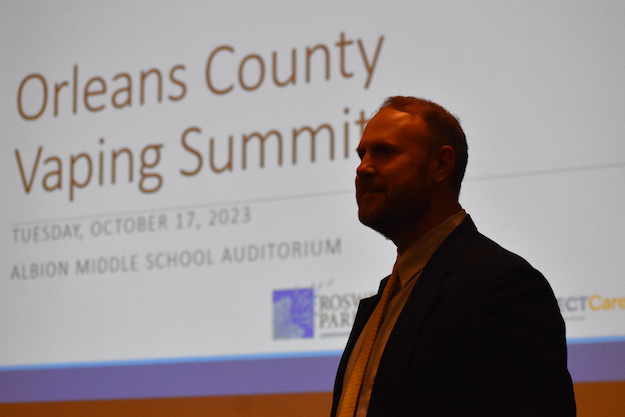
He spoke at the Vaping Summit in the Albion Middle School Auditorium, the first summit in either Orleans, Genesee or Wyoming counties.
Vaping has become popular among middle and high schoolers in the past seven to eight years, health experts said at the forum, with many parents thinking vaping is less harmful than smoking cigarettes. Vaping also is comes in thousands of different flavors, and many are candy flavored adding to the impression that they are safe and healthy.
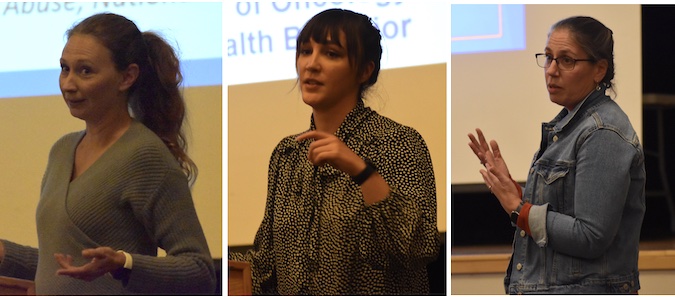
Speakers at the Vaping Forum included from left: Kristina Hawes, senior health project coordinator at the Wilmot Cancer Institute in Rochester; Dr. Danielle Smith, assistant professor at Roswell Park Comprehensive Cancer Center in Buffalo; and Mary Wright, prevention educator for UConnectCare, formerly GCASA.
But the health experts say vaping often comes in stronger nicotine concentrations than cigarettes, and the users become very distracted and irritable if they can’t vape, especially during several hour stretches during the school day.
“It is a nicotine stimulant that is very addictive,” said Kristina Hawes, senior health project coordinator at the Wilmot Cancer Institute in Rochester. “With e-cigarettes there is no regulation, there is no standardization of devices or e-liquids.”
She said “Big Tobacco” is using “predatory marketing” to target kids to become users of the products.
The community was urged to not “normalize” vaping. Dr. Danielle Smith, assistant professor at Roswell Park Comprehensive Cancer Center in Buffalo, said many teens see friends and family members vaping and assume it’s OK to use the products.
She urged people to wait until at least 21, and preferably 25, if they are going to try vaping – not when they are a child.
“Don’t use your body as an experiment,” she said.
Mickey Edwards, Albion Central School superintendent, said the district is pushing to educate students about the dangers and addictiveness of vaping.
“We’re trying very hard not to normalize it,” he said during the summit. “We’re giving kids education and not just being punitive.”
He thinks parental acceptance of vaping is one reason vaping is popular among youth.
“The parents may not see it as a problem because they do it themselves,” Edwards said.
Mary Wright works at Albion schools as a prevention educator for UConnectCare, formerly GCASA. She sees students struggle with strong cravings to vape during the school days. Some students give in to those cravings.
Vaping has made those addicted students struggle to concentrate, and maybe get in trouble because they can’t fight off the urge to vape.
Albion has started a “Vape University” as an alternative to suspension with a focus on prevention. Students participate in educational sessions (four sessions on the first offense for possession or use of vaping product). Students are educated about nicotine use and made aware of resources in community for support. Students who decline the sessions through the Vape University will face school consequences per the code of conduct.
Paul Pettit, public health director in Orleans and Genesee counties, speaks at the Vaping Forum on Tuesday evening, the first such forum in either of the counties. Pettit said vaping “is a serious public health issue facing the youth in our community.”
The Vaping Summit included statistics included some results from a 2021 survey among local high schoolers and middle schoolers about tobacco, drug and alcohol use.
Among 11th graders, 18 percent in Orleans County said they tried alcohol within the past month in 2021, while 2.5 percent smoked a cigarette, 13.2 percent tried marijuana and 1.3 percent used a pill, according to a survey of the students.
Among the respondents, 59 percent of 11th-graders viewed alcohol as harmful, while 74.7 percent considered cigarettes bad for their health, 36.0 percent thought marijuana was harmful and 71.7 percent said using pills not subscribed to them was bad.
The local survey didn’t specifically ask about vaping. The National You Tobacco Survey in 2022 surveyed more than 3 million middle and high school students. The survey found that 4.5 percent of middle schoolers regularly use tobacco products and 16.5 percent of high school use those products.
Wright, the prevention educator, said she sees students wrestling and struggling with the impacts of becoming vape addicts. The products can be costly for kids, who don’t tend to have much spending money.
Students say they feel like they are bad role models by vaping around younger siblings or cousins, she said.
There are some immediate health impacts from frequent vaping: sore throat, nose bleeds, headaches and worsening asthma.
Wright said vaping can distract users from other goals, often leading to more isolation.
“This can take over your life and cause you to drop other activities,” she said. “A lot of students have a hard time throughout the day staying focused. They reach for the vape.”
She works with students to develop a “quit plan.” Students, when trying to break free from vaping, often ask friends and family to help them quit by not vaping around them.
Diana Fulcomer, a prevention educator at Medina schools, said parents need to help keep their children from becoming vape addicts.
“Many parents still think I’d rather they be vaping than smoking a cigarette,” she said. “We need to educate the parents, too.”
Overdose deaths on rise in 2023 in Orleans County for first time since 2018
Press Release, Orleans County government
ALBION – The Orleans County Probation Department and the Genesee and Orleans County Health Departments are working together to battle opioid overdoses.
GO Health will install overdose emergency kits, also called NaloxBoxes, in the Probation Department and Public Safety Building. These kits include naloxone and other opioid overdose response tools.
“At Probation, we have dealt with many people that are battling substance use disorder so this is an effort to be prepared in case of an emergency,” said Sarah A. Osborne, Probation Director. “So many families across our community have been impacted by substance use disorder that any steps we can take to be better prepared are worth doing.”
According to GO Health, in Orleans County, opioid-related deaths peaked in 2018 with 11 fatal opioid overdoses (27.0 per 100,000 population). Since 2019, there have been 26 fatal overdoses in Orleans County, with some deaths still pending review and investigations. The majority of opioid-related deaths were male, white individuals and people in their 20s and 30s.
“Unfortunately, 2023 will likely be the first year with an increasing number of opioid-related deaths since 2018,” said Paul Pettit, Public Health Director for GO Health. “The fact is we have seen a decline in use of heroin and commonly prescribed opioids, but the rise of fentanyl in concurrence with stimulant drug use, especially cocaine, is now our biggest area of concern.”
GO Health is encouraging businesses and other organizations to follow the lead of the Probation Department and consider installing overdose emergency kits.
For those interested, you can complete an application (click here). If you have questions or would like additional information, you can call the Health Department at 585-589-3278.