By Tom Rivers, Editor Posted 22 July 2020 at 5:14 pm
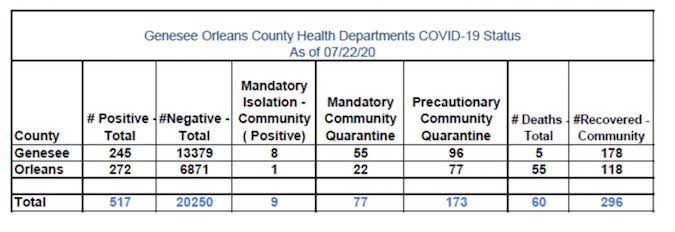
Orleans County doesn’t have any new confirmed cases of Covid-19, the Genesee and Orleans County Health Departments reported this afternoon.
Orleans also added nine people to precautionary quarantine to travel restrictions. The county still has 77 on precautionary quarantine due to travel.
The county also reports one additional recovery in the community from Covid-19 for 118 total. There are also two people hospitalized in the county from the virus.
In Genesee County, there is one additional confirmed case, bringing Genesee’s total to 245 cases of Covid-19.
The new case is a Darien resident in the 30s. The individual was not on mandatory quarantine prior to testing positive.
Genesee also has nine more people on precautionary quarantine due to travel from restricted states, and now has 96 on precautionary quarantine.
More from the Genesee and Orleans County Health Department
• Travel Advisory: New York is requiring travelers from the following 31 states with high coronavirus rates to self-quarantine for 14 days: Alaska, Alabama, Arizona, Arkansas, California, Delaware, Florida, Georgia, Iowa, Idaho, Indiana, Kansas, Louisiana, Maryland, Missouri, Mississippi, Montana, Nebraska, Nevada, New Mexico, North Carolina, North Dakota, Ohio, Oklahoma, South Carolina, Tennessee, Texas, Utah, Virginia, Washington and Wisconsin.
Those violating could be subject to a judicial order and mandatory quarantine and potential fines. These states may change at any time.
• Traveler Health Form: For all out-of-state travelers from NYS restricted states, whether arriving by land or air, must self-identify by completing a traveler health form or be subject to a $2,000 fine. Click here for the traveler health form.
By Tom Rivers, Editor Posted 21 July 2020 at 4:34 pm
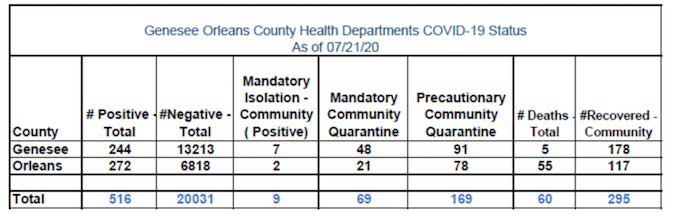
Orleans and Genesee today are both reporting one new case of Covid-19.
In Orleans, the new case is a Clarendon resident in the 80s. The county has now had 272 people test positive for the coronavirus.
The new positive individual was not on mandatory quarantine prior to testing positive.
The Orleans and Genesee County Health Departments also is reporting one new recovery, bringing that total to 117.
The county also has 45 new individuals are on precautionary quarantine due to travel from restricted states, for 78 total.
Two residents are currently hospitalized with Covid-19.
In Genesee County, the one new case is a Batavia resident in the 70s. Genesee has now had 244 people test positive for the virus.
The positive individual was not on mandatory quarantine prior to testing positive for Covid-19.
Two of the previous community positive cases have recovered and have been released from mandatory isolation. Genesee has now had 178 recoveries.
In Genesee, there are 15 new individuals are on precautionary quarantine due to travel from restricted states, and now has 91 total on precautionary quarantine due to travel.
No individuals are hospitalized in Genesee due to Covid-19.
More from the Genesee and Orleans County Health Department
• Travel Advisory: New York is requiring travelers from the following 31 states with high coronavirus rates to self-quarantine for 14 days: Alaska, Alabama, Arizona, Arkansas, California, Delaware, Florida, Georgia, Iowa, Idaho, Indiana, Kansas, Louisiana, Maryland, Missouri, Mississippi, Montana, Nebraska, Nevada, New Mexico, North Carolina, North Dakota, Ohio, Oklahoma, South Carolina, Tennessee, Texas, Utah, Virginia, Washington and Wisconsin.
Those violating could be subject to a judicial order and mandatory quarantine and potential fines. These states may change at any time.
• Traveler Health Form: For all out-of-state travelers from NYS restricted states, whether arriving by land or air, must self-identify by completing a traveler health form or be subject to a $2,000 fine. Click here for the traveler health form.
• Essential Workers’ Quarantine: Those who are noted as essential workers who have either been in close contact with someone who tested positive or who has traveled from a restricted state (more than 24 hours in restricted state) and are NYS residents will be placed on either mandatory quarantine (close contact with confirmed positive) or precautionary quarantine (returning traveler).
If they are not experiencing any symptoms, they can report to work if they are deemed essential and critical for the operation or safety of the workplace but they must follow strict guidelines while at the workplace which includes wearing a mask at all times while in the workplace for 14 days after exposure. They must self-monitor health and temperature, maintain social distancing practices, clean and disinfect workspaces and maintain quarantine which means they are only able to go to the workplace and home when not working. To read more about these requirements click here.
• For those who are traveling to NYS for work, click here for guidance.
• For those who are returning to their NYS residence or are traveling to NYS from restricted states and have tested for COVID-19, they will still be quarantined for the 14 days after the last contact within such designated states regardless if they tested negative. The quarantine runs independent of any testing due to the incubation period of the virus which can be anywhere from 2-14 days.
• Alcohol Sales Guidance: Executive Order 202.52 in effect starting July 17 requires all licensed establishments with on premises privileges (e.g. restaurants, taverns, manufacturers with tasting rooms, etc.) shall not serve alcoholic beverages unless such alcoholic beverage is accompanied by the purchase of a food item by each patron in a seated party.
By Tom Rivers, Editor Posted 21 July 2020 at 12:38 pm
New York has added 10 more states to a list where travelers need to self quarantine for 14 days when they come to New York.
Gov. Andrew Cuomo announced the new states on the list: Alaska, Delaware, Indiana, Maryland, Missouri, Montana, North Dakota, Nebraska, Virginia and Washington.
There are now 31 states on New York’s travel quarantine. These are states have a positive test rate higher than 10 per 100,000 residents over a 7-day rolling average or they are states with a 10% or higher positivity rate over a 7-day rolling average.
There were 22 states previously on the quarantine. One of those, Minnesota, is now off the list.
The other states, besides the 10 new ones listed, include: Alabama, Arizona, Arkansas, California, Florida, Georgia, Iowa, Idaho, Kansas, Louisiana, Minnesota, Mississippi, Nevada, New Mexico, North Carolina, Ohio, Oklahoma, South Carolina, Tennessee, Texas, Utah and Wisconsin.
The governor also announced the state had two people die from Covid-19 on Monday, that is the fewest deaths during the Covid-19 pandemic.
The state also had 724 people hospitalized with Covid-19 on Monday, the second fewest since March 18.
There were 66,169 tests were performed on Monday with 855 tests coming back positive or 1.29% of the total.
Governor says bars without social distancing pose ‘dangerous situation’
Cuomo, in a conference call with reporters, also addressed the state decision to not allow bars or restaurants to serve alcohol unless people are ordering food.
The governor said the state never allowed bars to reopen during the pandemic. The state doesn’t have separate liquor licenses for bars and restaurants.
Many other states have separate liquor licenses for bars and restaurants, and many of those states haven’t given bars permission to reopen.
Cuomo said the New York intended for bars to reopen later in the state’s reopening plan because bars draw crowds of people who don’t tend to sit at socially distanced tables.
“Bars are congregations of people milling about,” Cuomo said. “That is what we’re trying to avoid.”
He acknowledged the bars are under tremendous economic pressure. But he said they need to ensure patrons are being safe and not spreading the virus.
“Bars are the last type of activity you want to encourage, a large-scale congregant,” he said.
The state suspended the liquor licenses at four establishments yesterday, 3 in Queens and 1 in Long Island, and has now suspended the licenses at 27 bars or restaurants.
Cuomo said he will keep pushing for enforcement because bars without social distancing are a “dangerous situation” where the virus can spread.
By Tom Rivers, Editor Posted 20 July 2020 at 5:20 pm
Genesee has 3 new cases including 2 under age 20
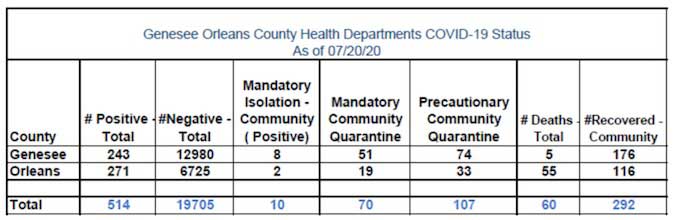
Orleans County has two new confirmed cases of Covid-19, the first new cases since a week ago.
The Genesee and Orleans County Health Departments said the two new cases are both in their 30s, with one person from Ridgeway and the other from Murray. The two new positive residents were not on mandatory quarantine prior to testing positive.
Orleans has now had 271 people test positive for Covid-19. The county also has two more recoveries for 116 total.
In addition, three people are currently hospitalized with Covid-19.
In Genesee County, there are three more confirmed cases – residents in Batavia, Bergen and Corfu. Two of the positive individuals are younger than 20 and one is in the 50s. The county has now had 243 people test positive.
The positive individuals were not on mandatory quarantine prior to testing positive, the Health Departments reported.
One of the previous community positive cases has recovered and has been released from mandatory isolation, bringing Genesee’s total recoveries to 176. No one is hospitalized from Genesee due to Covid-19.
Genesee and Orleans top 20,000 tests for Covid-19
The two counties have also topped 20,000 tests for Covid-19. Of the 20,319 tests, there have been 514 positives in the two counties, for a 2.53 percent positive rate.
In Orleans, the positive rate is more than double than in Genesee. Orleans has had 271 test positive out of 6,996 tests for a 3.84 percent positive rate.
In Genesee, the positive rate is 1.84 percent with 243 testing positive out of 13,223 tests.
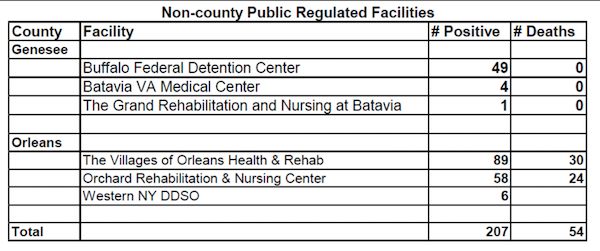
In Orleans, about half of the positive cases are nursing home residents. The Village of Orleans Health and Rehabilitation Center in Albion has had 89 residents test positive while 58 residents at Orchard Nursing and Rehabilitation Center in Medina have tested positive.
In Genesee, only one nursing home resident has tested positive, a resident of the Grand Rehabilitation and Nursing Center in Batavia.
Click here to view the Genesee and Orleans County online map of confirmed cases
The facility breakdown shows the total positive cases from those facilities where a confirmed case was reported to the Genesee and Orleans County Health Departments.
More from the Genesee and Orleans County Health Departments:
• Travel Advisory: Travelers from the following states with high coronavirus rates will be required to self-quarantine for 14 days: Alabama, Arizona, Arkansas, California, Florida, Georgia, Iowa, Idaho, Kansas, Louisiana, Minnesota, Mississippi, Nevada, New Mexico, North Carolina, Ohio, Oklahoma, South Carolina, Tennessee, Texas, Utah and Wisconsin.
Those violating could be subject to a judicial order and mandatory quarantine and potential fines. These states may change at any time.
• Traveler Health Form: For all out-of-state travelers from NYS restricted states, whether arriving by land or air, must self-identify by completing a traveler health form or be subject to a $2,000 fine. Click here for the traveler health form.
• Precautionary Quarantine: Everyone (including children) who has traveled to/from any restricted states (for more than 24 hours) are required to self (precautionary) quarantine and self-monitor their health upon entering New York.
This means the individual(s) cannot leave to go shopping, visiting, daycare and are only allowed to go for emergency care for 14 days. Businesses including childcare providers should include a travel question in their regular health screening for their staff and clientele/children. For general inquiries contact or call the Hotline: 1-888-364-3065 or click Ask A Question.
• Alcohol Sales Guidance: Executive Order 202.52 in effect starting July 17 requires all licensed establishments with on premises privileges (e.g. restaurants, taverns, manufacturers with tasting rooms, etc.) shall not serve alcoholic beverages unless such alcoholic beverage is accompanied by the purchase of a food item by each patron in a seated party.
• Covid Rental Assistance Program: A new Covid Rental Assistance Program will provide aid to low-income families who lost income due to the pandemic. Program applications are available here.
• Masks/Face coverings are still required to be properly worn (covering nose & mouth) for all employees who work with the public. They are to be worn with direct contact (and all food service workers are to properly wear coverings when preparing and serving food – no exceptions) with the public as well as with co-workers when social distancing of 6 feet or more is not able to be kept.
All residents over the age of 2 and able to medically tolerate a face-covering are required to cover their nose and mouth with a mask or cloth face-covering when in public and unable to maintain, or when not maintaining social distance of 6 feet or more.
• Community Testing Sites: Check with the testing site for any specific criteria necessary for testing such as illness, contact with someone who tested positive, essential worker, required for reopening/business, etc. Many need to have a doctor referral/prescription. Always call first.
Oak Orchard Health: 301 West Ave Albion, NY 14411. Call (585) 589-5613 to be screened and to schedule an appointment – no walk-ins.
WellNow Urgent Care: 4189 Veterans Memorial Drive Batavia, NY 14020.
Rochester Regional Health Urgent Care: 16 Bank Street Batavia, NY 14020. (Rochester Regional Health has transitioned Covid-19 evaluations from the tents at 127 North Street to Urgent Care.)
By Tom Rivers, Editor Posted 19 July 2020 at 10:22 am
New York State has a new low for hospitalizations from Covid-19. Gov. Andrew Cuomo announced today that 722 were hospitalized in the state on Saturday for Covid-19, the lowest number since March 18.
The state peaked with 18,825 hospitalizations from Covid-19.
The hospitalizations continue to drop. The 722 is down from 743 the previous day, which was the lowest since March 18.
“We’re continuing to progress forward through the Covid-19 pandemic in the face of a continued explosion of cases throughout the United States, and that’s reflected in today’s hospitalizations—the lowest number since March 18—and rate of positive cases,” Cuomo said. “During these confining and frustrating times, I know it’s tempting to be tired of the many rules and guidelines the state has issued, but I reiterate that this pandemic is far from over, and the incredible compliance and fortitude of New Yorkers are key parts of our ability to fight Covid-19. Socially distance, wear a mask, wash your hands and stay New York Smart.”
Of the 46,204 tests conducted in New York State on Saturday, 502, or 1.08 percent, were positive.
File photo by Tom Rivers: Mark Cye, chief executive officer for Orleans Community Health, is pictured by Medina Memorial Hospital in this photo from April 2018. He has been the CEO of the OCH and Medina memorial Hospital since January 2018.
MEDINA — Mark Cye, CEO/CFO of Orleans Community Health, has resigned effective July 28. Cye joined Orleans Community Health as chief financial officer a little over five years ago and has held the duel title of CEO/CFO for over two years.
Cye, who was trained in finance, was presented with an opportunity to secure the CFO position at Warren General Hospital, which is an $80 million operation in Warren, Pa.
Cye has enjoyed his time and roles at Orleans Community Health and is excited to get back to the finance role. Cye credits the hospital’s movement in the right direction, over the past couple years, to the continuous support of the staff at Orleans Community Health.
In the past two years the hospital has been able to improve financially and has been able to provide new programs and services to the community such as the Wound Care Center, podiatry, and the nursing home achieving a four-star rating with the New York State Department of Health.
Mark Shurtz, the current chief information officer and corporate compliance officer, will be stepping up as the interim CEO. Cye is confident with Shurtz’s ability to fulfill this role as he has been working closely with Cye over the past year.
Shurtz has been with Orleans Community Health as the CIO and corporate compliance officer since 2014. He brings with him 20 years of management experience spanning across military, legal and healthcare backgrounds.
He is looking forward to the continued support of our staff and is excited at the opportunity to work with the community and find ways to keep Orleans Community Health a valuable asset for the community.
By Tom Rivers, Editor Posted 17 July 2020 at 4:50 pm
In Orleans, 1 positive case out of 638 tested in past week
Orleans County again is reporting no new Covid-19 cases, while Genesee County has two more confirmed cases.
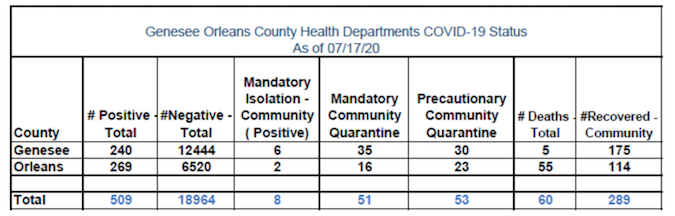
In Orleans, 269 people have tested positive for Covid-19 during the pandemic. In the past week (since July 10), there was one new confirmed case out of 638 tests for a positive rate of 0.16 percent. That is well below the state average of 0.99 percent, or 776 confirmed cases out of 78,239 tests on Thursday.
As part of the plan to reopen schools this fall, the governor has said one criteria will be a region needs to be under a 5 percent positive rate for Covid-19 tests.
Orleans has been well below that rate recently.
During the pandemic, the county has had 269 people test positive out of 6,789 tests, a positive rate of 3.96 percent.
Since July 1, the Genesee and Orleans County Health Departments are reporting 3 new confirmed cases in Orleans out of 1,510 tests, a 0.20 percent positive rate.
Going back three weeks to June 26, there have been 5 new positive cases out of 2,046 tests, a 0.24 percent positive rate.
Going back four weeks to June 19, there are 9 new confirmed cases out of 2,527 tests in the county, a positive rate of 0.36 percent.
More from the Genesee and Orleans County Health Departments:
In Genesee County, there are 2 new confirmed cases to report today. One is a Batavia resident and the other is from Le Roy. One person is in the 20s and the other in the 60s. The positive individuals were not on mandatory quarantine prior to testing positive.
Genesee also has two more recoveries for 175 total from the community. No one in Genesee is currently hospitalized with Covid-19. In Orleans, three people are hospitalized with Covid-19.
• Alcohol Sales Guidance: Executive Order 202.52 in effect starting July 17 all licensed establishments with on premises privileges (e.g. restaurants, taverns, manufacturers with tasting rooms, etc.) shall not serve alcoholic beverages unless such alcoholic beverage is accompanied by the purchase of a food item by each patron in a seated party. For more guidance from the NYS Liquor Authority, click here.
• COVID Rental Assistance Program: A new COVID Rental Assistance Program (click here) will provide aid to low- income families who lost income due to the pandemic; program applications will be available here on Thursday, July 16.
• Travel Advisory: New York is requiring travelers from the following 22 states with high coronavirus rates to self-quarantine for 14 days: Alabama, Arkansas, Arizona, California, Florida, Georgia, Iowa, Idaho, Kansas, Louisiana, Minnesota, Mississippi, North Carolina, New Mexico, Nevada, Ohio, Oklahoma, South Carolina, Tennessee, Texas, Utah and Wisconsin.
• Traveler Health Form: For all out-of-state travelers from NYS restricted states, whether arriving by land or air, must self-identify by completing a traveler health form or be subject to a $2,000 fine. Click here for the traveler health form.
• Community Testing Sites: Check with the testing site for any specific criteria necessary for testing such as illness, contact with someone who tested positive, essential worker, required for reopening/business, etc. Many need to have a doctor referral/prescription. Always call first.
Oak Orchard Health: 301 West Ave Albion, NY 14411. Call (585) 589-5613 to be screened and to schedule an appointment – no walk-ins.
WellNow Urgent Care: 4189 Veterans Memorial Drive Batavia, NY 14020.
Rochester Regional Health Urgent Care: 16 Bank Street Batavia, NY 14020. (Rochester Regional Health has transitioned Covid-19 evaluations from the tents at 127 North Street to Urgent Care.)
By Tom Rivers, Editor Posted 17 July 2020 at 11:52 am
New York is reporting 765 people are hospitalized due to Covid-19, the lowest number since March 18.
There were 78,239 Covid tests conducted in New York State yesterday, with 776 or 0.99 percent testing positive.
Gov. Andrew Cuomo said the failing number of hospitalizations from Covid-19 is good news for the state and shows the state’s strategy has been working in fighting the virus.
“Too many leaders throughout the country are still playing politics with this virus,” Governor Cuomo said. “Viruses respond to science and data – not political opinion. We know the prescription: masks, social distancing, and hand washing. That’s how we bent the curve in New York and that’s how we’ve kept our numbers so low as we see frightening spikes in the rest of the country.”
There were 10 confirmed deaths of Covid-19 on Thursday, which is far less than the peak of the pandemic when the state was suffering more than 700 deaths daily from Covid-19.
“We need to keep being smart – and smart means enforcement of the health orders we’ve put in place that will keep us healthy and prevent us from going back to the hell we went through,” Cuomo said.
File photo by Tom Rivers: John Bennett is executive director of GCASA.
The Covid-19 pandemic has not only adversely affected business operations and the economy, it also has fueled a surge in the opioid crisis, placing added strain on those in substance use recovery who have been isolated by state-mandated stay-at-home orders.
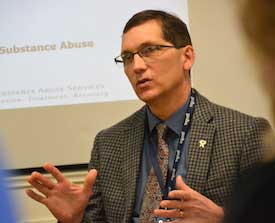
John Bennett, executive director of Genesee/Orleans Council on Alcoholism and Substance Abuse, drove home that point during Wednesday’s annual meeting for the agency, conducted via Zoom videoconferencing.
“Obviously, Covid-19 has changed how we do business and it has changed the landscape of where we were at a year ago,” Bennett said. “From 2017 to 2018, we saw a reduction in opioid overdoses across the country, and just last year alone there was a 5 percent reduction according to the Centers for Disease Control.”
But this year, things are very different, he said, reporting that the overdose rate went up 18 percent from a year ago in March, 29 percent in April and a 42 percent in May.
“So, overdoses are up 42 percent across the country, and I don’t think regionally that it’s any different. We’ve seen an increase in overdoses and overdose deaths,” he said.
Latest statistics were compiled by the Overdose Detection Mapping Application Program, a national surveillance system that provides near real-time suspected overdose data.
Despite the disheartening news, Bennett said that GCASA is steadfast in its mission to offer a wide spectrum of services to those in need.
“GCASA has been a regional leader in building new addiction services that normally aren’t in rural communities, and we continue to be committed to maintain our efforts to expand services so that folks in our regions and in our communities don’t have to travel outside the area,” he said.
Bennett, who took over as executive director in 2012, commended the board – “very committed and dedicated individuals who are kind and caring” – and praised his staff.
“To my staff who are on the call today, I’m super proud of all of you,” he said. “You’re always willing to pitch in and assist our community partners and advocate for people suffering from addiction.”
New Board president elected
Outgoing Board President Brian Paris conducted the election of new board members and presented the new slate of officers.
Elected to their first three-year terms were as follows:
Jennifer Groff. The director of fiscal operations and child support for Genesee County Department of Social Services, she has served on the GCASA Foundation board since 2018.
Stefano Napolitano. The City of Batavia fire chief, he also serves on the Foundation board and his department participates in the Police Assisted Addiction & Recovery Initiative in conjunction with GCASA.
Jackie Gardner. She is vice president of client services for Claims Recovery Financial Services.
Pattie Kepner. She is the associate executive of quality assurance for the Arc of Genesee and Orleans, having worked in human services for more than 30 years.
Tim Batzel. He is the business administrator at Alexander Central School, which contracts with GCASA for Prevention services.
Bennett thanked the outgoing board members for the six years of service. They are Paris, president; Shelley Falitico, Shawn Heubusch, Holli Nenni and Daniel Thurber.
The new slate of officers:
Virginia Taylor – president. She holds a Ph.D. in Higher Education. She is a recipient of the WNY Network for Women Leaders in Higher Education Bernice Poss Award, a Buffalo Business First 40 Under 40 Recognition Award, and Niagara County Community College Distinguished Alumni Award.
Victoria Elsenheimer – vice president. She is the executive assistant to the Vice President of Advancement, a position she has held for the past 12 years at Brockport State College. She joined the U.S. Army in 1989 and was enlisted in the Army Reserves for 17 years, honorably discharged as a Sergeant in 2006.
Frederick Rarick – secretary-treasurer. He is an attorney in Batavia; practicing law for 35 years in the representation of individuals charged with crimes. He is licensed to practice law in New York, California, and Washington, D.C. He was a past board member of the Genesee County Veterans’ Support Network.
2 awarded scholarships
As previously announced, Jillian Menzie of Bergen and Ashlyn LeBaron of Albion received GCASA Foundation scholarships for 2020. Each award was for $1,000.
Menzie is a 2020 graduate of Byron-Bergen Central School who plans to attend Brockport State College to pursue a nursing degree with a minor in Spanish. In addition, she plans to study abroad as well as join the Army ROTC program. Throughout her high school career, she participated in many sports teams, music programs, and clubs.
LeBaron is a 2020 graduate of Charles C. D’Amico High School in Albion and valedictorian of her class. She plans to attend Roberts Wesleyan College to pursue a career in nursing. She, too, participated in numerous extra-curricular activities, including sports, band and orchestra.
By Tom Rivers, Editor Posted 16 July 2020 at 4:24 pm
Orleans has 2 confirmed cases last 2 weeks out of 1,365 tested
Orleans and Genesee counties both do not have any new confirmed cases of Covid-19 to report today.
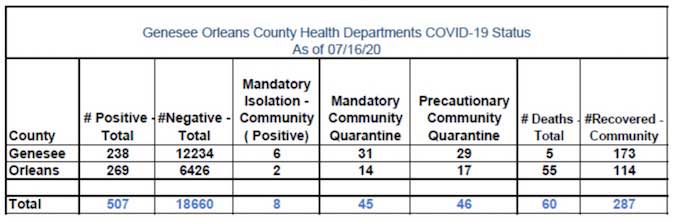
Orleans has had two new cases in the past two week, out of 1,365 tests since July 2, according to data from the Genesee and Orleans County Health Departments. That’s a positive rate of 0.15 percent.
Orleans has had 269 people test positive during the Covid-19 pandemic, while Genesee has had 238 people with a confirmed case of Covid-19.
Orleans currently has four residents hospitalized with Covid-19 while none are hospitalized in Genesee from Covid-19.
More from Genesee and Orleans County Health Departments:
• Travel Advisory: New York is requiring travelers from the following 22 states with high coronavirus rates to self-quarantine for 14 days: Alabama, Arkansas, Arizona, California, Florida, Georgia, Iowa, Idaho, Kansas, Louisiana, Minnesota, Mississippi, North Carolina, New Mexico, Nevada, Ohio, Oklahoma, South Carolina, Tennessee, Texas, Utah and Wisconsin.
• Traveler Health Form: For all out-of-state travelers from NYS restricted states, whether arriving by land or air, must self-identify by completing a traveler health form or be subject to a $2,000 fine. Click here for the traveler health form.
• Community Testing Sites: Check with the testing site for any specific criteria necessary for testing such as illness, contact with someone who tested positive, essential worker, required for reopening/business, etc. Many need to have a doctor referral/prescription. Always call first.
Oak Orchard Health: 301 West Ave Albion, NY 14411. Call (585) 589-5613 to be screened and to schedule an appointment – no walk-ins.
WellNow Urgent Care: 4189 Veterans Memorial Drive Batavia, NY 14020.
Rochester Regional Health Urgent Care: 16 Bank Street Batavia, NY 14020. (Rochester Regional Health has transitioned Covid-19 evaluations from the tents at 127 North Street to Urgent Care.)