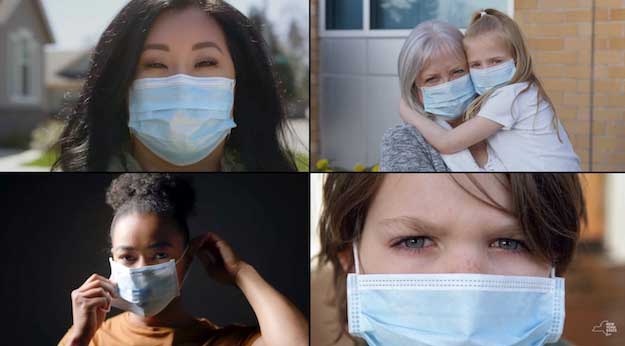
This screen shot is from the “You Have My Respect” commercial that encourages people to wear masks. This commercial is narrated by Morgan Freeman.
Press Release, Gov. Andrew Cuomo
With the ongoing COVID-19 pandemic spreading fast in many states across the country, Governor Andrew M. Cuomo today launched the national “Mask Up America” education and awareness campaign to urge all Americans to wear a mask while in public to help stop the spread of the virus.
Jane Rosenthal, producer and CEO Tribeca Enterprises, produced the series of spots with Academy Award-winning director Kathryn Bigelow. Robert De Niro, Kaitlyn Dever, Jamie Foxx, Morgan Freeman, John Leguizamo, Anthony Mackie, Rosie Perez, Ellen Pompeo and Jeffrey Wright used their voices and talent to promote the message and increase awareness. Creative agency TBWA\Chiat\Day New York assisted with the logo and branding development.
“New Yorkers suffered gravely when this pandemic hit our state and as we see other states battle the surge of COVID-19, we want to be sure all Americans know what we know here – that it is essential to wear a mask in order to protect one another,” Governor Cuomo said. “We can only beat this virus if we are united as one, not divided by ideology or politics. In that spirit we worked with the best and most creative team to deliver this vital message in multiple ways and in different voices – I wear a mask to protect you and you wear a mask to protect me. It is simple as that. Mask Up America.”
The campaign includes a series of eight TV public service announcements, the first two of which are available today. All of the PSAs will be available in partnership with the Ad Council for use by broadcast and digital media outlets. The PSAs will air in donated media time and space throughout the country.
Lisa Sherman, President & CEO of the Ad Council, said, “With cases of the virus continuing to rise across the country, we are proud to partner with Governor Cuomo’s office on this critical message and inspire all Americans to wear face coverings.”
The eight 30-second television spots, which will be rolled out throughout the month of July, include:
By Tom Rivers, Editor Posted 15 July 2020 at 5:06 pm
Orleans has now suffered 55 deaths from coronavirus
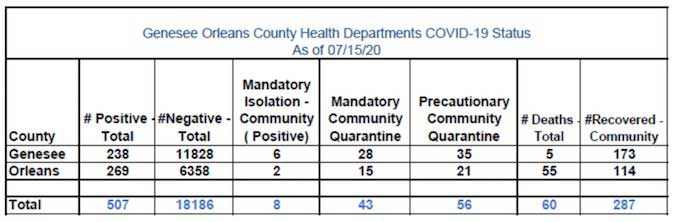
Another person has died from Covid-19 in Orleans County, bringing the county’s total confirmed deaths from Covid-19 to 55.
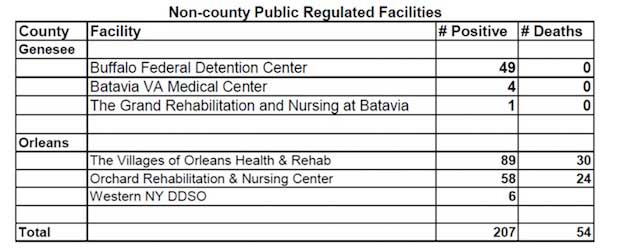
The latest death was a resident of Orchard Rehab & Nursing Center in Medina. That nursing home has now had 24 residents die of Covid-19. (The Villages of Orleans Health and Rehabilitation Center has had 30 residents die from Covid-19. A community resident also has died from Covid-19.)
The death reported today by the Genesee and Orleans Health Departments is the first since the 54thdeath was reported on June 29.
The Health Departments also reported today there are no new Covid-19 cases in Orleans, while Genesee has two new confirmed cases.
The two new cases in Genesee include a resident of Alexander and a person in Pembroke. One is in the 20s and the other is in the 40s.
The positive individuals were not on mandatory quarantine prior to testing positive.
Genesee also has one new recovery and has had 173 recoveries from the community.
The Health Departments also said 27 more people from Genesee are on precautionary quarantine due to travel from restricted states. Genesee now has 35 on precautionary quarantine due to travel.
Orleans has one more on precautionary quarantine for 21 total.
More from Genesee and Orleans County Health Departments:
• Travel Advisory: New York is requiring travelers from the following 22 states with high coronavirus rates to self-quarantine for 14 days: Alabama, Arkansas, Arizona, California, Florida, Georgia, Iowa, Idaho, Kansas, Louisiana, Minnesota, Mississippi, North Carolina, New Mexico, Nevada, Ohio, Oklahoma, South Carolina, Tennessee, Texas, Utah and Wisconsin.
• Traveler Health Form: For all out-of-state travelers from NYS restricted states, whether arriving by land or air, must self-identify by completing a traveler health form or be subject to a $2,000 fine. Click here for the traveler health form.
• Antibody Testing: This is a current snapshot (as of July 14) of the SARS-CoV-2 antibody test results we have received and will be updated periodically, but not daily.
Genesee County: Of the 1,674 antibody test results received there were 52 who tested positive for SARS-CoV-2 (the virus that causes COVID-19) antibodies.
Orleans County: Of the 721 antibody test results received there were 17 who tested positive for SARS-CoV-2 (the virus that causes COVID-19) antibodies.
By Tom Rivers, Editor Posted 15 July 2020 at 1:11 pm
New York State has passed 25,000 confirmed deaths from Covid-19. The state had nine confirmed deaths on Tuesday from Covid-19, bringing the total to 25,003.
The daily deaths from Covid-19 have been in the single digits most days the past two weeks. That is down from the peak in early April, when there were usually more than 700 each day with a peak of 799 on April 8.
Orleans County has 54 of those deaths during the Covid-19 pandemic, with 30 at the Villages of Orleans Health and Rehabilitation Center in Albion, 23 at Orchard Rehabilitation and Nursing Center in Medina, and one other resident in the community.
Gov. Andrew Cuomo said the state has made significant progress reducing the daily deaths and infections from Covid-19.
“New Yorkers brought the curve down by making big changes, and we see that work reflected in the numbers every day,” Cuomo said. “But we must continue to be smart – by wearing a mask, social distancing and washing our hands, we all have a role to play in protecting the progress we’ve made and leading the rest of the nation by example.”
Cuomo also announced today the state was named most responsible state in fighting Covid-19 according to a new study by The Truth About Insurance.
“We’ve used data and science to drive this fight and fuel our re-opening strategy, but make no mistake, this distinction is shared by every single New Yorker who did the right thing these last months, ignored the politics, socially distanced and wore a mask,” Cuomo said. “Together, we climbed this terrible mountain and came down on the other side, but we can’t stop now. We must remain disciplined and we must remain New York Tough. We’ve come too far to go back to where we were.”
By Tom Rivers, Editor Posted 14 July 2020 at 4:18 pm
There are no new confirmed cases of Covid-19 in Orleans County while Genesee County has two more, the Genesee and Orleans County Health Departments reported this afternoon.
There two new positive cases in Genesee include a Batavia resident and Pembroke resident. One of the new cases is a person in the 40s and the other is in the 60s. The positive individuals were on mandatory quarantine prior to testing positive.
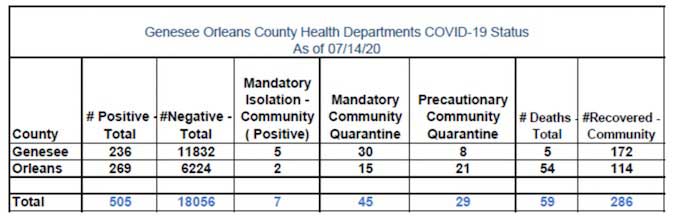
Genesee now has had 236 people test positive for coronavirus while Orleans has had 269.
Genesee also has had two more recoveries and now has 172 total in the community. No one in Genesee is currently hospitalized from Covid-19, while Orleans has six who are hospitalized with Covid-19.
More from Genesee and Orleans County Health Departments:
Travel Advisory: New York is requiring travelers from the following 22 states with high coronavirus rates to self-quarantine for 14 days: Alabama, Arkansas, Arizona, California, Florida, Georgia, Iowa, Idaho, Kansas, Louisiana, Minnesota, Mississippi, North Carolina, New Mexico, Nevada, Ohio, Oklahoma, South Carolina, Tennessee, Texas, Utah and Wisconsin.
Traveler Health Form: For all out-of-state travelers from NYS restricted states, whether arriving by land or air, must self-identify by completing a traveler health form or be subject to a $2,000 fine. Click here for the traveler health form.
Precautionary Quarantine: Everyone (including children) who has traveled to/from any restricted states (for more than 24 hours) are required to self (precautionary) quarantine and self-monitor their health upon entering New York.
This means the individual(s) cannot leave to go shopping, visiting, daycare and are only allowed to go for emergency care for 14 days. Businesses including childcare providers should include a travel question in their regular health screening for their staff and clientele/children. For general inquiries contact or call the Hotline: 1-888-364-3065 or click Ask A Question.
People traveling from those states to NY will need to self quarantine for 14 days
Press Release, Gov. Andrew Cuomo’s Office
Governor Andrew M. Cuomo today announced that four additional states meet the metrics to qualify for the travel advisory requiring individuals who have traveled to New York from those states, all of which have significant community spread, to quarantine for 14 days.
The newly-added states are Minnesota, New Mexico, Ohio and Wisconsin. Delaware has been removed. That puts 22 states on New York’s travel advisory.
The quarantine applies to any person arriving from a state with a positive test rate higher than 10 per 100,000 residents over a 7-day rolling average or a state with a 10% or higher positivity rate over a 7-day rolling average.
Yesterday, Governor Cuomo announced a travel enforcement operation will commence today at airports across the state to help ensure travelers are following the state’s quarantine restrictions and to help contain the rates of COVID-19 transmission in New York State.
“New Yorkers showed incredible courage and resiliency throughout this pandemic, and nowhere is their work more evident than in the numbers we release every day, including in New York City, once a global hotspot,” Governor Cuomo said. “However, the success of our efforts depends on citizens’ willingness to comply with state guidance, socially distance, wear masks and wash their hands, and rising cases around the country continue to threaten our progress, which is why four new states have been added to New York’s travel advisory.”
The 22 states on the advisory include Alabama, Arkansas, Arizona, California, Florida, Georgia, Iowa, Idaho, Kansas, Louisiana, Minnesota, Mississippi, North Carolina, New Mexico, Nevada, Ohio, Oklahoma, South Carolina, Tennessee, Texas, Utah and Wisconsin.
“It’s also clear based on contact tracing that many of the new cases in New York are a result of a lack of compliance during the July 4 weekend and illustrate how quickly the virus spreads, with one party, for example, infecting more than a third of attendees,” Cuomo said. “I cannot be more clear: Look at what’s happening in the rest of the country — if we are not smart, if we don’t wear masks and socially distance, cases will spike. No one wants to go back to the hell we experienced three months ago, so please stay vigilant.”
State and local contact tracing efforts found that 35 percent of people who attended a Fourth of July weekend party in Suffolk County – or more than 1/a third of the entire party – became infected with COVID-19, demonstrating how quickly the virus can spread.
By Tom Rivers, Editor Posted 13 July 2020 at 6:18 pm
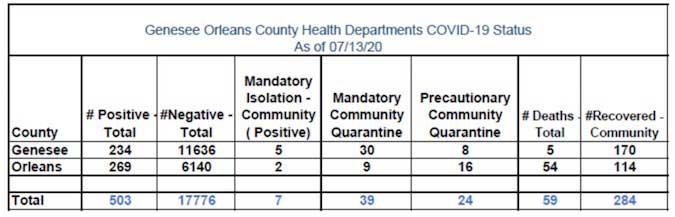
Orleans and Genesee counties each have one new confirmed case of Covid-19. Orleans has now had 269 people test positive while Genesee has had 234 test positive for coronavirus.
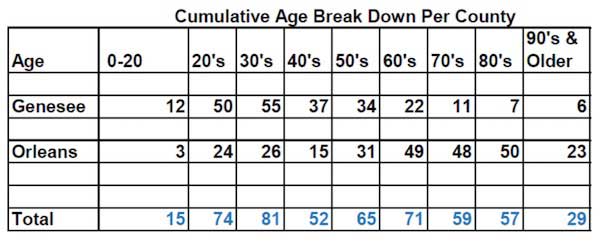
In Orleans, the new positive case is a person from Yates in the 20s. The individual was not on mandatory quarantine prior to testing positive, the Genesee and Orleans County Health Departments reported today.
Orleans also has one more recovery from Covid-19, for 114 recoveries from community members. In Orleans, there are seven people hospitalized with Covid-19.
The new positive case in Genesee County is a person from Oakfield in the 20s. The individual was on mandatory quarantine prior to testing positive.
Genesee also is reporting one more recovery for 170 total. No one in Genesee is currently hospitalized with Covid-19.
More information from the Genesee and Orleans County Health Departments:
• Nursing Home Visitation: Limited visitation and activities will be allowed in those regions in which the nursing home is in Phase 3. Click here for the guidance.
• Precautionary Quarantine: Everyone (including children) who has traveled to/from any restricted states (for more than 24 hours) are required to self quarantine and self-monitor their health upon entering New York. This means the individual(s) cannot leave to go shopping, visiting, daycare and are only allowed to go for emergency care for the first 14 days back in New York.
Businesses including childcare providers should include a travel question in their regular health screening for their staff and clientele/children. Click here for the guidance. For general inquiries contact or call the Hotline: 1-888-364-3065 or click Ask A Question.
As of July 7, the 19 states in the travel advisory include Alabama, Arkansas, Arizona, California, Delaware, Florida, Georgia, Iowa, Idaho, Kansas, Louisiana, Mississippi, Nevada, North Carolina, Oklahoma, South Carolina, Tennessee, Texas and Utah. Those violating could be subject to a judicial order and mandatory quarantine and potential fines.
In Orleans, there are 16 people currently on precautionary quarantine due to the advisory, while Genesee is reporting 8 people on precautionary quarantine.
• At-risk: Please continue to make sure you are practicing social distancing especially if you have underlying health conditions or are over 65 years old. Wear masks/face coverings whenever you are out in public, especially if you cannot maintain a 6-foot space between non-household members. Wash or sanitize your hands and shared items often.
The most important thing to remember is if you are having any type of symptoms to STAY HOME! Some of the symptoms people have been reporting are fever or chills, cough, shortness of breath or difficulty breathing, muscle or body aches, new loss of taste and/or smell, sore throat, congestion or runny nose, headaches, fatigue nausea or vomiting and/or diarrhea.
• Masks/Face-coverings are still required to be properly worn (covering nose & mouth) for all employees who work with the public. They are to be worn with direct contact (and all food service workers are to properly wear coverings when preparing and serving food – no exceptions) with the public as well as with co-workers when social distancing of 6 feet or more is not able to be kept.
All residents over the age of 2 years old and able to medically tolerate a face-covering are required to cover their nose and mouth with a mask or cloth face-covering when in public and unable to maintain, or when not maintaining social distance of 6 feet or more.
• Social Gathering Sizes: According to Governor Cuomo’s Executive Orders 202.42 and 202.45, all non-essential gatherings of up to 50 of individuals of any size for any reason (graduation parties, celebrations, or other social events) unless otherwise designated (ex. religious gatherings) are now allowed for those regions in phase 4. This is as long as requirements are followed for appropriate social distancing, and wearing cloth masks/face coverings over the mouth and nose.
•Community Testing Sites: Check with the testing site for any specific criteria necessary for testing such as illness, contact with someone who tested positive, essential worker, required for reopening/business, etc. Many need to have a doctor referral/prescription. Always call first.
Oak Orchard Health: 301 West Ave Albion, NY 14411. Call (585) 589-5613 to be screened and to schedule an appointment – no walk-ins.
WellNow Urgent Care: 4189 Veterans Memorial Drive Batavia, NY 14020.
Rochester Regional Health Urgent Care: 16 Bank Street Batavia, NY 14020. (Rochester Regional Health has transitioned Covid-19 evaluations from the tents at 127 North Street to Urgent Care.)
• Antibody Testing: This is a current snapshot of the SARS-CoV-2 antibody test results in both counties.
Genesee County: Of the 1,639 antibody test results received there are 51 who tested positive for SARS-CoV-2 (the virus that causes COVID-19) antibodies.
Orleans County: Of the 709 antibody test results received there are 17 who tested positive for SARS-CoV-2 (the virus that causes COVID-19) antibodies.
With 730 new cases, state passes 400K infections of Covid-19
Press Release, Gov. Andrew Cuomo’s Office
Governor Andrew M. Cuomo today updated New Yorkers on the state’s progress during the ongoing COVID-19 pandemic.
Hospitalizations dropped below 800 for the first time since March 18, and the three-day average death toll—7—is the lowest since March 16.
“Throughout this pandemic, we’ve made progress by recognizing that state and local governments can’t fight the virus on their own—the efforts of everyday New Yorkers to socially distance, wear masks and wash their hands are central to our ability to slow the spread and save lives,” Governor Cuomo said.
Today’s data is summarized briefly below:
Patient Hospitalization: 799 (-27)
Patients Newly Admitted: 75 (-12)
Number ICU: 177 (-1)
Number ICU with Intubation: 100 (+8)
Total Discharges: 71,477 (+106)
Deaths: 6
Total Deaths: 24,974
“As we allow ourselves to celebrate some good news—that hospitalizations have dropped below 800 for the first time since March 18 and the three-day average death toll is at its lowest since March 16—I urge residents to stay New York Tough and not give up the ground we’ve worked so hard to gain together, particularly in the face of rising cases throughout the country and compliance issues here at home,” Cuomo said.
Of the 69,203 tests conducted in New York State yesterday, 730, or 1.05 percent, were positive.
The Governor also confirmed 730 additional cases of novel coronavirus, bringing the statewide total to 401,029 confirmed cases in New York State.
By Tom Rivers, Editor Posted 10 July 2020 at 4:33 pm
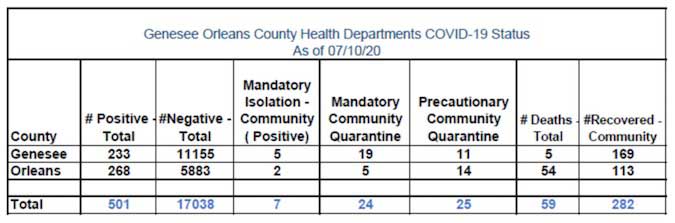
268 have tested positive in Orleans, while 233 cases in Genesee
Orleans County’s streak of seven days in a row without a new confirmed case of Covid-19 ended today with the Genesee and Orleans County Health Departments reporting one new case in Orleans, a person in the 30s from Carlton. The individual was not on mandatory quarantine prior to testing positive.
Orleans has now had 268 people test positive for Covid-19.
Genesee County has two new confirmed cases. Both are Batavia residents. One is in the 20s and the other is in the 60s.
Genesee has now had 233 people test positive.
The three new cases pushes the combined total in the two counties past 500 to 501.
Genesee is reporting three more recoveries from Covid-19, for 169 total from residents in the community.
Genesee doesn’t currently have any residents hospitalized with Covid-19, while Orleans has six.
More information from the Genesee and Orleans County Health Departments:
• Nursing Home Visitation: Limited visitation and activities will be allowed in those regions in which the nursing home is in Phase 3. Click here for the guidance.
• Precautionary Quarantine: Everyone (including children) who has traveled to/from any restricted states (for more than 24 hours) are required to self quarantine and self-monitor their health upon entering New York. This means the individual(s) cannot leave to go shopping, visiting, daycare and are only allowed to go for emergency care for the first 14 days back in New York.
Businesses including childcare providers should include a travel question in their regular health screening for their staff and clientele/children. Click here for the guidance. For general inquiries contact or call the Hotline: 1-888-364-3065 or click Ask A Question.
As of July 7, the 19 states in the travel advisory include Alabama, Arkansas, Arizona, California, Delaware, Florida, Georgia, Iowa, Idaho, Kansas, Louisiana, Mississippi, Nevada, North Carolina, Oklahoma, South Carolina, Tennessee, Texas and Utah. Those violating could be subject to a judicial order and mandatory quarantine and potential fines.
In Orleans, there are 14 people currently on precautionary quarantine due to the advisory, while Genesee is reporting 11 people on precautionary quarantine.
• Masks/Face-coverings are still required to be properly worn (covering nose & mouth) for all employees who work with the public. They are to be worn with direct contact (and all food service workers are to properly wear coverings when preparing and serving food – no exceptions) with the public as well as with co-workers when social distancing of 6 feet or more is not able to be kept.
All residents over the age of 2 years old and able to medically tolerate a face-covering are required to cover their nose and mouth with a mask or cloth face-covering when in public and unable to maintain, or when not maintaining social distance of 6 feet or more.
• Social Gathering Sizes: According to Governor Cuomo’s Executive Orders 202.42 and 202.45, all non-essential gatherings of up to 50 of individuals of any size for any reason (graduation parties, celebrations, or other social events) unless otherwise designated (ex. religious gatherings) are now allowed for those regions in phase 4. This is as long as requirements are followed for appropriate social distancing, and wearing cloth masks/face coverings over the mouth and nose.
• Community Testing Sites: Check with the testing site for any specific criteria necessary for testing such as illness, contact with someone who tested positive, essential worker, required for reopening/business, etc. Many need to have a doctor referral/prescription. Always call first.
Oak Orchard Health: 301 West Ave Albion, NY 14411. Call (585) 589-5613 to be screened and to schedule an appointment – no walk-ins.
WellNow Urgent Care: 4189 Veterans Memorial Drive Batavia, NY 14020.
Rochester Regional Health Urgent Care: 16 Bank Street Batavia, NY 14020. (Rochester Regional Health has transitioned Covid-19 evaluations from the tents at 127 North Street to Urgent Care.)
By Tom Rivers, Editor Posted 10 July 2020 at 3:52 pm
ALBANY – The State Department of Health announced today that beginning on Wednesday visitors will be allowed in nursing homes and long-term care facilities – for the first time since March 13.
Residents can have up to two visitors, DOH Commissioner Dr. Howard Zucker said.
This applies to nursing homes that haven’t had a Covid-19 case for at least 28 days, a threshold set by the federal Centers for Medicare & Medicaid Services.
“I know how painful it has been for residents of these facilities to endure such a long period of time without seeing family and loved ones, and my hope is that this adjustment to the visitation policy will provide some comfort to everyone,” Zucker said.
The visitors must undergo temperature checks, wear face coverings and socially distance during the visit. At least one of the two visitors must be at least 18 years of age or older. For each facility, only 10 percent of the residents can be allowed visitors at any time.
Nursing Homes accepting visitors will be required to send their visitation plan to the state Department of Health and affirmatively attest that they are following the guidance outlined here.
“With the knowledge we now have about how Covid-19 came into nursing homes – mainly through asymptomatic staff and visitors through no fault of their own – it is critical that as we resume visitations to these facilities we do it in a smart and cautious way to ensure the health and safety of residents and staff,” Zucker said. “We will continue to closely monitor the situation in each facility, and make adjustments based on the facts and data moving forward.”
6 animals have tested positive for rabies this year in Genesee, Orleans
Press Release, Genesee and Orleans County Health Departments
As stay-at-home restrictions progressed in New York State due to COVID-19, many people took this opportunity to adopt a new pet to spend their time with.
Animal shelters all over the state were reporting increased adoptions and some ran out of animals altogether. Now that it is summer and your new pets are going outside more, it is a perfect time to remind everyone how dangerous rabies can be and what you can do to prevent exposure to you, your family, and your pets.
Rabies is an infectious disease that can be fatal once symptoms (signs) show up. Rabies is a central nervous system disease which attacks the brain and causes death. It is most often spread through bites, scratches, and contact with infected saliva.
The Centers for Disease Control and Prevention reports that any mammal, including humans, can get rabies but it is most common in wild animals such as raccoons, skunks, bats, and foxes so it is wise to stay away from these animals (alive or dead).
In New York State, cats are the most frequently diagnosed domestic animals. The best way to prevent rabies exposure is to prevent your pets from contracting the virus by keeping their rabies vaccine up-to-date, so that they do not bring it into your home. Even indoor-only pets require a vaccination.
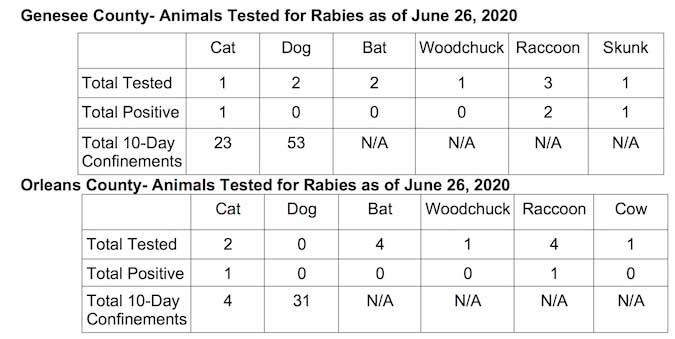
Sarah Balduf, Environmental Health Director of the Genesee and Orleans County Health Departments, reported that so far in 2020, the two counties have tested 22 animals and six tested positive for rabies. Additionally, 111 dogs and cats were observed in 10-day confinement.
An animal is subject to 10-day confinement if they are involved in an incident (i.e. biting a human) while apparently healthy. The animal’s health is monitored for 10 days to determine if rabies may be present and if further action is required. Complete details below.
One of the first signs of rabies in animals includes a change in the animal’s behavior.
“Animals may become unusually aggressive and try to bite you or other animals,” Balduf said. “A wild animal might act friendly or move slowly so that you could easily get close to it. Other symptoms include staggering, convulsions, choking, excessive drooling at the mouth, and paralysis.”
When humans are infected with rabies, they may not show symptoms for up to three months. Early symptoms of rabies are often flu-like and include fever, headache, and general weakness. As the disease progresses, symptoms include anxiety, confusion, agitation, hallucinations, hydrophobia (fear of water), and insomnia. Once symptoms have developed, rabies is almost always fatal to both humans and animals so it is crucial to report any possible exposures as soon as they occur.
To protect yourself from rabies, people are encouraged to avoid feeding, touching, or adopting wild animals and stray domestic animals such as cats and dogs that have not been properly rescued and vetted by a shelter and veterinarian. People are required by NYS law to keep their pets (dogs, cats, and ferrets) up-to-date on their rabies vaccination. It is recommended, though not mandatory, that livestock animals, especially valuable ones, are vaccinated as well. It is also recommended that people keep a close eye on children who are playing outdoors and telling them the dangers of playing with wild or stray animals (alive or dead).
Anyone who has been bitten by any animal or who otherwise may have been exposed to rabies needs to take immediate action. If you can do so safely, being careful not to damage the head/brain, capture the animal and call your local health department or a doctor to report the incident. Capturing the animal is vital in order for it to be tested for rabies. Testing will confirm if the animal is infected with the virus or not, making sure that only those who need treatment get it. Additionally, make sure exposed wounds or bites are cleaned thoroughly with soap and water and call your health care provider for further instructions.
(*If a bat is found in a room where there are unattended children, someone sleeping or someone who cannot speak for him/herself or your family pet, do not let the bat out of the house. To learn how to capture a bat safely, view a short video by clicking here.
A doctor in consultation with the health department will determine who needs to be vaccinated with rabies post-exposure prophylaxis (RPEP). A person who is exposed and has never been vaccinated against rabies may need to receive 4 doses of rabies vaccine on the following schedule: immediately, day 3, day 7, and day 14 after exposure. People who have weakened immune systems may require a fifth dose and some people required only 2 doses, as determined by a doctor.
The cost to treat an individual varies considerably based on weight, number of doses, and insurance. In 2020, treatment costs have ranged from $2,360-$6,130. Local health departments will work with the patient’s insurance company but what is not be covered by insurance is ultimately the responsibility of the taxpayers.
So far in 2020, Genesee County has had to treat six people with RPEP and Orleans County has had to treat three. It is important that all individuals do their part to prevent rabies in the community by vaccinating their pets and practicing caution around wild or stray animals.
To protect your pets from rabies, please visit one of the upcoming rabies vaccine clinics (subject to change due to COVID-19, watch GOHealthNY social media for updates and instructions to follow COVID-19 guidelines for everyone’s safety.):
Genesee County: Thursday, August 13 at the Genesee County Fairgrounds, 5031 East Main Road, Batavia from 4 p.m. to 7 p.m.
Orleans County: Saturday, August 15 at the Town of Shelby Highway Building, 4062 Salt Works Road, Medina, NY from 9 a.m. to 11:30 a.m.