









agriculture

Jacobs forms Agriculture Advisory Committee with 8-county representation

Posted 24 March 2021 at 6:42 am

Press Release, Congressman Chris Jacobs

ORCHARD PARK – Congressman Chris Jacobs (NY-27) announced he formed an agriculture advisory committee.

That group includes the county Farm Bureau presidents from the eight counties in the 27th Congressional District, representatives from the New York Farm Bureau, and other farmers from each of the eight counties. The representation spans the dairy, crop, poultry, and maple industries.

“Agriculture is the number one economic sector in our region, and our farmers provide nutritious produce and dairy nationwide,” Jacobs said. “I am proud to represent them on the House Agriculture Committee, and I want to make sure that they have a seat at the table as well. This committee serves as a way for me to hear directly from our farmers about their needs and concerns and will allow me to share pertinent information.”

The committee is set to have its first official meeting later this month and will meet quarterly. Jacobs is also a member of the House Agriculture Committee for the 117th Congress, serving on three subcommittees.

“Western New York is home to over 4,400 farms,” Jacobs said. “This committee ensures the voices of Western New York farmers and agribusinesses are heard and I am able to represent them as best I can. I look forward to working with them.”

Jacobs picked for co-chairman of House Maple Caucus

Posted 21 March 2021 at 2:51 pm

Press Release, Congressman Chris Jacobs

ATTICA – Congressman Chris Jacobs (NY-27) visited Merle Maple in Attica today to celebrate NYS Maple Weekend and announce his co-chairmanship of the House Maple Caucus.

“Maple production is an important part of the agricultural economy in Western New York,” Jacobs said. “In fact, Wyoming County is one of the largest maple producers in our state.”

In 2017, 1,695 New York maple farms with over 2,000,000 taps produced 714,372 gallons of syrup. Wyoming County accounted for over 91,000 of those gallons. Overall, farms in the eight counties throughout New York’s 27th District produced over 110,000 gallons of maple syrup.

“Generations of Western New Yorkers have provided maple syrup and other products to consumers nationally; it is part of our regional heritage and identity,” Jacobs said. “I am proud to announce I have joined the House Maple Caucus as a co-chair, which puts me in a strong position to advocate for this important industry.”

Jacobs serves as a co-chair of the House Maple Caucus along with Representatives Chris Pappas (NH-01) and Peter Welch (VT-AL). The bipartisan caucus was formed in the 116th Congress (2019-2020) to advocate for the American maple industry.

Apple growers vote to continue research and development program

Posted 19 March 2021 at 9:19 am

Farmers contribute $400K annually for research to boost profitability, battle pests

Press Release, NYS Department of Agriculture and Markets

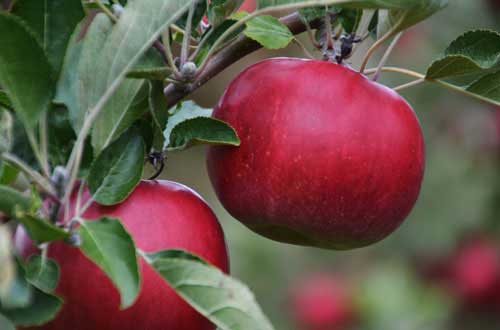
Photo by Tom Rivers – This photo from October 2015 shows apples at an Albion orchard. Orleans County is one of the leading apple-growing counties in the state, behind only Wayne and Ulster counties. New York State is the country’s second-leading apple producer, behind only Washington State.

ALBANY – The New York State Department of Agriculture and Markets announced that the state’s apple industry has voted in support of continuing the Apple Research and Development program.

New York apple growers are asked to approve of the program through a referendum vote every six years. The program is administered by Ag & Markets.

“The Apple Research and Development program has been important to funding much-needed research in pest management, potential disease, and other areas that make an impact on our farmers’ crops,” said State Agriculture Commissioner Richard A. Ball. “We thank our growers for participating in the referendum vote and look forward to continuing to support the program moving forward.”

The Apple Research and Development program was first established in 1990 by New York’s apple industry to fund research activities. In recent years, the program has been collecting nearly $400,000 in grower assessments annually, which are used to fund research critical to increasing the profitability of New York’s apple growers.

Research is conducted in the areas of pest management, bacterial infection, proper storage, product research, and overall best practices for growing and harvesting apples. The ARDP Advisory Board makes recommendations on the projects and establishes priorities based on the regions they represent.

For additional information on all current Marketing Order programs, including the ARDP, click here.

Soil & Water awarded $600K for conservation projects on farms in Orleans County

By Tom Rivers, Editor Posted 18 March 2021 at 3:33 pm

ALBION – The Orleans County Soil & Water Conservation District has been awarded two state grants for more than $600,000 for conservation projects on farms that will reduce sediment and runoff into local waterways.

The funding is part of $15 million announced by Gov. Andrew Cuomo to support agricultural water quality conservation projects across the state, benefiting 147 farms. The funding is being provided through the Agricultural Nonpoint Source Abatement and Control program, which supports projects that address water quality challenges in priority watersheds and protect the environment.

“Through the installations of these projects we are improving the water quality in Orleans County and in Lake Ontario,” said Katie Sommerfeldt, Soil & Water district manager in Orleans County. “Lake Ontario is used not only for recreation purposes, but is our drinking water source. This is just another reason why we need to protect this valuable resource.”

The first grant in Orleans County is for $282,934 for implementing 4,710 total acres of cover crops over three years on six different farms, Sommerfeldt said.

“By installing these cover crops we are reducing sediment and nutrient runoff from bare fields into nearby waterways,” she said.

The second grant is for $324,951 for implementing five Agrichemical Handling Facilities on five separate farms, including three farms in Barre, one in Ridgeway and one based in Hamlin. The Hamlin farm also operates land in Orleans County.

These facilities give the farms a safe place to store and mix pesticides, Sommerfeldt said. These buildings are designed to contain 125% of the volume of the farm’s largest sprayer.

If there is a spill while filling the sprayer, the floor will contain it. The farm would then be able to recover all spilled materials and reuse them for their intended purpose, Sommerfeldt said. “All of these facilities are located 100 feet from any watercourse or well,” she said. “By installing these facilities we are eliminating outdoor mixing sites that are located close to water bodies, thus eliminating any further water quality concerns from agrichemical spills.”

Farm Bureau leader wants farmworkers eligible for vaccine

By Tom Rivers, Editor Posted 12 March 2021 at 8:15 am

New York Farm Bureau is disappointed the state’s growing eligibility list for people to get the Covid-19 vaccine doesn’t include farmworkers.

NYFB President David Fisher issued this statement on Wednesday, a day after Gov. Andrew Cuomo visited a mass vaccination clinic in Syracuse. The governor this week announced the age eligibility for the vaccine would be lowered from 65 to 60 years old. Farmworkers haven’t been included among the eligible essential workers for the vaccine.

“It is frustrating that Governor Cuomo visited a location synonymous with New York agriculture, the State Fairgrounds in Syracuse, to announce the expansion of the state’s COVID vaccine eligibility list, yet he still refuses to protect farmworkers by including them in the ongoing rollout of phase 1b,” Fisher said in a statement. “The CDC recommends that food and agricultural workers be eligible for their own safety and that of our food system. It is time do what is right and prioritize the essential workers who help ensure New Yorkers have food on their tables.”

Jacobs wants dairy workers to be eligible for H-2A visa program

Posted 9 March 2021 at 7:13 pm

Press Release, Congressman Chris Jacobs

ORCHARD PARK – Congressman Chris Jacobs (NY-27) introduced legislation that would make the dairy industry eligible for H-2A temporary agricultural visas.

“As I have traveled throughout NY-27 and met with farmers, one thing that has become clear is the need for dairy producers to have access to a steady and legal workforce. Currently, dairy workers are not eligible for H-2A status because of the way current law is interpreted by federal agencies,” Jacobs said. “This simple legislation would fix an urgent need while Congress works on broader reforms to the H-2A program.”

The Dairy H-2A Eligibility Act would amend the Immigration and Nationality Act to include “dairy worker” as an eligible candidate for H-2A temporary agricultural worker visa status. Employers are currently only eligible for H-2A non-immigrant classification if they offer a temporary or seasonal position. Though H-2A workers are themselves temporary, dairy production has been interpreted to not qualify for these visas because it occurs year-round.

“Dairy’s workforce crisis is especially severe because dairy farms, which operate year-round, can’t use the H-2A program, which is seasonal. NMPF has fought for decades for H-2A access for dairy. We thank Congressman Jacobs for stepping up and making ag labor reform a priority issue, and we look forward to continuing to work with Rep. Jacobs to address the workforce needs of dairy farmers in New York and across the country,” Jim Mulhern, president and CEO of National Milk Producers Federation said.

“Agricultural labor reform has long been a New York Farm Bureau priority. We must address the seasonal and long-term needs of agriculture, including for the state’s dairy farms that currently do not have access to a year-round federal guest worker program. We thank Rep. Jacobs for his efforts to fix a broken system and moving the conversation forward for the betterment of our farms and food system,” David Fisher, New York Farm Bureau President said.

“The bottom line is that we need a migrant worker program that respects and enforces our immigration laws while providing farmers with the workforce that they need,” Jacobs said.

State approves $25 million more to continue Nourish NY through July

Posted 2 March 2021 at 1:08 pm

Press Release, Gov. Andrew Cuomo’s Office

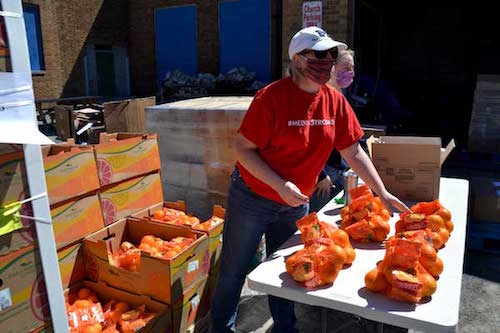
Photo by Tom Rivers: Heather Smith, director of the Orleans Community Health Foundation, volunteered at a food distribution in Medina on June 12.

Governor Andrew M. Cuomo today announced an additional $25 million has been directed to New York’s network of food banks and emergency food providers to support the Nourish New York program through July 2021.

Since the Governor launched Nourish NY at the height of the Covid-19 pandemic in April 2020, 21 million pounds of surplus agricultural products have been purchased from New York farmers and delivered to more than 1.3 million households in need across New York State.

Purchasing and food distribution using this third round of funding – which was first announced during the Governor’s 2021 State of the State Address – are currently underway. Since the launch of Nourish NY, a total of $60 million has been invested in the program.

“New York is on the path to recovery from the pandemic, but there is a continued need to assist families and our farmers across the state who are still struggling,” Governor Cuomo said. “Since its launch last spring, the Nourish New York initiative has had incredible success in connecting our agricultural producers with food banks in every corner of the state to bring fresh local foods to families in need.”

The Nourish New York program provides funds to New York’s food banks and emergency food providers, who then purchase agricultural products from New York farmers and dairy manufacturers and deliver the food to families in need.

Emergency food providers can use Nourish New York funds to:

  • Set up food-drive through events/giveaways;
  • Distribute dairy vouchers that can be redeemed in grocery stores for products like cheese, yogurt, milk, sour cream, and butter, throughout the state, and/or;
  • Purchase products directly from New York dairy/food manufacturers for their feeding programs.

Due to the Covid-19 pandemic, farmers experienced a drastic supply chain shift, which resulted in the loss of markets and income and in the waste of fresh surplus foods, particularly fluid milk. Simultaneously, the demand for food through emergency food providers escalated across the state. Seeing the opportunity to feed residents and aid farmers, the Governor launched the Nourish New York initiative. This initiative provided $25 million in funding for the first round and $10 million in the second round of the program for the purchase of foods grown, raised, or processed in New York State and has served as an important alternative revenue stream for farmers and dairy processors during the pandemic.  More than 4,150 farms have been impacted through the program.

State Agriculture Commissioner Richard A. Ball said, “Over the last 10 months, the Nourish New York program has helped feed more than one million families with nutritious dairy, fruits and vegetables, and so much more, and helped make sure our farmers had a market for their products.”

New York Farm Bureau President David Fisher said, “This additional funding for Nourish NY is good news for many farmers and low-income people who are still dealing with fallout from the pandemic. The program has coordinated a pathway to move food from farms to food banks in every region of the state, compensating farmers for their products and reducing food waste at the same time. It has proven to be a lifeline for people in need, and we thank Governor Cuomo for continuing the program.”

Albion Merchants want to bring farmers market to downtown Albion

By Tom Rivers, Editor Posted 1 March 2021 at 9:07 am

File photo by Tom Rivers: Dennis Stymus looks over his display of vegetables on Oct. 27, 2014 at the former Orleans County Farmers Market, which was located at the Save-A-Lot parking lot. That market was in operation for 10 years before closing in 2014.

ALBION – The Albion Merchants Association is proposing to bring a farmers market back to Albion.

A market operated on Saturdays at the Save-A-Lot parking lot on Route 31 until 2014. The Merchants Association wants to bring the market to downtown Albion on Sundays.

The Merchants Association filed a special events permit with the village, seeking to run a farmers market on Sundays from June 13 to Oct. 17 from 9 a.m. to 2 p.m. The Merchants want to use the village-owned lot at 19 North Main Street. This is the space next to the First Presbyterian Church.

In the application, the Merchants said the market would include vendor tents, food trucks and possibly music.

“I think it’s a great idea,” Mayor Eileen Banker said during last week’s Village Board meeting. “I would encourage that.”

The board wants to check with the Presbyterian Church to see if the congregation has concerns about any music from the market and possibly set a timeframe for when there shouldn’t be music at the market so it doesn’t interfere with the church service.

The village also wants to hear from the church leaders if the parking lot is used by the congregation on Sundays.

Interested vendors can email farmersmarketalbion@gmail.com for more information.

Agriculture outlook sees farm labor as scarce with rising wages in 2021

Photo by Tom Rivers: Farmworkers pick cucumbers in this photo from August 2019 along Townline Road in Barre-Shelby.

Posted 9 February 2021 at 11:17 am

Press Release, Cornell University

ITHACA – New York state farm operators can expect a tight labor market and rising wages in the year ahead, in addition to continued pandemic precautions, debate over immigration reform and potential changes to overtime pay, according to a Cornell agriculture expert.

“Ag labor is going to remain scarce due to … underlying demographics and labor market factors, even if we get immigration reform,” said Richard Stup, agricultural workforce specialist in the College of Agriculture and Life Sciences and at Cornell Cooperative Extension. “Wages are going to continue to climb from both market and regulatory pressure.”

Stup offered his outlook for the sector during the Charles H. Dyson School of Applied Economics and Management’s 2021 Agricultural and Food Business Outlook Conference, held virtually Jan. 25. The conference also featured presentations on the outlook for the U.S. economy and for the dairy, fruit, vegetable and wine markets.

Long-term demographic trends have made it more challenging for farms to find workers, Stup said. Those trends include a more urbanized U.S. population, declining flows of new immigrants and – prior to the pandemic – unemployment near 50-year lows.

“The overall unemployment rate was so low, it’s no wonder farms are having a hard time identifying people,” he said. “People don’t show up at the farm office anymore just looking for work.”

Overall, roughly 11,000 New York farms employed nearly 56,000 workers in 2017, down from 61,000 in 2012, according to the 2017 Census of Agriculture. Fruit and tree nut farms accounted for 24% of the hiring, followed by dairy cattle and milk production at 22%.

Stup highlighted Pew Research Center data showing that unauthorized immigration, upon which the agricultural sector has relied heavily, declined nationally between 2007 and 2016, with New York experiencing the second-largest drop after California.

And among the estimated 11 million current unauthorized immigrants, according to Pew, 66% are long-term residents who have been in the country for more than 10 years. Stup said that was evident on many farms in the state, where unauthorized immigrants who arrived in the 1990s are now middle managers, have families and are established in rural communities – a different image from one many people have had over the years, he said.

“It’s important for us to upgrade that image and modernize that image of who the unauthorized immigrant workforce really is,” said Stup. “This industry is changing as we watch it.”

President Joe Biden is calling for comprehensive immigration reform, something the federal government hasn’t achieved since 1986, Stup said. At the same time, he said, legal hiring of temporary agricultural guest workers under the H-2A visa program has grown dramatically in recent years. New York’s 8,482 certified H-2A positions last year was more than double its total in 2012 and was in the top 10 nationally, according to the U.S. Department of Labor.

“I suspect it will continue to grow here in New York because of the continued demand,” Stup said.

Regarding wages, Stup noted that New York state is moving toward a mandatory $15 minimum wage. Long Island farms must pay at least $14 per hour this year and move to $15 next year, Stup said. The upstate minimum is now set at $12.50, with the timing of future increases uncertain.

Nationally, farm wages have grown at a faster rate than non-farm wages over the last 30 years, Stup said, but haven’t caught up, now representing about 60% of non-farm, non-supervisory wages. “There’s room to grow,” he said.

In addition to wages, Stup said New York farms will be closely monitoring any state action on overtime pay. Farm employers currently pay overtime for work in excess of 60 hours per week, not 40 hours as in most other sectors. A state wage board may consider lowering that threshold later this year, Stup said, a potential concern for growers with the highest labor costs, including vegetable farms, tree farms and nurseries.

New York’s farm workforce did an “outstanding job” complying with prevention measures and limiting the spread of coronavirus last year, Stup said, avoiding many of the outbreaks seen in other states.

“For the 2021 growing season, in spite of the fact that there will be vaccinations coming,” he said, “we’re going to see a lot of the same restrictions … to protect the farm workforce going forward.”

Jacobs pleased to return to Agriculture Committee

Posted 26 January 2021 at 4:07 pm

Expanded Broadband, laying groundwork for new Farm Bill among priorities

Press Release, U.S. Rep. Chris Jacobs

Congressman Chris Jacobs (NY-27) is announcing that he is returning to the House Committee on Agriculture for the 117th Congress.

“Western New York’s economy and communities are directly supported by our agriculture industry,” Jacobs said. “Our farms, processing facilities, and agri-businesses provide thousands of good-paying jobs and present major opportunities to set our region up for future prosperity. It has been my mission to support our farmers in Congress – I made it a priority to be seated on the Agriculture Committee in July when I was first elected and look forward to carrying my work there into the 117th Congress.”

Announced earlier this year, Rep. David Scott (D-GA) will serve as Chairman, and Rep. Glenn ‘GT’ Thompson (R-PA) will serve as Ranking Member of the House Committee on Agriculture for the 117th Congress. The Committee is charged with reviewing, developing, and advancing policies and proposals to support, improve, and further the needs of American farmers, agricultural businesses, and rural communities. As of 2017, Western New York had over 4,400 farms producing over $1.1 billion in products, representing 22% of all NYS agriculture sales.

“Serving on the Agriculture Committee puts me in the best possible position to advocate for our farmers and their needs,” Jacobs said. “These past few months alone, I was able to work with my colleagues to ensure the Commodity Credit Corporation was allocated necessary funding, increase investments for the USDA ReConnect Broadband Program, and pass COVID-19 relief legislation with direct support programs for farmers like the Coronavirus Food Assistance Program (CFAP).”

“This term, there are major priorities that must be addressed. Our region needs improved broadband infrastructure, the agriculture sector needs new and younger farmers to ensure the longevity of such a critical industry, and we need to protect and support our farmers from unfair trade practices so they can access expanded markets and grow their businesses,” Jacobs said. “Finally, we will be in the beginning stages of developing a new Farm Bill early this year. I will be working diligently to ensure that the needs of Western New York farmers are met in that legislation.”

Jacobs wants agricultural employees to be eligible for Covid vaccine

Posted 23 January 2021 at 12:02 pm

Press Release, Congressman Chris Jacobs

ORCHARD PARK – Congressman Chris Jacobs (NY-27) sent a letter to New York State Governor Andrew Cuomo asking for the agricultural workers to be authorized to receive the COVID-19 vaccine.

“We owe our agricultural workers a debt of gratitude. They have supported our families and state economy throughout the entirety of this pandemic and are essential frontline employees,” Jacobs said. “Without their efforts, millions of families in New York, and around the nation, would not have been able to acquire the nutritious food needed to survive the health crisis.”

The Centers for Disease Control has recommended that Phase 1b of the vaccine rollout include agricultural workers as eligible recipients. Currently, the Governor has authorized only “public-facing grocery store employees” as eligible members of the food and agriculture workers category in New York State’s Phase 1b vaccine program.

“Currently, in New York State, employees of our farms, producers, and processing facilities are ineligible to receive the COVID-19 vaccine, despite their essential status and the recommendation of the CDC,” Jacobs said. “The work they do is critical to the stability of our nation, and I have asked the Governor to consider granting them eligibility status.”

According to NYS Comptroller DiNapoli, in 2017, over 33,000 farms in New York State employed over 55,000 workers and garnered over $5.7 billion in revenue. In the same year, agriculture added over $2.4 billion to the New York State Gross Domestic Product (GDP), and the state ranked in the top five of all producers for 15 different agricultural products.

“Not only is agriculture a major driver of the New York economy at a time when our state is facing massive budget deficits, but it is also a matter of health and safety,” Jacobs said. “Allowing the men and women working on the frontlines in agriculture to receive the vaccine strengthens and stabilizes our food supply chain at this critical time.”

Federal government modernizes H-2A program for farmworkers, employers

File photo by Tom Rivers: These farmworkers pick cucumbers in August 2019 along Townline Road in Barre. This is the spot near the corner of Shelby, Barre, Albion and Ridgeway, just south of the 4-H Fairgrounds.

Staff Reports Posted 17 January 2021 at 11:09 am

The federal Department of Labor announced on Friday it will be modernizing the H-2A program, which allows farms and agriculture businesses to bring in temporary guest workers from other countries.

The DOL is bringing the program into the digital era, harnessing the power of the FLAG electronic filing system to share information with other federal agencies like the Department of Homeland Security while also sharing information with the State Workforce systems and domestic farmworkers, the department said.

“This final rule streamlining and modernizing the H-2A visa process will go a long way in ensuring American farmers have access to a stable and skilled workforce, all while removing unnecessary bureaucratic processes,” Sonny Perdue, secretary of the Department of Agriculture, said in a statement on Friday. “USDA’s goal is to help farmers navigate the complex H-2A program that is administered by Department of Labor, Department of Homeland Security, and the State Department so hiring a farm worker is an easier process. These modernizations make the Federal government more responsive to our customers, ensuring American agriculture continues to lead the world for years to come.”

Perdue said there are also additional flexibilities to cut down on unnecessary burdens on the agricultural employers that use the program. These flexibilities include the ability to stagger the entry of workers into the country over a 120-day period and allowing agricultural employers the flexibility to file a single application for different dates of need instead of multiple applications.

Roy-Hart has new Agriculture Foundation to increase opportunities for students

Posted 5 January 2021 at 11:57 am

Press Release, Roy-Hart Agriculture Foundation

MIDDLEPORT – The new Royalton-Hartland Agriculture Foundation kicks off 2021 with a board of directors committed to providing investment and resources for innovative approaches to agriculture education, meeting needs of the Royalton-Hartland School District and the regional agricultural community.

Working cooperatively with the district, the RHAF plans to strengthen relationships with community leaders and businesses, increase leadership and character development opportunities for students, create a speakers bureau, arrange field trips for students and teachers, explore apprenticeship and job shadowing programs, and convene important conversations between the district and the community, said Mike Landers, president of the new foundation.

“The RHAF is separate from the district’s Board of Education,” Landers explained. “We believe we can bring countless opportunities to help the district, educators, administrators, students, parents and community. Our foundation is not responsible for any portion of the district’s budget.”

Joining Landers (Howell Motors) on the board include: Bob Confer (Confer Plastics), Dan Conley (USI Insurance Services), Mike Drum (Drum Oil & Propane), Steve Giroux (Middleport Family Health), Bob Masse (Frontier Airlines), Carisa Masse (JFK Middle School), Jeremy Silsby (Silsby Settlement Farms), Debi Sweeney (Maple View Dairy Farm) and John Sweeney (Maple View Dairy Farm). Non-voting members include Dr. Hank Stopinski, district superintendent, and Matthew Sweeney, Roy-Hart High School agriculture teacher.

A primary goal of the Foundation is to invest in creative educational programs and projects that have a significant positive impact on the lives of the students and families served. Beyond fund development, the RHAF seeks to provide networking opportunities, build relationships with stakeholder groups and the private sector, and offer culturally relevant information and training.

“In this unprecedented time for education, due to the pandemic and a reduction in state contracts, it is heartening that these high-profile community leaders are rallying others to learn about the exciting agriculture initiatives and programs in our schools,” Stopinski said. “Their leadership is gratifying to our school board, teachers and staff. The district looks forward to working with the Foundation to build a strong Agriculture Center of Excellence in the coming years.”

Albion farmer tops again in NY corn yield contest

By Tom Rivers, Editor Posted 4 January 2021 at 8:29 am

Provided photo: Adam Kirby holds the trophy for winning the 2019 corn yield contest in New York. He won the 2020 yield contest in the conventional irrigated category in NY.

ALBION – Adam Kirby again is on top of the corn yield contest in New York. Kirby won the contest in 2019 with a 277.0 bushel yield in the strip till, non-irrigated category.

He won another category in 2020 with a 271.8 bushel yield in the conventional irrigated category. Kirby used a Pioneer seed, P1197AM, for the winning entry.

He also was second in the strip, min, mulch, ridge-till non-irrigated category with a 273.6 yield. That was just behind Andrew Mcllroy of Pavilion at 273.8 bushels. Kirby used a Pioneer seed, P0720AM, for this entry.

Other New York winners in other categories include: conventional non-irrigated, Henry Everman of Danville at 299.8 bushels; no-till non-irrigated, Craig Phelps of Groveland at 239.2 bushels; strip, min, mulch, ridge-till irrigated, Tom Jeffres of Wyoming at 286.7 bushels.

The National Corn Growers Association announced the results of the contest last month.

Don Stall of Charlotte, Mich., produced the highest yield in the contest with a yield of 476.9 bushels per acre. That was in the conventional irrigated category.

The National Corn Yield Contest is in its 56th year and remains NCGA’s most popular program for members.

“This contest brings farmers together to create, innovate and explore ways to optimize the nation’s largest and arguably most important crop,” said Debbie Borg, chair of NCGA’s Member and Consumer Engagement Action Team. “At both the state and national levels, contest winners find new ways to excel while using a variety of techniques. Ultimately, the invention and improvement by farmers and input providers enable U.S. farmers to continue to meet the future demand for critical food, feed, fuel and fiber.”

Winners receive national recognition in publications such as the NCYC Corn Yield Guide, as well as trips or other awards from participating sponsoring seed, chemical and crop protection companies.

Winners are traditionally honored in March during Commodity Classic. With the convention moving to a virtual format in 2021, NCGA is working with sponsors to find an alternative means to recognize the accomplishments of yield contest winners.

Wage Board votes to keep farmworker OT threshold at 60 hours

Photo by Tom Rivers: Jeremy Neal of Poverty Hill Farms in Albion bales straw in July in a field along Route 31A in Shelby near Culvert Road.

By Tom Rivers, Editor Posted 31 December 2020 at 8:28 pm

ALBANY – A three-person Farm Labor Wage Board voted today to keep the overtime threshold for farmworkers at 60 hours per week.

The New York Farm Bureau wanted the threshold to stay at 60 hours, while some labor groups wanted it to drop to 40 hours to align with many other industries.

Denis Hughes, former president of the New York State AFL-CIO, cast the lone nay vote today. He requested an amendment that would keep the threshold at 60 hours for two more years and then do an eight-year phase-in to 40 hours. In that scenario, Hughes said the OT threshold would be reduced by 2.5 hours each year over eight years until it was at 40 hours a week, starting Jan. 1, 2030.

He wants farmworkers to be at 40 hours to start overtime like workers in restaurants, food processing and some other sectors of the food industry.

But Brenda McDuffie, chairwoman of the Farm Labor Wage Board, said there is too much uncertainty now in the farm economy to commit to lowering the overtime threshold.

McDuffie, president of the Buffalo Urban League, said farmers have had their markets disrupted by the Covid-19 pandemic. There is no certainty when the Covid impact will end, she said.

She noted the overtime wage is going up in upstate in 2021, from $11.80 to $12.50 per hour. The Wage Board will consider the issue again between Nov. 1 and Dec. 15, 2021.

New York Farm Bureau President David Fisher joined McDuffie in voting to keep the threshold at 60 hours in 2021. This past year was the first year the 60-hour threshold was in place. Before there wasn’t a weekly limit before overtime wages were implemented.

Fisher advocated for waiting at least three to five years to consider lowering the threshold, so more data could be analyzed on the impact for farms and the workers. Farmers have said in hearings there could be unintended consequences where workers get paid less per week with the overtime threshold dropping because farms could be force to cut hours.

“I had encouraged giving the process more time to fully evaluate what a lower threshold would mean for all involved, especially with such limited data from this year,” Fisher said in a statement. “I’d like to thank my fellow wage board members for their time and professionalism and encourage the Department of Labor to continue to work with the farming community to do what is best for our farms and employees. We need each other for agricultural production and our rural communities to flourish.”

There were five public hearings on the issue this year for the Wage Board to gather information and testimony. McDuffie said the group will continue to collect data and wants to hear from more farmers and workers in 2021.

State Republican Leader Rob Ortt issued a statement in support of the board’s decision today.

“While today’s announcement is positive, the reality is our farms are still under great strain,” Ortt said. “The Senate Republican Conference believes a vibrant agriculture industry is critical to the economic success of our state. We urge Leaders in Albany to reject any new burdens on our family farms and work with our Conference to advance solutions that will help grow this critical part of our state’s economy.”

Ortt said Albany has already imposed new burdens on family farms across the state. Lowering the OT threshold would have raised their costs during a time of economic crisis in the state.

“I thank the hundreds of farmers, farmworkers, and supporters who took the time to advocate on this issue and look forward to working with them to support New York agriculture in the future,” Ortt said.