









ALBANY – New York’s soybean growers had a record crop in 2021, and the corn output was a near record, USDA’s National Agricultural Statistics Service reported.
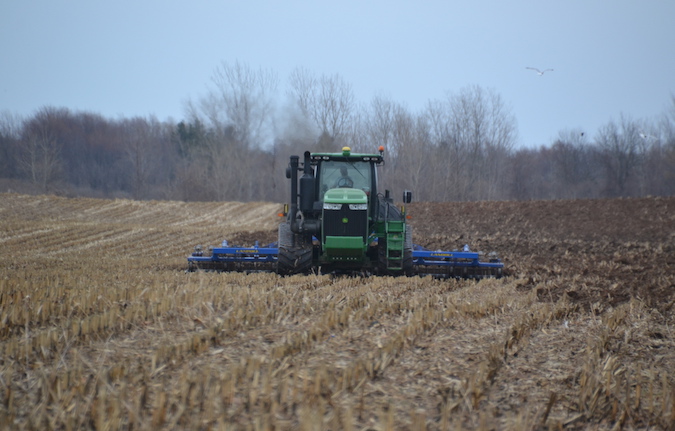
Soybean farmers produced a record high 17.0 million bushels, up 7 percent from 2020. Soybean yield is estimated at a record high 53.0 bushels per acre, up 2.0 bushels from 2020. Harvested area in 2021, at 320,000, is up 3% from last year, NASS reported.
Corn production in 2021 totaled 97.7 million bushels, up 24 percent from 2020. The average yield in New York is estimated at a record high 167.0 bushels per acre, 10.0 bushels above the 2020 average yield of 157.0 bushels per acre. Area harvested for grain, at 585,000 acres, is up 17 percent from 2020, NASS reported.
Nationally soybean growers also had record-high production and near-all-time high for corn production, according to the 2021 Crop Production Annual Summary released by NASS.
Soybean production for 2021 totaled a record-high 4.44 billion bushels, up 5 percent from 2020. With record high yields in 21 states, the average soybean yield is estimated at 51.4 bushels per acre, 0.4 bushel above 2020 and the second highest on record.
U.S. corn growers produced 15.1 billion bushels, up 7 percent from 2020 and the second highest on record. Corn yield in the United States is estimated at a record high 177.0 bushels per acre, 5.6 bushels above the 2020 yield of 171.4 bushels per acre.
By Tom Rivers, Editor Posted 12 January 2022 at 9:19 am
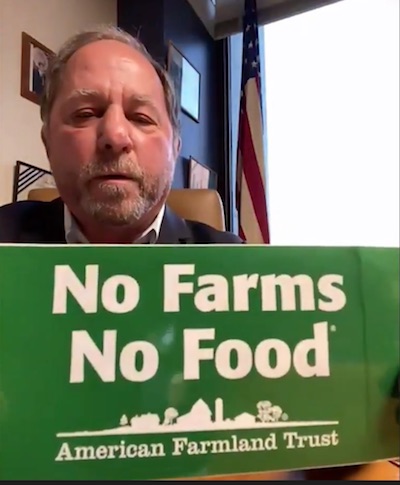
This screen shot shows Assemblyman Steve Hawley holding a “No Farms No Food” bumper sticker at the close of his testimony last week during a virtual hearing about lowering the overtime threshold for farms below the current 60-hour threshold in a week.
Farms in New York State are again facing the prospect that the overtime threshold will be changed.
There wasn’t an OT threshold until 2020, when it was set at 60 hours a week. Some state legislators are pushing to reduce that to 40 hours a week, like many other industries, but the farming sector has said that will likely put many of the operations out of business, or force them to switch from labor-intensive fruits, vegetables and dairy.
“Their very existence is jeopardized unlike ever before,” Assemblyman Steve Hawley said during the first of three virtual hearings about lowering the OT threshold.
Hawley is a former cash crop and livestock farmer in Batavia. He was the Genesee County Farm Bureau president. A back injury forced him to go into the insurance business where he continues to work with many farmers.
He said many pushing for lowering the overtime threshold have good intentions, but miss the reality that the change will result in smaller paychecks for workers, who will likely pursue farm jobs in other states where they can make more money.
“The surrounding states do not have this restriction,” Hawley said. “The workers will leave for other states where can get more hours.”
Hawley testified during the hearing on Jan. 4. The next two hearings are 5 p.m. on Jan. 18 and 5 p.m. on Jan. 20. (Click here for more information.)
New York farms work on a short growing season, compared to competitors in California and other warmer states. New York farms need to put in long days due to a compressed growing season and that often means working well beyond 40 hours a week, Hawley said.
“Farms cannot operate on a less than 60-hour work week, and the failure to recognize that fact will lead to the loss of our beloved family farms and all the jobs they provide,” Hawley said.
He praised the agriculture community, where he said “less than 1 percent of our population feeds our state, our country and our world.”
Farmers can’t set their prices for what they receive, but face rising costs for fuel, fertilizer and supplies.
“They are at the mercy of the weather and their government,” Hawley said.
A three-person Farm Labor Wage Board is convening the hearings. The group includes David Fisher, President of the New York Farm Bureau; Denis Hughes, former President of the New York State AFL-CIO; and Brenda McDuffie, President of the Buffalo Urban League.
The Wage Board about a year ago on Dec. 31, 2020 voted 2-1 to keep the OT threshold at 60 hours.
Hughes of the AFL-CIO cast the lone nay vote that day. He wanted an eight-year phase-in to 40 hours. In that scenario, Hughes said the OT threshold would be reduced by 2.5 hours each year over eight years until it was at 40 hours a week.
Fisher of the NYFB a year ago advocated for waiting at least three to five years to consider lowering the threshold, so more data could be analyzed on the impact for farms and the workers. Farmers have said in hearings there could be unintended consequences where workers get paid less per week with the overtime threshold dropping because farms could be force to cut hours.
McDuffie of the Urban League about a year ago said there was too much uncertainty in the farm economy to commit to lowering the overtime threshold. She said then farmers have had their markets disrupted by the Covid-19 pandemic. There is no certainty when the Covid impact will end, she said.
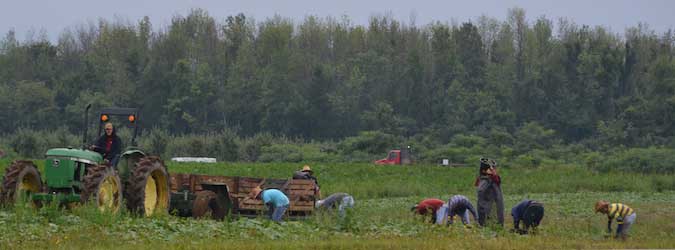
Photo by Tom Rivers: Farmworkers harvest vegetables in August 2019 by Townline Road in Barre.
‘The future of farming and food security in our state hangs in the balance’
Press Release, State Senate Republican Leader Rob Ortt
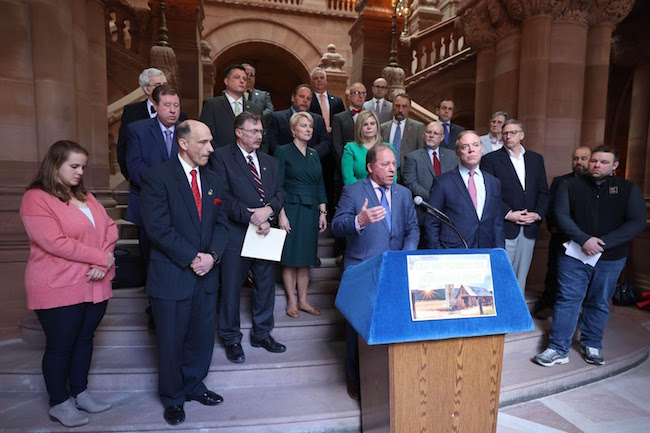
ALBANY – Senate Republican Leader Rob Ortt, along with members of the Senate Republican Conference, yesterday sent a letter to the Farm Laborers Wage Board, urging board members to vote against the reduction of the overtime threshold beyond the current 60 hours established in the Farm Laborer Fair Labor Practices Act (FLFLPA) of 2019.
Rob Ortt
“As we start the new year, the agriculture industry continues to struggle under burdensome state mandates and the lingering effects of the Covid-19 pandemic,” Ortt said. “Lowering the overtime threshold will push workers to other states and drastically lower production, leaving family farmers with a serious risk of losing their livelihoods.”
In January, the New York State Farm Labor Wage Board will revisit the threshold set in 2019 and make a determination on whether to lower the threshold to 40 hours. Ninety-six percent of farms in New York State, most of which are family-owned, are unable to cover the costs of paying time and a half; a threshold reduction would result in less hours for employees to work and smaller paychecks. With farms being local economic engines, this Albany mandate would have devastating effects on communities across New York State.
In their letter, the Republican legislators cited a recent study conducted at Cornell University. The study found that if the overtime threshold was lowered to 40 hours, two-thirds of dairy farmers would make significant changes to their operation, including leaving the industry or investing out of state, and half of fruit and vegetable farmers indicated they would decrease their operations or exit the industry.
“Even the most resilient of these New Yorkers would be forced to relinquish labor-intensive dairy or crops operations, relocate to other states or abandon agriculture entirely,” said Senator George Borrello, Ranking Member of the Senate Agriculture Committee. “I urge the members of the Wage Board to listen to researchers as well as those on the front lines, including farm workers, and reject any overtime changes. The future of farming and food security in our state hangs in the balance.”
Fellow Members of the Senate Republican Conference Senator Pam Helming, Senator Mike Martucci, Senator Patty Ritchie, Senator Sue Serino, Senator Fred Akshar, Senator Patrick Gallivan, Senator Anthony Palumbo, Senator Tom O’Mara, and Senator Alexis Weik also signed onto the letter.
By Tom Rivers, Editor Posted 26 December 2021 at 9:58 am
File photo: Adam Kirby holds the trophy for winning the 2019 corn yield contest in New York.
ALBION – An Albion farmer has again topped other corn growers in the state for the highest yield.
Adam Kirby finished first with a yield of 293.1075 in the strip, min, mulch, ridge – till non-irrigated category. Kirby used Pioneer seed PO947Q.
Some other nearby farmers won in the New York contest. Henry Everman of Dansville won conventional non-irrigated with a yield of 290.3780 and Tom Jeffres of Wyoming had the top yield, 263.4521, in strip, min, mulch, ridge-till irrigated
Kirby has now won the past three years. In 2019, he finished first with a 277.0 bushel yield in the strip till, non-irrigated category.
He won another category in 2020 with a 271.8 bushel yield in the conventional irrigated category. In 2020, he also was second in the strip, min, mulch, ridge-till non-irrigated category with a 273.6 yield.
Kirby and other winners around the country will be honored in March 2022 during Commodity Classic in New Orleans, La.
Press Release, NYS Horticulture Society and NYS Berry Growers Association
Jim Bittner
The Boards of Directors of the New York State Horticulture Society (NYSHS) and the New York State Berry Growers Association (NYSBGA) are pleased to announce that Jim Bittner of Appleton has been appointed their Interim Executive Director.
The NYSHS began 1855. Its purpose has always been to serve the fruit industry of New York. The programs of the “Hort Society” have changed over the years to keep up with the changing times. The present mission is to “…educate, promote and protect the New York Fruit Industry”.
Founded in 1988, the New York State Berry Growers Association is a nonprofit educational association for berry growers, from large wholesale family farms to independent farm stands and small pick-your-own operations, across New York State. The NYSBGA promotes the growing and marketing of berries through the exchange of valuable information, including scientific research and production techniques.
Bittner brings an understanding of the needs of the fruit industry and the needs of these organizations. His home farm, Bittner-Singer Orchards, in Appleton consists of 400 acres of fruit including apples, peaches, cherries, plums and apricots. His two sons, Kevin and David, are involved in the farm operation.
In the past, Bittner served on the Board of the Horticulture Society including being its chairperson. In that role, he was active in the Council of Agricultural Organizations and the Farm Viability Institute Board. He has been very active in Farm Bureau at many different levels over the years. All of these organizations are geared toward keeping agriculture as an economic engine for the New York State economy.
In addition to these organizations, Bittner served on the Niagara County Cooperative Extension Board and Niagara County Industrial Development Microenterprise grant program board. He is currently a member of the Soil and Water Board, Niagara County Farm Bureau Board, and Treasurer of the Barker Lions Club.
Bittner has received numerous agricultural and business awards including the Distinguished Service award from the New York Agricultural Society, Business Person of the Year from the Niagara County Chamber of Commerce, National Outstanding Young Farmer, 40 Under 40 from Buffalo Business First and Outstanding Young Alumni from the Agriculture and Life Sciences school at Cornell University.
Serving as Interim Director is important for many reasons, he explained. “There are many facets to these two organizations. We facilitate communication between farmers, agricultural researchers, and educators through our Fruit Quarterly. We keep farmers apprised of regulatory issues that could affect our ability to farm and work to educate decision makers on how new regulations will affect agriculture. Thirdly, we work with other agricultural organizations to ensure that we understand and appreciate the challenges we all face. I am really excited to work with people I have known for decades in this new capacity.”
By Tom Rivers, Editor Posted 3 December 2021 at 4:19 pm
Press Release, Assemblyman Michael Norris
Assemblyman Mike Norris (R,C-Lockport) is encouraging members of the agriculture community to continue reaching out to the state’s Farm Labor Wage Board to persuade them against further reducing the overtime threshold for farm workers.
Recently, downstate special interest groups have spearheaded efforts to reduce the overtime threshold from 60 to 40 hours a week, a move that would spike grocery costs for consumers and put local family farms out of business.
Farms across the state have been besieged by rising costs, including energy prices, various taxes, and rising labor costs as well as the addition of costly mandates from the state leading many farms, particularly small, family-run farms to close, consolidate or downsize operations. As the Consumer Price Index has risen more than 5.4 percent in the last year, New Yorkers, like all Americans, are struggling to make ends meet in the face of inflation. Fewer family farms would reduce local access to produce and other fresh products at a time when global supply chains are in crisis.
“I voted against this matter when it came up in the Assembly because the negative impact it would have on our farms was clear. Now, with inflation and rising costs, families are struggling – even the cost of Christmas trees is through the roof this year,” said Norris. “Families are having to make tough choices and I, for one, think our nation, and this great state, can do better. We have people who want to work, are willing to work and there’s work to be done. This is not the time to limit hard work, entrepreneurial spirit and ingenuity by putting farmers and farm workers alike out of business.”
An ardent agricultural advocate, Norris says the more people who reach out directly to the Farm Labor Wage Board, the more likely they will be to offset the proposed farm worker overtime expansion. To contact the board, you can call the state Department of Labor at (518) 457-9000, or a better option is to write to them at:
Ms. Brenda McDuffie, Chair
New York Farm Labor Wage Board
W.A. Harriman Campus, Building 12
Albany, NY 12240
In addition to rallying the public, Norris has been working with dozens of his legislative colleagues across party lines to encourage the board, as well as the Department of Labor and Department of Agriculture and Markets, to beat back these crippling mandates.
“This is a tough, yet decisive, time for our state. There are far too many people going hungry and out of work,” said Norris. “There are shortages on the shelves. This is not the time to further hinder our path or any individual’s will to work hard and move forward.”
Press Release, Cornell Cooperative Extension of Orleans County
Master Gardener Eileen Sorochty teaches a class on Hypertufa in 2019. Educational classes for the public are just one of the ways that Master Gardeners volunteer their time.
KNOWLESVILLE – Orleans County CCE is hosting a new hybrid Master Gardener training starting in January of 2022. The training is the first step towards becoming a Master Gardener volunteer with Cornell Cooperative Extension. This is the first year the training is being offered as an online/in-person hybrid course.
Master Gardener training has been offered for decades across NY state, but the core coursework has been in need of an update for some time. With the help of grant funding and input from volunteers and staff across the state, senior extension educators at Cornell spent the better part of 2019 curating the online content to offer thorough and in-depth lessons geared toward the adult learner.
The result is an online course packed with information on key topics such as Plant Biology, Food Gardening, Entomology and more, as well as options for more detailed content on specific topics under the “Explore and Learn More” link under each general section.
“I’m so impressed with this new hybrid format” said Katie Oakes, Horticulture Educator at Orleans CCE and coordinator of the Master Gardener program. “There is so much to learn within the training program, and an online format really allows participants to work at their own pace, on their own schedule.”
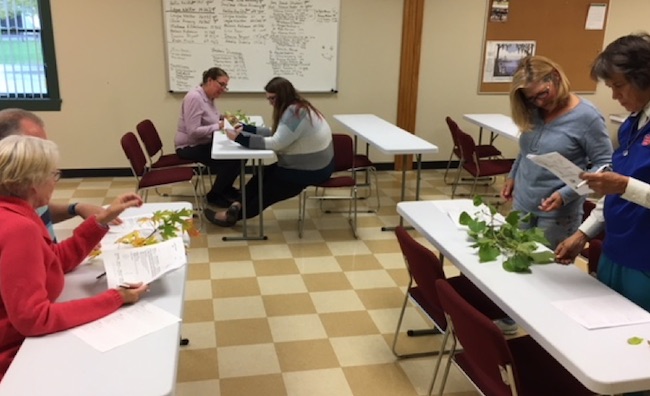
The training this coming winter will start January 13th and go until April 7th. Participants will be given access to the online portion of the course on the Moodle educational platform where they complete lessons on their own. The group will then meet every other week (dates vary) to reinforce key concepts and to complete several hands-on activities designed to put into practice what they learned on the Moodle course the weeks before.
“I think it’s really important to still have the in-person aspect,” explained Oakes, “Meeting in person builds that sense of community that might come a little less naturally in an online forum setting. Having the hands-on activities is really crucial, too, because people retain so much more knowledge by actually doing rather than simply observing.”

Past Master Gardener Trainings have consisted of sixteen 3-hour long lecture style classes covering a range of topics. The schedule was often difficult for participants with young families at home, full-time jobs, or other obligations. This new online course will give all participants the opportunity to gain knowledge and participate fully with a distance-learning perspective. The online course also includes extensive additional information that a fully in-person training just could not accommodate time-wise.
“This new online format makes it so much easier to access valuable resources – and there are a lot! There’s so much excellent information included in this training, several of the videos and links to articles I can’t wait to re-visit and look at again!” said Nancy Halstead, an Orleans County Master Gardener who took the piloted online course as a trial last winter.
After completion of the training, participants can complete 40 hours of volunteer service through the various programs at Orleans CCE to become a full-fledged Master Gardener Volunteer. Becoming a Master Gardener allows participants to become a part of a nation-wide volunteer association focused on extending land-grant university’s research and expertise to the public in their own local communities.
Current MG Volunteers in Orleans County serve the community in many different ways – offering educational classes to the public, hosting informational tables at local events, speaking at area garden clubs, displaying at farmers markets and the 4-H Fair, collaborating with other CCE programs like 4-H and Master Food Preservers and more! There are about 20 active MG Volunteers in Orleans County, and in addition to monthly meetings, the volunteers get together for field trips, gardening conferences, and social outings as well.
“I really love the camaraderie that comes with being a part of this group!” said long-time MG Volunteer Eileen Sorochty “It’s so wonderful to be around like-minded people caring about our environment and each other’s well-being. Being a Master Gardener has enriched my life in so many ways.”
The deadline to register for the upcoming Master Gardener training (with a $50 non-refundable deposit) is December 22. Cost for the training is typically $200 per person, but there is a 50% discount for the first ten people to register (a $100 value). Reduced rate tuition is also available for additional participants as needed. If internet accessibility is an issue, participants can utilize office hours at the Orleans County CCE Education Center M-F 8:30-4:30 to access the course using CCE wifi and computers.
For more information on the Master Gardener program in Orleans County, or to register for the upcoming Master Gardener Training, contact Horticulture Educator and MG Coordinator Katie Oakes at 585-798-4265 ext. 125 or email klo54@cornell.edu.
Horticulture educator and MG Training Instructor Katie Oakes demonstrates a grafting technique during a past Master Gardener Training.
By Tom Rivers, Editor Posted 1 December 2021 at 9:03 am
Cooperative Extension serving about 275 households with food distributions
Photo by Tom Rivers: Marsha Cook, a 4-H volunteer, and Peter Beach, a buildings and grounds employee for the Cornell Cooperative Extension in Orleans County, work together getting cans of corn and beans ready as part of a pop-up food pantry on July 12 at the Fairgrounds.
The Nourish New York program has permanently enshrined into state law. Governor Kathy Hochul on Nov. 20 signed the legislation, reaffirming New York’s commitment to providing support to those facing food insecurity across the state.
The Nourish New York initiative reroutes New York’s surplus agricultural products to the populations who need them most through the state’s food banks. The program also provides much-needed support for the food producers and farmers who have lost markets as a result of the Covid-19 pandemic because the state’s food banks are buying agricultural products from New York farmers and food processors, Hochul said.
The program provides some of the food for about 275 households in Orleans County during recent distributions at the Orleans County 4-H Fairgrounds.
This week’s distribution at Fairgrounds served 281 households and a total of 895 people, according to the check in.
The Fairgrounds will be hosting distributions on Jan. 3, Jan. 31, Feb. 28, March 28, April 25, May 23 and June 27.
The distributions used to have volunteers setting 20-pound boxes of food in the trunks of vehicles. The Extension in July shifted to a pop-up food pantry. In the new format, people park their cars and go into the Lartz Building and pick and choose what food they want.
Hochul’s Office said through three rounds of the program, New York’s food banks have purchased over 35 million pounds of New York food products, which equates to 29,800,000 meals.
In this fourth round, to date, New York’s food banks have purchased 6,903,366 pounds of food, creating an additional 5,752,805 meals for households in need. A total of $85 million has been committed to Nourish NY since its launch in May 2020. Nourish NY food purchases have positively impacted 4,178 businesses across the state, Hochul’s office said.
“Nourish NY served as a critical pipeline getting food from our farms to people in need during the pandemic, especially when there were serious disruptions in the supply chain,” said New York Farm Bureau President David Fisher. “Nourish NY will continue to assist farmers with the costs of harvesting, packaging, and transporting fruits, vegetables, dairy products and more while making sure all New Yorkers can put food on their tables. It is important that we continue to work together to strengthen New York agriculture and our local food system, so we have the ability to feed ourselves long after the pandemic subsides.”
By Tom Rivers, Editor Posted 23 November 2021 at 12:22 pm
The Orleans County Soil & Water Conservation District has been awarded a $276,271 state grant to assist five farms in the Oak Orchard River, Sandy Creek and Johnson Creek Watersheds.
The projects include the following conservation initiatives:
Focus on building healthy soils and promoting reduced tillage practices
Implement over 3,600 acres of cover crops throughout the watersheds
Reduce excessive runoff of nutrients and soil erosion to positively impact water quality
Gov. Kathy Hochul announced the grant as part of $14 million for 91 agricultural projects to help farmers address water quality challenges in priority watersheds.
“New York continues to take decisive action to protect access to clean water across the state,” Hochul said in a news release. “This money will go towards fulfilling both those goals by encouraging the implementation of cost-effective waterway protection and reducing our carbon footprint.”
Over the past 25 years, New York State has supported projects covering 500 separate watersheds across the State, including 1,300 manure storage projects to help farms actively balance nutrient supply and crop nutrient demand, Hochul said.
More than 800 acres of riparian buffer have been created to filter nutrients and sediment, protecting surface water, stabilizing streambanks, improving aquatic habitat, and reducing impacts from flooding.
In addition, more than 80,000 acres of cover crops have been planted to help prevent erosion, improve soil health, and increase organic matter in the soil, which retains more moisture for crop demand through the growing season.
Cover crops also sequester carbon, helping New York’s farmers combat climate change, Hochul said. Through Round 27of this program, approximately 20,000 acres of cover crop will be implemented.
Dale Stein, a dairy farmer from Le Roy, is chairman of the New York State Soil and Water Conservation Committee. “The awards announced today will have a far-reaching impact, helping these farms, and their county Soil and Water Conservation Districts, to improve soil health and preserve our water quality for years to come,” he said. “The Ag Non Point program has long been an important tool in our work to protect our natural resources, and even more so now, as we work to combat climate change.”
Other nearby projects funded include:
$64,040 was awarded to the Genesee County Soil and Water Conservation District to work with one farm in the Oak Orchard Creek/Spring Creek Watersheds: sub- watersheds of Lake Ontario.
$140,640 was awarded to the Genesee County Soil and Water Conservation District to work with one farm in the Tonawanda Creek Watershed.
$535,925 was awarded to the Genesee County Soil and Water Conservation District to work with one farm in the Oatka Creek/Black Creek Watersheds.
It will cost more for a Thanksgiving dinner this year, with the average price for a Thanksgiving feast for 10 people at $53.31, which is up $6.41 or 14 percent more than last year’s $46.90.
The American Farm Bureau Federation released the results of its 36th annual survey of Thanksgiving dinner staples.
A turkey costs more than last year, at $23.99 for a 16-pound bird. That’s roughly $1.50 per pound, up 24% from last year, but there are several mitigating factors.
“Several factors contributed to the increase in average cost of this year’s Thanksgiving dinner,” said AFBF Senior Economist Veronica Nigh. “These include dramatic disruptions to the U.S. economy and supply chains over the last 20 months; inflationary pressure throughout the economy; difficulty in predicting demand during the Covid-19 pandemic and high global demand for food, particularly meat.”
The shopping list for Farm Bureau’s informal survey includes turkey, stuffing, sweet potatoes, rolls with butter, peas, cranberries, a veggie tray, pumpkin pie with whipped cream, and coffee and milk, all in quantities sufficient to serve a family of 10 with plenty for leftovers.
“The trend of consumers cooking and eating at home more often due to the pandemic led to increased supermarket demand and higher retail food prices in 2020 and 2021, compared to pre-pandemic prices in 2019,” Nigh said.
In recognition of changes in Thanksgiving dinner traditions, the Farm Bureau price survey also includes ham, Russet potatoes and frozen green beans, in an expanded holiday menu. Adding these foods to the classic Thanksgiving menu increased the overall cost by $15.41, to $68.72. This updated basket of foods also increased in price (up 14%) compared to 2020.
This year’s national average cost was calculated using 218 surveys completed with pricing data from all 50 states and Puerto Rico. Farm Bureau volunteer shoppers checked prices in person and online using grocery store apps and websites. They looked for the best possible prices without taking advantage of special promotional coupons or purchase deals.
Farm Bureau reported the following changes of individual items served at many Thanksgivign meals:
16-pound turkey: $23.99 or approximately $1.50 per pound (up 24%)
Farms eligible for up to $200K to replace and upgrade housing
Press Release, Gov. Kathy Hochul’s Office
Governor Kathy Hochul today announced a new $25 million package in grants and loans to improve housing conditions for farmworkers and to protect the health and safety of this critical workforce.
The Farmworker Safety Housing Grant Program will fund the rehabilitation and replacement of existing substandard farmworker housing. Grants are available from NYS Homes and Community Renewal (HCR) through Federal Community Development Block Grant CARES Act funding, which provides resources to municipalities to improve housing and community facilities in response to Covid-19.
In addition, the State oversees a $15 million Farmworker Housing Program, a revolving loan program designed to improve farmworker housing, through which farmers can apply for up to $200,000 per farm.
“The New Yorkers who work hard to keep our farms operating deserve housing that is safe, secure, and does not jeopardize their health or wellbeing,” Governor Hochul said. “Many of these individuals often reside in congregate housing already in need of rehabilitation, and with the risks still posed by Covid-19, it’s critical we get this work underway as soon as possible. Thanks to this funding, we can make that a reality and ensure these hardworking New Yorkers have a suitable place to call home.”
For the Farmworker Safety Housing Grant Program, municipalities may apply for grants of up to $1 million to support a farm or group of farms with 5-10 housing units in need of rehabilitation or replacement to address issues such as environmental hazards, outdated air filtration systems, and to provide essential personal protective equipment such as masks and hand sanitizer.
Grants must benefit low- to moderate-income individuals with incomes at or below 80% of the Area Median Income and work must be completed within 12-18 months of award.
The Farmworker Safety Housing Grant Program complements the New York State Farmworker Housing Program, which was created more than 20 years ago to help farms provide safe and appropriate housing for their employees.
The program is administered by Farm Credit East in partnership with New York State Homes and Community Renewal and provides no-interest loans to finance improvement of existing housing or the construction or purchase of new housing for farmworkers. New York agricultural producers, including fruit, vegetable, greenhouse and nursery, equine, and dairy operations are eligible to apply.
Senator Kirsten Gillibrand said, “New York’s farmworkers have worked tirelessly throughout the pandemic to keep food on our tables. We owe it to them to make sure their living conditions do not put them at additional risk for Covid-19 exposure. I’ll keep fighting to protect farmworkers and keep New York’s agricultural community strong.”
New York Farm Bureau President David Fisher said, “New York’s farmers value the men and women who perform essential work on our farms. This includes providing safe housing for our employees. The grant and loan programs announced today will assist farmers to construct new housing and modernize their facilities. New York Farm Bureau has been a longtime advocate for the Farmworker Housing Program, and we commend Gov. Hochul for continuing the effort and making grant dollars available to farms that have been on the front lines protecting farmworkers during the pandemic.”
State Agriculture Commissioner Richard A. Ball said, “The Farmworker Safety Housing Grant Program and the New York State Farm Worker Housing Program are critical resources, allowing our farmers to invest in updated or new housing for their employees. As part of our work on the Agriculture Labor Advisory Group, which was formed several years ago, the state emphasized the importance of housing improvements for the safety and welfare of our year-round and seasonal workers who are essential to bringing food to our communities. Thanks to the New York State Department of Homes and Community Renewal, and its partnership with Farm Credit East, our farmers have a unique opportunity to access much-needed funding in this area and I encourage them to consider applying for the programs.”
WASHINGTON, D.C. – Today, U.S. Senator Kirsten Gillibrand, chair of the Senate Agriculture Subcommittee on Livestock, Dairy, Poultry, Local Food Systems, and Food Safety and Security and Congressman Sean Patrick Maloney, member of the House Agriculture Committee, announced that the Build Back Better package drafted by the House includes transformative debt relief provisions for New York farmers, many of whom suffered massive financial losses due to reduced demand and supply chain disruptions during the coronavirus pandemic.
The Build Back Better package also includes important provisions to ensure that borrowers who receive this relief will still be eligible for further USDA loans and that producers receive no tax liability.
These provisions incorporate proposals from Gillibrand and Maloney’s Relief for America’s Small Farmers Act. The impact of the debt relief provisions in the Build Back Better package will be far-reaching in New York State, with approximately 98% of New York State’s FSA direct loan borrowers receiving either full or partial debt relief under the legislation.
“Before the pandemic, many of New York’s farmers and farmers across the country were deeply in debt and facing financial hardship, and the pandemic substantially worsened their financial situation,” Gillibrand said. “Thankfully, relief is on the way. The Build Back Better package will deliver transformative debt relief to farmers in New York and across the nation and will help them pay their workers, upgrade their equipment, and keep food on our tables. I am grateful for Congressman Maloney’s partnership on this important bill and look forward to working with him to pass it into law.”
Regarding the debt relief provisions in the framework, borrowers who fall under the following categories will be deemed economically distressed and will receive full debt forgiveness:
Operates a farm or ranch headquartered in a county or zip code with a poverty rate of not less than 20% or on Tribal land held in trust
90 days or more delinquent on an eligible farm loan as of December 31, 2020 or April 30, 2021
Undergoing bankruptcy, foreclosure, and other financially distressed categories as of July 31, 2021
Received a USDA disaster set asides after January 1, 2020
Restructured eligible farm debt on or after January 1, 2020
Restructured eligible farm debt three or more times as of July 31, 2021
Owes more interest than principal on eligible farm debt as of July 31, 2021
All Farm Service Agency (FSA) direct loan borrowers who do not fall in the above categories will have their debt paid off in full if the debt is equal to or lower than $150,000, or otherwise will receive a $150,000 payment. That $150,000 payment will be reduced by the total amount of money that borrower received from the Market Facilitation Program in calendar years 2018 and 2019 and the Coronavirus Food Assistance Program in calendar year 2020.
Photo by Katie Oakes (left): Sample of Jumping worms brought into the Orleans County CCE office. Note the characteristic “coffee-grounds” appearance of the castings. Photo by UW Madison Arboretum (right): With nightcrawlers note the collar’s color and its distance from the head.
Posted 18 October 2021 at 3:43 pm
Press Release, Cornell Cooperative Extension in Orleans County
KNOWLESVILLE – The first confirmed case of the Asian Jumping Worm was submitted to the Diagnostic Lab at Orleans County Cornell Cooperative Extension last week. The specimen came from a home in the village of Medina. The homeowner could not be sure how it arrived to the property.
The “Asian Jumping Worm” is the common name for three different species of earthworms in the Amynthas and Metaphire genera. As the common name suggests, these worms originated in Asia.
There are actually no native earthworms here in Orleans County. The ones we commonly see on rainy days are actually species from Europe, brought over during colonization. These jumping worms pose a greater threat than the European species, however, because they consume organic matter in the soil at far greater rates than the naturalized European species.
This rapid consumption causes big problems for both plant and animal life that relies on healthy soil. Jumping worms leave behind nutrient stripped castings that make it difficult for plants to thrive. These castings are pretty distinctive in appearance, often being compared to dried coffee grounds.
Photo by UW Arboretum: Tiny cocoons are difficult to see.
The worms also disturb and degrade the soil to such extent that, in heavy infestation areas, the forest floor has actually been dropping due to the diminishing soil organic matter. The soil disturbance can also encourage an inhospitable environment for vital soil fauna and those that depend on them for survival like salamanders, birds and other animals. These earthworms can also reproduce without mating, so they can multiply rapidly creating high densities in the soil.
Jumping worms can be distinguished from European earthworms by their behavior and their “clitellum” (the distinct band near the head of the worm). In the jumping worm, the clitellum is often closer to the head, and whitish in color and smooth (the European species tend to have raised clitellum that are pinkish-brown in color). The jumping worms will also often have “crazy” behavior, wriggling and thrashing erratically when exposed.
The spread of these invasive worms can be directly linked to human activity. Worms and their poppy-sized egg casings can be transported through soil, mulch, tools and equipment, shared or purchased plants, or even treads on shoes. Essentially any soil mass larger than a poppy seed has the potential to spread either worms or the cocoon egg masses. Adult worms will die off with the winter cold, however the cocoons will survive the winter, hatch in the spring and start the cycle over again.
Because these worms have now been confirmed to be present in Orleans County, it is important for homeowners and businesses to do their part to reduce the spread. Some key ways to prevent these invasive worms from becoming more prevalent in our community are:
Do not buy or use jumping worms for bait, vermi-composting, or gardening. Purchased earthworms may also be mislabeled, so learn to identify jumping worms by their look and behavior.
Scout the Soil: Check new mulch, compost, and soil for jumping worms and inquire with providers if measures have been taken to reduce the spread of jumping worms. If you can’t confirm the source is jumping worm-free, only purchase or trade mulch, compost, and soil that has been heated to appropriate temperatures and duration following protocols for reducing pathogens (104 – 130˚F for three days is sufficient).
Scan the Plants: Check the soil and roots of potted plants and trees for jumping worms or castings before planting them in your yard. When the option exists, choose bare-root plants over potted plants, ensuring no soil remains affixed. If you find jumping worms in materials you bring in, dispose of all contaminated soil and castings in the trash and kill worms by freezing or leaving in a bag out in the sun, then discard. Alternatively, worms may be killed using vinegar or rubbing alcohol.
Clean compost, soil and debris from vehicles, personal gear (clothing and boot treads), equipment, and gardening tools before moving to and from sites.
If jumping worms are present on your property, do not share or move plants. If you do move or share plants, wash roots and share them either bare-root or re-pot in sterile potting soil.
For more detailed information and images, please see the WNY PRISM Homeowners Guide to Asian Jumping Worms.
Lowering 60-hour overtime threshold among the concerns
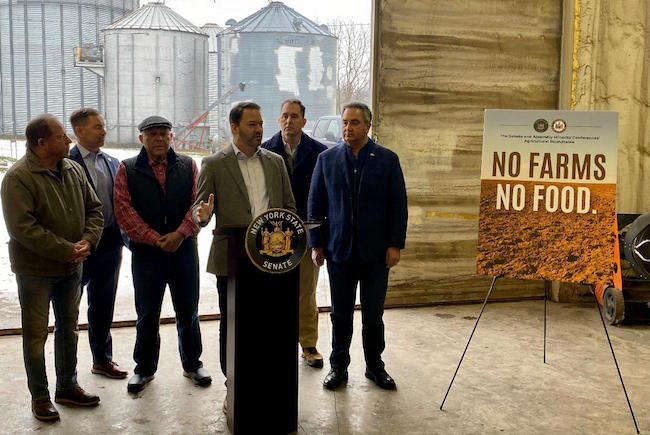
Provided photo: State Sen. Rob Ortt joins other state legislators for a listening session on Friday with local farmers at Bittner-Singer Orchards. Pictured from left include Bittner-Singer Orchards President Jim Bittner, Assemblyman Angelo Morinello, Assemblyman Steve Hawley, Sen. Rob Ortt and Sen. George Borrello.
Press Release, State Senate Republican Leader Rob Ortt
APPLETON – Senate Republican Leader Rob Ortt, along with members of the Senate and Assembly Republican Conferences, on Friday held a listening session with local farmers and stakeholders to hear about the pressing issues facing the agriculture industry.
Discussions revolved around the potential impacts of lowering the 60-hour overtime threshold. Later this year, the New York State Farm Labor Wage Board will revisit the threshold set in 2019 and make a determination on whether to lower the threshold to 40 hours. Lawmakers also heard from participants about the issues they’d like to see as priorities in the upcoming legislative session.
“The agriculture industry continues to struggle under burdensome state mandates and the lingering effects of the Covid-19 pandemic,” Ortt said. “I want to thank the farmers and stakeholders who shared their perspectives, particularly regarding the negative consequences that will occur if the wage board further lowers the overtime threshold. My colleagues and I will continue to advocate on behalf of our farmers, and I urge the wage board to listen to those who will be directly affected by their actions.”
Senator George Borrello said, “New York farmers are among the most hardworking and resilient individuals anywhere. They are the foundation of our state’s $6 billion agriculture industry, which is known for producing some of the finest meat, dairy and produce in the world. However, the strength and viability of our farming community is threatened by burdensome mandates and misguided policies from Albany that are making it harder than ever to stay in business. At the top of the list of challenges are the Farm Labor Act and potential changes to the 60-hour overtime threshold. My conversations with farmers and farm workers in recent months have echoed the comments we heard today about how harmful this change would be for everyone. The agricultural community is united on this issue.”
Senator Edward Rath said, “The agriculture industry is critical to our state’s economy and the character of our rural communities. Reducing the overtime threshold for farmworkers would have a devastating impact on the New York State agriculture industry at a time when many farms are struggling. To do so after so many farmers have stepped up and continue to step up to donate products to those in need during the pandemic, is unacceptable. Now is not the time to play politics, we need to listen to stakeholders and industry experts. The future of New York State’s agriculture industry depends on it. The evidence is clear; lowering the overtime threshold hurts farmers, workers and consumers.”
Senator Patrick M. Gallivan said, “Agriculture is one of the state’s most important industries, directly and in-directly employing thousands of hard-working residents. As we prepare for a new legislative session, it is important that we hear from farmers and others in the agriculture industry about the challenges they face, especially potential changes to the Farm Labor Act and other burdensome regulations that threaten the future of farming in New York. I look forward to working with those throughout the industry to improve the state’s business climate.”
Assemblyman Steve Hawley said, “In upstate New York, agriculture is more than an industry, it’s a shared heritage and way of life. The proposal to lower the 60-hour overtime threshold for farm laborers jeopardizes farming in New York as we know it today. It makes it less feasible to grow labor-intensive crops that New Yorkers expect to see on grocery store shelves and in their farmers markets. While our farm workers are some of the hardest working people in our state, I fear the unintended consequences of this policy could limit their opportunities and weaken agriculture in New York entirely.”
Assemblyman Mike Norris said, “Every farmer matters in New York State. Agriculture is a multibillion-dollar industry in New York, yet unfortunately, state regulations affecting our farms are far too often created by representatives who have never stepped foot on a farm. I have had the privilege of touring small, medium and large sized farms in various agricultural industries throughout Western New York, and I commend Minority Leader Ortt for hosting this roundtable because it is critical that we continue to gain valuable feedback on issues affecting our agriculture industry so we can ensure the future of farming in New York State is bright.”
Assemblyman Angelo Morinello said, “We must be cognizant of the reality of farm work. Seasons, crop readiness for harvest and weather conditions cannot be scheduled in the same manner as traditional manufacturing. Farmers provide perishable goods that dictate their readiness for market. Remember if you ate today, thank a farmer.”
Photo by Tom Rivers: A corn plant stands tall last month in a field of soybeans by Albion Central School near Clarendon Road.
Press Release, National Agricultural Statistics Service
ALBANY – The USDA-NASS has released the crop production forecast for October. The latest survey, which was conducted during the last week of September and the first week of October, included the following commodities:
• Corn production is forecast at 83.5 million bushels, up 6% from 2020. Based on conditions as of October 1, yields are expected to average 167.0 bushels per acre, unchanged from last month but up 10 bushels from the 2020 average. If this forecasted yield is realized, it will be a record high yield for New York. Area harvested for grain is forecast at 500 thousand acres, unchanged from 2020.
• Soybean production is forecast at 17.0 million bushels, up 7% from last year. Based on October 1 conditions, yields are expected to average a record high 53.0 bushels per acre, unchanged from last month and up 2.0 bushels from last year. Area for harvest is forecast at 320 thousand acres, up 8 thousand acres from 2020.
• Alfalfa hay and alfalfa mixtures production is forecast at 672 thousand tons, up 102 thousand from 2020. Based on October 1 conditions, yield is expected to average 2.40 tons per acre, up 0.50 ton from last year. Harvested area is forecast at 280 thousand acres, down 20 thousand acres from last year.
• Other hay production is forecast at 1.70 million tons, up 49% from 2020. Based on October 1 conditions, yields are expected to average 2.00 tons per acre, up 0.50 ton per acre from last year. Harvested area is forecast at 850 thousand acres, up 12% from 2020.