By Mike Wertman, Sports Writer Posted 14 November 2020 at 6:10 pm
Photos by Cheryl Wertman – Medina/Lyndonville’s Nate Dillenbeck battles with Tonawanda’s Ram Biswa (8) and Tyler Barker (6) for the ball during this afternoon’s Section VI Class B1 championship game at Tonawanda which ended in a 2-2 double overtime tie resulting in co-champions.
One hundred and ten minutes of soccer failed to produce a winner as No. 5 seed Medina/Lyndonville and host No. 2 Tonawanda battled to a 2-2 double overtime tie this afternoon resulting in the Mustangs and Warriors sharing the Section VI Class B1 boys soccer championship.
No shootout was held to break the tie as the cancellation of the state tournament made it unnecessary for the B1 and B2 winners to meet to determine the Section VI representative to the states.
Tonawanda did grab a lightning quick lead as Hunter Hollock scored on a breakaway just 2:56 in.
Medina/Lyndonville though battled back to knot the contest when Nate Dillenbeck broke in clean to score a goal with 6:40 remaining in the first half.
Jack Whipple of Medina/Lyndonville goes for a header against Tonawnada’s JP Young.
Keeping the momentum, the Mustangs then took their only lead when Dillenbeck scored just 1:42 into the second half off an assist from AJ Seefeldt as he beat the goalie to the ball.
The Warriors though answered back with a penalty kick goal by Hollock with 1:59 to go in the second half retying the contest at 2-2.
Neither team could then find the range over the remaining 11:59 of regulation time or in two 15 minute overtime periods resulting in a tie and sectional co-champions.
“Hat’s off to the kids it was a total team effort,” said Mustangs Coach Steve Luksch. “We had some injuries and some kids get banged up so it was next man and everyone gave it their best effort. Winning the sectionals has been our goal since last last year so we’ve been on a mission to do it from day one.”
The co-championship gives the Mustangs their third sectional title in the last nine years. The previous two titles came in 2011 with a 1-0 win over Tonawanda and in 2013 with a 2-1 overtime victory over Newfane,
Brian Fry of Medina/Lyndonville sends the ball up the sideline as Colin Kisloski defends for Tonawanda.
By Mike Wertman, Sports Writer Posted 14 November 2020 at 5:57 pm
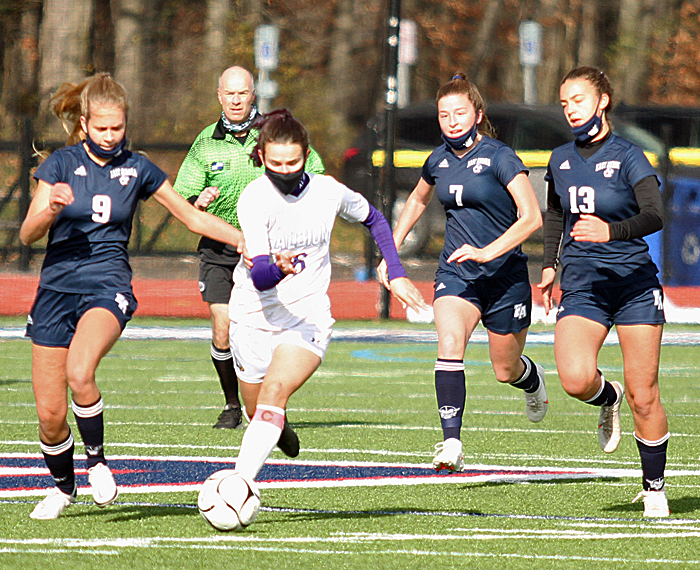
Photos by Cheryl Wertman – Albion’s Claire Squicciarini works the ball up field surrounded by East Aurora defenders Lila Sorgi (9), Gabbi Barusic (13) and Julia Patterson (7) during the Purple Eagles Class B1 championship game loss to the host Blue Devils this morning.
A quick goal in the first three minutes ignited top seeded East Aurora to a 4-0 victory over visiting No. 6 Albion this morning in the Section VI Class B1 girls soccer championship game.
Cora Rabey lined a shot into the corner of the goaljust 2:18 into the game for what proved to be the game winner for the Blue Devils.
East Aurora doubled its advantage when Anna Bean scored on a looping shot with 11:38 to go in the half.
East Aurora likewise opened the second half strong as Bean scored again just 1:51 in to give the Blue Devils a commanding 3-0 lead.
Katie Kivari rounded out the Blue Devils scorig when she found the net on a breakaway at he 24:04 mark.
East Aurora had a 25-4 advantage in shots on the day as Albion goalie Sydney Mulka made some 20 saves.
“They just had speed all over and they were very skilled,” said Albion Coach Maggie Orbaker. “Our kids gave it 100 percent though. They didn’t leave anything on the field. I’m just very proud of them. It was a very positive season.”
Albion finishes the season with a 9-4 record.
The Purple Eagles advanced to the title contest for the third time in the last four years by scoring a pair of overtime victories 2-1 over No. 3 Springville in the quarterfinals and 4-1 over N. 7 Depew in the semis.
In the Class B2 championship game top seeded Southwestern defeated visiting No. 2 Wilson 2-0.
Albion’s Kenzi Hapeman works to keep the ball away from East Aurora’s Cora Rabey.
By Kim Pritt, Contributor Posted 14 November 2020 at 3:00 pm
Let’s go on an adventure together….to Long Island!
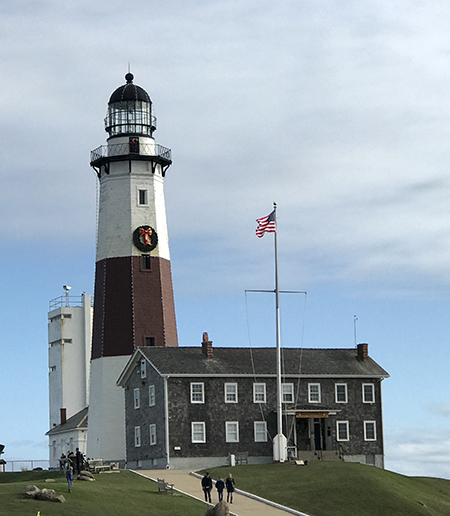
The beautiful lighthouse at Montauk, Long Island, NY
As Thanksgiving approaches, I find myself remembering a wonderful Thanksgiving I spent on Long Island in 2018. I traveled with a friend to her sister’s home for the holiday and we had the best time! I had been to New York City several times, but never during the holidays, and since Long Island was a bucket list item, it was a perfect way to spend Thanksgiving.
Our first full day, we took the Long Island Railroad into New York City. We had tickets to see the Rockettes at Radio City Music Hall – something I always wanted to see. We spent the entire day walking around the city looking at all the wonderful store windows all decorated for Christmas, shopping, eating, and, of course, we went to see Santa at Macy’s. I have always loved being in the city, but there was something so much more special getting to watch skaters at Rockefeller Center, seeing the Christmas window displays, sitting and listening to a choir sing in St. Patrick’s Cathedral, and that amazing light show on the Saks Fifth Avenue building after dark. It was a magical day that ended with me falling asleep on the train back to Long Island.
The rest of our time was spent on Long Island – no, we didn’t go back into the city to see the Macy’s Thanksgiving Day Parade. We spent Thanksgiving warm and cozy preparing and enjoying a delicious Thanksgiving meal with family and friends. Black Friday took us out shopping at a local mall and included a corned beef on rye sandwich at a kosher deli that was so good it brought tears to my eyes.
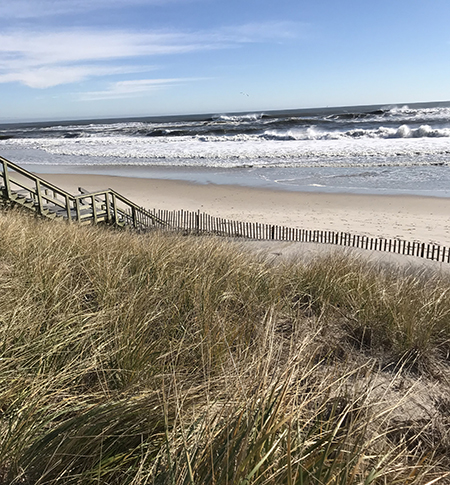
The Beach at Montauk
Then, the sightseeing began. On Saturday, we drove out to Montauk. If you’re ever on Long Island, you have to go to Montauk and see the lighthouse and shore – so peaceful and beautiful! Along the way, we drove through all the Hamptons, stopped at a wonderful historic cemetery in East Hampton that had a stone knight laid to rest in a crypt (there’s a few great photos of it in the blog post link), and even saw the infamous Big Duck in Flanders, a silly big pink and purple bird in high heels, and a flying pig! Yep – lots of cool stuff to see on Long Island, for sure!
Our time at Montauk was amazing. It is located at the tip of Long Island with the ocean on one side and the sound on the other and views of Connecticut in the distance. I love lighthouses and seek them out whenever I get the chance. The one on Montauk is stunning. We walked around the lighthouse and beach for a while enjoying the absolutely beautiful day.
The day trip into the city was amazing, but if I had just stayed on Long Island the whole time, I would have been just as happy. In addition to shopping and our day at Montauk, we spent a little time in Port Jefferson – one of many quaint beach communities. We also spent some time at another beach that was so gorgeous. This beach is the home of a huge memorial at the spot where TWA Flight 800 crashed just off shore 12 minutes after taking off from JFK on the evening of July 17, 1996. There were no survivors and an amazing International Memorial was established to honor those who died in the crash and those who worked tirelessly in the search and recovery efforts. The memorial includes all the names of those being honored, benches, information, and inspirational quotes.
This beautiful beach on the Long Island shore includes an International Memorial to the TWA Flight 800 crash site of 1996.
We also attended a Sunday evening mass at St. Francis Chapel in Miller Place. St. Francis is a Friary – an old Monastery with Father Frank who is a wonderful “hippy” priest who runs Hope House Mission, a great program that helps addicts get and stay clean.
I’m not sure what I expected Long Island to be like. I guess I thought it would be little quaint beach communities – well, there was definitely plenty of those, but it was so much more. First of all, it is a LOT bigger than I thought. I guess I thought it was just a small strip island with just beaches. It actually has a lot of rural space and wooded areas and there are tons of shopping opportunities – including lovely local shops, bigger malls, and even a Tanger Mall. It is a huge island – I think it took us a little over an hour to get from where we were staying in Miller Place to Montauk and Miller Place is about ½ way up the island. But, whatever I had pictured in my head, I found Long Island to be a beautiful place to visit with tons to do and see. It was a great week of wonderful memories. Long Island is definitely a place worth considering for a visit.
By Tom Rivers, Editor Posted 14 November 2020 at 7:48 am
Group looks to improve tracking and tracing system for produce grown in the state
File photo by Tom Rivers – Dirk Biemans co-owner and CEO of Intergrow Greenhouses, built its first 15-acre greenhouse in the Town of Gaines in 2003. The company has done multiple expansions since then. Biemans is serving on the new Produce Traceability Blue Ribbon Task Force. The company recently started construction on a new site in Ontario, Wayne County.
A new state task force includes agricultural leaders from throughout the state, including three with Orleans County connections.
State Agriculture Commissioner Richard A. Ball announced on Friday the members of the Produce Traceability Blue Ribbon Task Force, which met for the first time Thursday.
The task force, which is made up of New York farmers and representatives from produce distributors and retailers. The task force will build on New York’s leadership in food safety practices, Ball said.
The task force will review and make recommendations to further advance New York’s tracking and tracing system for produce grown in the state. An improved system will help consumers to more easily identify where products were grown and processed and allow the state to more quickly trace the origin of a product during foodborne illness investigations.
“We look forward to the work of this taskforce as a next step in the evolution of our food safety mission,” Ball said. “Food safety is everyone’s business, and this task force consists of all parts of the produce supply chain— from the farmer that grows our fruits and vegetables to the distribution center that sorts and/or bags it to the retailer who sells it. Understanding the sophisticated tracking systems that are already in place and how those systems communicate throughout the supply chain is key to supporting our farms, strengthening our food system, and reducing foodborne illness.”
Dirk Biemans, co-owner and president of Intergrow Greenhouses on Route 98 in Gaines, is a member of the task force. The company grows tomatoes hydroponically, offering consistent size and taste throughout the year.
Photo by Tom Rivers: Steven Karr, CEO of Pride Pak, gives a tour of the 68,000-square-foot vegetable processing site in Medina on Nov. 30, 2016. The company trims lettuce and packages it for salads for Wegmans.
Steven Karr, CEO of Pride Pak, and his son Angelo, Pride Pak vice president, opened a new vegetable processing facility on Maple Ridge Road in Medina in November 2016. They are both on the new state task force.
Pride Pak’s new 68,000-square-foot facility in Medina trims lettuce and packaging it for salads for Wegmans. Medina gives the company a U.S. site. Pride Pak also has facilities in Mississaugua and Newfoundland. It is the largest vegetable processor in Canada, and 35 percent of its produce comes to the U.S.
Pride Pak currently gets most of its lettuce, baby spinach, cauliflower, broccoli, turnips, carrots and other vegetables from Yuma in Arizona, California and Oregon.
Kaari Stannard, owner of New York Apple Sales, Inc., also is on the task force. She has served as chairwoman of the U.S. Apple Association. She is a partner in both Pomona Packing and Lake Ontario Fruit, which are apple packing facilities located in western New York. Stannard is also a partner in Fish Creek Orchards, located in Orleans County. Lake Ontario Fruit also is in Orleans County on Ridge Road in Gaines.
The complete list of members of the Task Force are:
Dr. Elizabeth Bihn, Cornell University, College of Agriculture and Life Sciences
Mike Durant, Food Industry Alliance
Steve Ball, Wegmans
Jim Calvin, New York Association of Convenience Stores
Michael King, Krasdale Foods
Renee St. Jacques, New York Farm Bureau
Dale Ila Riggs, New York State Berry Growers Association
Bethany Wallis, Northeast Organic Farming Association
Joy Crist, Crist Bros. Orchards
Jim Bittner, Bittner-Singer Farm
Paulette Satur, Satur Farm
Steve and Angelo Karr, Pride Pak
Erica Battisti, Stewarts Shops
Michael Muzyk, Baldor Specialty Food
Jim Hans, Driscoll’s
Kaari Stannard, NYS Apple Sales
Luke George, Upstate Growers & Packers
Dirk Biemans, Intergrow
Alisha Albinder, Hudson River Fruit Packers
Darby Greco, NYS Department of Health
Currently the Food and Drug Administration does not require a tracing system for produce. Unlike manufactured products, which are traceable through serial numbers, consumers generally cannot identify where fresh produce was grown.
In addition to the health and safety risks, this is costly to the entire supply chain, from the producers to retailers.
Kaari Stannard is a New York apple marketer, packer and grower.
The task force will analyze today’s existing tracking and tracing system, identify potential gaps and areas in need of improvement, and recommend uniform operating standards and practices for each point of the supply chain. This will provide consumers with more information about the source of the food they eat and expedite investigations of foodborne illness.
“New York State’s focus on traceability through the Produce Traceability Blue Ribbon Task Force is truly forward thinking,” said Betsy Bihn, College of Agriculture and Life Sciences at Cornell University Director of the Produce Safety Alliance. “With the FDA proposing to establish additional traceability recordkeeping requirements, it is imperative to understand current practices as well as any challenges that are preventing effective produce traceability from farm to fork. As the Cornell CALS representative, I am grateful to have the opportunity to facilitate this discussion as this work is important for food safety, but also important for NY growers and consumers.”
Mike Durant, President/CEO of the Food Industry Alliance of NYS, Inc., said, “New York’s retail food industry is committed to ensuring quality products to our customers and promoting food safety is paramount to that effort. As the industry evolves, so too does the entire food supply chain. This task force will be a collaborative effort to both further advance best practices in food safety and help preserve public trust. We are pleased to be part of this important effort.”
Not everyone was quick to hook up to new system – ‘You don’t miss what you never had’
Photos courtesy of Cobblestone Museum
By Doug Farley, Cobblestone Museum Director
GAINES – Burning candles or kerosene were two ways the school, the church, homes and businesses in the Hamlet of Childs would have provided lighting in the 1800s as seen here in this kerosene lamp fixture in the Universalist Church at Childs.
Note the glass “smoke bells” above the lamps that were designed to protect the ceiling by capturing the soot that was released when burning kerosene. Kerosene lighting was augmented with a product called “manufactured gas.”
The Albion Gasworks manufactured gas from 1858-1927. They did this by heating coal in a “retort” which produced a gas vapor that was stored under pressure to provide lighting for their customers. The byproduct produced from the process was known as “coke,” and was burned to provide heat in many early homes.
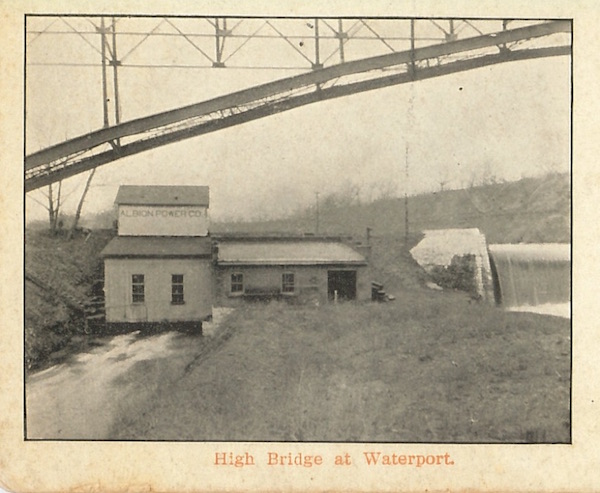
The next generation of lighting followed in 1888 when The Albion Electric Light & Power Company began generating power below the steel arch bridge from their hydroelectric station at Waterport. They distributed power using transmission lines that ran south along what we know as NYS Route 279.
Photo courtesy Orleans County Historian
One of the first major usages of Albion Power electricity was for electric arc street lights in the Village of Albion beginning April 1890. Here we see a community effort to raise a power pole in Albion.
Even though electricity was available at that time, there was a certain reticence to hook into the line. For instance, the Pullman Church always had power when it was built in 1894, but the nearby St. Joseph’s Church waited until 1913, and the Episcopal Church didn’t electrify until 1914. There is an adage that says, “You don’t miss what you never had.” That was the case for many homeowners, too.
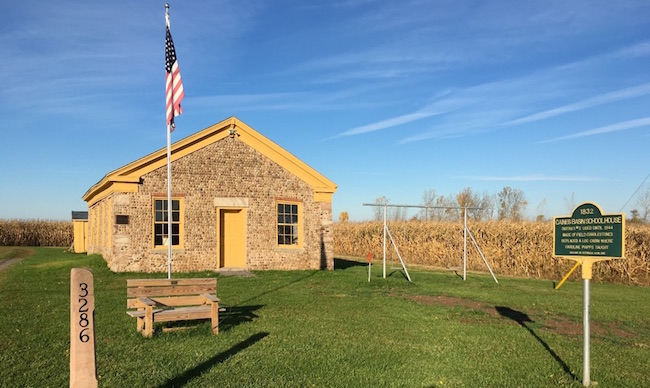
Former Orleans County Historian Bill Lattin remembers his father, Cary Lattin, telling him that he had electric wiring installed in his house on Gaines Basin Road when it was built in 1932, even though electricity was not yet available on the road.
Lattin lobbied his neighbors to try to drum up enough interest to entice the electric company to send power up Gaines Basin Road. But, Lattin had little success talking his neighbors into spending the money to add electricity to their homes in the era of the Great Depression.
Lattin finally succeeded in his quest when he convinced his fellow taxpayers of the Gaines Basin School that they should have electric lights in their schoolhouse. The neighbors’ favorable decision was responsible for power being distributed on the road. Lattin hooked up right away, but many neighbors waited awhile to follow suit.
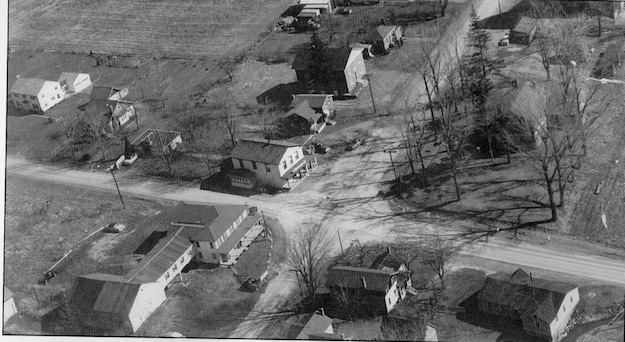
Electricity finally reached the Hamlet of Childs circa 1926. Other parts of the county weren’t fully electrified until after World War II. This is a birds-eye view of Childs in the early 1950s.
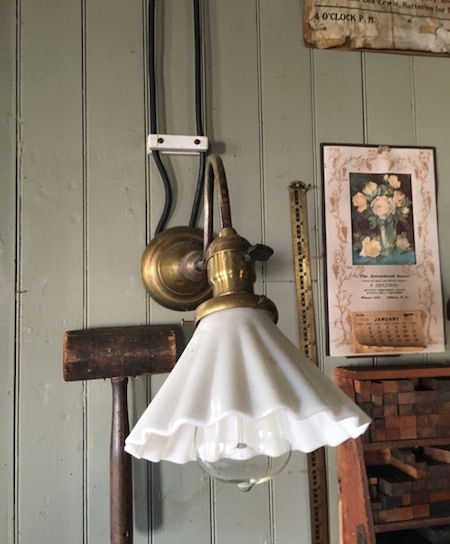
In the early days, those who wanted electricity in their homes would install “knob & tube” wiring on their interior walls. The two wires were plainly visible to the homes occupants and were held away from touching the wall using porcelain insulators.
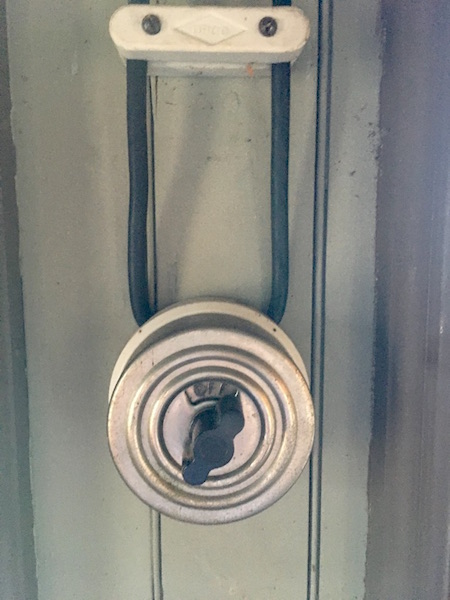
Ceramic insulators were also used for switches to help protect from stray electrical shocks. Here we see an early turn-button switch that was commonly used.
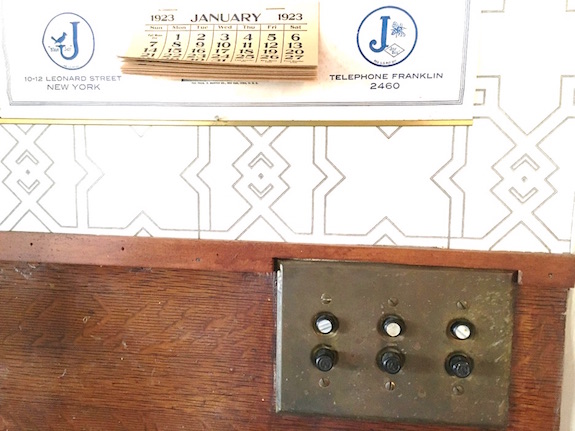
Other switches used push-buttons. Another oddity of that era was that fuse boxes were sometimes installed in a home’s attic instead of the basement. The electric lines entered the home through the attic, so it made sense at the time to place the fuse box there, too, albeit a little inconvenient to change a fuse. In later days, wiring was recessed behind walls, like we know it today.
Editor’s Note: This is the 14th article in a series about historic Childs in the Town of Gaines. The hamlet of Childs lies just north of Albion at the intersection of Routes 104 and 98. In 2019, Childs was selected to be on the Landmark Society of Western New York’s “Five to Revive” list. In 1993, the federal U.S. Department of the Interior declared the Cobblestone Museum in Childs a National Historic Landmark, the first site in Orleans County with that distinction.
The next article will take a look at the proliferation of labor savings appliances that found prominence in the all-electric home of the Roaring ’20s.
By Tom Rivers, Editor Posted 13 November 2020 at 6:48 pm
Photos courtesy of Barbie Hapeman
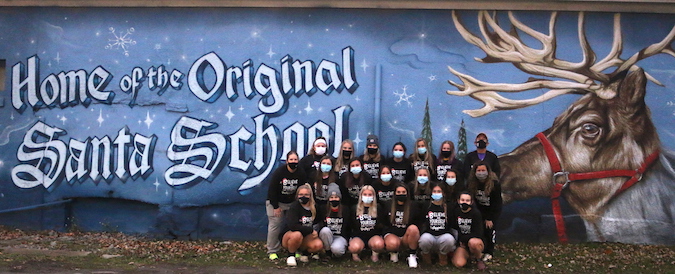
ALBION – After practice today, the Albion varsity girls soccer team went by the new mural on the northside of the Lake Country Pennysaver building. The mural highlights Albion as home of the first Santa Claus School, which was led by the late Charles W. Howard from 1937 to 1966.
The team, which plays in the sectional finals on Saturday against undefeated East Aurora, wanted to capture some of the “Believe” magic.
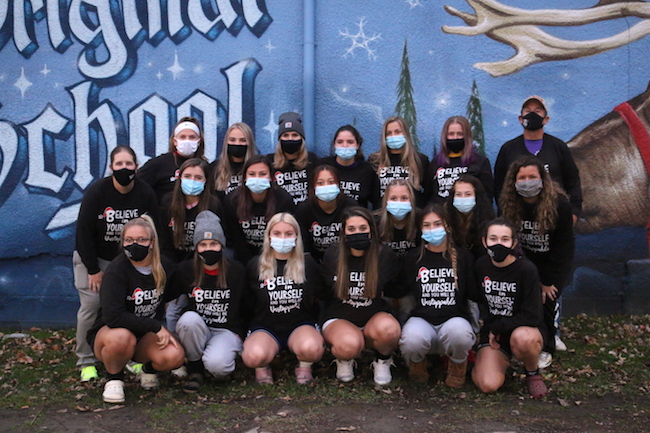
The players are all wearing T-shirts that say, “Believe in yourself and you will be unstoppable.” There is a Santa hat on the “B” in Believe.
The group pictured includes, front row, from left: Maddy Snook, Kailey Merrill, Brittney Spies-Hunt (Captain), Lauren Wehling, Bonnie DiCureia and Claire Squicciarini (Captain).
Middle Row: Assistant Coach – Sara Kappenhaver, Olivia Bieber, Ryan Olles, Aurora Serafin, Nora Hapeman, Elisa Bropst, Head Coach – Maggie Orbaker.
Top row: Abby Scanlan, Charley London, Ally Knaak, Olivia Krenning, Sydney Mulka, Emily Harling, Assistant Coach – John King.
Missing from photo: Leah Pritchard, Grace Elscher and Nicolina Creasey.
After a 1-3 start, Albion has won eight in a row to advance to the sectional finals for the third time in the last four years. The team will be leaving Albion at 8:45 Saturday morning. The community is welcome to give them a sendoff along Route 31. A group is expected to gather at the CRFS parking lot to wish them good luck.
By Tom Rivers, Editor Posted 13 November 2020 at 5:06 pm
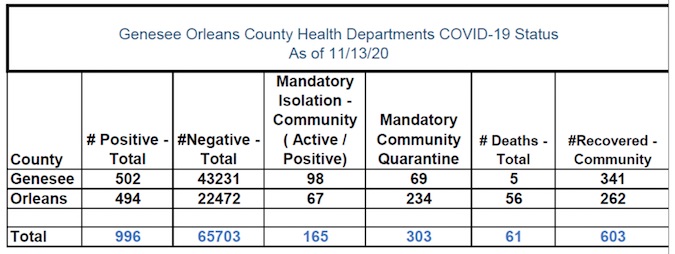
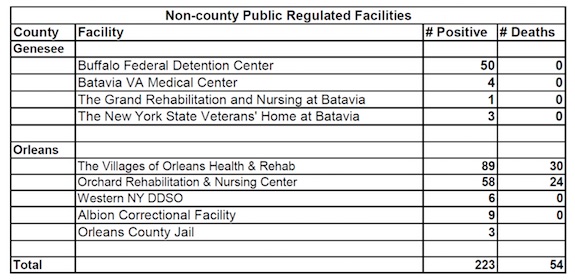
Orleans County has 12 more confirmed cases of Covid-19, including, for the first time, three inmates in the county jail. Orleans has now had 494 people test positive for Covid-19 since March.
The new positive cases reside in Albion, Kendall, Murray, Ridgeway and Shelby. The individuals are in the following age groups: 0-19, 20s, 30s, 40s, 50s, 60s and 70s.
Three of the individuals were on mandatory quarantine prior to testing positive.
Orleans also has had 14 more people recover from Covid and have been removed from the isolation list, the Genesee and Orleans County Health Departments reported this afternoon.
Two county residents are currently hospitalized due to Covid.
• Medina Central School also advised the community in a letter that two staff members tested positive for Covid-19. They have been on mandatory quarantine since Nov. 9.
Mark Kruzynski, the district superintendent, said there likely won’t be any contact tracing at the school because the two employees have been home since Nov. 9. The Health Department will decide if any additional action is needed.
The data isn this chart is cumulative going back to March.
Genesee County received 30 new positive cases of Covid-19. This is reflective from the cases reported yesterday, Health Department officials said.
Due to the volume of positives cases received today, data from Genesee will be updated as soon as possible, the department said. Staff is working on contact tracing.
The new positive cases reside in Alabama, Alexander, Batavia, Bergen, Elba, LeRoy, Oakfield, Pavilion and Pembroke. The individuals are in the age groups of 0-19, 20s, 30s, 40s, 50s, 60s and 70s.
One of the individuals was on mandatory quarantine prior to testing positive.
Genesee also has 19 more recoveries from Covid and they have been removed from the isolation list.
Genesee has 3 residents in the hospital due to Covid.
• The Health Department has been notified of a two positive staff members at Batavia Middle School. The individuals are on mandatory isolation until they recover. Contact tracing is in process for those who are considered close contacts and will be placed on mandatory quarantine for 14 days from the last contact with the positive individual. The school will remain open unless otherwise announced.
• The Health Department has been notified of a two positive students and one positive staff member at Pavilion Middle School. The individuals are on mandatory isolation until they recover. Contact tracing is in process for those who are considered close contacts and will be placed on mandatory quarantine for 14 days from the last contact with the positive individual. The school will remain open unless otherwise announced.
• 3-county data: Click here to see an online map of confirmed cases in Genesee, Orleans and Wyoming counties. There are 212 active cases in the three counties, with 98 in Genesee, 67 in Orleans and and 47 in Wyoming.
A reminder the numbers listed as positive/active are current community cases. The recovered numbers are only for community cases and do not include non-county regulated facilities. The total positive cases includes community active/positive, community recovered and all those from non-county regulated facilities.
Additional updates from the Health Departments:
• New restrictions – Effective today 13 at 10 p.m., bars, restaurants and gyms, as well as any State Liquor Authority-licensed establishment, must close in-person service from 10 p.m. to 5 a.m. daily.
Effective today, indoor and outdoor gatherings at private residences will be limited to no more than 10 people.
• Faith-based organizations: Consider continuing or reinstating remote worship due to increased numbers of positive Covid-19 cases to protect your more vulnerable population.
For those who are at risk of complications for Covid-19 or the flu, consider to connect with your house of worship remotely to lessen the risk of contracting Covid-19 or the flu.
If you are sick or experiencing new symptoms, stay home and worship remotely. Don’t share your germs with others.
• Time-Distance-Masks-Hands!: In order to limit the spread of Covid-19 you need to rethink any upcoming gatherings. The more time you spend with non-household members, the more at risk of spreading the virus and putting our counties in a micro-cluster which will increase restrictions. Even small gatherings have the potential to have an impact on our hospital systems as we are seeing an increase in hospital admissions and ICU admissions.
Limit time with non-household members…Keep at least 6 feet or more…Properly wear a mask/face covering over your nose and mouth…and wash your hands frequently with soap and water or 60% alcohol hand sanitizer, as well as sanitizing frequently touched surfaces/items.
• Gathering size: According to Governor Cuomo’s Executive Order 202.45, all non-essential gatherings of up to 50 individuals of any size for any reason at venues (celebrations, weddings, or other social events at public facilities or private venues) unless otherwise designated (ex. religious gatherings), are allowed as long as there is appropriate social distancing, wearing cloth masks/face coverings over their mouth and nose, and cleaning and disinfection protocol requirements followed.
With the recent uptick of individuals testing positive and the stricter guidance placed by the governor, it is important to remember that those who plan and host non-essential gatherings (whether at a venue or a private residence) as noted above, can be fined up to $15,000, and/or cause our counties to be considered a micro-cluster which will place the area under stricter restrictions.
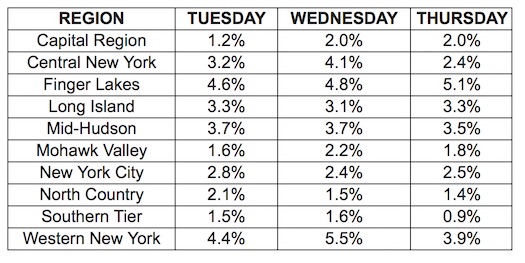
Orleans County is in the Finger Lakes Region, which had the highest positivity rate of Covid tests in the state on Thursday.
• Statewide data includes new record for tests: New York set a new record on Thursday with 203,721 tests reported. Of those 5,401 were positive or 2.65% of the total.
The positive testing rate in all Focus Zone Areas is 4.58 percent while the rate outside the Focus Zone Areas is 2.29 percent.
Total hospitalizations from Covid were at 1,737 in the state. There were also 24 fatalities yesterday from Covid in New York.
“We are testing more than just about any other state in the nation, reaching new record highs in the number of tests we perform in a single day,” Gov. Andrew Cuomo said. “The good news is our infection rate is one of the lowest in the nation. The bad news is we are in the midst of a sea of Covid rising around us. You look at the international numbers, and they are frightening – countries are locking down. You look at states around the country and the numbers are all going up quickly.”
Cuomo also announced that an emergency summit will be held this weekend with the governors of Northeastern states to discuss aligning policy in light of rising Covid-19 cases in the region and throughout the country.
“The reality is the virus is mobile and we’re in the holiday season and people will travel more,” he said. “These are all elements that conspire to increase the spread. We believe we’re going to have to be taking additional steps, and to the degree we can share information and align action with other regional states, we’ll do that.”
New York State Department of Transportation is advising motorists of its annual closure of the stretch of Lake Ontario State Parkway, west of Route 98 in the town of Carlton.
This year’s closure of the 2-mile section is anticipated to go into effect on Monday and last until next spring. A detour will be in place for motorists to exit at Route 98 and take Route 18 to continue west.
The DOT has closed that section of the roads in recent winters to save on de-icing materials, equipment and repairs to damaged pavement. Closing the 2-mile stretch saved an estimated $70,000 worth of maintenance and operating expenses including materials, equipment, and labor, the DOT has said.
About 800 cars travel this section every day, the DOT has said.
By Tom Rivers, Editor Posted 13 November 2020 at 12:34 pm
Photos by Tom Rivers
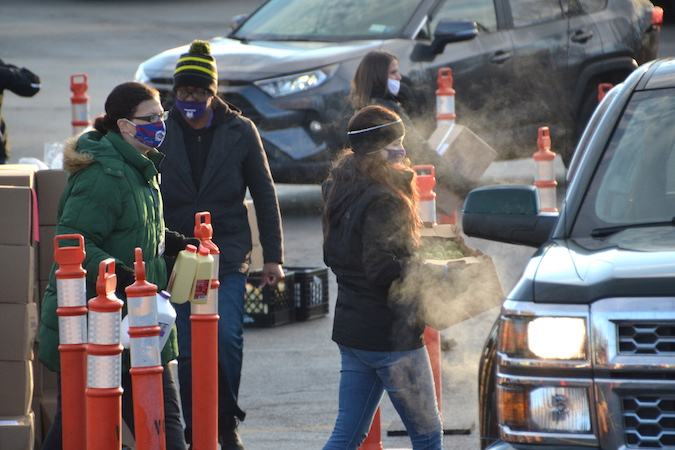
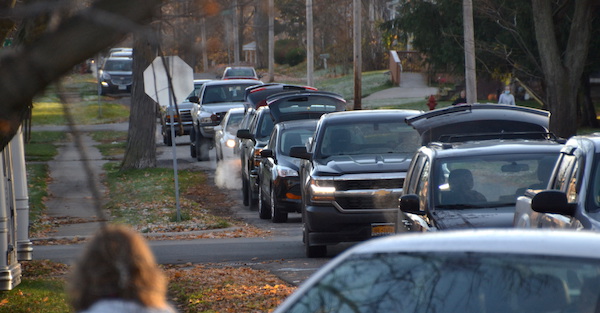
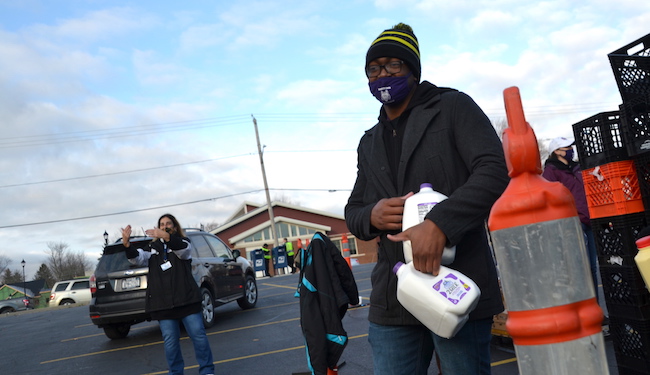
ALBION – There was a long line of vehicles in Albion this morning for a food distribution at the Main Street Store parking lot. A group of Iroquois Job Corps employees made up the bulk of the volunteers as well as staff from the Orleans County Office for the Aging and Community Action of Orleans and Genesee. Melissa Blanar, the OFA director, is at left.
This was the first food distribution in two weeks in Orleans County. The distributions include about 300 boxes of food, weighing 30 to 40 pounds. Each box has a mixture of produce, dairy and meat.
The vehicles were lined up down Chamberlain Street at about 8:30 a.m. The line also stretched down McKinistry Street, East Park Street and then down Main Street to Route 31.
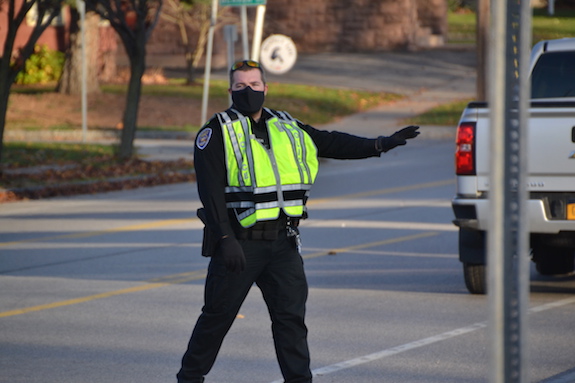
Albion police officer Will Francis directs traffic during the morning bottleneck.
Anthony Washington of Kendall, a Job Corps employee, assisted with the effort this chilly morning. Besides the gallons of 2 percent milk, people also received eggnog for the first time this year at one of the distributions.
The upcoming schedule includes:
Friday, November 20th – Ridgeway Fire Department at 11392 Ridge Road, Medina – line up on Horan Road.
Friday, December 4th – Cornell Cooperative Extension’s 4-H Fairgrounds at 126900 NYS Route 31, Albion – enter off Route 31-new location for Friday morning distribution.
Friday, December 11th – Community Action Main Street Store at 131 S. Main Street, Albion.
All events start at approximately 8:30 a.m., if delivery trucks are there by 8 a.m.
The U.S. Department of Agriculture has funded the USDA Farmers to Families Food Box Program nation-wide through the end of December.
By Tom Rivers, Editor Posted 13 November 2020 at 11:12 am
The Genesee County Health Department has issued a health alert after receiving a positive Covid-19 test from an individual who was at Batavia’s Original on Friday, November 6th, and Saturday, November 7th, between the hours of 4:30 p.m. to 10 p.m.
Contact tracing is in progress. However, unidentified individuals may have unknowingly been in contact with the person who tested positive, the Genesee County Health Department said today.
“We advise all individuals who were at Batavia’s Original on Friday or Saturday between the stated hours to monitor their symptoms for 14 days (through Nov. 20th or Nov. 21st),” the Health Department stated in a news release. “If symptoms of Covid-19 develop, contact your primary care provider to seek testing immediately and self-isolate until you receive your test results.”
Symptoms of Covid-19 include but are not limited to fever or chills, cough, shortness of breath or difficulty breathing, fatigue, muscle or body aches, headache, new loss of taste or smell, sore throat, congestion or runny nose, nausea or vomiting, diarrhea.
Batavia’s Original is closing the pizza business just for this weekend after five workers at the pizzeria tested positive or were in close contact with someone who tested positive. Several more employees are in mandatory quarantine for two weeks and can’t come to work, according to The Batavian.
Kathy Ferrara, the pizzeria’s owner, told the Batavian that three of workers likely contracted Covid at Halloween parties, while another hosted a card game and the other believes it was contracted from a family member.
Photo and articles courtesy of Katie Oakes, Horticulture Educator for the Cornell Cooperative Extension in Orleans County
KNOWLESVILLE – As winter looms nearer, now is a great time to accomplish some tasks outside that will benefit next year’s growing season in various ways.
Fall is the best time to plant spring flowering bulbs for a colorful reward early next year. Those first blooms of spring are a welcome sight after the snow and gray of a long winter. There are many different kinds of flowering spring bulbs – from more common ones like daffodils and tulips to lesser known varieties like Scillas and aconites.
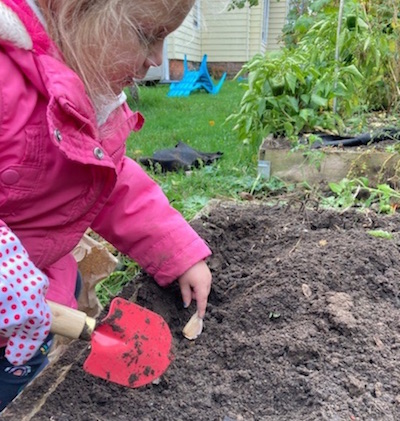
A just planted garlic clove should make an appearance in the spring.
Their specific care and site needs can vary, but most varieties require mostly sunny sites with light, well-drained soil. Spring-blooming bulbs come back year after year, so be sure to select a site with long-term potential. Most bulbs should be planted at a depth of about two to three times the length of the bulb.
Orientation of the bulbs while planting is important, usually the narrower, pointy end of the bulb goes up while the broader base goes down. Often there will be remnants of roots on the base of the bulb to give a good indicator of which direction to plant.
Bulbs are most aesthetically pleasing when planted in groups rather than singly. Cover with soil, water to settle the bulbs in, and wait for spring! Often, the tips of the bulb foliage can be seen poking through the soil even as early as January and February. Don’t worry, though – in almost all cases, they will not be harmed by subsequent freezing temperatures.
Garlic is also typically planted in the fall and is one of the easiest vegetable crops you can grow! Purchase heads from a local grower, through your farmers market, or from a roadside stand. Heads purchased from a commercial grocery store are usually not recommended for planting –they could be harboring viral, fungal or bacterial diseases, or they may have been treated to discourage sprouting.
Separate each clove from the head, leave the papery husk, and plant 4-6” apart in a sunny location with well-drained soil. Garlic can benefit from a fertilizer application, but if your soil is fertile and high in organic matter, it may not be necessary.
Garlic comes in both soft-neck and hard-neck varieties (“Elephant Garlic” is actually a type of leek, not a true garlic). The soft-neck and hard-neck varieties have some differences in the final crop (soft-neck varieties have stronger flavors and store better, but are less cold-hardy), but planting recommendations are the same.
These grape hyacinth bulbs are ready to go in the ground.
The garlic cloves will send out roots over the late fall and winter, then shoot and bulb development begins in the spring. Harvest is usually done in July or August. Aside from weeding to keep the planting clear, there’s not a lot of maintenance required to grow great garlic!
Leaves are in abundant supply this time of the year. They can provide beneficial cover for insects during the winter.
Gardeners often want to do one final clean-up in their growing beds before winter sets in. This is an excellent idea for any diseased plant material that may have been present during the growing season.
The best course of action to prevent overwintering and reinfection of diseases is to remove and destroy diseased plant material as soon as possible. Certain diseases can remain even after a cold winter, so it’s important not to leave the affected leaves/fruit in the garden or even in the compost.
Research shows, however, that it is more beneficial to the ecosystem as a whole to leave behind many of the spent flower stalks and fallen leaves that gardeners usually want to clear out and clean up.
Those spent flower seed heads can provide forage and food for winter birds, and the hollow stems of native plants can offer shelter and nesting sites for overwintering native bees. Nesting bumblebees burrow underground, so leaving some ground exposed and un-mulched can provide a welcome refuge for them.
Many butterfly species rely on fallen leaves for hibernating or for their caterpillars to use during chrysalis formation. Leaves can also be a great addition of brown material for compost piles and can serve as excellent (free!) mulch for garden beds.
So instead of putting bagged leaves at the curb, consider leaving a leaf pile in a corner of your yard. Your garden will be a haven for beneficial insects and animals!
For more timely gardening tips or to ask specific insect or plant disease questions, feel free to reach out to Orleans County Cornell Cooperative Extension Master Gardeners or Horticulture Educator Katie Oakes at 585-798-4265 ext. 125 or klo54@cornell.edu.
You’re here checking the site, so you know: Orleans Hub is a vital resource for our community. Day in and day out, we share information and insights that matter to those who live and work in the towns, villages and hamlets of our county. Local advertisers help make the Hub possible, and so can you. We do not charge for subscriptions, we do not have pop-up ads or ask you to do surveys to access the news.
Donate today to keep Orleans Hub healthy and accessible to all. Thank you!
A check can be mailed to Orleans Hub, P.O. Box 231, Albion, NY 14411.
(Editor’s Note: The Orleans/Niagara BOCES Teachers’ Association last month filed a lawsuit against the Orleans/Niagara BOCES and Dr. Clark Godshall, the district’s senior superintendent. The union said the BOCES didn’t adhere to Covid-19 protocols for social distancing, face coverings, health screenings, cleaning and disinfection for in-person learning at instructional sites within the district’s coverage area.)
Press Release, Dr. Clark J. Godshall, Senior District Superintendent of Orleans/Niagara BOCES
MEDINA – The New York State Supreme Court dismissed the BOCES Teachers Union’s lawsuit against the Orleans/Niagara BOCES, finding that NYSUT has no private right of action for injunctive relief under the New York Labor Law because review precedents were not fulfilled.
Specifically, a Public Employee Safety and Health (PESH) Bureau inspection has not occurred, and the PESH Bureau has not determined or notified the New York State Department of Labor that there is imminent danger to the safety and/or health of employee(s).
The Orleans/Niagara BOCES follows guidance from the Centers for Disease Control (CDC), the New York State Education Department, the New York State and local health departments, and their medical advisors for COVID-19 protocols.
The O/N BOCES has all of the necessary personal protective equipment (PPE), expending more than an additional $330,000 to ensure that our sites are adequately supplied. The BOCES has reconfigured instructional class space to adhere to social distancing and facial mask requirements. Additional staff were also added.
We are following mandates that New York State continues to issue for schools to remain open. These requiring that individuals maintain physical distancing, wearing face coverings, and required health screenings.
The O/N BOCES will continue to carefully monitor and implement safety guidelines at our sites. We recognize the ongoing pandemic is stressful for all involved. We will continue to work diligently to implement and enforce our safety plans that make the physical, academic, social, and emotional well-being of all students, staff and families our top priorities.
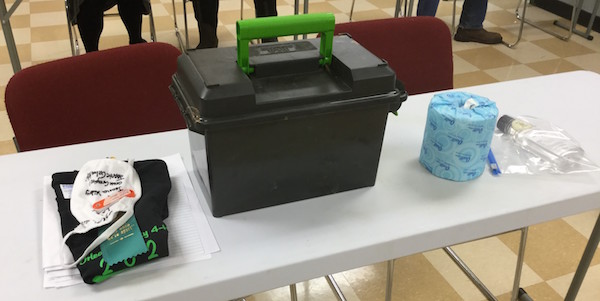
Package includes toilet paper, hand sanitizer, facial masks, and historic 2020 4-H Fair ribbons and T-shirts
Photos courtesy of Orleans County 4-H Program: Items are set out to be placed in the time capsule. Senior Council members signed the cloth face mask.
Press Release, Orleans County 4-H Program
KNOWLESVILLE – A Covid-19 time capsule created by Orleans County 4-H members both documents the events of the ongoing pandemic and also serves as a message to their future selves.
Members of the Orleans County 4-H Senior Council recently spent several weeks compiling items to place in the capsule including hand sanitizer, facial masks, toilet paper and historic 2020 4-H Fair ribbons and T-shirts. They also worked to include letters written to themselves which they will be able to read when the capsule is opened, probably in 15-20 years, said Grace Gregoire, 15, of Murray, Senior Council President.
The letters are the most important item in the time capsule, according to Grace. In her own letter, Grace wrote about the challenges and anxieties of living through a pandemic, “… in reality, Grace, you are beautiful and perfect in God’s eyes, never forget that.”
John Gabalski, 19, of Byron, who aged out of the 4-H program in October, wrote the pandemic gave him the opportunity to help out at food distributions, but, “The Covid-19 pandemic took away my last chance to participate in 4-H rabbit shows, the Orleans County 4-H Fair and the New York State Fair.” John wrote that despite the disappointments, he is now beginning his life as a 4-H alumnus.
Kate Bennett, 9, of Brockport wrote that there were big changes when Covid-19 hit with so many activities and school going virtual. “I started baking a lot and watching movies,” she wrote. She also was able to spend more time taking care of her goat.
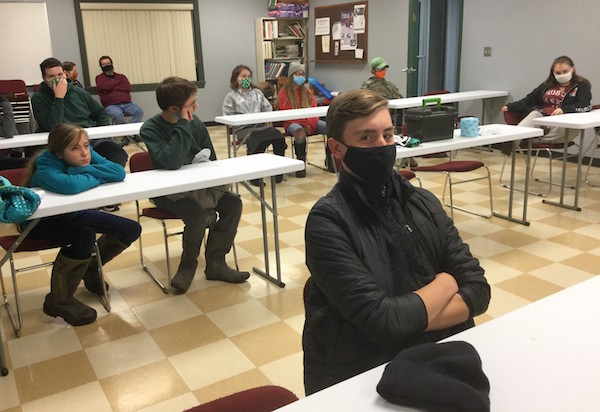
Members of Orleans County 4-H Senior Council (Zach Neal, 16, of Albion is at the front of the photo looking at the camera) met recently to put the time capsule together.
“It was the worst year ever,” wrote Sadie Gregoire, 13, of Murray. “If you are reading this, hopefully you can say you survived a pandemic.”
Orleans County CCE 4-H Administrative Assistant, Natalie Mrzywka, of Clarendon, wrote about making many masks for local farmers with her grandmother. “You would go places and not recognize people with face masks on,” she said.
4-H Program Coordinator Kristina Gabalski wrote that the pandemic made people realize that something so tiny we can’t even see it with our eyes can have a huge impact on our lives and that, “things can change forever in an instant.”
“The whole idea was a good idea,” Will Gregoire, 18, of Murray said of the project to create a time capsule.
Jeana Kidney, 17, of Medina said, “everything in the time capsule is significant, I can’t pick one item that is the most important.”
The time capsule will be stored in an archive room in the Education Center on the Orleans County 4-H Fairgrounds. Senior Council members say they look forward to seeing it again when they are adults.
“It will be fun to open in 15 years,” said Hugh Gabalski, 14, of Byron.