Five Star Bank, a subsidiary of Financial Institutions, is now accepting Paycheck Protection Program loan applications to meet the needs of small businesses and communities across Western and Central New York.
“The health of small business is central to the economic health of our communities,” said Martin K. Birmingham, President and CEO of Five Star Bank. “Our associates are pleased to be able to assist small businesses to take advantage of critical funding available to sustain their operations and preserve jobs. Following the first round of applications and funding, we have further streamlined our processes so that we can provide the most efficient and effective support to businesses interested in applying.”
To apply for a Paycheck Protection Program loan through Five Star Bank, applicants will need an active Five Star Bank business checking account, which can be opened online.
The PPP loan program has been extended to Wednesday, March 31, 2021. PPP Loans are available to small businesses, independent contractors, self-employed individuals, and sole proprietors.
In 2020, Five Star Bank was able to assist more than 1,700 small businesses in obtaining $270 million of PPP loans, helping to preserve an estimated 18,000 jobs.
New Guidelines to Expand Loan Eligibility
Eligibility is expanded for first-time borrowers to continue to help small businesses on the road to recovery.
Businesses with no more than 500 employees
Housing co-ops with less than 300 employees
Certain trade associations and chambers of commerce, nonprofits, states, or state instrumentalities that engage in destination or tourism marketing or providing live events (destination marketing organizations)
Seasonal employers
Borrowers with an existing PPP loan may also be eligible for a Second Draw PPP loan.
Expansion of Forgivable Expenses
In addition to payroll, rent, mortgage interest, and utilities, PPP funds may also be used on additional forgivable expenses, including:
Business software, Cloud computing services, or payroll processing
Costs related to property damage, vandalism, or looting due to public disturbances in 2020
Payments to suppliers that are essential to the business’ operations
Operating or capital expenses to comply with public health directives, including the installation of ventilation systems or physical barriers and the purchase of personal protective equipment
About Five Star Bank and Financial Institutions, Inc.
Five Star Bank provides a wide range of consumer and commercial banking and lending services to individuals, municipalities, and businesses through a network of more than 45 offices throughout Western and Central New York State. Additional Five Star Bank information is available at www.five-starbank.com and on Twitter, Instagram and Facebook.
By Tom Rivers, Editor Posted 31 January 2021 at 7:15 pm
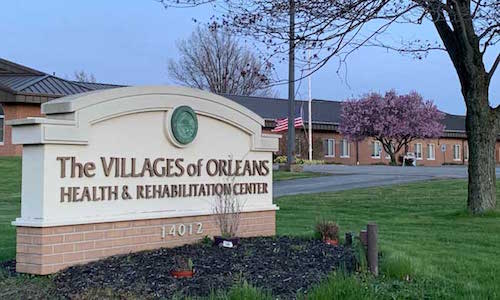
File photo by Tom Rivers: The flag is lowered in this photo from May at The Villages of Orleans Health and Rehabilitation Center in Albion, out of respect for the victims of Covid-19.
ALBION – A nursing home in Albion where 30 residents have passed away due to Covid-19 has been hit with a $66,632 fine for Covid violations.
The fine is the largest penalty for a nursing home in New York State for Covid violations, according to an article in The Buffalo News.
The Villages of Orleans Health and Rehabilitation Center was fined $20,000 in September by the state Department of Health for violations cited in a May 9 state inspection of the facility.
The new fine from the federal government is based on that earlier state inspection. DOH inspectors on May 9 said facility staff weren’t following proper infection prevention and control measures. One example included certified nursing aides and licensed practical nurses entering and exiting a room of a person with Covid, and then entering rooms of other residents without Covid.
The staff “passed breakfast trays, assisted with the residents’ meals and provided hands on care without wearing PPE and completing proper hand hygiene,” according to the DOH report.
The DOH said personal protective equipment wasn’t readily available to staff. Several employees told DOH there wasn’t adequate PPE for workers.
The Department of Health also reported that many nursing home employees, including agency staff, did not seem educated on infection control policies, standard/droplet precautions and Covid-19.
The Villages has had 93 of its residents in the 120-bed facility test positive for Covid. The Villages hasn’t experienced any deaths among residents since May due to Covid.
The nursing home is one of 20 in the state under investigation by the Attorney General Tish James. She released a report last week about nursing homes and their response during the pandemic. The AG said many nursing homes weren’t prepared to protect residents from Covid-19.
The AG also faulted the state for underreporting the deaths of nursing homes residents from Covid by as much as 50 percent.
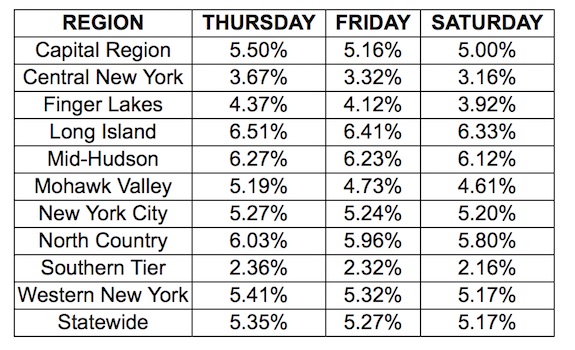
This chart from the Governor’s Office shows each region’s 7-day average percentage of positive test results over the last three days.
In the Finger Lakes, the 7-day average for positive tests dropped below 4 percent on Saturday to 3.92. At the beginning of the month, the region’s positivity rate was over 10 percent.
The nine-county region also has 542 people hospitalized due to Covid. That is more than 400 fewer than the 964 on Dec. 28.
Locally, among the GLOW counties, here are the percent positive in the past 7 days:
Genesee, 4.5 percent
Livingston, 4.1 percent
Orleans, 6.2 percent
Wyoming, 7.4 percent
This is the percent positive in the past 14 days:
Genesee, 5.2 percent
Livingston, 5.4 percent
Orleans, 6.1 percent
Wyoming, 8.4 percent
Statewide the positivity rate is at 4.44 percent. It was at 7.45 percent on Jan. 1. There were also 7,976 patient hospitalizations statewide on Saturday. The hospitalizations were at 9,273 on Jan. 19.
Governor Andrew M. Cuomo today announced that the state 7-day average Covid-19 positivity rate has declined for 23 straight days.
“We’ve dealt with a holiday surge driven by increased social activity, the surge is reducing, and the state’s 7-day average positivity rate has declined for 23 straight days, which is a significant trend,” Cuomo said. “As we continue to vaccinate as many New Yorkers as supply will allow, with our expansive distribution network ready to vaccinate significantly more people, it’s critical that New Yorkers stay safe. All the models show a continued reduction, and so we’ve been able to loosen restrictions with micro-clusters, the orange zones, and New York City indoor dining. In the here and now, the news is very good, but keep an eye on the U.K. variants and the other variants because all of them suggest more diligence will be needed.”
By Tom Rivers, Editor Posted 31 January 2021 at 4:00 pm
Nearly 3,000 have filled out survey so far
A group that is researching the internet gaps in Orleans County and developing a plan to improve broadband access is moving to a solutions phase.
The public is welcome to sign up for different sessions beginning this week. The more participation, the better in helping the Orleans Digital Literacy Initiative Steering Team pursue funding for expanded internet in the county, said Mary Beth Debus, president of Program Savvy Consulting.
She is assisting in the steering team in compiling the data about the internet shortcomings in the county, and trying to identify funding sources to expand services.
“The first several months we’ve been trying to define how different communities within the community are impacted by the lack of internet,” Debus said.
So far, nearly 3,000 people have filled out 48-question surveys about internet access and needs. The steering committee would like to have 5,000 surveys completed, but Debus said having nearly 3,000 surveys filled out so far “is a really impressive number” and shows the community is engaged in the issue. Click here to see the survey.
The committee will have 16 different sessions to dig deeper in the local internet challenges and gaps. Click here to see the topics and to register. If you register for a session, you should also register for the orientation.
Some of the topics include:
Digital Literacy: Older Adults – How might we help older adults discover opportunities provided by learning technology as well as how to use devices/access internet? How do we alert to concerns of fraud and misinformation? Might we push in these services through existing infrastructure?
Digital Literacy: Youth – How might we address gaps in digital literacy for Youth? How might we integrate internet safety into programming? How might we teach computer skills (vs. just phone).
Economic Equity: Access to Internet and Devices – How might we increase access to internet and devices for those with economic barriers?
Increasing Content for the Spanish Speaking Community – How might we increase access to content, training, coaching, and resources for primarily Spanish speaking community? How might we teach use of translation options?
Digital Literacy: Expanding Existing Services – There are existing training and coaching programs within Orleans County including BOCES, GLOW Workforce Development, NIOGA Libraries, and GCC BEST Center. How might we make these more accessible to the community? How can we design to be fully utilized and self-sustaining?
Digital Literacy: The Unemployed and Underemployed – How might we build the digital literacy skills of those out of work or displaced such that they can more successfully find and secure jobs? How might we link the unemployed to existing programs to support them?
Digital Literacy: Preparing the Future Workforce – What are the skills most needed in the future and what are some mechanisms for building these skills in future employees? In what ways can the business community/employers help to develop this workforce? What services/trainings/supports would be helpful to exist to support all businesses?
Digital Literacy – Supporting Schools, Students, and Families – How might the school systems support the community in developing digital literacy skills? What is the best way to offer support? How do we take full advantage of investment in technology? How do we support educators, students, and families?
Accessing and Using Internet: Solutions – How might we develop access to information technology resources for nonprofits? How might we enable use of technology for nonprofits to better achieve their missions?
Improving Internet Access – How can people with poor internet improve that internet? What options might be available? How do we alert people to these options? How might we reduce economic barriers?
Digital Literacy: Improving Access for Those Living with Disabilities – How might access to internet and devices be improved for those with disabilities? How might we teach digital literacy in an inclusive manner? How do we teach safety?
Improving Access to Health Care – How might we help patients learn to successfully participate in tele-med? How do we share the benefits? How do we develop health literacy? How do we ensure that they have access to devices that will work for them? Could we design positions that support digital/health literacy?
Developing an IT Workforce – How might we both attract educational programs to the community and recruit participants to these programs? How might we connect need to future jobs? How might we support those most in need of employment?
Designing a Digital Literacy Campaign – How do we get the community engaged in wanting to improve skills? How might we help the community to know the value of digital literacy? How do we share where to go to get help?
Putting It All Together: Developing an Initiative – This set of sessions will review all of the ideas from the individual sessions and search for overlaps, contingencies, and opportunities for coordination. This will be a longer process and will take place over three sessions and will require prework of reading prepared document of prior work.
By Tom Rivers, Editor Posted 31 January 2021 at 10:11 am
MEDINA – A committee that has been meeting since August to study police reform is recommending changes for the Medina Police Department, including the establishment of the Community Policing Board.
That board should include a cross-section of the community and should meet regularly, the Committee on Police Reform Collaborative. The new community policing board would work towards forming better relations between law enforcement and the community.
“These relationships can be beneficial to convey information in both directions,” according to the report from Committee on Police Reform Collaborative. “This Board may also be tasked with aiding in community relations events.”
The committee submitted a draft report this past week of its recommendations. (Click here to see the report.) The Village Board set a 7 p.m. public hearing on Feb. 22 for residents to comment on the report.
Medina needs to submit a report to the state by April 1. Gov. Andrew Cuomo last June approved an executive order requiring all 500 municipal police agencies in the state to have the public involved in studying current police policies, with possible recommendations for changes. Those reports need to be submitted to the state by April 1 or Cuomo said the state will withhold funding from communities that don’t do the report, which needs to include public meetings.
Cuomo, in his executive order, said the communities with police departments need to go over their policies on use of force by police officers, crowd management, community policing, implicit bias awareness training, de-escalation training and practices, restorative justice practices, community-based outreach and citizen complaint procedures. The communities may find no changes are needed, Cuomo said.
• MENTAL HEALTH and PROCEDURAL JUSTICE – The committee in Medina also is recommending increased training for Medina police officers in mental health and procedural justice.
The regular mental health training schedule should seek out opportunities for crisis intervention training and mental health first aid.
Medina has already sent an instructor for certification in “Principled Policing.” That program covers areas such as History of Policing, Communication, Racial Bias, Decision Making, Trust Building and Core Values.
“Regular training in this area may help officers deal with the difficulties of modern-day policing,” the committee report states. “All of these training areas can be reinforced through reality based training, including interactive scenarios involving use of communication skills.”
• COMMUNITY POLICING/RELATIONS: The Committee recommends that the Medina Police Department take efforts to increase community policing and relations. The committee recommended the Medina Village Board put $10,000 in the next budget to assist with these community policing initiatives.
The committee recommended open community meetings hosted by the Medina Police Department. These meetings can be used to relay relevant information, and hear public concerns.
The Medina PD should also do an annual public survey to gather input from local citizens on police activities.
Some other ways to strengthen community interaction with the department could be more officers on foot patrol, bike patrol and community activities. The committee recommended an annual gathering open to the public where police officers can have positive interactions with the community.
Medina might also consider assigning a Community Policing Officer to focus on creating opportunities for positive interactions with the community.
• ACCREDITATION: The Committee recommends that the Medina PD attempt to obtain NYS accreditation status. The NYS Accreditation Program provides outside guidance and oversight to law enforcement to ensure performance in areas such as policies, procedures and training.
• FUNDING: The committee said funding should be increased at the local and state levels for law enforcement and mental health services.
The Medina PD could pursue state grant funding for mental health, training and equipment.
The committee also said Medina should fund an investigator position in the Medina PD. “A designated position should result in a higher rate of case closures, which it is assumed will also increase public confidence,” the committee stated in the report.
• The Committee members include Chairman Scott Robinson (Medina Area Partnership), Medina Mayor Mike Sidari, Medina Police Chief Chad Kenward, Daniel Doctor (Medina Central School District Representative), Pastor Jovannie Canales, Jacquie Chinn, Medina PD Lt. Todd Draper, Sherry Tuohey, David King, Cynthia King, Danielle Figura (Orleans County Mental Health Department), Joe Cardone (Orleans County District Attorney) and Joanne Best (Orleans County Public Defender).
• The Medina Police Department currently has 13 officers, including a police chief, lieutenant, sergeant, a school-resource officer, eight patrolmen (including a K-9 officer) and a part-time officer. The department operates with two officers on duty 24-7. The department made 465 arrests in 2016, 551 in 2017, 416 in 2018 and 374 in 2019.
• Survey: The committee created an online survey with topics about transparency, racial bias, trustworthiness, and community participation. Respondents could also list their biggest concerns, as well as suggestions for improvements.
There was approximately 255 respondents to the survey, with 90 percent from Medina residents, with an equal response between male and females, with 80 percent from White, 8 percent from Hispanic and 7 percent from Black.
The survey respondents gave an overall ranking of the Medina PD at 3.7 out of 5, with the biggest concerns listed at 27% say increased training, 27 percent said community policing/relations, and 21 percent said mental health.
• Department policies reviewed: The committee reviewed the following departmental policies: use of force, mental health, body worn cameras, community relations, civilian personnel complaints, performance evaluations, handling deadly force incidents, use of firearms including taser and less lethal shotgun.
An email address was created to allow residents to voice specific concerns in detail. The committee will continue to accept comments at medinaprrc@gmail.com.
A Shield of Sterling motivates wearer to pursue goodness
This Shield is a cautionary, yet inspirational tale about a family spoon passed down through generations. It traveled from my ancestor’s table setting to my little pinky finger.
I wear it nearly everyday as a protective shield. Its shield helps to protect against those who bring negative energy or those that try to tempt behavior that is less than noble. Because, let’s be honest, life is full of moments that test our integrity. Lord knows I am no exception, as I do stand back and check myself often!
This ring is called a Burgoon Ring. Simple reason, it has Burgoon inscribed on it. Back in the days of President Hayes, my Great-Great-Grandfather Isadore, was not only part of the President’s circle, but he was a very successful and wealthy railroad man. In my possession is an entire scrapbook of articles from this time period documenting his accomplishments. This ring when worn makes one feel as though they can accomplish, dream, be proud, hold your head up high,.. never waiver. However, one man’s hard work and determination can become another generation’s curse and become their weakness.
The next generation of Burgoons was born with a Sterling Silver Spoon. The money that built up one generation, broke the next. Literally! I share this as not to disparage my heritage, because I think we can all agree that our lineage is peppered with lessons we can learn from. As gifts to us, they show us how to use our smarts and how to waste them.
If we are smart we will study them, learn from them and hopefully repeat the successes and not the failures. Great-Grandfather was a pastor. Sounds noble, right? Well the profession may be, but the man was not. He was entitled. He took the money earned by the sweat of his father and had a joyous time while hiding behind his religion. If I understand correctly, he had a fondness for unsavory things that cost lots of money. So by the time my grandfather was a man, the family fortune was gone.
This tale teaches us never to be entitled or squander what is given to us. Always work hard, have integrity, provide for ourselves. When your head hits the pillow at night be content knowing that you have earned your way in this life and it was not handed to you. Pride is a good thing when it motivates one to be self sufficient.
This ring is engraved with flowers, which I believe is another sign that it was meant for me, passed from dining tables to a pinky finger helps guide me…keeps me in line! This peace of silver once helped feed people’s bellies now helps feed my soul. In a way its story is about a family’s rising, falling and then rising again. Rising through sheer grit and pride. Grit my grandma passed down to the next generations. Maybe not with monetary wealth, but the kind that matters.. wealth of the heart and spirit. I am grateful for it each and every day.
To see My President Hayes Ring, visit My Blog live online (click here) and catch up on Weekly Photo Perks and past Sunday Posts. Like and share your comments.
By Tom Rivers, Editor Posted 30 January 2021 at 3:46 pm
MEDINA – The Village Board has approved installation of about 50 bluebird houses at several local parks and Boxwood Cemetery.
Daniel Rosentreter presented the plan to the Village Board, which gave its approval on Monday. Rosentreter needs to check with DPW Superintendent Jason Watts on the final locations.
Rosentreter, 28, would like to have most of the bluebird houses in place before the April-May nesting season.
The bluebird houses will be on ¾-inch galvanized electrical pipe, which have a smooth surface so squirrels can’t climb up on them, Rosentreter said.
He is an avid birder and wildlife photographer who wants to encourage bluebirds in the Medina community.
“The bluebird has decreased in population,” Rosentreter said. “This is a big way to bring them back.”
He is planning to have the bluebird houses installed at the perimeter of Boxwood Cemetery, Butts Park, Canal Basin Park, Gulf Park, Gwinn Street Park, Lions Park Pine Street Park and State Street Park.
When this group of bluebird house sis done, Rosentreter said he would like to add some to Ridgeway at a municipal-owned cemeteries and also at the Shelridge Country Club.
He has some volunteers to help with the effort of installing the bluebird houses.
“We have a lot of work to do now that this has been approved,” he said. “
By Kim Pritt, Contributor Posted 30 January 2021 at 3:00 pm
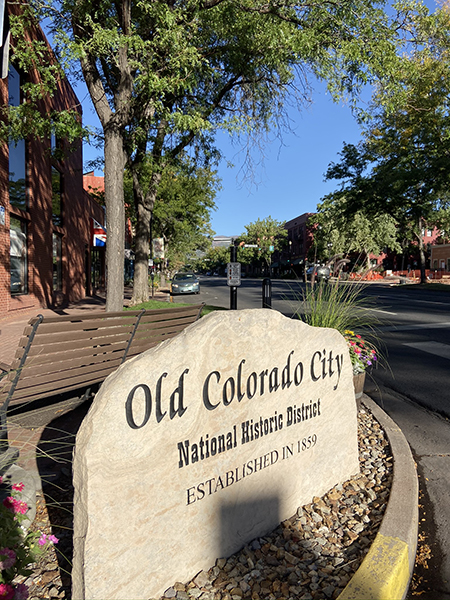
Old Colorado City is a great neighborhood in Colorado Springs that is full of history, shops, restaurants, and architecture.
Let’s go on an adventure together …. to Colorado!
In my last article, two weeks ago, I shared a teaser from my 2019 Colorado Adventure by writing about the Garden of the Gods. But, there was so much more to that trip. I flew into Denver, picked up my rental car, and drove to Colorado Springs, where I spent five full and two partial days. I could have easily spent several more days there – I had a blast! So, as Paul Harvey used to say, “And, now, here’s the REST of the story”.
If you’re in the Colorado Springs area, be sure to spend some time in Old Colorado City. Formerly known as just Colorado City, it used to be one of the first towns founded during the Pike’s Peak Gold Rush of 1859 and was briefly the capital of the Colorado Territory. It is now an historic neighborhood in Colorado Springs.
Known for coal and gold mining in its heyday, it is now on the National Registry of Historic Places. It is a very quaint little commercial district with lovely shops and fabulous restaurants. I had most of my meals there. I recommend Mountain View Restaurant for breakfast, also Dat’s Italian, Mother Muffs, and the Mason Jar for dinners. And, be sure to get a sweet treat at Rocky Mountain Chocolate Factory.
If you’re in the area on a Sunday and are looking for a worship service, I really enjoyed Pike’s Peak United Methodist Church – super friendly congregation. Old Colorado City is very enjoyable, even if you just take time to stroll the streets and take in all the amazing shops, murals, and architecture.
A wonderful place to spend time in Colorado Springs is the Cheyenne Mountain Zoo. Located on the side of Cheyenne Mountain, it is several levels of animal exhibits – including a huge giraffe enclosure with a board walk that you can walk all around it at eye level with the giraffes where you can feed and pet them (I spent a LOT of my time right there on that board walk). They also have a chair lift that takes you up the side of the mountain for some amazing views. Another feature of the zoo is the Will Rogers Shrine of the Sun. You have to pay extra to get through the gate to drive up a long, winding road up to the top of the mountain to the shrine. It is WELL worth it. Built in 1937, it is a memorial to Will Rogers that they call a “singing tower”, because of the noise the wind makes as it blows through the tower. Even if you don’t care to go to the zoo, consider going to the shrine – the views up there are incredible. Photos of the shrine are in the link for the zoo.
Another great place to visit in Colorado is Manitou Springs. It is near Colorado Springs and so worth the time to go there. It is such a pretty little cowboy town with a mix of history, quaint shops, and quirkiness with a beautiful mountain backdrop. Do yourself a favor and plan your visit to include breakfast at Adam’s Mountain Café – awesome breakfast! My day in Manitou Springs also included an accidental drive along the historic Ute Pass, which was a stunning drive.
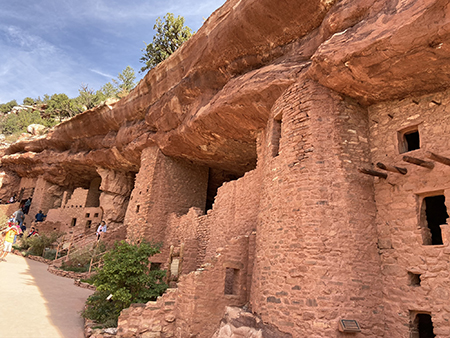
Manitou Cliff Dwellings in Manitou Springs. Original dwellings of the Anasazi Indians, believed to inhabit the Four Corners area about the time of Christ’s birth.
But, the main and coolest attraction in Manitou Springs is the Manitou Cliff Dwellings. The dwellings are original and authentic, but were not originally located in Manitou Springs. They were constructed and used in the Four Corners area (the spot where Colorado, New Mexico, Utah, and Arizona meet). There was a risk of them being ruined because they were not being preserved. A group decided to move them where they could be preserved and made available to the public as an educational tool to showcase the heritage.
The dwellings are comprised of Anasazi Ruins and were carefully disassembled, moved, and reassembled in their current location embedded into the cliff as it would have been originally. This took several years beginning in 1904 and completed in 1907, when it was opened to the public. It is a 40-room site that provided living space for several families of Anasazi Indians. The word Anasazi comes from the Navajo and loosely translates to mean “enemy ancestors”. They were believed to inhabit the Four Corners region about the time Christ was born.
A big highlight on my time in Colorado Springs was two ½ day cowboy-led jeep tours provided by a company called Adventures Out West. They were pretty pricey, but so amazing – I recommend spending the money, if you can fit it in your travel budget. The tours are in open 4×4 jeeps with really great guides and small groups – so lots of opportunity for questions, fun, and specialized photos. Also – a lot of the time, we were on roads that you REALLY need an experienced driver and a 4-wheel drive vehicle – trust me! They take you off road and off-off road along very narrow dirt roads with no shoulders and lots of curves, switch backs and tunnels. Between the two of them, we traveled along what used to be the Short Line Railroad tracks that wound along the side of the mountain, old stage coach routes, and trails with ruts, boulders, and streams to navigate across. It was so much fun. One of the tours had a cowboy guide named “Prairie Dog” and the other had a cowgirl guide named “Rambler” and they were both excellent guides.
The Shrine of the Sun is a tribute to Will Rogers with stunning views overlooking Colorado Springs. It is located in the Cheyenne Mountain Zoo.
I did a few other things while I was there, as well. I had dinner one night in downtown Colorado Springs at a really cool place called “The Rabbit Hole”. It is an Alice in Wonderland themed restaurant that is totally underground – a fun experience. I took one day and drove to Cripple Creek and Victor – two old mining towns that were pretty cool to drive around. The big story there was that I got so hopelessly lost between the two towns that I thought I was in the Hotel California – “you can check out any time you like, but you can never leave”. Go to the link below for “Colorado – The Rest of the Story” to read all about that little fiasco – in hindsight, it is a pretty funny story. I also drove to Pueblo, CO and spent some time walking along the Arkansas River in a lovely River Walk District.
Colorado is definitely God’s Country – so beautiful! And, the Colorado Springs area has so much to offer – and, if you want a big city experience (not for me, but you might), it is close to Denver. I hope you can experience it, someday, if you haven’t already.
In addition to the link from my Garden of the Gods article, here are five more links to blog posts with many, many photos and info about my Colorado Adventure. Check them out:
By Tom Rivers, Editor Posted 30 January 2021 at 11:36 am
Photos by Tom Rivers
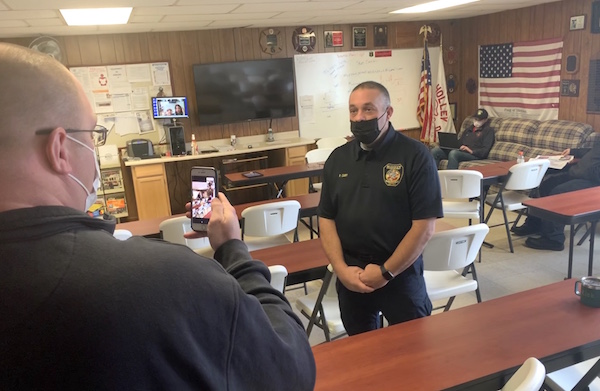
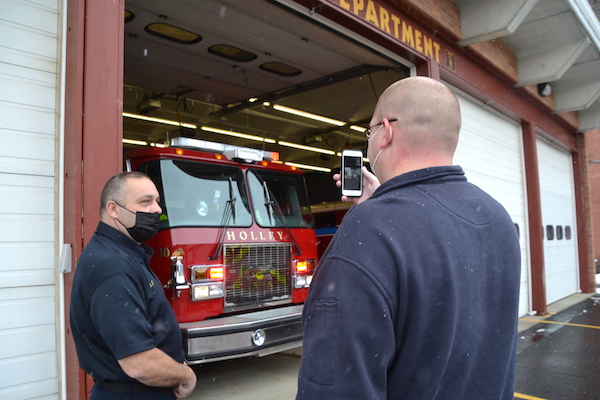
HOLLEY – Rick Cary, the deputy fire chief for the Murray Joint Fire District, speaks to Holley prekindergarten students on Wednesday when he gave them a virtual tour of the Holley fire house on Thomas Street. Kevin Dann is filming the session, which should be available on the fire department’s website and Facebook page.
Holley and Fancher-Hulberton-Murray firefighters usually do a fire prevention program in-person at the school in October. That was cancelled due to Covid-19 restrictions. The school district also alternates days for students to be in school to reduce the student population, with others fully remote only.
“We still want to send a message about fire prevention,” Cary said about making the video. “This is a trial. Hopefully it worked.”
The firefighters plan to make another video about kitchen safety.
Holley and FHM, which on Jan. 1 began operating as the Murray Joint Fire District, want to stress fire prevention to younger students and also familiarize them with firefighters and their equipment.
Sparky the firedog joined the tour and stressed the ABC’s of fire prevention. (A is for Alarms that let you know there’s a fire in your home. B is for Beep, Beep, Beep the sound a smoke alarm makes. C is for Calm, as in calmly get outside when the smoke alarm sounds.) Click here for more on the ABC’s.
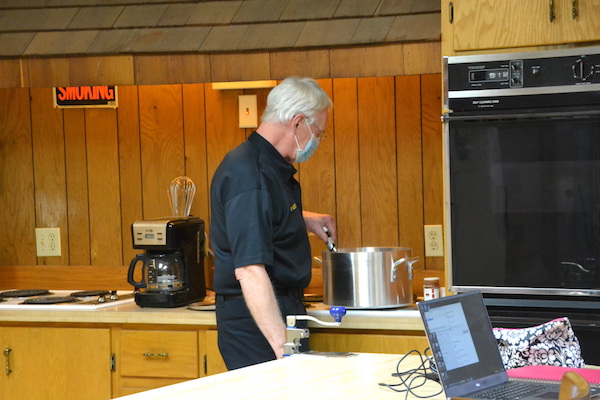
The video shows life in the fire house, and shows Ron Meiers cooking in the kitchen. Cary said the firefighters wanted to show they are regular people.
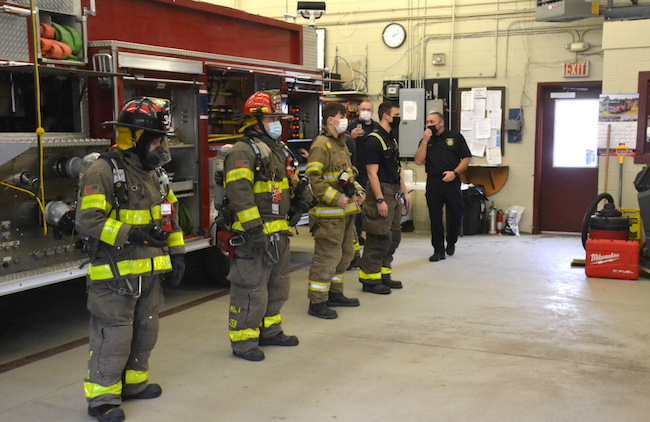
This group put on their turnout gear. Cary, speaking in the video, told the students they don’t need to be afraid if the see firefighters show up and their homes wearing the thick coats, boats and masks.
Some of these firefighters include Andrew Cary, Justin McMillion and Michael Snell.
Cary talked about some of fire trucks at the Holley fire house. The driver put on the lights and turned on the siren.
Loss of processing plants in Albion hurt family farms in Childs
By Doug Farley, Cobblestone Museum Director
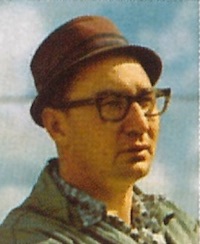
Ted Swierczynski in 1966
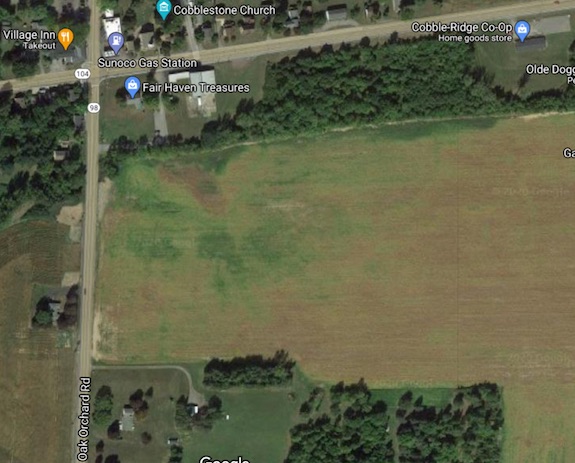
GAINES – Stanley Swierczynski got involved with farming in Gaines during the Great Depression. In 1950 he and his son Frank acquired 104 acres in the Hamlet of Childs on the south side of Ridge Road.
Later, Frank’s brother Ted got involved in the farm in the 1950s after he came home from the Korean War. The principal crops in the region at the time were tomatoes and cucumbers. They operated under the banner of Fair Haven Farms.
Fair Haven also had a small peach orchard across from the Cobblestone School. During this time period most local farmers sold peaches at the side of the road. Ted said, “It was easier then, less regulation.”
Ted Swiercznski remarked, “We later acquired or rented more land to eventually farm a couple thousand acres in the region. We had to use migrant farm labor out of the southern states. Still in need of even more laborers, we bussed in about 200 laborers a day from Rochester to hand pick snap beans and tomatoes.”
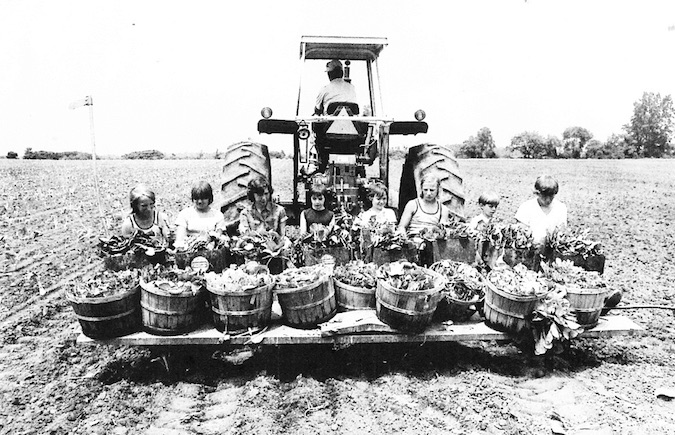
Ted Swiercznski considered his farm to be a family operation, seen here in 1977 driving tractor with the help of a few neighbors to round out his cabbage planting team. Manning the planter were (left to right) John Stirk, Colleen Swiercznski, Maureen Swiercznski, Cathy Swiercznski, Chris Swiercznski, Tim Stirk, Patrick Swiercznski and Tod Swiercznski.
Chris and Karen Watt are well known in the local farming community. In addition to their Farm Market at Five Corners, they have maintained orchards in Childs, too. In 1990, Chris took over farming Eugene Leigh’s apples on Route 98 and also his pears on the south side of Route 104 in Childs.
Chris said the Farm Market got started with a tent by the side of the road. In the 1980s, he and Karen worked under a tent for several years and then decided to build the Watt’s Farm Country Market to avoid the elements. They later added the ice cream stand. Watt Farms sells a large variety of local fruit including apples, pears, cherries, peaches, strawberries and melons. Chris said, “We farmed a total of seven different farm orchards.”
When questioned about the future, Chris said, “What we used to call a farm, is nothing but a field today.” Farms are getting bigger and bigger. “I’m winding down. I’ve got no kids who are interested in farming, so the operation might eventually become part of a larger farm. I’ve held the same job for 40 years. How many people can say that?”
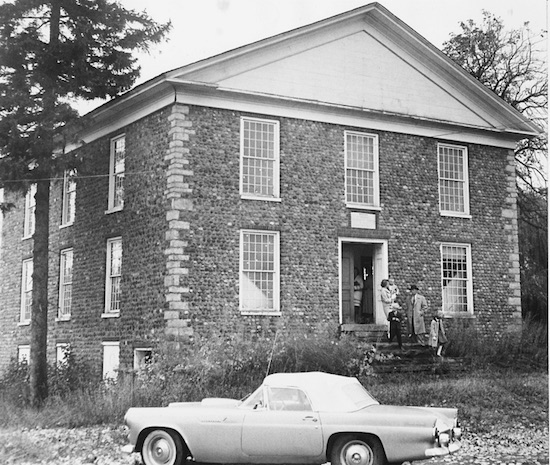
In a small way, even the Cobblestone Museum can trace its own roots to a history of agriculture in Childs. In the period 1930-1960, before the Cobblestone Society was formed, the Cobblestone Universalist Church was rented out by the Balcom Brothers, Walter and Oris, to store cabbage in the church basement. Mike Zambito, who operated Zambito Produce across the street from the church reflected on this. “The Balcom’s were notorious for storing cabbage in every available space. They rented out every conceivable nook and cranny they could to store cabbage. They filled the space by hand, starting by laying down straw and then stacking cabbage on top of that up to the rafters.”
He recalled that the cabbage was delivered using 10 wheelers or “canvas trucks.” He said, “Those old trucks had charcoal heaters.” Years of cabbage storage had taken a toll on the Cobblestone Church and one of the early tasks that the Cobblestone Society tackled in the early 1960s in preparation for public tours was adding a concrete floor to the Church basement.
Photo courtesy Orleans County Historian
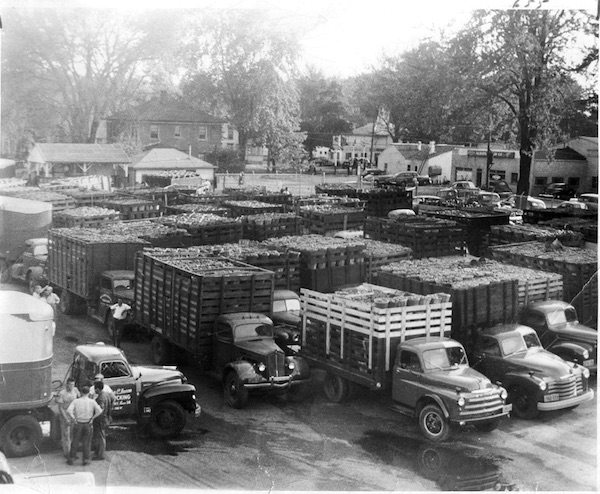
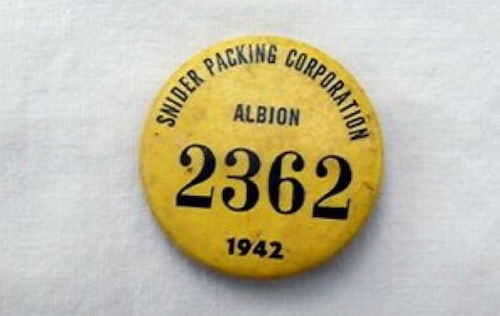
In its heyday, most local farms sold their tomatoes to Snider Packing in Albion which became a part of the Birdseye Division of General Foods in 1943, and then became Hunt-Wesson. An early morning delivery tie-up at the Snider plant is shown here in the 1950s. Ketchup, chili sauce and tomato paste were the principal products produced here.
Albion also had Dailey’s sauerkraut plant which processed 500 tons of cabbage each year and employed 100 workers. A canned cherries plant and several other local food plants thrived in the area following WWII including Comstock, Duffy-Mott, Lipton, Forman’s Pickles, Tree Pickles and H. J. Heinz.
The large food processing plants in Albion left the region in the 1960s and moved on to greener pastures in California. Ted Swiercznski said, “In the late 60s and 70s it all disappeared. Albion couldn’t compete with the better weather and longer growing season in California.” Local farmers also needed to find hundreds of hired hands to harvest their crops, and finding those hand laborers became increasingly more difficult. Machines were used to harvest the crop in California, making it much easier and cheaper to process food there instead.
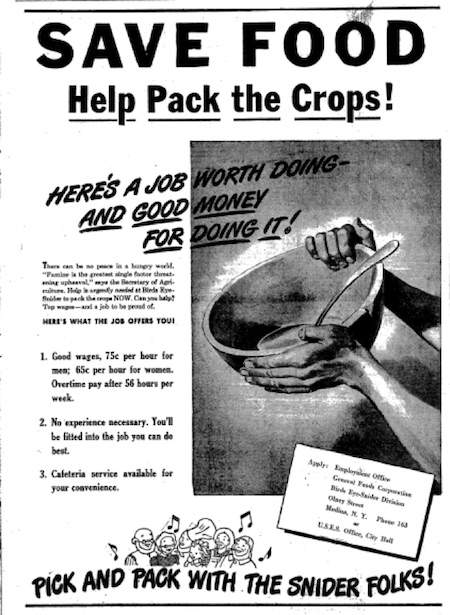
Food processing plants, just like the farmers, had a hard time securing enough labor to package the food products. Here, in 1946, Snider Packing is shown with one of their expensive full page newspaper ads that they used each week to try to get workers to process all of the crops that farmers took to the plant. Snider Packing supplemented its labor force during WWII by operating a prisoner-of-war facility behind their plant. German war prisoners were barracked on site and used as laborers in the food plant. Similar provisions were used in nearby Medina, as well as Youngstown in Niagara County where prisoners were housed in special barracks at Fort Niagara and were used to harvest the fruit crops.
An employee badge from Snider Packing is shown here. The demise of the local processing plants eventually led to the end of the small family farm era in Childs, too. Orleans County IDA administrator Raymond Pahura remarked in 1977 that the region had been lulled into a false sense of complacency in the post WWII years. He said, “I can remember a few years back when people were smug about our employment situation. Heinz, Hunt-Wesson, Duffy-Mott and Birds-Eye were fixtures in our community. We woke up one morning and they were all gone.”
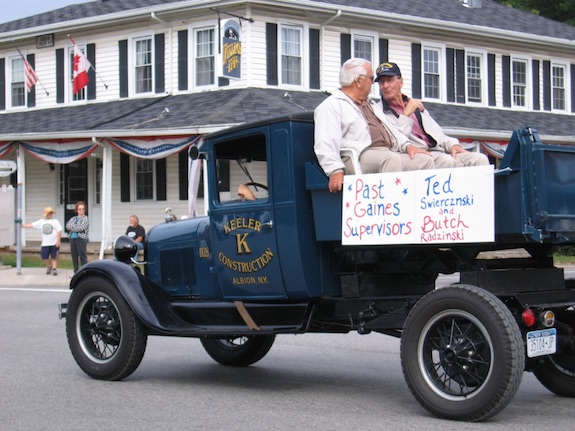
Ted Swiercznski eventually sold his farming interests in 1981. He also served as Town of Gaines Supervisor, along with Ron Radzinski (left), who are both seen here in Childs participating in the Town’s Bicentennial Parade in 2009.
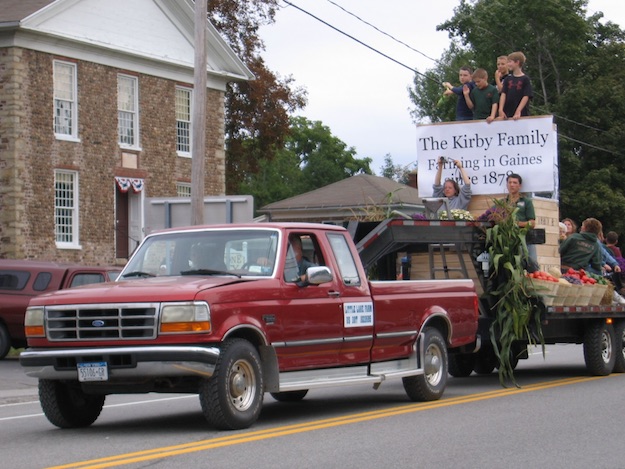
Agriculture in the Hamlet of Childs is now continued in part by Kirby Farms. Their lineage is traced to brothers Robert, John, Francis and George Kirby. Now, Bob’s son Jim is farming both sides of Ridge Road in Childs, along with his son Adam.
Sadly, for the most part, the era of small family farms came to an end in the 1970s and large corporate farms took their place. In Childs, the Zambito, Albanese and Swiercznski families actually joined forces to form ZAS Inc. to continue the farming tradition into the transition years. The three local farming families purchased an old building on Route 31 (across from current day Tops Market) where A&P Packing packaged onions and potatoes during the 1960s and 70s.
The Swiercznski family legacy continues in the region today operating in conjunction with Dragan Farms headquartered in Albion. Dragan principals, Steven Swiercznski and his cousin Tod Swierczynski, are farming about 2,000 acres of soybeans and wheat in the region with Dragan Farms.
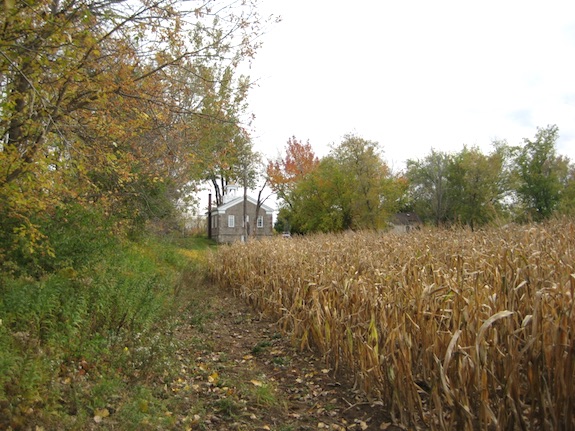
Jim Kirby has continued his family’s farming legacy stretching back to 1878, including tending this field of corn behind the Cobblestone District #5 Schoolhouse in Childs.
By Tom Rivers, Editor Posted 29 January 2021 at 7:13 pm
Photos by Tom Rivers
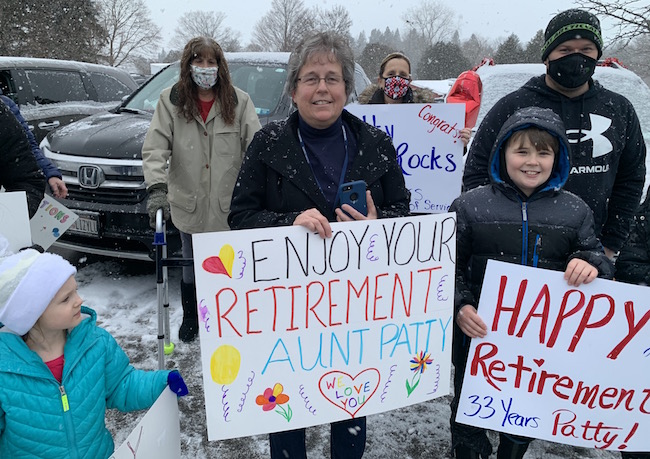
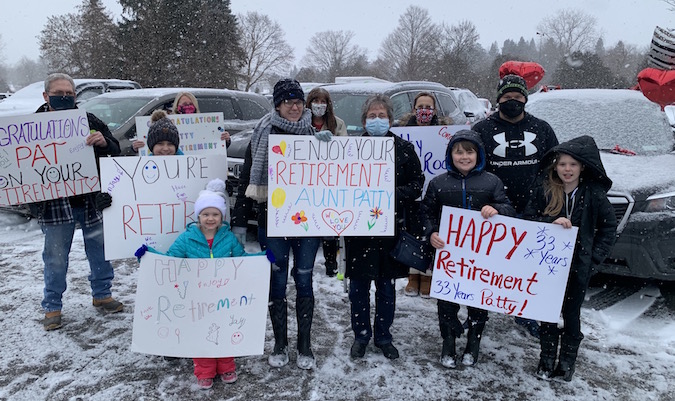
ALBION – Patty Fredendall, center, was greeted by friends and family today at 5 p.m. in the parking lot at the Public Safety Building. She worked her last day for the county today after more than 33 years, with the first 27 at the county nursing home and the past six at the Probation Department.
“I work with a great group of people,” Fredendall said. “I have a great family and a great work family.”
The Holley resident started with the nursing home as a medical records technician in October 1987. She went to the Probation Department in April 2015 and worked there as an account clerk typist.
Patty Fredendall is pictured with a big group of family and friends today after she worked her last day for the county.
Fredendall was presented with a “Special Recognition Award” on Wednesday by Lynne Johnson, the Orleans County Legislature chairwoman.
“Pat has been a great asset to both the Nursing Home and the Probation Department,” Johnson said. “Your dedication and expertise has benefited our county tremendously. We appreciate your support and commitment.”
Luci Taylor-Welch, the Probation Department director, said Fredendall will be “greatly missed” by her co-workers.
“Pat is an extremely conscientious employee who goes above and beyond in all that she does,” Taylor-Welch said.
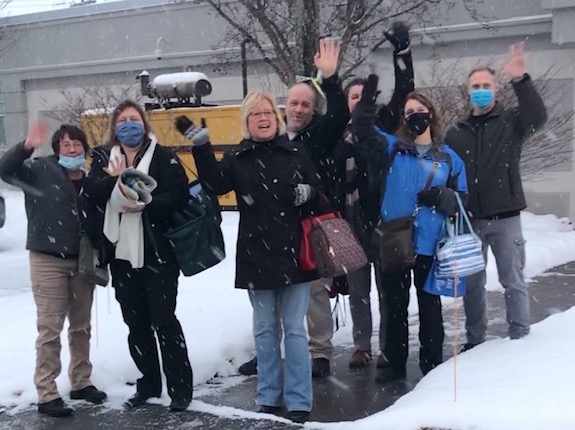
Provided photo: Fredendall’s colleagues at the Probation Department congratulate her on her retirement.
By Tom Rivers, Editor Posted 29 January 2021 at 4:29 pm
2 counties report 3 more Covid-19 deaths
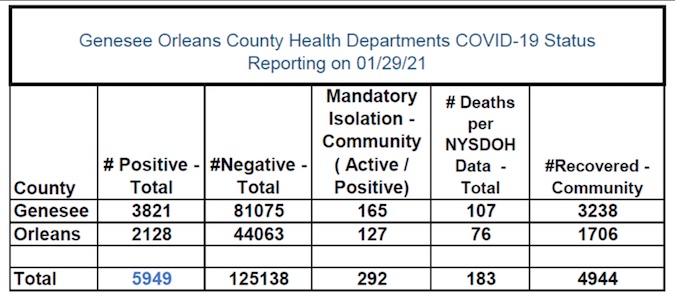
Orleans County is reporting 8 new positive cases of Covid-19 total, which is a rare day in the past two months when the county wasn’t in double digits for new cases. Orleans has now had 2,128 people test positive for Covid since last March.
The positive cases reside in the West Region (Yates, Ridgeway, Shelby), Central Region (Carlton, Gaines, Albion, Barre) and East Region (Kendall, Murray, Clarendon). The individuals are in the age groups of 0-19, 20s, 40s and 70s.
Of the new cases, 2 were on quarantine prior to testing positive. One of the cases also is a resident at the Orchard Rehabilitation & Nursing Center in Medina.
The county also is reporting 20 of the previous positive individuals have recovered and been removed from the isolation list.
There are currently 7 residents hospitalized due to Covid.
There are currently 127 actives cases in the county, which is down from 167 a week ago.
The Genesee and Orleans County Health Departments is reporting another death from Orleans due to Covid. The person is over age 65. Orleans is reporting five deaths from Covid since a week ago and 76 during the pandemic due to Covid.
“We will not be reporting any further information to protect the privacy of the individual and their family,” the Health Departments stated in a news briefing this afternoon in announcing the death. “We extend our deepest condolences to the family and friends of this individual at this very sad time.”
• Medina Central School is reporting four students tested positive for Covid, with two in the high school and two in the middle school.
With the four students, the Health Department is working with the school district to identify any potential close contacts and is notifying families who may have to quarantine, according to a letter on the district website from Mark Kruzynski, Medina’s district superintendent.
In Genesee County there are 46 new positive cases for a total of 3,821 confirmed cases since March.
The new positive cases reside in the West Region (Alabama, Darien, Pembroke), Central Region (Alexander, Batavia, Bethany, Elba, Oakfield) and East Region (Bergen, Byron, LeRoy, Pavilion, Stafford).
The individuals are in the age groups of 0-19, 20s, 30s, 40s, 50s, 60s, 70s, 80s and 90s.
The new cases include a resident of the Batavia VA Medical Center and a resident of Premier Genesee in Batavia.
The county is reporting 39 more of the previous positive individuals have recovered and been removed from the isolation list.
Genesee currently has 165 active cases which is down by 76 from the 241 a week ago.
The county also is reporting 21 residents are hospitalized due to Covid.
Genesee also has two more Covid-related deaths, who are both over the age of 65 and were residents of the LeRoy Village Green Residential Healthcare Facility. The county had six Covid-related deaths since a week ago and now has had 107 residents pass away due to Covid since last March, according to the Health Department data.
Corrections from the G-O Health Departments: The following two cases previously identified as residents of the Leroy Village Green Residential Healthcare Facility were double counted and have been retracted from today’s data: a case in his/her 80s and a case in his/her 60s. Two other cases previously reported as residents of the Leroy Village Green Residential Healthcare Facility are community members and have been retracted from today’s data.
Chart from Governor’s Office: This is each region’s 7-day average percentage of positive test results reported over the last three days.
Statewide Data: There were 12,579 new positive cases in the state reported on Thursday out of 270,518 tests for a positivity rate of 4.65 percent.
There were 8,357 people hospitalized due to Covid, which is down by 163 from Wednesday. There were also 151 deaths, bringing the total to 34,893.
Governor Andrew Cuomo today announced that assuming New York State’s Covid-19 infection rate stays on its current trajectory, indoor dining in New York City can reopen at 25 percent capacity on Valentine’s Day.
Cuomo also announced that marriage receptions will be able to resume in accordance with state guidance on March 15. Events must be approved by the local health department. There will be a 50 percent capacity limit and no more than 150 people can attend the event. All patrons must be tested prior to the event.
“As data on infection rates and hospitalizations continue to improve, we must begin taking steps to jumpstart our economic recovery as long as public health can be protected,” Cuomo said.
ORCHARD PARK – Congressman Chris Jacobs (NY-27) has joined a bipartisan group to call on the Biden Administration to work with the Canadian government to develop a cooperative plan to reduce cross-border travel restrictions.
“Reopening our Northern Border will have a direct impact on improving our local economy and allow for businesses and key industries relying on cross-border travelers to receive a much-needed boost,” Jacobs said. “In addition to injecting needed dollars into our struggling local economy, opening the border is of great personal concern for family members who have been separated for almost a year and property owners who have been unable to maintain or even check on their homes.”
The letter, signed by 24 representatives including Rep. Jacobs and New York Reps. Stefanik, Higgins, Katko, and Reed calls for the Biden Administration to develop a bi-national plan to cooperatively reopen the Northern Border and identifies five key actions that need to be taken:
Establish a Bilateral Plan for Restoring Travel – Both U.S. states and Canadian provinces have created extensive frameworks for reopening their respective economies based on public health metrics and criteria identified by public health experts. While these have guided reopening decisions in their respective territories, the U.S. and Canadian governments have yet to work collaboratively to use their existing frameworks to develop guidance for reopening the U.S. – Canadian border.
Prioritize Vaccines and Testing for All CBP Staff – Agents and staff of U.S. Customs and Border Protection (CBP) work on the frontlines to protect American interests and citizens. We need to ensure they have a continued supply of necessary PPE and that eligibility for vaccinations is expanded beyond its current level of only personnel within a 200-mile radius of a Veterans Affairs hospital.
Allow for Families to Safely Reunite – Since the travel restrictions were first implemented, Canada has expanded exemptions to allow family members and extended family members to enter Canada. However, the U.S. has yet to offer a similar procedure for land border crossings.
Develop a Policy for Property Owners – Individuals who own property in Canada have been unable to travel by car to their homes to conduct maintenance and collect necessary belongings, despite the ability to implement safe procedures such as a negative COVID test before traveling and implementing quarantine guidance.
Ensure Reciprocal Access to Transit through Boundary Waters – During the pandemic, Canadian boaters and boat tour operators have enjoyed access to U.S. waters so long as they did not dock at a U.S. port. U.S. boaters have not had the same reciprocal treatment from Canadian authorities. This has particularly harmed the U.S. boat tour industry, which has been unable to conduct unrestricted tours resulting in lost revenues.
“The Biden Administration has indicated through an executive order that they are pursuing a plan to open the U.S.-Canadian Border safely,” Jacobs said. “I urge them to work collaboratively with the Canadian government to develop an actionable plan that puts a stop to the endlessly extended travel restrictions and uncertainty for thousands of businesses, cross-border families, and American homeowners.”
ALBION – The Hoag Library will be moving our digital magazines from RBdigital to the Libby app as part of our OverDrive collection on Feb. 2. You will continue to be able to browse, borrow, and enjoy all the same great magazines from ZINIO you loved in the RBdigital app, now available in Libby from OverDrive.
If you have already been enjoying the Libby app, there will be no change, other than you may notice even more great titles available for you to borrow.
Getting Started with Libby
Our library is proud to offer you a wide selection of digital magazines for you to access anytime, anywhere through Libby, the one-tap reading app.
For those who have not yet tried the Libby app, all you need to get started is your library card number. The Libby app is easy to use and will guide you through the setup process and get you connected to our library in just a few minutes. You can find in-app support, or visit the Help site or Libby Academy within the app for assistance.
Patrons needing further assistance can call the library at (585) 589-4246 and schedule a one-on-one tech appointment with Adult Services Librarian Mike Magnuson.
New to digital?
In just a few taps, you can start reading instantly on your phone or tablet. The digital library is available 24/7 without leaving home and is free from our library. Download the Libby app to get started.

















 MEDINA – A committee that has been meeting since August to study police reform is recommending changes for the Medina Police Department, including the establishment of the Community Policing Board.
 A Shield of Sterling motivates wearer to pursue goodness