By Ginny Kropf, correspondent Posted 25 February 2022 at 12:34 pm
‘It affects the lives of tens of millions, and thanks in part to the pandemic, has only gotten worse.’
MEDINA – Orleans Community Health has recognized this past week as National Eating Disorder Awareness Week to dive deeper into this mental health condition, according to information from Anna O’Keefe, RD, CDN, clinical dietitian at Orleans Community Health.
Anna O’Keefe
“There has never been a time that this topic needs more attention than right now,” O’Keefe said in a press release. “For starters, this not a challenge for one gender, one age group or a single demographic of our society. It affects the lives of tens of millions, and thanks in part to the pandemic, has only gotten worse.”
It is estimates that 30 million Americans have struggled with an eating disorder at some point over their lifetime, said Claire Mysko, CEO of the National Eating Disorders Association. That breaks down to 20 million women and 10 million men.
Mysko shared information from the National Institute of Mental Health stating among teens 13 to 18, 3.8 percent of females and 1.5 percent of males are reported to have an eating disorder.
In addition, the National Association of Anorexia Nervosa and Associated Disorders says 13 percent of women older than 50 engage in disordered eating behaviors. This statistic doesn’t refer to having an eating disorder necessarily, but instead refers to the number of people who may do things like create certain rules about eating or obsess over being thin.
Sixteen percent of transgender college students are reported to have an eating disorder, according to the ANAD. Although statistics about eating disorders in this population group are not consistent, the NEDA states that bay, lesbian and bisexual teens are thought to be at a higher risk of binge eating and purging.
Eating disorders are classified as a mental health illness that causes constant and extreme food disturbances and are severe in nature. A healthy relationship with food is virtually impossible for those who suffer and it can consume their entire livelihood.
Like many mental health diseases, this does not just impact one aspect of life, but all aspects, including physical, mental and social wellbeing. Eating disorders are serious illnesses, and left untreated can cause detrimental consequences, including death.
O’Keefe added the term “eating disorder” is an umbrella term for many subsets of this disease, including anorexia nervosa, bulimia nervosa and binge eating.
Eating disorders are diagnosed based on criteria from the “Diagnostic and Statistical Manual of Mental Disorders,” which are the psychiatry standards used for diagnosing mental health disease. Anorexia Nervosa involves restriction of calories to the point of severe and significant weight loss. Individuals who suffer typically have distorted body image and can have a pathological fear of food and weight gain.
Bulimia Nervosa involves eating a large amount of food within a short amount of time and compensating for this via purging (vomiting), laxatives or excessive exercise. Individuals with this disease can often present as normal body weight.
Binge eating disorder involves reoccurring episodes of eating a large amount of food rapidly, beyond the point of fullness, and typically having no control over these episodes. This is the most common eating disorder in the United States, according to O’Keefe.
This disease does not discriminate and people of all ages, genders and body sizes are at risk to some degree.
More information on signs to be aware of, how to be supportive and treatment can be provided by one’s healthcare professional. O’Keefe added that recovery is possible.
WASHINGTON, DC – Congressman Chris Jacobs (NY-27) cosponsored the Unmask our Kids Act.
“It is far past time to remove the mask mandate in New York schools and return normalcy to our students’ classrooms, gymnasiums, lunchrooms, and playgrounds,” Jacobs said. “I am proud to join this legislation to do just that.”
The legislation would prohibit the Secretary of Education from providing federal funds to a local educational agency unless in-person education is available to all students and parents have the ability to send their children to class mask-less.
“As more states have moved to drop mask mandates on our children in schools, New York continues to bring up the rear by still forcing kids to mask up in the classroom,” Jacobs said. “Forced masking has done incredible damage to the emotional, social, and language development of children. Many younger students have now developed new speech problems as a result, with more suffering from emotional intelligence problems because they are unable to fully read facial cues.”
Note: The legislation was introduced by Ashley Hinson, a Republican from Iowa.
By Tom Rivers, Editor Posted 25 February 2022 at 9:09 am
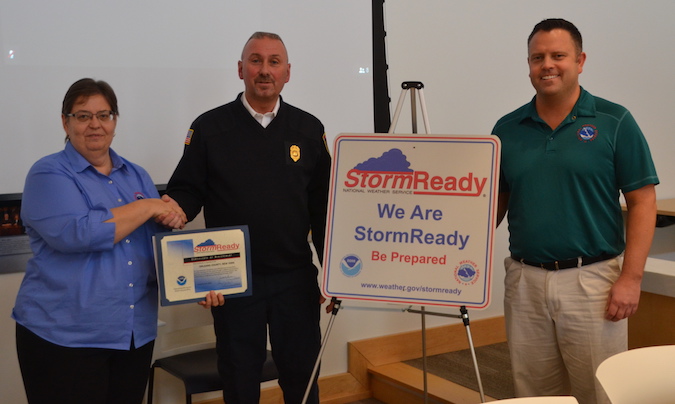
ALBION – The National Weather Service has recognized Orleans Couty with a “StormReady” designation for the county’s hazardous weather plan and other protocols to inform the public of dangerous weather conditions.
Judy Levan, Meteorologist in Charge of the Buffalo Branch of the National Weather Service, presented a certificate of recognition to Dale Banker, the county’s emergency management coordinator. She praised Banker and his staff “for the tremendous effort he has exhibited to accomplish the goals set forth in this program.”
To be recognized as a Storm Ready county, a community must meet the following requirements:
Establish a 24-hour warning point and emergency operations center
Have multiple ways to receive severe weather forecasts and warnings and to alert the public
Create a system that monitors local weather conditions
Promote the importance of public readiness through community seminars and education
Develop a formal hazardous weather plan, which includes training severe weather spotters and holding emergency exercises
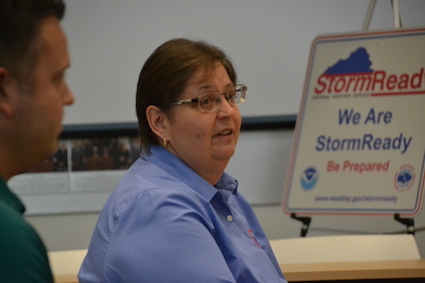
Judy Levan, Meteorologist in Charge of the Buffalo Branch of the National Weather Service, tells county legislators the county’s Emergency Management Office has a solid plan in place in case of weather emergencies.
Orleans County not only meets the criteria for the StormReady designation, “but has substantially exceeded them in many categories,” Levan said.
The StormReady program is designed to strengthen the relationship between emergency managers at the county level and the National Weather Service. Levan said the program makes sure all aspects of communication, warning reception and response are as efficient as possible and backups are in place in case one or more systems fail.
Banker said the county and NWS have provided weather radios to the five school districts in the county, as well as two for county officials to make sure weather alerts are received.
Orleans achieved the StormReady designation on Nov. 19 and it’s good for four years until Nov. 19, 2025. The Weather Service encourages the county to renew the recognition.
The county can use the StormReady logo in official letterheads, brochures and other documents.
If the county participates in the National Flood Insurance Program it may now be eligible for 25 additional Flood Insurance Service Organization community rating system points.
“We do not look forward to another natural disaster,” Levan said. “However, if and when another one does occur, you can be confident that officials in the county have improved their communication and safety skills needed to save lives and property.”
By Tom Rivers, Editor Posted 24 February 2022 at 9:29 pm
ALBION – In October 2020, David Hill opened Orleans Storage with 107 units at three buildings on West Countyhouse Road in Albion, just east of Route 98.
Business has been good, and Hill only has six units available.
He has proposed an expansion with three more buildings that would bring the total units to about 240.
The Orleans County Planning Board this evening voted in favor of the project which includes two buildings that would be 30 feet wide by 230 feet long, plus another building that would be 20 feet long by 225 feet.
“There is a definite demand,” he told the Planning Board this evening.
Dan Strong, the town’s code enforcement officer, said it’s a “low-key” business that is quiet with little traffic.
The board recommended the Town of Albion approve the site plan and permit for the project.
In other action:
• The board recommended the Town of Clarendon approve a permit for a diesel repair shop to be operated by Erich Hoak at 5267 Countyline Rd.
• The board re-elected Brian Napoli of Ridgeway as the board chairman and Paul Hendel of Murray as the vice chairman.
• Corey Winters, a planner with the County Planning and Development Department, announced the department was notified that $41,000 in state funding will be coming to Orleans for snowmobile trail maintenance and signage.
• Winters also notified the board that the household hazardous waste collection event will be back in August with expanded hours after last year’s event quickly filled up and some residents had to be turned away.
By Tom Rivers, Editor Posted 24 February 2022 at 3:28 pm
Each of 15 counties and cities of Rochester and Buffalo currently has own rep but that would change under proposal
File photo by Tom Rivers – Batavia Downs on Park Road in Batavia was a big factor in WROTB distributing nearly $5 million in earnings to its member municipalities in 2021.
ALBION – The Orleans County Legislature is opposing legislation in the State Senate that would change the makeup of the 17-member board of directors for Western Regional Off-Track Betting Corp.
Currently, each of the 15 counties plus the cities of Rochester and Buffalo have a member of the board and their votes carry the same weight, regardless of the population of their county or city.
State Sen. Tim Kennedy, a Democrat from Buffalo, has proposed making the board seats be based on population. Erie County, the most populous of the 15 counties, would get four seats on the board. Orleans, Wyoming and Monroe would share three directors, under Kennedy’s proposal.
Chautauqua, Cayuga, Genesee, Livingston, Schuyler and Seneca would share one member, with Niagara getting its own director. There would be one director for the counties of Oswego, Cattaraugus and Wayne; one each for the cities of Buffalo and Rochester; and a member to be appointed by the governor, another by the State Senate leader and one by the Assembly speaker.
Kennedy has also proposed capping the allowance of promotional items for certain members of the corporation to not receive a gift of any kind valued at an amount greater than $15. Kennedy also wants to prohibit take-home vehicles for OTB staff.
“Through this legislation, we’re holding members accountable, revising outdated policy, and creating fairer representation on the OTB board moving forward,” Kennedy said in a press release last month. “Taxpayers deserve better, and we intend to ensure they receive that.”
Orleans County is currently represented on the board by Ed Morgan, the former County Republican Party chairman who started as a county legislator last month. Morgan abstained from the Legislature’s vote on Wednesday when it approved a resolution in opposition to changing the structure of the board.
“This legislation will in fact have the opposite effect of the stated intention in the bill, as it will decimate the balanced representation formula determined previously by both the state legislature and governor as equitable and impartial, with a clear and explicit intent of providing each municipality that comprises the corporation an equal voice in WROTB matters,” the resolution states.
WROTB has distributed $236 million to the 15 counties and cities of Rochester and Buffalo since WROTB formed in 1974 with Orleans receiving $2.5 million.
The organization has shifted its operations away from OTB parlors to the gaming center in Batavia. The organization now only runs 11 OTB parlors, and 27 E-Z Bets at other businesses such as bowling alleys and bars.
Batavia Downs – the race track, gaming center, restaurant and hotel – is WROTB’s big money maker. It is the main reason WROTB was able to distribute $4,906,280 in earnings from 2021, the largest earnings in the organization’s history. The total shared from WROTB was $5,793,184 with surcharges on betting at horse racing boosted the number in addition to the earnings.
“The performance and accomplishments of the current WROTB Board and leadership cannot be discounted when considering this drastic and overreaching legislation,” the resolution states, and lists achievements including: the acquisition of an 84-room hotel on the grounds of Batavia Downs and countless fundraising events for charitable organizations.
The current board has a Republican majority and Kennedy’s proposal would likely tip it to Democratic Party favor.
The Orleans County Legislature urged the State Senate and Gov. Kathy Hochul to not support Kennedy’s proposal “as it will cause irreparable harm to Orleans County, its interests in WROTB, the economic interests of Orleans County, and the taxpayers of this county.”
By Tom Rivers, Editor Posted 24 February 2022 at 10:27 am
Farmers would likely to turn away from labor-intensive apples, cabbage and squash for grain and processing crops
Photo by Tom Rivers: Orleans County Farm Bureau President John Kast speaks at Wednesday’s County Legislature meeting when he asked the county officials to oppose lowering the overtime threshold in agriculture from the current 60 hours. Kast said the change would hurt seasonal workers who would see smaller paychecks with reduced hours and fewer jobs as farms would likely shift to more mechanization.
ALBION – Orleans County farmers each year welcome about 1,500 seasonal workers to bring in labor-intensive crops, from apples, cabbage, squash and cherries. Many workers are also needed each spring to plant onions on the muck in Barre and Clarendon.
Those workers are critical to Orleans County’s biggest business of agriculture, which totaled $155.3 million in 2017 federal ag census. That put Orleans as 14th among the state’s 62 counties.
But John Kast, president of Orleans County Farm Bureau, said the agriculture sector faces a big threat to its long-term viability with a strong push to lower the overtime threshold from 60 hours a week to 40.
“The decision to lower the overtime threshold will dramatically increase a farm’s operating cost with no way to adjust to recoup those costs,” Kast told the Orleans County Legislature on Wednesday. “Farms do not have the ability to set prices on our commodities. We are at the mercy of our buyers and futures markets. Unlike many other businesses that can raise prices or make other adjustments like adding self-checkout systems or kiosks for ordering, we must absorb the extra cost which is unsustainable.”
A three-person Farm Labor Wage Board voted on Jan. 28 to gradually reduce the overtime threshold in agriculture from 60 hours a week to 40 hours. The reduction in the OT threshold would be phased in from Jan. 1, 2024 to Jan. 1, 2032.
The County Legislature on Wednesday passed a formal resolution, asking Gov. Hochul not to follow the Wage Board by adopting the new threshold. Farmers have many cost factors out of their control and can’t pass on the increased costs due to a commodities market where prices are set due to global demand, legislators said.
The change in NY also puts NY farmers at a competitive disadvantage where there would be a different wage structure for workers. Many of those states already have a much lower minimum wage than in New York.
The seasonal workers, however, earn more than the minimum wage, Kast said.
The workers in the federal H2S program will be paid $15.66 an hour in 2022, Kast said. And farms also cover the visa costs, all travel costs to the local community and then back to their home country. The farms also must provide transportation and housing during the workers’ time here, Kast said.
“Our housing facilities are inspected by the local health department and are maintained under strict requirements from the New York State Department of Labor and Department of Health,” Kast told legislators. “Which is more than most apartments and condos are required to do. All of which provides additional benefits to our workers and adds additional costs to our farms.”
The Wage Board adopted a reduced threshold that would begin in two years with the threshold down to 56 hours a week and then would drop 4 more hours every two years until it’s at 40 hours a week on 2032.
The change would force farmers to either try to stay under the overtime cap and get as much work done as possible, or switch to less labor-intensive crops.
“Either option means less hours, less opportunity and less money for seasonal workers,” Kast said. “There are states all around that do not have overtime rules for agriculture and many of our workers have told us that if they will earn less money here and cannot work as much as they are able to, they will go elsewhere where they can.”
Kast said the very landscape of the county would change if the OT threshold drops, with fewer apple orchards and fields of cabbage and squash.
Kast said the seasonal workers, who often come from Mexico or Jamaica, have been with the same family-run farms for many years.
“Our workers are like family to many of us,” Kast said. “Often workers have been coming up for many years and in some cases multiple generations. We want them to enjoy working for us while being able to provide a good living wage for their families.”
By Tom Rivers, Editor Posted 24 February 2022 at 7:52 am
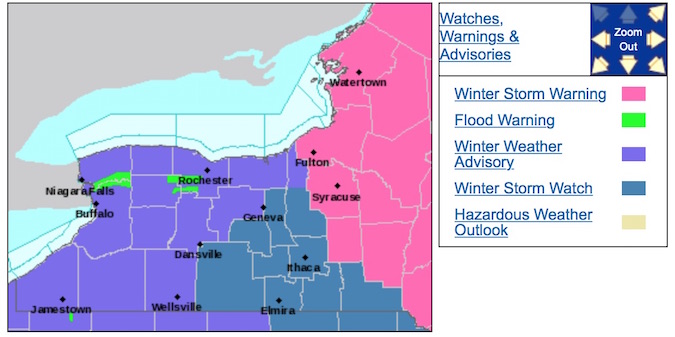
Map from National Weather Service in Buffalo
The National Weather Service in Buffalo has issued a winter weather advisory on Friday for Western New York.
The advisory for Orleans, Niagara and Monroe counties goes from 1 a.m. to 7 p.m. and forecasts 4 to 7 inches of snow for those counties with winds gusting up to 35 miles per hour.
“Plan on slippery road conditions,” the Weather Service said. “The hazardous conditions could impact the morning or evening commute.”
Saturday there is a chance for snow showers but will be mostly sunny with a high near 29. Sunday’s forecast will be mostly cloudy with a high near 33.
By Tom Rivers, Editor Posted 23 February 2022 at 8:59 pm
SHELBY – A section of Route 63 has been closed, including to emergency traffic, due to flooding and icy conditions. The section closed to traffic is between Fletcher Chapel and Lewiston roads.
By Tom Rivers, Editor Posted 23 February 2022 at 8:27 pm
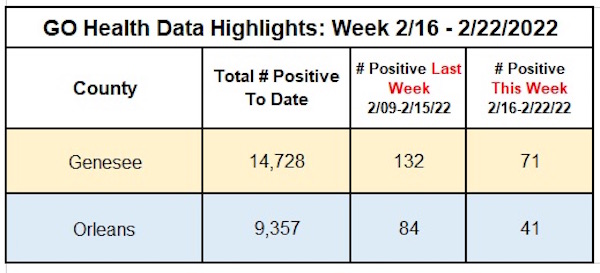
New Covid cases in Orleans and Genesee counties continue a sharp decline from the Omicron surge in January when the two counties experienced a pandemic peak in new cases.
The Genesee and Orleans County Health Departments reported there were 41 new cases in Orleans from Feb. 16-Feb. 22 and 71 in Genesee during those seven days.
The 112 new cases in the two counties is down from 216 the previous week and down 95 percent from the pandemic high of 2,703 cases at the peak of the Omicron surge from Jan. 5-11.
Orleans reported one death from Covid last week and now has had 111 residents pass away from Covid since the pandemic started nearly two years ago. Genesee didn’t report any new deaths from Covid and remains at 182 during the pandemic.
Orleans County, the Covid cases the past 9 weeks include:
159 – Dec. 22-28
379 – Dec. 29-Jan. 4
855 – Jan. 5-11
645 – Jan. 12-18
521 – Jan. 19-25
255 – Jan. 26-Feb. 1
157 – Feb. 2-8
84 – Feb. 9-15
41 – Feb. 16-22
In Genesee County, the Covid cases the past 9 weeks include:
276 – Dec. 22-28
383 – Dec. 29-Jan. 4
1,848 – Jan. 5-11
1,014 – Jan. 12-18
847 – Jan. 19-25
361 – Jan. 26-Feb. 1
198 – Feb. 2-8
132 – Feb. 9-15
71 – Feb. 16-22
Statewide the positivity rate dropped below 2 percent at 1.90 on Tuesday with 2,456 positive tests out of 129,088 reported. That is the fifth straight day the positivity rate is at 2.5 percent or less.
“Thanks to New Yorkers stepping up and getting vaccinated and boosted, our state is leading the way in beating back this virus and moving forward in the pandemic in a new way,” Governor Hochul said. “The vaccine is a critical tool to stay in front of COVID-19, but we still have more work to do to vaccinate our children. Parents and guardians, I encourage you to take advantage of the school midwinter break and consult with your child’s pediatrician about getting them vaccinated and boosted as soon as possible.”
MEDINA – At 14:49 hours today, the Orleans County Sheriff’s Department dispatchers alerted the Village of Medina Fire Department of a motor vehicle collision with possible entrapment at the intersection of Maple Ridge and Bates Roads.
Medina Engine 11 and Ambulance 61 arrived on scene to find a two-car collision with one vehicle in the roadway and a second vehicle in the ditch with its driver trapped inside.
Crews worked to stabilize the vehicle, provide patient care as well as extrication using two hydraulic tools. Crews from Medina and Shelby worked simultaneously to remove a door and the car roof in order to safely extricate the patient.
The patient was extricated in 27 minutes of crews arriving on scene. The patient was loaded into Medina Ambulance 61 and taken to the landing zone established by the Ridgeway Fire Department at the Medina Business Park. Mercy Flight transported the patient to ECMC in Buffalo. The other driver was assessed by Medina Ambulance 60 on scene and refused transport to a hospital.
Today was another example of the great partnerships in the area fire departments. Car positioning in and across the ditch full of running water made things difficult. Two separate teams communicating and working together made things go quickly and smoothly.
One other thing worth mentioning is the weather. Even though our weather here was dry and calm, it may not be like that in other parts of the area. Mercy Flight, specifically their pilots, are continuously assessing the weather to offer safe transport for them to the emergency scene and from the scene to a hospital.
At the time of the accident today we were right in the middle of some not-so-nice weather for flying. As the Mercy Flight crew assisted our paramedics with patient care on the ground, the pilot went airborne again to visually monitor surrounding weather conditions. Flying to Strong was not an option due to poor weather. The pilot touched the aircraft back down, the patient was loaded inside and Mercy Flight then took the patient to ECMC.
By Tom Rivers, Editor Posted 23 February 2022 at 3:10 pm
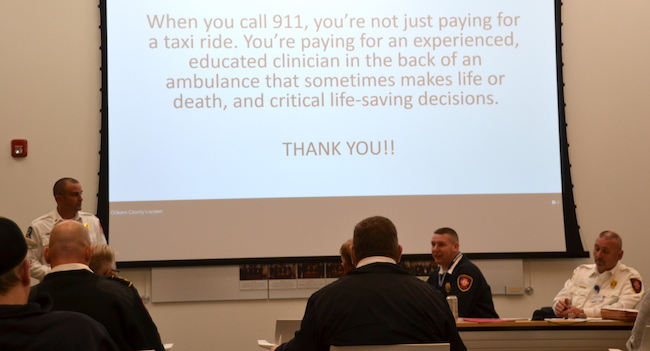
ALBION – A task force of about 30 local officials, fire department representatives and ambulance service providers met for the first time last week to discuss challenges to the local EMS system which often faces drop calls, slower response times, financial challenges and a shortage of manpower.
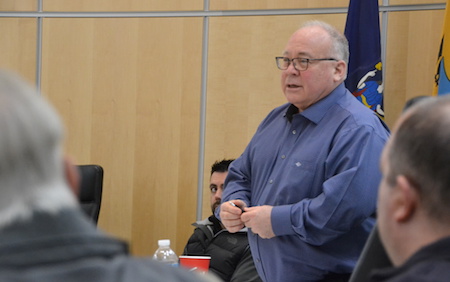
“We’re coming into this with an open mind,” Justin Niederhofer, the EMS coordinator for the county, told about 30 local officials, fire department representatives and ambulance providers during a meeting last week at the Orleans County legislative chambers. “We don’t know what the solution is.”
Orleans County Legislator Skip Draper, head of the county’s Public Safety Committee, convened the task force and urged the group to push for solutions.
He urged the group to put the past behind them, especially with dropped calls, and forge solutions for the future. A dropped call is a request for service but the agency can’t get there and the call is sent to another responding agency.
The task force members will need to decide what is an acceptable response time for an ambulance in their community, and work towards that goal. Niederhofer said it is “unrealistic to think 100 percent of the calls 100 percent of time.”
There are four ambulance providers serving the county – Medina Fire Department, COVA, Monroe Ambulance and the Kendall Fire Department – and all operate differently.
All four have seen their response times increase from 2018 to 2021.
COVA’s average response increased from 6:52 for 2,010 calls in 2018 to 8:10 for 2,214 calls in 2021. Dropped calls increased from 53 to 125 during that time period.
Kendall averaged a 9:19 response for 113 calls in 2018. That was up to 10:47 for 201 calls last year. Dropped calls up from 16 to 71 during those years.
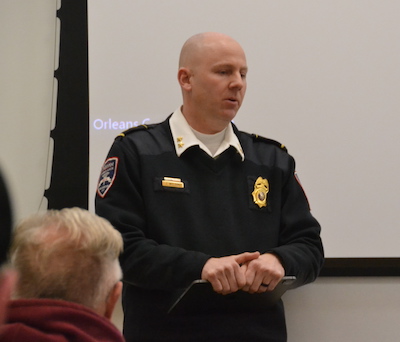
Medina had a 6:34 average response time for 2,333 EMS calls in 2018, which increased to 7:22 for 2,311 calls in 2021. Dropped calls up from 7 in 2018 to 21 last year.
Monroe Ambulance had a 12:13 average response time for 726 calls in Orleans County in 2018. That was up to 16:09 for 950 calls in 2021. Monroe’s drop calls in Orleans increased from 19 in 2018 to 79 in 2021.
Medina Fire Department serves the west end of the county – Shelby, Ridgeway, Medina, Lyndonville and Yates – and provides the service with the only paid career fire department in the county.
Dale Banker, the county’s emergency management coordinator, said more calls are going to mutual aid, which further strains the system and often results in a slower response.
The department has 21 paid firefighters who respond to fire and EMS calls. Fire Chief Matt Jackson said the department loses valued members to suburban departments that pay about $20,000 more annually.
Medina took over as the primary ambulance provider in 2007 for the western end of Orleans County. Rural Metro had the contract before that.
Medina responded to 2,616 total calls in 2021 with two-thirds of those EMS calls. Medina FD is increasingly being asked to provide mutual aid outside its primary service area, going into central Orleans, eastern Niagara and even Genesee County as many areas have manpower shortages.
Jackson said Medina will only take those calls if it has another available crew to respond to an emergency in Medina and western Orleans.
The Kendall Fire Department is the last volunteer fire department running an ambulance in Orleans County. Clarendon, Holley, Carlton, Albion and Shelby have all disbanded their ambulances.
Kendall has seven emergency medical technicians right now, with another in training, said Shelby Willis, EMS captain for the Kendall Fire Department.
“We have every intention of keeping up with our ambulance but staffing is the main problem right now,” Willis said.
Shelby Willis, EMS captain for the Kendall Fire Department, said the volunteer group isn’t able to bill for its services and relies on fundraisers.
The training requirements to be an EMT and paramedic have gone up, and ambulances have to drive farther, often into Rochester and Buffalo and then wait longer for hospitals to accept the patients. The whole process makes it much more demanding of time from the volunteer staff.
“We’re volunteers and we can’t make every call,” Willis said. “The transports are farther. Sometimes it takes 2 to 3 hours. We’re giving up a lot of time.”
Kendall is talking with the Murray Fire District about crew sharing, with the possibility of having an ambulance stationed in Murray with Murray firefighters helping to staff it.
Kendall, because it is a volunteer ambulance, can’t bill for its services. It relies on donations and fundraisers.
Monroe Ambulance responds to about 35,000 calls in Monroe County, eastern Orleans and Wyoming County.
John Williams is Deputy Chief at Monroe Ambulance. Hospitals are pulling many paramedics away with higher pay and an easier workload, he said.
The company is down 37 percent of its paramedics in the past two years. Many have left Monroe to work in hospitals where they are paid $35 an hour to do blood draws, said John Williams, deputy chief at Monroe Ambulance.
Monroe has launched an in-house EMT academy and has stepped up recruiting efforts at local high schools. It also is taking with Monroe Community College about a program to train paramedics.
Monroe Ambulance also is offering signing bonuses and boosting pay. Right now the average wage is $17.52 an hour for an EMT and about $25 for a paramedic.
Monroe has been hurt by people not paying their ambulance bills, and what is often a two-hour wait at hospitals to drop off a patient. That ties up the crew and leads to dropped calls for other emergencies, Williams said.
Monroe doesn’t keep an ambulance stationed in Orleans.
“The economics are not feasible for us to dedicate an ambulance to Orleans County,” he said.
Central Orleans Volunteer Ambulance is a non-profit organization based in Albion. The organization has struggled financially due to low Medicaid/Medicare reimbursement rates, patients who keep their insurance checks instead of directing them to COVA, and a lack of any tax support, said Wade Schwab, a paramedic and past president for COVA.
“It’s been a heckuva struggle,” Schwab said. “The biggest challenge is financial.”
Wade Schwab, a paramedic at COVA and past president, said the organization faces financial challenges. He advocates for assessing each household in central Orleans – Barre, Albion, Gaines and Carlton – $25 a year to keep COVA viable.
He said there is about $90,000 owed COVA in 2021 from unpaid bills. Turning unpaid bills into collections often “gets you nowhere.”
The longer wait times at hospitals also occupy an ambulance crew for more time, making them unavailable for other calls.
COVA has meet with local government leaders from the four central Orleans towns of Barre, Albion, Gaines and Carlton as well as the Village of Albion to dicuss an ambulance taxing district. None have moved to help COVA with the financial challenges, Schwab said.
COVA has suggested a $25 fee for each of the 7,793 households in central Orleans, which would raise $193,675.
With that funding, COVA could increase staff and put more ambulances in service, Schwab said.
Right now, state law limits an ambulance taxing district to a single town. COVA would like a multi-town taxing district for the four towns, or each town could perhaps create their own taxing district for an ambulance service. Schwab said COVA officials have met with state legislators to help with the issue, as well as to have insurance checks sent directly to COVA, but haven’t had much followup.
Schwab said the EMS staff should be paid more, given the training and responsibility. Right now, he said, Wegmans and Tim Hortons can offer similar pay for far less stress.
Some counties facing an EMS crisis have created county crews to supplement the local ambulance providers. Niederhofer and Dale Banker, the emergency management coordinator, said they would bring in officials from other counties who have tried that to hear how that has been working.
Schwab interjected that the county would be better served to assist its existing ambulance providers rather than create a new entity.
He said the county already has a great foundation for responding to EMS calls.
Justin Niederhofer, the county’s EMS coordinator and deputy emergency management coordinator, said the local EMS system has experienced more dropped calls and slower response times in the past year.
“We have hard-working professionals in the Medina Fire Department, Monroe Ambulance, COVA and Kendall, we just need a little help, Schwab said.
County Legislator Skip Draper convened the meeting as head of the County’s Public Safety Committee. He hears throughout the state that emergency services are collapsing.
The task force needs to offer solutions for the immediate problem and also look to future challenges. He said Medina FD is currently considered a model, but even that department is being in many directions and its future success is not a guarantee.
“Even though it’s working in some areas it’s still fragile,” Draper said about the EMS system.
The task force will next meet March 16 and will return with a survey about acceptable response times for different severities of emergency, whether advanced life support with paramedic level of care or basic life support at EMT level of care.
Jack Welch, the county chief administrative officer, said the local town and village leaders need to be part of solving the problem.
“We need buy-in from the municipalities,” Welch said. “What is acceptable service? We need to agree what the problem is.”
By Tom Rivers, Editor Posted 23 February 2022 at 9:22 am
MEDINA – A group is proposing to help Medina establish goals and projects to move the community forward.
The Village Board likes the idea of a group of “visionaries” that would brainstorm ways – big and small – to better Medina, but the board wants to see the group’s mission statement and if they envision acting in an official village capacity.
Kathy Blackburn discussed forming the “Waterfront and Community Development Committee” with the Village Board last week. Blackburn would be one of the members. She said the new committee would expand the scope from a group that worked to develop the Medina Local Waterfront Revitalization Program. That LWRP was funded by the state and tasked Medina with identifying projects to better utilize land near the canal, Oak Orchard Creek and Glenwood Lake. That plan picked about 20 projects to boost economic development, tourism, recreation and residential opportunities. The plan is complete and is awaiting final state approval.
With that group’s work done, Blackburn said there is need for a committee to help the village push along the projects and identify other initiatives away from the waterfront to boost Medina.
“We would make suggestions and strategies to the Medina Village Board,” Blackburn said. “We’re just strategizing what younger people are looking for in a village.”
The group would look at ways to improve and attract more investment in the downtown, neighborhoods, housing, the historic district and other zoning overlays.
Proposed members, besides Blackburn, would include Chris Busch, Andrew Meier, Mark Zambito, Chris Goyette, Gloria Brent, Jake Hebdon and Scott Robinson.
“These are movers and shakers,” said Tim Elliott, a village trustee. “These are people who can get things done.”
Owen Toale, the village’s deputy mayor, said there needs to be a clear defined role for the committee.
“These are all great people,” said Village Trustee Jess Marciano. “How will they overlap, how will they function with the other village committees? I love the idea, but is a formal committee needed?”
Trustee Elliott said the group would function as “think tank” and help identify projects and policies to benefit Medina.
Blackburn said she would work on a mission statement. She said the committee would tap into leaders from business, the Medina Area Partnership and some of the other village committees.
By Tom Rivers, Editor Posted 23 February 2022 at 8:39 am
File photo by Tom Rivers: DN Tanks applies a second coat of paint on Medina’s 3-million-gallon water tank in this photo from Aug. 8, 2016.
MEDINA – The Village Board is being asked to come up with a water rate for the Medina Business Park that would be only slightly higher than the village rate.
The village currently charges out-of-village users 1.6 times the village rate. That puts the community at a competitive disadvantage in attracting businesses to the site. Those companies compare costs at potential sites and water rates are a big factor, said Gabrielle Barone, vice president of business development for the Orleans Economic Development Agency.
Many businesses and site selectors reach out to the Orleans EDA about the Medina Business Park, which encompasses over 300 acres and is one of largest state-certified “shovel ready” in the region.
Barone said the land shouldn’t be considered an outside-user anyway after an agreement among the village, town, county and school district that gives the village a portion of the tax revenue even though the land south of Maple Ridge is outside the village.
This is the land known as the “Keppler Site” on the south side on Maple Ridge, just west of Bates Road.
“We’re responding to a number of very high level robust proposals,” Barone told the Village Board last week. “These companies expect to use large amounts of water.”
Barone urged the board to come up with a rate that the EDA can present to the prospective companies.
“Remember, we’re competing with several other areas,” she said. “We need to come up with a rate for outside users who are paying (village) taxes.”
The board said it would work on determining a rate and working with the EDA on how much to charge for water and sewer.
The EDA pitched the Medina Business Park as being conveniently located between Buffalo and Rochester, and also within 45 minutes of the Ontario, Canada border.
“With contiguous sites available ranging from 5 to 125 acres, Medina has the available infrastructure and incentive packages to make it a sought-after location for foreign and domestic companies looking to expand into New York State,” the EDA states in promoting the property.
By Tom Rivers, Editor Posted 23 February 2022 at 7:57 am
The Orleans County Conservative Party is backing Chris Jacobs for the newly drawn 24th Congressional District which shifts east to the other side of Rochester and includes 13 counties.
The local Conservatives, however, aren’t giving their endorsement to Assemblyman Steve Hawley or State Sen. Rob Ortt, even though they have among the most conservative voting records in the State Legislature.
Hawley has been in office for nearly 16 years since winning a special election on Feb. 28, 2006. Paul Lauricella, the Conservative Party in Orleans, said Hawley is a bona fide conservative but has been in office beyond the 12-year cutoff sent by the party.
Lauricella said the Conservatives believe in term limits, and want to see a politician, even a popular one, not stay in office after 12 years.
“The politicians talk of term limits but are not serious,” Lauricella writes in a letter to the editor on the Orleans Hub. “We are.”
Ortt may bring a strong conservative voice to the Legislature as the Republican Leader in the State Senate, but Lauricella said Ortt backed a budget from former Gov. Andrew Cuomo that funded the SAFE Act. Ortt also doesn’t reach out to the local Conservative Party leaders, Lauricella said.
He acknowledged the two local state legislators – Hawley and Ortt – will likely get the Conservative line in the election from the state committee.
With Jacobs, Lauricella said the congressman stands up for Donald Trump, opposes vaccine mandates and fights the “reckless spending of the Biden Administration.”
By Tom Rivers, Editor Posted 22 February 2022 at 9:50 pm
‘It would be devastating if it goes through (and is approved by state)’ – Legislator Bill Eick, retired dairy farmer
ALBION – The Orleans County Legislature plans to go on the record Wednesday, opposing a push to lower the overtime threshold in agriculture from 60 hours a week to 40.
That change would be particularly difficult for farmers in Orleans County who need workers for intensive hand labor with fruit, vegetable and dairy operations.
Local farms would likely have to curtail overtime to keep labor costs down. That would result in smaller paychecks for workers. Many of the workers would likely go to other states where their work weeks wouldn’t stop at 40 hours, said County Legislator Bill Eick of Shelby, who is a retired dairy farmer.
“These workers will go somewhere else where they can get the hours they want to work,” Eick said this evening during a meeting of Orleans county, village and town officials at the Black North Inn.
A three-person Farm Labor Wage Board voted on Jan. 28 to gradually reduce the overtime threshold in agriculture from 60 hours a week to 40 hours. The reduction in the OT threshold would be phased in from Jan. 1, 2024 to Jan. 1, 2032.
Many on the agriculture community, including New York Farm Bureau, are pleading with Gov. Kathy Hochul to reject the Wage Board’s decision.
“It would be devastating if it goes through,” Eick said.
Lyndonville Mayor John Belson also said he is concerned for wineries, which are growing in the region since the Niagara Wine Trail was established about 20 years ago. Three from Orleans are on that trail.
“It will crush the wineries,” Belson said.
Eick said many other counties around the state have officially opposed lowering the overtime threshold in agriculture. Genesee County voted last week on the measure, stating it was “emphatically” opposed to lowering the threshold.
The Orleans County Legislature, in a draft of the resolution, say farmers face many problems outside their control including climate change, land management policies, foreign market competition, livestock and crop diseases, natural disasters and cost increases of feed, fuel, equipment and labor costs.
“Farmers cannot pass on these increased costs as they operate in a commodities market where prices are set according to global demand,” the resolution states. “Many farmers in agriculture rely on migratory workers during the short growing season in Western New York, as they have a limited window to get the work done.”