By Tom Rivers, Editor Posted 21 February 2023 at 2:52 pm
The National Weather Service in Buffalo has issued a winter weather advisory from 4 p.m. Wednesday until 6 p.m. on Thursday for Orleans, Niagara and Monroe counties.
Mixed precipitation expected with total snow accumulations of 1 to 3 inches and ice accumulations of up to three tenths of an inch, the Weather Service said. Winds will be gusting as high as 45 mph.
The periods of snow, sleet or freezing rain will result in slippery roads and limited visibilities, according to the Weather Service, which urged motorists to slow down and use caution.
“Power outages and tree damage are likely due to the ice,” the Weather Service said. “Travel could be nearly impossible. The hazardous conditions could impact the morning or evening commute.”
By Tom Rivers, Editor Posted 21 February 2023 at 12:27 pm
MEDINA – Two candidates for two trustee positions will be unopposed on the ballot after turning in petitions signed by at least 100 eligible voters in the village.
Diana Baker and Jessica Marciano are both running under the Unity Party. Marciano is a current trustee. Owen Toale, the other trustee whose term expires March 31, isn’t seeking re-election to a two-year term.
In the Medina village elections the candidates run as independents without official backing from the major political parties.
Voting will be from noon to 9 p.m. at the Senior Center, 615 West Ave.
By Tom Rivers, Editor Posted 21 February 2023 at 11:02 am
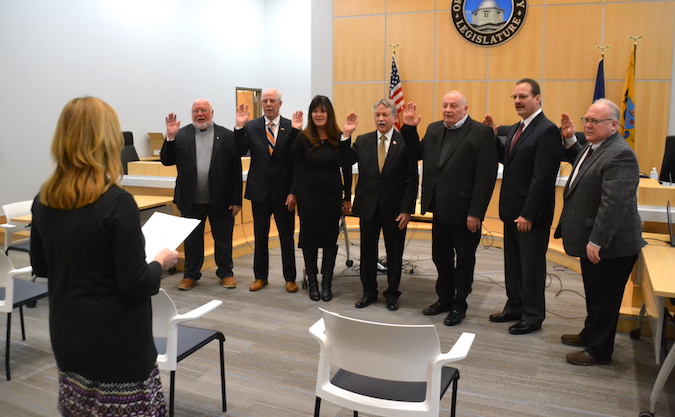
The Orleans County Legislature will vote today to do a once-every-10-year tweaking of the four legislative districts.
There won’t be any major shakeups. The Legislature still plans to keep three at-large districts which are elected countywide.
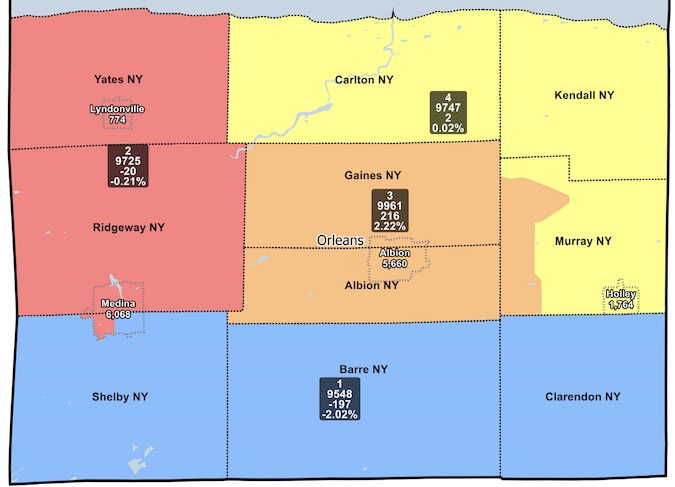
The plan calls for keeping the four legislative districts which are each about 10,000 people. There is some slight shifting to get the four legislative districts within a variance of 5 percent. Some tweaking is needed because the population variance would be an 11.7 percent deviation without changes. That is too much to be legal. (The threshold used to be 10 percent but has been lowered to 5 percent.)
The Legislature started in 1980 following a legal challenge against the previous Board of Supervisors and the principle of “one person, one vote” – that legislators represent districts that are apportioned equally.
The 10 town supervisors used to lead the county government. Some counties still do that, including 2 GLOW counties – Wyoming and Livingston. The towns vary in size so those counties used a weighted-voting system to meet the “one person, one vote” doctrine.
I think it was a good move for the County Legislature to move away from the Board of Supervisors back in 1980. The town supervisors have their hands full leading their towns. It also didn’t seem right to have the county run by the 10 town supervisors and no mayors from the villages.
However, the Legislature has continued to be “town centric” with six of the seven legislators coming from previous roles with town government, either as town supervisors, town councilman, town highway superintendent or a town book keeper. Only Fred Miller, a former Albion village trustee, joined the Legislature after serving on a Village Board.
Miller is also the lone Democrat on the Legislature. The Orleans County Democratic Party has filed a lawsuit in the State Supreme Court, seeking to do away with the at-large positions and seven districts of the same size. Democrats say the current system doesn’t meet the “one person, one vote” standard and also discourages competition, giving Republicans a near-guaranteed victory with the countywide positions. Republicans have a 2-to-1 enrollment advantage in the county.
A redistricting proposal for the County Legislature tweaks the boundaries for the four legislative districts.
Republicans now and back when the Legislature was formed see the at-large as an advantage for residents – that they get to vote for a district legislator and three countywide positions. They actually get to pick a majority of the Legislature. Democrats argue the current system staves off any challengers. In the last election in November 2021, all seven legislators were unopposed.
I’d like to present a different reason for redistricting: We need strong village voices on the Legislature.
The four villages – Albion, Holley, Lyndonville and Medina – account for 14,209 people or 35.2 percent of the county’s total, yet they don’t have much influence on the Legislature.
The villages face big challenges with high poverty rates, vacant homes, shrinking populations, and sky-high tax rates. But those challenges seldom come up in public debate at the county level. A culvert in need of attention in an out-of-the-way spot in the country consumes more passion and money from the current Legislature. They seem to think the villages issues are solely on the villages to resolve.
The Legislature should be redistricted and the villages of Albion and Medina should have their own representative on the body.
The county has 40,343 people, according to the 2020 Census. If that is divided by 7, each district should have 5,763 people. That happens to be very close to the size of the Village of Albion at 5,637 people and the Village of Medina at 6,047 people. If we had two village reps out of seven positions, that would account of 28.6 percent of the Legislature, close to the percentage of village population among the 40,343 total.
The current Legislature hasn’t given the villages (and towns) any more of the sales tax since 2001. Back then, the local sales tax was about $10 million for the year. Last year it totaled $22.5 million.
The county shares $1,366,671 in sales tax with the 10 towns and four villages – $378,777 to the four villages and $987,894 to the towns in 2023.
If the Legislature hadn’t frozen the formula, all the municipalities would have more than doubled their sales tax revenue since 2001.
The Legislature sees the county’s needs – upgraded buildings, roads and infrastructure repair – as top priorities deserving of the full amount of the sales tax increase since 2001. Yet, the village and town needs are seen as less important to the Legislature.
That seven-member body is painfully aloof to the rising tax rates at village level, among the highest in the Finger Lakes region. Those taxes are crushing to the residents, especially younger families and senior citizens. Those rates discourage investment in the villages, and these are the prime spots for businesses which need the village water and sewer services – and their population centers.
The County Legislature seems to cast blame on the villages for their state of affairs, and don’t see the Legislature’s duplicity in driving up the tax rates by hoarding the local sales tax.
Village reps from Medina and Albion would make noise about this situation, rather than the current finger pointing that the village leaders get from the county.
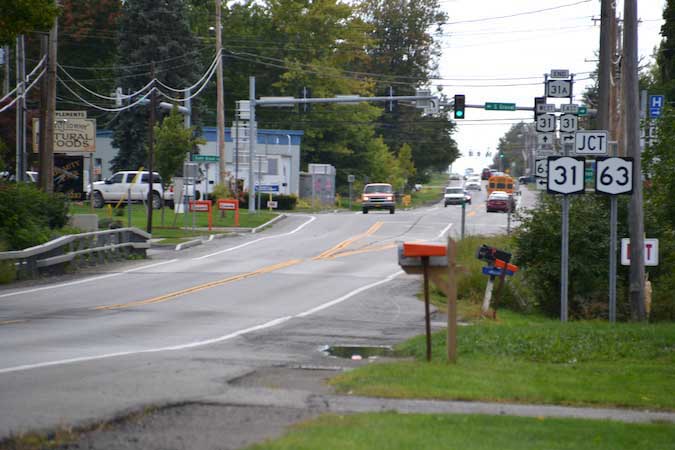
The Village of Albion completed a spray park in June 2021 that has been a big draw for the community. It was part of an $800,000 upgrade at the park on Route 31. The local villages work on quality-of-life issues and essential services despite no increase in the local sales tax since 2001.
If the county agrees to village districts in Albion and Medina, how else should the Legislature look?
With districts about 5,500 to 6,000 people, I would suggest the outside-village portions of Shelby and Ridgeway be in the same district. Together the two towns have 11,505 people. Take out the Village of Medina, and the remainder of those two towns have 5,458 people.
It makes sense to me to have Yates and Carlton in the same district. They are both rural towns along the lake, with many Amish and Mennonite businesses. Together they have 5,402 people.
The towns of Albion and Gaines also should be together. Together they have 10,865 people. Take out the village’s population of 5,637 and the two towns have 5,228 people.
The last two districts aren’t so clear cut. I think it makes sense to have Barre and Clarendon together. They are southern towns in the county, with muckland and wide open spaces. Together they have 5,158 people. I think it makes sense to include about 700 people in the southern part of Murray in this district. About 700 also should be taken from Murray and put in the Albion and Gaines district to bring that one closer to the average.
The last district would have Kendall and the rest of Murray. Kendall has 2,617 people. Murray has 4,796 residents. That’s 7,413 together. But if 1,400 are subtracted (to be included in the Barre-Clarendon district and the Albion-Gaines district) that would put the rest of Murray and Kendall at 6,013.
The county could utilize weighted voting to get the seven districts even closer.
The Legislature will vote at 4:30 p.m. today on its plan to keep the four districts and three at-large. It might not look at redistricting again for about 10 years.
If the redistricting plan passes today, I would encourage the Legislature to look again at having seven districts, and do it in about a year with public hearings around the county. Waiting 10 years is too long for our population and business centers in the village to go without strong advocates on the Legislature.
Contributed by Lydia Fernandez, Orleans County CCE Master Gardener
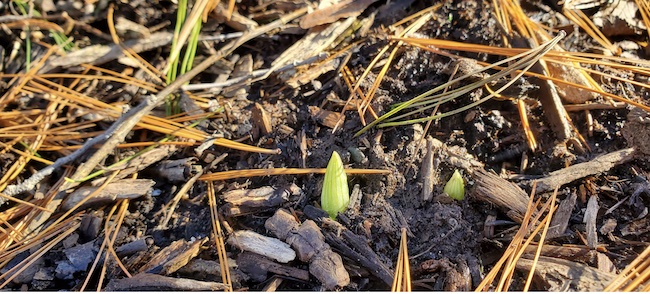
In many yards, daffodils and other spring-blooming bulbs have already started poking through the soil. Usually, they begin coming up in March or April, but our recent warm weather has woken them a little early.
Not to worry though. Spring-blooming bulbs are very hardy can handle our inevitable return to freezing temperatures. Even if the leaves are damaged by the cold, it should not affect the bulb’s ability to flower. As long as the flower buds stay beneath the soil in freezing weather, they should still bloom when spring actually arrives.
Spring-blooming bulbs such as daffodils, tulips and crocuses spend the winter in dormancy. This resting period comes after months of developing strong roots and making and storing food to produce flowers for the next year.
The leaves and flower buds form at the center of the bulb, where the plant stores its food. Warming soil signals the bulbs to start sending up the leaves and eventually the flower buds. A return of colder weather slows this process until conditions are right again. If the flower buds come up too soon and are damaged by cold, they will not produce a bloom. However, the leaves will continue to produce food to store in the bulb. Let that foliage grow until it dies back naturally, and flowers will likely return next year.
If you get fewer flowers than expected in the spring, it may not be because of erratic winter weather. It could be a sign that you need to divide your bulbs. Bulbs reproduce by forming new bulbs, called offsets, at their base, and when they get overcrowded, they don’t produce as many flowers.
Fewer flowers could also mean that the bulbs were not able to store enough food last year, either because the plant didn’t getting enough sun or because the leaves were removed too soon. Consider relocating your bulbs if they are in too much shade, and wherever they are, be sure to allow the leaves to mature, turn yellow and die back, before removing them.
Spring is officially less than five weeks away, so we won’t have long to wait for these flowers to emerge.
In the meantime, if you have questions about your yard or gardens, call or email Cornell Cooperative Extension of Orleans County at 585-798-4265 or email klo54@cornell.edu.
By Tom Rivers, Editor Posted 20 February 2023 at 10:11 am
MEDINA – The Medina Village Board and Shelby Town Board voted last week to hire an engineering firm to work on a pedestrian bridge over Oak Orchard Creek in a federally funded project.
The village in 2021 was awarded a $1,094,196 grant to construct the bridge and sidewalks as part of a multi-use path for pedestrians and bicycles.
The Barton & Loguidice firm will work on the design of the bridge, and will work to secure easements from utility companies and property owners.
Mayor Mike Sidari said the project should be complete in 2025. He appreciates that the state awarded the community a federal Transportation Alternatives Program (TAP) grant in 2021 for the project.
The section of Maple Ridge Road by the creek has become busier with a housing development, several new businesses and also the GCC campus center. There are also about 200 available acres in the area being promoted for development by the EDA.
The pedestrian bridge and sidewalks on Maple Ridge have been sought by the village for several years but Medina didn’t receive grants for the project. The bridge is expected to be about 20 feet away from the road on the north side.
By Tom Rivers, Editor Posted 20 February 2023 at 9:37 am
The average price for a gallon of regular unleaded gas dropped 3 cents in the past week in New York State, while staying at the same $3.49 price in Orleans County, according to AAA.
Today’s national average price for a gallon of gasoline is $3.41, down a penny since last Monday. One year ago, the price was $3.53. The New York State average is $3.49, down 3 cents since last Monday. A year ago, the NYS average was $3.75, AAA said.
The average diesel price in New York is at $5.130 a gallon today, compared to $5.191 a week ago, $5.275 a month ago and $4.201 a year ago.
Here are the average regular unleaded prices among Western New York counties:
Orleans, $3.486
Genesee, $3.365
Wyoming, $3.481
Livingston, $3.477
Monroe, $3.440
Niagara, $3.323
Erie, $3.425
Chautauqua, $3.616
Cattaraugus, $3.396
Allegany, $3.564
AAA issued this statement today about as prices: “The national average for a gallon of gas is down a penny this week while prices in New York have fallen slightly across the board. Fewer people are filling up and oil prices remain relatively low. This morning oil prices range from $77 to $84 per barrel, well off the highs we saw last year.
“Diesel prices are also falling. The national average price for a gallon of diesel is $4.49, down 6 cents from a week ago. Here in New York the current average for diesel is $5.13, down 6 cents from last week.”
By Ginny Kropf, correspondent Posted 20 February 2023 at 8:12 am
Store receives donation of many new and gently-worn dresses
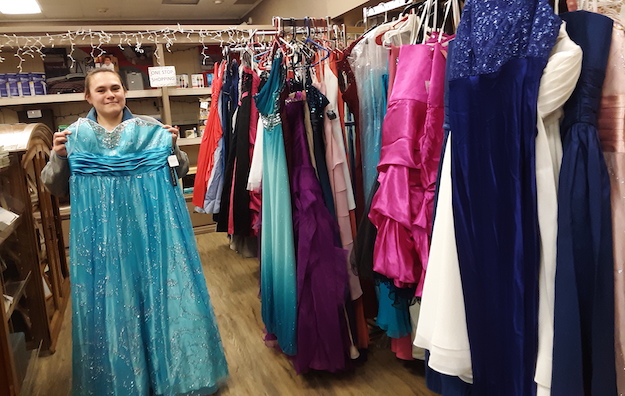
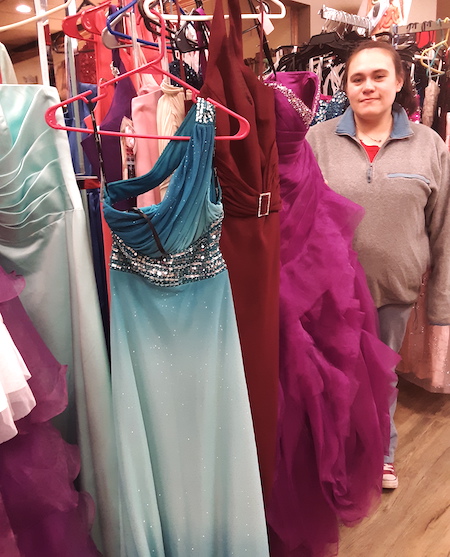
Photos by Ginny Kropf: An array of prom dresses are available at Community Action’s Main Street Store, and along with tips on makeup and accessories, will be free to any girl in Orleans County. Store manager Cassie Eagle, pictured, came up with the idea last year.
ALBION – Cassie Eagle, manager of Community Action’s Main Street Store, is a firm believer no girl should miss her senior prom because she can’t afford a dress.
Eagle was appointed manager of the store last year, and shortly after a large donation of prom dresses was received. Some are gently worn, but many others are brand new. They are all colors, sizes and styles.
Originally Eagle thought she would have a special sale and offer the dresses at a low cost, but then the idea hit her to offer them free, so every girl could have the opportunity to go her prom, regardless of their financial situation.
Cassie Eagle, manager of Community Action’s Main Street Store, shows some of the prom dresses which will be given free to girls in any Orleans County school.
After getting approval from her supervisors, Eagle contacted Albion school and the Orleans/Niagara BOCES. After much planning, they are on board with the idea.
On a designated day in May, High School Principal Jenn Ashbery will bring a cosmetology class from BOCES on a field trip to Albion High School. During the day, high school girls can come in and learn how to do simple updos and makeup from the cosmetology students. Students will be asked to bring their own makeup and hair supplies.
Later on the chosen day, Eagle will open the Main Street Store at 6 p.m. and invite girls from any Orleans County school to come and pick out a prom dress.
“We will be reminding them that after their prom they can donate the dresses back so we have them for next year,” Eagle said. “I plan to make this an annual event.”
The Main Street Store will also have shoes and handbags, along with hair styling items for sale at this time. Eagle is encouraging girls to pre-register for the event.
The store will be looking for volunteers to help the girls that night and anyone interested in helping can call 589-1430.
Eagle is also going to ask some of the students from BOCES to come in that night and help the girls. It is hoped those who are able will give tips to the BOCES stylists.
Eagle is hoping to solicit donations of makeup and hair products from local beauty shops, as well as monetary donations from any business who would like to support this event.
“Everyone so far is excited and ready to get this going,” Eagle said. “It is much bigger than anything I imagined when I first started it, so I am open to any help or ideas.”
Dresses are available in every color. Many are long gowns, some are mid length and others are minis. Sizes range from 1 to 23.
The exact date will be announced as soon as it is approved.
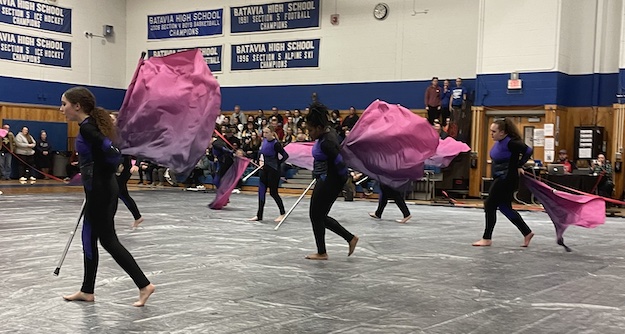
The varsity winter guard from Medina competes Saturday in Batavia.
Photos and information courtesy of Medina Mustang Boosters
BATAVIA – Medina’s Winter Guard competed for the third time this season in Batavia on Saturday.
The Varsity Guard’s show is entitled “Mission: Graduate.” The group sends a message that no matter where life takes you or what path you choose, you will always meet challenges.
Medina competed against 4 other guards in the Scholastic A class and came in 5th place with 61.69. Victor earned 1st place at 68.31; Orchard Park in 2nd with 67.49; Jamestown in 3rd with 65.58; and Lancaster in 4th at 64.09.
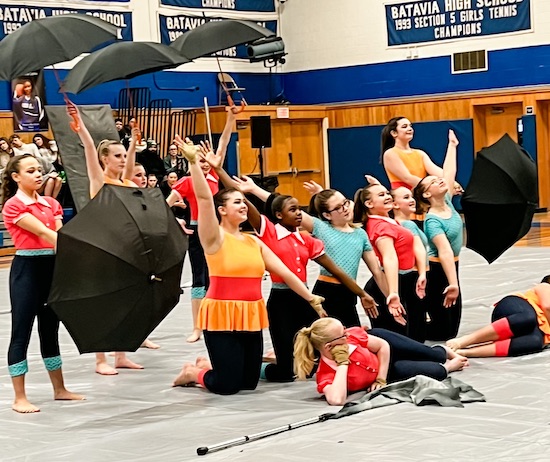
The Junior Varsity guard competed the first time in Batavia. In that cadet class Victor earned 1st place with 58.54, followed by Medina in second at 55.16; Jamestown in third at 54.99 and Batavia in 4th at 50.87.
The JV winter guard finished second in the competition at Batavia.
The Medina JV show is entitled “Umbrella.” It has a message that from where they are standing the sun is shining all over the place and once you’ve learned to sing in the rain, you will be able to survive the passing storms.
Medina’s next competition is March 4 in Lancaster and followed by the home show in Medina on March 11.
By Kim Pritt, Contributor Posted 19 February 2023 at 3:00 pm
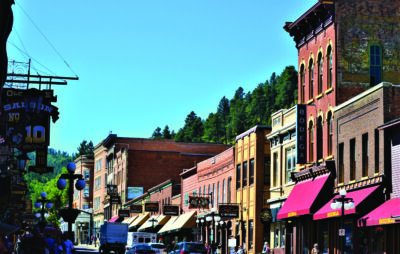
The town of Deadwood, SD is a gulch surrounded by hills with a distinct “old west” feel.
Let’s go on an adventure together….to Deadwood, SD!
Don’t shy away from places you think might be a waste of time because they seem to be too hokey or touristy. Sometimes they are….take my experience with Salem, MA, for example: I was really looking forward to it, but it was a total disappointment either because it was the off-season or we just didn’t find the right stuff to do (perhaps I should give it another try someday). But, sometimes hokey and touristy can be a lot of fun. To prove that point, I’m going to treat you to my day in Deadwood, SD.
While on a cross country motorhome trip with my brother and sister-in-law, we spent a good amount of time in South Dakota. We did all the usual stuff – Mt. Rushmore, Crazy Horse, The Badlands, Custer State Park, etc. But, we almost passed up visiting Deadwood. We talked about it – it was a tad out of the way from where we were camped and we thought it might be just another hokey old west town without too much to see or do. But, I’m so glad we decided to take a chance and check it out. We had such a good time!
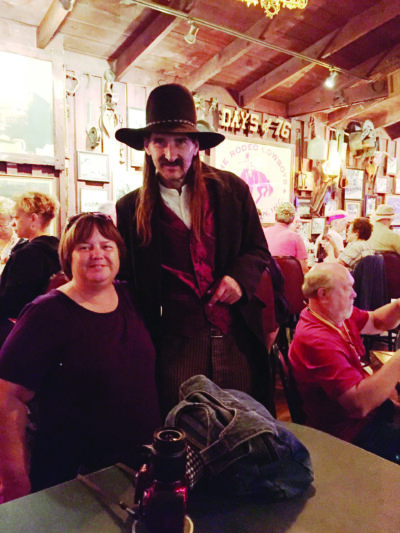
That’s me with Wild Bill Hickok. The man looks pretty good for having been fatally shot on August 2, 1876 and currently re-living his demise multiple times every day for the tourists.
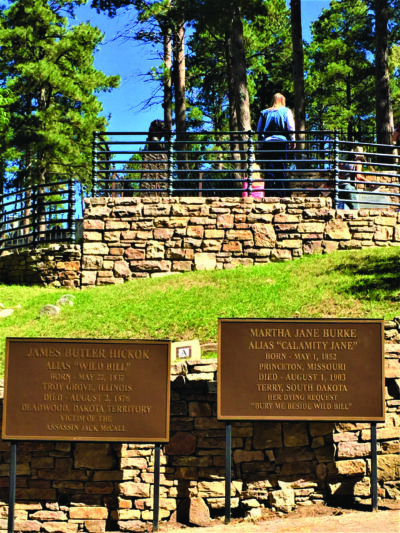
Originally named Deadwood Gulch, because of the dead trees found in the gulch, Deadwood was known as a “boom town” in 1876 during the Black Hills gold rush era. Thanks to “Colorado” Charley Utter, businesses began to pop up along the street that ran through the gulch – mostly saloons and brothels popular with the men that came to town in hopes of striking it rich with gold found in the Black Hills. Deadwood became even more famous as the town where Wild Bill Hickok was murdered by Jack McCall on August 2, 1876. Wild Bill was buried in Mount Moriah Cemetery overlooking the town of Deadwood. Later, per her last wishes – “Bury me beside Wild Bill”, Calamity Jane was buried beside him. The story goes that Calamity Jane was in love with Wild Bill – her account was that she married him, but divorced him so he could marry Agnes Lake, but there is no record of that ever happening. Friends of Wild Bill recounted that he took her under his wing, like a father figure, and there was no romantic attraction – although, she followed him around like a puppy dog pining for him. It was noted that Wild Bill dearly loved his wife, Agnes, and only came to Deadwood at the invitation of his friend, “Colorado” Charley Utter, who enticed him with the money that could be made there.
The poker hand that Wild Bill Hickok was playing – black aces and eights – when he was fatally shot in the back of the head by Jack McCall is now known as “The Deadman’s Hand”.
Wild Bill’s murderer, Jack McCall, was an unlucky gambler who claimed Wild Bill had killed his brother. He shot him from behind in the back of the head while Wild Bill was playing cards. His final hand – black aces and eights – became known as the “Dead Man’s Hand”. McCall was tried by an informal jury of miners and acquitted because of his defense of avenging his brother’s murder. After much scrutiny, McCall was rearrested and retried – this was not considered double jeopardy because the original trial was not recognized as a legal proceedings. In the second trial, McCall was found guilty and sentenced to be hanged.
We wandered around the brick streets in town browsing the shops and some of the historic buildings – including the oldest building still in existence since the town’s heyday. We had lunch at the # 10 Saloon and discovered they do a reenactment of Wild Bill’s murder, so we stayed for the show! It is not the actual saloon he was murdered in, but since that particular building is no longer standing, they do it there! It was a lot of fun and I even got to have my photo taken with Wild Bill himself – before he was fatally shot for the umpteenth time since that first time on August 2, 1876. The saloon is home to several portraits and artifacts attributed to “Colorado” Charley Utter, Wild Bill, and others of the day, including the actual chair Wild Bill was sitting in when he was shot from behind. The actors told stories of life in Deadwood in the 1870s and Wild Bill’s life up until his death. It was very interesting and entertaining.
We also went up the hill to Mt. Moriah Cemetery where Wild Bill and Calamity Jane are buried. There is an awesome overlook where you can look down over the gulch known as Deadwood. A cool place – especially if you’re into old cemeteries, like I am.
So, don’t overlook places you think might be hokey – they just might end up being a fun highlight of your adventure! Check out the post I wrote about our day in Deadwood, SD with lots more photos on my blog at https://thoughtsbykim.com/2016/10/29/2016-mea-6-deadwood-sd/.
Happy Adventuring!
The burial sites of Wild Bill Hickok and Calamity Jane in Mt Moriah Cemetery. The cemetery is located on the top of a hill overlooking Deadwood, SD.
By Ginny Kropf, correspondent Posted 19 February 2023 at 12:05 pm
MEDINA – Family, friends and the community paid tribute on Saturday to a lifelong resident whose legacy will continue for ages.
Art Hill
Art Hill, 78, died Jan. 26 in Florida, after suffering a fall on Jan. 25.
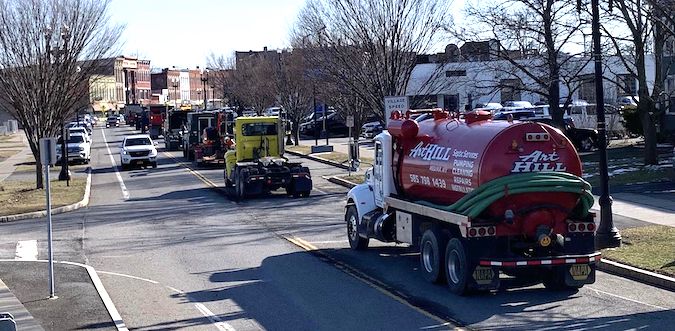
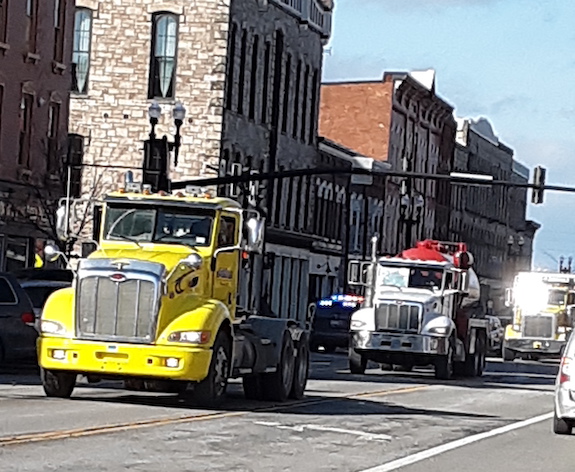
Hundreds paid their respects and shared memories at the Ridgeway Fire Hall on Saturday, after which 12 trucks from the fleet of Art Hill Excavating formed a parade down Main Street in Medina, enroute to burial in Millville Cemetery.
In the parade were dump trucks, a slinger truck, mini excavator and several tractor trailers, with longtime employee Donny Grabowski driving the fleet’s No. 36, said Art’s daughter Jennifer Hill-Young.
“He was an amazing man,” Jennifer said. “My brother and I were so lucky to have him. He was a firm boss, and a true leader. He wanted to teach us and instilled his knowledge in everyone.”
Art loved sports and he loved to build. He died doing what he loved. He was building a dock for their jet skis at their winter home in Florida and had gone to lumberyard for materials. With his arms full, he tripped and fell, hitting his head on the pavement. He died the next day.
A son of the late Hugh and Frances Hill, Art was born and grew up in Knowlesville. He graduated from Medina High School in 1962 and went to work for Phinney Tool and Die. He became a partner in Ridge Sand and Gravel, then in 1977, decided to go on his own and founded Art Hill Excavating.
Art was known in the area for his love of cars, and raced at Lancaster Speedway. He owned various stock cars locally and throughout the Northeast. His community and his involvement in racing were some of his greatest joys.
As a businessman, he was loved and respected throughout Western New York. He loved to create and help others during his 60-year career, and earned a reputation as one of the best heavy equipment operators in the business. Art was known for being fair, honest and doing the best job possible for every customer.
Shortly after starting his own business, Art asked Allan Kropf to fly him to New Jersey to pick up a dump truck he had bought. That started a lifelong acquaintance.
“There wasn’t a finer man than Art Hill,” Allan said. “To this day, whenever we met, we laughed about that trip. I always knew when I did business with Art, I was getting a fair deal.”
Art was a father figure to many of his employees, and Jennifer added they have brothers and a father/son working for the company, with all of whom Art shared his knowledge of construction.
Photo by Ginny Kropf: Three heavy trucks are part of a parade of 12 vehicles down Main Street in Medina, paying tribute to Medina native and businessman Art Hill, who died Jan. 26 in Florida, after suffering a fall.
Jennifer had worked for her dad for three years when he decided to “retire” and turn the business over to her, knowing she would run it with the same dedication and professionalism he did. She has now been president of the company for 12 years, but Art often called or stopped in, and was there when she needed help.
Art’s son Jerry , of whom he was also very proud, lives in Virginia and sells technologies to the federal government.
Later in life, Art married Marcia Hamilton and together they enjoyed cruising abroad, racing, cars, activities on the lake, traveling the country, movies and spending countless hours together.
His passing has left a huge void, but Art’s legacy will continue through Art Hill Excavating and its service to Western New York, Jennifer said.
In addition to his children Jennifer and Jerry, Art is survived by his wife Marcia, four grandchildren, two stepsons and several step-grandchildren.
Funeral arrangements were completed by Bogan and Tuttle Funeral Home.
Editor’s Note: Orleans County officials say it would add $1,059,034 per year in expense to the county budget, or 5.6 percent of the county’s tax levy if the state ends the Affordable Care Act enhanced Federal Medical Assistance Percentage (eFMAP) federal pass-through.
Press Release, New York State Association of Counties
One unintended consequence of the proposed $227 billion state budget is that it will increase the cost of home ownership and rents across New York State, according to testimony presented last week by the NYS Association of Counties (NYSAC).
The 2024 Executive State Budget proposes to withhold $625 million in federal funds that counties have used for more than a decade to prevent local property tax increases.
In testimony to the New York State Legislature’s Joint Budget Committee on Local Government, NYSAC detailed the harm that the proposal would do to local taxpayers and encouraged state lawmakers to reject this proposal.
The proposal would reverse 20 years of precedent by ending the practice of sharing federal Medicaid aid with counties that help pay for the program. If enacted, the first year of this action will cost counties $281 million and another $345 million to New York City. In three years, the impact of this new proposal will compound, costing local taxpayers more than $2.5 billion over the three-year period.
“Not only does this proposal harm New York’s local taxpayers, but it also subverts Congress’ intent for this funding to be shared with the local governments that contribute to the state’s Medicaid program,” said Clinton County Administrator Michael E. Zurlo, president of NYSAC. “At $7.6 billion a year, counties in New York contribute more than all other counties in the nation combined.”
The budget proposal targets eFMAP funding that was provided to states as part of the federal Affordable Care Act (ACA). In New York State, the ACA eFMAP has been used by the state to help fund the Medicaid program and by counties to help stabilize property taxes and provide other needed local services.
In a letter to the Governor, all 19 of New York’s county executives called on the State Legislature to reject a proposal in the Governor’s budget that ends the longstanding practice of sharing federal Medicaid funds, known as enhanced Federal Medical Assistance Percentage (eFMAP), with counties.
“As a former county official, you can appreciate that new costs imposed on local governments eventually come out of all New Yorkers’ pockets in the form of increased property taxes which make our state a less affordable place to live, work, or start a business,” said the letter signed by New York’s bi-partisan group of county executives.
Instead of sharing these federal dollars with counties to apply toward local tax relief, the state budget and financial plan divert the funding to other areas in the $227 billion state budget, including depositing $5.4 billion in reserves.
The impact of the state’s withholding of the federal Medicaid assistance will be felt as soon as the budget is enacted because counties’ 2023 budgets are already locked in place.
“A major factor in the creation of our state’s affordability crisis is the state’s long history of imposing higher and higher costs on its local governments,” said NYSAC Executive Director Stephen J. Acquario. “The last thing the state should do is burden local taxpayers with more costs that will drive up the cost of homeownership and rent, increase business expenses, and make New York more unaffordable.”
BATAVIA – The Rural Police Training Academy is proud to announce its 35th anniversary of providing top-quality training to police officers and pre-employment recruits in Western New York.
Since 1985, the RPTA has accepted recruits from across the region, offering a yearly basic course that runs from early April to the following early March, as well as a variety of in-service courses throughout the year in cooperation with the New York State Division of Criminal Justice Services.
“We are thrilled to celebrate 35 years of providing exceptional training and education to law enforcement professionals in Western New York,” said director of the Rural Police Training Academy Doug Brooks. “The RPTA is dedicated to producing well-prepared, confident officers who are committed to serving their communities with the highest level of professionalism.”
The RPTA’s basic course features classes on Tuesdays, a majority of Wednesdays and Thursdays, from April to the end of December. Physical agility testing is required for enrollment, which will be scheduled in the weeks leading up to the start of the Academy.
Both full and part-time officers, including those over the age of 35, are welcome to enroll, as well as pre-employment candidates who are at least 19 years old and have no felony or criminal convictions. A background investigation is required for all pre-employment candidates.
“Congratulations to the Rural Police Training Academy on their 35th anniversary of providing top-quality training to police officers and pre-employment recruits in Western New York,” said Dr. Craig Lamb, provost and vice president for Academic Affairs at GCC. “The RPTA plays a vital role in training and preparing law enforcement professionals, and their commitment to producing well-prepared and confident officers who serve their communities with the highest level of professionalism is commendable. We are proud to have such an outstanding organization in our community.”
Applications are now being emailed for the 35th Annual RPTA Class beginning in April 2023. If interested, please email RPTA Director Brooks at rpolice@genesee.edu and ask that an application packet be sent to you for the 2023 Academy.
Your email should include your name, phone number and preferred email. Seats are limited! More information can be found by clicking here.
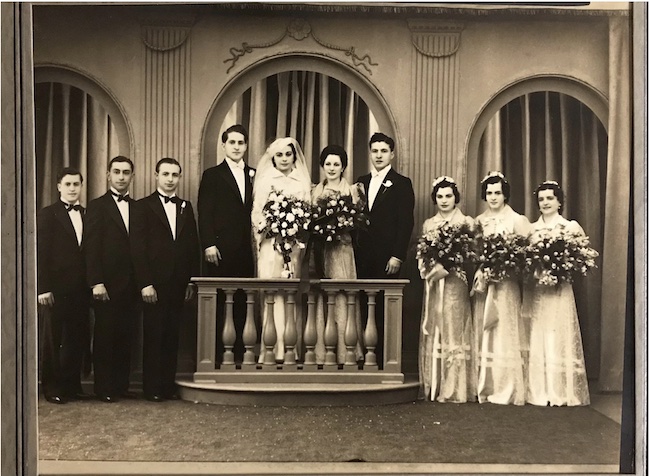
This is one of many unidentified wedding photos in the Orleans County Dept. of History collection. Do you recognize any member of this handsome group?
By Catherine Cooper, Orleans County Historian
Illuminating Orleans, Vol. 3 No. 7
ALBION – Emma B. Tripp became engaged to Louis J. Ives in 1908. They planned to be married in April 1911. But Mr. Ives disappeared.
On February 19, 1913, instead of enjoying wedded bliss, Mrs. Tripp found herself testifying against Mr. Ives before a jury at a Supreme Court trial held in Albion. Judge Warren B. Hooker presided.
Described in the Democrat & Chronicle as “an attractive widow, gowned in deep mourning.” Mrs. Tripp was represented by attorney Harry Fox. She sought $10,000 in breach of promise damages.
Mr. Ives did not appear and was not represented.
Mrs. Tripp first became acquainted with Mr. Ives when he rented a suite of rooms at her boarding house in Buffalo in 1906. Prior to his move, Mr. Ives, a widower, had operated a successful produce business in Medina, at 339 Main St. (currently Mystic Dragon’s Lair).
A friendship developed between the landlady and the tenant. They attended the theater and other entertainments together. Soon they were constant companions. Neither were in the full flush of youth: Mrs. Tripp was then aged 51 and Mr. Ives was 65.
Mrs. Tripp testified that she assisted Mr. Ives in the development and patenting of an induction device to dry wood flooring and railroad ties. Several prominent Buffalo businessmen invested money in a company which he formed to sell the product.
In his letters to her, which were read before the court, Mr. Ives referred to her as “Honey”, “My darling” and “Love”. He wrote poems expressing his undying love for her.
One evening, shortly before April 1911, the couple attended a dinner at the home of friends in Buffalo. At one point, Mr. Ives excused himself and said that “he would be back in a few minutes.” But he did not return. Mrs. Tripp heard from him the following day. He said he had been called to Lockport suddenly on business and that he would be back the next day. She did not see him again. At the time of the trial, Mr. Ives was said to be living in St. Catharines, Ontario.
The jury found in favor of Mrs. Tripp and awarded her $2,000 in damages.
Breach of promise actions pertaining to courtship or marriage situations were also referred to as “heart balm” cases. At a time when women relied on marriage for financial security, it was understood that an engagement was a promise to marry, a binding contract between two people and that the injured party could pursue financial compensation if one person broke the contract without consulting the other.
Upon her engagement, a woman would have discontinued the pursuit of other suitors, thus limiting future marriage prospects. A woman in Mrs. Tripp’s situation would have felt embarrassment, humiliation, and concern for her reputation. Few would have relished the scrutiny and loss of privacy associated with a public court case.
In the following years, a series of high profile and salacious heart balm cases generated negative publicity:
“$100,000 Heart Balm Award Won by Author’s First Wife” – (Chicago, 1935)
“Twice Wed Mrs. Fogarty Seeks $500,000 Breach of Promise Against Gene Tunney” – (Bridgeport, Ct., 1929)
These are just two of many such headlines. Public opinion gradually shifted to favor the accused, since the “injured parties” seemed to be conniving grafters.
On March 20, 1935, a bill sponsored by Senator John McNaboe of Manhattan was passed. It aimed to curb the “racketeering” associated with breach of promise and alienation of affection cases. By 1945, sixteen states had abolished breach of promise laws.
Mrs. Tripp returned to Buffalo and vanished into obscurity. Mr. Ives died in 1925 in Mineola, New York, at the home of his daughter.























 ALBION – Emma B. Tripp became engaged to Louis J. Ives in 1908. They planned to be married in April 1911. But Mr. Ives disappeared.