

















Cobblestone Museum plans events during April 8 solar eclipse, including car show


CHILDS – The Cobblestone Museum is ramping up activities in preparation for the much-anticipated total solar eclipse on April 8.
Orleans County is in the direct path of this historic event and a big influx of visitors is expected to the region, assistant director Sue Bonafini reported in the winter edition of the “Cobblestoner.”
“The Cobblestone Museum is hopeful that members of the Cobblestone Society, friends of the Museum and visitors from near and far will join us for some planned events between 10 a.m. and 3 p.m. Friday through Sunday and from 10 a.m. until the ‘main event’ concludes Monday afternoon (April 8),” Bonafini said.
The Cobblestone’s “SOLAR” weekend is an acronym of what is expected on that historic weekend, Bonafini explained.
“S” is for shopping. The Museum Gift Shop, Holiday Shoppe and used books building will be open for browsing and making purchases.
“O” is for the Olde Tyme photo opportunity that will be available, with accessories of bygone eras provided for guests to put on and create a souvenir photo. Children can also visit the “Cobbles the Mouse” photo booth.
“L” is for learning. The Cobblestone’s docents will tell the history of select campus buildings, where storytellers will share historical accounts from the past. Exhibit rooms will also be open, where guests can learn about the 19th century coverlets of Orleans County and the Victorian Mourning Art and Sundries exhibit on display. Blacksmithing demonstrations will take place at designated times in the Vagg Blacksmithing Shop.
“A” is for an auto show that will take place from noon to 3 p.m. on Saturday and Sunday afternoon (weather permitting), featuring a variety of classic, antique and sports cars parked on the grounds, where visitors can see them up close and talk to their owners.
“R” is for the refreshments which will be sold on Monday, Solar Eclipse Day. Pizza will be sold by the slice, while popcorn, cobblestone candy and beverages will be sold individually or as part of the special SOLAR admission package rate of $25 per person.
Regular admission is $9 for adults and $6 for teens and students with a valid college ID. Children under 12 are free with an accompanying adult.
In addition to the special SOLAR weekend, the Cobblestone Museum is urging people to register for their February virtual lecture event, in which speaker Debra Ross will address the solar eclipse. This is scheduled at 7 p.m. Feb. 22. Ross is chair of Rochester’s Eclipse Task Force and co-chair of the AAS National Solar Eclipse Task Force.
Having witnessed the 2017 Great American Eclipse in Missouri, and understanding the implications for the Rochester area, Ross started the Rochester Eclipse Task Force, which now has more than 750 members in the area.
Ross will discuss what is going to happen in our area on April 8, what makes it such a transformational experience, how to experience the eclipse safely and who everyone should prepare to craft their own eclipse story by making the most of this moment in their own personal history and in Western New York history.
“Life is about writing your own story and you want this to be a chapter that you look back on and talk about for the rest of your life,” Ross said.
Return to top
Albion, Medina churches will offer ecumenical Lenten lunches
MEDINA – Churches in Albion and Medina will be serving Lenten lunches in February and March.
The Medina Area Association of Churches sponsor a series of ecumenical Lenten lunches, beginning Feb. 15 at the First Presbyterian Church on Main Street. The lunches will take place each Thursday during Lent until March 21.
On a rotating basis, local participating churches will provide lunch at noon, followed by hymns and a meaningful reflection, according to Barb Hancock, a member of MAAC. This year’s speakers will explore the theme of “The Obedience of Christ.”
Everyone is welcome to come and share in the meal and fellowship. Each program ends by 1 p.m. Take-outs are available beginning at 11:45 a.m. and a donation of $5 is suggested, with all proceeds going to Orleans County Meals-on-Wheels program and Albion’s Koinonia Kitchen.
On Feb. 15, lunch of soup and turkey or ham sandwich will be provided by the First Presbyterian Church and a message by the Rev. William Wilkinson. Following weeks will be OneChurch on Feb. 22, chicken and biscuit lunch and message by the Rev. Kevin Weigel; Feb. 29, MAAC board, goulash and salad and message by the Rev. Vincent Iorio; March 7, First Baptist Church, beef on weck and message by the Rev. Randy LaBaron; March 14, Alabama Full Gospel Church, pulled pork and message by Pastor Russ Peters; and March 21, Grove United Methodist Church, ham and scalloped potatoes and message by Pastor Paul O’Dell.
Hancock advised that if Medina schools are closed due to weather, the Lenten lunches will also be canceled.
In Albion, the lunches are on Wednesdays from noon to 1 p.m. from Feb. 21 to March 20. The Albion Ministerium organizes the lunches which will also be at the First Baptist Church of Albion, 30 West Park St.
Lunches are free and includes soup and sandwiches, with singing and devotionals after lunch. Churches take turns preparing the meals and sharing a message.
The schedule for the churches preparing the meals includes: February 21 – Albion Baptist & Gaines Carlton Community; February 28 – Albion Presbyterian & Gaines Congregational; March 6 – Eagle Harbor Methodist; March 13 – West Barre Church; and March 20 – Holy Family Parish.
Return to top
Medina opens winterguard season with 2nd place in Orchard Park
 Return to top
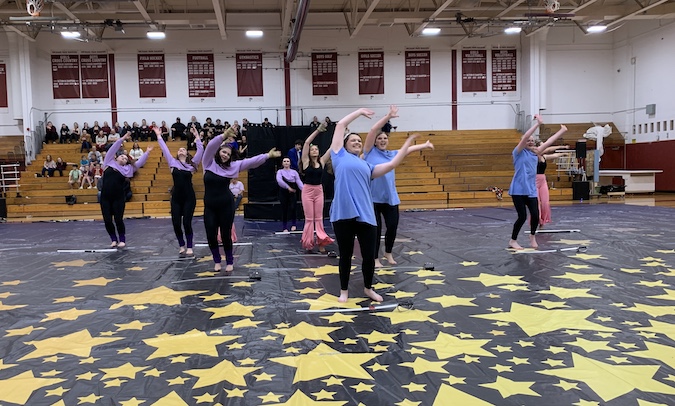
Press Release, Medina Band Boosters
ORCHARD PARK – The 2024 winterguard competitive season began in late January, while tryouts and practices began in November.
Winterguard is a hybrid art form that combines elements of music, dance and military-like precision marching in a competitive arena into a total entertainment package. WG started about 30 years ago and involves the manipulation (spins, tosses, flips) of equipment (rifles, flags, sabers) while moving around the performance space.
Medina’s Varsity Guard consists of 10 students in grades 9-11. On Saturday they competed for the first time this season at Orchard Park where a total of 12 guards in different classes performed in competition.
Medina took 2nd place in the Scholastic A class with a score of 55.39 while Orchard Park earned 1st place with 61.99 and Lancaster in 3rd at 55.18.
Winners in the other classes were Corey Cadet in 1st place with 47.30; Orchard Park JV in Regional A with 57.36; Ventures in A1 with 58.76; Orchard Park in Scholastic A with 61.99; Batavia in Independent A with 66.35; and Luminosa in Senior Class with 68.79.
Medina’s next competition is Saturday, Feb. 3rd in Batavia, and our home show is Saturday, March 9th.

Medina’s shows is entitled “Dancing Through the Decades,” a journey through Dick Clark’s American Bandstand.
Union for Sheriff’s Employees endorses Sansone for DA

Orleans County Republican Committee meets Feb. 3 to pick candidate
ALBION – A union representing about 50 employees in the Sheriff’s Department has endorsed John Sansone to be Orleans County’s next district attorney.

John Sansone
Joe Cardone, the current DA since 1992, isn’t seeking re-election. Both Sansone, an assistant district attorney, and Susan Howard, the first assistant DA, are seeking to be Cardone’s successor.
The Orleans County Sheriff’s Employees Association today announced it has endorsed Sansone. The union represents corrections officers, public safety dispatchers, sheriff’s office clerks, and jail cooks.
Chris Caufield, a lieutenant in the county jail, is the union president of Council 82 – Local #2966. He said the union heard both candidates outline their experience, qualifications and plans for the office if elected.
“We are confident that Mr. Sansone will continue to be fair, firm, and consistent when it comes to holding offenders accountable for their actions and will always act with the interest of public safety in mind,” Caufield said in a statement from the union. “Furthermore, our members believe that Mr. Sansone possesses the requisite leadership qualities, integrity, and experience to lead the District Attorney’s office moving forward, as it faces the challenges of new and proposed laws aimed at reforming the justice system.
“We anticipate a great working relationship with the District Attorney’s office led by Mr. Sansone, and we ask the community to join us in supporting Mr. John Sansone for Orleans County District Attorney in the upcoming election cycle.”
The Orleans County Republican Committee meets Feb. 3 to discuss its endorsement for district attorney as well as other offices.
Return to top
Diary from 1907 details 19-year-old’s new life in Holley after moving from NYC

By Catherine Cooper, Orleans County Historian
“Illuminating Orleans” – Volume 4, No. 5

Elbert Johnston was initiated as an Entered Apprentice of Murray Lodge No. 380, Free and Accepted Masons on January 25, 1910, passed to the degree of Fellow Craft on February 8, 1910, and was raised to the sublime degree of Master Mason (Third Degree) on February 22, 1910.
HOLLEY – May 4, 1907: “Up early, left New York, 7:50 am train….. At Mauch Chunk (PA.), went into the dining car and had dinner, Vegetable soup, English mutton chops, potatoes with cream and ice-cream, cost $1.25 with a tip of 25c. The waiter gave me the menu as a souvenir…..Had to change trains at Rochester….Mailed card to Mother….Walked about a mile from the Lehigh Valley Station to the N.Y.C.& H.R. Railroad and waited for the 7:55 pm train. Reached Holley nearly 9 pm.”
Thus begins a charming journal, written by Elbert Johnston, then aged 19, as he started his journey to a new job and a new life in Holley, NY. The journal is short-lived, little more than a month long, but the entries are detailed and offer a unique view into daily life in a rural village at that time.
Elbert was born in New York in 1887. His mother died when he was young. His father remarried. Following his death, Elbert was raised by his stepmother, Emma Johnston. He worked at the U.H. Dudley Co. in the city.
In May of 1907, he moved to Holley to work as a bookkeeper at Hudson Canning, the family business. Elbert’s Aunt Alice was the wife of Joseph B. Hudson, originally from Mattituck, Long Island, who had built the Hudson Canning factory in Holley in 1901. (See Column V4, No.4)
When he arrived, Elbert noted that “The house is not quite finished inside, and things are all in any old place.” It seems that his aunt and uncle had just moved in. There are references throughout to workmen in the house, the new bathtub “Very good washing, only the sides are slippery,” carpet selection, planting a hedge, sowing grass seed and putting sheep-manure on it.
Having arrived on a Saturday, Elbert attended the Baptist Church next day:
“I was welcomed and stayed to communion and Sunday School. The new minister, Rev. Herrell had a cold and could not speak very well. There were 81 people present and about half of that number in church service.”
He “fell in” to work at Hudson Canning on Monday, May 6 and “began to charge from farmers seed receipts to farmers ledger. Wrote letter to Gt. A&P Tea Co….and later mailed them 200 Hudson gallon apple labels by express collect.”
He recorded details of what he worked on each day at the Canning factory office.
It seems that there was a backlog of accounting to be dealt with. Once that was in order, he spent a great deal of time cleaning the “capper,” the machine which was used to process the pea crop.
At the end of the first week, Elbert wrote:
“Well, here I have been for one entire week, and I hardly know anyone….Kind of lonely, evenings not like the city.”
The next morning, he still had a “blue streak on, but I guess I had better laugh.”
That was about to change. He became friendly with George Dibble, a young man of the same age, whose father was involved in the Orleans Canning Company. Pretty soon, the two young men were out each evening for drives, or walks around the village, or to the cemetery or The Glen, accompanied at different times by Claire, Kathryn, Cora, Sally and Jennie, Miss Copping or Isabella Newton.
For evening entertainment, they visited the young ladies’ homes to hear them play piano or gramophone records. At his aunt’s house, Elbert played Dominoes, Pit, or Flinch or sometimes read.
Elbert’s first outing with George is worth noting. George invited him to a Women’s Suffrage meeting at the Presbyterian Church. The speaker was Mrs. Shaw.
“Her talk was interesting to those who perhaps were in favor of woman suffrage, but after sitting from eight to ten on a hard straw cushion and then not having converted me, well she wasn’t very good.”
Elbert was an inveterate “numbers person.” It is entirely appropriate that he wrote this journal in a Cash Ledger as he noted all his expenses and spending.
He noted attendance at every church service he attended. He noted the number of people he passed in the town square. On the evening of May 16, having shaved and put on his high collars etc., he and his new friend, George, went for a short walk and passed twenty-five people “That is pretty good for a little place like Holley.”
Later, on May 17, he noted: “While out, not counting the Square, there were 214 people that we passed, or about one nineth of the population. At the Church, there were over a hundred people.”
He noted the time he went to bed and the time he got up each day – he retired 9 p.m. to 10 p.m., but as late as 11:15 p.m. once. He generally rose around 6 a.m., a little after 7 a.m. on Sundays. He noted the weather and temperature each day. It turned cold on the second week of May and snow fell on May 10.
He mentioned meals as “after breakfast” or “home to dinner,” but unfortunately, he did not specify what they ate. On two or three occasions, he refers to buying grapefruit when they were out, they were 5 cents each.
It is interesting to note how important mail was as a means of communication prior to phones. The Hudson household had a phone, but there are references to the expense. Letters required a 2-cent stamp, postcards a 1-cent stamp. Postcards cost 5 cents.
On the journey to Holley, Elbert mailed a card to his mother from Rochester. During the month, Elbert received 26 letters and 5 postcards. These were from his mother, his friends George and Brooks, a young lady named Ethel, and former work colleagues from the Dudley Co., including the office-boy, Eugene Davis, whose card “Hope you arrived safe,” mailed in NYC on May 6, arrived in Holley on May 7. Elbert saved this correspondence, replied to each piece and made notes of his correspondence.
Elbert mentioned at the end of one day’s entry that “Uncle (Joseph Hudson) wants meaning of Deut. 14-26-28”. A few days later, Elbert mentioned that he had written to Dr. R.S. MacArthur for a “church letter,” and for an explanation of Deut.14-26. Dr. MacArthur was pastor at the Calvary Baptist Church in New York. Elbert presumably needed the “church letter” to transfer membership to the Holley church.
Elbert must have felt sufficiently at ease in Holley after the first month that he did not have to chronicle his experiences, or perhaps his blossoming social life did not allow him sufficient time to write – his gain, our loss. This diary is one of the many unique items in the Orleans County Dept. of History collection.
Return to top
Refill with Randy – OK Kitchen provides needed food and fellowship
 By Randy LeBaron
Good morning! Grab your favorite cup. Fill it up. And let’s start this day right… TOGETHER!!!
Let me start by saying how much I appreciated all of the shares and feedback over the past couple of weeks in regard to Risen Café’s “Pay It Forward” Program for feeding the homeless. I hope you will be just as supportive this week as I share about another fantastic ministry that feeds many here in Orleans County.
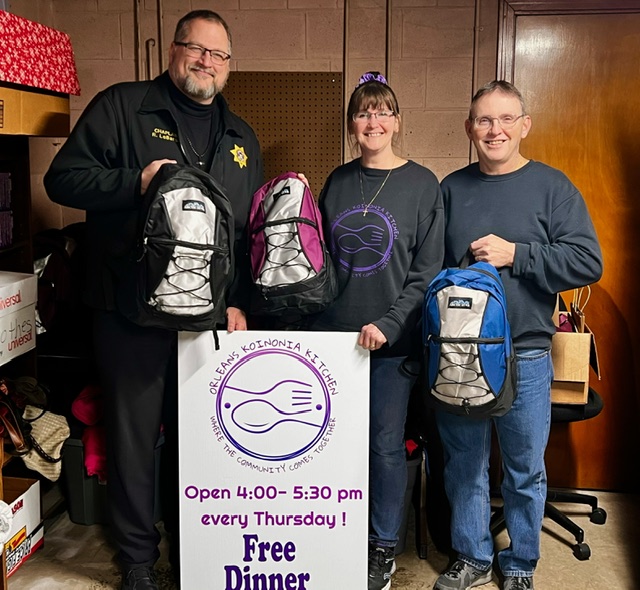
I am of course talking about the Orleans Koinonia Kitchen (OK Kitchen) which sets up every Thursday from 4 to 5:30 p.m. in the Harvest Christian Fellowship Dining Hall located at 560 East Ave. in Albion. I first met the director, Faith Smith, years ago when she ran the Community Kitchen, a soup kitchen that my church at the time participated in, and so I was excited to sit down with her and her husband Mike to hear about the fruitfulness of their latest endeavor.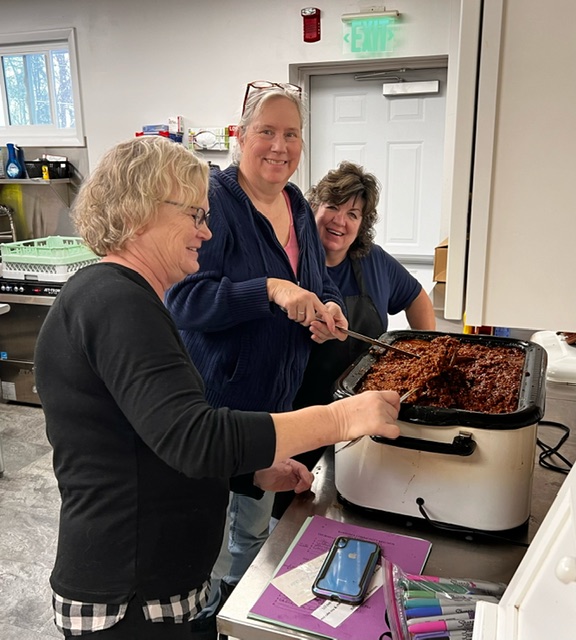
First off, for those who are not familiar with the Greek word Koinonia it is a term that describes fellowship, community, and intimacy. When asked what the word Koinonia meant to her, Faith simply looked around the dining hall where people had started filling up the tables and responded “This!” and by “this” Faith explained that the vision for the OK Kitchen was not simply to be a soup kitchen to feed the poor but rather a place that anyone from any walk of life could gather with others and experience authentic community. The hope is that when people leave both their stomachs and their souls will be full.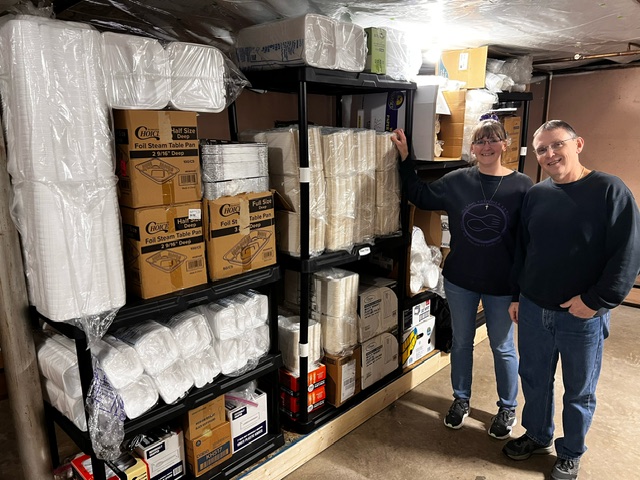
Also, for those who cannot physically get to the OK Kitchen, they have recruited volunteers to help pick people up or to deliver meals to them where they are. These meals include take-outs, frozen dinners, and even “Homeless Care” bags which are actually backpacks filled with personal care items, food, first aid kits, blankets, water, pen & paper, etc. They have also partnered with Risen Café (469 E. State St. Albion) to allow people to pick up a bag there or to get a meal there that the OK Kitchen will pay for. The goal is to help anyone that is in need to receive 5 days of food.
With a “No Questions Asked” policy and a warm greeting for all who stop by it’s no surprise to find out that last year 24,184 meals were given away. And if that sounds like a lot, it is! Thankfully though this is not a solo effort by Faith and Mike. Several groups from churches and local organizations sign up to provide food, and servers if possible, for one or more Thursdays out of the year. Some, like the Albion and Medina Lion’s Clubs, provide food every first Thursday of the month. Also, since the food is already taken care of, those first Thursdays are ideal for any individuals who would like to sign up to serve. On the evening that I was there a group from Oak Orchard Assembly of God both provided and served the meal. The church also filled a table with clothes that anyone could take, and other groups provide similar giveaways on their days.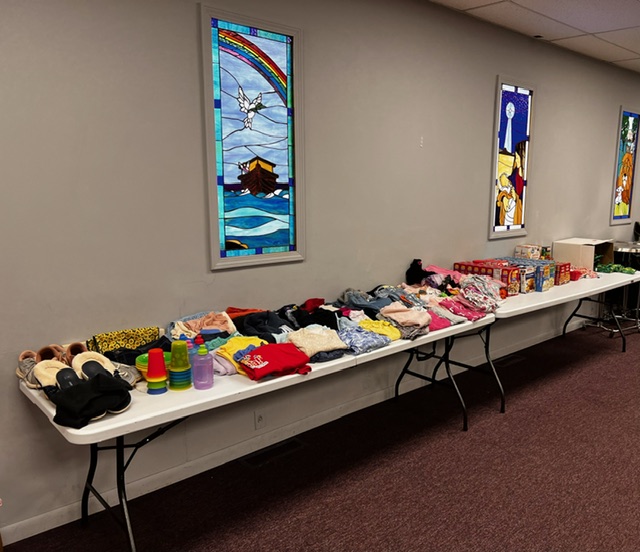
Both Mike & Faith’s enthusiasm for the ministry and their caring for those being served was evident, as was the camaraderie of the patrons and the joy of those volunteering. When asked what their biggest take away from 2023 was the Smiths quickly responded that they were overwhelmed by the amount of love and support that they had received not only from the local community but from all around Orleans County as well.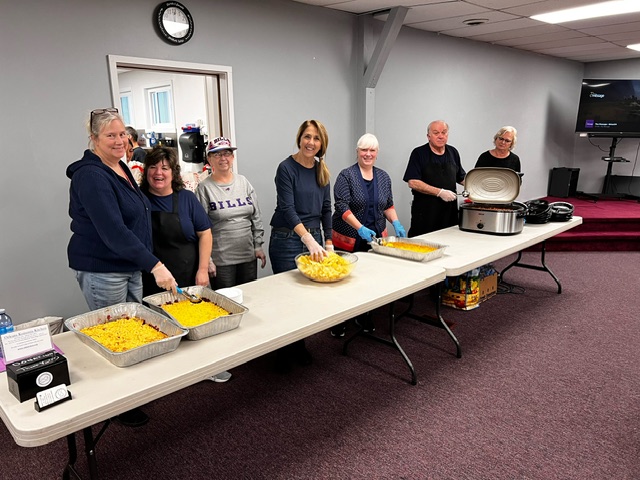
Lastly, I asked what the biggest needs were for 2024 and the answer was funding and transportation. Last year OK Kitchen received $37,534.90 in donations but are anticipating the need for more this coming year, especially as the cost of all the paper-ware, take-out containers, silverware, etc. continues to rise. I was reminded of the children’s story “Stone Soup” as Faith shared how if the 60-plus churches in the area committed to give only $25 a month it would make a huge impact. How much more of an impact could be made if individuals, businesses, and organizations committed similarly? There is also a great need for volunteers who can deliver meals or, preferably, pick people up and bring them to the Kitchen so that they can truly experience the sense of community that has been developed there.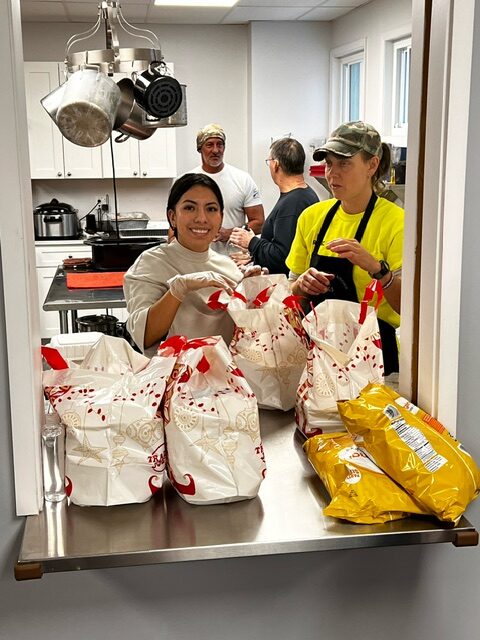
I am grateful for all of the outdoor fridges, food, pantries, and food distribution sites that we have here in our County and hope you will support any and all as you are able. If you would like to volunteer to provide and/or serve a meal, make a donation, or help with the transportation needs at Orleans Koinonia Kitchen, please contact Faith Smith at (585) 319-1578 or by e-mail at Okkitchen2022@gmail.com You won’t regret it!
Return to top
Small town gives strong support for Harrison family
 Return to top
Saul Harrison greeted by more than 1,000 people in a benefit to help him in battle with cancer
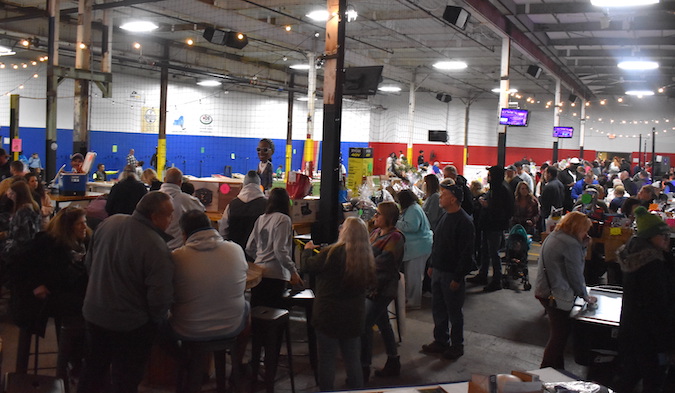
Photos by Tom Rivers
ALBION – A crowd of several hundred people are shown at Dubby’s Tailgate in a benefit for Saul Harrison this afternoon. Harrison is battling myeloma, a cancer of the plasma cells. He is getting chemotherapy and has had a mass removed from his spine and a lesion from his hip.
Harrison, 50, is still remembered as a powerful football player for Albion. But the 1992 graduate these days is known for his mild manner and gentleness as a youthcare worker for the county and a deacon at the Shiloh Church.
Holli Nenni, the county’s DSS commissioner, was among many in DSS at the benefit. Harrison, a 15-year county employee, is well-liked by his peers and the residents.
Harrison, besides working with youth, also is assists elderly residents. He shows lots of patience and understanding, Nenni said.
“He is a very dedicated employee,” she said. “He is an inspiration to our youth.”

Saul Harrison greets people at a benefit for him and his family today to help with medical costs and other expenses while he fights cancer.
Harrison shook many hands and received many hugs. He said the outpouring of support is very humbling.
Some of the foster kids he’s worked with attended the benefit and hugged him, so did some of the senior citizens he’s worked with.
His wife Connie thanked the community for the “amazing” show of support.

A large bobblehead of Snoop Dogg, an actor and rapper, was among the big-ticket items at today’s benefit. There were 130 baskets, many valued at $100 to $150, plus the 10 big ticket items valued at $300 or more.
Debbie Prest, one of the organizers of the benefit, said people responded in a big way today, spending money on the tickets and putting together so many baskets.
“Everybody knows Saul,” Prest said. “From his work with the county to helping coach youth sports.”
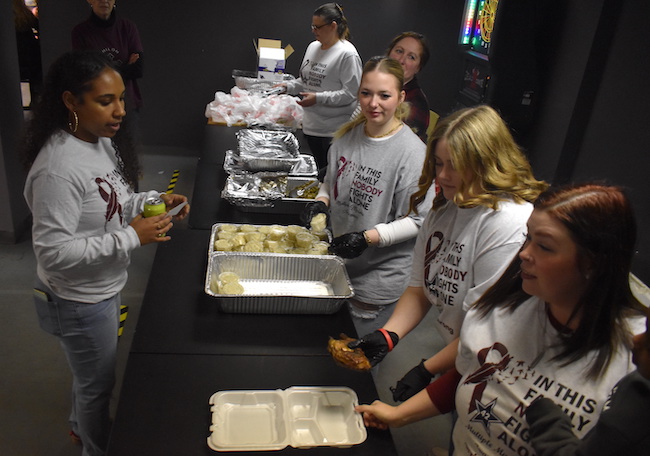
There were 500 chicken barbecue dinners and they were a quick sell out.
Laisha Harrison, left, is Saul Harrison’s daughter. She is served by, front to back: Jami Allport, Abby Kincaid, Micky Stowell, Jamie Allport and Crystal Botello.

Many of Harrison’s friends and family sold 50/50 raffle tickets and helped put on today’s event.
Trellis Pore, pastor of the Shiloh Church, has been a long-time friend of Harrison’s. The two grew up in the church together.
Harrison has a strong faith in God and long been a leader at the Shiloh Church.
“Saul is a solid individual,” Pore said. “For this cancer battle, they couldn’t have picked a tougher individual, physically and spiritually.”
Pore said “test” is part of a Christian’s testimony. God never said the road would be easy without challenges, Pore said.
He spoke while waiting to get into Dubby’s. The line to get inside was out into the parking lot. Pore marveled at the crowd. He has seen it many times in Albion and the local small towns, a big turnout to help a family facing a crisis.
“In a small town you have a sense of community,” Pore said. “That’s the greatest thing about it. This small town steps up. I wouldn’t want to live anywhere else.”

Provided photo: Saul Harrison is joined by his children, from left in back: Jamaur, Laisha and Noah.
Ag commissioner, in Orleans County stop, sees farm sector as important economic driver


LYNDONVILLE – Richard Ball, the state’s agricultural commissioner, sees brighter days ahead for the New York’s farm economy, which totals nearly $6 billion in total revenue.
In Orleans County, the total farm receipts are $155 million annually. Those figures are according to the 2017 ag census. The census is done every five years and data from 2022 will be released on Feb. 13.
Ball said Gov. Kathy Hochul sees the agricultural sector as critical to the state’s economy. Hochul kept Ball as the ag commissioner after she took over on Aug. 24, 2021 following Andrew Cuomo’s resignation.
“Whenever she calls me or whenever I see her we talk ag,” said Ball, who spoke at Friday’s Legislative Luncheon organized by the Orleans County Chamber of Commerce. “When she started, she told me she wanted me to stay and asked what do I need. We have a governor who gets agriculture.”
Ball, a farmer from Schoharie County, has been the state’s agricultural commissioner for nearly a decade.
He highlighted the governor’s executive budget, including these new investments for agriculture:
- $34 million in capital grants for on-farm milk storage technologies and processing infrastructure to improve supply chain efficiency.
- $21 million to a new Alternative Waste Management and Enhanced Precision Feed Program to further the mitigation of agricultural greenhouse gas emissions
- $10 million to continue a multi-year investment in support of kitchen facilities that prepare meals for K-12 schools from New York State farm products.
- $10 million to reinvigorate New York’s aquaculture industry through the Blue Food Transformation and to grow New York’s bioeconomy.
Ball said the agriculture economy also can play a role in helping the state meet its climate change and resiliency goals by sequestering carbon. The state Department of Agriculture and markets supports renewable energy projects, Ball said in response to a question at the luncheon, but those projects shouldn’t be at the expense of good farmland. The state is working on a plan to have solar projects be pushed to land that isn’t being farmed or isn’t considered good for growing crops, Ball said.
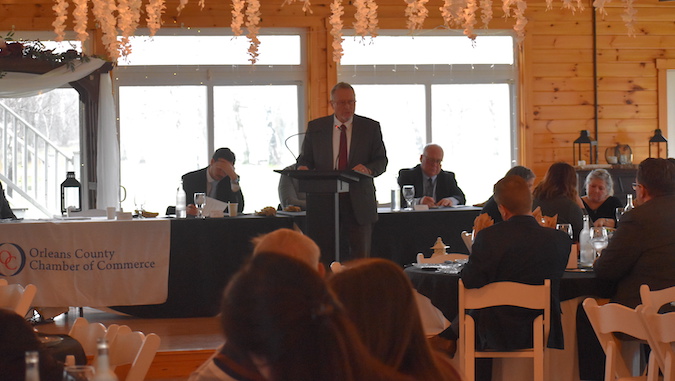
Richard Ball said agriculture remains a critical industry in the state, especially in rural communities like Orleans County.
Agriculture does face challenges, including a shortage of workers. He said Congress needs to overhaul the immigration system, which hasn’t been updated in about three decades. He isn’t optimistic Congress will pass meaningful legislation about the issue.
That leaves farmers to try to work with a federal guest-worker program that is cumbersome, costly and doesn’t fill the employment needs for farmers, Ball said told.
Ball said some farms are turning to technology and robotics to get some farm work done. The state is also stepping up workforce recruitment for local residents to learn skills and work in the ag industry, Ball said.
Assemblyman Steve Hawley, R-Batavia, said the industry is particularly challenged in New York due to high taxes, high costs for equipment and escalating expenses for workers, especially now that an overtime threshold has dropped from 60 hours a week to 56 hours, part of a phase in to get agriculture’s OT standard down to 40 hours .
Ball said the state is working to strengthen the food supply chains, including a stronger relationship between upstate farmers and the big market of New York City.
He sees an industry that will remain strong in the long-term future.
“New York has good land and access to water, the best land-grant system and some of best farmers in the world,” he said. “I like our chances.”
During his presentation, Ball also commended Amy Machamer of Holley for serving on the state’s agriculture task force. She is the owner of Hurd Orchards.
Return to top
Students from Orleans make Dean’s List at Morrisville, LeMoyne and FLCC
Students from Orleans County have earned academic honors by making the Dean’s List at SUNY Morrisville, Le Moyne College and Finger Lakes Community College.
• Blake Dunton of Knowlesville and Olivia Kroening of Knowlesville made the Dean’s List for the fall semester at Morrisville.
• Aubrey Schoolcraft, a freshman Accounting major from Medina, is on the Dean’s List at Le Moyne College in Syracuse.
• At Finger Lakes Community College in Canandaigua, Adriana Botello of Holley and Ella Lewis of Lyndonville made the Dean’s List as full-time students with grade point averages at 3.5 or higher.
Return to top
Monroe-Orleans Countyline Road closed between Gulf Road and 104 due to flooding
MURRAY – A section of Monroe-Orleans Countyline Road has been closed due to flooding. The Murray Joint Fire District announced the closure tonight. It effects the road between Gulf Road and Route 104.
The flooding conditions affected other roads in the county. Firefighters also have been busy today pumping basements, some with several feet of water.
UPDATE at 7:30 a.m. on Jan. 27: Countyline Road reopened to traffic this morning.
Return to top
Editorial: Years of being starved of state aid, sales tax put Medina in hole when trying to update fire department

It doesn’t take a genius to see Medina is set up to hit a fiscal wall. The day of reckoning has arrived. The village faces a major expense for a new fire truck and an addition to the fire hall.
The village has a bustling downtown, many manufacturers and a strong sense of pride and civic involvement. It should be able to afford an upgrade to its fire hall and fire apparatus. But Medina is in Orleans County, where the village gets crumbs of the local sales tax.
The village in 2024 will get $160,160 in the county’s sales tax that will likely be close to $25 million. That is less than 1 percent of the total. The county has kept the total sales tax share to the four villages and 10 towns at the same level since 2001 – $1,366,671.
Since then the sales tax revenues have more than doubled. Wal-Mart and many chain stores came to the community, boosting the sales tax. Internet sales are taxed. Prices have gone way up, leading to a higher sales tax, but still the villages and towns haven’t got any of that increase.
The county says it has expenses and can’t afford to give up a little more of that sales tax, even if a lot of that money is generated by the work of the villages and towns. The county has acquired a former bank in Albion for the treasurer’s office for $250,000. It bought the former GCC site for probation and the district attorney’s office for $975,000, and 25.7 vacant acres near that property for $500,000. These purchases came without any public input. They weren’t talked about for years, with a clear need long established like the ladder truck and fire hall addition in Medina.
Medina is one of the county’s shining successes. It is a Hallmark movie scene with its many well-attended events, including the very popular Parade of Lights. The county loves to brag about Medina, showcasing the village in tourism brochures and with economic development outreach.
But the county can’t budge with the sales tax.
Medina is in a tough spot. It has committed to a $1.7 million purchase for a new ladder truck. The current 28-year-old truck often is out of service due to malfunctioning parts. The village should have replaced it about a decade ago. It has asked and begged for more sales tax from the county but has been rebuffed.
Medina has no choice but to move forward on the ladder truck. It’s an important truck in responding to calls in Medina, and also on mutual aid in nearby towns. The village will be paying $159,000 annually over 20 years for the new ladder truck. (Medina also has a 32-year-old fire engine in need of replacement.)
The village also must do an addition of its fire hall to accommodate a taller ladder truck. The current size is smaller than a typical ladder truck and would need to be specially ordered at a high price tag. The fire hall addition and repairs to the current fire station from the 1930s would be about $6 million, according to projections from an engineering firm.
The village is looking to scale back the building project, and residents are speaking out about the high taxes in the village. They assume the village is spending too much – that it’s the village’s fault.
The problem is a lack of revenue to help offset the local property taxes. If Medina’s local sales tax share had been doubled, like the county’s, since 2001, that would give the village another $160,060 – enough to cover the annual debt service for the new truck without putting more on the village taxpayers.
I thought the county legislators would be alarmed last March when Medina’s villages taxes crossed the $20 per thousand threshold. Medina’s tax rate went from $18.85 to $21.15 per $1,000 of assessed property. Albion is close behind at $19.13. These tax rates are way out of line compared to villages and small cities in neighboring counties. The City of Batavia for example just released its 2024-25 budget with a $8.96 tax rate. It receives $7,783,469 of the Genesee County sales tax.
As the village tax rates continued to climb and fire trucks got older, I thought for sure the Orleans County legislators would realize their stinginess with the sales tax (when many other counties share 50 percent with towns, villages and cities). But the county remains iron-clad in opposition to freeing up any more for the villages, even when they wrestle with critical equipment purchases while the county pursues projects that don’t seem so essential.
Orleans County isn’t the only one giving the Village of Medina the shaft. The state has kept Medina’s AIM amount at $45,523 the past 15 years. The state gives $715 million annually to cities, villages and towns through Aid and Incentives to Municipalities. This is a small amount of the state sales tax share given back to municipalities to help them with their costs of delivering services. Nearly all of the $715 million goes to cities, even ones smaller than the Village of Medina get much more.
Medina, population 6,047, receives $45,523 or a per capita of $7.53. The City of Mechanicville, population 5,163 in Saratoga County, gets $1,649,701 for a per capita $319.52. The City of Salamanca in Cattaraugus County, population 5,929, gets $928,131 in AIM funding or $156.54 per capita.
What a difference it would make for the Village of Medina, which operates very much a like a city, if it was getting Salamanca money from the state. The Orleans Hub has railed about this disparity for years but our state legislators don’t have news conferences or put out press releases on this issue.
The Village of Medina’s biggest obstacles to success: Orleans County and New York State.
Return to top
County looks to create technical rescue team

Group would be trained for rope rescues, grain entrapment and water rescues

File photo by Tom Rivers: Ray Keffer of the Fancher-Hulberton-Murray Fire Company is on shore while three firefighters head out into the icy water of a quarry by the Erie Canal in Murray to go after a dog on Jan. 4, 2020. Firefighters were able to safely bring the dog to the shore. They also assisted the owner of the dog in getting up the embankment. The Orleans County Emergency Management Office wants to create a technical rescue team for rope rescues, grain entrapment and water rescues.
ALBION – The Orleans County Emergency Management Office is looking to create a technical rescue team for firefighters from multiple departments to train and work together and share equipment.
The team would be trained for highly technical rescues, such as rope rescues, grain entrapment and water rescues. There will be a public hearing at 4:25 p.m. on Feb. 20 for the creation of the Technical Rescue Team. The hearing will be at the legislative chambers of the Orleans County Office Building, 14016 Route 31 in Albion.
“We will have joint training where will we all work together,” said Justin Niederhofer, the EMO director.
Carlton, Clarendon, Medina, Murray and Shelby fire departments each have equipment for technical rescues. Firefighters from those departments, as well as other departments without that equipment, will have an opportunity to be trained to be on the technical rescue team.
Not all departments with rescue equipment have the same gear. The team will train on each department’s equipment to be familiar with the ropes, harnesses and other tools. Some departments also have grain rescue equipment which includes steel plates and an augur. The team members will also have wet suits for going into the water.
Niederhofer said firefighters deploy rope rescues when people are stuck down ravines and embankments.
The formation of the team will also increase the chances for grant funding for equipment and training, Niederhofer said.
Return to top
‘Harrison Strong’ fundraiser on Saturday backs much-loved Albion man with myeloma
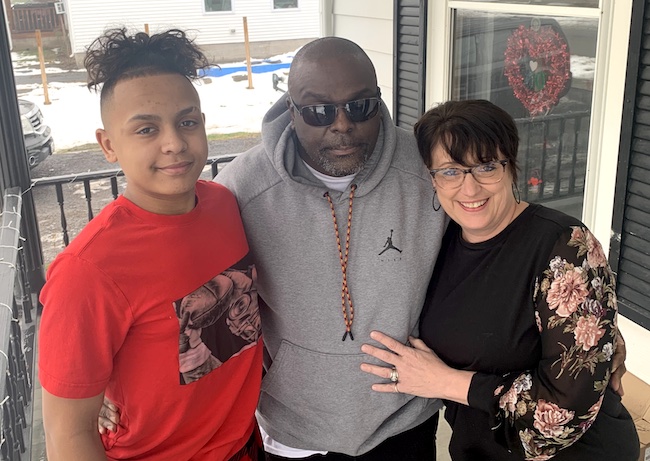
ALBION – Saul Harrison has long been a strong and dependable presence for the Albion community, back when starred on the football field in high school and for many years as an adult, serving as a youthcare worker for the county and a leader at the Shiloh Church.
Harrison, 50, is fighting myeloma, a cancer of the plasma cells. He has had a mass removed from his spine and a lesion from his hip. He is taking chemotherapy. Harrison is down 30 pounds since his first surgery on Dec. 2. His appetite is coming back, and he is thankful the pain is mostly gone in his back.
In October he started to feel intense pain in his back. Twice he went to the ER. An MRI on Nov. 30 detected the cancer.
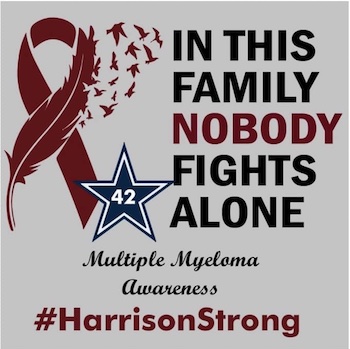 The community will have a benefit for the Harrison family from 1 to 5 p.m. on Saturday at Dubby’s Tailgate.
Saul and his Connie are thankful for the many cards and prayers, including some from strangers.
“The outpouring of support has been crazy,” Connie said today at the Harrison home on East Park Street.
Harrison has been forced to slow down from a busy pace, that included working full-time for the county and part-time on nights at Walmart while also running a barbecue business, Daisy’s Sweet Sauce, named for his mother.
“I’m keeping my faith and trusting in God,” Harrison said. “He will make me a stronger person. He puts stuff on us but not more than we can bear.”
Harrison said a long-time friend, John Butler, has been especially helpful getting him to medical appointments, cooking meals and fixing things around the house.
Butler said he is grateful to give back to someone who has done so much for others.
“I’ve known him for a long time,” Butler said today. “He has been my idol. I’ve always looked up to him. I love him to death.”
The benefit for Harrison is being planned by Geno Allport, Debbie Prest and Callie Allport. About 100 gift baskets are expected to be up for raffle, as well as a 50/50. Some of the big ticket items include an autographed football from Buffalo Bills star Dalton Kincaid, and autographed jerseys from Buffalo Bills players Terrell Bernard, Stevie Johnson and Eric Wood, and coach Sean McDermott.
There also will be a chicken barbecue with tickets at $20. The benefit will help the family with medical expenses.
Harrison said he is eager to get back to his active lifestyle, especially cheering on his son Noah at his sporting events.
“I’m looking forward to getting better and getting back out there,” he said. “I have a lot planned.”
Return to top
New coffee shop in Albion, Rise & Grind, already has devoted following

 Return to top
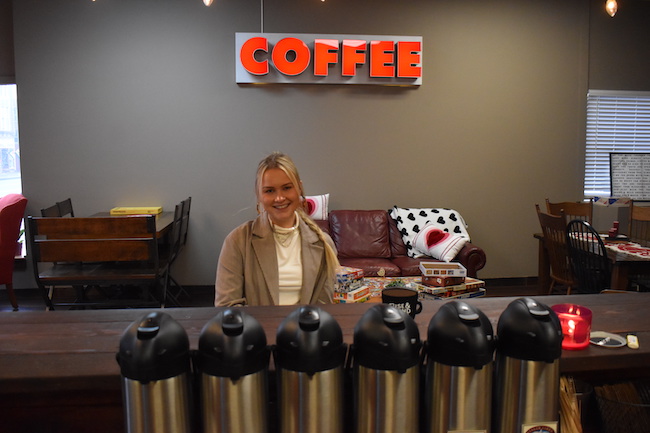
Photos by Tom Rivers
ALBION – Haley Black opened Rise & Grind last month, a coffee shop in downtown Albion at the corner of East Bank and North Main.
Black, 23, already has a devoted customer base, from teen-agers to senior citizens. She opened the business after 2 ½ years at Batavia Downs, working as a server and then a supervisor at the Fortunes restaurant.
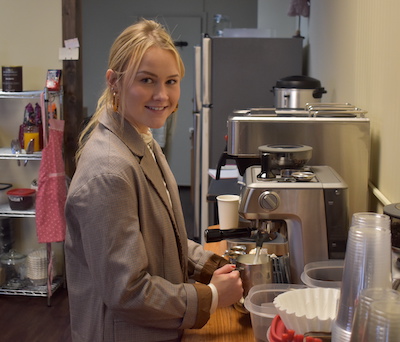
Haley Black makes a specialty coffee for a customer this afternoon at Rise & Grind.
She wanted to be in her hometown, and run a business where people could unwind and relax.
“We already have our regulars,” Black said this afternoon at Rise & Grind. “I’m people person and I’ve already made so many new friends.”
Her mother Marilyn Black has been a downtown mainstay for more than 30 years as the owner of Hair Fantasy next door. Haley’s father Corey Black did many of the renovations inside Rise & Grind, which previously was the Coffee Joint. Haley picked the colors and the look of the place are her ideas.
The result is a homey and inviting place that includes a sofa, many tables and chairs, and games and puzzles for people to enjoy.
Haley feels confident Rise & Grind has a long future at 63 North Main St. Besides coffee, tea and cold drinks, she has many sandwiches, as well as bagels, muffins and baked goods. She has partnered with other local businesses for some of the food items, but makes her own paninis, and eggbites with sausage and cheddar.
Black has impressed customers with the repertoire of drinks and a growing menu. Her father believes she will make the business a success, and give the downtown a welcoming space.
“She has the work ethic and the personality,” he said.
Haley said she has lots of other ideas for the site, including outdoor seating in the summer.
Rise & Grind is closed on Sundays. It’s open 7 a.m. to 3 p.m. on Monday, 7 a.m. to 6 p.m. on Tuesday, and 7 a.m. to 3 p.m. from Wednesday through Saturday.
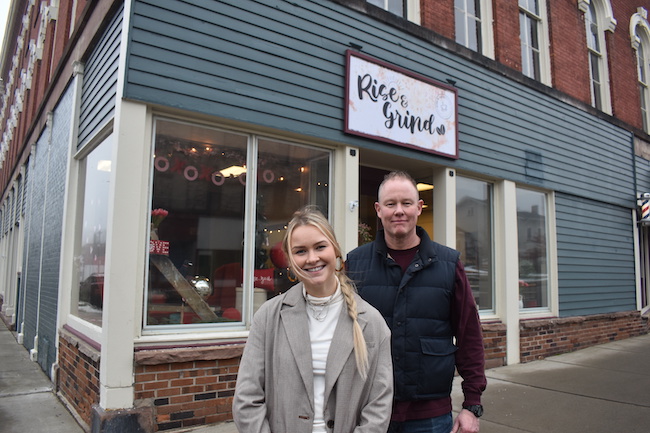
Haley and her father Corey Black are outside the new coffee shop in downtown Albion. Black and his wife Marilyn own the building, which also has Hair Fantasy next door. The Rise & Grind sign went up on Sunday.