By Tom Rivers, Editor Posted 14 December 2018 at 3:45 pm
Plaintiff argues Happy is a ‘person’ and should be freed from captivity at Bronx Zoo
Photo from Nonhuman Rights Project: Happy, a female Asian elephant born in the wild in 1971, is shown in the Bronx Zoo where Happy has been living the past 40 years.
ALBION – A State Supreme Court judge heard motions today in a case that claims an elephant at the Bronx Zoo should be considered a person and not be held in captivity.
“This is probably the most unusual case I’ve sat on,” State Supreme Court Justice Tracey Bannister said in the Orleans County Courthouse today.
She said she has been a judge for 10 years and worked in the court for 20 years prior to that.
“I’ve always enjoyed elephants,” she told the attorneys before they began their arguments.
Bannister would ultimately not make a ruling on the arguments, except to grant the a change of venue motion from the attorneys representing the Bronx Zoo. The judge said the case didn’t belong in Orleans County.
If the case proceeds and experts, lawyers and witnesses are called to court, Bannister said the courthouse in Albion “would be amongst the most inconvenient places” for a case originating in the Bronx. She said the case should be heard there.
Kenneth A. Manning, the attorney for the Bronx Zoo and its owner the Wildlife Conservation Society, said the Nonhuman Rights Project has been trying to “hijack the judicial system” by arguing an animal is a person and “shopping” the case to different courts outside what should be the obvious jurisdiction.
“Orleans County has nothing to do with this case, nothing,” Manning told Judge Bannister.
Steven M. Wise, an attorney and president of the Nonhuman Rights Project, said the court in Orleans County should hear the case.
He presented his arguments on behalf of Happy, a 47-year wild-born Asian elephant which has been in the Bronx Zoo for the past 40 years. Wise said he didn’t have any issues with Happy’s care by the zoo. He didn’t question the elephant’s veterinary treatment, food and health.
But he said the elephant ultimately is denied its freedom. Happy, while not a human being, should be considered a “person,” Wise said. An elephant is autonomous and social. It doesn’t want to held in captivity and confined to a “postage-stamp” of an acre, he said.
If the elephant was freed, Wise said it could go to an animal sanctuary with up to 2,300 acres to roam, including a site near Sacramento, Calif., or one in Tennessee.
Courts have historically acted on behalf of autonomy, Wise said. He cited cases when children held as slaves have been freed.
NhRP has filed habeas corpus lawsuits on behalf of chimpanzees with cases in Niagara County, Suffolk County and Fulton County. Manning, the Bronx Zoo attorney, said judges in those cases said NhRP failed to how cause. NhRP appealed and the Appellate Division at the Second, Third and Fourth Department all affirmed the courts’ decisions.
“A chimp has no benefit of habeas corpus because they simply not a person,” Manning said in court today.
The same logic should follow with the case of Happy, an elephant, he said.
“They will go from court to court, from animal to animal” until NhRP gets a favorable court decision, Manning told the judge.
He said the zoo has many experts who will testify that Happy is treated well.
Wise said the elephant has fundamental rights and shouldn’t be held at the zoo.
“It doesn’t matter whether they think Happy is happy,” Wise told the judge. “It’s a matter of liberty.”
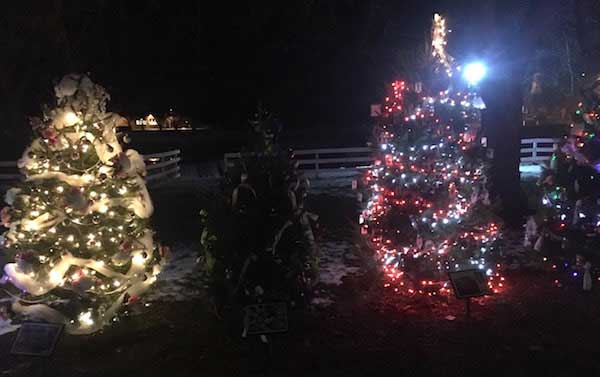
Photo courtesy of Christmas in Lyndonville: This photo shows one of the Christmas trees where ornaments and lights were removed by a vandal.
Press Release, Christmas in Lyndonville Committee
LYNDONVILLE – The Village Clerk’s Office was made aware on Dec. 6 that a patron’s tree in the Christmas in Lyndonville event had been vandalized. Upon reviewing the village surveillance cameras, video was able to be obtained to assist Village Police Officer William Larkin in the investigation.
It is believed that approximately 7-10 trees were affected, stripping trees completely of lights and ornaments and some tree toppers.
The village is able to report that an individual was apprehended early this morning, thanks to Officer W. Larkin with assistance from Orleans County Sheriff’s Department’s Sgt. John Doyle and Deputy Rob Riemer.
The village along with Officer Larkin are working to obtain back any stolen or damaged items. If you have not already reported any stolen or damage items please contact the Village Clerk’s Office at 585-765-9385 by Monday, Dec. 17.
Christmas in Lyndonville Chairperson Carla Woodworth has issued the following statement to all those participants:
“It deeply saddens us that we have had a piece of our hearts stolen from multiple trees in the Park at Christmas in Lyndonville, including our own. I’m truly sorry that this has happened at the most precious time of the year!
“It is our deepest desire to recover all that has been removed and return it to you! Please if anyone has had things removed from their tree make us aware by calling the Village Clerk’s Office at 585-765-9385.
“God bless all who have been touched by this hurtful action!!! May the Peace of Christ shine in all, this Christmas and remember decorations can be replaced!
“Our deepest gratitude to Officer Larkin for his dedication and actions in addressing this situation.”
By Tom Rivers, Editor Posted 14 December 2018 at 10:47 am
Photo by Tom Rivers: Lyndonville has 75 trees decorated and lighted up at Veterans Park during the holiday season. The 75 is the most since Lyndonville started the tree display in 2013.
LYNDONVILLE – A Lyndonville man was arrested last night after he was observed taking ornaments and lights off Christmas trees in Veterans Park, Lyndonville police officer Bill Larkin said today.
There are 75 trees in the park for Lyndonville’s sixth annual display of trees. Many families and organizations pay $30 for a tree and then decorate it. Larkin said several trees had items taken from them since they were first lighted up on Dec. 1.
He was watching the park last night and saw a man pull items off a tree. He was arrested for petit larceny, a class A misdemeanor, at 1 a.m. He was arraigned by Yates Town Justice Donald Grabowski, who set bail at $1,000 and remanded the man to the Orleans County Jail.
Not only was the man taking ornaments and lights form the trees, but Larkin said the man was in a village park after hours, which is also a violation.
The man has charged over the summer for pulling flowers out of the planter in front of the Village Office on Main Street.
By Tom Rivers, Editor Posted 14 December 2018 at 8:47 am
ALBION – The Aldi grocery store on Maple Ridge Road in Medina is planning a 2,062-square-foot expansion on the front side of the building.
The Orleans County Planning Board on Thursday voted in favor of the site plan for the project at 11248 Maple Ridge Rd. The application goes to the Town of Shelby Planning Board for a final OK.
The store expansion will occur within the existing parking area and sidewalks, and will add more space for groceries and also backroom storage, the company said in its application. The current building is 16,567 square feet.
The company anticipates construction in April-May 2019.
The number of parking spaces will be reduced from 89 to 87, which is more than the town’s requirement of at least one for every 300 square feet of gross floor area, or a minimum of 62 for the expanded store.
In other action at Thursday’s County Planning Board meeting:
• The board recommended the Town of Barre approve an area variance, site plan and special use permit for a pole barn at 4627 Oak Orchard Rd., which is in the General Business District.
Susan Sherman of Pavilion will run a business, Rice’s Country Haven Modification, from the site.
Sherman also plans to replace an existing mobile home with a new one.
She needs a 40-foot front setback variance for the pole barn, so it would be 35 feet away from the road instead of 75 feet. The Planning Board said the variance is needed for the pole barn to be in an accessible area.
• Recommended the Town of Shelby approve the site plan and special use permit for a riding arena at 11205 West Shelby Rd. in the Agricultural/Residential District.
Haleigh Clarke has proposed a 9,800-square-foot building that would 140 by 70 feet.
By Tom Rivers, Editor Posted 13 December 2018 at 9:46 pm
County Planning Board backs projects with nearly 30,000 panels
ALBION – The Orleans County Planning Board voted this evening to support the first utility-scale solar projects in the county.
Borrego Solar Systems is proposing the projects on land in Ridgeway owned by Kenneth Baker of Medina. One project would be on Allis Road and the other on Beals Road.
Borrego is based in Lowell, Mass. Marc Kenward, an engineer with Erdman Anthony Consulting Engineers, appeared before the County Planning Board today on Borrego’s behalf. He said Borrego has installed large-scale solar in Western New York, including a big array for Houghton College in Allegany County.
The solar project at 3846 Beals Road would be for 4.3 megawatts with 11,745 panels that would be ground-mounted at a 25-degree angle, Kenward said.
The project would use 16.5 acres of a 29.4-acre parcel in a Rural Residential District. The County Planning Board recommended the Town of Ridgeway approve the site plan and a special use permit.
The other project is for 6.8 megawatts and 18,295 panels at 3962 Allis Rd., near the new Helena Chemical plant. Borrego is proposing to use 29.0 acres of a 42.0-acre parcel.
The County Planning Board recommended Ridgeway approve the site plan and a special use permit, as well as a variance. The solar array would be 160 feet away from an existing structure on a neighboring lot. The town code requires a 250-foot setback. The county urged Ridgeway to approve the 90-foot variance.
Borrego said the variance would allow the company to maximize the number of solar panels without encroaching on nearby wetlands.
The neighboring structure is an unoccupied chemical warehouse. The solar panels will face away from the building and there is already screening in the form of a natural buffer, Planning Board members said.
Borrego would like to start construction on the project in the spring.
By Tom Rivers, Editor Posted 13 December 2018 at 3:29 pm
ALBION – Several people were sentenced in Orleans County Court today, and will spend time in either state prison, the Orleans County Jail or on probation.
Cynthia Lopez Lopez, 40, of Brockport was sentenced to 1 ½ years in state prison. She nearly completed a diversion program, making through 50 of 52 weeks before she was expelled from diversion after allegedly having drugs brought to the county jail.
She was sentenced on her original charge of criminal possession of a controlled substance in the fifth degree, which carries a maximum of 1 to 2 ½ years in prison as a first-time felon. She was arrested in April 2017 after allegedly selling Suboxone in Albion.
Her attorney Mark Lewis asked the judge not to send her to state prison. Lewis said she has already served 4 months in the county jail.
Charles Zambito, the acting judge from Genesee County, said Lopez Lopez had several violations when she was in the diversion program.
“She was in the diversion program for nearly a year and it didn’t do any good,” he said.
She will have a year of post-release supervision when she is out of prison.
In other sentencings:
A Niagara County woman was sentenced to 1 ½ to 3 years in state prison for promoting prison contraband.
Priscilla Gumpton, 52, allegedly had drugs brought to the Albion Correctional Facility when she was an inmate. She was released on Sept. 11.
Gumpton today tried to withdraw her guilty plea and asked the judge to give her a different assigned attorney, but Zambito declined. He said Gumpton knowingly accepted the plea offer and wasn’t coerced into pleading guilty.
“It appears she is appearing to avoid sentencing at this point,” District Attorney Joe Cardone told the judge. “She admitted under oath that she arranged to have these drugs brought into the facility.”
Zambito said the plea included a “fair” sentence. He gave her the minimum as part of the plea, which is 1 ½ to 3 years in state prison.
• Breanna Eaton, 25, of Medina was sentenced to a year in the county jail. She was terminated from a diversion program in September. If she had stayed drug-free and followed the rules of the program, a felony charge would have been dismissed and she would have been sentenced to a misdemeanor with no jail.
She was sentenced for fourth-degree grand larceny, which has a maximum of 1 to 3 years in state prison.
• Olivia Holloway, 40, of Shelby was sentenced to a year in the county jail on a forgery charge. She also didn’t complete the diversion program after she was charged in Monroe County with having cocaine.
• Ryan Childs, 24, of Hilton was sentenced to three years of probation after he pleaded guilty to driving while ability impaired by drugs. He was stopped in Murray on Nov. 17, 2017.
He also was fined $500 and needs to pay $395 in court surcharges. He also needs to do 40 hours of community service and had his license suspended for six months.
ALBION – Raul S. Cruz, 14, and Jennifer Lauro-Ramierez, 12, whom were reported missing have been located. Both were located in the Village of Albion and both have been returned to their parents.
The Albion Police Department would like to thank the media for assisting in this investigation. Information was provided to the Albion Police because of the information provided by various media outlets. That information led the Police to Cruz and Lauro-Ramierez.
Information was learned after Cruz and Lauro-Ramierez were located that they were attempting to remain missing for an extended period of time.
By Tom Rivers, Editor Posted 13 December 2018 at 8:48 am
7-member Siting Board with 5 state agency leaders makes the decision
Photo by Tom Rivers: Lance Mark, the Barre town attorney, responds to a request from resident to have a public referendum about a proposed wind turbine project.
BARRE – Town Board members were asked on Wednesday to put a proposed wind turbine project on the ballot, so residents could make their opinion known on the 47 turbines that would peak at about 600 feet.
John Metzler said surveys on the project have only included a small percentage of residents, including some respondents who don’t live in the town.
“Let all the people of Barre speak,” Metzler said at the Town Board meeting. “That’s the only way to bring a fair end to this.”
The town hired LaBella to do a survey, which accepted responses until July 27. Of the 290 respondents, 44 percent said they are supportive of the project, while 39 percent oppose it, 8 percent are neutral and 7 percent need more information.
Apex Clean Energy, which is working on the wind turbine project in Barre, also commissioned a phone survey in July which included 170 responses from area residents, with 52 percent stating they support the project, compared to 22 percent who say they oppose it.
Metzler said the surveys are far short of getting the opinion of the entire town, which included 2,025 residents in the 2010 Census.
He asked each of the five board members if they supported having a referendum on the project. Lynn Hill, Richard Bennett and Larry Gaylard responded no, while Tom McCabe said he wanted to check if that is legal. Town Supervisor Sean Pogue said he would instead favor a larger public forum where Apex could bring in experts to answer residents’ questions, similar to an Oct. 2 meeting in Lyndonville for Apex’s proposed Lighthouse Wind project in Yates and Somerset.
Town Attorney Lance Mark said a referendum wouldn’t be binding because the state has created a Siting Board through an Article 10 process that will determine if the projects are approved or not. The Siting Board has been through one application so far and approved a wind turbine project in Chautauqua County.
“It’s meaningless,” Mark said about a referendum. “It doesn’t control the outcome of siting turbines.”
Metzler said a referendum would still be beneficial for residents.
“It’s not a legal requirement,” he said about a public vote. “I’m looking to give everyone a fair voice.”
The seven-member Siting Board has five state representatives including the chairman of the Department of Public Service, commissioner of the Department of Environmental Conservation, commissioner of the Department of Health, chairman of the New York State Energy Research and Development Authority, and the commissioner of Economic Development.
The Siting Board also includes two representatives from the project area. Robin Nacca of Barre has been appointed to the Siting Board while the other local representative hasn’t been named yet.
Nacca attended Wednesday’s meeting and she said the local sentiment for or against the project is a factor in the Siting Board’s decision.
“The Siting Board has to be unbiased judges and listen to both sides,” she said. “However, the Siting Board doesn’t want to go against the majority.”
Mark agreed the Siting Board will consider community sentiment. He said a citizens’ group, Clear Skies Over Barre, has been recognized by the state to raise concerns from the community.
As part of its preliminary scoping statement for the 200-megawatt project, Apex needed to provide $350 per megawatt or $70,000 in intervenor funds for the local community to hire experts to review the Apex proposal. A judge determined the Town of Barre would receive $40,000 in those funds and Clear Skies Above Barre would have $30,000. That will allow the groups to hire environmental attorneys and experts to review the Apex submission.
Kerri Richardson, Clear Skies president, said Clear Skies wanted $78,000 “to do the job we wanted to do.” The $30,000 has been spent, she told town officials on Wednesday.
She said the town and Clear Skies should have worked together to maximize the funds. The town should be advocating for residents, too, and not expecting Clear Skies to do all of that work, Richardson said.
She told the Town Board she was disappointed it met in executive session on Tuesday with two representatives from Apex. That meeting was only posted on the door of the Town Hall, without many residents knowing the meeting had been called.
Pogue, the town supervisor, was asked by residents what the meeting was about. He said, “negotiations,” and declined to give more details.
“I’m not going to get into it,” Pogue said. “It was an executive session.”
Richardson questioned if it was a legal executive session. If Apex and the Town Board were discussing proposed changes to the town’s zoning for wind turbines, including setbacks, that should have been a public discussion, Richardson said.
Pogue and Mark said if there are any proposed changes in the ordinance there would be a public hearing and residents could provide feedback.
Pogue said the Town Board is pushing to have a draft of a revised wind turbine ordinance done next month, with a public hearing to follow.
U.S. Senator Charles E. Schumer revealed the details of the newly-released 2018 Farm Bill, Conference Report, which passed the Senate by an overwhelmingly bipartisan vote of 87-13.
Schumer said the bill will benefit key Upstate New York agricultural communities. Senator Schumer detailed several major areas in which the Farm Bill will be a major boost to Upstate farmers, growers, food-needy families and producers, as well as other New York businesses.
Schumer said the newly announced bill reflects a variety of different priorities he pushed for on behalf of the New York agricultural community. Schumer lauded the months-long bi-partisan process to craft the Farm Bill and congratulated committee leaders Sen. Debbie Stabenow and Republican Chair Pat Roberts, as well as committee member, Sen. Kirsten Gillibrand, for their assiduous work.
“The Farm Bill is a major victory for Upstate New York and its large and vital agricultural community,” said Senator Schumer. “Ensuring the passage of a Farm Bill is vital for New York’s agricultural community and our economy as a whole. The bill makes further investments to help Upstate New York dairy farmers, boosts the rapidly-growing organic sector, builds on New York’s burgeoning industrial hemp industry, expands rural broadband, strengthens crop insurance, and protects our most vulnerable hungry families and seniors from harmful cuts. While the bill does not contain everything that we fought for, it is ultimately a win for the farmers that are the heart of Upstate New York.”
Dairy:
The newly introduced Farm Bill includes major victories for Upstate New York dairy farmers and producers. The newly introduced Farm Bill invests in programs to help give much-needed relief to Upstate New York dairy farmers and producers. The Farm Bill includes a variety of helpful reforms including, an investment of $100 million to help improve the Federal dairy insurance program to help make the program work better for small to medium dairy farms, a provision waiving administrative fees for beginning, veteran, and underserved farmers, a provision continuing the vital changes made in the Omnibus Budget bill that allowed for the creation of new dairy insurance tools in the future, and a program that would provide funding to dairy organizations who chose to donate their products.
Rural Communities:
This Farm Bill focused on investing in our small rural communities across New York State and nationwide. One example of this was the establishment of a new grant program that will target high-need, rural areas seeking to undertake broadband internet projects. These projects will help connect our most in need areas and upgrade to more modern internet access. Additionally, the Farm Bill made important investments in programs that help grow our rural small businesses, as well as those that help to fight the opioid crisis.
Organic Farming:
The newly introduced Farm Bill establishes mandatory funding of $24 million over FY19-23 for the National Organic Certification Cost-Share Program (NOCCSP), which helps support farmers who want to become involved in the organic market by providing reimbursements of some of their annual fees for United States Department of Agriculture organic certification – it includes an increase in critical funding for organic research through the Organic Agriculture Research and Extension Initiative from its current level of $20 million to $50 million by FY2023. Finally, the Farm Bill increases the authorization for the National Organic Program (NOP). Schumer has been a major supporter of this program that helps USDA protect farmers from having to unfairly compete against fraudulent organic imports while also helping to maintain consumer confidence in the USDA certified organic brand. This bill increases the authorization for the NOP to $16.5 million in FY2019, $18 million in FY2020, $20 million in FY2021, $22 million in FY2022, and $24 million in FY2023.
Specialty Crops:
The Farm Bill contained a number of provisions beneficial to Upstate farmers, but especially to farmers of specialty crops. New York produces a wide range of specialty crops (fruits and vegetables, tree nuts, dried fruits, horticulture and nursery crops, herbs and spices, maple syrup, Christmas trees, etc.) that rank highly nationwide in terms of both production and economic value. The Senate Farm Bill, according to Schumer, provides vital funding to key programs that aid specialty crop producers, such as the Specialty Crop Block Grant Program and the Specialty Crop Research Initiative. These programs help provide support to New York’s specialty crop industry in the form of robust research funding.
Maple:
The Farm Bill reauthorizes Schumer’s original legislation known as The Maple Tap Act, which Schumer said is now officially called the Acer Access and Development Program. This provision will continue to help maple producers in the Hudson Valley and across Upstate New York boost their production and become more competitive with places like Canada, which produces 85 percent of the world’s maple product. Schumer said, specifically, this provision provides an authorization for USDA grants to states that create programs to encourage individual and private landowners to open up their trees to maple tapping. Schumer’s legislation would also provide grants to states to support market promotion, maple industry research and development, and education through leading institutions, like Cornell.
Hemp:
Another important provision Schumer fought to include was the Hemp Farming Act of 2018. Schumer, a cosponsor of the Hemp Farming Act, said the provision could help unlock industrial hemp’s full potential as an agricultural commodity across Upstate New York by removing hemp from a federal list of controlled substances. Schumer said the bill will do four important things for farmers nationwide including in New York State:
Remove industrial hemp from Schedule I of the Controlled Substances Act
Empower states to be the principal regulators of hemp
Allow hemp researchers to apply for competitive federal grants from the U.S. Department of Agriculture
Make hemp farmers eligible to apply for crop insurance
Most importantly, Schumer said this important provision would allow for New York’s agricultural community to grow industrial hemp as an agricultural commodity if they so choose, allowing New York growers more flexibility
Barley:
The Farm Bill requires the USDA National Agricultural Statistics Service to record all barley production in New York State. By ensuring that this critical information is accessible for barley farmers, they will be able to better determine any future plantings. Additionally, the provision would give crop insurance providers access to this essential information, which could spur them to expand coverage and potentially even offer a malting barley endorsement.
Supplemental Nutrition Assistant Program (SNAP):
Schumer explained that he fought to protect SNAP from any cuts in the Farm Bill. Schumer said that he also was able to push for other provisions to help those most in need. First, the Farm Bill creates opportunities for job training for some of the most in-need New Yorkers who participate in SNAP, to help them find and keep good-paying jobs. Second, the Farm Bill simplifies paperwork for New York seniors who participate in SNAP to ensure they get the nutritional assistance they need and deserve as quickly as possible. And lastly, the Farm Bill creates the “Farm to Food Bank” initiative, which will help provide New Yorkers using SNAP with locally-grown, New York produce and other food.
Conservation:
Schumer said the Farm Bill funds key environmental programs that are essential to farmers, like the Environmental Quality Incentives Program (EQIP) and the Regional Conservation Partnership Program (RCPP). These programs are voluntary conservation initiatives that farmers can utilize through the USDA’s Natural Resource Conservation Service (NRCS) to help them continue to be good stewards of the land.
PAWS:
The newly introduced Farm Bill also includes a vital provision called the Pet and Women Safety Act (PAWS) Act, which Schumer is currently a cosponsor of. This bill would help give victims of domestic violence and their pets greater access to safe sheltering options, as well as provide stronger legal protections to pets. According to the Humane Society, up to one-third of domestic violence victims delay leaving a dangerous situation, because they fear for the safety of their pets, and up to one-fourth return to an abuser due to concern for their pets.
Local Food Programs:
The Farm Bill creates a new Local Agriculture Market Program (LAMP) by combining the Value Added Producer Grants Program and the Farmers Market and Local Food Promotion Program. The value-added producers grant program helps dairy farmers that start producing artisanal cheese or apple growers that enter the hard cider industry. The grants administered through the new LAMP program will continue to support strengthening our local food systems from rural farmers to urban consumers.
The Farm Bill provides funding to support and strengthen rural water infrastructure. Funding to Rural Development programs like the Water, Waste Disposal, and Wastewater Facility Grant program will help families and businesses across Upstate New York and nationwide continue to have access to clean drinking water.
Community facility investments:
The Farm Bill supports Community Facility investments to continue to help provide resources to construct hospitals, improve schools, while also improving fire and police stations across small towns in New York State.
Photo by Tom Rivers: A boat heads west on the Erie Canal in Albion on Oct. 5, 2017.
Press Release, NYS Canal Corp.
The New York State Canal Corporation Board of Directors today approved a continued waiver of tolls for recreational vessels through 2021, following two years of toll-free travel that saw increases in canal traffic.
The tolls, $25 to $100 depending on the size of the boat, had been waived in 2017 and 2018 to celebrate the Erie Canal bicentennial and the 100-year anniversary of the New York State Barge Canal, now known as the New York State Canal System.
“We had initially waived the tolls for special occasions, but the increased patronage of the canals is also a cause for celebration,” said Gil C. Quiniones, president and CEO of the New York Power Authority, which oversees the state Canal System. “Come spring, we hope even more boaters will find out why the canals make for a unique experience on the water.”
Tolls will continue to be collected for commercial vessels.
Motorized pleasure boat traffic on the state Canal System increased 3 percent over last year as boaters took advantage of tolls being waived. Such vessels—the most-common type on the canals—were recorded traveling through Canal System locks and lift bridges 71,529 times during the 2018 navigation season, compared to 69,362 lockings in 2017.
The figures account for each time a boat goes through a lock or under a lift bridge, not the actual number of boats. If a boat travels through several locks it would be counted as locking through each time.
In a related move, the New York State Canal Corporation today announced the navigation season dates for recreational vessels for 2019-2021. Each year, the season will begin the Friday of the week before Memorial Day and end the Wednesday after Columbus Day. For example, the 2019 season will run from May 17 to Oct. 16. The dates are in line with the navigation seasons for the last two years.
“We sought to have a more predictable schedule for the thousands of boaters who use the canals,” said Brian U. Stratton, Canal Corporation director. “Announcing the dates now will provide mariners, communities and business interests along the canal corridor with ample advance notice to plan itineraries and events.”
The navigation season is designed to optimize conditions and productivity for critical maintenance and capital work that can only be performed when canals are closed. Traditionally, the canals have been kept open later in the year when very little boating occurred, forcing Canal Corporation employees and contractors to compact work schedules and work in more dangerous conditions.
The new schedule allows for increased productivity, while continuing navigation during periods when the overwhelming majority of boaters have historically used the canals – with the greatest usage between Memorial Day and Labor Day.
The Canal Corporation also announced it is reviewing the hours of operation during the navigation season in response to feedback from recreational boaters, vessel operators, and canal businesses. Operating hours for 2019 will be announced in April.
The dates are subject to change based on weather conditions and water levels.
WASHINGTON, DC – Congressman Chris Collins (NY-27) celebrated the passage of H.R 2, the Agriculture Improvement Act of 2018. H.R. 2 includes critically important dairy policy reforms that will strengthen and grow the Western New York dairy economy that in recent years has faced significant challenges.
H.R. 2 provides greater coverage to dairy farmers through the Margin Protection Program (MPP), and will allow farmers to participate in both the livestock and dairy protection programs. Additionally, the program will be rebranded as the Dairy Margin Coverage (DMC) Program .
“I am extremely proud to see the 2018 Farm Bill make it to President Trump’s desk,” said Collins. “For too long, dairy farmers in Western New York have struggled to keep the agricultural industry alive because of inefficiencies in past programs and the overall decline in the dairy market. The reforms passed in H.R. 2 will provide a significant boost to farmers right here in Western New York by allowing them to better utilize this program.”
This legislation will also help strengthen trade enforcement, promote the research and development of specialty crops, ensure funding to help farmers locate new global markets, significantly increase investment in organic research, and offers cost-sharing assistance to help farmers transition into organics.
“The agriculture industry is the backbone of New York’s 27th district,” Collins said. “Protecting Western New York farmers will always be a priority of mine, and I’m committed to doing what is best to help them succeed. While we still have a lot of work to do to turn this industry around, H.R. 2 is a huge step in the right direction, and I’m pleased to see it pass today.”
Photo and information courtesy of Kendall Fire Department
KENDALL – The Kendall Fire Department, and by extension the Kendall community, was honored recently when the Greater Rochester Health Foundation (GRHF) awarded the department a grant for $8,795.
The grant program was established by GRHF to make funds available for non-profit and volunteer organizations dedicated to promoting health, well-being and rescue services to their communities.
Kendall will use the grant towards the procurement of new equipment critical to the resuscitation of victims of cardiac arrest and for the CPR training of department and community members alike.
Eight new cardiac defibrillators and supportive equipment were obtained as well as new American Heart Association mandated technology required for our four CPR training mannequins.
Collectively, this new equipment will better position the dedicated members of your community fire and EMS agency to continue their goal of being there for you, when it counts, day or night.
CPR classes are available as a public service, free of charge, to anyone within the community that wishes to obtain this most important life-saving skill. We encourage you to contact the department at 659-8082 to obtain information regarding future classes.
In closing, it has been and will continue to be a privilege serving the community of Kendall. We are very pleased to be able to share this recognition with all of you. We want also to thank the Greater Rochester Health Foundation for its critical role funding our health care initiative. Lastly we acknowledge and appreciate the continued support that you, the Kendall community have shown us.
By Tom Rivers, Editor Posted 12 December 2018 at 4:59 pm
MEDINA – The Village Board has approved a $799,200 contract with the Wendel firm for construction management, design work and bidding services for an upcoming construction project at the wastewater treatment plant.
The board on Monday approved the contract, which is part of an estimated $5.4 million project at the sewer plant.
The village last month was awarded a state grant for $1,331,545 for the project through the Clean Water Infrastructure Act of 2017.
Medina’s sewer plant upgrades will include a new Rotating Biological Contractor (RBC) and aeration and blowers; grit classifier replacement; pretreatment system (micro screens) replacement; gravity thickener building improvements; HVAC improvements in the main control room; and miscellaneous sewer line improvements.
Wendel will design the project components, prepare contract documents, submit design packages, submit drawings and updated reports to the state Department of Environmental Conservation, prepare final bid documents, conduct a pre-bid meeting, respond to prospective bidder questions, conduct the bid opening, review and tabulate buds, conduct pre-award meetings with apparent low bidders and prepare recommendation of award letters.
Those pre-construction services total $399,750.
The construction services total $399,450 and include issuing notice of award to contractors, reviewing contractors’ bonds and insurances, preparing contracts, issuing notices to proceed letters, conducting pre-construction meetings, conducting monthly progress and coordination meetings at the sewer plant, have staff on site to monitor construction, provide consultation during construction and issue necessary interpretations and clarifications of contract.
Other services include reviewing and responding to technical questions from contractors and the village, review contractor progress payment requests, support construction coordination between village and contractors, engineer in charge with visit site to ensure phases of construction are in compliance, conduct interim and final inspection of construction, prepare a certificate of project completion for the village, work with village and the village’s financial advisors for documentation and technical assistance to support loan and grant requirements through the NYS Environmental Facilities Corporation.