Press Release, Erie Canalway National Heritage Corridor
Photo courtesy of Mike Bielkiewicz: Schuylerville hosts the Hudson Crossing Annual Cardboard Boat Race.
WATERFORD – The Erie Canalway National Heritage Corridor, in partnership with the NYS Canal Corporation, is offering sponsorships up to $500 for events or festivals taking place in the National Heritage Corridor from May through November 2019.
Qualifying events must promote or celebrate the distinctive historic, cultural, scenic or recreational resources of the canal corridor.
Eligible applicants include municipalities and nonprofit 501(c)(3) organizations. Applications are due by Feb. 15.
Priority consideration will be given to heritage events that celebrate the bicentennial period (1817-1825) and recreational events that encourage use of the NYS Canalway Water Trail, Canalway Trail, or participation in the Canalway Challenge.
The Erie Canalway National Heritage Corridor spans 524 miles across the full expanse of upstate New York, encompassing the Erie, Cayuga-Seneca, Oswego, and Champlain canals and their historic alignments, as well as more than 230 canal communities. Erie Canalway National Heritage Corridor Commission and the Erie Canalway Heritage Fund work in partnership to preserve our extraordinary heritage, to promote the Corridor as a world class tourism destination, and to foster vibrant communities connected by the waterway.
The New York State Canal Corporation, a subsidiary of the New York Power Authority, oversees the operation and promotion of the New York State Canal System. The Canal Corporation’s mission is to transform the Canal System into a world class recreationway and inland commercial waterway, and to foster recreation, tourism and economic development while preserving the natural environment and cultural heritage of the canal. For more information on the New York State Canal System and the Canal Corporation, please visit www.canals.ny.gov.
By Tom Rivers, Editor Posted 14 January 2019 at 10:37 pm
LYNDONVILLE – The school district wants to make laptops available for all students in grades 7 through 12 next school year, using state funds through the Smart Schools initiative.
Lyndonville was approved for $733,151 in Smart Schools funding in 2014. The 300 new Google Chromebooks would be part of Phase 4 of the Smart Schools in Lyndonville and would cost about $90,000.
Lyndonville held a public hearing about the proposal on Monday evening. The plan needs to get final approval from the State Education Department.
Lyndonville has already worked to upgrade its server and network through earlier phases of the Smart Schools.
The district has used some of the laptops in classes, but students haven’t been assigned their own computer to take home. That will change in September, as part of Phase 4.
Some teachers are using the computers in class, and students can do assignments and take tests on the laptops.
Dr. Aaron Slack, junior-senior high school principal at Lyndonville, has been working on the Phase 4 proposal with the computers. He said using the Chromebooks will help students transition to college, where many students are expected to complete homework and write papers and submit them electronically to their professors.
Slack said the district now has a strong enough network and wireless Internet access to handle students and teachers using the Chromebooks.
You’re here checking the site, so you know: Orleans Hub is a vital resource for our community. Day in and day out, we share information and insights that matter to those who live and work in the towns, villages and hamlets of our county. Local advertisers help make the Hub possible, and so can you.
Donate today to keep Orleans Hub healthy and accessible to all. Thank you!
Governor Andrew M. Cuomo today announced proposals to ban corporate contributions and expand upstate voting hours on primary election day will be included in the 2019 executive budget.
This proposal is part of the Governor’s comprehensive reforms to modernize New York’s voting laws, which also includes ensuring that all New Yorkers have time off to vote on Election Day and online and automatic voter registration.
The New York State Legislature today is poised to pass key voting reform legislation the Governor included in his 100-day Justice Agenda, including early voting, no-excuse absentee voting by mail, same-day registration and synchronizing federal and state elections.
“At a time when the federal government is doing everything it can to disenfranchise voters, we are taking action to make it easier for New Yorkers to participate in the democratic process and crack down on corporate influences in our election,” Governor Cuomo said. “It is absurd that voters in much of upstate New York are not allowed to vote until noon, whereas polls open everywhere else in the state at 6 a.m. – that ends now. These proposals will not only modernize our voting laws, they will remove barriers that have prevented and discouraged voters from exercising their sacred right to vote. I thank the legislature for their quick action today in voting on many of the critical voting reforms that are part of our 100-day agenda and I look forward to working with them to finish the job and enact these additional measures into law in the budget. The time is now.”
To modernize New York’s voting laws, Governor Cuomo’s 2019 executive budget will propose comprehensive legislation that includes:
• Voting before noon upstate: State Election Law currently prohibits poll places from opening before noon in primary elections only in upstate New York, creating unequal access to the polls across the state. New Yorkers everywhere are entitled to the same opportunity to vote, and this year New York will ensure that voting hours are extended for primary elections upstate to match those voting hours across the rest of the state.
• Make Election Day a holiday: An inability to take time off of work should never be a barrier to voting. This year, New York will ensure that any New Yorker has time off to vote on Election Day.
• Automatic registration: Today New Yorkers are given the opportunity to register to vote when interacting with State agencies and they must affirmatively ask to be registered. The budget will include a proposal to reverse that process and register eligible New Yorkers to vote unless they affirmatively ask not to be registered. Automatic voter registration will not only boost voter registration and turnout in this state, it will also strengthen our democratic process.
• Online registration: Apart from DMV, there is currently no online option for voter registration in New York State. The budget will include a proposal to ensure automatic voter registration opportunities are available online, including allowing New Yorkers to apply to register to vote on the State Board of Elections website.
• Ban corporate contributions: Corporate money has overtaken our election system. The executive budget will include a proposal to ban all corporate contributions, restoring the power to the people and helping to remove dark money and special interest influences in our democratic process.
Today, the New York State legislature is poised to pass the following voting reforms that were part of the Governor’s 100-day agenda:
• “Closing” the LLC Loophole: The legislature’s bill would “close” the LLC loophole by limiting the maximum contribution of an LLC to a total of $5,000 annually, the same limit as corporations. The bill would also require the disclosure of direct and indirect membership interests in the LLC making a campaign contribution, and for the contribution to be attributed to that individual.
• No-excuse absentee voting by mail: The New York State Constitution currently restricts absentee ballots to individuals who provide a qualifying reason, such as absence from the county on Election Day or an illness or disability. This unnecessarily prevents New Yorkers from being able to vote by mail for reasons other than those currently listed in the constitution, or simply for convenience. Amending the constitution to make absentee ballots available to any eligible voter, no matter their reason for wanting one will help make voting as accessible as possible.
• Early voting: Enacting early voting will make voting more convenient for voters whose professional or family obligations make it difficult to physically get to the polls, as well as reduce waiting times and ease logistical burdens for poll workers.
• Same-day registration: Voters are currently prohibited from registering to vote less than 10 days before an election and still being able to vote in that election. In today’s world with today’s technology, there is no policy or administrative reason to prevent voters from registering to vote on the day of an election. The budget will include a proposal to eliminate this outdated but formidable barrier to the ballot box.
• Synchronizing federal and state elections: New York State currently holds separate primary elections for state and federal elections. With the addition of a presidential primary every four years and a general election, this means that in some cases New York is holding four different elections in a year. This can be confusing to voters and waste administrative resources. This year’s budget will seek to unify the federal and state primaries once and for all and ensure that voters only go to the polls once to choose their nominees.
• Pre-registration for minors: New Yorkers are not permitted to register to vote unless they will be 18 years of age by the end of the year, and by the date of the election in which they intend to vote. The budget will include a proposal allowing 16 and 17-year-olds to pre-register to vote, meaning that a voter will automatically be registered on his or her 18th birthday.
• Universal transfer of registration: When New Yorkers move to a different county, their voter registration does not move with them. This requires the voter to re-register with his or her new local board of elections as if he or she were registering for this first time. New York will propose legislation to ensure that when a voter moves elsewhere in the state, his or her voter registration will seamlessly go with them.
For the second year in a row, property tax levy growth for school districts will be capped at 2 percent, according to data released by State Comptroller Thomas P. DiNapoli.
This 2 percent cap affects the tax cap calculations for 676 school districts as well as 10 cities with fiscal years starting July 1, 2019, including the “Big Four” cities of Buffalo, Rochester, Syracuse and Yonkers.
The tax cap, which first applied to local governments and school districts in 2012, limits annual tax levy increases to the lesser of the rate of inflation or 2 percent with certain exceptions, including a provision that allows school districts to override the cap with 60 percent voter approval of their budget.
For the list of allowable tax levy growth factors for all local governments, click here.
By Tom Rivers, Editor Posted 14 January 2019 at 1:51 pm
None of Orleans County districts are in top 50 in state for poverty rates
Recent data from the U.S. Census Bureau about poverty rates for school districts shows that none of the districts in Orleans County are even close to being in the top 50 of the districts with the highest poverty rates.
The Rochester City School District has the highest school-age poverty rate in the state at 52.2 percent, with 17,895 school-aged children out of 34,286, in poverty, according to the Census Bureau. The 50th highest rate is 30.2 percent of school-age children in poverty and that’s in Sidney Central School n Delaware County.
The Census Bureau detailed the poverty rates for children, ages 5 to 17, in each school district. In Orleans County, Holley has the highest poverty rate at 22.4 percent or 245 out of 1,094 school-aged children in 2017.
That is just above the 22.0 percent in Albion, the 20.8 percent in Medina, the 19.5 percent in Lyndonville and 17.8 percent in Kendall.
The Orleans poverty rates are higher than neighboring districts outside the county. Barker has a rate of 11.5 percent, while Batavia is at 18.3 percent. Brockport is at 13.6 percent; Elba is at 9.7 percent; Hilton at 8.8 percent and Roy-Hart, 9.0 percent.
Holley Central School Superintendent Brian Bartalo said the district’s leadership discusses the poverty rate and how the district can use technology and education to help students overcome poverty.
Bartalo joined Holley as school superintendent in July. He said he is impressed with the community support, and the push for high achievement for all students.
“The Holley community wants the best for their kids,” Bartalo said today. “The poverty rate isn’t defining us, although if the trend continues we will need to look for more ways to support our kids.”
Bartalo said Holley has technology and Internet access “that levels the playing field.”
ALBION – In the month of December, the Orleans County Sheriff’s Office 911 Dispatch Center processed 1,982 police incidents, including 765 events for Sheriff’s Road Patrol, 179 for the New York State Police and 1,038 calls for the Village police agencies of Lyndonville, Medina, Albion and Holley.
There were 526 Fire/EMS related calls dispatched countywide with 385 of those emergency medical in nature and a total of two drug overdoses.
Sheriff’s Office Road Patrol Deputies handled 76 automobile accidents, including 13 with injury and 41 car-deer collisions. Road patrol also made 56 service attempts and successfully served 24 subpoenas, civil or court papers. The Orleans County Jail processed in 98 inmates and handled 23 prisoner transports to court appearances.
The Sheriff’s Animal Control Division handled 59 incidents including nine stray dogs, two dog bite complaints, nine neighbor dog problems, and several other miscellaneous animal calls. In addition, 10 animals were taken in to shelter on voluntary surrenders.
In December the Sheriff’s Office assisted the Lord’s House Church, Waterport in spreading holiday cheer to those less fortunate. Members of the Sheriff’s Office helped collect and distribute goodies to over 100 area children in 40 families through the “Toys for Tots” program.
By Tom Rivers, Editor Posted 14 January 2019 at 10:31 am
MEDINA – The Village of Medina is hosting a public discussion and interactive session on Wednesday about the future of waterfront sites in Medina.
The Wednesday meeting on “Reimagining Our Waterfront” will be from 7 to 8:30 p.m. at the Medina United Methodist Church, the former Apple Grove at 11004 West Center St.
Community leaders welcome feedback from residents about how to better utilize the Erie Canal, Oak Orchard Creek and Glenwood Lake. The public is welcome to share ideas and visionary projects for Medina.
A committee has been working on a waterfront plan for Medina. The village has sizable open spaces near the canal, Glenwood Lake and the Oak Orchard.
The Village of Medina has initiated a Local Waterfront Revitalization Program to better utilize the waterfront for economic development, recreation and tourism.
The village received a state grant to cover most of the cost of the project to develop the waterfront program. That plan is expected to be finished in mid-2019, in time for Medina to apply for funding for state grants.
Some of the committee members see improved public access to the Medina Waterfalls as a top priority. Those waterfalls are currently dangerous for the public to access. The waterfalls are visible from the towpath by the canal, but a better vantage point could make the falls a bigger attraction for Medina.
The group also said the waterfront plan should include more amenities by the Canal Basin, including more lighting to make the area feel safer in the evening and at night.
The waterfront plan also can offer ways to better connect Medina’s downtown and some of the other historic sites in the community to the waterfront. Some committee members say a better developed trail system, linking the waterfront assets, should be developed.
Specifically, residents and committee members at a recent meeting noted projects that would boost Medina could include a brewery in the Canal Basin, a community center in Medina, and more backside facades such as the one at Fitzgibbons Public House that faces the canal.
By Tom Rivers, Editor Posted 14 January 2019 at 8:24 am
Photos by Tom Rivers
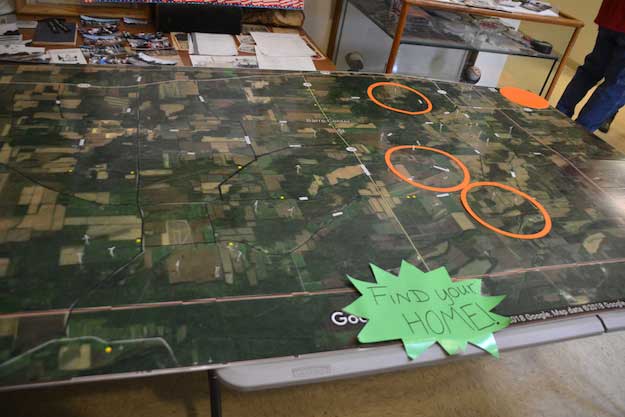
BARRE – Dave and Rhonda Waters attended Saturday’s open house at the Barre Town Hall. They live on Root Road and are concerned about a proposal to have 47 nearly 600-foot-high wind turbines in town, including three near their house.
“I don’t see us staying in the Barre area if these are built,” Waters said at the open house which was put on by Clear Skies Above Barre.
About 100 people attended the event. The Waters moved from Eagle Harbor to Root Road about 12 years ago. They enjoy the peace and quiet of Barre.
The turbines would bring an “unsightliness,” Mr. Waters said. He also worries about the impact on town roads, fields and the environment in bringing in the huge pieces of metal to make the turbines and then their construction.
The Waters worry the local property values would fall with the turbines on the landscape, more than offsetting any reductions in property taxes.
Clear Skies Above Barre created this map of turbine location. The citizens group obtained lease information from the County Clerk’s Office to identify the locations.
Dave and Rhonda Waters live on Root Road and would have three turbines near their house.
This shows how one of the turbines would dwarf a house in the community.
Clear Skies also discussed other issues including environmental and health concerns with turbines, why a PILOT payment plan isn’t the best option for the community, the “character and fitness” of Apex, and asked residents to list pros of the project. (After an hour of the meeting, no one had written down a “pro” with the project.)
Town Supervisor Sean Pogue attended Saturday’s session by Clear Skies. He was happy to see so many people seeking information. He urged residents to attend an open house on Wednesday at the Heritage Wind office at 49 N. Main St. in Albion. The public is welcome to meet Dave Phillips, Apex Clean Energy’s vice president of environmental, at a dinner and open house on Wednesday from 6:30 to 8 p.m.
Attendees are encouraged to ask environmental-related questions, and share feedback. Sandwiches and light refreshments will be provided.
“I’m glad to see people are coming out to hear their side,” Pogue said about the Clear Skies presentation. “There are two sides to every story and I would encourage them to also go to the Apex open house on Wednesday.”
Governor Andrew M. Cuomo today announced a bottle bill expansion and a plastic bag ban will be included in the 2019 Executive Budget. To combat litter, help reduce greenhouse gas emissions and protect the environment for future generations, the Governor is advancing legislation to expand New York’s Bottle Bill to make most non-alcoholic drink containers eligible for 5 cent redemption. Additionally, Governor Cuomo will advance legislation to ban all single-use plastic bags.
“While the federal government is taking our environmental progress backwards and selling out our communities to polluters and oil companies, in New York we are moving forward with the nation’s strongest environmental policies and doing everything in our power to protect our natural resources for future generations,” Governor Cuomo said. “These bold actions to ban plastic bags and promote recycling will reduce litter in our communities, protect our water and create a cleaner and greener New York for all.”
Bottle Bill Expansion
Since Governor Mario M. Cuomo enacted the Solid Waste Management Act 30 years ago, New York recycling laws have helped reduce waste in communities across the state. Under the Act, local municipalities adopted local recycling laws requiring source separation of recyclable, which have diverted more than 320 million tons of recyclables from disposal, reducing 1 billion metric tons of carbon dioxide in the process by decreasing methane emissions from landfills and reducing energy and fossil fuel use associated with the production of plastics and glass.
To take the next major step forward in reducing litter and protecting the environment, Governor Cuomo will expand the Bottle Bill to make most non-alcoholic beverage containers eligible for 5 cent redemption, including those for sports drinks, energy drinks, fruit and vegetable beverages and ready-to-drink teas and coffee.
The Bottle Bill expansion will include some exceptions for bottles containing dairy milk, milk substitutes, infant formula, syrups and flavorings, medical prescriptions and dietary supplements. This proposal will also help reduce sorting and financial burdens on local government recycling programs. Additionally, the Governor will include amendments to the Bottle Bill legislation to address implementation issues and to respond to feedback from stakeholders, as well as enhanced penalties.
The Governor will also direct DEC to conduct a study, in consultation with industry participants and retailers, on how the bottle bill could be further expanded to include wine and liquor bottles.
Plastic Bag Ban
New Yorkers use billions of plastic bags annually, which do not biodegrade, creating massive amounts of litter in neighborhoods and waterways and posing a threat to the health of New Yorkers and the environment.
In March 2017, Governor Cuomo created the New York State Plastic Bag Task Force to develop a comprehensive statewide solution to address pollution caused by plastic bags. Following the Task Force recommendations, the Governor introduced a Program Bill last year to prohibit businesses from providing plastic carryout bags to customers.
To address the environmental impacts of single-use plastic bags and provide a financial incentive to reduce waste, Governor Cuomo proposes a statewide plastic bag prohibition. This ban will help reduce the greenhouse gas emissions associated with plastic bag production and disposal, from petroleum used to produce the bags to emissions from the transportation of bags to landfills. DEC will work with stakeholders and community leaders to ensure the roll-out of this initiative does not disproportionately impact low and moderate income and environmental justice communities through the distribution of reusable bags and exemptions where appropriate.
DEC Commissioner Basil Seggos said, “Promoting recycling, reducing waste, and helping end the blight of plastic bags littering our environment are top priorities. Thanks to Governor Cuomo’s leadership, proposals to ban plastic bags and expand the bottle bill will bolster New York’s ongoing efforts to improve recycling markets and reduce contamination in the waste stream. These actions will also help municipalities and retailers respond to global changes in the recycling industry. We will continue to explore additional ways to protect our environment.”
By Tom Rivers, Editor Posted 13 January 2019 at 1:50 pm
State senator takes the oath in front of about 100 people at Medina VFW
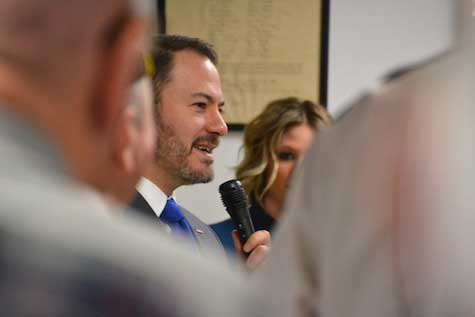
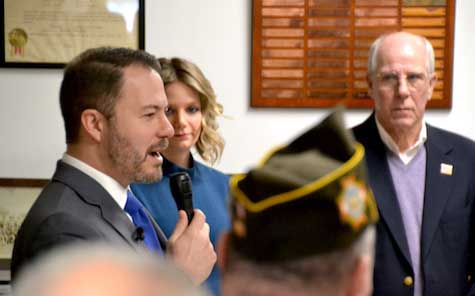
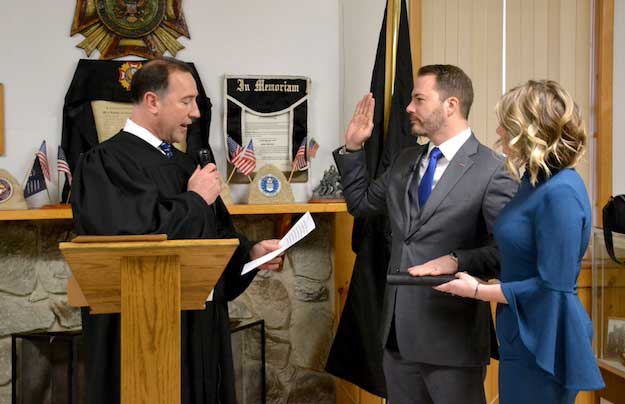
MEDINA – State Sen. Robert Ortt took the oath of office during a ceremony at the Medina VFW on Saturday. About 100 people attended the event to help Ortt kick off his third term as a state legislator. The crowd included many local veterans and Republican Party leaders and members from throughout the county.
Rob Ortt speaks to the crowd at the Medina VFW. He wanted to take the oath in the district, which includes all of Orleans, part of western Monroe and Niagara counties.
Ortt, 39, enters the legislative session in the minority conference after Democrats had a big November that resulted in the party getting a sizable majority in the Senate. Democrats now have 39 of the 63 seats. Republicans have been clinging to a slight majority in recent years. The Democratic takeover of the Senate puts all three legislative powers – the governor, the Assembly and Senate – in Democratic Party control.
“The landscape in our state capitol has changed and it has changed fairly dramatically,” Ortt told the group at the VFW.
The Democratic Party control likely will result in a push for more gun control, and a likely shift to more state funding to subways, city school districts and other issues that are on the front burner for many Democrats.
The 23 Republicans who remain in the State Senate represent about 8 million people out of 19.5 million in the state. Ortt said that group will continue to speak up for upstate school districts and communities, especially for rural areas that need more broadband Internet, and state investment in roads and bridges.
Most of the Democrats in the State Senate represent New York City or other urban areas.
“You’re going to see that in the priorities,” he said about the Senate’s legislative agenda. “My responsibility is to make sure upstate issues are talked about.”
Rob Ortt addresses a crowd in the Medina VFW while his wife Meghan, and Orleans County GOp Chairman Ed Morgan look on.
A recent Census report showed New York was one of nine states to lose population from July 2017 to July 2018. The country’s population went 0.6 percent or by about 2 million people to 327,167,434. However, New York dipped by 48,150 or 0.25 percent to 19,542,209.
Ortt said New York’s difficult business climate with high taxes and overly burdensome regulations drive out companies and residents.
“We need to address the reasons why people leave, and it’s easy: it’s taxes and it’s regulations,” Ortt said. “Those really strangle employers and when you strangle employers they then hire less people. When they hire less people, they seek jobs elsewhere.”
Ortt said the Senate’s new leader, Andrea Stewart-Cousins, has proven she is good person and honorable intentions. She is the first woman to lead the State Senate in its 241-year-history.
“She seems like a really nice person who I will probably disagree with 90 percent of the time on policies,” he said.
However, it is imperative that the Republicans in the Senate work “across the aisle” with Democrats if they want to have an impact on legislation.
Ortt is the ranking Republican for two State Senate committees – Senate Committee on Veterans, Homeland Security & Military Affairs as well as the Senate Committee on Agriculture. He is one of only two veterans in the Senate. He served in the National Guard and was deployed to Afghanistan from March to December 2008.
He looks forward to be on the Agriculture Committee to touring farms and ag businesses around the state.
“Agriculture is still the largest economic driver in New York State,” he said.
By Mike Wertman, Sports Writer Posted 13 January 2019 at 9:01 am
Photo by Cheryl Wertman – Medina’s Vincent Montague and his Mustang teammates face two N-O games this coming week.
With both teams looking to avoid an upset on Tuesday, Medina and Wilson are pointing to a key clash of unbeatens for the Niagara-Orleans League boys basketball lead on Friday at Medina.
Medina, which visits Akron on Tuesday and Wilson, which hosts Roy-Hart, are both currently at 4-0 in N-O competition.
The Lyndonville boys, which currently share the Genesee Region League Division II lead with Elba at 6-1, will be looking to rebound from a loss to undefeated (7-0) Division I leader Alexander when the Tigers host Byron-Bergen on Wednesday.
In wrestling competition, Holley-Kendall will host Lyndonville and St. Mary’s on Tuesday which will be highlighted by a pre match ceremony honoring the teams’ seniors and retiring Coach John Grillo.
Weekly Schedule Monday Boys Basketball: Elba at Albion, Holley at Pembroke, 7 p.m. Girls Basketball: Rochester Prep at Kendall, 6 p.m.
Tuesday Boys Basketball: Roy-Hart at Wilson, 6 p.m.; Medina at Akron, Newfane at Barker, 6:30 p.m. Girls Basketball: Lyndonville at Byron-Bergen, Akron at Medina, Barker at Newfane, 6:30 p.m.; Pembroke at Kendall, Holley at Notre Dame, Wilson at Roy-Hart, Olmsted at Albion, 7 p.m. Wrestling: Lyndonville at Holley-Kendall, 5:30 p.m.
Wednesday Boys Basketball: Byron-Bergen at Lyndonville, Kendall at Pembroke, Notre Dame at Holley, 7 p.m. Swimming: Roy-Hart at Medina, Newfane at Albion, Barker at Akron, 4:30 p.m.
Thursday Girls Basketball: Lyndonville at Oakfield-Alabama, Kendall at Attica, 7 p.m. Wrestling: Holley-Kendall at Wilson, 6 p.m.
Friday Boys Basketball: Wilson at Medina, 6:30 p.m.; Albion at Newfane, 6:45 p.m.; Oakfield-Alabama at Lyndonville, Barker at Roy-Hart, 7 p.m. Girls Basketball: Medina at Wilson, Roy-Hart at Barker, 6:30 p.m.; Newfane at Albion, Attica at Holley, 7 p.m. Swimming: Barker at Medina, Roy-Hart at Newfane, 4:30 p.m.; Akron at Albion, 4:45 p.m.
By Tom Rivers, Editor Posted 13 January 2019 at 8:53 am
Provided photos
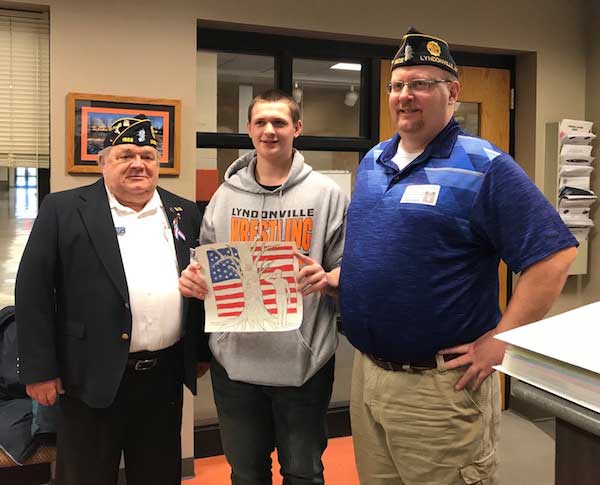
LYNDONVILLE – Lyndonville veterans and members of the American Legion, Joseph Hausler (left) and Steve Goodrich (right), are pictured with Gvani Rodriguez, an eighth grade student at Lyndonville who created the artwork to be used as a book for the American Legion in Lyndonville.
The American Legion in Lyndonville reached out to the school’s Art Department to have a student create a cover for a book the Legion is making that holds documentation for any service member that resided in Lyndonville throughout history.
Gvani used an image of the iconic shoe tree to represent Lyndonville as well as to show the roots of all the servicemen and women who have come through the town.
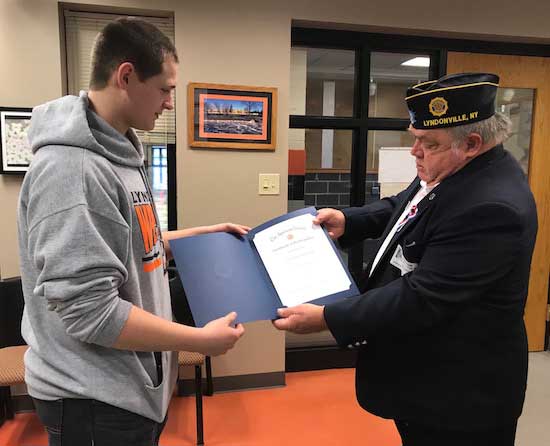
Joseph Hausler presents Gvani with a certificate. There will be another presentation to honor the Gvani and his artwork on Jan. 24 at the Lyndonville Presbyterian Church.
By Tom Rivers, Editor Posted 12 January 2019 at 8:10 pm
‘Holley Hub’ also does podcasts of current events
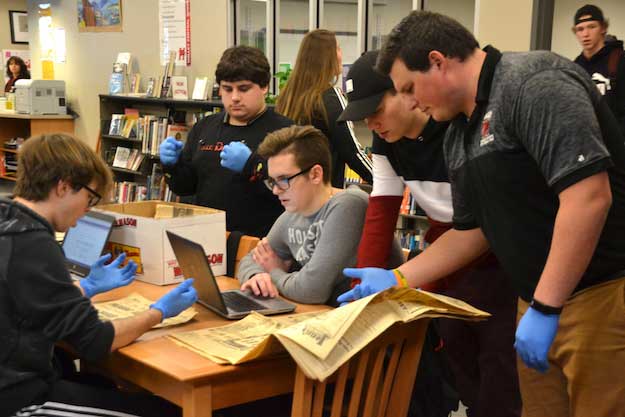
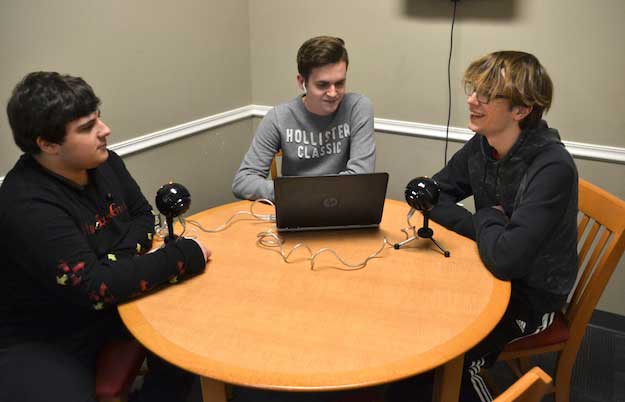
HOLLEY – Holley students in a current events class led by teacher Nick D’Amuro have spent this week poring over headlines from key moments in U.S. history since the 1960s.
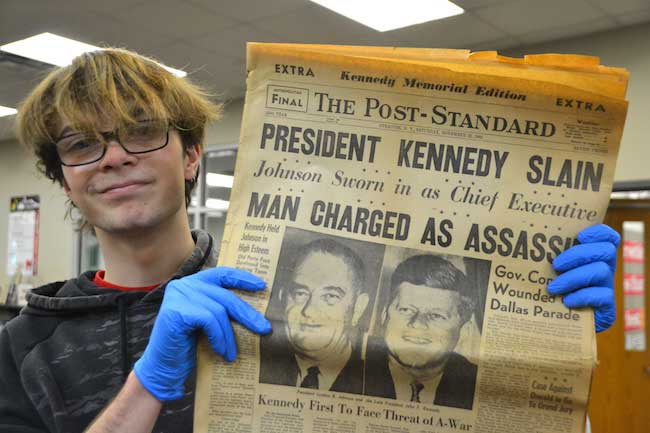
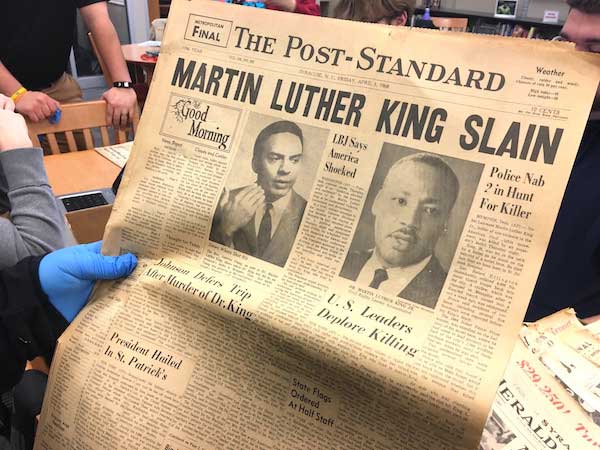
One of D’Amuro’s colleagues, science teacher Kristen Pelkey, handed off five boxes of newspapers covering about 60 years since 1958. These are newspapers from Syracuse that show the news coverage from historic days, including the assassinations of John F. Kennedy, Robert F. Kennedy and Martin Luther King Jr.; the resignation of Richard Nixon as U.S. president; many achievements by astronauts; and other key moments as well as ongoing coverage of the Vietnam War and the Civil Rights Movement.
Students are looking through the stacks of papers with rubber gloves, and making an inventory of the big headlines. They are making other observations, including the prominence of cigarette advertising, the lack of women in the news, and how newspapers weren’t very critical of government leaders until the 1970s with Nixon, who resigned in disgrace.
Holley teacher Nick D’Amuro and his students in the current events class look through newspapers of famous events from the 1960s.
The newspapers in the 1960s are very much in favor of government leaders, and really touted U.S. advances by astronauts as the country raced against Russia to have the first man on the Moon.
“In the 1960s, the newspapers were very patriotic and supportive of the government,” D’Amuro said during the class on Friday. “In the 1970s, the newspapers were more critical.”
There are 15 students in the class in grades 10 through 12. They meet each day for eighth period in the school library.
The batch of historic newspapers was a pleasant surprise. They were given to the science teacher, who thought D’Amuro and his class would enjoy going through the newspapers, which are considered “the first rough draft of history.”
“Martin Luther King Slain” – This April 5, 1968 edition of The Post-Standard in Syracuse covers the assassination of Civil Rights leader Martin Luther King Jr. The photo to the left shows Rev. Andrew Young, an aide to King shows where King was hit by a bullet in Memphis, Tenn. The newspaper cost 10 cents at the time.
The students have been digging into news this year, and it had been current events. The class created a “Holley Hub” podcast and has had about a dozen episodes so far. D’Amuro, who also teaches social studies, wants students to be critical thinkers and educated citizens. The podcasts are available through the Holley Hub Twitter feed.
D’Amuro said the old newspapers, covering historic events, has inspired students, and took them right back to key moments they had read about in class. With the newspaper coverage, the events didn’t feel like an event from decades ago.
The Holley students will go through the newspapers and compile highlights that they hope to share with the school community after they are done with their research, D’Amuro said.
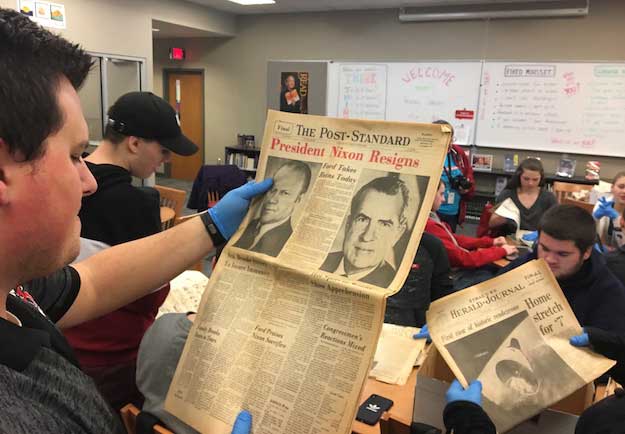
D’Amuro holds a copy of The Post-Standard from Aug. 9, 1974 that includes extensive coverage of the resignation of Richard Nixon as president. This edition includes the rare use of red letters in the headline. Back then, the newspapers were almost solely black and white.
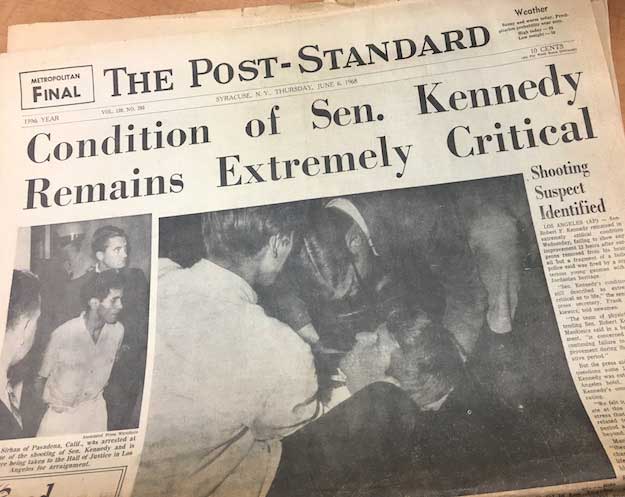
“Condition of Sen. Kennedy Remains Extremely Critical” – The June 6, 1968 Post-Standard is headlined by the shooting of Sen. Robert Kennedy in Los Angeles at a hotel. RFK was running for president was he was fatally shot by an assassin.
“Germans Celebrate Unity” – The Oct. 3, 1990 Herald-Journal highlights the reunification of Germany. “Forty-five years after it was carved up in defeat and disgrace, Germany was reunited today in a celebration of pealing bells, national hymns and the jubilant blare of good old German oom-pah-pah,” the article states. By 1990, there were color photographs on the front page.
These students are in the library discussing a podcast for the Holley Hub. They include, from left: Jordan Grein, editor Jeremy Crandall, and Jake Peters.
Governor Andrew M. Cuomo today announced a proposal to raise the minimum sales age for tobacco and electronic cigarette products from 18 to 21 will be included in the 2019 executive budget.
The proposal is part of the Governor’s comprehensive legislation to curb tobacco and e-cigarette products, which also calls for an end to the sale of tobacco and e-cigarette products in pharmacies and clarifies the State Health Department’s authority to ban the sale of certain flavored e-cigarette liquids, among other measures.
“We have made great strides to stamp out teen smoking, but new products threaten to undo this progress to the detriment of millions of Americans,” Cuomo said. “In New York, we refuse to stand idly by while unscrupulous businesses target our young people and put their very futures at risk. With this comprehensive proposal, we are taking aggressive action to combat this very real public health crisis and curb the use of nicotine products before they result in deadly consequences for an entire generation of New Yorkers.”
To combat the use of harmful tobacco and vapor products, Governor Cuomo will propose comprehensive legislation that includes:
• Raising the minimum sales age for tobacco and electronic cigarette products from 18 to 21: Most underage youth obtain tobacco and vapor products from friends, who are over 18 and can legally purchase products. Raising the minimum age will curb youth tobacco use and remove sources of tobacco from high schools.
• Ending the sale of tobacco and electronic cigarette products in pharmacies: Pharmacies sell tobacco cessation products and pharmaceuticals, and increasingly provide healthcare and health education. Allowing them to continue to sell tobacco products sends the incorrect message that tobacco products are safe. Ending the sale of tobacco and e-cigarette products in pharmacies will reduce the availability, visibility, and social acceptability of tobacco use, especially to youth.
• Implements display restrictions: New York will prohibit the display of tobacco products and packaging, including e-cigarettes, in all retail stores that are not adult-only. This practice will reduce youth exposure to predatory marketing practices.
• Clarifies the Health Department’s Authority to ban the sale of certain flavored e-cigarette liquids: Flavored combustible cigarettes, except menthol, were banned by the FDA in 2009 to reduce youth smoking as they were frequently used as a starter product. Most e-cigarette users said their first e-cigarette was flavored. Flavors, such as sweet tart, toffee, and bubble gum, make e-cigarettes more attractive to youth. The budget will include a proposal to provide the Department of Health the authority to ban the sale of certain flavored liquids that target youth use of e-cigarettes.
• Restricting available discounts provided by tobacco and electronic cigarette manufacturers and retailers: New York has the highest cigarette tax in the nation, but manufacturers and retailers have developed tactics to reduce prices, such as “buy one, get one free” discounts. These tactics directly target price-sensitive consumers, including youth. Restricting discounts on tobacco and vapor products will strengthen the impact of New York’s tax on tobacco and disincentivize tobacco use.
• Require e-cigarettes be sold only through licensed retailers: Currently the sale of e-cigarettes is almost entirely unregulated. Restricting the sale to licensed retailers will allow the current enforcement infrastructure to ensure that minors do not purchase tobacco products.
Under Governor Cuomo’s leadership, New York State has moved from the 18th healthiest state in the nation in 2012 to the 10th healthiest state in the nation in 2017. In 2017, Governor Cuomo expanded the Clean Indoor Air Act to prohibit e-cigarette use in nearly every workplace to protect workers and the public from harmful secondhand tobacco smoke and vaping aerosols.
Despite this progress, tobacco use continues to be the number one cause of preventable death in New York State. About 28,000 adult New Yorkers die every year as a result of smoking. Additionally, an increasing number of underage youth are using both traditional cigarettes and e-cigarettes. From 2014 to 2018 youth use of e-cigarettes increased by 160 percent from 10.5 percent to 27.4 percent and more than half of teens falsely believe that e-cigarette use is harmless.
New York State Health Commissioner Dr. Howard Zucker said, “New York State, under Governor Cuomo’s leadership, continues to fight the epidemic of nicotine addiction and this important legislation will further safeguard New Yorkers from the adverse health effects associated with exposure to tobacco products, especially among our youth.”
By Matthew Ballard, Orleans County Historian Posted 12 January 2019 at 8:44 am
“Overlooked Orleans” – Vol. 5, No. 2
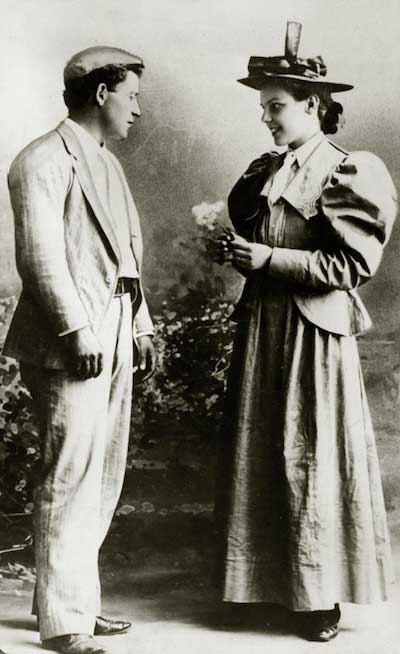
University of Chicago Photographic Archive: Amos Alonzo Stagg and Stella Robertson Stagg are pictured as newlyweds, c. 1894.
Medina claims Frances Folsom Cleveland, an official First Lady of the United States of America, as her own and in 1952 apparently tried to claim the First Lady of American Football as well.
Henry Clune wrote in a September 16th edition of the Rochester Democrat & Chronicle that he “…expressed the opinion that the wife of the former famous University of Chicago coach, [Alonzo Stagg], had come from Medina.” Fred Tanner of Albion quickly pointed out that Clune was incorrect.
Another football season has passed and there is no playoff football for fans of the Buffalo Bills. Instead, I received a rather interesting message earlier this week highlighting an old newspaper clipping authored by County Historian Arden McAllister in the early 1970s. In this article, McAllister notes that he held in his possession “a picture of the Class of 1891 of Albion High School which includes a young woman he says may be perhaps the only unofficial woman football coach in history.” So instead of watching the Bills push for the Lombardi Trophy, a quick read about Orleans County’s connection to one of the greatest football pioneers will fill that void.
The story begins with Stella Robertson, the daughter of Peter and Mary Chester Robertson, born August 7, 1875 in Gaines. As an astute young woman, she was well regarded among members of her class, was selected as the vice president of her senior class and graduated from the Albion High School in 1891. She soon enrolled at the University of Chicago where she would meet Professor Amos Stagg.
Born on August 16, 1862, Stagg attended Yale College as a divinity student, earning quite the reputation as a pitcher for the Bulldogs’ baseball team and playing for the college’s 1888 undefeated football team. His career as a collegiate athlete earned him a dual appointment as “Associate Professor and Director of the Department of Physical Culture and Athletics with full tenure…a double precedent in the history of American higher education,” according to Robin Lester. Stagg became the first physical department head appointed with tenure and the first tenured appointment for an intercollegiate coach at any institution.
Compared to his elder colleagues, Stagg was strikingly young and perhaps less distinguished visually, but his career as an athlete earned him a degree of unprecedented respect. He quickly became the most eligible bachelor on campus and developed an open courtship with the young Stella Robertson of Albion. Faced with criticism from colleagues about his relationship with Robertson, Stagg contemplated a change of profession but remained in his position with the encouragement and support of his soon-to-be fiancée.
Arden McAllister wrote that “…[Stagg] once pedaled his bicycle all of the 30 miles to Gaines to keep a date with [Stella]” and that “He often played golf on a course that once existed at Eagle Harbor and walked across the farms in short pants and knee socks.” The couple’s wedding was performed by Rev. Osburn of the Baptist Church on September 10, 1894 at the Robertson home in Albion. Stella was nearly two years away from completing her studies at Chicago and the couple quickly returned to Illinois after the nuptials.
Alonzo Stagg, “The Grand Old Man of Football,” remained at the University of Chicago until 1932 when then university president Robert Hutchins forced the 70-year-old coach to retire. The couple relocated to Stockton, California where Stagg coached for the College of the Pacific until 1946. His lengthy coaching tenure ended at Stockton College after acting as the institution’s kicking coach; he was 96 when he retired.
Although the length of time Stagg spent coaching is quite impressive, it is his legacy that is the most remarkable. Knute Rockne, the legendary football coach of Notre Dame, once said, “All football comes from Stagg.” Rockne was later asked where he developed such innovative plays, to which he responded, “I took them from Stagg, and Stagg took them from God.” Such statements appear to be true, as Stagg is often credited with inventing the tackling dummy and developing the huddle, the reverse and man in motion plays, and lateral passes. He pioneered the forward pass, the place kick and initiated the use of uniform numbers as well as the awarding of varsity letters. His impact on sports extended beyond football, inventing the batting cage for baseball and promoting basketball as the 5-on-5 matchup played today.
Perhaps most important to Stagg’s innovative success was the role that his wife played in his career. A 1943 newspaper article notes that “Mrs. Stagg serves as scout, statistician, historian, typist and advisor, as well as a one-woman consolation committee whenever things are breaking tough.” McAllister also reaffirmed this by writing, “They say that Stella often helped her husband plot gridiron strategy.”
So, to conclude this article, the American Football Coaches Association presents the Amos Alonzo Stagg Award annually to the “individual, group, or institution whose services have been outstanding in the advancement of the best interests of football.” Marv Levy, the winningest coach in Buffalo Bills’ history, is set to receive the Amos Alonzo Stagg Award in 2019.