By Tom Rivers, Editor Posted 6 March 2019 at 10:38 am
BARKER – The Village Board will discuss preliminary plans on Thursday for a new village hall after the building was destroyed by a fire on Jan. 21.
The board will meet 7 p.m. on Thursday at the Lions Club Community Center. The public is welcome and encouraged to attend, said Seanna Corwin-Bradley, a village trustee.
The Barker public library also was destroyed in the fire. The library has secured a temporary location and landlord and library leaders are expected to sign a lease this week, said Corwin-Bradley, who is also president of the library’s board of trustees.
“Still no news on cause and origin (of the fire),” she said in an email. “Investigators from both insurance companies plan on coming back to the site again once it it’s thawed.”
The village offices are temporarily at the police station at 1697 East Ave.
Fruit, vegetable and dairy operations are all labor intensive
Press Release, New York Farm Bureau
Photos by Tom Rivers: Workers at Lake Ontario Fruit in Albion fill bags and boxes with SweeTango apples in this photo from September 2014.
New York Farm Bureau on Tuesday highlighted a new report that detailed the extreme costs facing the state’s family farms should the farmworker labor bill (S. 2837/A. 2750) pass this legislative session.
Farm Credit East, a credible financial organization that works directly with farmers, analyzed economic data and determined overtime on a 40-hour work week and beyond an eight-hour day will increase labor costs on farms by $299 million or more than 17 percent. (Click here to see the report.)
The additional labor costs would also take a significant bite out of net farm income, especially at a time when the farm economy is suffering. The report says, when combined with the rising minimum wage, net farm income will drop by 23 percent.
Some of the state’s more labor-intensive commodities would take an even bigger hit financially. Vegetable growers will see net farm income decline by 43 percent. Greenhouse and nursery operations will have a 58 percent drop. Fruit growers will take a 74 percent hit. And dairy farms, will see net farm income completely wiped out with a 101 percent drop. These numbers are based on a five-year average of financial results.
New York Farm Bureau spoke about the report during a press conference at the Capitol in Albany as part of its annual lobby day. More than 200 farmers from across the state visited with their representatives and adopted lawmakers from New York City.
The average farm wage is more than $14 an hour, well above minimum wage. Farms compete for labor, and they could not attract or keep workers if employees did not earn a fair wage. Many also earn other benefits including free housing, transportation, utilities, and paid time off. In addition, it is a myth that farms do not pay workers’ compensation or unemployment insurance. Based on state formulas virtually all farms with employees meet these standards and pay workers’ comp and unemployment insurance.
During the press event, NYFB President David Fisher said the repercussions of this legislation based on economic analysis will be felt far beyond the state’s family farms and extend to the further decline of the rural economy both upstate and on Long Island. Already, according to the USDA, New York has lost nearly 20 percent of its dairy farms in the past five years. Undoubtedly, this legislation would make that dire situation worse. Fewer farms means fewer jobs on the farm and off as farm spending supports other rural businesses in their local areas.
The Elba Muck stretches into Barre and Clarendon in Orleans County, as well as Elba and Byron in Genesee County. Onions, potatoes and other crops are grown on the muck, shown in October 2015.
“We understand supporters of this bill mean well,” Fisher said. “We also mean well. We greatly appreciate the contributions our farmworkers make to our farms and our food supply, but these numbers demonstrate that it will be incredibly difficult for farms to meet the proposed labor mandates. It would be difficult for farms to compete in the marketplace when they can’t control their prices and must take what the markets demand.”
Judi Whittaker, of Whittaker Farms in Broome County, has a dairy farm that has been in the family for more than 100 years and she fears her grandchildren will not be able to continue the tradition. She said the overtime provision would force payroll up on her farm by more than $200,000, from the current $500,000 payroll.
“We value our employees greatly,” she said. “We house our employees and pay them everything they need free of charge. Having the payroll go up by that much will put us out of business. We haven’t paid ourselves in pretty much a year. We are trying to do what is right and paying our employees and paying our bills. My family is at the bottom of the list. There needs to be a more workable number to keep those of us family farms here for the future. You all eat. You need us.”
Sarah Dressel, of Dressel Farms in New Paltz, said during the event that as an apple grower who utilizes the federal H-2A guest worker visa program, this bill would bring income on her family’s farm to record lows. The H-2A rate for this year for New York will be over $13 per hour. With a 40-hour overtime, she would be forced to pay employees over $20 per hour, plus room and board at no cost to the employee, in addition to increased employment taxes.
“Workers that come through the H-2A program want to work as many hours as they can within their contract dates, and I’m seriously concerned that we will lose some help that has been coming for years when we have to cut the amount of hours they can work so that we can be economically sustainable,” Dressel said. “I’m the fourth generation to work my family farm, and I have serious concerns about the future of our orchard, and agriculture in general. Regulations and rising costs of doing business in New York are contrary to the prices that the national and global markets will allow.”
Brian Reeves, of Reeves Farms in Baldwinsville, has a 350-acre vegetable farm growing both conventional and organic crops. With labor costs already making up 40 percent of his expenses, overtime after 40 hours per week would cost his farm an additional $133,137 in wages per year, or approximately a 15 percent increase, based on 2018 numbers. This does not include the additional cost for taxes and workers compensation which would also increase with the higher wages.
Reeves added that an eight-hour per day restriction is a high overtime burden, especially considering this is not current law for other employers in New York. His employees may work six hours one day because of poor weather conditions and need to work 10 hours the next day to make up for lost time. It is conceivable that a farmworker may only work 40 hours in a week yet have several hours of overtime because all the hours occurred in four days due to weather restrictions.
“As our costs increase and we have no ability to recoup that increased cost, our future as a viable business is put into jeopardy,” Reeves said. “The next generation of our family has to seriously consider if they can continue to operate a profitable fresh market vegetable farm in New York State.”
New York Farm Bureau will continue to have positive conversations with lawmakers, including the bill’s sponsors. The organization has repeatedly asked for hearings, both upstate and on Long Island, where Senators and Assembly Members can hear from the people who will be directly impacted by the bill. We are pleased that the chairs of both the Labor and Agriculture Committees in the Senate and Assembly are working to make this happen.
“If supporters of this bill don’t take the farm community’s concerns seriously, the face of New York agriculture as we know it will change,” said Jeff Williams, NYFB Public Policy Director. “Rural New York matters. Local food production matters. We need to make sure farms have the opportunity to not only survive but thrive for the sake of their families and employees.”
By Tom Rivers, Editor Posted 6 March 2019 at 9:14 am
Photo by Tom Rivers
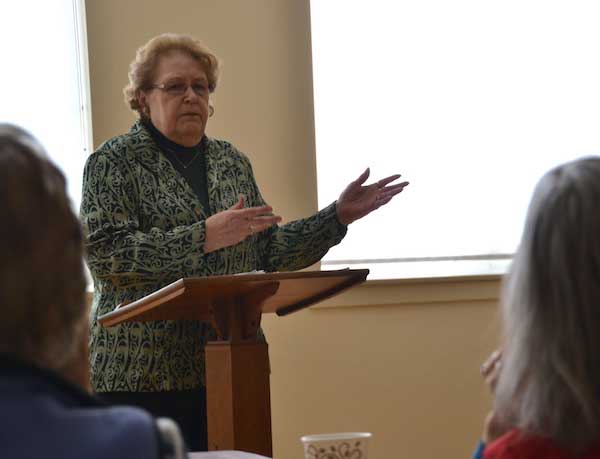
ALBION – Dee Robinson, a reference librarian at the Hoag Library, was the featured speaker on Tuesday during the monthly Take a Bite Out of History talk at the library.
Robinson focused her lecture on Sara Shaw, a Holley native who was a nurse during the Spanish-American War and World War I. Robinson wrote about Shaw in 2000, when Robinson’s book, Historical Amnesia, was published. That book highlighted local women whose contributions and accomplishments were often overlooked.
Robinson found more information about Shaw after the book was published. Robinson said Shaw was well respected as a nurse. She was born in Holley and graduated from the Bellevue School of Nurses in 1896. Two years later she became a Red Cross nurse.
She was sent to Puerto Rico, Cuba and the Philippine Islands during the Spanish-American War.
She worked for the Bellevue Hospital nursing staff from 1909 to 1941, taking a leave of absence during World War I. She was a supervising nurse in Italy, in charge of 37 nurses.
After the war, she returned to Bellevue and worked several years as the head nurse of the tuberculosis division of Bellevue Hospital in New York City.
She died at age 76 on Feb. 5, 1948 in New York City and is buried at Hillside Cemetery in Holley.
MEDINA – A Medina man on Tuesday was charged with burglary from several months ago after police used DNA evidence left at the scene to connect the crime to Javier Cuardrado, 43.
He has been charged with burglary in the 3rd degree, a Class D felony; criminal mischief in the 2nd degree, a Class D felony; and petit larceny, a Class A misdemeanor
The Medina Police Department on Sept. 14 responded to a burglar alarm at Hinsperger Poly Industries, 430 West Oak Orchard Street in the village of Medina. Upon arrival, officers determined that forced entry had been made into the building. Officers cleared the building and determined that the suspect had exited the building and fled the area prior to arrival, Lt. Todd Draper said.
Officers observed property inside that had been damaged and owners reported that items were stolen. Medina police officers, with assistance from the Orleans County Sheriff’s Department, processed the scene for evidence.
The evidence that was secured was sent to the Niagara County Forensic Lab for examination. The DNA evidence that was located identified a suspect. That suspect was interviewed and this individual confessed to conducting the burglary and stealing the property, Draper said.
Further evidence was located at the suspect’s residence. The case was investigated by Medina police officer Cory Collins.
By Tom Rivers, Editor Posted 5 March 2019 at 8:47 pm
Unknown how flag for regiment of ‘Colored Troops’ came into library’s possession
(Editor’s Note: This article has been updated to include the possible connection with the regiment’s officer from Barre.)
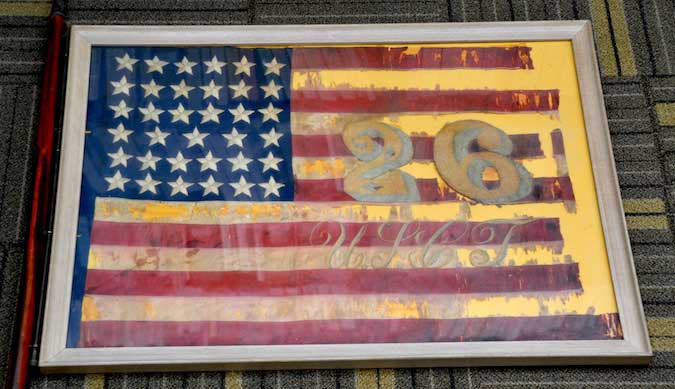
ALBION – For many decades a flag from the Civil War was up in the attic of the Swan Library in Albion, unbeknownst to the community and library staff.
That flag was used by an African-American regiment from New York – the 26th Regiment United States Colored Troops.
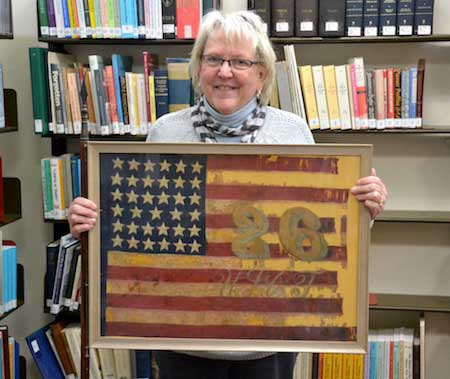
Betty Sue Miller, director of Hoag Library, holds the American flag for the 26th Regiment United States Colored Troops. She believes the flag was put in the frame to help preserve it in the 1950s. The flag was discovered in the attic of the former Swan Library.
“It spent many years in the attic of the Swan Library,” Betty Sue Miller, library director, said about the flag. “There were things there that hadn’t been looked at for years.”
The Hoag Library opened in July 2012. The old library also was mostly cleared out around that time. That building was the library’s home since 1900. When library staff were going through the items in the attic they found the old flag, which was in a frame.
The flag was moved to Hoag and put in a room with other community relics, mostly old books of local interest and history. There is a photograph by Matthew Brady, the famed Civil War photographer, and some other interesting local items, including signs from the Orleans County 4-H Fair.
Some library users knew about the flag and suggested that it be displayed or sold to someone who would appreciate it, perhaps a museum about African-American history.
The library reached out to Heritage Auctions in Dallas, Texas. The company estimated the flag is worth $20,000. Heritage wants to handle a sale for the flag and would promote it as a signature piece for an upcoming auction about Americana, Miller said. Heritage agreed to sell the flag for a 5 percent commission, well below its normal rate.
The library’s board of trustees are expected to vote on the issue at its 7 p.m. meeting on March 13. Miller said the board is inclined to sell the flag because there isn’t a positive connection to the county. Hoag Library also isn’t a museum and preserving and displaying the flag isn’t part of the library mission, Miller said.
The impeachment parchment, given as a gift by a former governor
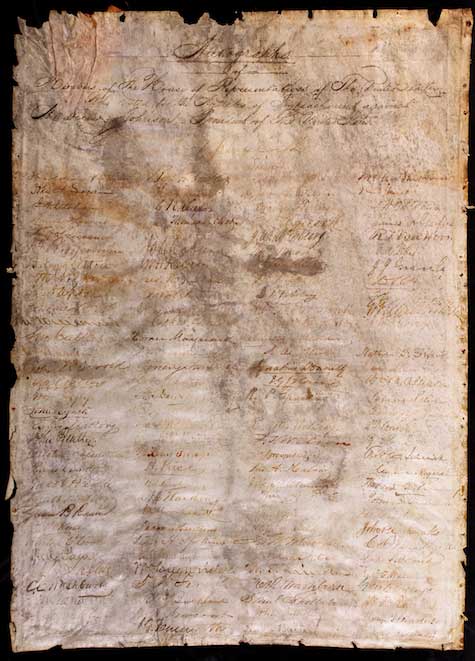
Photo by Bruce Landis (Photos by Bruce) – As governor of Georgia, Albion native Rufus Bullock was presented this list, showing the original signatures of members of Congress who voted to impeach Andrew Johnson on Feb. 24, 1968. Bullock donated the 17-inch-by-23-inch notice, written on parchment, to Swan Library in 1903, four years before he died.
The library has wrestled with a similar issue before. It was a decade ago when the former Swan Library considered selling a document from the impeachment proceedings against President Andrew Johnson.
Rufus Bullock, a former Albion resident, was governor of Georgia when Johnson was impeached. Johnson as governor was given an impeachment notice signed by the 126 members of House of Representatives who voted Feb. 24, 1868, to impeach Johnson for “high crimes and misdemeanors.” Forty-seven House members opposed the ousting.
Bullock moved back to Albion in his later years and gave the impeachment notice to Swan Library in 1903. The library had only been open for three years at that point. Bullock died at age 73 on April 27, 1907, and is buried near the tower at Mount Albion Cemetery.
For a century that document sat in the attic at Swan Library. Librarians were aware of that piece of history and kept it safe.
But when the community was looking to build a library, Swan leaders thought the impeachment notice might fetch a big dollar and could help get the new building built. Some speculated the document might be worth a million dollars or more.
Library leaders at the time sent a photo of the impeachment parchment and a description to Sotheby’s, the famous international auction house. Its assessment of the document: about $15,000 to $25,000 – a nice sum but library leaders decided it wasn’t a difference maker for the library.
Miller, speaking today, also said that document had a known community connection, given by a native son who loved the new library, the first in the Albion community. That’s why the library decided to keep it.
The Bullock gift occasionally comes out of storage for a display or as part of a historical discussion.
No certain provenance for flag
With antiques, the story behind the items – their provenance – is very important. There is a lot of missing information with the Civil War flag, including critical facts such as who gave it to the library and why.
Miller supports selling the flag and using the proceeds to benefit local history efforts at the Hoag. She would like to see old newspapers from the community be scanned and entered into an on-line database, for one project.
Some facts are known about the United States Colored Troops. There were three regiments of black troops from New York – 4,125 soldiers altogether – that served in the Civil War.
The Union had 178,895 soldiers in the Colored Troops from about 175 regiments during the last two years of the war. Their service bolstered the Union war effort at a critical time.
Miller believes the flag should be treasured and she wants to see it go to a place where it would be prominently displayed, diligently preserved and deeply appreciated.
Historian: Barre man led the regiment and likely brought flag back to the Albion community
The county historian believes the flag likely was in possession of a Barre man, who was a commissioned officer with the 26th USCT.
Charles H. Mattison of Barre was a 1st Lt. and adjutant for the regiment. He enlisted with the 151st NY Infantry to start, but turned down a commission with the 151st and then took a commission in 1864 with the 26th USCT, said Matt Ballard, the county historian.
Those regiments were led by officers who were white.
“It would make sense that a commissioned officer and adjutant would have a regimental flag,” Ballard said.
Mattison is buried at Mt. Albion and his wife died in 1910. Ballard thinks Mattison likely had the flag and his wife left it to the library, which was becoming “a defacto repository for local historical artifacts.”
By Tom Rivers, Editor Posted 5 March 2019 at 5:20 pm
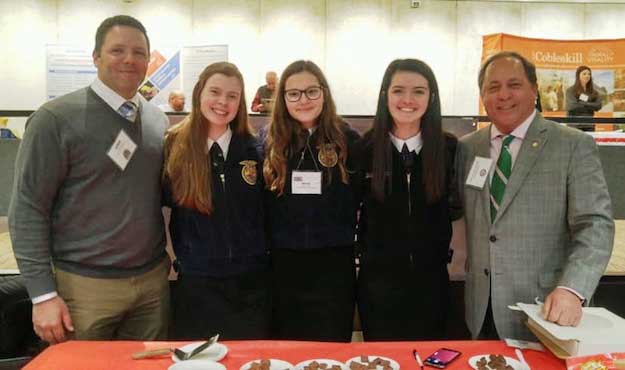
Photo courtesy of Albion FFA
ALBANY – Albion students in the FFA have spent the past two days in Albany meeting with state legislators and agriculture officials.
The photo shows, from left, FFA Advisor Adam Krenning, Lauren Beam, Bryne Dysard, Albion chapter president Bailey Nesbitt and State Assemblyman Steve Hawley.
They meet at the Taste of New York reception on Monday, sponsored by the New York Farm Bureau. This event highlights agricultural products produced in New York State. The reception was held at the Empire State Plaza Convention Hall.
Students also met with State Sen. Robert Ortt and Richard Ball, commissioner of the NYS Department of Agriculture and Markets.
By Tom Rivers, Editor Posted 5 March 2019 at 4:37 pm
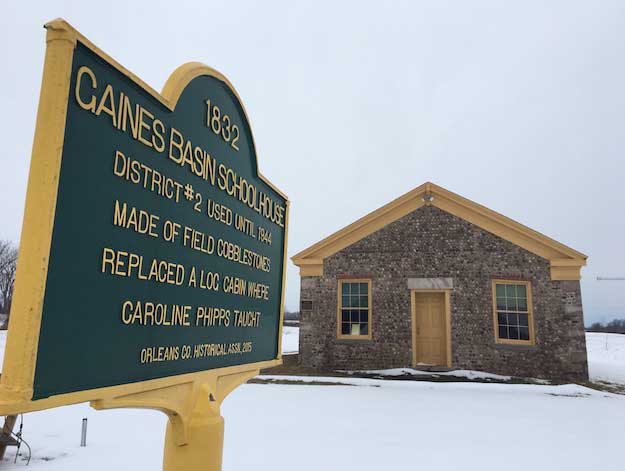
Photo by Tom Rivers: The cobblestone schoolhouse built in 1832 is pictured on Sunday on Gaines Basin Road in Gaines. This building was recently saved by the Orleans County Historical Association, which also put up the historical marker by the site in 2015.
The National Weather Service in Buffalo has issued a winter weather advisory from 10 tonight through 7 p.m. on Wednesday for Orleans, Niagara and Monroe counties.
Lake effect snow is expected with snow accumulations of 3 to 5 inches expected in the most persistent lake snows. The greatest amounts will be near the Lake Ontario shoreline, north of Route 104.
“Plan on slippery road conditions,” the Weather Service said. “The hazardous conditions could impact the morning or evening commute. Also, it will be bitterly cold with wind chills as low as 10 below.”
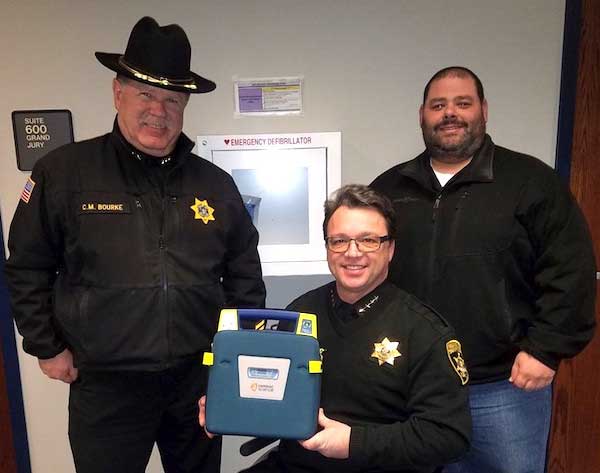
Provided photo: The Orleans County Sheriff’s Office purchased two automatic external defibrillators with a $3,000 grant from Walmart. Pictured from left include Undersheriff Chris Bourke, Sheriff Randy Bower and Kevin Ciccoline, Albion Walmart asset protection manager.
Press Release, Sheriff Randy Bower
ALBION – The Orleans County Sheriff’s Office recently received $3,000 from Albion’s Walmart Supercenter with funding awarded through Walmart Foundation Community Grant.
The grant provided funding for the purchase of two automatic external defibrillators and necessary AED supplies for public access within the community. AED’s are portable electronic devices that automatically diagnose life-threatening cardiac-related problems and treat the ailing person through defibrillation to restore effective rhythm.
The wall mounted AED’s are located in the main hallway at the Orleans County Public Safety Building and the lobby at Orleans County Animal Shelter.
We thank the Walmart Foundation and Albion’s Walmart Supercenter for their generous donation to assist in the safety of our community. In recent years, the Orleans County Sheriff’s Office received funding from the Walmart Foundation Community Grant to defray the cost for K-9 Otto’s food, supplies and vet bills.
MEDINA – Advanced Manufacturing and Engineering teacher, Bill Rakonczay, is proud to announce the SkillsUSA winners from his class competition at the Orleans Career and Technical Education Center.
The SkillsUSA overall Team winners include, from left: 3rd place: Matt Borowriak (Lockport) and Maddison Bale (Medina). Second place winners include Skyler Munn (Lyndonville) and Cal Stinson (Lyndonville). The 1st place team includes Luke Smeal (Lockport) and Canyon Wood (Royalton-Hartland).
The junior SkillsUSA Mill Competition winners include: 1st place, Caleb Boyce from Medina; 2nd place, Cal Stinson from Lyndonville; and 3rd place, Canyon Wood from Royalton-Hartland.
The junior SkillsUSA Lathe Competition winners include: 1st Place, Luke Smeal (Lockport); 2nd place, Skyler Munn (Lyndonville); and 3rd Place, Matt Borowiak (Lockport).
First place winners will move on to the regional competition at Alfred State University later this month.
By Tom Rivers, Editor Posted 5 March 2019 at 10:52 am
Provided photo: Richard “RJ” Gilman Jr. and his mother Joan are shown together in this photo.
KENDALL – A Kendall man who was charged after a mother and her son died from carbon monoxide poisoning last April 18 has rejected a plea offer which would have kept him out of state prison.
David A. Wiley Jr., 39, of Center Road has been charged with two counts of criminally negligent homicide and two counts of reckless endangerment in the first degree following the deaths of Joan C. Gilman, 38, and her son, Richard J. Gilman Jr., 14. They lived in a duplex at 2245 Center Rd. The electricity had been shut off to the house April 16 after bills went unpaid.
Wiley lived in a separate apartment in the house. He allegedly used a generator in a closed garage, which was directly below his neighbors’ apartment. The generator ran for 17 hours and the fumes from it were 4-5 times the amount that could kill a person, Undersheriff Chris Bourke said last April.
Orleans County District Attorney Joe Cardone offered to let Wiley plead guilty to 2nd degree reckless endangerment, a misdemeanor, WHEC is reporting. That would have kept Wiley out of state prison. He would face a maximum of nine months in the county jail with the plea deal.
Cardone told WHEC he will present the case to the grand jury and Wiley could again face felony homicide charges.
Wiley’s attorney, Paul Guerreri, told WHEC his client maintains his innocence and will prove it if the case goes to trial.
By Tom Rivers, Editor Posted 5 March 2019 at 10:05 am
Cobblestone Museum turns down money from developer for store across from National Historic Landmark
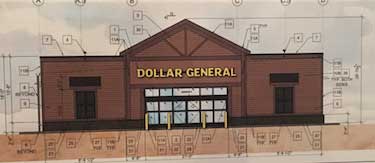
The Zaremba Group has proposed this design for a new Dollar General on Ridge Road, east of Route 98.
GAINES – Town of Gaines officials say a developer is still working to build a Dollar General store on Ridge Road, but hasn’t been able to satisfy the State Historic Preservation Office, which has urged the developer to find an alternative location for the store.
“It’s not a dead issue,” said Gerard Morrisey, chairman of the Gaines Zoning Board of Appeals. “Things are still active as far as I know.”
The Zaremba Group, the developer for the project, wants to put the new store across from the cobblestone schoolhouse, which was built in 1849. The schoolhouse is one of three cobblestone buildings that are a National Historic Landmark, the only historic site with that distinction in Orleans County.
SHPO told the developer if it’s determined to build on that site, it needs to try to mitigate the impact, with trees as a buffer and moving most of the parking to the side of the building and not the front. SHPO also said Zaremba should offer money to help compensate for its impact on the Cobblestone Historic District.
Photo by Tom Rivers: Gerard Morrisey, ZBA chairman, says an initial public notice about the project was vague and may have given the impression no one opposed the Dollar General.
Zaremba offered $25,000 to the Cobblestone Museum, and that was rejected by the museum’s board of directors last week. Jon Hinman, an engineer and project manager with the MRB Group, shared that news with the Gaines ZBA during the board’s meeting on Monday.
MRB is reviewing the engineering and site design for the project. The town hired MRB, and those fees are being covered by Zaremba.
Hinman said he hasn’t seen any updated plans for the project in several months because Zaremba is trying to satisfy SHPO. If Zaremba can get the OK from the state agency, that could stop the project, Hinman said.
Zaremba could find another organization to give funding to, Hinman said, to meet that requirement from SHPO. Zaremba could reach out to the town, a local library or historical society to donate the money, Hinman said, or the developer could increase the amount and see if it is acceptable to the museum.
Hinman also said Zaremba could look move the proposed store away from the cobblestone schoolhouse.
About 1,200 people backed petitions from the Cobblestone Museum urging Dollar General find another location for the store, outside of the historic district.
Morrisey said ZBA chairman shared other news during Monday’s meeting. The ZBA met with a Zaremba official about the project on Dec. 4, 2017. The minutes from that meeting have been sought by community members for much of last year, but the minutes only recently were made available.
Morrisey said waiting more than a year for a record of that meeting is unacceptable. He also questioned the vagueness of a notice about a public hearing at that meeting. The notice listed the tax map of the parcel and Zaremba as applicant, but didn’t say which road the parcel was on, the address or owner of the property.
The notice for the Dec. 4, 2017 meeting stated the purpose of the public hearing was to “receive public comment regarding an interpretation application regarding a definition for a proposed retail establishment which was submitted by Mary Ann Wervey of the Zaremba Group.”
That meeting is considered a milestone for the project because the ZBA gave the developer an indication a 9,100-square-foot store would be allowed in the historic district. The regulations for the historic district don’t allow new construction larger than 5,000 square feet. A general store also isn’t listed as a permitted use in the district, but a convenience store is allowed. Opponents to the project say the Dollar General should be considered a general store and not a convenience store.
The town’s regulations for projects in the historic district also state:
The proposed building or use is consistent with the architectural and historical significance of the area as a whole.
The proposed building or use does not encroach upon, diminish or otherwise adversely impact upon the other structures or uses within the district.
The ZBA may have felt there wasn’t any opposition in the community for the project based on that hearing on Dec. 4, 2017. There weren’t any public comments about the project at the hearing.
But Morrisey said the notice should have clearly stated what was being asked so the public could voice its opinion.
“Few people know tax numbers,” Morrisey, a former town assessor, said about the way the property was listed in the notice. “It’s not a great way to identify the properties to let people know what is going on.”
ZBA board members Curt Strickland and David Thom said the ZBA was hindered for much of last year because it did not have a secretary. They said the Town Board should have found a secretary for the board.
“It was up to the new Town Board to pick up the ball but they didn’t,” Thom said.
The Dec. 4, 2017 meeting actually happened before the new Town Board took over on Jan. 1, 2018. The ZBA secretary ended her employment in November 2017, and a new secretary wasn’t in place for the December meeting.
“For the minutes to just now appear is distressing,” said Morrisey, who was appointed the ZBA chairman this past January.
Hinman, the engineer with the MRB Group, said his firm would be willing to help the town as it works to clarify the text for the historic district. The town has formed a committee to work on an update to the comprehensive plan for the community, as well as the historic district.
The ZBA said it would consider a proposal from MRB, with the goal to allow some development in the historic district. Hinman said the expectations for the historic district should be clear in the town’s zoning “so this doesn’t happen again.”
The State Assembly passed legislation on Monday to expand current requirements that guns are kept in safe storage repositories, especially in households with children.
“Today’s bill is another important step in preventing gun violence,” Speaker Carl Heastie said in a news release on Monday. “Earlier this year we passed a package of legislation that addressed some of the root causes of gun violence. I am proud of our continued work with our Senate colleagues to ensure New York has the strongest and safest possible gun laws, and help keep our kids safe in our homes and in our communities.”
Under current law, safe storage of guns is only required if a person living in the household is federally prohibited from owning a gun, but not if there are children in the house, Heastie said.
The legislation on Monday would require that, in households with children and individuals prohibited from possessing a gun by federal or state law, all guns are safely stored when not in possession of the gun owner.
In homes with children, failure to safely store guns would be a class A misdemeanor. Individuals would also be required to safely store their guns when children are present in their homes, even if the children do not reside there. The bill would also require licensing officers to provide notice about safe storage of firearms. In addition, people, firms or businesses who sell firearms, rifles or shotguns would be required to conspicuously post notification of safe storage laws where guns are displayed or transferred to the buyer.
State Senator Rob Ortt (R-North Tonawanda) said the Assembly legislation violates the Constitution.
“Not only is today’s firearm storage legislation irresponsible, but it is also impractical and unnecessary,” Ortt said in a statement on Monday. “The passage of this legislation further highlights the utter disdain New York City regressives hold against the legal gun owners of our state and illustrates their ignorance regarding Second Amendment protections. By requiring firearms to be stored and locked away in safes, lawmakers are infringing on the fundamental American right of self-protection, and they are doing so in a manner that has already been ruled unconstitutional in D.C. v Heller. Either Democrats have no idea how firearms work or they are solely resolved to make them cost-prohibitive and inaccessible to American citizens.”
State Assemblyman Steve Hawley said the legislation is “another assault on our 2nd Amendment rights.” He said the Safe Storage Bill makes “law-abiding citizens criminals.”
Editor’s Note: This article was updated because first press release included wrong date for the workshop.
Press Release, Niagara-Orleans Schools Board Association
Have you ever considered running for the school board? A school board member takes on one of the most important citizen responsibilities: overseeing the education of the community’s youth.
Our local school boards are seeking men and women who find excitement and satisfaction in confronting tough challenges and working collegially to rise above them and help students in their communities succeed.
If you want to find out more about the election process and school board member responsibilities, the Niagara-Orleans School Boards Association is holding a free workshop for prospective and new school board members. You will learn about the election process, school boards and the law, Board-Superintendent relations, fiscal oversight and budget development, and perspectives on school board campaigns and school board service from veteran board members.
The workshop will be held on Saturday, March 30, from 9 a.m. to noon at the Newfane Early Childhood Center on 6048 Godfrey Rd., Burt. The workshop is presented as a community service and is free of charge. To register, please call the Niagara County School Boards Association at 731-6800 ext. 2211 or e-mail dedwards@onboces.org.
We hope you will consider running for the school board and help us provide our students the best education possible.
Lance Dickinson
President, Niagara-Orleans School Boards Association
By Tom Rivers, Editor Posted 4 March 2019 at 4:21 pm
Provided photos
LYNDONVILLE – Lyndonville Junior Class put on a Mardi Gras-themed “Mom Prom” on Friday and nearly 200 attended the event in the school cafeteria, including 68 moms with many wearing their prom dresses from a generation ago.
“It was a great two hours,” said Kim Bow, coordinator of the event at the Junior Class advisor.
These participants enjoyed the Mardi Gras theme.
Bow works for the school district as a registrar in the guidance office. She has been the Junior Class advisor for 13 years. Rather than selling candy or other merchandise for fundraisers, Bow likes to have community events to raise money for the junior class.
Last year the class had a Daddy-Daughter Dance. That was a more formal event with a red carpet. About 150 people attended that dance.
One of the girls at the dance suggested Lyndonville try a dance where mothers could dress up with their sons and daughters.
Mardi Gras will be celebrated on Tuesday. Given the nearness of that event, Bow and the junior class decided to have a Mardi Gras theme with masks and beads.
She said the mothers were eager participants and were enthusiastic dancers with their children. The fathers last year didn’t tend to dance too much, except for the formal dances, Bow said.
“The moms really danced,” she said. “It was fun and crazy. There was a lot of frivolity.”
By Tom Rivers, Editor Posted 4 March 2019 at 2:14 pm
The deadline has passed for candidates to be on the ballot for the March 19 village elections in Lyndonville and Medina.
Lyndonville has three candidates running for two village trustee positions that are for four-year terms. The spots are currently filled by Darren Wilson and Mary Kage. They both want to continue on the board. Kimberly Kenyon also will be on the ballot.
The village elections do not include major party affiliations. Kage is running under the Kage Party, Kenyon under the Pool Party, and Wilson picked the Main Street Party.
Voting will be from noon to 9 p.m. on March 19 at the Village Hall on 2 South Main St.
Medina has two candidates seeking two spots on the board. Incumbents Owen Toale and Todd Bensley are both seeking re-election to two-year terms. They are both running under the Accountability Party.
The election will be from noon to 9 p.m. at the Senior Center, the former railroad depot on West Avenue.
The two other villages in the county don’t have elections on March 19. Albion is in an off election year and Holley has its elections in June.