By Tom Rivers, Editor Posted 2 April 2019 at 2:31 pm
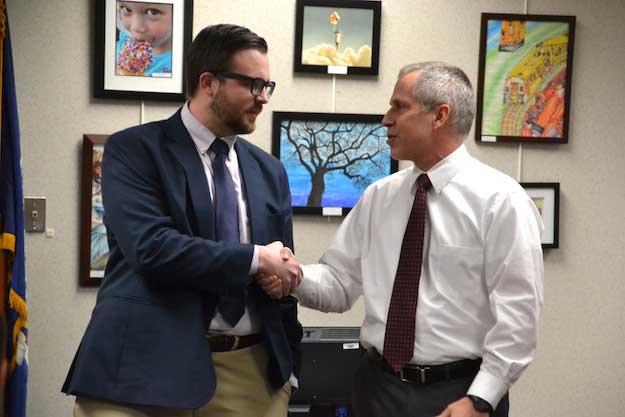
ALBION – The Albion Board of Education accepted a $2,500 grant from Monsanto on Monday through the company’s “America’s Farmers Grow Communities program.”
Monsanto chooses a customer for the grant, and that customer picks a local organization for the funding.
Phil Panek of Albion was picked by Monsanto for the grant, and he chose to support the Albion agriculture program at the school.
This is the second time a local Monsanto customer picked the Albion agriculture program to receive the grant. In 2014, Albion farmers Doug and Mitchell Kirby also chose the school’s agriculture program for the $2,500 grant.
This is the 10th year of the America’s Farmers Grow Communities program, where farmers have the chance to direct a $2,500 donation to a nonprofit of their choice. So far Monsanto has awarded more than $33 million to over 8,000 nonprofits across rural America.
By Tom Rivers, Editor Posted 2 April 2019 at 12:57 pm
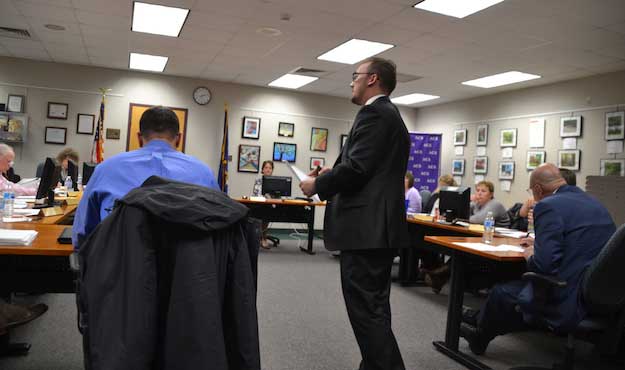
Photo by Tom Rivers: Derek Vallese, the new business administrator for Albion Central School, goes over the school district’s proposed $35.5 million budget on Monday. Vallese succeeds Shawn Liddle, who retired last month as the school’s business administrator. Vallese previously worked as treasurer for Newfane Central School.
ALBION — The school district won’t need to increase taxes in the 2019-20 school year. The district is proposing to collect $8,449,094 in property taxes, the same as in 2018-19.
This is now the 11th time in the past 13 years the school district has either kept taxes flat or reduced them.
The $35,555,151 budget will go before district voters on May 21 from noon to 8 p.m. at the elementary school conference room A. The overall budget expenses will increase less than 1 percent (0.94 percent) or by $329,885.
The district is projecting the tax rate will decrease from $15.47 per $1,000 of assessed property to $14.70. The towns have done a reassessment that will take effect with the next school budget. The reassessment will likely increase the tax base, driving down the rate. However, some people will pay more or less in taxes than they currently are, depending on the reassessed value of their property, a value set by town assessors. Overall, the district will be collecting the same amount of taxes.
The district was able to hold off a tax increase due to about $615,000 more in state aid, and a reduction in debt service by $857,942 to $784,408. The district’s contributions to the teacher retirement system also will be down about $289,000.
Those savings and additional state aid are helping to offset transportation costs going up by $607,698 to $2,569,593; maintenance expenses increasing by $218,574 to $3,445,933; and instruction costs up $375,102 to $25,927,654.
The district will also have a full-time school resource officer for the full school year at a cost of $81,250.
Derek Vallese, the district’s new business administrator, went over the budget during Monday’s Board of Education meeting.
State aid is budgeted for $25,852,494. That represents the governor’s proposed aid, plus $30,000. The final state budget included $43,000 more for Albion than what the district has budgeted, however the aid isn’t a solid number and can still change.
Vallese recommended keeping that $43,000 as a cushion in the budget, which the Board of Education supported.
Other propositions for the May 21 vote include:
• Authorization to spend $505,000 from the School Bus Purchase Reserve Fund to buy school buses during the 2020-21 school year.
• Authorization to collect $714,920 for Hoag Library, which is the same amount as 2018-19.
• Two seats with five-year terms are up for election. They are currently filled by David Sidari and Wendy Kirby. Petitions to run for the Board of Education are due to the district office by 5 p.m. on April 22.
By Tom Rivers, Editor Posted 2 April 2019 at 12:44 pm
Photos by Tom Rivers
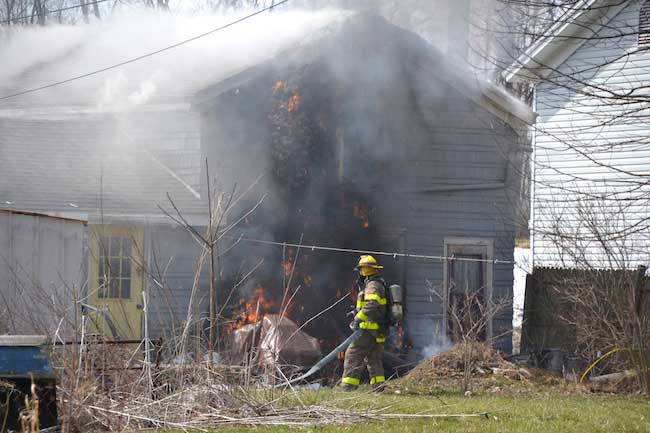
GAINES – A firefighter gets ready to spray water on the back of a house that was on fire today. Firefighters were dispatched at about 11:30 a.m. to a structure fire on Eagle Harbor-Knowlesville Road in Gaines.
No one was home when the fire broke out. Firefighters suspected the fire was caused by a wood stove, but the cause remains under investigation.
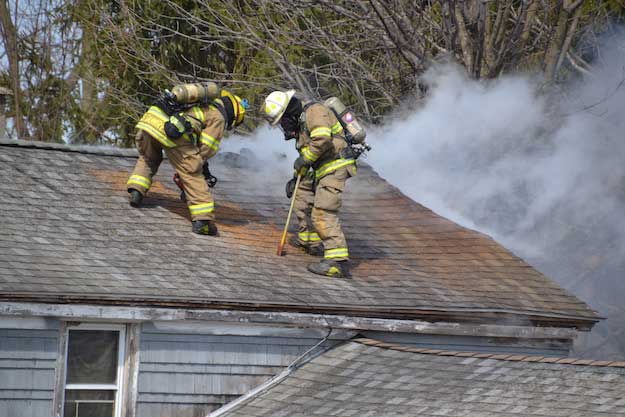
Carlton firefighters Seth Dumrese (lieutenant) and Chris Standish (assist chief) climbed to the roof of the house. They cut a hole in the roof to ventilate smoke at 13379 Eagle Harbor-Knowlesville Rd.
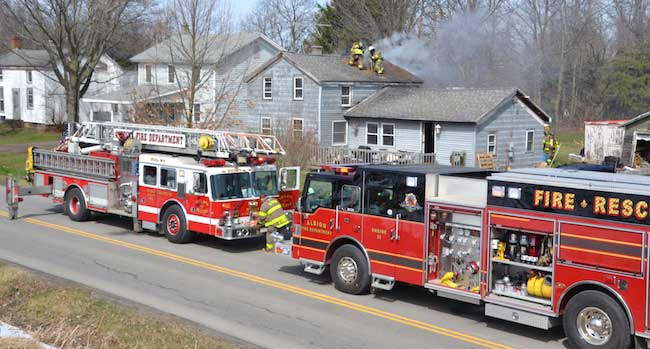
Albion, Medina and Carlton firefighters responded to the scene, as well as the Orleans County Emergency Management Office, and Albion police officers, the State Police, and the Orleans County Sheriff’s Office.
By Tom Rivers, Editor Posted 2 April 2019 at 9:42 am
Hoag is hosting several Civil War events in April
ALBION – A Civil War flag for a Colored Troops regiment will be on display this month at Hoag Library during special programs about the Civil War.
The library’s board of trustees on March 13 voted to have the flag sold through an auctioneer in Dallas, Texas. The flag hasn’t been sent away yet and will stay with the library through at least April.
The library wants to give people a chance to see the flag, which is in a deteriorated condition especially with the white stripes. Betty Sue Miller, the library director, said many people in the community have shared their opinion about whether the flag should stay or be sold.
“Many are commenting and they haven’t seen it,” she said.
The library board voted 5-0 to sell the flag, as long as it gets a minimum of $10,000. The board was concerned that restoring the flag would cost an estimated $8,000 to $10,000, and properly displaying it would cost additional expense.
The library is working with Heritage Auctions in Dallas, Texas, which wants to make the flag a showpiece item at an upcoming auction.
The flag for the 26th Regiment United States Colored Troops isn’t for a local unit. Those troops were based out of New York City, although County Historian Matt Ballard said they were led by a local white soldier, Charles H. Mattison of Barre.
Miller said she has reached out to the New York Public Library and also the National Civil War Museum in Harrisburg, Pa. to gauge their interest in the flag.
She is concerned the flag will continue to deteriorate if the library keeps it.
Photo courtesy of GCC: Derek Maxfield, left, is General Ulysses S. Grant and Tracy Ford is General William Tecumseh Sherman in a 45-minute theatrical “conversation” between the two Civil War generals for the Union. They will present “Now we stand by each other always” on April 17 at Hoag Library.
Meanwhile, the Hoag Library Civil War series begins today at noon with Tea with Dee, a discussion led by historian Dee Robinson who will highlight some local women during the Civil War, including a doctor, a housewife and a spy.
The series is a collaboration with the Orleans County Historical Association. Other programs this month include:
• April 9 at 1 p.m. — Mark Jones discusses Civil War bands and bandsmen
• April 11 at 6:30 p.m. — Peter Turkow leads an open discussion about the Civil War
• April 16 at noon — Dr. John Daly, associate professor of History at the Brockport State, will give a presentation, “When did the Civil War end?”
• April 17 at 7 p.m. — GCC professors Derek Maxfield and Tracy Ford showcase an historic Civil War era meeting in a unique program entitled, “Now we stand by each other always; A conversation between Gens. Ulysses S. Grant and William T. Sherman.” Ford plays the role of General Sherman and Maxfield is General Grant.
• April 22 at 7 p.m. — Albion resident and author Mike McFarland will discuss the Erie Canal during the Civil War.
• April 30 at 6 p.m. — Orleans County Historian Matt Ballard will discuss Civil War era Albion and Rufus Brown Bullock, an Albion resident who served as governor of Georgia during reconstruction from 1868 to 1871.
• May 4 at 11 a.m. and 4 p.m. — People, Weapons & Dress of the Civil War featuring the 4th South Carolina Infantry Reenactors.
By Ginny Kropf, correspondent Posted 2 April 2019 at 7:18 am
MEDINA – It has always been Joshua Ferguson’s dream to own his own business by the time he was 30.
Two years ago his wife Sarah got the ball rolling when she formed his LLC for his birthday.
Joshua turned 30 on Feb. 11 this year, and plans were already well along for the opening of his and Sarah’s new business, Express Pool and Spa.
On Monday morning the Fergusons cut the ribbon to celebrate the grand opening of their business, located at 3930 Salt Works Rd., near the corner of West Center Street.
Express Pool and Spa offers a full line of pool supplies, covers, chemicals and parts, heaters, filters and pumps, as well as in-ground and above-ground pools. Joshua also operates JKF Services, for which he performs handyman services.
“So we are able to install and repair decks, as well as install pools,” Sarah said.
They also do liner inspections and repairs, and offer weekly pool servicing, as well as seasonal opening and closing of pools.
Express Pool and Spa employs Christianne Morreale of Lyndonville as sales manager, service technicians Mike Romano and Zach Cogar, and seasonal technician Ethan Creig.
Express Pool and Spa is open from 10 a.m. to 6 p.m. Monday through Friday, 9 a.m. to 5 p.m. Saturday and 10 a.m. to 4 p.m. Sunday.
For information call (585) 318-4769.
At left, Christianne Morreale, sales manager for Express Pool and Spa, and owner Sarah Ferguson hold Ferguson’s twins, 3-year-old Serenita and Joycelyn in the Ferguson’s new pool and spa store which officially opened Monday morning at 3930 Salt Works Rd.
By Tom Rivers, Editor Posted 1 April 2019 at 10:59 pm
ALBION – Matt Ballard, the Orleans County historian, was recognized this evening as a “Friend of Education” by the Albion school district.
Ballard, a 2006 Albion graduate, often visits Tim Archer’s seventh-grade service learning class and helps students with research and also leads informative discussions for the class, Archer said at today’s Board of Education meeting.
Ballard also assists the district each fall for the annual Ghost Walk at Mount Albion Cemetery, where students portray residents buried at the cemetery. About 500 people attend that event each year.
Ballard graduated from Albion in 2006. He works full-time as library director at Roberts Wesleyan College in North Chili. He works part-time as county historian and also is finishing a second master’s degree at Brockport State College. His first master’s was in library science. Now he is pursuing a degree in American history.
Ballard has been the county historian for about four years. He followed Bill Lattin, who also helped Archer’s students on many projects and was a frequent guest in the class.
“Matt had tough shoes to fill following Bill Lattin,” Archer said at this evening’s Board of Education meeting.
Lattin used to bring in a slide projector with images of Albion’s past. Ballard has digitized files and uses a remote to go through a presentation on a flatscreen. Like Lattin, he connects students to the the past, telling stories about people and places.
“He is a good guy and great example for our students,” Archer said.
Starkweather Miller said Ballard has pinpointed some people at the cemetery who hadn’t been included before on the Ghost Walks. He makes suggestions that have improved the annual event, she said.
Ballard has been instrumental in helping Archer’s classes with several community service projects, most recently helping research the former Orleans County Alms House on West Countyhouse Road in Albion.
The classes are researching the 250 names recorded as being buried on the grounds, most with no marker at all, or a simple stone with a number. Ballard has been helping the classes locate and study newly found primary source documents. The students hope to have an interpretive panel erected on the site this spring listing the long forgotten names.
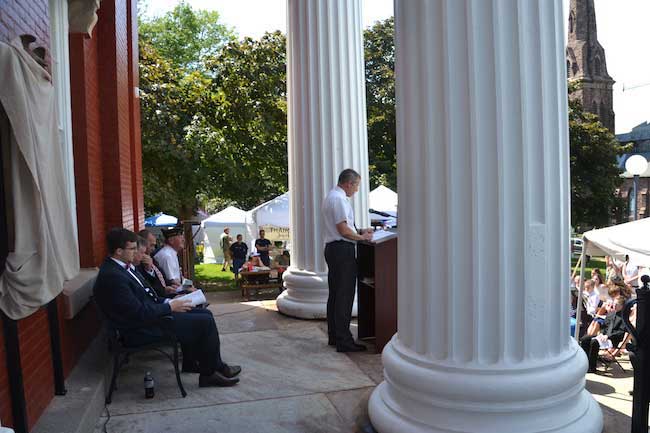
Photo by Tom Rivers: Matt Ballard, seated at left, joins Tim Archer and the community at a rededication ceremony on June 9, 2017 for a bronze tablet listing the names of 24 soldiers from Orleans County who died in World War I. The tablet was rededicated at the County Courthouse. The marker was originally installed at the courthouse but was removed, and later was in possession of the American Legion. The Legion in Albion sold its post building on Main Street to Community Action, and relocated to the former Scottish Pines golf course on Gaines Basin Road. The Legion wanted to find a proper home for the memorial tablet, and reached out to Archer. His seventh grade students were doing research on local soldiers involved in World War I. The memorial tablet had been in storage.
Some of the other projects Ballard has helped Archer’s students with include:
• Research and design for an interpretive panel by the Erie Canal and the waterway’s impact on Albion that was unveiled last year.
• Assisted with last year’s Arbor Day ceremony at Mount Albion.
• Assisted with rededication of a World War I memorial, which was rededicated in June 2017 at the County Courthouse. The bronze marker lists the names of 24 local residents from the school district (towns of Albion, Barre, Carlton and Gaines) who died in World War I.
• Assisted with historical marker for local soldier who died at Gettysburg. On Oct. 8, 2016, the historical marker was unveiled for Herbert Charles Taylor, the only Orleans County resident believed to have been killed in the Battle at Gettysburg. That marker is at Hillside Cemetery in Holley.
• Helped Albion students dedicate a new marker at the Civil War section of historic Mount Albion Cemetery, with the marker dedicated on May 26, 2016. Ballard helped students research local Civil War soldiers.
• Worked with students to secure a proper cemetery marker for one Civil War veteran at the old St. Joseph’s Cemetery in Albion. A new headstone was unveiled on April 30, 2016 for John Frost, a principal musician (chief bugler) for the 33rd New York Infantry and also the 3rd Brigade, 2nd Division of 6th Corps. Frost was buried in St. Joseph’s Cemetery on Brown Road in 1915. He finally received a marker 101 years after his death.
Frost raised five children in Orleans County and sold coal for a living. In 2015, the Holy Family Parish was going through records at the cemetery and realized that John Frost never had a headstone. Ballard, a member of the parish and also the Knights of Columbus, shared the story with Archer, who then told his students about Frost. The students wanted Frost to have a headstone.
By Tom Rivers, Editor Posted 1 April 2019 at 4:24 pm
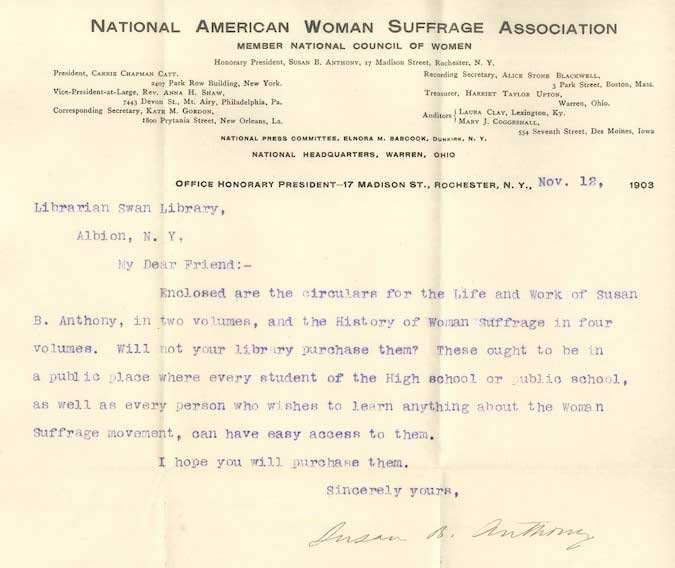
ALBION – Hoag Library found a letter today in the files of its local history room that was written to the former Swan Library from Susan B. Anthony, the women’s rights activist who was a pivotal leader for women’s suffrage.
The Nov. 12, 1903 letter from Anthony encourages Swan Library in Albion to buy four volumes of the History of Woman Suffrage and also two volumes about the Life and Work of Susan B. Anthony.
The History of Woman Suffrage would later include six volumes from 1881 to 1922 and includes more than 5,700 pages about the women’s suffrage movement.
The first two volumes of the Life and Work of Susan B. Anthony were published in 1898 and were written by journalist Ida Husted Harper. She would write a third in 1908, after Anthony’s death.
Dee Robinson, a reference librarian at Hoag, was looking through the files in the local history today when she found the letter from Anthony.
The typed letter to “Librarian Swan Library” says the following:
My Dear Friend : —
Enclosed are the circulars for the Life and Work of Susan B. Anthony, in two volumes, and the History of Woman Suffrage in four volumes. Will not your library purchase them? These ought to be in a public place where every student of the High school or public school, as well as every person who wishes to learn anything about the Woman Suffrage movement, can have easy access to them.
I hope you will purchase them.
Sincerely yours,
(signed) Susan B. Anthony
The library last year hired two new librarians and that is freeing up Robinson to search through the old files in the history room, said Betty Sue Miller, the library’s director.
Robinson has also found an original program from the dedication of Swan Library, which opened in 1900. She also found an advertisement for a play from 1873 where community members performed Dickens’ plays to raise money for a library.
“We’re digging through the archives,” Miller said this afternoon. “Who knows what else we’ll find.”
Robinson is checking to see if the books in Anthony’s letter are still in the library’s possession. Miller said she would like to create a timeline display about the library’s history in Albion, and include a copy of the letter from Anthony. The original will be kept in a secure spot.
Anthony signed the letter when she was 83 and serving as the honorary president of the National American Woman Suffrage Association. Anthony had an office at 17 Madison St., Rochester.
She would die at age 86 on March 13, 1906. She was a leader at age 28 when a group of women held a convention at Seneca Falls in 1848, the first Women’s Rights Convention in the United States. It began the Suffrage movement and Anthony devoted her life to the cause.
She didn’t live to see women get the right to vote. That right was secured in 1920 with the passage of the 19th Amendment.
By Tom Rivers, Editor Posted 1 April 2019 at 2:40 pm
Provided photo
ALBION – The New York State Office of Temporary and Disability Assistance has recognized Orleans County’s Job Development Agency and the Department of Social Services for the county’s success in transitioning people from public assistance to securing employment. The county was honored for its success from 2015 to 2018.
Pictured form left at last week’s Orleans County Legislature meeting include, from left: Fred Miller, county legislator and chairman of the Economic Assistance & Opportunity Committee; Tom Kuryla, DSS commissioner; Darcell McDonald, Temporary Assistance Specialist 1 in Employment & Income Support Programs, NYS Office of Temporary and Disability Assistance; Kelly Kiebala, director of the Job Development Agency in Orleans County; and Lauren Kirby, Workforce Coordinator in the OC Job Development Agency.
Health Education Team for Genesee & Orleans Counties
The first week of April is National Public Health Week, a week set aside showing us how we can choose healthier living. National Public Health Week started in April of 1995 by the American Public Health Association with a focus on Public Health prevention topics. This years’ theme is, “Creating the Healthiest Nation: For science. For action. For Health.”
The topics for each day are:
• Monday, April 1st – Healthy Communities: People’s health, longevity and well-being are connected to their communities. Americans face many issues in their community such as being exposed to air pollution, lead, and even unsafe places to walk. Working with transportation planners to create safe walking and biking paths and organizing clinics for vaccines such as flu shots are all steps that can be taken to benefit people in the community and prevent preventable deaths. By making health a priority in policymaking we can help make a difference in communities.
• Tuesday, April 2nd – Violence Prevention: Violence is a significant public health problem in the United States, whether it is gun-related, rape, domestic abuse, suicide, or even child abuse. As public health professionals, it is part of our job to prevent acts of violence. This can be done through urging policy makers to inforce stricter gun laws, working with local colleges to help victims of sexual violence, and enforcing home-visits to prevent child maltreatment. It is important to advocate community-driven solutions that target the source of where the violence is coming from that do not punish the community as a whole.
• Wednesday, April 3rd – Rural Health: Americans who live in rural communities have an increased risk of death from heart disease, cancer, unintentional injury, stroke, and chronic lower respiratory disease. There has also been a higher rate of suicide and opioid overdoses shown in rural communities. To improve rural community’s health it is important that we focus on social determinants that negatively impact health. By offering telemedicine, increasing job training opportunities and helping children achieve success academically; we can help improve the health of those living in rural populations.
• Thursday, April 4th – Technology and Public Health: Technology can be a powerful public health tool. It can be used to help educate and advocate communities, can help practitioners swap their best practices, can be used for GIS mapping, and can even be used as a text line to find out information about certain health topics. It is important that public health funding levels continue to be supported to allow workers to have access to the latest technology.
• Friday, April 5th – Climate Change: Climate change is seen as one of the greatest threats to public health. It can lead to natural disasters, impact food security, water and air quality, and even increase the risk of vector-borne diseases. Climate change is a real issue that has already begun to occur. Supporting policies that reduce greenhouse gas emissions, carpooling, and steering toward renewable, clean energies instead of fossil fuels can help make a difference in climate change and our health.
• Saturday and Sunday, April 6th & 7th – Global Health: America’s health and the world’s health are fundamentally connected. Consider that during the H1N1 flu pandemic, the virus quickly traveled around the world and a global effort was required to track its movements and eventually contain the disease. Across the world, communities still struggle with preventable and often-neglected diseases. The World Health Organization’s top 10 threats to global health include: pandemic flu, cholera, violent conflict, malaria, malnutrition and natural disasters.
Public Health covers a wide variety of topic areas. According to the WHO, public health refers to all organized measures (whether public or private) to prevent disease, promote health, and prolong life among the population as a whole. Its activities aim to provide conditions in which people can be healthy and focus on entire populations, not on individual patients or diseases. It is important to remember that most of public health is prevention!
“As you can see, public health isn’t just about being physically healthy,” stated Paul Pettit, Genesee and Orleans County Public Health Director. “It includes the health of the whole body and mind, as well as community resiliency, and the safety of the environment we live, work and play in. The Health Departments’ are moving into the role of Chief Health Strategists, we want to embrace and encourage our communities to work with us to create new and innovative ways to improve health, so please reach out.”
The benefits of prevention are undeniable. For example, public health is credited with adding 25 years to life expectancy of people in the United States. “Promoting public health in community development, local businesses and through community events will help us move toward being the healthiest counties in New York State,” stated Dr. Gregory Collins, Commissioner of Wyoming County Public Health.
What can you do throughout the year to encourage better health in your home, neighborhood, work place and county?
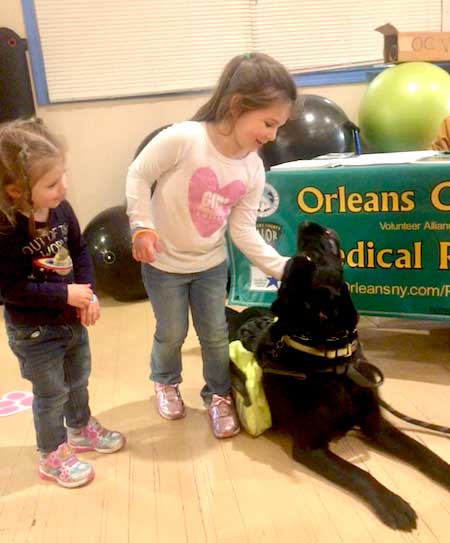
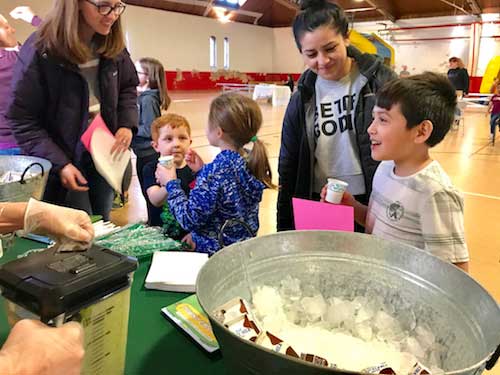
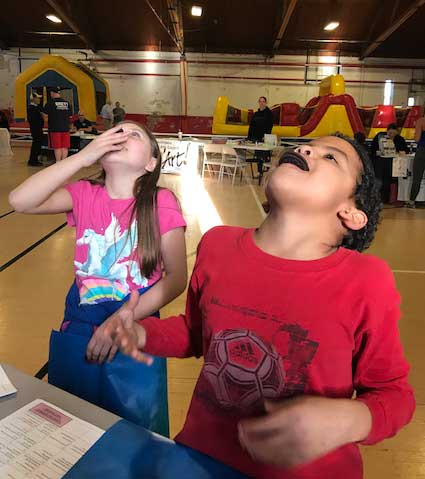
MEDINA – The Orleans County YMCA on Friday evening welcomed 125 children to the Y on Pearl Street in Medina for Healthy Kids Day.
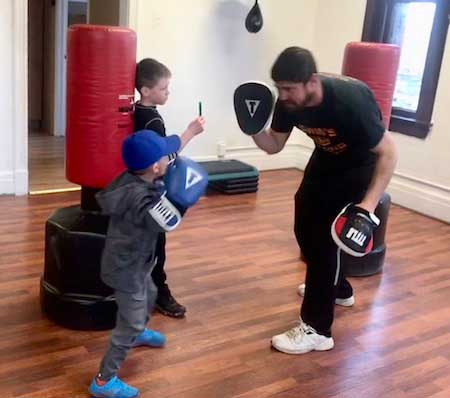
The annual Healthy Kids Day event at the Orleans County YMCA was popular among families and partnering agencies. The event grew this year in providing more activities and expanding the event outside of the gymnasium into the upper level of the facility where the Rock Wall was open, along with showcasing the new Fitness On Demand room and instructional boxing demonstrations with Theo Irwin, said Greg Reed, the Y executive director.
The gymnasium was packed with activities and explorative information for youth and parents to participate in as they filled in their HKD Bingo Card.
Many of the activities were orchestrated and facilitated by these organizations: Orleans United DFC Coalition, Orleans Community Health, Fidelis Care, Genesee & Orleans County Health Departments, GO Art!, Lee-Whedon Memorial Library, Community Action of Orleans & Genesee/CCR&R, Cornell Cooperative Extension of Orleans County, NY State of Health, Hoag Library, Farm Credit East, Medina LOYALS Football Club, and Medina Lions Club.
To top it all off, kids turned in their bingo card at the end of the night for a healthy snack to enjoy on the way home. The Orleans County YMCA can’t wait to host this event again next year as it continues to grow, so be ready next March to bring your family to Healthy Kids Day 2020, Red said.
Theo Irwin provides some boxing tips to youngsters.
By Tom Rivers, Editor Posted 1 April 2019 at 11:56 am
The newly adopted state budget boosts funding for about 700 school districts across the state by about $1 billon to $27.9 billion total, out of an overall state budget of $175.5 billion.
The five school districts in Orleans County will collectively see their aid increase by $4,218,481 from $90,187,018 to $94,405,499. Of that funding, Foundation Aid for the five districts is up from $62,989,454 to $64,321,594.
Here is a breakdown of the aid for the five districts:
District
2018-19
2019-20
Change
Albion
$26,284,822
$26,900,100
$615,278 (2.3%)
Holley
$17,143,587
$17,461,046
$317,459 (1.9%)
Kendall
$12,358,316
$12,704,072
$345,756 (2.8%)
Lyndonville
$9,415,349
$9,128,047
$-287,302 (-3.1%)
Medina
$24,984,944
$28,212,234
$3,227,290 (12.92%)
Total for all 5
$90,187,018
$94,405,499
$4,218,481 (4.7 %)
Source: NYS Division of the Budget
Editor’s note: Lyndonville’s overall aid was down mainly because of a drop in building aid, from $1,612,890 to $837,971. Without the building aid, Lyndonville’s school funding was up by $487,617 or 6.3 percent.
Medina, which is working on a $34 million capital project, is seeing a big increase in overall aid partly because of the building aid increasing from $2,070,276 to $4,207,671. Not including building aid, Medina is slated to get a $1,089,895 increase in state aid or by 4.8 percent.
The New York State School Boards Association gave a favorable reaction to the state funding for schools.
Here is a statement from Timothy G. Kremer, NYSSBA executive director:
“The new state budget agreement includes a number of victories for school districts and students in New York’s public schools.
“First, while the $618 million increase in foundation aid is below our request, it is nearly double the amount proposed by the governor and represents a strong investment in our public schools.
“Equally important, the budget preserves local school board authority to allocate funding within school district buildings.
“In addition, lawmakers enacted significant policy changes and mandate relief, enacting several longstanding school board priorities. These include authorizing school districts to create a TRS reserve fund and increasing the BOCES District Superintendent salary cap. These changes provide school board members with financial management tools to stabilize fluctuating pension costs from year to year, and recruit top leadership talent to manage our regional BOCES throughout the state.
“We are disappointed that the tax cap was made permanent with no changes, but will continue to work with lawmakers to make common-sense changes to the cap. We applaud lawmakers for rejecting proposals to consolidate expense-based aids and reduce building aid reimbursement.
“Finally, students will benefit from a NYSSBA-supported initiative, included in the budget, that allows community colleges and high schools to provide dual enrollment programs that enable students to receive college credit at little or no cost.”
The Alliance for Quality Education, however, was disappointed in the aid for schools.
Jasmine Gripper, legislative director for the Alliance, said the $1 billion in total increase in school aid is far below the New York State Board of Regents recommendation of $2.1 billion increase, including $1.6 in Foundation Aid.
New York is number two in the nation in inequitable school funding and the funding gap between rich and poor schools has grown by 25 percent under Governor Cuomo. This budget will make educational inequity continue to grow, Gripper said.
Here is the statement from Gripper:
“This year’s budget is one of dashed hopes and deferred dreams. Foundation Aid is the core funding for the education of our children. It is the money that gets into the classroom. With a $175.5 billion budget, the need for $1.2 billion in new Foundation Aid seems like a drop in the bucket to educate and invest in the future of our state. This time we cannot blame the Republicans. The reality is that the triple blue state leadership, took the route of protecting millionaires over transforming educational opportunity in the state.
“This budget fails to address the needs of students and their families. The $620 million increase of Foundation Aid is sorely inadequate, one that will not even make a dent in the systemic racism in education funding, but instead further locks it into place. This means more overcrowded classrooms, out of date technology, a continued crisis shortage of social workers and school counselors and grossly inadequate resources for student learning.
“There is no question that Andrew Cuomo is the biggest obstacle to providing every child in this state with a ‘sound, basic education.’ Once again he has planted himself firmly in front of the schoolhouse door to block the resources needed to educate every child, in particular Black, Brown, immigrant and economically disadvantaged children. Governor Cuomo continues to choose to be a champion of the millionaires and one percent at the expense of our children’s education.
“The Legislature proposed one house budgets that would have met students’ needs, but in the enacted budget they negotiated a mere $50 million increase over the Cuomo proposal. Students need a more forceful commitment to educational justice from the Assembly and the Senate.”
LYNDONVILLE – March is recognized nationally as “Music In Our Schools” month. In recognition of this, the Lyndonville Music Department hosts an annual “Prism” concert showcasing its top musical talent through a variety of small ensemble performances. Only select musicians are invited to participate from grades 5-12. The concert is fast paced, with one performance beginning as soon as another ends, featuring both instrumental and vocal groups. It is normally a solid 1 ½ to 2 hours of fantastic music with no interruption, however last Tuesday night was an exception.
Tamara Huzair, a senior at LCS who intends to pursue a career in music, took to the microphone half way through the concert.
“As a special part of tonight’s concert, we are unveiling the new baby grand piano you see before you,” Tamara told the audience.
With joint financial support from the Lyndonville Music Boosters, Lyndonville Central School and the Lyndonville Area Foundation, the funds were secured for this instrument. This piano truly represents all the hard work, dedication and collaboration from every facet of the community that helps create the wonderful music program we have here, Tamara said.
She then introduced music teachers John Bailey, Jennifer Trupo and Kristina Best who performed a six-handed arrangement of Aram Khachaturian’s “Sabre Dance.” Tamara joked that the teachers wanted to “show you as many keys as possible at the same time.” Lyndonville Music Boosters president Michelle Dillenbeck said, “the performance was the perfect way to christen the new piano… the audience loved it.”
Click here to see a video of the teachers playing “Sabre Dance.”
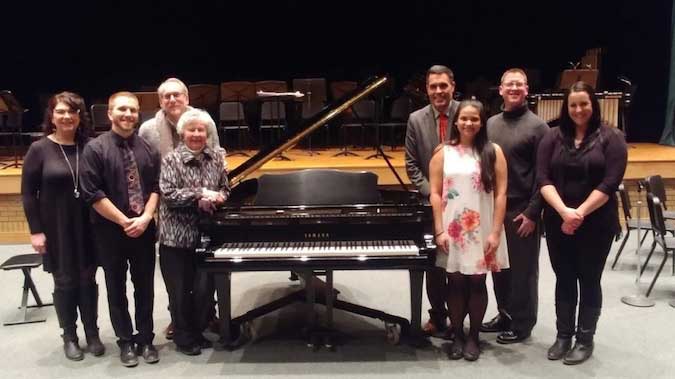
Pictured with the new piano include from left: Jennifer Neroni-Trupo, vocal music instructor; John Bailey, elementary instrumental instructor; Darren Wilson and Rita Wolfe, President and Vice President of the Lyndonville Area Foundation; Jason Smith, Superintendent of Lyndonville Central School; Tamara Huzair, senior music student; Patrick Whipple, Vice President of the Lyndonville Music Boosters; and Kristina Best, high school instrumental instructor.
Dillenbeck, while helping to set up for a Christmas concert last December, joked with elementary instrumental instructor John Bailey that the piano currently used in performances was showing significant signs of wear and age.
Darren Wilson, president of the Lyndonville Area Foundation who attended the concert that night, also mentioned that the piano had perhaps reached the end of its useful life. Ironically, late that evening, after the concert had concluded, vocal music instructor Jennifer Trupo noticed an important post on Facebook.
“Tom Miller of Miller Piano Service posted some photos on Facebook of this beautiful Yamaha piano for a great price,” Trupo said. “There was immediately interest from other potential buyers, so I knew we had to jump at it right away before it was purchased by somebody else!” The next day, Music Boosters officers set out to acquire the instrument. They immediately approved a non-refundable down payment, and sought to partner with other organizations to secure full funding before the deadline to purchase passed. They applied for a grant from the Lyndonville Area Foundation, and asked for a matching donation from the district. Thankfully, both the district and Foundation jumped at the opportunity to be involved, and the piano was purchased with equal contributions from all.
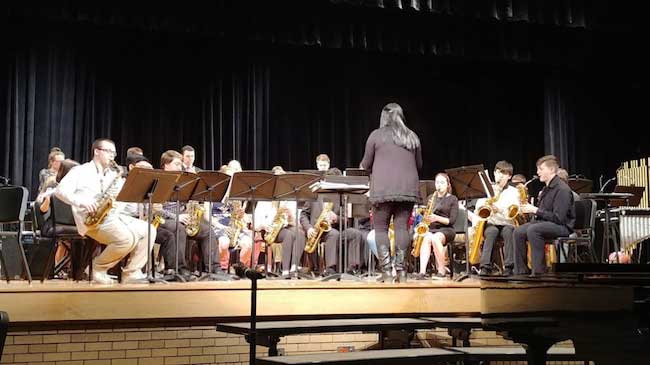
The Lyndonville high school jazz band, directed by Kristina Best, was the final performance of this year’s “Music In Our Schools” PRISM concert which involved vocal and instrumental music students in grades 5-12.
“The District was honored to partner with the Lyndonville Music Boosters and Lyndonville Area Foundation to provide this beautiful piano to enhance our already outstanding music program,” said Superintendent Jason Smith. “Every year our concerts are a major event in the community, and this piano will be enjoyed and appreciated for generations!”
Wilson expressed similar sentiments. “The Foundation recognizes the central role that Lyndonville Central School occupies within the community. The Foundation also recognizes that, like many other communities, overall funding for arts and music programs has been diminishing, requiring greater outside support for their continuation. As the school and the Music Boosters stepped up to provide a major portion of the purchase price of the new piano – a much-needed, long overdue but expensive asset to the school’s music department – the Foundation’s Board of Directors were unanimous in their decision to contribute the remaining amount needed for the piano’s purchase. The piano will be a centerpiece for the music department for many years to come. The instrument’s longevity was a contributing factor in the Foundation’s decision to assist in its funding.”
All three organizations hope that the procurement of this beautiful piano will increase the quality of events they host in the future. The Boosters and district are excited to show off the piano for the whole county next year as they host one of the two high school All-County music festivals scheduled.
By Tom Rivers, Editor Posted 1 April 2019 at 8:13 am
The state budget was approved this morning, just after the midnight deadline. Local state legislators share their concerns with the $175 billion spending plan.
Ortt: ‘The cost of living and working in our state just increased dramatically’
Rob Ortt
A statement from Senator Rob Ortt, R-North Tonawanda:
“Budgets are about priorities, and this year, Democrats have chosen to prioritize free college for illegal aliens, to roll back charges against serious criminals, to provide corporate subsidies for Hollywood billionaires, and to provide political welfare through taxpayer-funded campaigns.
“If your only crime is being a farmer, gun owner, business owner or a regular, hard-working New Yorker, Democrats have demonstrated that you are not a priority. We’re now looking at over a billion dollars in new taxes and fees, from pain meds for cancer patients to grocery bags, internet purchases for everyday New Yorkers or electric bills for a local mom and pop small business – the cost of living and working in our state just increased dramatically. Apparently, the only crime this new majority finds unforgivable is being a law-abiding, taxpayer.”
Hawley: Downstate dominates in new budget
Steve Hawley
“As usual, the state budget was passed in the middle of the night, rushed through the Legislature with little time for public input or discussion and ridden with contentious policy proposals that should be debated separate from a spending plan.
“I am concerned that the governor can now close up to three state prisons within 90 days and state leaders are content with ending bail for some felonies, putting the public at risk and sending the message that those who have broken the law should be given more and more leeway.
“While we did secure funding for key bridge repair and infrastructure projects I am concerned at the growing disparity between upstate and downstate infrastructure spending with the Metropolitan Transportation Authority (MTA) consuming billions of tax dollars per year with little oversight or accountability.
“I have been a champion of easing the burden on local governments for years and tonight our conference offered a budget amendment to fully restore Aid and Incentives to Municipalities (AIM) funding – this was shamelessly defeated by the Assembly Majority. Gov. Cuomo has drastically changed the AIM formula, forcing counties to fend for themselves instead of offering state help to bolster local services.
“I am pleased to see our direct-care professionals receive funding for retention and salary increases but more needs to be done to protect those who protect our most vulnerable New Yorkers. Our conference has advocated for a living wage for these dedicated men and women for years and will continue championing their cause until a true living wage is achieved.
“As session continues I will keep banging the drum for tax relief, an end to mandated Albany spending passed down to homeowners, reforming our charitable gaming laws and fighting the pro-criminal, anti-Second Amendment policies pushed by Gov. Cuomo.”
Norris: New budget ‘is an attack on upstate’
Mike Norris
A statement from Assemblyman Mike Norris, R-Lockport
“This downstate dominated one-party designed budget is an attack on upstate New York. With one million New Yorkers having already fled our state’s ‘tax and spend’ culture since 2010, we needed this budget to do something to reduce the high taxes and excessive fees and regulations that continue to drive people and jobs away.
“Instead, the downstate one-party majorities pushed through the most expensive spending plan in our state’s history that not only raised taxes by more than $4 billion, including changes to the long-proven STAR program, but also raises state debt to $57 billion, which is the second highest in the nation – an action that will cripple future generations of New Yorkers.
“In the scope of their massive spending plan, the priorities of Western New Yorkers were left out. Their downstate-driven budget cuts construction aid for libraries, does nothing to support volunteer firefighters, outrageously shifts how local Aid to Municipalities is funded, makes it harder for police to do their jobs, imposes many new unfunded mandates on local governments and businesses, gives away taxpayers’ hard-earned money as free tuition for illegal immigrants while ignoring the needs of citizens who are college-bound, strips funding from the Extreme Winter Recovery infrastructure program, and gives nothing more to improve the crumbling bridges and roads north of Long Island.
“Yet, the budget makes dangerous changes that empower criminals. Western New Yorkers and I both know that this is clearly the wrong direction for our state, and I voted ‘no’ on the entire budget.”
ALBION – Heritage Wind has posted the information from its February 28 Community Forum at the Carl I. Bergerson Middle School Auditorium.
The PowerPoint, Video, Transcript and Full Question and Answer Document can be found at at the Heritage Wind Power website.
The information session introduced further information on Heritage Wind’s proposed project in the Town of Barre in Orleans County. The program was conducted by a professional moderator and included a panel of professionals comprising Apex Clean Energy development team members and experts speaking on the topics of wildlife, sound, infrastructure, shadow flicker, and the permitting process.
A Q&A session was led by the moderator after the panel presentation. Audience members had the opportunity to submit their questions before and during the program for the moderator to pose to panel members about the project. Questions that went unanswered due to time constraints are part of what has been posted.
“Our intent with the forum and this extensive follow-up is to be as transparent as possible and to give residents and stakeholders the facts and data they need,” said Apex Director of Northeast Development Neil Habig. “We look forward to continued outreach to the community of Barre.”